What Makes Chinese Names a Window Into Culture and Identity
Imagine meeting two people both introduced as "Li Wei." In English, you'd assume they share the same name. In Chinese, those two syllables could be written with entirely different characters, one meaning "beautiful greatness" and another meaning "standing guard." The tones shift, the brushstrokes change, and suddenly you're looking at two completely different identities compressed into what sounds like the same label to an untrained ear.
This is the fundamental difference between Chinese names and most Western naming traditions. In English, choosing a name is largely a one-dimensional exercise: does it sound good? Parents might consider family tradition or cultural origin, but the primary filter is phonetic appeal. A Chinese name definition, by contrast, demands that every character satisfy multiple dimensions at once: sound, visual form, literary meaning, and even elemental balance rooted in cosmology.
Why Chinese Names Are More Than Labels
So what is a Chinese name, really? It's a compressed cultural text. In just two or three characters, a name encodes family lineage, philosophical values, historical context, and parental hopes for a child's future. Chinese families often spend weeks or even months deliberating over a single name because each character carries its own pronunciation, semantic weight, and cultural associations. The character Ming (明) evokes brightness and intelligence. Hui (慧) suggests deep wisdom. Xue (雪) conjures purity and stillness. None of these choices are accidental.
Unlike naming systems where popularity drives selection, the meaning of Chinese names operates through intentional layering. Parents aren't just picking something that sounds pleasant. They're composing a phrase, sometimes drawing from classical poetry like the Book of Songs or Tang dynasty verse, to give their child a name that resonates across generations.
Names as Cultural Texts Encoding Identity
Every character in a Chinese name is chosen with philosophical and familial intentionality. A name that succeeds on sound but fails on meaning, or balances elements but looks clumsy in calligraphy, is considered incomplete.
This multi-dimensional approach means that names and characters are inseparable in Chinese culture. You can't fully understand a person's name without seeing it written, because the visual form of the characters carries as much information as the spoken sound. The same syllable "mei" pronounced in the third tone means "beautiful" (美), while in the second tone it means "plum blossom" (梅). Both are common in Chinese names and meanings, yet they paint entirely different portraits of the person who carries them.
The cultural significance of Chinese names extends far beyond personal identity. Names in Chinese and meanings reflect Confucian ethics, Daoist cosmology, clan history, gender expectations, and even the political era in which a person was born. A name given during the Cultural Revolution carries different ideological weight than one chosen during the economic reform period. A name selected after consulting a fortune teller's birth chart reveals a family's spiritual framework.
What follows is an exploration of this rich system from the ground up: how Chinese names are structured, the philosophical traditions that guide character selection, the historical forces that shaped naming trends across dynasties, and how these conventions continue to evolve in a globalized world. Each layer reveals something deeper about how identity, family, and culture converge in the simple act of giving a child a name.
How Chinese Names Are Structured and Why Order Matters
When you hear a Chinese name like Yao Ming, which part is the family name? If you guessed "Yao," you're right, but most English speakers instinctively assume it's "Ming" because Western conventions place the given name first. This single point of confusion reveals something fundamental about how Chinese names work: the structure itself carries cultural meaning.
Surname First and What That Order Reveals
Chinese name structure follows a clear formula: surname (姓 xing) comes first, followed by the given name (名 ming). In English, you'd say "John Smith." In Chinese, it's "Smith John." This isn't an arbitrary formatting choice. The order of Chinese names reflects a Confucian worldview where collective identity takes precedence over individual identity. By placing the family name first, the system signals that you belong to a lineage before you exist as a person.
Think of it this way. When Chinese names surname first, they're making a philosophical statement: family, clan, and ancestral heritage define the foundation of who you are. Your given name, the part your parents carefully crafted, comes second because personal identity is built on top of that communal belonging, not separate from it.
This creates a common source of confusion in cross-cultural settings. When someone introduces themselves as "Zhang Wei," non-Chinese speakers often treat "Zhang" as the given name and "Wei" as the surname. Understanding the distinction between chinese names first last conventions and Western ones is essential for anyone navigating multicultural environments.
One Character or Two in the Given Name
How are Chinese names structured in terms of length? A typical Chinese name contains two or three characters total. The surname is almost always a single character, while the given name is either one or two characters. This means most names are either two syllables (one-character surname plus one-character given name) or three syllables (one-character surname plus two-character given name).
The 3 letter Chinese name, meaning three characters total, is the most common format in modern China. Two-character given names allow parents to combine meanings in ways a single character cannot. For example, pairing 美 (mei, beautiful) with 华 (hua, splendid) creates 美华, a compound meaning that neither character achieves alone.
| Full Name | Surname | Given Name | Meaning of Components |
|---|---|---|---|
| 姚明 (Yao Ming) | 姚 (Yao) | 明 (Ming) | Surname: ancient clan name; Given: bright, brilliant |
| 李美华 (Li Meihua) | 李 (Li) | 美华 (Meihua) | Surname: plum; Given: beautiful splendor |
| 王菲 (Wang Fei) | 王 (Wang) | 菲 (Fei) | Surname: king; Given: fragrant, luxuriant |
| 毛泽东 (Mao Zedong) | 毛 (Mao) | 泽东 (Zedong) | Surname: hair/fur; Given: benefiting the East |
| 邓小平 (Deng Xiaoping) | 邓 (Deng) | 小平 (Xiaoping) | Surname: ancient state; Given: small and peaceful |
Notice how each name, regardless of whether the given name is one character or two, remains compact. Chinese name order keeps things concise by design. There are no middle names in the Western sense, no suffixes like "Jr." or "III." Every syllable carries semantic weight, and nothing is filler. This economy of expression is part of why choosing a name becomes such a deliberate, high-stakes process for Chinese families, one that often involves balancing sound, meaning, and deeper philosophical frameworks simultaneously.
The Philosophical and Spiritual Framework Behind Choosing a Name
That deliberate balancing act, weighing sound against meaning against visual form, doesn't happen in a vacuum. It draws from a philosophical ecosystem that has shaped Chinese thought for over two millennia. When parents select naming chinese characters, they're working within frameworks rooted in Confucianism, Daoism, and classical cosmology. Understanding chinese name meaning requires understanding these deeper systems, because the characters themselves are chosen to align a child with moral ideals and cosmic forces.
Confucian Virtues Encoded in Characters
Confucian philosophy treats names as a child's first moral lesson. Rather than simply labeling a person, the name establishes an aspiration, a virtue the bearer should spend a lifetime cultivating. This is why characters like 仁 (ren, benevolence), 德 (de, virtue), 信 (xin, trustworthiness), and 智 (zhi, wisdom) appear so frequently across generations of Chinese names.
Consider the character 德 (de). It contains the radical for "walk" or "go," suggesting that virtue is a path rather than a fixed state. Parents who choose this character aren't declaring their child virtuous. They're setting a direction. Similarly, 诚 (cheng, sincerity) combines "speech" with "complete," encoding the idea that one's words should be whole reflections of one's thoughts. Each character carries centuries of philosophical weight, and the chinese meaning of names becomes inseparable from the ethical traditions that produced them.
Filial piety (孝 xiao), righteousness (义 yi), propriety (礼 li), and diligence (勤 qin) round out the most common virtue-based characters. The choice among them often reflects what a family values most: scholarly achievement, moral integrity, or practical perseverance.
Wuxing and Birth Charts in Name Selection
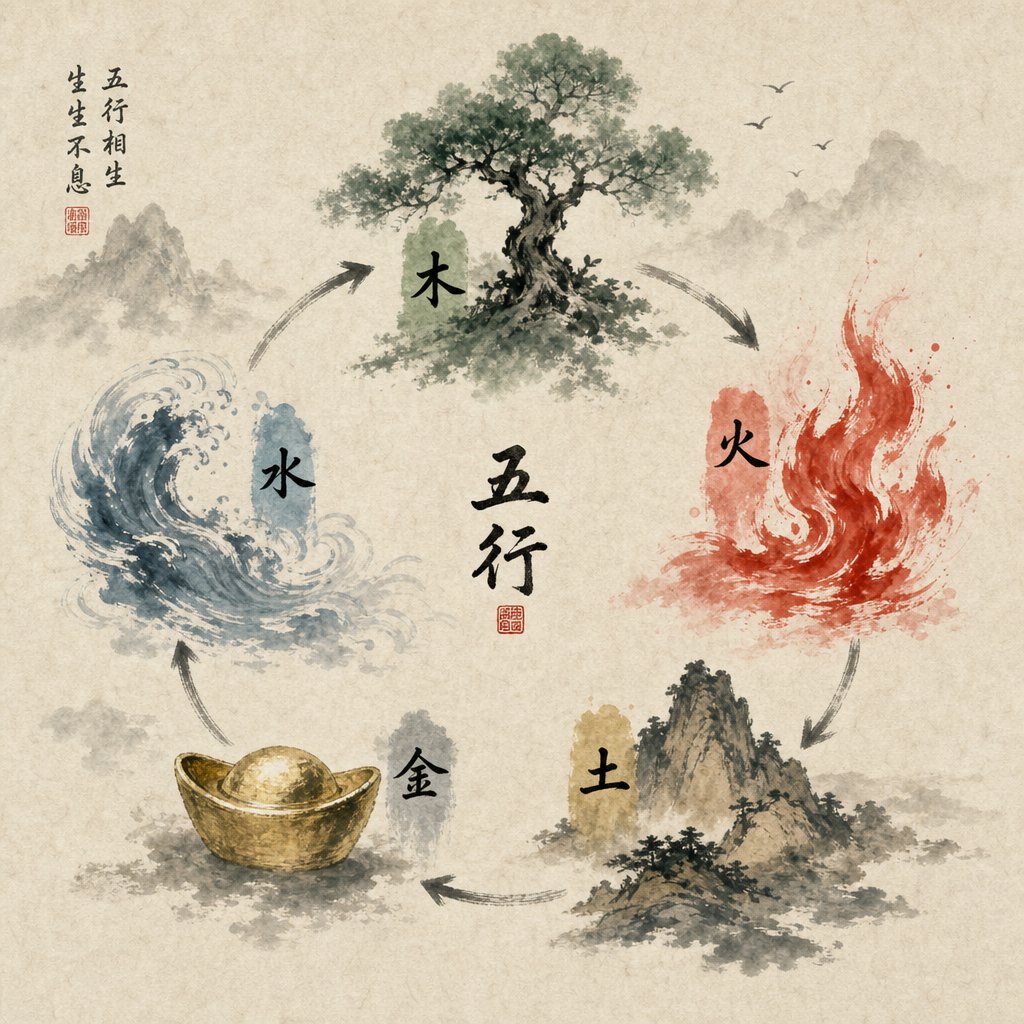
Beyond moral philosophy, chinese name interpretation often involves cosmological calculation. The Five Elements theory (Wuxing) describes five phases of energy that cycle through nature and human life. A child's birth date and time generate a BaZi (八字) chart mapping which elements are dominant, which are weak, and which are entirely absent. The name then compensates for imbalances.
Here's how the five elements connect to specific characters through their radicals:
- Wood (木 mu): Associated with growth and vitality. Characters include 林 (lin, forest), 芳 (fang, fragrant), and 桐 (tong, paulownia tree).
- Fire (火 huo): Associated with passion and illumination. Characters include 炎 (yan, flame), 煜 (yu, radiant), and 照 (zhao, illuminate).
- Earth (土 tu): Associated with stability and nurturing. Characters include 坤 (kun, earth/feminine), 岳 (yue, peak), and 城 (cheng, city).
- Metal (金 jin): Associated with clarity and discipline. Characters include 鑫 (xin, prosperity), 铭 (ming, inscription), and 锐 (rui, sharp).
- Water (水 shui): Associated with wisdom and adaptability. Characters include 涵 (han, contain), 泽 (ze, marsh/beneficence), and 润 (run, moist).
These elements interact through generating and controlling cycles. Wood feeds Fire, Fire creates Earth, Earth bears Metal, Metal collects Water, and Water nourishes Wood. If a child's chart shows a deficiency in Metal, for instance, a naming specialist might select 铭 (ming), meaning "to engrave," which carries strong Metal energy and suggests a person who leaves a lasting mark. The china name meaning embedded in such a choice isn't arbitrary. It's architecturally designed to restore elemental harmony.
Balancing Yin-Yang Through Stroke Counts
The philosophical layering doesn't stop at elemental balance. Stroke count numerology adds another dimension to mandarin name meaning. Every Chinese character requires a specific number of brushstrokes to write. Characters with an even number of strokes are classified as Yin, while those with an odd number are Yang.
A well-constructed name follows specific Yin-Yang patterns across its characters. Acceptable combinations include Yang-Yang-Yin, Yin-Yin-Yang, Yang-Yin-Yin, and Yin-Yang-Yang. Beyond the pattern, the total stroke count of the full name should fall within a set of auspicious numbers. This means a character that satisfies meaning, sound, and elemental requirements might still be rejected if it throws off the name's numerological balance.
What emerges from all these layers is a picture of chinese name meanings as something far more engineered than intuitive. A name must satisfy Confucian moral aspiration, elemental composition based on birth timing, stroke-count numerology, and aesthetic harmony in both sound and calligraphy. It's a system where philosophy, cosmology, and art converge in two or three carefully chosen characters, each one carrying the weight of an entire worldview.
These philosophical frameworks didn't develop in isolation from history. The families who applied them belonged to clans, and those clans carried surnames that stretch back thousands of years, connecting living individuals to ancient lineage systems that shaped Chinese society from its earliest dynasties.
Chinese Surnames and What They Reveal About Clan History
Stop a random person on the street in China, and there's roughly a one-in-three chance their surname is Wang, Li, Zhang, Liu, or Chen. Those five chinese last names alone account for more than 433 million people, or 30% of the population. Zoom out slightly, and the picture gets even more striking: nearly 86% of China's 1.37 billion citizens share just 100 surnames. A country with the world's largest population operates with one of the smallest surname pools on Earth.
How did this happen? And what does the dominance of a handful of chinese family names reveal about thousands of years of clan history, migration, and political power?
Why So Few Surnames Dominate a Billion People
The concentration isn't random. It's the result of compounding forces across millennia. China has recorded more than 20,000 surnames throughout its history, yet only about 6,000 remain in use today. Several mechanisms drove this consolidation:
First, there's a natural demographic process called the Galton-Watson effect. In patrilineal societies where women traditionally adopt their husband's surname, smaller family lines die out over time if they don't produce enough male descendants. Large, resource-rich clans had more children, spreading their surname across wider territories. A 1992 study by Stanford University and the Chinese Academy of Sciences noted that Chinese surnames appeared at least 3,000 years earlier than in Europe or Japan, giving this extinction process far more time to consolidate the pool.
Second, political upheaval played a direct role. Throughout dynastic history, ethnic minorities and nomadic groups adopted Han Chinese surnames, sometimes voluntarily to integrate into society, sometimes under pressure during Sinicization campaigns. People also simplified complex characters by switching to similar-sounding but more common alternatives. Others abandoned surnames believed to bring ill fortune.
Third, the sheer age of the system matters. The first records of a surname in chinese stretch back to the Shang and Zhou dynasties (1600-256 BC), when people wrote on bronze, bamboo, and silk. With over three millennia of generational turnover, rare names had countless opportunities to vanish while dominant ones compounded their reach.
Origins of Chinese Family Names Across Dynasties
The meaning of chinese surnames becomes clearer when you trace where they came from. Chinese surnames didn't emerge from a single source. They fall into distinct origin categories, each reflecting a different facet of ancient social organization:
- Ancestral states and fiefdoms: When ancient kingdoms fell, their people often adopted the state's name as a surname. Chen (陈) derives from the state of Chen during the Zhou Dynasty. Zhao (赵) comes from the state of Zhao.
- Imperial bestowals: Emperors granted surnames to loyal subjects as rewards. The Tang Dynasty's ruling Li family famously bestowed their surname on favored generals and officials, inflating the Li population dramatically.
- Geographic features: Families living near distinctive landmarks adopted those features as identifiers. Yang (杨) means "poplar tree," originating from clans near poplar groves.
- Occupations and roles: Si (司) means "to manage" and likely originated with administrators. Wang (王) means "king" and traces back to descendants of royal courts.
By the Song Dynasty (AD 960-1279), the classic text Baijiaxing (Hundred Family Surnames) had codified 504 surnames into a poem used to teach children to read. The work became so culturally embedded that it gave rise to the expression laobaixing, meaning "one hundred old surnames," which remains the colloquial term for ordinary people.
Here are the most common chinese surnames with their etymological roots:
- Wang (王) - Means "king." Originated from descendants of deposed royal families who preserved their connection to sovereignty through their surname.
- Li (李) - Means "plum tree." Gained massive prominence as the imperial surname of the Tang Dynasty (AD 618-907), when it was also bestowed on loyal subjects.
- Zhang (张) - Means "to stretch" or "to draw a bow." The character combines the bow radical with "long," linking it to legendary archers and military figures.
- Liu (刘) - Most famous as the royal surname of the Han Dynasty (206 BC - AD 220). Millions claim descent from the Han emperors through this lineage.
- Chen (陈) - Derived from the ancient state of Chen. When the state collapsed, its people carried the name forward as a marker of homeland identity.
Each of these chinese last name meanings tells a story of power, geography, or survival. A person surnamed Wang carries an echo of ancient royalty. Someone named Chen preserves the memory of a fallen kingdom. The chinese surname isn't just an identifier; it's a compressed genealogical record linking living individuals to ancestors who may have walked the same land three thousand years ago.
This is why losing a surname carries real emotional weight. When villages in Shandong province were forced to change their ancestral surname "Shan" to the more common "Xian" for digital ID compatibility, over 200 residents lost a direct thread to their heritage. As one villager put it: "Our generation still knows what our original surnames were, but our children have their names changed from an early age, and in a few years they will forget."
Surnames anchored identity within the clan system, but they were only one layer of a much more elaborate naming architecture. In imperial China, a person didn't carry just one name. They moved through a sequence of names tied to life stages, social relationships, and political hierarchy, each governed by strict rules about who could use which name and when.
Historical Naming Systems and the Power of Taboo
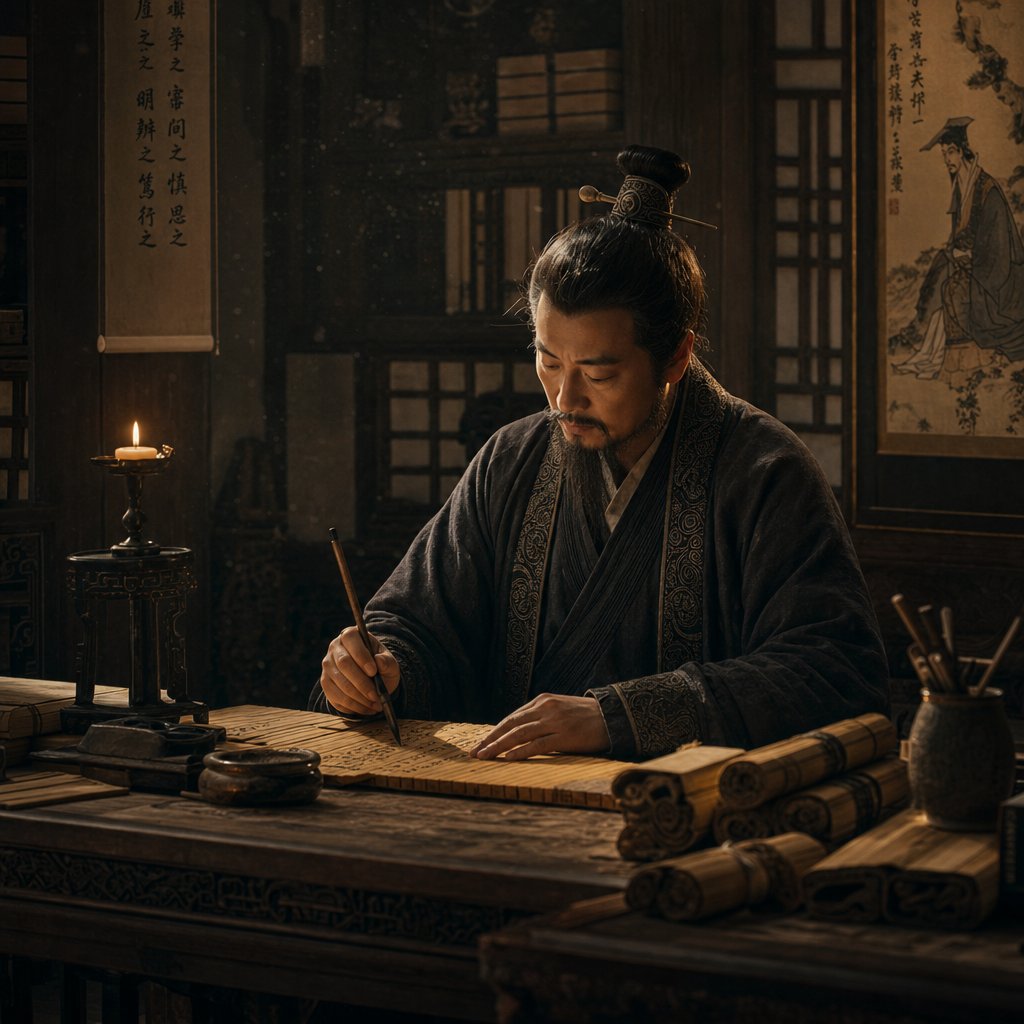
That sequence of names wasn't decorative. It was a social operating system. In imperial China, a person could accumulate three, four, or even five different names across a lifetime, each one unlocked at a specific life stage and governed by strict rules about who was permitted to speak it aloud. Understanding chinese name origins means understanding this layered architecture, because it reveals how traditional chinese names functioned as tools of social regulation, not just personal identification.
Birth Names and Courtesy Names in Social Context
The foundation was the birth name, or ming (名). This was the personal name given in childhood, used by family and close friends. It remained intimate throughout a person's life. Once a young man reached the age of 20 sui and underwent the capping ceremony (guan 冠), he received a courtesy name, or zi (字). Women received theirs at 15 upon the pinning ceremony (ji 笄). From that point forward, using someone's ming directly was considered disrespectful among peers. The courtesy name became the socially appropriate form of address.
Here's where it gets interesting. The ming and the chinese courtesy name were almost always semantically linked. Zhuge Liang (诸葛亮), the legendary Three Kingdoms strategist, had a ming meaning "bright" (亮 liang). His courtesy name was Kongming (孔明), meaning "enlightened opening," a poetic expansion of the same concept. Yue Fei (岳飞), the Song dynasty general, carried a ming meaning "flying" (飞 fei) and a courtesy name Pengju (鹏举), meaning "the great roc rises," amplifying the original image into something grander.
This wasn't coincidence. It was convention. The courtesy name elaborated on the birth name the way a thesis expands on a title. Other patterns existed too. Some families used birth-order markers as the first character of the zi: bo (伯) for the eldest son, zhong (仲) for the second, shu (叔) for the third, and ji (季) for the youngest. Confucius himself, whose ming was Qiu (丘), bore the courtesy name Zhongni (仲尼), the "zhong" signaling his position as second-born.
Beyond the courtesy name sat the hao (号), a freely chosen literary name or style. This was the most personal and creative layer. Scholars, poets, and officials adopted a hao to express their temperament, philosophy, or connection to a place. Zhuge Liang called himself Wolong (卧龙), "Sleeping Dragon." The Song dynasty writer Ouyang Xiu used Zuiweng (醉翁), "Old Drunkard." The poet Su Shi went by Dongpo Jushi (东坡居士), "Scholar of the Eastern Slope." These ancient chinese names weren't assigned. They were composed, acts of self-definition that revealed how a person wished to be remembered.
The system created a social map. Your ming belonged to your parents and closest intimates. Your zi belonged to your peers and formal correspondents. Your hao belonged to the literary world and posterity. Knowing which name to use in which context was itself a marker of education and social fluency. Behind the name chinese tradition placed layers of meaning that regulated relationships as much as they expressed identity.
Naming Taboos and Their Consequences Across Dynasties
If the naming system organized social relationships horizontally among peers, naming taboos (bihu 避讳) enforced hierarchy vertically. The principle was straightforward: you must never speak or write the personal name of the emperor, your living elders, or revered ancestors. The consequences for violations ranged from social humiliation to criminal punishment.
During the Tang and Qing dynasties, violating imperial naming taboos could result in failed examinations, dismissed petitions, altered book titles, and in extreme cases, imprisonment or execution. A single forbidden character in an essay could end a scholar's career.
The mechanics were elaborate. When the Tang dynasty founder Li Yuan (李渊) took the throne, the historian writing the Jinshu (Book of Jin) could not use the character 渊 for anyone else. The Xiongnu chieftain Liu Yuan (刘渊) had to be referred to by his courtesy name, Yuanhai (元海), throughout the entire text. The character itself became radioactive. During the Kangxi Emperor's reign (r. 1661-1722), the book Taixuanjing (太玄经) was renamed Taiyuanjing (太元经) because the emperor's personal name contained the character 玄 (xuan). Scribes even altered the physical form of taboo characters, omitting the final stroke of 玄 to produce a visually distinct variant.
These weren't obscure regulations. They shaped daily life. Students preparing for imperial examinations memorized lists of forbidden characters spanning multiple generations of rulers. Writers restructured sentences to avoid taboo words. The Ming dynasty founder's surname character 朱 was officially written as 硃 in certain contexts to sidestep the prohibition. Even place names and common vocabulary shifted when they collided with an emperor's name.
The chinese name origin of these taboos lies in the Confucian concept of ming fen (名分), the idea that names define social roles and that misusing a name disrupts the moral order. Speaking an emperor's name implied equality with him. Using a father's name casually suggested disrespect for the family hierarchy. The taboo system transformed names into instruments of political and familial control, reinforcing the same collective-over-individual principle visible in the surname-first convention.
This elaborate architecture of birth names, courtesy names, literary names, and taboos governed elite Chinese society for over two thousand years. But naming conventions didn't just mark individual life stages. Within clans, they also marked something broader: generational position. Families developed systems to encode which generation a person belonged to directly into their given name, creating visible threads of lineage that connected cousins, uncles, and distant relatives across vast geographic distances.
Generational Names and Gender Traditions in Chinese Naming
Those visible threads of lineage have a name: zibei (字辈), or generational names. The system works like this: a clan selects a sequence of characters, often arranged into a poem, and assigns one character to each successive generation. Every child born into that generation shares the same character in their given name. Brothers, sisters, and cousins all carry this marker, making it immediately obvious where someone sits in the family line just by reading their name.
How Generational Names Mark Family Lineage
Imagine a family with the surname Li (李). Their generation poem assigns the characters 义 (Yi, righteousness), 礼 (Li, propriety), and 智 (Zhi, wisdom) to three consecutive generations. The grandfather's generation all share 义 as their generation character. His children all carry 礼. His grandchildren all carry 智. The generation character most often appears as the first character of the given name, though some clans place it second. The remaining character is the personal one, unique to each individual.
Because each clan's poem is unique, even a handful of generation characters can act like a fingerprint, helping identify which family someone belongs to and which branch they descend from. This is why generation poems matter for genealogical research. If you know a few characters from your family's sequence, you can use them to search for your clan's jiapu (家谱), the genealogy book recording family history across generations.
| Generation | Generation Character | Example Name 1 | Example Name 2 | Meaning of Generation Character |
|---|---|---|---|---|
| Grandfather's | 义 (Yi) | 李义山 (Li Yishan) | 李义明 (Li Yiming) | Righteousness |
| Father's | 礼 (Li) | 李礼文 (Li Liwen) | 李礼华 (Li Lihua) | Propriety, ritual |
| Current | 智 (Zhi) | 李智远 (Li Zhiyuan) | 李智瑶 (Li Zhiyao) | Wisdom |
| Children's | 信 (Xin) | 李信杰 (Li Xinjie) | 李信萱 (Li Xinxuan) | Trustworthiness |
Notice how the generation character stays constant across siblings and cousins, while the personal character varies. This creates an instant visual hierarchy. You'll also notice the generation characters themselves often convey Confucian virtues, reinforcing clan values with every birth. Generation poems were primarily created for male descendants, giving brothers and cousins a shared character. In some families, daughters also received a generation character, either matching or distinct from the males.
By the mid-20th century, many of these traditions declined, particularly in urban areas. Single-character given names without a generation marker grew more popular. Still, many families in rural southern China and overseas communities continue passing on generation characters today.
Gendered Characters and Modern Challenges to Convention
Beyond generational markers, Chinese naming has long followed gender conventions that steer parents toward distinct character pools for sons and daughters. When choosing chinese names for boys, families traditionally drew from characters suggesting strength, ambition, and scholarly achievement. A chinese male name might include 强 (qiang, strong), 伟 (wei, great), 志 (zhi, ambition), 杰 (jie, outstanding), or 鹏 (peng, the mythical roc bird). Chinese masculine names often evoke vastness, power, and upward movement.
Chinese first names female, by contrast, traditionally favored characters associated with beauty, grace, and nature. Characters like 美 (mei, beautiful), 芳 (fang, fragrant), 婷 (ting, graceful), 兰 (lan, orchid), and 雪 (xue, snow) dominate older generations of chinese feminine names. These choices reflected cultural expectations about femininity: softness, elegance, and natural beauty.
The divide is real but not absolute. Chinese male given names like 文 (wen, literary/cultured) blur the boundary, appearing in both chinese first names male and female names depending on the accompanying character. Similarly, 慧 (hui, wisdom) has long been used across genders.
Modern parents are increasingly challenging these conventions. Urban families now choose characters for daughters that emphasize independence, intelligence, and ambition rather than physical beauty. Names like 思远 (Siyuan, thinking far) or 睿 (Rui, astute) appear in chinese names male and female alike. The old binary is softening, though it hasn't disappeared entirely. Grandparents and naming consultants still sometimes push back when parents select characters that cross traditional gender lines.
What's emerging is a generation of names that reflect shifting social values, names shaped not just by clan tradition and cosmological calculation, but by the political and historical currents of the era in which a child is born.

How Modern History and Tonal Complexity Shape Name Choices
Scan a classroom roster in China and you can practically read the country's political history. A child named Jianguo (建国, "build the nation") almost certainly has grandparents who lived through 1949. A teenager named Aoyun (奥运, "Olympics") was likely born around 2008. Names don't just reflect personal taste. They absorb the ideological atmosphere of the moment, turning each generation's children into living timestamps of the era that produced them.
Political Eras That Shaped Naming Trends
Chinese naming trends track political shifts with remarkable precision. Each major period since 1949 produced a distinct vocabulary of aspirational characters, and you can map a person's approximate birth decade just by reading their given name.
- Founding era (1949-1959): Names celebrated national rebirth. Jianguo (建国, "build the nation"), Jianhua (建华, "build China"), and Guoqiang (国强, "strong country") dominated. More than 960,000 people share the name Jianguo, with roughly 24% born in this single decade. About 60% of people named Minzhu (民主, "democracy") were also born in the 1950s.
- Korean War period (1950-1953): Tens of thousands of babies received names like Yuanchao (援朝, "aid Korea"), Kangmei (抗美, "resist US aggression"), and Weiguo (卫国, "guard the nation"). Nearly 90% of people surnamed Zhang with the given name Yuanchao were born in this period.
- Cultural Revolution (1966-1976): Ideological loyalty replaced personal aspiration. Parents chose Weihong (卫红, "protect the revolution"), Weidong (卫东, "protect Chairman Mao Zedong"), Xuenong (学农, "learn from peasants"), and even Wenge (文革, "Cultural Revolution") itself. Naming a child after political devotion wasn't just fashionable. It was a survival strategy signaling allegiance.
- Reform and opening-up (1978-1990s): The naming pool diversified dramatically. Characters reflecting personal qualities, beauty, and individual ambition replaced political slogans. Parents began choosing names for aesthetic and philosophical reasons rather than ideological ones.
- One-child policy era (1980s-2015): With only one chance to name a child, parents invested unprecedented deliberation into the process. Some families abandoned the traditional two- or three-character format entirely, using four characters to incorporate both parents' surnames rather than only the father's.
- Globalization era (2000s-present): Names began reflecting international aspiration and pop culture. About 31,000 infants were named Shen'ao (申奥, "bid for Olympics") or Aoyun (奥运, "Olympics") after China's successful 2001 bid. In 2008 alone, 4,783 babies received the name Aoyun.
What's striking is how quickly these shifts occurred. A family might have a grandfather named Weiguo ("guard the nation"), a father named Zhiqiang (志强, "ambitious and strong"), and a daughter named Yuhan (雨涵, "rain and depth"), three generations spanning three entirely different naming philosophies within a single household.
The one-child policy deserves special attention here. When families could have five or six children, the weight on any single name was distributed. Lose one naming opportunity, and another would come. But when the state limited families to a single child, that one name had to carry everything: ancestral honor, parental dreams, elemental balance, and aesthetic beauty. Naming consultants and fortune tellers saw their business surge during this period, as parents treated the naming process with the gravity of a life-defining decision, because in a sense, it was.
Navigating Tones and Characters With the Same Sound
Here's where chinese name pronunciation introduces a layer of complexity that most non-Chinese speakers never encounter. Mandarin has only about 400 distinct syllables. Add the four tones (plus a neutral tone), and you get roughly 1,300 possible sound combinations. Yet the language contains tens of thousands of characters. The result? Dozens or even hundreds of characters can share the same romanized spelling.
A research visualization by CSH researcher Liuhuaying Yang illustrates this vividly: thousands of distinct Chinese characters compress into just 375 Pinyin syllables when romanized. Take the syllable "wei" as an example. Depending on tone and character selection, it can mean "great" (伟), "guard" (卫), "micro" (微), "danger" (危), "tail" (尾), or "flavor" (味), among many others. The artist Ai Weiwei's given name uses the character 未 (meaning "not yet"), but someone encountering his romanized name alone would have no way to determine which "wei" was intended.
This is why pronouncing chinese names from their romanized form tells you almost nothing about their meaning. Two people with the Pinyin name "Li Wei" might carry completely different characters, different tones, and different identities. The pronunciation of chinese names in Pinyin is a flattened approximation, stripping away the tonal and visual information that gives each name its uniqueness.
For parents, this tonal density is both a challenge and an opportunity. When selecting a name, they must consider how to pronounce chinese names aloud in everyday contexts. Will the tonal combination flow naturally in conversation? Could the name sound like an unfortunate homophone in local dialect? Mandarin name pronunciation matters because a beautiful character pairing can become awkward if the tones create an unpleasant melodic pattern, say, four consecutive fourth-tone characters that sound harsh and abrupt.
Parents also think about how the name will survive the chinese pronunciation of names in cross-cultural settings. A name that works perfectly in Mandarin might become unrecognizable when flattened into Pinyin on a passport or university application. Yang's research frames this as a fundamental loss: "When transliterated, these unique characters are grouped into clusters sharing the same syllable, blurring their individuality." The leaf-and-tree metaphor she uses captures it well. Each character is a unique leaf, but romanization forces them onto shared branches, erasing the distinctions that make chinese names and pronunciation inseparable from meaning.
This tension between sound and script, between what a name means on paper and how it travels across languages, becomes even more acute when families leave China entirely. The naming process then splits in two: one name for home, another for the world outside.
Naming Ceremonies Today and Influence Across East Asia
That split between home and world doesn't just affect diaspora families. Even within China, the act of naming a child sits at the intersection of ancient ritual and modern life. Parents today navigate a process that can involve fortune tellers, smartphone apps, classical poetry anthologies, and heated family group chats, sometimes all at once. The chinese naming customs surrounding a child's first days remain surprisingly structured, even in cosmopolitan cities where tradition supposedly takes a back seat.
Traditional Naming Ceremonies and Modern Practices
In traditional practice, a newborn doesn't receive a formal name immediately. The process unfolds in stages, each tied to specific milestones in the child's first weeks of life. Here's how the sequence typically works:
- Birth and temporary name: At birth, the baby may receive a "milk name" (乳名 ruming), an informal nickname used within the family. These are often deliberately humble or playful, like Xiaobao (小宝, "little treasure") or even mildly unflattering names meant to ward off evil spirits by making the child seem unworthy of their attention.
- Consulting the birth chart: Within the first few days, the family calculates the child's Eight Characters (Bazi), mapping the year, month, day, and hour of birth to determine which of the five elements the child lacks. This elemental reading guides character selection for the formal name.
- Elder and specialist input: Grandparents, respected family members, or professional naming consultants propose characters. In some families, a Daoist priest or Buddhist monk offers guidance. The process weighs meaning, stroke count, tonal flow, and elemental balance simultaneously.
- The one-month celebration (满月 manyue): Traditionally, the formal name is announced at the one-month celebration, when the family distributes red-dyed eggs and hosts a banquet for relatives and friends. This event marks the child's official entry into the family and community.
- Registration: The name is recorded in the household registry (户口 hukou), making it legally binding. In modern China, this step must happen within 30 days of birth in most jurisdictions.
What's changed is the balance of influence. A generation ago, grandparents and fortune tellers held near-veto power over chinese baby names. Today, urban parents in Beijing or Shanghai often treat elder input as advisory rather than authoritative. They might run a name through an online stroke-count calculator, cross-reference it against lists of the most popular chinese names to avoid overuse, and still consult a grandparent for final approval. The ritual framework persists, but decision-making authority has shifted toward the parents themselves.
The Global Times reports that post-1990 generation parents increasingly draw from classical Chinese texts when naming children. Names like Yanzhou (砚舟, "inkstone boat"), rooted in Song dynasty poetry, and Chirou (驰柔, "harness softness"), drawn from the Tao Te Ching, reflect a conscious return to literary tradition. As cultural sociologist Xu Shumin observes, these choices represent young parents "reclaiming traditional Chinese culture as a living aesthetic in everyday life." The chinese naming convention hasn't been abandoned. It's been reinterpreted through a generation that grew up with both Hanfu revivals and smartphone culture.
Chinese Naming Influence Across East Asia
Chinese naming conventions didn't stay within China's borders. For centuries, the Chinese writing system and its associated cultural frameworks radiated outward across East Asia, shaping how neighboring civilizations structured identity itself. Understanding this influence reframes the chinese naming convention as a regional phenomenon, not merely a national one.
In Korea, the connection is direct and deep. Korean names follow the same surname-first structure, typically consisting of a one-character surname and a two-character given name. Until the mid-20th century, most Korean given names were composed using Chinese characters (Hanja), and generational naming (돌림자 dollimja) operated on the same principle as Chinese zibei: one shared character marking all members of the same generation within a clan. Even today, many Korean families consult the same Five Elements framework when selecting Hanja characters for a child's name.
Japan absorbed Chinese characters (Kanji) into its naming system during the 5th and 6th centuries. Japanese names use Kanji for both surnames and given names, though the readings can follow either Chinese-derived pronunciations (on'yomi) or native Japanese readings (kun'yomi). The result is a hybrid system where a single written asian name might be pronounced multiple ways, a complexity that echoes the tonal ambiguity of Chinese names but manifests differently.
Vietnam's relationship with Chinese naming ran even deeper. For nearly a thousand years of Chinese imperial rule, Vietnamese elites adopted Chinese-style names wholesale. Vietnamese surnames like Nguyen, Tran, and Le derive from Chinese characters (阮, 陈, 黎), and the surname-first convention persists in Vietnamese today. The generational naming tradition also took root, though it evolved into distinctly Vietnamese forms after independence.
What connects all these asian names is a shared foundation: the idea that a name is a composed text, not merely a label. The character-based writing system made this possible. Because each character carries independent meaning, names across the entire Sinosphere function as compressed statements of identity, aspiration, and belonging. This is why scholars speak of a broader East Asian naming culture rather than isolated national traditions.
Yet this shared heritage is fracturing. As each nation modernizes on its own terms, naming practices diverge. South Korea restricted Hanja use in official documents. Japan periodically updates its list of approved Kanji for names. And within China itself, the tension between preserving tradition and embracing global identity plays out most visibly among families who leave the mainland entirely, carrying their naming heritage into societies that can't read a single character.
Diaspora Naming Practices and Preserving Cultural Identity
Carrying a name across borders isn't the same as carrying a suitcase. A suitcase arrives intact. A Chinese name, when it crosses into an English-speaking society, loses dimensions. The tones vanish. The characters collapse into alphabet letters. The layered meaning, the elemental balance, the generational marker, all of it compresses into a flat romanized string that tells the listener almost nothing about what the name actually says.
For the roughly 50 million overseas Chinese living outside mainland China, this isn't an abstract linguistic problem. It's a daily negotiation between cultural preservation and practical survival.
Why Chinese Names Resist Simple Translation
You can't perform a straightforward chinese name translation from characters to English. The systems are structurally incompatible. Here's why:
Chinese characters are logographic. Each one carries independent meaning, visual form, and tonal pronunciation simultaneously. English uses an alphabet that represents only sound. When you attempt to name translate chinese characters into English, you're forced to choose: do you transliterate the sound (producing something like "Jing Xuan"), or do you translate the meaning (producing something like "Quiet Elegance")? Neither option preserves the original. The transliteration strips away meaning. The translation strips away sound and cultural resonance.
As the British Council explains, because Chinese uses characters rather than an alphabet, names cannot be directly translated from English to Chinese. You can choose characters that approximate English pronunciation, but the result is a new name with its own Chinese meaning, not a translation of the original. The reverse is equally true. Converting chinese names into english produces a phonetic shell emptied of semantic content.
Consider the name 陈婧璇. In characters, it's vivid and three-dimensional: 婧 suggests a woman of talent and grace, while 璇 evokes a beautiful jade or a celestial star. Romanized as "Chen Jingxuan," those layers disappear entirely. A non-Chinese speaker sees syllables. A Chinese reader sees a portrait. This is why any attempt to find chinese names for english names or generate an english to chinese name inevitably creates something new rather than translating something existing. You're not converting. You're composing a second identity.
The tonal dimension compounds the problem. "Jing" in the first tone means "quiet" (静). In the fourth tone, it means "mirror" (镜). In the third tone, it means "well" (井). A romanized spelling flattens all of these into a single ambiguous string. Someone encountering a chinese name from english name romanization alone has no way to recover the original character, tone, or meaning. The information is structurally lost, not merely hidden.
Bicultural Naming and Identity in the Diaspora
This structural gap is why most overseas Chinese families don't attempt translation at all. Instead, they maintain parallel naming systems: a Chinese name for family and cultural life, and a separate English name for public and professional contexts. The two names coexist without one being a version of the other.
A study published in the Journal for Multicultural Education found that Chinese American parents named their children by considering both Mandarin and English linguistic features, traditional and pop culture, and the transnational identity of their children. The process isn't a compromise. It's a deliberate dual composition, two names crafted with equal care for different audiences and contexts.
The motivations for adopting English names vary enormously, and assuming a single explanation misses the complexity. As journalist Jing Xuan Teng writes, some people adopt English names because a teacher asked them to, or because it helps them shift into an English-speaking mindset, or simply for fun. Others make the choice to reduce friction in professional settings where their name in chinese characters would be consistently mispronounced or misspelled. In places like Hong Kong, Singapore, and Malaysia, English names have been absorbed into local culture so thoroughly that they've developed their own conventions independent of Western norms.
For diaspora families, the question of which name to use becomes a question of identity navigation. The chinese for name in Mandarin is 名字 (mingzi), but the concept it represents in a bicultural household is far more layered than a single label. Children grow up answering to different names in different rooms of the same house: their Chinese name when grandmother calls them to dinner, their English name when a school friend texts.
Maintaining a Chinese name across generations preserves more than a label. It preserves a thread of cultural continuity that connects children to ancestral meaning, philosophical tradition, and family identity in ways no English equivalent can replicate.
This dual-name practice isn't without tension. Some second- and third-generation Chinese Americans report feeling disconnected from their Chinese name, unable to write the characters or explain the meaning their parents embedded in them. Others describe their Chinese name as a private inheritance, something intimate that belongs to family rather than the public world. The Singaporean writer Jing Xuan Teng captures this ambivalence precisely: she describes feeling "estranged" from her full Chinese name (陈婧璇) after years in English-dominant environments, yet finding unexpected comfort when people in China finally used it for something as mundane as labeling a parcel.
Pronunciation presents its own daily friction. Non-Chinese speakers frequently mispronounce tones, swap syllables, or default to anglicized approximations that bear little resemblance to the original sound. Practical guidance helps: learning that "x" in Pinyin sounds like "sh," that "q" sounds like "ch," and that "zh" sounds like "j" removes the most common stumbling blocks. But even perfect pronunciation of the romanized form doesn't recover what's lost. The name's full identity lives in its characters, not its sound alone.
What emerges from diaspora naming practices is not a story of loss but of adaptation. Families aren't abandoning tradition. They're running two naming systems in parallel, each serving a different function. The Chinese name anchors identity within family, culture, and philosophical heritage. The English name navigates the practical world outside. Neither replaces the other. Together, they reflect the reality of living across cultures, something Chinese naming traditions, with their long history of multiple names for multiple contexts, have always accommodated.
This adaptability is perhaps the most enduring feature of the entire system. From the courtesy names of ancient scholars to the bicultural names of today's diaspora children, Chinese naming has never been static. It absorbs new pressures, whether political, linguistic, or geographic, and reshapes itself without losing its core principle: that a name is not merely a sound you answer to, but a composed text carrying the weight of family, philosophy, and cultural memory in every character chosen.
Frequently Asked Questions About the Cultural Significance of Chinese Names
1. Why do Chinese names put the surname first?
The surname-first convention in Chinese names reflects Confucian values that prioritize collective identity over individualism. By placing the family name before the given name, the structure signals that a person belongs to a lineage and clan before they exist as an individual. This ordering principle has been consistent for thousands of years and influenced naming systems across East Asia, including Korea, Japan, and Vietnam.
2. How do Chinese parents choose characters for a child's name?
Chinese parents typically consider multiple dimensions simultaneously when selecting name characters. These include the semantic meaning of each character, its tonal pronunciation, stroke count numerology for yin-yang balance, elemental composition based on the child's birth chart (Bazi), visual aesthetics in calligraphy, and literary or poetic associations. Many families also consult elders, fortune tellers, or professional naming specialists to ensure the chosen characters satisfy Confucian moral aspirations and cosmological harmony.
3. What is a generational name in Chinese culture?
A generational name (zibei) is a system where one character in the given name is shared by all family members born in the same generation. Clans create a sequence of characters, often arranged into a poem, assigning one character per generation. This shared marker makes it immediately visible where someone sits in the family lineage. Siblings and cousins carry the same generation character while their second given-name character remains unique to each individual.
4. Why can't Chinese names be directly translated into English?
Chinese characters are logographic, carrying independent meaning, visual form, and tonal pronunciation simultaneously, while English letters represent only sound. When romanized, a Chinese name loses its tonal distinctions, character-level meaning, and visual identity. The syllable 'wei' alone can correspond to dozens of different characters with entirely different meanings depending on tone. This structural incompatibility means any conversion creates a new identity rather than preserving the original.
5. How have political events in China influenced naming trends?
Major political periods created distinct naming vocabularies. The 1949 founding era produced patriotic names like Jianguo (build the nation). The Cultural Revolution generated ideologically loyal names like Weidong (protect Mao Zedong). Economic reforms shifted naming toward personal qualities and individual aspiration. The one-child policy intensified deliberation over a single name, while globalization introduced names reflecting international events like the Olympics. Each generation's names serve as living timestamps of the era that produced them.