What Happens When Earth Is Missing From Your BaZi Chart
When a child is born in a traditional Chinese family, the first question is rarely about weight or length. It is: "What hour was the baby born?" That exact moment unlocks an elemental map of the child's nature, a map that directly shapes the name they will carry for life. And when that map reveals an earth element missing in the BaZi chart, parents face a specific challenge: how to restore grounding and stability through the characters chosen for their child's name.
What Does a Missing Earth Element Mean in BaZi
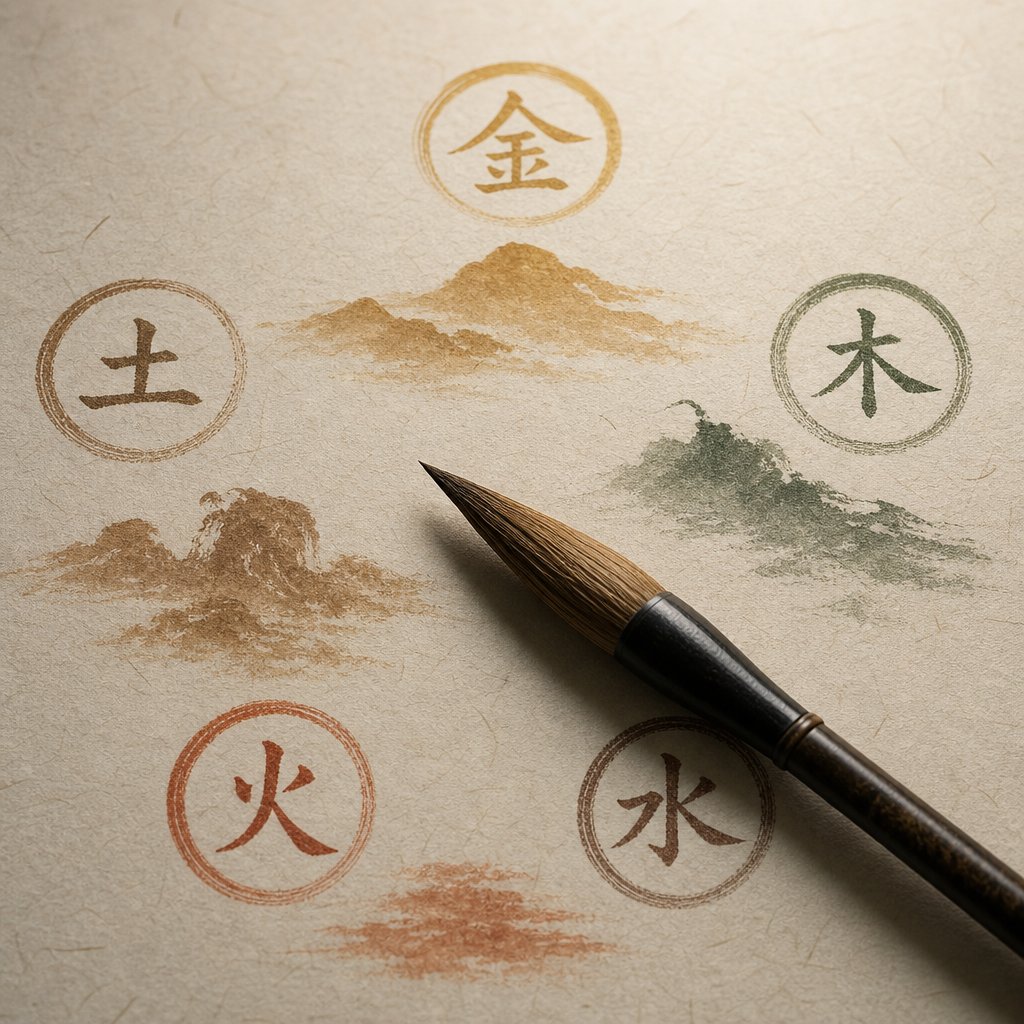
BaZi, literally meaning "Eight Characters," is a calendar-based calculation system also known as the Four Pillars of Destiny. It takes four units of time from your birth (year, month, day, and hour) and converts each into a pair of characters from the Gan-Zhi system. Each pair consists of one Heavenly Stem and one Earthly Branch. Four time units multiplied by two characters each gives you eight characters total, and these characters correspond to the Five Elements: Wood, Fire, Earth, Metal, and Water.
Imagine these five elements as phases of energy rather than physical materials. Earth represents the stabilizing, centering force, the transitional energy between seasons that governs grounding, trust, and nourishment. When none of your eight characters contain Earth-associated stems or branches, your chart is considered Earth-deficient. This absence signals a gap in the qualities Earth provides: reliability, patience, steadfastness, and the capacity to feel rooted in life.
A BaZi chart with no earth element does not mean a person is doomed to instability. It means the chart lacks a particular energetic phase that, left unaddressed, may manifest as difficulty with commitment, a sense of being unanchored, or challenges in building trust over time. The deficiency points to an area where intentional support can make a meaningful difference.
Why Your Chinese Name Can Compensate for Elemental Gaps
In Chinese metaphysics, a name is not merely a label. It functions as a compensating element, a daily remedy you speak, write, and hear throughout your entire life. If a BaZi chart reveals earth element deficiency, a naming specialist selects characters that carry Earth energy through their radicals, meanings, and phonetic qualities. Characters built with the earth radical (土), mountain radical (山), or stone radical (石) introduce grounding energy into the bearer's identity every time the name is used.
A Chinese name is spoken dozens of times daily, written thousands of times across a lifetime, and internalized as core identity. This makes it the most consistent and personal elemental remedy available in Chinese metaphysics.
The logic is straightforward: you cannot change your birth chart, but you can introduce balancing energy through the characters you carry. A name rich in Earth energy acts as a constant, gentle correction, reinforcing stability and trust in someone whose natal chart lacks those qualities naturally. This is why understanding how to fix missing earth in a BaZi name matters so much to parents seeking a meaningful, balanced identity for their child.
This approach goes deeper than simply picking a character that "looks earthy." The process requires understanding which specific stems and branches carry Earth energy, whether the Day Master actually benefits from added Earth, and how the generative and controlling cycles of the Five Elements interact within the chart. Each of these layers determines whether Earth is truly the right remedy, or whether a supportive element like Fire might serve the child better.
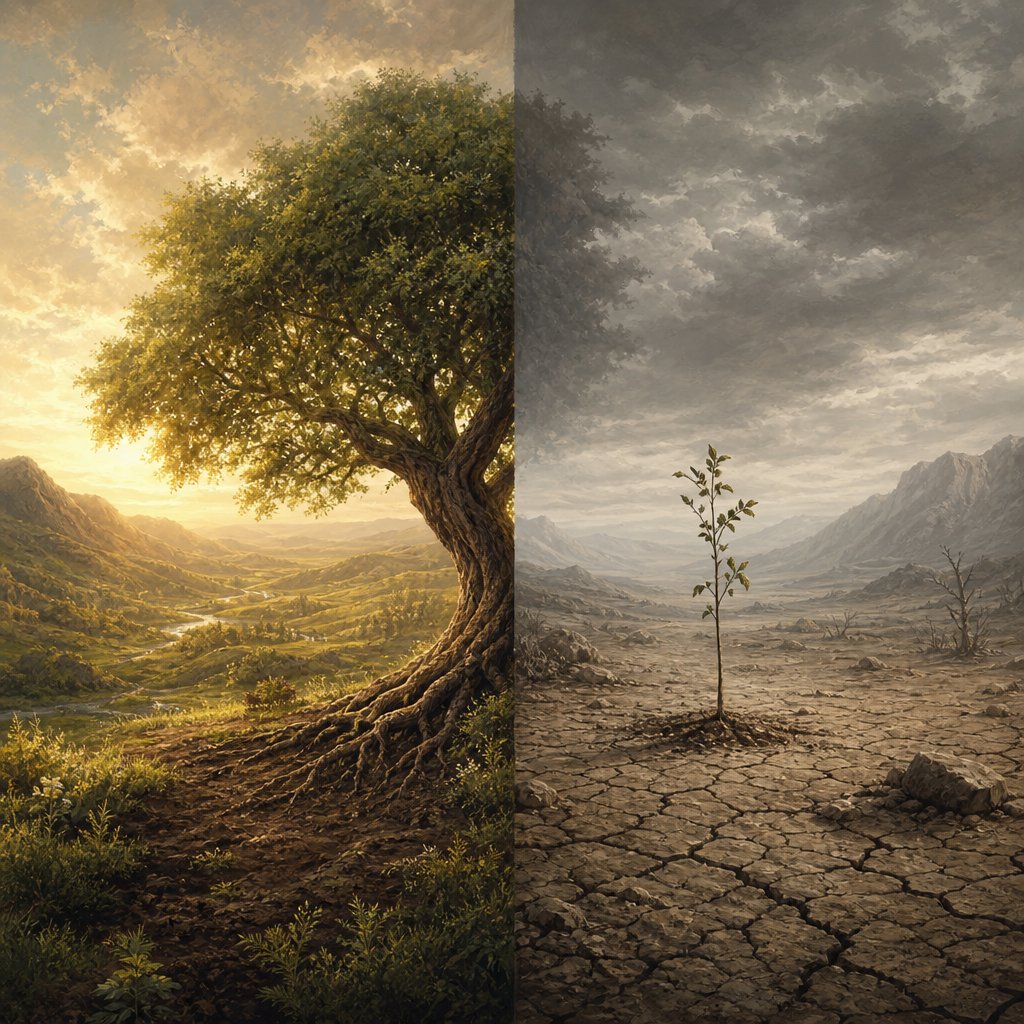
Earth Element Traits and What Their Absence Means for You
Every element in the Five Element system carries a distinct personality, a set of qualities it brings to a chart when present and a set of gaps it leaves when absent. Earth is the center of the cycle, the stabilizing pivot around which the other four elements rotate. Understanding its characteristics in detail reveals exactly why an earth element missing in a BaZi name creates such specific vulnerabilities, and why naming remedies target the precise qualities a person needs to develop.
Earth Element Personality and Life Traits
Picture the ground beneath your feet. It holds you up without asking anything in return. It absorbs rain, supports growth, and remains steady through every season. That is the nature of Earth energy in Chinese metaphysics: quiet, dependable, and fundamentally nurturing.
A person with strong Earth energy in their BaZi chart tends to be the reliable friend, the steady colleague, the one others turn to in a crisis. In traditional Chinese medicine, the Earth element governs our capacity for sympathy, thoughtful reflection, and clear thinking. Earth types value friendship, act as natural mediators, and bring people together. Their presence feels comforting because they radiate a sense of being settled and secure within themselves.
The earth element characteristics within the Five Elements framework include:
- Stability - the ability to remain consistent and grounded through life's changes
- Trustworthiness - a natural inclination toward honesty, loyalty, and keeping commitments
- Nourishment - the capacity to care for others and oneself without depletion
- Practicality - a preference for realistic, workable solutions over abstract ideals
- Patience - comfort with slow, steady progress rather than impulsive action
- Empathy - genuine concern for others' well-being and a talent for peacemaking
- Centeredness - the feeling of being at home in one's own body and life
When Earth is balanced in a chart, a person feels confident, at ease, and comfortable with life. They digest experiences the way a healthy stomach digests food: absorbing what is useful, releasing what is not, and maintaining equilibrium throughout the process. Earth's position in the Five Element cycle represents unity and balance, the midpoint where all other energies find their reference.
How Missing Earth Affects Health and Stability
When Earth energy is absent or severely deficient, those grounding qualities simply have no foundation to stand on. The lack of earth element symptoms show up across three distinct areas of life: personality, physical health, and broader life outcomes.
On the personality level, someone with missing Earth may struggle with indecisiveness. Without that internal anchor, choices feel overwhelming because there is no stable center from which to evaluate options. Commitment becomes difficult, not from lack of desire, but from a persistent sense of being unmoored. You might notice a pattern of starting projects or relationships with enthusiasm, then drifting away when the initial excitement fades. The feeling of instability and insecurity can become chronic, making it hard to trust oneself or others fully.
The missing earth element health effects in BaZi connect directly to the organs Earth governs in traditional Chinese medicine: the Stomach and Spleen. These organs handle transformation and transportation of nutrients throughout the body. When Earth energy is weak, digestive issues like bloating, sluggish metabolism, loose stools, and food sensitivities often follow. Muscle weakness and fatigue are common because the Spleen controls the flesh and the four limbs. Some people experience excessive dampness in the body, which can manifest as a heavy feeling, foggy thinking, or a tendency to gain weight easily.
| Area | When Earth Is Present | When Earth Is Missing |
|---|---|---|
| Personality | Grounded, decisive, reliable, patient | Indecisive, scattered, difficulty with commitment |
| Emotions | Centered, empathetic, secure | Anxious, overthinking, chronically worried |
| Physical Health | Strong digestion, good muscle tone, steady energy | Digestive issues, fatigue, muscle weakness, dampness |
| Relationships | Trustworthy, nurturing, loyal | Difficulty building trust, unstable connections |
| Career | Steady progress, dependable reputation | Frequent changes, lack of follow-through, instability |
In life outcomes, the absence of Earth often correlates with instability in both relationships and career. Without the grounding force that builds trust over time, partnerships may feel shaky or impermanent. Career paths might shift frequently, not from ambition but from an inability to settle and build something lasting. Financial security can also suffer because Earth energy supports the patience required for long-term wealth building.
This is precisely why naming remedies for an earth-deficient chart focus on cultivating specific qualities rather than offering vague "good luck." A name carrying Earth energy reinforces stability, patience, and trustworthiness dozens of times each day. It targets the exact traits the chart lacks, functioning as a constant reminder and energetic supplement for qualities the person needs to grow into. The character chosen is not random. It is selected to address the specific gap between what the chart provides naturally and what a balanced life requires.
Of course, knowing that Earth is missing is only the first step. The real question is how to confirm this deficiency by reading the actual stems and branches in a BaZi chart, and which specific characters carry the Earth energy you are looking for.
How to Read Your BaZi Chart and Spot Missing Earth
Confirming that Earth is genuinely absent from a chart requires more than intuition. You need to look at the actual characters, identify their elemental assignments, and tally what is present versus what is not. Sounds complex? The structure is surprisingly logical once you see how birth data translates into the Four Pillars of Destiny.
Mapping Your Birth Data to the Four Pillars
A BaZi chart is built from four units of time: the year, month, day, and hour of birth. Each unit becomes one "pillar," and each pillar contains exactly two characters: a Heavenly Stem on top and an Earthly Branch on the bottom. Four pillars multiplied by two characters gives you the eight characters (Ba Zi) that form the complete chart.
The Heavenly Stems are a set of ten characters that cycle through time, while the Earthly Branches are a set of twelve. Together they form the sexagenary cycle, a sixty-unit system that ancient Chinese astronomers used to track years, months, days, and hours long before modern clocks existed. Each Stem and Branch carries a fixed Five Element assignment and a Yin or Yang polarity.
Here is how the four pillars break down in terms of what they represent in a person's life:
- Year Pillar - represents ancestry, early environment, and the foundation from which you grow. It reflects your roots and broader generational energy.
- Month Pillar - represents your social environment, siblings, peers, and plays a critical role in determining the seasonal strength of your chart.
- Day Pillar - represents the self. The Heavenly Stem of this pillar is your Day Master, the focal point of the entire chart. The Day Branch reflects marriage and personal expression.
- Hour Pillar - represents children, aspirations, and the later stage of life.
To generate these four pillars, you need the exact birth date and time converted into the traditional Chinese calendar system. The Stem-Branch timekeeping method uses solar terms rather than standard clock time, which means the month boundaries follow the 24 solar terms of the agricultural calendar rather than the first and fifteenth of each lunar month. The hour is divided into twelve two-hour segments (called double-hours), each corresponding to one of the twelve Earthly Branches.
Imagine you are looking at a chart for a child born on April 3, 1980, after 7:00 AM. Using a perpetual calendar or BaZi calculator, you would find the following structure:
| Year Pillar | Month Pillar | Day Pillar | Hour Pillar | |
|---|---|---|---|---|
| Heavenly Stem | Geng (Metal) | Ji (Earth) | Bing (Fire) | Ren (Water) |
| Earthly Branch | Shen (Metal) | Mao (Wood) | Wu (Fire) | Chen (Earth) |
| Element | Metal | Earth / Wood | Fire / Fire | Water / Earth |
In this example, you can see Earth appearing in the Month Stem (Ji) and the Hour Branch (Chen). This person does not lack Earth. But if those positions held Wood, Water, or Metal characters instead, and no other Earth-associated character appeared anywhere in the eight positions, the chart would be classified as Earth-deficient.
Counting Elements Across All Eight Characters
To identify a missing element in a BaZi chart, you examine all eight characters individually and assign each its corresponding element. The process is straightforward:
The ten Heavenly Stems divide evenly among the five elements, two stems per element:
- Wood - Jia (Yang), Yi (Yin)
- Fire - Bing (Yang), Ding (Yin)
- Earth - Wu (Yang), Ji (Yin)
- Metal - Geng (Yang), Xin (Yin)
- Water - Ren (Yang), Gui (Yin)
The twelve Earthly Branches also carry elemental assignments, though the distribution is less even. Four branches belong to Earth (Chen, Xu, Chou, Wei), while the remaining eight split between Wood, Fire, Metal, and Water with two branches each. This means Earth actually has the most branch positions available, yet it can still be entirely absent from a chart if none of those four branches or two stems appear in the eight characters.
The counting method works like this: go through each of the four Heavenly Stems and four Earthly Branches in the chart, note the element for each, and check whether all five elements are represented. As traditional BaZi analysis explains, whichever element does not appear among these eight characters is the one considered lacking.
A practical way to visualize this is a simple tally:
| Element | Heavenly Stems Present | Earthly Branches Present | Total Count |
|---|---|---|---|
| Wood | Yi | Mao | 2 |
| Fire | Bing, Ding | Si | 3 |
| Earth | - | - | 0 |
| Metal | Geng | Shen | 2 |
| Water | Gui | - | 1 |
In this hypothetical chart, Earth scores zero. No Earth Heavenly Stems (Wu or Ji) and no Earth Earthly Branches (Chen, Xu, Chou, or Wei) appear anywhere in the eight characters. This is a clear case of Earth deficiency, the kind of chart where naming remedies become especially relevant.
One important nuance: this basic counting method gives you a surface-level reading. Each Earthly Branch also contains "hidden stems" inside it, secondary elemental energies that are not immediately visible but still influence the chart. For example, the branch Shen (Metal) contains hidden stems of Ren (Water) and Wu (Earth). If Shen appears in your chart, there is technically some buried Earth energy present, even though the primary element of that branch is Metal. Whether this hidden Earth is strong enough to count depends on the branch's position and the overall chart dynamics.
This distinction between completely absent Earth and merely weak or hidden Earth matters enormously for naming decisions. A chart with zero visible Earth and no hidden Earth stems is a stronger candidate for direct Earth-radical characters in the name. A chart where Earth exists in hidden stems but never surfaces as a primary element may need a different approach, perhaps characters that draw out and strengthen the latent Earth energy rather than adding it from scratch.
The key takeaway: before selecting name characters to compensate for missing Earth, you need to confirm the deficiency by checking all eight positions, including their hidden stems. This tells you whether Earth is truly absent or simply buried beneath the surface, waiting to be activated. And the character that determines how you interpret all of this, the one that decides what your chart actually needs, is the Day Master sitting at the top of your Day Pillar.
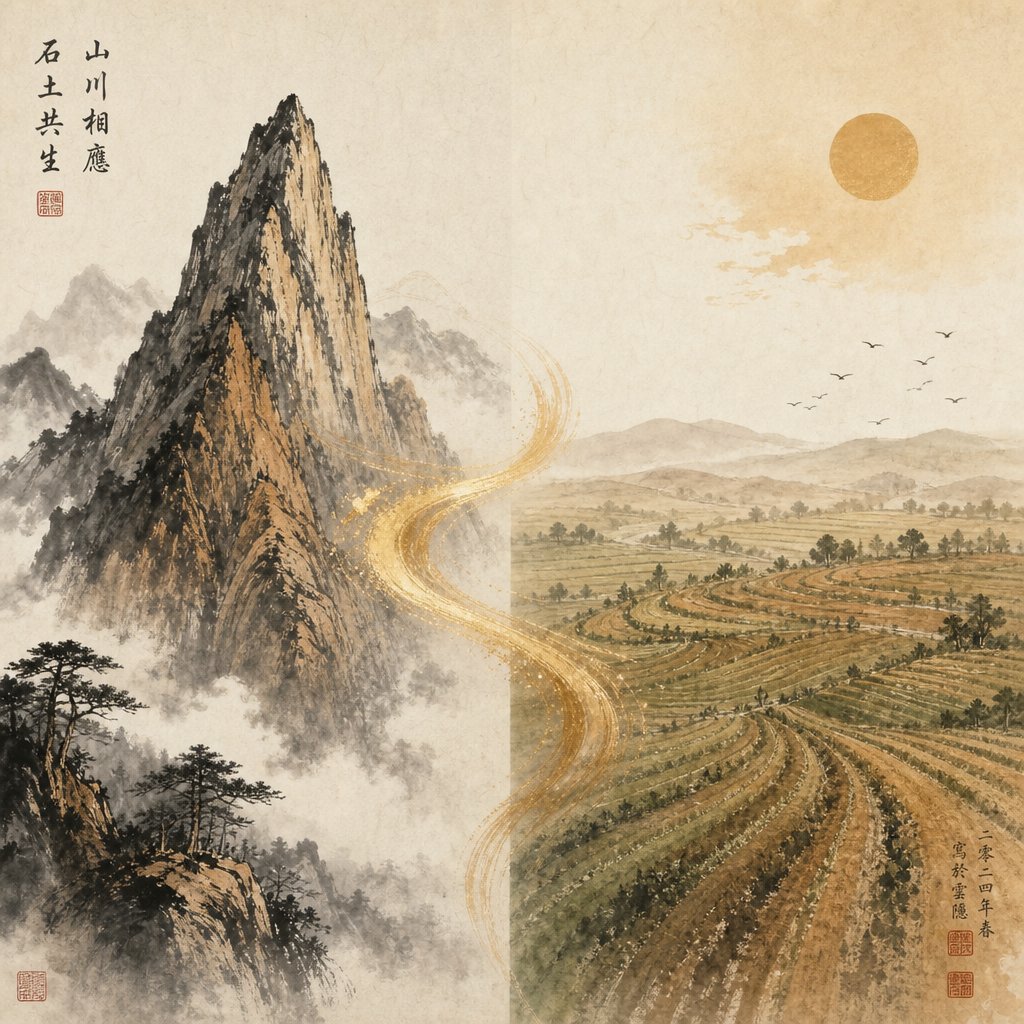
Heavenly Stems and Earthly Branches That Carry Earth Energy
The Day Master at the top of your Day Pillar tells you who you are in the chart. But to confirm whether Earth is genuinely absent, you need to know exactly which characters represent Earth energy in the first place. Two Heavenly Stems and four Earthly Branches carry Earth as their primary element. If none of these six characters appear anywhere in the eight positions of a chart, Earth is definitively missing.
Earth Heavenly Stems Wu and Ji Explained
The Wu and Ji earth Heavenly Stems in BaZi represent the two polarities of Earth energy. Think of them as two expressions of the same grounding force, one expansive and one contained.
Wu (戊) is Yang Earth. Picture a mountain: massive, immovable, and visible from a great distance. Wu Earth is solid, protective, and commanding. It represents large-scale stability, the kind of grounding that comes from sheer presence and permanence. In a person's chart, Wu Earth as a Day Master suggests someone dependable, generous, and broad-minded, though potentially stubborn when challenged.
Ji (己) is Yin Earth. Picture fertile farmland: soft, receptive, and nurturing. Ji Earth is adaptable, productive, and quietly supportive. It represents the kind of stability that comes from flexibility rather than rigidity. A Ji Earth Day Master tends to be accommodating, detail-oriented, and skilled at cultivating growth in others.
Both stems belong to the late summer season in the Five Element cycle, that transitional period between summer's peak heat and autumn's cooling descent. This seasonal placement reinforces Earth's role as the mediator, the element that bridges transitions and holds the center while other energies shift around it.
| Stem | Chinese | Polarity | Image | Season | Key Qualities |
|---|---|---|---|---|---|
| Wu | 戊 | Yang Earth | Mountain | Late summer | Solid, protective, immovable, generous |
| Ji | 己 | Yin Earth | Farmland | Late summer | Nurturing, adaptable, receptive, productive |
If neither Wu nor Ji appears among your four Heavenly Stems, the visible layer of your chart contains no Earth energy at all. But the visible layer is only half the picture. The Earthly Branches below hold additional Earth potential.
Earth Earthly Branches and Their Seasonal Connections
Four of the twelve Earthly Branches carry Earth as their dominant element: Chou (丑), Chen (辰), Wei (未), and Xu (戌). You might notice something interesting about their placement in the calendar. Rather than clustering together, these four earth Earthly Branches (Chou, Chen, Wei, Xu) sit at the transitions between seasons, one at the tail end of each seasonal cycle.
- Chou (丑) - Ox, late winter (January). Earth energy emerging from the cold, preparing for spring.
- Chen (辰) - Dragon, late spring (April). Earth energy bridging spring's growth into summer's heat.
- Wei (未) - Goat, late summer (July). Earth energy at its peak, the heart of the transitional season.
- Xu (戌) - Dog, late autumn (October). Earth energy winding down the harvest before winter arrives.
This pattern is not coincidental. Earth governs transitions in Chinese metaphysics. It is the element that appears whenever one season hands off to the next, providing the stable ground on which change can occur without chaos. The four Earth branches mark these pivot points in the annual cycle.
| Branch | Chinese | Zodiac | Polarity | Season Transition | Hidden Stems |
|---|---|---|---|---|---|
| Chou | 丑 | Ox | Yin Earth | Winter to Spring | Ji (Earth), Gui (Water), Xin (Metal) |
| Chen | 辰 | Dragon | Yang Earth | Spring to Summer | Wu (Earth), Yi (Wood), Gui (Water) |
| Wei | 未 | Goat | Yin Earth | Summer to Autumn | Ji (Earth), Ding (Fire), Yi (Wood) |
| Xu | 戌 | Dog | Yang Earth | Autumn to Winter | Wu (Earth), Xin (Metal), Ding (Fire) |
Look at the "Hidden Stems" column. Each Earth branch contains its own Earth stem as the main qi (primary hidden stem), plus two additional stems from other elements. This layered structure is what makes the hidden stems in BaZi so important for accurate chart reading.
But here is the critical nuance: Earth energy also hides inside branches that are not primarily Earth. The branch Yin (Tiger) is classified as Wood, yet it contains Wu Earth as a sub-qi. Si (Snake) is Fire, but it also holds Wu Earth. Shen (Monkey) is Metal, yet Wu Earth sits inside it as well. Wu (Horse) is Fire, but Ji Earth resides within.
This means a chart might show no primary Earth stems or branches on the surface, yet still contain partial Earth energy buried inside non-Earth branches. Whether this hidden Earth is strong enough to count depends on its position in the branch (main qi versus sub-qi) and whether the branch itself is supported or clashed by other characters in the chart.
A practical distinction emerges from this:
- Earth truly missing - No Wu or Ji in the Heavenly Stems, no Chou/Chen/Wei/Xu in the Earthly Branches, and no hidden Earth stems in any of the branches present. This is rare but represents the strongest case for Earth-radical naming characters.
- Earth merely weak - No primary Earth characters visible, but one or more branches contain Earth as a sub-qi (hidden stem). The energy exists but lacks strength and visibility. Naming remedies may still be appropriate, though the approach might differ.
Understanding yin and yang Earth in the Four Pillars also matters for character selection. If the chart's hidden Earth is all Yin (Ji), a Yang Earth (Wu) character in the name provides complementary balance. If the chart shows traces of Yang Earth buried in sub-qi positions, a Yin Earth character might harmonize better. This polarity consideration adds another layer to the naming decision.
The distinction between truly absent and merely buried Earth energy shapes everything that follows in the naming process. But even confirming the deficiency does not automatically mean Earth is the correct remedy. The Day Master's relationship to Earth, whether it acts as a resource, an output, or even a threat, determines whether adding Earth through a name actually helps the chart or inadvertently creates new imbalances.
The Day Master and Why Chart Balance Matters More Than Filling Gaps
Here is where most parents make a costly mistake. They see Earth missing from their child's chart and immediately reach for Earth-radical characters. It feels logical: something is absent, so you add it back. But BaZi does not work like filling a hole with dirt. The real question is not "what is missing?" but "what does the Day Master actually need?"
Understanding Your Day Master and Element Needs
Your Day Master is the Heavenly Stem sitting atop the Day Pillar. It represents the core self, the reference point from which every other element in the chart is interpreted. A Day Master made of Wood views Earth differently than one made of Water or Metal. The relationship changes everything.
Consider a weak Ren Water Day Master born in a dry autumn month. This chart might show zero Earth characters, yet the person's primary need is not Earth at all. Water is already struggling to survive. Adding Earth, which controls Water in the Five Element cycle, would weaken the Day Master further. What this chart actually needs is Metal (which generates Water) or more Water (peer support). The missing element and the favorable element are two entirely different things.
Day Master strength determines the direction of the remedy. A strong Day Master can handle elements that drain or control it. A weak one needs support and nourishment first. This assessment of BaZi day master element balance is the foundation of any naming decision.
A missing element is a observation about the chart's composition. A favorable element is a prescription based on what the Day Master needs to thrive. These two are not always the same, and confusing them is the most common error in BaZi naming.
When Adding Earth Is Not the Right Remedy
Should you add the missing element to a BaZi name automatically? Not necessarily. Here are scenarios where Earth is absent but still not the correct naming remedy:
- Weak Wood Day Master - Earth represents Wealth for Wood. A weak Day Master chasing Wealth it cannot hold leads to exhaustion, not prosperity. This chart needs Water (Resource) or Wood (Peer) first.
- Weak Water Day Master - Earth is the Authority element for Water, meaning it controls and pressures. Adding Earth to an already struggling Water Day Master increases the burden rather than relieving it.
- Strong Fire Day Master - Earth represents Output for Fire. Adding Earth here might seem harmless since Fire produces Earth, but if the chart already has excessive output energy, more Earth drains the Day Master's vitality without providing balance.
The common misconception that "lacking equals needing" has led many families astray. One practitioner's account describes a client who lacked Metal in their chart but actually favored Fire. Following generic advice to supplement Metal worsened their situation. The same principle applies to Earth: its absence does not automatically make it the remedy.
Day master strength and the naming remedy must align. A professional assessment considers not just what is missing, but what role Earth plays relative to the Day Master. Is Earth a resource, an output, a source of wealth, or a controlling force? The answer determines whether Earth-radical characters belong in the name or whether a supportive element that generates Earth indirectly would serve the chart better.
This is where the Five Element cycles become essential. If direct Earth is too strong a remedy, the generative cycle offers a gentler path: Fire produces Earth naturally, meaning Fire-element characters can coax Earth energy into existence without overwhelming the Day Master.
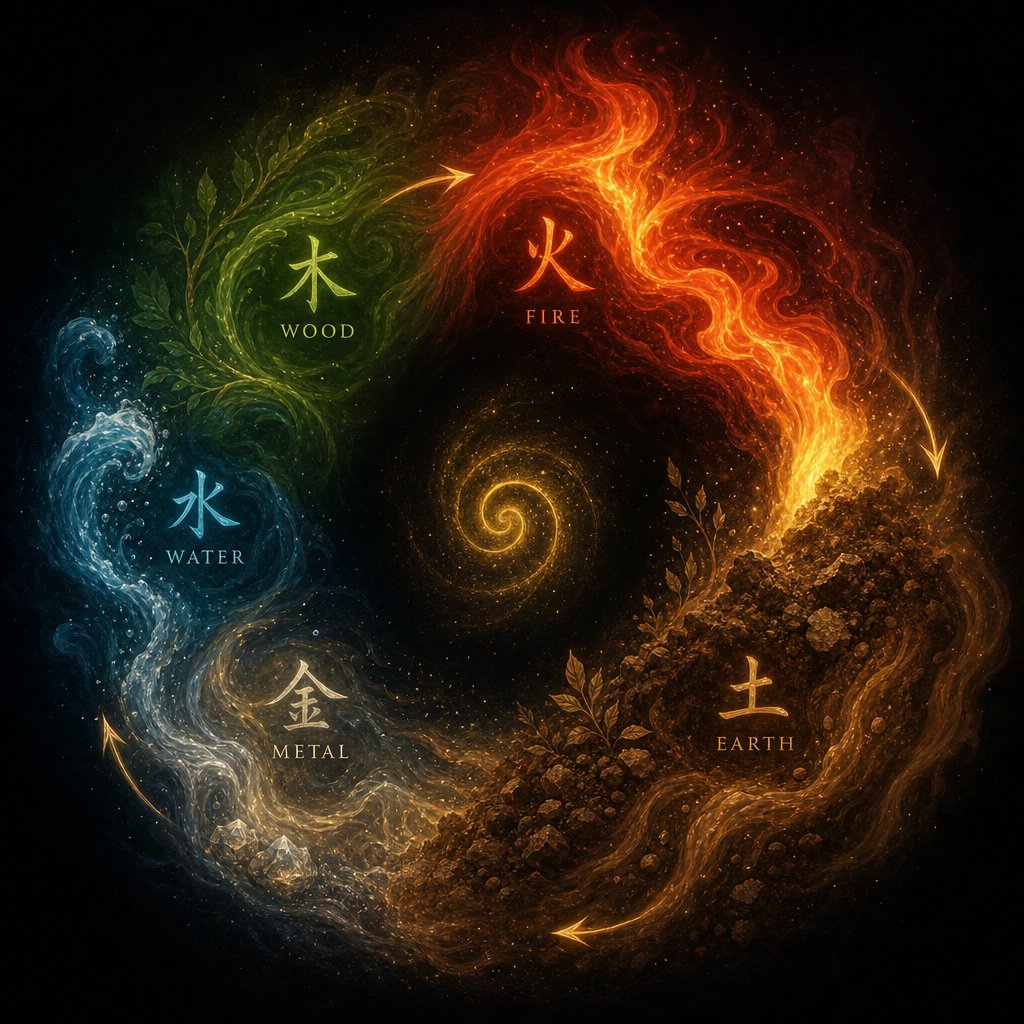
Element Cycles and Why Supportive Elements Strengthen Your Name
The Five Elements do not exist in isolation. They interact through two fundamental cycles that determine how energy flows, builds, and regulates within a BaZi chart. When you understand these cycles, the logic behind element relationships in Chinese naming remedies becomes clear: sometimes the best way to bring Earth energy into a name is not through Earth itself, but through the element that naturally creates it.
How Fire Produces Earth in the Generative Cycle
Think of a forest fire. What remains after the flames subside? Ash. And ash becomes soil. This is the intuitive image behind the five element cycle's earth generation principle: Fire produces Earth. It is not a metaphor invented for convenience. It reflects an observable natural process that Chinese philosophers codified thousands of years ago into the generating cycle (sheng cycle), where each element gives rise to the next in a continuous loop.
The full generative sequence runs like this:
- Wood feeds Fire - wood provides fuel for flames to grow
- Fire creates Earth - combustion produces ash, which becomes soil
- Earth produces Metal - minerals form within the ground over time
- Metal generates Water - condensation forms on metal surfaces
- Water nourishes Wood - water feeds roots and enables growth
For a chart with an earth element missing in the BaZi name context, this cycle offers a powerful insight. Fire is Earth's "mother" in the generative relationship. Including Fire-element characters in a name does not just add Fire energy. It actively generates Earth energy as a natural byproduct, the way a warm hearth gradually builds a bed of nourishing ash beneath it.
This is why a skilled practitioner might recommend Fire-radical characters alongside or even instead of direct Earth-radical characters. Fire produces Earth element energy indirectly, creating a gentler, more organic flow rather than forcing Earth into a chart that may not be ready to receive it directly. For a weak Day Master that cannot handle the weight of direct Earth, Fire acts as a bridge, generating the needed energy without overwhelming the chart's balance.
Using Supportive Elements Beyond Earth Itself
The generative cycle is only half the picture. The controlling cycle (ke cycle) introduces checks and balances, where each element restrains another to prevent excess. Both cycles matter when selecting supportive elements for missing earth in a BaZi name.
Here are the element relationships most relevant to Earth remediation:
- Fire generates Earth - the "mother" element that produces Earth energy naturally. Fire-radical characters support Earth indirectly.
- Earth generates Metal - Earth is Metal's mother. If the chart already has strong Metal, adding Earth feeds that Metal further, which may or may not be desirable.
- Wood controls Earth - trees root into soil, breaking it apart. Excess Wood in a chart weakens whatever Earth energy you introduce through naming.
- Earth controls Water - earth dams and redirects water. Adding Earth to a chart heavy in Water creates a controlling dynamic that could either stabilize or suppress, depending on the Day Master.
Imagine a child whose chart lacks Earth but has a Wood Day Master with abundant Wood and Water energy. Adding Earth directly gives the Wood Day Master more Wealth to chase, which sounds positive until you realize a weak Wood Day Master cannot hold that Wealth. The better approach? Introduce Fire characters that serve double duty: Fire exhausts the excess Wood (since Wood feeds Fire), and Fire simultaneously generates Earth energy downstream. One element solves two problems.
This layered thinking is what separates a thoughtful naming remedy from a simplistic one. A practitioner reading the full chart dynamics might prescribe a name combining one Fire-radical character and one Earth-radical character, creating a miniature generative cycle within the name itself. The Fire character feeds the Earth character, mirroring the natural producing flow and reinforcing the remedy's effectiveness every time the name is spoken or written.
The controlling cycle also warns against certain combinations. If a child's chart already contains strong Wood energy, placing an Earth-radical character in the name without Fire support leaves that Earth vulnerable to Wood's controlling force. The remedy gets undermined by the very chart it is trying to balance. Adding Fire between them, even as a secondary character, breaks the direct Wood-controls-Earth dynamic by redirecting Wood's energy into Fire first.
These interactions explain why BaZi naming is never as simple as looking up "Earth characters" in a dictionary. The element relationships within the chart, the generative and controlling dynamics already at play, and the Day Master's specific needs all determine whether Earth alone is sufficient or whether supportive elements create a stronger, more resilient remedy. With this framework in mind, the next consideration becomes practical: which specific Chinese characters carry Earth energy through their radicals, and how do you choose among them for a name that sounds beautiful, carries meaningful weight, and delivers the elemental correction the chart requires?
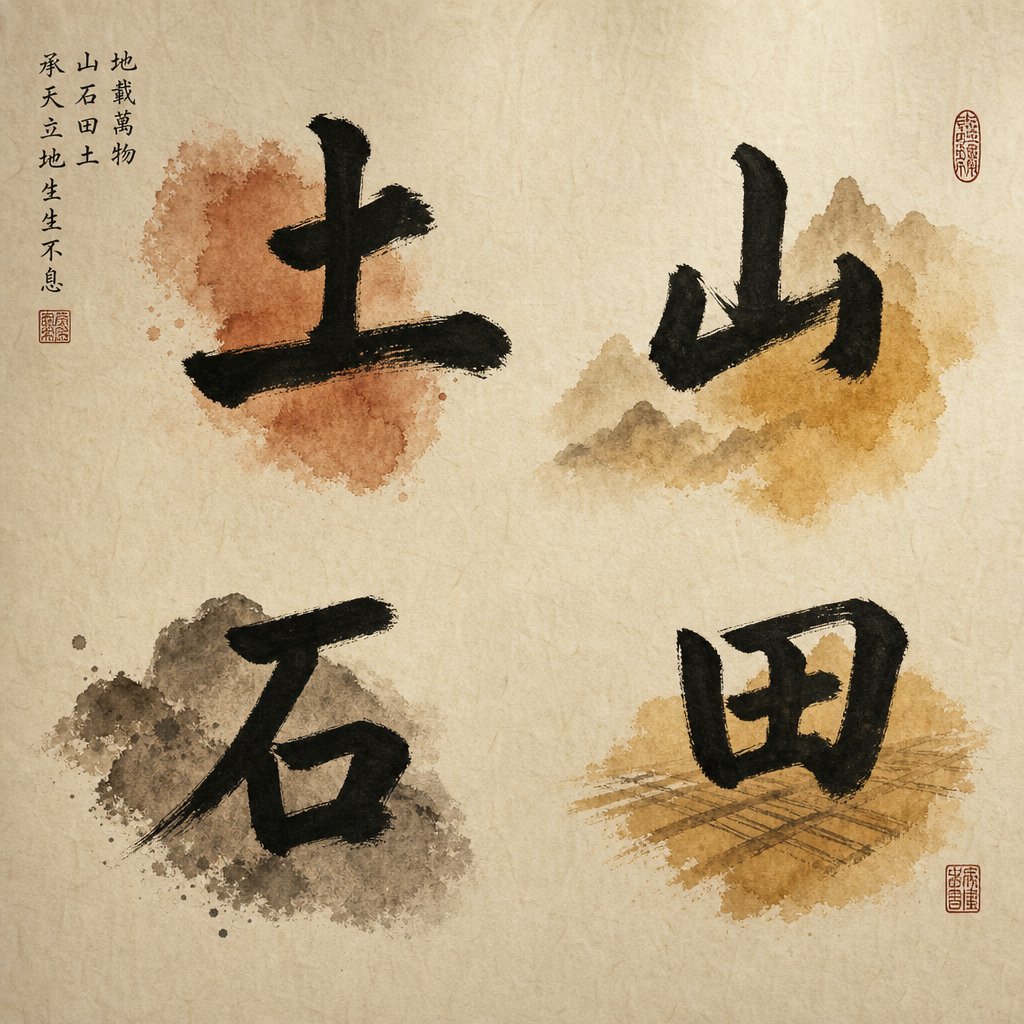
Chinese Characters With Earth Radicals for Naming Your Child
Knowing that Earth is the correct remedy is one thing. Finding the right character to carry that energy in a name your child will use for a lifetime is another challenge entirely. In Chinese, a character's radical acts as its elemental signature. Characters built around Earth-related radicals naturally resonate with grounding, stabilizing energy, making them the primary pool from which naming specialists draw when addressing an earth element missing in a BaZi name.
Four radicals serve as the main carriers of Earth energy in Chinese characters: 土 (earth/soil), 山 (mountain), 石 (stone), and 田 (field). Each carries a slightly different flavor of Earth, from the solid permanence of mountain stone to the nurturing receptivity of cultivated land. Choosing among them depends on what kind of grounding the chart needs and what qualities the parents wish to emphasize.
Characters With the Earth Radical 土
The 土 radical is the most direct expression of Earth energy in Chinese writing. As radical reference guides note, characters containing 土 (called 提土旁 when appearing on the left side) relate to land, ground, and construction. For naming purposes, these tu radical characters for baby names offer the purest Earth elemental infusion available.
Not every character with the earth radical works well in a name, though. Characters like 埋 (to bury) or 塌 (to collapse) carry Earth energy but bring negative connotations no parent would want attached to their child. The art lies in selecting characters where the radical delivers elemental support while the full character conveys aspiration, beauty, or strength.
Here are some of the best earth element characters for naming that use the 土 radical:
- 坤 (kun) - Represents the receptive, nurturing power of the earth in the I Ching. It carries deep philosophical weight, suggesting someone who supports and sustains others with quiet strength. Traditionally used in male names, though increasingly seen in female names as well.
- 培 (pei) - Means to cultivate, nurture, or foster growth. Think of it as the act of building up soil around a young plant's roots. It works beautifully in both male and female names, suggesting someone who develops potential in themselves and others.
- 城 (cheng) - Means city or city wall. It evokes protection, structure, and civilization built on solid ground. Primarily used in male names, it suggests someone who builds lasting things and provides shelter for others.
- 垚 (yao) - Three earth radicals stacked together, meaning high and level ground. It is visually striking and elementally powerful, tripling the Earth energy in a single character. Used in both male and female names for its strong grounding effect.
Mountain, Stone, and Field Radicals for Earth Names
Earth energy extends beyond the 土 radical itself. The 山 radical (mountain) connects to landforms and elevated terrain, the 石 radical (stone) relates to rock and mineral solidity, and the 田 radical (field) represents cultivated, productive earth. Each offers a distinct expression of grounding energy for mountain radical Chinese name characters and beyond.
| Radical | Character | Pinyin | Meaning | Tone | Suitability |
|---|---|---|---|---|---|
| 山 (mountain) | 岳 | yue | Great mountain, father-in-law; evokes majesty and permanence | 4th | Male |
| 山 (mountain) | 峰 | feng | Peak, summit; suggests reaching the highest point through steady effort | 1st | Male |
| 山 (mountain) | 岚 | lan | Mountain mist; combines Earth grounding with poetic softness | 2nd | Female |
| 石 (stone) | 磊 | lei | Three stones stacked; means open-hearted, upright, and frank | 3rd | Male |
| 石 (stone) | 磐 | pan | Massive rock, bedrock; suggests unshakeable stability | 2nd | Male |
| 田 (field) | 畇 | yun | Cultivated land, well-tended fields; suggests careful nurturing | 2nd | Unisex |
| 田 (field) | 畅 | chang | Smooth, unobstructed; suggests free-flowing progress on solid ground | 4th | Unisex |
| 土 (earth) | 坤 | kun | Receptive earth force from the I Ching; deep philosophical resonance | 1st | Unisex |
| 土 (earth) | 培 | pei | To cultivate, to nurture growth from the ground up | 2nd | Unisex |
| 土 (earth) | 城 | cheng | City wall, fortification; protection and lasting structure | 2nd | Male |
You will notice the table includes a "Tone" column. This matters because tonal harmony is one of the four dimensions a Chinese name must satisfy. A name where all characters share the same tone sounds flat and monotonous when spoken aloud. Ideally, the surname, first character, and second character move through different tones, creating a natural melodic rhythm. If your surname is a 2nd tone character, pairing it with a 4th tone Earth character like 岳 (yue) or 畅 (chang) creates pleasing tonal contrast.
Stroke count is another practical consideration. In traditional naming numerology (五格剖象法), the total strokes of each character interact mathematically to produce auspicious or inauspicious configurations. A character like 磊 carries 15 strokes, while 培 has 11 and 城 has 9. These numbers combine with the surname's stroke count to create patterns that practitioners evaluate for harmony. Beyond numerology, stroke count affects visual balance. A surname with few strokes paired with a dense, complex given name character can look lopsided when written, while matching complexity creates a more elegant visual signature.
Character meaning deserves equal weight. As the four-dimensional naming framework emphasizes, a name that succeeds on elemental balance but fails on meaning is considered incomplete. The character 磊 does not just deliver Earth energy through its triple-stone structure. It carries a cultural meaning of being open, honest, and upright (光明磊落), adding a layer of aspirational character to the elemental remedy. Similarly, 培 does not merely ground. It actively suggests growth and development, making it especially fitting for a child whose parents want Earth energy expressed as nurturing potential rather than immovable weight.
The best Chinese characters with earth radical for names work across all four dimensions simultaneously: they sound right with the surname, look balanced when written, carry meaningful aspirations, and deliver the elemental correction the BaZi chart requires. Finding that intersection is where the real craft of naming lives, and it is also where the process benefits most from a structured, step-by-step approach that accounts for each dimension in sequence rather than trying to satisfy them all at once.
Practical Steps to Choose a Name That Restores Earth Balance
All the theory, all the elemental cycles, all the radical tables converge on one practical question: how do you actually move from a blank page to a finished name that grounds your child's chart? The step-by-step BaZi naming process for the earth element follows a specific sequence, and skipping steps is where most families run into trouble. Each stage builds on the one before it, narrowing the field from thousands of possible characters down to the handful that truly fit.
Step by Step Process for Earth Element Name Selection
Think of this as a funnel. You start wide, gathering data, and progressively filter until only the right characters remain. Here is the complete workflow for how to choose a Chinese name for missing Earth:
- Calculate the BaZi chart accurately. You need the exact birth year, month, day, and hour converted into the Heavenly Stem and Earthly Branch system. Use a reliable BaZi calculator or perpetual calendar. As BaZi naming guides emphasize, birth time matters because the Hour Pillar can shift the entire elemental composition. If the time is uncertain, note that limitation before proceeding.
- Identify the Day Master. The Heavenly Stem on top of the Day Pillar is the child's core identity in the chart. Write it down. Every decision that follows references this single character.
- Assess overall chart balance and Day Master strength. Count all elements present, check the birth season's influence, and determine whether the Day Master is strong or weak. A Day Master born in its productive season with peer support is strong. One born in a controlling season without allies is weak. This assessment shapes everything.
- Determine whether Earth is the correct remedy. Ask: what role does Earth play relative to this Day Master? Is it Resource, Output, Wealth, Authority, or Peer? A weak Day Master that views Earth as a controlling force should not receive more Earth. Only proceed with Earth-radical characters if Earth genuinely supports the chart's balance.
- Select the appropriate radical type. If direct Earth is suitable, choose between 土, 山, 石, and 田 radicals based on the flavor of grounding needed. If indirect support works better, consider Fire-radical characters that generate Earth through the productive cycle. Some charts benefit from a combination of both.
- Choose characters with harmonious meaning and sound. From your selected radical group, filter for characters that carry positive meaning, pair well tonally with the surname, and avoid unfortunate homophones. Read the full name aloud in both Mandarin and any family dialect. The name should flow naturally when spoken.
- Verify stroke count compatibility. Check the total strokes of each character against the surname using the Three Talents and Five Elements framework (using traditional Kangxi Dictionary stroke counts). Ensure the Heaven, Man, and Earth stroke configurations produce generating rather than clashing relationships. Adjust character choices if the numerology creates unfavorable patterns.
This bazi balanced name selection guide works as a decision tree. Each step either confirms your direction or redirects you before you invest time in the wrong characters. Skipping step four is the most common mistake: parents jump from "Earth is missing" straight to "pick an Earth character" without asking whether Earth actually helps their child's specific Day Master.
A practical tip for families working through this process: keep a shortlist of three to five candidate characters after step six, then run all of them through step seven. Stroke count compatibility often eliminates one or two options, leaving you with a final set that satisfies every dimension simultaneously.
When to Seek Professional BaZi Naming Guidance
Some charts are straightforward. Earth is clearly absent, the Day Master clearly benefits from it, and a well-chosen character slots in without conflict. Other charts are not so cooperative. When should you consider a professional BaZi naming consultation rather than working through the process alone?
- The Day Master's strength is ambiguous. If you cannot confidently determine whether the Day Master is strong or weak, the entire remedy direction becomes uncertain. Professionals assess subtle factors like hidden stems, seasonal influence, and combination dynamics that shift the balance.
- Multiple elements are missing or weak. A chart lacking both Earth and Metal, for example, requires prioritization. Which deficiency matters more? The answer depends on the Day Master's specific needs and the interactions between what is present.
- The chart contains clashes or combinations. Certain branch combinations transform one element into another. A chart that appears Earth-deficient on the surface might actually generate Earth through hidden transformations. Recognizing these requires training.
- Family naming rules add constraints. Generation characters, clan taboos, or the need for a name that works across Chinese and English contexts all narrow the available options. A professional can navigate these constraints while maintaining elemental integrity.
For families bridging cultural contexts, modern naming adds another layer. Many parents want a Chinese name that carries BaZi balance and an English name that works in international settings. The thematic approach works well here: if the chart benefits from Earth, the English name might draw on imagery of stability, mountains, or groundedness without needing a radical-based elemental link. The Chinese name handles the precise elemental work while the English name echoes the same qualities through meaning and association.
AI tools can assist with the early stages of this process, organizing birth details, summarizing elemental composition, and suggesting candidate characters by radical or meaning. They are useful for generating a first round of ideas and checking stroke count calculations quickly. But the interpretive steps, assessing Day Master strength, determining the correct remedy, and judging whether a character's cultural associations truly fit the family, still benefit from human judgment and experience.
The final name should feel like a natural fit, not a technical formula. It should sound right when called across a playground, look balanced when written on a school form, carry meaning the child can grow into proudly, and quietly deliver the grounding energy their chart needs every single day. That intersection of beauty, meaning, sound, and elemental purpose is what makes BaZi naming an art as much as a science.
Frequently Asked Questions About Earth Element Missing in BaZi Names
1. How do I know if the earth element is missing from my BaZi chart?
To confirm Earth is missing, examine all eight characters in your Four Pillars chart. Check whether any of the two Earth Heavenly Stems (Wu or Ji) or four Earth Earthly Branches (Chou, Chen, Wei, Xu) appear. If none of these six characters show up in any of the eight positions, Earth is considered absent. However, you should also check hidden stems within other branches, as some non-Earth branches like Shen (Monkey) or Si (Snake) contain buried Earth energy that may partially compensate for the surface-level deficiency.
2. Should I always add earth element characters to a name when earth is missing in BaZi?
Not necessarily. A missing element and a favorable element are two different things in BaZi analysis. The correct remedy depends on your Day Master's strength and its relationship to Earth. For example, if you have a weak Water Day Master, Earth acts as a controlling force that adds pressure rather than support. In such cases, Metal or Water characters would serve the chart better. Always assess the Day Master's needs before selecting Earth-radical characters for a name.
3. What Chinese characters with earth radicals are best for baby names?
The most commonly recommended Earth-radical characters for naming include those built with the 土 (earth), 山 (mountain), 石 (stone), and 田 (field) radicals. Popular choices include 坤 (kun, receptive earth power), 培 (pei, to cultivate), 城 (cheng, city wall), 岳 (yue, great mountain), 峰 (feng, summit), 磊 (lei, open-hearted and upright), and 岚 (lan, mountain mist). The best choice depends on tonal harmony with the surname, stroke count compatibility, and whether the character's meaning aligns with the family's aspirations.
4. Can fire element characters help compensate for missing earth in a BaZi name?
Yes. In the Five Element generative cycle, Fire naturally produces Earth, much like combustion creates ash that becomes soil. Fire-radical characters can generate Earth energy indirectly, offering a gentler remedy for charts where direct Earth might overwhelm a weak Day Master. A skilled practitioner may recommend combining one Fire-radical character with one Earth-radical character in a name, creating a miniature generative cycle that reinforces the remedy each time the name is used.
5. What is the difference between earth truly missing and earth being weak in a BaZi chart?
Earth is truly missing when no Earth Heavenly Stems, no Earth Earthly Branches, and no hidden Earth stems appear anywhere in the chart. Earth is merely weak when no primary Earth characters are visible on the surface, but one or more branches contain Earth as a sub-qi (hidden stem). The distinction matters for naming because a truly absent Earth calls for direct Earth-radical characters, while weak or hidden Earth may respond better to characters that draw out and strengthen the latent energy already present in the chart.