Why Your Email Signature Pinyin Name Format Matters
Imagine receiving an email from a new colleague named "Li Wei." Is Li the family name or the given name? Should you reply with "Hi Li" or "Hi Wei"? If you guessed wrong, you just addressed someone by their surname as if it were their first name, or vice versa. This confusion plays out thousands of times a day in international inboxes, and it almost always traces back to one thing: how the pinyin name was formatted in the signature block.
Your email signature pinyin name format is the specific way you romanize and display a Chinese name using the Latin alphabet in your professional sign-off. It encompasses name ordering, capitalization, spacing, and whether you include Chinese characters or an adopted English name alongside the pinyin. Getting this right matters because your signature is often the only cue a recipient has for understanding who you are and how to address you correctly.
What Pinyin Name Format Means in Email Signatures
Pinyin, the official romanization system for Standard Mandarin Chinese, converts characters into Latin letters so non-Chinese readers can pronounce and identify names. In an email signature, pinyin formatting goes beyond simple transliteration. It involves deliberate choices about structure, visual hierarchy, and clarity that help recipients parse your name at a glance. This topic sits at the intersection of Chinese naming conventions, romanization standards, and professional digital communication, which is why it deserves focused attention rather than a passing mention in a broader guide on how to start a chinese email.
Why Proper Formatting Matters for Recipients
Western colleagues often cannot distinguish family names from given names in a pinyin signature without proper formatting cues, because both components can appear as short, unfamiliar syllables of similar length.
In Chinese culture, the surname comes first, followed by the given name. A name like "Zhang Wei" places the family name (Zhang) before the given name (Wei). Without clear formatting signals, recipients unfamiliar with Chinese email writing conventions have no reliable way to tell which is which. The result? Awkward misaddressing, confused CRM entries, and a subtle erosion of professional credibility over time.
This guide covers both sides of the equation: Chinese professionals formatting their names for Western recipients, and Western professionals incorporating Chinese or pinyin names into their own signatures. Whether you are crafting a bilingual signature for international business or simply trying to help colleagues address you correctly, the formatting decisions you make in that small block of text shape every first impression your emails create.
The choices involved, name order, romanization system, tone marks, bilingual display, go deeper than most people realize. Each decision carries trade-offs that depend on your audience, your industry, and the platforms you use.
Understanding Chinese Name Ordering Conventions
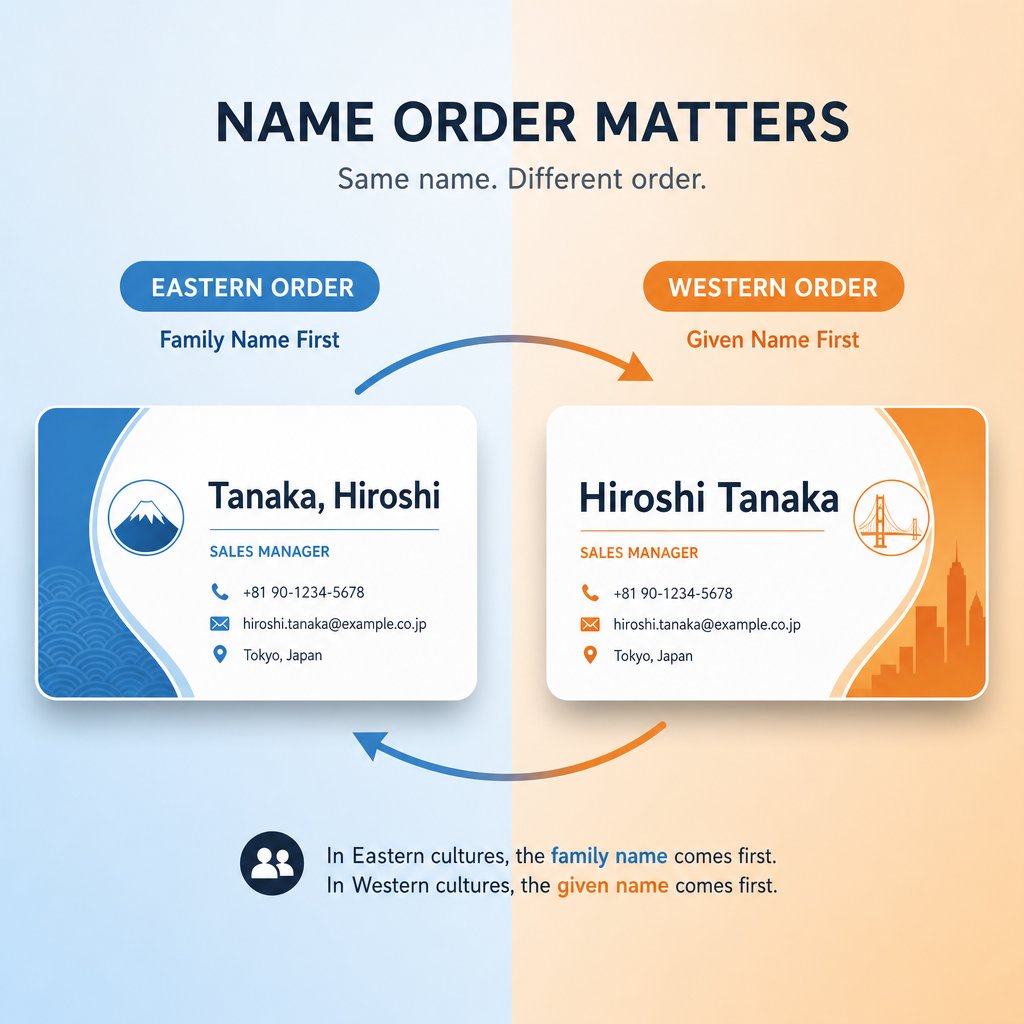
The single biggest source of confusion in a pinyin email signature comes down to one structural question: which name goes first? In English-speaking countries, given name precedes family name. In Chinese culture, the opposite is true. This difference is not arbitrary. It reflects a deeply rooted cultural logic that shapes how names function in professional communication, and getting it wrong in your signature can quietly derail how people address you for months.
Family Name First vs Given Name First
Chinese names follow a family-name-first structure that dates back thousands of years. The surname appears at the front, symbolizing the importance of family lineage and heritage. The given name follows, representing the individual. So when you see "Wang Ming" written in Chinese order, "Wang" is the surname and "Ming" is the given name.
Compare this to Western conventions, where "John Smith" places the given name first. The clash between these two systems creates a real problem in email signatures. When a Western recipient reads "Wang Ming" at the bottom of an email, they often default to their own cultural framework and assume "Wang" is the given name. They then reply with "Hi Wang," unknowingly addressing the person by their family name as though it were a first name.
This confusion multiplies with names where both syllables could plausibly be either a surname or a given name. Consider "Chen Li" or "Liu Yang." Without formatting cues, a recipient unfamiliar with common Chinese surnames has no way to parse these correctly. The letter format chinese professionals use in domestic correspondence does not present this problem, because Chinese-speaking recipients already know the convention. International email signatures demand a different approach.
Choosing Name Order Based on Your Audience
You face a fundamental decision: do you present your name in Chinese order (family name + given name) or Western order (given name + family name)? The answer depends on who reads your emails most often.
- Use Chinese order when your primary recipients are Chinese-speaking, when you work in academic sinology, or when your correspondence follows a chinese letter format that preserves traditional conventions.
- Use Western order when your primary audience is non-Chinese-speaking. This reduces cognitive friction for recipients who expect given-name-first formatting and helps them address you correctly without guessing.
- Use a hybrid approach when you communicate regularly with both audiences. Capitalizing the surname (e.g., "WANG Ming" or "Ming WANG") signals which component is the family name regardless of order.
If you are wondering how to write a letter in chinese that follows traditional name placement while also maintaining clarity for international readers, the hybrid capitalization method offers a practical middle ground. Many multinational organizations and academic institutions now recommend this approach in their style guides.
The Cultural Significance of Family Name Prominence
The family name carries weight in Chinese culture that goes beyond simple identification. As Temple University's Center for Chinese Language Instruction explains, the surname represents not just an individual but an entire lineage, reinforcing a sense of belonging and connection across generations. In Chinese business etiquette, people are typically addressed by surname plus a title or honorific, such as "Wang Jingli" (Manager Wang). The given name alone is reserved for close personal relationships.
This cultural context matters for your email signature because it shapes how Chinese-speaking recipients perceive your formatting choices. Placing the family name first signals cultural awareness and respect for convention. Placing it second, in Western order, signals accessibility for international audiences. Neither choice is inherently wrong, but each sends a different message about your professional context and priorities.
Here is the key principle: consistency across all professional communications matters more than either choice alone. If your email signature says "Wei Zhang" but your LinkedIn profile reads "Zhang Wei" and your business card shows "ZHANG Wei," you have created three different identities that recipients struggle to reconcile. Pick one format, apply it everywhere, and let that consistency build name recognition over time.
The ordering decision is your foundation. But once you settle on a name sequence, a second layer of choices emerges: which romanization system should you use to spell the name itself?
Choosing the Right Romanization System
Not all romanized Chinese names are spelled the same way. The same person's name can look noticeably different depending on which romanization system was used to convert it from characters to Latin letters. If you have ever seen "Xie" and "Hsieh" and wondered whether those represent the same surname, you have already encountered this problem firsthand. For your email signature, the system you choose determines how your name appears to every recipient, so it is worth understanding what your options are and why one system dominates international professional communication.
Hanyu Pinyin as the International Standard
Hanyu Pinyin is by far the most widely used romanization system for Mandarin Chinese today. Developed in China during the 1950s and officially adopted in 1958, it became the international standard for romanizing Chinese through ISO 7098. The United Nations, international media organizations, and most academic institutions worldwide use Hanyu Pinyin as their default system for rendering Chinese names and terms in Latin script.
For professionals composing an email in mandarin contexts or formatting their signatures for global audiences, Hanyu Pinyin is the straightforward choice. It is what language learners study, what mapping services display, and what most international databases index. When a recruiter, client, or collaborator searches for your name, Hanyu Pinyin spelling gives you the highest chance of being found and recognized consistently.
As Washington University's East Asian Library notes, Pinyin is the official romanization system in China and is studied by all elementary school students. Its dominance in education, technology, and international communication makes it the natural default for professional name formatting.
Wade-Giles and Tongyong Pinyin in Specific Contexts
Before Hanyu Pinyin gained global traction, the Wade-Giles system served as the primary romanization method in English-language scholarship. Created by Thomas Wade in 1859 and refined by Herbert Giles in 1892, it was the standard in Western academia for over a century. You will still encounter Wade-Giles spellings in older publications, library catalogs, and certain Taiwanese contexts. Names like "Chiang Kai-shek" and "Taipei" (rather than "Taibei") reflect Wade-Giles conventions that became so established they persist as proper nouns.
In Taiwan specifically, Wade-Giles remains common for personal names on passports and official documents, though the situation is mixed. Many Taiwanese professionals have names romanized in Wade-Giles because that was the system in use when their documents were first issued. If you are learning how to write a letter in mandarin for Taiwanese business contacts, you may notice their signatures use spellings that differ from mainland Hanyu Pinyin conventions.
Tongyong Pinyin was developed in Taiwan in 1998 as a compromise system. It was briefly adopted for some government signage and documents, but its usage has remained limited. Most international professionals will never encounter it outside of certain Taiwanese street signs from a specific era. Its practical relevance for email signatures is minimal unless you already have official documents issued under this system.
ISO 7098 and Professional Name Formatting
The ISO 7098 standard specifically endorses Hanyu Pinyin for the romanization of Chinese. This matters for your email format mandarin name display because it means Hanyu Pinyin is not just popular but institutionally recognized. International organizations, academic journals, and multinational corporations reference this standard when establishing their own style guides for Chinese name rendering.
Here is a practical comparison of how the same name appears across all three systems:
| System Name | Origin / Usage Region | Example Name | Recommended Context |
|---|---|---|---|
| Hanyu Pinyin | Mainland China; international standard (ISO 7098) | Xie Minghua | International business, academia, most professional contexts |
| Wade-Giles | Western academia (historical); Taiwan (personal names) | Hsieh Ming-hua | Legacy academic publications, established Taiwanese professional identities |
| Tongyong Pinyin | Taiwan (limited government use, 2002-2008 era) | Sie Minghua | Rarely recommended; only if existing official documents use it |
Notice how the surname alone changes from "Xie" to "Hsieh" to "Sie" depending on the system. For a recipient unfamiliar with Chinese romanization, these look like three completely different names. This is exactly why consistency matters. Switching between systems across your email signature, LinkedIn profile, and published work creates confusion that undermines professional recognition.
The practical recommendation is simple: use Hanyu Pinyin unless you have an established professional identity in another system. If your passport, published research, or decades of business correspondence already use Wade-Giles spellings, switching to Hanyu Pinyin could create more confusion than it solves. A professor who has published 50 papers as "Hsieh Ming-hua" should not suddenly become "Xie Minghua" in their email signature. But for professionals early in their careers or those setting up international communications for the first time, Hanyu Pinyin offers the widest recognition and the clearest path to consistency.
Choosing your romanization system settles how your name is spelled. The next set of decisions, equally important for clarity, involves how that spelling is visually presented: where capitals go, how syllables are spaced, and whether hyphens help or hinder readability.
Pinyin Capitalization, Spacing, and Hyphenation Rules
Spelling your name in the right romanization system is only half the job. The visual presentation of that spelling, where you place capitals, how you handle spaces, whether you introduce hyphens, determines whether a recipient can parse your name correctly at a glance. In an email signature, there is no opportunity to clarify. The formatting has to do the work on its own.
These rules are not arbitrary style preferences. They come from the official pinyin orthography standards, adapted here for the specific demands of professional email signatures where maximum clarity is the goal.
Capitalization Rules for Pinyin Names
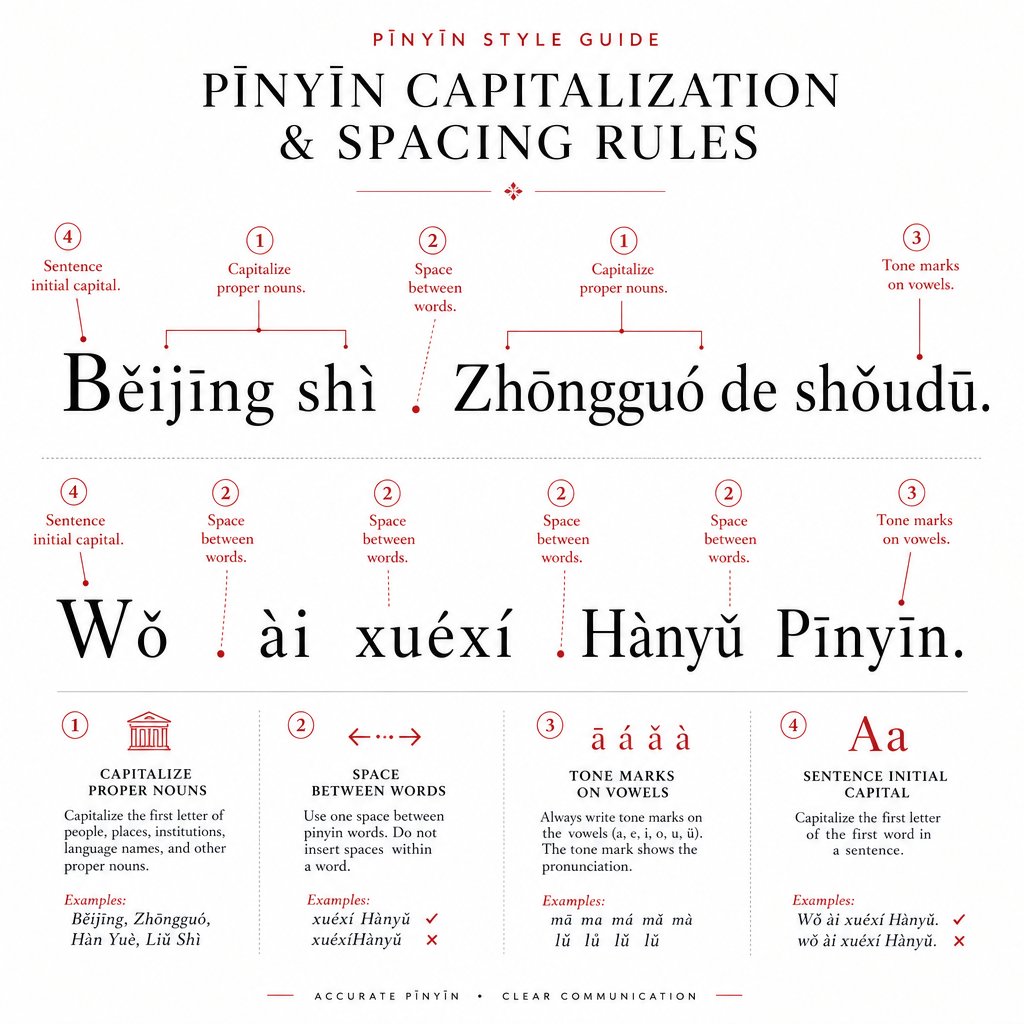
Pinyin names follow a straightforward capitalization principle: capitalize the first letter of the family name and the first letter of the given name. Both components are proper nouns, so both get initial caps. A two-syllable given name is written as a single word with only the first letter capitalized, not each syllable.
What about all-caps for the surname? You will see formats like "ZHANG Wei" or "Wei ZHANG" in some corporate and academic style guides. This approach uses full capitalization of the family name as a visual signal to help recipients identify which part is the surname. It is a legitimate chinese email writing format choice in international organizations, but it is not standard pinyin orthography. Use it when your organization's style guide requires it or when your audience consistently struggles to identify your family name.
Avoid writing your entire name in lowercase ("zhang wei") or in all caps ("ZHANG WEI"). Lowercase strips away the proper-noun signal entirely, making your name look like a common word. Full caps for both components eliminates the visual distinction between family name and given name, defeating the purpose of capitalization as a formatting cue.
Spacing and Hyphenation Best Practices
Spacing is where most formatting errors occur. The core rule is simple but frequently broken: place a space between the family name and the given name, but do not place a space within a two-syllable given name. The given name is treated as a single word regardless of how many syllables it contains.
Consider the name 王秀英. The correct pinyin rendering is "Wang Xiuying," not "Wang Xiu Ying." Splitting the given name into two separate words creates a three-part name that looks like a Western first-middle-last structure. A recipient might then assume "Xiu" is a middle name and address you as "Ms. Ying," which is wrong on multiple levels.
Hyphenation introduces another layer of complexity. In the Wade-Giles system, hyphens between given-name syllables were standard (e.g., "Hsiu-ying"). Hanyu Pinyin does not use hyphens within given names. However, you may still see hyphens in names from Taiwan or in older romanizations that have become established identities. If your professional name is already known with a hyphen, forcing a change could create more confusion than it resolves.
Compound family names like Ouyang (欧阳) present a specific case. The correct pinyin format writes the compound surname as one word: "Ouyang." Writing it as "Ou-yang" or "Ou Yang" splits the surname and makes it look like a given-name-plus-family-name combination, which completely inverts the name's structure for an unfamiliar reader.
Correct vs Incorrect Examples
The following table puts these rules side by side with concrete examples. When reviewing your own email format chinese name display, check your signature against each rule:
| Rule | Correct Example | Incorrect Example | Why It Matters |
|---|---|---|---|
| Capitalize family name and given name initial | Zhang Wei | zhang wei | Lowercase removes proper-noun recognition; recipients may not identify it as a name |
| Do not use all caps for both components | Zhang Wei (or ZHANG Wei) | ZHANG WEI | All caps for everything eliminates the visual cue distinguishing surname from given name |
| No space within a two-syllable given name | Wang Xiuying | Wang Xiu Ying | A space creates a false three-part structure that mimics Western first-middle-last names |
| No intercaps within the given name | Li Mingzhe | Li MingZhe | Intercaps (camelCase) are not standard pinyin and look like a software variable, not a name |
| No hyphen in given name (Hanyu Pinyin) | Chen Jianguo | Chen Jian-guo | Hyphens belong to Wade-Giles convention; mixing systems creates inconsistency |
| Compound surnames written as one word | Ouyang Xiu | Ou-yang Xiu / Ou Yang Xiu | Splitting the surname makes it look like a given name, inverting the entire name structure |
| Use apostrophe for ambiguous syllable boundaries | Xi'an (place) / Fang'an | Xian / Fangan | Without the apostrophe, "Xian" could be one syllable or two, creating misreadings |
One additional note on the apostrophe rule: while it applies more often to place names and common words, it can affect given names too. A name like "Lu'an" needs the apostrophe to prevent being read as "Luan." In a chinese letter writing format or any professional context, this small mark prevents genuine misidentification.
The underlying principle across all these rules is the same: your email signature must communicate your name structure without any verbal explanation. A recipient scanning your sign-off should instantly know which part is your family name, which is your given name, and how to address you. Every formatting choice either supports or undermines that instant recognition.
These capitalization and spacing conventions handle the structural clarity of your name. But there is one more visual element that divides opinion among professionals: whether to include the tone marks that sit above pinyin vowels, or leave them off entirely.
Tone Marks in Email Signatures: Include or Omit
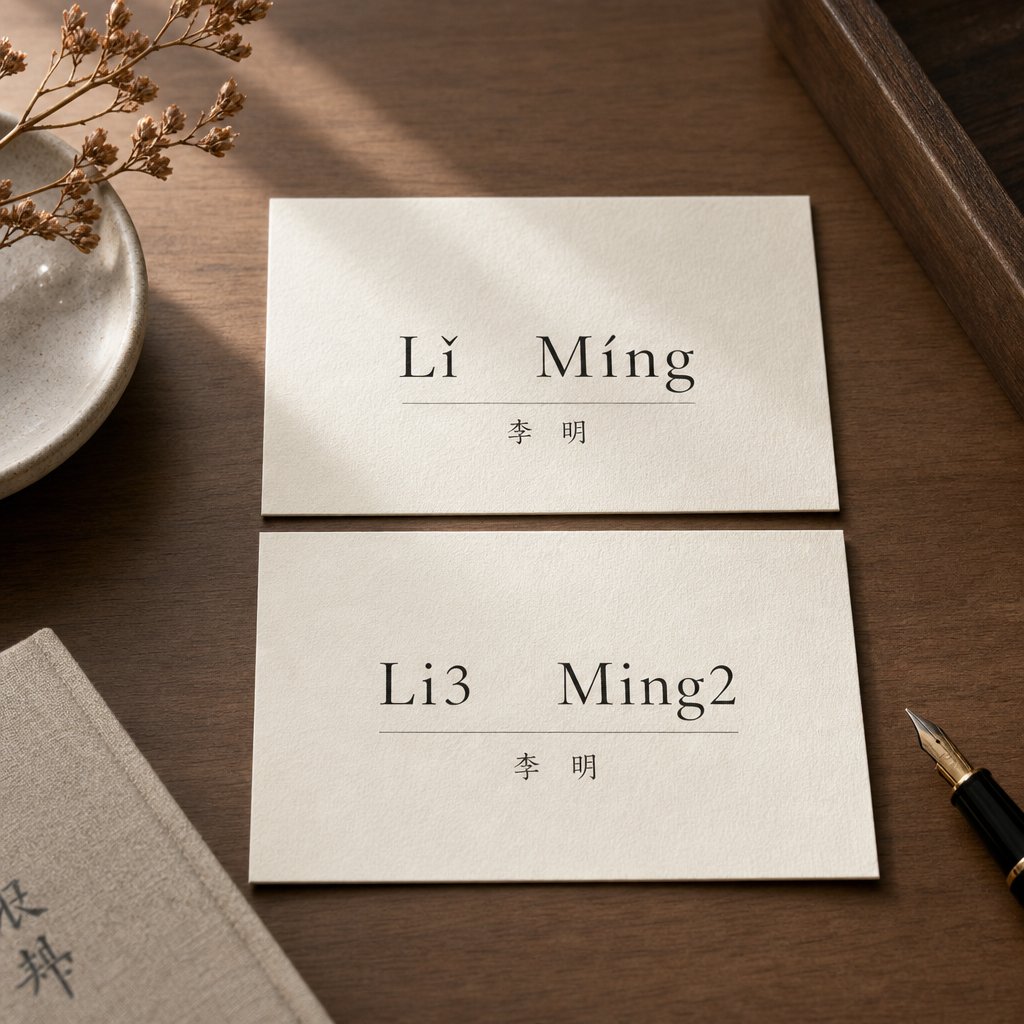
Pinyin tone marks are the small diacritics that sit above vowels: the flat line of first tone (ā), the rising stroke of second tone (á), the dipping curve of third tone (ǎ), and the falling slash of fourth tone (à). In a textbook or language-learning app, these marks are essential. They distinguish words that would otherwise look identical. But in a professional email signature, they introduce a practical question most people overlook: will your recipient's email client actually display them correctly?
This is not a theoretical concern. Tone marks are extended Unicode characters, and their rendering depends entirely on the encoding settings of the recipient's email client, operating system, and font stack. When any link in that chain fails, "Zhāng Wěi" can appear as garbled symbols, question marks in boxes, or broken character sequences. Your carefully formatted name suddenly looks like a software error.
Arguments For Including Tone Marks
- Linguistic accuracy: Tone marks convey pronunciation information that plain pinyin cannot. For recipients who read pinyin, they clarify exactly which characters your name represents.
- Academic convention: In sinology, linguistics, and Chinese studies, tone marks are expected in formal chinese scholarly writing. Omitting them in these fields can look imprecise.
- Disambiguation: Common pinyin syllables like "li" or "zhang" map to dozens of possible characters. Tone marks narrow the possibilities, which matters in a chinese formal email format where precision signals professionalism.
Arguments For Omitting Tone Marks
- Encoding unpredictability: Not all email clients handle diacritics reliably. As CodeTwo's documentation explains, non-Latin or accented characters can display as question marks or incorrect symbols when encoding settings are misconfigured, a problem tied to whether the sender's and recipient's systems both enforce UTF-8.
- Recipient unfamiliarity: Most non-Chinese-speaking professionals do not know what tone marks mean. The diacritics add visual noise without conveying useful information to the majority of international recipients.
- Search and database issues: CRM systems, address books, and corporate directories often strip or mishandle diacritics. Your name may become unsearchable or create duplicate entries.
- Cross-platform inconsistency: Even when one email client renders tone marks correctly, forwarding that message to another platform can break the display. A signature that looks polished in Gmail may appear corrupted in an older Outlook installation.
Encoding and Rendering Considerations
The root issue is character encoding. UTF-8 encoding supports over 1.1 million characters, including every pinyin tone mark. When both sender and recipient use UTF-8, diacritics render perfectly. The problem is that you cannot control your recipient's setup. Some organizations still use ISO-8859-1 or have misconfigured Exchange servers that default to legacy character sets. In those environments, your tone-marked name breaks silently, and you will never know it happened.
Plain ASCII characters, the basic Latin alphabet without any diacritics, render identically on every email platform, every operating system, and every font. Writing "Zhang Wei" instead of "Zhāng Wěi" guarantees universal compatibility. No encoding negotiation required, no rendering surprises.
The practical recommendation for most professionals: omit tone marks in your email signature. If your work falls within chinese formal writing in academic or linguistic contexts where tone marks carry meaningful information for your readers, include them, but test your signature by sending it to colleagues on different platforms first. For everyone else, especially in corporate international business, plain ASCII pinyin delivers clarity without risk. Your signature needs to look correct in every inbox it reaches, not just your own.
Tone marks are one dimension of how much linguistic detail to pack into a signature. The next question is broader: how do you handle the full bilingual picture when your professional identity spans both Chinese characters and romanized text?
Bilingual Signatures and English Adopted Names
Most professionals working across Chinese and English-speaking contexts do not operate in a single language. Their identity lives in two scripts simultaneously: Chinese characters that carry cultural meaning and pinyin (or an English adopted name) that makes them accessible to international contacts. The challenge is presenting both without creating a cluttered, confusing signature block that leaves recipients unsure what to call you.
A bilingual email signature is not just a nice-to-have for cross-border communication. It is a functional tool that helps different audiences find the version of your name they need. A Chinese-speaking colleague will scan for characters. A Western client will look for Latin letters. Your formatting determines whether both groups get what they need in a single glance.
Displaying Chinese Characters with Pinyin
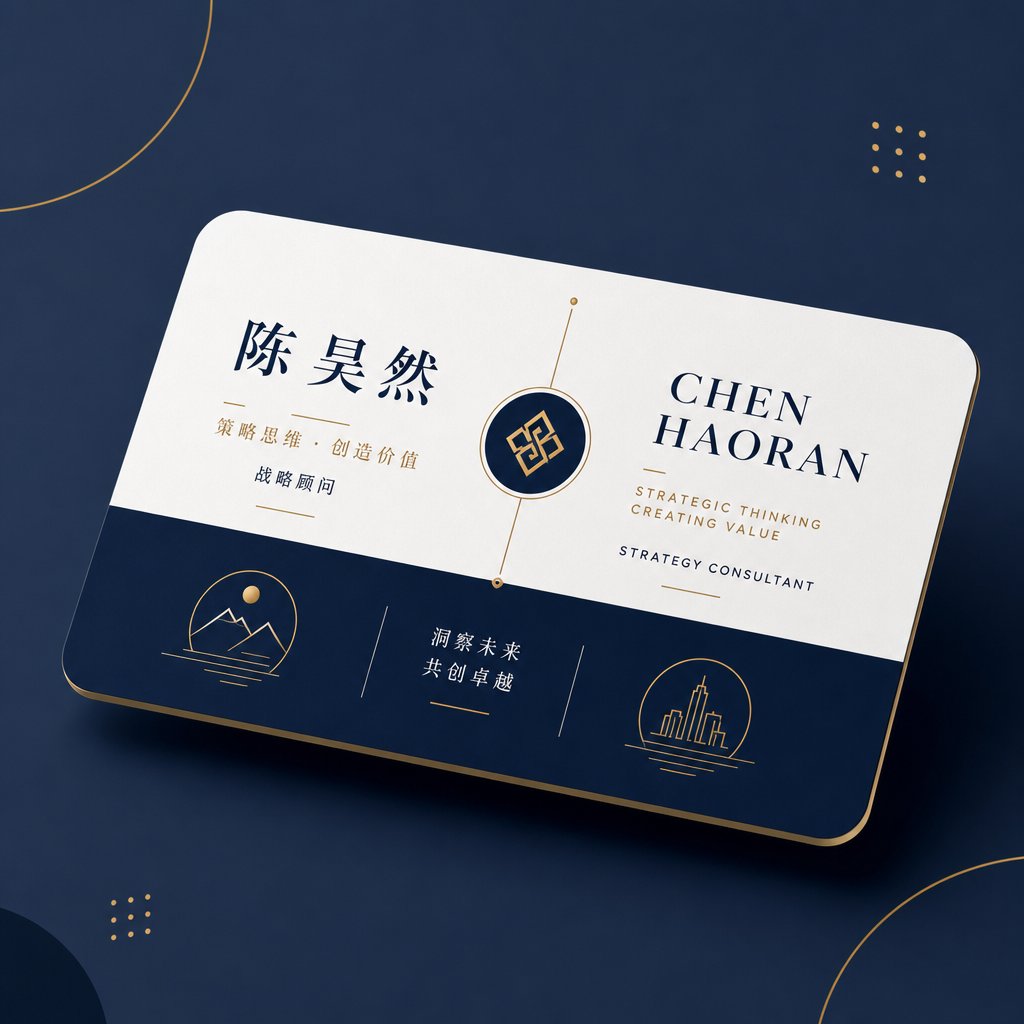
The most common approach places Chinese characters alongside their pinyin romanization so recipients can see both the original name and its pronunciation guide. But the order and visual relationship between these elements matters. As Chinese Name Translator's business card guide notes, the most professional layout prioritizes Chinese characters as the original and most authentic form while providing pinyin as a pronunciation guide.
In an email signature, you have less vertical space than a business card, so side-by-side or parenthetical formats work better than stacked layouts. Here are the core patterns:
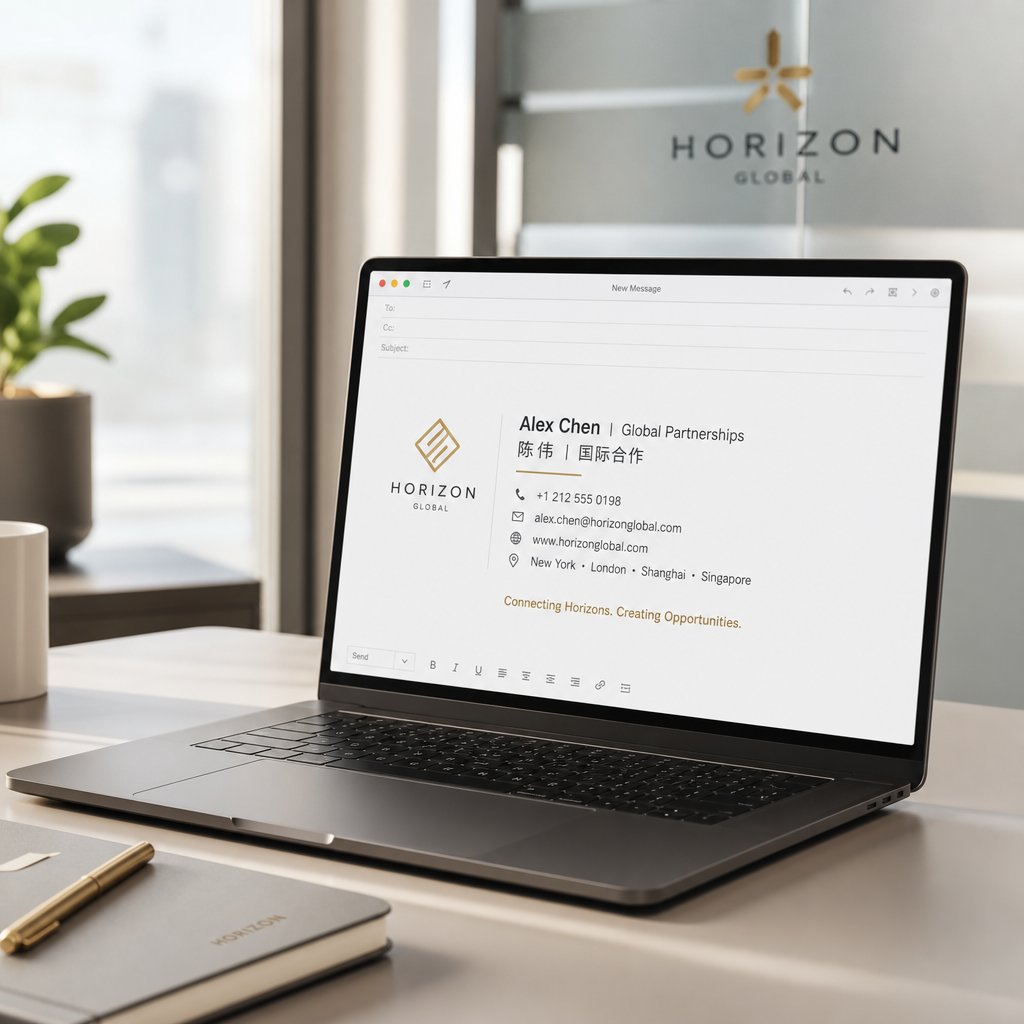
- Zhang Wei (张伟) — Pinyin first, characters in parentheses. Best for international business where most recipients read Latin script and the characters serve as a secondary identifier for Chinese-speaking contacts.
- 张伟 (Zhang Wei) — Characters first, pinyin in parentheses. Best when your primary audience is Chinese-speaking and the pinyin is a courtesy for occasional international recipients.
- Zhang Wei | 张伟 — Pipe separator with equal visual weight. Works well in corporate environments where both audiences are equally important and you want neither script to appear subordinate.
The choice between these patterns depends on who opens your emails most often. If 80% of your recipients read English, lead with pinyin. If the split is closer to even, the pipe-separator format signals equal respect for both audiences. This logic mirrors how professionals choose their email in chinese format for domestic versus international correspondence.
Incorporating English Adopted Names
Many Chinese professionals use an English adopted name alongside their Chinese name. Think "David," "Lisa," or "Kevin" paired with a Chinese surname. This practice is widespread in international business, and it raises a formatting question: where does the English name go in relation to the pinyin and characters?
Here are the most common patterns, each suited to a different professional context:
- David Zhang | 张伟 (Zhang Wei) — English adopted name as the primary display, with characters and pinyin as supporting information. Common in multinational corporations where colleagues already know you by your English name.
- Zhang Wei (David) | 张伟 — Pinyin as primary, English name as a familiar shorthand in parentheses. Useful when you want to maintain your Chinese name's prominence while giving Western colleagues an easy option for addressing you.
- Wei Zhang (David Zhang) — Western-order pinyin with the English adopted name in parentheses. A streamlined format for professionals who do not need to display characters because their recipients never interact with Chinese text.
- 张伟 Zhang Wei (David) — Characters and pinyin together, English name as a tertiary element. Appropriate for academic or diplomatic contexts where the chinese letter format formal conventions prioritize the full legal name.
One critical point from professional naming guides: your English adopted name's surname should match the pinyin of your Chinese surname. "David Zhang" works because "Zhang" is the pinyin for 张. "David Chen" when your actual surname is 张 creates a disconnect that confuses anyone trying to link your two identities. Consistency between your English name and your pinyin surname helps recipients immediately recognize that both names refer to the same person.
Formatting Patterns for Different Scenarios
Different professional contexts carry different norms for how much name information belongs in a signature. What works in a corporate setting may look excessive in a freelance context, and what passes in casual chinese emails between colleagues would feel incomplete in diplomatic correspondence.
Corporate international business: Keep it clean and scannable. Lead with the name your colleagues use daily, whether that is an English adopted name or pinyin in Western order. Include characters only if you regularly communicate with Chinese-speaking partners. A format like "David Zhang (张伟)" or "Wei Zhang | 张伟" covers most corporate needs without visual clutter.
Academia: Precision matters here. Include your full pinyin name in the order used in your publications, plus characters for anyone searching Chinese-language databases. Academics often omit English adopted names entirely because their published identity is their pinyin name. "Zhang Wei 张伟" with no parentheses or separators is common in scholarly signatures.
Freelance and creative professionals: Flexibility is your advantage. You can lean into whichever name feels most authentic to your brand. A designer working with both Chinese and international clients might use "张伟 Zhang Wei" with characters prominent, while a consultant primarily serving Western markets might simply go with "Wei Zhang" and skip characters altogether.
Diplomatic and government correspondence: Formal conventions apply. Full legal name in characters, followed by pinyin in official order (family name first), with any English name clearly marked as an alternative. This mirrors the chinese letter format formal standards used in official communications between institutions.
Regardless of which pattern you choose, the modern reality is that your email signature does not exist in isolation. Your name appears on Slack display names, LinkedIn profiles, Zoom meeting screens, Microsoft Teams cards, and WeChat business profiles. A recipient who sees "David Zhang" in your email but "Zhang Wei" on LinkedIn and "张伟" on WeChat has to do mental work to confirm these are all the same person.
The fix is straightforward: pick one bilingual format and replicate it everywhere. If your email signature reads "David Zhang | 张伟 (Zhang Wei)," your LinkedIn name field should reflect the same structure as closely as the platform allows. Your Zoom display name should match. Even a chinese informal letter format to a close colleague benefits from the same name presentation, because consistency builds recognition faster than any single formatting choice.
This cross-platform consistency becomes especially important when you consider that different email clients and collaboration tools render signatures differently. The formatting that looks polished in your compose window may not survive the journey to every recipient's inbox.
Platform-Specific Formatting for Gmail, Outlook, and Apple Mail
You have settled on your name order, romanization system, and bilingual format. Everything looks polished in your compose window. But here is the uncomfortable truth: the signature your recipient sees may not match what you designed. Gmail, Outlook, and Apple Mail each process signatures through different rendering engines, and each one handles Chinese characters, diacritics, and special formatting in its own way.
Before diving into platform specifics, there is a distinction many professionals miss entirely. Your email has two separate name-display elements: the "From" display name field (what appears in the inbox list before anyone opens your message) and the signature block at the bottom of the email body. Both need attention, and they are configured in completely different places. A perfectly formatted signature means nothing if your display name field still reads "wei zhang" in lowercase or truncates your bilingual name mid-character.
Gmail Signature Formatting for Pinyin Names
Gmail uses its own rendering engine that aggressively sanitizes HTML in signatures. It strips class-based CSS, rewrites inline styles, and proxies all images through Google's servers. For pinyin names specifically, Gmail handles UTF-8 Chinese characters well on initial display, so a chinese email address format like "Zhang Wei (张伟)" renders correctly in most cases. However, tone marks can behave unpredictably when Gmail reprocesses signatures in reply chains.
Gmail's display name field supports Unicode, meaning you can include Chinese characters alongside pinyin. But keep it concise. A display name like "David Zhang 张伟" works, while "David Zhang | 张伟 (Zhang Wei) | Senior Consultant" will likely get truncated in the recipient's inbox view, especially on mobile.
One Gmail-specific quirk: when sending mail in chinese or bilingual contexts, the signature editor sometimes introduces extra line breaks around Chinese characters. Preview your signature by sending a test email to yourself and checking it on both desktop and mobile Gmail before finalizing.
Outlook and Apple Mail Considerations
Outlook for Windows uses the Microsoft Word rendering engine for HTML email, a decision that has frustrated email designers for over a decade. This engine ignores many modern CSS properties and can reformat text spacing in ways that affect how your pinyin name displays. Specifically, Outlook may add its own paragraph spacing between your name line and your title line, breaking the tight visual hierarchy you designed.
For professionals who regularly email China-based contacts or maintain a chinese email address on an Exchange server, Outlook's character encoding is generally reliable for UTF-8 content on first send. The problems emerge in reply chains, where Outlook may re-encode quoted content and introduce artifacts around Chinese characters or diacritics. As Email Signature Rescue's research documents, Outlook frequently converts externally hosted images to attachments and applies its own font declarations to quoted content, overriding your original formatting choices.
Apple Mail, built on the WebKit browser engine, offers the most faithful initial rendering of HTML signatures. Chinese characters, pinyin with tone marks, and bilingual layouts all display cleanly. The catch comes in reply chains: Apple Mail wraps quoted content in blue left-border styling and may strip formatting when converting messages to plain text. On iOS, additional compression can degrade signature images, and the smaller screen width may cause table-based layouts to collapse.
Testing Your Signature Across Platforms
The differences across clients mean you cannot trust what you see in your own compose window. Here is a quick comparison of how each platform handles the elements that matter most for pinyin name formatting:
| Platform | Character Encoding Support | Display Name Length Limit | Known Issues with Diacritics |
|---|---|---|---|
| Gmail | Full UTF-8; proxies images through Google servers | ~70 characters before truncation in inbox view | Tone marks may break in reply chains after HTML sanitization |
| Outlook (Windows) | UTF-8 supported but Word engine may re-encode in replies | ~256 characters (rarely a practical limit) | Diacritics can display as question marks on misconfigured Exchange servers |
| Apple Mail | Full UTF-8 via WebKit; most standards-compliant | No hard limit; truncation depends on window width | Reliable on desktop; iOS may compress or reformat in forwarded messages |
The practical takeaway: before you finalize your signature, send test emails to at least one Gmail, one Outlook, and one Apple Mail account. Check both the display name in the inbox list and the full signature in the opened message. View each on desktop and mobile. If you use Chinese characters or tone marks, verify they render as actual characters rather than empty boxes or question marks on every platform.
HTML signatures give you more control over layout, fonts, and visual hierarchy than plain-text signatures. But that control comes with a trade-off: HTML renders differently across clients, while plain text looks identical everywhere. For a pinyin name signature, a well-structured plain-text fallback ensures your name remains readable even when HTML formatting gets stripped. Many professionals maintain both versions, letting the email client negotiate which to display based on the recipient's settings.
Platform testing confirms your signature works today. The next step is putting all these decisions together into a ready-to-use template you can deploy immediately.
Ready-to-Use Email Signature Templates with Pinyin
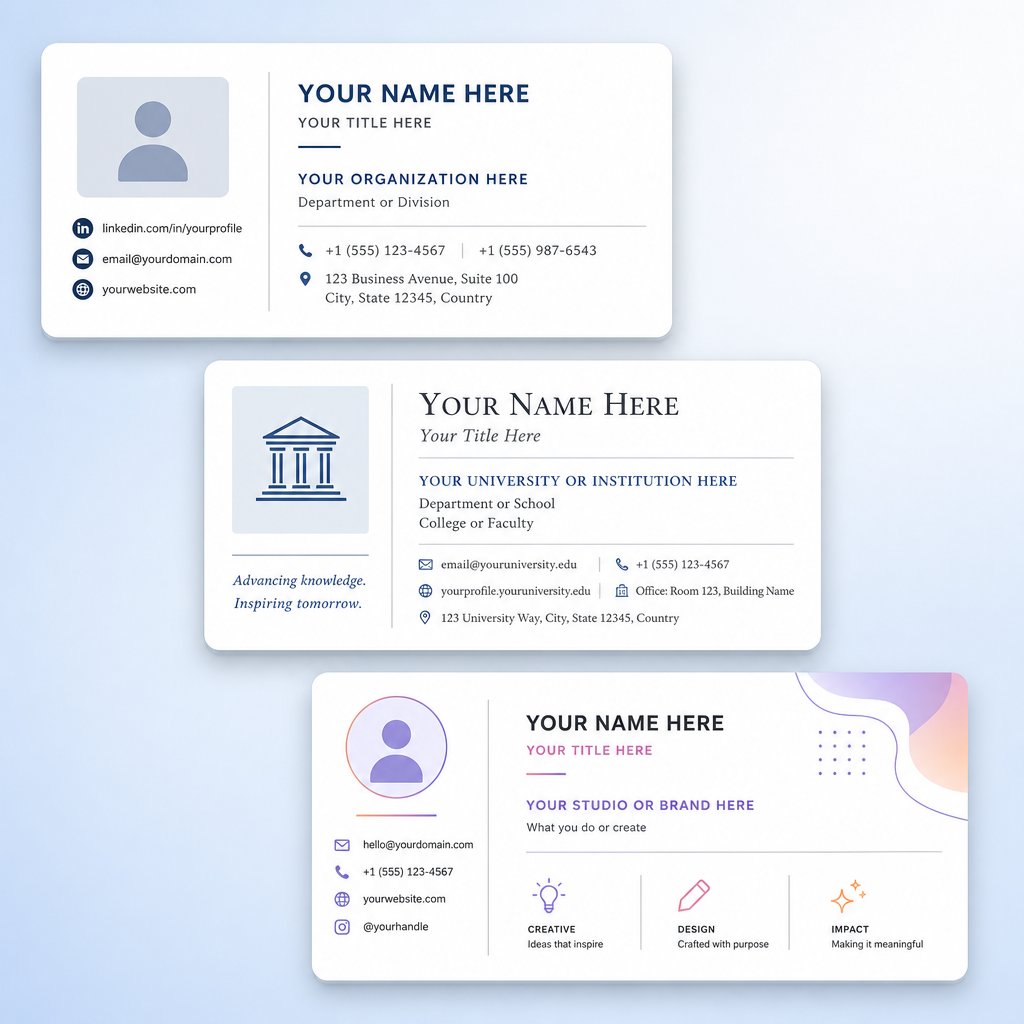
Knowing the rules is one thing. Seeing them applied in a complete, copy-ready signature block is another. The templates below bring together every formatting principle covered so far: correct name order, proper capitalization, bilingual display, and platform-safe encoding. Each one is designed for a specific professional context, so you can pick the pattern that matches your situation and adapt it to your organization's existing standards.
Two versions are provided for each scenario: a plain-text format that renders identically on every email client, and a structured HTML version that gives you more visual control. If you have tested your signature across Gmail, Outlook, and Apple Mail as recommended in the previous section, the HTML versions should display reliably. When in doubt, the plain-text fallback guarantees universal readability.
Corporate Email Signature Templates
Corporate signatures prioritize scannability. Recipients need to identify your name, role, and contact details within seconds. Lead with the name your colleagues use daily, whether that is an English adopted name or pinyin in Western order, and keep the bilingual elements compact.
Plain-text version (with English adopted name):
David Zhang | 张伟 (Zhang Wei)
Senior Business Development Manager
Global Solutions Inc.
Tel: +86 21 5888 7700
Email: [email protected]
LinkedIn: linkedin.com/in/davidzhang
Plain-text version (pinyin only, no adopted name):
Zhang Wei (张伟)
Regional Sales Director
SinoTech Partners Ltd.
Tel: +86 10 6532 4400
Email: [email protected]
HTML version (with adopted name and visual hierarchy):
<table cellpadding="0" cellspacing="0" style="font-family: Arial, sans-serif; font-size: 14px; color: #333333;">
  <tr>
    <td style="padding-bottom: 4px; font-size: 16px; font-weight: bold;">
      David Zhang <span style="font-weight: normal; color: #666666;">| 张伟</span>
    </td>
  </tr>
  <tr>
    <td style="padding-bottom: 8px; color: #555555;">
      Senior Business Development Manager
    </td>
  </tr>
  <tr>
    <td style="border-top: 1px solid #cccccc; padding-top: 8px;">
      Global Solutions Inc.<br>
      Tel: +86 21 5888 7700<br>
      Email: [email protected]
    </td>
  </tr>
</table>
Notice the formatting hierarchy at work here. The name sits at the top in a larger, bolder font. The Chinese characters appear in a lighter color as a secondary identifier rather than competing for attention. This follows the visual hierarchy principle where the most important element (your name) gets the strongest visual weight, and supporting details step back. A chinese email example like this works well for professionals who communicate primarily with English-speaking contacts but want Chinese-speaking partners to recognize them instantly.
Academic Email Signature Templates
Academic signatures carry different expectations. Precision matters more than brevity. Your published name, institutional affiliation, and research identity all need to be present. Academics typically use their full pinyin name rather than an English adopted name, because their publication record is tied to that specific spelling.
Plain-text version (researcher with bilingual display):
Li Mingzhe 李明哲
Associate Professor, Department of Comparative Literature
Beijing Normal University 北京师范大学
Email: [email protected]
ORCID: 0000-0002-1234-5678
ResearchGate: researchgate.net/profile/Mingzhe-Li
Plain-text version (postdoctoral researcher at a Western institution):
CHEN Jiahui (陈嘉慧)
Postdoctoral Research Fellow
Center for East Asian Studies, Stanford University
Email: [email protected]
Google Scholar: scholar.google.com/citations?user=XXXXX
HTML version (academic with full bilingual formatting):
<table cellpadding="0" cellspacing="0" style="font-family: 'Times New Roman', serif; font-size: 13px; color: #222222;">
  <tr>
    <td style="padding-bottom: 2px; font-size: 15px; font-weight: bold;">
      Li Mingzhe <span style="font-weight: normal;">李明哲</span>
    </td>
  </tr>
  <tr>
    <td style="padding-bottom: 2px;">
      Associate Professor, Department of Comparative Literature
    </td>
  </tr>
  <tr>
    <td style="padding-bottom: 8px;">
      Beijing Normal University 北京师范大学
    </td>
  </tr>
  <tr>
    <td style="border-top: 1px solid #999999; padding-top: 6px; font-size: 12px; color: #555555;">
      Email: [email protected]<br>
      ORCID: 0000-0002-1234-5678
    </td>
  </tr>
</table>
The second plain-text example uses the all-caps surname convention ("CHEN Jiahui") common in international academic institutions. This is a chinese letter format sample you will see across journal submissions, conference programs, and university directories. It eliminates any ambiguity about which component is the family name, which is especially useful when your work appears in citation databases where name parsing affects discoverability.
Freelance and Creative Professional Templates
Freelancers and creative professionals have more flexibility. Your signature is part of your personal brand, so it can lean into whichever name presentation feels most authentic to your work. A designer serving both Chinese and international clients might foreground characters. A consultant targeting Western markets might keep things minimal.
Plain-text version (bilingual creative professional):
Wang Yue 王悦
Freelance UX Designer
Portfolio: wangyue.design
Email: [email protected]
WeChat: wangyue_design
Plain-text version (consultant with English adopted name, minimal format):
Sophie Liu (Liu Jing | 刘静)
Independent Strategy Consultant
Email: [email protected]
Tel: +1 415 555 0192
LinkedIn: linkedin.com/in/sophieliu
HTML version (creative professional with brand-forward styling):
<table cellpadding="0" cellspacing="0" style="font-family: 'Helvetica Neue', sans-serif; font-size: 13px; color: #333333;">
  <tr>
    <td style="padding-bottom: 4px; font-size: 16px; font-weight: bold; color: #1a1a1a;">
      Wang Yue <span style="font-size: 15px; color: #444444;">王悦</span>
    </td>
  </tr>
  <tr>
    <td style="padding-bottom: 8px; font-style: italic; color: #666666;">
      Freelance UX Designer
    </td>
  </tr>
  <tr>
    <td style="border-top: 1px solid #dddddd; padding-top: 8px; font-size: 12px;">
      Portfolio: wangyue.design<br>
      Email: [email protected]<br>
      WeChat: wangyue_design
    </td>
  </tr>
</table>
Freelancers often include WeChat alongside traditional contact details, especially when serving clients in China. This chinese email sample reflects the reality that professional communication in Chinese business contexts frequently moves from email to messaging platforms early in the relationship.
A few principles apply across all three contexts. First, adapt these templates to match your organization's existing signature standards. If your company mandates a specific font, color scheme, or layout structure, preserve those while applying the pinyin formatting rules from earlier sections. Second, keep your name as the largest or boldest element in the signature. As visual hierarchy research confirms, the first and last name should be the most prominent text in any signature block because it builds trust and personalization. Third, test every template by sending it to yourself on multiple platforms before deploying it live.
These templates give you a starting point, not a rigid formula. The best signature is one that applies correct pinyin formatting principles while fitting naturally into your professional context. With a working template in place, the final step is pulling all your decisions into a single checklist that keeps your name consistent everywhere it appears.
Building a Consistent Professional Identity with Pinyin
Every section of this guide has involved a decision. Name order, romanization system, capitalization, tone marks, bilingual display, platform testing. Taken individually, each choice is manageable. Taken together, they form a complete system that determines whether recipients can identify, address, and remember you correctly. The professionals who get this right are the ones who make these decisions once, document them, and apply them everywhere.
Your Pinyin Email Signature Decision Checklist
When you sit down to finalize your signature, work through these steps in order. Each one builds on the previous decision:
- Decide name order based on your primary audience. If most recipients are non-Chinese-speaking, use Western order (given name + family name). If most are Chinese-speaking or you work in academic sinology, use Chinese order (family name + given name). Consider capitalizing the surname (ZHANG Wei) if your audience is mixed.
- Confirm your romanization system. Use Hanyu Pinyin unless you have an established professional identity in Wade-Giles or another system. Do not mix systems across platforms.
- Decide on tone marks. Omit them for corporate and general professional contexts. Include them only if your field expects linguistic precision and you have verified rendering across your recipients' platforms.
- Choose a bilingual format if needed. Select a pattern that matches your professional context: "David Zhang | 张伟" for corporate, "Li Mingzhe 李明哲" for academic, or pinyin-only if your recipients never interact with Chinese text.
- Test across platforms. Send your finalized signature to at least one Gmail, one Outlook, and one Apple Mail account. Check both desktop and mobile. Verify that characters render correctly and nothing truncates.
This checklist works whether you are learning how to write an email in chinese for the first time or refining a signature you have used for years. The goal is not perfection on the first attempt but a deliberate, documented set of choices you can apply consistently.
Maintaining Consistency Across Digital Platforms
Your email signature is just one touchpoint. Recipients encounter your name on LinkedIn profiles, Slack display names, Zoom meeting screens, conference badges, published papers, and business cards. Every inconsistency forces people to wonder whether they are looking at the same person. As brand alignment research shows, consistent presentation across digital platforms builds recognition and trust, and inconsistency erodes both.
Think of your pinyin name format as a personal brand element. The same way a company uses identical logos and colors everywhere, your name should appear in the same format across every professional surface. If your email signature reads "Wei Zhang (张伟)," your LinkedIn name field, Zoom display name, and published bylines should follow the same structure as closely as each platform allows.
This consistency extends beyond the name itself. How to write a chinese email, how to end a chinese email, and how to close a letter in chinese all involve conventions that reinforce your professional identity. A well-formatted chinese email ending paired with a clear signature creates a cohesive impression from greeting to sign-off. When every element aligns, recipients build a mental model of who you are that sticks.
The underlying principle is simple: the best email signature pinyin name format is the one that helps recipients correctly identify and address you without hesitation. It is not about following rules for their own sake. It is about removing friction from every professional interaction so people remember your work, not their confusion about your name.
Frequently Asked Questions About Email Signature Pinyin Name Format
1. Should I put my Chinese family name first or last in my email signature?
It depends on your primary audience. If most of your recipients are non-Chinese-speaking, use Western order with your given name first (e.g., Wei Zhang). If your audience is predominantly Chinese-speaking or you work in academic sinology, keep Chinese order with the family name first (e.g., Zhang Wei). For mixed audiences, capitalizing the surname in full (ZHANG Wei or Wei ZHANG) helps recipients identify which component is the family name regardless of order. The most important factor is consistency across all your professional platforms.
2. Should I include tone marks in my pinyin email signature?
For most professional contexts, omit tone marks. While they provide linguistic accuracy, tone marks are extended Unicode characters that may not render correctly across all email clients. Recipients using misconfigured Exchange servers or legacy encoding settings might see garbled symbols instead of your name. Plain ASCII pinyin (Zhang Wei instead of Zhang Wei with diacritics) guarantees universal compatibility. The exception is academic or linguistic fields where tone marks carry meaningful information for your readers, but always test rendering across platforms first.
3. How do I format a two-syllable Chinese given name in pinyin for my email signature?
Write the two-syllable given name as a single word with only the first letter capitalized. For example, the name 王秀英 should appear as Wang Xiuying, not Wang Xiu Ying or Wang XiuYing. Splitting the given name into two words creates a false three-part structure that mimics Western first-middle-last names, causing recipients to misidentify parts of your name. Similarly, avoid hyphens between syllables (Xiu-ying) unless you use the Wade-Giles system and have an established identity with that spelling.
4. What is the best way to display both Chinese characters and pinyin in an email signature?
Choose a format based on your primary audience. For international business where most recipients read English, lead with pinyin and place characters in parentheses: Zhang Wei (张伟). For Chinese-speaking audiences, reverse it: 张伟 (Zhang Wei). If both audiences are equally important, use a pipe separator for equal visual weight: Zhang Wei | 张伟. If you also use an English adopted name, a format like David Zhang | 张伟 (Zhang Wei) covers all bases. Whichever pattern you choose, replicate it across LinkedIn, Slack, Zoom, and other platforms for consistent recognition.
5. Which romanization system should I use for my name in an email signature?
Use Hanyu Pinyin unless you have an established professional identity in another system. Hanyu Pinyin is the ISO 7098 international standard, used by the United Nations, global media, and most academic institutions. Wade-Giles may be appropriate if your passport, published research, or decades of correspondence already use that spelling, particularly for Taiwanese professionals. Switching systems mid-career can create more confusion than it solves, so if you are starting fresh, Hanyu Pinyin offers the widest recognition and best consistency for international communication.