The Only Ancient Script Still Alive Today
Imagine picking up a document written over two thousand years ago and still being able to read parts of it. For readers of Chinese characters, this isn't hypothetical. It's reality. Of every ancient writing system ever invented, Chinese hanzi is the only one still used in daily life by over a billion people. Egyptian hieroglyphics fell silent. Sumerian cuneiform crumbled into archaeological curiosity. Yet Chinese characters kept going, adapting across dynasties, revolutions, and technological upheavals.
The World's Longest-Living Writing System
So what are Chinese characters called in their native language? They're known as hanzi (汉字), literally "Han characters." Unlike a Chinese alphabet (which doesn't technically exist), each character represents a meaningful unit rather than a single sound. This distinction matters. It's the reason a modern Mandarin speaker can look at a Han Dynasty text and grasp its meaning, even though pronunciation has shifted dramatically over two millennia. Try doing that with Egyptian hieroglyphics or Mayan glyphs and you'll hit a wall immediately.
As Zev Handel, professor of Chinese at the University of Washington, points out: "Egyptian hieroglyphs and Sumerian cuneiform each lasted about 3,000 years, and that's where we are right now with Chinese." The system has reached the same age at which other scripts died, yet it shows no signs of slowing down.
Why Writing Systems Change Over Time
Here's the question worth sitting with: how does writing reflect the culture that produces it? The evolution of Chinese characters wasn't random. Every shift in form, from pictographic sketches on bone to streamlined strokes on screens, responded to something concrete. A new writing surface. A political mandate. The need for speed.
Chinese characters have survived for over 3,000 years not by staying the same, but by adapting continuously to the materials, politics, and technologies of each era.
What is Chinese writing called when people refer to the broader system? You'll hear terms like "hanzi," "Chinese script," or simply "Chinese writing symbols." Whatever the label, the system's genius lies in its flexibility. Throughout this article, we'll trace specific characters, like those for mountain, water, and horse, through each evolutionary stage. You'll see how a recognizable picture of a horse carved into turtle shell became the abstract 马 typed on phones today. Each transformation tells a story about the people who made it happen.
That story begins long before the first confirmed writing, in a murky period of pottery marks and proto-symbols that scholars still debate.
Before Writing Began and the Proto-Writing Debate
Thousands of years before anyone carved divination questions into turtle shells, Neolithic communities across China were scratching marks into wet clay. These ancient chinese symbols, found on pottery fragments dating back to roughly 5000 B.C., raise a tantalizing question: are we looking at the earliest seeds of Chinese writing, or just decorative scratches with no linguistic meaning?
Pottery Marks and Proto-Writing Symbols
The most famous examples come from the Banpo village site near modern Xi'an, where archaeologists uncovered painted pottery bearing simple geometric marks, short lines, crosses, angles, and shapes resembling numerals. Similar marks have turned up at Jiahu (circa 6600 B.C.), Dadiwan, and Liangzhu culture sites, scattered across a wide geographic range. Some of these ancient china symbols look strikingly similar to later Chinese characters. A few even resemble oracle bone forms for numbers or basic concepts.
Sounds like early writing, right? Not so fast. Scholars remain deeply divided. The core debate hinges on specific criteria that separate true writing from symbolic marking:
- Systematic use: True writing requires a consistent set of symbols used repeatedly with shared meaning across a community.
- Linguistic mapping: Writing must represent language, not just ideas. Each symbol needs to correspond to words or morphemes in a spoken tongue.
- Combinability: Symbols must combine in structured ways to express complex thoughts beyond what a single mark conveys.
The Banpo pottery marks fail most of these tests. They appear in isolation, rarely repeat in recognizable patterns, and show no evidence of combining into sequences. Most scholars classify them as clan emblems, ownership marks, or tally symbols rather than true ancient china writing. Yet a minority argue these marks represent a proto-writing stage, a necessary precursor that planted the conceptual seeds for what came later.
The Archaeological Trail Before Oracle Bones
Here's where the mystery deepens. When confirmed Chinese ancient writing finally appears on oracle bones around 1200 B.C., it arrives fully formed. The script already contains thousands of distinct characters, complex grammatical structures, and multiple character-formation methods. This level of sophistication doesn't emerge overnight. It implies centuries, possibly millennia, of prior development that left almost no trace in the archaeological record.
Why the gap? Several explanations circulate among researchers. Writing during the intervening period may have been practiced on perishable materials like wood, bamboo, or silk, none of which survive well in China's climate. It's also possible that ancient china language and writing developed in regions not yet excavated, or that early texts were limited to elite contexts where few artifacts were produced.
Some tantalizing clues do exist. Symbols found on late Neolithic pottery from the Dawenkou culture (circa 2500 B.C.) appear more complex and pictographic than the earlier Banpo marks. A few scholars have drawn connections between these and later oracle bone forms, though the links remain speculative. What we can say with confidence is that the leap from isolated pottery marks to a mature writing system of 4,500-plus characters didn't happen in a vacuum. An entire developmental chapter of ancient chinese hieroglyphics and proto-scripts remains hidden beneath the soil, waiting for future discoveries to fill the gap.
The writing system that finally emerges into clear view, oracle bone script, arrives not as a tentative experiment but as a powerful tool of royal authority, carved into animal bones to communicate with ancestors and gods.
Oracle Bone Script and the Shang Dynasty Origins
Picture this: a scholar in 1899 Beijing glances into his bowl of herbal medicine and notices something odd. Scratched into a fragment of bone floating in the broth are markings, faint but deliberate, that look like ancient writing. That moment of recognition would rewrite the origin of chinese characters and push confirmed Chinese literacy back by centuries.
Wang Yirong's Discovery and Its Significance
The scholar was Wang Yirong, a chancellor of the Imperial Academy and an expert in ancient inscriptions. At the time, fragments of old bone and shell were being sold in Chinese apothecaries as "dragon bones," ground into powder for traditional remedies. A popular legend even tells of a barber named Li Cheng from the village of Xiaotun who supposedly discovered that powdered bone fragments healed his skin sores, then went door to door selling ground-up dragon bones as medicine.
Whether or not that folk tale holds any truth, Wang Yirong's trained eye saw what others had missed. He suspected the markings were an archaic script, possibly older than the bronze vessel inscriptions from the Western Zhou dynasty (1046-771 B.C.), which were then considered the oldest chinese characters known to scholarship. He was right. What had been floating in medicinal soup turned out to be the earliest writing ever confirmed in East Asia.
Wang's discovery triggered an immediate investigation into where these bones originated. Archaeologists traced them back to fields near Xiaotun village, close to modern Anyang in Henan province. Over the following decades, excavations revealed that this site was Yinxu, the last capital of the Shang dynasty. The ruins yielded not just inscribed bones but cemeteries, sacrificial pits, temples, and palaces. In 2006, UNESCO designated Yinxu a World Heritage site, recognizing it as ground zero of recorded Chinese history.
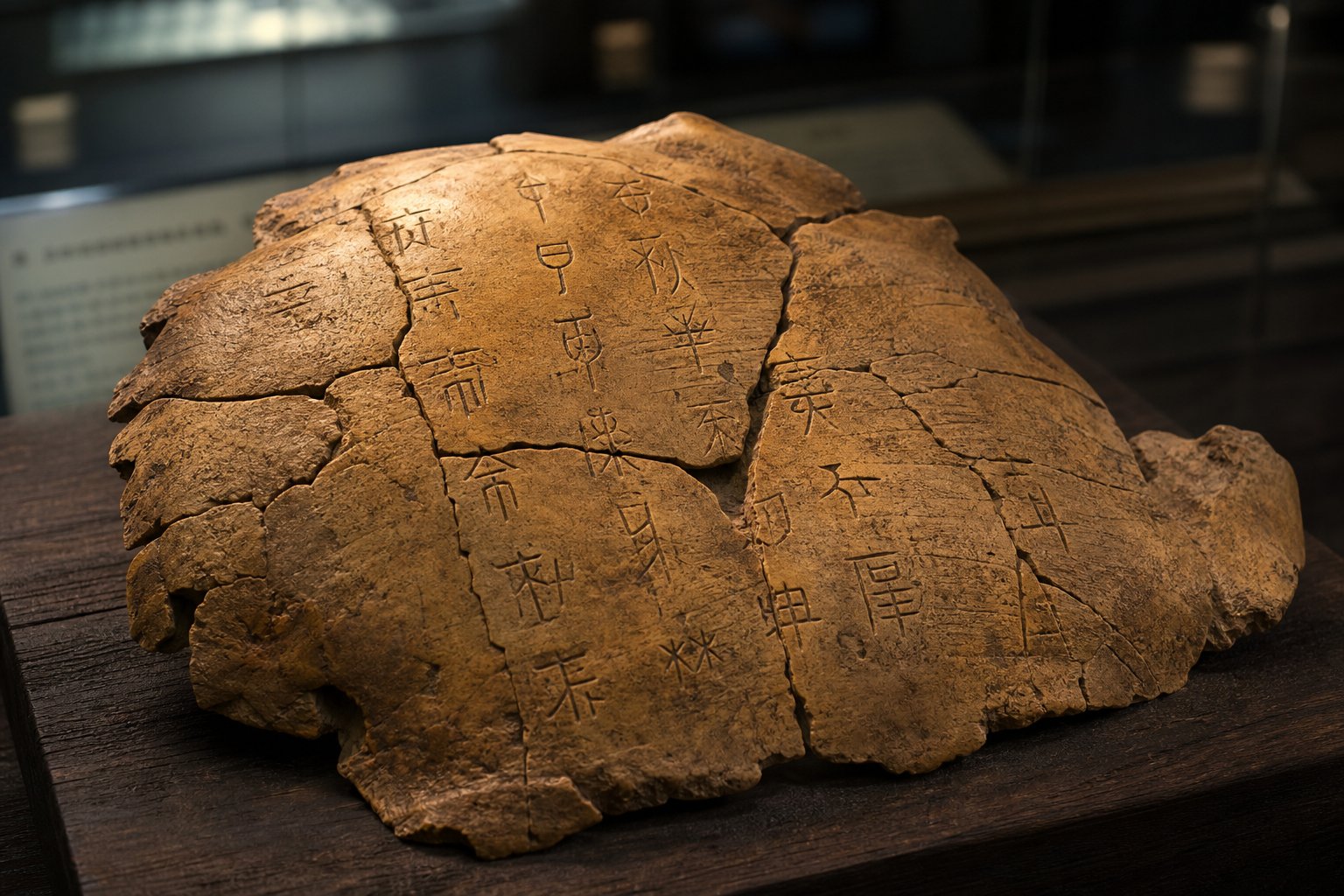
So what exactly were these bones used for? The oracle bone script, known in Chinese as 甲骨文 (jiaguwen), served a specific ritual purpose. Under the direction of the Shang king and his diviner, ox scapulae (shoulder blade bones) and turtle plastrons (the flat undershell) were scraped clean, polished, and prepared with rows of carved grooves and pits. During divination, a heated rod was inserted into these grooves, producing hairline cracks on the opposite surface. The diviner then interpreted the direction and pattern of those cracks as answers from ancestral spirits. A scribe carved the king's question, and later the outcome, directly onto the bone or shell.
The Smithsonian's National Museum of Asian Art notes that most oracle bone inscriptions contain four parts: an introduction, a charge (the topic), a prognostication (interpretation of cracks), and a verification (the actual outcome). Questions ranged from weather forecasts and harvest predictions to military campaigns and royal toothaches. Through these inscriptions, we glimpse the daily anxieties and ambitions of rulers who lived over three thousand years ago.
What Oracle Bones Reveal About Early Characters
The earliest examples of chinese writing are found on these very bones and shells, and they reveal something remarkable about how ancient people turned the visible world into written language. Early chinese characters in the oracle bone script were overwhelmingly pictographic. You can look at them and see what they represent.
Consider a few examples:
- 马 (horse): The oracle bone form shows a recognizable animal in profile, with a mane, four legs, and a tail. The pictorial origin is unmistakable.
- 山 (mountain): Three peaks rising from a baseline, a direct sketch of a mountain range as seen from a distance.
- 水 (water): Wavy vertical lines depicting flowing water, sometimes with dots suggesting droplets or splashes.
- 日 (sun): A circle with a dot or line in the center, representing the solar disc.
- 月 (moon): A crescent shape, capturing the moon in its most recognizable phase.
These chinese ancient characters weren't abstract symbols invented from nothing. They were drawings, simplified and stylized, but still rooted in direct observation of the physical world. Animals, body parts, natural phenomena, tools, and plants all found their way into this early visual vocabulary.
The numbers tell an interesting story too. Approximately 4,500 distinct characters have been identified across the more than 150,000 oracle bone fragments discovered at Yinxu. Yet only about 1,500 of those characters have been definitively deciphered. The rest remain mysteries, their meanings lost because the objects or concepts they represented may have fallen out of use, or because too few contextual examples survive to pin down a reliable interpretation.
Material constraints also left a visible fingerprint on these ancient chinese characters. Carving into hard turtle shell or dense bone with a sharp stylus is physically demanding work. You can't easily produce thick, flowing curves the way you might with a brush on silk. The result? Oracle bone characters tend to be angular, thin-lined, and compact. Strokes are straight or only slightly curved. Complex forms get simplified to what's achievable with a pointed tool pressed into resistant material. Imagine trying to draw a detailed horse with a nail on a ceramic plate, and you'll understand why these early scribes favored economy of line.
This relationship between writing surface and character form is a pattern that repeats throughout the history of writing in the Shang dynasty and beyond. When the medium changed, so did the script. The next major shift came when Chinese civilization discovered a new canvas for its words: cast bronze. And bronze didn't just change how characters looked. It changed what writing was for.
Bronze Inscriptions and the Era of Regional Scripts
Bronze changed everything. When the Western Zhou dynasty (1046-771 BC) cast ritual vessels from alloys of copper, tin, and lead, they weren't just making cookware. They were creating monuments meant to last forever, and the characters inscribed on them reflected that ambition. This shift from carving bone to casting metal marks one of the most visually dramatic chapters in chinese script evolution.
From Bone to Bronze and How Material Shaped Form
Think about the difference between scratching into a hard shell with a stylus and pressing characters into a soft clay mold that will later be filled with molten metal. The physical constraints are completely different. Bronze inscriptions, known as 金文 (jinwen, literally "metal writing"), allowed scribes to produce thicker, rounder strokes with a fluidity impossible on bone. Lines could swell and taper. Curves could flow without the resistance of a hard surface fighting back.
The purpose of early chinese writing on bronze also shifted dramatically. Oracle bones asked questions of the dead. Bronze vessels celebrated the living and honored ancestors through commemorative records. Inscriptions documented military victories, royal awards, treaties, and lineage histories. The privilege of casting bronze was reserved for the Zhou king, who shared it with allied noble families through ritual ceremonies. These vessels served in sacrificial rites, offering food and drink to ancestral spirits in exchange for blessings of wealth, longevity, and fertility.
Early Western Zhou inscriptions were short, sometimes just a clan name of ten characters or fewer, echoing Shang tradition. Over time, texts grew dramatically longer and appeared on the outer surfaces of vessels, visible even from a distance. By the late Western Zhou period, inscriptions included full lineage histories stretching back to a family's first ancestor who served the Zhou court. The ancient chinese script on these bronzes became increasingly standardized and repetitive in structure, even as it grew more complex in content.
Regional Divergence During the Warring States Period
When the Zhou central authority collapsed and China fractured into competing kingdoms during the Warring States period (475-221 BC), something fascinating happened to the writing system. Without a central power enforcing consistency, each state's script drifted in its own direction. The same character might look completely different depending on whether it was written in Chu, Qi, or Qin. Imagine trying to read a document from a neighboring kingdom and finding the old chinese characters barely recognizable.
Scholars generally classify Warring States writing into five regional script traditions, each with distinctive visual characteristics:
- Qi (eastern): Characters were vertically elongated and slender, fitted into imaginary narrow rectangles. Straight lines dominated, with sharp tips at stroke endings giving a sense of firmness and formality.
- Chu (southern): A "supple and sinuous" calligraphic style with flowing, curved strokes. Chu scribes also developed the ornate "bird-and-insect script," embedding stylized bird and worm imagery into character strokes for decorative effect.
- Qin (western): Square, squat characters with round stroke endings, closely preserving the balanced proportions of mid-to-late Western Zhou inscriptions. This conservative style would later become the basis for national standardization.
- Yan (northern): Influenced by both eastern elongation and southern decorative tendencies, showing that cultural exchange crossed political borders.
- Three Jin states (central): A transitional zone where brush-written manuscripts on bamboo developed calligraphic features distinct from formal bronze script chinese traditions.
These weren't just cosmetic differences. Regional divergence in china writing created real communication barriers across kingdoms. A merchant from Chu reading a Qin legal document would struggle with unfamiliar character forms. Administrative coordination between allied states required scribes trained in multiple regional conventions. The ancient china characters of this period reveal a writing system pulling apart at the seams, fragmenting along political lines.
This chaos couldn't last. When one kingdom finally conquered all the others, unifying the script became not just a cultural project but a political necessity. That kingdom was Qin, and its solution would reshape Chinese writing permanently.
Standardization Under Qin and the Clerical Transformation
Qin didn't just conquer six rival kingdoms. It erased their scripts. In 221 BC, when Qin Shi Huang declared himself the first emperor of a unified China, he inherited a patchwork of mutually confusing regional writing systems. His response was swift and absolute: one empire, one script. This single decree triggered the most deliberate act of standardization in chinese characters history, and it permanently altered how the written language looked, functioned, and spread.
Qin Shi Huang's Mandate for One Script
The Qin court viewed script variation as more than an inconvenience. It was a threat. Differing character forms across former kingdoms hindered taxation, slowed communication between officials, complicated trade, and could even serve as a vector for political dissent. Around 220 BC, Qin Shi Huang ordered a systematic standardization of the country's weights, measures, currency, and writing system. Character forms that differed from those used by Qin scribes were discarded outright.
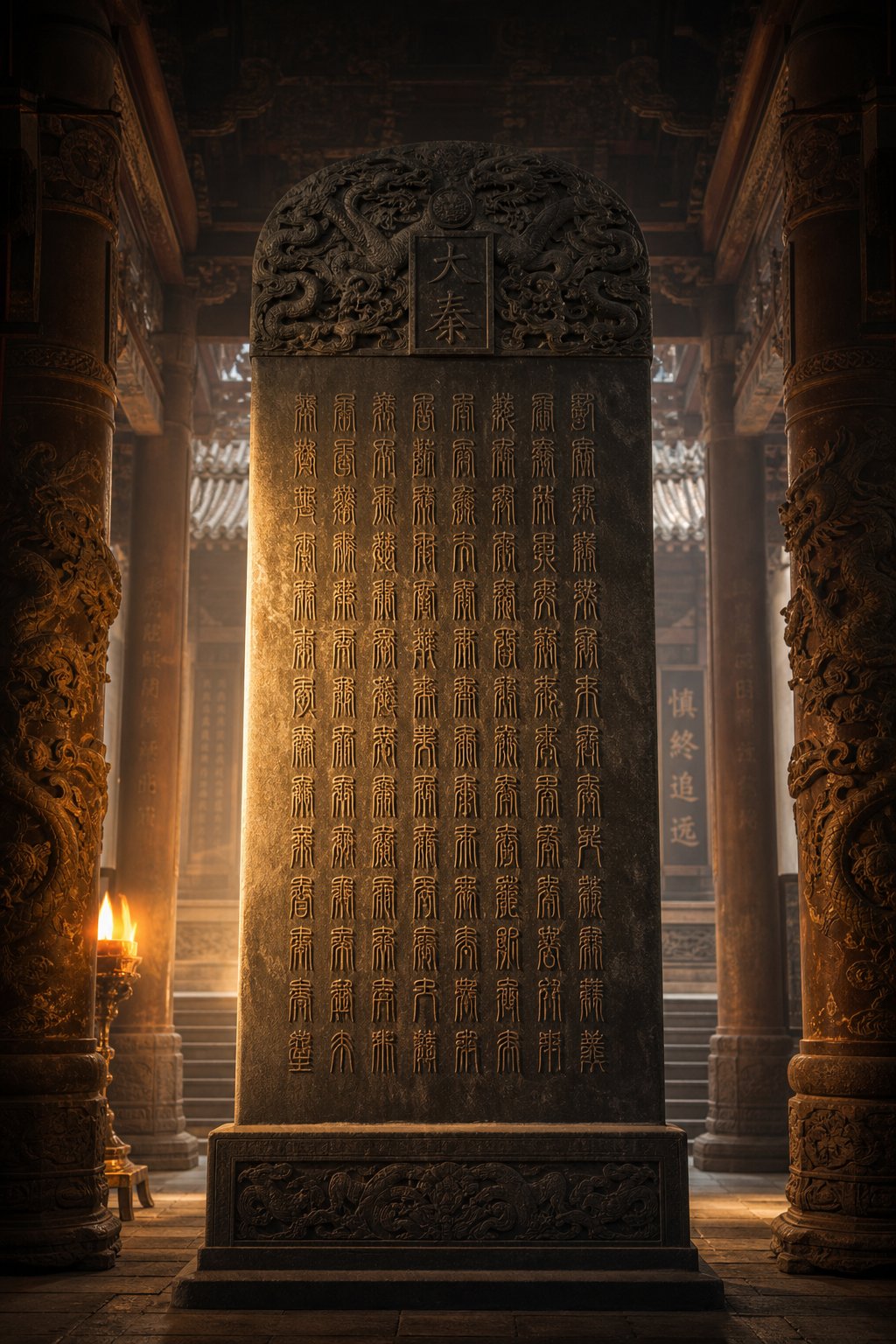
The man tasked with executing this linguistic unification was Chancellor Li Si, one of the most powerful political figures of the era. Li Si compiled the Cangjiepian, a primer containing approximately 3,300 standardized characters that would serve as the official reference for the entire empire. The script he promoted became known as Small Seal Script (小篆, xiaozhuan), built upon the Qin state's own writing tradition, which had remained relatively conservative compared to the more experimental scripts of Chu or Qi.
What did Small Seal Script actually look like? Imagine characters that are:
- Symmetrical: Left and right sides mirror each other wherever possible, giving each character a sense of formal balance.
- Elongated: Characters stretch vertically into tall, narrow rectangles rather than sitting in compact squares.
- Highly regularized: Stroke widths remain uniform throughout, with no thick-thin variation. Lines curve smoothly and evenly.
- Rounded: Corners are softened, and strokes flow in continuous arcs rather than sharp angles.
The result was elegant but slow to write. Small Seal Script worked beautifully for imperial edicts carved into stone steles, for official seals, and for formal inscriptions on standardized weights and measures. It projected authority and permanence. But for the daily grind of government paperwork? It was painfully impractical. Clerks copying legal documents, recording census data, and drafting correspondence needed something faster. That practical pressure would soon birth an entirely new script style.
Clerical Script and the Brush Revolution
The history in chinese writing is full of moments where bureaucratic necessity drove aesthetic transformation. Clerical Script (隶书, lishu) is the clearest example. As the National Palace Museum notes, the process of abbreviating and adapting seal script to form clerical script had actually begun during the Eastern Zhou dynasty, but it was finalized into a universal script during the Han dynasty (206 BC-220 AD). Government clerks, drowning in administrative documents, gradually stripped away the ornamental curves of seal script and replaced them with faster, more angular strokes.
This wasn't just a cosmetic tweak. It was a fundamental restructuring of how characters were built. The shift coincided with a change in writing technology: from stylus-on-bamboo to brush-on-silk and eventually paper. A brush loaded with ink behaves differently than a pointed tool pressed into clay or bamboo. It rewards horizontal sweeps, allows dramatic thick-thin variation, and makes certain stroke types, like the characteristic "silkworm head and goose tail" of clerical script, both natural and efficient.
Key features of Clerical Script include:
- Horizontal emphasis: Characters spread wider than they are tall, reversing the vertical elongation of seal script.
- Angular construction: Smooth curves become sharp corners. Rounded arcs flatten into straight horizontals.
- Stroke variation: Unlike the uniform-width lines of seal script, clerical strokes swell and taper, pressing thick at the start and flicking thin at the end.
- Structural simplification: Complex pictographic elements are reduced to abstract stroke patterns that prioritize speed over visual resemblance to the original object.
To understand just how dramatic this chinese character evolution was, consider how specific characters transformed across each major stage:
| Character | Oracle Bone Script | Bronze Script | Small Seal Script | Clerical Script |
|---|---|---|---|---|
| 人 (person) | A side-view stick figure with a clearly visible head, torso, and two legs in a walking posture | Rounder, thicker lines; the figure becomes more stylized but retains a recognizable human profile | Simplified to two smooth, symmetrical curved strokes meeting at the top, still suggesting a person bowing | Reduced to two straight, angular strokes: one slanting left (pie) and one slanting right (na), fully abstract |
| 水 (water) | Wavy vertical lines with dots, clearly depicting flowing water or a stream with splashes | Central wavy line flanked by droplet-like curves; thicker and more fluid than the bone version | A central flowing stroke with symmetrical curved branches on each side, elegant but still suggesting liquid movement | A vertical central stroke with short angular strokes branching left and right, no longer resembling water visually |
| 山 (mountain) | Three pointed peaks rising from a connected base, a direct sketch of a mountain range | Peaks become rounder and more uniform; the base thickens into a solid horizontal | Three smooth vertical peaks of equal height connected by a curved baseline, highly regularized | Three vertical strokes of varying height connected by a single horizontal base stroke, geometric and abstract |
| 马 (horse) | A recognizable horse in profile: head with eye, mane, body, four legs, and flowing tail | The horse becomes more stylized; legs merge, mane simplifies, but the animal shape remains identifiable | Highly abstracted but still retains a suggestion of the horse's head at top and legs at bottom within a flowing form | Completely restructured into a stack of horizontal strokes with angular turns; no visual connection to a horse remains |
Look at that table and you'll notice something striking. The shift from seal to clerical script represents the single most dramatic structural break in chinese script history. Oracle bone, bronze, and seal forms all maintain some thread of pictographic logic. You can squint at a seal script horse and still sense the animal lurking in the curves. Clerical script severs that connection entirely. Characters become abstract arrangements of standardized strokes, efficient to write but no longer pictures of anything.
This transformation, sometimes called the "clerical change" (隶变, libian), is the dividing line between ancient and modern Chinese writing. Every script style that followed, including the regular, running, and cursive forms still used today, descends from clerical script's structural logic rather than from the pictographic tradition of earlier stages. In terms of chinese writing evolution, the Han dynasty clerks who reshaped characters for speed unknowingly set the template for the next two thousand years.
The chinese characters for history (历史) themselves underwent this same journey, their ancient pictographic roots flattened into the angular forms we recognize today. And once clerical script established the structural blueprint, calligraphers of later dynasties would take that framework and push it in new directions, balancing clarity, speed, and artistic expression in ways that produced not one successor script but three.
Regular, Running, and Cursive Script Styles
Clerical script gave Chinese characters their modern structural DNA. But structure alone doesn't satisfy every need. A government edict demands clarity. A personal letter calls for speed. A hanging scroll in a scholar's study craves beauty. These competing pressures produced not one successor to clerical script but three distinct chinese script styles, each optimized for a different balance of legibility, efficiency, and artistic expression.
Regular Script as the Standard for Nearly Two Millennia
Regular Script (楷书, kaishu) emerged during the late Han dynasty around the second century CE and reached full maturity during the Tang dynasty (618-907). As the Smithsonian's National Museum of Asian Art explains, this script combines distinct, individual strokes into visually sophisticated forms that are both balanced and clearly legible. It remains the first script taught to schoolchildren and serves as the typeface for most modern printed materials.
What makes Regular Script so enduring? Each stroke is precisely articulated. There's no ambiguity about where one stroke ends and another begins. Eight fundamental stroke types, all contained within the single character 永 (yong, meaning "forever"), form the building blocks for every character in the system. These include horizontal strokes, vertical strokes, dots, hooks, and various falling strokes at different angles. Master those eight movements and you hold the key to writing all of chinese handwriting in its formal mode.
Regular Script represents something like the "final form" of character architecture. The structural changes that swept through oracle bone, bronze, seal, and clerical stages all settled here into a stable equilibrium. Characters sit in uniform square frames. Proportions are balanced. Strokes follow a fixed order. This stability is precisely why Regular Script has served as the standard for nearly 1,800 years without requiring further structural overhaul.
Running and Cursive Scripts for Speed and Art
Regular Script is clear, but it's also slow. Every stroke demands a deliberate lift and placement of the brush. For everyday correspondence, note-taking, or personal writing, that level of precision becomes a bottleneck. Running Script and Cursive Script evolved as natural solutions to this tension between form and flow.
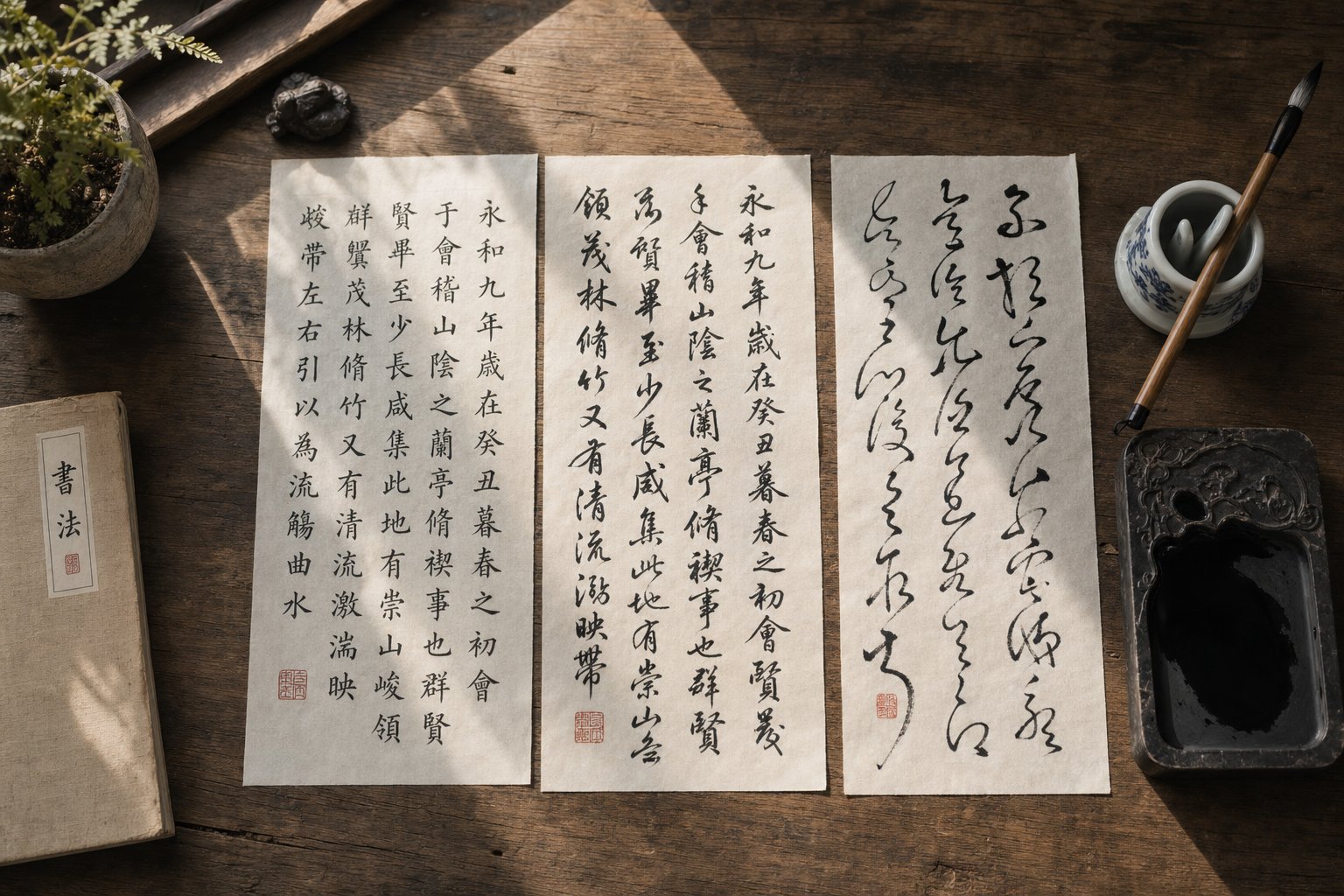
Running Script (行书, xingshu) is the semi-cursive middle ground. Strokes within a character connect partially, the brush sometimes staying on the paper between movements rather than lifting after each one. The result is faster writing that remains legible to any educated reader. According to the Metropolitan Museum of Art, increasingly cursive forms of writing developed during the Han dynasty as both a natural evolution and a response to the aesthetic potential of brush and ink.
Cursive Script (草书, caoshu), sometimes called Grass Script, pushes abbreviation to its extreme. Characters dissolve into fluid abstractions where two or more may be linked together in a single flourish of the brush. Legibility takes a back seat to rhythm, energy, and personal expression. Reading cursive script requires specialized training; writing it demands years of practice to internalize the abbreviated forms.
To describe ancient chinese calligraphers who mastered these styles, you inevitably start with Wang Xizhi (303-361 CE), often called the "Sage of Calligraphy." His Preface to the Orchid Pavilion, written in Running Script, is considered the single greatest example of chinese writing in calligraphic history. Wang demonstrated that speed and beauty weren't opposites. His brushwork captured spontaneous emotion within disciplined structure, a balance that calligraphers have chased for seventeen centuries since.
Here's a breakdown of each chinese script name, its characteristics, and its role in the broader system of mandarin calligraphy:
- Regular Script (楷书, kaishu) — Matured: Tang dynasty (7th-8th century). Primary use: formal documents, printed text, education. Visual characteristics: each stroke clearly separated, balanced square proportions, uniform spacing, no stroke connections between characters.
- Running Script (行书, xingshu) — Matured: Eastern Jin dynasty (4th century). Primary use: personal correspondence, everyday handwriting, informal documents. Visual characteristics: partial stroke connections within characters, slightly tilted forms, faster rhythm, remains legible without specialized training.
- Cursive Script (草书, caoshu) — Matured: Han dynasty for early forms (2nd century), Eastern Jin for modern cursive. Primary use: artistic expression, poetry, personal notes among educated elites. Visual characteristics: radically abbreviated strokes, characters linked across boundaries, fluid and continuous brush movement, highly individual and often illegible to untrained readers.
These three styles didn't replace each other chronologically. They coexist. A calligrapher might write a formal memorial in Regular Script, dash off a letter to a friend in Running Script, and compose an artistic hanging scroll in Cursive. The choice depends on context, audience, and intent. Together, they represent the full expressive range of the Chinese brush, from disciplined clarity to wild abstraction.
Yet understanding how characters look in different scripts only tells part of the story. A deeper question remains: how were characters constructed in the first place? What logic governs why 明 combines sun and moon to mean "bright," or why 妈 pairs a female radical with a sound component to mean "mother"? The answer lies in six ancient principles of character formation that explain not just appearance but architecture.
Six Methods of Character Formation Explained
You've seen how characters changed shape across dynasties, from pictorial sketches on bone to abstract strokes on paper. But shape is only half the story. The deeper question is structural: what rules governed how new characters were created in the first place? Why does 明 combine sun and moon? Why does 妈 pair a meaning element with a sound element? The answers trace back to a classification system first articulated by Han dynasty scholars nearly two thousand years ago.
This framework is called 六书 (liushu), or the "Six Methods." It describes six distinct principles by which Chinese characters, each one a sinogram carrying meaning and sound, were formed or repurposed. Understanding these categories transforms what might look like thousands of arbitrary symbols into a system governed by consistent internal logic.
Pictographs, Ideographs, and Compound Ideographs
The first three categories are the most intuitive. They represent the earliest and most visually transparent methods of character creation.
Pictographs (象形, xiangxing) are the characters most people think of when they imagine chinese pictographs. These are direct visual representations of objects. The character 日 (ri, sun) originated as a circle with a dot in the center. 月 (yue, moon) started as a crescent. 木 (mu, tree) depicted a trunk with branches above and roots below. 山 (shan, mountain) sketched three peaks rising from a baseline. Each pictograph chinese character began as a simplified drawing of something observable in the physical world.
Here's the catch: pictograms chinese learners encounter today make up only about 4% of all characters. They're the most famous type, the ones textbooks love to showcase, but they represent a tiny fraction of the total system. A single chinese pictogram like 火 (huo, fire) is memorable precisely because it's rare among the tens of thousands of characters in use.
Simple ideographs (指事, zhishi) take a different approach. Instead of drawing a concrete object, they express abstract concepts through symbolic indicators. The character 上 (shang, above) places a short stroke above a horizontal baseline, pointing upward. Flip that arrangement and you get 下 (xia, below). The numbers 一 (one), 二 (two), and 三 (three) use stacked horizontal lines to represent quantity directly. These are sometimes called "self-explanatory" characters because their meaning becomes apparent once you grasp the visual logic.
Compound ideographs (会意, huiyi) combine two or more pictographic or ideographic elements to express a new, often more abstract meaning. This is where things get creative. Consider 明 (ming, bright): it merges 日 (sun) and 月 (moon), the two brightest objects in the sky, to convey the concept of brightness. The character 休 (xiu, to rest) places the person radical 亻next to 木 (tree), evoking someone leaning against a tree to take a break. Or look at 看 (kan, to look), which combines 手 (hand) and 目 (eye), as if shading your eyes with your hand to see into the distance.
These three categories, pictographs, simple ideographs, and compound ideographs, are elegant and intuitive. But they share a fundamental limitation: they can only represent concepts that lend themselves to visual depiction or logical combination. How do you draw "philosophy"? How do you sketch "negotiate"? For the vast expansion of vocabulary that a complex civilization demands, Chinese needed a more productive method.
Phono-Semantic Compounds and Why They Dominate
This is where the system's true engine reveals itself. Phono-semantic compounds (形声, xingsheng) account for over 80% of all Chinese characters. If you're learning to read Chinese, this is the category you'll encounter most often by a wide margin.
The principle is straightforward: combine one component that hints at meaning (the semantic radical) with another that hints at pronunciation (the phonetic component). The character 妈 (ma, mother) pairs the female radical 女 with the phonetic element 马 (ma, horse), which contributes its sound but not its meaning. Similarly, 湖 (hu, lake) combines the water radical 氵with the phonetic component 胡 (hu). You see the water radical and know the character relates to liquid. You see 胡 and know it probably sounds like "hu." Together, they give you both a semantic clue and a pronunciation guide.
This method enabled massive vocabulary expansion without requiring entirely new visual inventions for every word. Need a character for a specific type of fish? Take the fish radical 鱼 and attach a phonetic component. Need a word for a particular emotion? Use the heart radical 忄 plus a sound indicator. The system is modular, productive, and scalable, which explains why it dominates the types of chinese characters in existence.
Native speakers internalize this logic intuitively. When encountering an unfamiliar character, they follow the rule of thumb 有边读边 (you bian du bian): "if it has a side, read the side." The phonetic component, often positioned on the right, gives a reasonable guess at pronunciation even for characters never seen before.
The remaining two categories function differently. They describe not how characters were constructed but how existing characters were repurposed:
Transfer characters (转注, zhuanzhu) are pairs of characters that were once interchangeable in meaning but gradually diverged. The characters 考 (kao, to test) and 老 (lao, old) share an etymological root and were historically related in meaning before drifting apart over centuries.
Loan characters (假借, jiajie) occur when an existing character gets "borrowed" to represent a different word with a similar sound. The character 来 (lai) originally meant "wheat" but was borrowed to write the verb "to come" because the pronunciations matched. Eventually, a new character 麦 (mai) was created specifically for "wheat," freeing 来 for its borrowed meaning permanently.
Here's the complete framework presented together:
- Pictographs (象形, xiangxing) — Characters that visually depict objects. Examples: 日 (sun), 月 (moon), 山 (mountain), 火 (fire). Approximately 4% of all characters.
- Simple Ideographs (指事, zhishi) — Characters that use symbolic indicators to express abstract concepts. Examples: 上 (above), 下 (below), 一 (one), 二 (two), 三 (three).
- Compound Ideographs (会意, huiyi) — Characters combining two or more elements to create new meaning. Examples: 明 (bright = sun + moon), 休 (rest = person + tree), 林 (forest = tree + tree).
- Phono-Semantic Compounds (形声, xingsheng) — Characters combining a meaning radical with a sound component. Examples: 妈 (mother = female radical + 马 sound), 湖 (lake = water radical + 胡 sound). Over 80% of all characters.
- Transfer Characters (转注, zhuanzhu) — Pairs of characters with shared etymological origins whose meanings diverged over time. Examples: 考 (to test) and 老 (old); 窍 (hole) and 空 (emptiness).
- Loan Characters (假借, jiajie) — Characters borrowed to represent homophones or near-homophones. Examples: 来 (originally "wheat," borrowed for "to come"); 乎 (originally "to call out," borrowed as a grammatical particle).
Notice how the first four categories describe methods of creating characters, while the last two describe methods of using existing characters in new ways. This distinction matters. The chinese ideograph and pictograph categories gave the system its visual foundation, but phono-semantic compounding gave it the scalability to grow from a few thousand characters into the tens of thousands needed by a literate civilization.
These six principles operated across every historical stage we've traced so far, from oracle bones through clerical script. They explain the internal architecture of characters regardless of which calligraphic style renders them on the page. Yet by the twentieth century, a new pressure emerged that none of these ancient formation methods anticipated: the political demand to make characters simpler, faster to learn, and accessible to hundreds of millions of people who had never been taught to read.
Traditional vs Simplified and the Modern Divide
By the early twentieth century, China faced a literacy crisis. The vast majority of the population couldn't read. Republican intellectuals and politicians alike saw thousands of complex characters as a barrier to modernization, economic development, and popular political participation. The question wasn't whether reform was needed but how radical it should be. The answer, when it finally came, would split the Chinese-speaking world into two camps that persist to this day: traditional vs simplified chinese characters.
The PRC Simplification Campaigns of 1956 and 1964
The push to simplify didn't begin with the Communist Party. In 1935, the ruling Kuomintang (KMT) government published an official simplification scheme and attempted implementation before withdrawing it under conservative opposition. So when the People's Republic launched its own campaign after 1949, it was continuing a conversation that had been building for decades.
The motivations were both practical and ideological. Mass literacy campaigns needed characters that workers and farmers could learn quickly. Some reformers believed complex characters actively hindered modernization. The most radical voices even advocated abandoning characters entirely in favor of an alphabetic system, a goal that was later quietly shelved when it became clear that characters were too deeply embedded in Chinese culture and identity to discard.
The first official "Scheme for Simplifying Chinese Characters" arrived in 1956, followed by an expanded list in 1964. As Sixth Tone reports, two primary measures drove the reform. The first reduced the total number of characters by choosing a single variant, usually one with fewer strokes, and making it the official form. The second regularized cursive shorthand forms into the standard script, adopting abbreviated shapes that had circulated informally for centuries.
The specific techniques included:
- Stroke reduction: Replacing complex components with simpler geometric substitutes (e.g., the left side of 語 became 讠 instead of 言).
- Cursive adoption: Formalizing handwritten shortcuts that scribes had used since the Han dynasty into printed standard forms.
- Component substitution: Swapping intricate semantic elements for simpler phonetic or symbolic placeholders.
- Whole-character replacement: In some cases, replacing an entire complex character with a simpler homophone or near-homophone.
In hindsight, many of these simplified chinese writing symbols weren't new inventions at all. Type designer Liu Yuli notes that "many of the simplifications were not new inventions, but continuations of older variant forms." The cursive script tradition, dating back to the Han dynasty, had already produced most of these abbreviated shapes organically. The PRC campaign simply made them official.
A second round of simplification attempted in 1977 went too far. Public confusion and backlash led to its formal rescission in 1986, and no further simplification has been attempted since.
Traditional vs Simplified Characters Compared
What does simplification actually look like in practice? The differences range from subtle trimming to dramatic restructuring. Here's how several common characters compare across the two systems:
| Meaning | Traditional | Simplified | Stroke Reduction | Method Used |
|---|---|---|---|---|
| Dragon | 龍 | 龙 | 16 → 5 | Cursive form adoption; entire structure replaced with a drastically abbreviated shape |
| Study/Learn | 學 | 学 | 16 → 8 | Upper component simplified by removing repeated elements and reducing to essential strokes |
| Book/Write | 書 | 书 | 10 → 4 | Cursive shorthand formalized; complex interior components eliminated |
| Country | 國 | 国 | 11 → 8 | Interior component 或 replaced with simpler 玉 (jade), symbolizing national treasure |
| Love | 愛 | 爱 | 13 → 10 | Heart radical (心) in the middle removed; critics note this literally "takes the heart out of love" |
| East | 東 | 东 | 8 → 5 | Internal structure simplified by replacing detailed strokes with a single crossing pattern |
Today, simplified chinese is the standard in mainland China and Singapore. Traditional chinese writing remains the norm in Taiwan, Hong Kong, and Macau. This geographic split means that traditional characters chinese communities use daily carry cultural and political weight beyond mere orthography. For many in Taiwan and Hong Kong, traditional mandarin characters represent continuity with pre-revolutionary culture, a visible marker of distinct identity.
The cultural debate remains lively. Critics of simplification argue that reducing strokes sometimes destroyed the semantic logic embedded in character structure. The character 愛 losing its heart radical is the most cited example, though linguists point out that this kind of poetic reading often overstates how consciously people parse individual components. Defenders counter with hard data: China's literacy rate climbed from roughly 20% in 1949 to over 97% today, and while simplification wasn't the only factor, it removed one barrier from an already steep learning curve.
Here's a useful statistical frame: approximately 3,500 basic characters cover about 90% of content in a typical Chinese newspaper. The official "Table of General Standard Chinese Characters" released in 2013 specifies 8,105 standard characters for mainland use, of which less than a third actually came from the 1950s simplification scheme. The rest were never simplified at all. In other words, the overlap between traditional chinese characters and their mainland counterparts is far greater than the popular narrative suggests.
Perhaps the most interesting twist is that the original practical argument for simplification, making characters easier to write by hand, has largely evaporated. With smartphones and computers handling most written communication, few people write characters stroke by stroke anymore. The main barrier to literacy is no longer stroke complexity but the sheer number of characters to memorize. That technological shift hasn't erased the divide between the two systems, but it has quietly made the debate less urgent, even as digital tools open entirely new questions about how characters will continue adapting.
Digital Adaptation and Global Legacy
Smartphones didn't kill Chinese characters. They transformed them. The same writing system that once required years of brush training now flows through touchscreens at speeds that would stun a Tang dynasty calligrapher. Rather than rendering characters obsolete, digital technology has given them new life and new pathways for evolution.
Chinese Characters in the Digital Era
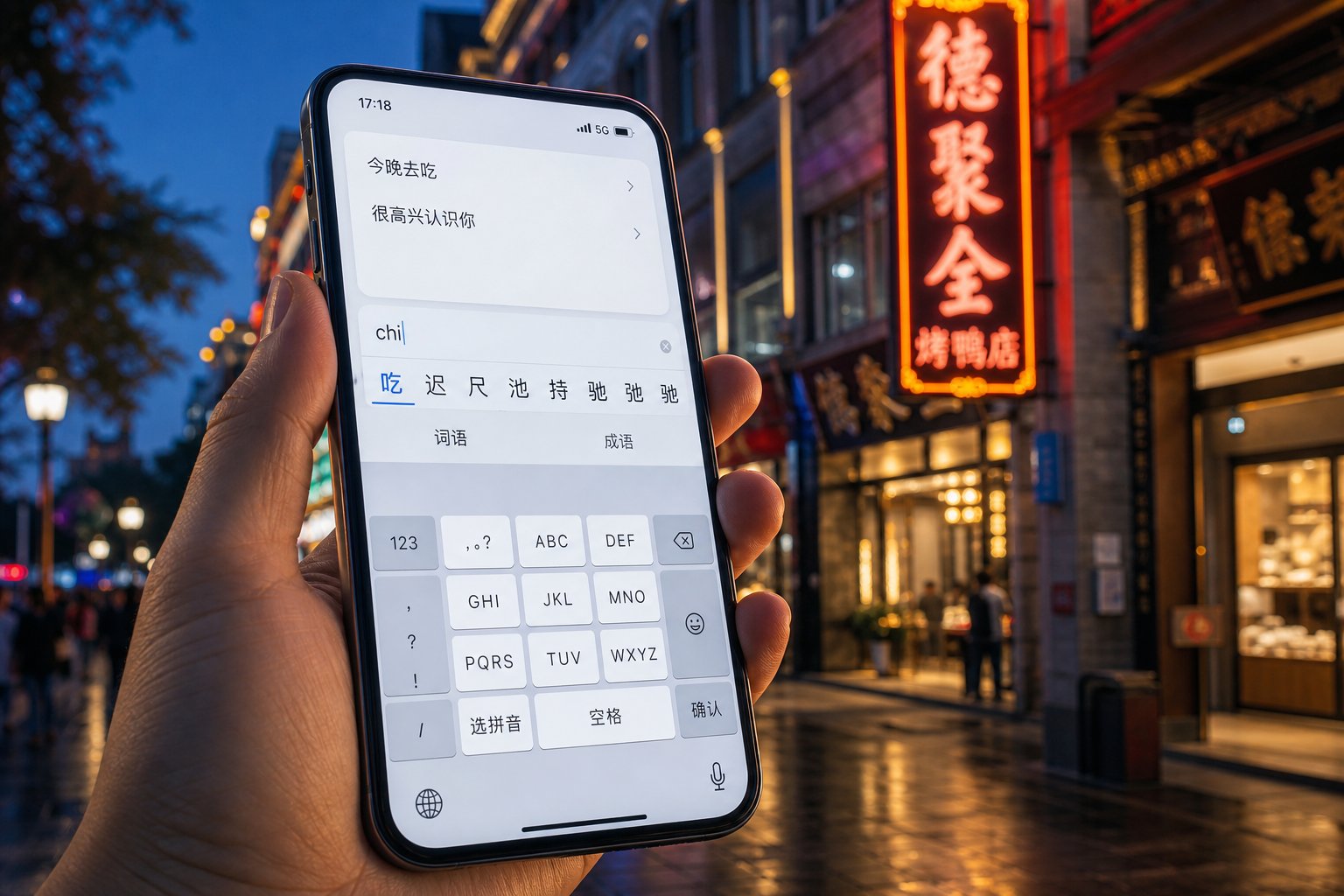
How do you type a language with tens of thousands of characters on a keyboard designed for 26 letters? This was the central engineering challenge of Chinese computing, and the solutions that emerged reshaped how people interact with their own writing system. The most popular method today is pinyin input: type the romanized pronunciation, and the software offers a list of matching characters to select from. It's fast, intuitive, and has an unexpected side effect. Because users recognize characters rather than actively recall every stroke, some researchers report a phenomenon called "character amnesia," where people forget how to write characters by hand that they can still read effortlessly.
For those who prefer a more tactile approach, handwriting recognition lets you draw chinese characters directly on a screen with your finger or stylus. A chinese character finder built into most smartphones can identify even sloppily written input and suggest the correct character. You can also draw mandarin characters into dedicated lookup tools, essentially using a chinese character drawer to search by shape when you don't know the pronunciation. Radical-based search offers yet another path: identify one component of an unknown character, and the system narrows down possibilities from thousands to a manageable handful.
The system remains open-ended, too. New characters continue to be created when needed. In the early twentieth century, the character 她 (ta, she) was invented to distinguish feminine third-person pronouns from the gender-neutral 他. More recently, as Zev Handel notes, characters like 鿬 have been coined for newly discovered chemical elements. Unicode now encodes over 97,000 Chinese characters, ensuring that even rare historical forms survive in digital space. The system keeps growing because it was designed to grow.
Global Influence on Japanese, Korean, and Vietnamese Writing
Chinese characters didn't stay in China. For centuries, they served as the shared literary medium across East Asia, much as Latin once functioned in Europe. Each neighboring culture absorbed the script and adapted it to fit languages with entirely different grammars and sound systems. An asian writing system comparison reveals just how differently each culture handled the same raw material:
- Japanese (kanji 漢字): Japan adopted Chinese characters wholesale, reading them with both Chinese-derived pronunciations (on'yomi) and native Japanese readings (kun'yomi). The system grew so complex that Japan developed two additional phonetic scripts, hiragana and katakana, simplified from Chinese character forms to handle grammatical elements. Today, chinese kanji remains firmly embedded in modern Japanese. A literate adult uses roughly 2,136 characters designated as "regular use" alongside the two phonetic scripts.
- Korean (hanja 漢字): Korea used Chinese characters for over a millennium before King Sejong introduced the Hangeul alphabet in 1443. Chinese characters gradually receded from daily use, especially after North Korea eliminated them entirely in 1949. South Korea still teaches some hanja in schools, but their presence in everyday writing has declined sharply.
- Vietnamese (chu Han 字漢 / chu Nom 字喃): Vietnam used Chinese characters for official administration and developed chu Nom, a system that repurposed and modified Chinese characters to write Vietnamese. French colonization introduced the Latin-based quoc ngu script, which fully replaced character-based writing by the mid-twentieth century.
The contrast is striking. Chinese vs japanese characters shows a case of deep, permanent integration. Korean and Vietnamese demonstrate how political shifts can displace even a deeply rooted script. Yet in all three cases, the influence of Chinese characters persists in vocabulary, literary tradition, and cultural memory.
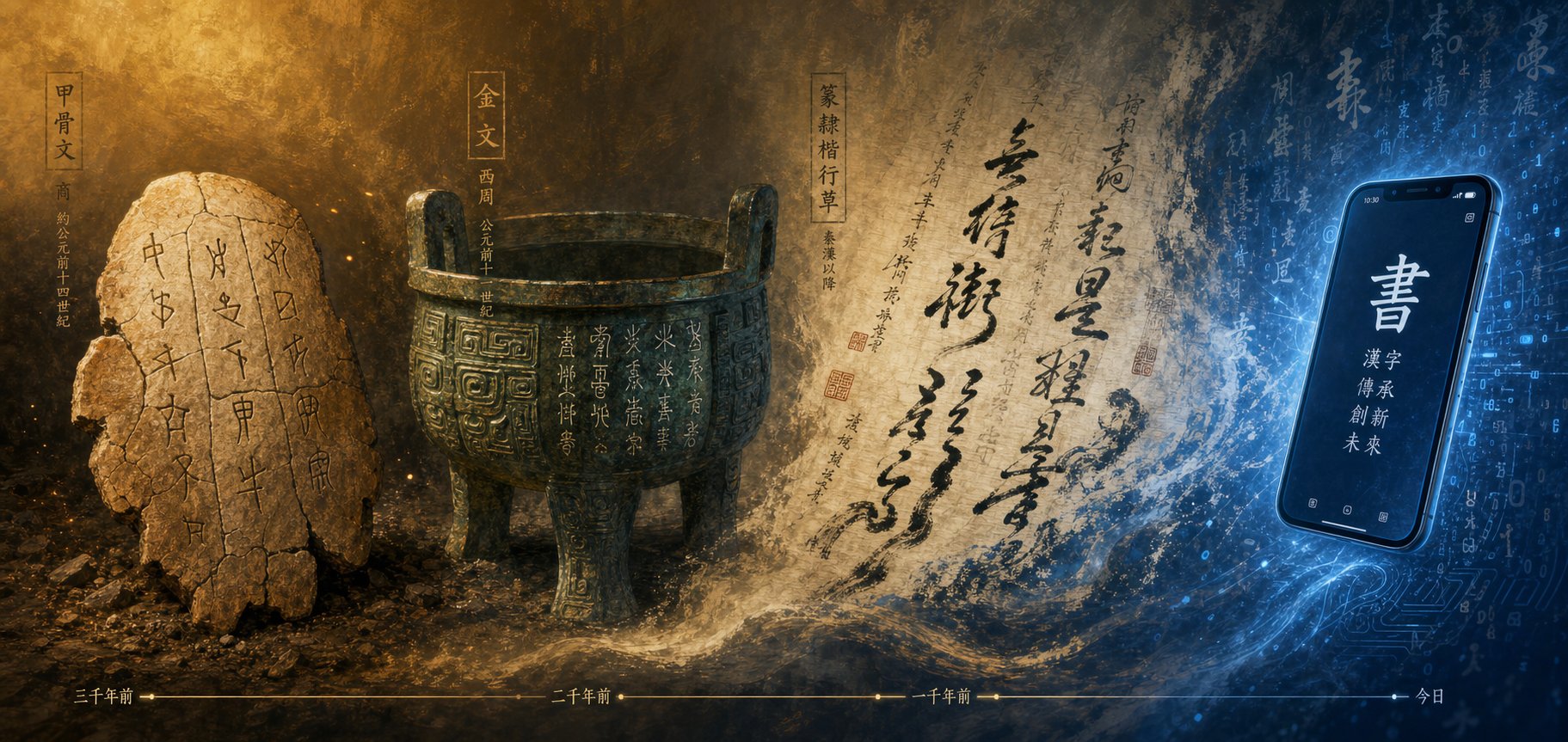
From turtle shells to touchscreens, from oracle pits to pinyin input, the story of Chinese characters is ultimately a story about adaptability. The system survived not by resisting change but by absorbing it, bending to new materials, new politics, and new technologies without breaking. Over a billion people use these characters daily, and the script continues to evolve in real time. That's not the mark of a relic. It's the mark of a living system, one that has outlasted every prediction of its demise and shows no sign of stopping.
Frequently Asked Questions About the Evolution of Chinese Characters
1. What are the main stages in the evolution of Chinese characters?
Chinese characters passed through six major stages: oracle bone script (c. 1200 BC) carved into turtle shells and animal bones, bronze inscriptions (c. 1046 BC) cast into ritual vessels, Small Seal Script standardized by the Qin dynasty in 221 BC, Clerical Script developed by Han dynasty clerks for faster writing, and finally Regular Script which matured during the Tang dynasty and remains the standard printed form today. Running Script and Cursive Script also developed as informal and artistic variants. Each transition was driven by changes in writing materials, political needs, or the demand for greater writing speed.
2. Why do simplified and traditional Chinese characters exist?
The split dates to the 1950s and 1960s when the People's Republic of China launched official simplification campaigns to boost mass literacy. The government reduced stroke counts, adopted longstanding cursive shorthand forms, and replaced complex components with simpler substitutes. Mainland China and Singapore adopted simplified characters, while Taiwan, Hong Kong, and Macau retained traditional forms. The debate continues today: critics argue simplification destroyed embedded semantic logic, while supporters point to China's literacy rate rising from roughly 20% in 1949 to over 97% today.
3. How were Chinese characters originally formed?
Chinese characters were created using six classical methods known as liushu. Pictographs directly depict objects like sun or mountain. Simple ideographs use symbolic indicators for abstract concepts like above or below. Compound ideographs combine elements to create new meanings, such as sun plus moon equaling bright. Phono-semantic compounds, which make up over 80% of all characters, pair a meaning radical with a sound component. Transfer characters and loan characters describe how existing characters were repurposed rather than newly created. This framework explains why the system could scale from a few thousand early characters to tens of thousands.
4. What is the oldest known form of Chinese writing?
The oldest confirmed Chinese writing is oracle bone script (jiaguwen), dating to approximately 1200-1050 BC during the Shang dynasty. These characters were carved into turtle plastrons and ox scapulae for royal divination rituals. About 4,500 distinct characters have been identified across more than 150,000 bone fragments found at Yinxu near modern Anyang, though only around 1,500 have been definitively deciphered. The script was already highly developed when it appeared, suggesting an earlier developmental period that remains undocumented in the archaeological record.
5. How are Chinese characters used in the digital age?
Digital technology adapted to Chinese characters through multiple input methods. Pinyin input lets users type romanized pronunciations and select matching characters from a list. Handwriting recognition allows drawing characters directly on touchscreens. Radical-based search helps identify unknown characters by their component parts. Unicode now encodes over 97,000 Chinese characters, preserving even rare historical forms. New characters continue to be coined for modern needs, such as names for newly discovered chemical elements, proving the system remains actively evolving rather than frozen in its historical form.