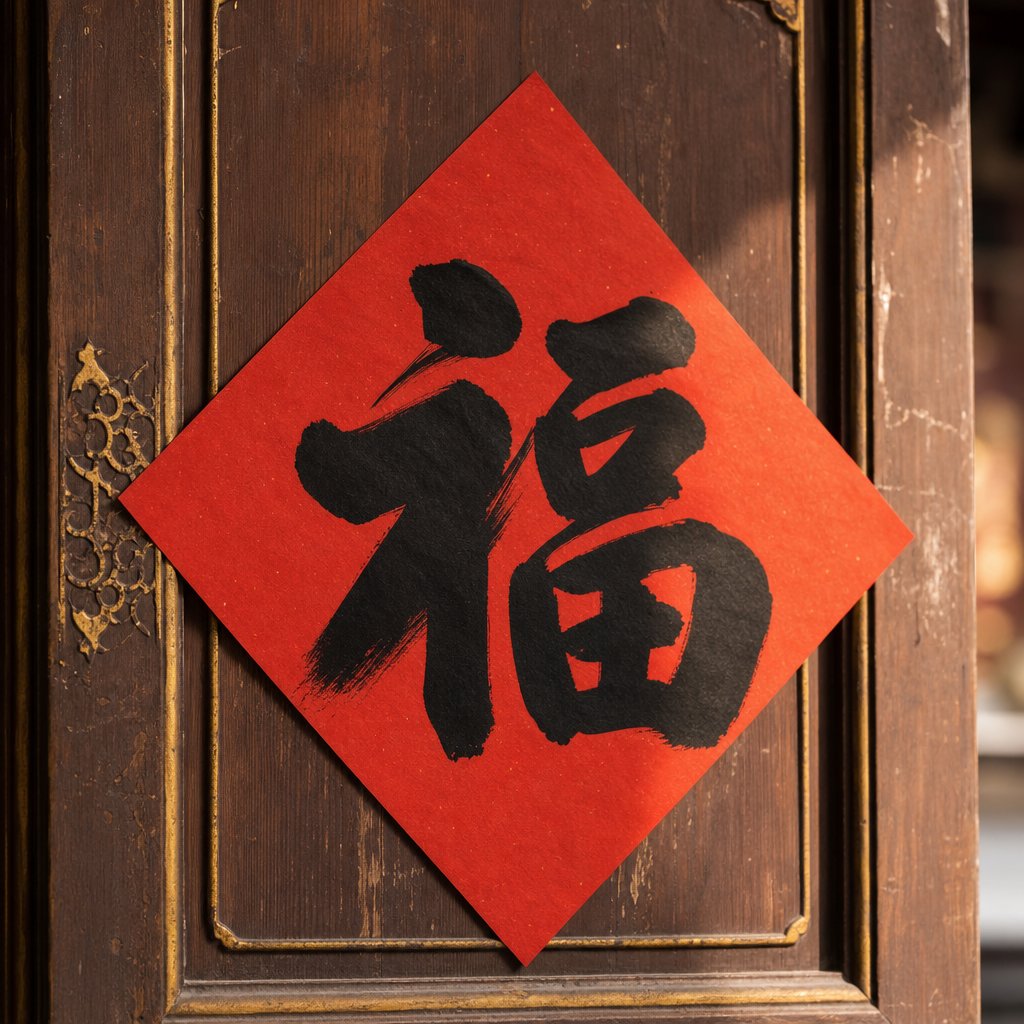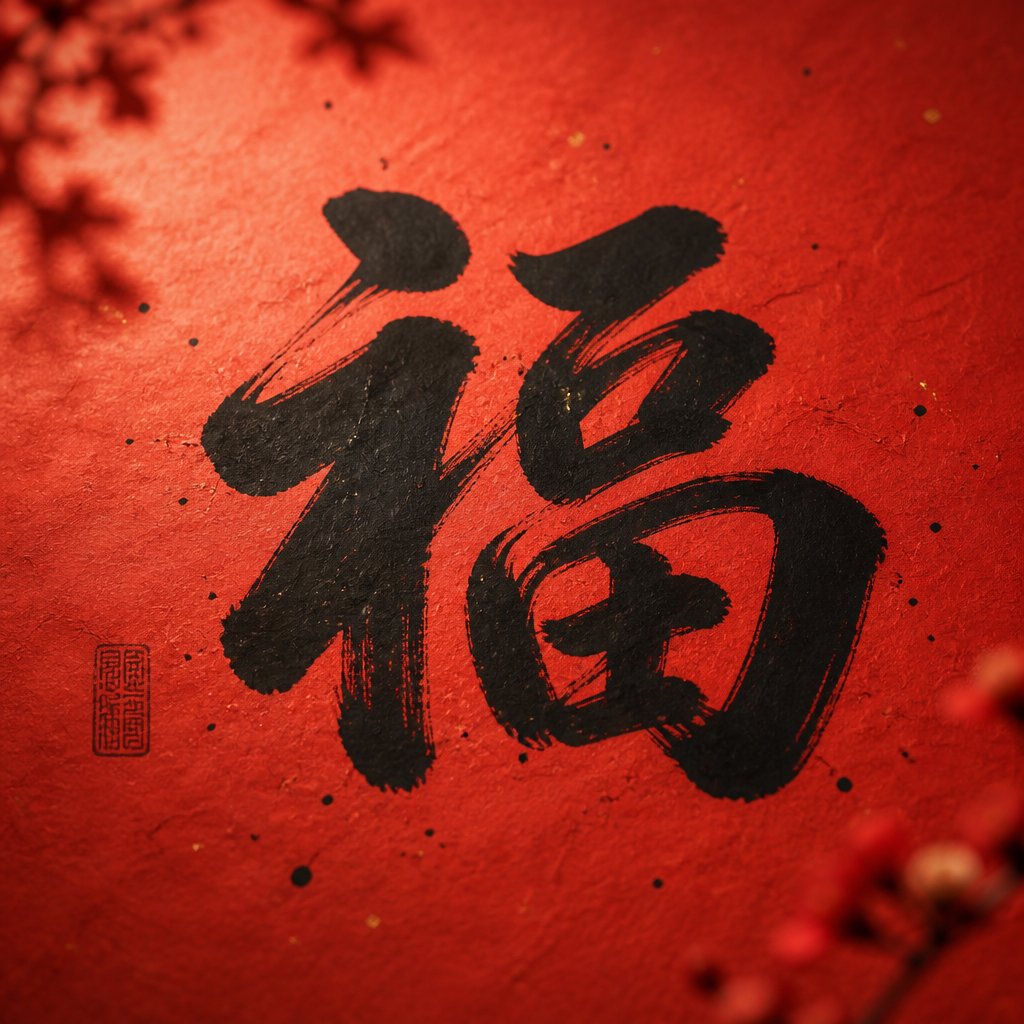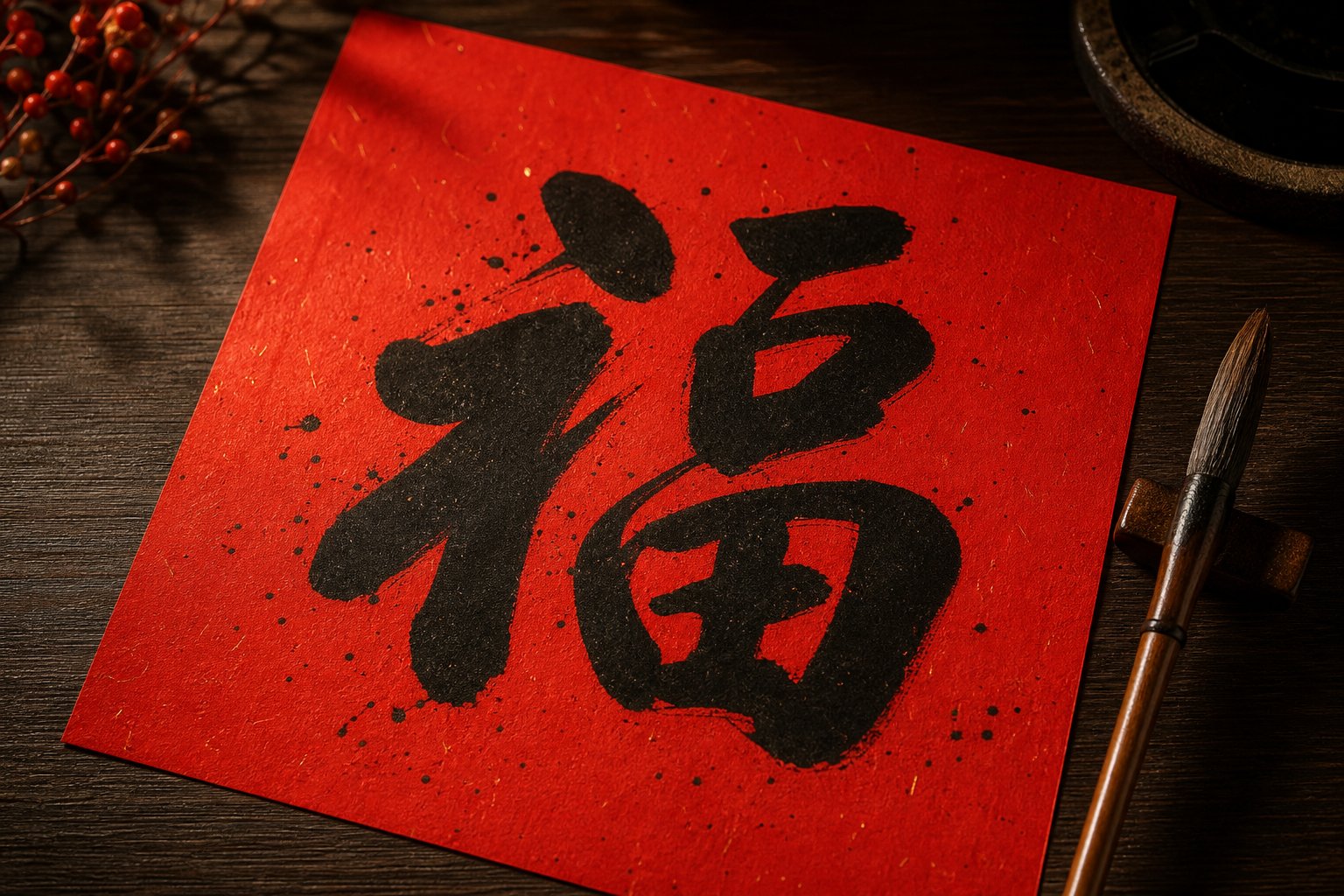
The Fu Character and Its Layered Meanings
What is fu, exactly? The fu chinese character (福) is one of the most recognized symbols in East Asian culture, yet its meaning resists any single English translation. It simultaneously carries the weight of fortune, blessing, good luck, happiness, and prosperity — concepts that in Western languages occupy separate semantic lanes but in Chinese converge into a single written form. Understanding the fu character calligraphy meaning requires looking beyond dictionary definitions and into the brushstrokes themselves.
What Does Fu Mean in Chinese Culture
At its core, the chinese fu symbol represents a state of complete well-being. Imagine having shelter, enough food, family harmony, and spiritual favor all at once — that's 福. It's not passive luck that falls into your lap. It's an active, holistic condition where life's essential elements align.
Fu (福) encompasses five interconnected meanings: divine blessing, material fortune, personal happiness, family prosperity, and good luck in chinese tradition. No single English word captures its full range.
You'll encounter chinese fu in nearly every corner of daily life across Chinese-speaking communities — printed on red envelopes, carved into doorframes, embroidered on textiles, and brushed onto paper during festivals. Its presence is both decorative and performative, meaning the act of displaying it is believed to invite the very blessings it names.
Why Calligraphy Style Shapes Meaning
Here's what most explanations miss: how the Fu character is written communicates as much as what it means. Chinese calligraphy operates across five major script types — seal, clerical, standard, running, and cursive — each carrying its own emotional and cultural register. As the Khan Academy's introduction to Chinese calligraphy explains, choosing a script type amounts to "possessing the key to deciphering the calligrapher's mind at the moment of creation." A Fu written in solemn seal script evokes ancient ritual authority. The same character dashed off in wild cursive radiates spontaneous joy. The meaning shifts not because the word changes, but because the visual language surrounding it does.
This is the lens we'll use throughout: the fu character calligraphy meaning lives at the intersection of linguistic content and artistic form. Each radical, each brushstroke variation, and each stylistic choice adds a layer of cultural communication that a simple translation can never capture. The character's internal architecture — its radicals and structural components — tells a story all on its own.
Historical Evolution from Oracle Bone to Modern Form
Every chinese character fu carries within it a fossil record — layers of meaning deposited over millennia. The fortune chinese character we recognize today looks nothing like its earliest ancestor carved into tortoise shells more than three thousand years ago. Tracing that transformation reveals how each dynasty reshaped what blessing meant to its people.
Oracle Bone and Bronze Inscription Origins
Picture this: a pair of hands lifting a wine vessel toward a stone altar. That image, scratched into animal bone during the Shang dynasty (roughly 1600-1046 BCE), is the oldest known form of 福. The character wasn't abstract — it was a scene. The left component depicted an altar used in the worship of heaven, while the right side showed a cup and wine jar held by two hands, representing offerings to the divine. Classical sinological research by scholars like Cheng Minglu (2019) confirms that putting both pictograms together symbolized offerings made on the altar to the most high God.
The original meaning, then, was startlingly specific: not "good luck" in any casual sense, but "blessings received from God through ritual offering." The fu mandarin character began its life as a religious act frozen in written form. You weren't describing fortune — you were invoking it through sacrifice.
Bronze inscriptions from the subsequent Zhou dynasty (1046-256 BCE) preserved this ritual core while gradually smoothing the pictographic edges. The hands became more stylized, the altar more geometric, but the spiritual DNA remained intact. The chinese character for good fortune still meant, at this stage, something earned through devotion rather than stumbled upon by chance.
How Meaning Evolved Across Dynasties
Languages don't sit still, and neither do the values cultures attach to their words. As Chinese civilization grew more complex, 福 absorbed new layers of meaning — each dynasty projecting its own aspirations onto the character. What started as a prayer became a philosophy of the good life.
- Shang Dynasty (c. 1600-1046 BCE): Meaning confined to divine blessing through ritual sacrifice. The character functioned almost as a verb — the act of offering to receive heavenly favor.
- Zhou Dynasty (1046-256 BCE): Expanded to include the concept of heaven's mandate and moral favor. Blessing became linked to virtuous conduct, not just correct ritual.
- Han Dynasty (206 BCE-220 CE): Material prosperity entered the picture. As Confucian values formalized, the chinese character for good luck began encompassing wealth, official rank, and longevity alongside spiritual grace.
- Tang and Song Dynasties (618-1279 CE): Social harmony and cultural refinement joined the semantic cluster. Fu now implied not just personal fortune but harmonious family relationships and community standing.
- Ming and Qing Dynasties (1368-1912 CE): The character reached its fullest expression — comprehensive good fortune covering health, wealth, virtue, longevity, and a peaceful death. Folk traditions like displaying Fu during New Year celebrations cemented its role as an all-encompassing wish.
- Modern Era (1912-present): The character retains all accumulated meanings while gaining new resonance in contexts from digital red envelopes to corporate branding. Its written form stabilized, but its cultural weight keeps growing.
Notice the pattern: each era's highest values got folded into 福. When agricultural wealth mattered most, the character absorbed prosperity. When social networks defined success, it absorbed harmony. The chinese character for fortune functions like a cultural mirror — reflecting back whatever a society considers the complete good life.
It's worth noting that the visual evolution followed a parallel track. The pictographic clarity of oracle bone script gave way to the balanced geometry of seal script, then the angular efficiency of clerical and standard forms. As scholars at the East Asia School of Theology have documented, the "一口田" pattern visible in the modern character's right side actually evolved from the decorative pattern on the ancient wine jar — not from later folk etymologies assigning separate meanings to each stroke.
This distinction matters for anyone studying fu character calligraphy meaning seriously. The character's visual structure carries genuine historical memory, but that memory is older and stranger than popular explanations suggest. Its components point back to altars and offerings, not simply to fields and mouths — though later generations found those readings meaningful too.
Decoding the Radicals Inside the Fu Character
Those later generations weren't wrong to find meaning in the character's architecture. Whether or not the modern form preserves its original pictographic intent, the radicals inside 福 tell a compelling story about what Chinese culture considers a blessed life. Think of it as reading a building's blueprint — each structural element carries weight.
Breaking Down the Structural Components
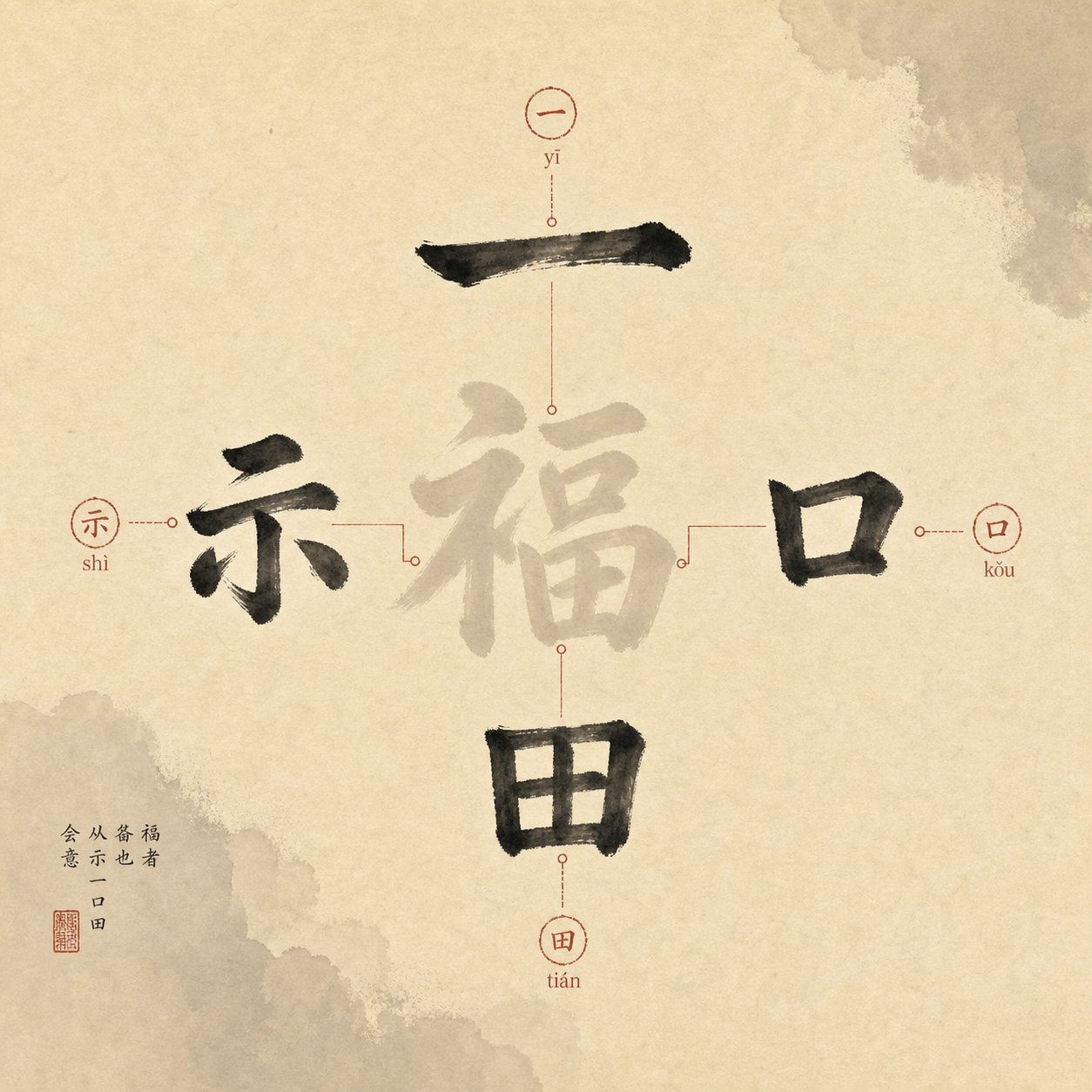
When you look at the chinese character for luck and prosperity, you'll notice it splits cleanly into a left side and a right side. The left radical anchors the character's spiritual dimension, while the right side stacks three elements that together describe material and social completeness.
- 示 (shì) — the altar radical: Positioned on the left (written as 礻in its compressed form), this radical derives from a pictogram of a sacrificial altar. It signals that the character belongs to the domain of the divine — spiritual revelation, worship, and heavenly favor. Every character carrying this radical connects to something sacred.
- 一 (yī) — one, or a roof: The single horizontal stroke at the top of the right side represents a roof or shelter. It's the most basic requirement for security — a covered space to call home.
- 口 (kǒu) — mouth, or a person to feed: Sitting beneath the roof, this component represents either a mouth (sustenance, food) or a person within the household. Either reading points to the same idea: no one goes hungry.
- 田 (tián) — field, or land: The bottom element depicts a plot of agricultural land divided into sections. In traditional agrarian China, owning productive land was the foundation of the wealth chinese character concepts pointed toward — economic self-sufficiency passed down through generations.
Stack these together and you get a vivid picture: one person under a roof, with food and land, blessed by heaven. That's the classical Chinese vision of complete fortune — not extravagant riches, but stable, divinely favored sufficiency.
How Structure Reveals Cultural Values
What makes this breakdown valuable for understanding fu character calligraphy meaning is how it maps directly onto traditional priorities. The chinese character for prosperity doesn't depict gold coins or a throne. It depicts shelter, sustenance, productive earth, and spiritual connection. The values are agrarian, communal, and grounded.
For calligraphers, this structural awareness shapes artistic decisions. An artist writing the prosperity character chinese audiences display during New Year might give extra visual weight to the 田 component — broadening its strokes to emphasize abundance. Another calligrapher might elongate the 示 radical, drawing the viewer's eye toward the spiritual dimension of blessing. The chinese character for wealth encoded in 福 isn't just about money; it's about the land that generates it and the divine favor that sustains it.
This is why reducing 福 to a single English word always falls short. The character's internal architecture encodes an entire philosophy: that true fortune requires all four elements — divine grace, shelter, nourishment, and productive resources — working in harmony. Remove any one piece and the blessing is incomplete.
Understanding these radicals also changes how you perceive different calligraphy scripts. A seal script version preserves each component in near-pictographic clarity, letting you almost see the altar and the field. A cursive script version merges these elements into flowing gestures where individual radicals dissolve into expressive movement — shifting the emphasis from what fortune contains to how fortune feels.
Five Calligraphy Scripts Transform the Fu Character
That shift from pictographic clarity to expressive gesture isn't random — it follows a specific historical sequence. Chinese calligraphy developed across five major script types, each with its own structural logic, emotional tone, and cultural context. When applied to the fu character in chinese, these scripts don't just change how 福 looks. They change what it communicates.
Seal Script and Clerical Script Forms
Seal script (篆書, zhuànshū) is the oldest surviving calligraphic style, and it renders the chinese character for fu in its most archaic, ritualistic form. Imagine perfectly even line weight — no thick-thin variation — with rounded, symmetrical geometry that gives the character an almost medallion-like quality. Each radical remains visually distinct, preserving the pictographic roots we explored earlier. The 示 altar radical still looks like an altar. The 田 field still reads as enclosed land. Writing Fu in seal script evokes ancient authority, the weight of bronze vessels and carved jade seals. As the Skritter Blog notes, seal script emphasizes left-to-right symmetry using mainly curves and dots with no sharp corners — making it feel closer to drawing than writing.
Clerical script (隸書, lìshū) flattens that vertical symmetry into a wide, horizontal format. There's a classical saying that captures the contrast perfectly: "Seal script is like a painting, and clerical script is like a wave." Applied to the fu character, clerical script introduces the distinctive "silkworm head and goose tail" — horizontal strokes that begin with a rounded press and end with an upward flick. The result is a Fu that feels grounded, official, and rhythmic. Where seal script whispers of temple rituals, clerical script speaks of imperial administration and bureaucratic elegance.
Regular, Running, and Cursive Script Variations
Regular script (楷書, kǎishū) is the form most people recognize today. It renders the fu in chinese character with architectural precision — square proportions, clearly separated strokes, and balanced visual weight. Song dynasty calligrapher Su Shi described it best: "Standard script is like standing." Each of the character's thirteen strokes occupies its proper place. This is the version you'll find in textbooks, on formal scrolls, and in printed fonts. When someone writes good luck in chinese characters for a formal gift, regular script is the default choice.
Running script (行書, xíngshū) loosens that structure. Strokes begin connecting, corners soften, and the brush lifts less frequently from the paper. The fu character gains warmth and personal energy — like hearing a familiar blessing spoken by someone who means it. It's the most commonly used style in daily handwriting, and its flexibility makes it a favorite among calligraphers seeking to balance legibility with expressiveness.
Cursive script (草書, cǎoshū) pushes furthest from the standard form. Radicals merge, strokes abbreviate, and the chinese luck character becomes an almost abstract gesture of movement and emotion. Don't mistake speed for carelessness — cursive follows a codified system of abbreviations called 草法 (cǎofǎ) that practitioners must memorize. But the visual effect is dramatic: Fu dissolves from a readable character into pure expressive energy, capturing the feeling of fortune rather than spelling it out.
| Dimension | Seal Script (篆書) | Clerical Script (隸書) | Regular Script (楷書) | Running Script (行書) | Cursive Script (草書) |
|---|---|---|---|---|---|
| Stroke Count | Varies (archaic forms) | ~13 (expanded horizontals) | 13 (standard) | 10-13 (some merged) | 5-8 (heavily abbreviated) |
| Line Quality | Even weight, rounded | Wave-like, thick-thin contrast | Precise, angular | Fluid, moderately varied | Rapid, highly dynamic |
| Compositional Balance | Vertical symmetry | Horizontal emphasis | Square, centered | Slightly asymmetric | Freely asymmetric |
| Visual Weight | Dense, compact | Broad, grounded | Balanced, stable | Light, flowing | Concentrated bursts |
| Emotional Register | Solemn, sacred | Dignified, official | Formal, respectful | Warm, personal | Joyful, spontaneous |
| Typical Use Context | Scholarly display, seals | Traditional inscriptions | Formal blessings, gifts | Personal letters, New Year writing | Artistic display, celebration |
Each row in this comparison reveals something important: the same chinese characters for good luck carry fundamentally different emotional weight depending on the script. A seal script Fu on your wall signals scholarly reverence for antiquity. A cursive Fu radiates celebratory energy. The meaning encoded in the radicals stays constant, but the calligrapher's script choice determines whether that meaning arrives as a solemn prayer, a formal wish, or a burst of joy.
This is why fu character calligraphy meaning can't be separated from script selection. The character isn't just a container for semantic content — it's a performance, and the script is the tone of voice.
Why the Fu Character Is Displayed Upside Down
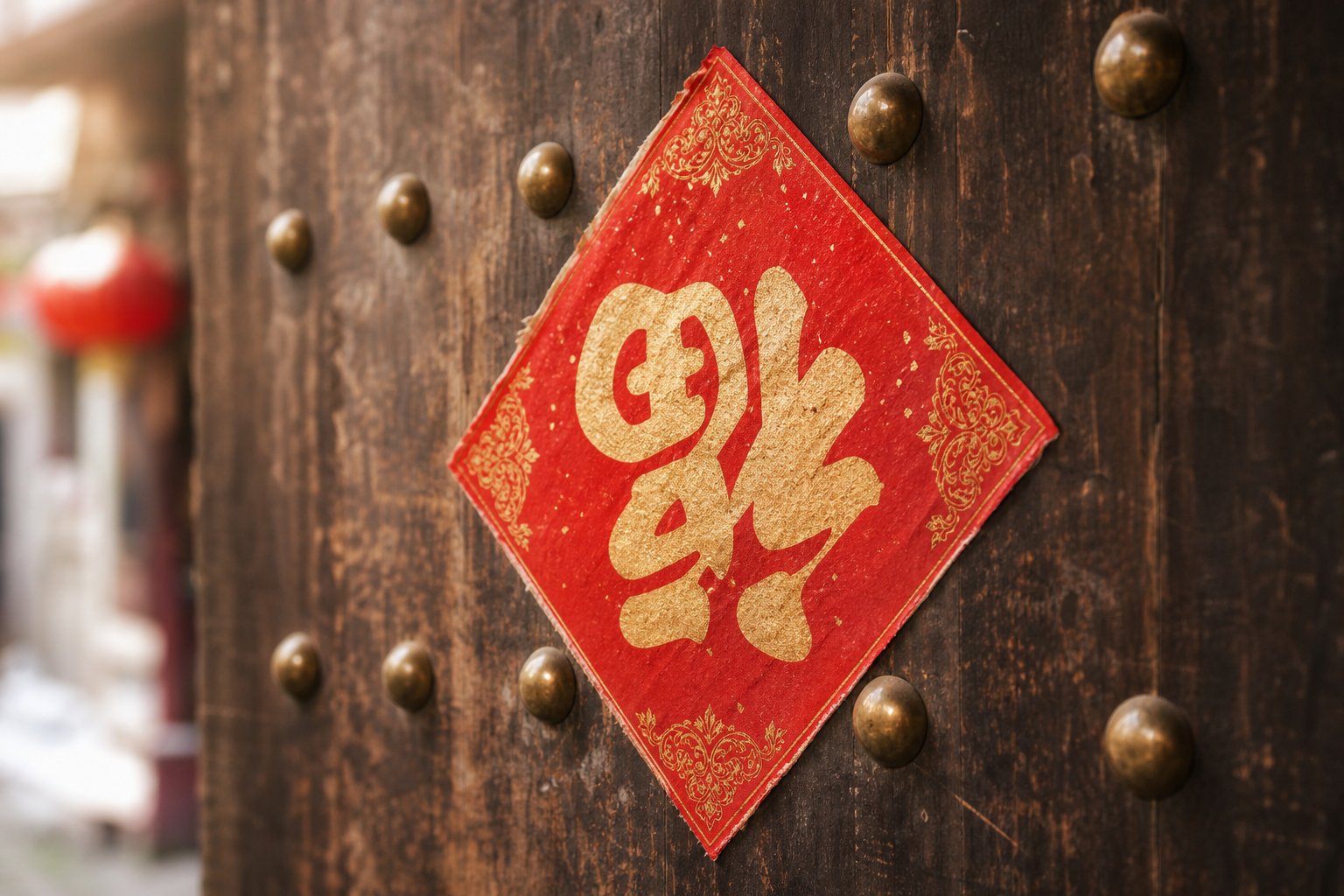
Script choice shapes how fortune sounds. But there's another visual decision that transforms the fu sign entirely — rotating it 180 degrees. Walk through any Chinese neighborhood during the lunar new year and you'll spot diamond-shaped red squares with 福 pasted deliberately upside down on doors, cabinets, and walls. This isn't carelessness or a decorating mistake. It's a linguistic trick hiding in plain sight, and understanding it reveals how deeply Chinese culture trusts the power of spoken language to shape reality.
The Linguistic Wordplay Behind Upside-Down Fu
The entire tradition rests on a single homophone pun — one of the most elegant in any language. When you flip the symbol fu upside down, a Chinese speaker would describe the scene as 福倒了 (fú dào le), meaning "the Fu is inverted." Say that phrase out loud, and it sounds identical to a completely different sentence:
福倒了 (fú dào le) — "Fu is upside-down" — sounds identical to 福到了 (fú dào le) — "Fortune has arrived."
Why does this work? The character 倒 (dào, fourth tone, meaning "to invert or turn upside-down") and the character 到 (dào, fourth tone, meaning "to arrive") share the exact same pronunciation and the same falling fourth tone. They are perfect homophones. So pasting fú in chinese upside down on your door isn't just decoration — it's a verbal spell disguised as a visual act. Anyone who sees it and describes what they see inadvertently declares that fortune has arrived at your home.
This kind of phonetic magic runs deep in Chinese linguistic culture. It belongs to a broader tradition called 口彩 (kǒucǎi) — auspicious wordplay where sounds create meaning regardless of the characters behind them. Fish served at New Year dinner works the same way: 鱼 (yú, fish) sounds like 余 (yú, surplus), so eating fish becomes a declaration that abundance will carry into the new year. The upside-down fu chinese new year tradition applies identical logic to the written character itself.
Song Dynasty Origins and Why the Tradition Persisted
The practice of mounting 福 during the new year dates to at least the Song dynasty (960-1279 CE), making it over a thousand years old. But the most popular origin story for the upside-down variation involves a household where a servant's error became a stroke of genius.
The tale goes like this: on Chinese New Year's Eve, servants were tasked with pasting fu characters throughout a noble household. One illiterate servant accidentally placed a 福 upside down. The master of the house was furious — an inverted blessing could be read as an insult to fortune itself. But a quick-thinking servant stepped in and reframed the mistake: "This is no error, my lord. It means fortune has arrived at your door!" The wordplay landed. The household accepted the explanation as auspicious, and the custom spread.
Whether this story is historically precise matters less than why it resonated so powerfully across centuries. Chinese culture has long operated on the principle that language doesn't merely describe reality — it participates in creating it. Saying something auspicious makes it more likely. Avoiding unlucky words prevents misfortune. The upside-down chinese new year fu tradition took root because it aligned perfectly with this worldview: a visual arrangement that forces anyone who encounters it to verbally summon good fortune, whether they intend to or not.
This also explains why chinese new year decorations fu remain universal across Chinese communities worldwide, regardless of dialect or socioeconomic background. The pun works in nearly all varieties of Chinese — Mandarin, Cantonese, and beyond — because the homophony between "invert" and "arrive" persists across regional pronunciations. The tradition isn't tied to one locality or class. It's a shared linguistic inheritance that turns every doorway into a site of performative blessing.
For calligraphers, the upside-down display adds another layer to consider. The character must remain legible and aesthetically balanced even when inverted — which means the compositional weight of the brushwork matters in all orientations. A well-written Fu works as both a readable character and a rotated talisman, its radicals still visible, its strokes still harmonious, its meaning activated by the simple physics of gravity working against expectation.
The tradition also raises a practical question that many people get wrong: should every fu sign be hung upside down, or only certain ones? The answer involves specific placement rules that vary by location within the home — a distinction that carries real cultural weight.
The Sanxing Deities and the Written Fu Tradition
The written character and the upside-down display custom both treat 福 as something active — a force you summon rather than a word you read. That performative quality connects the calligraphic tradition to something much older: a cosmological framework where fortune isn't just a concept but a deity. The Fu character doesn't exist in isolation. It belongs to a trinity of blessings personified as gods, worshipped as stars, and depicted across centuries of Chinese art.
Fu Lu Shou and the Deity of Blessing
Imagine three figures standing side by side — one holding a ruyi scepter, one cradling a child, one leaning on a gnarled staff with a peach in hand. These are the Sanxing (三星, Three Stars): Fu (福, blessing and fortune), Lu (禄, prosperity and official status), and Shou (寿, longevity). Together they represent the complete spectrum of a good life as Chinese culture defines it. The chinese symbol for good fortune isn't just a written character — it's also a living deity in this triad.
The Three Star Gods originated from Chinese worship of stars in the southern sky. During Lichun (立春, the Beginning of Spring), three stars appear close together in a straight line, and these became personified as auspicious immortals who respectively govern blessings, career success, and lifespan. The Fu Star deity (福星, Fuxing) specifically embodies the same concept encoded in the written character — divine favor that produces material and spiritual well-being.
What does the Fu deity actually represent? The concept of 福 as embodied by Fuxing covers five types of blessings (五福, wu fu). The Book of Documents (书经, Shujing) from the Zhou dynasty defines these as longevity, wealth, wellbeing and peace, love of virtue, and a natural death. Notice how closely this mirrors the radical structure of the written character — the altar radical pointing to spiritual virtue, the roof to peace, the field to wealth, and the whole composition to a life lived fully and ended naturally.
In artistic depictions, the Fu Star deity typically holds a ruyi (如意, a scepter symbolizing good fortune) or a yuanbao (元宝, an ancient gold ingot). Porcelain vases, silk embroideries, and painted scrolls from the Ming and Qing dynasties frequently show all three deities together, often with the calligraphic character 福 incorporated into the background or decorative border. The fortune symbol as written text and the fortune symbol as divine figure reinforce each other — two expressions of the same cultural conviction.
The prosperity chinese symbol tradition extends beyond the three deities themselves. Traditional decorative art uses clever substitutions: bats (蝠, fu) pun on the sound of 福, deer (鹿, lu) pun on 禄, and cranes or peaches stand in for longevity. A painting of five bats circling a peach tree encodes the wish for all five blessings plus long life — without writing a single character. The calligraphic Fu and the pictorial Fu operate as parallel systems, each activating the same blessing through different visual languages.
How Spiritual Symbolism Informs Calligraphic Practice
Here's what connects all of this to the brush in a calligrapher's hand: when someone writes 福 during a festival, they aren't simply producing a decorative object. They're participating in the same spiritual tradition that generated the Sanxing worship — the belief that correct ritual action produces real blessing. The chinese symbol for blessed isn't a label applied after the fact. It's an invocation that creates what it names.
This performative understanding changes how you think about fu character calligraphy meaning entirely. The calligrapher isn't a sign-maker. They're closer to a priest or a poet — someone whose skilled action bridges the human and divine worlds. The quality of the brushwork matters not just aesthetically but spiritually. A well-written Fu, executed with proper intention and technical mastery, is understood to carry more blessing than a carelessly scrawled one.
The key symbolic associations that flow through every brushed Fu character include:
- Divine favor: The 示 radical connects the act of writing to the altar, to heaven's attention, to the same spiritual authority the Fu Star deity embodies.
- Material abundance: The 田 component and the broader association with the five blessings ensure that writing Fu invokes tangible prosperity — not just good feelings, but real-world sufficiency.
- Family harmony: The 口 beneath the 一 roof places human relationships at the center of blessing. Writing Fu for a household is a wish for the people inside it, not just the building.
- Comprehensive good fortune: Because 福 carries all five blessings simultaneously, a single brushed character functions as a complete prayer — covering health, wealth, virtue, peace, and longevity in one gesture.
The chinese symbol for blessings, then, operates on multiple levels at once. It's a linguistic sign, a work of art, a spiritual act, and a cultural performance. The Sanxing framework helps explain why: the blessing chinese symbol isn't pointing to something abstract or distant. It's pointing to a deity, a star, a cosmic force that Chinese tradition treats as real and responsive to human action.
This spiritual dimension also explains why calligraphers traditionally prepare themselves before writing Fu — grinding ink slowly, settling the mind, choosing paper with care. The ritual mirrors the ancient offerings depicted in the character's oracle bone form. The wine vessel and altar have been replaced by brush and inkstone, but the underlying logic persists: skilled, intentional action directed toward the divine produces blessing in return.
Knowing this context reshapes how you read a Fu character hanging on someone's door. It's not a sign that says "fortune." It's an active request, a performed blessing, a written prayer backed by three thousand years of cosmological tradition. And like any prayer, its power depends partly on how it's delivered — which brings us to the practical question of where and how to display it correctly.
Display Etiquette and Proper Placement of Fu
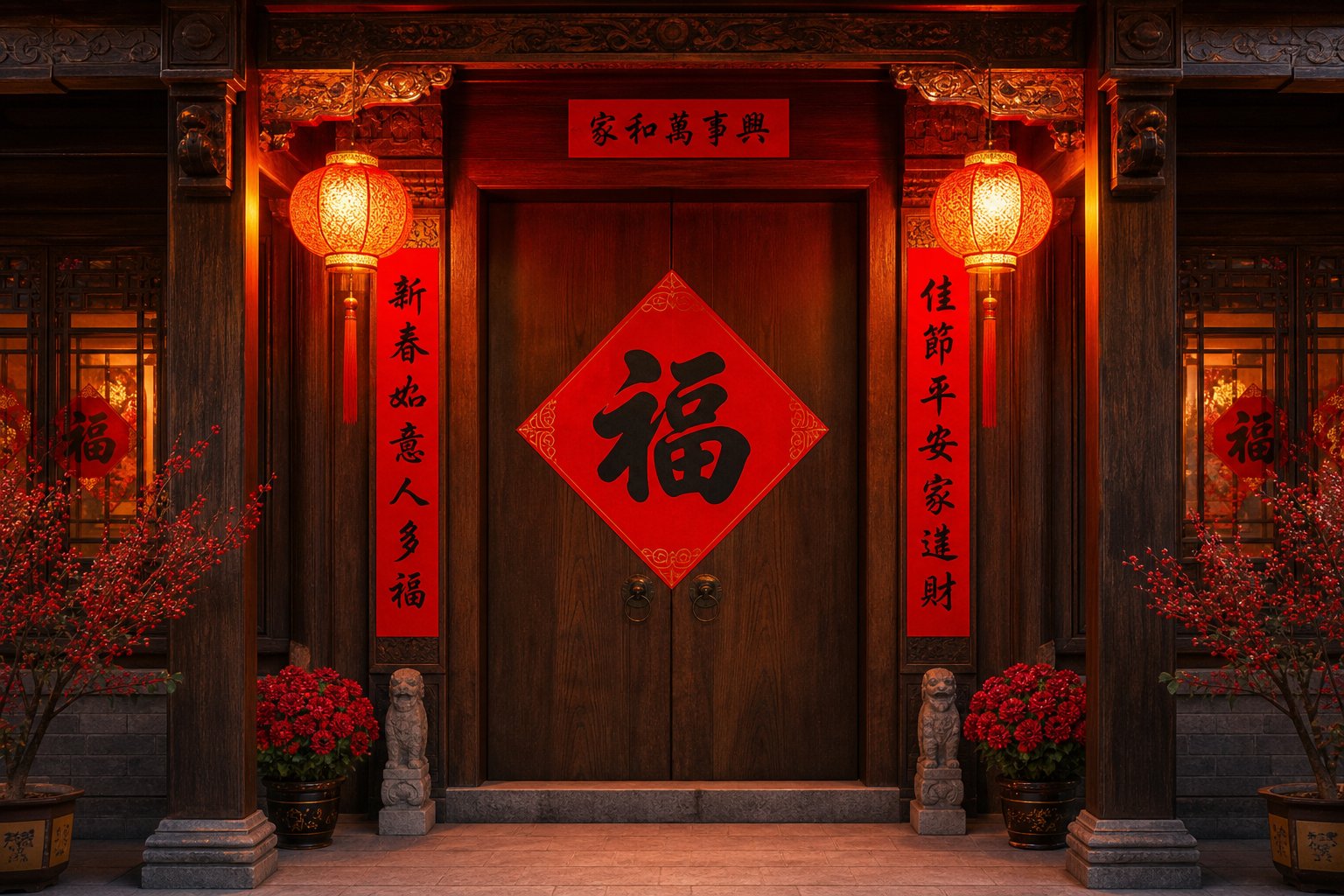
A well-written Fu carries spiritual weight — but that weight can be misdirected if the character ends up in the wrong orientation or the wrong spot. The chinese symbol for luck isn't a one-size-fits-all decoration. Traditional etiquette prescribes specific rules about which Fu faces right-side-up and which gets flipped, depending on where in the home it's placed. Getting this wrong doesn't just look odd — it can signal the opposite of what you intend.
Right-Side-Up Versus Upside-Down Placement Rules
Here's the rule most people miss: the main front door Fu should always be displayed right-side-up. This isn't optional or a matter of personal taste. In traditional practice, the front entrance represents the dignified face of the household — the point where fortune formally arrives. Hanging the good luck chinese symbol upright on the main chinese doorway signals that blessings are welcomed with proper respect and gravity. Inverting it there is considered improper, suggesting that fortune is being carelessly dumped rather than respectfully received.
The upside-down orientation belongs on secondary surfaces. As the Confucius Institute for Scotland explains, places like water tanks, cupboards inside the house, storage containers, and barns are appropriate locations for an inverted Fu — because you want fortune to "pour into" those vessels. The wordplay works differently here: you're directing abundance into containers rather than greeting it at your threshold.
Think of it this way: the front door is where you receive a guest. You stand upright, formal, welcoming. Interior storage is where you want things to flow in and accumulate. The orientation of the chinese luck symbol matches the function of the surface it occupies.
Placement Locations and Seasonal Timing
The symbol for good luck in chinese tradition appears throughout the home, but each location carries its own protocol. Families typically put up their Fu characters on New Year's Eve (除夕, Chuxi) as part of the broader spring couplet writing tradition — the same day door couplets are pasted on either side of the entrance frame. Timing matters: displaying Fu too early feels premature, while waiting past New Year's Day misses the window when blessings are believed to be most actively circulating.
Here's a clear breakdown of traditional placement rules organized by location:
- Main entrance door: Right-side-up. This is the most important Fu in the household — it represents the formal arrival of fortune and should be the largest, most carefully written character.
- Interior walls and living room: Right-side-up. These spaces represent the family's shared life and deserve the same dignity as the front entrance.
- Rice containers and grain storage: Upside-down. You want abundance to "pour into" your food supply, so the inverted good luck in chinese symbol directs fortune downward into the vessel.
- Wardrobes and cabinets: Upside-down. Same logic — fortune flows into enclosed storage spaces.
- Water barrels and tanks: Upside-down. The traditional reasoning is that you don't want to "empty out" your water supply, so the inverted Fu keeps abundance flowing in.
- Window frames: Right-side-up. Windows face outward like the front door and maintain the household's public dignity.
- Garbage bins: Right-side-up. This one surprises people — but inverting Fu on a trash bin would mean fortune is being "poured into" the garbage. Keeping it upright prevents that unfortunate reading.
Notice the underlying logic: any surface that faces the outside world or represents the household's dignity gets a right-side-up Fu. Any container you want filled with abundance gets an inverted one. The good luck in chinese symbol isn't just slapped on every flat surface — its orientation is a deliberate communicative choice, shaped by the same linguistic awareness that created the upside-down tradition in the first place.
For anyone choosing a calligraphy style for their chinese doorway display, these placement rules add another consideration. The main door Fu — right-side-up, prominent, representing the household — typically calls for a more formal script. Interior and storage placements allow more playful or personal styles. The etiquette of placement and the aesthetics of brushwork work together, each reinforcing the other's cultural logic.
Modern Calligraphers and the Living Fu Tradition
Placement rules tell you where the character goes. But someone still has to write it. Every year, in the weeks leading up to Chinese New Year, calligraphers across China, Taiwan, Singapore, and diaspora communities worldwide pick up their brushes and produce thousands of Fu characters — not for galleries or collectors, but for neighbors, coworkers, and strangers passing by on the street. This is where fu character calligraphy meaning stops being theory and becomes a living, breathing cultural act.
Writing Spring Couplets as Living Cultural Practice
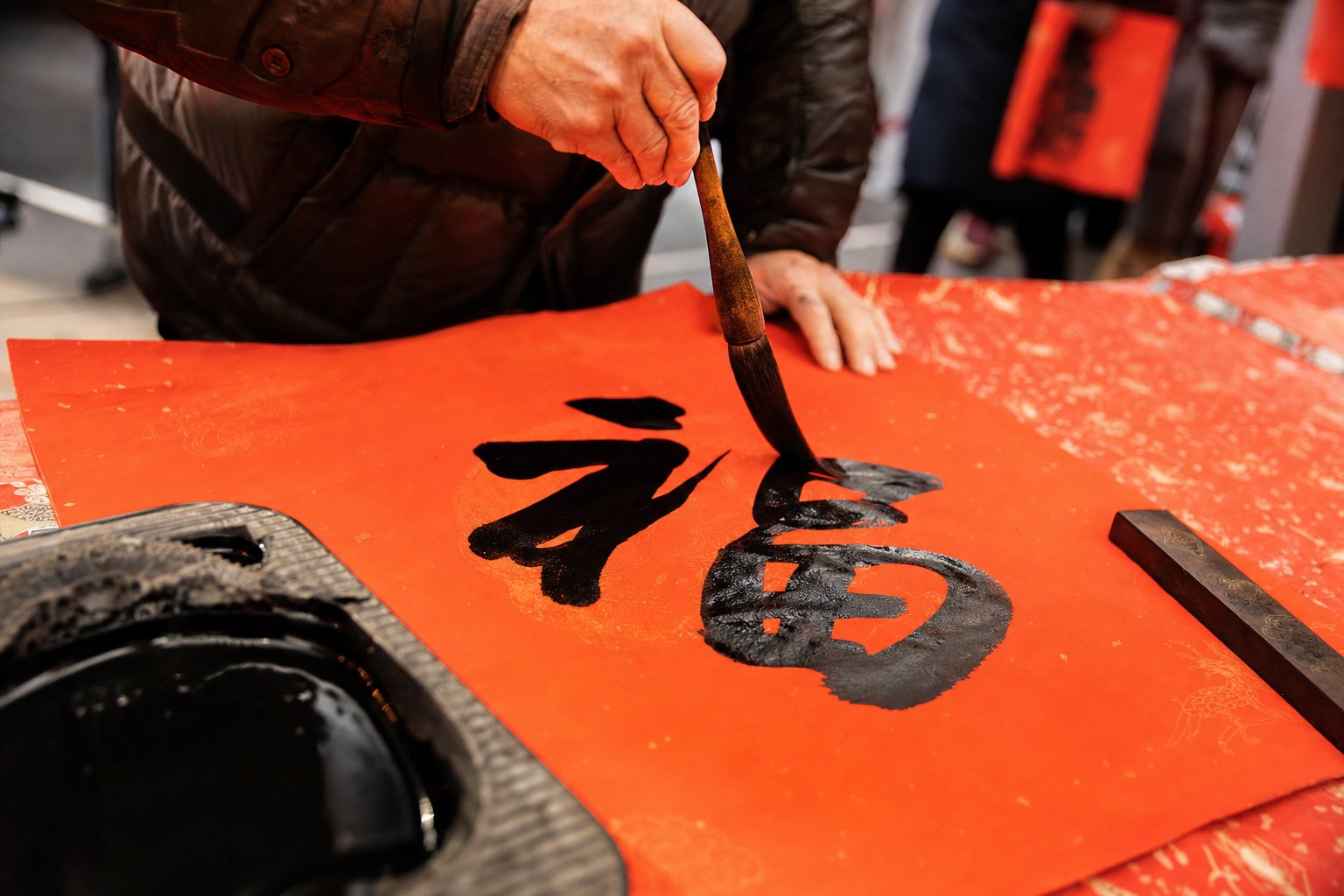
Imagine walking through a public square in late January. Folding tables line the sidewalk, covered in red paper, ink stones, and felt mats. Behind each table sits a calligrapher — sometimes a retired teacher, sometimes a university student, sometimes a monk from a nearby temple — grinding ink and writing chinese good luck characters for anyone who asks. This is the spring couplet writing tradition (写春联, xiě chūnlián), and it transforms calligraphy from a solitary art into a communal event.
The practice works like this: community members approach a calligrapher's table, request a Fu character or a pair of door couplets, and often watch the brushwork happen in real time. Some calligraphers write for free as a public service. Others accept small donations or red envelopes. Either way, the exchange is personal — the calligrapher might ask about your family situation, your hopes for the coming year, or which style you prefer, then tailor the brushwork accordingly. Good luck in chinese writing isn't mass-produced here. It's handcrafted for a specific household.
What keeps this tradition alive in an era of printed decorations and digital red envelopes? Part of it is aesthetic — a hand-brushed Fu on handmade paper carries a visual warmth that no printer can replicate. But the deeper reason connects back to the performative dimension we explored earlier. A Fu written by a skilled hand, with focused intention, in the presence of the person who will display it, carries more cultural weight than a factory-printed version. The act of writing is the blessing. Watching it happen is receiving it.
Community calligraphy events also serve as informal teaching spaces. Children watch brush technique up close. Adults who haven't held a brush since school reconnect with the physical pleasure of ink on paper. The tradition of chinese writing for good luck passes between generations not through textbooks but through these annual, embodied encounters. It's calligraphy as social glue — keeping a three-thousand-year-old art form relevant by tying it to the rhythms of everyday life rather than confining it behind museum glass.
Choosing a Calligraphy Style for Your Fu Character
So you're standing at that table, and the calligrapher asks: "Which style would you like?" This isn't a trivial question. Your choice of script communicates intent, signals your relationship to the recipient, and sets the emotional tone of the blessing. Think of it like choosing between a formal letter and a handwritten note — both carry words, but the medium shapes how those words land.
The general principle is straightforward: formality of occasion matches formality of script. But the nuances matter. Regular script (楷書) communicates respect and propriety — it's the lucky chinese letters equivalent of addressing someone by their full title. You'd choose it for a Fu destined for your grandparents' front door or a gift to a respected elder. Running script (行書) softens that formality into warmth, making it ideal for friends, siblings, or your own household. Cursive script (草書) is expressive and celebratory — perfect for artistic display or festive gatherings where energy matters more than legibility. And seal script (篆書) signals scholarly depth and historical awareness, suited for a study, a tea room, or a gift between intellectuals who appreciate antiquity.
Beyond script choice, several other material decisions shape the Fu character's communicative power. Ink color matters: black ink on red paper is the standard for New Year Fu, but gold ink on red paper elevates the formality for special occasions. Paper quality ranges from thin machine-cut squares to thick handmade xuan paper with visible fiber texture. Mounting style — whether the Fu is left as a loose sheet, backed with cardboard for door display, or formally mounted as a hanging scroll — signals how permanently and prominently the blessing is meant to live in someone's space.
The chinese letter for luck, when written with all these choices aligned, becomes a complete communicative package. Here's a practical guide matching style to situation:
| Calligraphy Style | Best Occasion | Ideal Recipient | Emotional Tone | Recommended Ink/Paper |
|---|---|---|---|---|
| Regular Script (楷書) | Formal New Year blessing, ancestral altar | Elders, parents, teachers | Respectful, dignified | Black ink on thick red paper |
| Running Script (行書) | Personal New Year wishes, housewarming | Friends, siblings, own household | Warm, sincere | Black or gold ink on red paper |
| Cursive Script (草書) | Artistic display, festive celebration | Art collectors, close friends who appreciate calligraphy | Joyful, energetic | Black ink on xuan paper or red paper |
| Seal Script (篆書) | Scholarly gift, study decoration | Intellectuals, cultural enthusiasts | Ancient, contemplative | Cinnabar red or black ink on cream xuan paper |
| Clerical Script (隸書) | Traditional home decor, cultural events | History enthusiasts, formal settings | Classical, grounded | Black ink on red or gold-flecked paper |
You'll notice that lucky in chinese writing isn't one thing — it's a spectrum of tones, each appropriate to different relationships and contexts. A cursive Fu given to your grandmother might feel disrespectful (too casual, too hard to read). A rigid regular script Fu at a lively New Year party might feel stiff. Matching style to context is part of the cultural literacy that chinese writing luck traditions demand.
Contemporary calligraphers also experiment beyond these traditional categories. Some blend scripts — starting a stroke in regular form and letting it trail into running script fluidity. Others incorporate seal carving, stamping a personal chop (印章, yìnzhāng) in red beside the brushed character to add authentication and visual contrast. A few avant-garde practitioners push into abstracted forms where the Fu character becomes almost purely gestural, legible only to those who know what they're looking at.
What unites all these approaches is the underlying conviction that writing Fu is not neutral transcription. Every choice — script, ink, paper, speed, pressure, mounting — adds meaning. The calligrapher isn't copying a character. They're composing a blessing, calibrated to its recipient and occasion, using the full expressive range that three millennia of brush tradition have made available.
That richness of intention is also where misunderstandings creep in. With so many layers of meaning packed into a single character, it's easy for oversimplified explanations to circulate — and some of the most common claims about Fu turn out to be flat wrong.
Common Mistakes and Misconceptions About Fu
With so many layers of meaning packed into a single character, oversimplified explanations inevitably circulate — and some of the most common claims about 福 turn out to be flat wrong. Whether you're exploring fu meaning for the first time or revisiting it after years of casual familiarity, these corrections will sharpen your understanding of what the character actually communicates.
Misconceptions About Meaning and Translation
The most persistent error? Translating 福 as simply "luck." You'll find this reduction everywhere — travel blogs, tattoo guides, souvenir shop labels. But as we've seen throughout this article, the fu meaning in chinese tradition encompasses blessing, fortune, happiness, prosperity, and spiritual favor simultaneously. Luck implies randomness, something that happens to you by chance. Fu implies a state of holistic well-being that's cultivated, received through proper conduct, and sustained by cosmic harmony. The two concepts aren't interchangeable.
Another common confusion involves mixing up 福 with visually or semantically adjacent characters. The character 运 (yùn) specifically means luck or fate in the chance-based sense. The character 吉 (jí) means auspicious or propitious. And 祥 (xiáng) means good omen. Each occupies its own semantic lane. When someone asks what does fu mean and receives "luck" as the answer, they're getting roughly one-fifth of the picture — and arguably the least accurate fifth at that.
The fu chinese meaning also gets flattened when people treat it as purely material. Yes, prosperity is part of 福. But the character's radical structure — with its altar component pointing toward the divine and its roof sheltering a person — encodes spiritual, familial, and material dimensions all at once. Reducing fu meaning chinese to "wealth" or "money luck" strips away the very architecture that makes the character culturally significant.
Errors in Display and Cultural Context
The second category of mistakes involves how people physically handle the character. The biggest offender: the belief that every Fu should be hung upside down. As we covered in the placement section, traditional etiquette reserves the inverted orientation for storage containers, cabinets, and water barrels — surfaces where you want fortune to "pour in." The main front door Fu must face right-side-up. Inverting it there suggests fortune is being dumped carelessly rather than welcomed with dignity.
Equally problematic is treating 福 as purely decorative — a splash of red for aesthetic purposes, no different from a geometric pattern or a floral motif. The 福 meaning runs far deeper than decoration. As the Rebel With A Heart blog puts it, Fu is "something to be received and never forced — a shared aspiration, our deepest yearning, and a collective prayer." Displaying it carries active cultural and spiritual significance. The character is performative: putting it up is understood as generating blessing, not merely referencing it.
Here are the most common mistakes alongside their corrections:
- Mistake: Translating 福 as "luck." Correction: Fu encompasses blessing, fortune, happiness, prosperity, and divine favor — a holistic state, not a random event.
- Mistake: Hanging all Fu characters upside down. Correction: Only secondary surfaces (storage, cabinets, water containers) get inverted Fu. The main door Fu stays right-side-up.
- Mistake: Treating Fu as interchangeable with 运 (luck) or 吉 (auspicious). Correction: Each character occupies a distinct semantic space. Fu is the broadest, encompassing elements the others don't.
- Mistake: Viewing displayed Fu as mere decoration. Correction: The act of writing and displaying Fu is a performative blessing — it creates what it names, not just labels it.
- Mistake: Assuming calligraphy style doesn't matter. Correction: Script choice communicates emotional register, formality, and cultural context. A cursive Fu and a regular script Fu say different things.
Understanding Fu requires appreciating both its written form and its cultural performance. The character is not a static symbol to be decoded — it is a living act of blessing whose meaning shifts with every brushstroke, orientation, and placement choice.
When you grasp this, the fu character calligraphy meaning stops being a translation problem and becomes something richer: a window into how Chinese culture uses written language not just to describe the world, but to actively shape it.
Frequently Asked Questions About Fu Character Calligraphy Meaning
1. What does the Chinese Fu character (福) literally mean?
Fu (福) does not translate to a single English word. It simultaneously encompasses divine blessing, material fortune, personal happiness, family prosperity, and good luck. Its radical components depict a person under a roof with land and food, blessed by heaven — representing the classical Chinese vision of complete well-being rather than random chance.
2. Why is the Fu character hung upside down during Chinese New Year?
The tradition relies on a homophone pun: 福倒了 (fu dao le, meaning 'Fu is inverted') sounds identical to 福到了 (fu dao le, meaning 'fortune has arrived'). The characters 倒 (to invert) and 到 (to arrive) share the same pronunciation and fourth tone. However, traditional etiquette dictates that only Fu on storage containers and cabinets should be inverted — the main door Fu must remain right-side-up.
3. What are the radicals inside the Fu character and what do they represent?
The Fu character contains four key components: 示 (shi, altar/divine) on the left indicating spiritual favor; 一 (yi, roof/shelter) at the top right representing security; 口 (kou, mouth/person) in the middle right symbolizing sustenance; and 田 (tian, field/land) at the bottom right representing agricultural wealth. Together they encode the idea that true fortune requires divine grace, shelter, nourishment, and productive resources working in harmony.
4. Which calligraphy style is best for writing a Fu character as a gift?
The ideal style depends on the recipient and occasion. Regular script (楷書) suits formal blessings for elders and parents. Running script (行書) works well for personal wishes to friends and family. Cursive script (草書) fits artistic displays and celebrations. Seal script (篆書) is appropriate for scholarly gifts between intellectuals. Each script communicates a different emotional register — from solemn respect to spontaneous joy.
5. Is Fu the same as the Chinese character for luck?
No. Fu (福) is frequently mistranslated as simply 'luck,' but it carries a much broader meaning. The character 运 (yun) specifically refers to luck or fate in the chance-based sense, while 吉 (ji) means auspicious and 祥 (xiang) means good omen. Fu encompasses all of these plus spiritual blessing, material prosperity, and family harmony — making it the most comprehensive term for good fortune in Chinese culture.