The Gao Surname and Its Meaning in Chinese Culture
Imagine carrying a family name that once belonged to emperors, frontier poets, and military strategists spanning over three thousand years of recorded history. For approximately 17 million people alive today, that name is Gao. The gao surname traces its roots deep into Chinese antiquity, connecting modern bearers to royal courts, philosophical traditions, and one of the most overlooked imperial dynasties in East Asian history.
Yet most descendants know only fragments of this story. The full picture, from legendary architects of the Yellow Emperor's era to the founding of an entire dynasty, remains hidden in classical genealogical texts that few have read in full. Understanding gao surname history starts with the character itself and what it reveals about the people who first carried it.
What the Character 高 Means
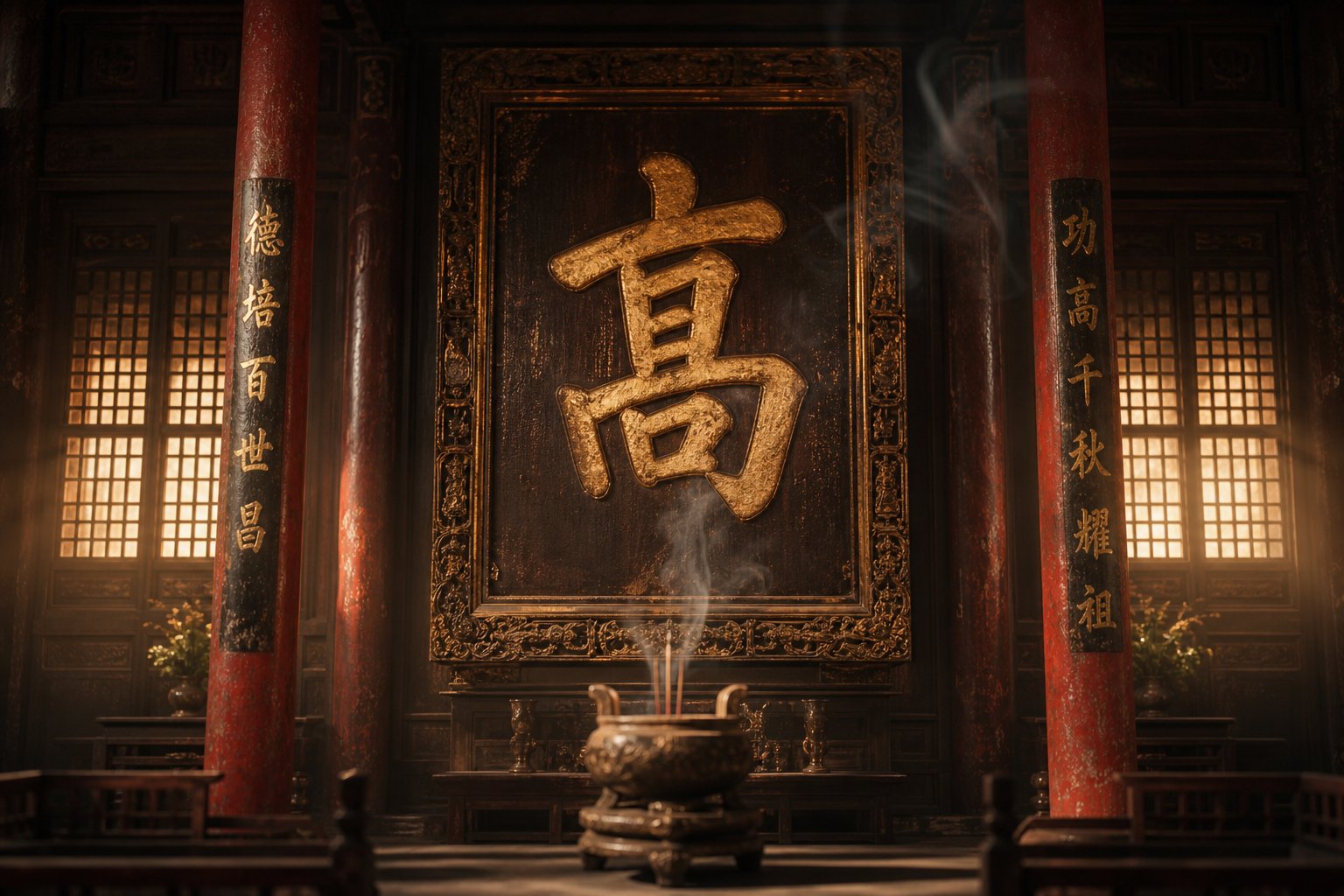
The character 高 (pronounced gāo in Mandarin, with a high, level first tone) literally translates to "tall" or "high." But in Chinese culture, height carries far more weight than physical measurement. It signals elevation in status, loftiness of character, and noble aspiration. When you see gao in chinese compound words, it appears in terms like 高贵 (noble), 高尚 (lofty, virtuous), and 高明 (brilliant). The character itself, in its ancient oracle bone form, depicted a tall building or watchtower, a structure that rose above its surroundings.
This association between physical height and social prestige made 高 a natural fit as a surname for families connected to power. According to the Lüshi Chunqiu, the earliest recorded figure bearing the name was Gao Yuan, credited with inventing housing in deep antiquity. Height in architecture symbolized prestige, and his skill in constructing towering buildings earned him widespread respect. His descendants adopted Gao as their surname to honor that legacy.
The character 高 encodes aspiration itself. In a culture where names shape destiny, bearing the surname Gao meant your lineage reached upward, toward authority, toward excellence, toward heaven.
The Gao Surname Among Chinese Family Names
Where does the gao surname sit within the broader landscape of Chinese family names? In 2019, it ranked as the 19th most common surname in Mainland China, placing it firmly among the nation's most widespread lineages. The classical Baijiaxing (Hundred Family Surnames), compiled during the Song dynasty, also includes Gao as a prominent entry, reflecting its established status even a thousand years ago.
With roughly 17 million living bearers worldwide, the name spans not just mainland China but Taiwan, Hong Kong, Southeast Asia, Korea (where it appears as Ko or Go), and growing diaspora communities across North America and Europe. Its reach reflects centuries of migration, political upheaval, and cultural exchange.
What makes gao meaning chinese particularly rich is that the surname did not emerge from a single ancestor. Multiple origin branches, including descent from the legendary Jiang Ziya through the ancient State of Qi, connections to non-Han ethnic groups who adopted the name during periods of sinicization, and even alternative character origins, all feed into the modern Gao population. Each branch carries its own story of how political power, geographic identity, and cultural aspiration converged into a single shared character: 高.
The oldest and most celebrated of these branches leads back to the Spring and Autumn period, to a man named Gao Xi whose loyalty to a future king earned his family a surname that would endure for millennia.
Ancient Origins in the State of Qi and Beyond
The gao last name origin story is not a single thread but a braid of distinct lineages, each rooted in a different era and political context. The most prominent branch traces directly to one of China's most legendary figures: Jiang Ziya, the military strategist who helped the Zhou dynasty overthrow the Shang around 1046 BC. His reward was the State of Qi, a powerful feudal domain in what is now Shandong province. From that state, generations later, the surname Gao emerged through a combination of political loyalty, hereditary fiefs, and the ancient practice of converting place names into family names.
Two additional branches, written with entirely different Chinese characters but romanized identically as Gao, add further complexity. Understanding all three helps explain why the last name Gao appears across such diverse genealogical records.
Descent from Jiang Ziya and the State of Qi
Here is where the story gets personal. Gao Xi, an eighth-generation descendant of Jiang Ziya, lived during a period of violent internal turmoil in the State of Qi. When the ruling duke was assassinated, the state plunged into chaos. Gao Xi joined forces with other officials to suppress the rebellion, then played a pivotal role in helping his close ally ascend the throne as Duke Huan of Qi (died 643 BC), who would become the first recognized hegemon of the Spring and Autumn period.
For this service, Gao Xi received the title of Chief Minister and was formally honored with the surname Gao. The name itself came from his grandfather's fief, a territory called Gao located in what is now Yuxian, Henan province. This fief had originally been granted to Prince Gao, a son of Duke Wen of Qi (died 804 BC). So the progression was clear: a place name became a title, the title became a hereditary designation, and that designation crystallized into a surname carried by all descendants.
A secondary Qi-related branch emerged later through Zi Gao, the style name of Prince Qi, a son of Duke Hui of Qi (died 599 BC). His descendants adopted his courtesy name as their family name, further expanding the surname gao population within the same state but through a separate princely line.
The State of Gao and Alternative Character Origins
Not everyone bearing the gao last name descends from the Qi lineage. Two other Chinese characters, pronounced identically or nearly so, produced their own Gao surname branches:
- 郜 (Gao) — The State of Gao: King Wen of Zhou (1152-1056 BC) granted his 11th son a small feudal state called Gao, located in present-day Chengwu, Shandong province. When the state of Song annexed this territory during the Spring and Autumn period (770-476 BC), displaced descendants adopted their lost state's name as a surname.
- 皋 (Gao) — Meaning "marsh": This character traces back to Gao Yao, the legendary official in charge of criminal law under Emperor Shun (c. 23rd century BC). A separate branch connects to Gao Ru, an official in the state of Yue during the Spring and Autumn period. A third sub-branch derives from an ancient tribe or small state, possibly in northern China, later absorbed by the state of Jin.
- 高 (Gao) — The primary character: The dominant lineage through Jiang Ziya and the State of Qi, plus later adoptions by non-Han ethnic groups during the Northern Dynasties period.
When these names were romanized into the Latin alphabet, all three characters collapsed into a single spelling: Gao. This means that two families both bearing the last name Gao may actually descend from entirely unrelated origins, written with different characters carrying different meanings.
Classical Sources That Document These Origins
How do historians verify these lineages? Several classical Chinese genealogical texts serve as primary authorities. The Yuanhe Xing Zuan (元和姓纂), compiled during the Tang dynasty around 812 AD by Lin Bao, is one of the earliest comprehensive surname dictionaries. It systematically records the origin, geographic distribution, and notable figures of each surname, including detailed entries on the Gao branches.
The Tongzhi (通志), a Song dynasty encyclopedic work by Zheng Qiao completed around 1161 AD, contains a dedicated section on clan and surname origins (Shi Zu Lue) that cross-references earlier records. For the surname gao specifically, it confirms the Qi state lineage and documents the 郜 and 皋 branches as distinct origins. The Dictionary of American Family Names by Patrick Hanks also catalogs these multiple origins for modern genealogical researchers working with romanized records.
Together, these sources establish that the gao last name origin is not monolithic. It is a convergence of at least three distinct character lineages, multiple princely houses, and later ethnic adoptions, all funneled through history into a single modern identity. That convergence would reach its most dramatic expression centuries later, when one branch of the Gao clan seized imperial power and founded a dynasty of their own.
The Northern Qi Dynasty and the Gao Imperial Clan
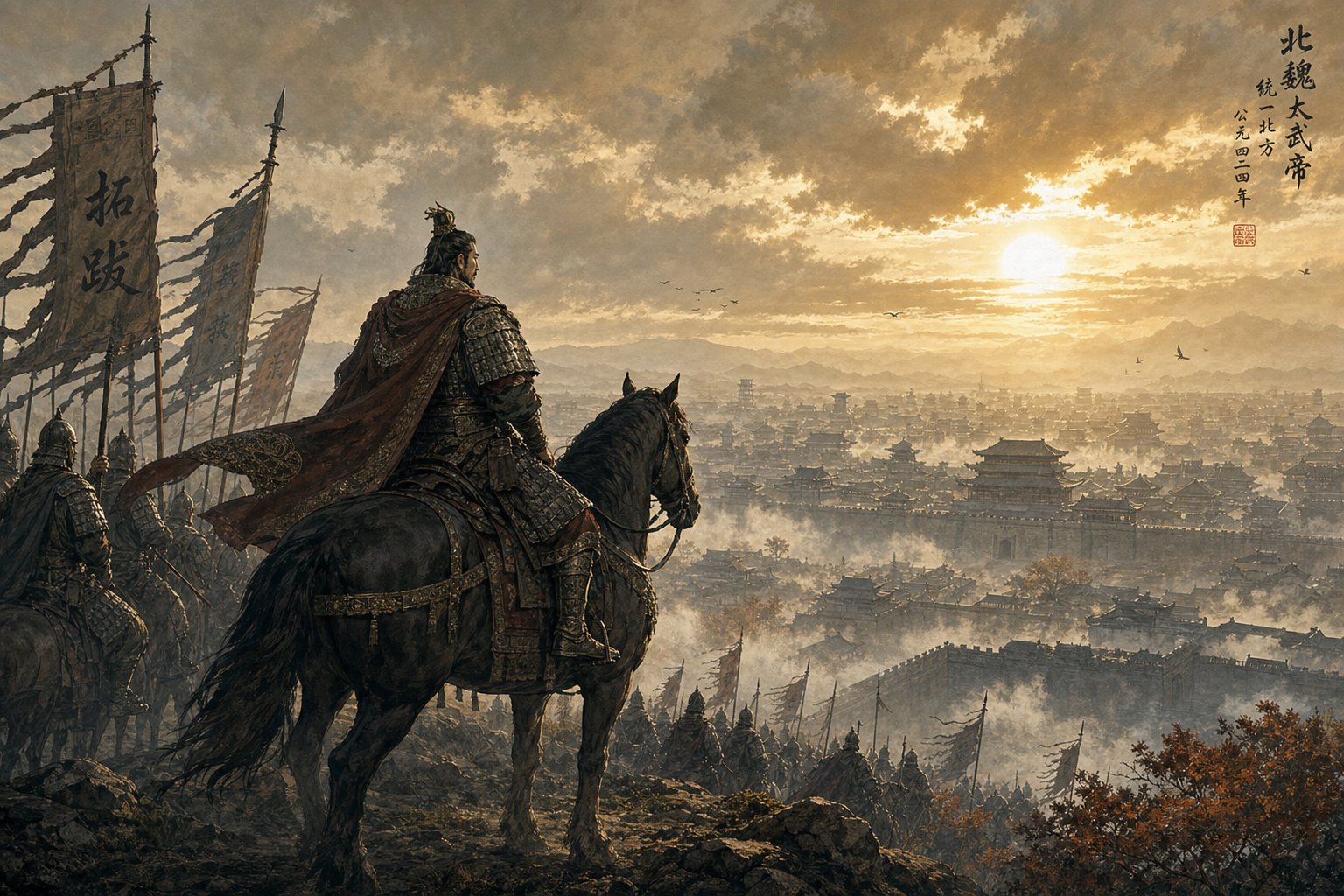
Most Chinese surnames can claim famous scholars, generals, or ministers. Very few can claim an entire imperial dynasty. For the Gao family, that distinction belongs to the Northern Qi (550-577 CE), a 27-year period when the character 高 was not just a family name but the ruling surname of a state controlling eastern northern China. This is the chapter of gao surname history that most descendants never discover, yet it represents the absolute political zenith of the clan.
The story begins not with an emperor, but with a penniless orphan who married above his station and outmaneuvered every rival in one of China's most chaotic centuries.
Gao Huan and the Rise to Imperial Power
Born in 496 CE at the northern frontier garrison town of Huaishuo (near modern Baotou, Inner Mongolia), Gao Huan came from a Han Chinese family that had lived among the Xianbei people for generations. His grandfather had been exiled to the frontier for political offenses, and by the time Gao Huan was born, the family had adopted Xianbei customs so thoroughly that he spoke the Xianbei language as his primary tongue. His parents died when he was an infant, and he was raised in poverty by his older sister and her husband.
The turning point came through marriage. Lou Zhaojun, a wealthy Xianbei woman, spotted Gao Huan and was so impressed by his bearing that she married him against her parents' wishes. Her dowry gave him enough money to buy a horse, his first step toward a military career. From that modest beginning, Gao Huan rose through the ranks during the collapse of the Northern Wei dynasty, a period of civil war, frontier rebellions, and ethnic tension that tore northern China apart.
His path to power followed a pattern of calculated patience. He served under the powerful Erzhu clan, building his own network of loyal officers while his superiors underestimated him. When the Erzhus grew corrupt and overextended, Gao Huan turned against them in 531, defeating their combined forces at the Battle of Hanling in 532 despite being outnumbered. He captured the strategic city of Yecheng and made it his base of operations.
By 534, Gao Huan had effectively split the Northern Wei empire in two. He installed a puppet emperor and established the Eastern Wei, ruling from behind the throne as paramount general. He never took the imperial title himself, but everyone understood who held real power. His military headquarters at Jinyang (modern Taiyuan, Shanxi) became the true center of government, while the nominal capital at Yecheng housed the emperor he controlled.
Gao Huan told his Xianbei soldiers that the Chinese were their servants who farmed and clothed them, while simultaneously telling the Chinese that the Xianbei were their hired protectors. He governed by balancing two worlds, belonging fully to neither.
When Gao Huan died in 547, exhausted after a failed siege of the Western Wei fortress at Yubi, he left behind a political machine ready for the final step. His eldest son Gao Cheng took over as regent, and after Gao Cheng was assassinated in 549, the second son Gao Yang moved decisively.
The Northern Qi Dynasty Under Gao Rule
On June 9, 550, Gao Yang forced Emperor Xiaojing of Eastern Wei to abdicate and declared himself Emperor Wenxuan of a new dynasty: the Northern Qi. The surname Gao became an imperial surname, a status that carried enormous prestige in Chinese political culture. The dynasty's alternative historical name, "Gao Qi" (高齊), literally embedded the family name into the state's identity.
The gao family ruled from their capital at Yecheng (in modern Handan, Hebei), one of the great cities of medieval China. At its peak, the Northern Qi controlled roughly 1.5 million square kilometers of territory, making it the strongest of the three states that divided China during this period. Its domain stretched from the Yellow River plains to the Shandong coast, encompassing the most agriculturally productive and densely populated regions of northern China.
Six emperors from the Gao clan sat on the Northern Qi throne across those 27 years:
- Emperor Wenxuan (Gao Yang) — r. 550-559. The founder. Capable in his early reign but increasingly erratic.
- Emperor Fei (Gao Yin) — r. 559-560. Wenxuan's son, deposed after less than a year.
- Emperor Xiaozhao (Gao Yan) — r. 560-561. Gao Huan's sixth son, who seized the throne from his nephew.
- Emperor Wucheng (Gao Zhan) — r. 561-565. Gao Huan's ninth son, who abdicated in favor of his own son.
- Houzhu (Gao Wei) — r. 565-577. The last effective ruler, whose incompetence led to the dynasty's fall.
- Youzhu (Gao Heng) — r. 577. A child emperor who reigned for mere weeks before capture.
Beyond politics, the Northern Qi left a cultural footprint that outlasted its brief existence. Its ceramics marked a revival of Chinese ceramic art, with green-splashed porcelain designs previously thought to have originated under the later Tang dynasty. Tomb murals from the period, such as those discovered in the tomb of Xu Xianxiu in Taiyuan (dated 571 CE), reveal a cosmopolitan court culture with strong Central Asian and Sogdian influences. Buddhist sculpture flourished, producing distinctive columnar statues that departed from earlier styles. The dynasty also constructed over 1,600 kilometers of Great Wall fortifications to defend against Turkic incursions from the north.
This cosmopolitanism reflected the gao chinese rulers' unique position straddling Han and Xianbei cultures. The court employed officials from diverse ethnic backgrounds, patronized Buddhist monasteries, and maintained trade connections along the Silk Road that brought Persian artifacts, Zoroastrian influences, and Central Asian musicians into the heart of northern China.
Legacy of the Northern Qi for Gao Descendants
The dynasty ended in 577 when the rival Northern Zhou, a smaller state with fewer resources but more effective leadership, conquered the Northern Qi in a swift campaign. Emperor Houzhu's misrule, corrupt officials, and a deteriorating military made the collapse almost inevitable. Both the last emperor and his young successor were captured and killed.
Yet the political fall did not erase the genealogical significance. For centuries afterward, chinese gao clan genealogies traced their lineages back to the Northern Qi imperial house. The dynasty's founding ancestor Gao Huan received the posthumous temple name "Gaozu" (高祖) and the title "Emperor Shenwu," ensuring his place at the apex of clan ancestral records. The Bohai Commandery, which Gao Huan claimed as his ancestral homeland, became one of the most prestigious commandery designations (郡望) associated with the surname.
During the Northern Qi period, the imperial court also granted the surname Gao to meritorious officials of Xianbei origin, including figures like Yuan Jing'an and Yuan Wenyao. This practice of bestowing the imperial surname as a political honor expanded the gao family far beyond its original bloodlines, weaving new ethnic threads into the clan's fabric. It meant that when the dynasty fell, its surname legacy scattered across northern China through both biological descent and political adoption.
The Northern Qi represents something rare in Chinese history: a moment when a single surname held sovereign power. For modern Gao descendants researching their ancestry, this dynasty is often the missing piece that connects scattered genealogical fragments to a larger narrative of imperial ambition, cultural achievement, and eventual dispersal across the Chinese landscape and beyond.
That dispersal was not limited to Han Chinese bearers. The very policies that made the Northern Qi a multiethnic state also ensured that the Gao surname would be carried forward by peoples of Xianbei, Jurchen, and eventually Manchu descent, each adding their own chapter to the name's evolving story.
Multi-Ethnic Roots of the Gao Surname
China's surname system was never a closed loop reserved for a single ethnicity. Across centuries of conquest, migration, and deliberate state policy, non-Han peoples adopted Chinese last names as part of broader cultural integration. The Gao surname absorbed more of these cross-ethnic threads than most families realize, making it one of the most diverse lineages in Chinese genealogical history.
Xianbei Adoption During the Northern Dynasties
The most systematic wave of non-Han adoption came during the Northern Wei dynasty (386-534 CE), when Emperor Xiaowen launched sweeping sinicization reforms in the 490s. He ordered Xianbei nobles to abandon their original surnames, adopt Chinese clothing and language, and intermarry with Han elite families. He changed his own clan name from Tuoba to Yuan and restructured the entire aristocratic hierarchy around Chinese-style social stratification.
Under these policies, dozens of Xianbei clans received or chose new Chinese surnames. Some families adopted Gao based on phonetic similarity to their original names, while others received it through imperial bestowal. Even before Emperor Xiaowen's reforms, the Xianbei ruler Murong Yun (died 409 CE) of the Later Yan dynasty had already adopted Gao as his personal surname, demonstrating that the char in chinese carried prestige that transcended ethnic boundaries. The Northern Qi dynasty itself, as covered earlier, granted the surname Gao to Xianbei officials as a political honor, further embedding non-Han lineages into the clan.
Jurchen and Manchu Gao Lineages
A second major ethnic thread runs through the Jurchen people and their Manchu descendants. During the Jin dynasty (1115-1234 CE), the Jurchen surname Heshelie (赫舍里) was officially translated into the Chinese surname Gao. This was not a casual choice. The History of Jin records multiple prominent Heshelie clan members, and its National Language commentary explicitly states: "Heshelie is called Gao."
Centuries later, when the Manchu people consolidated their identity during the Qing dynasty (1616-1911), the Heseri clan (the evolved form of Heshelie) became one of the most powerful Manchu lineages. Soni, a founding minister of the Qing dynasty, belonged to this clan. After the mid-Qing period, as Manchu families increasingly adopted single-character Chinese surnames, some Heseri descendants chose "He" (taking the first syllable), while others reverted to the older Jin-dynasty translation and used Gao. This means that certain Manchu families bearing the go surname today trace their lineage through a completely different historical pathway than Han Chinese Gao families.
Other Ethnic Minorities Bearing the Gao Name
Beyond the Xianbei and Jurchen-Manchu lines, several other ethnic groups came to bear the surname through distinct historical circumstances. Hui (Chinese Muslim) communities adopted Gao in some cases through conversion-era name changes during the Tang and Song dynasties, when Central Asian merchants settled in China and took Chinese surnames for commercial and social integration. Among the Yi people of southwestern China, certain clan names were transliterated as Gao when Chinese administrative systems required standardized registration. Miao and Zhuang communities in southern China similarly adopted the surname during Ming and Qing dynasty campaigns to bring frontier populations under centralized governance.
The table below organizes these multi-ethnic origins:
| Ethnic Group | Original Surname or Clan | Approximate Period | Historical Context |
|---|---|---|---|
| Xianbei | Various clan names | 4th-6th century CE | Sinicization policies under Northern Wei; imperial bestowal during Northern Qi |
| Jurchen | Heshelie (赫舍里) | 12th-13th century CE | Official translation of Jurchen surname into Chinese during Jin dynasty |
| Manchu | Heseri (赫舍里) | 17th-20th century CE | Adoption of Chinese surnames after mid-Qing; some branches reverted to Jin-era translation "Gao" |
| Hui (Chinese Muslim) | Various Central Asian names | 7th-13th century CE | Merchant settlement and cultural integration during Tang and Song dynasties |
| Yi | Clan names transliterated | 14th-19th century CE | Administrative standardization under Ming and Qing governance |
| Miao / Zhuang | Local clan designations | 15th-19th century CE | Frontier integration campaigns; household registration requirements |
| Korean (Gaoli) | 고 (Go/Ko) | Ancient period onward | Shared use of character 高; independent clan origins on Jeju Island |
What this diversity reveals is that the modern Gao population is not a single family tree but a forest of separate roots that grew into a shared canopy. Two people bearing the same surname may descend from a Spring and Autumn period duke, a Xianbei cavalry officer, a Jurchen nobleman, or a Hui merchant, each carrying a fundamentally different ancestral story written with the same character.
This multi-ethnic reality also shaped where Gao families ended up geographically. The Xianbei and Jurchen branches concentrated in northern China, while Hui Gao families clustered along Silk Road trade routes and in cities like Xi'an and Quanzhou. Tracing these migration patterns reveals how the surname spread from its Shandong heartland to every corner of China and eventually across international borders.

Migration Patterns From Northern China to the World
A surname can stay rooted in one place for centuries, then scatter across a continent in a single generation. For the Gao clan, the ancestral homeland sat squarely in the Shandong and Henan corridor of northern China, the same territory where the State of Qi once flourished and where the Northern Qi dynasty held court. But war, famine, and political collapse pushed successive waves of Gao families southward, and eventually overseas, creating a global footprint that stretches from Fujian fishing villages to Silicon Valley suburbs.
Each migration wave left a trail. Understanding when and why these movements happened helps modern descendants pinpoint which branch of the family tree they belong to and where their ancestors likely lived before arriving at their current location.
From Shandong Southward Through the Dynasties
The earliest Gao populations clustered around two regions: Shandong (the old State of Qi heartland) and the Bohai Commandery area spanning parts of modern Hebei and Shandong. For roughly a thousand years, from the Spring and Autumn period through the end of the Northern Qi, these northern plains remained the demographic center of gravity for the surname.
Three major southward migration waves reshaped that distribution:
- The Jin Dynasty collapse (317 CE): When northern China fell to non-Han invaders, nearly one million people fled south across the Yangtze River. Gao families from the Bohai region joined this exodus, establishing new communities in the Jiangsu and Zhejiang areas. This first wave planted the surname in central China for the first time at scale.
- The An Lushan Rebellion (755-763 CE): This devastating Tang dynasty civil war killed millions and displaced entire populations from the Yellow River basin. Gao families who had remained in the north during the previous centuries now moved south into the Yangtze Delta, Jiangxi, and Hunan. The rebellion shattered the Tang empire's northern heartland and permanently shifted China's demographic center southward.
- The Southern Song migration (1127-1279 CE): When Jurchen armies conquered northern China and established the Jin dynasty, the Song court retreated south to Hangzhou. An estimated five million northerners followed. This final great wave pushed Gao families deep into Fujian and Guangdong for the first time, positioning them near the coastal ports that would later serve as launching points for overseas migration.
By the Ming dynasty (1368-1644), the Gao surname had spread across virtually every province. Genetic ancestry data from 23andMe reflects this dispersal pattern clearly: among people with the surname Gao who have tested, recent ancestry locations include Shandong, Zhejiang, Fujian, Guangdong, and Shanghai in roughly equal proportions, each representing about 17.8% of the sample. The even distribution tells a story of thorough geographic spread rather than concentration in any single region.
The Gao Diaspora in Southeast Asia and Korea
Once Gao families reached the southern coastal provinces of Fujian and Guangdong, the sea became the next frontier. Hokkien-speaking communities from southern Fujian had been engaged in maritime trade since the Song dynasty, when the port of Quanzhou served as China's primary gateway to Southeast Asian commerce. Gao families who had settled in the Zhangzhou and Quanzhou prefectures joined this outward flow.
The pattern intensified during the Ming and Qing dynasties. After the lifting of the ban on private maritime trade in 1567, hundreds of junks were involved in the South Seas trade by the 1610s, carrying merchants and laborers to Manila, Batavia (Jakarta), Ayutthaya (Thailand), and the Malay Peninsula. Hokkien families, including those surnamed Gao, established sojourning communities at these ports. In the Hokkien dialect, the character 高 is pronounced "Ko" or "Koh," which is why descendants in Malaysia and Singapore often spell their last name Ko or Koh rather than Gao.
This explains a question many people ask about the ko last name origin. When you encounter the surname Koh in Singapore or Malaysia, it frequently traces back to the same character 高 carried south by Hokkien migrants. The koh last name origin is not a separate surname at all but a dialect pronunciation of the same ancestral character. Clan associations in Penang, Singapore, and other Southeast Asian cities maintained connections to ancestral villages in Fujian, sending donations back to China and providing welfare support to newly arrived immigrants.
The Korean connection follows a different pathway entirely. The surname Ko (고) in Korea uses the same Chinese character 高 but has independent origins. The largest Korean clan bearing this name is the Jeju Go clan, which claims descent from Go Eul-na, the legendary first ruler of the ancient kingdom of Tamna on Jeju Island. A separate branch, the Liaoyang-based Go clan, traces its ancestry to the royal family of Goguryeo, the powerful Korean kingdom whose rulers adopted the surname Go (高) based on a claimed connection to the mythical Chinese emperor Gao Yang. According to the 2000 South Korean census, 435,839 people bore this surname, with 67.5% choosing to romanize it as Ko, 18.3% as Go, and 11.4% as Koh on their passports. The surname koh, in this Korean context, represents the same character but an entirely separate genealogical tradition from the Chinese Gao lineages.
Modern Global Distribution
The twentieth and twenty-first centuries brought new migration channels. Political upheaval during the Chinese Civil War, the founding of the People's Republic in 1949, and later economic reforms all generated waves of emigration to North America, Europe, and Australasia.
In the United States, the Gao surname has grown rapidly. U.S. Census data shows the number of people with the last name Gao more than doubled between 2000 and 2010, rising from 5,405 to 12,172 individuals. Its national ranking jumped from 5,866th to 2,948th in that same decade, a growth rate of over 125%. The overwhelming majority (97.39% in 2010) identified as Asian or Pacific Islander, reflecting recent immigration from China rather than long-established diaspora communities.
Major destinations for modern Gao migration include:
- Malaysia and Singapore: Hokkien-speaking communities established since the 18th century; surname typically spelled Ko or Koh.
- Indonesia: Concentrated in Java and Sumatra; arrived through the same Hokkien maritime trade networks.
- South Korea: Independent origin through the Jeju Go clan and Goguryeo royal lineage; over 435,000 bearers as of 2000.
- United States and Canada: Rapid growth since the 1990s driven by skilled immigration and student migration from mainland China.
- Taiwan: Both long-established Hokkien Gao/Ko families and post-1949 arrivals from all mainland provinces.
- Australia and United Kingdom: Growing communities since the 1980s, primarily from professional and academic migration.
The ancestry composition data from 23andMe customers with the surname Gao reinforces this picture: 89.2% show Chinese ancestry, 4.5% Manchurian and Mongolian, and 3.9% Korean. That Manchurian-Mongolian component likely reflects the Jurchen and Xianbei adoption threads discussed earlier, persisting in the genetic record centuries after the original surname transfers occurred.
What all these migration threads share is a common starting point in northern China and a series of historical shocks that pushed families outward in stages. The character 高 traveled along trade routes, refugee trails, and immigration queues, adapting its pronunciation at each stop but preserving its meaning. Whether spelled Gao, Ko, Koh, or Go, the name still points back to the same ancient aspiration encoded in its strokes: height, elevation, reaching upward.
Yet spelling is only one layer of the puzzle. The same character sounds dramatically different depending on which dialect or language system renders it, and understanding those phonetic variations is essential for anyone trying to connect scattered family records across borders.
How to Pronounce Gao: Romanization Variants Explained
You are looking at a family record from the 1920s and the surname reads "Kao." A relative in Singapore spells it "Koh." A Korean colleague writes "Ko." Are these the same name? Yes. Every one of these spellings traces back to the single character 高, filtered through different dialects, romanization systems, and national conventions. Understanding gao pronunciation across these systems is the key to reconnecting fragmented family records that appear unrelated on paper.
For English speakers wondering how to pronounce Gao, the Mandarin version sounds roughly like "gow" (rhyming with "cow"), spoken in a high, flat tone. The IPA transcription is /kɑʊ̯⁵⁵/. But that is only one pronunciation among many, and the others explain why the same surname appears under so many different spellings worldwide.
Mandarin Romanization and Wade-Giles Differences
The most common source of confusion is the difference between "Gao" and "Kao." Both represent the exact same Mandarin sound. The difference is purely a matter of which romanization system was used to transcribe it.
Modern pinyin, adopted by the People's Republic of China in 1958 and internationally standardized in 1982, spells the sound as gao. The older Wade-Giles system, developed by British diplomats in the 19th century and dominant in English-language scholarship until the 1980s, spells the identical sound as kao. Wade-Giles uses "k" for unaspirated velar stops where pinyin uses "g," and reserves "k'" (with an apostrophe) for the aspirated version that pinyin writes as "k."
This means the kao last name you encounter in older immigration records, academic publications, or Taiwanese documents is not a different surname. It is the same character 高, the same pronunciation, transcribed under a different system. Taiwan continued using Wade-Giles for passport romanization well into the 21st century, which is why many Taiwanese families still spell their name Kao rather than Gao. The Yale romanization system, used primarily in American language instruction, renders it as "gau," adding yet another spelling variant to the mix.
Dialect Variants in Cantonese and Hokkien
Dialect differences produce genuinely different sounds, not just different spellings of the same sound. When you pronounce gao in Cantonese, the character 高 becomes "gou" (Jyutping: gou1), with an IPA value of /kou̯⁵⁵/. Romanized in informal contexts, this often appears as Go or Ko on identity documents from Hong Kong and Guangdong province.
Hokkien dialects shift the pronunciation further. In the Southern Min dialect spoken across Fujian, Taiwan, and Southeast Asian Chinese communities, 高 is pronounced "ko" (/ko⁴⁴/) in its literary reading, which is the form used for surnames. This produces the spellings Ko and Koh that dominate among overseas Chinese families in Malaysia, Singapore, the Philippines, and Indonesia. The Teochew dialect, closely related to Hokkien, uses "go" for surnames, yielding yet another variant.
Hakka dialects add one more layer. In Sixian Hakka (common in Taiwan and parts of Guangdong), the pronunciation is "ko" (/ko²⁴/), while Meixian Hakka renders it as "gau" (/kau⁴⁴/). These variations explain why two families from neighboring villages in Guangdong might spell the same surname differently depending on whether they speak Cantonese, Hakka, or Teochew at home.
For those researching gao meaning japanese, the character 高 crossed into Japan as part of the broader adoption of Chinese characters (kanji). In Japanese, it carries the on'yomi reading "kou" (こう), derived from the Middle Chinese pronunciation "kaw." The kun'yomi (native Japanese reading) is "taka," meaning tall or high. As a Japanese surname, 高 is typically read as Taka or appears in compounds like Takahashi (高橋). The character retains its core meaning of height and elevation across both languages.
The Korean Surname Ko and Its Chinese Connection
The Korean surname 고 (Go/Ko) uses the same hanja character 高, but its origins are largely independent of the Chinese Gao lineages. In Korean, the character is pronounced "go" (/ko̞/), romanized as either Go (Revised Romanization) or Ko (McCune-Reischauer system). A 2007 study of South Korean passport applications found that 67.5% of bearers chose the spelling Ko, 18.3% preferred Go, and 11.4% used Koh.
The largest Korean clan bearing this surname, the Jeju Go clan, claims descent from Go Eul-na, the mythical first ruler of the kingdom of Tamna on Jeju Island. This origin has no genealogical connection to the Chinese Jiang Ziya lineage. A separate Korean branch, the Liaoyang-based Go clan, does trace its ancestry to the royal family of Goguryeo, whose rulers adopted the character 高 based on a claimed connection to the ancient Chinese emperor Gao Yang (Zhuanxu). The 2000 South Korean census recorded 435,839 people bearing this surname across 135,488 households.
Vietnamese provides one final variant. The character 高 is read as cao in Vietnamese (Sino-Vietnamese reading), producing the surname Cao. This reading evolved from the same Middle Chinese source but followed Vietnamese phonological rules, dropping the initial velar stop and shifting the vowel.
The table below consolidates these variants for quick reference:
| Spelling | Romanization System / Dialect | Pronunciation (IPA) | Primary Region of Use |
|---|---|---|---|
| Gao | Mandarin (Pinyin) | /kɑʊ̯⁵⁵/ | Mainland China, international standard |
| Kao | Mandarin (Wade-Giles) | /kɑʊ̯⁵⁵/ | Taiwan, older English-language records |
| Go / Ko | Cantonese (Jyutping: gou1) | /kou̯⁵⁵/ | Hong Kong, Guangdong, Macau |
| Ko / Koh | Hokkien (Southern Min) | /ko⁴⁴/ | Malaysia, Singapore, Philippines, Taiwan |
| Go / Ko / Koh | Korean (고) | /ko̞/ | South Korea, North Korea, Korean diaspora |
| Cao | Vietnamese (Sino-Vietnamese) | /kaːw/ | Vietnam |
| Kou (こう) / Taka (たか) | Japanese (on'yomi / kun'yomi) | /koː/ or /taka/ | Japan |
Every entry in this table points back to the same ten-stroke character. The divergence happened gradually over centuries as regional speech communities evolved their own phonological systems while retaining the shared writing system. For genealogical researchers, this means a single ancestor's records might appear under three or four different spellings depending on when and where the documents were created. Recognizing these variants as a unified family is often the first breakthrough in connecting scattered branches of a family tree.
The people who bore these names, regardless of spelling, produced a remarkable cultural legacy. Poets, dramatists, and scholars carrying the character 高 shaped Chinese literature across multiple dynasties, building an intellectual heritage that rivals the clan's political achievements.
Cultural and Literary Legacy of the Gao Clan
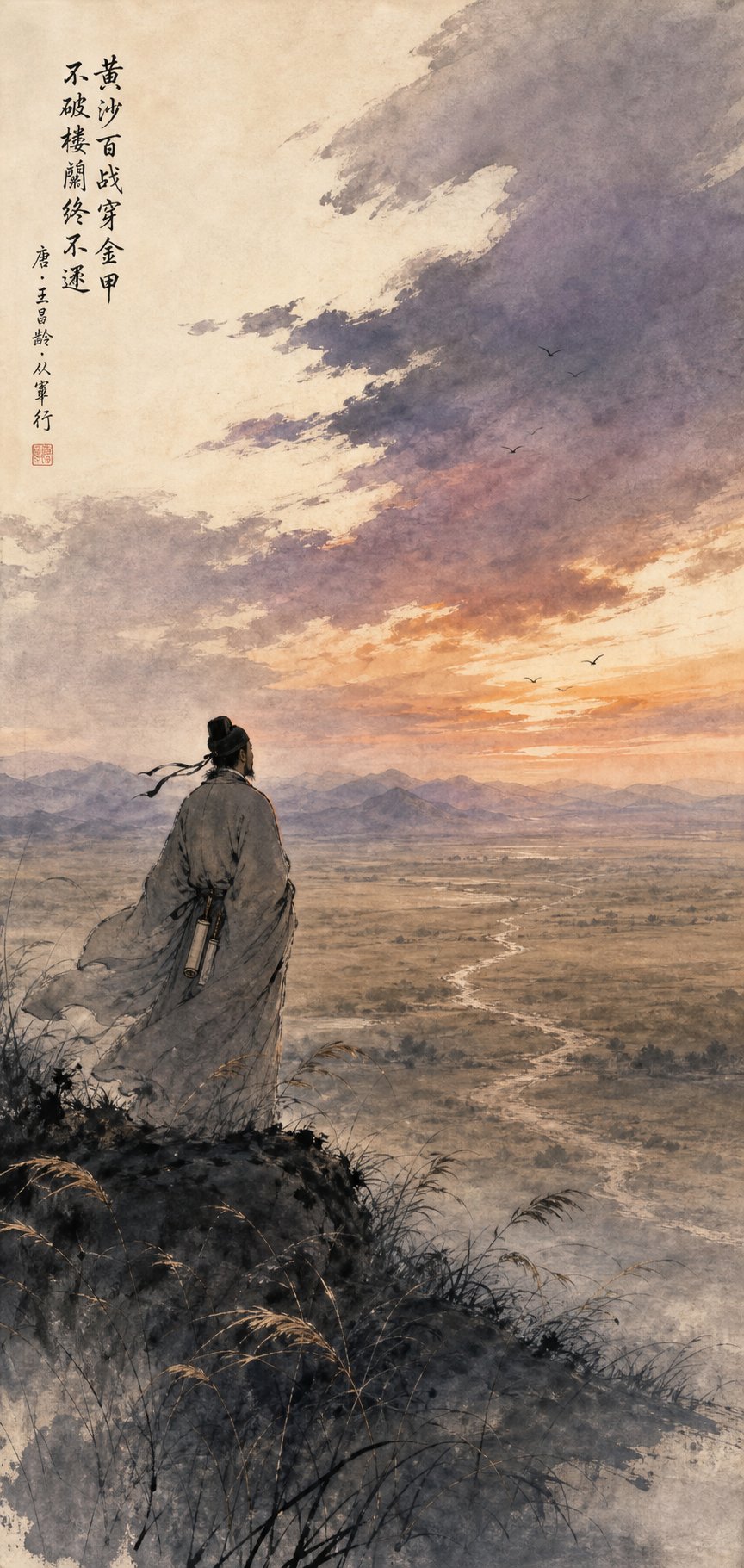
A surname can carry political power for a generation, but cultural prestige endures for millennia. While the Northern Qi dynasty gave the Gao clan its imperial moment, the poets, dramatists, and scholars who bore the name 高 across subsequent centuries built something more durable: a literary reputation that placed the surname among China's most intellectually distinguished lineages. From frontier battlefields to imperial courts to the stages of southern opera houses, Gao-surnamed writers shaped Chinese literature at pivotal turning points.
What makes this legacy distinctive is its range. These were not court poets recycling safe themes. They were innovators who pushed their respective art forms into new territory, often at personal cost.
Gao Shi and Tang Dynasty Poetry
The Tang dynasty (618-907 CE) produced China's golden age of poetry, and Gao Shi (c. 704-765) stands among its most celebrated voices. Born in Cangzhou, Hebei, into an impoverished family, he spent his youth wandering central and southern China, failing repeatedly to secure an official position. In 731, he joined the army at the northern frontier garrison of Shuofang, where he witnessed firsthand the brutal campaigns against the Khitan people. That experience produced his masterpiece, "A Song of the Yan Country," one of the defining works of Tang frontier poetry.
What set Gao Shi apart from contemporaries was his dual identity as soldier and poet. He was not writing about war from a comfortable study. He lived it. During his travels in the 740s, he befriended Li Bai and Du Fu, the two titans of Tang verse. The friendship between Li and Gao connected the era's greatest literary minds, and their mutual influence shaped the direction of mid-Tang poetry. Two of Gao Shi's poems were selected for the Three Hundred Tang Poems, the anthology that has defined the Tang canon for centuries.
His farewell poetry, particularly Farewell to Dongda, broke with convention. Where most Tang farewell poems wallowed in grief at parting, Gao Shi's verses radiated optimism and encouragement, urging the departing friend toward confidence rather than sorrow. This emotional boldness influenced later Song dynasty artists and poets who valued human agency over fatalistic melancholy.
Gao Shi's career eventually caught up with his talent. During the An Lushan Rebellion (755-763), his military expertise earned him rapid promotions, and he rose to become jiedushi (military governor) of Chengdu. He ended his life as deputy minister of the Ministry of Justice, dying in Chang'an in 765. Among Tang poets, he remains one of the very few who achieved both literary greatness and high political office.
Gao Ming and Gao Qi in Later Dynasties
Six centuries after Gao Shi's frontier verses, another bearer of the surname transformed Chinese drama. Gao Ming (c. 1305-1370) was a poet and playwright of the late Yuan dynasty who quit a frustrating official career under Mongol rule in 1356 to devote himself to theater. As a southerner, he rejected the fashionable zaju (variety theater) flourishing under northern Mongol patronage and instead wrote for nanxi (southern drama), an operatic folk tradition associated with the former Song capital of Hangzhou.
His sole surviving work, Pipaji (The Lute), completed around 1367, became one of the most influential plays in Chinese theatrical history. The story follows Zhao Wuniang, a devoted wife who wanders as an itinerant lute player searching for her husband, an ambitious scholar who abandoned her and his aging parents in pursuit of fame at court. The moralistic tragicomedy won the favor of the founding Ming emperor and single-handedly restored the nanxi form to national stature. Its libretto elevated popular operatic verse into polished poetry, and its melodious southern music set the template for Ming dynasty drama that followed.
A generation later, Gao Qi (1336-1374) emerged as arguably the finest poet of the early Ming dynasty. Born in Suzhou, he was grouped among the "Ten Friends of the North Wall" and later recognized as one of the "Three Masters of Early Ming Poetry." His verse combined the clarity of Tang models with a fresh observational precision that captured the textures of daily life in Jiangnan. Unlike Gao Shi, whose poetry drew from military experience, Gao Qi found his material in landscapes, friendships, and the quiet dramas of civilian existence.
His brilliance proved fatal. When the Ming founder Zhu Yuanzhang suspected him of political disloyalty, Gao Qi was executed at age 38, cutting short a career that scholars believe would have placed him among China's all-time greatest poets. Even so, his surviving body of work, over 2,000 poems, secured his reputation as the Ming dynasty's preeminent lyric voice.
Modern Figures Carrying the Gao Legacy
The literary and intellectual tradition did not end with imperial China. Modern bearers of the surname have distinguished themselves across sciences, arts, and public life, extending the clan's cultural footprint into the contemporary world. The legendary figure of gao yuan, credited in the Lushi Chunqiu with inventing housing in deep antiquity, established a pattern of creative innovation that resurfaces across the centuries. From the Qing dynasty painter Gaoxiang, one of the Eight Eccentrics of Yangzhou known for his spare ink-wash plum blossoms, to twentieth-century Nobel laureates, the thread of artistic and intellectual ambition persists.
The following chronological timeline captures key cultural contributors bearing the Gao surname:
- Gao Shi (704-765) — Tang dynasty frontier poet and military governor; two poems in the Three Hundred Tang Poems.
- Gao Ming (c. 1305-1370) — Yuan dynasty dramatist whose Pipaji (The Lute) became the model for all Ming dynasty southern opera.
- Gao Qi (1336-1374) — Early Ming poet, considered the era's finest lyricist; executed at 38 but left over 2,000 poems.
- Gao Jianfu (1879-1951) — Co-founder of the Lingnan School of painting, which fused Chinese ink traditions with Japanese and Western techniques.
- Gao Xingjian (born 1940) — Novelist, playwright, and painter who won the 2000 Nobel Prize in Literature, the first Chinese-language writer to receive the honor.
- Gao Bin — Contemporary researcher in computational sciences whose work represents the surname's ongoing presence in technical fields.
- Gao Qian — Modern academic contributing to cross-disciplinary research, continuing the clan's tradition of intellectual pursuit.
Beyond these individual achievements, modern professionals named Gao have made their mark across diverse fields. Figures like Jifan Gao in business leadership, James Gao in technology and engineering, and Liang Gao in academic research demonstrate that the surname's association with excellence extends well beyond the literary arts. The pattern holds: whether the medium is poetry, drama, painting, physics, or entrepreneurship, bearers of the name 高 continue reaching upward.
What connects Gao Shi's frontier verses to Gao Xingjian's experimental novels is not just a shared character on a family register. It is a cultural expectation embedded in the surname itself. The character 高 means height, and for over two thousand years, the families who carried it produced individuals determined to live up to that meaning.
Yet cultural legacy is only as durable as the records that preserve it. For most Gao descendants, the connection between their own family and these historical figures depends on genealogical documents: clan hall registries, ancestral temple records, and handwritten family tree books passed down through generations. Understanding how those records work, and where to find them, is the practical key to unlocking personal connections within this broader heritage.
Genealogical Records and Clan Traditions
Cultural legacy lives in poems and paintings. But personal ancestry lives in documents: handwritten ledgers, carved wooden plaques, and genealogy books stored in ancestral halls or carried overseas in the luggage of migrating families. For anyone bearing the Gao surname, or its dialect variants like the kao surname, surname ko, or last name go origin spellings, these records are the bridge between a famous clan history and your specific place within it.
The challenge is knowing what to look for and where to find it. Chinese genealogical traditions differ fundamentally from Western systems. In most Western countries, churches and governments maintained birth, marriage, and death records. In China, it was traditionally the duty of the individual family or clan to keep records. Most Chinese archives do not hold documents about individuals. Instead, private records were kept by families in their ancestral villages. This means tracing your Gao ancestry requires understanding a set of uniquely Chinese institutions.
Clan Hall Names and Ancestral Halls
Walk through older neighborhoods in Singapore, Penang, or even certain HDB estates, and you might spot a small plaque above a doorway inscribed with two or three Chinese characters. This is a tanghao (堂号), or ancestral hall name, and it functions as a compressed genealogical statement. A single glance tells you the family's surname origin, their ancestral homeland, and which branch of the clan they belong to.
The tanghao system works like this: each major surname has one or more hall names derived from the geographic location where the clan first rose to prominence, a classical reference to a famous ancestor's achievement, or a moral teaching central to the family's identity. In Singapore, commonly seen examples include Yingchuan (颍川) for the Chen clan, Xihe (西河) for Lin, and Taiyuan (太原) for Wang.
For the Gao surname, the most prestigious tanghao is Bohai (渤海堂). This traces directly to the Bohai Commandery in modern Hebei and Shandong, the region Gao Huan claimed as his ancestral homeland before founding the Northern Qi dynasty. Families displaying this hall name are asserting a connection to the imperial Gao lineage. A secondary hall name, Houyu (厚余堂, meaning "abundant surplus"), reflects a different branch's values of prosperity and generosity. Other Gao-associated hall names include Gongyi (供义堂) and Liyi (立义堂), both emphasizing righteousness.
These plaques were not merely decorative. In overseas Chinese communities, they served a practical social function. As one Singaporean resident explained about his family's tradition: "At the very least, it sparks curiosity and attention, and then we can explain it to them." Younger generations who may not know their clan's full history encounter the tanghao as a starting point for questions. A single surname can have multiple hall names. The Chen clan, for instance, has eight. Conversely, some hall names are shared across different surnames descended from a common ancestor.
Ancestral halls themselves, the physical buildings where clan rituals took place, served as repositories for genealogical records, spirit tablets of deceased ancestors, and communal gathering spaces. In southern China, particularly Fujian and Guangdong, these halls often survived into the modern era and remain active sites for clan reunions and ancestral worship. For Gao families whose ancestors migrated from these regions, the ancestral hall in the home village may still hold records connecting overseas branches to their mainland roots.
Family Genealogy Books and What They Contain
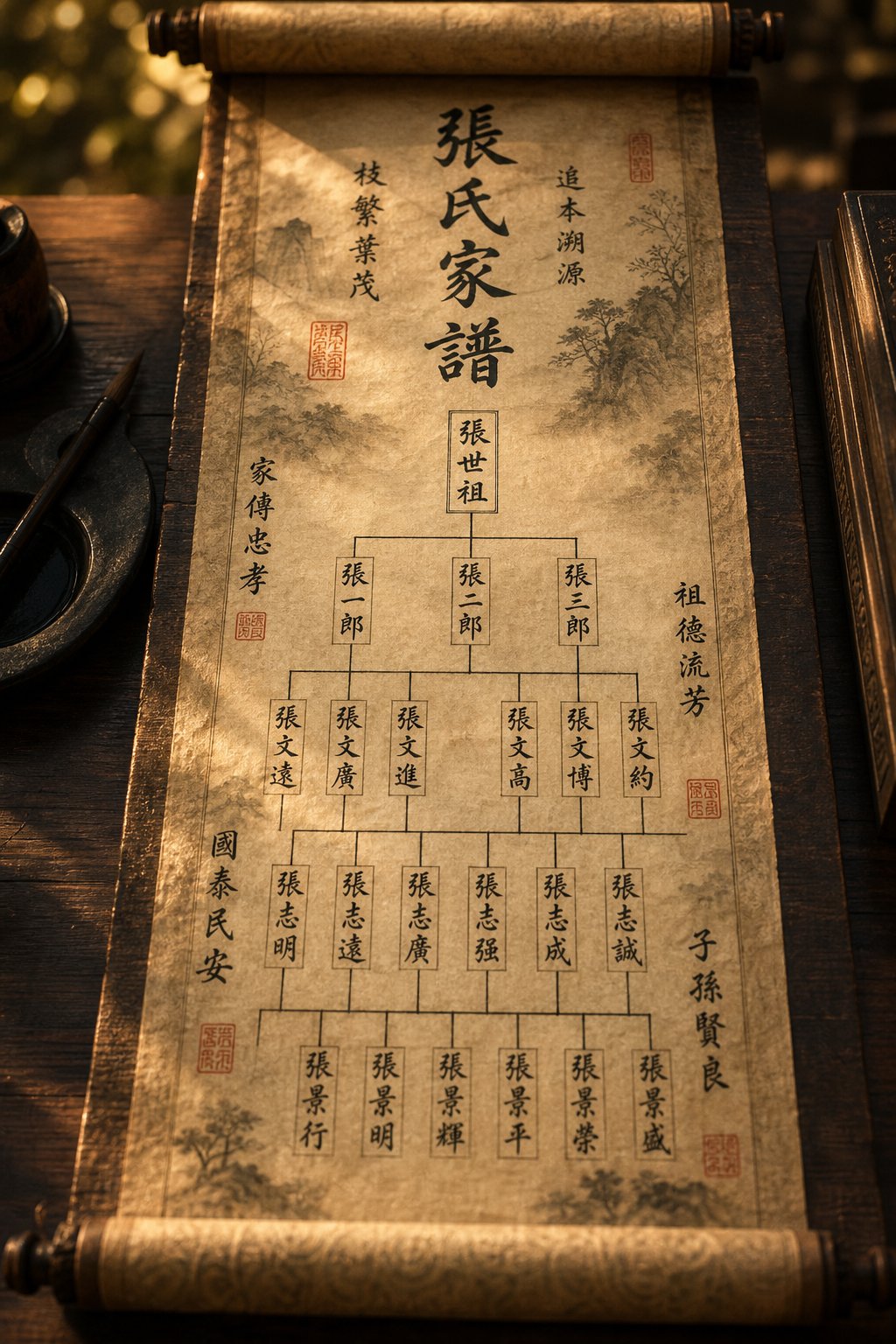
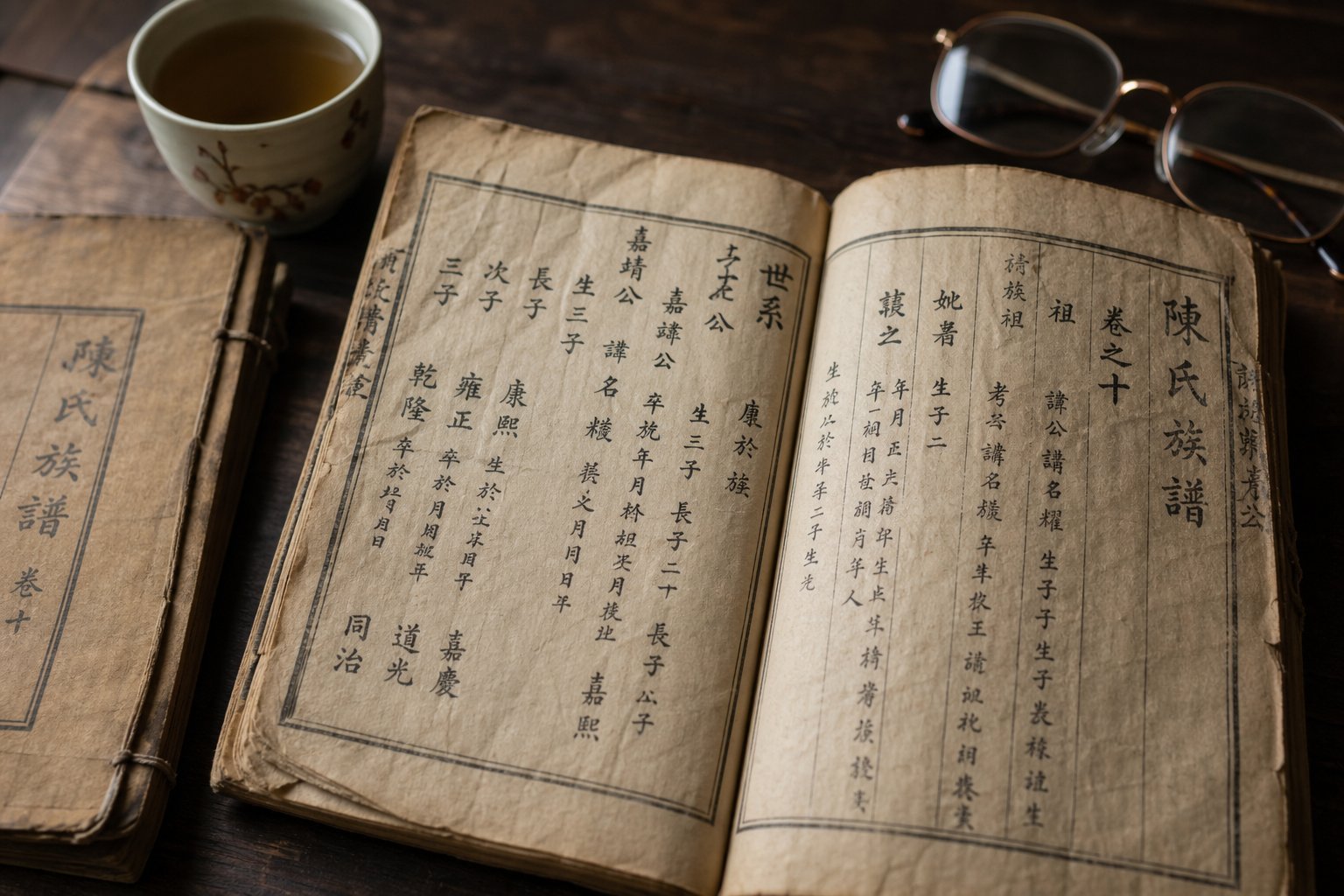
The most detailed genealogical resource in Chinese culture is the zupu (族谱) or jiapu (家谱), a clan genealogy book that records male lineage spanning generations. These are not simple family trees. A jiapu is a comprehensive clan document that typically includes:
- Preface and surname origins: An introductory essay explaining the clan's founding ancestor, migration history, and connection to broader surname lineages.
- Pedigree charts: Generational diagrams starting from the founding ancestor and recording male descendants generation by generation. Wives are usually recorded only by surname, and daughters are rarely included.
- Biographical entries: Short biographies of notable ancestors, including their official positions, achievements, and dates.
- Generation poems (字辈): Poems that determined naming conventions for each generation, allowing you to identify which generation a person belongs to based on one character in their given name.
- Family rules and teachings: Moral codes governing clan behavior, marriage practices, and inheritance customs.
- Ancestral portraits and cemetery maps: Visual records showing the locations of ancestral graves and likenesses of important forebears.
- Migration histories: Accounts of when and why branches of the family relocated to new regions.
These books come in several structural styles. The Su Style (蘇式), also called the Hanging Pearl Style, arranges descendants in a vertical cascading format. The Ou Yang Style (歐陽式) uses a horizontal layout. The Imperial Style (牒記式) reads more like a narrative document. Recognizing which style your family's zupu uses helps you navigate its contents even without full Chinese literacy.
For Gao families specifically, zupu records often trace the lineage back to the Bohai Commandery origin, through the Northern Qi imperial period, and then forward through whichever migration wave brought the branch to its current location. The generation poem is particularly useful: if you know which character appears in your grandfather's given name, you can often identify exactly which generation he represents and locate his entry in the book.
Historically, these books were updated every 20 to 30 years during formal clan gatherings. The responsibility for maintaining and storing the zupu typically fell to the eldest son of the senior branch. Multiple copies were sometimes distributed among different family branches as insurance against loss. During the Cultural Revolution (1966-1976), many zupu were destroyed as symbols of feudal culture. However, copies often survived through distant relatives or through clan members who had emigrated overseas before the 1960s.
Tracing Your Gao Ancestry Today
Imagine you know your family bears the last name Kao on old immigration papers, or perhaps the last name go origin spelling appears on a great-grandparent's tombstone in Malaysia. How do you connect that fragment to the broader Gao genealogical tradition? The process involves working backward from what you know toward the records that can fill the gaps.
Start with what is closest. Elderly family members often hold information that never made it into written records. Grandparents may remember the ancestral village name, the generation poem characters, or the tanghao that once hung above the family door. Chinese tombstones, both in China and overseas, typically contain more detail than Western equivalents, including the deceased's Chinese name, spouse's surname, children's names, and crucially, the place of birth in China.
The key piece of information for unlocking Chinese records is the ancestral village (祖籍). Once you identify the specific village or county your migrating ancestor came from, you can search for the clan's zupu and potentially connect to living relatives who maintain it.
Resources available to modern researchers include:
- FamilySearch Jiapu Collection: The FamilySearch database hosts digitized clan genealogy books searchable by surname and region, with a dedicated guide for reading different jiapu styles.
- Shanghai Library Genealogy Collection: One of the world's largest repositories of Chinese clan genealogies, with an online search portal at jiapu.library.sh.cn covering tens of thousands of zupu volumes.
- My China Roots Zupu Database: A searchable database of clan genealogy books with tools for connecting overseas descendants to ancestral village records.
- Immigration records from destination countries: Countries like the United States, Canada, Australia, and various Southeast Asian nations maintained arrival records of Chinese immigrants. These often include Chinese names, ages, occupations, and origin locations. Chinese exclusionary legislation from the late 1800s to mid-1900s ironically created detailed paper trails through personal interviews and tax records.
- Clan association records: After settling overseas, many Chinese immigrants joined surname-based or district-based associations that kept membership records including hometowns and family details.
- Chinese tombstone databases: Cemetery records in overseas Chinese communities often preserve ancestral place names and family relationships in Chinese characters.
- DNA testing services: Modern genetic ancestry platforms can confirm regional origins and connect you to genetic relatives who may hold genealogical documents you lack.
For those whose records use the kao last name origin spelling, remember that this is simply the Wade-Giles romanization of 高. Searching under both "Gao" and "Kao" in English-language databases will capture records created under different romanization conventions. Similarly, if your family uses the surname Ko or Koh, searching under the character 高 in Chinese-language databases bypasses the romanization problem entirely.
The language barrier remains the most significant challenge. Many descendants of Chinese emigrants no longer read or write Chinese, creating a gap between them and records written entirely in classical or traditional Chinese. Professional genealogists specializing in Chinese family history, roots trips to ancestral villages, and the growing availability of translation tools and guided research services are all helping to bridge that gap.
Even if someone says your family's jiapu has been lost, there may still be hope. Many copies are preserved through distant relatives or clan members who emigrated overseas before the 1960s.
The Gao surname's genealogical infrastructure, from Bohai hall names to Northern Qi imperial records to Hokkien clan associations in Southeast Asia, provides an unusually rich set of pathways for tracing ancestry. The character 高 has been documented, cataloged, and celebrated for over two thousand years. The records exist. The question is whether modern descendants will take the steps to find them and reconnect with a lineage that stretches from the courts of ancient Qi to the present day.
Frequently Asked Questions About the Gao Surname
1. What does the Chinese surname Gao mean?
The character 高 (gao) literally means 'tall' or 'high' and carries deep cultural associations with nobility, virtue, and aspiration. In its ancient oracle bone form, it depicted a tall watchtower rising above its surroundings. The surname became linked to elevated social status, appearing in Chinese compound words for noble (高贵), lofty (高尚), and brilliant (高明). One tradition credits Gao Yuan, a legendary figure said to have invented housing in deep antiquity, as the earliest bearer of the name.
2. Where does the Gao surname originate from?
The primary Gao lineage descends from Jiang Ziya, the military strategist who helped found the Zhou dynasty around 1046 BC. His descendant Gao Xi received the surname after helping Duke Huan of Qi rise to power during the Spring and Autumn period. Two additional branches use different characters romanized as Gao: one from the State of Gao (郜) founded by King Wen of Zhou's 11th son, and another connected to the character 皋 tracing back to the legendary official Gao Yao under Emperor Shun.
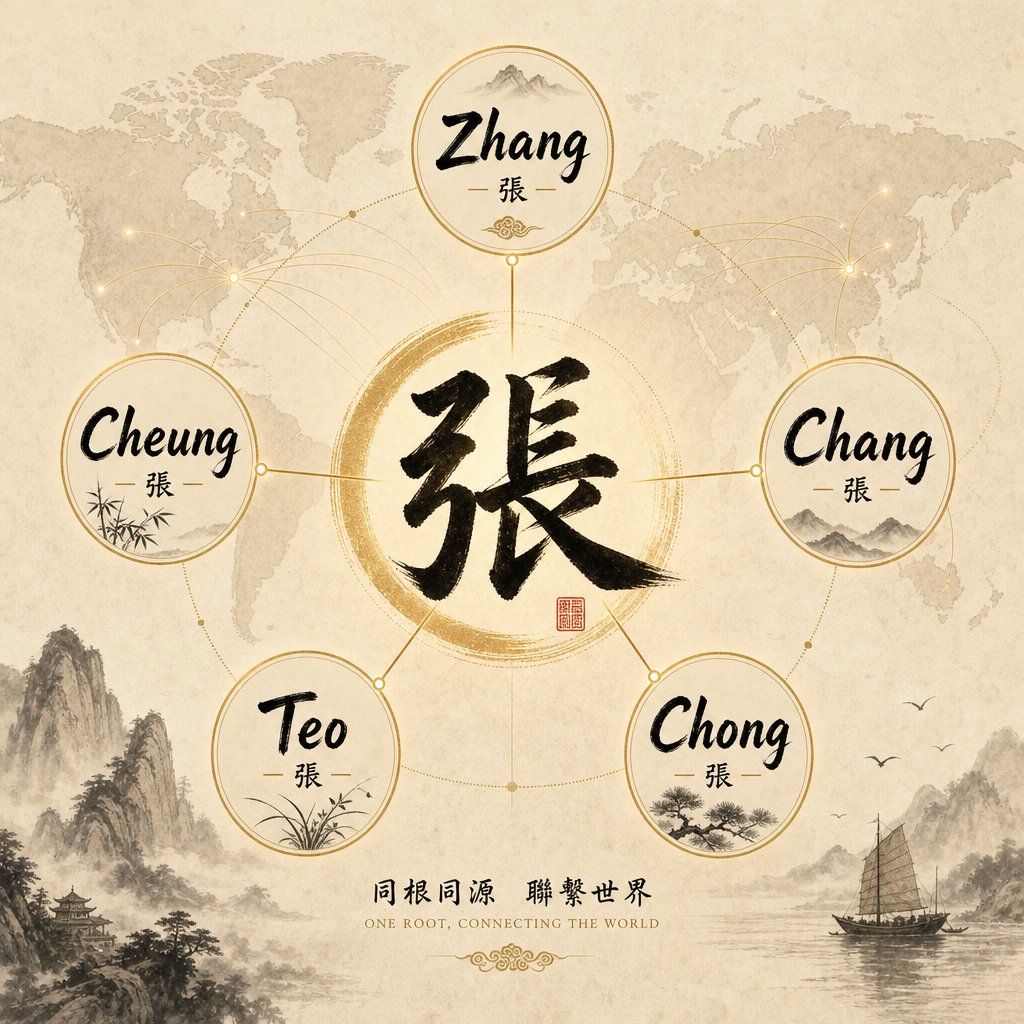
3. Why is the Gao surname spelled differently as Ko, Koh, Kao, or Go?
All these spellings represent the same Chinese character 高 filtered through different romanization systems and dialects. Kao comes from the older Wade-Giles system used in Taiwan and pre-1980s English records. Ko and Koh reflect the Hokkien dialect pronunciation common in Malaysia and Singapore. Go appears in Cantonese contexts from Hong Kong. In Korea, the same character is romanized as Ko, Go, or Koh depending on the individual's preference. Each variant traces back to one ancestral character pronounced differently across regional speech communities.
4. Did the Gao family ever rule a Chinese dynasty?
Yes. The Gao clan founded and ruled the Northern Qi dynasty (550-577 CE), making 高 an imperial surname. Gao Huan, a military commander who rose from poverty, effectively split the Northern Wei empire and controlled eastern northern China as paramount general. His son Gao Yang formally declared the dynasty in 550 CE. Six Gao emperors ruled over 27 years, controlling roughly 1.5 million square kilometers of territory including China's most productive agricultural regions.
5. How can I trace my Gao family ancestry?
Start by interviewing elderly relatives about your ancestral village name, generation poem characters, or clan hall name (tanghao). Chinese tombstones often record birthplace details. Key resources include the FamilySearch Jiapu Collection of digitized clan genealogy books, the Shanghai Library Genealogy Collection, immigration records from destination countries, and overseas clan association membership rolls. The most critical piece of information is your ancestral village (祖籍), which unlocks access to local zupu records that may document your specific branch.