Zhao and Chiu Are the Same Surname in Different Dialects
Imagine you are researching your family tree and you find a branch spelled "Zhao" alongside another spelled "Chiu." Are these two separate families, or one lineage split by spelling? If this question brought you here, the short answer is clear: Zhao and Chiu are romanizations of the exact same Chinese character, 趙. The difference comes down to dialect, not ancestry.
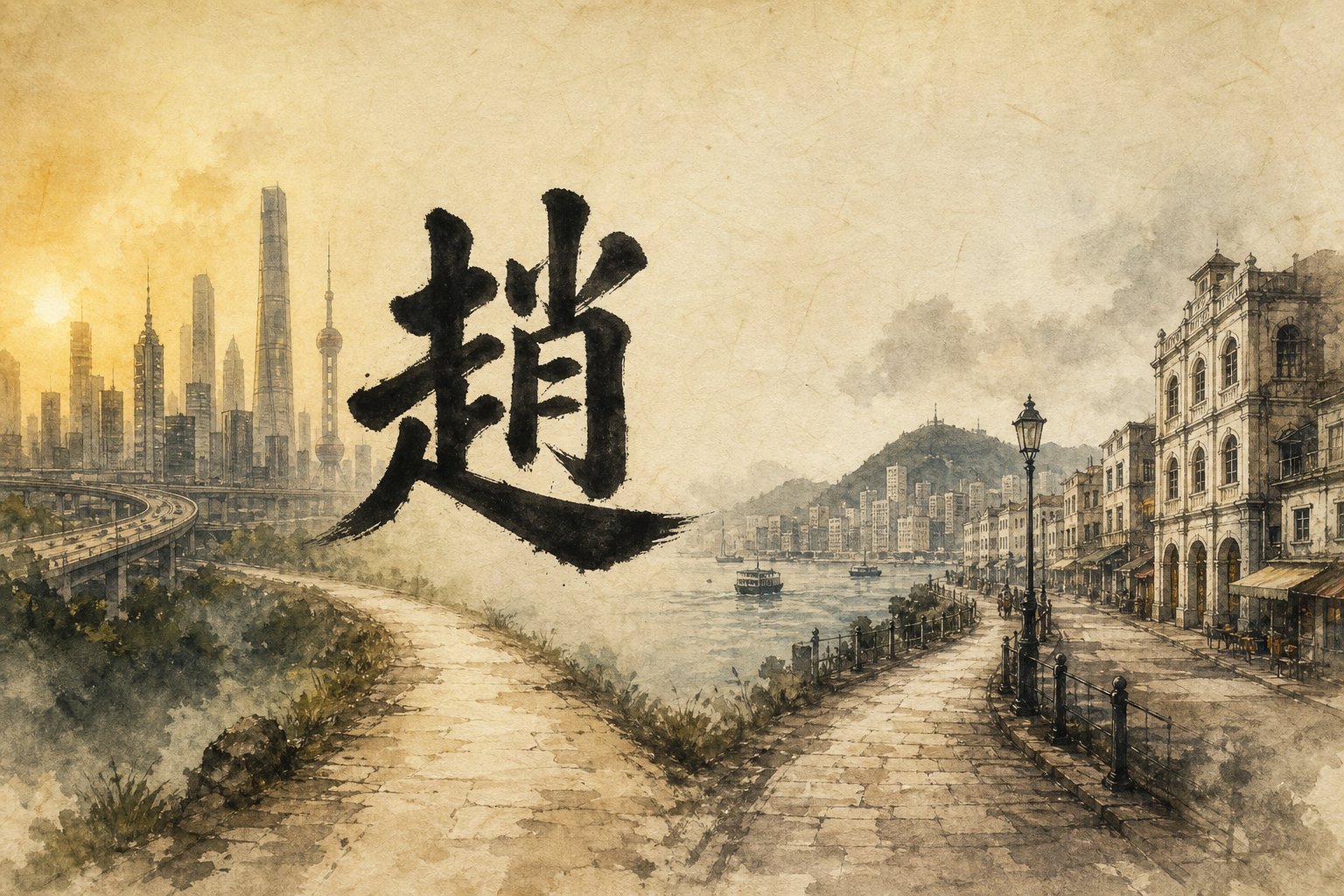
Zhao and Chiu are not different surnames — they are the same character (趙) filtered through different Chinese dialect romanization systems.
Mandarin speakers pronounce 趙 as "Zhao" (using the Pinyin system), while Cantonese speakers pronounce it closer to "Chiu" (rendered through informal Cantonese romanization or Jyutping as ziu6). Both point back to a single Chinese surname with deep imperial roots — it ranks first in the famous Hundred Family Surnames text because it was the royal surname of the Song Dynasty.
Why Zhao and Chiu Confuse So Many Families
The confusion is understandable. When you see two completely different English spellings, your instinct says these must be different surnames chinese families carry. But Chinese surnames work differently from Western ones. A single character can produce multiple romanized forms depending on the speaker's dialect, the era of emigration, and the country where the name was registered. For 趙 alone, variant spellings include Zhao, Chiu, Chao, Chu, Jew, Tio, and Trieu — all tracing to the same origin.
What This Comparison Covers
No single resource pulls together the phonetic, historical, and practical reasons behind the Zhao vs Chiu surname split in one place. This article fills that gap. You will find a breakdown of how each spelling is produced by its respective dialect system, why "Chiu" can be ambiguous (it maps to other characters too), and how migration patterns locked these spellings into passports and official records. Whether you discovered a possible family connection or you are trying to confirm shared ancestry across different surnames chinese diaspora communities carry, the sections ahead give you a clear, research-backed path to verify the link.
How We Ranked These Key Differences
Spelling differences between Zhao and Chiu are not random. They follow patterns rooted in phonetics, history, and geography. To make this comparison useful rather than just interesting, we evaluated each difference against a consistent set of criteria — ranked by how much it actually helps someone confirm whether two family branches share the character 趙.
Evaluation Criteria for Each Difference
When you look at a chinese surnames list that includes both "Zhao" and "Chiu," you need a framework to understand what separates them and what connects them. Here are the five criteria we used, ordered from most to least important for someone trying to verify a family link:
- Romanization system rules — Which formal or informal system produced each spelling? This is the single biggest factor. Pinyin gives you "Zhao," Cantonese romanization gives you "Chiu," and Wade-Giles gives you "Chao." Knowing the system tells you the dialect immediately.
- Phonetic analysis — How does each dialect actually pronounce 趙? Mandarin uses a retroflex initial (zh-) and a diphthong (-ao). Cantonese drops the retroflex entirely and shifts the vowel to -iu. These sound changes explain why the spellings look so different on paper.
- Historical documentation — What do classical texts and clan records say? The Hundred Family Surnames (百家姓) lists 趙 first, and historical genealogies trace all chinese surnames back to specific origin points. Cross-referencing these records confirms whether a "Chiu" family and a "Zhao" family descend from the same lineage.
- Geographic distribution data — Where did each spelling take root? Migration waves from Guangdong province produced "Chiu" in Hong Kong and Southeast Asia, while mainland standardization after 1958 locked in "Zhao." Location and time period narrow down which romanization a family would carry.
- Practical identity verification — Can you actually confirm the connection using available documents? Passport records, clan association registries, and ancestral village databases all provide concrete ways to match a romanized spelling back to the original character.
Sources and Reference Standards Used
Each section of this comparison draws on specific reference standards. For romanization accuracy, we relied on the official Jyutping system developed by the Linguistic Society of Hong Kong, the PRC's Pinyin standardization documents, and the Wade-Giles system still found in older Taiwanese records. For historical context, the Hundred Family Surnames text and Song Dynasty genealogical records anchor the origin story of 趙.
Research on how non-standardized romanization creates confusion among all chinese surnames — particularly in data linkage — informed our disambiguation section. A 2025 study from University College London demonstrated that informal Hong Kong Government romanization achieved only 68.8% recall when matching surname records, while standardized systems like Jyutping and Pinyin exceeded 95%. That gap illustrates exactly why families using "Chiu" can struggle to connect their records with "Zhao" relatives in databases designed around a single spelling.
Migration history records from colonial Hong Kong, Southeast Asian immigration archives, and the list of chinese surnames documented across diaspora communities round out the geographic picture. Together, these sources let us move beyond guesswork and give you verifiable answers about how 趙 became two spellings — and what that means for your family research.
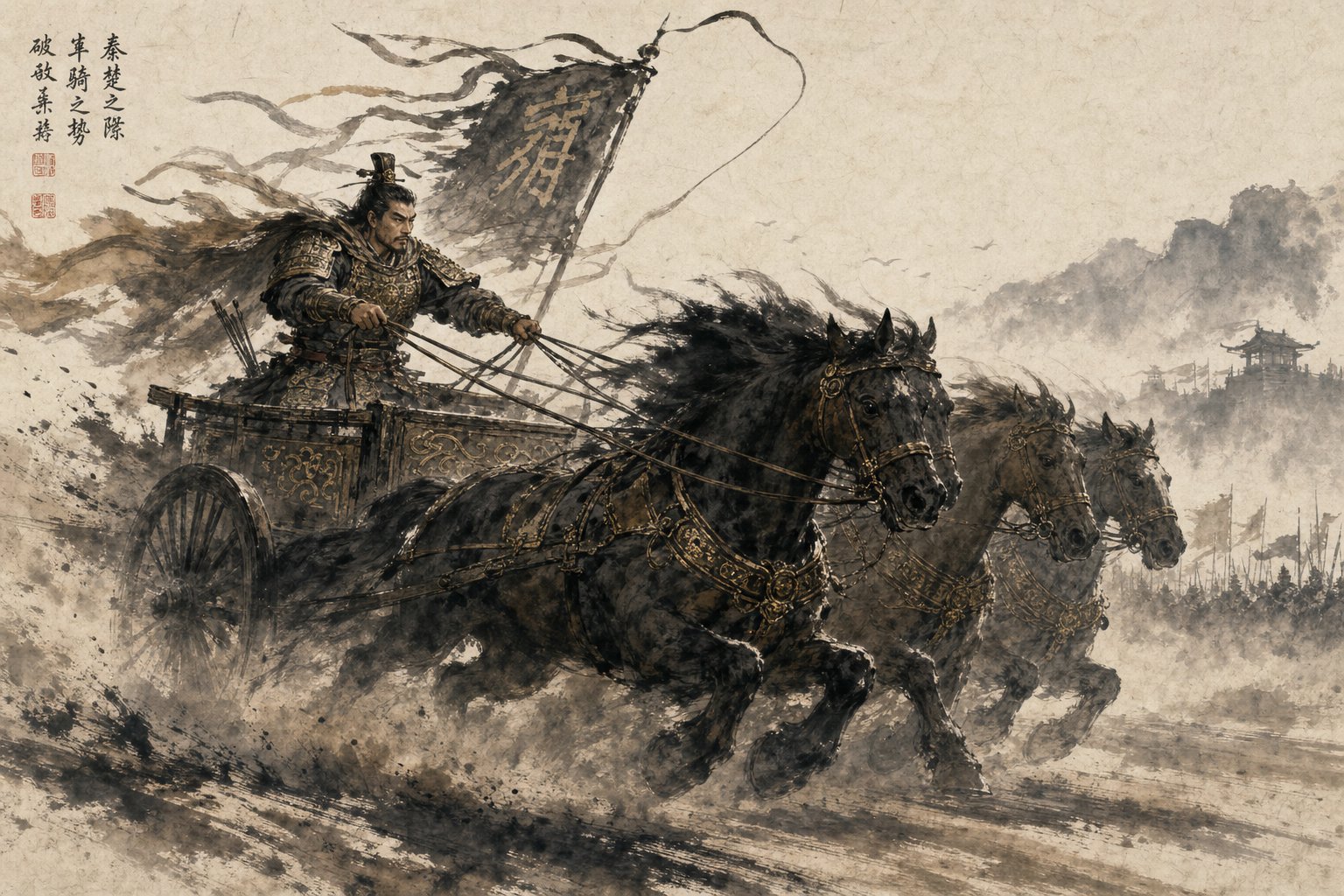
The Shared Character 趙 and Its Imperial History
Strip away the romanization and you are left with a single character: 趙. This is the anchor point. Whether a family writes Zhao, Chiu, Chao, or Tio on their documents, the character behind the spelling carries over 3,000 years of chinese surname history tied to charioteers, warring kingdoms, and an imperial dynasty. Understanding 趙 itself — its structure, its meaning, and why it holds such prestige — gives you the foundation to see past spelling differences entirely.
The Character 趙 and Its Warring States Origin
The character 趙 is built from two components. On the left sits the radical 走 (zǒu), meaning "to walk" or "to run." On the right is 肖 (xiào), which functions here as a phonetic element rather than carrying its standalone meaning. Together, the character evokes motion and speed — fitting, given its origin story.
The chinese surname origin of 趙 traces back to a man named Zao Fu, a legendary charioteer who served King Mu of Zhou during the Western Zhou period (roughly 10th century BC). According to historical records, Zao Fu drove the king's chariot a thousand li in a single day to rush back to the capital and suppress a rebellion by King Xu Yan. For this service, King Mu granted him the city of Zhaocheng (in present-day Hongtong, Shanxi Province). Zao Fu's descendants adopted the name of their fief as their clan name — and the Zhao surname was born.
By the Warring States period (475–221 BC), the Zhao clan had grown powerful enough to split the State of Jin into three parts alongside the Han and Wei families. The resulting State of Zhao became one of the seven major powers competing for dominance across ancient China. King Wuling of Zhao famously reformed his army by adopting nomadic cavalry tactics, turning Zhao into a military force that rivaled the State of Qin for decades. Among ancient chinese surnames, few carry this kind of direct connection to sovereign power.
Why 趙 Ranks First in the Hundred Family Surnames
If you have ever seen a list of the 100 most common chinese surnames, you might notice that 趙 appears at the very top of the classical Hundred Family Surnames (百家姓) text. This is not because it was the most populous surname at the time — it was not. The text was compiled during the early Song Dynasty (960 AD onward), and the Song Dynasty's founding emperor was Zhao Kuangyin. Placing the imperial surname first was a matter of political protocol, not population statistics.
That political choice, however, reflects something real about the meaning of chinese surnames in traditional culture. The surname you carry signals lineage, regional origin, and sometimes historical rank. For 趙, the association with royal chinese surnames is not symbolic — it is literal. The Zhao clan produced the entire Song Dynasty imperial line, which ruled China for over 300 years across both the Northern and Southern Song periods.
- Approximate population today: Over 28 million people carry the surname 趙 in China alone, accounting for roughly 2.04% of the national population.
- Historical kingdoms: The State of Zhao (Warring States period), the Nanyue Kingdom (founded by Zhao Tuo in present-day Guangdong), and the Song Dynasty (960–1279 AD).
- Modern ranking: 趙 is the 8th most common surname in China according to recent census data, down from its ceremonial first-place position in the classical text.
- Geographic concentration: Highest density along the Yellow River basin — Hebei, Shandong, Henan, and Shanxi provinces — with the province of Henan holding the largest Zhao-surname population.
When you research chinese surnames and meanings, 趙 stands out because its story is not just etymological — it is political and military. The character encodes a narrative of speed (the charioteer origin), sovereignty (the Warring States kingdom), and imperial authority (the Song Dynasty). Every family that carries this character, whether they spell it Zhao or Chiu on their passport, inherits that same lineage.
The character itself never changed. What changed was how different Chinese dialect groups voiced it — and how colonial-era clerks and modern standardization systems chose to write that sound in the Latin alphabet. Those phonetic mechanics are where the real divergence begins.
Mandarin Pinyin and the Zhao Spelling Explained
The character 趙 never changed, but the sound system that voices it determines what you see on paper. In Mandarin — the official language of mainland China — 趙 is pronounced with a specific set of phonetic features that map directly to the spelling "Zhao." Understanding exactly how Mandarin phonetics produce this spelling makes it easier to see why Cantonese speakers end up with something completely different.
How Mandarin Phonetics Produce the Zhao Spelling
Say "Zhao" out loud. If you are a native English speaker, you probably approximated it as "jow" or "zow." The actual Mandarin pronunciation involves three distinct phonetic components that English does not neatly replicate:
- The zh- initial: This is a retroflex affricate — your tongue curls back toward the roof of your mouth, then releases with a buzzing friction. English has nothing quite like it. The closest comparison might be the "j" in "judge," but produced further back in the mouth. This retroflex quality is unique to Mandarin among Chinese dialects; Cantonese, Hokkien, and Hakka all lack it entirely.
- The -ao final: This is a diphthong that starts with an open "ah" sound and glides toward an "oo" sound. Think of the "ow" in "how" but starting with a wider mouth. In Pinyin, "ao" always represents this specific vowel combination.
- The fourth tone (falling tone): Mandarin is a tonal language with four main tones. 趙 carries the fourth tone — a sharp, decisive drop from high to low pitch, like the tone of voice you use when giving a firm command. In Pinyin, this is marked as zhào, though the tone mark is typically dropped in surname romanization on passports and legal documents.
Put these together and you get zhào — a sound that the Pinyin system renders unambiguously as "Zhao." Unlike the chinese surname zhang, which shares the same zh- retroflex initial but pairs it with a different vowel (-ang), Zhao's -ao ending gives it a rounder, more open sound. Both Zhang and Zhao demonstrate how Mandarin's retroflex initials create spellings that look unfamiliar to English readers, yet each maps to one specific character without confusion.
Pinyin Standardization and Modern Usage
Pinyin was officially adopted by the People's Republic of China in 1958 as the standard romanization system for Mandarin Chinese. The system was designed to be phonetically precise — each combination of letters corresponds to exactly one syllable in Mandarin, eliminating the ambiguity that plagued earlier systems. By 1982, the International Organization for Standardization (ISO) adopted Pinyin as the international standard for romanizing Chinese, and it became the dominant system used in passports, international publications, and digital input methods.
For families on the mainland, this standardization means that "Zhao" is now the universal surname for chinese citizens carrying the character 趙 on their official documents. There is no variation, no regional spelling — the system produces one output. This consistency is a major advantage when searching genealogy databases or linking records across countries that recognize Pinyin.
Before Pinyin, however, the Wade-Giles system (developed in the 19th century by British diplomats) was the dominant romanization in English-language texts. Under Wade-Giles, 趙 becomes "Chao" — yet another variant that can confuse researchers. As the Library of Congress Pinyin Conversion Project documents, Wade-Giles syllables use apostrophes to indicate aspiration and hyphens to separate syllable components, while Pinyin joins syllables and drops these marks entirely. The shift from "Chao" to "Zhao" in library catalogs, academic citations, and government records happened gradually through the 1980s and 1990s as institutions worldwide adopted the ISO standard.
You will still encounter "Chao" in older Taiwanese documents and among families who emigrated before Taiwan's partial shift toward Pinyin in recent decades. Similarly, the chinese surname transliterating zuo — an entirely different character (左) — shows how Wade-Giles and Pinyin can produce confusingly similar-looking results for unrelated surnames, reinforcing why identifying the underlying character matters more than the spelling.
Pros of the Zhao Spelling
- Internationally recognized under ISO 7098 — libraries, governments, and databases worldwide treat it as the standard romanization of 趙
- Unambiguous mapping: "Zhao" corresponds to 趙 and essentially no other common character, making record-matching straightforward
- Consistent across all mainland Chinese passports issued since the 1980s, creating a single searchable spelling for genealogy platforms
- Supported by every major digital input method — typing "zhao" in any Pinyin keyboard immediately offers 趙 as a candidate
Cons of the Zhao Spelling
- Unfamiliar pronunciation for non-Mandarin speakers — the zh- retroflex has no English equivalent, leading to frequent mispronunciation as "zay-oh" or "zow"
- Does not reflect how Cantonese, Hokkien, or Hakka speakers actually say the character, creating a disconnect for diaspora families who never spoke Mandarin
- Relatively recent adoption (post-1958) means it does not appear in older emigration records, ship manifests, or colonial-era documents — families researching pre-1960s history will not find "Zhao" in those archives
This precision is exactly what makes Pinyin powerful for record-keeping — but it also explains why millions of families who left China before 1958 carry a completely different spelling. Their pronunciation was never Mandarin to begin with. It was Cantonese, and the sound their dialect produces for 趙 follows an entirely different phonetic path.

Cantonese Romanization and the Chiu Spelling Explained
Cantonese does not simply swap one letter for another when voicing 趙. It runs the character through a completely different phonetic engine — one that lacks the retroflex sounds Mandarin relies on and reshapes the vowel into a tighter, more forward position. The result is a pronunciation that English-speaking clerks heard as "Chiu," and that spelling stuck long before any formal system existed to standardize it.
How Cantonese Phonetics Produce the Chiu Spelling
When a Cantonese speaker says 趙, three phonetic shifts separate the sound from its Mandarin counterpart:
- The initial consonant: Cantonese has no retroflex sounds at all. Where Mandarin curls the tongue back to produce zh-, Cantonese uses an alveolar affricate — the tongue strikes the ridge just behind the upper teeth. In the formal Jyutping system, this is written as z- (ziu6), while the Yale romanization renders it with a j- (jiuh). English speakers hearing this sound naturally approximate it as "ch," which is how the informal spelling took hold.
- The vowel: Mandarin's wide diphthong -ao (starting open and gliding toward "oo") becomes -iu in Cantonese — a tighter combination that moves from an "ee" position toward a rounded "oo." The mouth shape is fundamentally different. If you say "chew" in English, you are already close to the Cantonese vowel. This is why some families spell it "Chew" instead of "Chiu," and why searching for the chew surname in chinese records sometimes surfaces 趙 alongside other characters.
- The tone: Cantonese has six tones compared to Mandarin's four. 趙 carries tone 6 in Cantonese (a low-level tone), which sounds flatter and less dramatic than Mandarin's sharp fourth-tone drop. Tone is never reflected in informal romanization, but it matters for distinguishing 趙 from other characters that share the ziu- syllable in Cantonese.
These three shifts — consonant, vowel, and tone — combine to produce a sound that bears little resemblance to "Zhao" when you hear it spoken. A Cantonese speaker saying their own surname and a Mandarin speaker saying theirs could easily be mistaken for two entirely different names by an English listener. They are not. The character is identical.
Jyutping vs Informal Cantonese Romanization
Here is where things get complicated for genealogy research. Unlike Mandarin's Pinyin, which was standardized in 1958 and adopted internationally by 1982, Cantonese romanization never achieved a single dominant standard during the critical decades of emigration.
The Linguistic Society of Hong Kong developed Jyutping in 1993 — but by then, millions of Cantonese-speaking families had already registered their surnames abroad using informal English approximations. Colonial-era clerks in Hong Kong, immigration officers in San Francisco, and registry officials in Singapore all wrote down what they heard, filtered through their own language backgrounds. The result was a patchwork: Chiu, Chew, Chu, Jew, Jue, Siu, and Tsiu all appear in records for the same character 趙.
The chan surname in chinese (陳) faces a similar fragmentation problem — romanized as Chan in Hong Kong, Chen in Mandarin Pinyin, Tan in Hokkien, and Chin in Hakka. Likewise, the chau surname in chinese (周) overlaps with some "Chiu" spellings, creating confusion that only character-level verification can resolve. Even the cheong surname in chinese (張/章) demonstrates how a single Cantonese sound can map to multiple unrelated characters, compounding the disambiguation challenge.
The informal nature of "Chiu" means it was never assigned to 趙 exclusively. When someone searches for the chew surname in chinese databases, they may find results pointing to 趙, 邱, 周, or 朱 — all of which can produce similar Cantonese romanizations depending on the transcriber's ear and the speaker's regional accent within Guangdong province.
Pros of the Chiu Spelling
- Reflects the actual pronunciation used by Cantonese-speaking families — it sounds like what the family actually says
- Familiar and recognizable within the Cantonese diaspora across Hong Kong, Malaysia, Singapore, Canada, and Australia
- Carries historical continuity — families have used this spelling for three or more generations, and it appears on birth certificates, property deeds, and immigration records dating back to the 19th century
- Connects to a living community identity, particularly through clan associations that organize under the "Chiu" spelling in cities like Vancouver, Sydney, and Kuala Lumpur
Cons of the Chiu Spelling
- Ambiguous — maps to multiple unrelated Chinese characters (趙, 邱, 丘, 周, 朱), making database searches unreliable without character-level confirmation
- Not internationally standardized — no ISO recognition, no consistent encoding rules, and no guarantee that two "Chiu" families share the same surname
- Varies by transcriber — the same family might appear as Chiu on a Hong Kong ID, Chew on a Malaysian IC, and Chu on an Australian passport, all within one generation
- Invisible to Pinyin-based search systems — genealogy platforms that index by Mandarin romanization will not surface "Chiu" results when someone searches for "Zhao"
This ambiguity is the core practical problem. "Zhao" points to one character with near-certainty. "Chiu" points to several possibilities, and only family records or direct knowledge of the original character can resolve which one applies. That disambiguation challenge — figuring out exactly which character hides behind a "Chiu" spelling — is where many families get stuck.
The Disambiguation Problem When Chiu Means Multiple Characters
So you know your family surname is spelled "Chiu." You have seen that it could mean 趙 — the same character behind "Zhao." But here is the uncomfortable reality: it might not. The spelling "Chiu" is shared by multiple unrelated Chinese characters, each representing a completely different lineage with a different origin story. If someone asks "what is your surname in chinese?" and you answer "Chiu" without specifying the character, you have not actually answered the question. You have given a sound, not an identity.
Why Chiu Maps to Multiple Characters
The root cause is simple: Cantonese romanization was never standardized during the peak emigration decades. Colonial clerks wrote down phonetic approximations, and several distinct Chinese characters happen to produce similar sounds in Cantonese. According to My China Roots, "Chiu" is the transliteration of at least 12 different Chinese surnames — its meaning varies depending on how it is written in Chinese and which dialect it is pronounced in.
This is not a minor overlap. These characters represent entirely separate family lines with different geographic origins, different clan histories, and different positions among surnames in chinese genealogical records. A Chiu family carrying 邱 has no ancestral connection whatsoever to a Chiu family carrying 趙, despite the identical English spelling. The situation is comparable to how the chin surname in chinese can represent 陳, 秦, or 錢 depending on dialect and transcription — same romanized form, completely different lineages.
Here are the most common characters that produce a "Chiu" romanization:
| Chinese Character | Meaning | Cantonese Pronunciation | Mandarin Equivalent | Approximate Population (China) |
|---|---|---|---|---|
| 趙 | Ancient State of Zhao; to surpass | ziu6 | Zhao | ~28 million |
| 邱 | Mound; hill (variant of 丘) | jau1 | Qiu | ~4.5 million |
| 丘 | Hill; mound | jau1 | Qiu | ~3.5 million |
| 周 | Zhou Dynasty; cycle; complete | zau1 | Zhou | ~25 million |
| 仇 | Enemy; enmity (as surname: companion) | sau4 | Qiu | ~1 million |
| 招 | To beckon; to recruit | ziu1 | Zhao | <500,000 |
| 闕 | Watchtower; deficiency | kyut3 | Que | <300,000 |
Notice the scale difference. If your family carries 趙, you share a surname with roughly 28 million people in China. If your character is 仇, that number drops to around one million. The chen surname chinese character (陳) faces a similar romanization collision — appearing as Chen, Chan, Tan, or Chin depending on dialect — but at least Chen in Pinyin maps overwhelmingly to one character. "Chiu" offers no such certainty.
A Decision-Tree Approach to Identify Your Character
If you are unsure which character your "Chiu" represents, you do not need to guess. Work through these steps in order, stopping as soon as you get a definitive answer:
- Check family documents written in Chinese. Ancestral tablets, old letters, wedding invitations, or funeral programs often display the surname character. Even a single document with the character 趙 written on it resolves the question permanently.
- Ask elder relatives directly. Grandparents or great-aunts who grew up in China or Hong Kong likely know the character, even if they cannot write it. Show them the table above and ask which one matches.
- Identify your ancestral village. Certain villages in Guangdong are associated with specific surname clans. If your family traces to a village dominated by 趙 families, that is strong evidence. Clan association registries — particularly those in Hong Kong, Kuala Lumpur, and San Francisco — maintain village-to-surname mappings.
- Cross-reference with clan associations. Zhao/Chiu clan associations (趙氏宗親會) exist in most major diaspora cities. Contact them with whatever family details you have — ancestral village, generation name, or immigration records — and they can often confirm whether your family belongs to the 趙 lineage.
- Search genealogy platforms by character, not romanization. Platforms like My China Roots allow you to search by the Chinese character itself, bypassing the romanization ambiguity entirely. Their database includes over 1,100 Chiu family tree books (族譜) that can be filtered by specific character.
This process works for any ambiguous romanized surname in chinese genealogy — whether you are researching a Chiu, a Chin, or even a cai surname in chinese (蔡 vs 才). The principle is the same: romanization is a lossy encoding. Information is lost when a character becomes a Latin-alphabet spelling. Your job is to recover that lost information by going back to the source.
One practical note: if your family emigrated from Guangdong province and the surname has been spelled "Chiu" for multiple generations, the two most statistically likely characters are 趙 and 邱. The ling surname in chinese (凌 vs 令) faces a comparable two-way split in Cantonese romanization. Narrowing between these two candidates is usually straightforward — 趙 families tend to trace to northern Guangdong or have ancestors who migrated south from the Yellow River basin, while 邱 families more commonly originate from Fujian or eastern Guangdong (Chaoshan region).
The chin surname in chinese presents an almost identical disambiguation puzzle, and the same decision-tree logic applies. Character-level verification is the only reliable endpoint — everything else is probability, not proof.
Geographic origin, then, is not just background context. It is an active diagnostic tool. The migration patterns that brought families out of China and into diaspora communities also left behind a trail of records — colonial registrations, ship manifests, village gazetteers — that can pinpoint exactly which character a family carried before English spelling flattened the distinctions.
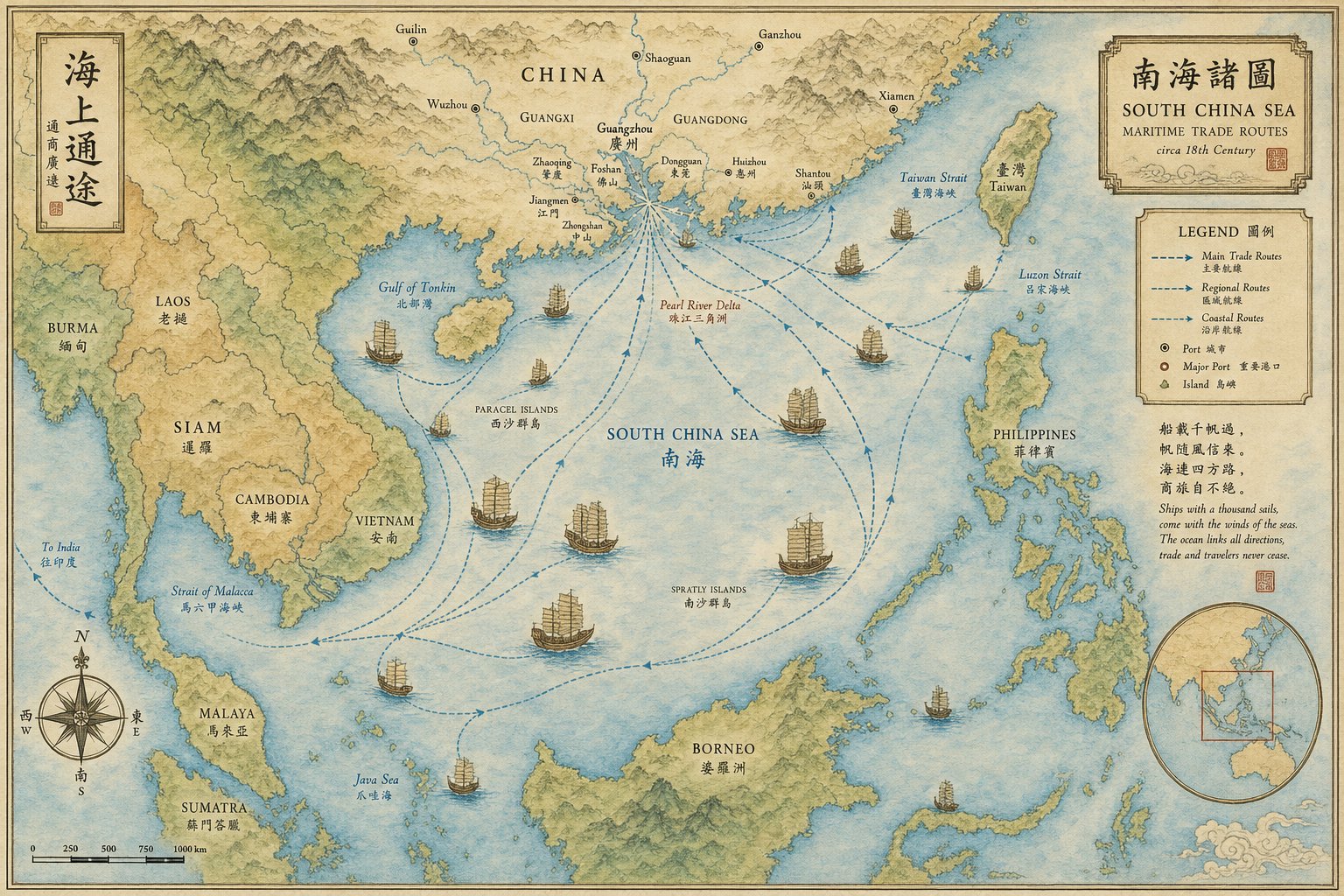
Geographic and Migration Patterns Behind Each Spelling
A family's spelling of 趙 is not a personal choice — it is a timestamp. It tells you when they left China, which port they departed from, which dialect they spoke at home, and which colonial administration processed their paperwork on the other end. The pattern is remarkably consistent: if your family spells it "Chiu," they almost certainly emigrated from Guangdong province before 1980. If they spell it "Zhao," they likely left mainland China after Pinyin became the passport standard. The exceptions are few, and they follow their own predictable logic.
Migration Waves That Shaped Surname Spellings
Chinese emigration did not happen all at once. It rolled out in distinct waves, each carrying a different dialect group to a different destination — and each wave arrived under a different administrative system that recorded names its own way.
The earliest significant wave relevant to the Zhao/Chiu split began in the mid-1800s. European colonial powers opened treaty ports and created demand for labor in mines, plantations, and railways across Southeast Asia and the Americas. Guangdong province — particularly the Pearl River Delta — supplied the largest number of emigrants. By 1957, an estimated 8.2 million overseas Chinese traced their origins to Guangdong alone, representing roughly 68% of the total overseas Chinese population at that time. These emigrants spoke Cantonese, Hokkien, Teochew, or Hakka — not Mandarin. Their surnames were recorded in whatever romanization the receiving country's clerks devised.
A second wave followed the fall of the Qing Dynasty, the Warlord Era, and the upheavals of the Chinese Civil War through the first half of the 20th century. Families fleeing instability settled across Southeast Asia, with many Cantonese speakers concentrating in Hong Kong, Malaya, and Singapore. Their names were still recorded using informal dialect-based romanization — Pinyin did not yet exist.
The third wave, beginning in the 1980s after China's Reform and Opening Up policy, brought a fundamentally different naming pattern. These emigrants carried PRC-issued passports with Pinyin romanization already printed on them. A 趙 family leaving Shanghai in 1990 arrived in Vancouver as "Zhao" — no clerk interpretation needed. This is why chinese american surnames from recent decades overwhelmingly follow Pinyin conventions, while older american chinese surnames from the 19th and early 20th centuries reflect Cantonese or Toishanese pronunciations.
The dividing line is roughly 1980. Before that date, dialect and colonial administration determined your spelling. After it, Pinyin standardization did.
Colonial-Era Romanization in Hong Kong and Southeast Asia
Imagine a 趙 family arriving at a British colonial office in Hong Kong in 1920. The clerk speaks English. The family speaks Cantonese. There is no standardized system — no Jyutping, no official transliteration guide. The clerk listens to the Cantonese pronunciation (something like "tsiu" or "chiu" to English ears) and writes down his best approximation using English phonetic conventions. That approximation becomes the family's legal surname for generations.
The same process played out differently depending on which European power controlled the territory. A Portuguese clerk in Macau heard the same Cantonese sound but filtered it through Portuguese phonetics, producing "Chio" or "Cheo." A Dutch administrator in the East Indies heard a Hokkien speaker say 趙 (closer to "Tio" in that dialect) and wrote it down using Dutch spelling conventions — resulting in "Thio" or "Tio." Each colonial system created its own variant, and each variant became locked into legal records.
This is why chinese filipino surnames often look different from the same character romanized in Malaysia or Australia. The Dutch colonial administration in Indonesia recorded Chinese names based primarily on Hokkien pronunciation using Dutch spelling conventions. Under this system, 張 (Zhang in Pinyin) became "Thio" or "Tio" — and 趙 could appear as "Tio" as well, since both characters share a similar Hokkien pronunciation. The overlap created yet another layer of ambiguity for chinese surnames in the philippines and Indonesia, where Hokkien-speaking immigrants from Fujian province dominated the early Chinese communities.
The li chinese surname (李) illustrates the same colonial fragmentation clearly: it appears as Lee in British territories, Lie in Dutch Indonesia, Li in Pinyin, and Lei in Cantonese. Similarly, the lee surname chinese families carry in Hong Kong, Malaysia, and Singapore reflects British colonial romanization conventions — not Mandarin pronunciation. The chinese surname lee is actually one of the most visible examples of how a single character (李) fractures into multiple spellings across diaspora communities, following the exact same pattern that splits 趙 into Zhao, Chiu, and Tio.
| Region | Time Period | Typical Romanization of 趙 | Dominant Dialect | Colonial/Administrative System |
|---|---|---|---|---|
| Hong Kong | 1840s–1997 | Chiu, Chew, Tsiu | Cantonese | British colonial (English phonetics) |
| Macau | 1557–1999 | Chio, Cheo | Cantonese | Portuguese colonial (Portuguese phonetics) |
| British Malaya / Singapore | 1820s–1963 | Chiu, Chew, Teo | Cantonese / Hokkien / Teochew | British colonial (English phonetics) |
| Dutch East Indies (Indonesia) | 1600s–1949 | Tio, Thio | Hokkien | Dutch colonial (Dutch phonetics) |
| Philippines | 1565–1946 | Tio, Chio | Hokkien | Spanish then American colonial |
| Mainland China (post-1958) | 1958–present | Zhao | Mandarin (official) | PRC Pinyin standard |
| Taiwan | 1945–present | Chao, Zhao | Mandarin | Wade-Giles (older) / Pinyin (newer) |
| United States / Canada | 1850s–1960s | Chiu, Jew, Jue, Chew | Cantonese / Toishanese | Immigration officer transcription |
| United States / Canada | 1980s–present | Zhao | Mandarin | Pinyin on PRC passports |
Notice the split in the United States and Canada entries. Early chinese american surnames from the Gold Rush era and the transcontinental railroad period reflect Cantonese and Toishanese pronunciations — because those were the dialect groups that dominated emigration from Guangdong's Sze Yup (四邑) region. The "Jew" and "Jue" variants come from Toishanese, where the initial consonant shifts even further from standard Cantonese. A family named "Jew" in San Francisco's Chinatown and a family named "Zhao" in a modern Bay Area suburb may carry the exact same character 趙 — separated only by 130 years of immigration history and a dialect shift.
The Hokkien variant "Tio" deserves special attention for families researching chinese surnames in the philippines and Indonesia. Hokkien speakers from Fujian's Zhangzhou and Quanzhou regions formed the majority of early Chinese immigrants to the Dutch East Indies and the Spanish Philippines. Their pronunciation of 趙 drops the Cantonese "ch" entirely, producing a sound closer to "tee-oh." Dutch clerks wrote this as "Tio" or "Thio," while Spanish-era Filipino records might render it as "Chio" or "Tio" depending on the transcriber. After Indonesia's independence and the Suharto-era name change policies, some Tio families adopted Indonesian-sounding names entirely — making the connection to 趙 even harder to trace without family documents showing the original character.
What all these variants share is a common mechanism: a non-Mandarin speaker pronounced 趙 in their native dialect, and a non-Chinese administrator wrote down what they heard using their own language's spelling rules. The character never changed. The sound shifted by dialect. The spelling shifted by colonial language. Three layers of transformation — character to dialect sound to foreign script — produced a dozen different surnames from one ancestor.
Knowing which layer applies to your family narrows the search dramatically. A "Chiu" from Hong Kong and a "Tio" from Jakarta face different disambiguation challenges, but both can be resolved by tracing backward through the same colonial-era records that created the spelling in the first place. The question is not just whether your family carries 趙 — it is how to prove it when the paper trail spans multiple countries, languages, and administrative systems.
Side-by-Side Comparison of Zhao and Chiu
Dialect shifts, colonial clerks, and standardization timelines — the previous sections covered a lot of ground. This table pulls every key difference into one view so you can see exactly where the two spellings diverge and where they converge on the same origin.
Complete Feature Comparison Table
| Feature | Zhao | Chiu |
|---|---|---|
| Dialect Origin | Mandarin | Cantonese |
| Romanization System | Pinyin (ISO 7098) | Informal Cantonese / Hong Kong Government romanization |
| Chinese Character | 趙 | 趙 (but also 邱, 丘, 周, and others) |
| Tone | 4th tone (falling) — zhào | Tone 6 (low-level) — ziu6 |
| Geographic Prevalence | Mainland China, post-1980s diaspora worldwide | Hong Kong, Southeast Asia, pre-1980 diaspora (Canada, Australia, US) |
| Ambiguity Level | Very low — maps almost exclusively to 趙 | High — maps to multiple unrelated characters |
| Passport Usage | All PRC passports since the 1980s | Hong Kong IDs, older diaspora documents, some Malaysian and Singaporean ICs |
| Approximate Global Speakers | ~28.3 million (primarily China, per Forebears surname data) | Subset of the same 28.3 million, plus ambiguous overlap with other characters |
Which Spelling Is More Common Globally
By raw numbers, "Zhao" dominates. It covers the vast majority of the approximately 28.3 million people who carry 趙 worldwide — making it the 14th most common surname on the planet. Among the most common chinese surnames, 趙 ranks 8th within China itself. The "Chiu" spelling, while deeply rooted in diaspora communities, represents a smaller slice of the total population because it is concentrated among Cantonese-speaking emigrants and their descendants.
That said, "Chiu" punches above its weight in specific regions. In Hong Kong, Malaysia, Singapore, Vancouver, and Sydney, it is the familiar form — the one that appears on shopfronts, clan association banners, and community directories. If you are researching popular chinese surnames within these Cantonese-speaking communities, "Chiu" is what you will encounter far more often than "Zhao."
Here are the three essential takeaways from this comparison:
- Same character, different sound systems. Both spellings encode 趙. The difference is purely phonetic and administrative — Mandarin pronunciation plus Pinyin rules produce "Zhao," while Cantonese pronunciation plus informal English transcription produce "Chiu."
- Ambiguity is one-directional. "Zhao" reliably points to 趙. "Chiu" does not — it requires character-level verification because multiple unrelated surnames share that romanization. This asymmetry matters for genealogy searches and database matching.
- Time period and geography predict the spelling. Pre-1980 emigration from Guangdong almost always yields "Chiu" or a variant. Post-1980 emigration from anywhere in mainland China yields "Zhao." Knowing when and where a family left China tells you which spelling to expect.
If your family spells it Chiu and another family spells it Zhao, you may share the exact same ancestral surname 趙 — the spelling difference reflects dialect, not lineage.
This is the most common chinese surname misconception among diaspora families: treating spelling as identity. Two branches of the same clan can carry different romanizations for generations without realizing they share an ancestor — simply because one branch left through Hong Kong in 1920 and the other left through Shanghai in 1990. The spelling diverged. The lineage did not.
Recognizing the connection is the first step. Proving it — through documents, clan records, and character verification — is the practical work that comes next.
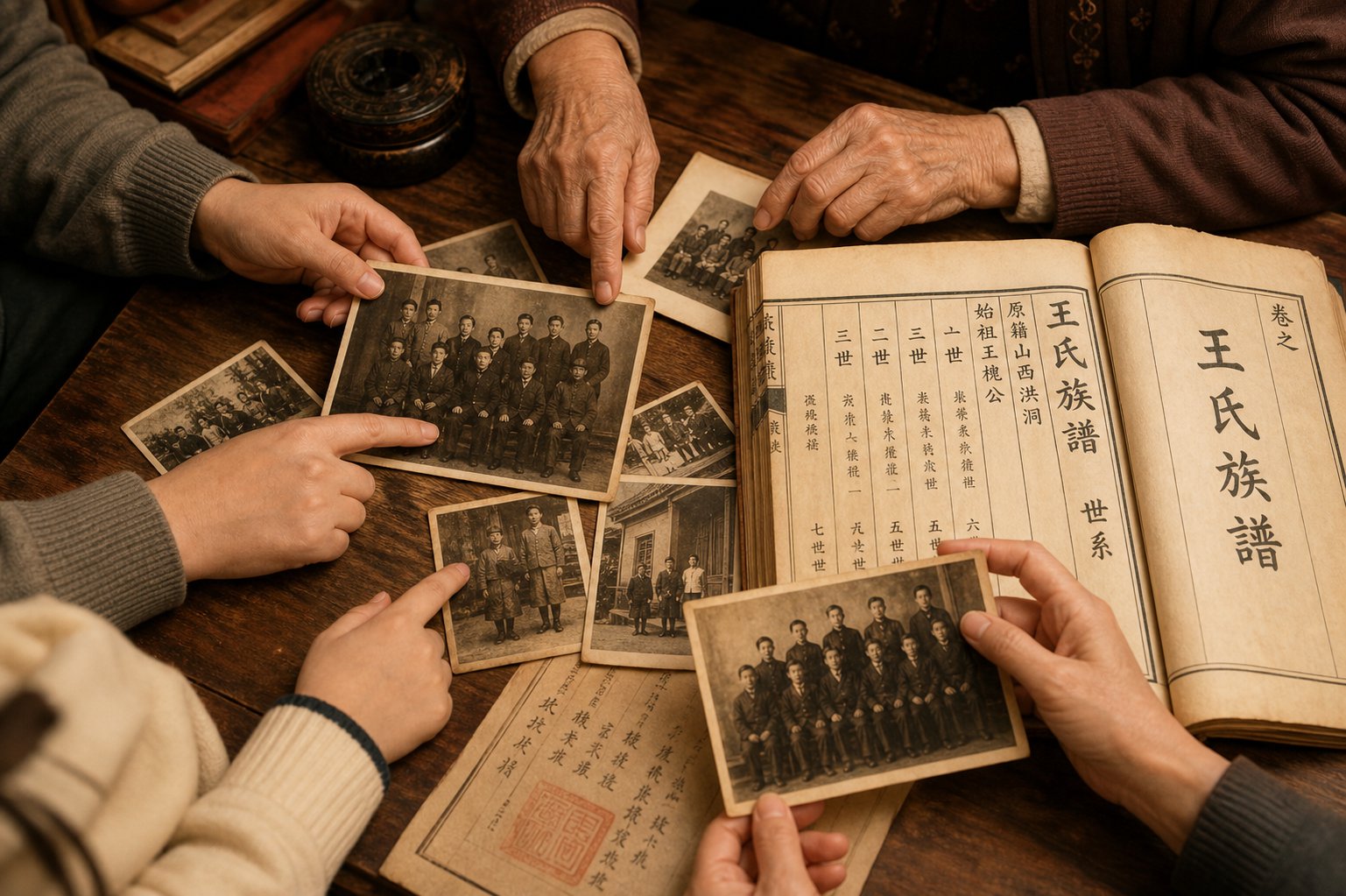
How to Verify and Trace Your Surname Connection
Recognizing that Zhao and Chiu might be the same surname is the easy part. Proving it — with enough certainty to connect family branches, update legal documents, or join a clan association — requires a specific sequence of steps. Each step narrows the possibilities until you arrive at a definitive answer: either your family carries 趙, or it carries a different character that happens to romanize the same way.
Steps to Verify Shared Ancestry Across Spellings
Think of this as a funnel. You start broad and get progressively more specific. Most families can confirm their character within the first two steps — but if your paper trail is thin, steps three and four provide alternative paths to the same answer.
- Identify the Chinese character through family records. This is the fastest route. Look for any document that shows the surname in Chinese characters rather than romanized form. Ancestral tablets, old passports, tombstone inscriptions, wedding invitations, funeral programs, and even red envelopes (紅包) from family events sometimes display the character. A single instance of 趙 written in your family's hand settles the question permanently. As Legacy Tree Genealogists notes, even families who no longer speak Chinese often retain documents, heirlooms, or photos with Chinese writing that can reveal the original character.
- Confirm dialect origin through your ancestral village. If you know which village or county your family came from in China, that geographic data narrows the field dramatically. Certain villages in Guangdong are dominated by specific surname clans — a 趙 village will not produce 邱 families, and vice versa. County gazetteers (縣志) and village genealogies (族譜) record which clans settled where. If your family traces to a known Zhao-clan village, the connection is established even without a physical document showing the character.
- Cross-reference clan association registries. Zhao/Chiu clan associations (趙氏宗親會) operate in most major diaspora cities — Hong Kong, Kuala Lumpur, Singapore, Vancouver, Sydney, San Francisco, and New York all have active chapters. These organizations maintain membership records indexed by ancestral village and generation name. Contact them with whatever details you have: your family's emigration port, the approximate decade they left, any generation names (字輩) passed down orally. They can often confirm membership or point you toward the correct branch.
- Use genealogy platforms that support character-based search. This is critical. Many Western genealogy databases index chinese names and surnames by romanization only — which means a search for "Chiu" will never surface "Zhao" results, even when both represent 趙. Platforms like My China Roots, FamilySearch's Chinese collection, and the Shanghai Library's genealogy database allow you to search by the Chinese character itself, bypassing the romanization problem entirely. If you already know your character is 趙, search by character to find matching clan genealogies (族譜) regardless of how other branches romanized their name.
One important note about chinese names surname first conventions: when searching older records — especially immigration documents from the 19th and early 20th centuries — remember that are chinese names written surname first in the original Chinese format. Foreign clerks sometimes reversed this order, recording the surname as a middle name or even a given name. A person named 趙明華 (Zhao Minghua) might appear in American immigration records as "Ming Wah Chiu" or "Chiu Ming Wah" depending on whether the clerk understood that are chinese surnames first or last in the naming sequence. The UK HM Passport Office guidance on Chinese names confirms that Chinese citizens are referred to by their surname first, and that forenames are often transposed in Western documents — a pattern that has confused genealogical searches for over a century.
Practical Tips for Passport and Official Documents
Verification is one thing. Deciding what to do with the information is another. Families sometimes face a practical question: should we standardize our spelling across branches? Should a "Chiu" family switch to "Zhao" on new passports to match mainland relatives?
There is no single right answer, but here are the considerations:
- Passport naming follows issuing country rules. A PRC passport will always show "Zhao" because Pinyin is mandatory. A Hong Kong SAR passport allows the holder to retain their traditional romanization — so "Chiu" remains valid and legal. Changing your passport spelling is possible but involves bureaucratic steps and may create mismatches with older documents like birth certificates and property titles.
- Database matching favors consistency. If you are actively building a family tree across branches, having one standardized romanization (or better, always including the character 趙 alongside any romanized form) makes cross-referencing dramatically easier. Some families add the Chinese character in parentheses on genealogy profiles — "Chiu (趙)" — to bridge the gap without abandoning their traditional spelling.
- Cultural identity matters. For many Cantonese-speaking families, "Chiu" is not just a spelling — it is three or four generations of identity. It appears on grandparents' immigration papers, on the clan association plaque in their community hall, and on tombstones in overseas Chinese cemeteries. Switching to "Zhao" for administrative convenience can feel like erasing that history. There is no genealogical requirement to standardize. Both spellings are correct representations of 趙 in their respective dialect systems.
- Legal name changes create paper trail gaps. If you change your surname spelling on a new passport, you may need to carry supporting documentation linking your old and new names for banking, property, and immigration purposes. Some countries require a deed poll or statutory declaration to formalize the change.
The most practical approach for most families: keep your traditional spelling for daily life and legal documents, but ensure your chinese name surname character (趙) is recorded somewhere accessible — in your genealogy file, your clan association membership, or even a simple note attached to your family tree. That character is the permanent anchor. The romanization is just the surface layer, and it can flex across dialects, countries, and generations without breaking the underlying connection.
Whether your family has been "Chiu" since a British clerk wrote it down in 1890s Hong Kong or "Zhao" since a Pinyin-standard passport was issued in 2005, the lineage runs through the same character, the same Warring States kingdom, and the same imperial dynasty. The spelling is a historical artifact. The ancestry is not.
Frequently Asked Questions About Zhao vs Chiu Surname
1. Are Zhao and Chiu the same Chinese surname?
Yes, both Zhao and Chiu represent the same Chinese character 趙. The spelling difference results from dialect-based romanization systems. Mandarin speakers use Pinyin, which produces 'Zhao,' while Cantonese speakers pronounce the same character as something closer to 'Chiu.' The underlying lineage, origin story, and ancestral character are identical regardless of which spelling a family uses.
2. Why does the surname Chiu have multiple meanings in Chinese?
Unlike 'Zhao,' which maps almost exclusively to 趙, the romanization 'Chiu' can represent several unrelated Chinese characters including 趙, 邱, 丘, 周, and 仇. This ambiguity exists because Cantonese romanization was never formally standardized during peak emigration decades. Colonial clerks wrote phonetic approximations, and multiple distinct characters happen to sound similar in Cantonese. Character-level verification through family documents or clan associations is the only reliable way to confirm which surname a 'Chiu' family actually carries.
3. How can I find out if my Chiu surname is the same as Zhao?
Start by checking family documents written in Chinese, such as ancestral tablets, old passports, tombstone inscriptions, or wedding invitations, for the character 趙. If no documents exist, ask elder relatives to identify the character, trace your ancestral village in Guangdong province, contact a Zhao/Chiu clan association (趙氏宗親會), or use genealogy platforms like My China Roots that support character-based searches rather than romanization-only lookups.
4. What other spellings exist for the Chinese surname 趙 besides Zhao and Chiu?
The character 趙 has been romanized in many ways depending on dialect and colonial administration. Common variants include Chao (Wade-Giles/Taiwanese), Chew (Malaysian Cantonese), Tio or Thio (Hokkien in Indonesia and the Philippines), Jew or Jue (Toishanese in early American Chinatowns), Chio (Portuguese Macau), and Tsiu (older Hong Kong records). All trace back to the same character and the same ancestral lineage from the ancient State of Zhao.
5. Should my family change our surname spelling from Chiu to Zhao?
There is no genealogical requirement to standardize. Both spellings correctly represent 趙 in their respective dialect systems. Many families keep 'Chiu' because it carries generations of identity tied to immigration papers, clan associations, and community history. A practical middle ground is to record the Chinese character 趙 alongside your traditional romanization in genealogy files and official profiles, ensuring database matching works without erasing your family's dialect heritage.