Why Researching Your Chinese Surname History Matters
Imagine you have a romanized spelling on an old immigration document — maybe "Chan" or "Lee" — and nothing else. No ancestral village name, no Chinese characters, no family contacts back in China. This is the reality for millions of diaspora researchers trying to trace their Chinese ancestry. The good news? That single spelling is more powerful than you might think. This guide walks you through a complete workflow to move from a romanized surname to a documented, verified surname history.
Why Chinese Surname Research Is Different
Western genealogy typically starts with church records, census data, or civil registrations maintained by central authorities. Chinese surname research flips that model. In China, families and clans kept all the documentation — not the state. Chinese surnames have a history dating back more than 4,000 years, making them far older than most European family names. They carry embedded geographic and clan information that, once decoded, can point you toward a specific region, migration route, or founding ancestor.
Chinese family names predate most European surnames by millennia. Unlike Western last names that often describe occupations or physical traits, Chinese surnames encode geographic origins, clan affiliations, and ancient lineage splits that researchers can trace across documented history.
Dialect variations add another layer of complexity. A single Chinese character like 陳 can appear as Chen, Chan, Tan, Tjin, or Ting depending on the speaker's dialect and the era of immigration. Understanding chinese family names and meanings requires navigating these layers — something Western genealogy rarely demands.
What You Need Before You Start
You don't need fluency in Mandarin or access to archives in China to begin. All you need is your romanized surname spelling and a willingness to work through the process step by step. Any additional details — a dialect group, an immigration port, a family story about a home province — will accelerate your research. This guide assumes you're starting from near zero and builds from there.
The Xing vs Shi Distinction Explained
In ancient China, what we now call a "chinese surname" was actually two separate concepts: the xing (姓) and the shi (氏). The xing was the broader clan name — a marker of exogamous blood ties stretching back to semi-legendary ancestors. The shi was a subordinate family identifier, derived from the main clan and tied to specific lands, titles, or branches. Think of xing as the trunk and shi as the branches.
Why does this matter for your research? If your chinese surname traces to an ancient xing, its origins may be semi-mythological and harder to pin down precisely. If it derives from a shi, you'll often find a more concrete founding ancestor and a specific historical period — typically the Zhou Dynasty (1046-256 BC) or later. By the Warring States period (481-221 BC), the two concepts merged into the single-surname system used today. Knowing which category your name falls into tells you how far back documented records can realistically take you.
The path from a romanized spelling to verified chinese family names and meanings involves several distinct steps — identifying the correct Chinese characters, locating historical texts, and accessing clan records. Each step builds on the last, and the process starts with something deceptively simple: gathering what you already know.
Step 1 Gather What You Already Know About Your Surname
Every piece of information you already have — even fragments that seem useless — becomes a research clue when you know how to use it. Before diving into historical texts or online databases, take stock of what's already in your possession. A romanized chinese last name on a ship manifest, a grandmother's offhand mention of a home province, or even the dialect your family spoke at home can dramatically narrow your search.
Gather Your Family Documents and Oral History
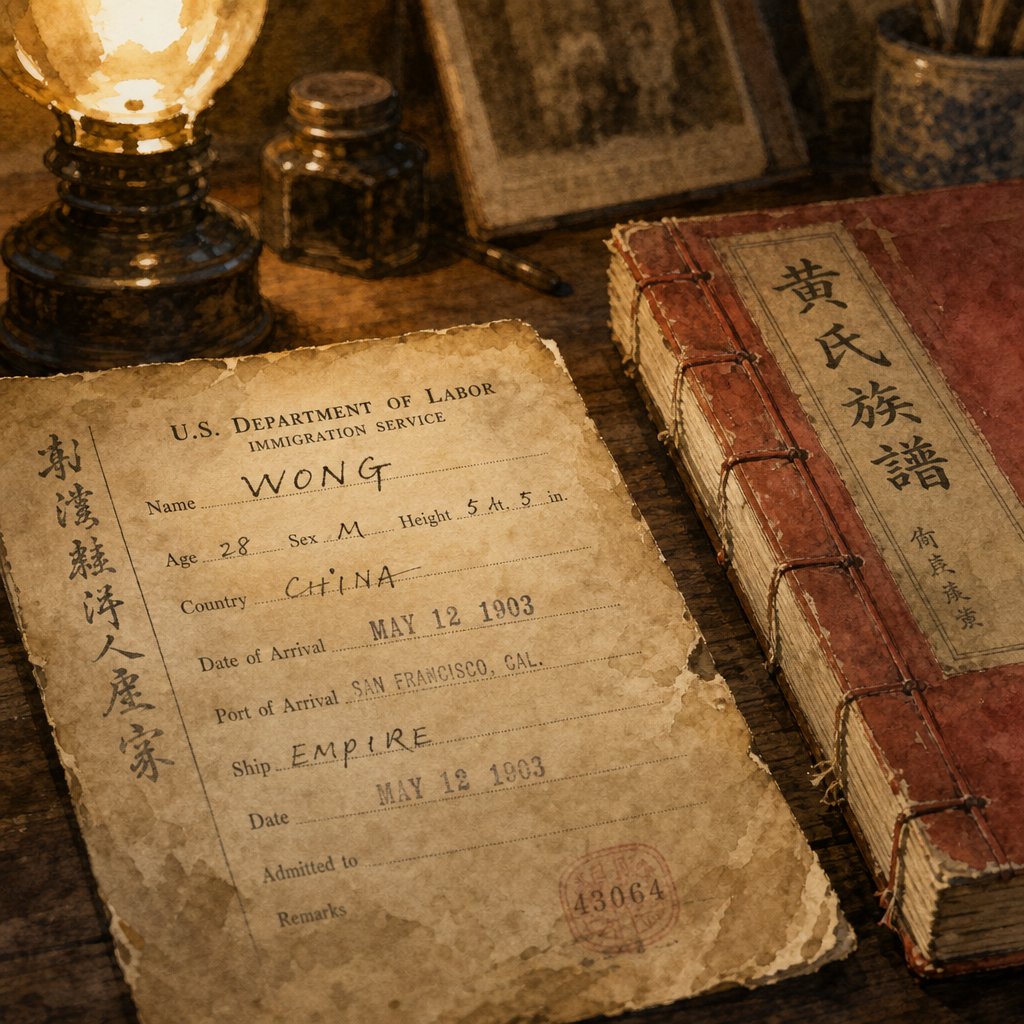
Start by pulling together every document and family memory that touches on your surname or ancestral origins. You're building a foundation here, and even small details matter. A spelling variation on one document versus another can reveal dialect clues. A relative's memory of which port the family departed from can point to a specific region in southern China.
- Immigration documents (ship manifests, naturalization papers, visa applications)
- Birth, marriage, and death certificates — check for spelling variations across documents
- Family association membership records or correspondence
- Old photographs with writing on the back (sometimes in Chinese characters)
- Oral history from older relatives: dialect spoken at home, names of villages or cities, stories about the journey
- Business licenses, property records, or tax documents bearing the surname
- Any documents with Chinese characters, even if you cannot read them
Pay close attention to inconsistencies. If your surname is spelled "Chan" on one record and "Chin" on another, that's not an error — it's a clue about how immigration officials heard and transcribed the name at different times.
Identify Your Dialect Group
Dialect identification is arguably the single most powerful tool for narrowing down your chinese last name to its correct Chinese character and geographic origin. The major dialect groups among overseas Chinese — Cantonese, Hokkien, Teochew, Hakka, and Hainanese — each came from distinct regions of southern China and pronounced surnames in completely different ways.
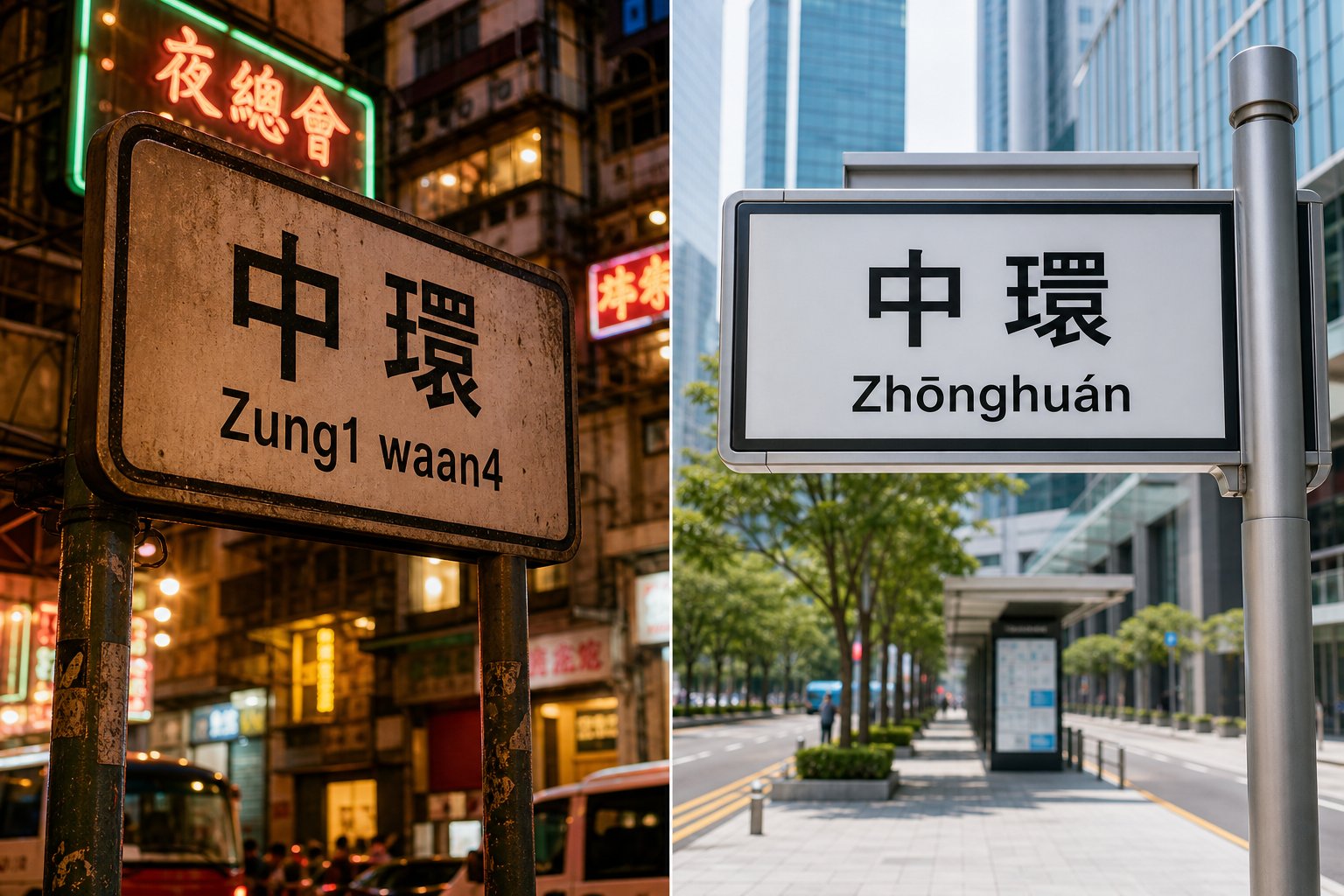
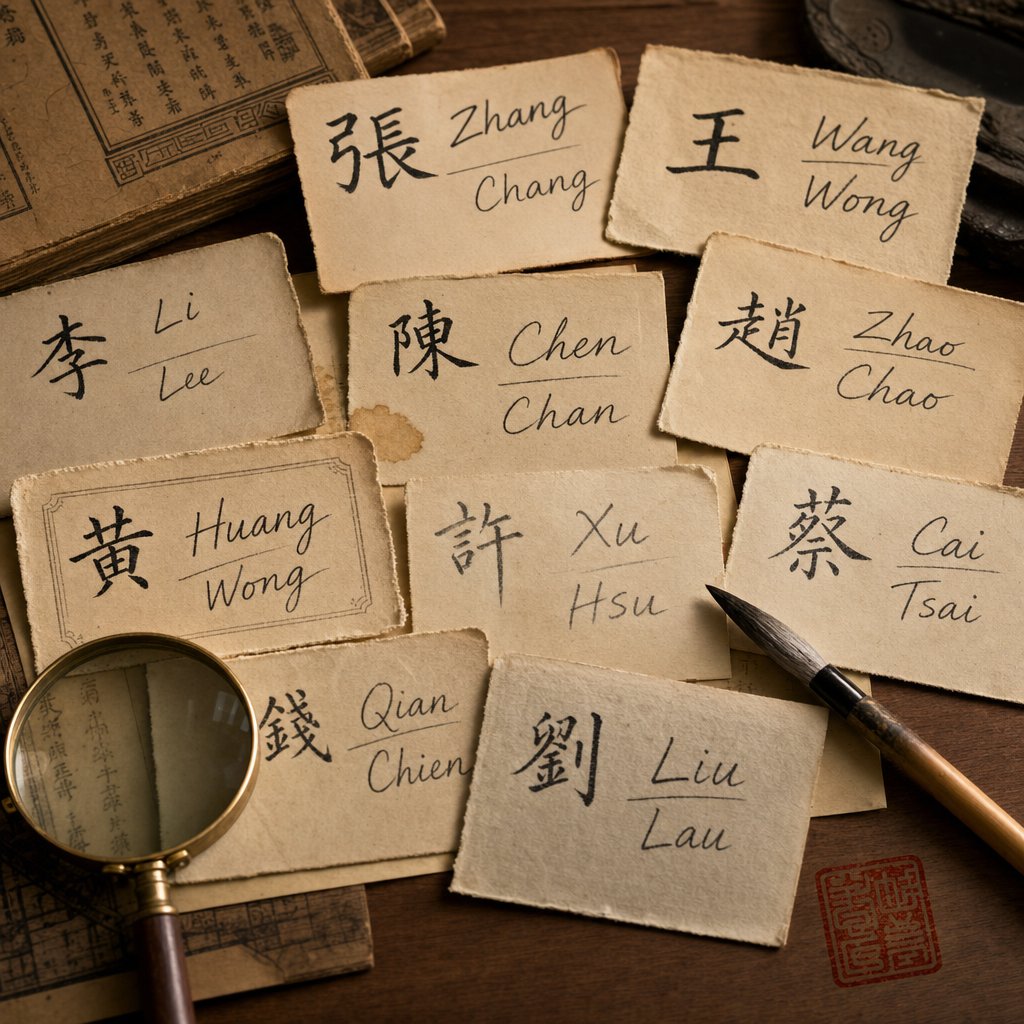
Consider the surname character 黄. In Mandarin, it's "Huang." Among cantonese surnames, it becomes "Wong." In Teochew, it's "Ng" or "Ong." The same character, the same family — but spellings so different they look entirely unrelated. Similarly, 陳 appears as "Chen" among mandarin last names, "Chan" in Cantonese, "Tan" in Hokkien, and "Tjin" in some Indonesian transcriptions. My China Roots documents that 陳 alone has been romanized as Chen, Chan, Chin, Chinn, Ching, Chun, Chang, Tan, Tang, Tchen, Tin, Ting, Tjin, Jin, and more.
If you know your family spoke Cantonese at home, you've already eliminated Hokkien, Teochew, and Hakka spelling patterns from consideration. That single fact can cut your list of possible characters in half. Cantonese last names follow specific romanization patterns that differ sharply from mandarin surnames or Hokkien spellings, so dialect knowledge acts as a geographic filter pointing you toward Guangdong's Pearl River Delta, Fujian province, or Chaozhou prefecture.
Recognize Immigration-Era Name Changes
Here's where the research gets tricky. Many Chinese surnames were altered — sometimes beyond recognition — during the immigration process. Without standardized romanization systems, immigration officials simply guessed at spellings based on whatever sounds they heard. The result? A single family might end up with three different surname spellings across siblings who arrived on different ships.
The "paper son" system adds another layer of complexity. During the Chinese Exclusion era (1882-1943), some immigrants entered the United States using purchased documents that listed them as relatives of Chinese American citizens. As one immigrant, Mr. Chan, explained: "We didn't want to come here illegally, but we were forced to because of the immigration laws." These individuals often adopted entirely different surnames — the surname of their "paper father" — meaning the name on official records may not reflect their biological family at all.
Chinese naming conventions also confused Western officials. Because Chinese places the surname before the given name (e.g., Long Kaiwei, where Long is the surname), officials sometimes recorded the given name as the surname. Some families ended up with double-character surnames like "Wing Luck" that were actually a given name mistakenly registered as the family name. Others acquired the Cantonese honorific prefix "Ah-" permanently attached to their surname, turning "Wong" into "Ahwong."
Recognizing these patterns doesn't solve the puzzle immediately, but it tells you which documents to trust and which to question. If your family arrived during the Exclusion era, consider the possibility that the surname itself may be adopted rather than ancestral. Oral history from older relatives often holds the key — the name the family used privately may differ from what appears on paper.
With your documents gathered, your dialect group identified (or at least narrowed down), and immigration-era distortions accounted for, you have the raw material needed for the next critical step: matching your romanized spelling to the correct Chinese character.
Step 2 Identify the Chinese Characters for Your Surname
A romanized spelling is a starting point, not a destination. The real breakthrough in your research happens when you identify the correct hanzi family name — the actual Chinese character behind the spelling. This step matters because everything that follows (historical texts, clan records, origin stories) is organized by character, not by romanization. Get the character wrong, and you'll be researching someone else's family.
Match Your Romanized Spelling to Chinese Characters
Here's the core challenge: multiple Chinese characters can produce the same romanized spelling. Take "Li" in Pinyin. According to Wikipedia's documentation, at least nine distinct Chinese surnames all romanize as Li — including 李 (plum, shared by over 100 million people worldwide), 黎 (dark), 栗 (chestnut), 利 (sharp), and 厲 (strict). Each has a completely different origin story, geographic distribution, and clan history. If your family name in chinese is spelled "Li," you need to determine which character it actually represents before you can trace its history.
So how do you narrow it down? Start with frequency. Li 李 is the second most common chinese name surname in China, shared by 93 million people. Unless you have evidence pointing elsewhere, statistical probability favors the most common character. Then layer in your dialect clues. If your family is Cantonese and the name was spelled "Lei" on old documents, that points toward 李 (which is "Lei" in Cantonese) rather than 黎 (which is "Lai" in Cantonese). Different characters that share a Pinyin spelling often diverge in other dialect romanizations.
FamilySearch offers a practical tool for this matching process. Navigate to their China Collection of Genealogies, select Browse, and you'll find a chinese surnames list of over 430 family names displayed in both Pinyin and Chinese characters. As genealogist Linda Yip demonstrated, you can visually match characters from immigration documents or grave markers against this list to confirm your surname. The top 100 names cover roughly 85% of the Chinese population, so there's a strong chance your surname in chinese appears there.
Navigate Wade-Giles vs Pinyin vs Jyutping
Your romanized spelling didn't appear out of thin air — it was produced by a specific romanization system, and identifying which system was used tells you a lot about when and where the spelling was recorded.
The Library of Congress identifies clear markers that distinguish these systems. Wade-Giles (developed in the 1800s) uses apostrophes to mark aspiration and hyphens between syllables — so "Ch'en" is Wade-Giles for the same surname that Pinyin spells "Chen." If you see apostrophes or syllables beginning with "Hs" or "Ts," you're looking at Wade-Giles. Pinyin (adopted by China in 1958 and internationally from the 1980s onward) uses letters like B, D, G, Q, X, and Z at the start of syllables — letters that never begin a Wade-Giles syllable.
Jyutping is the standardized romanization for Cantonese, while POJ (Pe̍h-ōe-jī) serves Hokkien. Older documents from Hong Kong, Macau, and Southeast Asia often use informal Cantonese romanizations that predate Jyutping — spellings like "Ng," "Tsang," or "Yip" that follow no formal system but reflect Cantonese pronunciation.
Recognizing the system helps you reverse-engineer the original character. A surname spelled "Hsieh" is clearly Wade-Giles (Pinyin: Xie, 謝). "Chua" is Hokkien (Pinyin: Cai, 蔡). Once you identify the system, you can convert to Pinyin and search any chinese surname list or database with confidence.
Use Dialect Spelling as a Geographic Clue
Dialect romanizations do more than help you find the right character — they point toward a geographic origin. A surname spelled in Cantonese romanization almost certainly traces to Guangdong province. Hokkien spellings point to Fujian or Taiwan. Teochew spellings narrow the origin to the Chaoshan region of eastern Guangdong.
The table below shows how common surnames appear across different romanization systems. Use it to cross-reference your spelling against a list of chinese surnames and identify both the character and the likely dialect origin:
| Chinese Character | Pinyin (Mandarin) | Wade-Giles | Cantonese | Hokkien | Likely Origin Region |
|---|---|---|---|---|---|
| 陳 | Chen | Ch'en | Chan / Chin | Tan / Ting | Guangdong / Fujian |
| 李 | Li | Li | Lei | Lee | Widespread |
| 黃 | Huang | Huang | Wong | Ng / Ong | Guangdong / Fujian |
| 林 | Lin | Lin | Lam | Lim | Fujian / Guangdong |
| 楊 | Yang | Yang | Yeung / Young | Iu / Yeo | Guangdong / widespread |
| 葉 | Ye | Yeh | Yip / Ip | Iap | Guangdong / Fujian |
| 謝 | Xie | Hsieh | Tse / Che | Chia / Sia | Guangdong / Fujian |
| 蔡 | Cai | Ts'ai | Choi / Tsoi | Chua / Choa | Fujian / Teochew |
Notice how "Young" maps to 楊 (Yang in Pinyin) — a connection that's invisible unless you know to check Cantonese romanization patterns. Similarly, "Yip" becomes 葉 (Ye in Pinyin), a link that only emerges when you recognize the Cantonese spelling convention.
Your method for cross-referencing is straightforward: take your romanized spelling, check it against the FamilySearch chinese surnames list and dialect-specific romanization tables, identify candidate characters, then use your dialect group knowledge to confirm the match. If multiple characters remain plausible, look for secondary evidence — grave markers, family association records, or documents with Chinese writing that you can compare character by character.
With the correct character identified, you've unlocked the key that opens every historical source ahead. Chinese genealogical texts, origin compilations, and clan records are all indexed by character — and that's exactly where the research turns next.
Step 3 Research Your Surname Origin in Historical Texts
You've identified the correct Chinese character. That character is your key to a library of historical texts stretching back over a thousand years — texts that document chinese surnames and meanings, founding ancestors, geographic origins, and the specific events that brought each surname into existence. The question now is: where do you look, and how do you evaluate what you find?
Start with the Hundred Family Surnames Text
The Baijiaxing (百家姓), or "Hundred Family Surnames," is the natural starting point. Written during the early Song Dynasty (960-1279), this text lists 504 surnames in 564 characters, arranged in four-character rhymed verses that were originally used to teach children to read. The ordering itself carries historical information — Zhao (趙) comes first because it was the imperial surname of the Song Dynasty, followed by Qian (錢), the surname of the Wu-Yue state rulers whose territory the compiler likely inhabited.
The Baijiaxing alone won't give you a full origin story. Think of it as a directory — it confirms your surname's existence and historical recognition during the Song period. But later expansions of this text are far more useful for tracing chinese name origin details. The Qianjiaxing wen (千家姓文), compiled by Cui Mian in the mid-17th century, expanded the list to 1,006 family names and — critically — included explanations of each name's history. The Ming Dynasty's Qianjiaxing (千家姓) by Wu Shen recorded 1,968 family names, capturing many ancient chinese surnames that the original text omitted.
For a more accessible starting point, the Song Dynasty text Xingshi Ji Jiu Pian (姓氏急就篇), available digitally on ctext.org, provides surname origin information in a format that's searchable online. Wikipedia and Baidu Baike also offer basic origin narratives for major surnames — useful as a first pass, though they require verification.
Cross-Reference Historical Surname Compilations
The real depth comes from the Tongzhi Shizu Lüe (通志·氏族略), a treatise on clan origins compiled by the Southern Song scholar Zheng Qiao (1104-1162). Completed in 1161, this work spans six juan (scrolls) dedicated entirely to documenting the origins and branches of Chinese family clans. Unlike the Baijiaxing, which simply lists names, the Shizu Lüe traces how surnames emerged from feudal territories, official titles, ancestral given names, and geographic features.
Zheng Qiao modeled this treatise on the hereditary biographies found in earlier dynastic histories, creating what amounts to a systematic catalog of chinese surname meanings and their documented derivations. For researchers tracing ancient chinese last names, this text provides the kind of sourced, scholarly analysis that separates documented history from legend.
Regional gazetteers (difangzhi, 地方志) add a third layer of verification. These county- and prefecture-level records document which surnames were present in specific locations during specific periods. If the Shizu Lüe claims your surname originated in a particular region, a gazetteer from that region can confirm or challenge the claim by showing when bearers of that name actually appear in local records.
Distinguish Documented Origins from Folk Etymology
Not every origin story you encounter is equally reliable. Many websites and popular books repeat folk etymologies — appealing narratives that connect a surname to a famous emperor or legendary figure without solid textual support. When researching chinese surnames meaning and origin, you need a method for separating documented history from wishful thinking.
Here's a replicable verification process you can apply to any surname origin claim:
- Locate the earliest text that makes the claim. A story first appearing in a Song Dynasty compilation carries more weight than one that surfaces in a modern blog post with no cited source.
- Check whether the Tongzhi Shizu Lüe or another pre-modern scholarly text corroborates the claim independently. Two sources from different periods citing the same origin are far stronger than a single source repeated everywhere.
- Verify geographic plausibility. If the origin story places your surname's founding in Henan province, do regional gazetteers from Henan show early concentrations of that surname? Does the claimed migration pattern align with known historical movements?
- Assess linguistic plausibility. Some folk etymologies rely on character meanings that didn't exist in the period claimed, or on phonetic similarities that only work in modern Mandarin — not in the ancient pronunciation that would have been spoken when the surname supposedly formed.
- Look for the "too perfect" signal. Origin stories that connect a surname to the Yellow Emperor or a single dramatic event with no intermediate documentation are often legendary rather than historical. Documented origins tend to be more mundane — a place name, an official title, a branch split from a larger clan.
Take the surname Zhong (钟) as an example. Historical records document that a Zhong ancestor named Ye relocated his family to the Zhongli Mountains in Yingchuan (modern Henan) during the late Qin Dynasty (221-206 BC), and his son Qi adopted the surname from the mountain's name. This origin story is verifiable: it names specific people, a specific place, a specific time period, and a plausible mechanism (adopting a geographic name for safety during political turmoil). Compare that to vague claims like "this surname descends from the Yellow Emperor" — which may be technically true for hundreds of surnames but tells you nothing useful.
The goal isn't to debunk every origin story. It's to understand which parts of your surname's history rest on documented evidence and which parts are traditional narratives that may or may not reflect actual events. That distinction matters enormously when you move to the next phase of research — locating the clan-specific records that connect your particular family branch to the broader surname history.

Step 4 Locate and Access Jiapu Family Registers
Historical surname compilations tell you where a name came from in broad strokes. But to connect your specific family branch to that broader history — to trace the actual people who carried your surname through generations — you need a jiapu. These clan genealogy books are the backbone of chinese genealogy, and they hold information no other source can provide.
Understanding Jiapu and Zupu Family Registers
A jiapu (家谱), also called a zupu (族谱), is a traditional book that records one clan's generational heritage. Think of it as a family tree in chinese names, dates, and biographical details — but far more comprehensive than a simple pedigree chart. These registers trace a single patrilineal line from a founding ancestor forward, generation by generation, sometimes spanning 500 or more years of documented history.
What makes a jiapu different from Western genealogical records? It's clan-centered and clan-maintained. No government agency compiled these books. Families themselves commissioned, wrote, updated, and preserved them — often revising the register every few decades to add new generations. FamilySearch describes the jiapu as recording "the family's bloodline heritage, often tracing back hundreds of years of history, usually focusing on male descendants."
A typical jiapu contains far more than names and dates. Most combine several categories of information:
- Surname origins and migration history — how the clan arrived in its current location
- Pedigree charts showing male descendants generation by generation
- Generation poems (字辈) — predetermined character sequences that dictate naming conventions for each generation
- Biographical entries for notable ancestors, including birth years, death years, and spouse surnames
- Ancestral portraits and cemetery maps
- Family rules, teachings, and clan governance documents
- Postscripts recording when and why the jiapu was compiled or revised
The generation poem alone can be a powerful research tool. If you know your grandfather's given name contained the character "明" and your father's contained "德," you can search a jiapu's generation poem to pinpoint exactly which generation your family belongs to — and then trace backward and forward from there.
Where to Find These Records
Jiapu survive in two broad categories: clan-kept records still held by families or clan associations, and institutional collections gathered by libraries and archives. Your search strategy differs for each.
Clan-kept records are the originals — handwritten or printed volumes passed down within a family or stored at an ancestral hall. Many were destroyed during the Cultural Revolution (1966-1976), but significant numbers survived, hidden by families or preserved by overseas relatives in Malaysia, Singapore, and the United States. Overseas Chinese family associations (宗亲会) often hold copies that predate the destruction in mainland China.
Institutional collections are more accessible for diaspora researchers. Here are the major repositories and how to access them:
- Shanghai Library (上海图书馆) — Holds approximately 30,000 genealogies, making it the largest single collection. Their Chinese Genealogy Knowledge Service Platform provides an online catalog with bibliographical information and availability status. Of the 30,000 holdings, about 15,000 are available on-site, and 8,565 are accessible externally through their digital platform.
- FamilySearch — Holds scanned copies of tens of thousands of Chinese genealogies spanning 1239-2014, acquired from institutions including the Chinese Academy of Social Sciences, the Library of Congress, Harvard-Yenching Library, and Columbia University. Most are browsable online for free by registered users.
- National Library of China (中国国家图书馆) — Maintains a genealogy collection and digitized rare book resources, though online access is more limited than the Shanghai Library.
- University libraries — Harvard-Yenching Library, Columbia University, UC-Berkeley, Stanford, University of Chicago, University of British Columbia, and others hold smaller but significant collections, often including rare Ming Dynasty genealogies.
- Library of Congress — Their Chinese Rare Book Digital Collection includes at least 15 genealogies, mostly from the Ming period, in high-quality digital scans.
- Overseas clan associations — Chinese family associations in Southeast Asia (particularly Malaysia and Singapore), the United States, and Australia often hold jiapu copies brought by early immigrants. These are sometimes the only surviving copies of genealogies destroyed on the mainland.
The distinction between clan-kept and institutional records matters for your research strategy. Institutional collections are searchable through catalogs and databases — you can look up your surname and province to find relevant genealogies. Clan-kept records require personal connections: reaching out to family associations, contacting village elders, or hiring a researcher in China who can visit ancestral halls on your behalf.
How to Request Access and Interpret Entries
For FamilySearch's collection, access is straightforward. Register for a free account, navigate to the China Collection of Genealogies, and browse by family name. The collection lacks a searchable text index — you'll browse images organized by surname — but the visual format means you can scan pedigree charts even with limited Chinese reading ability.
The Shanghai Library requires more effort. Their genealogy reading room on the second floor provides computers for accessing scanned images of internally available genealogies. Anyone with a Shanghai Library ID can use the reading room for free, though printing costs about 1 RMB per page. For remote researchers, the online platform provides access to their externally available subset.
Interpreting a jiapu without fluent Chinese is challenging but not impossible. Here's what to look for:
- Pedigree charts — These follow predictable visual patterns. FamilySearch's Jiapu Guide identifies five common styles: Su Style (蘇式), Ou Yang Style (歐陽式), Imperial Style (牒記式), Pagoda Style (寶塔式), and Document Style (文檔式). Each arranges generations differently, but all flow from founding ancestor downward.
- Recurring characters — Generation poems create visible patterns. If every name in one generation shares a common character, that's the generation marker — and it tells you exactly where in the lineage you're looking.
- Dates — Chinese dates use reign years (e.g., 乾隆三十年 = 30th year of Qianlong = 1765). Online conversion tools can translate these to Western calendar dates.
- Geographic references — Place names in migration histories often use historical administrative terms. A county name from the Qing Dynasty may not match modern maps, but historical gazetteers can bridge the gap.
Don't give up if your family's jiapu seems lost. As FamilySearch notes, many copies survive through distant relatives or clan members who emigrated before the 1960s. A genealogy chinese researchers assumed was destroyed may still exist in a family association archive in Kuala Lumpur or San Francisco. The search itself often surfaces unexpected connections — a distant cousin who kept a copy, a digitized fragment in a university collection, or a clan association that maintained records your immediate family lost track of decades ago.
Building your china family tree from jiapu records is deeply rewarding, but it raises a practical question that stops many researchers cold: what do you do when you can't read the documents you've found?
Step 5 Navigate the Language Barrier in Chinese Records
You've located a jiapu or found a promising document in a digital archive — but it's entirely in classical Chinese, and you can't read a single character beyond your surname. This is the wall most diaspora researchers hit. The good news? You don't need fluency to make meaningful progress. A combination of digital tools, naming pattern recognition, and human intermediaries can carry you surprisingly far.
Tools for Translating Genealogical Documents
No single tool handles classical Chinese genealogical text perfectly, but layering several approaches together produces workable results. If you're trying to find your chinese name in a document or decode a pedigree chart, here's what's available:
- Pleco (smartphone app) — Uses your phone camera to recognize Chinese characters in real time and provides dictionary definitions. Works well for individual characters on grave markers, certificates, or printed genealogies. Limited with handwritten or faded text.
- Google Translate (camera and text modes) — Handles modern Chinese reasonably well but struggles with classical Chinese grammar and archaic vocabulary common in jiapu. Useful for getting the gist of a passage, not for precise translation. Note: Google Translate defaults to Mandarin (Pinyin output), not Cantonese.
- Cantonese Tools — Converts Chinese characters into Cantonese pronunciation (Jyutping). Invaluable if you're trying to match a character to a romanized spelling you heard from relatives.
- Hong Kong Vision romanization converter — Romanizes Chinese characters into seven different systems simultaneously, helping you match characters to various dialect spellings.
- FamilySearch's Jiapu Guide — Provides visual examples of common jiapu layouts with labeled sections, so you can identify which part of a page contains names, dates, or biographical notes even without reading the text.
- AI-powered OCR tools — Services like My China Roots' Image to Text feature can extract characters from scanned genealogy pages, converting images into searchable text you can then feed into translation tools.
A practical workflow: photograph or screenshot the document, run it through OCR to extract characters, paste the text into Google Translate for a rough meaning, then use Pleco to look up individual characters that seem important (especially names and place names). This won't give you a polished translation, but it will tell you whether a document is relevant to your family before you invest in professional translation.
Understanding Generation Names and Naming Patterns
Even without reading Chinese fluently, you can use naming patterns to identify family connections across documents. Generation names (字辈, zibi) are the most powerful pattern for this purpose.
Here's how they work. A clan's founding ancestors composed a generation poem — a sequence of characters, usually in lines of five or seven, that predetermined one character in every descendant's given name for dozens of generations forward. FamilySearch explains that brothers and cousins in the same generation share this character, making it immediately visible which generation someone belongs to. The generation character typically appears as the first of two given-name characters, though some clans place it second.
Imagine you're scanning a jiapu and you notice that every name in one row shares the character 德. That's the generation marker. The next row all share 明. If your grandfather's name contained 德 and your father's contained 明, you've just located your family's position in the lineage — without reading anything else on the page.
Courtesy names (字, zi) add another identification layer. In traditional Chinese culture, men received a formal courtesy name at age 20, separate from their given name. Some clans maintained separate generation poems for courtesy names. If you encounter a document listing someone by a name you don't recognize, it may be their courtesy name rather than their given name — the same person, recorded differently.
These patterns matter practically because they help you find your chinese family name connections even when documents use unfamiliar name forms. A relative listed by courtesy name in one record and given name in another might look like two different people unless you understand the naming system.
Working with Researchers and Clan Associations
When tools reach their limits, people bridge the gap. Two categories of human intermediaries can accelerate your research dramatically: professional genealogists and overseas clan associations.
My China Roots, based in Singapore and Guangzhou, employs Chinese-speaking genealogists who specialize in tracing diaspora families back to their ancestral villages. They offer services ranging from surname research to full village exploration trips. For researchers who need a specific document translated or a particular archive visited, hiring a professional researcher in China eliminates the language barrier entirely — though at a cost.
Overseas Chinese associations offer a free or low-cost alternative. These organizations — originally called kongsi or clan halls — bring together people who share the same chinese family name or ancestral place. My China Roots documents that these associations traditionally kept membership lists, cemetery records, subscription lists for charitable activities, and sometimes zupu (clan genealogies) themselves. Because they bridge the overseas community and the ancestral homeland, they often have bilingual members who can help you interpret documents or connect you with relatives in China.
To find a relevant association, search for your surname plus "family association" and your city or region. Major cities with historic Chinatowns — San Francisco, Vancouver, New York, Sydney, Singapore, Kuala Lumpur — typically have multiple surname-based organizations still active today. Even if the association doesn't hold your specific family's records, members may recognize your generation poem characters, know which village your surname branch originated from, or connect you with someone who can help you find my chinese name in historical records.
The language barrier is real, but it's not a dead end. Between digital tools, pattern recognition, and community connections, most researchers can extract meaningful information from Chinese-language documents — enough to verify surname origins, identify generational placement, and determine whether a particular jiapu contains their family line. What these methods can't always confirm is biological lineage itself, and that's where modern science offers a complementary path forward.

Step 6 Use DNA Testing and Digital Databases
Documents and clan records tell you what a family claimed about its lineage. DNA tells you what biology confirms. For researchers tracing chinese ancestors through surname history, genetic testing offers a way to verify patrilineal connections, identify distant relatives, and sometimes break through brick walls that paper records alone can't solve. But DNA testing for East Asian ancestry comes with specific limitations you should understand before investing.
DNA Testing for Chinese Surname Verification
Here's why DNA is particularly relevant to surname research: Chinese surnames pass patrilineally, from father to son — and so does the Y chromosome. This parallel inheritance means that men who share a surname and a common male ancestor should also share similar Y-DNA markers. A 2018 study published in Forensic Science International: Genetics demonstrated this connection directly. Researchers surveyed Y-STR variations at 15 loci across 19,009 individuals in Shandong Province and found they could infer a person's surname from their Y-STR profile with 65% accuracy for a single guess — and over 80% accuracy when providing four or more candidate surnames.
What does this mean for your research? If you've identified a likely surname character but aren't certain it's correct — perhaps because of paper son complications or immigration-era name changes — Y-DNA testing can provide independent confirmation. When your Y-DNA profile clusters with other men who carry the same surname, that's biological evidence supporting the documentary trail. When it doesn't match, that's a signal to revisit your assumptions about the surname's authenticity in your family line.
Y-DNA testing is available through services like FamilyTreeDNA, which offers both Y-STR and Y-SNP testing. The STR tests reveal short-term mutations useful for matching within a few hundred years, while SNP tests trace deeper haplogroup branches that can connect you to broader population movements across millennia. For surname verification specifically, Y-STR matching at 37 or more markers gives the most actionable results.
Limitations of Current DNA Databases
Sounds straightforward? There's a catch. Most major DNA testing companies built their reference panels primarily from European populations. While this gap has narrowed considerably, it still affects the specificity of results for people with chinese roots.
AncestryDNA currently leads with 7,649 reference samples for Asian populations — more than some competitors use to represent the entire world. Their East Asian breakdown includes regions like Central and Eastern China, Northern China, Southern China, Southwestern China, and Tibetan Peoples. That's a meaningful level of geographic specificity. But compare it to their European coverage, where individual countries are subdivided into dozens of micro-regions, and you'll see the disparity.
23andMe offers Chinese-specific categories including Northern Chinese and Tibetan, Southern Chinese and Taiwanese, and South Chinese as distinct groups. FamilyTreeDNA and MyHeritage provide broader categories — "Chinese" or "Chinese and Vietnamese" — with less internal differentiation. None of these services can currently tell you which province or county your ancestors came from with the precision that European users often enjoy.
This matters for surname research because ancestry in chinese populations is deeply regional. A surname that originated in Henan and migrated to Guangdong carries a different history than the same surname in Fujian. DNA ethnicity estimates can confirm broad East Asian heritage, but they rarely pinpoint the specific geographic origin that surname research requires. Use DNA as a supplement to documentary research, not a replacement for it.
Online Databases and Digitized Records
While DNA databases grow slowly for East Asian populations, digitized genealogical records are expanding rapidly. The shift from physical archives to searchable online platforms has transformed what's possible for diaspora researchers who can't travel to China.
The table below compares the major database types available for surname research and what each offers:
| Database Type | Example Platform | What It Offers for Surname Research | Access |
|---|---|---|---|
| Genealogy collections | FamilySearch China Genealogies | Scanned jiapu images browsable by surname; tens of thousands of clan records spanning 1239-2014 | Free with registration |
| Institutional catalog | Shanghai Library Genealogy Platform | Catalog of 30,000+ genealogies with bibliographic data; 8,500+ accessible remotely | Free (partial); on-site for full access |
| Local gazetteers | Digitized difangzhi collections | County-level records showing which surnames were present in specific regions during specific periods | Varies; some free, some institutional |
| DNA matching | AncestryDNA / FamilyTreeDNA | Genetic cousin matching; Y-DNA haplogroup assignment for patrilineal surname verification | Paid (test kit purchase) |
| Village databases | Toisan Village Database | Search by surname to find associated villages in the Taishan region of Guangdong | Free |
| Surname distribution | Chinese surname mapping tools | Geographic distribution data showing where specific surnames concentrate today and historically | Varies |
The FamilySearch China Websites wiki page aggregates dozens of additional resources, including links to the National Library of China's genealogy portal, overseas Chinese research databases, and region-specific tools like the Siyi Genealogy Forum for researchers with roots in Guangdong's "Four Counties" area.
For researchers trying to search by surname across multiple platforms simultaneously, a practical approach is to start with FamilySearch's browsable collection (which requires no Chinese language ability to navigate), then check the Shanghai Library catalog for additional holdings, and finally use village databases to connect your surname to specific geographic locations. Each platform fills a different gap — FamilySearch provides the actual documents, Shanghai Library tells you what exists even if you can't access it remotely, and village databases provide the geographic specificity that DNA tests currently lack.
Digitized local gazetteers deserve special attention. These historical records — compiled at the county level throughout the Ming and Qing dynasties — document local families, notable residents, and population movements. When you find your surname mentioned in a gazetteer from a specific county, that's independent evidence placing your roots surname in a particular location during a particular era. Combined with jiapu records and DNA confirmation, gazetteer references create a triangulated picture of your surname's geographic history.
Between DNA testing and digital databases, the tools available for tracing chinese roots have expanded enormously in recent years. But more information also means more opportunities for error — especially when online sources repeat unverified claims or conflate surnames that share a romanization. Knowing how to evaluate what you find is just as important as knowing where to look.
Step 7 Verify Sources and Avoid Common Mistakes
More access to information doesn't automatically mean better research. The internet is full of surname origin pages that repeat the same unverified legends, conflate distinct surnames sharing a romanization, or present folk etymology as documented fact. When you're trying to understand the meaning of chinese last names, a critical eye is your most important tool. Here's how to separate reliable claims from noise.
Red Flags in Online Surname Origin Claims
You'll notice certain patterns on unreliable sites. A page that claims every bearer of a common chinese surname descends from a single legendary emperor — with no intermediate documentation — is telling you a story, not history. Watch for these warning signs: no cited sources or dates, identical text copied across multiple websites, origin narratives that skip thousands of years between a founding ancestor and the present, and claims that treat all romanization variants as the same surname without distinguishing the underlying characters.
Sites covering rare chinese last names are especially prone to speculation. Because fewer scholars have studied uncommon chinese surnames in depth, online entries for these names often rely on a single source or outright guesswork. The rarer the name, the more carefully you should verify.
How to Verify Surname Etymology
Apply this checklist to any chinese last name meanings claim you encounter online or in popular books:
- Check the source's age. Does the claim trace back to a pre-modern text (Song Dynasty or earlier), or does it first appear on a modern website? Older sources carry more weight.
- Look for independent corroboration. Do at least two unrelated historical texts make the same claim? A single source repeated everywhere is still a single source.
- Verify geographic alignment. Does the claimed origin region match where bearers of that surname actually concentrated historically? Cross-reference with gazetteers or surname distribution data.
- Test linguistic plausibility. Does the proposed character meaning make sense in the historical period claimed? Some etymologies rely on modern character interpretations that didn't exist in ancient Chinese.
- Check for conflation. Is the source distinguishing between different characters that share the same romanization, or lumping them together? Last name meanings chinese researchers uncover should always be tied to a specific character, not a spelling.
Common Research Pitfalls to Avoid
Three mistakes trip up researchers more than any others. First: confusing surname homonyms. As covered earlier, multiple characters can share one romanization. If you search for the meaning of chinese surnames spelled "Li" without specifying the character, you'll get results blending 李, 黎, 利, and others into a meaningless jumble. Always anchor your research to a specific character.
Second: assuming shared ancestry. Just because 98 million people carry the surname Wang doesn't mean they all descend from one ancestor. Many surnames have multiple documented origins — different families adopting the same character independently at different times and places. Chinese last names meaning "king" (王) arose through at least a dozen separate lineage events across different dynasties.
Third: trusting a single dramatic origin story. The most compelling narrative isn't always the most accurate one. A surname origin that names a specific person, place, time period, and mechanism (as discussed in Step 3) is far more credible than a sweeping claim connecting your name to mythological figures. When researching chinese last name meanings, prefer the mundane and documented over the dramatic and unsourced.
Verification isn't about being cynical — it's about building a surname history you can trust and pass on with confidence. That confidence matters most in the final step: turning your research into a living document that serves your family for generations to come.

Step 8 Build Your Surname Research Into a Living Document
Research without documentation is just memory — and memory fades. Everything you've uncovered about your chinese last names and meanings, your clan's migration path, and your family's place in a generational lineage deserves a permanent home. Not just for you, but for the cousins, nieces, and grandchildren who will one day ask the same questions you started with.
Your Complete Research Workflow Summary
You've moved from a single romanized spelling to a layered understanding of your surname's history. Here's the condensed path as a quick-reference checklist:
- Gather all available documents, oral history, and dialect clues from your family.
- Identify your dialect group (Cantonese, Hokkien, Teochew, Hakka) to narrow geographic origins and romanization patterns.
- Match your romanized spelling to the correct Chinese character using dialect tables, FamilySearch tools, and frequency data.
- Research your surname's documented origin in historical texts — start with the Hundred Family Surnames, cross-reference the Tongzhi Shizu Lue, and verify against regional gazetteers.
- Locate and access jiapu (clan genealogy books) through institutional collections, overseas clan associations, or professional researchers.
- Use translation tools, generation name patterns, and bilingual intermediaries to interpret Chinese-language records.
- Supplement documentary research with Y-DNA testing for patrilineal verification and digital databases for geographic confirmation.
- Verify every claim against the source-evaluation checklist — anchor findings to specific characters, corroborated texts, and geographic plausibility.
This workflow isn't strictly linear. You'll circle back. A jiapu discovery in Step 5 might reveal a generation poem that sends you back to Step 2 to re-interview a relative. A DNA match in Step 7 might surface a cousin who holds documents you didn't know existed. Each pass through the cycle adds depth.
Connecting with Surname Research Communities
Surname research is rarely a solo endeavor. Other people are working on the same questions — sometimes the same family lines — and connecting with them multiplies what any individual can accomplish alone.
The Chinese Genealogy Research group on FamilySearch Community brings together researchers at every skill level, from beginners who only know a romanized spelling to experts who read classical Chinese. You can post questions, share discoveries, and book online consultations with Chinese research specialists. Surname-specific Facebook groups and WeChat communities also exist for many of the most popular chinese last names — search for your character plus "genealogy" or "clan" to find them.
Overseas clan associations remain active in cities with historic Chinese communities. These organizations welcome new members researching their lineage, and longtime members often hold institutional knowledge about common chinese last names in their network — which villages produced which branches, which families emigrated when, and where surviving records are kept. Even a single conversation with an association elder can redirect months of research.
Preserving and Sharing Your Findings
The U.S. National Archives offers practical guidance on preserving family documents: store papers in acid-free folders, keep photographs away from direct light, and digitize fragile originals before they deteriorate further. These principles apply equally to the research you've compiled — your notes, translations, photocopies of jiapu pages, and correspondence with clan associations all constitute a family archive worth protecting.
Digitization is your strongest preservation tool. Scan every document. Back up files in multiple locations. Consider uploading your findings to shared platforms — FamilySearch's family tree, My China Roots' collaborative database, or your clan association's records. When you contribute your research to a shared repository, you're doing for future researchers what someone else's contribution may have done for you.
Every piece of surname research you document and share becomes a bridge — connecting descendants who haven't yet started asking questions to ancestors whose stories would otherwise be lost.
Share your findings with living family members, too. A cousin who seems uninterested today may become deeply curious in ten years. A niece who's too young to care now will one day want to know where her chinese last names and meanings originated. The research you preserve becomes their starting point — not a romanized spelling and a blank page, but a documented lineage they can build on.
Surname research carries an emotional weight that goes beyond academic interest. Tracing the path from a spelling on a faded document to a founding ancestor named in a thousand-year-old text is an act of reclamation. It reconnects you to a lineage that immigration, language loss, and political upheaval tried to sever. The most popular chinese last names — Li, Wang, Zhang, Chen — are shared by hundreds of millions of people, but your specific branch, your specific migration story, your specific place in a generation poem belongs only to your family. Documenting it means it can never be lost again.
Frequently Asked Questions About Researching Chinese Surname History
1. How do I find the Chinese character for my surname if I only know the English spelling?
Start by identifying your family's dialect group (Cantonese, Hokkien, Teochew, or Hakka), since the same character produces different romanized spellings across dialects. Use FamilySearch's China Collection of Genealogies to browse over 430 surnames in both Pinyin and characters. Cross-reference your spelling against dialect-specific romanization tables, and consider frequency — the top 100 surnames cover about 85% of the Chinese population. If multiple characters remain possible, look for secondary evidence like grave markers or family association records that display the character directly.
2. What are jiapu and how can they help me trace my Chinese family history?
Jiapu (家谱) are traditional clan genealogy books maintained by Chinese families for centuries. They record patrilineal descent from a founding ancestor, generation poems that dictate naming patterns, migration routes, biographical entries, and ancestral portraits. Major repositories include the Shanghai Library (holding over 30,000 genealogies), FamilySearch's digitized collection spanning 1239-2014, and overseas clan associations in Southeast Asia and North America. Even without Chinese reading ability, you can identify your family's position using generation name patterns visible in pedigree charts.
3. Can DNA testing help verify my Chinese surname origins?
Y-DNA testing can verify patrilineal surname connections because both the Y chromosome and Chinese surnames pass from father to son. Research has shown that Y-STR profiles can predict Chinese surnames with over 80% accuracy when multiple candidates are considered. However, major DNA databases have smaller East Asian reference populations compared to European ones, limiting geographic specificity. DNA works best as a supplement to documentary research — confirming connections suggested by paper records rather than replacing traditional genealogical methods.
4. How do I tell if an online Chinese surname origin story is reliable?
Apply five verification criteria: check whether the earliest source predates the modern internet (Song Dynasty texts carry more weight than blog posts), look for independent corroboration across at least two unrelated historical texts, verify that the claimed geographic origin aligns with known surname distribution patterns, assess whether the etymology is linguistically plausible for the historical period claimed, and watch for the 'too perfect' signal where a surname connects directly to a legendary emperor with no intermediate documentation. Always anchor research to a specific Chinese character rather than a romanized spelling.
5. What resources are available if I cannot read Chinese but want to research my surname?
Several tools bridge the language gap: Pleco's camera feature recognizes characters on documents in real time, Google Translate handles modern Chinese text for rough meanings, and OCR tools like My China Roots' Image to Text extract characters from scanned genealogy pages. Generation name patterns in jiapu are visually identifiable even without reading ability — look for repeated characters across names in the same row. Overseas clan associations often have bilingual members who can interpret documents, and professional genealogists like those at My China Roots offer paid research services that eliminate the language barrier entirely.