The Matrilineal Roots of Chinese Surnames
Imagine a naming system so old that it predates written history, one where your identity traced back not to your father but to your mother. Chinese surnames are among the oldest continuous naming systems on Earth, stretching back over five thousand years. And here's what most people don't realize: their deepest roots are matrilineal. The earliest chinese family names weren't passed down from father to son. They flowed through the mother's line, and the proof is baked right into the characters themselves.
Look closely at the oldest chinese surnames, and you'll notice something striking. Characters like 姬 (Ji), 姜 (Jiang), and 姚 (Yao) all share a common element on their left side: the nü (女) radical, meaning "woman" or "female." This isn't coincidence. It's a linguistic fossil, a direct trace of ancient matriarchal clan society preserved in ink and bone.
What Makes a Surname Matriarchal
A matriarchal surname is one that originated during the matrilineal clan period, when kinship and group identity were determined through the mother. In this system, children belonged to the mother's clan, and the surname functioned as a blood marker tying individuals to a shared female ancestor. The character 姓 (xing) itself combines 女 (woman) with 生 (birth), literally meaning "born of a woman." Among common chinese names today, many descend from these ancient matrilineal roots without their bearers ever knowing it.
The Xing and Shi Distinction
Understanding ancient chinese surnames requires grasping a distinction that collapsed over two thousand years ago but once defined the entire social structure of early China.
Xing (姓) identified your matrilineal clan, the broad kinship group descended from a common female ancestor. Shi (氏) identified your patrilineal branch, a subdivision that emerged later as populations grew and clans splintered into smaller units based on territory, occupation, or noble title.
As Keats School explains, marriage was forbidden between people sharing the same xing because they belonged to the same matrilineal bloodline. Shi, on the other hand, served to distinguish branches within that larger group. Nobles carried both a xing and a shi. Commoners had only a xing. Over time, as chinese names evolved through the Qin and Han dynasties, xing and shi merged into the single-surname system familiar today.
But the original characters never forgot where they came from. The nü radical embedded in those ancient chinese last names still whispers of a time when lineage meant the mother's line, and the proof lies in the very strokes of the brush.
How Ancient Characters Encode Female Lineage
Those brushstrokes didn't appear out of nowhere. The nü (女) radical sitting inside each ancient chinese surname is physical evidence, carved into turtle shells and cast into bronze vessels thousands of years ago. To understand what these characters really tell us, you need to look at how they were written before paper even existed.
The Nü Radical as a Matrilineal Marker
When you examine a chinese surname like 姬 (Ji) or 姜 (Jiang), the left-hand component 女 isn't decorative. It's semantic. In Chinese character construction, radicals signal the meaning category a character belongs to. A character with the water radical (氵) relates to liquid. A character with the fire radical (火) relates to heat. So when the earliest surname characters consistently carry the woman radical, the chinese surnames meaning is unmistakable: these names belong to the category of female descent.
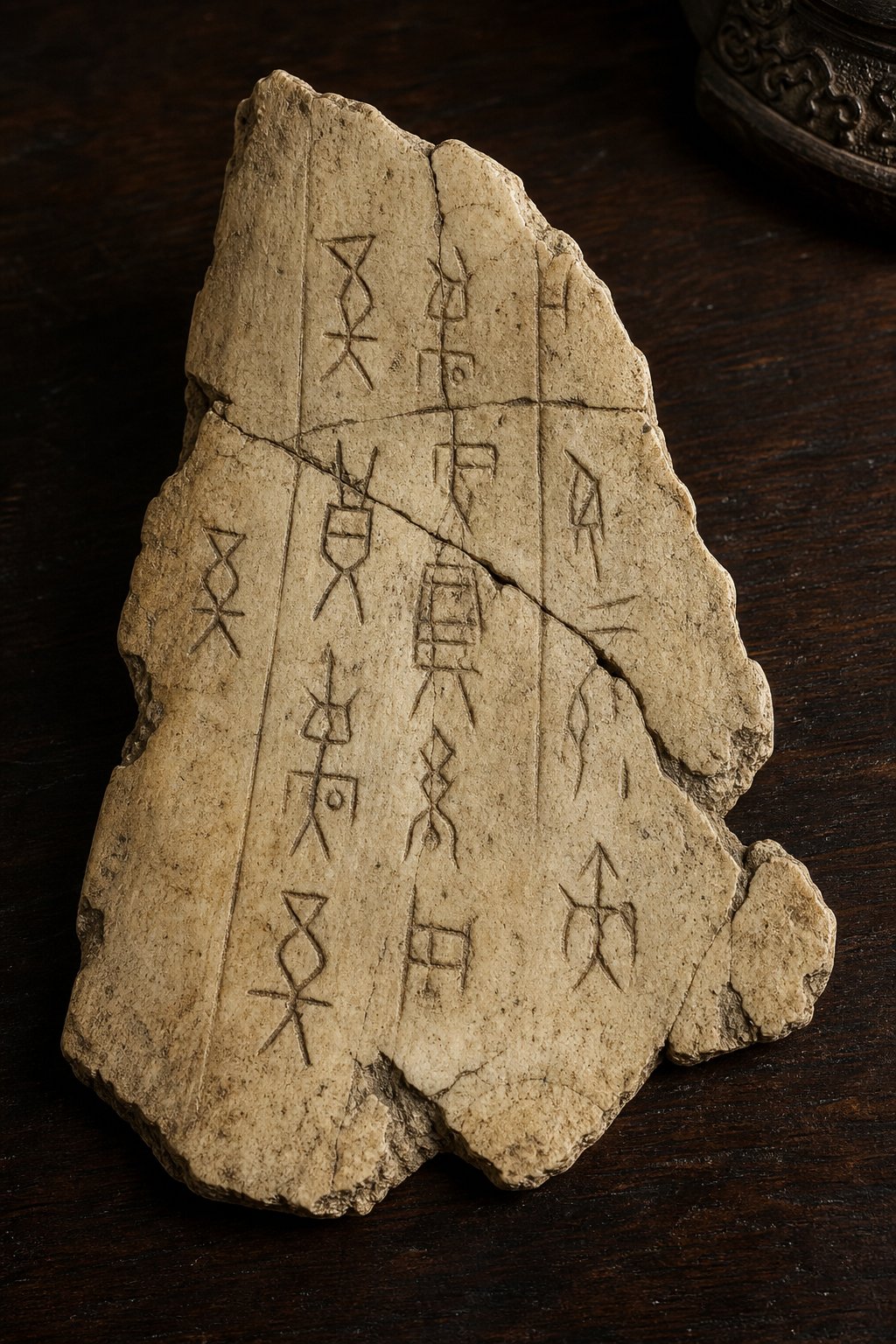
This wasn't a later editorial choice. The nü radical appears in the very oldest written forms of these characters, dating back to the late Shang dynasty (c. 1250-1050 BCE). Scribes carving oracle bone inscriptions (甲骨文, jiaguwen) already wrote these surnames with the female element intact. The concept of surname 中文 scholars study today was already gendered feminine over three thousand years ago.
Paleographic Evidence Across Script Periods
Chinese characters evolved through several major script periods. Oracle Bone Inscriptions (甲骨文) from the late Shang dynasty represent the earliest substantial written records. Bronze Inscriptions (金文, jinwen) followed during the Shang and Zhou dynasties (c. 1600-256 BCE), cast into ritual vessels. Small Seal Script (小篆, xiaozhuan) emerged when the Qin dynasty unified writing in 221 BCE.
Across all three stages, the matrilineal surname characters retained their female radical. The forms grew more stylized, the strokes more regular, but the woman component persisted. This consistency across a thousand years of script evolution tells us the female association wasn't accidental or decorative. It was foundational to what these characters meant.
Here's how several key matriarchal surnames appear across these script periods, revealing the chinese last name meanings embedded in their structure:
| Modern Form | Pinyin | Oracle Bone Form (甲骨文) | Meaning / Origin | Associated Clan |
|---|---|---|---|---|
| 姬 | Ji | 女 + footprint glyph | Born of a woman who stepped in a divine footprint | Yellow Emperor's clan |
| 姜 | Jiang | 女 + sheep/goat glyph | Woman of the Qiang pastoral people | Shennong's clan |
| 姒 | Si | 女 + successor glyph | Female heir or successor | Xia dynasty rulers |
| 嬴 | Ying | 女 + growth/surplus glyph | Woman who brings abundance | Qin royal lineage |
| 姚 | Yao | 女 + kiln/pottery glyph | Woman associated with pottery craft | Sage-king Shun's clan |
You'll notice every single entry carries that same female element, whether scratched into bone or cast into bronze. The chinese surname meanings encoded in these characters survived script reforms, dynastic collapses, and thousands of years of linguistic change. They are, in a real sense, the oldest written evidence we have for matrilineal social organization in East Asia.
Yet characters on shells and vessels only tell part of the story. The clans behind these surnames had names, legends, and mythological founders, eight great lineages that tradition holds as the root of all Chinese family identity.
The Eight Great Surnames of Chinese Antiquity
Eight lineages. Eight characters carrying the woman radical. Together, they form the foundation of virtually every Chinese family name in existence. Known as the 上古八大姓 (shanggu ba da xing), these ancient surnames represent the oldest traceable clan identities in Chinese civilization. Each one connects to a legendary matriarchal ancestor, a mythological origin story, and a vast web of modern descendants.
What makes these old chinese names so remarkable? They aren't just historical curiosities. According to classical genealogical records like the Tongzhi (通志), these eight xing gave rise to 82% of all surnames found in the Hundred Family Surnames. Every Wang, Zhang, Liu, and Chen can theoretically trace their lineage back to one of these ancient roots.
The Eight Great Surnames Explained
The traditional list includes 姬 (Ji), 姜 (Jiang), 姒 (Si), 嬴 (Ying), 妘 (Yun), 媯 (Gui), 姚 (Yao), and 姞 (Ji). Some sources substitute 妊 (Ren) for 姞, but the version with 姞 is more widely cited in modern scholarship. Each character visibly contains the nü radical, reinforcing their origin in matrilineal clan society.
Here's a comprehensive reference showing the chinese surnames and meanings behind each of these ancient surnames:
| Character | Pinyin | Meaning / Origin | Associated Clan | Legendary Ancestor |
|---|---|---|---|---|
| 姬 | Ji | Born at Ji River; divine footprint birth | Zhou royal house | Yellow Emperor (Huangdi); later traced to Houji |
| 姜 | Jiang | Woman of the Qiang people at Jiang River | Shennong's clan | Yan Emperor (Shennong) |
| 姒 | Si | Female successor; born from swallowed yi plant | Xia dynasty rulers | Yu the Great (Dayu) |
| 嬴 | Ying | Abundance; taming of birds and beasts | Qin royal lineage | Boyi (assistant to Emperor Shun) |
| 妘 | Yun | Born at Yun River; fire lineage | Zhurong's descendants | Zhurong (God of Fire) |
| 媯 | Gui | Dwelling by the Gui River | Chen state founders | Emperor Shun |
| 姚 | Yao | Born at Yao Xu (pottery mound) | Shun's birth clan | Emperor Shun |
| 姞 | Ji | Auspicious woman; allied with Ji clan | Huangdi's secondary lineage | Yellow Emperor (Huangdi) |
You'll notice that several of these ancient chinese names trace back to the same mythological figure through different paths. 媯 and 姚 both connect to Emperor Shun: he was born at Yao Xu and later settled by the Gui River. 姬 and 姞 both link to the Yellow Emperor's broader kinship network. This overlap reflects how ancient surnames functioned as markers of shared maternal descent rather than individual identity.
Legendary Matriarchs Behind Each Xing
The origin stories follow a consistent pattern. A woman encounters something miraculous, conceives, and founds a lineage named after the place or circumstance of that birth. Yu the Great's mother reportedly swallowed a yi (薏苡) plant seed and bore him, giving rise to the surname 姒. The Yan Emperor's mother conceived after encountering a divine dragon at Jiang River, producing the 姜 lineage. These narratives center female bodies and female experiences as the origin point of entire civilizations.
Among these royal chinese surnames, some remain in active use today. 姚 and 姜 are still relatively common, with notable modern bearers like Yao Ming (姚明). Others have become rare chinese surnames or vanished entirely as living family names. 妘, for instance, has fewer than a handful of known bearers. 嬴 survives mainly in genealogical records rather than on modern ID cards. These unique chinese surnames exist today as living fossils, carried by small populations who preserve an unbroken link to deep antiquity.
The 姬 surname alone reportedly generated over 411 modern surnames, including Wang (王), Zhou (周), and Wu (吴). 姒 branched into more than 30 ancient chinese last names such as Xia (夏), Zeng (曾), Deng (邓), and Ouyang (欧阳). The fire god Zhurong's 妘 lineage split into eight sub-surnames before further fragmenting into Tao (陶), Bu (卜), and Yun (云) during the Zhou dynasty.
These genealogies are rich and detailed, but they come to us filtered through texts written centuries after the events they describe. The legendary matriarchs may be mythologized, the origin stories embellished. So what does the physical evidence actually show about the societies that used these names? The answer lies buried in the earth of Neolithic village sites along the Yellow and Yangtze rivers.
Archaeological Evidence for Matrilineal Society
Legends are compelling, but soil doesn't lie. The mythological matriarchs behind the Eight Great Surnames belong to a period roughly spanning 5000-2500 BCE. Fortunately, that same window left behind physical settlements, burial grounds, and now even recoverable DNA. These sites offer a ground-level view of how ancient chinese family names may have actually functioned in daily life.
Banpo and Hemudu as Matrilineal Evidence
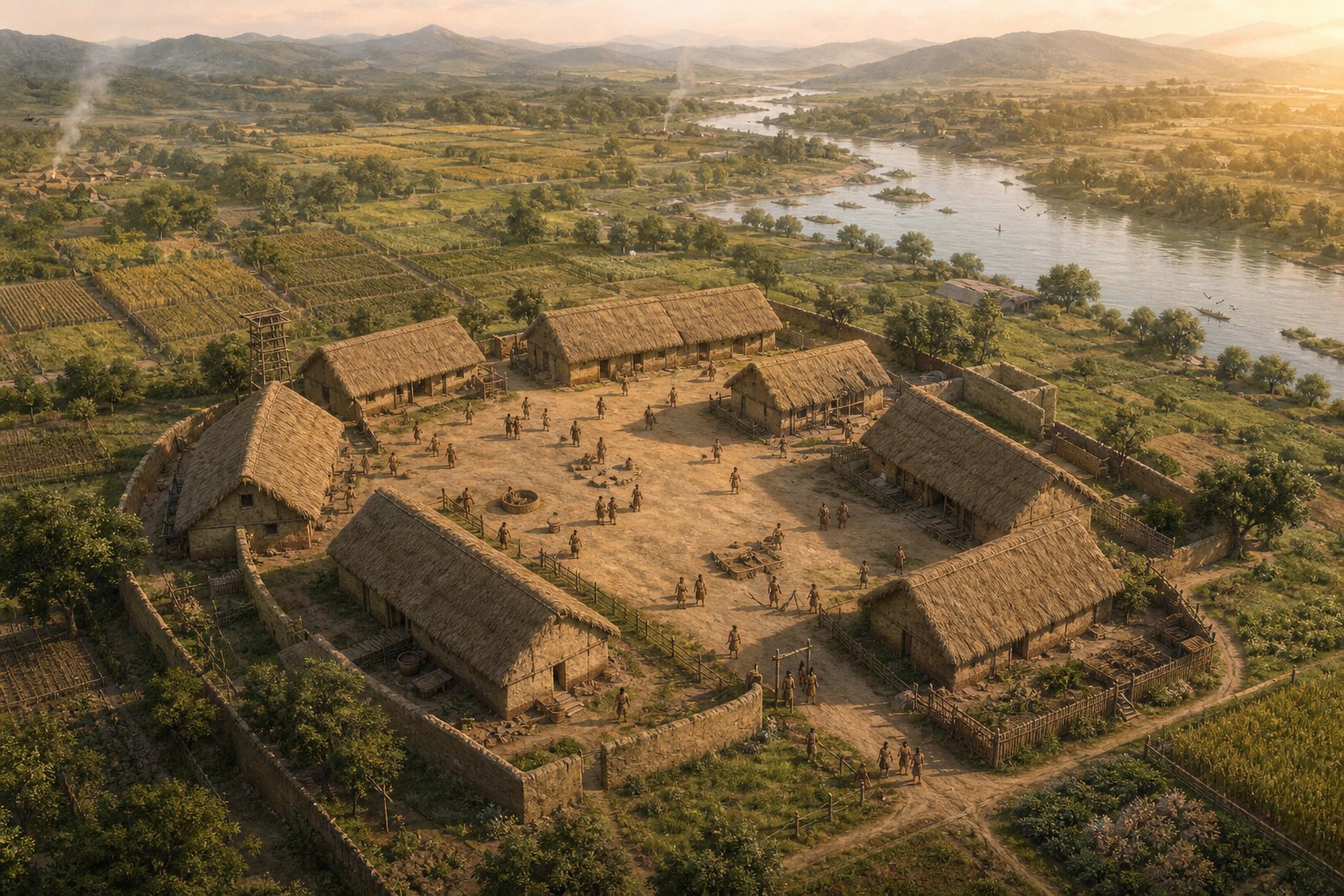
Banpo (半坡), located near modern Xi'an in Shaanxi province, dates to approximately 4500 BCE. Hemudu (河姆渡), in Zhejiang province, is even older at roughly 5000 BCE. Both sites show settlement patterns consistent with matrilineal social organization. At Banpo, communal longhouses clustered around a central plaza, with smaller dwellings radiating outward. Burial analysis reveals that women were interred in central, communal areas while men's graves appeared more dispersed, suggesting that female kin groups formed the residential core of the village.
Hemudu, a rice-cultivating settlement along the Yangtze, shows similar clustering. Dwellings were organized into multi-family longhouses where several generations likely lived together. The layout mirrors ethnographically documented matrilineal societies where women remain in their natal homes and husbands move in from outside the community.
More recently, the Fujia site (富家, Shandong province, c. 2750-2500 BCE) provided the strongest genomic confirmation yet. Researchers from Peking University extracted ancient DNA from 60 individuals buried across two separate cemeteries. Every person in the northern cemetery carried mitochondrial haplogroup M8a3. In the southern cemetery, 44 of 46 individuals shared haplogroup D5b1b. Because mitochondrial DNA passes exclusively from mother to child, this uniformity within each cemetery proves that burial followed maternal descent lines across at least 10 generations.
Here are the key archaeological indicators of matrilineal organization found at these sites:
- Communal longhouses organized around female kin groups, with women buried centrally and men more peripherally
- Burial clustering by maternal lineage rather than by spousal or paternal relationships
- Low mitochondrial DNA diversity within cemetery groups, indicating shared maternal ancestors
- High Y-chromosome diversity, showing that males married into the community from outside
- Isotopic evidence of geographic stability, with little residential mobility among community members
- Endogamous marriage patterns within a small effective population (estimated 200-400 individuals at Fujia)
These findings challenge the long-held assumption that patrilineal organization was universal among Neolithic societies. As the Fujia study published in Nature concluded, the community maintained stable matrilineal structure supported by burial affiliation, genetic patterns, and isotopic homogeneity, resembling modern matrilineal systems with low inequality and minimal wealth accumulation.
How Surname Transmission Worked in Practice
Imagine living in one of these settlements. You're born into your mother's longhouse, surrounded by her sisters, her mother, and their children. Your identity, your clan membership, comes from this maternal line. When you ask where surnames originate from in this context, the answer is straightforward: from the mother's body and the mother's home.
Children inherited their mother's xing automatically. A woman of the 姜 clan bore 姜 children regardless of who the father was. Men carried their mother's xing too, but when they married, they moved to their wife's settlement. Their children would carry their wife's surname, not theirs. This system made biological sense in an era before paternity could be reliably established. Maternity is never in doubt.
The chinese name origin of these ancient family names, then, wasn't a bureaucratic decision. It was an organic reflection of how people actually lived: in female-centered households where the mother's line determined your place in the community, your burial location, and your clan obligations. These chinese clans functioned as both social safety nets and identity markers, binding people across generations through a single maternal thread.
The physical evidence paints a consistent picture across multiple sites spanning thousands of years and hundreds of miles. Yet consistency in the archaeological record doesn't settle every question. Scholars still debate what this matrilineal structure actually meant in terms of power, authority, and political organization, and whether the legendary accounts reflect genuine memory or later ideological construction.
Common Misconceptions and Scholarly Debates
The nü radical is there. The burial patterns confirm maternal clustering. The DNA evidence is compelling. But does any of this prove that women ruled? This is where popular understanding and academic scholarship sharply diverge, and where the chinese name meaning embedded in these ancient characters gets tangled up with modern assumptions about gender and power.
Matrilineal Does Not Mean Matriarchal
These two words sound similar, but they describe fundamentally different things. Confusing them is the single most common mistake people make when exploring how do chinese names work at their deepest historical level.
Matrilineal means descent and identity are traced through the mother's line. Matriarchal means women hold political authority and social dominance. A society can be matrilineal without being matriarchal, just as a society can trace inheritance through women while men still control governance, warfare, and religious authority.
The archaeological evidence from Banpo, Hemudu, and Fujia demonstrates matrilineal descent. Women formed the residential core. Children inherited maternal clan identity. Burial followed the mother's line. But none of this tells us who made decisions, who led rituals, or who resolved disputes. As anthropological research emphasizes, a culture can be both matrilineal and patriarchal simultaneously. Lineage and power are separate axes.
When we look at chinese last names and meanings rooted in the nü radical, we can confidently say they encode female lineage. We cannot confidently say they encode female rule. The term "matriarchal surnames" is convenient shorthand, but scholars prefer "matrilineal surnames" as the more precise descriptor.
The Zhou Dynasty Reconstruction Debate
A deeper question lurks beneath the terminology problem. Did these matrilineal naming systems actually exist as described, or were they partially invented by later historians with their own agenda?
The earliest written accounts of the Eight Great Surnames come from Zhou dynasty texts (c. 1046-256 BCE) and later compilations like Sima Qian's Records of the Grand Historian (c. 94 BCE). The Zhou royal house claimed descent from the 姬 (Ji) xing. Their rivals, the Shang, were linked to different lineages. Some scholars argue that Zhou-era historians retroactively organized messy, overlapping clan identities into a neat eight-surname framework to legitimize Zhou political authority. By positioning 姬 as the most prolific and prestigious of the ancient xing, they elevated their own dynasty's cosmic mandate.
On the other side, defenders of the traditional account point out that the nü radical in these characters predates Zhou propaganda. Oracle bone inscriptions from the Shang dynasty already use these characters with the female component. The linguistic evidence is older than any single dynasty's political needs. The chinese name meaning carried by these radicals wasn't invented by Zhou scribes. It was inherited by them.
The most balanced reading? The matrilineal naming system was likely real and ancient, but the tidy genealogical narratives connecting each surname to a specific legendary figure were shaped, polished, and sometimes fabricated by later writers. The characters preserve genuine memory. The stories around them blend history with myth.
Understanding chinese family names and meanings at this level requires holding both truths simultaneously: the nü radical is authentic evidence of matrilineal descent, and the grand genealogies are partially ideological constructions. Neither fact cancels the other. What remains undeniable is that something fundamental shifted between the matrilineal world these surnames emerged from and the patrilineal system that eventually replaced them. That transition didn't happen overnight, and it didn't happen for a single reason.
The Transition from Matrilineal to Patrilineal Surnames
The shift wasn't a revolution. It was a slow erosion, spanning roughly two thousand years, driven by changes in how people farmed, fought, and passed down wealth. By the time the Shang dynasty consolidated power around 1600 BCE, the matrilineal xing system was already fracturing. By the end of the Zhou dynasty (256 BCE), the chinese last name as we recognize it today had become almost entirely patrilineal. What happened in between?
Why the Shift to Patrilineal Names Happened
No single event flipped the switch. Instead, several reinforcing pressures gradually made paternal descent more socially useful than maternal descent. As Stevan Harrell's comparative research on Chinese family systems explains, patriliny became entrenched because property relations took precedence over practically every other aspect of family organization in emerging state societies. The family became the primary unit for managing and transmitting wealth, and male control of that wealth shaped everything else.
Here are the chronological stages that drove the transition:
- Intensification of agriculture (c. 4000-3000 BCE): As millet and rice farming replaced foraging, land became a fixed asset worth defending and inheriting. Surplus grain created storable wealth for the first time, and communities needed clear rules about who controlled it.
- Rise of warfare and male military organization (c. 3000-2000 BCE): Increasing competition over fertile land and water resources elevated the social importance of male warrior groups. Men who fought together formed bonds of loyalty that paralleled and eventually rivaled maternal kin ties.
- Development of property inheritance through male lines (c. 2000-1600 BCE): As wealth accumulated in the form of land, livestock, and bronze, fathers sought to pass assets directly to sons. Patrilocal residence, where wives moved into the husband's household, became the norm. The chinese family name began following the father rather than the mother.
- Political consolidation under the Shang dynasty (c. 1600-1046 BCE): The Shang state formalized patrilineal succession for royal and noble houses. Oracle bone records show kings tracing ancestry through fathers, not mothers. The last name chinese nobles carried now signaled political allegiance as much as kinship.
- Zhou feudal expansion (c. 1046-771 BCE): The Zhou distributed fiefdoms to patrilineal relatives, creating hundreds of new territorial identities. Each fief generated its own shi (氏), a branch name tied to land grants, official titles, or place of residence.
- Qin-Han unification of xing and shi (221 BCE onward): The Qin dynasty collapsed the old distinction entirely. Every person carried a single surname passed from father to child. The structure of chinese names first last, with surname preceding given name, became standardized across the empire.
From One Xing to Hundreds of Shi
Picture a single river splitting into a delta. That's what happened to each of the eight original xing. As patrilineal branches multiplied, each needed a distinct identifier. A noble granted land at a place called Chen took Chen as his shi. A minister holding the title of Sima adopted Sima. A craftsman working with pottery might become Tao. These shi proliferated into the hundreds, then thousands.
The 姬 (Ji) xing alone reportedly generated over 400 shi. 姜 (Jiang) produced more than 100, including common chinese full names still widespread today like Lu (吕), Xu (许), and Qi (齐). Each new branch carried its own identity while the original matrilineal xing faded into genealogical memory. Among china last names in modern use, the overwhelming majority trace back to these patrilineal shi rather than to the original eight xing.
By the Han dynasty (206 BCE-220 CE), the transformation was complete. Chinese first and last names followed paternal lines exclusively. The nü radical in those ancient characters became a historical curiosity rather than a living social principle. Yet the genetic signatures of those original matrilineal clans didn't vanish. They simply became invisible, buried beneath layers of patrilineal naming. Modern science, however, has found ways to read those buried signals.
Genetic Research Meets Ancient Genealogy
DNA doesn't care about dynastic propaganda. It doesn't embellish origin stories or flatter royal houses. That's precisely why geneticists have turned to Y-chromosome analysis as an independent check on the legendary genealogies linking modern asian surnames back to the Eight Great Xing. The results? Partly validating, partly complicating, and entirely fascinating.
Y-Chromosome Evidence and Ancient Clans
Here's the logic behind this research. Y chromosomes pass from father to son, just like surnames have done in China for the past two thousand years. If a group of men sharing the same surname also share a distinctive Y-chromosome haplogroup, that's strong evidence they descend from a common male ancestor. Researchers can then estimate when that ancestor lived by counting accumulated mutations, essentially building a genetic clock.
Studies mapping haplogroups to surname populations have produced striking correlations. Haplogroup O-M122 and its subclades, particularly branches like O3a1c (now reclassified as O-F11) and O3a2c1a (O-F46), show elevated frequencies among populations bearing surnames traditionally descended from the 姬 (Ji) xing. A 2019 study published in the Journal of Human Genetics demonstrated this approach with the surname Ye (叶). Researchers collected 292 male samples and found that haplogroup O-F492 appeared at 26.71% frequency, far above the background rate. High-throughput sequencing revealed that 67% of Ye-surnamed individuals clustered into three branches descending from a single node, with coalescent ages of roughly 1,775 to 1,925 years ago, matching the historical migration of the Ye clan after the Yongjia Rebellion in the Jin Dynasty.
Similar studies on surnames like Li, Wang, and Zhang have identified dominant haplogroups within each, sometimes confirming traditional genealogical claims and sometimes revealing unexpected diversity. Populations carrying cantonese surnames and taiwanese surnames descended from the same ancient xing often share haplogroup signatures despite centuries of geographic separation, suggesting genuine patrilineal continuity after the matrilineal-to-patrilineal transition.
But here's where it gets complicated. The Y-chromosome tracks paternal descent, the exact opposite of what the original matrilineal xing system encoded. Genetic studies can confirm that men sharing a surname today descend from a common male ancestor who lived, say, 2,500 years ago. They cannot directly confirm the matrilineal connections that existed before patrilineal naming took over. The genetic clock starts ticking from the moment surnames became patrilineal. Everything before that transition remains largely invisible to Y-chromosome analysis.
Other limitations compound this gap. Surname adoption, where unrelated families took the same name for political or social reasons, introduces genetic noise. Non-paternity events across thousands of years dilute the signal further. And migration patterns mean that people bearing the same surname in different regions may share no recent genetic ancestor at all. The Ye surname study found multiple distinct haplogroups among its sample, indicating that not all modern Ye-surnamed individuals descend from the same patriline, let alone the same ancient matrilineal clan.
Cross-Cultural Parallels in Matrilineal Naming
China's matrilineal naming system wasn't unique. Placing it alongside other documented matrilineal societies reveals shared structural patterns that strengthen the case for its historicity. Among asian names and surnames more broadly, the Minangkabau of West Sumatra maintain matrilineal clan names to this day, with property and family identity passing through the mother. The Khasi people of northeastern India use maternal surnames and practice matrilocal residence, a system strikingly similar to what Neolithic Chinese sites suggest.
Beyond Asia, the Iroquois Confederacy organized political authority through matrilineal clans, with clan mothers holding the power to appoint and remove chiefs. The Akan people of Ghana trace clan membership through the mother, and their naming system reflects this maternal orientation. These parallels matter because they demonstrate that matrilineal naming isn't a theoretical abstraction. It's a well-documented social technology that multiple human societies independently developed.
What distinguishes the Chinese case among surnames in asia and globally is the sheer scale of its documentary record. Few other matrilineal systems left behind written characters that physically encode female descent into their structure. The nü radical is a kind of evidence that the Minangkabau and Khasi systems, however well-preserved in practice, simply don't have. It bridges the gap between living ethnographic parallels and deep archaeological time.
Genetics, archaeology, linguistics, and cross-cultural comparison each illuminate a different facet of these ancient asian family names. None alone tells the complete story. Together, they build a case that the matrilineal xing system was real, widespread, and foundational. The question that remains for millions of people today is more personal: which of those eight ancient matrilineal clans does your own surname descend from?
The Living Legacy in Modern Chinese Surnames
That question isn't rhetorical. With the right mapping, you can actually answer it. The eight ancient matrilineal xing didn't disappear. They fragmented, branched, and multiplied into the thousands of surnames carried by over a billion people today. Many of the most common chinese last names, the ones you encounter daily, trace directly back to one of those nü-radical ancestors.
Modern Surnames Descended from Ancient Matriarchal Xing
The scale of this branching is staggering. The 姬 (Ji) xing alone generated 411 documented surnames, accounting for 82% of the 504 entries in the classical Hundred Family Surnames (百家姓). That single matrilineal clan produced what is arguably the most common chinese last name in the world: Wang (王), carried by over 100 million people. It also gave rise to Zhou (周), Wu (吴), Zheng (郑), Wei (魏), Yang (杨), and Cao (曹), among hundreds of others. The reference material describes Ji as the "Ancestor of Myriad Surnames," and the numbers back that claim.
The other seven xing followed the same pattern on a smaller but still impressive scale. Here's a practical reference mapping each ancient matrilineal surname to its major modern descendants:
| Ancient Xing | Pinyin | Major Modern Surnames | Estimated Modern Descendants |
|---|---|---|---|
| 姬 | Ji | Wang (王), Zhou (周), Wu (吴), Zheng (郑) | 411+ surnames |
| 姜 | Jiang | Lu (吕), Xu (许), Qi (齐), Gao (高) | 100+ surnames |
| 姒 | Si | Xia (夏), Zeng (曾), Bao (鲍), Ouyang (欧阳) | 30+ surnames |
| 嬴 | Ying | Zhao (赵), Qin (秦), Xu (徐), Lian (廉) | 40+ surnames |
| 妘 | Yun | Yun (云), Tao (陶), Bu (卜), Cao (漕) | 10+ surnames |
| 媯 | Gui | Chen (陈), Tian (田), Yuan (袁), Sun (孙) | 30+ surnames |
| 姚 | Yao | Yao (姚), Lu (陆), Hu (胡), Wang (汪) | 20+ surnames |
| 姞 | Ji | Yan (燕), Mi (密), Que (阙), Guang (光) | 10+ surnames |
Scan any list of chinese surnames and you'll find that the most common chinese surnames, the ones topping population rankings decade after decade, cluster heavily under 姬 and 姜. Wang, Li, Zhang, Liu, Chen: between them, these popular chinese last names cover nearly a third of China's population, and each traces back to one of the eight xing through documented genealogical chains.
Tracing Your Roots to a Matriarchal Clan
For Chinese diaspora communities, this mapping offers something beyond academic interest. It provides a bridge across the gap that emigration, war, and cultural disruption created. Many overseas Chinese families lost their genealogical records (族谱, zupu) during the upheavals of the 19th and 20th centuries. Knowing which ancient xing your surname descends from gives you a starting point, a clan identity that predates any single dynasty or political boundary.
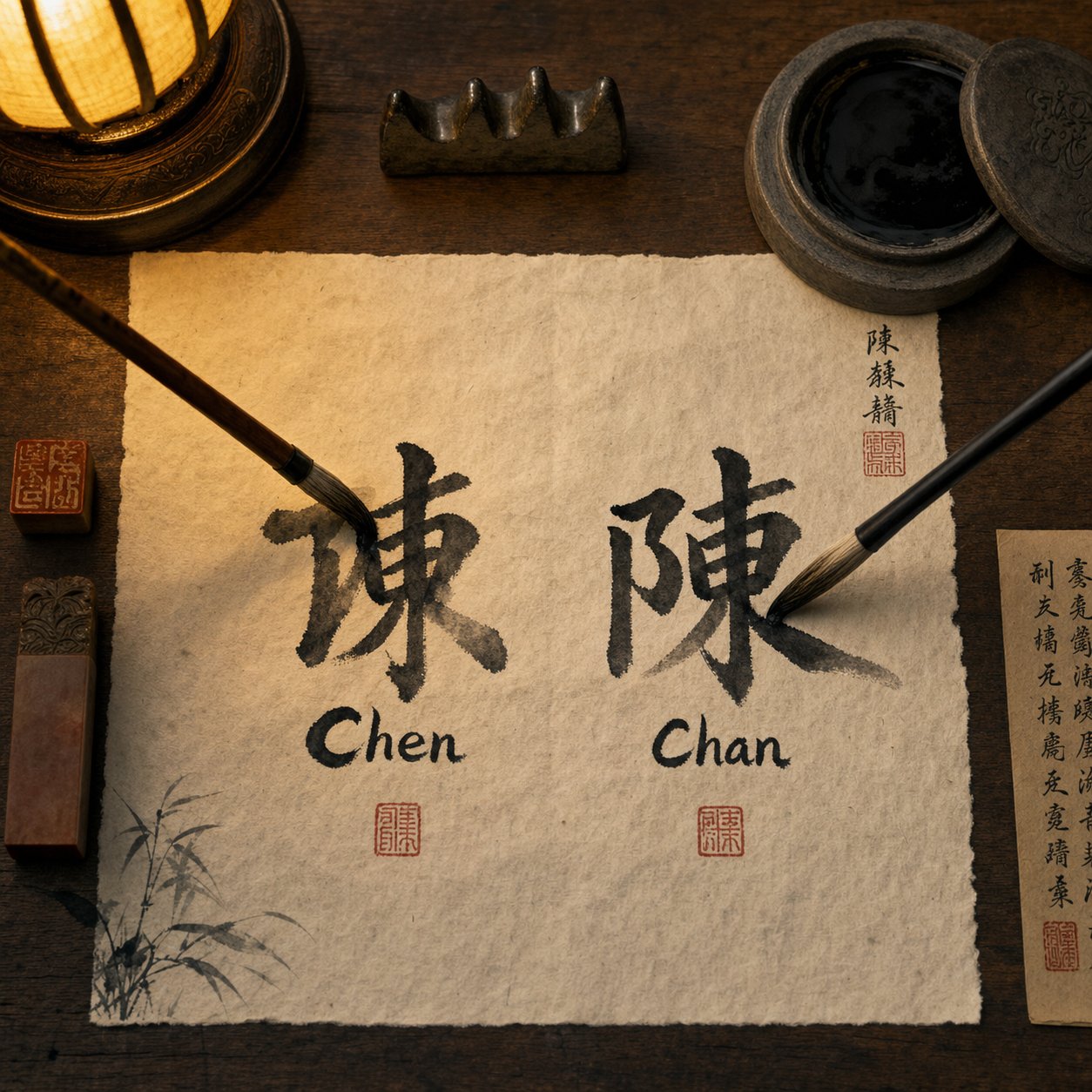
If your surname is Zhou, you belong to the 姬 lineage. If it's Chen, you trace to 媯. If it's Zhao, your roots lie in 嬴. This isn't speculation. These connections are documented in classical genealogical texts like the Yuanhe Xing Zuan (元和姓纂) and confirmed by the branching patterns recorded in the Zuo Zhuan and Records of the Grand Historian.
A comprehensive chinese surnames list organized by ancestral xing becomes a practical tool for genealogical research. Rather than searching blindly through thousands of years of records, you can narrow your focus to the specific matrilineal clan your family branched from, then trace the shi that emerged from it, the fief or title that became your modern surname, and the migration patterns that brought your ancestors to their current location.
The nü radical in those eight ancient characters isn't just a linguistic curiosity. It's a key. It unlocks a layer of identity that most people carrying common chinese surnames never knew they had: a connection to a matrilineal world where your mother's clan was your first and most fundamental name. Every Wang, every Chen, every Zhou alive today carries that inheritance silently in the history of their surname, a five-thousand-year thread running from Neolithic longhouses to modern birth certificates.
Frequently Asked Questions About Ancient Chinese Matriarchal Surnames
1. Why do ancient Chinese surnames contain the woman (nü) radical?
The nü (女) radical in ancient Chinese surnames like 姬, 姜, and 姚 serves as a semantic marker indicating female descent. In Chinese character construction, radicals signal meaning categories. The consistent presence of the woman radical in the oldest surname characters, confirmed in oracle bone inscriptions dating to the late Shang dynasty (c. 1250-1050 BCE), shows these names originated during a matrilineal period when clan identity passed through the mother's line. The character 姓 (xing, meaning surname) itself combines 女 (woman) with 生 (birth), literally translating to 'born of a woman.'
2. What are the Eight Great Surnames of Chinese Antiquity?
The Eight Great Surnames (上古八大姓) are 姬 (Ji), 姜 (Jiang), 姒 (Si), 嬴 (Ying), 妘 (Yun), 媯 (Gui), 姚 (Yao), and 姞 (Ji). Each contains the nü radical and traces back to a legendary matriarchal ancestor. These eight xing are considered the root of virtually all modern Chinese surnames. The 姬 surname alone reportedly generated over 411 modern surnames including Wang, Zhou, and Wu, while 姜 produced over 100 including Lu, Xu, and Qi.
3. What is the difference between xing and shi in Chinese naming?
Xing (姓) was the original matrilineal clan identifier, connecting individuals to a shared female ancestor. Marriage between people sharing the same xing was forbidden because it indicated shared blood. Shi (氏) emerged later as a patrilineal branch name that distinguished sub-groups within a larger xing based on territory, occupation, or noble title. During the Qin and Han dynasties (221 BCE onward), xing and shi merged into the single-surname system used today, with surnames passing exclusively through the father's line.
4. Is there archaeological evidence for matrilineal society in ancient China?
Yes. Multiple Neolithic sites provide physical evidence. Banpo (c. 4500 BCE) near Xi'an shows communal longhouses organized around female kin groups with women buried centrally. The Fujia site in Shandong (c. 2750-2500 BCE) provided genomic confirmation: ancient DNA from 60 individuals showed uniform mitochondrial haplogroups within each cemetery group, proving burial followed maternal descent lines across at least 10 generations. High Y-chromosome diversity at these sites indicates males married into communities from outside, consistent with matrilineal residence patterns.
5. How can I trace my Chinese surname back to an ancient matriarchal clan?
Classical genealogical texts like the Yuanhe Xing Zuan and Records of the Grand Historian document which modern surnames branched from each of the eight ancient xing. For example, if your surname is Wang, Zhou, or Wu, you trace to the 姬 lineage. Chen, Tian, or Yuan connect to 媯. Zhao, Qin, or Xu link to 嬴. These connections are well-documented through the shi branching system that occurred during the Zhou dynasty when patrilineal clans split from the original matrilineal xing based on fiefdoms, titles, or geographic locations.