Understanding Chinese Name Structure Before You Begin
Imagine filling out a visa application and realizing you're unsure whether your surname goes first or last. Or picture receiving a business card from a Chinese colleague and not knowing which part of their name to use in conversation. These situations happen constantly, and getting it wrong can cause real problems on legal documents, academic records, and professional profiles.
Chinese names follow a structure that's essentially the reverse of Western naming conventions. The surname comes first, the given name follows, and the entire name is typically just two or three characters. There's no middle name in the Western sense, no suffix, and no separation by spaces in the original script. When you try to write a Chinese name in English, you're not simply spelling out letters. You're translating an entirely different naming logic into a system built for a different language.
Why Chinese-to-English Name Conversion Is Tricky
Unlike alphabetic languages, Chinese characters don't have a direct letter-by-letter equivalent. Chinese names written in English rely on romanization, a system that assigns Latin letters to represent the sounds of each character. The challenge? Multiple romanization systems exist, regional dialects produce different spellings, and the name order question adds another layer of confusion. Among asian names, Chinese names are particularly prone to formatting errors because of these overlapping variables.
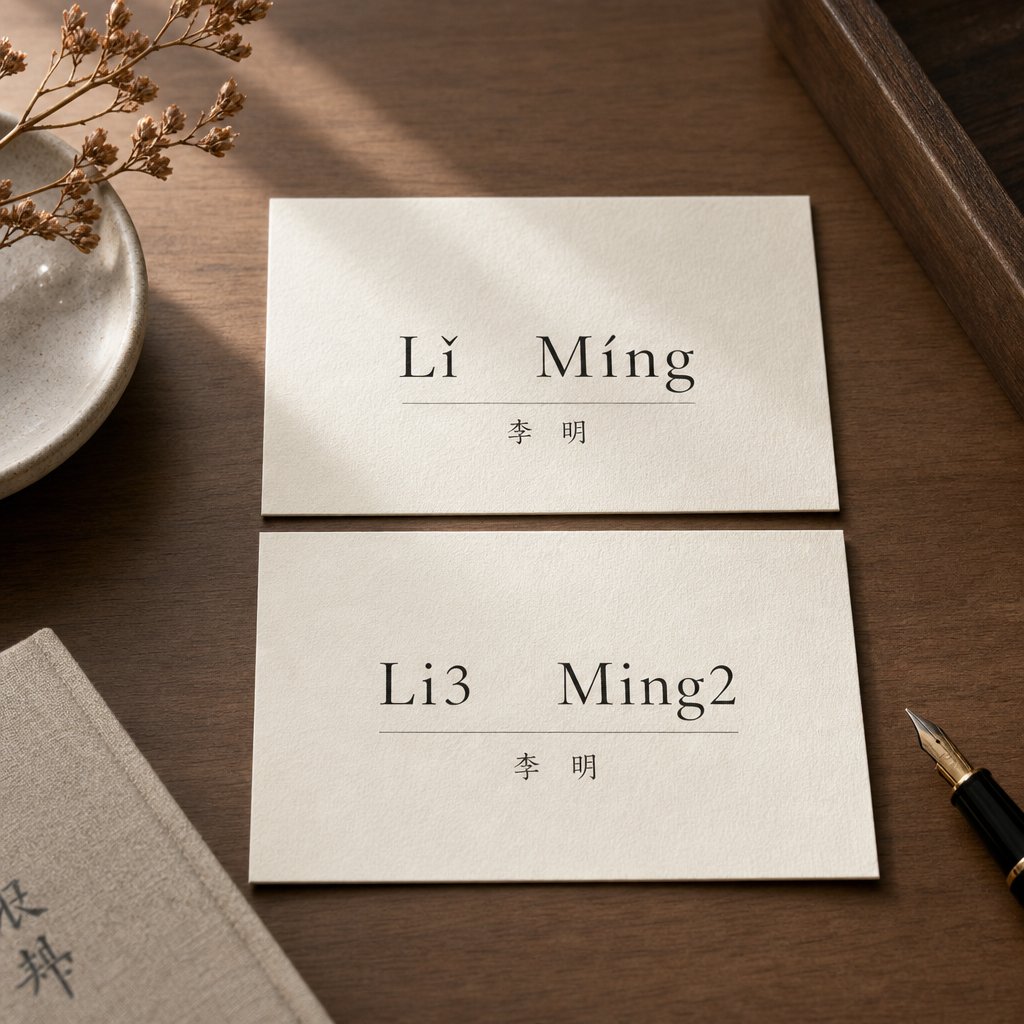
A Chinese name is not simply spelled out letter by letter. It is romanized through a specific system that converts sounds into Latin script.
Who This Guide Is For
This guide serves two audiences. If you're a Chinese speaker figuring out how to present your own name abroad, you'll find clear formatting rules for every context from passports to LinkedIn. If you're an English speaker trying to correctly address a colleague or cite an author, you'll learn how to identify surname versus given name and avoid common missteps with asian names. Either way, the goal is the same: accuracy without erasing identity.
The process breaks down into clear, manageable steps, starting with the most fundamental one: knowing exactly which part of the name is which.
Step 1 - Identify the Surname and Given Name Components
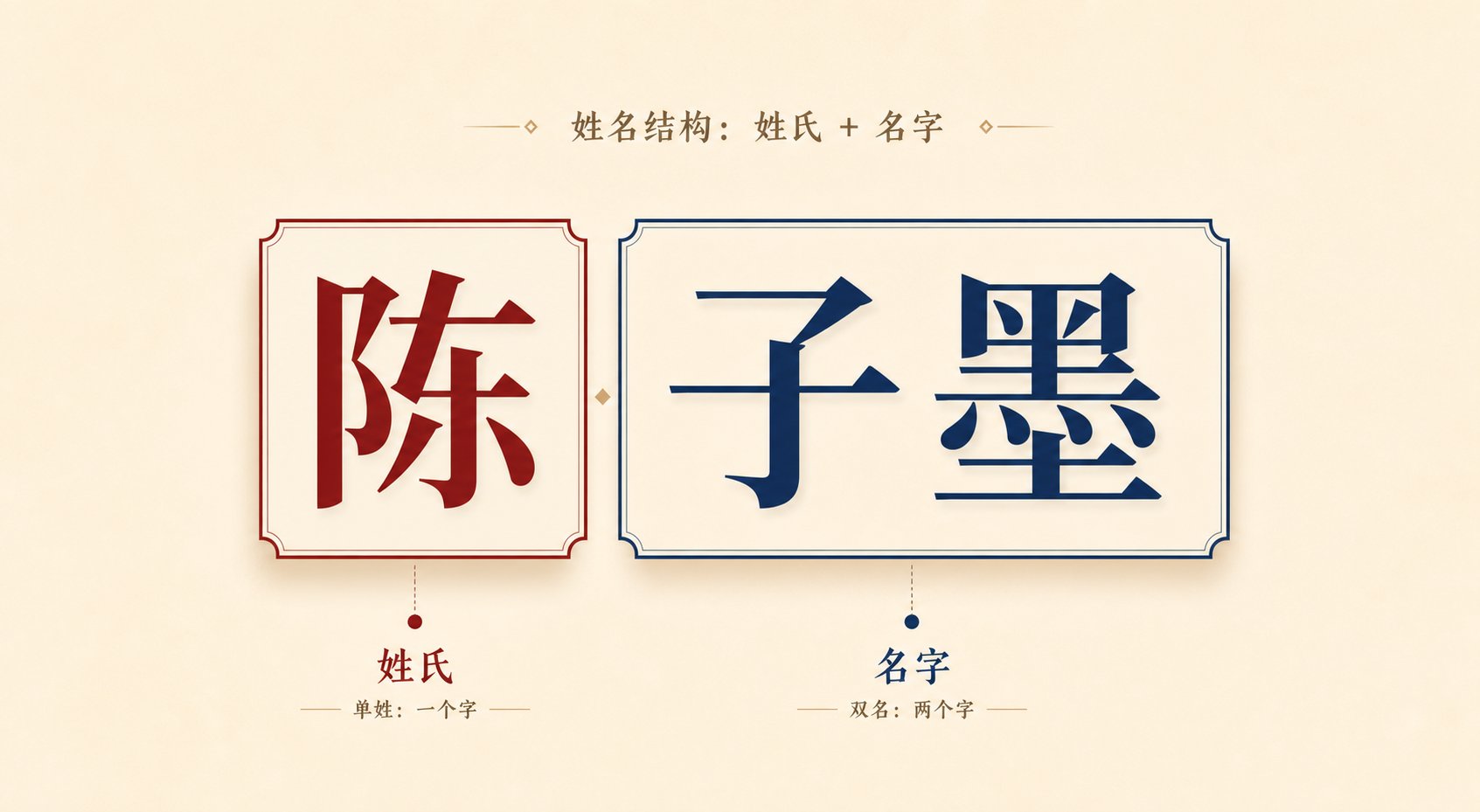
Every Chinese name carries a built-in structure, and recognizing it is the foundation for writing it correctly in English. The chinese for name breaks into two distinct parts: the surname (姓, xìng) and the given name (名, míng). The surname always comes first in the original Chinese, and it's almost always a single character. The given name follows and can be one or two characters long. That's it. No middle name, no generational suffix in the Western sense.
Surname vs Given Name Breakdown
Think of a Chinese name like a two-part code. The first part identifies the family, and the second part identifies the individual. Take the name 王小明 as an example. The first character, 王 (Wáng), is the surname. The remaining two characters, 小明 (Xiǎomíng), form the given name. Together, the full name is only three characters long, yet it contains all the information a Western full name would carry.
Here's what makes this tricky for English speakers: the pool of Chinese surnames is remarkably small. The top 100 surnames account for roughly 85% of China's population of over 1.4 billion people. The top three alone, Wang, Li, and Zhang, are each shared by around 100 million people. So when you encounter a name in characters, the surname is almost certainly one of a limited set of familiar single-character family names.
Given names, on the other hand, are nearly limitless. Parents choose characters based on meaning, sound, generational tradition, or personal hopes for the child. Among chinese names male, you'll often see characters like 强 (Qiáng, meaning strong) or 伟 (Wěi, meaning great). Popular female chinese names frequently include characters like 美 (Měi, meaning beautiful) or 慧 (Huì, meaning wise). Some china female names draw from nature, using characters for flowers, jade, or moonlight, while mandarin names female from recent generations often reflect modern aspirations like independence or happiness.
One-Character and Two-Character Given Names
Given names come in two varieties. A two-character given name like 小明 (Xiǎomíng) is the most common structure, producing a three-character full name. A one-character given name like 磊 (Lěi) creates a two-character full name, such as 王磊 (Wáng Lěi). Both formats are perfectly standard.
Why does this matter for romanization? Because if you see a three-syllable Chinese name written in English, like Wang Xiaoming, you can reliably assume the single syllable is the surname and the two-syllable portion is the given name. A two-syllable name like Wang Lei means each syllable represents one character: surname plus a single-character given name. Recognizing this pattern prevents the common mistake of splitting a two-character given name into what looks like a first name and a middle name.
The table below shows how several names break down, illustrating both one-character and two-character given names along with chinese given names male and female examples:
| Full Chinese Name | Surname (Character) | Given Name (Characters) | Romanized Form |
|---|---|---|---|
| 王小明 | 王 | 小明 | Wang Xiaoming |
| 李娜 | 李 | 娜 | Li Na |
| 张伟 | 张 | 伟 | Zhang Wei |
| 陈美玲 | 陈 | 美玲 | Chen Meiling |
Notice how each name in characters follows the same logic: surname first, given name second. Whether the given name is one character or two, the surname holds its position at the front. This is the essential first step. Before you choose a romanization system, before you decide on name order or formatting, you need to correctly identify which part is the family name and which part belongs to the individual.
Getting this wrong has real consequences. Misidentifying the surname can lead to filing errors on legal documents, incorrect citations in academic papers, or the simple social awkwardness of calling someone by their family name as if it were their first name. The structure itself is consistent and predictable, so once you internalize the pattern, the next challenge becomes converting those characters into their correct English spelling.
Step 2 - Choose the Right Romanization System
The same mandarin characters can produce completely different English spellings depending on which romanization system you use. The surname 张 becomes Zhang in one system, Chang in another, and Cheung in a third. So before you convert chinese names to english, you need to pick the right system, or you'll end up with a spelling that doesn't match the person's region, background, or official documents.
Pinyin as the Modern Standard
Hanyu Pinyin is the romanization system developed by the People's Republic of China in the 1950s and adopted as an international ISO standard (ISO 7098) in 1982. It's what most people mean when they talk about converting chinese names into english today. If you've ever used a mandarin chinese translator or typed Chinese on a phone keyboard, you've already encountered Pinyin.
The Chinese government standard GB/T 28039-2011 formalizes how Pinyin should be applied to personal names: surname comes first, both surname and given name are capitalized, and a two-character given name is written as a single word without spaces or hyphens. For example, 王小明 becomes Wang Xiaoming, not Wang Xiao Ming or Wang Xiao-Ming.
Pinyin is the default choice for any modern chinese name english translation unless the person already uses an established spelling from a different system. It's what appears on Mainland Chinese passports, academic publications, and international correspondence.
Comparing Romanization Systems Side by Side
Pinyin isn't the only game in town. Several other systems exist, each tied to a specific region or historical period. The differences aren't subtle. Look at how three common surnames appear across systems:
| System | Region Used | 张 (Zhāng) | 陈 (Chén) | 李 (Lǐ) |
|---|---|---|---|---|
| Hanyu Pinyin | Mainland China (standard) | Zhang | Chen | Li |
| Wade-Giles | Taiwan, older texts | Chang | Ch'en | Li |
| Cantonese (Jyutping/Yale) | Hong Kong, Macau | Cheung | Chan | Lei |
| Hokkien dialect | Singapore, Malaysia | Teo / Chong | Tan | Lee |
Notice how 陈 alone produces four distinct English spellings: Chen, Ch'en, Chan, and Tan. Each is correct within its own context. Someone searching for an english to chinese converter might assume there's one "right" answer, but the reality is that chinese symbols and meanings map to different sounds depending on dialect and region. The spelling reflects pronunciation, and pronunciation varies.
When to Use Which System
Choosing the right system comes down to a few practical questions:
- Mainland China origin: Use Hanyu Pinyin. It's the official standard and what appears on PRC-issued documents.
- Taiwan: Check the person's existing romanization. Many Taiwanese names use Wade-Giles or Tongyong Pinyin, and individuals often have a preferred spelling that may not follow any single system consistently.
- Hong Kong or Macau: Expect Cantonese-based romanization. Names like Chan, Wong, and Cheung are standard here and should not be "corrected" to Pinyin.
- Singapore or Malaysia: Dialect-based spellings dominate. Hokkien, Teochew, and Cantonese each produce different results, and families often retain spellings established generations ago.
The golden rule? If the person already has a romanized spelling they use on official documents or professionally, respect that spelling regardless of which system it follows. Romanization systems are tools for converting chinese names to english, not rigid rules that override personal choice. A name like "Lee" doesn't need to be corrected to "Li" just because Pinyin says so, especially if the person's passport, publications, and business cards all say Lee.
With the romanization system selected, the next decision shapes how others read and interpret the name: which part comes first when you actually write it down.
Step 3 - Decide on the Correct Name Order
You've identified the surname and given name, picked a romanization system, and now you're staring at a form asking for your full name in chinese characters converted to English. Which part goes first? This single decision determines whether people call you by your family name or your personal name for years to come.
Three conventions exist, and each one is valid depending on the situation. The key is knowing which format fits which context, and then sticking with it consistently within that domain.
Surname-First vs Given-Name-First Conventions
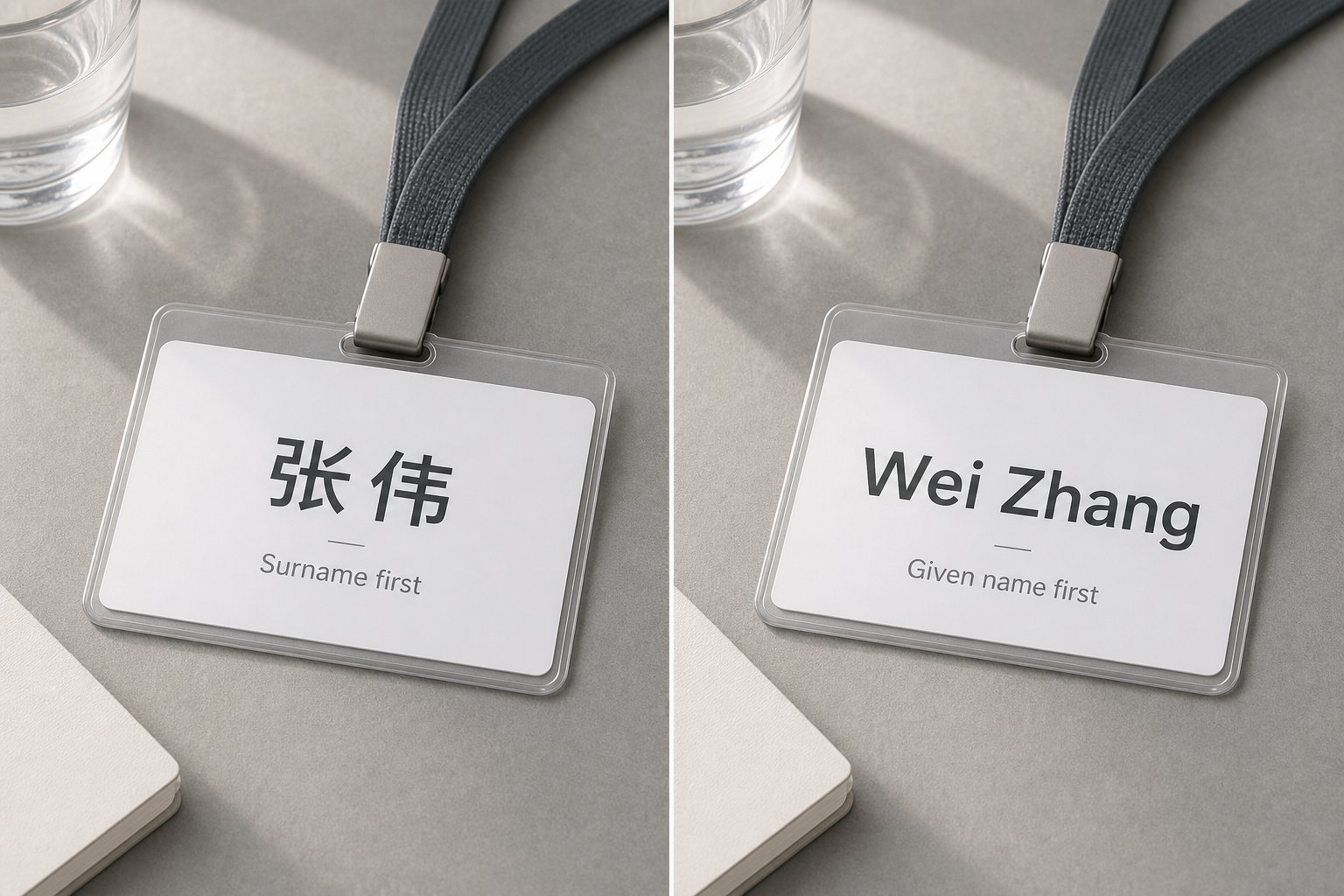
Here are the three standard approaches for ordering a chinese name and english name on documents and profiles:
1. Chinese order, surname first: Wang Xiaoming. This preserves the original structure and is the format used on PRC passports and in most Chinese-language academic publishing. It's also the format recommended by the Chinese national standard GB/T 28039-2011.
2. Western order, given name first: Xiaoming Wang. This follows English naming conventions and is what most Western databases, HR systems, and social platforms expect. Many Chinese professionals living abroad adopt this order for daily use.
3. Comma notation: Wang, Xiaoming. The comma signals that the surname has been placed first deliberately. This format appears in library catalogs, academic citation systems, and formal directories where alphabetical sorting by surname is standard.
Which one should you use? That depends entirely on context. A person writing china names in english might use all three formats across different parts of their life, and that's completely normal. You'll notice the same researcher listed as "WANG Xiaoming" in a journal, "Xiaoming Wang" on LinkedIn, and "Wang, Xiaoming" in a bibliography. None of these are wrong. They're simply different conventions for different audiences.
How to Signal Which Name Is the Surname
The biggest source of confusion with a chinese name with english name formatting is ambiguity. When someone reads "Wang Xiaoming," how do they know Wang is the surname and not the given name? One widely adopted solution is capitalizing the entire surname: WANG Xiaoming. This convention appears in international academic publishing, EU official documents, and many conference name badges.
Here's when each format tends to be preferred:
- Passport applications (PRC): Surname first, all caps for surname field. The given name appears as one continuous word (e.g., Surname: WANG, Given name: XIAOMING).
- Academic papers and journal submissions: WANG Xiaoming or Wang, Xiaoming, depending on the citation style. APA uses the comma-inverted format in reference lists.
- Business cards: Surname in all caps (WANG Xiaoming) is common among Chinese professionals working internationally, as the Asia Media Centre notes this practice prevents confusion over which name is the family name.
- Email signatures and LinkedIn: Western order (Xiaoming Wang) is typical for professionals in English-speaking environments, since platforms auto-sort by last name field.
- Social media profiles: Personal preference dominates. Some people use Chinese order, others Western order, and some include their Chinese characters alongside the romanized form.
The important takeaway? There's no single "correct" order for every situation. What matters is that readers can identify which part is the surname. Using all caps, comma notation, or simply being consistent within a given platform all accomplish this goal. If you're writing your own full name in chinese-to-english format, pick the convention that matches your context and use it every time within that space.
Of course, name order is only half the formatting puzzle. The way you handle capitalization, spacing, and hyphenation within the name itself introduces another set of choices that directly affect readability and official recognition.
Step 4 - Apply Capitalization Spacing and Hyphenation Rules
You've settled on a romanization system and a name order. But how do you actually spell name in chinese-to-english format when it comes to the fine details? Should the given name be one word or two? Hyphenated or not? All caps or just the first letter? These small formatting choices determine whether your name looks polished on a resume or triggers confusion in a government database.
Capitalization Rules for Romanized Names
The core rule for chinese name writing is straightforward: capitalize the first letter of the surname and the first letter of the given name. Everything else stays lowercase. According to Taiwan's Guidelines for Transliteration of Chinese, "only initials of the names are capitalized; the rest of the letters are all lower-cased." The Mainland Chinese standard GB/T 28039-2011 follows the same principle.
So 王小明 becomes Wang Xiaoming. Not wang xiaoming, not WANG XIAOMING (unless you're deliberately using all-caps for the surname to signal which part is the family name, as discussed in the previous step). The capitalization pattern mirrors how English names work: first letter up, rest down.
To Hyphenate or Not to Hyphenate
This is where writing chinese names gets contentious. When a given name has two characters, like 小明 (Xiǎomíng), you have three options:
- One word, no hyphen: Xiaoming (Pinyin standard)
- Hyphenated: Xiao-Ming (common in Taiwan and older documents)
- Two separate words: Xiao Ming (informal, but causes problems)
The official Pinyin standard is clear: two-character given names are written as a single word without a hyphen. Wang Xiaoming, not Wang Xiao-Ming or Wang Xiao Ming. The logic is that the two characters together form one given name, not two separate names.
However, many people add a hyphen for readability, especially in Taiwan where the transliteration guidelines show examples like "Chen Zhi-ming" for postal addresses. The hyphen helps English readers see where one syllable ends and the next begins. It's a practical compromise, not technically standard under Pinyin rules but widely accepted.
The format to avoid? Writing the two syllables as completely separate words. "Wang Xiao Ming" looks like a person with a middle name, which invites systems to treat "Xiao" as a first name and "Ming" as a middle name. This splitting error is one of the most common problems people encounter when asking how do you write name in chinese-to-english format correctly.
Spacing Conventions That Avoid Confusion
Between the surname and given name, a single space is all you need. No comma (unless you're using the inverted citation format), no extra punctuation. The table below shows how the same name appears under different formatting conventions, so you can match your context:
| Format | Example | When Used | Standard Compliance |
|---|---|---|---|
| Pinyin standard | Li Xiaoming | General use, Mainland China documents | Fully compliant (GB/T 28039-2011) |
| Surname in all caps | LI Xiaoming | Academic publishing, international conferences | Compliant with added clarity |
| Comma-inverted | LI, Xiaoming | Library catalogs, citation reference lists | Compliant (bibliographic convention) |
| Hyphenated given name | Xiao-Ming Li | Taiwan, some Western-order contexts | Non-standard Pinyin, but widely accepted |
| Western order, no hyphen | Xiaoming Li | English-speaking professional environments | Compliant (order preference only) |
| Surname last, all caps | Xiaoming LI | EU documents, French academic convention | Compliant with regional practice |
Notice that every acceptable format keeps the two-syllable given name together as one unit, whether hyphenated or not. The spacing rule is simple: one space separates surname from given name, and nothing splits the given name into isolated parts.
When someone asks "my name is in chinese characters, how do I write it in English?" the answer combines everything covered so far: identify surname and given name, romanize using the appropriate system, choose your name order for the context, then apply these capitalization and spacing rules consistently. The formatting details might seem minor, but they're what prevent your name from being mangled by airline booking systems, university registrars, and HR databases that parse names into rigid first/middle/last fields.
Consistency across a single context matters more than picking the "perfect" format. But some contexts have non-negotiable requirements, particularly legal documents and academic publishing, where specific formatting rules are dictated by the institution rather than personal preference.
Step 5 - Format Your Name for Professional and Legal Contexts
A single person can have their name appear in four or five different formats across their professional and legal life, and every one of those formats can be correct. The difference lies in context. A passport doesn't follow the same rules as a journal citation, and a LinkedIn profile doesn't need to match a university transcript. What matters is using the right format for each domain and keeping it consistent within that space.
So how do you write your name in chinese-to-english format for specific real-world situations? Here's a breakdown by context.
Academic Publishing and Citation Formats
Academic journals each follow their own citation style, and each style has specific rules for how Chinese author names appear in reference lists. If you're publishing research or being cited by others, the format isn't up to personal preference. It's dictated by the style guide.
- APA style: Uses surname followed by a comma and initials. Wang Xiaoming becomes Wang, X. In the reference list, the format mirrors Western author names: surname first, then initials of the given name. Yale University Library's citation guide for East Asian sources shows examples like "Hao, C. (1998)" for a Chinese author, following this exact pattern.
- Chicago style: Lists the full romanized name in bibliography entries, typically surname first with a comma: Wang, Xiaoming. In footnotes, the name appears in natural order: Xiaoming Wang.
- MLA style: Similar to Chicago for the Works Cited page: Wang, Xiaoming. The given name is spelled out in full rather than reduced to initials.
The critical point for academics: once your english name from chinese name appears in a published citation, that spelling follows you through every database, index, and future reference. Changing it later fragments your publication record and makes your work harder to find.
Passports and Legal Documents
Passports issued by the People's Republic of China follow a rigid format. The surname field contains the family name in all capital letters, and the given name field contains the full given name as one continuous word, also capitalized. No hyphens, no spaces within the given name.
- PRC passport format: Surname: WANG | Given name: XIAOMING
- Taiwan passport format: May use hyphenated given names (e.g., HSIAO-MING) and Wade-Giles or other romanization systems
- Hong Kong passport format: Cantonese romanization with the given name often hyphenated (e.g., SIU-MING)
- Visa and immigration forms: Must match the passport spelling exactly, character for character
This is where how can i write my name in chinese-to-english format stops being a style question and becomes a legal one. Once a romanized spelling appears on your passport, every subsequent document, your visa applications, bank accounts, university enrollment, and employment records, needs to match. A mismatch between your passport name and your airline ticket can get you denied boarding. A mismatch between your transcript and your diploma can delay credential verification.
If you haven't yet applied for your first passport or are renewing, that's your one opportunity to lock in the romanization you want to carry forward.
Business Cards and Professional Profiles
Professional contexts offer more flexibility than legal documents, but consistency still matters within each platform.
- Business cards: Many professionals use the SURNAME Given-name format (WANG Xiaoming) on one side and include Chinese characters on the reverse. This eliminates ambiguity for international contacts.
- LinkedIn and email signatures: Western order (Xiaoming Wang) works best because these platforms auto-sort by the last-name field. If you use Chinese order, the system may file you under "X" instead of "W."
- University enrollment forms: Follow whatever format your passport uses. Admissions offices cross-reference your application against your travel document, so your chinese name from english name conversion needs to be identical across both.
- Corporate HR systems: Enter your name exactly as it appears on your work authorization documents. Some systems allow a "preferred name" field for daily use, which is where you can add an English first name or alternate formatting.
The underlying principle across all these contexts is simple: match the domain's expectations, then don't deviate within that domain. Your journal articles can use a different format than your passport, and your LinkedIn can differ from your business card. But your journal articles should all use the same format as each other, and every legal document should match every other legal document.
Regional conventions add another layer to these decisions. The formatting norms in Hong Kong, Taiwan, Singapore, and Mainland China don't just differ in romanization systems. They differ in how names are structured, ordered, and combined with English given names in ways that reflect each region's unique linguistic and colonial history.
Step 6 - Handle Regional Naming Conventions Across Chinese-Speaking Areas
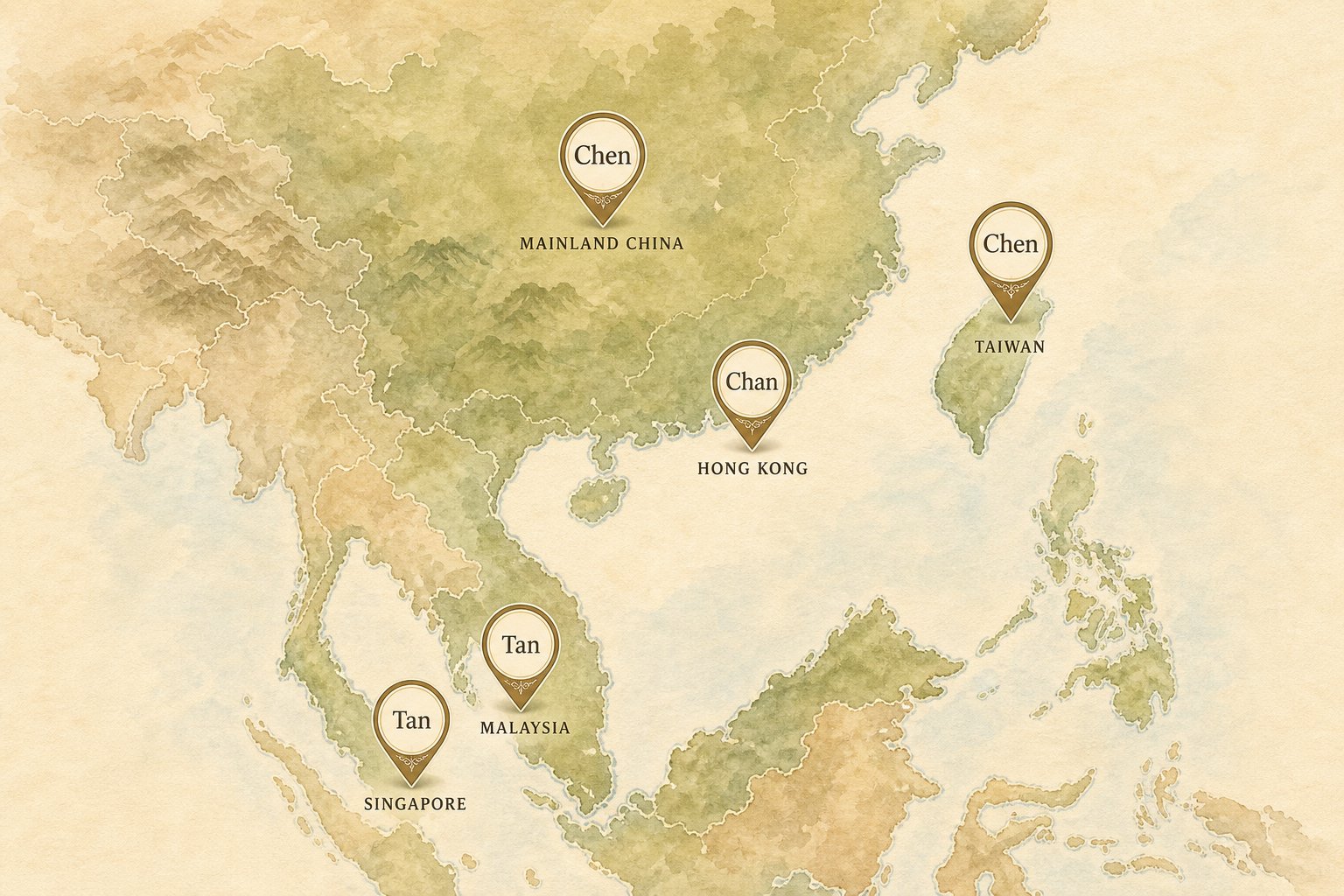
A person named 陈志明 in Mainland China writes their name as Chen Zhiming. That same name, belonging to someone from Hong Kong, becomes Chan Chi-ming. In Singapore, it might appear as Tan Chee Beng. Same characters, same meaning, completely different English spellings. Regional conventions aren't just minor variations. They reflect distinct dialects, colonial histories, and cultural identities that shape how millions of people present themselves to the world.
If you try to mandarin translate a name without considering where the person is from, you'll likely produce a spelling they don't recognize as their own. Here's how naming conventions break down across the major Chinese-speaking regions.
Mainland China and Standard Pinyin
Mainland China is the most straightforward case. The government mandates Hanyu Pinyin for all official romanization, and the national standard GB/T 28039-2011 leaves little room for ambiguity. Surnames come first, given names are written as one word, and the spelling follows Pinyin rules exactly.
For someone from the Mainland, the name chinesisch characters map to Pinyin in a predictable, one-to-one relationship. 张 is always Zhang, 王 is always Wang, and 陈 is always Chen. This consistency makes Mainland Chinese names the easiest to handle when converting to English. If you know the person is from the PRC and they don't already have an established alternative spelling, Pinyin is the correct default.
Taiwan and Wade-Giles Variations
Taiwan's romanization landscape is considerably messier. The island has never fully standardized on a single system. You'll encounter Wade-Giles spellings, Tongyong Pinyin (briefly adopted as an official standard), Hanyu Pinyin (now used for some street signs and newer documents), and personal preference spellings that don't follow any system at all.
The practical result? A Taiwanese person's romanized name might not match any textbook system. As romanization.com's analysis of Taiwan's situation explains, what's commonly seen in Taiwan is a "bastardized form of Wade-Giles" where the apostrophe, essential to the system's accuracy, is almost always omitted. This means a spelling like "Chang" could represent either 张 (Zhāng in Pinyin) or 昌 (Chāng), since the apostrophe that distinguishes aspirated from unaspirated consonants is routinely dropped.
For names, this creates a patchwork. The surname 陈 might appear as Ch'en (proper Wade-Giles), Chen (Pinyin or simplified Wade-Giles without the apostrophe), or even Tan (if the family has Hokkien roots from southern Taiwan). Many Taiwanese people simply use whatever spelling their parents chose decades ago, regardless of which system it technically belongs to. The key takeaway: never "correct" a Taiwanese person's name spelling to standard Pinyin unless they ask you to.
Hong Kong Cantonese and Singapore Dialect Names
Hong Kong naming conventions are unique in the Chinese-speaking world. Three features set them apart:
- Cantonese pronunciation: Names are romanized based on Cantonese sounds, not Mandarin. The surname 陈 becomes Chan, 张 becomes Cheung, and 黄 becomes Wong.
- English given names: Most Hong Kong residents adopt a Western first name that sits before the Chinese surname. Jackie Chan (陈港生), Andy Lau (刘德华), and Maggie Cheung (张曼玉) all follow this pattern. The English name isn't a translation of the Chinese given name. It's a separate name chosen for English-language contexts.
- Hyphenated Chinese given names: The Cantonese given name typically appears after the surname with a hyphen: Chan Chi-ming, not Chan Chiming. This differs from the Mainland Pinyin convention of writing given names as one word.
The hybrid format, English name + Chinese surname + hyphenated Cantonese given name, produces structures like "David Chan Chi-ming." This three-layer naming convention is standard in Hong Kong and shouldn't be treated as an error or an incomplete name. Among asian names for boys and asian names for girls in Hong Kong, this blended format is the norm rather than the exception.
Macau follows a similar Cantonese base but adds Portuguese-influenced spellings from its colonial history. The surname 黄 might appear as Vong rather than Wong, and given names sometimes carry Portuguese elements.
Singapore and Malaysia present yet another pattern. The Chinese communities in these countries trace their roots to southern Chinese provinces, and their surnames reflect the dialects their ancestors spoke: Hokkien, Teochew, Cantonese, and Hakka. As CNA reports, the surname 黄 alone produces multiple spellings depending on dialect: "Ng" for Teochew or Hokkien, "Ooi" or "Wee" for Hokkien, "Wong" for Cantonese, and "Bong" for Hakka. Similarly, 郑 becomes "Tay," "Tee," or "Teh" in Hokkien and Teochew, but "Cheng" in Cantonese.
The table below shows how a single surname travels across regions, producing spellings that look nothing alike:
| Region | System/Dialect | 陈 Spelling | 张 Spelling | 黄 Spelling |
|---|---|---|---|---|
| Mainland China | Hanyu Pinyin | Chen | Zhang | Huang |
| Taiwan | Wade-Giles (modified) | Ch'en / Chen | Chang | Huang |
| Hong Kong | Cantonese | Chan | Cheung | Wong |
| Macau | Cantonese + Portuguese | Chan | Cheong | Vong |
| Singapore/Malaysia | Hokkien | Tan | Teo | Ng / Ooi |
| Singapore/Malaysia | Teochew | Tan | Teo | Ng |
Imagine encountering the surnames Chan, Chen, Tan, and Ch'en in a single international conference. They could all represent the same character, 陈, worn by people from different regions. Understanding the chang shi chinese meaning or zou meaning chinese name requires knowing not just the character but the regional context behind its romanization.
The overriding principle across all these regions is respect for the individual's chosen spelling. A person's romanized name isn't a puzzle for you to solve or a mistake for you to fix. If someone from Singapore spells their surname "Tan" and someone from Beijing spells the identical character "Chen," both are correct. The romanization reflects their linguistic heritage, their family's history, and often their legal identity across decades of official documents.
Applying a system mechanically, converting every 陈 to "Chen" because Pinyin says so, erases the regional and dialectal identity embedded in a person's name. The best practice is always the simplest one: ask the person how they spell their name, then use that spelling exactly as given.
Regional variation explains why the same character produces different spellings. But even within a single region and system, people still make formatting errors that create confusion on documents, databases, and professional records. The most common of these mistakes are predictable and preventable.
Step 7 - Avoid These Common Mistakes and Stay Consistent
You've learned the systems, the formatting rules, and the regional variations. Yet even people who understand the basics still trip over the same handful of errors when producing an english translation of chinese names. Some of these mistakes cause social awkwardness. Others create real problems on legal documents, academic records, and immigration paperwork, where name discrepancies across translated documents can trigger processing delays or outright rejections.
Here are the most frequent errors, ranked from the one you'll encounter most often to the least common:
Mistaking the Surname for a Given Name
- Assuming the first word is the given name. English speakers instinctively read the first name in a sequence as the personal name. So when they see "Wang Xiaoming," they call the person "Wang" thinking it's a first name. In reality, Wang is the surname. This is the single most common mistake, and it happens in emails, meetings, and even official correspondence daily.
- Splitting a two-character given name into two separate names. When "Xiaoming" appears in English, some systems and people treat it as two names: "Xiao" as a first name and "Ming" as a middle name. Suddenly one person becomes two fragments in a database. A chinese name generator or chinese name generator male tool might output the name correctly as one unit, but the human entering it into a form splits it apart anyway.
- Inconsistent romanization across documents. Using "Chen" on a passport, "Chan" on a business card, and "Tan" on a university application for the same person creates an identity verification nightmare. Each spelling might reflect a legitimate system, but mixing them across a single document set signals confusion rather than multilingual competence.
- Adding tone marks where they don't belong. Tone marks (like the accent in Wáng or Xiǎomíng) are useful in language-learning contexts and dictionaries. They don't belong on passports, resumes, business cards, or legal forms. Including them in professional documents looks like you're trying to translate english to simplified chinese characters rather than simply romanizing a name.
- Misspelling common surnames. "Zheng" becomes "Zeng." "Huang" becomes "Haung." "Zhang" becomes "Zang." These aren't romanization differences. They're typos that persist because someone copied the name incorrectly once and the error propagated through every subsequent document. Unlike the tattoo chinese writing mistakes that people discover too late on their skin, a misspelled surname on official records can actually be corrected, but only if you catch it early.
Splitting Two-Character Given Names Incorrectly
This error deserves extra emphasis because it's structural, not just cosmetic. When a form asks for "First Name" and "Middle Name," people instinctively break "Xiaoming" into "Xiao" and "Ming" to fill both fields. The result? Airlines, universities, and government agencies now have a record of someone whose first name is "Xiao" and middle name is "Ming," which matches nothing on their passport. If you encounter a form that doesn't accommodate a two-syllable given name in one field, leave the middle name field blank rather than splitting the given name apart.
Inconsistency Across Documents and Why It Causes Problems
Consistency isn't glamorous, but it's the single factor that prevents the most real-world headaches. An asian name generator might offer you creative romanization options, but once you pick a spelling, that spelling needs to appear identically on every document within a given domain. Your passport spelling should match your visa, your bank account, your employment records, and your airline bookings. Your academic name should match across every journal, conference paper, and co-author listing.
Why? Because systems match identities by exact string comparison. "Xiao-Ming Wang" and "Xiaoming Wang" are two different people to a computer. "Chen Wei" and "Chan Wai" won't link to the same publication record. Every variation you introduce creates a fork in your documented identity that takes real effort to reconcile later.
Always ask the person how they prefer their name written in English. Once chosen, use that exact spelling consistently everywhere.
That principle applies whether you're writing your own name or handling someone else's. The romanization system matters. The formatting matters. The regional context matters. But none of it matters as much as picking one version and committing to it across every document, profile, and record where your name appears. Consistency is what holds your identity together across languages, borders, and bureaucracies.
Frequently Asked Questions About Writing Chinese Names in English
1. Do Chinese names put the surname first or last in English?
In the original Chinese, the surname always comes first. When writing in English, you can keep the Chinese order (Wang Xiaoming), switch to Western order (Xiaoming Wang), or use comma notation (Wang, Xiaoming). The choice depends on context. PRC passports and Chinese academic publishing keep surname first, while LinkedIn profiles and Western workplaces typically use given-name-first order. Using all caps for the surname (WANG Xiaoming) helps eliminate ambiguity regardless of order.
2. Should I hyphenate a two-character Chinese given name in English?
The official Pinyin standard writes two-character given names as one word without a hyphen, such as Xiaoming rather than Xiao-Ming. However, hyphens are widely accepted and common in Taiwan and Hong Kong naming conventions. The format you should avoid is writing the two syllables as completely separate words (Xiao Ming), because databases and forms will treat them as a first name and middle name, creating mismatches with passport records.
3. Why do the same Chinese characters produce different English spellings?
Different romanization systems and regional dialects produce different spellings for identical characters. For example, the surname 陈 becomes Chen in Mainland China's Pinyin system, Chan in Hong Kong's Cantonese romanization, and Tan in Singapore's Hokkien dialect spelling. Each spelling reflects the local pronunciation and the romanization system historically used in that region. All versions are correct within their respective contexts.
4. How should I write my Chinese name on a passport application?
For PRC passports, use Hanyu Pinyin with the surname in all capital letters in the surname field and the full given name as one continuous capitalized word in the given name field (e.g., Surname: WANG, Given name: XIAOMING). Taiwan passports may use Wade-Giles with hyphenated given names, and Hong Kong passports use Cantonese romanization. Once your romanized name appears on a passport, all subsequent legal documents must match that exact spelling.
5. What is the most common mistake when writing Chinese names in English?
The most frequent error is assuming the first word in a Chinese name is the given name. English speakers instinctively read the first name as the personal name, so they call someone by their surname thinking it is a first name. The second most common mistake is splitting a two-character given name into separate first and middle names on forms, which creates identity verification problems across official documents and databases.