What the Hundred Family Surnames Really Is
The Hundred Family Surnames, known in Chinese as 百家姓 (Bai Jia Xing), is a classical text that catalogs common Chinese surnames. Composed during the early Song Dynasty around 960 AD in Hangzhou, it stands as one of the oldest and most widely recognized cultural documents in Chinese civilization. Despite its name suggesting just a hundred entries, the text actually records 504 surnames, making it a far more comprehensive registry than most people expect.
What Is the Hundred Family Surnames Text
Imagine a document so well-crafted that children have been reciting it from memory for over a thousand years. That's exactly what this text achieves. Its structure is deceptively simple: 504 surnames arranged in rhyming couplets of four characters per line, creating a rhythmic flow that makes memorization almost effortless. Of those 504 entries, 444 are single-character surnames and 60 are compound (two-character) surnames grouped at the end.
The word "hundred" in the title doesn't refer to a literal count. In classical Chinese, "hundred families" (百家) is an idiomatic expression meaning "all families" or "the common people." So the name essentially translates to "the surnames of all families" rather than a strict numerical claim. You'll notice this kind of poetic shorthand appears frequently in classical Chinese titles.
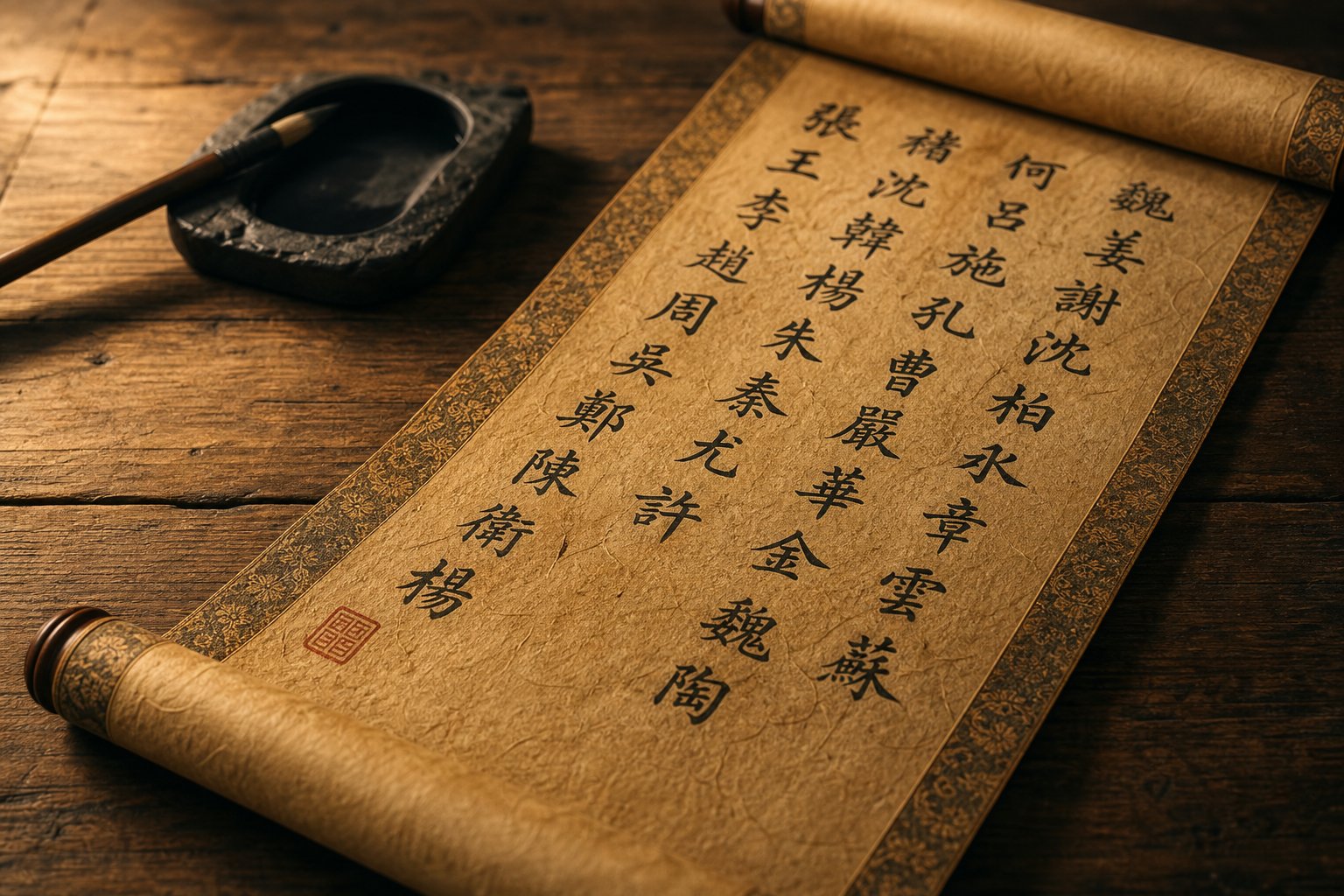
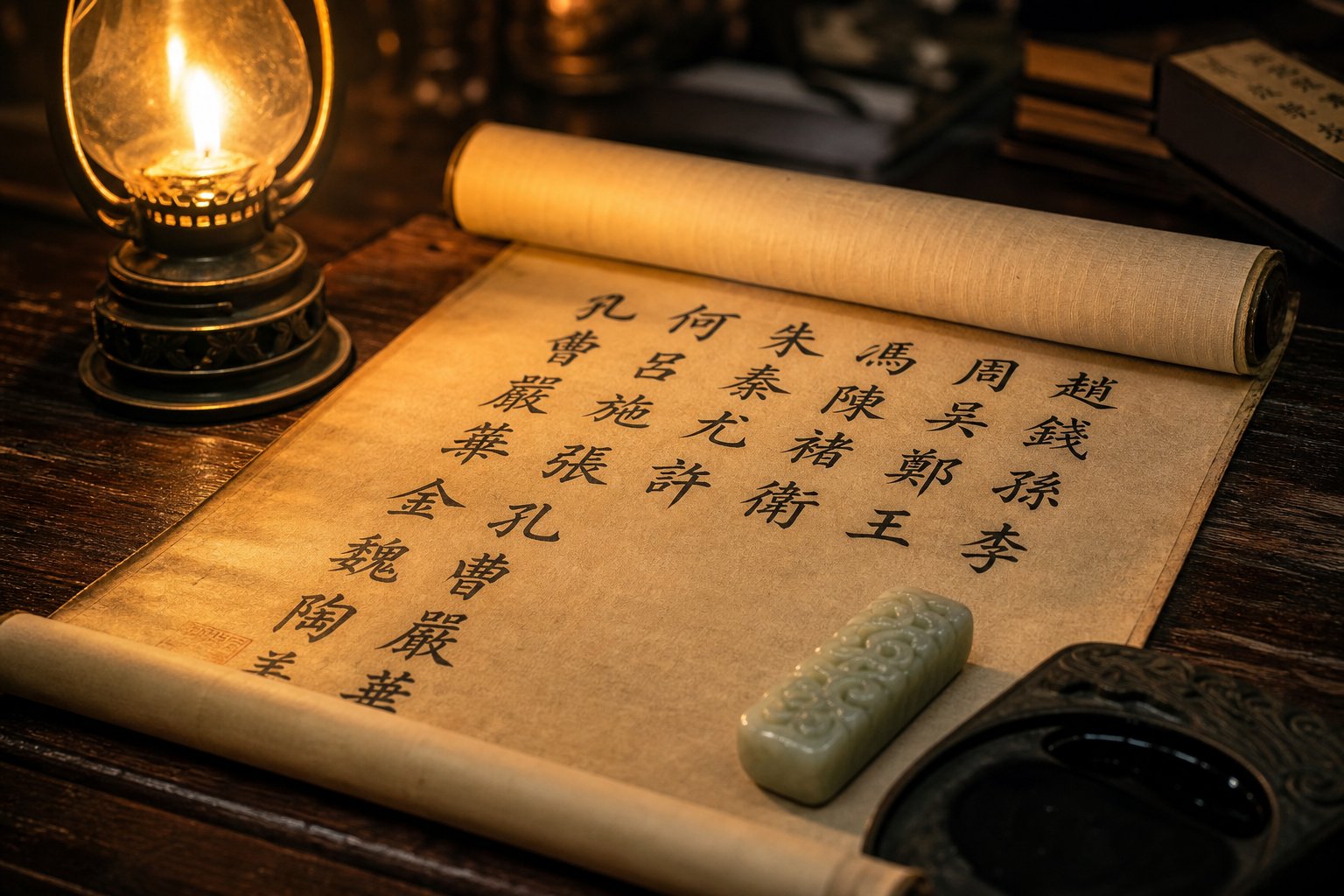
Each line reads like a short verse. The opening line alone, 赵钱孙李 (Zhao Qian Sun Li), rolls off the tongue with a cadence that sticks in your memory after just a few repetitions. This wasn't accidental. The entire text was engineered as a learning tool, built for young students who needed to recognize and recall Chinese family names as part of their basic education.
Why This Text Still Matters for Chinese Culture
For over a billion people today, this text remains a living reference point. Every Chinese surname carries layers of history, geographic origin, and ancestral identity. The Hundred Family Surnames provides a shared framework for understanding how these names connect to a broader cultural story.
The Hundred Family Surnames is the earliest surviving comprehensive surname registry in Chinese history, linking modern Chinese family names to a documented tradition stretching back over a millennium.
Chinese naming conventions place the surname first, a practice that reflects the cultural weight given to family lineage. When someone introduces themselves with a Chinese surname like Wang, Li, or Zhang, they're invoking an identity that predates most modern nations. This text gave that identity its first organized written form, and it continues to serve as the starting point for anyone exploring the origins of Chinese surnames.
The question that makes this text truly fascinating, though, isn't what it contains. It's why the surnames appear in the specific order they do. The arrangement wasn't random, wasn't alphabetical, and wasn't based on population size. It was political.
Song Dynasty Origins and the Scholar Behind the Text
That political dimension traces directly back to where and when the text was written. The Hundred Family Surnames emerged from a very specific moment in Chinese history: the founding years of the Song Dynasty, when a newly unified empire was still consolidating power and a scholar in Hangzhou decided to put pen to paper.
The Author Qian Tang and Hangzhou Origins
The text is attributed to a scholar known as Qian Tang (钱塘), who lived in Hangzhou during the early Northern Song Dynasty around 960 AD. Details about his life remain sparse in historical records, and some scholars debate whether "Qian Tang" was a personal name or a reference to the Qiantang region itself. What's clear is that the compiler worked in Hangzhou, and that geographic detail matters enormously.
Why Hangzhou? Because it had just served as the capital of the Wuyue Kingdom, one of the Ten Kingdoms that existed during the chaotic Five Dynasties period preceding the Song. Wuyue was ruled by the Qian family, and its last king, Qian Chu, made the politically shrewd decision to surrender peacefully to the Song Dynasty in 978 AD rather than fight a losing war.
This peaceful submission shaped everything about the text's creation. A scholar writing in Hangzhou, the former Wuyue capital, would naturally place the Song imperial surname Zhao first as a declaration of loyalty to the new regime. The Qian surname came second as a nod to the local Wuyue kings who had ruled his own city just years earlier. The list of chinese family names that opens the text reads like a diplomatic document disguised as a children's primer.
Hangzhou's unique position as a recently absorbed regional capital gave the compiler both motivation and perspective. He was writing from a place where old loyalties to the Qian royal house still ran deep, yet new allegiance to the Zhao emperors was politically necessary. The ancient chinese surnames he chose to highlight first weren't selected for their frequency among the population. They were selected for their relevance to the power structures surrounding him.
How the Text Spread Through Chinese Society
A regional compilation from one city in southeastern China might easily have remained a local curiosity. Instead, it became a nationwide educational standard within a few generations. Two factors made this possible: technology and political stability.
The Song Dynasty represented a golden age for woodblock printing. While the technology existed before the Song, it was during this period that printing became commercially viable at scale. Books that previously required painstaking hand-copying could now be reproduced in hundreds or thousands of copies. The Hundred Family Surnames, with its short length and practical utility, was an ideal candidate for mass printing. It was cheap to produce, easy to sell, and useful to nearly every family.
Here's what made this text different from most printed works of the era: it wasn't aimed at elite scholars. The majority of Song Dynasty publications served government officials, Buddhist monasteries, or wealthy literati. This chinese surname list, by contrast, targeted ordinary households. Parents bought it so their children could learn to read. Village tutors used it as a first textbook. It was one of the earliest documents widely printed for popular consumption rather than scholarly prestige.
The political stability of the early Song period also played a crucial role. After decades of fragmentation during the Five Dynasties and Ten Kingdoms era, the Song reunification created conditions where cultural projects could flourish. Trade routes reopened, paper production expanded, and a growing merchant class created demand for affordable educational materials. The text rode this wave of cultural and economic growth from Hangzhou outward across the empire.
Within a century of its composition, the text had become inseparable from basic Chinese education. It joined the Three Character Classic and the Thousand Character Classic as part of the standard literacy curriculum, a trio so fundamental that students across China would encounter it before any other formal text. What began as one scholar's politically coded surname中文 registry in a single city became the shared cultural inheritance of an entire civilization.
The ordering that Qian Tang chose, however, wasn't just a product of local politics. Each of the first several surnames tells a specific story about Song Dynasty power dynamics, diplomatic surrenders, and royal marriages. The logic is precise, deliberate, and far more revealing than most readers realize.
The Hidden Political Logic Behind the Surname Order
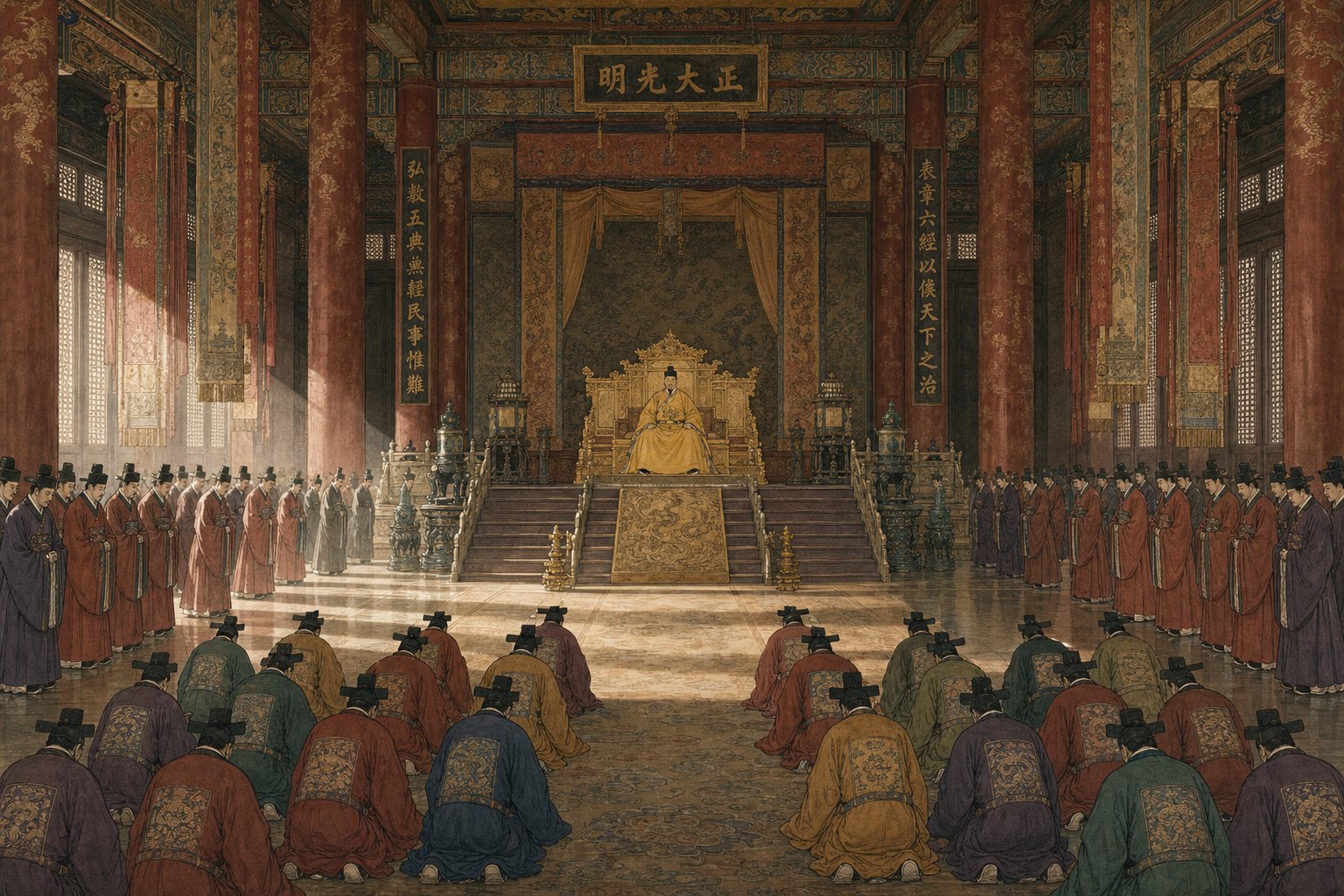
Think about it this way: if you were compiling a list of surnames in a newly unified empire, who would you put first? The answer in 960 AD was obvious. You'd put the emperor's surname at the top, and then you'd arrange everyone else according to how much political respect they deserved. That's exactly what happened with the Hundred Family Surnames, and the result is a text where every position in the opening lines carries deliberate meaning.
Why Zhao Comes First as the Imperial Surname
Zhao (赵) leads the entire text for one reason: it was the surname of the Song Dynasty's founding emperor, Zhao Kuangyin, and every emperor who followed him. This wasn't a ranking based on population. Wang is actually the most common chinese last name in modern China, and Li has held that position at various points in history. Yet neither appears first.
The placement was a political statement of loyalty. Putting any other surname before Zhao would have been an act of disrespect toward the ruling house, potentially even a dangerous one. In imperial China, the emperor's surname carried almost sacred weight. It represented the Mandate of Heaven, the divine right to rule. A scholar composing a text in the early Song period would have understood instinctively that Zhao belonged at position one. No other choice was politically survivable.
Among all the royal chinese surnames that have ruled China across its dynastic history, Zhao holds a unique distinction. It's the only imperial surname that achieved its prominence specifically because of this text's enduring popularity. The Song Dynasty lasted over 300 years, and throughout that entire period, children across the empire opened their education by reciting "Zhao" as the first word.
The Full Political Sequence of the Opening Lines
The genius of the text's ordering becomes clear when you decode the first eight to ten surnames. Each one maps to a specific political relationship in the early Song unification period. The opening line, 赵钱孙李 (Zhao Qian Sun Li), reads like a compressed diplomatic history.
- Zhao (赵) - The Song Dynasty imperial surname. Emperor Zhao Kuangyin founded the dynasty in 960 AD, making this the undisputed first position.
- Qian (钱) - The surname of Qian Chu, last king of the Wuyue Kingdom based in Hangzhou. He surrendered peacefully to the Song in 978 AD, earning his family second place as a reward for avoiding bloodshed.
- Sun (孙) - The Sun family name belonged to the queen consort of the Wuyue royal house. Placing Sun third honored the Wuyue queen's lineage, reinforcing the diplomatic goodwill between Song and the surrendered kingdom.
- Li (李) - The imperial surname of the Southern Tang dynasty, another kingdom that submitted to Song rule. Li Yu, the famous poet-king, was the last Southern Tang ruler.
- Zhou (周) - Connected to the Later Zhou dynasty, the regime that immediately preceded the Song. Zhao Kuangyin had served as a general under the Zhou before seizing power.
- Wu (吴) - Associated with the state of Wuyue itself (吴越), reinforcing the Hangzhou connection and honoring regional identity.
- Zheng (郑) - Linked to prominent official families who supported the Song unification effort.
- Wang (王) - Despite being arguably the most common chinese last name across Chinese history, Wang appears eighth. Its meaning of "king" gave it prestige, but not enough to outrank the actual ruling houses.
Notice the pattern. The first four surnames alone tell the story of two kingdoms surrendering to one empire, with the compiler carefully balancing imperial authority against local diplomatic sensitivities. A reader in Hangzhou would have recognized every reference immediately.
What This Ordering Tells Us About Song Dynasty Politics
The arrangement reveals something profound about how the early Song Dynasty consolidated power. Rather than conquering through pure military force and erasing the identities of defeated kingdoms, the Song pursued a strategy of incorporation. Defeated royal families were honored, given positions at court, and in this case, granted prominent placement in a cultural text that would outlive them all.
Qian Chu's peaceful surrender of Wuyue is the clearest example. By placing Qian second in the text, the compiler sent a message: loyalty and peaceful submission would be rewarded with lasting recognition. This wasn't just flattery. It was propaganda designed to encourage other holdout kingdoms to surrender rather than fight.
The text also reflects the compiler's own position. Writing in Hangzhou, the former Wuyue capital, he needed to honor both his new Song overlords and his old Wuyue rulers simultaneously. The surname ordering accomplishes both. Zhao comes first to satisfy imperial authority. Qian and Sun follow immediately to reassure local Wuyue families that their heritage still mattered.
What emerges is a document that functions on two levels at once. On the surface, it's a simple common chinese last name registry for teaching children to read. Beneath that surface, it's a carefully coded map of early Song political relationships, diplomatic surrenders, and strategic marriages. Every surname in the opening lines earned its position not through population size or historical age, but through its relevance to the power dynamics of a specific historical moment.
This political coding, however, tells us nothing about where these surnames actually came from. The stories behind individual names like Wang, Zhang, and Li stretch back thousands of years before the Song Dynasty, rooted in legends of ancient kings, mythical inventors, and imperial gifts that reshaped entire family lines.
Fascinating Origin Stories of Popular Chinese Last Names
Every entry in the text carries a backstory that predates the Song Dynasty by centuries, sometimes millennia. These aren't arbitrary labels. Chinese last names function as compressed histories, each one encoding information about ancestral homelands, ancient occupations, or royal bloodlines. The origin stories behind the most popular chinese last names reveal how deeply personal identity intertwines with collective memory in Chinese culture.
Wang — The Surname That Means Royalty
Wang (王, pronounced wang, second tone) is arguably the most literal surname in the Chinese language. The character itself means "king." Its three horizontal strokes represent Heaven, Earth, and Humanity, connected by a single vertical line symbolizing the ruler who unites all three realms.
How does a word meaning "king" become a common family name? The answer lies in fallen royalty. During the Spring and Autumn and Warring States periods (770 BC - 221 BC), numerous Zhou Dynasty princes lost their territories and titles. Their descendants, still recognized by locals as people of royal blood, became known simply as "Wang" — the king's people. Crown Prince Jin of the Eastern Zhou is considered the most prominent ancestor of the Wang lineage. After his father demoted him for speaking too bluntly, his son fled to Taiyuan, where locals called the family "Wang" in recognition of their royal origins.
Other Wang lineages trace back to the Shang Dynasty prince Bigan and to Tian Jian, the last King of Qi. Multiple royal houses across different eras independently produced Wang descendants, which explains why this surname tops modern population rankings despite appearing eighth in the original text.
Zhang — The Bow-Maker Legend
Zhang (张, pronounced zhang, first tone) carries its origin story right inside the character. Look closely and you'll spot the radical 弓 on the left side — it means "bow." The surname traces back to Hui, a grandson of the legendary Yellow Emperor, who is credited with inventing the bow and arrow. For this achievement, he was granted the title "Zhang" (meaning "to draw a bow" or "to stretch"), and his descendants adopted it as their family name.
This makes Zhang one of the oldest chinese last names with a verifiable etymological connection to its original meaning. Every time someone writes the character, they're referencing a weapon innovation from mythological prehistory. With roughly 90 million bearers today, the bow-maker's legacy stretches far.
Li — A Surname Granted by Tang Emperors
Li (李, pronounced li, third tone) has ancient roots — some genealogies trace it to Gao Yao, a legendary judge who served Emperor Shun. But what made Li explode in population was a Tang Dynasty practice that no other surname benefited from so dramatically.
Tang emperors (618 - 907 AD) routinely bestowed their imperial surname on loyal generals, meritorious officials, and allied tribal leaders as the highest possible honor. Imagine receiving the emperor's own family name as a reward for military service. Entire clans adopted Li overnight, swelling its numbers far beyond natural growth. This practice continued across nearly three centuries of Tang rule, transforming Li from a moderately common name into one of the most widespread surnames in East Asia.
More Surname Origins at a Glance
Beyond these three giants, dozens of other surnames carry equally compelling histories. Here's a quick reference for several major names:
- Chen (陈, chen, second tone) — Derived from the ancient state of Chen, founded by descendants of the legendary Emperor Shun. One of the oldest place-name surnames.
- Huang (黄, huang, second tone) — Traces to the ancient Huang Kingdom in modern Henan province. The character means "yellow," connecting it to the Yellow Emperor tradition.
- Kong (孔, kong, third tone) — The kong last name is forever linked to Confucius (Kong Qiu). His descendants maintained meticulous genealogical records for over 2,500 years, making the Kong family tree one of the longest documented lineages in human history.
- Hong (洪, hong, second tone) — The hong last name originated from the ancient Gong clan. Some branches adopted Hong after fleeing political persecution, altering their surname slightly to avoid detection while preserving phonetic continuity.
- Tan (谭/陈, tan, second tone) — The last name tan origin connects to the ancient state of Tan in present-day Shandong province. When the state was conquered by Qi in 684 BC, its people adopted their former kingdom's name as a surname to preserve their identity.
- Liu (刘, liu, second tone) — The imperial surname of the Han Dynasty. Like Li during the Tang, Liu expanded through imperial grants and the prestige of ruling China's longest-lasting dynasty.
A pattern emerges across these stories. Chinese surnames originate from four main sources: royal lineages, geographic place names, ancestral occupations, and imperial grants. Some families chose their names. Others had names chosen for them by emperors, conquerors, or the communities that remembered their origins long after political power faded.
These origin stories weren't just oral traditions passed between generations. They were actively taught. For nearly a thousand years, the text that cataloged these surnames served as one of three foundational primers in Chinese education, shaping how children first encountered written language and social identity simultaneously.
A Literacy Primer That Shaped Generations of Chinese Children
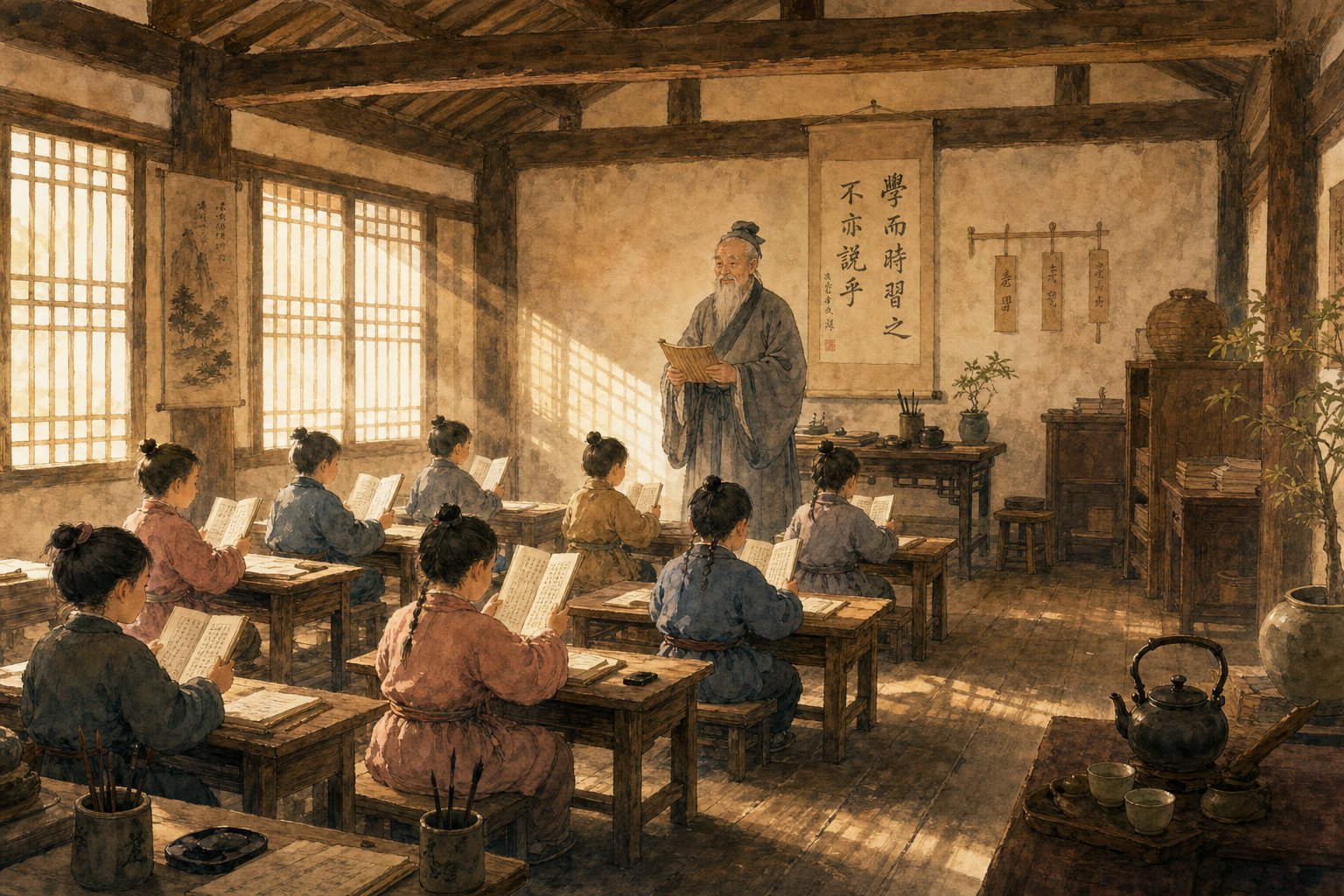
Three texts. Roughly 2,000 unique characters between them. For nearly a millennium, that combination formed the entire foundation of Chinese childhood education. Before a student could read philosophy, history, or poetry, they first had to pass through a curriculum so streamlined and effective that it survived dynasty after dynasty virtually unchanged.
The San Bai Qian Trilogy for Children
During the Ming and Qing dynasties, the standard introductory literacy curriculum crystallized into a trio known as San Bai Qian (三百千) — shorthand drawn from the first character in each title. The three texts were the Three Character Classic (三字经, San Zi Jing), the Hundred Family Surnames (百家姓, Bai Jia Xing), and the Thousand Character Classic (千字文, Qian Zi Wen). Together, they gave young learners a crash course in character recognition before moving on to understanding meaning and writing.
Each text served a distinct pedagogical purpose:
- Three Character Classic — Taught Confucian moral values, basic history, and the importance of education. Its opening line, "People at birth are inherently good," remains one of the most recognized phrases in Chinese culture.
- Hundred Family Surnames — Taught social identity and belonging. By memorizing surnames, children learned to recognize the hundred characters and names that connected them to family, community, and the broader social fabric.
- Thousand Character Classic — Taught exactly 1,000 unique characters arranged in 250 lines of four characters each, all within a coherent prose passage. It built vocabulary and contextual reading skills.
The logic was deliberate. You'll notice the sequence moves from values to identity to vocabulary, each layer building on the last. A child who completed all three could recognize and pronounce roughly 2,000 characters — enough to begin reading simple texts. Since Chinese doesn't use an alphabet, this memorization-first approach was the most efficient path to functional literacy available.
These weren't elite materials reserved for wealthy families. Woodblock printing made them cheap to produce, and they were available to students from both privileged backgrounds and ordinary villages. The order of chinese names a child encountered in the Hundred Family Surnames was often their first formal introduction to how chinese full names worked — surname first, given name second, family identity before individual identity.
How Rhyming Couplets Aided Memorization
What made the Hundred Family Surnames stick in young minds wasn't just repetition. It was rhythm. The text arranges surnames in lines of four characters each, with alternating lines rhyming at the end. This four-character cadence creates a musical pattern that functions like a mnemonic device — similar to how Western children learn the alphabet through song rather than rote letter-by-letter drilling.
Imagine a six-year-old chanting these lines in a village schoolroom. The rhythm carries the content forward, making each new surname easier to absorb because it fits into an expected sonic pattern. Even if a child didn't understand every surname's meaning, the rhyming structure ensured they could recall the sequence.
赵钱孙李 (Zhao Qian Sun Li) — 周吴郑王 (Zhou Wu Zheng Wang): The surnames Zhao, Qian, Sun, and Li — Zhou, Wu, Zheng, and Wang. Notice how Li and Wang rhyme in classical Chinese pronunciation, creating the paired couplet structure that drives the entire text forward.
This pattern repeats across all 504 surnames. Each set of two lines forms a rhyming pair, giving the text a sing-song quality that made it ideal for group recitation. Teachers would chant a line, students would echo it back, and within weeks the hundred characters representing major surnames were locked into memory.
The pedagogical brilliance here is subtle. Children weren't just learning to recognize characters in isolation. They were learning surnames — words that connected directly to real people in their communities. A child could recite a line and immediately point to a neighbor, a shopkeeper, or a classmate whose name appeared in the verse. Abstract literacy became personal and social in a way that pure vocabulary lists never could.
Yet for all its comprehensiveness, the text focused almost entirely on single-character surnames. Tucked away at the end, a smaller and often overlooked section catalogs something rarer: compound surnames built from two characters, each carrying its own distinctive origin story and cultural weight.
The Rare Compound Surnames Most People Overlook
Those 60 entries grouped at the tail end of the text look different from everything that precedes them. Instead of a single character, each one uses two characters to form a complete surname. These are compound surnames (复姓, fu xing), and they represent some of the rarest chinese surnames still in use today. While most readers breeze past them, these unusual surnames carry origin stories rooted in ancient official titles, geographic landmarks, and ethnic identities that predate the text itself by centuries.
What Are Compound Surnames and Where Do They Come From
A compound surname uses two Chinese characters where most families use one. Sounds simple, but the implications run deep. When you meet someone named Ouyang, Sima, or Zhuge, you're encountering a naming tradition that traces back to the Zhou Dynasty (1046 - 256 BC) and earlier. These aren't modern inventions or hyphenated combinations. They're ancient, indivisible family names with specific etymological roots.
Where did they come from? The origins fall into several distinct categories:
- Official titles — Sima (司马, si ma) literally means "Master of the Horse," a high military rank equivalent to a marshal. Situ (司徒) meant "Minister over the Masses." Sikong (司空) meant "Minister of Works." Families who held these positions for generations eventually adopted the title itself as their permanent surname.
- Place names — Ouyang (欧阳, ou yang) refers to the south side of Mount Ou Yu. Dongfang (东方) means "the East." Shangguan (上官) derives from a location associated with high-ranking officials. Geography became identity.
- Noble lineage markers — Gongsun (公孙) translates to "dukes' descendants," a term used during the Spring and Autumn period to address children of nobility. Xiahou (夏侯) means "Marquess of Xia," tracing back to descendants of the legendary Yu the Great.
- Ethnic and tribal origins — Some compound surnames entered Chinese culture through non-Han peoples. Huyan (呼延) came from the Xiongnu, Murong (慕容) from the Xianbei, and Yuwen (宇文) also from Xianbei tribes that eventually assimilated into Han Chinese society.
China once had over 1,000 compound surnames in active use. Today, fewer than 100 remain. Many became extinct surnames over the centuries as families simplified their names to single characters for convenience, social pressure, or political survival. Taking Ouyang as an example, people today with the standalone surname Ou or Yang are believed to be descendants of the original Ouyang lineage who dropped one character at some point in their family history. This gradual simplification means that many extinct last names weren't truly lost — they were absorbed into shorter forms that erased their compound origins.
Famous Compound Surnames in Chinese History and Literature
Despite their rarity, compound surnames appear disproportionately among China's most celebrated historical figures. The two-character structure gives these names a distinctive, almost aristocratic quality that writers and historians have long associated with exceptional individuals.
Sima Qian (司马迁), the Han Dynasty historian who authored the Records of the Grand Historian, is perhaps the most famous bearer of a compound surname. His family name literally announced their ancestral profession: masters of horses, military commanders. Zhuge Liang (诸葛亮), the legendary strategist of the Three Kingdoms period, carried a surname that originated as a branch of the Ge (葛) clan. Ouyang Xiu (欧阳修), the Song Dynasty poet and statesman, bore a name rooted in geography.
Compound surnames also dominate Chinese martial arts fiction. Jin Yong populated his novels with characters named Linghu Chong, Ouyang Feng, and Dongfang Bubai. Gu Long created Ximen Chuixue and Sikong Zhaixing. These fictional choices weren't random — authors understood that uncommon chinese surnames with two characters evoke a sense of antiquity and distinction that single-character names rarely match.
In modern China, Ouyang remains the most widely used compound surname, with over 1.1 million bearers according to the 2020 National Name Report by China's Ministry of Public Security. Shangguan follows with approximately 88,000 people, then Huangfu, Linghu, Zhuge, Situ, and Sima in descending order. These numbers are tiny compared to the tens of millions who share surnames like Wang or Li, but they carry a cultural prestige that population statistics can't capture.
Here's a comparison of major compound surnames, their origins, and the historical figures who made them famous:
| Compound Surname | Pinyin | Origin/Meaning | Notable Historical Figure | Approx. Modern Bearers |
|---|---|---|---|---|
| 欧阳 | Ouyang | South of Mount Ou Yu (place name) | Ouyang Xiu, Song Dynasty poet | 1.1 million+ |
| 司马 | Sima | "Master of the Horse" (military title) | Sima Qian, Han Dynasty historian | Tens of thousands |
| 诸葛 | Zhuge | Branch of the Ge clan (lineage marker) | Zhuge Liang, Three Kingdoms strategist | Tens of thousands |
| 上官 | Shangguan | "High official" (title/place name) | Shangguan Wan'er, Tang Dynasty poet | ~88,000 |
| 皇甫 | Huangfu | Branch of the Zi clan (Eastern Zhou nobility) | Huangfu Song, Han Dynasty general | Tens of thousands |
| 夏侯 | Xiahou | "Marquess of Xia" (noble title from Yu the Great's descendants) | Xiahou Dun, Three Kingdoms general | Fewer than 10,000 |
What makes these uncommon family names so vulnerable to disappearing? Chinese tradition passes surnames through the father's line. When a compound-surnamed family produces only daughters in one generation, or when bearers marry into single-character surname families and children take the simpler name, the compound form can vanish within a single generation. One compound surname, Xushi, reportedly has only a single inheritor remaining — a woman named Xushi Yin'e in Quanzhou, whose family traces back to a 15th-century Ceylon prince stranded in China.
The rarest chinese surnames today exist in a paradox. They carry more historical weight and cultural prestige than common names, yet their very rarity makes them fragile. Each generation that passes without new bearers pushes another compound surname closer to extinction. The text preserved 60 of them in writing over a thousand years ago, but preservation on paper doesn't guarantee survival in practice.
This gap between what the text records and what actually exists in the modern population raises a broader question. How does the original ordering of all 504 surnames compare to the reality of who actually bears these names today? The answer involves dramatic demographic shifts that no Song Dynasty scholar could have predicted.
Traditional Ordering vs Modern Surname Rankings Compared
A text written to honor political hierarchies in 960 AD was never meant to reflect actual population numbers. Yet for centuries, many readers assumed the opening surnames must be the most widespread. Modern census data tells a completely different story. The gap between the original sequence and today's demographic reality reveals just how dramatically China's population landscape has shifted over a thousand years.
Traditional Order vs Modern Population Data
Here's a question worth asking: if you lined up the first 20 surnames from the original text and compared them to modern frequency rankings, how many would match? Almost none. The Hundred Family Surnames places Zhao at position one, but Zhao doesn't even crack the top five most common chinese last names today. Meanwhile, Wang — buried at position eight in the text — sits at the very top of modern population data.
China's Ministry of Public Security publishes national name reports that track surname frequency across the country's nearly 1.4 billion citizens. Their data paints a picture that would have surprised the Song Dynasty compiler entirely. About 100 million people carry the surname Wang alone — a number larger than the entire population of most European countries.
The following table compares the original text ordering against modern population-based rankings:
| Position in Original Text | Surname (Pinyin) | Character | Modern Population Rank | Reason for Original Placement |
|---|---|---|---|---|
| 1 | Zhao | 赵 | 8th | Song Dynasty imperial surname |
| 2 | Qian | 钱 | Outside top 20 | Wuyue Kingdom royal surname |
| 3 | Sun | 孙 | 12th | Wuyue queen's family |
| 4 | Li | 李 | 2nd | Southern Tang imperial surname |
| 5 | Zhou | 周 | 10th | Later Zhou dynasty connection |
| 6 | Wu | 吴 | 9th | Wuyue state association |
| 7 | Zheng | 郑 | 21st | Prominent official families |
| 8 | Wang | 王 | 1st | Character meaning "king" |
| 9 | Feng | 冯 | 27th | Historical noble lineage |
| 10 | Chen | 陈 | 5th | Ancient state of Chen |
| 11 | Chu | 褚 | Outside top 100 | Court official connection |
| 12 | Wei | 卫 | Outside top 50 | Ancient state of Wei |
| 13 | Jiang | 蒋 | 39th | Zhou Dynasty noble lineage |
| 14 | Shen | 沈 | 41st | Ancient state of Shen |
| 15 | Han | 韩 | 25th | Warring States kingdom |
| 16 | Yang | 杨 | 6th | Ancient noble lineage |
| 17 | Zhu | 朱 | 14th | Pre-Song noble family |
| 18 | Qin | 秦 | 74th | Ancient state of Qin |
| 19 | You | 尤 | Outside top 50 | Regional notable family |
| 20 | Xu | 许 | 26th | Ancient state of Xu |
The mismatch is striking. Wang, Li, Zhang, Liu, and Chen form the actual top five most common chinese last names in modern China, yet only Li and Chen appear in the text's first 10 positions. Zhang (ranked 3rd by population) doesn't show up until position 24 in the original text. Liu (ranked 4th) sits at position 252. The ordering was never about frequency — it was about politics, and the data confirms this beyond any doubt.
The five most common surnames in China — Wang, Li, Zhang, Liu, and Chen — together account for over 400 million people. Wang and Li are locked in a tight race for the top spot, with the gap between them narrowing to just 610,000 people in recent reports. That's a common chinese surname competition playing out across a population of 1.4 billion.
How Surname Distribution Has Shifted Over Centuries
So what happened between 960 AD and today? How did surnames like Wang and Zhang rise to dominate while others like Qian and Chu faded into relative obscurity? The answer involves several overlapping demographic forces that reshaped China's population over a millennium.
Imperial surname grants. As discussed in earlier sections, Tang Dynasty emperors bestowed the surname Li on thousands of loyal officials and military leaders. This single practice inflated Li's numbers far beyond natural growth rates. The Ming Dynasty did something similar with Zhu. Each dynasty that granted its imperial surname to outsiders created a permanent demographic ripple that compounded over generations.
Migration patterns. Research from Beijing Normal University using data from China's National Citizen Identity Information Center (covering 1.28 billion citizens) demonstrates how migration fundamentally reshaped surname geography. Northern Chinese populations migrated southward in massive waves, particularly after the Song Dynasty moved its capital to Lin'an (modern Hangzhou). These migrations carried northern surnames like Wang, Zhang, and Liu into southern regions where they hadn't previously existed in large numbers. The Yangtze River basin became what researchers call an "Immigration Region" — a zone where continuous influxes from the north created the highest levels of surname diversity in the country.
Ethnic assimilation. China's 55 ethnic minority groups have gradually adopted Han-style surnames over centuries. Manchu, Mongol, and Xianbei families often selected common chinese common last names when assimilating into Han society. A Manchu clan might choose Wang or Liu as their Chinese surname, adding millions of new bearers to already-large surname pools while smaller, more distinctive names gained no such boost.
Regional population growth. The northeastern and northwestern regions of China experienced explosive population growth in the last two centuries through organized migration campaigns. Researchers describe these as "Reclaimed Regions" where settlers from the Yellow River basin brought their surnames into previously sparsely populated territories. Because these settlers came predominantly from areas dominated by Wang, Li, and Zhang, those surnames spread disproportionately into new regions.
Drift and isolation. In mountainous southern provinces like Guangdong, Fujian, and Guizhou, geographic barriers limited population mixing. Certain surnames became locally dominant through random drift — small founding populations whose descendants multiplied in relative isolation. This explains why some surnames rank high nationally but cluster heavily in specific provinces, while others maintain even distribution across the country.
The cumulative effect of these forces is remarkable. China currently has over 6,150 surnames in active use, yet the most common 100 surnames account for approximately 85 percent of the entire population. Twenty-three individual surnames each exceed 10 million bearers. The concentration is extreme: a relatively small number of names cover the vast majority of people, while thousands of rare surnames share the remaining fraction.
This 85-percent figure actually validates the original text's core intuition. The Song Dynasty compiler understood that a manageable number of surnames could represent nearly everyone. His count of 504 was generous — you really only need about 100 to cover the overwhelming majority of Chinese people. The text's premise was sound even if its ordering was political rather than statistical.
What the compiler couldn't have anticipated was how dramatically the relative sizes of individual surnames would shift. Wang wasn't the most common surname in china during the Song Dynasty. Its rise to the top position is a product of post-Song migration, Manchu assimilation during the Qing Dynasty, and the sheer geographic spread of Wang-surnamed families across every province. Li held the top position for much of the Tang and Song periods, benefiting from centuries of imperial grants. The modern competition between Wang and Li for first place represents the endpoint of a thousand-year demographic race shaped by forces far beyond any single text's control.
These population shifts look different depending on where in the world you're standing. For the millions of Chinese who emigrated across Southeast Asia, the Americas, and Europe over the past several centuries, surname identity took on additional layers of complexity. The same character that reads as "Chen" in Mandarin becomes "Chan" in Cantonese and "Tan" in Hokkien — a single surname fracturing into multiple spellings as it crossed linguistic and national borders.
Chinese Surnames Across the Global Diaspora
That fracturing isn't a modern phenomenon. It began centuries ago, when waves of emigrants left southern China speaking Cantonese, Hokkien, Teochew, and Hakka — not Mandarin. Colonial officials in British Malaya, the Dutch East Indies, and the Philippines wrote down what they heard phonetically, and those spellings became permanent. The result is a global landscape where two people sharing the exact same ancestral character can carry completely different last name chinese spellings on their passports.
How One Surname Becomes Many Spellings
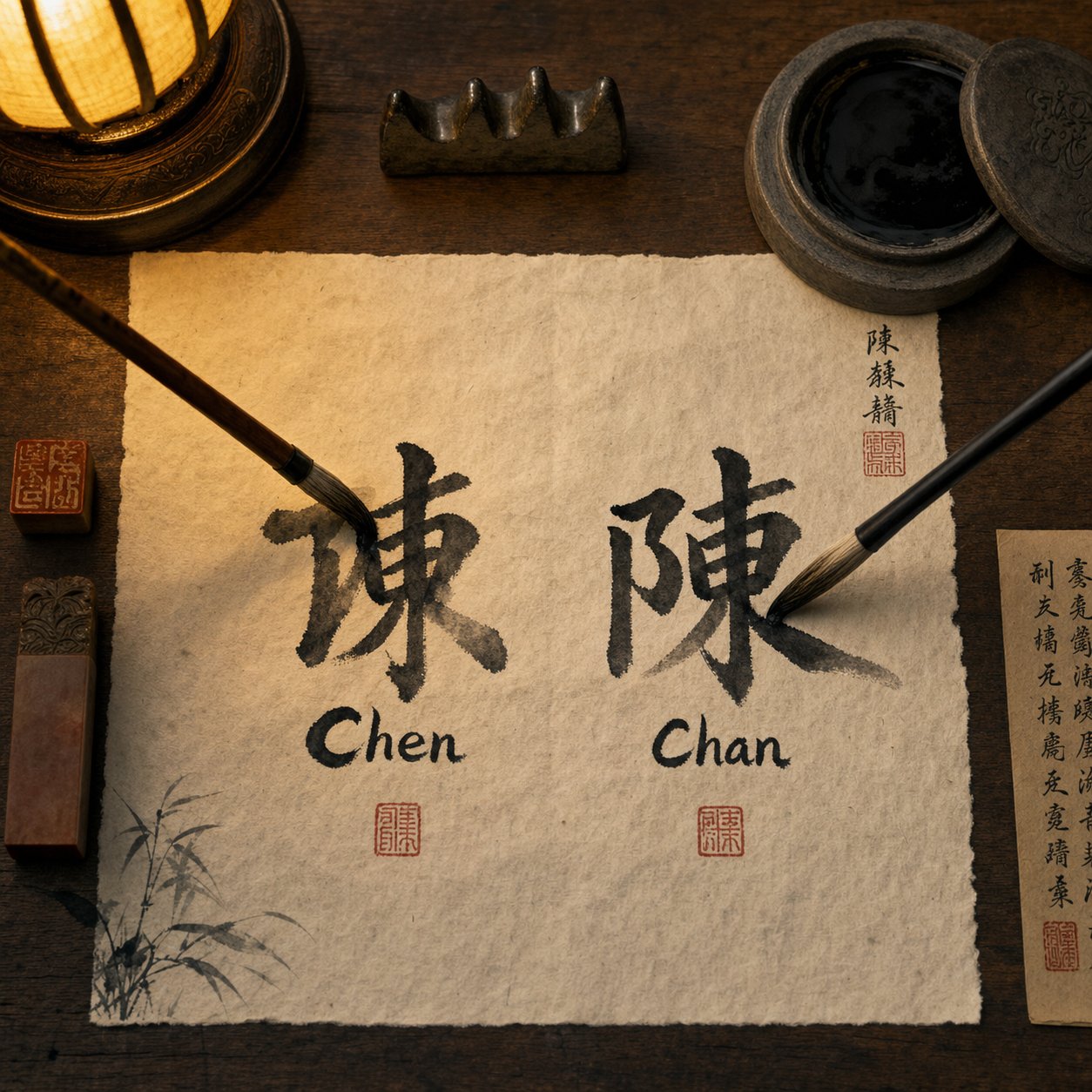
Consider the surname 陈. In Mandarin Pinyin, it's Chen. Cross into Cantonese-speaking Hong Kong, and it becomes Chan. Travel to Hokkien communities in Singapore or Malaysia, and it transforms into Tan. Some Teochew speakers use Teh. Older romanization systems recorded it as Chin. Five different spellings, one identical character, one shared ancestor.
This isn't confusion — it's linguistic precision. Each spelling accurately represents how the character sounds in a specific Chinese dialect. The character 陈 traces back to the ancient state of Chen, and every Chan, Tan, Teh, and Chin family in Southeast Asia descends from the same lineage. They just left China from different ports, speaking different regional languages.
The surname 黄 shows even more dramatic variation. In Mandarin, it's Huang. Cantonese speakers — particularly those with hong kong surnames — write it as Wong. Hokkien communities in Penang and Singapore use Ooi, Wee, or Ng. That last one surprises many people: Ng doesn't only come from the character 吴. In Hokkien and Teochew pronunciation, 黄 produces a nasal sound that English struggles to represent, so British colonial officers simply wrote "Ng" and moved on. The spelling stuck permanently.
The surname 林 follows a cleaner pattern but still splits across borders. Mandarin gives us Lin. Hokkien, Teochew, Hakka, and Hainanese speakers all produce something closer to Lim. Cantonese speakers say Lam. If your last name chinese spelling is Lim, your ancestors almost certainly emigrated from Fujian or Guangdong province. If it's Lam, the Cantonese connection is strong. If it's Lin, your family likely arrived in a Western country more recently, after Mandarin Pinyin became the standard romanization system.
The character 王 — meaning "king" and ranking as the most common surname in modern China — demonstrates how dialect and geography interact. Mandarin speakers write Wang. Cantonese speakers in Hong Kong write Wong. Hokkien speakers in Southeast Asia write Ong. Teochew speakers may use Heng. Among famous asian last names recognized internationally, Wong is arguably the most widely known variant, appearing everywhere from Hollywood credits to corporate boardrooms across Asia and the West.
Here's a reference table showing how mandarin surnames transform across dialect groups and countries of settlement:
| Character | Mandarin (Pinyin) | Cantonese | Hokkien/Teochew | Hakka | Common in |
|---|---|---|---|---|---|
| 陈 | Chen | Chan | Tan / Teh | Chin | Hong Kong, Malaysia, Singapore, Philippines |
| 黄 | Huang | Wong | Ooi / Ng / Wee | Fong / Wong | Hong Kong, Malaysia, Indonesia, USA |
| 林 | Lin | Lam | Lim | Lim | Malaysia, Singapore, Taiwan, Philippines |
| 王 | Wang | Wong | Ong / Heng | Wong | Hong Kong, Singapore, USA, UK |
| 李 | Li | Lee / Lei | Lee | Lee / Li | Worldwide — one of the most recognized surnames asian communities share |
| 张 | Zhang | Cheung / Cheong | Teo / Teoh | Chong / Chang | Hong Kong, Malaysia, USA |
| 刘 | Liu | Lau / Low | Lau / Low | Liew / Lew | Hong Kong, Malaysia, Singapore |
| 杨 | Yang | Yeung | Yeoh / Yeo | Yong | Malaysia, Singapore, Hong Kong |
| 吴 | Wu | Ng / Woo | Goh / Go | Ng / Wu | Singapore, Philippines, Malaysia |
| 蔡 | Cai | Choi / Tsoi | Chua / Choo | Chai | Malaysia, Singapore, Philippines |
You'll notice that hong kong last names tend to follow Cantonese pronunciation, while surnames in asia's Southeast Asian communities — particularly Malaysia, Singapore, and Indonesia — reflect Hokkien and Teochew speech patterns. This isn't random. It maps directly to migration history. Cantonese speakers dominated emigration to Hong Kong (which was already Cantonese-speaking), North America, and Australia. Hokkien and Teochew speakers dominated the earlier waves of migration to Southeast Asia, particularly the Straits Settlements of Penang, Malacca, and Singapore.
The timing of emigration matters too. Families who left China during the British colonial era had their surnames recorded phonetically by English-speaking officials who had no standardized system to follow. Later emigrants, arriving after China adopted Pinyin in 1958, tend to carry Mandarin-based spellings. This means two cousins from the same village could end up with different surname spellings simply because one left in 1920 and the other in 1980.
Surname Associations and Overseas Chinese Identity
Scattered across different countries with different surname spellings, how do diaspora communities maintain connections to shared ancestry? The answer lies in an institution that has operated for centuries: the surname association, known in Chinese as 宗亲会 (zong qin hui).
These organizations bring together everyone who shares a surname — regardless of spelling variation — under one roof. A surname association for 陈 in Kuala Lumpur might include members who spell their name Chen, Chan, Tan, and Teh. What unites them isn't the romanization on their identity cards. It's the shared Chinese character and the ancestral lineage it represents.
Surname associations serve multiple functions in diaspora life:
- Genealogical research — Maintaining records that connect overseas families back to specific villages in Fujian, Guangdong, or other ancestral provinces.
- Cultural preservation — Organizing festivals, temple worship, and educational programs that keep Chinese traditions alive across generations born abroad.
- Mutual aid — Historically providing financial support, business networks, and housing assistance to newly arrived immigrants who shared the surname.
- Identity anchoring — Giving diaspora families a sense of belonging that transcends national borders and linguistic differences.
In cities like Singapore, Penang, Bangkok, Manila, San Francisco, and Vancouver, these associations operate clan halls that have functioned continuously for over a century. Some maintain ancestral tablets, libraries of genealogical records, and direct relationships with home villages in China. The Hundred Family Surnames text often appears in these halls — framed on walls, printed in educational materials, or recited during cultural events — as a reminder that every surname in the diaspora connects back to a documented tradition.
For younger generations born overseas, the text serves a different purpose than it did for Song Dynasty schoolchildren. It's no longer a literacy primer. Instead, it functions as a cultural map — a way to locate your family within a broader story that spans continents and centuries. When a third-generation Malaysian Chinese teenager named Tan discovers that their surname connects them to the ancient state of Chen, to the character 陈, and to every Chan in Hong Kong and every Chen in Beijing, the text becomes a bridge across linguistic fragmentation.
This bridging function grows more important as surnames in asia continue to diversify through intermarriage, emigration to new countries, and generational language shifts. A Wong family in San Francisco, a Huang family in Shanghai, and an Ooi family in Penang may never meet — but the Hundred Family Surnames places them all within the same cultural framework, connected by a single character that has carried meaning for over a thousand years.
The diaspora experience highlights something essential about the text's lasting power. It was written as a political document, repurposed as a children's primer, and now functions as a cultural anchor for communities separated by oceans and languages. That capacity to evolve — to mean different things to different generations while preserving the same core content — is precisely what has kept it relevant across eleven centuries and counting.
Why the Hundred Family Surnames Still Matters Today
That capacity to evolve didn't stop at the diaspora. Inside China itself, the text is experiencing a quiet renaissance. Families who once dismissed it as an outdated relic of imperial education are returning to it with fresh eyes — not as a literacy tool, but as a gateway to something deeply personal: the question of where they come from.
The Modern Revival of Genealogy Research in China
Across China, a genealogy boom is underway. Families are reconstructing their 族谱 (zupu) — clan genealogies that trace lineage back through centuries of births, marriages, migrations, and name changes. For many, the Hundred Family Surnames serves as the first reference point in that journey. You find your surname in the text, identify its traditional position, and then begin tracing backward through historical records to locate your specific ancestral branch.
Why now? Rapid urbanization over the past four decades scattered families across provinces. Grandparents who once kept oral histories have passed away. Young professionals in Shanghai or Shenzhen realize they can't name their great-grandparents or identify their ancestral village. The urgency to recover that information before it disappears entirely has turned genealogy into both a personal mission and a commercial industry. Online platforms, DNA testing services, and digitized county archives now make it possible to research a chinese family name list that once required months of travel to ancestral villages.
The text itself doesn't contain genealogical data — it's a list of chinese surnames, not a family tree. But it provides the organizational framework. Each surname entry connects to documented origin stories, ancestral homelands, and historical migration patterns that genealogy researchers use as starting coordinates. A family named Zheng, for instance, knows from the text's traditional commentaries that their surname traces to the ancient state of Zheng in modern Henan province. That geographic anchor narrows the search from an entire country to a specific region.
Government statistical bureaus have continued this cataloging tradition into the modern era. China's Ministry of Public Security now tracks over 6,000 surnames china currently has in active use — a number that dwarfs the original 504 but confirms the text's foundational insight that surnames form a finite, documentable system. The ministry's annual National Name Report has become a cultural event in its own right, with media coverage analyzing which surnames are growing, shrinking, or appearing for the first time through ethnic minority registration.
From Political Document to Cultural Heritage Artifact
Consider the arc this text has traveled. In 960 AD, it was a political statement — a scholar in Hangzhou encoding Song Dynasty loyalty into a surname registry. By the Ming Dynasty, it had been repurposed as a children's primer, stripped of its political context and valued purely for its educational utility. During the Cultural Revolution, it was dismissed as feudal heritage. And today? It's preserved as intangible cultural heritage, studied by linguists, referenced by demographers, and recited by families reconnecting with ancestral identity.
Few documents in any civilization have served so many different purposes across so many centuries. The 100 surnames text has been propaganda, pedagogy, poetry, and now patrimony — each generation finding a new reason to keep it alive without discarding the previous generation's use for it.
Modern surname surveys by government bureaus represent the latest chapter in this tradition. When the Ministry of Public Security publishes data showing that Wang, Li, Zhang, Liu, and Chen remain the five most common surnames, they're performing essentially the same act that Qian Tang performed in 960 AD: documenting who the Chinese people are through the lens of their family names. The methodology has changed — census data replaces political hierarchy — but the impulse to catalog and organize surnames into a coherent system remains identical.
The Hundred Family Surnames endures not because it is historically frozen, but because each generation discovers a new reason to consult it — as political loyalty, as literacy primer, as genealogical starting point, and as cultural heritage connecting 1.4 billion people to a shared naming tradition over a thousand years old.
What began as one scholar's coded tribute to Song Dynasty power has become something its author never intended: a living document that belongs to everyone who carries a Chinese surname, regardless of where in the world they live or which dialect shaped the spelling on their passport. The text doesn't just record history. It participates in it, accumulating new meaning with every generation that picks it up and finds their name inside.
Frequently Asked Questions About the Hundred Family Surnames
1. Why does Zhao come first in the Hundred Family Surnames instead of Wang or Li?
Zhao leads the text because it was the imperial surname of the Song Dynasty emperors who ruled when the text was composed around 960 AD. The ordering was entirely political, not based on population frequency. The compiler placed the ruling house first as a declaration of loyalty, followed by Qian (the surrendered Wuyue king's surname), Sun (the Wuyue queen's family), and Li (the Southern Tang royal house). Wang, despite being the most common surname today, appears only at position eight because its political significance was lower than the royal families involved in Song Dynasty unification.
2. How many surnames does the Hundred Family Surnames actually contain?
Despite its name suggesting just 100 entries, the text records 504 surnames in total. Of these, 444 are single-character surnames and 60 are compound (two-character) surnames grouped at the end. The word 'hundred' in the title comes from the classical Chinese idiom 百家 (bai jia), which means 'all families' or 'the common people' rather than a literal numerical count. The text was designed as a comprehensive registry covering virtually every surname in use during the early Song Dynasty.
3. What are the most common Chinese surnames today compared to the original text's ordering?
Modern census data from China's Ministry of Public Security shows the top five surnames by population are Wang, Li, Zhang, Liu, and Chen. This differs dramatically from the text's opening sequence of Zhao, Qian, Sun, Li, Zhou, Wu, Zheng, Wang. Wang ranks first today with roughly 100 million bearers but sits at position eight in the original text. Zhao, placed first in the text for political reasons, ranks only eighth by modern population. Approximately 85% of China's 1.4 billion people share about 100 surnames, with over 6,000 surnames currently in active use nationwide.
4. What are compound surnames in Chinese and why are they so rare?
Compound surnames (复姓) use two characters instead of one, such as Sima, Ouyang, and Zhuge. They originate from ancient official titles, geographic place names, noble lineage markers, or ethnic tribal identifiers dating back to the Zhou Dynasty. China once had over 1,000 compound surnames, but fewer than 100 remain today. They became rare because families gradually simplified their names to single characters for convenience or social pressure. Ouyang is the most common compound surname today with about 1.1 million bearers, compared to tens of millions for top single-character surnames like Wang or Li.
5. Why do Chinese surnames have different spellings in different countries?
The same Chinese character produces different romanized spellings depending on which dialect the emigrant spoke and which country they settled in. For example, the character 陈 becomes Chen in Mandarin Pinyin, Chan in Cantonese (common in Hong Kong), Tan in Hokkien (common in Singapore and Malaysia), and Chin in older romanization systems. Colonial officials in Southeast Asia and the West wrote down surnames phonetically based on what they heard, and those spellings became permanent. Two people with identical ancestral characters can carry completely different passport spellings simply because their families left China from different regions or in different eras.