Li Bai Name Meaning Explained
What does the name Li Bai actually mean? The li bai name meaning breaks down into two Chinese characters: 李 (Lǐ), a surname meaning "plum tree," and 白 (Bái), a given name meaning "white" or "bright." Together, 李白 names the most celebrated li bai poet in Chinese literary history, a man whose identity was woven into celestial mythology from the moment of his birth.
Li Bai (李白, Lǐ Bái): A Tang Dynasty poet whose given name means "white" or "bright," linked to the planet Venus through his courtesy name Taibai (太白, "Great White"). His mother reportedly dreamed of Venus the night she conceived him, and the name reflects that celestial origin.
What Li Bai Means in Chinese
In Mandarin Chinese, the name is pronounced Lǐ Bái (pinyin). The surname 李 places him within the imperial clan of the Tang Dynasty, while the character 白 carries meanings of whiteness, brightness, purity, and clarity. This poet, written about in the books of Tang dynasty history, bore a name that doubled as a poetic image: luminous, unadorned, and tied to the heavens.
Why His Name Still Captivates Readers
A Chinese name is rarely just a label. Li Bai's name encodes an imperial lineage, a celestial legend involving the planet Venus, and an aesthetic philosophy of radiant simplicity that runs through every verse he composed. His courtesy name, Taibai, literally translates to "Great White" and served as the traditional Chinese name for Venus. Even his famous epithet, "Banished Immortal," suggests a being of heavenly origin sent down to walk among mortals.
Each layer of his name opens a different door into Tang Dynasty culture, Chinese cosmology, and the art of poetry itself. The characters hold more than etymology. They hold a universe.
How Chinese Names Work
Imagine introducing yourself by saying your family name first and your personal name second. That is exactly how Chinese names operate. When you encounter "Li Bai," you are reading a surname followed by a given name, the reverse of Western naming conventions. Understanding this structure is essential to grasping the full li bai name meaning and the cultural weight each character carries.
Surname First and Given Name Second
In Chinese, the surname (姓, xìng) always comes first. "Li" (李) is the family name, shared across an entire clan. "Bai" (白) is the personal name, chosen specifically for this individual. So when you see words with li at the front of a Chinese name, you are looking at the family identifier, not a first name in the Western sense.
How to pronounce bai? In Mandarin pinyin, it sounds like "bye" with a rising tone. The bai chinese character (白) is one of the most common elements in Chinese vocabulary, appearing in everyday words for clarity, blankness, and light. Placed after the surname, it becomes the intimate, personal half of the poet's identity.
The Multi-Name System of Tang Dynasty China
A single given name was only the beginning. Educated men in Tang Dynasty China moved through life carrying multiple names, each reserved for specific social situations. You might find all of these recorded in a calligraphy book preserving a scholar's literary works or personal correspondence. The system looked like this:
- Given name (名, míng): Assigned at birth by parents. Used only by elders and in formal records.
- Courtesy name (字, zì): Adopted at the age of maturity (around 20). Used by peers and colleagues as a sign of respect. Calling someone by their given name directly was considered impolite among equals.
- Art name (号, hào): A self-chosen literary pseudonym reflecting personal philosophy or aesthetic ideals. Often seen in poetry collections and inscribed in a calligraphy book alongside the poet's works.
This layered system meant that the same person could be addressed differently depending on who was speaking, the formality of the occasion, and the relationship between the parties. A father used the given name. A friend used the courtesy name. A reader centuries later might know only the art name.
Li Bai operated within all three layers. His given name was Bai (白). His courtesy name was Taibai (太白). His art name was Qinglian Jushi (青蓮居士). Each name unlocked a different facet of his identity, and each carried its own symbolic resonance rooted in Chinese cosmology and literary tradition.
The Li Surname and Its Imperial Roots
The surname 李 is not just any family name. It is the single most common surname in China today, carried by nearly 100 million people, and during the Tang Dynasty (618-907 CE), it was the name of emperors. When you read "Li Bai," that first character places the poet within a lineage that ruled one of the most powerful civilizations on Earth. Understanding what 李 contains, both visually and historically, reveals a political dimension to the li bai name meaning that goes far beyond etymology.
The Plum Tree Character
Look closely at 李 and you will see two components stacked vertically. The top half is 木 (mù), meaning "tree" or "wood." The bottom half is 子 (zǐ), meaning "child" or "seed." Together, they form a character that literally depicts a tree bearing fruit: the plum tree.
Why does this matter? In Chinese culture, the plum tree is far more than an orchard staple. It carries deep symbolic weight:
- Resilience: Plum blossoms bloom in late winter, pushing through frost and snow before any other flower dares to open. They represent endurance through hardship.
- Beauty in simplicity: The blossoms are small, pale, and unadorned, yet celebrated as one of the "Four Gentlemen" (四君子) of Chinese art alongside orchid, bamboo, and chrysanthemum.
- Renewal: Because they appear at the turn of seasons, plum blossoms signal the arrival of spring and new beginnings.
For poets of the Tang dynasty, the plum tree was a ready-made metaphor for the scholar who thrives in adversity. The fact that Li Bai's surname literally encodes this image gives his name a poetic resonance before you even reach the given name.
An Imperial Surname in Tang Dynasty China
Here is where the political weight enters. The Tang Dynasty was founded by the Li family. Emperor Gaozu (Li Yuan) established the dynasty in 618 CE, and for nearly three centuries, every ruler on the throne bore the surname 李. Carrying this name during the Tang era was not neutral. It signaled proximity to power, whether real or claimed.
To bear the surname Li in Tang Dynasty China was to share a character with the Son of Heaven. It could open doors at court, lend credibility to a poet seeking patronage, and imply a bloodline touched by imperial destiny.
Li Bai himself claimed descent from Li Gao, a Tang Dynasty general and distant member of the imperial clan. According to accounts preserved by tang poets and historians, his family had been exiled to the western frontier regions, possibly in what is now Kyrgyzstan or the Gansu corridor, before returning to the Chinese heartland during his childhood. The exact details remain debated among scholars, but the claim itself mattered enormously for his social positioning.
Think of it this way: a poet in books of Tang dynasty records who shared the emperor's surname and claimed royal blood could present himself as a peer of the aristocracy rather than a mere commoner seeking favor. Li Bai leveraged this identity throughout his life, approaching the court not as a supplicant but as someone who belonged there by birthright. Whether his genealogical claims were fully legitimate or partly constructed, they shaped how contemporaries received him and how book of tang poet biographies recorded his story.
This imperial connection also colored his famous independence. Among the poets of the tang dynasty, Li Bai stood out for his refusal to climb the bureaucratic ladder through the standard examination system. A man who believed himself descended from emperors could afford to wait for a direct imperial summons, and that is exactly what he did, eventually receiving a call to the court of Emperor Xuanzong in 742 CE.
The plum tree and the throne. Resilience and royalty. Both meanings live inside that single character 李, giving the poet's surname a depth that most Western readers never suspect.
The Character Bai and Its Layered Symbolism
Resilience and royalty live in the surname. But what about the given name? The character 白 (bái) is where the li bai name meaning shifts from political lineage to something luminous and almost otherworldly. This single character carries a constellation of meanings: white, bright, pure, clear, plain, and even blank. Each shade of meaning adds another dimension to the poet's identity.
White Bright and Pure
Visually, 白 is one of the oldest and most recognizable characters in Chinese writing. Its earliest oracle bone form depicted the shape of an acorn or a flame tip, representing something radiating light. Over millennia, it simplified into the clean six-stroke character used today. Unlike compound characters built from multiple radicals, 白 functions as a radical itself, appearing inside dozens of other characters related to brightness and clarity.
Open any Chinese dictionary and you will find 白 carrying a remarkable range of definitions:
- White: The color itself, the absence of hue, associated with snow, bone, and bare silk.
- Bright / Luminous: Describing light that is clear and unobstructed, as in 明白 (míngbai, "to understand" — literally "bright-white").
- Pure / Unadorned: Something free from mixture or contamination, plain and honest.
- Clear / Plain-spoken: As in 白话 (báihuà), the vernacular language stripped of literary ornamentation.
- Blank / Empty: A white page, an unmarked space, potential waiting to be filled.
When Li Bai's parents chose this character for their son, they selected a word that simultaneously evoked radiance, honesty, and celestial light. It was not a common given name for men of the era, which made it distinctive and immediately suggestive of something beyond the ordinary.
Cultural Symbolism of Bai in Chinese Tradition
In Chinese literary tradition, whiteness connects directly to two powerful natural images: moonlight and snow. Both represent purity, transience, and a beauty that exists beyond human control. The moon, in particular, holds a central place in Chinese poetics as a symbol of reunion, longing, love, and purity.
Consider Li Bai's most famous moon poem, "Thoughts on a Tranquil Night" (静夜思). The opening line reads: 床前明月光 — "Before my bed, bright moonlight." The character 明 (míng, bright) contains 白 as a conceptual cousin, and the entire scene bathes in white radiance. The poet, all alone in the moonlight of a foreign land, mistakes the glow on the floor for frost. Whiteness here becomes the bridge between homesickness and beauty, between the celestial and the deeply personal.
This is not coincidence. The imagery of 白 saturates Li Bai's work. In "Grief on the Jade Steps" (玉阶怨), white dew grows on jade steps while a woman gazes at the autumn moon. The moon poem builds its emotional power entirely on images of pale light, crystal curtains, and solitary watching. Whiteness in these verses is never merely decorative. It carries emotional weight: loneliness, purity of feeling, and an ache for something unreachable.
Yet 白 also carries a shadow. In Chinese culture, white is the color of mourning. Funeral garments are white. White flowers mark death. This duality gives the character a bittersweet edge that resonates with Li Bai's poetic temperament, a man who celebrated life with extraordinary intensity while remaining haunted by impermanence.
| Meaning of 白 | Context | Connection to Li Bai |
|---|---|---|
| White (color) | Snow, silk, bone, funeral garments | Imagery of frost and moonlight in his verses |
| Bright / Luminous | Moonlight, starlight, dawn | His courtesy name Taibai ("Great Brightness") links to Venus |
| Pure / Unadorned | Moral character, simplicity | His poetic style favors clarity over ornamentation |
| Clear / Plain | Vernacular speech, transparency | His poems use accessible language that endures across centuries |
| Blank / Empty | Unmarked space, potential | Daoist emptiness and spontaneity in his philosophy |
| Mourning | Death, funerals, loss | The transience and melancholy woven through his drinking poems |
All of these meanings coexist inside a single character. When readers encounter 白 in the poet's name, they are not seeing one definition but an entire spectrum of associations that Chinese literary culture has layered over thousands of years. The brightness of Venus, the purity of moonlight, the starkness of grief — all compressed into six brushstrokes.
That celestial brightness encoded in 白 was no accident. It pointed directly upward, toward a specific star in the night sky, and toward a birth legend that would define the poet's identity for over a thousand years.
Venus and the Birth Legend Behind His Name
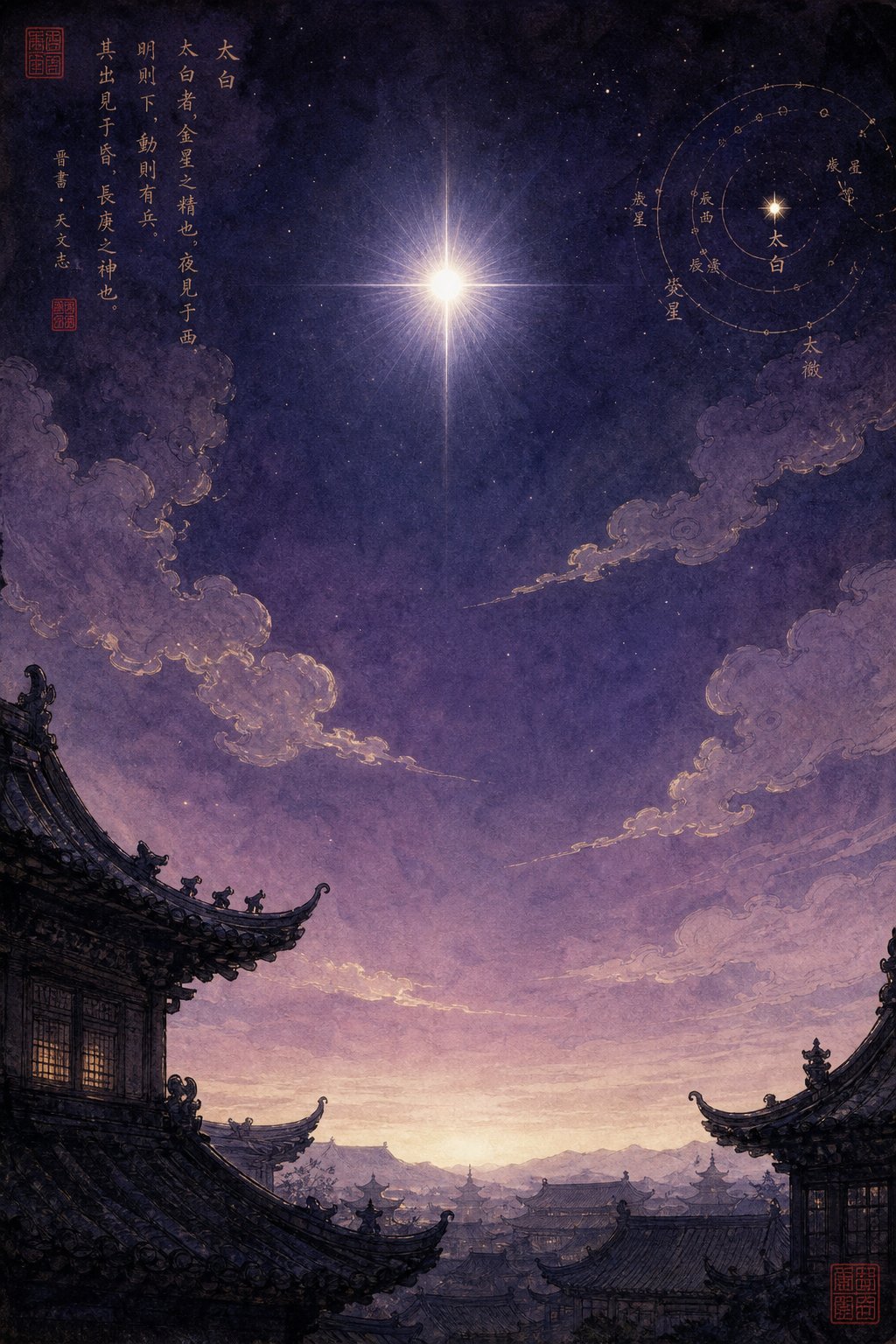
That star was Venus. In Chinese astronomy, the planet Venus has been called 太白 (Tàibái) — "Great White" or "Supreme Brightness" — for over two thousand years. This was not merely a poetic nickname. It was the formal astronomical designation recorded in texts like the Records of the Grand Historian (史记), where the astronomer Sima Qian documented Venus's movements and their significance for statecraft and warfare. And it was the courtesy name given to the most famous chinese poet of the Tang Dynasty.
Li Bai's courtesy name (字, zì) was Taibai (太白). In the multi-name system of Tang Dynasty China, this was the name his peers would have used in daily conversation, the name inscribed on formal correspondence, and the name by which educated society knew him. When later generations refer to him as Li Tai Po — an older romanization of Li Taibai — they are using this courtesy name rather than his given name. The choice was deliberate, rooted in a birth story that fused family legend with celestial mythology.
Taibai as the Chinese Name for Venus
Why did the ancient Chinese call Venus "Great White"? Look at the night sky. Venus is the brightest natural object visible from Earth after the sun and the moon. At its most luminous, it outshines every star and planet, casting faint shadows on a clear night. Its brilliance is white and steady, unlike the reddish flicker of Mars or the golden warmth of Jupiter. The character 太 (tài) means "great" or "supreme," and 白 (bái) means "white" or "bright." Together, 太白 names the celestial body by its most obvious quality: supreme brightness.
Venus also held a unique position in Chinese cosmology because it appears in two different guises. When it rises before dawn in the eastern sky, the ancients called it 启明 (Qǐmíng) — the "Opener of Brightness" or Morning Star. When it appears after sunset in the western sky, they called it 长庚 (Chánggēng) — the "Long-lasting Brightness" or Evening Star. The Book of Songs (诗经), China's oldest poetry anthology, records both names: "In the east is the Morning Star, in the west is the Evening Star." For centuries, people did not realize these were the same object. Once astronomers confirmed the identity, Venus became a symbol of duality and transformation — a single body wearing two faces depending on the hour.
In the framework of Yin-Yang and Five Elements theory, Venus corresponded to the element Metal and the direction West. It governed warfare and military affairs. The Records of the Grand Historian states: "The Great White Star is the essence of western metal, the son of the White Emperor, a symbol of a high-ranking official or a great general." Military strategists adjusted battle plans based on Venus's movements. Its appearance could signal victory; its absence could warn of defeat. Naming a child after this star was not casual. It was an act of cosmic ambition.
The Legend of the Changgang Star Dream
How did a baby born in the western frontier of Tang China come to carry the name of the brightest planet? The answer lives in a story passed down through family records and literary prefaces — a story that blends maternal vision with celestial destiny.
According to Li Yangbing's "Preface to the Collection from the Thatched Hall," on the night Lady Jiang conceived her son, the Changgeng star — Venus in its evening aspect — entered her dream. Startled by the vision of supreme brightness descending into her body, she understood the child would carry something heavenly. He was therefore named Bai (White) at birth, and given the courtesy name Taibai (Great White) to honor the star that announced his arrival.
This was not an unusual practice. Dream-inspired naming was a recognized tradition in Tang Dynasty culture and earlier periods. Parents who experienced vivid dreams during pregnancy or on the night of conception often interpreted them as messages from heaven, choosing names that reflected the dream's content. A dream of a dragon might produce a name containing 龙 (lóng). A dream of a phoenix could yield 凤 (fèng). A dream of the brightest star in the sky? That produced 白 and 太白.
The legend served multiple purposes. It elevated Li Bai from a talented poet into something approaching a mythic figure — a being whose connection to the heavens was established before his first breath. In the context of poetry in tang dynasty literary culture, where Daoist immortality and celestial transcendence were serious philosophical pursuits, claiming stellar origins was not mere vanity. It positioned the poet within a cosmological narrative. The Gold Star of Venus, known in Daoist tradition as a deity of wisdom and strategic brilliance, had supposedly chosen to manifest through this child. Later generations would describe Li Bai's calligraphic style as something heavenly in cursive, his brushstrokes carrying the same untamed energy as his verse — as though the star's radiance flowed through his hand as naturally as through his words.
Did Lady Jiang truly dream of Venus? The historical record cannot confirm or deny a private dream. What matters is that the family believed it, named the child accordingly, and the story became inseparable from the poet's identity. By the time Li Bai arrived at the Tang court decades later, the legend preceded him. He was not simply a gifted writer seeking patronage. He was the man named after Venus, the poet whose very existence had been announced by the brightest light in the night sky.
This celestial framing — a name drawn from the heavens, a courtesy name that doubled as an astronomical term — meant that Li Bai carried his mythology with him in every introduction, every signature, every poem signed with the name Taibai. The star was not just his namesake. It became his brand, his origin story, and eventually, the lens through which an entire civilization would remember him. Something heavenly in cursive script, something immortal in verse.
Yet Venus and the birth legend were only part of the picture. Li Bai accumulated names throughout his life the way other men accumulated titles, and each one revealed a different facet of how his world perceived him.
Every Name Li Bai Was Known By
Li Bai did not move through the world with a single name. He carried a constellation of them — each one earned, inherited, or bestowed at a different stage of life, each one revealing something distinct about how he saw himself and how others saw him. For readers trying to pin down the poet spelling they encounter in different translations and anthologies, this multiplicity can be confusing. The same man appears as Li Bai, Li Taibai, Qinglian Jushi, Li Twelve, and the Banished Immortal depending on who is writing and when. Understanding the full catalog of his names is understanding the full scope of his identity.
Courtesy Name, Art Name, and Nicknames
You already know the given name: Bai (白), meaning white or bright, chosen after his mother's dream of Venus. You know the courtesy name: Taibai (太白), the astronomical designation for Venus itself, used by peers and colleagues throughout his adult life. These two names anchored his public identity. But the system did not stop there.
Li Bai's self-chosen art name was Qinglian Jushi (青蓮居士), which translates to "Householder of the Green Lotus" or "Lay Buddhist of the Blue Lotus." This name reveals a spiritual dimension absent from his celestial given name. The lotus is Buddhism's central symbol of purity — a flower that rises clean from muddy water. By calling himself a "householder" (居士, jūshì), Li Bai identified as a lay practitioner rather than a monk, someone who pursued spiritual cultivation without renouncing worldly life. The "green" or "blue" (青, qīng) lotus specifically references Qinglian Township in Sichuan, where he spent his youth. So the art name simultaneously declared his spiritual orientation and his geographic roots.
Then there was the informal nickname: Li Twelve (李十二, Lǐ Shí'èr). This was not poetic or mythological. It was simply his birth-order ranking among male cousins in the extended Li clan. In Tang Dynasty social life, friends and acquaintances commonly addressed each other by these generational numbers. The great poet Du Fu, Li Bai's close friend, used this nickname in poems addressed to him. It was intimate, casual, and grounded — a reminder that behind the celestial mythology stood a real man with a specific place in a family hierarchy.
Each name operated in a different register. The given name belonged to family elders and official documents. The courtesy name belonged to educated peers. The art name belonged to literary posterity. The nickname belonged to friends. Together, they formed a complete social map of one person's life.
The Banished Immortal and Other Epithets
The most famous title Li Bai ever received came not from his family but from a stranger who read his poetry and was stunned. Around 742 CE, when Li Bai arrived in the Tang capital of Chang'an, the elderly court official He Zhizhang (贺知章) encountered his work — some accounts say it was the poem "Shu Dao Nan" (蜀道难, "Hard Roads in Shu") — and declared on the spot: "This is no mortal. This is a banished immortal!"
The phrase was 謫仙人 (zhé xiān rén). 謫 means "banished" or "exiled as punishment." 仙人 means "immortal" or "transcendent being." The implication was extraordinary: Li Bai was not merely talented. He was a celestial being who had been cast down from heaven, perhaps for some transgression, and was temporarily walking the earth in human form. His poetry was not learned skill but divine nature leaking through a mortal vessel.
Sounds dramatic? It was. But in the context of Tang Dynasty Daoism, where the pursuit of immortality was a genuine philosophical and alchemical practice, calling someone a "banished immortal" was not empty flattery. It was a cosmological claim. He Zhizhang was saying that Li Bai's talent could not be explained by human effort alone. And the label stuck. For over a thousand years, Chinese literary culture has referred to Li Bai as the Banished Immortal (謫仙, zhé xiān), and the title has become inseparable from his legacy.
Other epithets accumulated over the centuries. He became known as the "Poet Immortal" (诗仙, Shī Xiān), distinguishing him from Du Fu, the "Poet Sage" (诗圣, Shī Shèng). Western readers who encounter the poet Li Po in older English translations — or the variant "poet po" in casual references — are meeting the same figure under a different romanization, but the Chinese epithet remains unchanged regardless of spelling system. The lipo poet of Ezra Pound's imagination and the Li Bai of modern pinyin scholarship share every one of these titles.
| Name | Chinese Characters | Pinyin | Meaning | Context of Use |
|---|---|---|---|---|
| Given name | 白 | Bái | White / Bright | Used by parents, elders, and in official records |
| Courtesy name | 太白 | Tàibái | Great White (Venus) | Used by peers, colleagues, and in formal social settings |
| Art name | 青蓮居士 | Qīnglián Jūshì | Householder of the Green Lotus | Self-chosen literary pseudonym for poetry and spiritual identity |
| Generational nickname | 李十二 | Lǐ Shí'èr | Li Twelve (birth order among cousins) | Used by close friends like Du Fu in personal poems |
| Epithet (by He Zhizhang) | 謫仙人 | Zhé Xiān Rén | Banished Immortal | Literary title reflecting his perceived supernatural genius |
| Posthumous epithet | 诗仙 | Shī Xiān | Poet Immortal | Used by later generations to rank him among China's greatest poets |
Notice the pattern. The given name points to brightness. The courtesy name points to a star. The art name points to spiritual purity. The epithet points to heaven itself. Each name escalates the celestial association, building a cumulative identity that lifts the poet further from the ordinary with every layer added. By the time all names are assembled, Li Bai is no longer simply a man who wrote well. He is a figure suspended between the human and the divine, named at every stage of life for something luminous and unreachable.
This proliferation of names also explains a practical puzzle that confuses many English-language readers: why does the same poet appear under so many different spellings across books, anthologies, and academic papers?
Why You See Li Bai, Li Po, and Ri Haku
The confusion is real. You pick up one anthology and the poet is called Li Po. Another book spells it Li-Po. A university syllabus lists Li Bo. An early twentieth-century translation credits someone named Rihaku. A Cantonese speaker might refer to him as Lee Po Chinese readers would recognize instantly. Are these different people? They are not. Every one of these spellings represents the same two characters — 李白 — filtered through different romanization systems, regional pronunciations, and translation histories.
Pinyin, Wade-Giles, and Historical Spellings
The root of the problem is that Chinese characters do not have a single "correct" English spelling. They have sounds, and those sounds must be approximated using the Latin alphabet. Over the past 150 years, multiple systems have competed to do this job, and each one produces a different result for the same character.
The two dominant systems are:
- Pinyin (拼音): The official romanization system of the People's Republic of China, adopted in 1958 and now the international standard. Under pinyin, 李白 becomes Li Bai. This is the spelling used in modern scholarship, Chinese government publications, and most academic work published after the 1980s.
- Wade-Giles: A romanization system developed by British diplomats Thomas Wade and Herbert Giles in the late 19th century. Under Wade-Giles, 白 is romanized as Po (or P'o with an aspirate mark), producing Li Po or Li-Po. This spelling dominated English-language sinology for over a century and still appears in older translations, library catalogs, and literary anthologies.
Why does the same character 白 become "Bai" in one system and "Po" in another? Two reasons. First, Wade-Giles uses different consonant and vowel conventions than pinyin — what pinyin writes as "b" Wade-Giles writes as "p" (reserving "p'" for the aspirated sound). Second, and more importantly, the Wade-Giles "Po" reflects an older or regional pronunciation. In standard Mandarin today, 白 is pronounced bái. But in certain historical readings and in Cantonese, the vowel shifts. Cantonese speakers pronounce 白 as "baak6," and older Mandarin literary readings sometimes rendered it closer to "bo" or "po." The variant Li Bo splits the difference, representing a Mandarin pronunciation that treats 白 with a slightly different vowel than modern standard pinyin dictates.
Here is a quick reference for every major variant you will encounter:
- Li Bai — Hanyu Pinyin (modern standard)
- Li Po — Wade-Giles romanization
- Li-Po — Wade-Giles with hyphenation (common in older literary publications)
- Li Bo — Alternative Mandarin reading reflecting a literary pronunciation of 白
- Li Taibo / Li T'ai-po — Full courtesy name in pinyin / Wade-Giles
- Ri Haku — Japanese on'yomi reading of the same characters
None of these is "wrong." They are parallel transcriptions of identical characters, each carrying the fingerprint of a particular era, language community, or scholarly tradition. When you see lee po chinese literature references in older English texts, you are simply encountering a pre-pinyin spelling convention that has not been updated.
Ri Haku and the Ezra Pound Connection
The most surprising variant is Rihaku. It looks nothing like the Chinese name, and for good reason — it is not Chinese at all. It is Japanese.
When Chinese characters (漢字, kanji) entered Japan, they carried with them Chinese-derived pronunciations called on'yomi (音読み). The character 李 received the Japanese reading "Ri" (り), and 白 became "Haku" (はく). So 李白, read through the Japanese phonetic system, becomes Ri Haku. Japanese scholars, poets, and readers have known the Tang poet by this name for over a thousand years.
This would have remained a footnote in comparative linguistics if not for one man: Ezra Pound. In 1915, Pound published Cathay, a slim collection of translations from classical Chinese poetry that became one of the most influential volumes in modern English literature. The poems were luminous, spare, and emotionally direct. They transformed how English-speaking readers understood Chinese verse. And they credited the author as "Rihaku."
Why? Pound did not read Chinese. He worked from the notebooks of Ernest Fenollosa, an American scholar who had studied Chinese poetry in Japan under Japanese teachers. Fenollosa's notes used Japanese readings of Chinese characters throughout. When Pound inherited these manuscripts after Fenollosa's death, he adopted the Japanese pronunciations wholesale. The result was that an entire generation of Western readers — including T.S. Eliot, W.B. Yeats, and countless university students — first encountered Li Bai under his Japanese name.
Pound's Cathay translations, sometimes called works of imperial Cathay for their evocation of ancient Chinese civilization, introduced poems like "The River-Merchant's Wife: A Letter" and "Exile's Letter" to the English-speaking world. These poems became canonical in modernist literature. And because Pound's versions were so widely read, the name "Rihaku" persisted in Western literary consciousness long after sinologists had standardized pinyin spellings. Even today, you will find anthologies of modernist poetry that index the poet under "R" rather than "L."
The irony is rich. A poet whose Chinese name means "white" and "bright" — whose identity was built on celestial imagery and linguistic precision — became famous in the West through a chain of linguistic indirection: Chinese characters read by Japanese scholars, transcribed by an American art historian, and finally shaped into English verse by a poet who could not read the originals. The li bai name meaning, so carefully constructed across layers of Chinese culture, arrived in English stripped of its etymology and wearing a foreign pronunciation.
Yet the poetry survived every transformation. Regardless of whether readers know him as Li Bai, Li Po, or Rihaku, the imagery of moonlight, whiteness, and celestial brightness shines through — because those qualities live not just in his name but in the very fabric of his verses.
How His Name Echoes Through His Poetry
The poetry survived every spelling variant because the name's meaning is not just biographical trivia — it is a key to reading the verses themselves. Across the hundreds of poems li bai left behind, the imagery of whiteness, brightness, and celestial radiance appears with a frequency that goes beyond coincidence. His name was not a label sitting apart from his art. It was a thread running through it.
Moonlight and Whiteness in His Most Famous Verses
Consider the most widely memorized poem in the Chinese language: "Quiet Night Thought" (静夜思). Every schoolchild in China knows its opening line: 床前明月光 — "Before my bed, bright moonlight." The character 明 (míng, bright) and the character 白 (bái, white) are conceptual siblings. Moonlight in Chinese poetry is always 白 — white, pale, luminous. When Li Bai writes about bright moonlight pooling on the floor like frost, he is writing inside the semantic field of his own name. The poem on alone in a strange land, gazing at the moon and thinking of home, becomes a kind of self-portrait painted in the color of his given name.
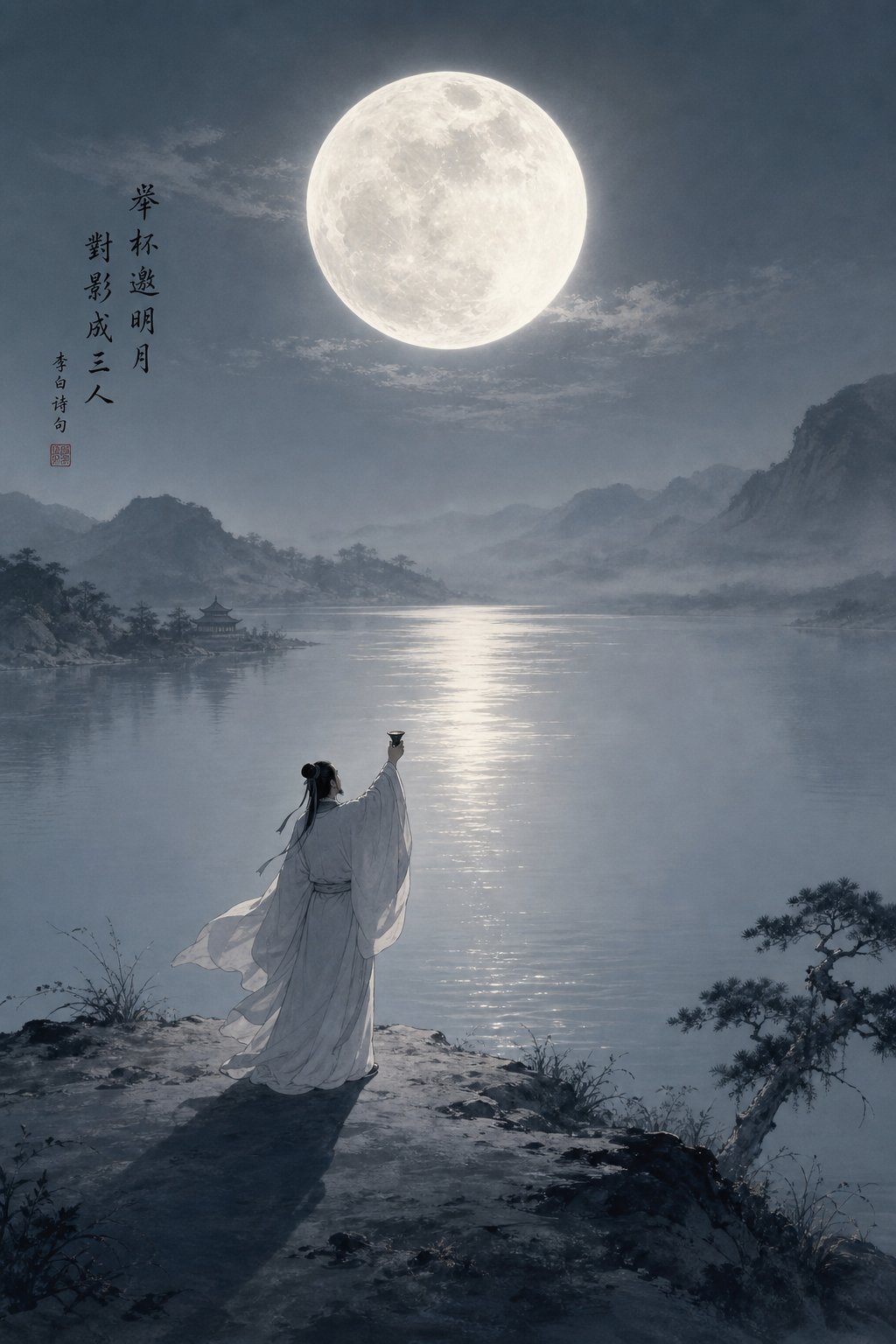
The pattern intensifies in "Drinking Alone Under the Moon" (月下独酌), one of the most celebrated poems of li bai. Here the poet raises his cup to the moon, invites his own shadow to join the party, and creates a trio of solitary companions: man, moon, shadow. The moon is again 明月 — bright moon — and the entire scene unfolds in white radiance against darkness. There is a saying that sober thoughts are drunk words, and Li Bai's drinking poems bear this out. Beneath the wine-soaked spontaneity lies precise imagery that circles back, again and again, to brightness against the void.
Even in poems far removed from moonlit scenes, whiteness intrudes. In 蜀道难 ("Hard Roads in Shu"), the terrifying mountain passes are crowned with snow, and waterfalls crash white against black cliffs. In "Seeing Off Meng Haoran at Yellow Crane Tower," the lone sail vanishes into blue sky and the Yangtze flows toward the horizon — but the sky's emptiness reads as a kind of blankness, the 白 of open space. Li bai poetry returns to these images the way a river returns to the sea.
A Poet Who Lived Inside His Name
What makes this remarkable is not that a poet used light imagery — many poets do. What makes it remarkable is the density and consistency. Poems by li bai treat brightness as a personal signature rather than a generic device. The celestial radiance of Venus, the purity of white, the clarity of moonlight — these are not decorations scattered across his work. They are the recurring vocabulary of a man whose identity was fused with luminosity from birth.
"I raise my cup to invite the bright moon; with my shadow we become three." — Li Bai, "Drinking Alone Under the Moon" (月下独酌)
That single couplet contains the entire li bai name meaning in miniature. The bright moon (明月) carries the radiance of 白. The solitude carries the poet's famous independence. And the act of drinking — spontaneous, unguarded, where sober thoughts are drunk words made visible — carries the Daoist freedom that defined his life. Poems of li bai do not merely describe the world. They enact the meaning of his name in image after image, verse after verse, until the poet and the brightness become indistinguishable.
This fusion of name and art is what elevates Li Bai from a great technician to a mythic figure. His name did not just predict his poetry. His poetry fulfilled his name. And that fulfillment — that sense of a life lived in perfect alignment with its own symbolism — is what gives the full significance of his name its lasting power.
Understanding the Full Significance of Li Bai's Name
A life lived in alignment with its own symbolism — that is what separates a name from a destiny. The poet li bai did not simply carry a beautiful name. He inhabited it. Every layer, from the plum tree surname to the Banished Immortal epithet, functioned as both identity and prophecy, a compressed narrative that Chinese culture has been unpacking for over a thousand years.
A Name That Contains a Universe
Chinese names are not labels. They are arguments. They encode what a family hopes, what the cosmos signals, and what a culture values. Li Bai's name makes this visible in a way few other names in literary history can match. The surname places him among emperors. The given name bathes him in celestial light. The courtesy name pins that light to a specific star. And the epithet bestowed by He Zhizhang lifts him out of the mortal world entirely.
Think of it as a telescope with four lenses, each one magnifying the same quality — luminosity — from a different angle. The plum tree blooms white in winter frost. The character 白 radiates brightness. Venus blazes as the supreme white star. And the Banished Immortal descends from heaven trailing divine radiance behind him. Every name points in the same direction: upward, toward light.
For anyone asking who is li bo or who was li bo under an older spelling, the answer is the same figure viewed through the same layered identity. The romanization changes. The meaning does not.
Reading Li Bai With New Eyes
Here is the practical takeaway. Next time you encounter poetry li bai wrote — whether it is the moonlit homesickness of "Quiet Night Thought" or the wild mountain terror of "Hard Roads in Shu" — watch for the brightness. Notice how white light, pale moonbeams, snow on peaks, and blank sky recur like a signature woven into the fabric of the verse. You are not just reading imagery. You are reading the poet's name enacted across every line.
Understanding the li bai name meaning transforms passive reading into active recognition. The celestial mythology, the imperial lineage, the Daoist purity — all of it lives inside two characters and radiates outward into hundreds of poems that have shaped Chinese literature for thirteen centuries.
- 李 (Lǐ) — Plum Tree: Imperial surname of the Tang Dynasty, symbolizing resilience and beauty in adversity.
- 白 (Bái) — White / Bright: Given name evoking purity, moonlight, and celestial radiance.
- 太白 (Tàibái) — Great White (Venus): Courtesy name linking the poet to the brightest planet, inspired by his mother's dream.
- 青蓮居士 (Qīnglián Jūshì) — Householder of the Green Lotus: Art name reflecting Buddhist spirituality and his Sichuan origins.
- 謫仙人 (Zhé Xiān Rén) — Banished Immortal: Epithet declaring his genius too vast for human origin.
Five names. One poet. A single identity built from earth, sky, and everything luminous between them. That is what two characters can hold when an entire civilization pours its mythology into a name.
Frequently Asked Questions About Li Bai's Name
1. What does Li Bai mean in English?
Li Bai (李白) translates to 'Plum Tree' (Li) and 'White' or 'Bright' (Bai) in English. The surname 李 combines the radicals for tree and child, representing the plum tree, while the given name 白 carries meanings of whiteness, brightness, purity, and clarity. Together, the name evokes an image of luminous natural beauty tied to celestial mythology, as his courtesy name Taibai (太白) directly references Venus, the brightest planet visible from Earth.
2. Why is Li Bai also called Li Po?
Li Bai and Li Po refer to the same poet. The difference comes from two romanization systems used to convert Chinese characters into English letters. 'Li Bai' uses Hanyu Pinyin, the modern international standard adopted in 1958. 'Li Po' uses the older Wade-Giles system developed by British diplomats in the 19th century, where the consonant 'b' is written as 'p.' Both spellings represent the identical characters 李白. You may also encounter 'Li Bo,' which reflects an alternative Mandarin literary pronunciation of the character 白.
3. What is the connection between Li Bai's name and Venus?
Li Bai's courtesy name was Taibai (太白), which is the traditional Chinese astronomical term for the planet Venus, meaning 'Great White' or 'Supreme Brightness.' According to legend, his mother dreamed of the Changgeng star (Venus in its evening aspect) on the night of his conception. This celestial vision directly inspired both his given name Bai (白, white/bright) and his courtesy name Taibai. Venus held significant cosmological importance in ancient China, associated with the element Metal, military affairs, and strategic brilliance.
4. What does 'Banished Immortal' mean in relation to Li Bai?
The title 'Banished Immortal' (謫仙人, zhé xiān rén) was bestowed upon Li Bai by the court official He Zhizhang around 742 CE. After reading Li Bai's poetry, He Zhizhang declared that such talent could not belong to a mortal — Li Bai must be a celestial being exiled from heaven. Within Tang Dynasty Daoist culture, this was a serious cosmological claim suggesting his genius transcended human capability. The epithet became permanently attached to his literary legacy and reinforced the celestial themes already present in his given name and courtesy name.
5. Who is Rihaku and how is that name related to Li Bai?
Rihaku is the Japanese pronunciation (on'yomi reading) of the characters 李白. In Japanese, 李 is read as 'Ri' and 白 as 'Haku.' This name became widely known in Western literature through Ezra Pound's 1915 poetry collection Cathay, which translated Chinese poems using Japanese readings taken from Ernest Fenollosa's scholarly notes. Because Pound's translations were enormously influential in modernist literature, many English readers first encountered Li Bai under the name Rihaku, and some older anthologies still index him under that spelling.