Why Liang and Leung Are the Same Surname Spelled Differently
Ever noticed that some relatives spell their last name Liang while others go by Leung? Maybe you've spotted Leong, Neo, or even Luong on a family tree and wondered whether these people are actually related to you. Here's the short answer: they almost certainly are.
Liang and Leung both represent 梁 — the difference is dialect, not ancestry.
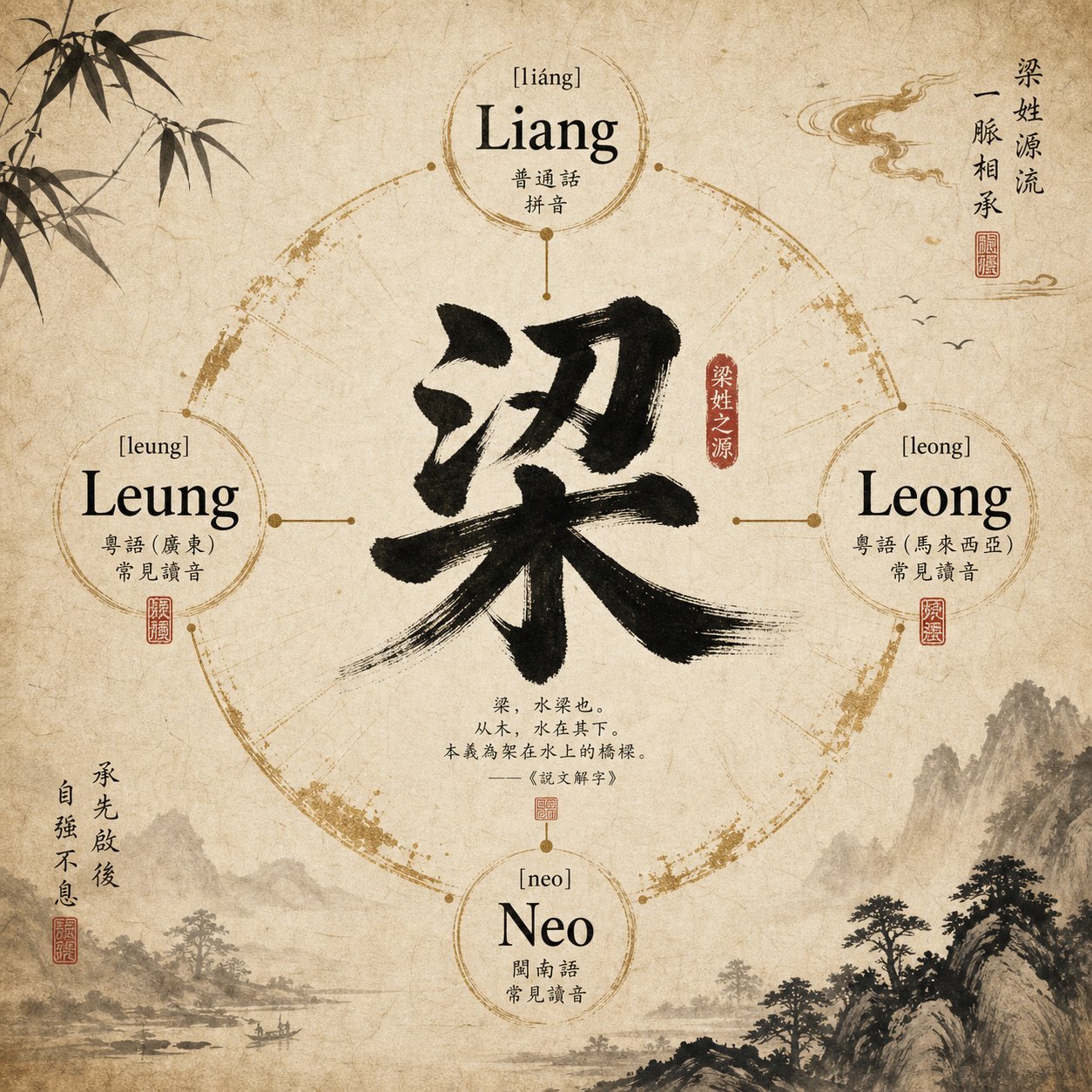
The Liang surname in Chinese is written with a single character — 梁. Whether someone spells it Liang, Leung, or any other variant, they're representing the same character. The divergence comes down to which Chinese dialect a family spoke and which romanization system was used when their name was first written in the Latin alphabet. A Mandarin speaker's 梁 becomes Liang. A Cantonese speaker's 梁 becomes Leung. Same family, same roots, different sounds.
Why One Chinese Character Has So Many Spellings
Chinese is not one language — it's a family of related dialects that can sound as different from each other as French does from Spanish. Mandarin, Cantonese, Hokkien, and Teochew each pronounce 梁 in their own way. When governments and colonial administrators needed to write these names using English letters, they transliterated what they heard. The result? One surname, half a dozen spellings scattered across passports, immigration records, and birth certificates worldwide.
What You Will Learn From This Comparison
This guide breaks down every major variant of the Leung last name and the Liang surname side by side. You'll learn exactly which dialect and region each spelling comes from, how to pronounce each version correctly, and how to use your own spelling as a clue to trace your family's migration history. Whether your name appears as Leong in Malaysia or Neo in Singapore, the path back to 梁 — and to your shared Zhou Dynasty ancestors — is clearer than you might think.
The key to understanding these differences lies in the romanization systems that created them, each developed in a different era and for a different dialect.
How We Evaluated Each Surname Variant
Romanization — the process of writing Chinese characters using the Latin alphabet — is the engine behind every spelling difference you see. Each system was built at a different point in history, for a different dialect, and by people with different goals. When you understand the timeline, the puzzle of why your cousin spells it Liang while your uncle goes by Leung starts to make sense.
How Romanization Systems Create Different Spellings
Imagine three linguists listening to the same character, 梁, spoken by three different people. One hears a Mandarin speaker in Beijing and writes "liang." Another hears a Cantonese speaker in Hong Kong and writes "leung." A third, working in the 19th century with older academic conventions, might produce something else entirely. None of them are wrong — they're each capturing a different pronunciation through a different set of spelling rules.
Three romanization systems matter most for understanding surname variants:
- Wade-Giles (1859) — Developed by Thomas Wade and later refined by Herbert Giles, this was the earliest widely adopted system for transliterating Mandarin Chinese. It dominated academic and diplomatic use for over a century and remains common in Taiwan. Under Wade-Giles, you'll see spellings like "Liang" for 梁, though with different diacritical conventions than modern Pinyin.
- Hanyu Pinyin (1958) — The People's Republic of China officially adopted this system after roughly 20 years of development. It became the international standard when the United Nations endorsed it in 1986. In Pinyin, 梁 is spelled "liang" — the version most people encounter today when they pronounce Liang in Mandarin.
- Jyutping (1993) — Created by the Linguistic Society of Hong Kong specifically for Cantonese, Jyutping standardized how Cantonese sounds map to Latin letters. Under this system, 梁 is rendered as "loeng4." The older, informal Cantonese romanization used in Hong Kong government records — which predates Jyutping — gave us the familiar spelling "Leung."
Each system captures the leung pronunciation or the liang pronunciation faithfully within its own framework. The conflict only appears when you place them side by side without context.
Criteria for Comparing Each Variant
To give you a clear picture of each spelling, the sections ahead evaluate every variant of 梁 against four criteria:
- Phonetic origin — Which dialect does the spelling reflect, and which romanization system produced it?
- Geographic prevalence — Where in the world is this spelling most commonly found on official documents?
- Population — Roughly how many people carry this particular variant?
- Genealogical implications — What does the spelling tell you about your family's migration path and dialect community?
These four lenses help you move beyond surface-level confusion. A spelling isn't just a spelling — it's a compressed record of where your ancestors lived, what language they spoke at home, and which bureaucratic system first wrote their name down. With that framework in place, each variant tells its own story, starting with the most globally recognized form: Liang as it appears in standard Mandarin Pinyin.
Liang as the Mandarin Pinyin Standard
If you search for the surname 梁 in any modern Chinese dictionary, textbook, or government database in mainland China, you'll find one spelling: Liang. This is the form that appears on passports issued by the People's Republic of China, on academic papers, and in international news coverage. It's the version most non-Chinese speakers encounter first — and for many families, it's the only spelling they've ever known.
But the Liang last name didn't become the global default by accident. Its dominance traces back to a specific political decision in 1958, and its roots reach much further — all the way to a feudal state granted during the Western Zhou Dynasty over 2,800 years ago.
Liang Pronunciation and Tonal Guide
Wondering how to pronounce Liang correctly? Break it into two parts: "lee" followed by "ahng." The stress falls on the second syllable, giving you something close to "lee-AHNG." In Mandarin, it carries the second tone — a rising pitch, like the inflection in your voice when you ask a question in English. Imagine saying "really?" and notice how your voice lifts at the end. That rising contour is what you're aiming for with the liang pronunciation.
In the International Phonetic Alphabet (IPA), it's transcribed as /ljɑŋ/ with a rising tone (tone 2). The "li" blends smoothly into "ang" as a single syllable — it's not two separate beats. Native Mandarin speakers produce it in one fluid motion, and the tonal rise distinguishes it from other characters that share the same consonant-vowel structure but carry different tones.
For English speakers, the most common mistake is pronouncing it as "lee-ANG" with a flat, neutral tone. Adding that upward pitch shift makes a real difference in how natural it sounds to Mandarin ears.
Historical Origins in the Zhou Dynasty
The liang last name origin stretches back to the Western Zhou Dynasty (1046-771 BCE). During the reign of King Xuan of Zhou (827-782 BCE), a military commander named Qin Zhong led expeditions to subdue peoples in the western territories. After Qin Zhong's death, the king divided conquered lands among his sons. The second son received territory around what is now Liangshan County in Shandong Province — and his descendants adopted the place name as their surname.
This origin story connects the Liang surname directly to the ancient State of Liang, making it one of China's oldest place-based surnames. The character 梁 itself carries meanings of "beam," "bridge," and "ridge" — structural elements that hold things together. Over the centuries, the surname spread across China as descendants migrated, served in government, and established new branches of the family tree.
By the time of the Hundred Family Surnames — a classic Song Dynasty text cataloging Chinese surnames — 梁 was already listed at position 128, reflecting its established presence across the country. Today, it ranks as the 22nd most common surname in mainland China, carried by tens of millions of people.
Where Liang Is Most Common Today
The Liang spelling dominates wherever Mandarin serves as the primary language of government and daily life. Mainland China is the obvious center, but you'll also find it across Taiwan (sometimes alongside Wade-Giles variants), among Mandarin-speaking communities in Southeast Asia, and increasingly among younger diaspora families who've adopted Pinyin as their standard.
Its reach extends beyond ethnic Chinese communities too. Because Pinyin became the international standard endorsed by the United Nations, ISO, and the Library of Congress, "Liang" is the form that appears in English-language news, academic citations, and global databases. When a researcher, journalist, or immigration officer encounters the surname 梁, Pinyin is typically their default reference.
Pros
- Internationally recognized as the standard romanization — understood across academic, diplomatic, and governmental contexts worldwide
- Used in all official PRC documents, making it consistent across passports, birth certificates, and legal records
- Simplest for non-Chinese speakers to approximate, since Pinyin was designed with learner accessibility in mind
- Supported by digital systems — Chinese input methods, search engines, and databases all default to Pinyin
Cons
- Does not reflect Cantonese, Hokkien, or other dialect pronunciations — a Cantonese-speaking grandmother might not recognize "Liang" as her own name
- May disconnect diaspora families from their regional heritage, especially those whose ancestors emigrated before 1958
- Erases the phonetic diversity that different spellings preserve — switching to Liang means losing the audible link to a family's specific dialect community
For families rooted in Mandarin-speaking regions, the Liang spelling is a natural fit — accurate, practical, and globally legible. But millions of 梁 families don't come from Mandarin-speaking backgrounds at all. Their ancestors spoke Cantonese in the villages of Guangdong Province, and when colonial administrators wrote their names into English-language records, a very different spelling emerged.

Leung as the Cantonese Romanization
Guangdong Province, Hong Kong, Macau — these are the places where 梁 sounds nothing like "lee-AHNG." In Cantonese, the same character carries a completely different phonetic shape, and when that sound was written down in English letters, it became Leung. If your family traces its roots to southern China or arrived in a Western country through Hong Kong, this is likely the spelling on your passport.
The leung last name origin is identical to Liang's — same Zhou Dynasty ancestors, same character 梁, same meaning of "beam" or "bridge." What changed is the mouth that spoke it and the ear that transcribed it.
How to Pronounce Leung Correctly
So how do you pronounce Leung? It's not "lung," it's not "lee-ung," and it's definitely not "lounge." The closest English approximation sounds like "lerng" — rhyming roughly with a shortened version of "earning" but with an "l" at the front and a nasal "ng" finish. Your lips stay relaxed, the vowel sits in the middle of your mouth, and the sound ends with that soft nasal ring.
In Jyutping — the standardized Cantonese romanization system — it's written as loeng4. The number 4 indicates a low falling tone, which means your pitch drops steadily as you say the syllable. In IPA terms, you're looking at /lœːŋ/ with a low falling contour. The vowel is rounded and mid-front, a sound that doesn't exist cleanly in English, which is exactly why so many non-Cantonese speakers struggle with it.
If you've ever wondered how to say Leung in a way that a Hong Kong native would recognize, focus on three things: start with a clear "l," produce a rounded vowel somewhere between "er" and "uh," and let the "ng" resonate through your nose. Skip the "oo" sound that the spelling might suggest — there's no "oo" in this word at all.
Why Leung Dominates in Hong Kong and the West
Leung is the default spelling for 梁 across Hong Kong, Macau, and the vast Cantonese-speaking diaspora in countries like Canada, the United States, the United Kingdom, and Australia. This isn't a coincidence — it reflects migration patterns that funneled millions of Cantonese speakers through Hong Kong's administrative systems before they settled abroad.
During the 19th and 20th centuries, the majority of Chinese emigrants to Western countries came from Guangdong Province and spoke Cantonese. Hong Kong served as the primary departure point, and its government offices produced the English-language documents — passports, identity cards, ship manifests — that fixed these spellings permanently. Once "Leung" appeared on an immigration form, it became the family's legal name in their new country.
The spelling carries real social weight too. Reporting from Hong Kong has documented how mainland Chinese migrants to the territory actively change their Mandarin-based romanizations to Cantonese equivalents — switching "Zhu" to "Chu" or "Zeng" to "Tsang" — to signal local identity. The Leung spelling functions the same way: it marks the bearer as Cantonese, as connected to Hong Kong's culture and community. It's not just a phonetic record — it's a cultural identity marker.
Colonial History Behind the Spelling
The specific form "Leung" emerged from British colonial administration. When Britain took control of Hong Kong in 1841, officials needed to record Chinese names in English for legal, tax, and census purposes. They listened to Cantonese speakers and wrote what they heard using English spelling conventions. No single standardized system governed this process — clerks and registrars made judgment calls based on how the sounds mapped to familiar English letter combinations.
This informal, ear-based approach is why you'll sometimes see slight variations even within Cantonese romanization: "Leung" and "Leong" both attempt to capture the same sound, but the clerk in Hong Kong heard it differently than the clerk in Kuala Lumpur. The Hong Kong version settled on "Leung" as the dominant convention, and it became entrenched through decades of consistent government use — on birth certificates, marriage records, property deeds, and eventually passports.
By the time Jyutping was formally developed in 1993, millions of families already carried the "Leung" spelling across multiple generations. Jyutping's "loeng" never replaced it in everyday use because legal names don't change with academic standards. The colonial-era spelling had already become the family heirloom.
Pros
- Reflects authentic Cantonese pronunciation — immediately recognizable to other Cantonese speakers worldwide
- Widely established in English-speaking countries, particularly Canada, the UK, and Australia, where Cantonese diaspora communities are large and well-rooted
- Functions as a strong cultural identity marker, signaling connection to Hong Kong and Guangdong heritage
- Supported by decades of consistent use in official Hong Kong government records
Cons
- Often mispronounced by non-Cantonese speakers — "lounge," "lung," and "lee-ung" are all common errors
- Can create confusion when connecting with Mandarin-speaking relatives who use "Liang" and may not immediately recognize the relationship
- The informal colonial romanization lacks the systematic consistency of Pinyin or Jyutping, occasionally producing variant spellings within the same family
The Leung spelling anchors families firmly in Cantonese-speaking identity — but not every Cantonese speaker who left Guangdong ended up in Hong Kong. Millions migrated instead to Malaysia, Singapore, and other parts of Southeast Asia, where local languages and different colonial administrations shaped the same sound into yet another form.
Leong and the Southeast Asian Diaspora
When Cantonese speakers from Guangdong Province sailed south instead of west, they carried the same pronunciation of 梁 — but landed in countries with entirely different writing conventions. In Malaysia, Singapore, and Macau, that sound was captured not as "Leung" but as Leong. The Leong surname represents the same character and the same Cantonese phonetics, filtered through Malay-influenced spelling norms that favored "eo" over "eu" for that rounded mid-vowel.
If your family carries the Leong last name, your ancestors almost certainly passed through Southeast Asian administrative systems rather than Hong Kong's colonial offices. That single letter difference — "eo" versus "eu" — is a geographic fingerprint.
Leong in Malaysia and Singapore
The Leong spelling is deeply embedded in Malaysian and Singaporean records. Both countries have large ethnic Chinese populations — roughly 23% of Malaysia and over 74% of Singapore — and Cantonese speakers make up a significant portion of those communities. When British colonial administrators in Malaya and the Straits Settlements registered Chinese residents, they transliterated Cantonese names using spelling conventions shaped by the local Malay-language environment.
Malay phonetics influenced how clerks interpreted vowel sounds. The "eo" combination felt more natural within a Malay orthographic context than the "eu" that Hong Kong officials preferred. The result: two different English spellings for the same Cantonese syllable, permanently split by geography. You'll find the Leong last name across Malaysian identity cards, Singaporean NRIC documents, and generations of birth certificates throughout the region.
Migration Patterns That Shaped This Variant
The Leong name origin traces the same ancestral path as Leung — out of Guangdong Province — but follows a different route south. During the 19th and early 20th centuries, millions of Chinese migrants moved to Southeast Asia to work in tin mines, rubber plantations, and trading ports. Many came from the same Cantonese-speaking districts that also fed emigration to Hong Kong and the West.
These migrants arrived in waves. Earlier settlers traded and intermarried with local populations, creating hybrid Peranakan communities. Later arrivals, particularly during the tin-mining boom of the 1800s, maintained stronger ties to their Chinese dialect communities. Regardless of when they arrived, their surnames were recorded by local administrators who spelled what they heard using the conventions available to them — and "Leong" became the standard output.
The pattern is consistent: Cantonese speakers who settled in British Malaya, the Straits Settlements (Penang, Malacca, Singapore), or Portuguese-administered Macau ended up with "Leong" on their documents. Those who stayed in or passed through Hong Kong got "Leung." Same family networks, same dialect, different bureaucracies.
Differences Between Leong and Leung
Phonetically, Leong and Leung represent the same Cantonese sound — loeng4 in Jyutping. The difference is purely orthographic, a product of which colonial system wrote the name down first. Think of it like "colour" versus "color" — same word, different spelling traditions shaped by geography.
In practice, though, the distinction carries real genealogical information. A family named Leong almost certainly has roots in Malaysia, Singapore, Macau, or the Philippines. A family named Leung most likely connects to Hong Kong. When you're tracing relatives across borders, this spelling difference helps you narrow down which migration corridor your ancestors traveled.
Pros
- Reflects Southeast Asian Cantonese heritage with precision — immediately signals Malaysian or Singaporean roots
- Well-established in official records across multiple countries, with consistent use spanning over a century
- Helps distinguish Southeast Asian branches of a family from Hong Kong branches, making genealogical research more targeted
Cons
- Sometimes confused with unrelated surnames — "Leong" can be mistaken for a variant of "Leon" or other non-Chinese names
- Less internationally recognized than either Liang or Leung, which can cause confusion in global contexts
- The phonetic similarity to Leung means outsiders often don't realize these represent different migration histories
Cantonese speakers produced Leung and Leong depending on where they landed. But 梁 families who spoke Hokkien or Teochew — dialects from Fujian Province and eastern Guangdong — generated spellings so different they barely look related to the same character at all.

Neo, Niu, and Liong From Hokkien and Teochew Dialects
Imagine meeting someone named Neo at a business conference in Singapore and someone named Liang at a meeting in Beijing. You'd never guess they share the same surname character — 梁 — unless someone told you. That's the reality of Hokkien and Teochew romanization. These southern Chinese dialects pronounce 梁 so differently from Mandarin and Cantonese that the resulting English spellings look like entirely separate names.
Where Mandarin produces "liang" and Cantonese gives "leung" or "leong," Hokkien speakers say something closer to "neo" or "niu," while Fuzhou dialect speakers produce "liong." The consonants shift, the vowels transform, and the final result bears almost no visual resemblance to the Pinyin standard. Yet every one of these variants traces back to the same Zhou Dynasty ancestors and the same character sitting in position 128 of the Hundred Family Surnames.
Neo and Niu From Hokkien Communities
The spelling Neo is the dominant romanization of 梁 among Hokkien and Teochew dialect speakers, particularly in Singapore. In Hokkien — the dialect spoken by many ethnic Chinese families in Fujian Province, Taiwan, and Southeast Asia — the character 梁 is pronounced with a nasal initial and a vowel that English ears interpret as "eo" or "io." The result is a surname that looks nothing like Liang to the untrained eye.
You'll recognize this spelling from prominent Singaporeans like filmmaker Jack Neo (梁智強) and politician David Neo (梁振伟). In both cases, the Chinese characters on their identity documents confirm they carry the same surname as every Liang and Leung in the world — the English spelling just reflects their family's Hokkien-speaking heritage.
The variant Niu (and sometimes Nio) appears in similar communities, particularly among Indonesian Chinese families of Hokkien descent. The historian Nio Joe Lan, an Indonesian scholar of Chinese-Indonesian heritage, carried this spelling. The phonetic difference between Neo and Niu is subtle — both attempt to capture the same Hokkien sound using different romanization conventions shaped by whether the local administrative language was English (Singapore) or Dutch/Malay (Indonesia).
In Singapore, where Chinese names are officially romanized based on dialect pronunciation rather than Mandarin Pinyin, the Neo spelling appears on NRICs, passports, and birth certificates as the legal form of the name. As the Cultural Atlas notes, Chinese Singaporeans often have a personal attachment to their particular romanized spelling because it is their official name — unlike in mainland China, where the Chinese characters take legal precedence.
Liong and Liung in Teochew Dialect
The liong variant emerges from a different branch of southern Chinese dialects — primarily Fuzhou (the capital dialect of Fujian Province) and, in some cases, Teochew communities. Where Hokkien drops the "l" sound entirely to produce Neo, Fuzhou dialect retains it but reshapes the vowel, giving you liong or sometimes liung.
Geographically, you'll find the liong spelling most often in Indonesia, where large Fuzhou-speaking communities settled during the 19th and 20th centuries. It also appears in the Philippines, where Chinese-Filipino families of Fuzhou descent carried the name through generations of local registration. The liung variant shows up less frequently but follows the same phonetic logic — a retained "l" initial combined with a dialect-specific vowel and nasal ending.
These spellings can cause real confusion in genealogical research. Someone searching for relatives named Liong might never think to look under Liang, Leung, or Neo — yet all four spellings could represent cousins descended from the same ancestral village in southern China. The phonetic gap between them is wide enough that even database searches won't automatically connect the dots.
Why These Variants Look Unrelated
The disconnect comes down to how radically southern Chinese dialects diverge from Mandarin. Hokkien and Teochew split from the common Chinese language family centuries ago, preserving ancient pronunciations that Mandarin has long since shed. When 梁 is spoken in Hokkien, the initial "l" softens or disappears, the medial vowel shifts dramatically, and the final consonant changes character. The result is a syllable that shares almost no phonetic DNA with "liang" — even though the written character remains identical.
Think of it this way: the English words "water" and the German "Wasser" are clearly related. But the English "water" and the French "eau" look completely unrelated — even though they descend from the same Proto-Indo-European root. Neo and Liang have a similar relationship. The written ancestor (梁) is shared, but the spoken forms diverged so long ago that the romanized spellings reveal no family resemblance.
This is precisely why the ling family name and its many variants confuse people doing cross-dialect genealogy. Without knowing that Neo, Niu, Liong, and Liang all map to 梁, you could spend years searching the wrong surname databases entirely.
Pros
- Preserves specific dialect heritage — a Neo surname immediately identifies Hokkien or Teochew roots, while Liong signals Fuzhou ancestry
- Important for genealogical accuracy, especially when tracing migration routes through Southeast Asia
- Carries deep cultural significance in communities where dialect identity remains a core part of family history
Cons
- Frequently mistaken for entirely different surnames — most people outside Hokkien or Fuzhou communities won't recognize Neo or Liong as variants of 梁
- Very limited recognition outside specific communities in Singapore, Indonesia, and the Philippines
- Creates significant barriers in genealogical databases and family searches, where algorithms won't link Neo to Liang without manual intervention
These dialect-driven variants represent the furthest phonetic reach of 梁 within Chinese-speaking communities. But the character's influence didn't stop at China's borders. Centuries of cultural exchange carried 梁 into Vietnamese and Japanese naming systems, where it took on yet another set of pronunciations — and spellings — shaped by entirely different languages.
Lương and Ryō in Vietnamese and Japanese Traditions
Chinese characters didn't stay in China. Over centuries of trade, conquest, scholarship, and diplomacy, the character 梁 embedded itself in the writing systems of neighboring civilizations. In Vietnam, it became the surname Lương. In Japan, it's read as Ryō. Neither spelling looks anything like Liang or Leung — yet both trace directly to the same character and, in many cases, the same ancestral lineage.
Understanding these cross-border variants matters if your genealogy research leads beyond Chinese-speaking communities. A relative named Lương in Ho Chi Minh City and a relative named Leung in Vancouver may share more than a distant ancestor — they may share a grandparent.
Lương in Vietnamese Naming Traditions
Vietnam's naming system absorbed hundreds of Chinese surnames during over a thousand years of Chinese imperial rule and cultural exchange. The Luong last name — written with diacritical marks as Lương — is the Sino-Vietnamese reading of 梁. Sino-Vietnamese refers to the layer of Chinese-derived vocabulary that entered the Vietnamese language primarily during the Tang and Song dynasties, when Chinese characters served as Vietnam's official writing system.
The luong last name origin is straightforward: Vietnamese scholars and administrators read 梁 using Vietnamese phonetic rules applied to the Chinese character, producing "lương" — a two-syllable pronunciation with a rising tone on the second element. When Vietnamese families carried this surname, they were often descendants of Chinese migrants who settled in Vietnam or Vietnamese families who adopted Chinese-style surnames during periods of sinicization.
FamilySearch records show the Luong surname most concentrated in Vietnam, with secondary populations in the United States and mainland China. The luong last name nationality is overwhelmingly Vietnamese in the modern diaspora — when you encounter someone named Luong in Western countries, they most likely trace their heritage to Vietnam rather than directly to China, even though the surname's ultimate origin is Chinese.
What makes this variant particularly interesting for genealogy is that it can indicate either Chinese ancestry within Vietnam or deep Vietnamese roots stretching back centuries. Some Lương families descend from Chinese merchants and officials who settled in Vietnam during the Ming and Qing dynasties. Others belong to families that have been Vietnamese for so many generations that the Chinese connection exists only in the character itself.
Ryō in Japanese Kanji Systems
Japan imported Chinese characters — called kanji — beginning around the 5th century CE. Each kanji carries at least two readings: the on'yomi (sound reading), which approximates the original Chinese pronunciation, and the kun'yomi (meaning reading), which uses a native Japanese word. For 梁, the on'yomi reading is ryō (りょう) — a compressed echo of the ancient Chinese pronunciation filtered through Japanese phonology.
In Japanese, 梁 primarily functions as a common noun meaning "beam" or "girder" rather than as a frequent surname. However, it does appear in Japanese names and is well-known as a reference to the Chinese Liang Dynasty. The reading ryō preserves a pronunciation that's arguably closer to the ancient Chinese original than modern Mandarin "liang" — Japanese on'yomi readings often fossilize Tang Dynasty-era pronunciations that have since shifted in China itself.
For genealogical purposes, encountering Ryō as a surname in Japan is rare but not impossible. It more commonly appears in historical and literary contexts, particularly when referencing Chinese figures or the Liang Dynasty period.
The Liang Dynasty Connection Across East Asia
The Liang Dynasty (502-557 CE) played a direct role in spreading the character 梁 across East Asia. Founded by Emperor Wu (Xiao Yan), this Southern Dynasty ruled from its capital at Jiankang — modern-day Nanjing — and maintained active trade and diplomatic relations with Korea, Japan, and Southeast Asian kingdoms. The dynasty's name itself used the character 梁, embedding it in historical records across the region.
Emperor Wu's patronage of Buddhism and literature created cultural exports that traveled along trade routes to Japan, Korea, and Vietnam. Buddhist texts, literary anthologies, and diplomatic correspondence all carried the dynasty's name — and by extension, the character 梁 — into foreign writing systems. When Japanese scholars studied Chinese history, they learned to read 梁 as ryō. When Vietnamese administrators recorded dynastic histories, they rendered it as lương.
This shared historical layer means that 梁 isn't just a surname — it's a cultural marker recognized across East Asian civilizations. A Vietnamese historian reading about the Liang Dynasty, a Japanese student studying kanji, and a Cantonese speaker introducing themselves as Leung are all engaging with the same character through different linguistic lenses.
Pros
- Demonstrates pan-Asian cultural connections — understanding these variants reveals how deeply Chinese naming traditions influenced neighboring civilizations
- Valuable for cross-border genealogy, especially for families with branches in Vietnam, Japan, and China
- Provides historical depth that enriches understanding of the surname beyond dialect differences alone
Cons
- May not be recognized as related to Chinese 梁 by casual observers — Lương and Ryō look entirely foreign to someone familiar only with Liang or Leung
- Cross-border genealogical connections are harder to verify due to centuries of separation and different record-keeping systems
- The cultural distance between Vietnamese, Japanese, and Chinese naming conventions can make family connections feel abstract rather than concrete
With variants spanning from Neo in Singapore to Lương in Hanoi to Ryō in Tokyo, the full picture of 梁 covers an enormous geographic and linguistic range. Seeing all these forms side by side — in a single consolidated view — makes the relationships between them far easier to grasp.
Complete Comparison of Every 梁 Surname Variant
You've seen each variant in its own context — the dialect it reflects, the region it dominates, the migration story it encodes. But when you're trying to figure out whether a distant relative named Leong in Kuala Lumpur connects to your Liang-surnamed cousin in Shanghai, you need everything in one place. The table below puts all eight major spellings of 梁 side by side so you can compare them at a glance.
Side-by-Side Variant Comparison Table
| Variant Spelling | Dialect / Language | Region of Prevalence | Pronunciation (IPA) | Romanization System | Approximate Population |
|---|---|---|---|---|---|
| Liang | Mandarin | Mainland China, Taiwan, international academic use | /ljɑŋ/ (tone 2, rising) | Hanyu Pinyin (1958) | ~11 million+ |
| Leung | Cantonese | Hong Kong, Macau, Canada, UK, Australia | /lœːŋ/ (tone 4, low falling) | Hong Kong Government Romanization | ~3 million+ |
| Leong | Cantonese | Malaysia, Singapore, Philippines | /lœːŋ/ (tone 4, low falling) | Malay-influenced romanization | ~1 million+ |
| Neo | Hokkien / Teochew | Singapore, Penang, parts of Fujian | /niɔ/ or /neo/ | Singapore dialect romanization | ~500,000+ |
| Niu | Hokkien / Teochew | Indonesia, Taiwan (some communities) | /niu/ | Dutch/Malay-influenced romanization | ~200,000+ |
| Liong | Hakka / Fuzhou | Indonesia, Philippines, parts of Malaysia | /liɔŋ/ | Local dialect romanization | ~300,000+ |
| Lương | Vietnamese (Sino-Vietnamese) | Vietnam, Vietnamese diaspora (US, France, Australia) | /lɨəŋ/ (rising tone) | Vietnamese Quốc Ngữ | ~500,000+ |
| Ryō | Japanese (on'yomi) | Japan (rare as surname, common in historical reference) | /ɾʲoː/ | Japanese kanji reading | Rare as surname |
Notice the pattern: the surname Liang dominates wherever Mandarin is the official language, while the surname Leung and its close cousin Leong appear wherever Cantonese speakers settled under British or Malay-influenced administrations. The Hokkien variants — Neo and Niu — cluster in Southeast Asian communities where Fujian-origin families put down roots. Each spelling is a compressed migration record.
Population figures are approximate and drawn from census data, surname frequency studies, and diaspora community estimates. The last name Liang carries the largest absolute numbers because mainland China's population dwarfs other regions. But in percentage terms, the last name Leung may actually be more common within its specific communities — particularly in Hong Kong, where 梁 consistently ranks among the top ten surnames.
Common Misconceptions About These Spellings
When people encounter different spellings of the same Chinese surname, a few assumptions tend to surface. All of them are wrong — and they can derail genealogy research or create unnecessary distance between relatives who share the same roots.
Misconception 1: Different spellings mean different surnames. This is the most common error. Someone named Neo might assume they have no connection to a Liang-surnamed colleague, when in fact both names represent 梁. The spellings diverge because of dialect, not because of different ancestral origins. If you write the character, it's identical. The English letters are just a phonetic approximation — and approximations vary depending on who's listening.
Misconception 2: One spelling is more "correct" or "authentic" than another. You'll sometimes hear that Liang is the "real" spelling because it's the official Pinyin standard. That's like saying the French pronunciation of "Paris" is wrong because English speakers say it differently. Pinyin standardizes Mandarin — it doesn't invalidate Cantonese, Hokkien, or any other dialect. A family that has used Leung for five generations isn't spelling their name incorrectly. They're spelling it exactly as their ancestors pronounced it.
Misconception 3: Spelling indicates different ethnic backgrounds. Seeing "Lương" might make someone assume Vietnamese ethnicity with no Chinese connection. Seeing "Neo" might suggest a non-Chinese name entirely. In reality, all these variants trace to the same Chinese character and — in most cases — the same ancestral lineage rooted in the Zhou Dynasty. Ethnicity, nationality, and surname spelling are three separate things that don't always align the way people expect.
All variants trace back to the same ancestor and the same Chinese character — 梁.
The practical takeaway? When you're searching for family connections, never limit yourself to one spelling. A comprehensive search for 梁 relatives means looking under Liang, Leung, Leong, Neo, Niu, Liong, Lương, and even Ryō — depending on where your family's branches migrated. The character unites what the alphabet divides.
Knowing which variant maps to which dialect and region is the first step. The next question is more personal: how do you use your own specific spelling to trace backward — from the name on your passport to the village your ancestors left?
How to Trace Your Family's Dialect Origin and Ancestry
Your surname spelling is more than a label — it's a clue. Whether your passport reads Leung, Leong, Neo, or Liang, that specific combination of letters encodes information about which dialect your ancestors spoke, which port they departed from, and which bureaucratic system first wrote their name in English. The question is: how do you decode it?
The good news is that understanding the leung name origin or the liang surname origin doesn't require fluency in Chinese or access to expensive archives. It starts with the spelling you already carry and works backward through dialect, geography, and migration records to connect you with relatives who may spell the same character 梁 in completely different ways.
Identifying Your Dialect Origin From Your Spelling
Your first move is the simplest: match your spelling to a dialect group. This alone narrows your ancestral search from all of China to a specific province or even a cluster of villages.
- Liang — Your family likely spoke Mandarin and has roots in northern or central China, or emigrated after 1958 when Pinyin became standard. Check connections to provinces like Shandong, Henan, Shaanxi, or Guangxi (where Mandarin is also dominant).
- Leung — Cantonese-speaking family with strong ties to Hong Kong or Macau. Your ancestors almost certainly came from Guangdong Province, likely from the Pearl River Delta region.
- Leong — Also Cantonese, but routed through Malaysia, Singapore, or the Philippines. Same dialect origin as Leung, different administrative pathway.
- Neo or Niu — Hokkien or Teochew dialect speakers from Fujian Province or eastern Guangdong. Look for connections to Singapore, Penang, or Indonesian Chinese communities.
- Liong — Fuzhou or Hakka dialect background, typically with roots in Indonesia or the Philippines.
- Lương — Vietnamese heritage, with the surname entering through Sino-Vietnamese linguistic traditions. Your Chinese connection may be recent (a few generations) or ancient (centuries of cultural absorption).
Once you've identified your dialect group, you've already answered one of the biggest questions in Chinese genealogy research. As Legacy Tree Genealogists emphasize, figuring out which dialect your ancestor spoke is a critical early step — because it determines which region of China to search and which records will be relevant.
Connecting With Relatives Who Use Different Variants
Here's where things get practical. Imagine you're named Leung and you discover a branch of your family in Guangzhou who spell it Liang. Are you related? Almost certainly — if you share the character 梁, you share the lineage. The spelling difference simply reflects that your branch left Guangdong and passed through Hong Kong's colonial system, while their branch stayed and adopted Pinyin when it became the national standard.
The liang surname meaning — "beam" or "bridge" — is the same regardless of which romanization your family uses. The meaning of liang as a character points to structural support, something that holds things together. That etymology doesn't change whether you write it as Leung, Leong, or Neo. The liang name meaning stays constant because the character stays constant.
To find these cross-variant connections, you'll need to think in characters rather than letters. Search genealogical databases using 梁 directly when possible. On platforms like FamilySearch, try entering multiple romanized variants in separate searches. And when reaching out to potential relatives in other countries, lead with the character — it bridges every dialect gap instantly.
Practical Steps for Genealogy Research
Ready to dig deeper? Here's a structured approach that moves from what you know (your spelling) to what you want to find (your ancestral village and extended family network):
- Document your current spelling and its history. When did your family first use this romanization? Check the oldest official documents you can find — immigration papers, ship manifests, naturalization records, or birth certificates. The earliest document with your surname spelling tells you which system recorded it.
- Map your spelling to a dialect and region. Use the dialect identification guide above to narrow your geographic origin. If you're unsure, research historical Chinese immigration patterns to your family's destination country. As genealogy researchers note, most immigrants traveled with people from the same dialect group and settled in communities that spoke the same language.
- Search for your ancestor's name in Chinese characters. This is the bridge between your English-language records and Chinese-language archives. Look for Chinese characters on old family documents, tombstones, letters, or heirlooms. Chinese Clan Associations sometimes maintain archived member lists that include characters alongside romanized names.
- Research migration records from your identified region. Once you know the departure region, look for ship passenger lists, port records, and immigration files. For U.S.-bound ancestors, the National Archives Chinese-American records contain case files from the Chinese Exclusion Act era that often include Chinese characters and village names.
- Connect with surname associations and clan organizations. 梁 clan associations exist in Hong Kong, Malaysia, Singapore, San Francisco, New York, and many other cities with significant Chinese populations. These organizations often maintain genealogical records, ancestral hall connections, and can help link diaspora families back to specific villages in China.
- Cross-reference across spelling variants. Don't limit your search to one romanization. If you're a Leung, also search under Liang, Leong, and Neo. Your great-uncle who emigrated to Singapore might appear as Leong in records there, while his brother who went to Vancouver shows up as Leung. Same family, different destination, different spelling.
One important caution: Chinese naming conventions place the surname before the given name. Historical immigration officials sometimes reversed this order, recording the surname as a middle name or the given name as the surname. If your ancestor's records seem inconsistent, consider whether a name reversal occurred during processing.
The liang surname origin — rooted in the Western Zhou Dynasty over 2,800 years ago — means that every person carrying any variant of 梁 shares an ancestral connection stretching back roughly 3,000 years. Whether your family spells it Leung in Toronto, Leong in Penang, Neo in Singapore, or Lương in Saigon, the character on the page is the same one granted to descendants of a Zhou Dynasty commander nearly three millennia ago.
Different dialects, different countries, different centuries of migration — but one surname, one character, one origin. The spelling on your passport isn't a barrier between you and your relatives. It's a roadmap showing exactly which path your branch of the family took when they left home.
Frequently Asked Questions About Liang vs Leung Surname
1. Are Liang and Leung the same surname?
Yes, Liang and Leung represent the identical Chinese character 梁. The spelling difference exists because Liang is the Mandarin Pinyin romanization used in mainland China, while Leung is the Cantonese romanization used primarily in Hong Kong, Macau, and Cantonese-speaking diaspora communities. Both trace back to the same Zhou Dynasty ancestors and carry the same meaning of 'beam' or 'bridge.' The variant a family uses depends on which dialect they spoke and which administrative system first recorded their name in English letters.
2. How do you pronounce Leung correctly?
Leung is pronounced approximately like 'lerng,' rhyming with a shortened version of 'earning' but starting with an 'l' and ending with a nasal 'ng' sound. In Jyutping (standardized Cantonese romanization), it is written as loeng4, indicating a low falling tone. The IPA transcription is /lœːŋ/. Common mispronunciations include 'lung,' 'lee-ung,' and 'lounge' — none of which are correct. The key is to produce a rounded mid-front vowel between 'er' and 'uh' without any 'oo' sound.
3. What is the origin of the Liang surname?
The Liang surname originated during the Western Zhou Dynasty (1046-771 BCE). King Xuan of Zhou granted territory around present-day Liangshan County in Shandong Province to the second son of military commander Qin Zhong. The descendants of this son adopted the place name — the State of Liang — as their family surname. The character 梁 means 'beam,' 'bridge,' or 'ridge,' and the surname ranks as the 22nd most common in mainland China today, carried by tens of millions of people worldwide across various spelling variants.
4. Why do some people spell the surname Neo instead of Liang?
Neo is the Hokkien and Teochew dialect romanization of the same character 梁. Southern Chinese dialects like Hokkien pronounce this character so differently from Mandarin that the resulting English spelling bears no visual resemblance to Liang. In Hokkien, the initial 'l' softens or disappears and the vowel shifts dramatically, producing a sound English speakers interpret as 'neo.' This spelling is most common in Singapore, where Chinese names are officially romanized based on dialect pronunciation rather than Mandarin Pinyin.
5. How can I trace my family's dialect origin using my surname spelling?
Your surname spelling directly indicates your family's dialect group and likely geographic origin. Liang points to Mandarin-speaking regions in northern or central China. Leung indicates Cantonese roots via Hong Kong. Leong suggests Cantonese heritage routed through Malaysia or Singapore. Neo or Niu signals Hokkien or Teochew speakers from Fujian Province. Liong indicates Fuzhou or Hakka dialect background. Start by matching your spelling to a dialect, then research migration records from that specific region and connect with 梁 clan associations in your area.