The Ma Surname and Its Surprising Multiple Origins
Imagine two people named Ma sitting across from each other at a dinner table. One traces their ancestry to a Warring States general who tamed cavalry horses. The other descends from Muslim traders who traveled the Silk Road carrying the name of the Prophet Muhammad. Same two letters, completely different stories. That contrast sits at the heart of what makes the Ma surname one of the most fascinating family names in the world.
What the Ma Surname Means
At its core, the Ma surname is written as 馬 in traditional Chinese and 马 in simplified form. The literal translation is "horse" — a creature that symbolized speed, power, and unyielding spirit in ancient Chinese culture. So what does the Ma name meaning come down to? A single animal that carried armies, connected empires, and shaped civilizations.
Ma (馬/马) is a Chinese surname meaning "horse," ranking as the 13th most common surname in mainland China. With over 21 million bearers globally, it spans multiple cultures, religions, and continents — each with its own independent origin story.
The surname Ma ranks approximately 13th to 19th among Chinese surnames depending on the source consulted. That range exists because census methodologies differ, but the takeaway is consistent: this is one of the most widespread family names across East Asia. You'll find it carried by tech billionaires like Jack Ma Yun and Pony Ma, classical musicians like Yo-Yo Ma, and millions of everyday families from Shaanxi to Singapore.
Why Ma Has Multiple Independent Origins
Here's where things get interesting. Many people assume that everyone with the Ma last name shares a common ancestor somewhere deep in history. That assumption is wrong. The surname Ma has at least four to five completely independent origin streams:
- A Chinese military origin tied to a Warring States cavalry general
- A Hui Muslim origin where Ma serves as a sinicized form of Muhammad
- A Korean origin (마) linked to the ancient Mahan confederacy, using an entirely different character
- A Vietnamese origin found among certain ethnic minority groups
- Western variants, including anglicizations of Irish and other European surnames
These are not branches of the same tree. They are separate trees that happen to produce fruit with the same label. When people ask what does Ma mean as a surname, the honest answer depends entirely on which cultural and ancestral line you're tracing. A Hui Muslim family bearing the surname Ma carries a legacy rooted in Islamic faith and Silk Road commerce. A family descended from the Zhao clan carries a legacy of ancient Chinese warfare. Sharing the romanized spelling "Ma" does not imply shared blood.
This article treats each origin with equal depth and respect, exploring how a single two-letter name became a crossroads where Chinese military history, Islamic culture, Korean identity, and global migration all converge. The story begins where the character itself began — scratched into oracle bones thousands of years ago as a picture of a horse.
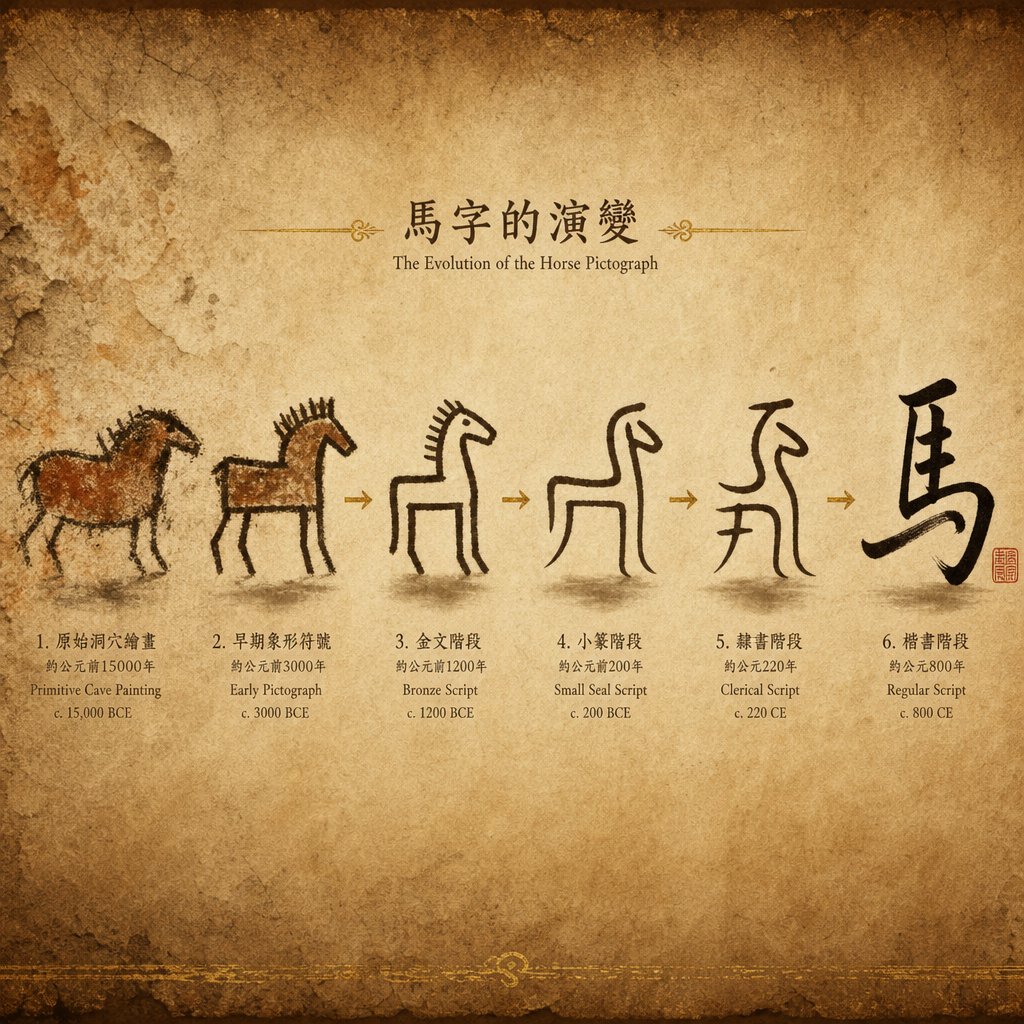
Evolution of the Chinese Character for Horse
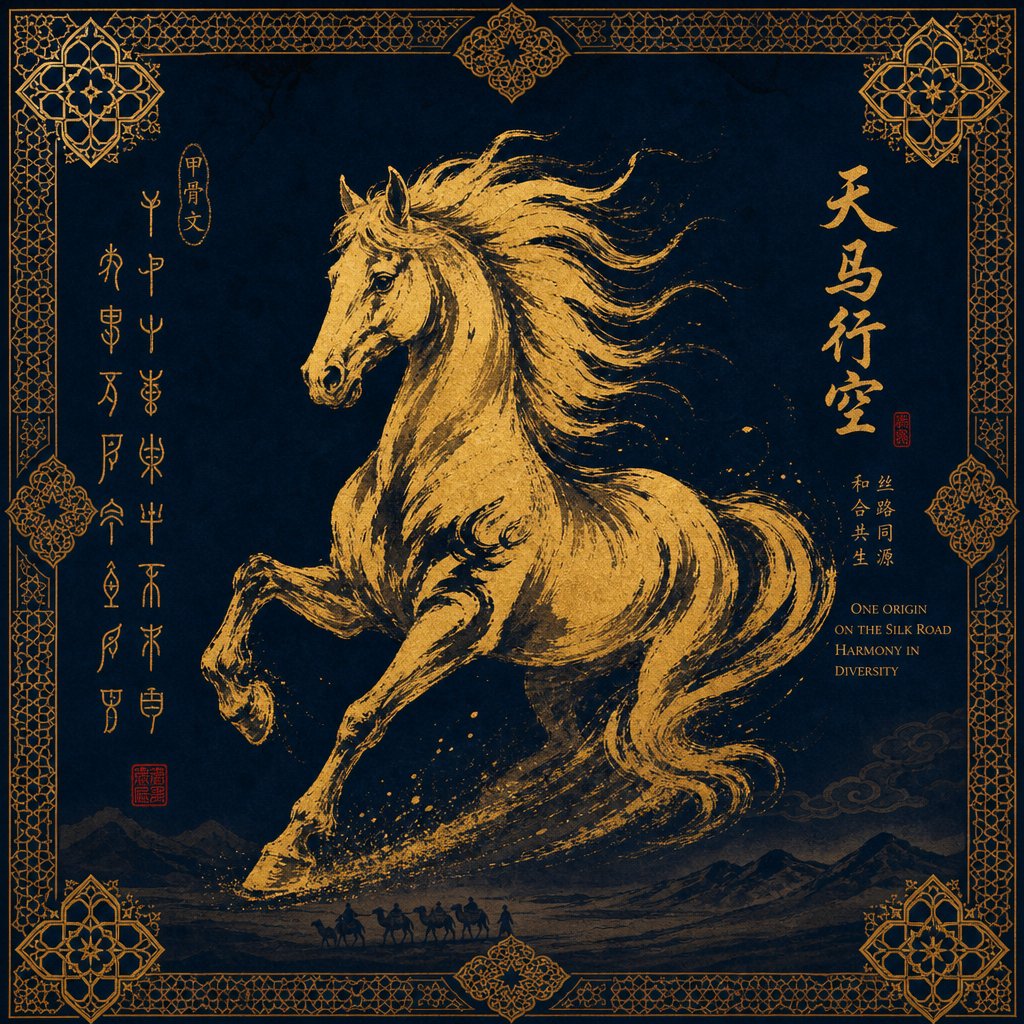
Three thousand years ago, a scribe pressed a stylus into a piece of turtle shell and drew something that looked unmistakably like a horse — large eyes, a flowing mane, four legs in motion. That image is the ancestor of every Ma chinese character you see written today. Tracing how this pictograph transformed into the modern 马 reveals not just a story about writing, but about how an entire culture encoded its values into ink and bone.
From Oracle Bone to Modern Script
The chinese character for horse has passed through at least six major script stages over three millennia. Each stage stripped away a little more of the original picture while preserving the character's essential identity.
- Oracle Bone Script (Shang Dynasty, c. 1400-1200 BC): The earliest known form. The character was essentially a drawing — exaggerated eyes conveyed liveliness, a flowing mane suggested speed, and four distinct legs showed the animal in motion. Seeing the character was like seeing the horse itself.
- Bronze Inscription Script (Zhou Dynasty, c. 1046-256 BC): Cast onto ritual vessels, the horse became neater. Strokes shifted from rounded to angular, and while the biological outline remained readable, the character was already moving toward symbolic abstraction.
- Small Seal Script (Qin Dynasty, 221-207 BC): Standardization reshaped the character to fit narrow bamboo slips. The originally horizontal horse "stood up" into a vertical form. The eye simplified into a square, and the mane reduced to parallel strokes.
- Clerical Script (Han Dynasty, 202 BC - AD 220): A turning point. Curves straightened into efficient brushstrokes. The four legs became four swift strokes at the base of 馬 — often misread as representing "fire," but more likely symbolizing the churning hooves of a galloping steed.
- Regular Script (Sui/Tang Dynasties onward): The form stabilized into the traditional 馬 still used in Taiwan and Hong Kong — strong, balanced, and instantly recognizable.
- Simplified Script (1950s-present): Mainland China reduced the stroke count, producing the modern 马. The visual weight lightened, but the cultural resonance remained intact.
If you're wondering how to say horse in Mandarin, the answer is mǎ — a falling-rising third tone that has stayed remarkably consistent across centuries of phonetic drift.
How the Horse Became a Written Symbol
The ma character carries more than phonetic information. The Eastern Han scholar Xu Shen, writing in his dictionary Shuowen Jiezi around AD 100, defined it this way: "The horse means anger; it means martialism." In ancient China, horses represented speed, loyalty, and military prowess. They carried generals into battle, connected distant provinces through relay stations, and served as markers of aristocratic status.
That cultural weight transferred directly to the surname. When families adopted Ma as their family name, they weren't just labeling themselves with an animal — they were claiming an association with power, mobility, and martial valor. The chinese character for ma functions as both a semantic and phonetic building block in dozens of compound words, from 马力 (horsepower) to 马上 (immediately, literally "on horseback"). Its presence in the language is so pervasive that the ma characters appear in words for mother (妈), ants (蚂蚁), and even the question particle (吗) — all borrowing the horse's sound if not its meaning.
This deep cultural embedding explains why the surname carried prestige from its earliest days. A name rooted in the horse was a name rooted in everything the horse stood for: strength on the battlefield, reliability on the road, and the kind of restless energy that builds empires. The general who first turned that symbolism into a family legacy did so on a very specific battlefield, in a very specific war.
The Warring States Military Origin of Ma
That general was Zhao She, and the war was the brutal power struggle between China's seven warring kingdoms in the 3rd century BC. His story is the most widely accepted ma last name origin among Chinese genealogical sources — a tale of an underestimated official who became a military legend and, in the process, founded one of China's most enduring family names.
Zhao She and the Battle of Eyu
Zhao She didn't start as a warrior. He began his career as a tax collector in the State of Zhao's ministry of revenue, where his fairness and integrity caught the attention of the Lord of Pingyuan, who recommended him for higher service. That recommendation changed history.
In 270 BCE, the powerful State of Qin besieged the strategic stronghold of Eyu (閼與), located in what is now Heshun, Shanxi Province. Zhao's most senior generals considered a rescue mission impossible — the distance was too great, and Qin's forces too strong. Zhao She disagreed. He argued that when two armies meet in a narrow pass, the braver side wins.
The King of Zhao gave him command. Zhao She marched his army out, then did something unexpected: he stopped. For weeks, he built fortifications and projected an image of pure defense, lulling the Qin forces into complacency. Then, in a sudden offensive strike, he attacked. The Qin army, caught completely off guard, suffered a decisive defeat. It was a textbook example of deception and timing — qualities that would define the ma surname origin story for millennia.
From Mafu Fief to Family Name
For this victory, King Huiwen of Zhao granted Zhao She a fief called Mafu (马服), located northwest of the Zhao capital Handan in present-day Hebei Province. He received the title Lord Mafu (马服君), placing him on equal footing with legendary statesmen like Lian Po and Lin Xiangru.
The ma etymology here is straightforward. "Ma" (马) means horse, and "fu" (服) means to tame or harness. Mafu was literally "the place where horses are tamed" — a name reflecting the region's role in supplying cavalry mounts to Zhao's military. When Zhao She's descendants needed a family name, they initially adopted the full "Mafu." Over generations, they shortened it to the single character Ma.
This is the origin that Chinese genealogical records treat as primary. The Baidu Encyclopedia entry on the Ma surname identifies Zhao She as the founding ancestor, and Handan as the ancestral homeland where the surname first took root. His burial site at Purple Mountain (also called Mafu Mountain) remains a pilgrimage point for Ma descendants worldwide.
The ma meaning chinese families carried forward wasn't just a label — it was a martial identity. A surname born on the battlefield, granted by a king for military valor, and rooted in a place that bred warhorses. That combination of military prestige and horse symbolism gave the Ma clan a reputation that attracted powerful figures dynasty after dynasty, each one adding new chapters to the family's legacy.
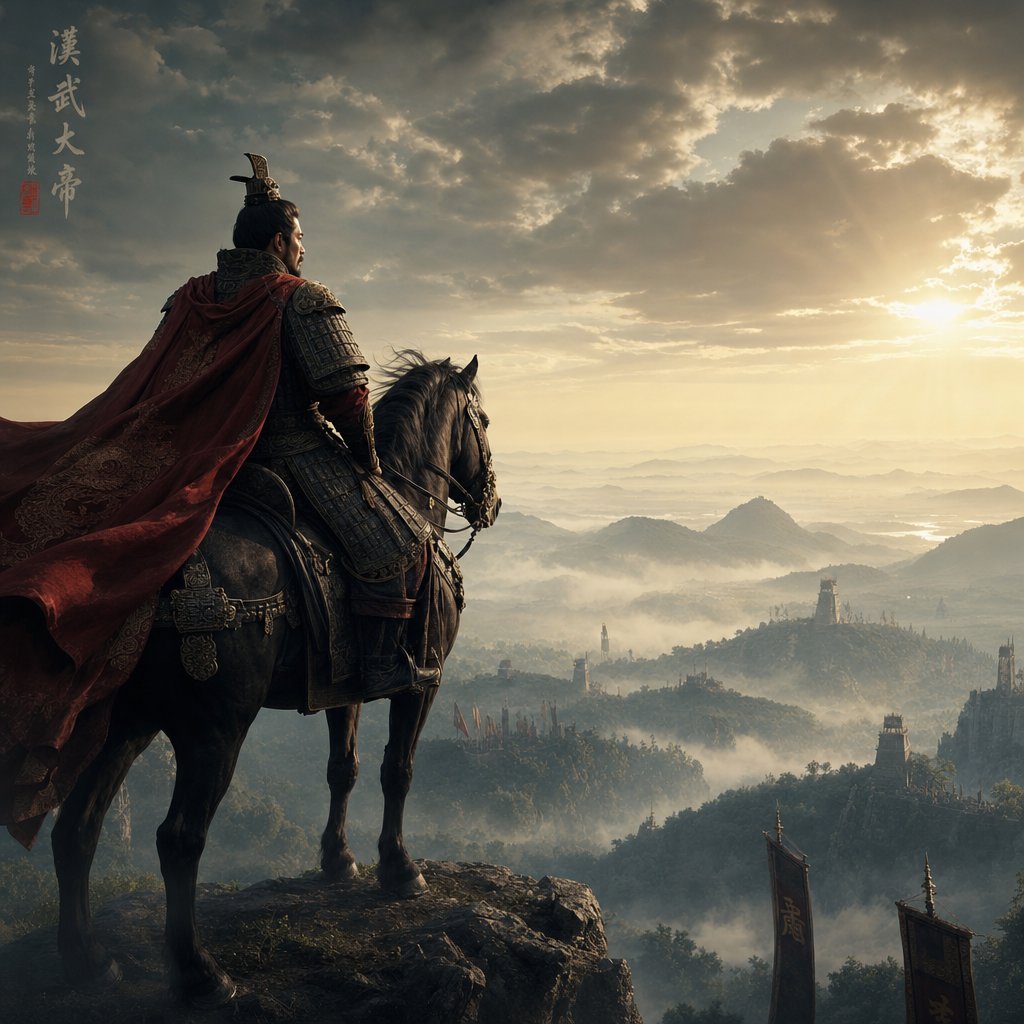
Key Dynasties That Shaped the Ma Family Legacy
Zhao She's descendants didn't rest on inherited glory. Generation after generation, members of the Ma family rose to positions of military and political power, reinforcing the surname's martial identity across some of China's most turbulent centuries. Three dynasties in particular produced figures who transformed Ma from a regional clan name into one of the most common last names in China.
Ma Yuan and Han Dynasty Expansion
The most celebrated figure in the Ma chinese lineage is undoubtedly Ma Yuan (c. 14 BC - 49 AD), known by his honorific title Fubo Jiangjun — "General Who Calms the Waves." Born in modern Xingping, Shaanxi Province, Ma Yuan traced his ancestry directly back to Zhao She, making him a living continuation of the surname's founding military tradition.
His career under Emperor Guangwu of the Eastern Han reads like a catalog of frontier warfare. In 35 AD, he defeated the Xianlian Qiang tribes in Longxi and Jincheng commanderies, capturing thousands of livestock and restoring Han authority along the northwestern frontier — despite sustaining a leg injury in combat. But the campaign that earned him immortality came in 42-43 AD, when he led roughly 10,000 troops south to suppress the rebellion of the Trung sisters in Jiaozhi (modern Vietnam). Navigating brutal terrain and coordinating a coastal supply fleet, Ma Yuan dismantled the insurgency and restored Han control over the Red River Delta.
Ma Yuan died in 49 AD during a campaign against the Wulin tribes in present-day Guizhou, struck down by plague rather than enemy blades. His legacy spawned two enduring Chinese idioms: "wrapping one's body in horse leather" (a vow to die honorably in battle) and "drawing a tiger improperly results in a dog" (a warning against hollow imitation). Temples bearing his title still stand across southern China, from Guilin's Mount Fubo to shrines in Hunan.
The Ma Clan Through Three Kingdoms and Beyond
The Ma in chinese history didn't fade after the Han. During the chaotic late Eastern Han and Three Kingdoms period, Ma Teng — a direct descendant of Ma Yuan — controlled Liang Province, a vast territory spanning parts of modern Shaanxi and Gansu. Despite growing up in extreme poverty and selling firewood to survive, Ma Teng rose through military ranks to become one of the most powerful warlords in China's northwest. His son, Ma Chao, became even more famous, leading a coalition against Cao Cao at the Battle of Tong Pass in 211 AD and later serving under Liu Bei in the Kingdom of Shu.
Centuries later, the Ma family's legacy shifted from the battlefield to the open ocean. During the Ming dynasty, Ma Huan served as the principal Muslim translator and chronicler aboard Zheng He's treasure fleet. Joining the fourth voyage in 1413, Ma Huan documented encounters across Southeast Asia, India, and the Persian Gulf. His written accounts remain among the most valuable primary sources on 15th-century maritime Asia.
| Name | Dynasty | Notable Achievement |
|---|---|---|
| Ma Yuan (马援) | Eastern Han (14 BC - 49 AD) | Suppressed the Trung sisters' rebellion in Vietnam; earned the title "General Who Calms the Waves" |
| Ma Teng (马腾) | Late Eastern Han / Three Kingdoms (died 212) | Controlled Liang Province as a powerful northwestern warlord; descendant of Ma Yuan |
| Ma Chao (马超) | Three Kingdoms (176-222) | Led coalition against Cao Cao at Tong Pass; became a general under Liu Bei in Shu |
| Ma Huan (马欢) | Ming (c. 1380-1460) | Served as interpreter and chronicler on Zheng He's maritime voyages to the Indian Ocean |
Notice the pattern. From Ma Yuan's southern campaigns to Ma Teng's northwestern stronghold to Ma Huan's oceanic journeys, each generation pushed the surname's geographic reach further. Military service carried the Ma family into frontier territories where they settled, intermarried, and established new branches. This is precisely why Ma became so widespread across China's northern and western regions — it wasn't just population growth, it was strategic dispersal driven by centuries of military deployment and exploration.
Yet military service and imperial exploration account for only one stream of the Ma surname's expansion. Along the same Silk Road corridors that Ma family generals once patrolled, a completely different group of people was adopting the very same character for entirely different reasons — reasons rooted not in Chinese warfare, but in Islamic faith.
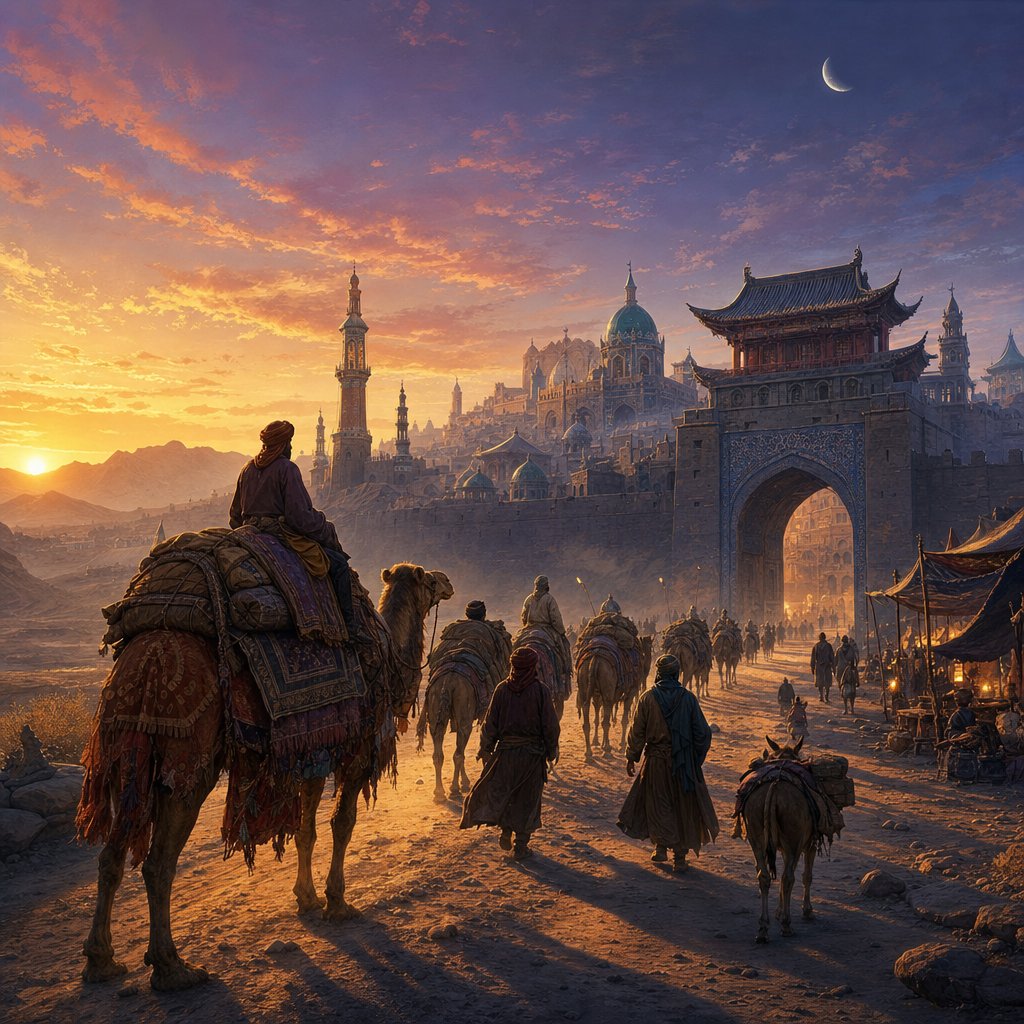
The Hui Muslim Adoption of Ma from Muhammad
Along the Silk Road, camel caravans carried more than silk and spices. They carried faith. Beginning in the Tang dynasty (618-907 AD), Arab and Persian Muslim traders sailed into Guangzhou and trekked overland through Central Asia into Chang'an, bringing Islam to Chinese soil. Over centuries, these merchants settled, married local women, and built communities. But they faced a practical problem: the Chinese administrative system required everyone to carry a Chinese surname. How do you compress an Arabic name like Muhammad into a single Chinese character?
How Muhammad Became Ma in China
The answer turned out to be surprisingly elegant. The full Chinese transliteration of Muhammad is 穆罕默德 (Muhanmode). Muslim settlers searching for a Chinese surname that echoed their prophet's name noticed that the character 马 — pronounced mǎ — captured the opening syllable of Muhammad with reasonable phonetic fidelity. It was short, common, easy to write, and already carried positive cultural associations with strength and speed.
Muhammad (穆罕默德) → phonetic abbreviation → Ma (马): a single character that allowed Muslim families to honor the Prophet's name while fitting seamlessly into Chinese society.
This wasn't the only factor. As historical accounts of Islam in China note, many Muslim men from the Middle East and Central Asia "took the name Ma, partly because of the similarity in sound, and partly because the Muslims love horses and the character Ma stands for horses." The dual resonance — phonetic link to Muhammad and symbolic link to a noble animal — made the choice feel natural rather than forced.
The result? Ma became overwhelmingly the most common surname among China's Hui Muslim population. A well-known saying in China's northwest provinces captures this reality: "Nine Ma in ten Muslims" (十个回回九个马). When someone asks what mā in chinese means for a Hui family, the answer isn't simply "horse" — it's a compressed act of cultural memory, a way of carrying Islamic identity inside a Chinese linguistic framework.
The Silk Road Connection to Islam
The adoption didn't happen overnight. During the Tang and Song dynasties, Muslim communities in port cities like Guangzhou and Quanzhou still maintained Arabic and Persian as daily languages. They lived in designated foreign quarters, held their own legal customs, and often kept their original names. The real pressure to sinicize came during the Ming dynasty (1368-1644), when integration policies required minorities to adopt Chinese dress, language, and surnames. The Ming government's isolationist stance cut Chinese Muslims off from the broader Islamic world, accelerating their linguistic shift toward Chinese.
Imagine being a fifth-generation Muslim in 15th-century Nanjing. Your ancestors spoke Arabic, but you speak Mandarin. Your community prays at the mosque, observes halal dietary laws, and reveres the Prophet — yet your daily life is conducted entirely in Chinese. Choosing Ma as your family name wasn't a betrayal of identity. It was a bridge between two worlds.
Other Muslim settlers followed similar phonetic logic. Hassan became Ha (哈). Hussain became Hu (胡). Sayyid became Sai (赛). Nasser became Na (纳). But none of these alternatives achieved the sheer prevalence of Ma. The ma mandarin meaning for Hui communities became inseparable from Islamic heritage — so much so that genealogical researchers today use the surname as an initial indicator when tracing Hui ancestry in northwestern provinces like Ningxia, Gansu, and Qinghai.
What makes this story remarkable in the broader context of global surname history is the scale of the transformation. Tens of millions of people today carry a surname whose written form says "horse" but whose ancestral meaning points to the Prophet of Islam. The mā chinese character on their identification cards is identical to the one carried by descendants of Zhao She's military lineage — same ink, same strokes, completely different origin. Two families named Ma might live on the same street in Xi'an, one attending Friday prayers at the Great Mosque and the other tracing ancestry to Han dynasty generals, united only by a shared character that means something different to each.
This dual identity embedded within a single surname raises a natural question: if the same romanized spelling can mask such different histories within China itself, what happens when you cross national borders entirely? The answer involves Korea, Vietnam, and naming traditions that have nothing to do with either horses or Muhammad.
Korean, Vietnamese, and Western Origins of Ma
Cross a national border, and the same two letters point to an entirely different past. The romanized spelling "Ma" appears in Korean, Vietnamese, Burmese, and even Western naming traditions — each carrying its own ancestral logic that has nothing to do with Chinese warhorses or Islamic phonetics.
Korean Ma and the Mahan Confederacy
Ma in Korean is written 마 and corresponds to the hanja character 馬. But here's the key distinction: the Korean Ma surname traces to Ma Ryo (馬黎), who attended King Onjo when he left Goguryeo to found the Baekje Kingdom in 18 BC. This origin has no genealogical connection to Zhao She or the Chinese military lineage whatsoever.
The broader historical backdrop involves the Mahan confederacy (馬韓), a tribal grouping in southwestern Korea that existed from roughly 194 BC to the 6th century CE. In Old Korean, "ma" likely meant "south" rather than "horse" — so the same character carried a completely different semantic load on the peninsula. The Mahan confederacy was the largest of the Samhan (Three Hans) and eventually gave rise to the Baekje Kingdom, one of Korea's Three Kingdoms.
The Korean Ma family reappears in historical records during the Koryo dynasty, when a court official named Ma Sun-hung was enfeoffed with Mokchon County in Chungcheong South Province, establishing the clan seat that persists today.
Vietnamese and Western Variants
In Vietnam, the surname appears as Ma (Mã), using the Chinese character 馬. It is found among both ethnic Vietnamese and the Cham people of southern Vietnam, though its adoption history differs from the Chinese and Korean lines. Among certain highland ethnic minorities, Ma functions independently of any Chinese-derived tradition.
Western naming traditions add further complexity. In Burmese culture, "Ma" is a form of address for young women — akin to "Miss" — that became registered as a surname only after immigration to the United States. In Cambodian usage, ម៉ org likely derives from southern Chinese dialects and means "grandmother." And in Irish genealogy, the surname Mar or its variants can appear as an entirely unrelated Western family name, making the surname Mar and the broader mar surname tradition a separate thread altogether.
- Chinese Ma (馬/马): Means "horse" — military and Hui Muslim origins
- Korean Ma (마/馬): Traces to Ma Ryo and the Baekje founding, connected to the Mahan confederacy era
- Vietnamese Ma (Mã/馬): Found among ethnic Vietnamese and Cham communities with distinct adoption histories
- Burmese Ma: A female honorific registered as a surname after emigration
- Western Ma/Mar: Independent origins in Irish and other European linguistic traditions
The takeaway is simple but important: sharing the romanized spelling does not imply shared ancestry. Ma is not a mass surname in the sense of one enormous family — it's a mass surname in the sense of multiple unrelated populations converging on the same two letters through completely independent historical processes. A Korean Ma researching their genealogy would find nothing useful in Chinese Zhao clan records, just as an Irish Mar family gains nothing from studying Silk Road trade routes.
This convergence of spellings creates a practical challenge. When descendants of these different traditions emigrated to new countries, their names were romanized into identical forms — yet the dialect pronunciations they carried with them often reveal which origin stream they belong to.
Regional Pronunciations and Spelling Variants of the Mak Surname and Beyond
A family named Ma in Beijing, a family named Mah in Vancouver, and a family named Beh in Penang might all share the exact same ancestral character — 馬 — yet never recognize each other as relatives on paper. That's because Chinese dialects don't just change how a character sounds. They change how it gets spelled when someone boards a ship or fills out an immigration form. Understanding these variants is the difference between a dead end and a breakthrough in genealogical research.
Dialect Readings from Cantonese to Hokkien
Mandarin gives us the familiar mǎ, but step outside the Mandarin-speaking north and the pronunciation shifts dramatically. In Cantonese — the dominant dialect among early emigrants to North America and Australia — the character 馬 is read as maa5, producing romanizations like Mah or Maa. In Hokkien and Teochew, dialects spoken across Fujian, Taiwan, and much of Southeast Asia, the same character becomes Bé or Má, yielding spellings like Be, Beh, or Bay that look nothing like "Ma" at all. Hakka speakers pronounce it Mâ, which typically gets romanized as Ma or Mah depending on the destination country's conventions.
Among the Hmong people of Laos, China, and Vietnam, the character 馬 corresponds to the Moua clan name — yet another romanization of the same underlying character filtered through a completely different linguistic tradition.
International Romanization Variants
When Chinese emigrants settled abroad, immigration officials transcribed their names by ear. No standardized system existed for most of this history. The result? A single surname character spawned dozens of spellings across different countries and decades. If you carry the Mak surname or the last name Mak, your family likely emigrated from a Cantonese-speaking region where the final -k stop was preserved in speech. The Mak last name origin traces back to the same 馬 character, just filtered through Cantonese phonology where unreleased stop consonants are common.
Similarly, researching the mok last name origin leads to the same character pronounced through yet another dialectal lens — often associated with communities from specific districts in Guangdong Province. The spelling "Mok" reflects a vowel shift particular to certain Cantonese sub-dialects.
| Dialect | Pronunciation | Common Romanization |
|---|---|---|
| Mandarin | mǎ | Ma |
| Cantonese | maa5 | Mah, Maa, Mak, Mok |
| Hokkien / Teochew | Bé / Má | Beh, Be, Bay |
| Hakka | Mâ | Ma, Mah |
| Hmong | Moua | Moua, Mua |
| Vietnamese (Sino-Vietnamese) | Mã | Ma |
Why does this matter for family history? Imagine two cousins whose grandfather emigrated from Guangdong. One cousin's branch settled in Malaysia, where their name was recorded as Beh. The other branch landed in San Francisco, where an immigration clerk wrote down Mah. Decades later, these cousins might not realize they share the same Mak family name — the same character, the same ancestor, separated only by the accident of which dialect an official happened to hear.
As My China Roots notes, a single Chinese surname can have over 30 romanization variants due to dialect differences and inconsistent transcription practices. For anyone researching the Mak last name, this means casting a wide net: searching for Mah, Mar, Beh, Mok, Bay, and even Moua alongside the standard Ma. Each spelling is a clue pointing back to a specific emigration port, a specific dialect community, and ultimately a specific region of origin — breadcrumbs that can reconnect scattered branches of the same family tree across continents and centuries.
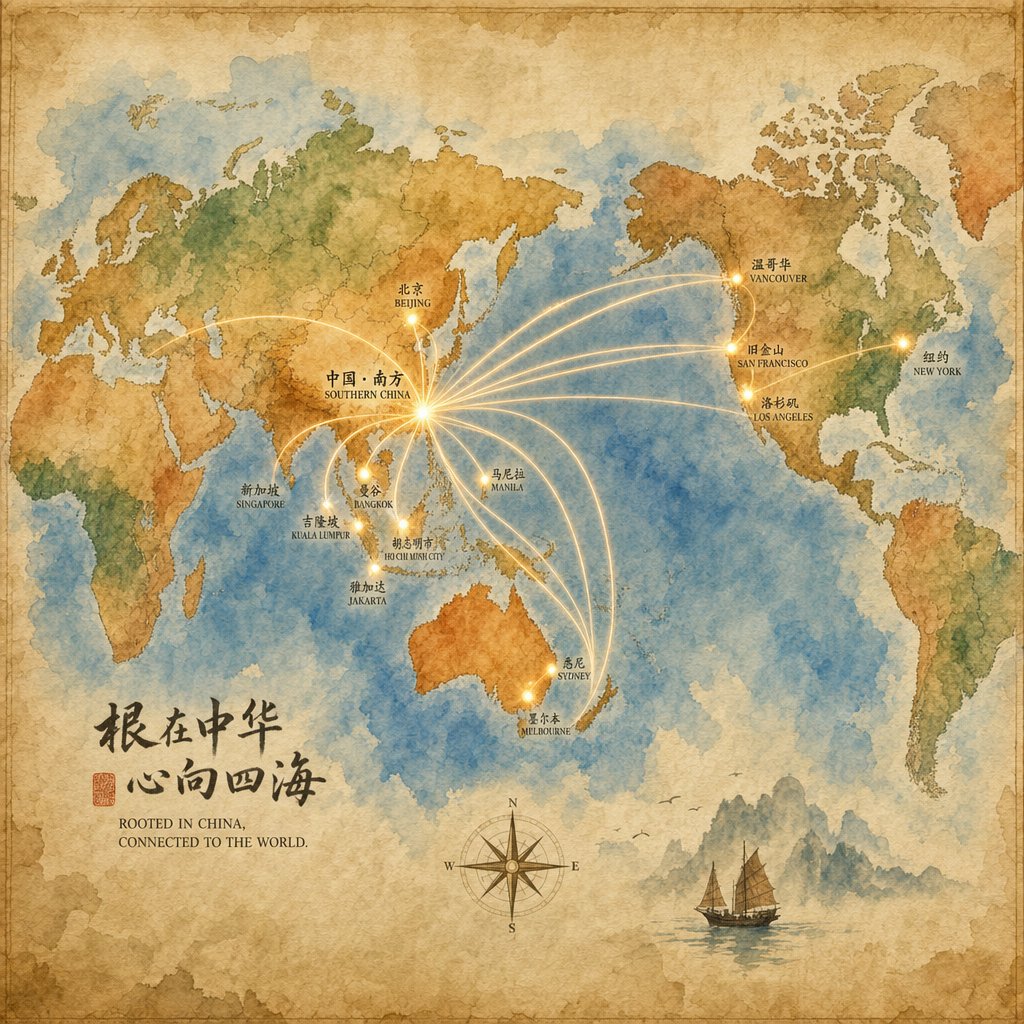
Migration Patterns and Global Distribution of Last Names Starting with Ma
Those spelling variants didn't scatter randomly. Each one traces back to a specific port, a specific decade, and a specific push factor that sent families across oceans. The Ma surname's global footprint is the product of at least three distinct migration corridors — each tied to a different origin stream, a different era, and a different destination.
From Northern China to the Silk Road
The surname's geographic story begins in Handan, Hebei Province — Zhao She's original fief. From there, the earliest expansions followed military deployments. Ma Yuan's campaigns pushed the clan south into Hunan, Guangxi, and Vietnam during the Han dynasty. Ma Teng's power base pulled it west into Gansu and the frontier zones bordering Central Asia. Each posting left behind settled descendants who established new clan branches far from the ancestral homeland.
The Hui Muslim stream followed a different corridor entirely. Arab and Persian traders entered China through two main routes: overland via the Silk Road into Xi'an and Lanzhou, and by sea into Guangzhou and Quanzhou. As these communities adopted the Ma surname and grew over centuries, they concentrated heavily in China's northwestern provinces — Ningxia, Gansu, Qinghai, and Yunnan. Their westward distribution along the old Silk Road corridor remains visible today in the demographic makeup of cities like Yinchuan, where Ma is among the most common last names.
Periods of political collapse accelerated southward movement for both streams. The fall of the Northern Song dynasty in 1127 triggered massive population shifts toward the Yangtze Delta and beyond. The Mongol invasions, the Ming-Qing transition, and the Taiping Rebellion each generated fresh waves of displacement that carried Ma families into Fujian, Guangdong, and eventually Southeast Asia through established maritime trade networks.
The Modern Global Diaspora
The 19th century opened new chapters. Chinese emigration surged as treaty ports funneled laborers toward gold rushes in California and Australia, tin mines in Malaya, and plantations across Southeast Asia. Cantonese-speaking Ma families from Guangdong formed part of this wave, arriving in San Francisco, Melbourne, and Singapore with their surname romanized as Mah, Mak, or Beh depending on dialect and destination.
Data from Forebears.io confirms the scale of this dispersal: approximately 21.3 million people bear the Ma surname worldwide, distributed across more than 187 countries and territories. China accounts for the overwhelming majority at 18.4 million, but significant populations appear in India (2 million), Myanmar (302,000), Vietnam (219,000), and Hong Kong (70,000). In the United States alone, roughly 29,000 people carry the surname — making it one of the more recognizable last names that start with Ma in American communities. Canada hosts over 11,000, Australia over 4,500, and the United Kingdom nearly 2,000.
California, with its deep history of Chinese immigration dating to the 1848 Gold Rush, holds a particularly high concentration. Ma ranks among the popular surnames in California's Bay Area and Los Angeles County, reflecting over 170 years of continuous settlement from southern Chinese dialect communities. The surname's incidence in the United States grew by over 146,000 percent between 1880 and 2014 — a staggering increase that mirrors broader waves of Chinese immigration after exclusion-era laws were repealed in 1965.
While Ma may not hold the title of most common Asian last name globally — that distinction belongs to names like Wang or Li — its cross-cultural reach is arguably unmatched. No other Asian surname spans Chinese, Korean, Vietnamese, Burmese, and Hui Muslim communities simultaneously while also appearing independently in Western naming traditions. Its presence in 187 countries isn't just a demographic fact. It's a map of human movement — Silk Road caravans, maritime trade fleets, gold rush migrations, refugee waves, and modern professional mobility all leaving their fingerprints in census data.
For descendants trying to trace their roots, these migration patterns offer critical context. A Ma family in Melbourne likely traces to 19th-century Cantonese emigration from Guangdong. A Ma family in Almaty, Kazakhstan, probably connects to Hui Muslim communities along the old Silk Road. A Ma family in Flushing, Queens, may have arrived during the post-1965 immigration wave from northern China. The spelling variant, the geographic location, and the arrival decade together form a triangulation that can point researchers toward the right origin stream — and ultimately, the right ancestral village.
What Ma Surname Research Means for Your Family History
Spelling variants, migration corridors, and origin streams are useful as abstract knowledge — but they become powerful when you apply them to your own family. If you carry the last name Ma, or if it appears somewhere in your family tree, the question isn't just "what does my surname mean?" It's "which Ma am I?" Answering that question connects you to a specific history, a specific culture, and a specific set of ancestors whose lives shaped the name you carry today.
Connecting Your Ma Ancestry to Its Origin Stream
The first step is narrowing down which of the independent origin streams your Ma family name belongs to. Four key indicators can help you triangulate:
- Geographic origin: A family rooted in Ningxia, Gansu, or Qinghai likely belongs to the Hui Muslim stream. A family from Hebei or Shaanxi may trace back to the Zhao She military lineage. A family from Korea's Chungcheong Province connects to the Mahan confederacy tradition.
- Religious background: If your family observes Islamic practices — halal dietary customs, mosque attendance, Ramadan fasting — the Muhammad-to-Ma phonetic adoption is almost certainly your origin story.
- Dialect pronunciation: How older family members pronounce the surname reveals regional roots. Cantonese "Mah," Hokkien "Beh," or Mandarin "Ma" each points to a different emigration source.
- Traditional genealogical records: Chinese clan genealogies (族谱 or 家谱) often trace lineages back dozens of generations. If your family maintained one, it will typically state the founding ancestor and ancestral homeland explicitly.
You don't need all four indicators to make progress. Even one — a grandmother's mention of a mosque, a grandfather's Cantonese dialect, a family Bible listing a village name — can point you toward the right branch.
Using Surname Research for Family History
Once you've identified your likely origin stream, practical research can begin. Here's a sequence that works whether your Ma family name traces to Chinese generals, Silk Road merchants, or Korean court officials:
- Interview living relatives. Ask about ancestral villages, religious practices, dialect words, and any documents (passports, immigration papers, old photographs with Chinese inscriptions) that might survive in family collections.
- Identify your spelling variant. Check immigration records, naturalization documents, and early census entries. A shift from "Beh" to "Ma" between generations signals a dialect community and narrows your search region.
- Search digitized genealogies. FamilySearch hosts a large collection of Chinese clan genealogies (家谱) searchable by surname and province. Enter "Ma" in pinyin, select the relevant province, and browse available records.
- Cross-reference migration patterns. Match your family's arrival date and destination country against known emigration waves. A Ma family arriving in San Francisco in the 1870s almost certainly came from Guangdong. A Ma family settling in Istanbul in the 1940s likely connects to Hui communities displaced during China's civil war.
- Consult community organizations. Hui Muslim genealogical societies, Korean clan associations, and Chinese-Australian family history groups all maintain specialized databases and expertise that general platforms lack.
The ma family name is ultimately a case study in how two letters can contain multitudes. A single romanized spelling masks at least five independent ancestral lines — Chinese military, Hui Muslim, Korean, Vietnamese, and Western — each with its own founding story, its own migration history, and its own cultural meaning. Two people sharing the last name Ma might share nothing else: not language, not religion, not continent of origin, not even the same Chinese character.
That complexity isn't a barrier to research. It's an invitation. Every Ma family carries a specific story waiting to be uncovered — a story of generals or prophets, of Silk Road caravans or gold rush ships, of oracle bone horses or Korean confederacies. The surname is your starting point. Where it leads depends on which questions you ask, which records you find, and which ancestors are waiting at the other end of the search.
Frequently Asked Questions About the Ma Surname
1. What does the surname Ma mean?
The surname Ma (馬/马) literally translates to 'horse' in Chinese. However, its meaning varies by cultural context. For families descended from the Warring States general Zhao She, it references a cavalry-related fief called Mafu ('place where horses are tamed'). For Hui Muslim families, Ma serves as a phonetic abbreviation of Muhammad (穆罕默德), chosen during the Tang and Ming dynasties when Muslim settlers needed Chinese surnames for administrative purposes. In Korean tradition, the same romanized spelling connects to the ancient Mahan confederacy rather than horses at all.
2. Is Ma a Chinese or Muslim surname?
Ma is both. It has at least two major independent origin streams within China alone. The Chinese military origin traces to General Zhao She of the State of Zhao around 270 BCE, whose descendants adopted the name from his horse-related fief. The Hui Muslim origin developed centuries later when Arab and Persian traders along the Silk Road adopted Ma as a phonetic approximation of Muhammad. Today, a common saying in China's northwest — 'Nine Ma in ten Muslims' — reflects how dominant the surname became among Hui communities, while millions of non-Muslim Chinese families also carry it from the older military lineage.
3. How common is the Ma surname worldwide?
Ma ranks approximately 13th to 19th among Chinese surnames depending on the census source, with over 21 million bearers globally across 187 countries and territories. China accounts for roughly 18.4 million, followed by India (2 million), Myanmar (302,000), Vietnam (219,000), and Hong Kong (70,000). In the United States, approximately 29,000 people carry the surname, with particularly high concentrations in California due to over 170 years of continuous Chinese immigration to the state.
4. Are Mah, Mak, and Beh the same surname as Ma?
Yes, these are all romanization variants of the same Chinese character 馬. The different spellings result from dialect pronunciations and inconsistent transcription by immigration officials. Cantonese speakers produced 'Mah' or 'Mak,' Hokkien speakers produced 'Beh' or 'Be,' and Hakka speakers typically kept 'Ma' or 'Mah.' Hmong communities romanize it as 'Moua.' For genealogical research, searching all these variants is essential since family members who emigrated from different regions or in different decades may carry different spellings despite sharing the same ancestor.
5. How can I find out which Ma origin my family belongs to?
Four key indicators help identify your origin stream. Geographic origin is the strongest clue — families from Ningxia, Gansu, or Qinghai likely belong to the Hui Muslim stream, while those from Hebei or Shaanxi may trace to the Zhao She military lineage. Religious background matters too: Islamic practices point to the Muhammad-to-Ma adoption. Dialect pronunciation reveals regional roots (Cantonese 'Mah' vs. Hokkien 'Beh'). Finally, traditional Chinese clan genealogies (族谱) often explicitly name the founding ancestor. Even one of these indicators can point you toward the correct branch for deeper research.