What Missing Elements Mean in Chinese Baby Names
When parents explore chinese baby names and meanings, they often encounter a concept that goes far deeper than sound or aesthetics: the idea that a name should complete what a child's birth chart is missing. This tradition, known as 缺五行 (que wu xing), sits at the heart of Chinese naming philosophy and has guided families for centuries.
What Are Missing Elements in Chinese Naming
Chinese naming tradition operates on a foundational belief: every person is born with a unique energetic blueprint composed of the Five Elements, or Wu Xing — Wood, Fire, Earth, Metal, and Water. A child's birth chart, called BaZi (Eight Characters), maps the elemental forces present at the exact moment of birth. Sometimes, one or more elements are completely absent or significantly underrepresented in that chart. These gaps are what practitioners call missing elements.
Imagine you scan the 100 most common chinese baby names and notice characters containing water radicals, wood radicals, or metal components. That is not coincidence. Many of those names were deliberately chosen to address an elemental gap identified in the child's birth chart. The practice reflects a deeper logic: each chinese baby name carries elemental weight, and that weight is meant to serve a purpose.
Why Elemental Balance Matters for a Child's Name
The reasoning is straightforward. If a birth chart shows an abundance of Fire but no Water, the chart is considered imbalanced. Traditional belief holds that this imbalance can manifest as challenges in temperament, health, or life direction. Parents then select baby chinese names containing characters associated with the missing element to restore harmony.
A name is believed to supplement what the birth chart lacks, creating harmony for the child's life path.
This is not about superstition or blind tradition. It is a structured system with identifiable rules, mappings, and logic. The problem is that most resources online either oversimplify the process — telling you to just "add whatever is missing" — or redirect you to paid consultants without explaining why.
This article takes a different approach. Rather than handing you a calculator or a list, it walks through the underlying mechanics so you understand how elemental composition is determined, why certain gaps matter more than others, and how character selection actually works. Whether you ultimately consult a professional or make decisions independently, understanding the logic helps you ask sharper questions and avoid common pitfalls.
The first step in that process is learning how to read the birth chart itself — and that begins with the Four Pillars.
How to Read a BaZi Chart for Elemental Composition
A BaZi chart is built from four data points: the year, month, day, and hour of a child's birth. Each of these produces one "pillar," and each pillar contains two characters — a Heavenly Stem on top and an Earthly Branch below. Four pillars, two characters each, eight characters total. That is where the name BaZi (八字, "Eight Characters") comes from, and it is the foundation of every baby chinese name decision rooted in elemental theory.
The Four Pillars and Their Elemental Associations
Every Heavenly Stem and every Earthly Branch carries a specific Five Element association. When you lay out all eight characters, you can tally which elements appear, which dominate, and which are absent. Here is the basic structure of a BaZi chart:
| Year Pillar | Month Pillar | Day Pillar | Hour Pillar | |
|---|---|---|---|---|
| Heavenly Stem | Element A (Yang/Yin) | Element B (Yang/Yin) | Element C (Yang/Yin) | Element D (Yang/Yin) |
| Earthly Branch | Element E + hidden stems | Element F + hidden stems | Element G + hidden stems | Element H + hidden stems |
The Day Stem (Element C in the table above) represents the self — practitioners call it the Day Master. It is the reference point for determining which elements support you, which challenge you, and which are missing entirely. The remaining seven characters form the environment around that Day Master.
What makes this more layered than it first appears is that Earthly Branches contain hidden stems. A single branch can carry two or three concealed elemental associations beneath its surface element. So a chart that looks like it has no Fire on the surface might actually contain Fire buried inside a branch. This is why a simple baby chinese name calculator that only counts surface elements can mislead parents — it may flag an element as missing when it is actually present but hidden.
The chart is constructed using the solar calendar and solar term boundaries, not the lunar calendar. The year pillar changes at Li Chun (start of spring), not on Chinese New Year. The month pillar follows solar terms like Jing Zhe and Qing Ming. The day pillar must be looked up in a perpetual calendar. And the hour pillar is derived from the day stem using a formula called Wu Shu Dun. Each step requires precision — a wrong boundary means a wrong element, which cascades into incorrect naming decisions.
What to Do When the Exact Birth Hour Is Unknown
Here is a practical problem many parents face: they do not know the exact birth hour. Without it, the Hour Pillar cannot be determined, and two of the eight characters remain unknown. This matters because the Hour Pillar governs specific life areas, including the relationship with children, and its elements can shift the entire chart's balance.
When studying chinese baby names over time popularity, you will notice that older generations often lack recorded birth times — hospital documentation was less standardized, and home births were common. Even today, parents in diaspora communities may have approximate times at best.
So what can you do?
- Use a two-hour window estimate. Chinese hours span two Western hours (for example, 9:00-11:00 AM is Si hour). If you know the birth was "mid-morning," you can narrow it to one or two possible branches and check whether the elemental outcome changes significantly between them.
- Analyze the six known characters. Experienced practitioners routinely read charts with only three pillars. The Year, Month, and Day pillars still provide six characters — enough to identify dominant elements and major gaps, even if the Hour Pillar remains uncertain.
- Consult a practitioner for chart rectification. Some professionals use life events, physical characteristics, or cross-referencing with other systems to narrow down the missing hour. This is especially worthwhile when the six known characters are ambiguous or when multiple elements appear equally weak.
A baby chinese name app or baby chinese name generator will typically ask for the birth hour and produce results based on whatever you enter. If you input an estimated time, understand that the output is conditional — it reflects one possible chart, not a confirmed one. For parents working with uncertain birth times, treating the results as directional rather than absolute is the more honest approach.
The key takeaway: even with an incomplete chart, you are not working blind. Six characters still reveal a great deal about elemental composition. The real question becomes how to interpret what those characters contain — and that requires understanding the elemental mappings of each Stem and Branch individually.
Heavenly Stems and Earthly Branches Explained
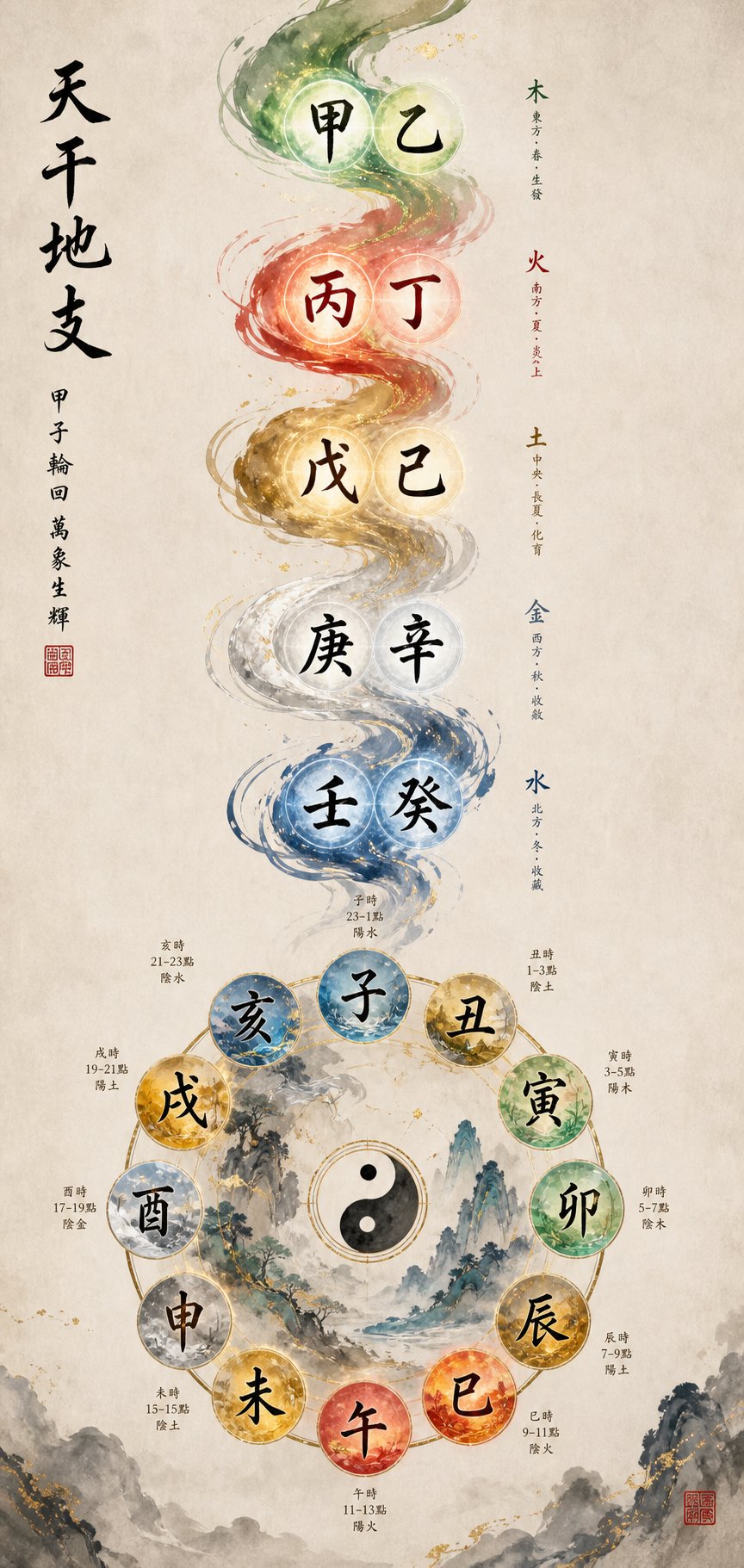
Every character in a BaZi chart is either a Heavenly Stem or an Earthly Branch, and each one maps to a specific element with a specific polarity. This is not abstract theory — it is the exact reference system you need to determine which elements are present, absent, or hidden in your child's chart. Whether you are searching for baby boy names in chinese characters or exploring options for a daughter, the elemental identity of each Stem and Branch dictates what the chart actually contains.
Heavenly Stems and Their Five Element Pairings
The Ten Heavenly Stems form five pairs. Each pair shares an element but differs in polarity — one Yang, one Yin. Yang stems represent the element in its outward, active form. Yin stems represent the same element in its inward, receptive form. The distinction matters because Yang and Yin versions of the same element behave differently in chart interactions.
Here is the complete mapping:
| Heavenly Stem | Pinyin | Element | Polarity | Season/Direction |
|---|---|---|---|---|
| 甲 | Jia | Wood | Yang | Spring / East |
| 乙 | Yi | Wood | Yin | Spring / East |
| 丙 | Bing | Fire | Yang | Summer / South |
| 丁 | Ding | Fire | Yin | Summer / South |
| 戊 | Wu | Earth | Yang | Center / Transitional |
| 己 | Ji | Earth | Yin | Center / Transitional |
| 庚 | Geng | Metal | Yang | Autumn / West |
| 辛 | Xin | Metal | Yin | Autumn / West |
| 壬 | Ren | Water | Yang | Winter / North |
| 癸 | Gui | Water | Yin | Winter / North |
Reading the Heavenly Stems is straightforward — each one equals exactly one element. If your child's Day Stem is 丙 (Bing), the Day Master is Yang Fire. If the Year Stem is 庚 (Geng), that pillar contributes Yang Metal. No ambiguity, no hidden layers. The complexity lives in the row below.
Earthly Branches and Hidden Elemental Stems
The Twelve Earthly Branches are where element identification gets layered. Each branch carries a primary element on the surface, but most also contain one or two hidden stems buried inside. These hidden stems represent secondary elemental influences that are present in the chart but weaker than the main element of that branch.
Think of it this way: a Heavenly Stem is a single clear note. An Earthly Branch is a chord — it has a dominant tone, but other notes ring underneath. When parents look at baby girl chinese names and try to identify missing elements, overlooking hidden stems is one of the most common errors. A chart might appear to lack Fire entirely, yet Fire could be sitting inside a branch as a hidden stem, quietly present but not dominant.
| Earthly Branch | Pinyin | Primary Element | Hidden Stem(s) | Hidden Element(s) |
|---|---|---|---|---|
| 子 | Zi | Water | 癸 | Water |
| 丑 | Chou | Earth | 己, 癸, 辛 | Earth, Water, Metal |
| 寅 | Yin | Wood | 甲, 丙, 戊 | Wood, Fire, Earth |
| 卯 | Mao | Wood | 乙 | Wood |
| 辰 | Chen | Earth | 戊, 乙, 癸 | Earth, Wood, Water |
| 巳 | Si | Fire | 丙, 庚, 戊 | Fire, Metal, Earth |
| 午 | Wu | Fire | 丁, 己 | Fire, Earth |
| 未 | Wei | Earth | 己, 丁, 乙 | Earth, Fire, Wood |
| 申 | Shen | Metal | 庚, 壬, 戊 | Metal, Water, Earth |
| 酉 | You | Metal | 辛 | Metal |
| 戌 | Xu | Earth | 戊, 辛, 丁 | Earth, Metal, Fire |
| 亥 | Hai | Water | 壬, 甲 | Water, Wood |
Notice that some branches — like 子 (Zi), 卯 (Mao), and 酉 (You) — are elementally pure. They contain only one element with no hidden diversity. Others, like 寅 (Yin) or 巳 (Si), carry three different elements within a single branch. This means a chart with 寅 in it technically contains Wood, Fire, and Earth all from that one position, even though Wood is the dominant surface element.
This layering is precisely why identifying missing elements in chinese baby names requires more than a surface count. A parent selecting a baby boy name in chinese characters to compensate for "missing Fire" needs to first confirm that Fire is not already hiding inside a branch like 寅, 巳, or 戌. If Fire is present as a hidden stem, it is not truly absent — it is weak. And weak versus absent calls for different naming strategies, a distinction that becomes critical in the next layer of analysis.
Not Every Missing Element Needs to Be Added
Here is where most online guides fall short. They tell you to identify what is missing, pick a character that carries that element, and move on. Sounds simple. But that advice skips a question that changes everything: does the chart actually benefit from having that element added?
The distinction between a truly missing element, a weak element, and an unfavorable element is the single most important nuance in understanding missing elements in chinese baby names. Getting this wrong does not just produce a suboptimal name — it can introduce an element that actively disrupts the chart's existing balance.
Truly Missing vs. Weak vs. Unfavorable Elements
These three categories look similar on the surface but require completely different responses. Here is how they break down:
- Truly Missing: The element does not appear anywhere in the chart — not as a Heavenly Stem, not as a primary Earthly Branch element, and not as a hidden stem within any branch. It is completely absent from all eight characters. This is the rarest scenario because hidden stems distribute elements widely.
- Weak: The element exists in the chart but only as a hidden stem inside one branch, or it appears once with no seasonal support and no allies among the other characters. It is present on paper but lacks the strength to exert meaningful influence. Most cases that parents identify as "missing" actually fall into this category.
- Unfavorable: The element is absent or weak, but its absence actually serves the chart well. Its presence would create a destructive relationship with the Day Master or tip the balance in a harmful direction. The chart is healthier without it.
You will notice that the third category contradicts the instinct most parents have. If something is missing, fill the gap — that feels logical. But BaZi does not work like a checklist where all five boxes need ticking. It works like an ecosystem where certain forces benefit the central figure (the Day Master) and others challenge it.
When Compensating a Missing Element Can Backfire
Consider a practical scenario. A child born with a weak Water Day Master has a chart dominated by Earth and Metal. Fire is completely absent. The instinct is to add Fire through the name. But Fire in this chart would strengthen Earth (Fire produces Earth in the productive cycle), and Earth is already overwhelming the Day Master by controlling Water. Adding Fire does not help — it feeds the very element that is already too strong.
This is what some practitioners call the zero-sum fallacy: the assumption that filling every elemental gap creates balance. In reality, element strength is relative and contextual. A missing element might be missing precisely because the chart functions better without it. Parents searching for auspicious chinese names for ox babies 2021 or auspicious chinese names for rat babies 2020 encountered this issue frequently — zodiac year guides often recommend blanket elemental additions based on the year alone, ignoring the full chart context that makes each child's situation unique.
The same problem appeared in guides listing auspicious chinese names for pig babies 2019. Generic year-based advice suggested adding certain elements to all children born that year, treating the Year Pillar as the whole story. But the Year Pillar is only one of four pillars. Two children born in the same year but different months, days, and hours can have radically different elemental needs — one might genuinely need Water supplementation while the other would be harmed by it.
So when is compensation appropriate? Two conditions generally need to be met. First, the element must be genuinely needed by the Day Master — it either supports the Day Master directly or controls an element that is too strong. Second, adding it should not feed a destructive cycle that harms the chart's existing structure. When both conditions align, supplementing through a name character makes sense. When they do not, leaving the gap alone is the wiser choice.
This raises an obvious follow-up: how do you determine which element the Day Master actually needs? That question has a specific answer in BaZi theory, and it carries a name — the Useful God.

The Useful God Concept and Why It Changes Everything
The Useful God — 用神 (Yong Shen) — is the element that most benefits the Day Master in a given chart. It is not necessarily the element that is missing. It is the element that, when strengthened, brings the entire chart into its most functional state. This single concept separates folk-level naming from professional-level analysis, and it explains why two practitioners can look at the same chart and recommend different elements.
What Is the Useful God in BaZi Analysis
Think of the Day Master as the central figure in a story. The other seven characters in the chart form the environment around that figure — some supportive, some challenging, some neutral. The Useful God is whichever element plays the most beneficial role in that environment. It might support the Day Master directly, or it might control an element that has grown too dominant.
A baby chinese name feng shui approach that simply fills in whatever is absent treats the chart like a shopping list. The Useful God approach treats it like a dynamic system. The question is not "what is missing?" but "what does this particular Day Master need most to thrive?"
Here is a practical illustration drawn from practitioner analysis: a child born in 2012 with a Water Day Master (壬) has Water appearing five times across the eight characters. Fire is almost entirely absent — only trace amounts hide within two branches. The instinct would be to add Fire. But because the chart is overwhelmingly Water-dominant, Fire introduced directly would simply be extinguished by the surrounding Water. It cannot survive, let alone help. The actual Useful God turns out to be Wood, because Wood drains excess Water (the productive cycle: Water nourishes Wood), bringing the chart back toward equilibrium. Fire becomes viable only after Wood is present to act as a bridge.
This is why a baby chinese name fortune teller with genuine training will not just count elements and fill gaps. They identify the Useful God first, then select characters accordingly.
Traditional Compensation vs. Useful God Approach
The traditional folk method works like this: run the birth data, see which element is absent, pick a character with that element's radical. Done. This approach is widespread because it is simple and feels intuitive. It also works in straightforward charts where the missing element happens to coincide with the Useful God.
The professional method adds a critical filter. Before selecting any character, a baby chinese name master singapore or any trained practitioner will determine the Day Master's strength (strong or weak), identify which elements help versus harm, and only then designate the Useful God. The missing element might be the Useful God — or it might be an element whose absence is actually protecting the chart.
The Useful God may differ from the missing element, and professional naming prioritizes the former over the latter.
This distinction reconciles the conflicting advice parents encounter online. One source says "add Water," another says "avoid Water" — for the same birth date. The disagreement usually traces back to one source using the folk method (fill what is missing) and the other using Useful God analysis (strengthen what helps). They are answering different questions.
For parents navigating baby chinese name selection singapore services or consulting practitioners anywhere, understanding this concept changes the conversation entirely. You can ask: "Is the element you are recommending the Useful God, or simply the missing element?" That one question reveals whether the practitioner is working at a surface level or conducting genuine chart analysis.
In complex charts — where multiple elements are absent, or where the Day Master sits at a borderline between strong and weak — Useful God determination becomes the deciding factor. It sets the priority. If Wood is the Useful God and both Fire and Metal are missing, Wood gets addressed first. Fire and Metal may or may not be supplemented depending on whether they support or undermine Wood's role in the chart.
Knowing which element to prioritize is half the equation. The other half is knowing which characters actually carry that element — and that depends on understanding how Chinese radicals map to the Five Elements.
Chinese Radicals and Their Five Element Mappings
You know which element to target. The Useful God analysis pointed you toward Water, or Wood, or whichever element your child's chart genuinely needs. The next question is concrete: which characters actually carry that element? The answer lives in radicals.
Radicals (部首) are the structural building blocks of Chinese characters. Every character in the language contains at least one radical, and in the context of Five Element naming, the radical is the primary method for classifying a character's elemental nature. Not the character's meaning in modern usage. Not its pronunciation. Its radical. This is the foundational reference that most guides mention in passing but never actually deliver in usable form.
Radical-to-Element Reference Table
When browsing chinese baby girl names with meaning or searching for baby boy names in chinese with meaning, you will encounter characters that seem obviously tied to an element. A character meaning "ocean" feels like Water. A character meaning "forest" feels like Wood. In most cases, that intuition aligns with the radical classification — but not always. The radical is what practitioners use as the definitive classifier, because it reflects the character's structural DNA rather than its semantic drift over centuries.
Here is a working reference table covering the most commonly used radicals for each element, along with example characters frequently chosen for names:
| Element | Associated Radicals | Example Name Characters | Meanings |
|---|---|---|---|
| Water | 氵(three-dot water), 水, 雨, 冫(ice) | 涵 (han), 淳 (chun), 澤 (ze), 霖 (lin), 溪 (xi) | Contain/nourish, pure/honest, grace/moisture, continuous rain, stream |
| Wood | 木, 艹 (grass), 竹, 禾 (grain) | 桐 (tong), 楠 (nan), 芷 (zhi), 萱 (xuan), 筠 (yun) | Paulownia tree, cedar, angelica, daylily, bamboo |
| Fire | 火, 灬 (four-dot fire), 日 (sun) | 煜 (yu), 炫 (xuan), 晗 (han), 曦 (xi), 昕 (xin) | Brilliant light, dazzling, dawn, morning sun, daybreak |
| Earth | 土, 山, 石, 田 (field), 阝(mound) | 坤 (kun), 峻 (jun), 岚 (lan), 磊 (lei), 垚 (yao) | Earth/feminine, towering, mountain mist, stacked stones, high ground |
| Metal | 金, 钅(metal radical), 刂 (knife), 刀 | 鑫 (xin), 铭 (ming), 锦 (jin), 钰 (yu), 銘 (ming) | Prosperity, inscription, brocade, precious jade-metal, engraving |
A few things to notice. Water radicals are among the most common in chinese baby names for girls — characters like 涵, 淳, and 溪 carry both elegance and clear elemental identity. For a baby boy chinese name, Earth and Metal radicals tend to appear frequently in characters like 峻, 磊, and 铭, which convey strength alongside their elemental function. Wood radicals span both genders comfortably, with 萱 and 芷 popular for girls while 桐 and 楠 lean toward boys.
The radical-based classification method is considered the oldest and most widely accepted approach to determining a character's Five Element nature. Its logic traces back to the pictographic origins of Chinese writing — characters were originally drawings of the natural world, and their radicals preserve that elemental connection even as meanings evolved.
Characters That Look Elemental but Are Not
Here is where parents frequently stumble. Some characters feel strongly associated with an element based on their modern meaning, but their radical tells a different story. When selecting baby girl chinese names unique to your child's elemental needs, or choosing any name character for Five Element purposes, the radical classification must take priority over semantic intuition.
Common misclassifications include:
- 雯 (wen) — "cloud patterns": Feels like Water because clouds relate to weather and rain. However, the character's primary radical is 文 (literature/pattern), and while the 雨 component is present on top, some classification systems treat this as a weaker Water association than characters where 氵 is the structural radical. Practitioners disagree on this one, which is itself a warning sign to verify rather than assume.
- 明 (ming) — "bright": Contains both 日 (sun/Fire) and 月 (moon). Parents often classify it as Fire because of the sun component, but the moon radical introduces a secondary association. Its elemental classification depends on which system the practitioner follows — some assign it to Fire, others treat it as mixed.
- 永 (yong) — "eternal": Visually resembles the water radical 氵 in its stroke structure, and its original etymology relates to flowing water. But its modern radical classification is 水 only in some dictionaries, while others list it under 丶. The elemental strength here is considered weak Water rather than strong Water.
- 泰 (tai) — "peace/prosperity": Contains the water component 水 at the bottom, but the character's overall meaning has drifted far from water. Classification systems generally assign it weak Water rather than strong Water, making it a poor choice if you need robust Water supplementation.
- 胜 (sheng) — "victory": The left component 月 in this character is actually the flesh radical (肉) written in its compressed form, not the moon. This means it carries no Fire association despite looking like it might. Its elemental classification leans toward Earth or Water depending on the system used.
The underlying lesson is consistent: when a character's meaning suggests one element but its radical structure points elsewhere, trust the radical. Meaning can shift across centuries and dialects. Radicals preserve the character's original elemental architecture.
For parents exploring baby girl chinese names and meaning or compiling shortlists of characters, a practical workflow helps avoid these traps. First, identify the target element from your Useful God analysis. Second, filter characters by their primary radical — use the radical groupings in the table above as your starting filter. Third, verify that the character's meaning and tone work well alongside the surname and any other given-name character. Elemental correctness matters, but a name also needs to sound right and carry appropriate meaning.
This brings up a subtlety that the radical table alone cannot address. When you place two characters side by side in a given name, their elements interact. A Wood-element character paired with a Fire-element character creates a productive flow (Wood feeds Fire). A Water-element character paired with a Fire-element character creates a destructive clash (Water extinguishes Fire). These interactions follow predictable cycles — and understanding those cycles determines whether your character pairing strengthens the name or undermines it.
Element Cycles That Shape Character Selection
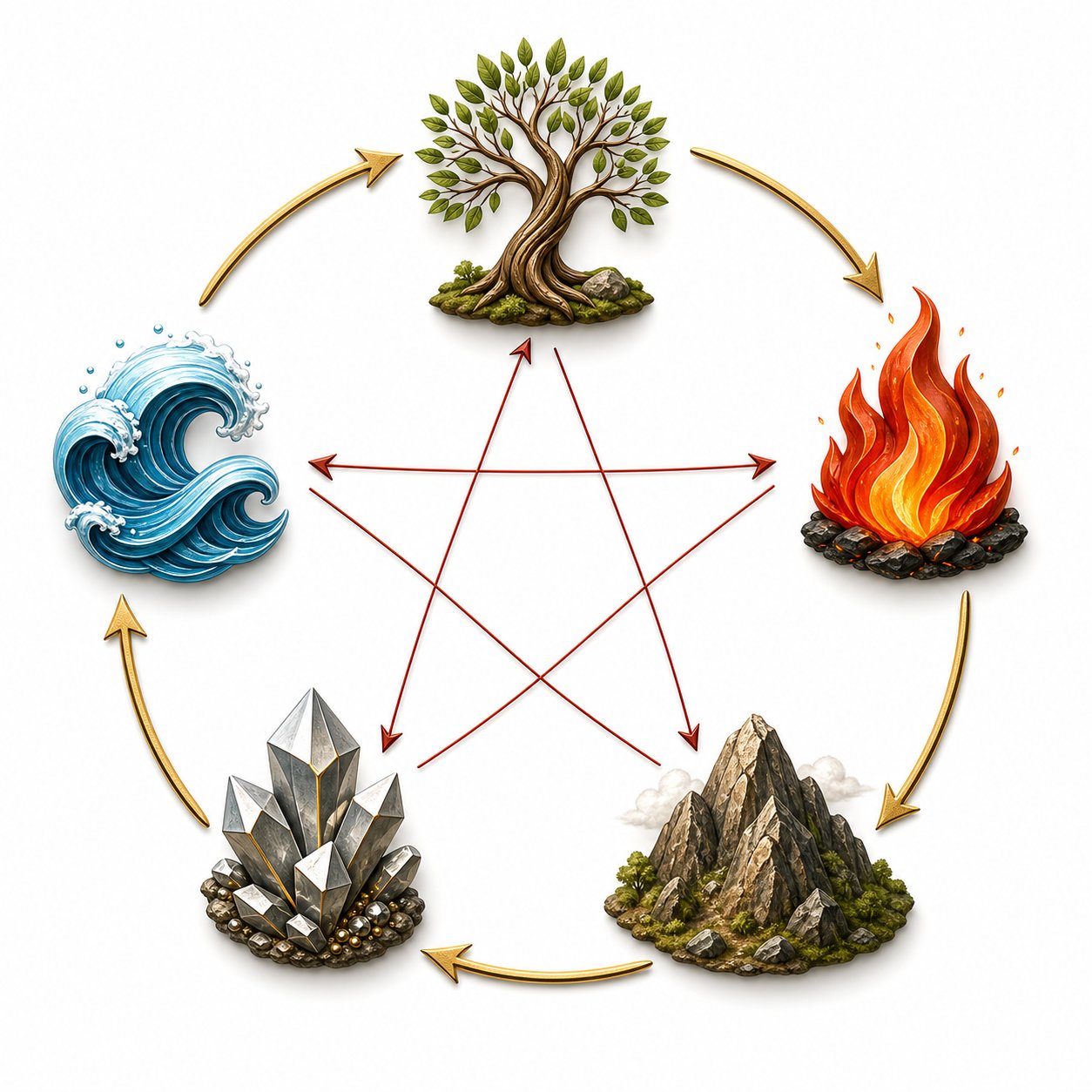
Two characters sitting side by side in a given name do not exist in isolation. They interact according to fixed elemental rules — rules that either create harmony or introduce friction. These rules are the productive cycle and the destructive cycle, and they determine whether your carefully chosen characters work together or quietly undermine each other.
The Productive and Destructive Element Cycles
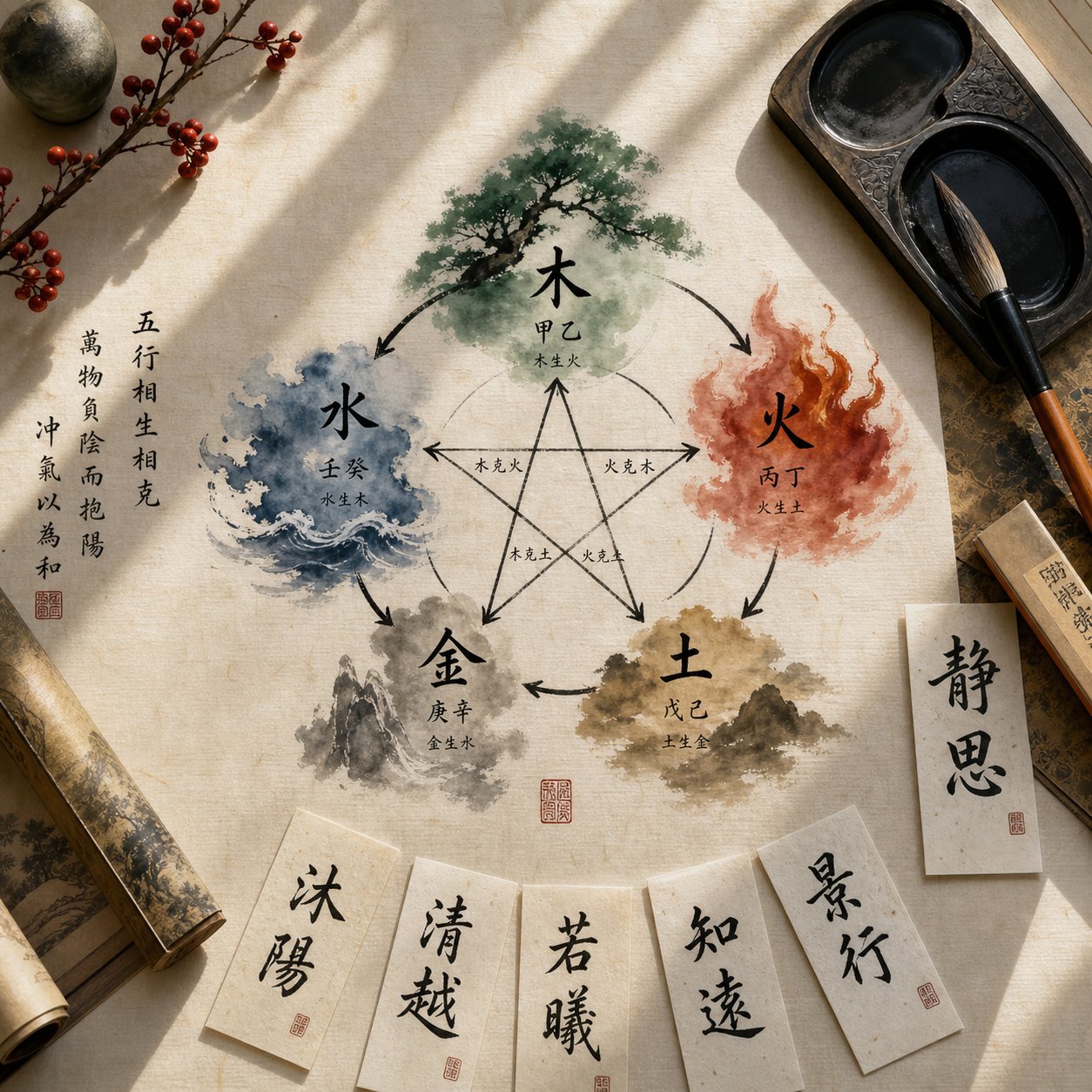
The productive cycle (相生, xiang sheng) describes how one element nourishes and gives rise to the next. Think of it as a chain of support — each element feeds the one that follows it:
- Wood feeds Fire — wood serves as fuel, allowing fire to burn.
- Fire creates Earth — fire reduces matter to ash, which becomes soil.
- Earth bears Metal — minerals and ores form within the earth.
- Metal collects Water — metal surfaces condense moisture; metal tools dig wells.
- Water nourishes Wood — water sustains plant growth, completing the circle.
The destructive cycle (相克, xiang ke) describes how one element restrains or weakens another. This is not necessarily negative in a chart — sometimes restraint is exactly what an overpowering element needs. But in a name, unintentional destructive pairings create internal conflict:
- Wood parts Earth — roots break through soil, destabilizing it.
- Earth absorbs Water — soil dams and absorbs water flow.
- Water extinguishes Fire — water overwhelms and puts out flame.
- Fire melts Metal — intense heat softens and destroys metal.
- Metal chops Wood — blades cut through timber.
These cycles are not theoretical abstractions. They directly govern how name characters interact. A name containing 森 (sen, triple Wood) paired with 焱 (yan, triple Fire) follows the productive cycle — Wood feeds Fire, creating forward momentum. A name containing 淼 (miao, triple Water) paired with 焱 creates a destructive clash — Water extinguishes Fire, and the two characters work against each other energetically.
How Cycles Affect Character Pairing in Names
When a two-character given name follows the productive cycle from first character to second, practitioners consider the energy to flow smoothly. The first character generates and supports the second, creating a sense of growth and continuity. Parents researching auspicious chinese names for dragon babies or auspicious chinese names for tiger babies will often find recommended pairings that follow this productive sequence — a Wood character followed by a Fire character, or a Metal character followed by a Water character.
The reverse matters too. If the first character destroys the second, the name carries an internal tension. Imagine naming a child with a Fire character followed by a Metal character. Fire melts Metal — the first element in the name actively weakens the second. Some practitioners view this as the name "consuming itself," though others argue that controlled destruction can serve a purpose when the chart needs a specific element restrained.
Here is where it connects back to missing elements. Suppose your child's chart needs Water (the Useful God), and you select a Water-element character. You still need to consider what sits next to it. If the surname carries strong Earth energy, Earth absorbs Water — meaning the surname is actively weakening the very element you chose to supplement. The character selection was correct in isolation but fails in context. Parents looking for auspicious chinese names for rabbit babies or auspicious chinese names for snake babies face this exact challenge when their surname's elemental nature conflicts with the element they need to introduce.
The practical guideline is straightforward: check three relationships before finalizing a name. First, the relationship between the surname's element and the first given-name character. Second, the relationship between the two given-name characters themselves. Third, the relationship between the supplemented element and the dominant elements already in the chart. If any of these relationships fall on the destructive cycle in a way that weakens your target element, reconsider the pairing.
A productive flow is ideal but not always achievable. Sometimes the surname's element is fixed and unavoidable. In those cases, practitioners recommend inserting a bridging element. If the surname is Earth and the target element is Water (Earth destroys Water), placing a Metal character between them creates a productive chain: Earth bears Metal, Metal collects Water. The destructive relationship is neutralized by routing through an intermediary. Guides listing auspicious chinese names for goat babies or auspicious chinese names for horse babies sometimes use this bridging technique, recommending specific character sequences that route around elemental conflicts inherent to those zodiac years.
This bridging principle also explains why some names use characters that do not directly represent the missing element at all. A parent might need Fire, but if Fire clashes with the surname, they select Wood instead — because Wood feeds Fire in the productive cycle, indirectly strengthening Fire without triggering a destructive interaction. The element arrives through support rather than direct insertion.
Understanding these cycles transforms character selection from a one-dimensional lookup ("find a Water character") into a relational decision ("find a Water character that survives and thrives next to what is already there"). It is the difference between placing a single puzzle piece and checking whether it actually connects to its neighbors.
Of course, knowing the theory and applying it correctly are two different things. The cycles are clear, but parents working without professional guidance still make predictable errors — errors that go beyond cycle mismatches into issues of radical misidentification, tonal dissonance, and overcorrection.
Common Mistakes When Choosing Characters for Missing Elements
The theory is sound. The cycles make sense on paper. Yet parents working through this process independently — especially for the first time — fall into the same traps repeatedly. Some of these errors are subtle enough that the name looks correct to an untrained eye but fails under practitioner-level scrutiny. Others are obvious once you know what to watch for.
Top Mistakes in DIY Element-Based Naming
These are the errors that appear most frequently when parents self-select characters to address missing elements in their child's chart:
- Choosing characters based on meaning alone without verifying the radical. A character meaning "river" feels like Water, but if its structural radical belongs to a different category, the elemental classification does not match the intuition. As practitioner Li Jiancheng notes, relying on dictionary-listed Five Element assignments or semantic meaning rather than proper character decomposition is one of the most widespread naming errors — a character's true elemental nature requires understanding its internal structure, not just its surface definition.
- Ignoring the surname's elemental nature. The surname is fixed. Its element interacts with whatever given-name characters follow it. A parent who selects a perfect Water character but pairs it with a surname carrying strong Earth energy has introduced a destructive relationship at the very front of the name. The supplement gets weakened before it can do its work.
- Sacrificing tonal harmony for elemental correctness. A name needs to sound right when spoken aloud — called across a playground, repeated in a classroom, said thousands of times over a lifetime. Prioritizing elemental balance while ignoring how the tones collide or how the syllables flow produces a name that is technically correct but phonetically awkward. As one naming customs guide puts it, parents should say the full name out loud repeatedly, even shout it across a room, before committing.
- Over-correcting with multiple characters of the same element. If the chart needs Water, using two Water-heavy characters in the given name does not double the benefit. It floods the chart. Gentle supplementation — one character with a clear Water radical — is usually sufficient. Stacking the same element creates a new imbalance rather than resolving the original one.
- Confusing simplified and traditional character radicals. The radical of a character can differ between simplified (used in mainland China) and traditional (used in Taiwan, Hong Kong, and many overseas communities) forms. A character classified under one radical in simplified script may carry a different radical in traditional script. Parents working across both systems — common in chinese american baby names where families reference mainland and Taiwanese sources simultaneously — need to confirm which script system their practitioner or reference tool uses.
- Using stroke-count methods to determine element. Some online tools assign elements based on total stroke count rather than radical classification. This method, as Li Jiancheng's analysis demonstrates, produces contradictions — the character 水 (water) has four strokes, and four maps to Fire in stroke-count systems, turning a Water character into a Fire classification. The result is nonsensical and can lead parents to select the exact opposite of what they need.
Guidance for Diaspora Parents Honoring the Tradition
For families living outside China — particularly those navigating chinese english baby names that need to work in two languages and two cultural contexts — the challenge multiplies. You may want to honor the Five Element tradition without flying to Hong Kong for a consultation. The question becomes: what can you reasonably handle yourself, and where does professional input genuinely add value?
Here is a practical division. You can self-assess with reasonable confidence: identifying the basic elemental composition of a chart using the Heavenly Stem and Earthly Branch tables, recognizing which elements are surface-absent, verifying a character's radical classification using a reliable dictionary, and checking productive versus destructive cycle relationships between your surname and chosen characters. These are mechanical steps with clear reference points.
What genuinely benefits from professional input: determining whether a missing element is truly needed versus unfavorable for the chart, identifying the Useful God in complex or borderline charts, resolving conflicts where the surname's element clashes with the needed element, and evaluating hidden stem strength — whether a buried element is strong enough to count or too weak to matter. These require judgment calls that depend on experience reading hundreds of charts, not just following a table.
Many diaspora families also face a layered naming decision. They are choosing american chinese baby names or anglo chinese baby names — a child who will carry both an English legal name and a Chinese given name used within the family. Some parents pick american baby names popular with chinese parents (like Ethan, Chloe, or Lucas) for the English name and reserve the Five Element work entirely for the Chinese name. Others attempt to find american names for chinese babies where the English name phonetically echoes the Chinese characters, adding another constraint on top of elemental requirements. Both approaches are valid, but trying to satisfy phonetic bilingual matching and elemental balance simultaneously narrows the character pool dramatically. If you must choose which constraint to relax, most practitioners recommend prioritizing elemental correctness in the Chinese name and treating phonetic crossover as a bonus rather than a requirement.
The honest reality is this: a parent who understands the logic — who knows what radicals map to which elements, who checks cycle interactions, who avoids the mistakes listed above — can make a solid naming decision for a straightforward chart. A chart with one clearly missing element, a cooperative surname, and an obvious Useful God does not require a master. A chart with three weak elements, conflicting cycles, and a borderline Day Master does. Knowing which situation you are in is itself a skill this article aims to build.
Putting It All Together for Your Baby's Name
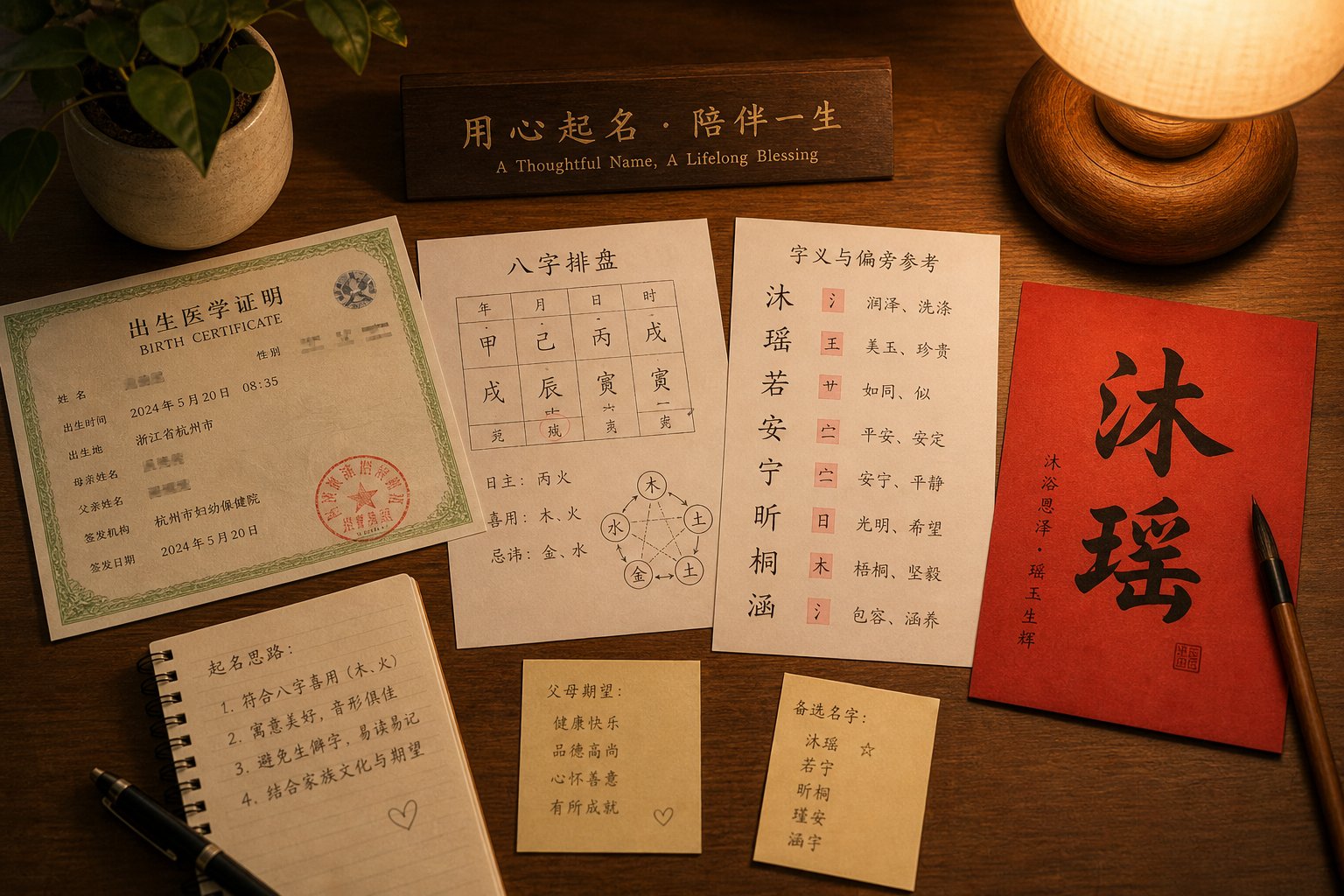
You have the theory. You understand how BaZi charts work, what hidden stems mean, why not every gap needs filling, how the Useful God overrides simple absence, which radicals carry which elements, and how cycles govern character pairing. The question remaining is practical: what do you actually do, step by step, when sitting down to select chinese baby girl names or chinese baby boy names rooted in Five Element logic?
A Step-by-Step Decision Framework
This sequence moves from raw data to final decision. Each step depends on the one before it, so skipping ahead — jumping straight to character selection without confirming the Useful God, for example — is where most DIY efforts go wrong.
- Determine the BaZi chart. Gather the exact year, month, day, and hour of birth. Convert these into the Four Pillars using a reliable perpetual calendar or BaZi calculator. Confirm that the month pillar follows solar term boundaries, not the lunar calendar.
- Map the elemental composition. Identify the element of each Heavenly Stem (straightforward — one element per stem). Then identify the primary and hidden elements within each Earthly Branch. Tally all elements present across the full chart.
- Distinguish missing from weak from unfavorable. Check whether the absent element appears anywhere — even as a hidden stem inside a branch. If it appears only once with no seasonal support, classify it as weak rather than truly missing. Then ask: does the chart benefit from this element's presence, or is its absence actually protective?
- Identify the Useful God. Determine the Day Master's strength (strong or weak based on seasonal support and allied elements). Identify which element most benefits the Day Master — this is your naming priority, regardless of what is technically absent.
- Check productive and destructive cycle implications. Verify that the target element does not feed a destructive dynamic already present in the chart. Confirm it does not clash with the surname's element. If it does, consider a bridging element that routes around the conflict.
- Select characters by radical classification. Filter candidate characters by their structural radical, not by meaning alone. Use the radical-to-element reference to confirm each character genuinely carries the target element.
- Verify meaning and tonal harmony. Say the full name — surname plus given name — out loud. Check that tones flow naturally, that the meaning is appropriate and positive, and that the characters do not form unintended homophones or awkward combinations in spoken use.
- Confirm compatibility between all name characters. Check the elemental relationship between the surname and first given-name character, then between the two given-name characters. A productive flow is ideal. A destructive clash at any junction warrants reconsidering the pairing.
This framework applies whether you are selecting chinese baby names girl options or narrowing down chinese baby names boy candidates. The logic is gender-neutral — what changes between children is the chart itself, not the process.
Understanding the logic helps parents ask better questions even when consulting a professional. You do not need to master every nuance — but knowing the framework means you can evaluate advice rather than accept it blindly.
When to Seek Professional Naming Consultation
Not every chart requires a master. A straightforward chart — one clearly missing element, a cooperative surname, an obvious Useful God — can be navigated independently using the steps above. Baby chinese name selection in these cases is a matter of careful reference work rather than interpretive judgment.
Professional consultation adds genuine value when:
- The Day Master sits at a borderline between strong and weak, making Useful God determination ambiguous.
- Multiple elements are missing or weak simultaneously, creating competing priorities.
- The surname's element directly clashes with the needed element, requiring creative bridging solutions.
- Hidden stems are the only source of a critical element, and you cannot confidently assess their strength.
- The chart contains complex interactions — combinations, clashes, or punishments between branches — that alter elemental dynamics beyond simple counting.
A trained practitioner brings pattern recognition built from reading hundreds or thousands of charts. They spot interactions that tables and frameworks cannot fully capture. But here is the key distinction: a parent who understands this framework walks into that consultation as a participant, not a passive recipient. You can ask why a specific element was chosen. You can question whether the recommendation targets the Useful God or merely fills a gap. You can verify that the suggested character's radical actually matches the claimed element. That informed engagement — not blind trust, not complete independence — is where the best naming decisions happen.
Whether you are choosing chinese girl baby names, deliberating over baby boy chinese names, or navigating the full complexity of elemental naming for the first time, the principle stays the same. A name built on understood logic serves your child better than one built on unexamined tradition or algorithmic output. The Five Element system is not a black box. It is a structured, learnable framework — and you now have the tools to use it.
Frequently Asked Questions About Missing Elements in Chinese Baby Names
1. How do I find out which element is missing from my baby's birth chart?
To identify missing elements, you need to construct a BaZi (Four Pillars) chart using the baby's exact year, month, day, and hour of birth. Each pillar contains a Heavenly Stem and an Earthly Branch, both carrying specific Five Element associations. Map all eight characters to their elements, including hidden stems within the Earthly Branches, then tally which of the five elements (Wood, Fire, Earth, Metal, Water) are absent or underrepresented. Remember that hidden stems inside branches can contain elements that appear missing on the surface, so a thorough count requires looking beyond the obvious primary elements.
2. Does my baby's name need to include every missing element from the birth chart?
No. Not every absent element requires compensation. An element can be missing because its absence actually benefits the chart's overall balance. The critical distinction is between a truly missing element (completely absent and needed), a weak element (present but lacking strength), and an unfavorable element (absent but better left that way). Professional practitioners use Useful God analysis to determine which element genuinely helps the Day Master rather than blindly filling every gap, since adding the wrong element can strengthen unfavorable dynamics in the chart.
3. What is the Useful God (Yong Shen) and how does it affect Chinese baby naming?
The Useful God is the specific element that most benefits the Day Master (the element representing the child in the birth chart). It may or may not be the same as the missing element. Professional naming prioritizes strengthening the Useful God over simply filling elemental gaps. For example, if Water is missing but adding Water would feed an already overpowering element in the chart, the Useful God might actually be Wood or Metal instead. This concept explains why different practitioners sometimes recommend different elements for the same birth date.
4. How do I know which Chinese characters carry a specific Five Element?
The primary method is radical classification. Every Chinese character contains at least one radical (structural building block), and each radical maps to a specific element. For example, characters with the three-dot water radical (氵) carry Water, those with the wood radical (木) carry Wood, and those with the fire radical (火) carry Fire. The key rule is to trust the radical over the character's modern meaning, since some characters seem associated with one element based on meaning but structurally belong to another. Always verify the radical rather than relying on semantic intuition.
5. Can I choose my baby's Chinese name for missing elements without consulting a professional?
For straightforward charts with one clearly missing element, a cooperative surname, and an obvious Useful God, parents can make solid naming decisions independently using proper reference tables and cycle checks. However, professional consultation adds genuine value when the Day Master's strength is borderline, multiple elements are missing simultaneously, the surname clashes with the needed element, or the chart contains complex branch interactions. Understanding the framework yourself means you can evaluate professional advice critically rather than accepting recommendations without question.