The Remarkable Discovery of Dragon Bones
Imagine walking into a pharmacy and realizing the medicine being sold as powder was actually the oldest written record of an entire civilization. That is essentially what happened in 1899, when a Chinese scholar stumbled upon inscriptions that would rewrite history.
Wang Yirong and the Dragon Bone Mystery
For centuries, traditional Chinese pharmacies sold fragments of ancient bone labeled as "dragon bones." Customers ground them into powder and swallowed them as remedies for wounds and illness. Nobody questioned what the bones actually were. Then Wang Yirong, a director of the Chinese Imperial Academy and a skilled calligrapher, acquired some unground dragon bones from a pharmacist in Beijing. Unlike the powdered specimens most buyers received, these fragments were still intact, and their surfaces were covered with carved symbols.
Wang recognized something extraordinary. The markings resembled rudimentary Chinese characters, far older than any writing previously known. He tried to trace the bones back to their source, but the pharmacist, fearing his livelihood was at stake, refused to reveal where the dragon bone relics originated. Wang collected more specimens from other shops and began attempting translations. Tragically, he died during the Boxer Rebellion in 1900, just a year after his discovery. His friend and colleague Liu E continued the work, publishing the first paper on these bone oracle script characters in 1903 and arguing they represented the oldest Chinese writing ever found.
They were right. The bones were eventually traced to Yinxu, a site near Anyang in northern China, once the capital of the Shang dynasty. What pharmacists had been grinding into medicine for generations turned out to be oracle bones, inscribed records of royal divination dating back over 3,000 years.
Why Oracle Bones Rewrote Chinese History
Before Wang Yirong's discovery, the Shang dynasty existed largely in the realm of legend. Ancient texts like the Records of the Grand Historian by Sima Qian mentioned the Shang, but those accounts were written a full millennium after the dynasty's fall. Some scholars questioned whether the Shang was historical at all. The oracle bone script changed everything.
These inscriptions pushed verified Chinese writing back to approximately 1250-1050 BCE, providing direct physical evidence of a literate, organized Shang civilization. Names of kings, records of military campaigns, and details of religious rituals carved into bone matched and confirmed what later historians had written from memory and oral tradition.
The discovery of oracle bone script did more than add centuries to the timeline of Chinese writing. It transformed a semi-mythical dynasty into documented history, giving China's cultural heritage an unbroken written lineage stretching back over three millennia.
This article traces the full arc of that story. You will follow the oracle bone outline from ancient divination rituals through the painstaking work of decipherment, explore how individual characters evolved into the modern Chinese writing system, and discover why these inscriptions still matter today. Whether you are a student of Chinese language, a history enthusiast, or simply curious about how ancient civilizations communicated with their gods, the journey from dragon bone relic to living script begins here.
What Oracle Bones Are and Where They Were Found
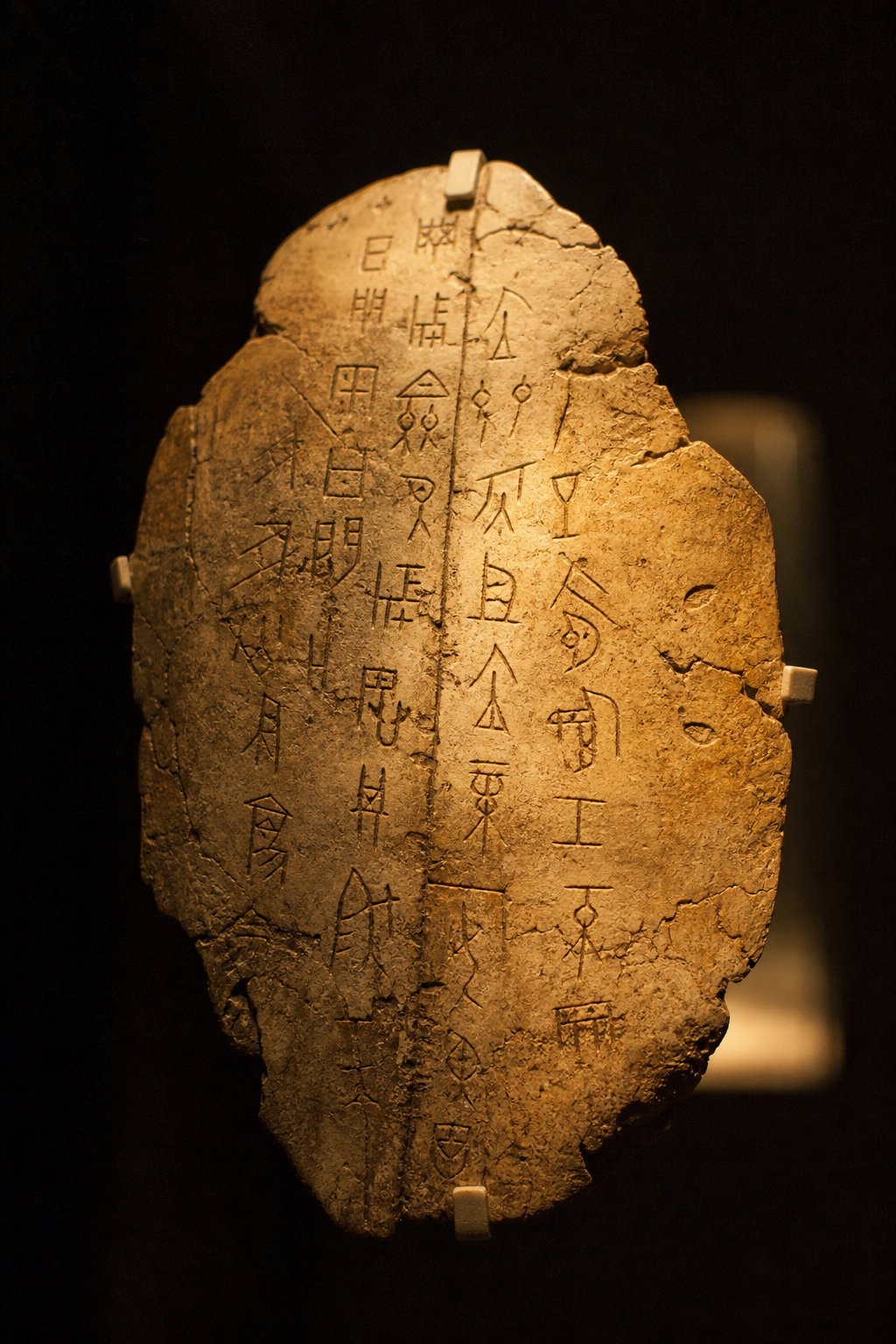
So what are oracle bones, exactly? The term sounds mystical, but the objects themselves are surprisingly tangible. At their simplest, the oracle bones definition is this: they are pieces of ox bone (specifically the flat shoulder blade, or scapula) and turtle shell (the underside, called the plastron) that Shang Dynasty diviners inscribed with questions for the spirit world. Dating to roughly 1250-1050 BCE, these fragments served as both ritual tools and written records, making them the earliest substantial evidence of the Chinese written language.
Defining Oracle Bones and Their Physical Form
Picture holding a piece of polished ox bone about the size of your hand, its surface covered in tiny carved symbols arranged in neat columns. That is what was the oracle bone in its most common form. The two primary materials, ox scapulae and turtle plastrons, were chosen for their broad, flat surfaces, which provided ample space for carving and, more importantly, cracked in readable patterns when heated.
A typical ox bone fragment measures roughly 20 to 30 centimeters in length, while turtle plastrons vary depending on the species. Both were carefully prepared: scraped smooth, polished, and drilled with small pits on the reverse side before use. The inscriptions themselves are remarkably fine, with individual characters often just a few millimeters tall, carved using sharp bronze or stone tools.
The numbers behind these ancient china oracle bones are staggering. Archaeologists have recovered approximately 150,000 fragments to date. Across those pieces, scholars have identified around 4,000 distinct characters. Of those, only about 1,500 to 2,000 have been definitively deciphered. The remaining characters, many of them proper nouns or terms for objects lost to time, continue to resist translation.
The Archaeological Site of Yinxu
Nearly all chinese oracle bones trace back to a single location: Yinxu, or the "Ruins of Yin," situated near modern Anyang in Henan Province. This was the last capital of the Shang Dynasty, and it is where royal diviners produced and archived their inscribed bones over roughly 255 years of continuous use.
Understanding the oracle bones def requires understanding this site. Yinxu was not a small settlement. It was a sprawling political and ceremonial center, home to kings, artisans, and the scribes who recorded divination results. UNESCO inscribed Yinxu as a World Heritage Site in 2006, recognizing its outstanding universal value for demonstrating the development of one of the world's oldest writing systems.
- Location: Northwest of Anyang City, Henan Province, approximately 500 km south of Beijing
- Historical role: Capital of the late Shang Dynasty (c. 1300-1046 BCE), spanning 12 kings across 8 generations
- Excavation history: Systematic archaeological work began in 1928 and continues today, uncovering over 80 palace foundations, royal tombs, and numerous oracle bone pits
- Scale of finds: Tens of thousands of inscribed bone and shell fragments recovered from storage pits within the palace area
- UNESCO designation: Inscribed on the World Heritage List in 2006 under criteria (ii), (iii), (iv), and (vi), with a protected area of 414 hectares and a buffer zone of 720 hectares
The site confirms that Yinxu was not merely a place where bones were stored. It was a functioning capital where divination was woven into governance, agriculture, warfare, and worship. Every inscribed fragment is a direct window into how Shang rulers made decisions, and the sheer volume of material tells us this practice was not occasional but systematic, performed on a near-daily basis for centuries.
These bones sat in the ground for over three thousand years. The questions carved into their surfaces, however, are startlingly human: Will it rain? Should we go to war? Will the queen's child be a son? The answers to what those inscriptions actually say open an entirely different chapter of the story.
How the Shang Dynasty Used Oracle Bones for Divination
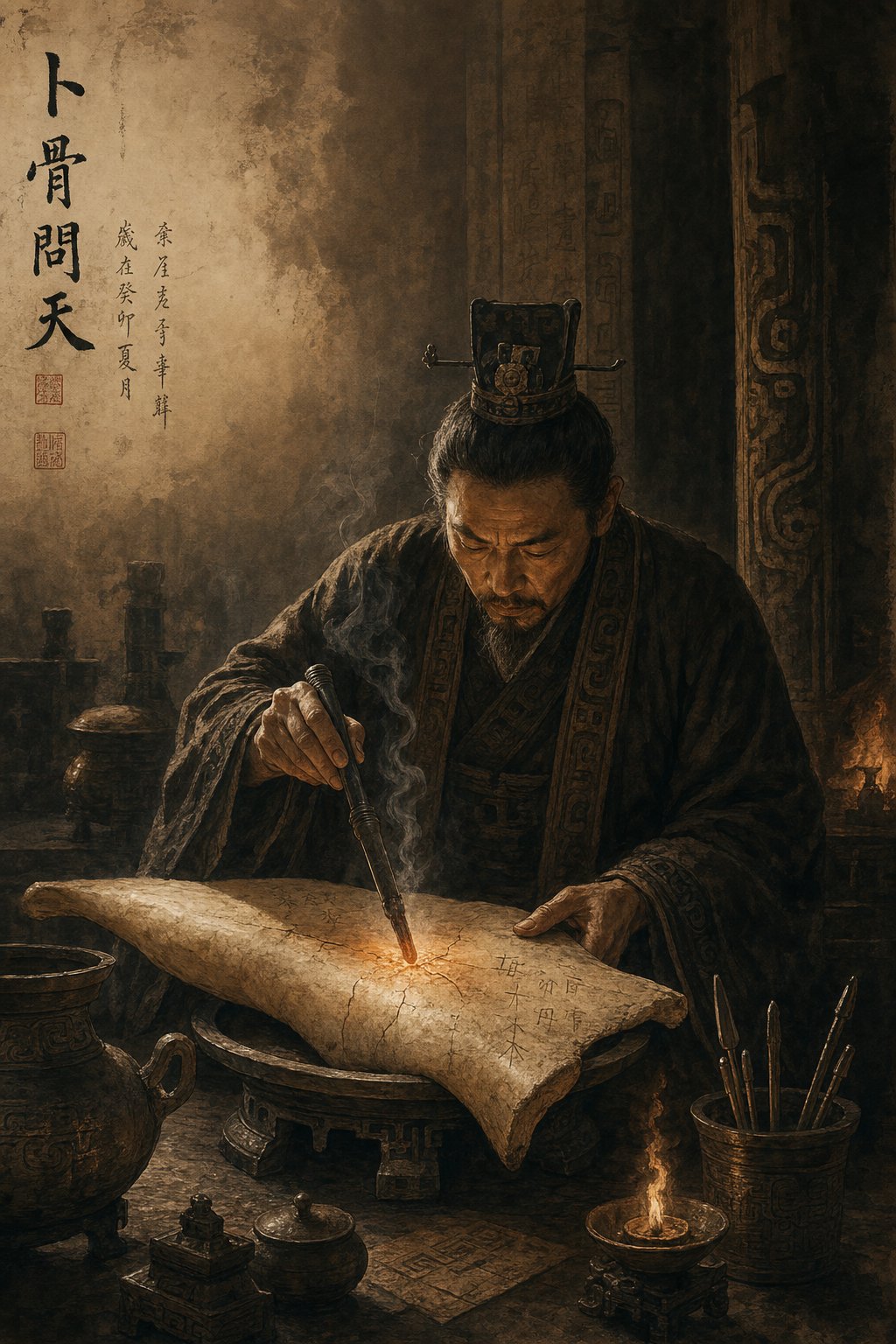
Rain, war, harvests, the health of an unborn child. These were not casual concerns for Shang rulers. They were matters to put before the ancestors and gods, and the method for doing so was precise, ritualized, and remarkably physical. So what were oracle bones used for? They were the medium through which kings communicated with the spirit world, transforming questions into cracks and cracks into divine answers.
The Step-by-Step Divination Ritual
The process of pyromantic divination was not improvised. It followed a strict sequence, repeated thousands of times across centuries of Shang rule. Each step required specialized knowledge, and the entire ritual was overseen by the king and a team of court diviners whose names were often recorded on the bones themselves.
Here is how oracle bones were used, from raw material to inscribed record:
- Preparation of the bone or shell. Scribes selected an ox scapula or turtle plastron and scraped its surface smooth, removing any remaining tissue or irregularities. The bone was then polished to create a clean writing surface.
- Drilling and chiseling hollows. On the reverse side of the bone, craftsmen carved rows of small oval or round pits. These hollows thinned the material at precise points, controlling exactly where cracks would appear when heat was applied. This was not guesswork. It was engineering.
- Formulation of the question. The court diviner, working under the king's direction, composed a formal question, called the "charge." Questions were typically framed as statements to be confirmed or denied: "It will rain in the next ten days" or "We should attack the Qiang to the west."
- Application of heat. A heated bronze rod or burning brand was pressed into one of the prepared hollows on the reverse side. The concentrated heat caused the thinned bone to crack on the front surface, producing a pattern resembling the Chinese character bu (卜), meaning "to divine."
- Interpretation of the crack pattern. The king or chief diviner read the direction, length, and shape of the resulting cracks. The specific criteria for a favorable versus unfavorable reading remain debated by scholars, but the practice clearly followed established conventions.
- Inscription of the record. After the divination, a scribe carved the complete record onto the bone's surface: the date, the diviner's name, the question asked, the king's interpretation, and sometimes a later note recording whether the prediction proved correct.
This sequence reveals something important. What are oracle bones and how were they used? They were not passive objects. They were active instruments in a system of governance where political and spiritual authority were inseparable. The king did not merely rule. He mediated between the human world and the divine, and the bones were his proof of that connection.
Materials and Tools of the Oracle Bone Scribe
Why ox scapulae and turtle plastrons specifically? The answer lies in their physical properties. Both materials offer broad, relatively flat surfaces ideal for carving fine characters. Ox shoulder blades are dense yet thin enough to crack predictably when heated. Turtle plastrons, the flat underside of the shell, provided an even smoother natural surface and cracked with particular clarity.
Shang diviners sourced turtle shells from multiple species, some local and others imported from regions hundreds of kilometers away. The logistics of acquiring these materials in bulk suggest organized supply networks, another indicator of the dynasty's administrative sophistication.
The tools themselves were equally specialized. Scribes used sharp bronze points or fine stone blades to carve characters into the hard bone surface. The strokes are thin, angular, and precise, a direct consequence of the medium. You cannot produce flowing curves on bone the way you can with a brush on silk. This constraint shaped the visual character of oracle bone script itself, giving it the sharp, linear quality that distinguishes it from later calligraphic styles.
The deliberately placed hollows on the reverse side deserve special attention. Their positioning was calculated so that cracks would form in predictable locations on the front, near the inscribed question. This shows the Shang understood the material science of bone stress and fracture patterns. What were oracle bones and how were they used? They were used with a level of technical precision that challenges any assumption of "primitive" ritual. The entire system, from material preparation to crack interpretation to record-keeping, operated as a sophisticated bureaucratic and spiritual technology.
Shang dynasty oracle bones were produced in enormous quantities. The sheer volume of surviving fragments tells us that divination was not reserved for rare crises. It was a daily practice embedded in the rhythm of court life. And the inscriptions left behind on those bones do far more than record yes-or-no answers. They capture the full texture of Shang society: its fears, ambitions, and the questions its rulers considered worth asking the gods.
What Oracle Bone Inscriptions Reveal About Ancient Life
Knowing how divination worked is one thing. Knowing what the Shang actually asked their ancestors is something else entirely. The oracle bone inscriptions are not abstract symbols waiting for linguistic analysis. They are real questions from real people, and the topics they cover paint a vivid portrait of a society far more complex than "ancient" might suggest.
Topics of Royal Divination
Imagine running a kingdom where every major decision, from planting crops to launching a military campaign, required spiritual approval first. That was daily life for Shang rulers. The oracle bones shang dynasty diviners produced cover a remarkably wide range of subjects, and categorizing them reveals just how deeply divination was woven into governance.
According to records from the National Palace Museum, Taipei, Shang royal divinations touched on almost every topic of importance at the time. Here are the major themes found across the roughly 150,000 recovered fragments:
- Weather and agriculture: Will it rain in the next ten days? Will the eastern lands receive a good harvest? In an agrarian state, a failed crop meant famine, so these questions carried existential weight.
- Warfare: Should the king join a general to attack the Shaofang? Which officer should lead a punitive expedition? Military inscriptions often name specific enemy tribes marked with the suffix "fang," meaning outer region.
- Ancestor worship and sacrifice: Should we offer three or five oxen? What day is appropriate for a ceremony honoring Father Jia? Sacrificial planning dominates the archive, with kings divining the menu, timing, and scale of offerings.
- Royal hunts: Hunting was not leisure. It served political and military purposes, and inscriptions record prayers for good luck at specific dates and locations.
- Childbirth: When will the queen give birth? Will the child be a boy? The sex of royal offspring was a matter of dynastic succession, divined with obvious urgency.
- Illness and ailments: Is Father Yi causing the king's toothache? Is Grandfather Ding harming the king? Disease was attributed to displeased ancestors, and the cure involved identifying which spirit was responsible.
- Settlement building: Should we construct a new walled settlement? Will the high god Di approve or obstruct?
These categories tell us something profound. Writing in the Shang dynasty was not decorative or ceremonial in a vague sense. It was functional record-keeping for a state that managed agriculture, coordinated military campaigns across allied territories, maintained elaborate religious calendars, and tracked royal genealogies. The shang dynasty symbols carved into bone are bureaucratic documents as much as spiritual ones.
Reading a Sample Inscription
What does a single oracle bone inscription actually look like when translated? The structure follows a consistent format that scholars have identified across thousands of examples. A complete inscription contains up to five parts:
- Preface: The date (using the Shang sixty-day calendar cycle) and the name of the diviner performing the ritual.
- Charge: The statement or question put before the spirits. Despite common assumptions, most charges are phrased as statements to be confirmed or denied, not as direct questions.
- Crack notation: A record that cracks were made, sometimes noting the location within a temple or ceremonial space.
- Prognostication: The king's personal reading of the cracks, often introduced with "The king read the cracks and said..."
- Verification: A later addition recording what actually happened, confirming or (rarely) contradicting the prediction.
Not every inscription includes all five elements. Many contain only the preface and charge, with prognostication and verification often omitted. But when a full record survives, it reads like a miniature narrative. Consider this example concerning the birth of a royal child, drawn from shang oracle bones of the Wu Ding period:
Crack-making on jiashen (day 21), Que divined: "Lady Hao's childbearing will be good." The king read the cracks and said: "If it be on a ding-day that she give birth, there will be prolonged luck." After thirty-one days, on jiayin (day 51), she gave birth. It was not good; it was a girl.
That final line, "it was not good; it was a girl," is jarring to modern readers, but it reveals the patriarchal priorities of Shang succession with blunt honesty. This is shang china writing at its most unfiltered: no later editor softened the record or removed the failed prediction. The verification stands as written, a rare case where the king's prognostication did not match reality.
Another inscription records a military decision: "On dingmao (day 4) divined: If the king joins with Zhi Guo to attack the Shaofang, he will receive assistance. Cracked in the temple of Ancestor Yi. Fifth moon." Here you can see the political and spiritual dimensions fused together. The king is not simply deciding strategy. He is asking whether ancestral spirits will back his campaign.
These oracle bone inscriptions are not just evidence of early writing. They are primary historical documents, unedited and contemporary, recording the decisions of a ruling class in real time. They confirm military alliances, reveal family dynamics, document agricultural anxieties, and expose religious beliefs with a directness that later Chinese historical texts, written centuries after the fact, simply cannot match.
The characters used to record all of this were not random scratches. Each one followed structural principles, pictographic logic that connected the shape of a symbol to its meaning. Tracing how those individual characters evolved from bone carvings into the modern script used today reveals a continuous thread stretching across more than three thousand years.
How Oracle Bone Characters Evolved Into Modern Chinese
A circle with a dot in the center. A stick figure in profile. A trio of peaks rising from a baseline. These are not children's drawings. They are ancient chinese characters carved into bone over three thousand years ago, and you can still see their logic inside the modern forms used by over a billion people today. The history chinese characters trace from oracle bone to printed page is not a story of replacement. It is a story of continuous transformation, where each stage reshaped the last without ever breaking the thread.
Tracing Characters from Bone to Modern Form
The best way to understand this evolution is to watch specific bone characters move through time. Each stage brought new tools, new materials, and new aesthetic priorities, but the core meaning encoded in the original pictograph persisted.
| Character | Oracle Bone Form | Chinese Bronze Script | Seal Script | Modern Form |
|---|---|---|---|---|
| Sun | A circle with a dot or line in the center, representing the solar disk | Rounder, with the inner dot becoming a horizontal stroke | Elongated into a vertical rectangle with a center bar | 日 |
| Moon | A crescent shape, sometimes with lines suggesting the surface | Thicker crescent with more uniform curves | Narrowed into a rectangular form with internal strokes | 月 |
| Mountain | Three peaks rising from a base, the middle peak tallest | Peaks become more stylized and symmetrical | Smoothed into three vertical strokes on a base | 山 |
| Water | A winding central stream with droplets or smaller streams on each side | Flowing lines become more regular and parallel | Symmetrical curves representing flowing water | 水 |
| Person | A figure in profile with visible arms and legs, as if walking | Slightly more abstract but still recognizably human | Simplified to two sweeping strokes suggesting a standing figure | 人 |
| Tree | A trunk with branches above and roots below, clearly a living plant | Branches and roots become more geometric | Symmetrical form with balanced upper and lower strokes | 木 |
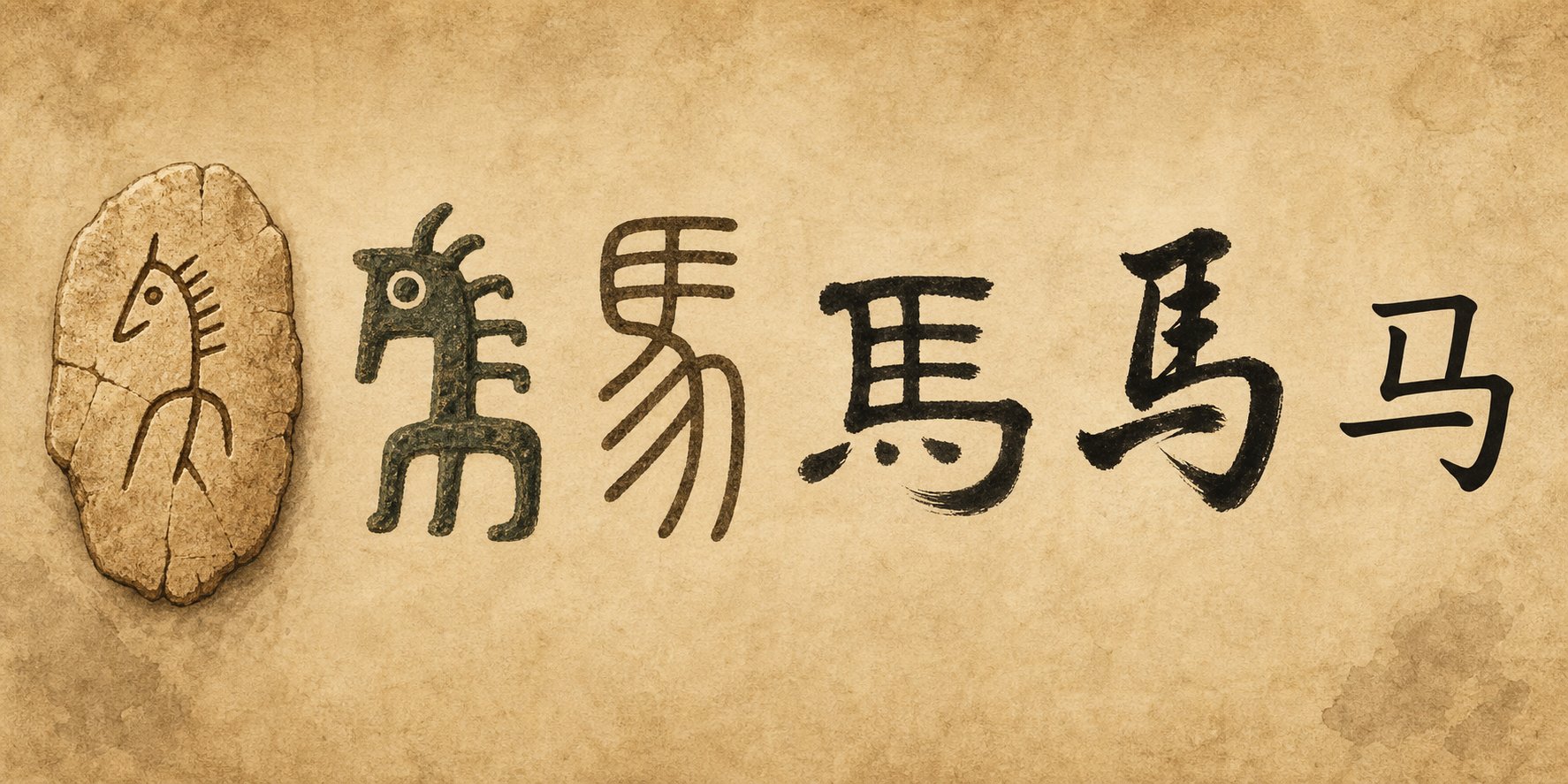
| Horse | A full animal in profile showing mane, four legs, and tail | Mane and legs stylized into recognizable but simplified strokes | Highly abstracted but retaining the sense of a four-legged animal | 馬 / 马 |
You will notice a clear pattern. The oracle bone forms are the most pictographic, closest to actual drawings of the thing they represent. With each subsequent stage, the characters become more abstract, more geometric, and more standardized. Yet the underlying logic never fully disappears. Even in the modern character 山, you can still see three peaks. In 人, you can still sense a figure leaning forward.
Why Characters Changed Shape Over Millennia
If the original pictographs worked, why change them at all? The answer lies in the tools people wrote with and the demands of the civilizations they served.
Shang dynasty writing was carved into hard bone and shell with a sharp stylus. This medium favored thin, angular strokes and compact designs. You could not easily produce curves or flowing lines on ox bone, so the earliest characters have a scratchy, linear quality. When writing moved to bronze vessels during the Western Zhou Dynasty (1046-771 BCE), the process changed entirely. Bronze inscriptions were cast into metal, allowing rounder, more decorative strokes. Characters became fuller and more ornamental, reflecting their new role on ceremonial objects meant to impress.
The next major shift came with the bamboo stylus and brush. Writing on bamboo strips and silk with ink rewarded speed and fluidity. Curved strokes became easier than the angular carvings of bone. Characters began to flow rather than stand rigid. This material shift, from carving to brushwork, is arguably the single biggest force in reshaping the chinese written language from pictographic sketches into the stroke-based system familiar today.
Then came politics. When Qin Shi Huang unified China in 221 BCE, his chancellor Li Si standardized the script into Small Seal Script, eliminating regional variants that had developed across rival states. A single empire needed a single writing system. Efficiency drove further simplification during the Han Dynasty, when government clerks developed Clerical Script to handle the paperwork of a massive bureaucracy. Each reform traded some pictographic clarity for speed, consistency, and scalability.
The result is a writing system where a character like 馬 (horse) no longer looks much like a horse, but still carries the structural DNA of that original oracle bone sketch showing mane, legs, and tail. The transformation was gradual, spanning over three millennia, and driven not by any single decision but by the accumulated pressure of new tools, new governments, and new needs.
This evolution was not random drift. It followed identifiable structural principles, a framework Chinese scholars codified centuries ago into six categories of character formation. Those principles were already operating in the oracle bone period itself, which tells us something surprising about just how sophisticated this writing system was from the very beginning.
The Six Principles Behind Chinese Character Formation
Six categories. That is how Chinese scholars have traditionally explained the logic behind every character in the script. Known as liushu (六書), or "The Six Principles," this framework was first codified by Xu Shen in his landmark dictionary Shuowen Jiezi, published in 100 CE. What makes this framework remarkable for our purposes is not just its elegance as a classification system. It is the fact that oracle script from the Shang Dynasty, over a thousand years before Xu Shen wrote his dictionary, already demonstrates all six principles in action.
That single observation carries enormous implications. If the earliest surviving chinese bone script already uses every known method of character formation, then what we are looking at is not a writing system in its infancy. It is one that had already matured, which means its true origins must stretch back even further into unrecorded history.
The Liushu Framework and Oracle Bone Evidence
Xu Shen's system, as described in Outlier Linguistics' analysis of the liushu tradition, classifies characters into six types based on how they were formed. Each category represents a different strategy for turning meaning or sound into a written symbol. Here is how each one works, with examples drawn directly from the oracle bone period:
| Category | Chinese Name | Definition | Oracle Bone Examples |
|---|---|---|---|
| Pictographs | 象形 xiangxing | A drawing that resembles the physical form of the object it represents. "One makes a drawing of an object and follows the outline of its physical form." | 日 (sun: a circle with a center dot), 月 (moon: a crescent shape), 馬 (horse: an animal in profile with mane and legs) |
| Simple Ideographs | 指事 zhishi | An abstract indicator that points to a concept through position or added marks. "When seen they can be recognized; when inspected, their meaning becomes apparent." | 上 (above: a mark above a baseline), 下 (below: a mark below a baseline), 本 (root: a tree with a mark at the base) |
| Compound Ideographs | 會意 huiyi | Two or more meaningful elements combined so their joint meaning creates a new concept. "One matches types and combines their meanings." | 明 (bright: sun + moon together), 休 (rest: a person leaning against a tree), 林 (forest: two trees side by side) |
| Phono-semantic Compounds | 形聲 xingsheng | One component suggests the meaning category while another indicates pronunciation. "Based on a thing, one creates a written word and takes a phonetically analogous one." | 河 (river: water radical + sound component 可), 江 (river: water radical + sound component 工) |
| Transfer Characters | 轉注 zhuanzhu | Characters of similar meaning within the same semantic category that are mutually explanatory. "One establishes graphs of similar categories under one head." | 考 (deceased father) and 老 (aged): sharing a semantic root related to old age |
| Loan Characters | 假借 jiajie | A character borrowed to represent a word that sounds the same but originally had no written form. "Originally having no proper graph, by just relying on the sound, it is entrusted to the thing." | 來 (originally pictograph of wheat, borrowed for the verb "to come" because of shared pronunciation) |
The first four categories describe how characters were structurally created. The last two, transfer and loan characters, describe how existing characters were repurposed or extended. Together, they account for virtually every character in the chinese ancient script and its descendants.
A quick note on terminology: the word "wen" (文) in Chinese refers to a simple, indivisible character, often a pictograph or ideograph, while "zi" (字) refers to a compound character built from components. This wen definition matters because it reflects how ancient scholars already distinguished between simple and complex character structures. The bonescript of the Shang period contains both types in abundance.
What This Tells Us About Writing System Maturity
Here is the critical point most discussions miss. A truly primitive writing system, one just emerging from pictorial representation, would rely almost exclusively on pictographs and perhaps simple ideographs. You draw what you see. That is stage one of any script's development.
But the Shang dynasty writing system does not stop there. It already uses phono-semantic compounds, characters where one part signals meaning and another signals sound. This is an extraordinarily sophisticated technique. It requires writers to think abstractly about language itself, separating the sound of a word from its meaning and encoding both simultaneously in a single visual unit. Scholars estimate that phono-semantic compounds already account for a significant portion of oracle bone characters, and this category would eventually grow to represent over 80% of all Chinese characters in later periods.
The presence of loan characters is equally telling. Borrowing a character purely for its sound, ignoring its original meaning, shows that scribes understood writing as a representation of spoken language, not just a collection of pictures. They had moved beyond drawing things and into encoding speech. That conceptual leap does not happen overnight.
As research from Rutgers University notes, "The degree of maturity of this truly archaic writing (1600 to 1100 BC) indicates that even earlier writing in China dated before 1600 BC remains to be discovered." Pottery marks from sites like Banpo (4800-4200 BCE) and Dawenkou (3605-2340 BCE) may represent precursors, but no confirmed transitional script has yet been found between those isolated marks and the fully developed ancient chinese ideograms of the oracle bones.
This gap is one of the great unsolved puzzles in the study of early writing. Somewhere between the scattered pottery symbols of the Neolithic period and the sophisticated oracle bone corpus lies a developmental phase, possibly spanning centuries, that has left no surviving trace. The materials that carried it, likely bamboo, wood, or other perishable surfaces, have long since decayed.
What we can say with confidence is this: by the time Shang scribes were carving questions into bone, they had inherited a fully operational writing system capable of expressing abstract ideas, recording speech sounds, and adapting flexibly to new vocabulary. The six principles were not invented by Xu Shen. He merely described what had been functioning for over a millennium before his birth. The oracle bones are not the beginning of Chinese writing. They are the earliest surviving evidence of a system already in its maturity.
Understanding these structural principles is one thing. Unlocking the specific characters, matching ancient forms to known words, and building a coherent picture of Shang literacy required generations of dedicated scholars, each building on the last. Their work transformed scattered bone fragments into readable history.
Scholars Who Unlocked the Secrets of Oracle Bone Script
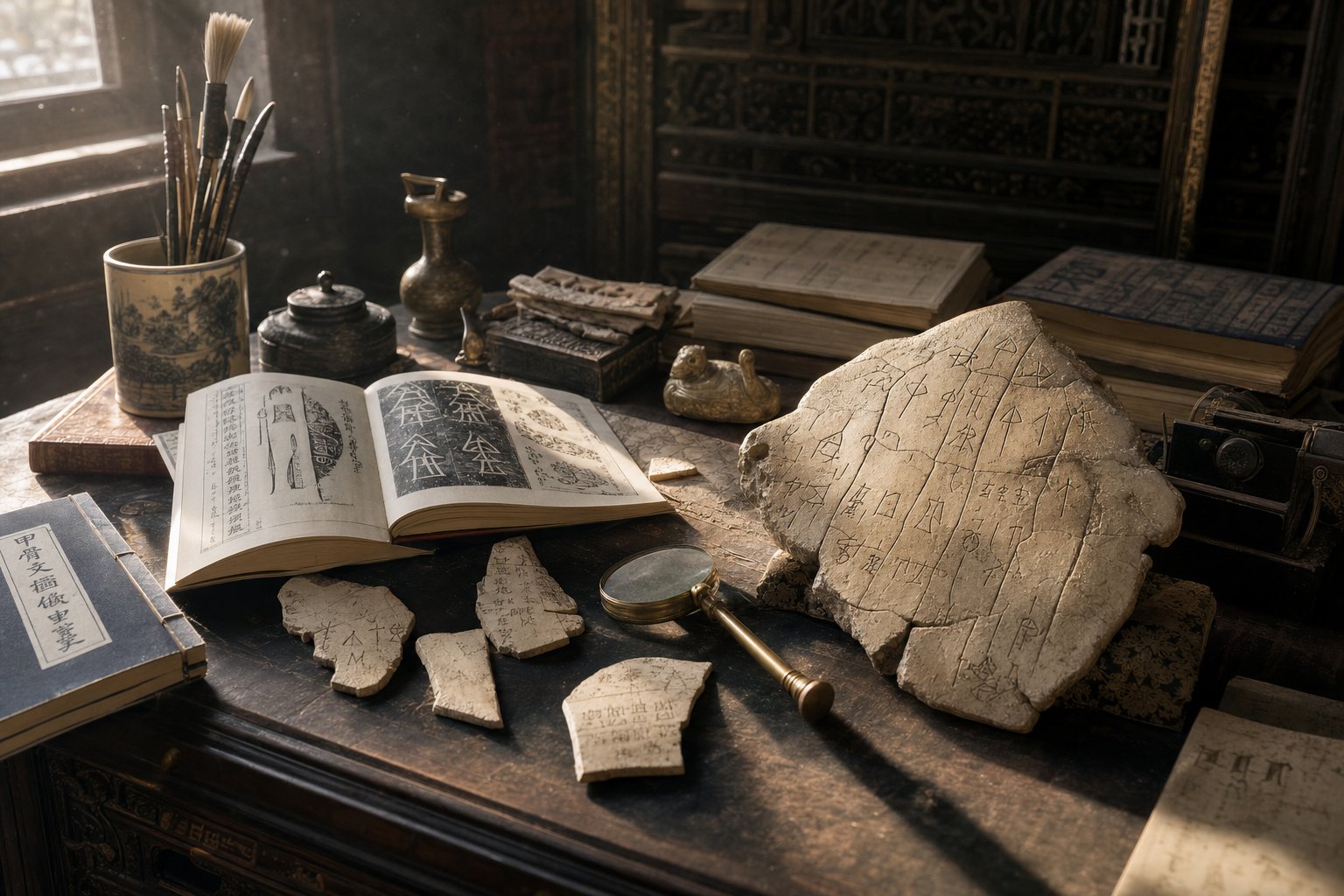
A mature writing system buried for three millennia does not decode itself. From the moment Wang Yirong recognized those carved symbols in 1899, it took generations of scholars, each with different skills and methods, to transform scattered bone fragments into readable documents. Their collective effort built jiaguwen (甲骨文, literally "shell-bone writing") studies into one of the most rigorous branches of Chinese historical scholarship.
Pioneers of Oracle Bone Research
What does oracle bones mean as a field of study? It means over a century of painstaking work by researchers who collected, cataloged, dated, and deciphered tens of thousands of inscribed fragments. The discipline's foundation rests on four towering figures, each of whom advanced the work in a distinct way:
- Wang Yirong (1845-1900): First recognition. A Qing Dynasty scholar and director of the Imperial Academy, Wang identified the inscriptions on "dragon bones" as ancient writing in 1899. His tragic death during the Boxer Rebellion cut his research short, but his initial insight launched the entire field.
- Luo Zhenyu (1866-1940): Systematic collection and early decipherment. Luo collected over 30,000 inscribed fragments and published them in his series Yinxu Shuqi. More critically, he successfully identified over 570 oracle bone characters, including hundreds of frequently used ones that made it possible to read entire divination records for the first time. He also traced the bones to their source at Yinxu near Anyang.
- Dong Zuobin (1895-1963): Periodization and scientific methodology. Dong participated in the systematic excavations at Yinxu beginning in 1928 and developed a landmark classification system. Using ten criteria, including diviner names, calligraphic style, and content patterns, he divided oracle bone inscriptions into five chronological periods spanning the dynasty's 200-plus years. This framework gave the field its scientific backbone, allowing scholars to date individual fragments and track how the script evolved over time.
- Guo Moruo (1892-1978): Interpretation and historical synthesis. Guo published Yinqi Cuibian, in which he explained and interpreted 1,595 oracle bone characters, and Buci Tongzuan, a classified collection of divination texts organized by content. He later edited the monumental 13-volume Jiaguwen Heji (Collection of Oracle Bone Inscriptions), containing 41,956 pieces. Guo's work transformed oracle bone script translation from isolated character identification into coherent historical narrative.
The period between 1899 and 1928 is often called the "Study by Luo and Wang" in Chinese academic circles, recognizing how these early pioneers shaped the field's foundations. Wang Guowei, another key figure of this era, cross-referenced king names found on oracle bones with those recorded in Sima Qian's Records of the Grand Historian, proving the historical accuracy of texts written a millennium after the Shang fell. This single act of verification gave the oracle bone meaning far beyond linguistics: it confirmed an entire dynasty's existence.
Modern Decipherment Challenges
Despite over 120 years of scholarship, the work is far from finished. Of approximately 4,000 distinct characters identified across the oracle bone corpus, only about 1,500 to 2,000 have been definitively deciphered. The remaining characters resist translation for several reasons:
- Proper nouns: Many undeciphered characters are names of people, places, or ancestral spirits that have no surviving context to anchor their meaning.
- Lost referents: Some characters refer to objects, animals, or practices that no longer exist, leaving scholars without a conceptual anchor.
- Fragmentary evidence: A character appearing on only one or two broken fragments offers too little context for confident identification.
- Variant forms: Shang scribes had not yet standardized their writing, so a single word might appear in multiple graphic forms across different periods, complicating pattern recognition.
Modern efforts have introduced digital databases and computational approaches to the problem. Researchers now use machine learning to identify patterns across thousands of fragments, and online platforms allow scholars worldwide to collaborate on decipherment in real time. The oracle bone definition as a field has expanded from philology into digital humanities.
In 2017, UNESCO inscribed Chinese oracle bone inscriptions on the Memory of the World Register, recognizing them as documentary heritage of global significance. The designation acknowledges both the cultural weight of these artifacts and the ongoing scholarly importance of deciphering what remains unread. Each newly decoded character has the potential to unlock entire categories of inscription, revealing aspects of Shang life that have waited over three thousand years to be understood.
These inscriptions belong to a specific time and place, but they also belong to a broader story. Viewed alongside the world's other independent inventions of writing, oracle bone script occupies a unique position: the only ancient system with a direct, unbroken lineage to a modern script still in daily use.
Oracle Bone Script Among the World's Earliest Writing Systems
Humans invented writing independently at least three times in history. Each invention arose in a different region, used different materials, and served different immediate purposes. Yet only one of these ancient systems survived into the modern world without interruption. Placing the earliest chinese writing alongside its global counterparts reveals just how extraordinary that continuity is.
Comparing the World's Independent Writing Inventions
Writing did not spread from a single source. It emerged separately in Mesopotamia, Egypt, China, and Mesoamerica, each time solving the same fundamental problem: how to make language visible and permanent. The Duolingo research blog notes that the surface used to record written language is crucial when discussing writing's history, since durable materials like stone, clay, or bone survived millennia while perishable ones vanished. That survival bias shapes what we know about each system's origins.
Here is how the world's independently invented writing systems compare across key dimensions:
| Writing System | Earliest Evidence | Writing Medium | Script Type | Survival Into Modern Use |
|---|---|---|---|---|
| Sumerian Cuneiform | c. 3400 BCE | Wet clay tablets, pressed with a wedge-shaped stylus | Logographic, later syllabic | Extinct. No modern descendant in active use. |
| Egyptian Hieroglyphs | c. 3200 BCE | Stone, papyrus, wood | Logographic and consonantal | Extinct as a script, but ancestral to the Latin, Greek, Cyrillic, and Arabic alphabets through Phoenician intermediaries. |
| Chinese Oracle Bone Script | c. 1250 BCE | Ox bone and turtle shell | Logographic | Direct, unbroken lineage to modern Chinese characters (hanzi), Japanese kanji, and derived scripts like hiragana and katakana. |
| Mesoamerican Glyphs (Maya) | c. 300 BCE | Stone, stucco, bark paper | Logographic and syllabic | Extinct. Forcibly ended by European colonization in the 16th-17th centuries. Mayan languages now use the Latin alphabet. |
A few things stand out immediately. Cuneiform and hieroglyphs are both older than the oldest chinese writing we have physical evidence for, yet neither survived as a living system. Maya glyphs were violently suppressed. Only the ancient china writing system that began on Shang Dynasty bones continued evolving without a break, adapting to new tools and new eras while retaining its logographic core.
What Makes Chinese Script Unique Among Ancient Systems
Cuneiform died when Aramaic and Greek alphabets proved more practical for the empires that conquered Mesopotamia. Hieroglyphs faded as Egypt adopted Greek and later Arabic scripts. In both cases, logographic systems gave way to alphabetic ones, trading thousands of unique symbols for a small set of letters representing individual sounds. The efficiency argument won.
So why did the shang dynasty written language not follow the same path? Several factors converged. Chinese is a tonal, monosyllabic language where many words share identical pronunciations. A purely phonetic script would create massive ambiguity. The logographic system, where each character carries both sound and meaning, resolves that ambiguity visually. A reader sees 河 and 何 and instantly distinguishes "river" from "what," even though both are pronounced he. An alphabet cannot do that without additional context.
There is also the question of dialect diversity. The shang china writing system and its descendants function across mutually unintelligible spoken varieties of Chinese. A speaker of Cantonese and a speaker of Mandarin cannot understand each other's speech, but they can read the same newspaper. Characters encode meaning independent of pronunciation, making them a unifying technology across a linguistically fragmented landscape. No alphabetic system offers that advantage at the same scale.
The result is striking. The oldest chinese characters, carved into bone over three thousand years ago, belong to the same continuous tradition as the text messages sent today in Beijing, Taipei, and Singapore. No other early chinese writing system on Earth can make that claim. Cuneiform is studied by specialists. Hieroglyphs fill museum displays. But Chinese characters remain a living, daily tool for over a billion people, carrying within their strokes the structural DNA of those original Shang inscriptions.
That living quality is not just a historical curiosity. It means anyone learning to write chinese today is, in a very real sense, engaging with the same system those Shang diviners used. Recognizing the pictographic logic still embedded in modern characters connects present-day learners to a tradition older than the Roman alphabet, older than the Parthenon, older than the Hebrew Bible. The practical question becomes: how do you actually see that ancient logic inside a modern character?
Reading Oracle Bone Characters and Their Modern Cultural Legacy
You already know the history. You have seen how characters evolved from carved pictographs into modern forms. The next step is training your eye to spot that ancient logic when you encounter a Chinese character today. Once you learn what to look for, the pictographic origins become surprisingly visible, and both ancient and modern forms become easier to remember.
How to Recognize Pictographic Logic in Oracle Bone Characters
Think of chinese oracle bone script as a visual vocabulary built from the world its creators inhabited. Shang scribes drew what they saw: bodies, landscapes, animals, and tools. Those drawings became stylized over centuries, but the structural skeleton remains. When you look at a modern character, ask yourself: what real-world shape could this have started as?
Here are the main categories to watch for, with descriptions of what the oracle bone form depicted versus what the modern character retains:
- Body parts (人, 手, 目): The oracle bone form of 人 (person) shows a figure in profile with arms extended, as if mid-stride. Modern 人 preserves those two angled strokes, still suggesting a walking figure. The character 手 (hand) in its bronze script form depicts a hand with extended fingers, while 目 (eye) was originally a vertical oval with a circle inside representing the pupil. Today's 目 still shows a rectangular eye shape with internal horizontal lines.
- Natural elements (日, 月, 雨): The oracle bone 日 (sun) was a circle with a dot or stroke at the center, representing the solar disk. Modern 日 is a rectangle with a horizontal bar, but the enclosed shape with a center mark persists. The character 雨 (rain) depicted a cloud with droplets falling below, and the modern form still shows a horizontal top stroke (sky) with vertical dots beneath.
- Animals (馬, 魚, 鳥): These are among the most dramatic transformations. The oracle bone 馬 (horse) was a full animal in profile showing a head, mane, four legs, and tail. Modern 馬 is heavily abstracted, but the four bottom dots still echo those legs. The character 魚 (fish) originally showed a head, body, fins, and tail, while 鳥 (bird) depicted a creature with a head, body, legs, and long tail feathers.
- Objects and structures (車, 門, 田): The oracle bone 車 (chariot) resembled a vehicle seen from above with two wheels and an axle. Modern 車 retains that cross-shaped axle structure. The character 門 (gate) depicted two door panels side by side, and the modern form still shows that symmetrical double-panel shape. The character 田 (field) was a grid of divided plots, exactly as it appears today.
- Plants (木, 禾, 竹): The oracle bone 木 (tree) showed a trunk with branches above and roots below. Modern 木 keeps that vertical stroke with upper and lower extensions. The character 禾 (grain) resembled a stalk with drooping ears of grain at the top, while 竹 (bamboo) depicted stalks with leaves hanging down.
The pattern is consistent. Oracle bone forms are closest to actual drawings. Each subsequent script stage traded visual realism for writing speed and standardization. But the structural logic, the reason a character looks the way it does, traces back to that original oracle bone drawing every time. Training your eye to see these connections makes both ancient chinese calligraphy and modern characters more intuitive. You stop memorizing arbitrary shapes and start reading a visual language with three thousand years of internal logic.
Oracle Bone Script in Modern Chinese Culture
So how do we use oracle bones today? Not for divination, obviously. But their influence runs through contemporary Chinese culture in ways that might surprise you.
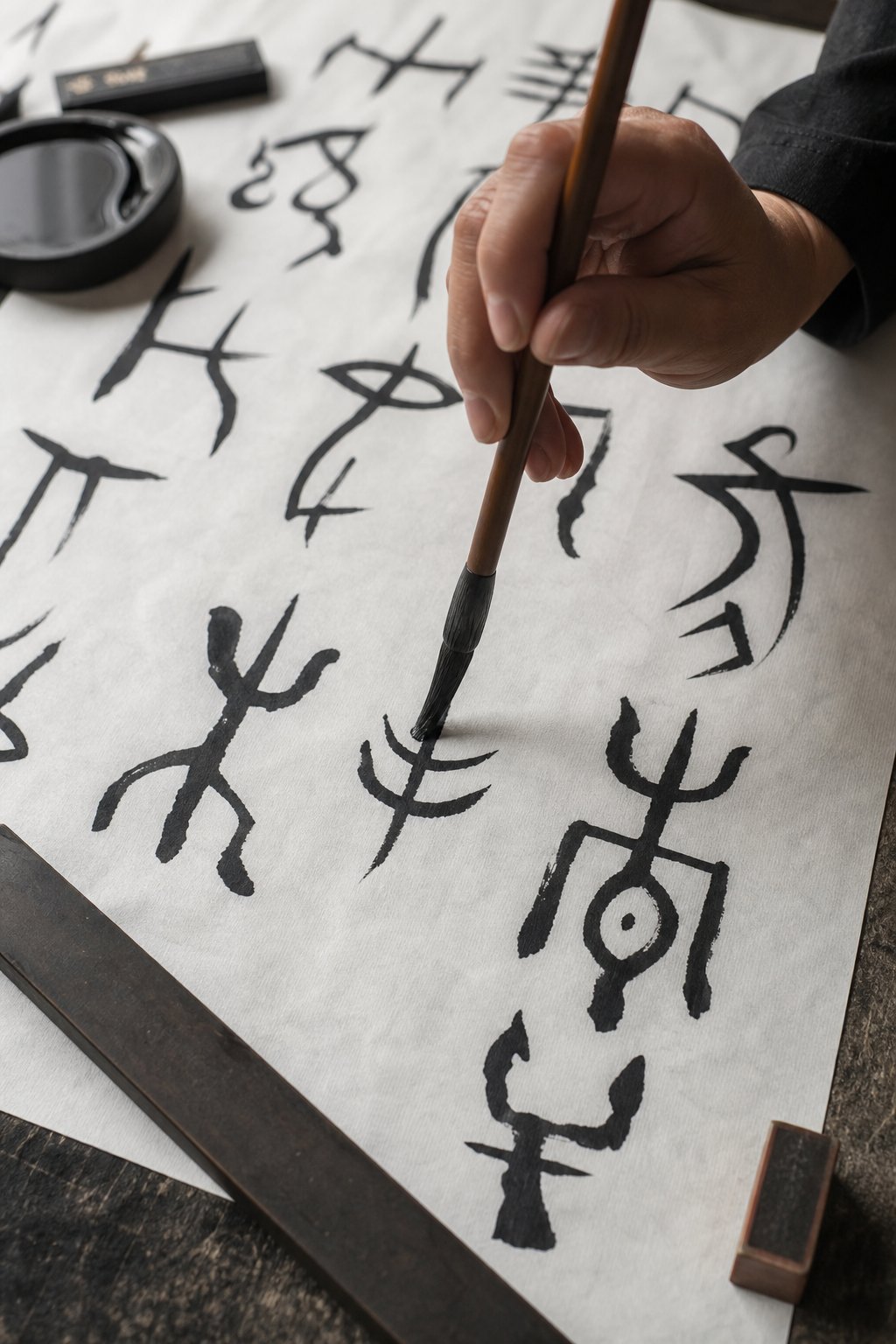
In calligraphy in chinese artistic practice, oracle bone aesthetics have experienced a revival. Contemporary calligraphers study the angular, compact strokes of Shang inscriptions and incorporate that energy into modern brushwork. The sharp, decisive lines of bone carving offer a counterpoint to the flowing curves of later calligraphic traditions. Artists working in this style often display their pieces on a chinese scroll format, blending ancient visual language with traditional presentation methods. Galleries in Beijing, Taipei, and Shanghai regularly feature exhibitions where oracle bone forms are reimagined through ink, print, and digital media.
Graphic designers have also embraced oracle bone aesthetics. The pictographic clarity of these ancient forms translates naturally into logo design, branding, and typography experiments. Because the characters are visually intuitive, depicting recognizable objects and animals, they communicate across language barriers in ways that modern abstract characters cannot. An oracle bone drawing of a horse or a sun needs no translation.
In education, oracle bone script has become a powerful teaching tool. Chinese language instructors increasingly use pictographic origins to help students write chinese characters with better retention. When a learner sees that 山 started as three mountain peaks, or that 雨 began as a cloud dropping rain, the modern form stops feeling arbitrary. Several digital platforms now offer interactive databases where users can look up any modern character and trace it back through seal script, bronze script, and oracle bone forms. The Yinxu Oracle Bone Inscription Digital Database, launched by the Zhonghua Book Company, contains over 143,000 inscriptions and offers specialized search tools including an oracle bone dictionary and graph input assistant. These digital resources have democratized access to material that was once available only to specialists with institutional subscriptions.
There is also a dimension of cultural pride. China possesses the world's oldest continuously used writing system, a fact that carries deep significance for national identity and cultural heritage. The 2017 UNESCO Memory of the World designation reinforced this status internationally. Schools incorporate oracle bone history into curricula not just as linguistics but as a connection to civilizational continuity. When Chinese students learn that the characters they write daily descend in an unbroken line from Shang Dynasty inscriptions, they are engaging with a tradition older than any alphabet currently in use.
From Wang Yirong's startled recognition in a Beijing pharmacy to machine learning algorithms scanning digitized bone fragments, the story of oracle bone script chinese characters spans the full arc of modern scholarship. What began as ground-up medicine became the key to verifying an entire dynasty. What looked like primitive scratches turned out to be a fully mature writing system operating on principles still active today. And what might seem like dead artifacts in museum cases are, in fact, the living roots of a script used every day by over a billion people. The dragon bones still speak. You just need to know how to read them.
Frequently Asked Questions About Oracle Bone Script
1. What are oracle bones and how were they used?
Oracle bones are pieces of ox scapulae and turtle plastrons that Shang Dynasty diviners (c. 1250-1050 BCE) used for pyromantic divination. The process involved scraping and polishing the bone, drilling small hollows on the reverse side, applying heat with a bronze rod to produce cracks, and then interpreting those crack patterns as divine answers. Court diviners formulated questions about warfare, weather, harvests, ancestor worship, and royal births, then inscribed the question, interpretation, and sometimes the outcome directly onto the bone surface.
2. How many oracle bone characters have been deciphered?
Scholars have identified approximately 4,000 distinct characters across the roughly 150,000 recovered oracle bone fragments. Of those, only about 1,500 to 2,000 have been definitively deciphered. The remaining characters resist translation because many are proper nouns, place names, or terms for objects and practices that no longer exist. Modern efforts using digital databases and machine learning are helping researchers identify new patterns, but significant portions of the corpus remain unread after over 120 years of study.
3. How did oracle bone script evolve into modern Chinese characters?
Oracle bone characters transformed through several stages driven by changes in writing tools and political standardization. The angular bone carvings gave way to rounder bronze inscription forms during the Western Zhou Dynasty, then shifted again when brush and ink on bamboo and silk replaced carving. Qin Shi Huang's unification in 221 BCE imposed Small Seal Script as a standard, and Han Dynasty clerks further simplified forms for bureaucratic efficiency. Throughout this 3,000-year process, the logographic core and pictographic logic of the original characters persisted without breaking continuity.
4. Why is oracle bone script considered a mature writing system?
Oracle bone script already demonstrates all six traditional principles of Chinese character formation (liushu): pictographs, simple ideographs, compound ideographs, phono-semantic compounds, transfer characters, and loan characters. The presence of phono-semantic compounds, where one component signals meaning and another signals sound, shows scribes were encoding spoken language abstractly rather than simply drawing pictures. This level of sophistication implies an earlier developmental period, possibly spanning centuries, that has not survived in the archaeological record.
5. Where were oracle bones discovered and who found them?
The vast majority of oracle bones were excavated at Yinxu (Ruins of Yin) near Anyang in Henan Province, the last capital of the Shang Dynasty. Scholar Wang Yirong first recognized the inscriptions in 1899 after noticing carved symbols on unground 'dragon bones' sold as traditional medicine in Beijing pharmacies. Systematic archaeological excavation of the Yinxu site began in 1928 and continues today. UNESCO designated Yinxu a World Heritage Site in 2006 and inscribed the oracle bone collection on the Memory of the World Register in 2017.