The Problem With Pinyin Name Capitalization Nobody Agrees On
Imagine you are filling out a visa application, and you pause at the name field. Your passport reads ZHANG XIAOMING. Your university transcript says Zhang Xiao Ming. A published paper lists you as Zhang Xiaoming. Three documents, three formats, one person. Which version is correct?
The same name written three ways: ZHANG XIAOMING (passport), Zhang Xiao Ming (transcript), Zhang Xiaoming (standard pinyin). All refer to the same person, yet each follows a different convention.
This confusion is not a minor formatting quirk. It creates real problems at border control, during academic publishing, and when applying for international credentials. People learning how to write in pinyin encounter conflicting guidance from textbooks, software tools like a pinyinizer, and official documents. Even native speakers familiar with han yu ping ying often disagree on the correct approach.
The root cause is simple: multiple authoritative standards exist, and each one serves a different purpose. China's national standard says one thing. The ISO international guideline says something slightly different. Passport offices follow their own protocol entirely. Without a single reference that maps these rules side by side, you are left guessing.
What This Guide Covers
This article consolidates pinyin name capitalization rules from every major standard into one place. Think of it as a resource similar to dictionary entries that give you definitive answers rather than conflicting opinions. Whether you are a language learner, a professional translator, a publisher maintaining a style guide, or someone formatting your own name for international use, you will find clear guidance here.
We will walk through the official Chinese national standard (GB/T 16159), the ISO 7098 international romanization framework, and the UN system. You will see exactly where they agree, where they diverge, and which standard applies to your specific situation.
Official Standards That Govern Pinyin Capitalization
Three documents form the backbone of every capitalization decision you will ever make with romanized Chinese names. They were developed by different bodies, adopted at different times, and serve different audiences, but they share a common ancestor: the Scheme for the Chinese Phonetic Alphabet approved by China's National People's Congress in 1958. Understanding which standard applies to your situation is the first step toward consistent formatting.
The system itself traces back to the work of Zhou Youguang, the linguist widely credited as the "father of pinyin." Zhou led the committee that designed the romanization scheme, drawing on decades of earlier phonetic notation efforts by both Chinese and Western scholars. His framework established the orthographic principles that all three modern standards build upon, including how personal names should be segmented and capitalized.
GB/T 16159 and China's National Standard
China's domestic authority on pinyin orthography is GB/T 16159-2012, formally titled "Basic Rules of the Chinese Phonetic Alphabet Orthography" (Hanyu Pinyin Zhengcifa Jiben Guize). First issued in 1996 and revised in 2012, this document governs how pinyin is written in education, publishing, and public signage within China. It specifies that the first letter of a surname and the first letter of a given name must both be capitalized, with the given name written as a single unit regardless of how many characters it contains.
If you are working with mainland Chinese publications, textbooks, or government documents, GB/T 16159 is your primary reference. It also provides guidance on converting hanyu pinyin to chinese characters and back, establishing word-boundary rules that directly affect name formatting. The 2012 revision introduced some flexibility, such as allowing alternate spacing for particles, but the personal name rules remained firm.
ISO 7098 and International Guidelines
Beyond China's borders, the governing document is ISO 7098, maintained by the International Organization for Standardization's Technical Committee 46 (Information and Documentation). The original version appeared in 1982, with revisions in 1991 and 2015. The latest edition (ISO 7098:2015) reflects updated practices for digital environments and documentation automation.
ISO 7098 aligns closely with GB/T 16159 on personal name capitalization but frames its rules for an international audience: librarians cataloging Chinese-language materials, publishers handling multilingual documents, and institutions that need a pinyin cross reference chart for consistent romanization. Where GB/T 16159 assumes a Chinese-language context, ISO 7098 addresses how pinyin interacts with other Latin-alphabet writing systems. This distinction matters when you are formatting names alongside English, French, or German text in academic or institutional settings.
UN Romanization System
The United Nations adopted Chinese pinyin for romanizing geographical names at the Third UN Conference on the Standardization of Geographical Names on 7 September 1977. Two years later, the UN Secretariat extended this to personal names, issuing explanations on using pinyin as the international standard for romanizing both Chinese personal and geographical names. This resolution effectively replaced the older Wade-Giles system in diplomatic and cartographic contexts, though wade giles spellings still appear in historical documents and some Taiwanese publications.
The UN system does not publish a separate capitalization rulebook. Instead, it defers to the principles established in China's national scheme and ISO 7098. Its significance lies in institutional adoption: when UN agencies, diplomatic missions, and international NGOs format Chinese names, they follow this resolution as their bclup (baseline capitalization and latinization usage protocol) for consistency across multilingual communications.
Who Uses What and When
The adoption timeline helps clarify which standard carries authority in different regions:
- China (1958, revised 2012): Adopted the Scheme for the Chinese Phonetic Alphabet nationally; GB/T 16159-2012 governs all domestic usage.
- United Nations (1977/1979): Adopted pinyin for geographical and personal names in international documents, replacing Wade-Giles.
- ISO (1982, revised 2015): Published ISO 7098 as the international romanization standard for documentation and information exchange.
- Singapore (1980s): Adopted Hanyu Pinyin for romanizing Chinese names in official records and identity documents.
- Taiwan (2009): Officially adopted Hanyu Pinyin for romanization of place names, though personal name romanization remains more flexible in practice.
Each of these bodies references the same foundational principles Zhou Youguang's team established, which means the core capitalization rules are remarkably consistent across all three standards. The differences, as you will see, emerge in edge cases: all-caps formatting, hyphenation tolerance, and whether tone marks are required or optional.
Basic Rules for Surnames and Given Names
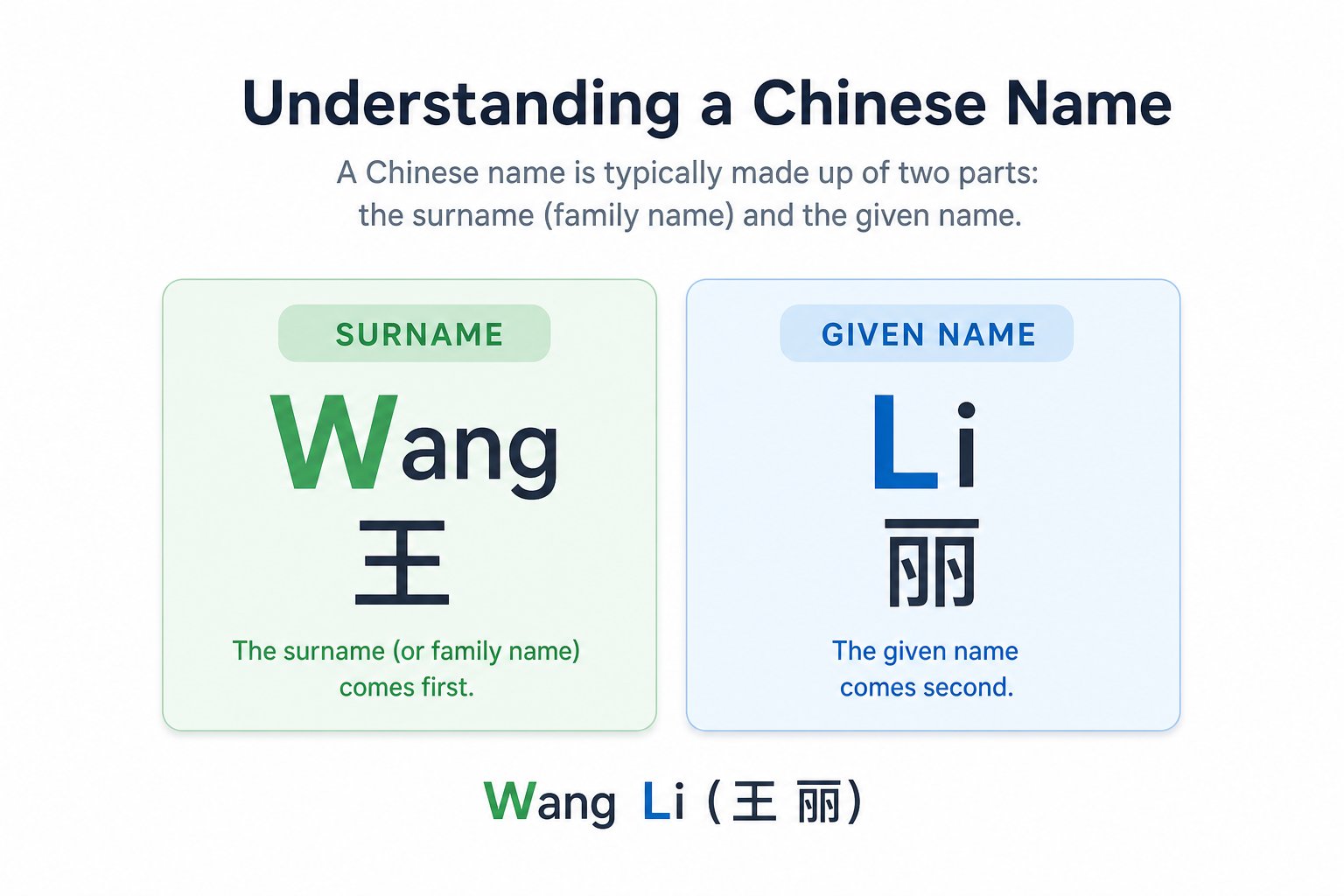
The standards are clear on paper, but what do they actually look like in practice? Every rule boils down to two structural principles: capitalize the first letter of both the surname and the given name, and treat each component as a single unbroken word. That is the entire foundation. Everything else is application.
Han Chinese personal names follow a fixed structure: surname (xing) first, given name (ming) second. This is the opposite of most Western naming conventions, where the given name precedes the family name. When you convert hanzi to pinyin, the surname-first order is preserved. John Smith becomes Smith John in structural terms, except the Chinese convention has been this way for thousands of years.
Capitalizing Single-Character Surnames
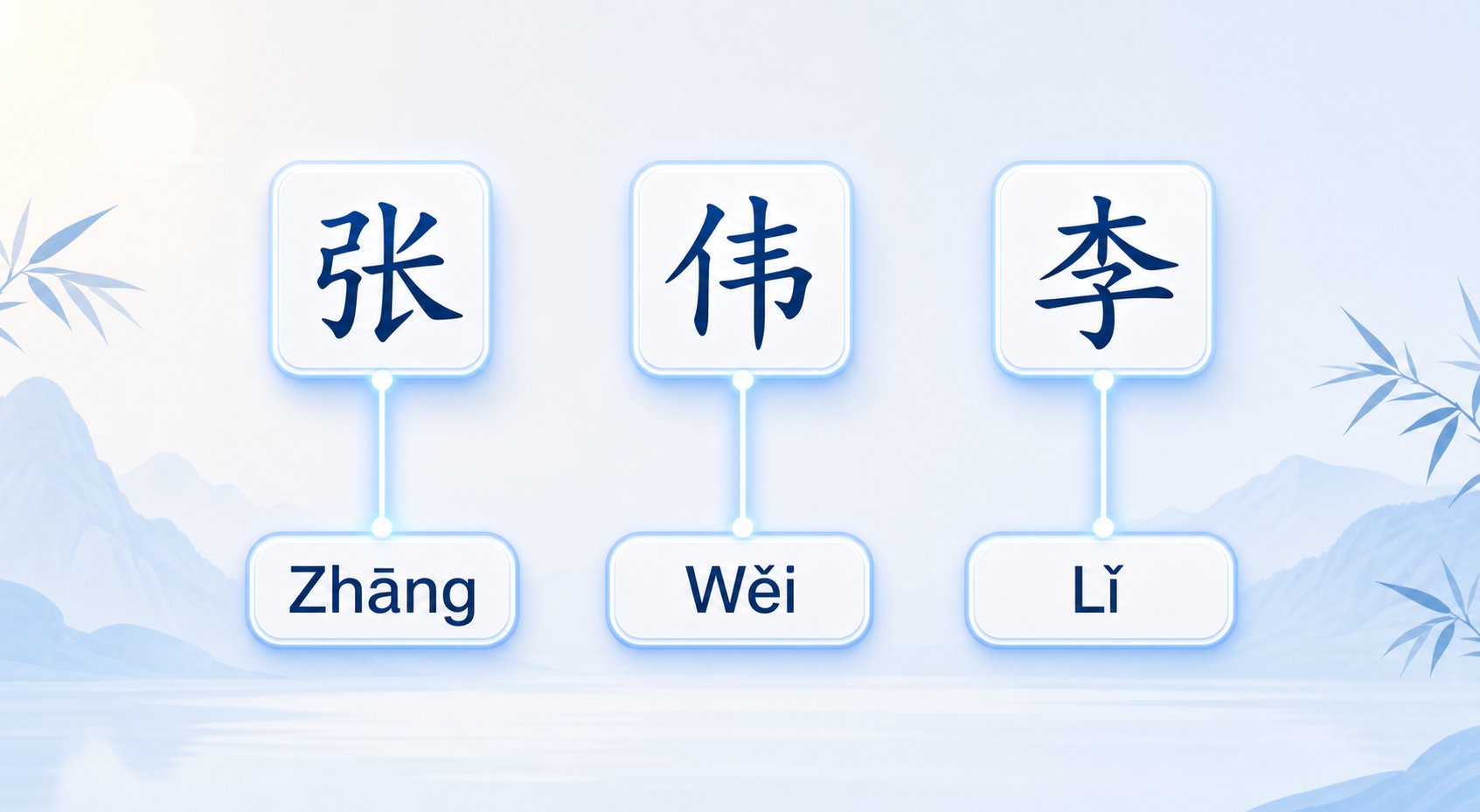
Nearly all Han Chinese surnames are monosyllabic, a single character, a single syllable. The rule is straightforward: capitalize the first letter, write it as its own word, and separate it from the given name with a space. Some of the most common chinese characters used as surnames include Wang, Li, Zhang, and Liu. Each gets a capital initial letter and stands alone.
Think of your pengyou (friend) named Li Wei. The surname Li is one capitalized word. The given name Wei is another capitalized word. Two words, two capital letters, one space between them.
Two-Character Given Names Written as One Word
Here is where most errors happen. The most common modern Chinese name structure is one-character surname plus two-character given name. The critical rule: both syllables of a two-character given name are joined together as a single word, with only the first syllable capitalized. No space. No hyphen. One word.
So a name like 王小明 becomes Wang Xiaoming. Not Wang Xiao Ming. Not Wang Xiao-ming. Not Wang XiaoMing. The given name Xiaoming is one linguistic unit and must be written as such.
The reference text Chinese Romanization: Pronunciation and Orthography by Yin Binyong states this explicitly: "The given name is a single entity and should not be broken up; moreover, use of the hyphen to clarify syllable boundaries is entirely superfluous." The older practice of writing Zhou En-lai with a hyphen is not considered standard in Hanyu Pinyin.
Single-Character Given Names
When the given name is only one character, the formatting is even simpler. Both the surname and the given name are single syllables, each capitalized, separated by a space: Zhang Fei, Qu Yuan, Lei Feng. The potential confusion here is that English speakers may accidentally reverse the order, assuming the second word is the surname. For names in this 1+1 pattern, context or the all-caps surname technique (ZHANG Fei) can help international readers identify which element is which.
Correct vs. Incorrect Formatting at a Glance
| Correct Format | Incorrect Format | Explanation |
|---|---|---|
| Wang Xiaoming | Wang Xiao Ming | Given name syllables must not be separated by a space |
| Wang Xiaoming | Wang Xiao-ming | Hyphens are not used between given name syllables |
| Wang Xiaoming | Wang XiaoMing | Only the first letter of the given name is capitalized, not each syllable |
| Zhou Enlai | Zhou En-lai | Hyphenation in given names is not standard pinyin orthography |
| Zhang Fei | zhang fei | Both surname and given name require an initial capital letter |
| Sun Zhongshan | SUN ZHONG SHAN | All-caps with spaces between given name syllables violates both spacing and case rules |
Notice the pattern: every correct example has exactly two words, each starting with a capital letter, with the given name always written as one continuous unit. This holds true whether the given name has one syllable or two. The consistency makes the rule easy to remember once you see it laid out.
These foundational rules cover the vast majority of Chinese names you will encounter. But what happens when the surname itself has two characters? Compound surnames like Zhuge and Ouyang introduce an additional layer of complexity that the basic one-character surname rules do not address.
Compound Surnames and Ethnic Minority Names
Compound surnames break the one-character pattern that most people assume is universal. Names like Zhuge, Ouyang, Sima, and Shangguan contain two characters in the surname slot, and this changes how capitalization and spacing work. If you have ever encountered an unknown character combination and wondered whether it was a surname or part of a given name, you are not alone. The distinction matters for correct formatting.
How Compound Surnames Are Capitalized
The rule is consistent with the single-character approach but applied differently: both syllables of a compound surname are written together as one word, with only the first letter capitalized. The surname remains a single unit, just like a two-character given name remains a single unit.
So the famous strategist is written Zhuge Liang. Not Zhu Ge Liang. Not ZhuGe Liang. The compound surname Zhuge is one word, one capital letter. The given name Liang is another word, another capital letter.
| Compound Surname | Correct Pinyin Format | Incorrect Format |
|---|---|---|
| 诸葛 (Zhuge) | Zhuge Liang | Zhu Ge Liang |
| 欧阳 (Ouyang) | Ouyang Xiu | Ou Yang Xiu |
| 司马 (Sima) | Sima Qian | Si Ma Qian |
| 上官 (Shangguan) | Shangguan Wan'er | Shang Guan Wan Er |
| 公孙 (Gongsun) | Gongsun Long | Gong Sun Long |
| 令狐 (Linghu) | Linghu Chong | Ling Hu Chong |
Distinguishing Compound Surnames From Given Names
Here is the practical challenge: how do you tell whether "Ouyang Xiu" is a compound surname plus a one-character given name, or a single-character surname plus a two-character given name? Without context, the pinyin alone does not always make this clear. Among common chinese characters used as surnames, compound surnames are relatively rare, numbering only around 80 in active use compared to thousands of single-character surnames. Familiarity with the most frequent compound surnames is the most reliable way to parse ambiguous names. Some databases and input systems even flag names with the most strokes in a chinese character as potential compound surname candidates, since many compound surnames use less common characters.
In practice, the person bearing the name is the best authority. When formatting someone else's name, confirm the surname-given name boundary before applying capitalization rules.
Ethnic Minority Names Outside the Han Structure
China's 55 officially recognized ethnic minorities include groups whose naming conventions differ fundamentally from the Han surname-plus-given-name model. Tibetan names, for instance, typically consist of two or more elements without a family surname at all. A name like Tenzin Gyatso is two given-name elements, not a surname followed by a given name. In pinyin contexts, each element is capitalized as a separate word.
Uyghur naming conventions present an even more distinct case. Uyghurs traditionally use a given name followed by a patronymic, their father's first name. As the Uyghur Human Rights Project documents, a family might look like this: the father is Memet Abduqadir, the mother is Amangul Niyaz, and the children are Arafat Memet and Arfiya Memet. The children's last element is their father's given name, not an intergenerational family surname.
When Uyghur names are rendered in pinyin on Chinese official documents, they often appear in reversed order or with distorted spellings. The Uyghur skier Dilnigar Ilhamjan, for example, was widely reported as "Dinigeer Yilamujiang" during the 2022 Beijing Winter Olympics, a pinyin transliteration of the Chinese character transliteration of her Uyghur name. Each capitalization choice in these cases reflects a political and linguistic layer that standard Han Chinese pinyin rules were never designed to address.
For Tibetan, Uyghur, Mongolian, and other minority names written in pinyin, the general principle still holds: capitalize the first letter of each name element as written, and keep multi-syllable elements together as single words. But the underlying structure, what counts as a surname versus a given name versus a patronymic, requires understanding the specific cultural convention rather than defaulting to Han Chinese assumptions.
These compound and minority name cases reveal something important: the standard rules work cleanly for the majority of names, but edge cases demand a direct comparison of how different standards handle the same formatting questions.
Side-by-Side Comparison of Major Standards
Knowing that three standards exist is one thing. Knowing exactly where they overlap and where they pull in different directions is what actually solves your formatting problem. The good news: on the core question of how to capitalize a Chinese personal name, all three systems say essentially the same thing. The complications emerge in secondary details like tone marks, all-caps conventions, and how much flexibility they allow for hyphens.
Where the Standards Agree
GB/T 16159, ISO 7098, and the UN romanization system share the same foundational rules for personal name capitalization:
- The surname is written as one word with its first letter capitalized.
- The given name is written as one word with its first letter capitalized, regardless of how many characters it contains.
- Surname comes before given name (Chinese name order is preserved).
- Compound surnames are treated as a single word with only the initial letter capitalized.
- A space separates the surname from the given name, and no other spaces appear within either component.
This consensus means that for everyday writing, the format "Zhang Xiaoming" is universally correct across all three systems. If you remember nothing else, remember that. The disagreements only surface when you move into specialized contexts like library cataloging, passport printing, or academic citation styles that layer additional conventions on top of the base rules.
Key Differences Between GB/T 16159 and ISO 7098
The two most detailed standards diverge on a handful of secondary formatting questions. GB/T 16159 is prescriptive about tone marks: they should be included in standard pinyin text, and the national standard treats tones as essential for representing correct Mandarin pronunciation. ISO 7098, while acknowledging tone marks, permits their omission in contexts where they are impractical, such as database fields, email addresses, or systems that cannot render diacritics.
On the question of all-caps formatting, GB/T 16159 allows writing an entire name in capitals for special emphasis or header contexts (WANG XIAOMING), but specifies that in running text, standard mixed-case applies. ISO 7098 similarly permits all-caps but adds a note about using it to distinguish surnames in international contexts, a convention you will often see in academic journals where the surname appears in small caps or full capitals (WANG Xiaoming) to signal name order to non-Chinese readers.
Hyphenation is where the standards show the sharpest contrast in practice, even if both technically discourage it. GB/T 16159 flatly states that given names should not be hyphenated. ISO 7098 acknowledges that some legacy systems and older publications used hyphens (Zhou En-lai, Mao Ze-dong) and notes these as non-standard without condemning existing records that use them. This tolerance means you will still encounter hyphenated forms in older international publications, a taiwan newspaper in chinese from the 1980s, or historical diplomatic documents, even though current best practice rejects them.
The Library of Congress Approach
The Library of Congress (LC) operates under its own cataloging rules that diverge from all three standards in one significant way: syllable separation. According to the LC Pinyin Conversion Project guidelines, the Library continues its practice of separating individual syllables, except in the cases of personal names, geographic locations, and certain proper nouns. This means common words in titles and subjects are spaced syllable-by-syllable (zhong guo rather than zhongguo), but personal names follow the standard joined format.
The LC system also omits tone marks entirely. Their guidelines state plainly that tones will not be indicated. This decision was made for practical cataloging reasons: consistency across millions of records, compatibility with legacy systems, and the reality that most library users searching for Chinese-language materials do not type tone marks. If you have ever used a tool like mandarinspot or consulted a tone chart to verify diacritics, you know how much additional effort tone marks require. The LC decided that effort was not justified for bibliographic retrieval purposes.
For personal names specifically, the LC approach aligns with the other standards on capitalization and joining. A name like Mao Dun appears as "Mao, Dun" in authority records (inverted for cataloging), with both elements capitalized and the given name written as one unit. The LC's earlier Wade-Giles records used forms like "Mao, Tun" which were systematically converted to pinyin starting in 2000.
The critical point: LC cataloging rules are designed for bibliographic databases, not general writing. Applying LC conventions to a business card, academic paper, or passport application would produce technically incorrect results by the other three standards. The syllable-separation practice in particular does not translate to any other context.
Full Comparison Across All Dimensions
| Dimension | GB/T 16159-2012 | ISO 7098:2015 | UN System | Library of Congress |
|---|---|---|---|---|
| Surname capitalization | First letter capitalized | First letter capitalized | First letter capitalized | First letter capitalized (inverted with comma in records) |
| Given name formatting | One word, first letter capitalized, syllables joined | One word, first letter capitalized, syllables joined | One word, first letter capitalized, syllables joined | One word, first letter capitalized, syllables joined |
| All-caps usage | Permitted for emphasis or headers | Permitted; full-caps surname used to signal name order internationally | Follows ISO/GB conventions | Not standard practice in records |
| Hyphen in given names | Not permitted | Not standard; legacy forms acknowledged | Not permitted | Not used |
| Tone marks | Required in standard text | Recommended; omission permitted in limited contexts | Not specified as mandatory | Omitted entirely |
| Syllable separation (non-names) | Word-based spacing | Word-based spacing | Word-based spacing | Syllable-by-syllable spacing |
| Primary audience | Domestic Chinese publishing, education, signage | International documentation, libraries, multilingual publishing | Diplomatic communications, geographic naming | Bibliographic cataloging |
Follow GB/T 16159 for Chinese domestic contexts, ISO 7098 for international academic and publishing work, and your destination country's passport office rules for travel documents. When in doubt, the format "Surname Givenname" with standard mixed-case capitalization satisfies all three core standards simultaneously.
The comparison reveals a reassuring pattern: the standards converge on everything that matters for personal name capitalization and diverge only on peripheral formatting choices. Your real challenge is not choosing between contradictory rules. It is applying the correct standard to the correct document type, especially when that document is an official form with its own institutional conventions layered on top.
Formatting Pinyin Names on Passports and Official Documents
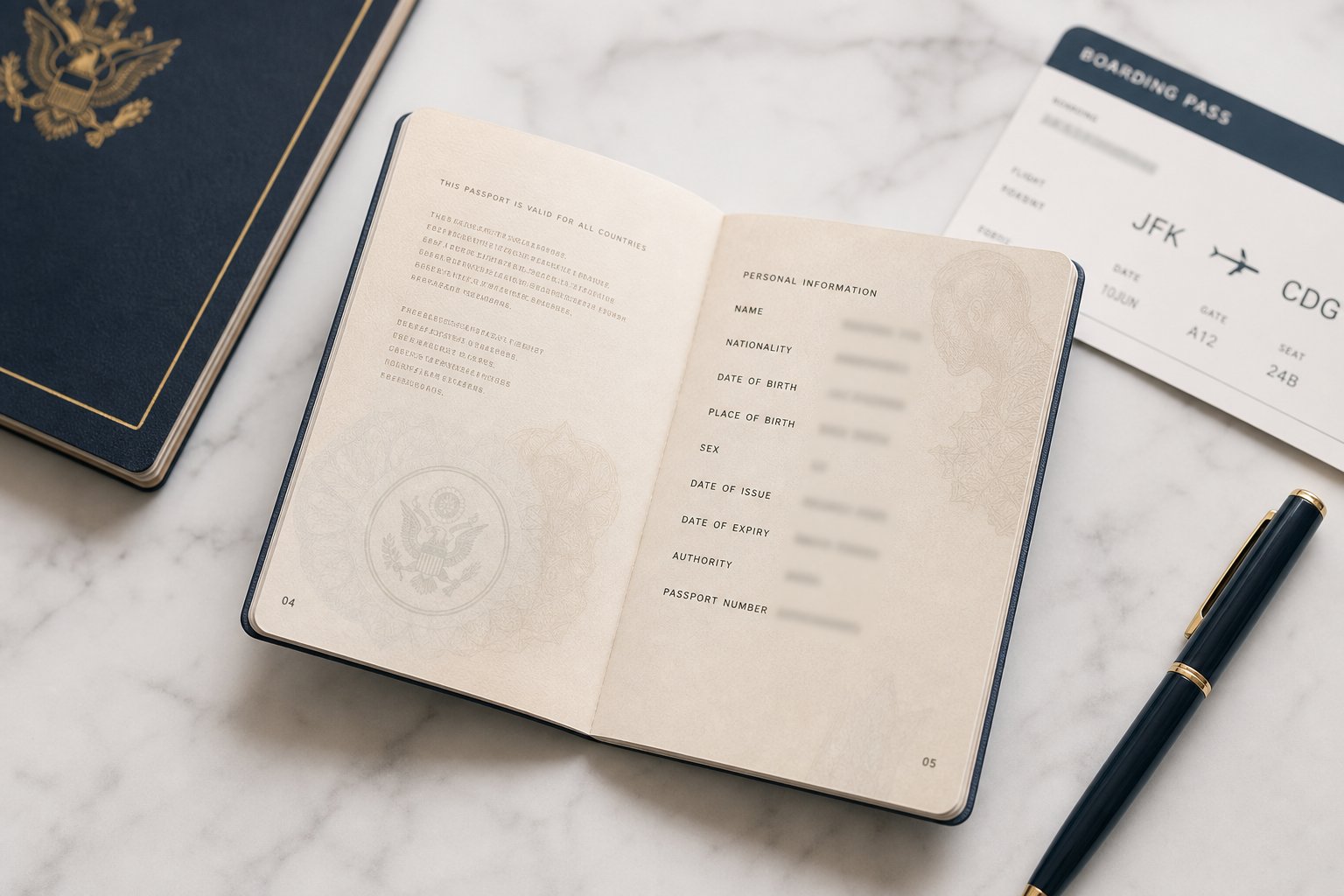
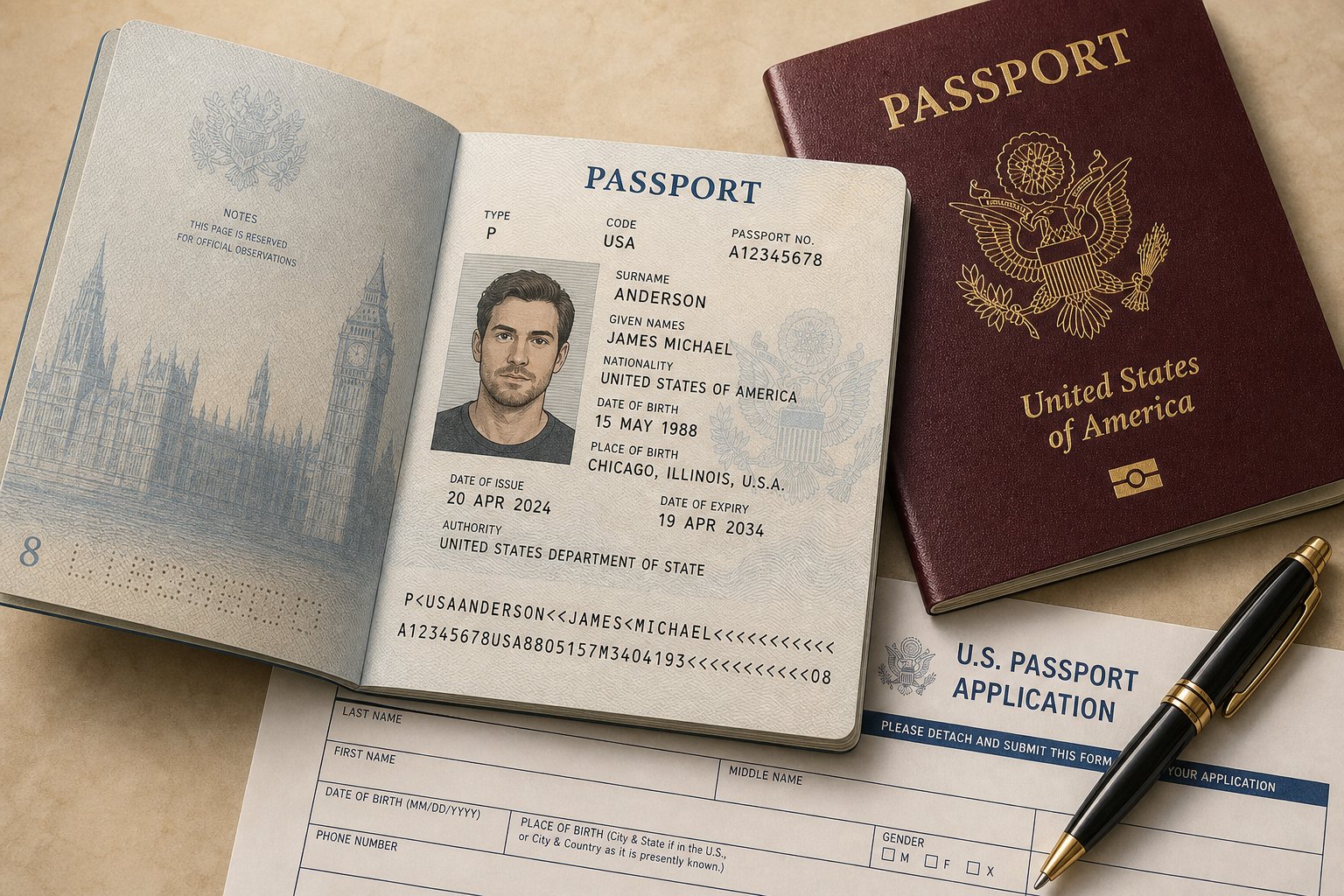
Official documents do not follow standard pinyin orthography. That single fact causes more confusion than any other aspect of name formatting. You can memorize every rule from GB/T 16159 and ISO 7098, but the moment you open your Chinese passport, you will see something entirely different: your name printed in all capitals, no tone marks, and sometimes no space between surname and given name. Understanding why documents deviate from the standard, and how to handle each format, is what keeps your identity consistent across borders.
Passport and Visa Name Formatting
Chinese passports display names in the Machine-Readable Zone (MRZ) using all capital letters with no diacritics. The International Civil Aviation Organization (ICAO) Doc 9303 governs these standards worldwide. A name like Wang Xiaoming appears as WANG XIAOMING on the MRZ line, with a filler character separating the surname from the given name in the machine-readable code but no visible space on the printed page itself.
Key constraints of the passport format:
- All letters are uppercase (Roman alphabet only).
- No tone marks, diacritics, or special characters are permitted.
- Hyphens are replaced by filler characters in the MRZ.
- Apostrophes are omitted entirely (Xi'an becomes XIAN).
- The name field is limited to 39 characters and may be truncated for longer names.
- Surname (primary identifier) appears first, followed by given name (secondary identifier).
This means your passport will never reflect "correct" pinyin orthography. It cannot. The system was designed for machine readability across every writing system on earth, not for linguistic accuracy in any single one. When you fill out a visa application or immigration form, copy the name exactly as it appears in your passport MRZ, even if it looks wrong by standard pinyin rules.
Academic and Publishing Conventions
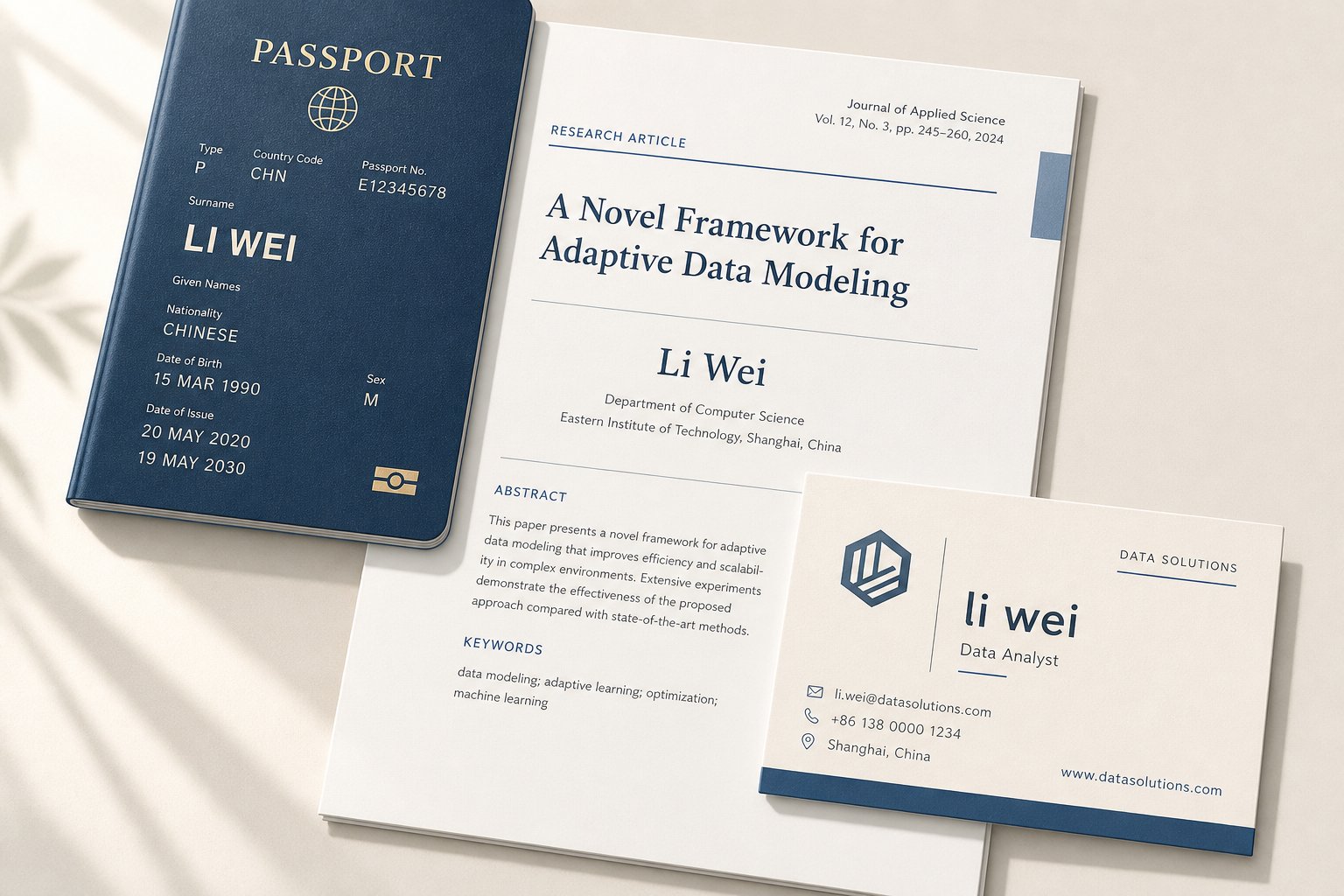
Academic contexts follow different logic. The Peking University STL Library citation guide specifies that when citing Chinese authors, you should transcribe names in pinyin, joining multiple syllables of surnames and given names without hyphens or commas. A legal citation would read: Zhang Mingkai, not ZHANG MINGKAI or Zhang Ming-kai.
Most academic publishers expect standard mixed-case formatting in running text. Journals often use the SURNAME Givenname convention (WANG Xiaoming) in author bylines to signal name order to international readers, then revert to standard capitalization within the article body. If you are preparing a manuscript, check the publisher's style guide. Some follow Chicago Manual of Style conventions, others defer to ISO 7098 directly.
Transcripts and diplomas vary by institution. Chinese universities typically print names in characters alongside an all-caps pinyin version, similar to the passport format. When these documents are translated for international use, the translator should convert to standard mixed-case pinyin unless the receiving institution specifically requests all-caps.
Business Cards and International Correspondence
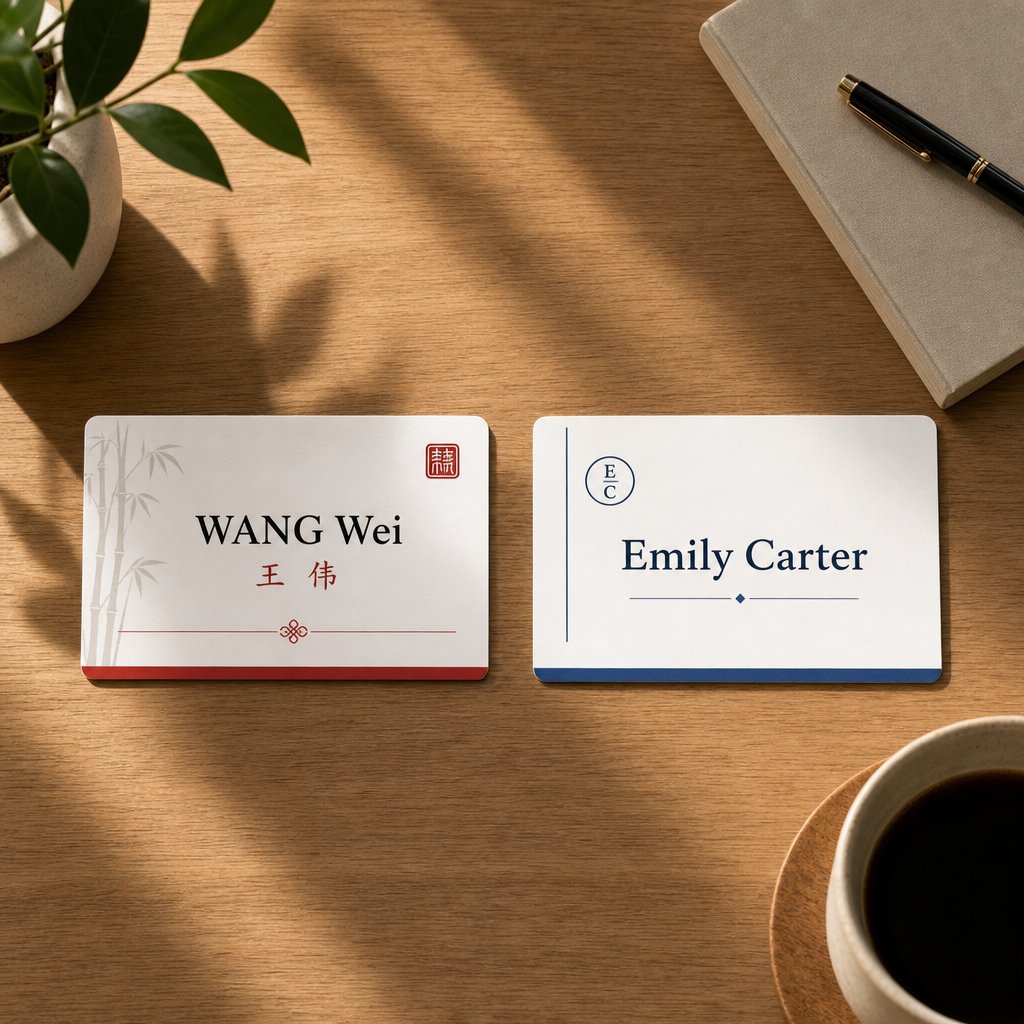
Business cards offer the most flexibility. Many professionals use a bilingual layout: Chinese characters rendered in a font like songti or pingfang sc on one side, with the romanized name in standard capitalization on the other. Digital documents that embed Chinese text often rely on system fonts such as pingfang tc for traditional characters or the simsun.ttc font file for simplified Chinese display, but the pinyin name itself should always appear in a standard Latin typeface with proper capitalization.
For international correspondence and email signatures, the standard format (Zhang Xiaoming) works best. Some professionals add their surname in capitals, ZHANG Xiaoming, to help Western colleagues identify which element is the family name. Others reverse the order entirely for Western audiences, writing Xiaoming Zhang. Both approaches are acceptable in informal business contexts, but pick one and stay consistent.
Handling International Forms That Expect Western Name Order
When a form asks for "First Name" and "Last Name," you face a structural mismatch. Chinese name order places the surname first, but these fields assume given-name-first order. The safest approach:
- Last Name / Surname / Family Name field: Enter your surname (e.g., Zhang).
- First Name / Given Name field: Enter your given name as one word (e.g., Xiaoming).
- Middle Name field: Leave blank unless your given name has been split across documents.
- Full Name field: Match your passport exactly if the form is for official or immigration purposes.
The critical principle is consistency. If your passport says ZHANG XIAOMING, your visa application should produce the same result. If your academic transcript says Zhang Xiao Ming with a space in the given name, flag this discrepancy early. Immigration systems cross-reference documents, and mismatched name formats can trigger delays or rejections. When digital systems render your name using embedded fonts like simsun.ttc for Chinese characters alongside a Latin-script pinyin field, ensure the romanized version matches your passport MRZ every time.
Consistency across documents matters more than perfection in any single one. But consistency requires knowing what errors look like, and the most common mistakes follow predictable patterns that are easy to fix once you can spot them.
Common Mistakes and How to Fix Them
Predictable patterns mean fixable problems. Most capitalization errors fall into a handful of categories, and once you can identify the type of mistake, the correction is straightforward. The following breakdown covers the errors that appear most frequently in academic papers, official forms, and everyday writing, along with the specific rule each one violates.
Hyphenation Errors in Given Names
The hyphen is the single most persistent formatting mistake in romanized Chinese names. Older publications, legacy databases, and even some modern style guides still insert a hyphen between the syllables of a two-character given name. You will see Deng Xiao-ping, Li Xiao-long, or Zhou En-lai in historical texts, news archives, and translated works from the mid-20th century.
The rule is unambiguous: standard Hanyu Pinyin does not use hyphens in personal names. The given name is one word. Period. This applies regardless of whether the syllables might be confused with other words of similar character or whether the name contains an unusual syllable boundary. The apostrophe handles genuine ambiguity (as in Xi'an), but hyphens have no role in name formatting under any current standard.
Regional pronunciation habits sometimes reinforce this error. A speaker familiar with Sichuan pronunciation might mentally segment syllables differently than a standard Mandarin speaker, leading them to insert visual breaks that reflect their spoken rhythm. But pinyin orthography follows standard Mandarin segmentation rules, not regional speech patterns.
Inconsistent Capitalization Across Documents
Imagine submitting a journal article as "Liu Mingyu," then discovering your co-author listed you as "LIU Ming-Yu" in the references. This inconsistency is not just aesthetically jarring. It can cause citation indexing systems to treat you as two different people.
The most common capitalization errors include:
- Failing to capitalize the given name after the space (Zhang xiaoming instead of Zhang Xiaoming)
- Capitalizing each syllable of the given name independently (Zhang Xiao Ming)
- Using intercaps within the given name (Zhang XiaoMing)
- Writing everything in lowercase (zhang xiaoming)
- Splitting compound surnames into separate capitalized words (Si Ma Qian instead of Sima Qian)
Each of these errors stems from applying English capitalization logic, where each "word" gets a capital letter, to a system where the given name is structurally one word regardless of syllable count.
Tone Mark Placement Mistakes
When tone marks are included, they must go on the correct vowel. The placement rules follow a clear hierarchy: a and e always take the tone mark when present, o takes it in the combination ou, and in all other cases the final vowel receives the mark. Getting this wrong does not affect capitalization directly, but it undermines the credibility of any document that claims to use proper pinyin formatting.
A related issue involves erhua suffixes in names. While rare in formal given names, some informal or regional names include the erhua (儿化) suffix. When it appears, it attaches to the preceding syllable without affecting capitalization: a name ending in -er does not get split into a separate word or receive its own capital letter.
Error Reference Table
| Incorrect Example | Correct Example | Rule Violated |
|---|---|---|
| Wang Xiao-ming | Wang Xiaoming | Hyphens are not used in given names |
| Wang Xiao Ming | Wang Xiaoming | Given name syllables must be joined as one word |
| Wang XiaoMing | Wang Xiaoming | Only the first letter of the given name is capitalized |
| Ou Yang Xiu | Ouyang Xiu | Compound surnames are written as one word |
| zhang xiaoming | Zhang Xiaoming | Both surname and given name require initial capitals |
| WANG xiao ming | Wang Xiaoming (or WANG XIAOMING) | Mixed all-caps surname with lowercase split given name violates both case and spacing rules |
| Wáng Xiǎo Míng | Wáng Xiǎomíng | Tone marks do not justify splitting the given name into separate words |
| Zhū Gě Liàng | Zhūgě Liàng | Compound surname syllables are joined with only the first letter capitalized |
Resolving Conflicts Between Formats
When you encounter your own name written differently across documents, which version wins? The answer depends on context:
- Immigration and travel: Your passport MRZ is the authority. Match it exactly on all visa and border-related forms, even if the format is technically non-standard pinyin.
- Academic publishing: Follow the journal or publisher's style guide. If none is specified, use standard mixed-case formatting per ISO 7098.
- Legal documents within China: GB/T 16159 governs. Standard capitalization with tone marks where the system supports them.
- International business and correspondence: Standard mixed-case (Zhang Xiaoming) is universally understood and accepted.
When two documents conflict, the one with legal authority in your current context takes precedence. For everything else, default to standard mixed-case pinyin and stay consistent.
Generational and Courtesy Name Elements
Some Chinese families use generational name characters (zibei), where all siblings or cousins share one character in their given name. For example, three brothers might be named Zhang Wenhua, Zhang Wenming, and Zhang Wenjun, with "Wen" as the shared generational element. This does not change the capitalization rules. The given name is still one word: Wenhua, Wenming, Wenjun. The generational character does not get separated or specially marked.
Courtesy names (zi) and art names (hao), common in historical contexts, follow the same formatting principle. Su Shi's courtesy name Zizhan is written as two capitalized words: Su Zizhan, treating the courtesy name exactly like a standard given name. Do not hyphenate or split these elements, even when they carry distinct semantic meaning.
These error patterns cover the vast majority of mistakes you will encounter in the wild. Recognizing them is the diagnostic step. The next question is more practical: given your specific role and context, which rules matter most and how do you apply them efficiently?
Practical Guidelines for Every Situation
Rules are only useful if you can apply them quickly in the moment you need them. Whether you are labeling a flash card in chinese characters, preparing a manuscript for peer review, or filling out an immigration form, the decision process is the same. Here is a streamlined approach that works regardless of your role.
- Identify your context. Are you writing for a Chinese domestic audience, an international publication, or an official document? This determines which standard governs.
- Select the appropriate standard. Domestic Chinese contexts follow GB/T 16159. International academic and publishing work follows ISO 7098. Passports and immigration forms follow ICAO/MRZ conventions. Legal or diplomatic documents follow the UN system.
- Apply the rules consistently. Once you have chosen a standard, do not mix conventions from another. A single document should never contain both "WANG XIAOMING" and "Wang Xiao-ming."
For Language Learners and Students
When you are deep in chinese character writing practice, name formatting might feel like a low priority. But building correct habits early saves you from relearning later. Most spaced repetition app platforms and pleco software allow you to create a user dictionary where you can store names with proper pinyin formatting. Use this feature to reinforce correct capitalization every time you review vocabulary.
Online dictionaries like dict.cn and bkrs are useful for verifying individual character readings, but they typically display syllables in isolation rather than as formatted names. When you look up characters from the most frequent chinese characters lists, remember that the capitalization and joining rules only apply when those characters function as parts of a personal name. A character standing alone in a dictionary entry does not carry capitalization information.
For Translators and Publishers
Consistency across an entire document or publication is your primary obligation. Establish a style sheet at the start of any project that specifies: which standard you are following, whether tone marks are included, and how you will handle compound surnames and minority names. Reference this sheet for every name that appears in the text.
When translating works that contain dozens of personal names, build a name index early. Cross-reference each name's character form against its pinyin rendering to catch errors before they propagate through the manuscript. If your publisher does not specify a standard, default to ISO 7098 for international audiences.
For People Formatting Their Own Names
You have the most at stake and the most control. Start with your passport, since that is the format immigration systems will cross-reference against every other document you produce. Then establish a standard mixed-case version (Zhang Xiaoming) for professional use. Keep both versions documented somewhere accessible so you can copy them exactly when filling out forms under time pressure.
If your name has already been formatted inconsistently across existing documents, prioritize aligning future documents with your passport. Retroactively correcting old records is rarely worth the administrative effort unless the discrepancy is causing active problems with background checks or credential verification.
Consistency beats perfection. Pick one standard, apply it everywhere within a given context, and match your passport exactly on anything immigration-related. The format "Surname Givenname" with standard mixed-case capitalization satisfies every major standard simultaneously.
Frequently Asked Questions About Pinyin Name Capitalization
1. Should I capitalize both syllables of a two-character Chinese given name in pinyin?
No. Only the first letter of the entire given name is capitalized, and both syllables are joined as one word. For example, the name 王小明 is written as Wang Xiaoming, not Wang Xiao Ming or Wang XiaoMing. All major standards, including GB/T 16159 and ISO 7098, treat the given name as a single linguistic unit regardless of how many characters it contains.
2. Why does my Chinese passport format my pinyin name differently from standard rules?
Chinese passports follow ICAO Doc 9303 standards for machine-readable travel documents, which require all capital letters, no tone marks, and no diacritics. This means WANG XIAOMING on your passport is correct for that context, even though standard pinyin orthography would write it as Wang Xiaoming. When filling out visa or immigration forms, always match your passport MRZ exactly rather than applying standard pinyin formatting.
3. Are hyphens allowed in pinyin personal names?
No. Current Hanyu Pinyin standards explicitly prohibit hyphens in personal names. Older forms like Deng Xiao-ping or Zhou En-lai are legacy spellings from before standardization was fully adopted internationally. The correct modern format joins all given name syllables without hyphens or spaces: Deng Xiaoping, Zhou Enlai. The apostrophe is used only to prevent syllable ambiguity in specific phonetic combinations, not as a name separator.
4. How do you capitalize compound Chinese surnames like Ouyang or Zhuge in pinyin?
Compound surnames follow the same principle as single-character surnames: write the entire surname as one word with only the first letter capitalized. Zhuge Liang is correct, not Zhu Ge Liang or ZhuGe Liang. The compound surname functions as a single unit. Common examples include Ouyang Xiu, Sima Qian, and Shangguan Wan'er. There are roughly 80 compound surnames in active use, so familiarity with the most common ones helps you parse ambiguous names correctly.
5. Which pinyin capitalization standard should I follow for academic publishing?
For international academic work, ISO 7098:2015 is the most widely accepted reference. It specifies standard mixed-case formatting with the surname and given name each written as one capitalized word. Many journals also use the SURNAME Givenname convention in author bylines to clarify name order for non-Chinese readers. Always check your target journal's style guide first, as some publishers layer additional conventions on top of the ISO standard.