Understanding the Link Between Pinyin and Name Characters
Imagine you meet someone named "Li." In romanized form, that single syllable tells you almost nothing. It could be 李 (plum tree), 丽 (beautiful), 力 (strength), 立 (to stand), 莉 (jasmine), or 理 (reason) — and those are just a handful from a pool of dozens. Each character carries its own history stretching back thousands of years, its own visual architecture, and its own web of cultural meaning. Yet on a passport, in a database, or across a conference table, they all collapse into three letters: L-i.
This is the central tension of pinyin name character evolution — the collision between a writing system built on meaning-rich symbols and a romanization system designed to represent sound alone. Understanding how these two tracks developed, diverged, and now interact is the core focus of this article.
Where Sound Meets Meaning in Chinese Names
So what are chinese names, really? Unlike most Western names, where sound is the primary carrier of identity, a name in chinese operates across multiple dimensions simultaneously — sound, visual form, literary meaning, and even elemental balance. The characters chosen for a name are not arbitrary labels. They are deliberate selections from a vast inventory of symbols, each one a compressed poem of etymology and aspiration.
How do chinese names work at the structural level? The surname comes first, typically one character, followed by a given name of one or two characters. Parents spend weeks — sometimes months — selecting given-name characters that harmonize in tone, balance visually when written, and carry layered cultural resonance. Among asian names, this multi-dimensional selection process is uniquely complex because the Chinese writing system offers so many characters sharing identical pronunciations.
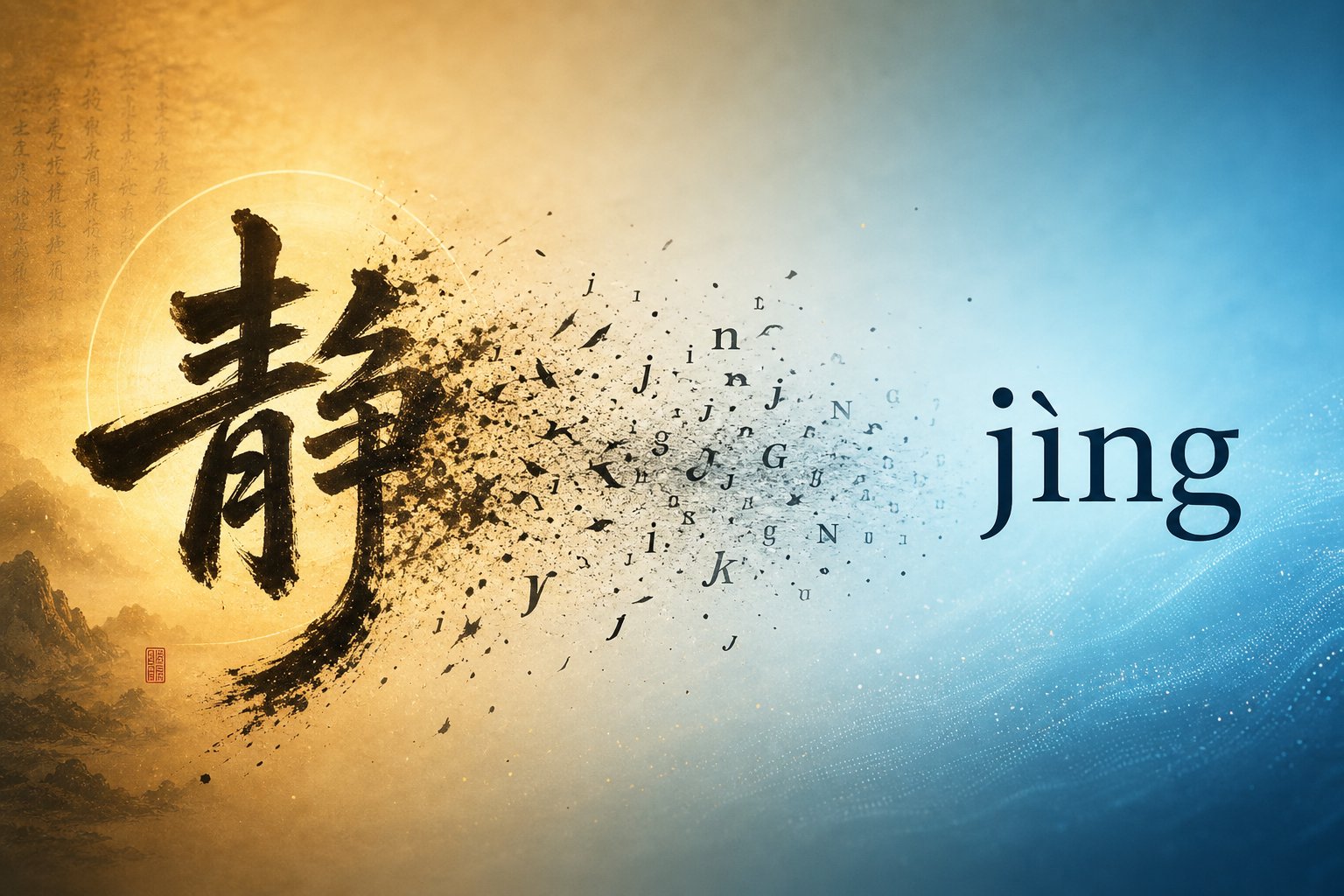
When pinyin strips away tone marks — as international systems routinely do — it flattens the very tonal distinctions that separate one name character from another, turning a rich field of meaning into a single ambiguous string of letters.
Why Pinyin and Character Evolution Are Inseparable
You cannot fully grasp the relationship between chinese and pinyin without seeing them as two parallel stories that keep intersecting. On one track, Chinese characters have evolved visually over three millennia — from pictographs scratched into oracle bones to the streamlined simplified forms used today. On the other track, the pinyin romanization system emerged in 1958 as a literacy tool, then expanded into an international standard, a digital input method, and ultimately a filter through which the world reads Chinese names.
These two tracks matter for different audiences. Linguists study how sound-symbol relationships shift across centuries. Parents choosing names navigate the tension between characters that look and mean what they want versus characters that romanize clearly for global use. Anyone working cross-culturally with chinese names — in HR systems, legal documents, or academic publishing — encounters the information loss that pinyin introduces.
This article follows both tracks forward through time, pausing at each intersection point: ancient script origins, the birth of standardized romanization, character simplification campaigns, the homophony challenge, digital input pressures, and international system constraints. Each era imposed new rules on which characters parents could or would choose for names and characters that define identity. The story begins where all Chinese characters begin — carved into bone and shell, thousands of years before anyone imagined spelling them with Roman letters.
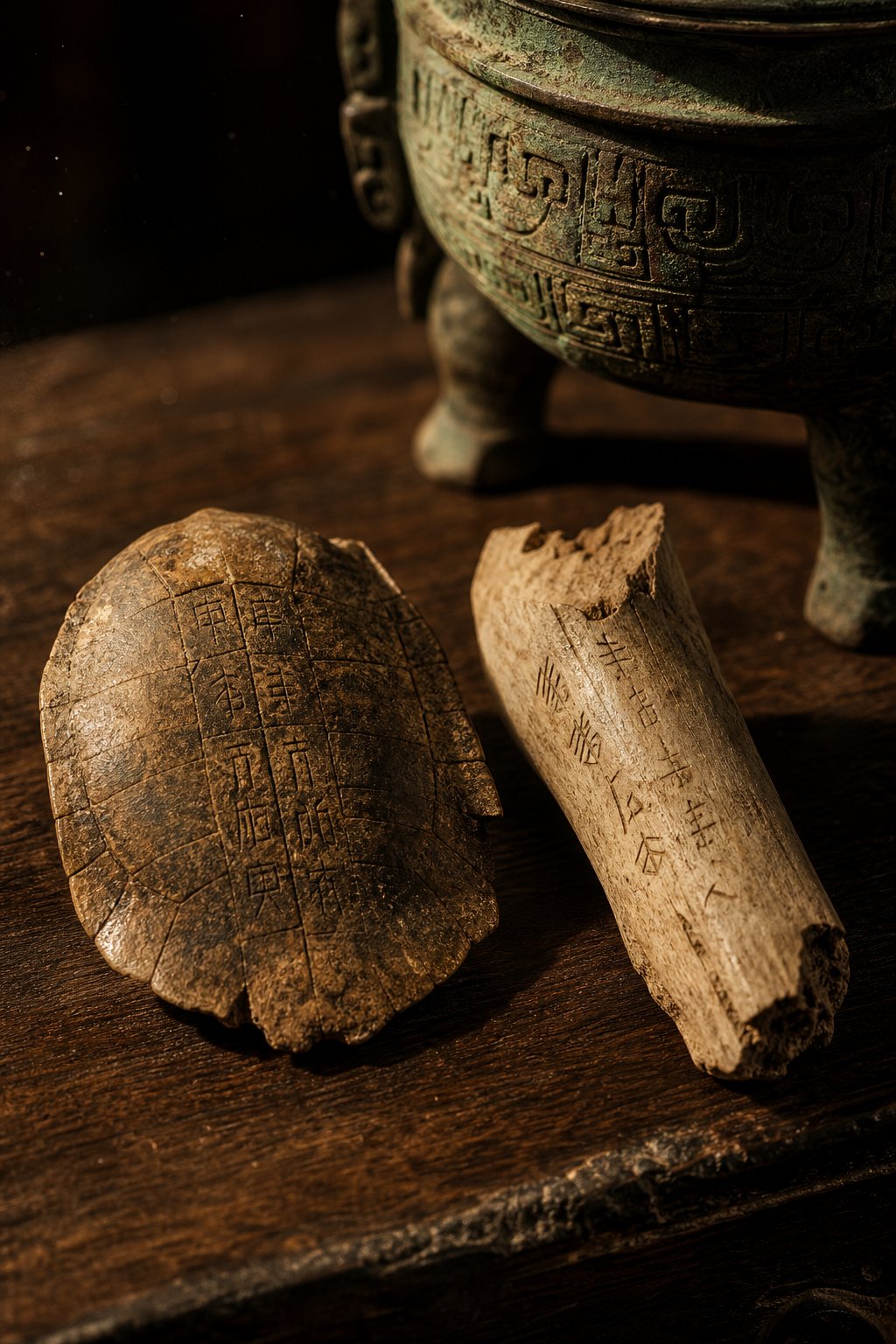
Ancient Script Origins of Modern Name Characters
Those carvings on bone and shell were not decorative. They were questions — posed to ancestors and gods, scratched into turtle plastrons and ox scapulae, then heated until cracks appeared to reveal answers. These oracle bone inscriptions (甲骨文, jiǎgǔwén), dating to roughly 1200 BCE, represent the earliest verified forms of the chinese writing system. And among those ancient glyphs, you will find the ancestors of characters still given to children today.
What are chinese letters called? Technically, they are not letters at all. Each chinese character is a logograph — a symbol representing a word or morpheme rather than a single sound. This distinction matters enormously for naming. When parents select name chinese characters, they are choosing units of meaning with visual histories stretching back over three thousand years, not simply assembling phonetic building blocks.
Oracle Bone Origins of Popular Name Characters
Consider the character 明 (míng), meaning "bright" or "brilliant" — one of the most enduring choices in ancient chinese names and modern ones alike. On oracle bones, it appeared as a pictograph combining a window and the moon, capturing the idea of moonlight streaming through an opening. The concept was visceral: brightness defined by contrast with darkness.
Or take 安 (ān), meaning "peace" or "tranquility." Its oracle bone form depicted a woman beneath a roof — the idea of safety, of someone sheltered and settled. Parents have chosen this character for millennia, and the core meaning has never drifted. The visual form, however, has transformed dramatically.
Then there is 林 (lín), meaning "forest," composed of two tree characters side by side. As a hanzi family name, 林 ranks among the most common character surnames in Chinese-speaking communities. Its oracle bone form showed two clearly recognizable trees with branches and roots. Even in its earliest incarnation, the logic was transparent: one tree is a tree, two trees together become a forest.
How Bronze and Seal Scripts Refined Character Aesthetics
As Chinese civilization moved from the Shang dynasty into the Zhou period, writing migrated from bone to bronze. Cast into ritual vessels, characters gained rounder strokes and more uniform proportions. This bronze script (金文) era smoothed the rough, angular scratches of oracle bone writing into something more deliberate and decorative.
The character 龙 (lóng), meaning "dragon," illustrates this shift vividly. On oracle bones, it was a sprawling, serpentine figure with visible horns and claws — almost a drawing. In bronze script, the dragon became more stylized, its body compressed into a tighter frame while retaining recognizable features. By the time seal script (篆书) emerged during the Qin dynasty's standardization efforts, 龙 had become an elegant, flowing composition — still complex, but governed by consistent stroke rules.
Seal script imposed order. The etymological tracing approach used in classical dictionaries like Xu Shen's Shuowen Jiezi (说文解字, 100 CE) relied heavily on seal script forms to analyze character structure and meaning. This dictionary cataloged over 9,000 characters by their component parts, establishing a systematic framework that scholars still reference when studying how name characters evolved.
The Visual Journey From Ancient Glyph to Modern Stroke
The transition from seal script to regular script (楷书) during the Han dynasty was the most consequential aesthetic shift for naming. Regular script introduced the angular, brush-driven strokes that define how characters look today. The visual balance of a character in regular script — its stroke count, symmetry, and spatial distribution — became a key factor in name selection.
The table below traces four popular name characters across their major script stages:
| Character | Meaning | Oracle Bone | Bronze Script | Seal Script | Regular Script | Simplified |
|---|---|---|---|---|---|---|
| 明 | Bright | Window + moon pictograph | Rounded sun + moon | Symmetrical sun-moon pair | 日 + 月 (sun + moon) | 明 (unchanged) |
| 安 | Peace | Woman under roof sketch | Stylized roof over figure | Balanced 宀 + 女 form | 宀 + 女 | 安 (unchanged) |
| 林 | Forest | Two branching trees | Paired rounded trees | Uniform double-wood form | 木 + 木 | 林 (unchanged) |
| 龙 / 龍 | Dragon | Serpentine figure with horns | Compressed coiled dragon | Elaborate flowing form | 龍 (16 strokes) | 龙 (5 strokes) |
Notice a pattern: 明, 安, and 林 survived into simplified Chinese virtually unchanged because their structures were already economical. The character 龍, with its sixteen strokes, was radically reduced to 龙 — a transformation that altered its visual weight and, by extension, its aesthetic appeal as a name character.
This pattern reveals something important about how the chinese character system interacts with naming culture. Characters that maintained visual stability across millennia tend to carry a sense of timelessness that parents find appealing. Those that underwent dramatic simplification entered a different aesthetic conversation entirely — one shaped by mid-twentieth-century language reform policies that would soon collide with another new force: standardized romanization.
Birth of the Pinyin System and Its Naming Impact
Character simplification was only half of the language reform equation. Running on a parallel track — developed by the same committees, driven by the same literacy crisis — was a project to give Chinese characters a standardized phonetic spelling in Roman letters. The result, Hanyu Pinyin, would permanently alter how Chinese names travel beyond the page they are written on.
The 1958 Pinyin System and Its Original Purpose
So what is pinyin, exactly? It is the official romanization system for Standard Mandarin Chinese, using the Latin alphabet to represent the sounds of characters. But its origin story is rooted in something far more urgent than linguistic elegance. In the early 1950s, China faced staggering illiteracy rates. Hundreds of millions of people could not read or write. The government needed a tool — fast, practical, scalable — that could bridge the gap between spoken Mandarin and the thousands of characters required for basic literacy.
Development began in 1955 under a committee led by Zhou Youguang, a linguist and economist who would later be called the "Father of Pinyin." His task was deceptively simple: design a logical system that maps Mandarin sounds to Latin letters so that anyone familiar with the alphabet could approximate correct pronunciation. By 1957, the system was finalized. The following year, the Chinese government officially adopted Hanyu Pinyin as the national standard for romanization.
The original purpose was purely pedagogical. Pinyin was never intended to replace characters — it was a scaffold. Students would learn pinyin first, use it to decode pronunciation, and then graduate to reading characters directly. Think of it as training wheels for a writing system with no inherent phonetic cues. A pinyin chart posted on a classroom wall gave students a complete map of Mandarin syllables, organized by initials and finals, that they could reference while learning to read.
What few anticipated was how profoundly this phonetic scaffold would reshape the relationship between sound and identity in Chinese names.
How Standardized Romanization Changed Name Perception
Before pinyin, there was no single agreed-upon way to spell a Chinese name in Roman letters. Older systems like Wade-Giles and various postal romanizations produced inconsistent results. The same surname could appear as "Chou," "Chow," or "Zhou" depending on which system — or which regional dialect — informed the spelling. Converting chinese to pinyin created, for the first time, a uniform phonetic representation that could be applied nationwide.
This uniformity had a subtle but powerful effect on naming culture. Pinyin standardized pronunciation across dialects by anchoring every character to a single Mandarin reading. A character pronounced "wong" in Cantonese and "huang" in Mandarin now had one official pinyin spelling: huang. For families navigating between dialect communities, pinyin became the authoritative phonological layer — the definitive answer to "how is this name pronounced?"
Imagine a parent in the 1960s selecting characters for a child's name. Previously, the sound of the name was experienced locally — shaped by regional accent, family dialect, community norms. With pinyin's adoption, that same name gained a fixed, portable pronunciation tied to standard Mandarin. The pinyin table became a reference not just for students learning to read, but for anyone transmitting a name across dialect boundaries or into international contexts.
This shift also meant that converting chinese to mandarin pinyin was no longer an academic exercise — it became a practical necessity for official documents, telegrams, and eventually passports. The phonetic identity of a name, once fluid and regional, solidified into a single romanized string. And that string, stripped of characters, carried far less information than the original.
Pinyin gave every Chinese name a universal pronunciation but took away the visible meaning that characters provide — creating a permanent tension between how names sound and what they signify.
The broader language reform movement produced both pinyin and character simplification as parallel forces reshaping naming culture simultaneously. The Scheme for Simplifying Chinese Characters, promulgated in January 1956, reduced stroke counts and merged variant forms just two years before pinyin's official adoption. Together, these reforms compressed the visual complexity of characters while expanding their phonetic accessibility — a double transformation that parents navigating pinyin to chinese character choices would feel for generations.
Key milestones in pinyin's adoption trace a clear arc from classroom tool to global infrastructure:
- 1958: Official adoption by the Chinese government as the national phonetic standard for Mandarin, integrated into primary school curricula and literacy campaigns.
- 1982: The International Organization for Standardization (ISO) recognized Hanyu Pinyin as the international standard for romanizing Mandarin Chinese (ISO 7098), replacing Wade-Giles in most global contexts.
- 1990s-2000s: Pinyin became the dominant input method for typing Chinese characters on computers and mobile phones, transforming it from a pronunciation guide into the primary interface between users and the character set itself.
Each milestone deepened pinyin's influence on how names function. ISO recognition meant that chinese to han yu pin yin conversion became the default for international documents, libraries, and databases. Digital input integration meant that every time someone typed a name, they first spelled it in pinyin — then selected from a ranked list of character candidates. The phonetic layer was no longer just a learning aid. It had become a gatekeeper standing between intention and inscription.
This gatekeeper role would soon collide with the visual and semantic disruptions of character simplification — a reform that was already reshaping which characters parents found appealing, legible, and worthy of a name.
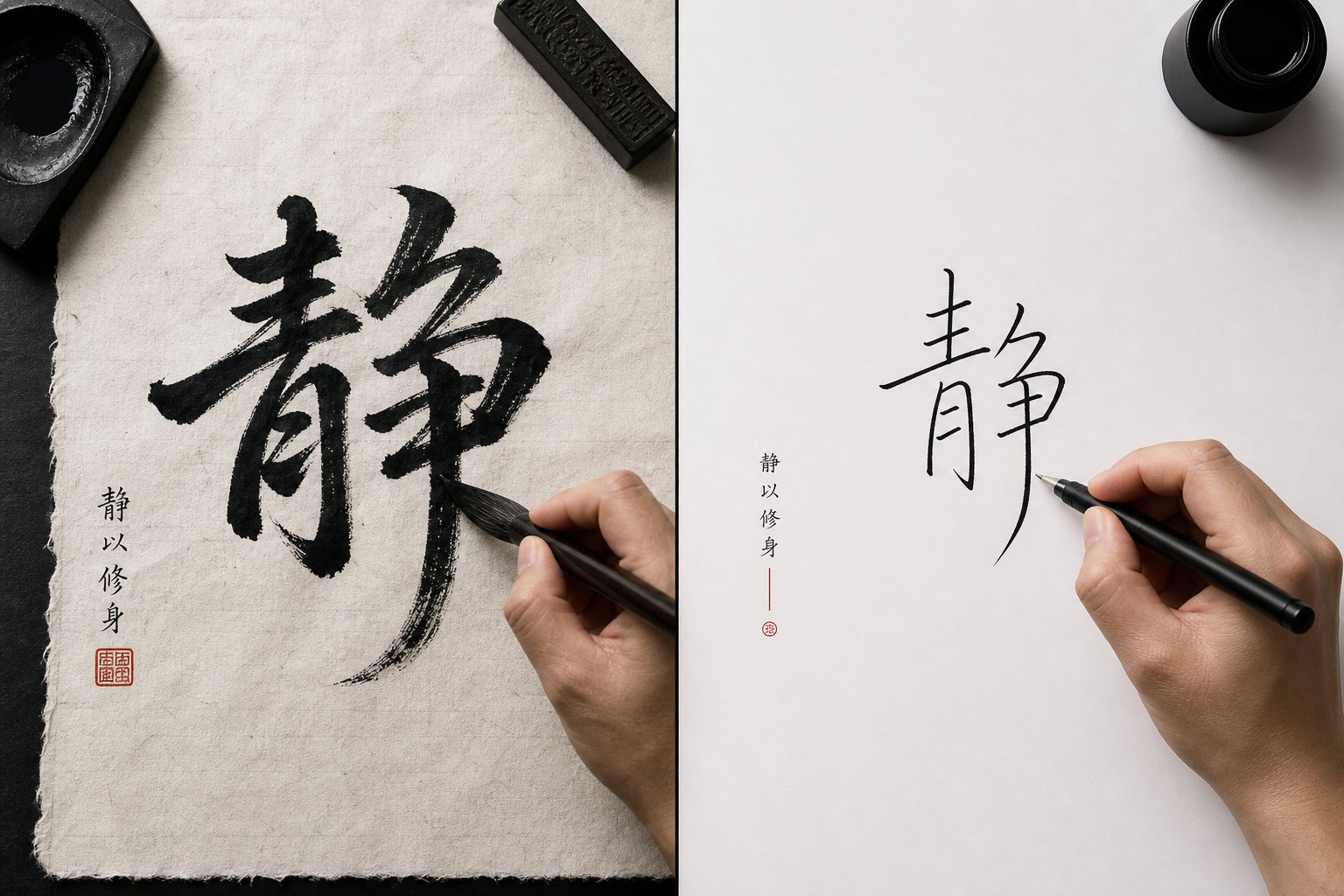
Character Simplification and Shifts in Naming Taste
The simplification campaigns of the 1950s and 1960s did not just reduce stroke counts. They rewired the aesthetic logic that had guided chinese name meaning for centuries. Characters that once conveyed elegance through visual complexity suddenly looked different on paper — some gaining a clean, modern appeal, others losing the very structural richness that made them desirable for names in the first place.
Characters Lost and Gained Through Simplification
When the government promulgated the Scheme for Simplifying Chinese Characters in 1956, the reforms touched thousands of characters. But the impact on naming was uneven. Some characters emerged from simplification looking sharper and more balanced. Others lost components that carried deep cultural resonance.
Take 华 (huá), meaning "splendid" or "China" — one of the most popular chinese names and meanings combinations for given names. Its traditional form 華 featured an intricate floral structure suggesting blossoming. The simplified version replaced that complexity with a phonetic element (化) topped by a cross. Type designers have noted that while the simplification made writing faster, it stripped the character of its visual connection to flowers and flourishing — the very imagery that made it appealing for names.
Conversely, some characters gained popularity after simplification. The character 龙 (lóng, "dragon") dropped from 16 strokes to just 5, making it far more practical for everyday writing. Parents who might have hesitated at the complexity of 龍 found 龙 accessible and visually punchy — a common chinese name element that simplification made easier to use without sacrificing symbolic power.
How Reduced Stroke Counts Shifted Aesthetic Preferences
Traditional chinese name interpretation often considered visual balance: how characters in a full name looked together when written in columns or on red paper. A name combining a simple surname with an elaborate given-name character created pleasing contrast. Simplification disrupted this calculus by compressing many characters into fewer strokes, narrowing the range of visual weight available to parents.
The table below compares traditional and simplified forms of characters frequently chosen for names, showing how the reform altered their visual profile:
| Traditional | Simplified | Pinyin | Meaning | Stroke Change | Naming Impact |
|---|---|---|---|---|---|
| 華 | 华 | huá | Splendid, China | 14 → 6 | Remained popular but lost floral visual resonance |
| 龍 | 龙 | lóng | Dragon | 16 → 5 | Gained accessibility; usage in names increased |
| 麗 | 丽 | lì | Beautiful | 19 → 7 | Became one of the most popular chinese names for girls |
| 葉 | 叶 | yè | Leaf (also surname) | 15 → 5 | Simplified form merged with unrelated character 叶 (xié) |
| 鬆 | 松 | sōng | Loose / Pine tree | 18 → 8 | Merged two meanings into one form; surname ambiguity |
| 後 | 后 | hòu | Behind / Empress | 9 → 6 | Two distinct surnames collapsed into one character |
Notice how 丽 (lì, "beautiful") became far more practical after dropping from 19 strokes to 7. Its streamlined form made it one of the most frequently chosen characters for girls' names in the decades following reform — a shift driven as much by writing convenience as by meaning.
The Merging Problem and Name Ambiguity
The most consequential effect on chinese name meanings came from character mergers. Simplification sometimes collapsed two or more distinct traditional characters into a single simplified form. When those characters served as surnames, the results were particularly sensitive.
The merger of 後 (behind) and 后 (empress) into the single character 后 meant that two historically unrelated family names became visually identical. As one scholar observed, in communities where marrying someone of the same surname was considered taboo, such mergers raised uncomfortable questions about whether two previously distinct lineages were now "the same family."
Similarly, the character 发 now writes both fā 發 ("to emit, to develop") and fǎ 髮 ("hair"). A person whose name contains 发 in simplified text requires context — or the original traditional form — for accurate chinese name definition. Without that context, the meaning chinese names carry becomes genuinely ambiguous.
Here is where simplification and pinyin compounded each other's limitations. Characters like 後 and 后 were already homophones in Mandarin — both pronounced hòu. Pinyin already could not distinguish them. When simplification merged their written forms too, both the phonetic and visual channels of disambiguation collapsed simultaneously. A name written "Hou" in pinyin and 后 in simplified characters offers no clue whether the bearer descends from the "empress" lineage or the "behind" lineage. The information simply vanishes.
This double erasure — phonetic through pinyin, visual through simplification — created a new kind of naming pressure. Families who valued clarity began gravitating toward characters that survived simplification without merging, characters whose chinese name interpretation remained unambiguous in both written and romanized form. That pressure toward distinctiveness would soon intersect with yet another force: the sheer scale of homophony that pinyin exposes when tone marks disappear.
The Homophony Challenge in Pinyin Name Representation
The scale of that homophony is staggering. The entire Mandarin sound system contains roughly 400 distinct syllables — or about 1,300 if you count tonal variations. Yet the standard character set used in modern Chinese contains tens of thousands of entries. The math is unforgiving: thousands of distinct characters must share a limited pool of sounds. For naming, this means a single pinyin syllable can point to dozens of completely unrelated characters, each carrying a different identity.
One Syllable, Dozens of Characters
Consider the syllable "wei." Without tone marks, it maps to characters meaning "great" (伟), "protect" (卫), "not yet" (未), "stomach" (胃), "fear" (畏), "position" (位), "taste" (味), and many more. A CSH research visualization illustrates this compression vividly: thousands of distinct Chinese characters collapse into just 375 unique pinyin syllables when tone marks are removed. Two people with entirely different names — different characters, different meanings, different family histories — can end up with identical romanized spellings.
The artist Ai Weiwei offers a clear example. His given name uses the character 未 (wèi, "not yet") twice. But someone encountering "Weiwei" in romanized form has no way to distinguish it from names using 伟伟, 薇薇, or 威威 — each carrying vastly different connotations. Chinese pronunciation alone, with correct tones, would narrow the options. Stripped of tones on paper, the ambiguity becomes total.
Which pinyin syllables create the most naming collisions? Here are some of the most overloaded syllables commonly found in given names, ranked by approximate number of distinct character mappings:
- yì — over 80 possible characters (义, 意, 艺, 忆, 翼, 益, 毅, etc.)
- jīng/jìng — over 60 possible characters (静, 晶, 京, 精, 景, 敬, 镜, etc.)
- wéi/wèi — over 50 possible characters (伟, 卫, 维, 薇, 威, 未, etc.)
- yú/yǔ — over 40 possible characters (宇, 雨, 玉, 瑜, 羽, 裕, etc.)
- xīn/xìn — over 35 possible characters (心, 新, 欣, 鑫, 信, 馨, etc.)
Each of these syllables appears in millions of registered names across Chinese-speaking populations. When flattened into toneless yin pinyin on an international document, the individuality of each name — what the CSH researcher Liuhuaying Yang calls the "leaf" on a shared "tree" — disappears entirely.
Tone Marks as Disambiguation Tools
The tones of chinese language do provide a partial solution. Mandarin uses four tones plus a neutral tone, and these tonal distinctions split each base syllable into multiple phonetic slots. The syllable "ma," for instance, separates into mā (mother), má (hemp), mǎ (horse), and mà (scold). Knowing the tone immediately narrows the field of candidate characters.
For names, this matters enormously. The á pronunciation of a syllable versus its fourth-tone counterpart can mean the difference between "elegant" and "inferior." Parents selecting characters are acutely aware of tonal aesthetics — how the rise and fall of tones across a full name creates a melodic contour. A name with all falling tones feels heavy; mixing tones produces rhythm and flow.
Yet here is the problem: tone marks vanish the moment a name leaves Chinese-language contexts. Passports issued by the People's Republic of China print names in toneless pinyin. International databases, airline systems, and university records strip diacritics by default. The zhou pronunciation "Zhōu" (周, a surname) and "Zhòu" (咒, a curse) become identical "Zhou" — a flattening that erases precisely the phonological information needed to narrow character candidates. Anyone wondering how to pronounce yuan, for example, needs to know whether it carries the second tone (元, "origin") or the fourth tone (愿, "wish") — but international systems rarely preserve that distinction.
Creative Naming Through Deliberate Homophony
Not all homophony is a problem. Some parents treat it as a feature. Chinese naming culture has a long tradition of selecting characters that sound like auspicious words, embedding hidden blessings that only those who know the chosen character can fully appreciate.
A child named 瑜 (yú, "fine jade") carries a surface meaning of preciousness. But the sound "yu" also echoes 余 (surplus, abundance) and 鱼 (fish, a symbol of prosperity). The parent who chose 瑜 may have intended all three resonances to hover around the name — a deliberate layering of meaning through shared chinese tones and syllables.
This creative exploitation of homophony works because Chinese culture treats sound symbolism seriously. Numbers, words, and names are evaluated for phonetic echoes: the number 8 is lucky because "bā" sounds like 发 (fā, "to prosper"). Names operate on the same principle. A character chosen for its written meaning simultaneously broadcasts phonetic associations to every listener — associations that shift depending on dialect, context, and the listener's own vocabulary.
The result is a naming system where homophony functions as both a bug and a feature. It erases distinction in international contexts while enabling creative depth in domestic ones. Parents who understand this duality can select characters that work on multiple levels: visually meaningful when written, tonally pleasing when spoken, and phonetically resonant with auspicious homophones.
This deliberate play with sound and symbol happens at the moment of naming — a deeply personal, analog decision. But increasingly, that decision is mediated by a digital interface. When parents type a pinyin syllable into a phone or computer to find their chosen character, the technology itself begins shaping which characters surface first, which feel accessible, and which fade into obscurity.
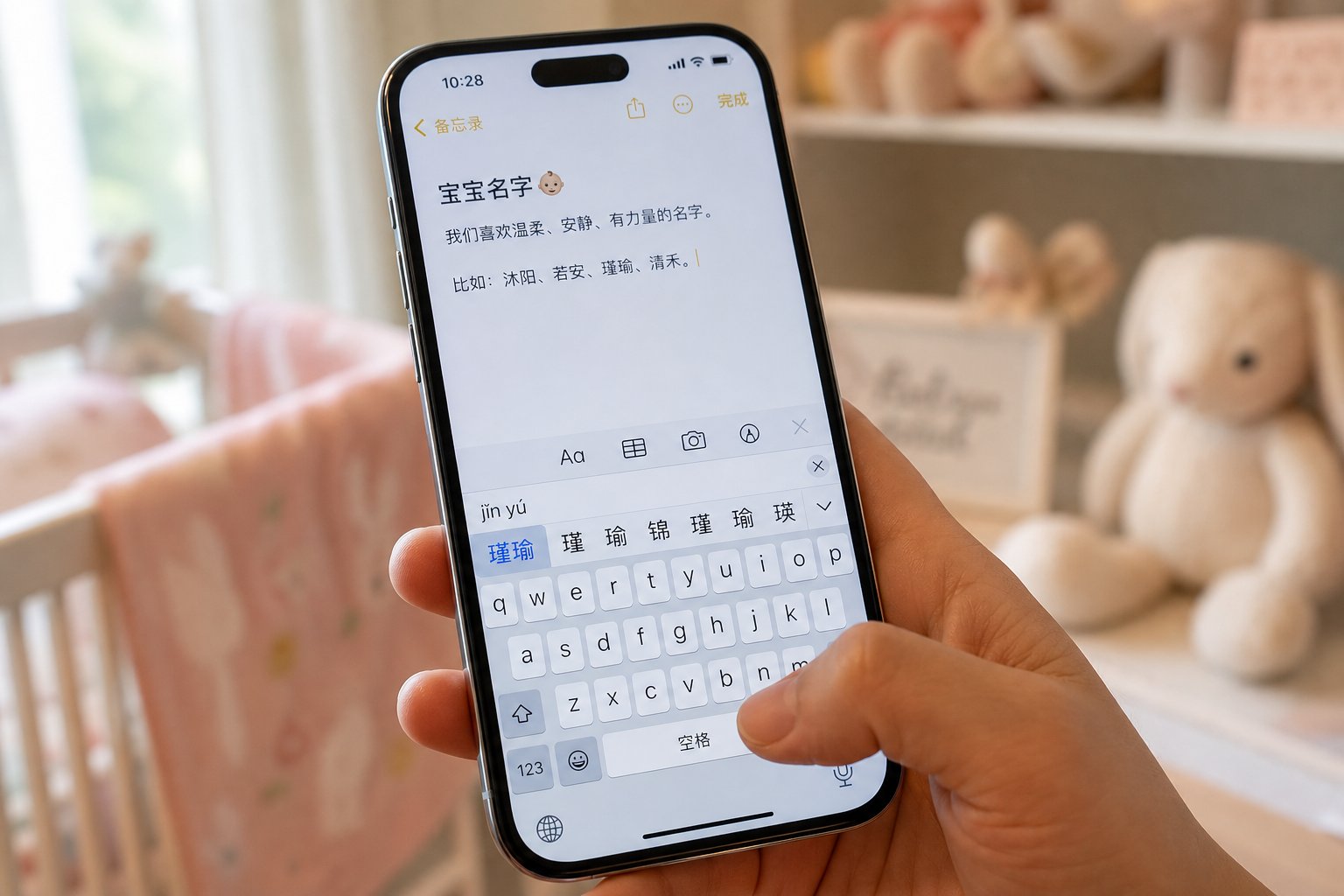
Digital Input Technology as a New Naming Pressure
That digital interface is not neutral. Every time a parent types a pinyin syllable into a phone or computer to find a name character, the software makes decisions about what appears first, second, and twentieth on the candidate list. Those ranking decisions, repeated billions of times daily across Chinese-speaking populations, have quietly become one of the most powerful forces shaping which characters end up in children's names.
How Pinyin Input Methods Rank Character Candidates
The basic mechanics of a pinyin input method are straightforward. You type a syllable — say, "zi" — and the software presents a ranked list of characters matching that pronunciation. But the ranking is not random. Modern input methods use frequency data, contextual prediction, and user history to decide which characters appear at the top of the list.
When you use a mandarin keyboard on any major platform, the system draws on massive language corpora to determine which characters are most commonly associated with a given pinyin string. Characters that appear frequently in everyday text — common words, popular phrases — float to the top. Rare or archaic characters sink to positions that require scrolling, sometimes across multiple pages of candidates.
This chinese typing method works brilliantly for general communication. But for naming, it introduces a subtle bias. A parent searching for an unusual character with deep literary resonance may need to scroll past dozens of common alternatives before finding it. The software essentially asks: are you sure you don't want one of these more popular options instead?
Most modern implementations also adjust rankings based on prior usage statistics and user dictionaries. If you have never typed a particular rare character before, the system has no signal to prioritize it. The first encounter with a desired name character can feel like searching for a specific book in an unsorted warehouse — you know it exists, but the system is not helping you find it.
Digital Frequency Bias and Emerging Name Trends
The consequences show up in naming statistics. Characters that rank high in default input method dictionaries appear disproportionately in names registered over the past two decades. When someone asks "what is my chinese name" and uses a chinese name converter tool to explore options, the characters surfaced first are inevitably the most common ones — creating a self-reinforcing cycle where popular characters become even more popular because they are easier to find and type.
This feedback loop operates through several distinct channels:
- Frequency bias toward common characters: Default candidate rankings favor high-frequency characters, making them the path of least resistance during name selection. Parents who are undecided may settle on a top-ranked option simply because it appeared first.
- Exposure to rare characters through expanded dictionaries: Conversely, some input methods now include extended character sets that surface unusual options parents might never have encountered in print. A parent typing "xuan" might discover 璇 (fine jade) or 萱 (daylily) alongside the more common 选 (to choose).
- Predictive text surfacing unexpected combinations: Word prediction features suggest multi-character phrases based on partial input. When a parent types the first character of a name, the system may propose second characters based on common pairings — effectively recommending name combinations that already exist in its training data.
- Platform-specific ranking differences: Sogou Pinyin, Microsoft Pinyin, and Apple's built-in input method each use different corpora and algorithms. The same pinyin string can produce different top candidates across platforms, meaning the device a parent happens to use can influence which characters feel most accessible.
The result is a technological layer that joins the older constraints — political ideology, simplification mandates, phonological standardization — as a shaping force on character choice. Anyone trying to name convert to chinese characters now navigates not just meaning, sound, and visual balance, but also the algorithmic preferences of their input software.
This pressure is particularly visible in the clustering of popular names. When millions of parents type the same fashionable pinyin syllable and select from the same frequency-ranked list, convergence is inevitable. China's Ministry of Public Security has reported waves of naming trends — periods where specific characters dominate new birth registrations — that correlate with their prominence in default input method rankings.
The irony is sharp. Pinyin input was designed to make the full breadth of Chinese characters accessible through a simple phonetic interface. In practice, it has created a new bottleneck where algorithmic ranking mediates between parental intention and final character selection. The technology that was supposed to democratize access to all characters has, in some ways, narrowed the field — making the most common options feel like the most natural ones.
Yet this constraint operates entirely within domestic Chinese-language contexts. The moment a name leaves that environment — printed on a passport, entered into a foreign database, spoken across a border — an entirely different set of technological and bureaucratic limitations takes over, stripping away not just algorithmic nuance but the characters themselves.
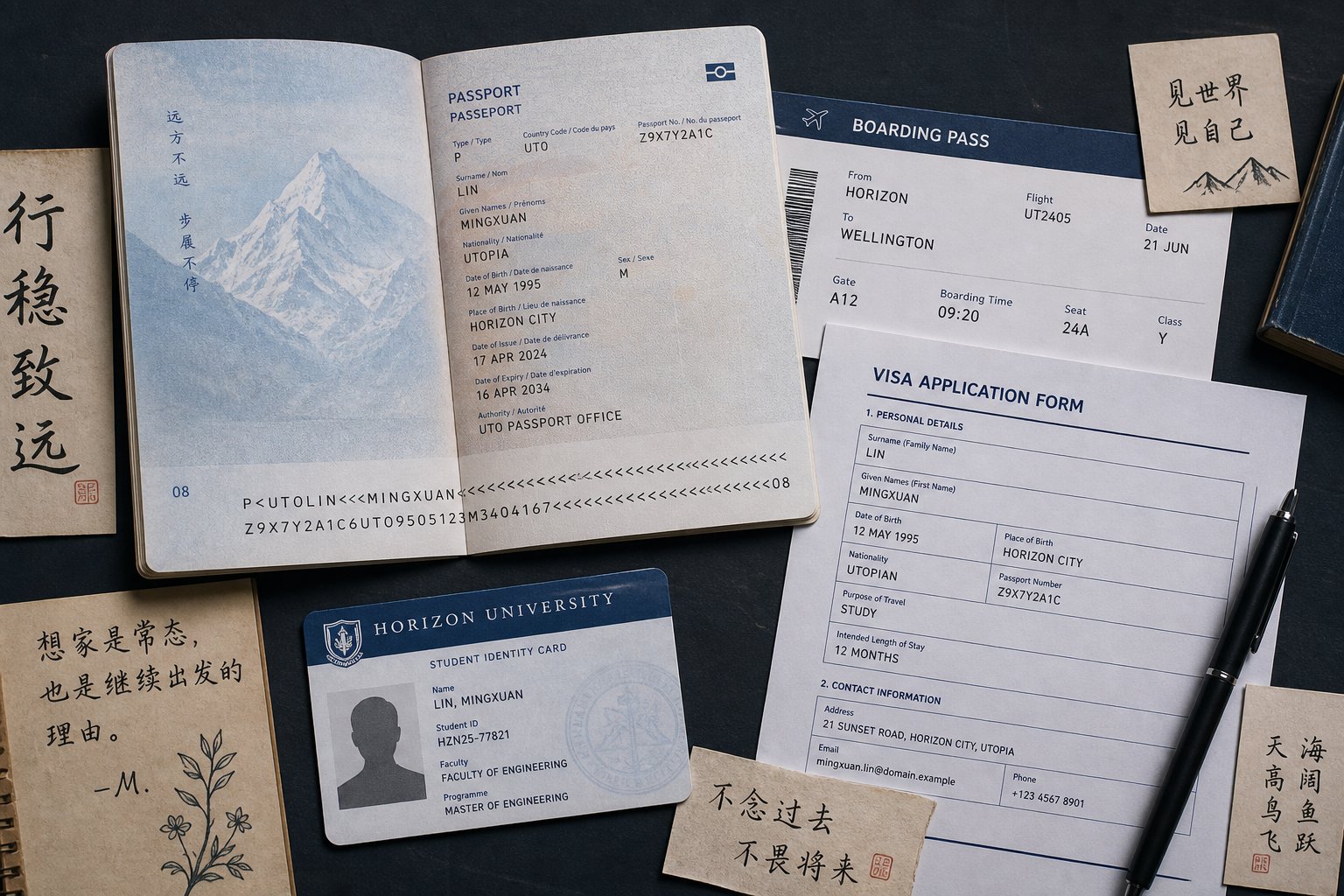
Pinyin Names Across Borders and Systems
A name that functions beautifully in Chinese — tonally balanced, visually elegant, rich with layered meaning — can become nearly unrecognizable the moment it enters an international system. Passports flatten it. Databases truncate it. Immigration forms force it into fields designed for Western naming conventions. And each of these constraints strips away another layer of the information that made the original character selection meaningful.
Passport Standards and Tone Mark Removal
Chinese passports issued by the People's Republic of China print the bearer's name in toneless pinyin using only the 26 basic Latin letters. No diacritics. No tone numbers. No indication of which character lies behind each syllable. The standard follows ICAO (International Civil Aviation Organization) guidelines, which restrict machine-readable zones to unaccented ASCII characters.
What does this mean in practice? A person whose name is 张伟 (Zhāng Wěi) appears on their passport as "ZHANG WEI" — identical to someone named 张威 (Zhāng Wēi), 张薇 (Zhāng Wēi), or 张维 (Zhāng Wéi). The chinese transliteration process erases precisely the tonal and character-level distinctions that differentiate these individuals. Research from University College London on Chinese name representation in data systems found that removing tonal information from romanized names significantly reduces the uniqueness of name representations, degrading the identifying information available for distinguishing between individuals.
This is not a minor edge case. Zhang Wei is one of the most common name combinations in China — shared by hundreds of thousands of people. When their passports all read "ZHANG WEI," the pinyin to english conversion has effectively collapsed an enormous number of distinct identities into a single string.
Database Limitations and Name Flattening
The problem extends far beyond passports. University enrollment systems, hospital records, banking databases, airline reservation platforms — most were built with Indo-European languages in mind, using ASCII or basic Latin character sets. Even Unicode-capable systems often store names in romanized form for indexing and search purposes, discarding the original characters entirely.
The UCL research team demonstrated this concretely: in a dataset of 771 Hong Kong student names, all individuals had unique Chinese full names. But when those names were converted to non-tonal romanization, uniqueness dropped — different people became indistinguishable in the system. The study found that standardized tonal romanization (Jyutping and Pinyin with tone numbers) achieved over 95% recall in data linkage blocking strategies, while non-standardized romanization without tones reached only 68.8%. That gap represents real people whose records get confused, merged, or lost.
The table below illustrates how a single toneless pinyin name can map to multiple character combinations, each representing a completely different person with a different family history:
| Pinyin (No Tones) | Possible Characters | Meaning | Tone Pattern |
|---|---|---|---|
| LI WEI | 李伟 | Plum + Great | lǐ wěi (3-3) |
| LI WEI | 李薇 | Plum + Fern | lǐ wēi (3-1) |
| LI WEI | 黎威 | Dawn + Might | lí wēi (2-1) |
| LI WEI | 力维 | Strength + Maintain | lì wéi (4-2) |
| LI WEI | 丽卫 | Beautiful + Defend | lì wèi (4-4) |
| WANG JING | 王静 | King + Quiet | wáng jìng (2-4) |
| WANG JING | 王晶 | King + Crystal | wáng jīng (2-1) |
| WANG JING | 汪京 | Vast + Capital | wāng jīng (1-1) |
| WANG JING | 王景 | King + Scenery | wáng jǐng (2-3) |
Every row in that table represents a distinct individual with a distinct identity — collapsed into the same database entry. For anyone attempting chinese name translation in an official context, this information loss is not theoretical. It creates real legal and administrative friction: mismatched records across countries, denied visa applications because names do not "match," and medical records attributed to the wrong patient.
How International Constraints Influence Domestic Character Choice
Here is where the feedback loop closes. Globally mobile families — those who anticipate their children studying abroad, working internationally, or holding multiple passports — increasingly factor romanization clarity into their character selection process. The awareness that a name will eventually be rendered as chinese names into english systems shapes which characters feel practical.
A parent might avoid characters whose pinyin spelling looks confusing to English speakers. The syllable "xu," for instance, baffles many non-Chinese readers who are unsure whether it rhymes with "shoe" or "zoo." Characters romanized as "qi" or "zhi" face similar pronunciation hurdles abroad. Some families gravitate toward characters whose pinyin forms happen to resemble familiar English sounds — names like "Ming," "Lin," or "Wei" that cross linguistic boundaries more smoothly.
The diaspora perspective sharpens this pressure further. Chinese communities abroad often navigate dual naming systems: a Chinese character name for family and cultural contexts, and an English name for professional and legal use. The relationship between these two names varies widely. Some people choose an english to chinese name pairing based on phonetic similarity — selecting characters that approximate the sound of an English name. Others maintain completely separate names with no phonetic connection.
The growing practice of seeking a chinese name from english name — or the reverse — reflects how deeply international systems have penetrated domestic naming logic. Parents who once chose characters purely for meaning and tonal beauty now weigh a third factor: how will this name survive the journey through international bureaucracy? Will it be mangled, confused with someone else's, or rendered unpronounceable?
This is not a hypothetical concern. A historical linkage of US Census data matched only 3.6% of male Chinese migrants between 1880 and 1900, compared to 16.3% of English migrants — a gap driven largely by inconsistent romanization of chinese names for english names databases. Modern systems have improved, but the fundamental architecture remains biased toward languages that map neatly onto Latin characters without information loss.
The concept of generating a chinese name from english or finding equivalent characters for a foreign name has become an entire cottage industry — from online name generators to professional naming consultants who help diaspora families bridge both worlds. These services exist precisely because the international system demands a romanized form while Chinese culture demands meaningful characters, and no automated conversion can fully satisfy both.
What emerges from this cross-border tension is a new evolutionary pressure on character selection — one that operates alongside the political, aesthetic, phonological, and digital pressures of earlier eras. The pinyin name character evolution story is not just about how characters changed over millennia or how romanization standardized sound. It is also about how global infrastructure, built on assumptions that do not accommodate tonal logographic systems, pushes back against the very diversity of characters that makes Chinese naming so rich.
Each era has imposed its own constraints on which characters parents choose. And when you line those eras up side by side — from oracle bone origins through simplification campaigns to passport databases — a clear pattern emerges: naming has always been an act of navigating limitations, with each generation facing a different set of walls.
The Ongoing Evolution of Sound and Symbol in Names
Each generation of Chinese parents has faced a different set of walls when choosing characters for their children. Political ideology dictated which meanings were acceptable. Simplification mandates altered which forms were available. Phonological standardization fixed how names sounded across dialects. Digital input ranked which characters appeared first. International systems determined how much information survived the journey abroad. Lined up chronologically, these constraints reveal a consistent pattern: chinese naming conventions have never been free from external pressure. They have only ever shifted from one set of limitations to another.
A Decade-by-Decade Timeline of Naming and Pinyin Milestones
The table below maps the major forces that shaped character selection and pinyin development across modern Chinese history. Each row captures a moment when the rules of naming shifted — sometimes gradually, sometimes overnight.
| Decade | Major Political/Cultural Event | Character Trend Shift | Pinyin Milestone |
|---|---|---|---|
| 1950s | Founding of the PRC (1949); Great Leap Forward (1958) | Patriotic characters dominate: 国 (guó, nation), 建 (jiàn, build), 强 (qiáng, strong). Names like 建国 and 卫国 reflect national pride. | Hanyu Pinyin officially adopted in 1958 as a literacy tool for primary education. |
| 1960s | Cultural Revolution (1966-1976) | Revolutionary characters surge: 红 (hóng, red), 兵 (bīng, soldier), 革 (gé, revolution). Some children named 文革 directly. | Pinyin use expands in schools but remains domestically focused; no international recognition yet. |
| 1970s | Late Cultural Revolution; Reform and Opening Up begins (1978) | Single-character given names rise sharply. Wealth-associated characters like 富 (fù, rich) appear. Name uniqueness begins increasing after 1970. | Pinyin gains traction as a standardization tool across dialect regions; early discussions of international adoption begin. |
| 1980s | Economic liberalization; One-Child Policy enforcement intensifies | Double-character names return. Western-influenced names emerge (苏珊/Susan). Repeated-character names (冰冰, 诗诗) gain popularity for girls. | ISO 7098 (1982) recognizes Hanyu Pinyin as the international romanization standard, replacing Wade-Giles in global contexts. |
| 1990s | Market economy expansion; early internet adoption | Mother's surname incorporated into children's names. Individualistic, creative combinations increase. Three-character given names rise. | Pinyin-based computer input methods become mainstream, making pinyin the primary interface for typing characters. |
| 2000s | WTO entry (2001); global mobility accelerates | Rare characters chosen to avoid duplication. Four-character names appear. Classical literary references return (浩然 from Mencius). | Mobile phone pinyin input becomes dominant; predictive text begins influencing character discovery and selection. |
| 2010s | Social media culture; pop culture naming influence | TV-inspired names spike (若曦 after Treading On Thin Ice, 2011). Nature-themed characters trend for girls (梓萱, 子轩). Aesthetic over ideology. | AI-powered input methods refine candidate ranking; cloud-based dictionaries expand accessible character sets. |
| 2020s | Global diaspora growth; AI tools proliferate | Parents balance domestic meaning with international legibility. Cross-cultural naming consultants grow. Unique names continue rising. | AI name generators use pinyin as input; global database constraints feed back into domestic character choice. |
Several patterns emerge from this timeline. The 1950s and 1960s show political ideology as the dominant constraint — typical chinese names from those decades read like slogans, their characters chosen to signal loyalty rather than personal aspiration. Research on naming trends confirms that actors born in the 1950s carry names like 宝国 (Bǎoguó, "protect the country") and 国强 (Guóqiáng, "country is strong"), while those born in the 1960s often bear characters drawn directly from revolutionary vocabulary.
The shift from the 1970s onward tells a different story. As political pressure eased, aesthetic and practical concerns filled the vacuum. The rise of single-character names in the late 1970s — documented in cross-temporal research on Chinese baby names — coincided with a cultural appetite for conciseness and modernity. Average name length decreased sharply between 1961 and 1990 as one-character given names climbed from roughly 10% to over 30% of new registrations. Then, after 1991, the trend reversed: three-character names surged while single-character names declined, pushing average length back up.
Naming Under Constraint Across Eras
What unites these decades is not any single force but the persistence of constraint itself. The specific walls change — ideology gives way to simplification mandates, which give way to digital algorithms, which give way to passport standards — but the act of naming always involves navigating limitations that the parents did not choose.
Consider how chinese last names interact with these pressures differently than given names. A chinese surname is inherited, not selected. Its character is fixed by lineage. But the meaning and associations of that surname shift as the cultural landscape changes. Understanding chinese last name meanings — why 王 (Wáng) connotes "king" or 林 (Lín) evokes "forest" — requires tracing the same character evolution that shapes given-name selection. The difference is that parents cannot optimize a surname for modern aesthetics or international legibility. They can only work with or around it.
Chinese surnames meaning and origin also interact with pinyin in distinctive ways. The most common chinese last names — Wang, Li, Zhang, Liu, Chen — are so frequent that their pinyin forms have become almost meaningless as identifiers in international databases. When millions of people share both a surname character and its romanized spelling, the given name bears the entire burden of distinction. This is why given-name character selection has grown increasingly creative over the decades, with parents reaching for rarer characters, longer combinations, and more individualistic choices to compensate for surname-level homogeneity.
The trajectory of common chinese names across these decades also reflects a broader cultural shift from collectivism toward individualism. Research tracking name uniqueness in China found that unique names increased significantly after the 1970s, correlating with economic liberalization and growing contact with the outside world. Chinese first names in the 2020s bear almost no resemblance to those of the 1950s — not just in character choice but in the underlying philosophy of what a name should do. Where earlier generations wanted names that signaled belonging to a collective project, contemporary parents want names that distinguish their child as an individual.
Pinyin sits at the center of this evolution — not as the primary driver, but as a persistent mediating layer that shapes how every other constraint is experienced. It standardized pronunciation, enabled digital input, facilitated international transmission, and introduced its own form of information loss at every step. The relationship between sound and symbol in Chinese names has never been static, and pinyin ensured it never could be again.
The story continues to unfold. AI-powered name generators now accept pinyin input and suggest character combinations optimized for meaning, tonal balance, stroke count, and even international pronounceability — compressing what once took weeks of deliberation into seconds of algorithmic output. Global mobility means more families than ever must consider how a name will function across multiple writing systems and bureaucratic frameworks simultaneously. And as Chinese-speaking communities grow worldwide, the pressure to reconcile character depth with romanized simplicity only intensifies.
What remains constant is the fundamental tension this article has traced from oracle bones to algorithms: Chinese characters carry meaning that sound alone cannot capture, and every system designed to represent those characters phonetically — from pinyin classrooms to passport printers to predictive keyboards — must decide what to preserve and what to sacrifice. For parents choosing a name, that tension is not abstract. It is the space in which identity is made.
Frequently Asked Questions About Pinyin Name Character Evolution
1. Why does the same pinyin spelling represent so many different Chinese name characters?
Mandarin has only about 400 distinct syllables (around 1,300 with tones), but tens of thousands of characters exist. This means dozens of unrelated characters share identical pronunciations. When tone marks are removed — as happens on passports and in international databases — the ambiguity multiplies further. For example, the toneless pinyin 'wei' maps to over 50 characters including 伟 (great), 卫 (protect), 薇 (fern), and 威 (might), each carrying completely different meanings and family histories.
2. How did character simplification in the 1950s change Chinese naming conventions?
The simplification campaigns reduced stroke counts for thousands of characters, altering the visual balance that traditionally guided name selection. Some characters like 龙 (dragon, reduced from 16 to 5 strokes) gained popularity because they became easier to write. Others lost cultural resonance when their complex visual structures were stripped away. Most problematically, some simplifications merged previously distinct characters into one form, creating surname ambiguity where two unrelated family lineages became visually identical.
3. How do pinyin input methods on phones and computers influence which characters parents choose for names?
Pinyin input methods rank character candidates by frequency when you type a syllable. High-frequency characters appear at the top of suggestion lists, making them the path of least resistance. This creates a feedback loop where already-popular name characters become even more popular because they are easier to find and select. Rare or literary characters may require scrolling through multiple pages, discouraging their use. Different platforms (Sogou, Microsoft, Apple) also rank candidates differently, meaning the device a parent uses can subtly shape their character choices.
4. What information is lost when Chinese names are written in pinyin on passports?
Passports follow ICAO standards that restrict names to the 26 basic Latin letters without diacritics. This removes tone marks, which distinguish different characters sharing the same base syllable, and eliminates the characters themselves, which carry distinct meanings. A name like 张伟 (Zhang Wei) becomes identical to 张威, 张薇, or 张维 on a passport — all printed as 'ZHANG WEI.' Research shows this flattening significantly reduces name uniqueness and creates real administrative problems including mismatched records, confused medical files, and denied visa applications.
5. How do globally mobile Chinese families factor pinyin into their naming decisions?
Families anticipating international mobility increasingly consider how a name will romanize when selecting characters. They may avoid characters whose pinyin spellings confuse English speakers (like 'xu' or 'qi'), favor characters that romanize into familiar-sounding strings (like 'Ming' or 'Lin'), or choose characters that remain unambiguous even without tone marks. Some families maintain dual naming systems — a Chinese character name for cultural contexts and a separate English name for professional use — while others seek characters that bridge both worlds phonetically.