Why Your Pinyin Name Format Shapes Your Academic Visibility
When you publish internationally, your name pinyin becomes your academic fingerprint. It is the romanized version of your Chinese name that appears on every journal article, conference paper, and database entry tied to your research career. The way you format it, whether you hyphenate, concatenate, or reorder the syllables, determines how citation databases recognize and link your work.
Sounds straightforward? In practice, it is anything but. Writing Chinese names in Latin script forces decisions that have no single universal standard. Should the surname come first or last? Should a two-character given name be written as one word or two? Each choice creates a distinct string in Scopus, Web of Science, and Google Scholar. And each distinct string can become a separate identity.
Why Pinyin Name Format Matters in Academic Publishing
Your pinyin name format for academic papers is not a cosmetic preference. It is a metadata decision. Citation databases rely on exact or near-exact string matching to attribute papers to the correct author. A researcher named Wang Xiaoming might appear as X. Wang, Xiaoming Wang, Xiao-Ming Wang, or X.M. Wang across different publications. To an algorithm, these can look like four different people.
The result is citation fragmentation: your h-index splits across phantom profiles, grant committees see an incomplete publication record, and collaborators struggle to find your full body of work. Research from Nature highlights how services that track researcher profiles can splinter online identities, making consistent formatting essential for discoverability.
The Cost of Inconsistent Name Formatting
A single researcher using two or three pinyin variations across their career can appear as multiple unrelated authors in citation databases, effectively splitting years of accumulated citations among ghost identities that no one claims.
This is not a hypothetical risk. Even in the Web of Science, minor variations in author initials or name formatting have caused entire citation histories to be misattributed to unrelated researchers. If a well-established scholar can lose hundreds of citations due to a small metadata mismatch, imagine the compounding effect for early-career researchers who have not yet settled on how to write their name in Chinese romanization for international journals.
This article bridges the gap between orthographic rules and the practical reality of filling out submission forms. You will learn exactly how to structure your name so that every paper you publish strengthens a single, unified academic identity rather than scattering citations across the database.
Understanding Chinese Name Structure in Pinyin
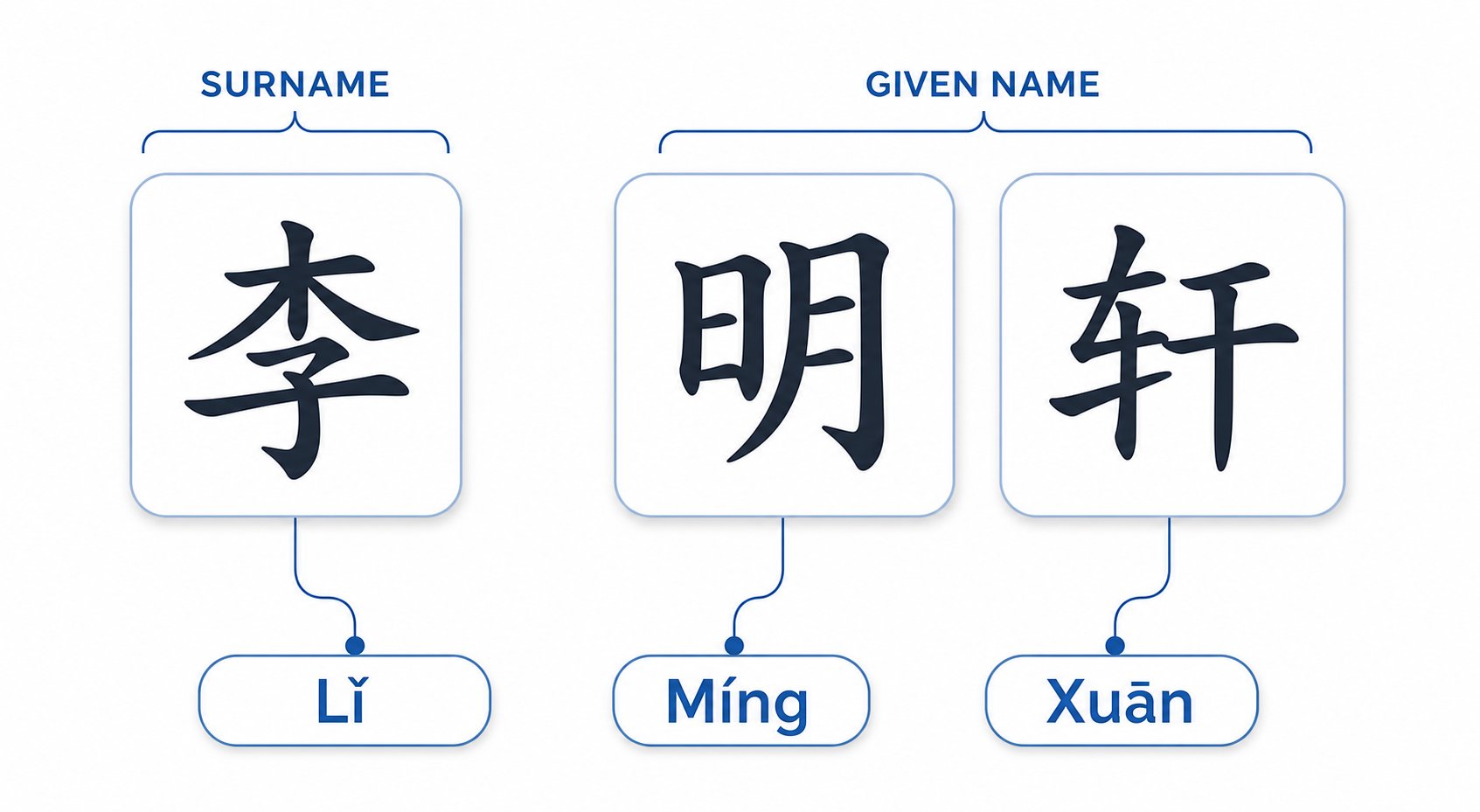
Before you can format your name correctly on a manuscript, you need to understand what you are actually translating. Chinese names follow a consistent internal logic that differs fundamentally from Western naming conventions. The chinese name structure places the family name first, followed by the given name, with no space separating them in written Chinese characters. When you romanize that structure into pinyin for an international journal, you are not just swapping characters for letters. You are segmenting a continuous string into parts that Western databases can parse.
How Chinese Names Are Structured
A Chinese name typically consists of two components: a surname (xing) and a given name (ming). Most surnames are monosyllabic, meaning they consist of a single character. Think of common family names like Wang, Li, Zhang, or Chen. A smaller set of surnames are disyllabic, composed of two characters, such as Ouyang or Sima. These compound surnames are less common but important to recognize because they create unique formatting challenges in submission systems.
Given names, on the other hand, are usually one or two characters long. A single-character given name produces one syllable in pinyin (e.g., Wei, Jing, Lei), while a two-character given name produces two syllables (e.g., Xiaoming, Guoqiang, Meiling). The chinese naming convention of combining a one-syllable surname with a two-syllable given name means most full names are exactly three syllables long. This predictable rhythm is what makes pinyin romanization workable, but it also creates the ambiguity that trips up citation databases.
In Chinese script, a name like 李小明 appears as three characters with no visual separation between surname and given name. Native readers instantly recognize 李 as the surname and 小明 as the given name based on cultural knowledge and context. Western academic systems have no such intuition. They need explicit segmentation: a clear boundary between family name and personal name.
From Characters to Pinyin Romanization
Pinyin romanization converts each Chinese character into a syllable spelled with Latin letters. The foundational orthographic authority on this process is Yin Binyong's Chinese Romanization: Pronunciation and Orthography (Sinolingua, 1990), which dedicates an entire section to personal names within its treatment of proper nouns. The standard it describes is straightforward: write the surname as one unit, write the given name as one unit, capitalize the first letter of each unit, and separate them with a space.
Imagine you are naming chinese characters for a journal byline. The character 王 becomes "Wang." The characters 国强 become "Guoqiang" when written as a single concatenated unit, following the orthographic rule that a two-character given name forms one word in pinyin. You end up with "Wang Guoqiang" as the full romanized form.
Here is how this works across different name types:
| Surname (Characters) | Surname (Pinyin) | Given Name (Characters) | Given Name (Pinyin) | Full Romanized Form |
|---|---|---|---|---|
| 李 | Li | 小明 | Xiaoming | Li Xiaoming |
| 王 | Wang | 国强 | Guoqiang | Wang Guoqiang |
| 欧阳 | Ouyang | 雪 | Xue | Ouyang Xue |
Notice the third example. Ouyang is a disyllabic surname written as one word with a single initial capital. The given name Xue is monosyllabic. Without understanding this structure, a database or editor might misread "Ouyang" as a given name and "Xue" as the surname, reversing the author's identity entirely.
This is the core tension in writing chinese names for academic systems: what appears seamless in characters must be explicitly broken apart in pinyin, and the way you break it apart dictates how every database, editor, and co-author will interpret your identity. The structural decision is settled by orthographic rules. The formatting decision, whether to place the surname first or last, hyphenate the given name, or use initials, is where real-world publishing complications begin.
Choosing Between Surname First and Given Name First
Of all the formatting decisions you face, name order is the one most likely to cause indexing errors. In Chinese, the surname always comes first. In most Western academic contexts, the given name leads and the family name follows. So when you submit a paper internationally, you are forced to choose: do you preserve the chinese names surname first convention, or do you invert the order to match what journals and databases expect?
Surname First or Given Name First
Most international journals in STEM, social sciences, and humanities default to given-name-first formatting. If your name is Li Xiaoming in Chinese, the journal byline would read "Xiaoming Li." The submission system treats the last word as your family name and uses it for alphabetical sorting, citation abbreviation, and database indexing. This is the format Scopus, Web of Science, and Google Scholar are built to parse.
Some journals, particularly those in Asian studies, Chinese linguistics, or area-specific humanities fields, accept or even prefer the surname-first order: "Li Xiaoming." This preserves the original chinese name first name last name sequence and avoids the cultural erasure of inverting a name purely for Western convenience. However, it introduces a parsing risk. If the system does not know that "Li" is the surname, it may file you under "Xiaoming" as the family name, creating a ghost entry that no one will ever search for.
The critical factor is how the submission form separates your name into fields. When a system asks for "First Name" and "Last Name" independently, you must place your given name in the first name field and your surname in the last name field, regardless of your cultural preference for ordering. The display order on the published paper may differ from how the metadata is stored. What matters for indexing is which string lands in which database field.
How Name Order Affects Citation Indexing
Citation databases do not read your name the way a human colleague would. They parse structured metadata. Google Scholar's indexing system, for example, relies on meta tags like citation_author to identify who wrote a paper. If your surname ends up in the given-name field because you entered it in the wrong box on a submission form, the automated parser will misattribute your work.
The practical consequences ripple across your entire career:
- Database discoverability: A colleague searching for your work by family name will not find papers indexed under your first name in chinese. Your publications become invisible to the people most likely to cite them.
- Co-author consistency: If your co-authors list you as "Li, X." on one paper and "Xiaoming, L." on another because of a field-entry error, those appear as two different researchers in every automated system.
- Cross-publication identity: Tenure committees and grant reviewers increasingly rely on database profiles to verify publication records. Split identities mean an incomplete picture of your output, one that you may not even realize is fragmented until it costs you.
Whichever order you choose, the single most important principle is consistency. Use the same order on every manuscript, every conference submission, and every institutional profile. A researcher who publishes five papers as "Xiaoming Li" and three as "Li Xiaoming" has just created two separate citation trails that may never be automatically reconciled. The format itself matters less than the discipline of applying it identically across every publication touchpoint.
Consistency in ordering, though, is only half the equation. The other half is how you handle the given name itself, whether you write it as a single block, split it with a space, or connect its syllables with a hyphen. Each approach triggers different behavior in database parsing engines.
Hyphenation, Spacing, and Concatenation for Given Names
You have settled on a name order. The surname goes in the right field. But what about the given name itself? If your given name has two syllables, say Xiaoming, you face a three-way choice that directly shapes how databases store and retrieve your work. Do you write it as Xiaoming, Xiao-Ming, or Xiao Ming? Each option produces a different string, and each string behaves differently inside the metadata systems that power citation tracking.
This is the single most debated question about how to spell name in chinese romanization for journals, and the answer depends on understanding what happens after you hit "submit."
Hyphenation vs Spacing vs Concatenation
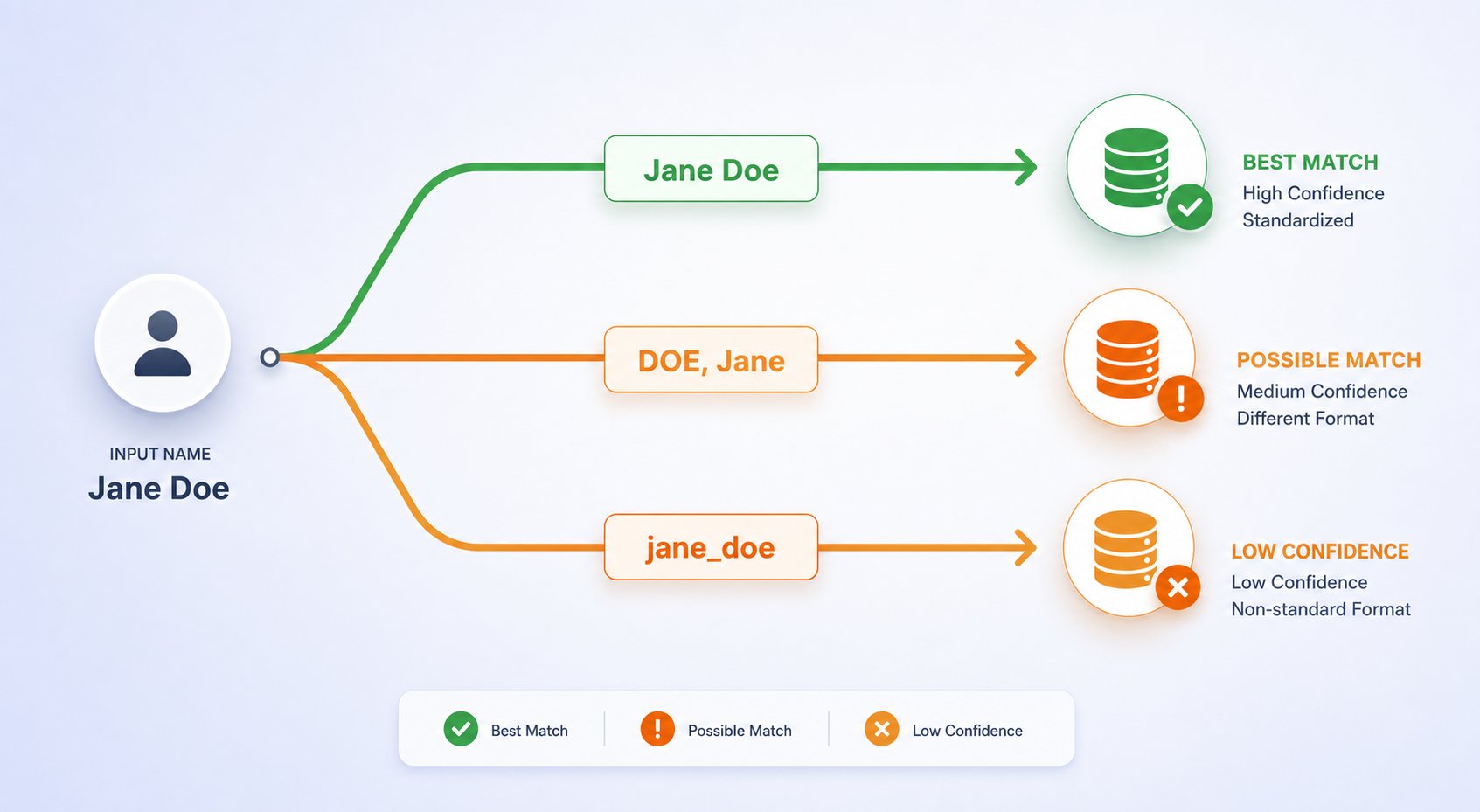
When you type your given name into a submission form, the system does not understand Chinese name structure. It applies Western parsing logic. That logic treats a space as a separator between distinct name units and often interprets anything between the first name and last name as a middle name. A hyphen may or may not be preserved depending on the journal's typesetting system. A single concatenated word, by contrast, stays intact as one unit no matter how the system processes it.
Consider a researcher named 李小明. Here is how each formatting choice plays out:
Spacing (Xiao Ming Li): The submission system sees three separate words. It may assign "Xiao" to the first-name field and "Ming" to the middle-name field. Your published byline might read "X. M. Li" in abbreviated form, which looks identical to dozens of other researchers. Worse, some databases will index you under "Xiao Li" and others under "X. M. Li," fragmenting your identity across multiple entries.
Hyphenation (Xiao-Ming Li): The hyphen signals that the two syllables belong together. Many systems will keep "Xiao-Ming" as a single first-name unit. However, not all databases handle hyphens consistently. Some strip them during indexing, converting your name to "Xiaoming." Others preserve them. The result is that your chinese name letters may appear differently across Scopus, Web of Science, and Google Scholar, even when you entered the same format every time.
Concatenation (Xiaoming Li): Writing the given name as one unbroken word eliminates ambiguity entirely. No system will split "Xiaoming" into two parts. It stays in the first-name field as a single string. This is also the approach recommended by GB/T 16159, the Chinese national standard for pinyin orthography, which specifies that a multi-syllable given name should be written as one word with only the initial letter capitalized.
The regional patterns behind these choices are worth noting. As Chuniversiteit documents, concatenation is the standard approach in mainland China (think Xi Jinping, Mao Zedong), hyphenation is particularly popular in Taiwan and regions historically connected to the Republic of China (Chiang Kai-shek, Lai Ching-te), and spacing tends to appear in Cantonese-speaking regions like Hong Kong. These are cultural conventions, not academic formatting rules, but they explain why researchers from different backgrounds instinctively reach for different formats.
Which Format Maximizes Database Searchability
When your goal is a single, unambiguous identity across every database that tracks your publications, the comparison breaks down clearly:
| Format | Example | Database Parsing Behavior | Searchability Impact | Common Journal Preference |
|---|---|---|---|---|
| Concatenation | Xiaoming Li | Given name stays as one unit in the first-name field | High: single consistent string across all databases | Most STEM journals, GB/T 16159 standard |
| Hyphenation | Xiao-Ming Li | Usually kept as one unit, but hyphen handling varies by system | Medium: some databases strip or alter hyphens during indexing | Some biomedical journals, common in Taiwanese academic circles |
| Spacing | Xiao Ming Li | Second syllable often parsed as middle name | Low: creates initials like X. M. Li, high ambiguity with other authors | Rarely preferred; sometimes seen in humanities |
The pattern is clear. Concatenation gives you the most predictable, stable result across systems. It avoids the middle-name trap, prevents hyphen-stripping inconsistencies, and produces a unique string that is easy to search. If a colleague types "Xiaoming Li" into any database, they get one result cluster instead of scattered fragments.
Does this mean hyphenation is wrong? Not necessarily. If you have already published multiple papers as Xiao-Ming Li and your citation record is established under that format, switching now would create exactly the kind of fragmentation you are trying to avoid. The best format is the one you can commit to permanently. But if you are early in your career and still deciding how to represent your chinese letters for names in academic contexts, concatenation offers the lowest friction path to a clean, unified database identity.
Choosing a format is one thing. Applying it correctly within the specific rules of APA, MLA, Chicago, or IEEE is another challenge entirely, because each citation style imposes its own conventions on how author names appear in reference lists.
Pinyin Name Formatting Across Major Citation Styles
You have picked your format and committed to consistency. But when your name appears in someone else's reference list, the citation style dictates how it looks. Each major style has its own rules for abbreviation, punctuation, and ordering, and those rules interact with pinyin in ways that can either preserve or obscure your identity. If you are citing a reference in chinese scholarship or being cited by a colleague abroad, understanding these differences protects your discoverability on both sides of the equation.
For non-Chinese researchers and editors, this is equally critical. Misformatting a pinyin name in a bibliography is not just a style error. It can sever the link between the citation and the author's database profile, costing them a counted citation.
APA and MLA Pinyin Name Requirements
APA 7th edition follows a strict pattern: family name, comma, then initials with periods. For a researcher named Wang Guoqiang, the reference entry reads "Wang, G." If the given name is hyphenated (Guo-Qiang), APA treats each part as a separate initial: "Wang, G.-Q." This is where concatenation pays off. A concatenated given name produces a single initial, reducing ambiguity against other authors sharing the same surname.
As the Hong Kong Baptist University Library research guide notes, APA requires transliteration of non-Latin scripts into pinyin romanization, with no tone marks necessary. The name in chinese script may optionally appear in brackets after the romanized version if it helps readers identify the source, though most English-language journals omit this.
MLA 9th edition takes a different approach. In the Works Cited list, the format is family name, comma, full given name: "Wang, Guoqiang." MLA preserves the complete given name rather than reducing it to initials, which actually benefits pinyin names by keeping the full string searchable. The Purdue OWL confirms that when a name already appears in surname-first order in the original source, you do not add a comma or reverse it again in MLA.
Chicago, Vancouver, and IEEE Formatting Rules
Chicago 17th edition offers two systems. In the notes-bibliography system, the bibliography entry mirrors MLA: "Li, Xiaoming." In author-date, the parenthetical citation reads "(Li 2024)." Chicago also permits including chinese name in chinese letters immediately following the romanized form in bibliographies when it helps readers identify the reference, a useful option for area-studies publications.
Vancouver style, standard in biomedical publishing, compresses the name further: family name followed by initials without periods or spaces. Wang Guoqiang becomes "Wang G." A hyphenated given name like Guo-Qiang becomes "Wang GQ." No periods, no hyphens in the final output. This extreme compression makes your initial format choice almost invisible in the published reference, but the underlying metadata still depends on what you entered in the submission system.
IEEE flips the order entirely for reference lists: initials precede the family name. The same researcher appears as "G. Wang." This format is common across engineering and computer science publications.
Here is how a single author's name transforms across all five styles:
| Citation Style | Format Pattern | Pinyin Example (Wang Guoqiang) | Notes |
|---|---|---|---|
| APA 7th | Family name, Initials. | Wang, G. | Periods after each initial; hyphenated names yield two initials (G.-Q.) |
| MLA 9th | Family name, Full given name. | Wang, Guoqiang. | Full given name preserved; no reversal comma if source already surname-first |
| Chicago 17th (Bibliography) | Family name, Full given name. | Li, Xiaoming. | May include characters in brackets after romanized name for clarity |
| Vancouver | Family name Initials | Wang G | No periods, no spaces between initials; hyphenated names become two-letter block (GQ) |
| IEEE | Initials. Family name | G. Wang | Initials precede surname; period after each initial |
If you are an editor or non-Chinese co-author handling a name in chinese script that you need to romanize for a bibliography, start by checking how the author formats their own name on their institutional page or ORCID profile. Use that exact form. Do not guess at which syllable is the surname or arbitrarily split a concatenated given name into initials. When in doubt, a quick search of the author's existing publications will show you the format they have established.
The citation style governs how your name appears in other people's bibliographies. But the format that feeds those bibliographies originates from one place: the submission form you filled out when you uploaded your manuscript.
How to Enter Your Pinyin Name on Journal Submissions
You know your preferred format. You understand how citation styles will abbreviate it. But the moment of truth arrives when you are staring at a journal's online submission portal with four or five blank fields asking for your name. What exactly do you type in each box? This is where theory meets the practical reality of systems built for Western naming conventions, and where a single wrong keystroke can undo all your careful planning.
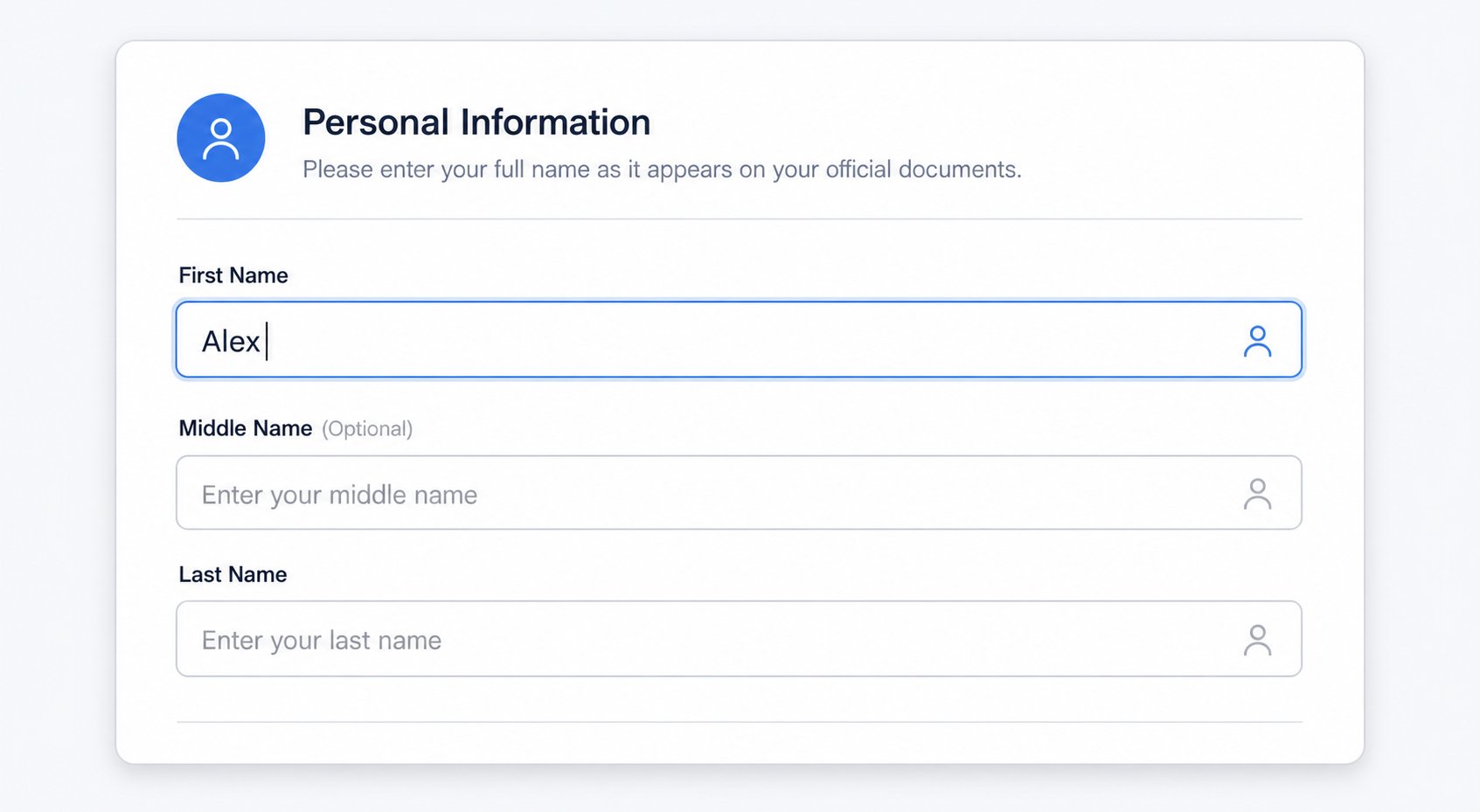
Most submission platforms, whether ScholarOne, Editorial Manager, or OJS, present the same basic structure: a first-name field, an optional middle-name field, and a last-name field. Some add a "preferred display name" or "publishing name" option. The challenge is mapping a Chinese name, which does not natively have a "middle" component, onto a form designed for names like "John Michael Smith."
Filling Out the Submission Form Correctly
Imagine your name is 欧阳国强 (Ouyang Guoqiang). You have a compound surname and a two-syllable given name. How do you distribute that across the form fields without creating a metadata error? Here is the step-by-step process:
- Last Name / Family Name field: Enter your full surname as one word. For monosyllabic surnames, this is simple: "Wang," "Li," "Chen." For compound surnames like Ouyang or Sima, type the entire surname as a single unit: "Ouyang." Do not split it across the last-name and middle-name fields. If the system rejects it because it expects a single syllable, contact the editorial office directly.
- First Name / Given Name field: Enter your full given name in your chosen format. If you use concatenation, type "Guoqiang." If you use hyphenation, type "Guo-Qiang." Do not place part of your given name here and part in the middle-name field. The entire given name belongs in this single box.
- Middle Name field: Leave this blank. Chinese names do not have middle names in the Western sense. Placing a syllable here will cause databases to generate initials like "G. Q. Ouyang" instead of "Guoqiang Ouyang," splitting your identity.
- Preferred Display Name / Publishing Name: If the system offers this field, use it to specify exactly how your name should appear on the published article. Type your full preferred format: "Guoqiang Ouyang" or "Ouyang Guoqiang," depending on your chosen order. This field often overrides the parsed first/last structure for the byline display.
- Communicate with the editor: If your name has any unusual element, a compound surname, a single-character given name that might be mistaken for an initial, or a preferred surname-first ordering, add a brief note in the cover letter. A single sentence is enough: "Please note that my family name is Ouyang (two syllables) and my given name is Guoqiang."
This process applies whether you are wondering how can I write my name in chinese romanization for a physics journal or how do I write my name in chinese pinyin for a linguistics submission. The mechanics of the form are the same. What changes is the ordering convention your discipline expects.
Discipline-Specific Name Format Guidance
Not every field treats pinyin names identically. The conventions split roughly along a STEM-versus-humanities line, with some important exceptions.
STEM journals (physics, chemistry, engineering, computer science, biomedical sciences) overwhelmingly expect given-name-first, surname-last ordering with a concatenated given name. If you are submitting to Nature, IEEE Transactions, or The Lancet, your byline should read "Guoqiang Ouyang." These journals feed directly into Scopus and Web of Science, where surname-last formatting aligns with how the indexing algorithms parse author metadata.
Humanities and social sciences journals in Asian studies (Journal of Asian Studies, Modern China, The China Quarterly) often accept or prefer surname-first ordering: "Ouyang Guoqiang." These publications serve readerships familiar with Chinese naming conventions and may even require it for consistency with how names appear in primary sources. If you publish in this space, check the journal's author guidelines for explicit instructions on name ordering.
Cross-disciplinary researchers face the hardest choice. If you publish in both computational linguistics and Chinese literary studies, you may encounter conflicting expectations. The safest approach is to pick one format and use it everywhere, then rely on the "preferred display name" field or a cover letter note to handle journals whose house style differs. Your database identity depends on the metadata fields, not the visual byline, so consistency in the structured fields matters more than how the name prints on the page.
One detail that trips up many researchers: how to write your name in mandarin romanization when the journal asks for "name as it appears on your passport" or "legal name." Passport pinyin formatting (all capitals, no spaces in given names, e.g., OUYANG GUOQIANG) is not the same as your academic publishing name. Use your publishing format in the author fields and reserve the passport format only if the journal explicitly requests it for administrative purposes.
Getting your own submission form right is half the battle. The other half emerges when you are on the receiving end, trying to correctly cite a colleague whose pinyin name you have encountered for the first time in a reference list.
How to Cite Other Authors' Pinyin Names in References
Formatting your own name is a challenge you solve once and apply forever. Citing someone else's pinyin name is a challenge you face every time you encounter an unfamiliar Chinese author in a source. Get it wrong, and you cost that researcher a citation, the same way inconsistency costs you. If you have ever stared at a byline like "Yifei Zhang" and wondered whether Yifei is the surname or the given name, you are not alone. Editors, co-authors, and researchers outside the Chinese-speaking world run into this ambiguity constantly.
Identifying Surname and Given Name in Pinyin
Chinese surnames are overwhelmingly monosyllabic. When you see a three-syllable pinyin name like "Chen Weiming," the single syllable at one end is almost always the family name. But what about "Ouyang Xiu" or "Sima Qian"? Compound surnames break the one-syllable rule, and without familiarity with names in chinese writing, you might split them incorrectly.
Context clues help. If the original publication lists the author as "Zhang, Y." in its reference section, the journal has already identified Zhang as the surname. If the source is a Chinese-language publication, the name chinese character order places the surname first by default. But when you are working from an English-language paper that lists "Yifei Zhang" on the byline, the Western given-name-first convention tells you Zhang is the family name.
The real difficulty arises with two-syllable strings. Is "Meiling" a concatenated given name, or could "Mei" be the surname and "Ling" the given name? Both are plausible. This is where verification becomes essential rather than guesswork.
Guidance for Editors and Non-Chinese Co-Authors
If you are an editor handling a reference list or a co-author compiling a shared bibliography, do not guess how do you write names in chinese romanization based on intuition alone. A wrong guess creates exactly the kind of metadata error that fragments citation records. The NIE Library's citation guide emphasizes that for Chinese names, you should not invert the order when the convention already places the surname first, a rule that APA style supports for names following non-Western formats.
When an author's name appears differently across their own publications, perhaps as "Wei-Lin Chen" in one paper and "Weilin Chen" in another, you face a judgment call. Do not average the two or pick whichever you saw first. Instead, follow a verification process:
- Check the original publication's author listing. The journal's metadata usually separates given name and family name in its citation export. Download the BibTeX or RIS file if available; the structured fields will show you which part is which.
- Look up the author's institutional profile. University faculty pages almost always display the name in the researcher's preferred format, often alongside the name in its original characters.
- Verify against ORCID. An ORCID profile lists the author's preferred publication name and any alternate name variants they have registered. This is the most authoritative source for how the researcher wants to be cited.
- Follow the format the author uses most consistently. If three out of four papers use "Weilin Chen" and one uses "Wei-Lin Chen," go with the majority. The author likely corrected their format over time, and the most frequent version reflects their settled preference.
This checklist takes less than two minutes and prevents a citation from landing in the wrong author cluster. It also signals professional respect. When you cite a colleague's name exactly as they have established it, you reinforce their unified academic identity rather than accidentally splintering it.
Handling other people's names correctly is a collaborative responsibility. But the mistakes that do the most cumulative damage are the ones researchers make with their own names, often without realizing the long-term consequences until years of citations have already scattered.
Common Pinyin Name Formatting Mistakes to Avoid
Most citation fragmentation is not caused by database glitches or editorial errors. It is caused by researchers themselves, making small, seemingly harmless formatting decisions that diverge from one paper to the next. Each inconsistency is minor in isolation. Over a decade-long career, they compound into a tangled web of phantom identities that no algorithm can automatically reconcile.
If you are still figuring out how to write name in chinese romanization for journals, learning from these common mistakes is faster than learning from your own scattered citation record five years from now.
Inconsistent Ordering Across Publications
This is the most damaging mistake because it creates the widest split in your database identity. A researcher who submits as "Xiaoming Li" to one journal and "Li Xiaoming" to another has just created two separate author entries in Scopus. Neither entry knows the other exists.
- Mistake: Alternating between surname-first and given-name-first ordering depending on the journal's geographic focus or your mood at submission time.
- Correct approach: Pick one order and use it on every manuscript, conference paper, and preprint. If a journal's house style requires a different display order, let the editor adjust the byline, but keep your metadata fields consistent.
Given Name Splitting and Initial Ambiguity
The second cluster of mistakes revolves around how you handle the given name itself. These errors are subtler but equally corrosive to your chinese name writing identity in databases.
- Mistake: Splitting a two-syllable given name across the first-name and middle-name fields, producing initials like "X. M. Li" instead of "X. Li." This makes you indistinguishable from every other researcher surnamed Li whose given name starts with X.
- Correct approach: Enter your entire given name as one unit in the first-name field. Leave the middle-name field empty. "Xiaoming" stays together, producing the unambiguous initial "X. Li" or, better yet, the full form "Xiaoming Li."
- Mistake: Switching between concatenation, hyphenation, and spacing across different publications. One paper lists you as "Xiao-Ming Li," the next as "Xiaoming Li," and a third as "Xiao Ming Li." Databases treat these as three different people.
- Correct approach: Commit to one format permanently. If you have already published under multiple variants, do not keep adding new ones. Settle on the format with the most existing citations and use it exclusively going forward.
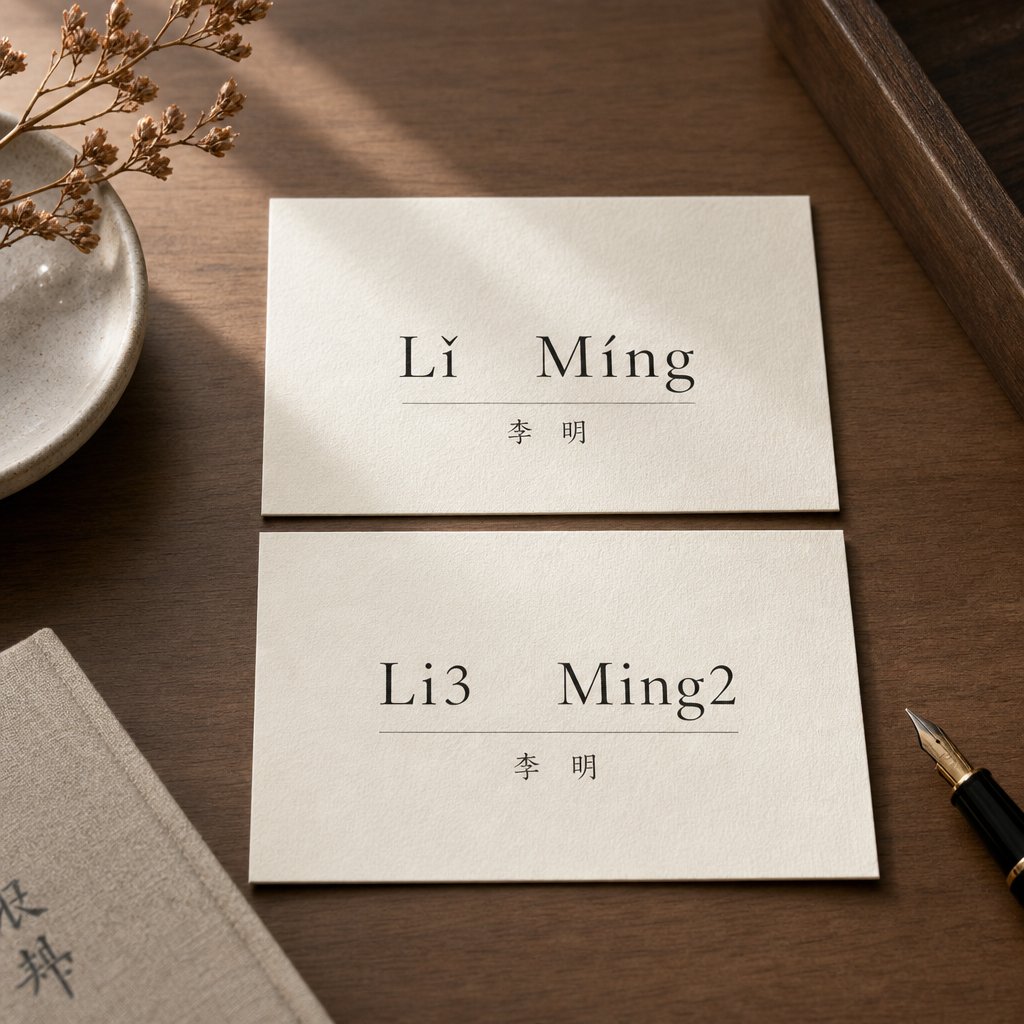
- Mistake: Including tone marks (diacritics) in some submissions but not others. While GB/T 16159 technically includes tone marks in standard pinyin, virtually no academic database or journal typesetting system handles them consistently. "Guóqiáng" and "Guoqiang" become two different strings in an index.
- Correct approach: Omit tone marks entirely in your academic publishing name. No major citation database uses them for author matching, and their inconsistent rendering across systems creates unnecessary variation.
- Mistake: Entering a different name format on the submission form than what appears in the published paper. This happens when a researcher types their passport-style name (all capitals, no spaces) into the system, then the journal reformats it for the byline without updating the underlying metadata.
- Correct approach: Always enter your name in your chosen academic format, with proper capitalization and your preferred concatenation or hyphenation style. After publication, verify that the published metadata matches what you submitted by checking the article's citation export file.
Every one of these mistakes shares a common thread: they introduce variation where databases need uniformity. A single inconsistency might cost you a handful of citations. Five inconsistencies across twenty papers can fracture your publication record into pieces that even manual correction struggles to reassemble. The earlier you standardize how to write name in chinese pinyin for your academic identity, the less cleanup you will face later.
Standardizing your format is the essential first step. Anchoring that format to a persistent digital identifier is what makes it permanent, ensuring that even if a database misparses your name on one paper, the system can still trace it back to you.
Linking Your Pinyin Name Format to ORCID and Digital Identity
A consistent pinyin format protects you at the submission level. But databases change, journals merge, and metadata gets reprocessed. What happens when an algorithm re-indexes your older papers and encounters a name variant you used years ago? Without a persistent anchor tying all those variants back to a single identity, you are relying on string matching alone, and string matching fails the moment anything deviates.
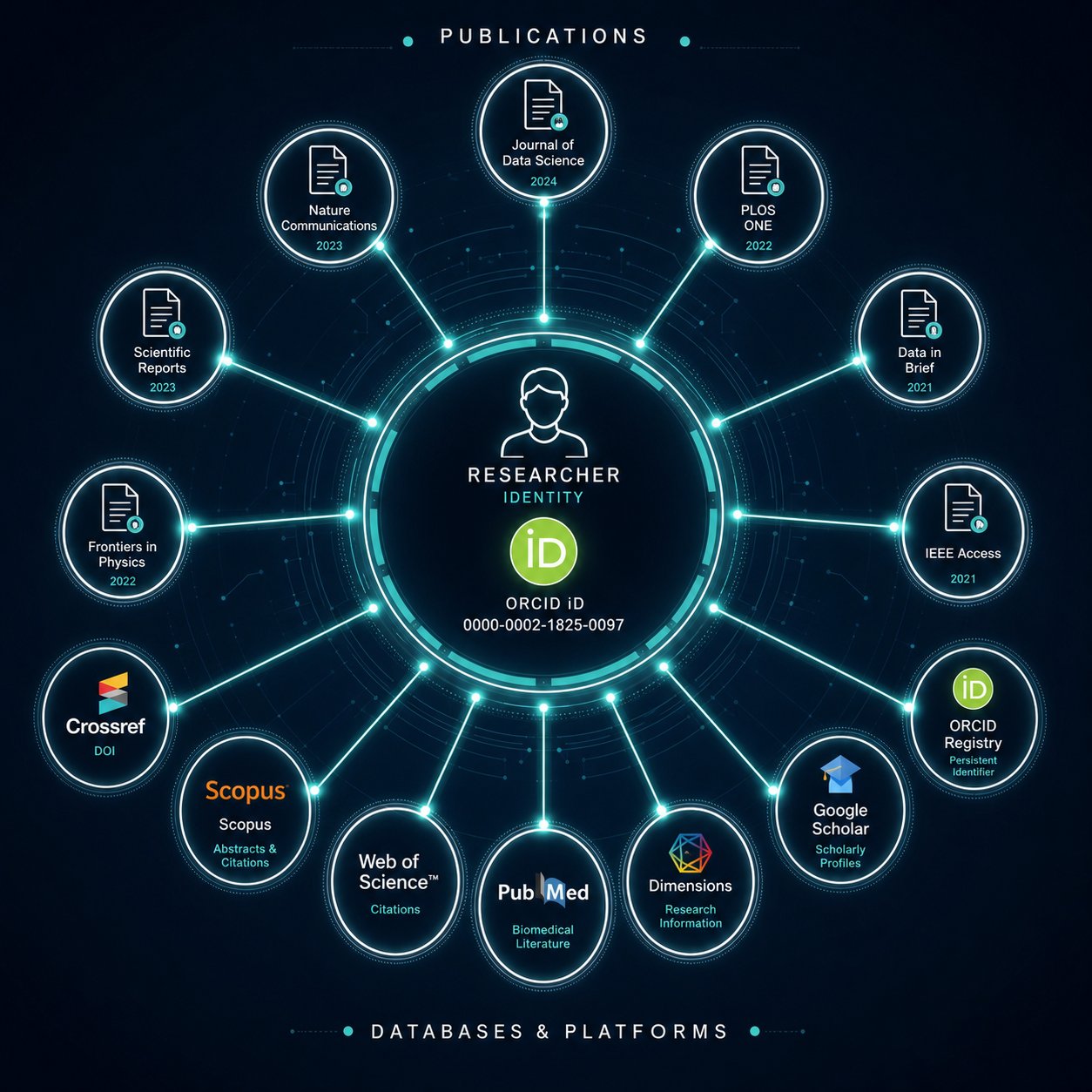
This is exactly the problem ORCID solves. Your ORCID iD is a 16-digit persistent identifier that functions as a permanent bridge between you and every paper you have ever published, regardless of how your name appears on each one. But the bridge only works if you configure it to reflect your chosen pinyin format and register the variants that already exist in the wild.
Setting Up Your ORCID Profile to Match Your Pinyin Format
ORCID's name system has three layers, each serving a different purpose. The ORCID name record includes a required given name field, an optional family name field, a published name field, and an "Also known as" section for alternate names. Think of it as writing my name in chinese romanization once, definitively, and then telling the system about every other version that has ever appeared on a paper.
Here is how to align your ORCID profile with your academic pinyin format:
- Set your Given Name and Family Name fields to match the exact format you use on journal submissions. If you publish as "Guoqiang Wang," enter "Guoqiang" in the given name field and "Wang" in the family name field. Do not use initials here. Do not add tone marks you would not use on a manuscript.
- Set your Published Name to the full display version you want associated with your work. This is how your name appears at the top of your ORCID record and what automated systems pull when linking publications. If you prefer "Guoqiang Wang," type exactly that. If your discipline uses surname-first ordering, enter "Wang Guoqiang" instead.
- Add all previous variants under "Also known as." If early papers list you as "Guo-Qiang Wang," "G.Q. Wang," or "G. Wang," add each one as a separate entry. ORCID uses these variants to help systems match older publications to your current identity. You can also add your name in its original Chinese characters here, which helps colleagues searching for how to write name in mandarin or looking up your work from Chinese-language databases.
- Include your ORCID iD on every future submission. Most journal submission systems now have an ORCID field. When you link your iD at submission time, the published metadata carries your persistent identifier alongside your name string. Even if a database misparses your pinyin, the ORCID iD provides a fallback path to your unified record.
Using Digital Identifiers to Prevent Citation Fragmentation
ORCID is the most widely adopted researcher identifier, but it is not the only one. Scopus Author ID, Web of Science ResearcherID, and Google Scholar profiles all maintain their own author-clustering systems. The key principle applies equally to all of them: your display name on each platform should mirror the pinyin format you use on publications.
When these systems encounter a new paper with your name, they check it against existing profiles. If your Scopus Author ID shows "Xiaoming Li" but a new paper lists "Xiao-Ming Li," the algorithm may hesitate to auto-assign it. An ORCID iD embedded in the paper's metadata resolves that hesitation instantly, telling the system that both strings belong to the same person.
This is also why how to write name in chinese language for academic purposes is not a one-time decision but an ongoing maintenance task. Periodically review your profiles across platforms. Confirm that your primary display name is consistent, that your variant names are registered, and that new publications are being correctly attributed. A five-minute check once or twice a year prevents the kind of silent fragmentation that only surfaces when you are assembling a tenure dossier or grant application.
Choose one consistent pinyin format, apply it to every publication and profile, and anchor it to a persistent digital identifier. That single discipline turns a lifetime of papers into one unified, discoverable academic identity.
Frequently Asked Questions About Pinyin Name Format for Academic Papers
1. Should I put my Chinese surname first or last on academic papers?
Most international STEM and social science journals expect given-name-first ordering (e.g., Xiaoming Li), while some Asian studies and humanities journals accept surname-first (e.g., Li Xiaoming). The key factor is not which order you choose but how you fill in the submission form fields. Always place your family name in the Last Name field and your given name in the First Name field, regardless of display preference. Consistency across all publications matters more than the order itself, because switching between formats creates separate author entries in Scopus and Web of Science that algorithms cannot automatically merge.
2. Is it better to hyphenate or concatenate a two-syllable Chinese given name in pinyin?
Concatenation (writing the given name as one word, e.g., Xiaoming) is generally the safest choice for database searchability. It prevents systems from splitting your given name into a first name and middle name, which happens with spacing (Xiao Ming). Hyphenation (Xiao-Ming) keeps syllables visually distinct but some databases strip hyphens during indexing, creating inconsistencies. The Chinese national standard GB/T 16159 recommends concatenation with only the first letter capitalized. However, if you have already built a citation record under a hyphenated format, switching now would cause more fragmentation than it solves.
3. How do I prevent citation fragmentation when my pinyin name has common initials?
Avoid placing part of your given name in the middle-name field on submission forms, as this generates ambiguous initials like X. M. Li that match many other researchers. Instead, enter your full concatenated given name in the first-name field and leave the middle-name field blank. Register an ORCID iD and include it on every submission so databases can link your papers even when initials overlap with other authors. Also add all previous name variants to your ORCID 'Also known as' section to help automated systems connect older publications to your current identity.
4. How should I format a Chinese author's pinyin name in an APA or MLA reference list?
In APA 7th edition, use the family name followed by a comma and initials with periods (e.g., Wang, G.). In MLA 9th edition, use the family name followed by the full given name (e.g., Wang, Guoqiang). To determine which part is the surname, check the author's ORCID profile, institutional page, or the citation export file from the original publication. Never guess based on syllable count alone, especially with compound surnames like Ouyang or Sima that break the typical monosyllabic pattern.
5. Should I include tone marks in my pinyin name on academic publications?
No. While tone marks are part of standard pinyin orthography, virtually no academic database or journal typesetting system handles them consistently. Including diacritics on some papers but not others creates two different strings in citation indexes, splitting your publication record. Omit tone marks entirely from your academic publishing name. No major citation database uses them for author matching, and their inconsistent rendering across platforms introduces unnecessary variation that works against your discoverability.