What Are Pinyin Name Homophones and Why Do They Matter
Imagine you meet three colleagues at a conference. Their name badges all read "Li Wei." Same spelling, same pronunciation, yet each person's name carries a completely different meaning in Chinese characters. One might be 李伟 (strong), another 黎薇 (rose), and the third 力维 (sustaining force). Welcome to the world of pinyin name homophones, where identical romanized spellings mask entirely different identities.
This is not a rare coincidence. Mandarin Chinese operates with roughly 400 distinct syllables in its pinyin system, yet those syllables must represent tens of thousands of characters. The math alone guarantees massive overlap, and nowhere is that overlap felt more acutely than in personal names.
What Makes Pinyin Name Homophones So Common
Pinyin name homophones occur when two or more Chinese names share identical romanized spellings despite being written with different characters and carrying different meanings. The root cause is structural. Mandarin's sound inventory is remarkably compact compared to languages like English, which uses over 15,000 possible syllables. When you funnel thousands of characters through just 400 or so syllable slots, collisions become inevitable.
Mandarin Chinese has approximately 400 unique pinyin syllables serving over 50,000 characters. In the context of personal names, this means dozens or even hundreds of distinct names can share a single romanized spelling.
This matters to anyone who reads, writes, or processes Chinese names in romanized form. HR professionals managing international teams, university admissions officers, passport control agents, and even friends trying to find the right person on social media all encounter this problem daily.
Mandarin Tones and Why They Disappear in Writing
A quick clarification for readers wondering: is Mandarin the same as Chinese? Not exactly. "Chinese" is an umbrella term covering a family of related languages, including Cantonese, Shanghainese, Hokkien, and others. Mandarin is one specific member of that family, but it serves as the official spoken language of mainland China, Taiwan, and Singapore. When people discuss pinyin, they are specifically talking about the romanization system for Mandarin pronunciation.
Mandarin uses four tones (plus a neutral tone) to distinguish meaning. The syllable "ma" can mean mother (first tone), hemp (second tone), horse (third tone), or scold (fourth tone). Tones help reduce ambiguity in speech. The problem? Standard pinyin as written on passports, business cards, and email addresses almost never includes tone marks. Strip away the tones, and those four versions of "ma" collapse into one identical spelling. Multiply that across every syllable in a name, and you'll see why Chinese homophones create so much confusion in international settings.
Whether you are choosing a Chinese name, working with Chinese colleagues, or simply curious about how romanization works, understanding this phenomenon gives you a practical edge. It helps you ask the right questions, avoid embarrassing mix-ups, and appreciate why a name that looks simple on paper might carry layers of meaning underneath.
The real complexity emerges when you look at how this limited syllable inventory interacts with the specific characters Chinese parents favor for names, creating predictable clusters of identical-sounding names that affect millions of people.
The Linguistic Mechanics Behind Pinyin Name Collisions
That compact syllable inventory does not exist by accident. It is a structural feature of Mandarin phonology, and understanding how it works reveals why pinyin name homophones are not just common but mathematically unavoidable.
Mandarin syllables follow a strict pattern: an optional initial consonant, a final vowel component, and a tone. The language uses 23 initials and 35 finals, but not every combination is valid. After filtering out impossible pairings, you end up with roughly 400 usable syllables. Compare that to English, which permits well over 10,000 distinct syllable shapes. The gap is enormous, and it creates what linguists sometimes call a phonological bottleneck.
The 400-Syllable Bottleneck in Chinese Names
When you need to spell Chinese words in English contexts using pinyin, you are compressing a writing system of tens of thousands of characters into those 400 slots. Consider the syllable "li." Even before tones enter the picture, this single spelling maps to characters like:
- 力 (strength)
- 丽 (beautiful)
- 莉 (jasmine)
- 立 (to stand)
- 利 (sharp, benefit)
- 黎 (dawn, a surname)
- 理 (reason, logic)
- 礼 (courtesy, ritual)
- 李 (plum, a surname)
Every one of these characters appears regularly in Chinese personal names. A parent choosing 丽 wants their child's name to evoke beauty. Another choosing 力 wants to convey strength. Yet on any romanized document, both names look identical: "Li."
This is not a flaw in pinyin itself. Pinyin was designed in the 1950s as a pronunciation guide, not a replacement for Chinese characters. Its purpose was to help people learn how to say words correctly, to standardize Mandarin pronunciation across China's many dialect regions, and to serve as a tool for typing. It was never intended to carry meaning on its own. The system employs 21 onsets and 39 rimes composed of 26 Latin letters, plus four lexical tones, to transcribe the sounds of all Chinese characters. But sounds and meanings are separate layers in Chinese, and pinyin only captures one of them.
When pinyin gets used as a standalone representation of names, as it does on passports, international IDs, and email addresses, it strips away the semantic layer entirely. You lose the character, the radical structure, and the visual meaning. What remains is a bare phonetic shell that dozens of different names happen to share.
How Tone Removal Multiplies Ambiguity
Tones do help narrow things down in spoken Mandarin. The syllable "li" splits into four tonal variants:
| Tone | Pinyin with Tone Mark | Example Characters in Names |
|---|---|---|
| 1st (high level) | li | 丽 (beautiful), 黎 (dawn) |
| 2nd (rising) | li | 离 (departure), 梨 (pear) |
| 3rd (dipping) | li | 李 (plum/surname), 理 (reason), 礼 (courtesy) |
| 4th (falling) | li | 力 (strength), 利 (benefit), 立 (stand), 莉 (jasmine) |
Four tones give you four buckets instead of one, which helps. But look at the fourth tone alone: 力, 利, 立, and 莉 are all "li" in the fourth tone, and all appear frequently in given names. Even with full tonal information, significant overlap remains. Research on Chinese phonological representations confirms that homophonic characters, including those sharing both syllable and tone, present persistent challenges for learners and native speakers alike when context is absent.
The real damage happens when tones disappear entirely. Standard romanization on official documents drops tone marks. International systems, from airline booking software to corporate HR databases, do not support diacritics. The result? All four tonal variants of "li" collapse into one string of letters. A name pool that was already crowded becomes impossibly dense.
Sounds complex? Think of it this way. Imagine English had only 400 possible first names, and every passport printed them without capitalization or spacing differences. You would constantly confuse people. That is essentially what happens when Mandarin names enter pinyin-only environments.
Is Mandarin and Chinese the same thing in this context? For naming purposes, the distinction matters. Pinyin applies specifically to Mandarin pronunciation. A person whose family speaks Cantonese might have a name that sounds completely different in their home dialect but gets flattened into the same pinyin spelling when processed through Mandarin-based romanization. This adds yet another layer of collision that goes beyond what the 400-syllable count alone would predict.
The bottleneck is not evenly distributed, either. Certain syllables cluster heavily in naming conventions, concentrating the homophone problem around a handful of popular sounds that millions of Chinese people share.
Most Common Pinyin Name Syllables and Their Many Meanings
That clustering is not random. Chinese parents draw from a relatively small pool of favored sounds when naming children, and those sounds happen to sit at the most congested intersections of the pinyin system. The result: millions of people end up with chinese names that sound the same in romanized form, even though the underlying characters are entirely different.
Which syllables carry the heaviest load? A handful dominate both surnames and given names, creating layers of overlap that compound on top of each other.
Top Pinyin Name Syllables and Their Character Variants
Certain pinyin syllables appear so frequently in personal names that they function almost like naming magnets. Parents gravitate toward them because the characters they represent carry desirable meanings: beauty, strength, wisdom, brightness, joy. The table below shows some of the most common chinese names same pronunciation patterns you will encounter.
| Pinyin Syllable | Tone Variants | Common Name Characters | Approximate Meaning |
|---|---|---|---|
| Wei | wéi, wěi, wèi | 伟, 薇, 维, 威, 卫 | Great, fern/rose, maintain, mighty, protect |
| Li | lí, lǐ, lì | 丽, 李, 莉, 力, 利, 黎, 礼 | Beautiful, plum, jasmine, strength, benefit, dawn, courtesy |
| Jing | jīng, jǐng, jìng | 静, 晶, 景, 京, 敬 | Quiet, crystal, scenery, capital, respect |
| Xin | xīn, xìn | 欣, 新, 鑫, 心, 信 | Happy, new, prosperous, heart, trust |
| Ming | míng, mìng | 明, 铭, 鸣, 茗, 命 | Bright, inscribe, cry out, tea, destiny |
| Hui | huì, huī | 慧, 辉, 惠, 晖, 荟 | Wisdom, splendor, kindness, sunshine, gathering |
| Yan | yán, yàn | 燕, 艳, 岩, 彦, 颜 | Swallow, gorgeous, rock, accomplished, face/color |
| Jie | jié, jiě, jiè | 杰, 洁, 捷, 婕 | Outstanding, pure, swift, graceful |
| Hua | huá, huà | 华, 花, 桦, 画 | Splendid/China, flower, birch, painting |
| Jun | jūn, jùn | 军, 俊, 君, 钧 | Army, handsome, noble, weight/measure |
Notice how a single syllable like "Wei" branches into at least five commonly used name characters across three tones. When tone marks disappear on documents, all five collapse into one spelling. Multiply that by the hundreds of millions of people whose names contain these syllables, and you begin to see the scale of the problem.
Why do these particular sounds dominate? Chinese naming culture prizes characters that express aspirations: brightness, beauty, strength, wisdom, nobility. The characters carrying those meanings happen to cluster around a small set of phonetic values. Parents are not choosing sounds; they are choosing meanings. But the meanings they want happen to rhyme with each other, so to speak. If you have ever searched what rhymes with chinese name syllables, you would find that the answer is: far too many other names.
Given Names vs Surnames in Homophone Frequency
The overlap starts before given names even enter the picture. China's surname pool is remarkably concentrated. Nearly 86% of the population shares just 100 surnames, with the top three alone, Wang, Li, and Zhang, covering over 270 million people. Wang (王) accounts for roughly 101.8 million bearers, Li (李) follows with about 101.3 million, and Zhang (张) adds another 95.7 million.
That concentration means the surname "Li" already creates a massive collision zone. Pair it with a popular given name syllable like "Wei" or "Jing," and you get combinations shared by tens of thousands of unrelated individuals. The name "Li Wei" is not just common; it is statistically inevitable in any large Chinese population.
Given names offer more variety in theory, since parents can combine characters freely. But in practice, naming trends create waves. Characters like 伟 (great), 明 (bright), 芳 (fragrant), 静 (quiet), and 华 (splendid) appear in given names across generations, concentrating millions of people around the same handful of sounds. A generation of children named with 欣 (xin, happy) or 浩 (hao, vast) produces another dense cluster of identical pinyin spellings.
The pattern is clear: a small set of surnames funnels people into shared family name slots, and popular given name characters push them into shared given name slots. The combination produces an extraordinary density of people whose full names look identical in romanized form, even though the characters tell completely different stories.
This concentration is not just a linguistic curiosity. It shapes real decisions, from how parents select characters with auspicious associations to how they actively avoid sounds that carry unfortunate meanings in Chinese culture.
How Chinese Parents Use Homophones to Choose Lucky Names
Chinese naming is never just about picking a pleasant sound. Parents treat the phonetic layer of a name as a carrier of fortune, deliberately choosing characters whose pronunciation echoes lucky chinese name meanings and steering clear of any syllable that might summon bad luck through sound alone. In a language where hundreds of characters share identical pronunciations, every name is surrounded by a cloud of sonic neighbors, and parents navigate that cloud with care.
Auspicious Sound Associations in Name Selection
The logic works like this: if a name character sounds like a word associated with prosperity, health, or happiness, that resemblance is considered a subtle blessing woven into the child's identity. The connection does not need to be exact. Even a partial phonetic overlap is enough to activate the association in a listener's mind.
Imagine naming a child with a character pronounced "fu." Regardless of which specific character you choose, every native speaker will hear an echo of 福 (fu, fortune/blessing). That sonic shadow follows the name everywhere, reinforcing positive connotations each time someone says it aloud. The chinese name sound meaning relationship is not metaphorical to many families. It is a practical consideration that ranks alongside stroke count, character aesthetics, and generational naming traditions.
Common auspicious sound associations that parents actively seek include:
- Characters sounding like 福 (fu) - fortune, blessing, happiness
- Characters sounding like 财 (cai) - wealth, material abundance
- Characters sounding like 吉 (ji) - luck, auspiciousness
- Characters sounding like 安 (an) - peace, safety, stability
- Characters sounding like 寿 (shou) - longevity, long life
- Characters sounding like 喜 (xi) - joy, celebration, double happiness
- Characters sounding like 发 (fa) - to prosper, to flourish (as in 发财, getting rich)
- Characters sounding like 余 (yu) - surplus, having more than enough
The number eight (八, ba) illustrates how deeply these sound associations run in Chinese culture. Its pronunciation closely resembles 发 (fa), short for 发财 (fa cai, to obtain wealth). This near-homophone connection is so powerful that license plates containing 8888 have sold for millions of dollars, and the Beijing Olympics opening ceremony began at 8:08 PM on 8/8/08. The same phonetic logic drives name selection: parents want their child's name to resonate with prosperity every time it is spoken.
Taboo Sounds That Parents Avoid
The flip side is equally important. Certain sounds carry negative associations so strong that parents will reject an otherwise beautiful character if its pronunciation lands too close to an unlucky word. This is not casual superstition for many families. It is a firm boundary.
Sounds that Chinese parents commonly avoid in names include:
- Characters sounding like 死 (si) - death, dying (the number four, 四 si, is avoided for the same reason)
- Characters sounding like 苦 (ku) - bitterness, hardship, suffering
- Characters sounding like 败 (bai) - failure, defeat, decline
- Characters sounding like 离 (li) - separation, departure, leaving
- Characters sounding like 散 (san) - to scatter, to break apart
- Characters sounding like 输 (shu) - to lose, to be defeated
- Characters sounding like 病 (bing) - illness, sickness
- Characters sounding like 穷 (qiong) - poverty, destitution
The avoidance of 死 (si, death) runs so deep that most Chinese buildings skip the fourth floor entirely, jumping from three to five. A name character pronounced "si" in any tone would trigger immediate concern, regardless of its actual meaning. Similarly, 书 (shu, book) shares its pronunciation with 输 (shu, to lose), which is why giving books as gifts can be considered unlucky in some contexts. Parents apply this same filtering to every syllable in a potential name.
The screening process is thorough. A character might have a lovely meaning on its own, but if combining it with the surname creates a phrase that sounds like something unfortunate, the name gets discarded. For example, a surname like Yang (杨) paired with a given name Wei (伟) sounds fine. But pair the surname Mei (梅) with a given name like Liangxin (良心, conscience), and you get "Mei Liangxin," which sounds like "没良心" (heartless). These full-name homophone traps require parents to think beyond individual characters.
Regional Dialect Considerations in Naming
Here is where the complexity deepens. Chinese and Mandarin are not the same thing in practice. Mandarin is the official standard language, but hundreds of millions of people also speak regional languages like Cantonese, Hokkien, Hakka, and Shanghainese at home. A name that sounds perfectly auspicious in Mandarin might create an embarrassing or inauspicious homophone in another dialect.
The character 王 offers a clear example. It is pronounced "Wang" in Mandarin, "Wong" in Cantonese, "Ong" in Hokkien, and "Heng" in Teochew. Each pronunciation sits in a different phonetic neighborhood, surrounded by different homophone associations. A given name character that pairs well with "Wang" might clash badly when read as "Wong" at a family gathering in Guangdong.
Families with roots in southern China often test a name across multiple dialect pronunciations before committing. A grandmother in Fujian might flag a name that sounds fine in Mandarin but resembles a vulgar word in Hokkien. A Cantonese-speaking uncle might catch an unfortunate rhyme that Mandarin speakers would never notice. This multi-dialect vetting process is an informal but widespread practice, especially in diaspora communities across Southeast Asia where the spelling of a surname signals ancestral regional origins.
The interplay between pinyin name homophones and dialect variation means that naming decisions are never purely about Mandarin pronunciation. They involve navigating overlapping sound systems, each with its own set of lucky and unlucky associations. A name is not truly safe until it has been tested against every language the family speaks.
All of this careful phonetic engineering happens before a name ever leaves the family home. The real trouble begins when that name enters official systems, where characters vanish, tones disappear, and the only thing left is a bare romanized string on a passport or ID card.
When Tones Disappear on Passports and Documents
That bare romanized string is not just an inconvenience. It is the starting point for a cascade of chinese name romanization problems that affect millions of people every time they cross a border, start a new job, or enroll in a university abroad. The moment a Chinese name enters a pinyin-only system, all the careful character selection, tonal distinction, and semantic richness collapses into a handful of letters that could belong to thousands of different people.
Passports and Travel Documents Without Tones
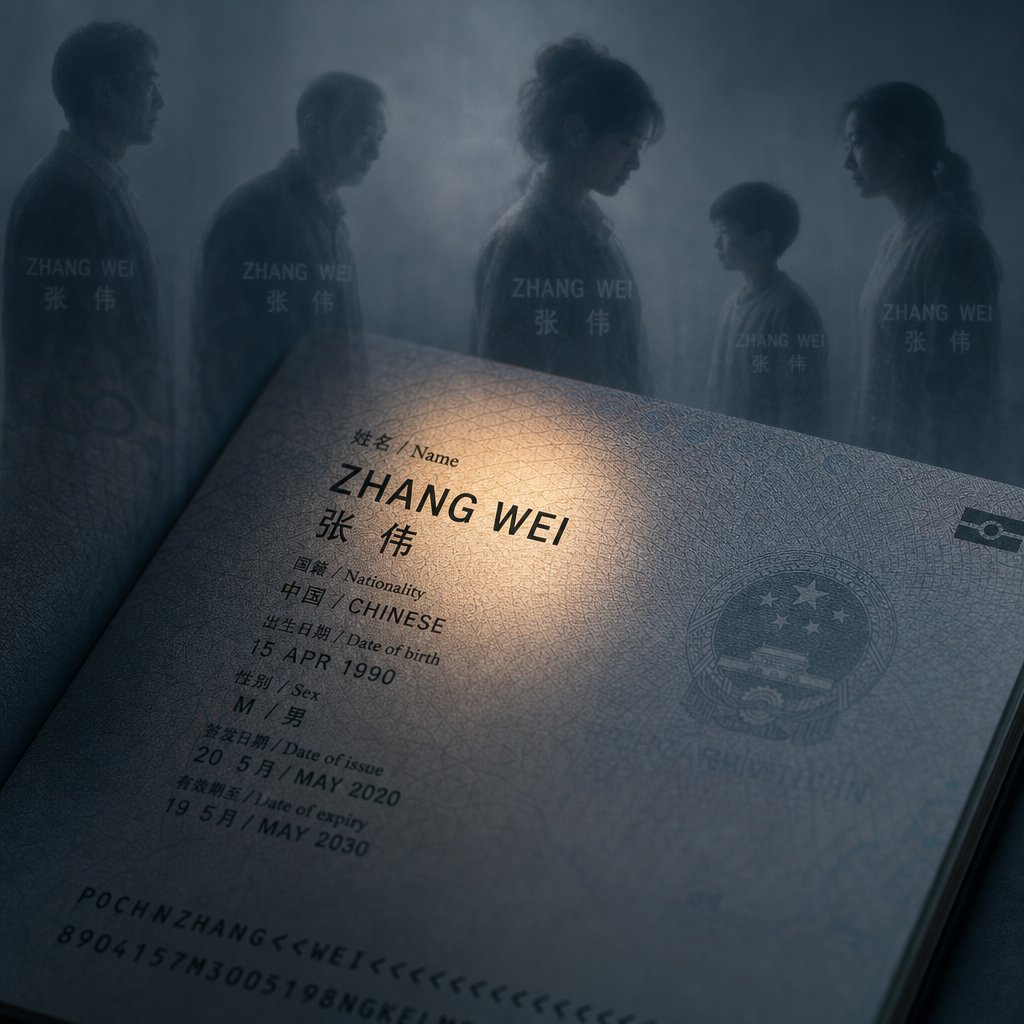
Chinese passports print names in pinyin without tone marks. This is not an oversight. China's official policy, established by the State Council in 1978, mandates that tone-marking diacritics are omitted from pinyin transliterations of personal names. International systems reinforce this: ICAO standards for machine-readable zones do not support diacritics, airline booking software strips them, and most databases worldwide treat names as plain ASCII text.
The consequences are immediate. Consider that roughly 108 million people share the surname Wang, 105 million share Li, and 98 million share Zhang. Pair any of those surnames with a popular given name syllable like Wei or Jing, and you get identical passport names for tens of thousands of unrelated individuals. A border agent scanning two passports that both read "Li Jing" has no way to distinguish 李静 (quiet plum) from 黎晶 (dawn crystal) without checking the Chinese character field, which many international systems cannot read.
Spelling inconsistencies add another layer. China's National Immigration Administration specifies that the character 吕 should appear as "LYU" on exit-entry documents, even though standard pinyin renders it as "Lu" with an umlaut. Holders of older documents may retain earlier spellings for consistency, meaning the same person might appear as "LU" in one system and "LYU" in another. When you are trying to figure out how to write a chinese name in english for official purposes, even the rules themselves create variation.
Flight bookings compound the problem. Airline systems typically allow only 26 unaccented Latin letters. A traveler whose name contains "u" (as in 女, nu) loses the umlaut entirely. Two passengers named "Lu Wei" might actually be 吕伟 and 陆维, completely different people whose tickets, frequent flyer accounts, and boarding passes look identical.
Corporate Email Systems and Name Disambiguation
Multinational companies with offices in China face this daily. When HR generates email addresses using the standard firstname.lastname format, collisions happen fast. A company with 500 employees in Shanghai might easily have three people whose romanized name produces "[email protected]." The second and third get bumped to wei.zhang2 or wei.zhang3, arbitrary numbers that carry no meaning and create confusion for anyone trying to reach the right person.
University registrars encounter the same issue. A large Chinese university might enroll dozens of students named "Wang Wei" in a single academic year. Transcript systems, library accounts, and dormitory assignments all depend on name-based identification, and when multiple students share identical romanized names, administrative errors follow. The wrong student receives a grade notification. A scholarship gets attributed to the wrong Wang Wei. Records merge accidentally.
Banking and financial compliance systems face perhaps the highest stakes. Name screening against sanctions lists and watchlists relies on matching romanized names, and simple romanization is too simplistic because names can be transliterated in many ways. A single pinyin string might match dozens of unrelated individuals on a customer database, generating false positives that require expensive manual review. Are Chinese and Mandarin the same when it comes to these systems? Not at all. A customer from Hong Kong might romanize their name using Cantonese pronunciation, while a mainland customer uses Mandarin pinyin, yet both could end up with identical Latin spellings through different phonetic paths.
Common workarounds have emerged, though none fully solve the problem:
- Adding a middle initial or second given-name syllable to create differentiation
- Appending birth years or employee ID numbers to email addresses
- Using alternate romanization spellings (Wade-Giles instead of pinyin)
- Including Chinese characters alongside pinyin in internal directories
- Adopting a Western given name as a prefix (e.g., "Tony Li Wei")
Each workaround introduces its own inconsistencies. A person who goes by "David Wang" at work might appear as "Wang Wei" on their passport and "Wei Wang" in an academic database. Is Mandarin and Chinese the same thing when processing these names? The answer matters because different romanization systems, dialect-based spellings, and personal preferences all feed into the same global databases, multiplying the confusion far beyond what the original 400-syllable bottleneck would suggest.
These identity collisions are not just bureaucratic headaches. They shape how Chinese professionals present themselves internationally, how they build digital identities, and how they navigate a world of systems designed for languages where spelling and identity align more neatly. That gap between system design and linguistic reality also opens the door to creative exploitation, from internet wordplay to deliberate ambiguity in online personas.
Cross-Cultural Confusion and Internet Name Wordplay
That creative exploitation plays out in two directions. In professional settings, pinyin name homophones generate genuine confusion when Chinese names enter English-speaking environments. Online, the same phonetic ambiguity becomes a playground for wordplay, coded communication, and identity construction. Both sides reveal how deeply sound-based collisions shape real interactions.
Business Card Confusion in International Settings
Picture a networking event at a multinational conference. You collect three business cards, and all three read "Jing Li." One person is a marketing director, another a software engineer, the third a finance analyst. Their names are 李静, 黎晶, and 李靖, three entirely different identities flattened into identical text. Which card belongs to whom? Without Chinese characters printed alongside the pinyin, you are guessing.
Western colleagues often compound the problem by mispronouncing names in ways that erase what little distinction remains. Someone unfamiliar with pinyin might pronounce "Xu" like the English word "zoo" instead of the correct Mandarin sound closer to "shoo." Two colleagues named Xu Wei and Zhu Wei, clearly different in speech, might get called the same thing by a manager who reads both as rhyming with "zoo." Are Mandarin and Chinese the same in terms of how these names get mangled abroad? The confusion runs even deeper when colleagues from Cantonese-speaking backgrounds romanize their names differently, yet end up sounding identical to untrained ears.
The social cost is real. People stop correcting mispronunciations after the fifth attempt. They adopt Western nicknames to sidestep the issue entirely. Some professionals report being addressed by a colleague's name for months because no one in the office could distinguish between two people whose email addresses differed only by a trailing number.
English Names That Accidentally Sound Like Chinese Words
The homophone confusion runs both ways. Certain English names, when heard through Mandarin phonetics, accidentally produce hilarious or unfortunate chinese word associations. Chinese language instructor Dr. Candise Lin has documented how common American names sound to Mandarin speakers, and the results highlight just how unpredictable cross-linguistic sound mapping can be.
Some english names that sound chinese in unexpected ways include:
- Robin (Luo ben) - sounds like "running naked"
- Nelson (Niao shen) - sounds like "God of Pee"
- Nicholas (Ni kou si le) - sounds like "you are so stingy"
- Isabella (Yi sheng bei la) - sounds like "the doctor got arrested"
- Logan (Nao geng) - sounds like "brain stroke"
- Tiffany (Ti fa ni) - sounds like "kick your ass"
- Robert (Luo bo) - sounds like "carrot"
- Nancy (Nan si) - sounds like "difficult to die"
- Martha (Ma hua) - sounds like "fried dough twist"
These transliterations are not exact. English and Mandarin have different sound inventories, so the Chinese "readings" are approximations. But they illustrate a key point: phonetic overlap between languages creates unintended meanings that neither speaker controls. A person named Gordon has no idea their name sounds like "dog balls" (Gou dan) to a Mandarin-speaking colleague who might be too polite to mention it.
The phenomenon works in reverse too. A Chinese person choosing the English name "Shannon" might not realize it sounds close to 傻男 (sha nan, foolish man) when heard by other Mandarin speakers. These accidental homophones rarely cause serious problems, but they add a layer of social awkwardness to cross-cultural introductions that both sides navigate daily.
Number Homophones as Online Nicknames
Move from the conference room to the internet, and pinyin ambiguity transforms from a source of confusion into a creative tool. Chinese netizens have built an entire communication system around chinese number homophones meaning, using digit sequences as names, handles, and coded messages. The logic is simple: numbers have fixed pronunciations in Mandarin, and those pronunciations often sound like common phrases.
The most widely recognized examples include:
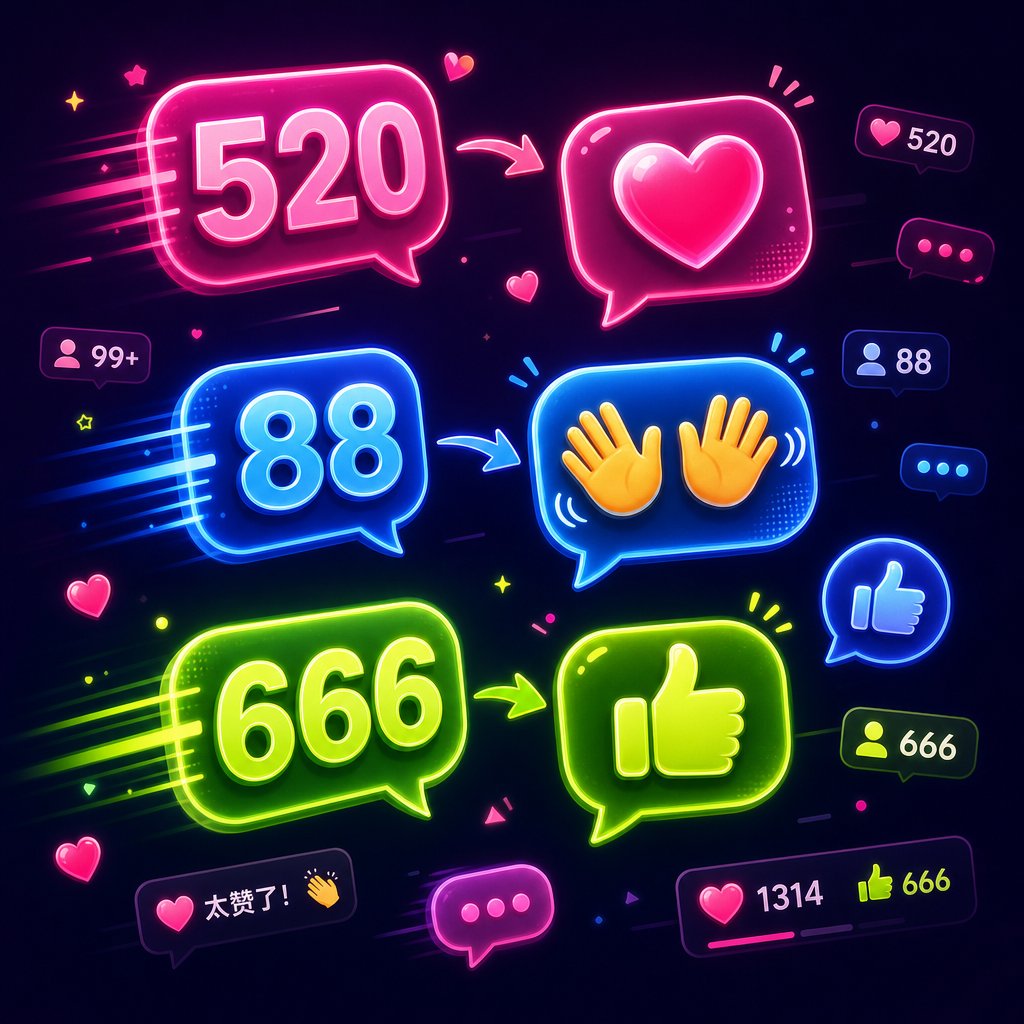
- 520 (wu er ling) - sounds like 我爱你 (wo ai ni), meaning "I love you"
- 1314 (yi san yi si) - sounds like 一生一世 (yi sheng yi shi), meaning "forever and always"
- 5201314 - combines both to mean "I love you forever"
- 88 (ba ba) - sounds like 拜拜 (bai bai), meaning "bye-bye"
- 233 (er san san) - represents laughter, similar to "LOL"
- 666 (liu liu liu) - means "awesome" or "smooth," praising someone's skill
- 555 (wu wu wu) - mimics the sound of crying
- 94 (jiu si) - sounds like 就是 (jiu shi), meaning "exactly"
- 748 (qi si ba) - sounds like 去死吧 (qu si ba), meaning "go to hell"
- 250 (er bai wu) - means "idiot," rooted in ancient currency units where being "250" meant half-witted
These number sequences function as names and identities online. A username like "520forever" or "1314xx" immediately signals romantic intent to any Chinese speaker. Couples celebrate May 20th (5/20) as an unofficial Valentine's Day because the date itself is a love declaration. Gaming handles built from 666 announce confidence. The numbers are not random; they are chinese internet slang homophones functioning as a parallel naming system.
The practice extends beyond romance and humor into more politically charged territory. China's Cyberspace Administration has launched campaigns specifically targeting homophone-based expressions online, recognizing that users exploit pinyin ambiguity to evade censorship filters. When a sensitive word gets blocked, users substitute a homophone, a number sequence, or a pinyin abbreviation that conveys the same meaning to human readers while slipping past automated detection. Abbreviations like "XSWL" (xiao si wo le, meaning "I died laughing") use pinyin initials instead of characters, creating yet another layer of coded identity.
The government's concern is telling. As former internet censor Liu Lipeng explained, authorities worry that if coded expressions evolve faster than censors can track them, "it may only be possible to use official narratives and official definitions." The crackdown targets homophones, pinyin abbreviations, and character distortions precisely because they exploit the same phonetic ambiguity that makes names so confusing in official systems.
For online identity, this means Chinese internet users routinely build pseudonyms from homophone logic. A handle might reference a celebrity's name through a sound-alike, comment on current events through a number code, or simply express a personality trait via phonetic pun. The line between a "name" and a "message" blurs completely when every sound carries multiple possible meanings.
This playful, subversive relationship with homophones is not new. It draws from centuries of literary tradition where authors embedded hidden meanings in character names, using the same phonetic overlap that confuses passport systems to create art, satire, and cultural commentary.
Famous Examples of Name Homophones in Culture and History
That literary tradition runs deep. For centuries, Chinese authors have treated character names as a second layer of storytelling, embedding thematic meaning through deliberate homophonic choices. Readers who catch the sonic double meanings unlock an entirely hidden narrative beneath the surface plot. Those who miss them still enjoy the story, but they lose a dimension the author carefully constructed.
Literary Wordplay With Homophonic Character Names
The most celebrated chinese homophone wordplay examples come from Dream of the Red Chamber, the 18th-century novel by Cao Xueqin widely considered one of China's four great classical novels. Cao built his entire narrative framework on homophonic names that telegraph the story's philosophical concerns from the very first chapter.
The novel's two central families carry surnames that function as a thesis statement. The Jia family (贾) shares its pronunciation with 假 (jia), meaning "fake" or "illusory." Their counterparts, the Zhen family (甄), sound identical to 真 (zhen), meaning "real" or "true." The entire novel explores the boundary between illusion and reality, and Cao encoded that theme directly into the family names. Every time a character says "the Jia household," a literate reader hears "the fake household."
In Dream of the Red Chamber, the surname Jia (贾) puns with "fake" (假) and Zhen (甄) puns with "real" (真), turning every mention of these families into a philosophical statement about illusion versus truth.
The dream of the red chamber name meanings extend far beyond the surnames. The four Jia sisters, Yuanchun, Yingchun, Tanchun, and Xichun, carry given names whose first characters combine to form "Yuan-Ying-Tan-Xi," a homophone for a phrase meaning "supposed to sigh." Their collective name foreshadows the family's tragic decline. The character Zhen Yinglian (甄英莲) has a name that sounds like "deserving of pity," which perfectly describes her fate as a kidnapped child sold into servitude. Qin Keqing (秦可卿) sounds like "look down upon love," while her brother Qin Zhong (秦钟) echoes "passion incarnate."
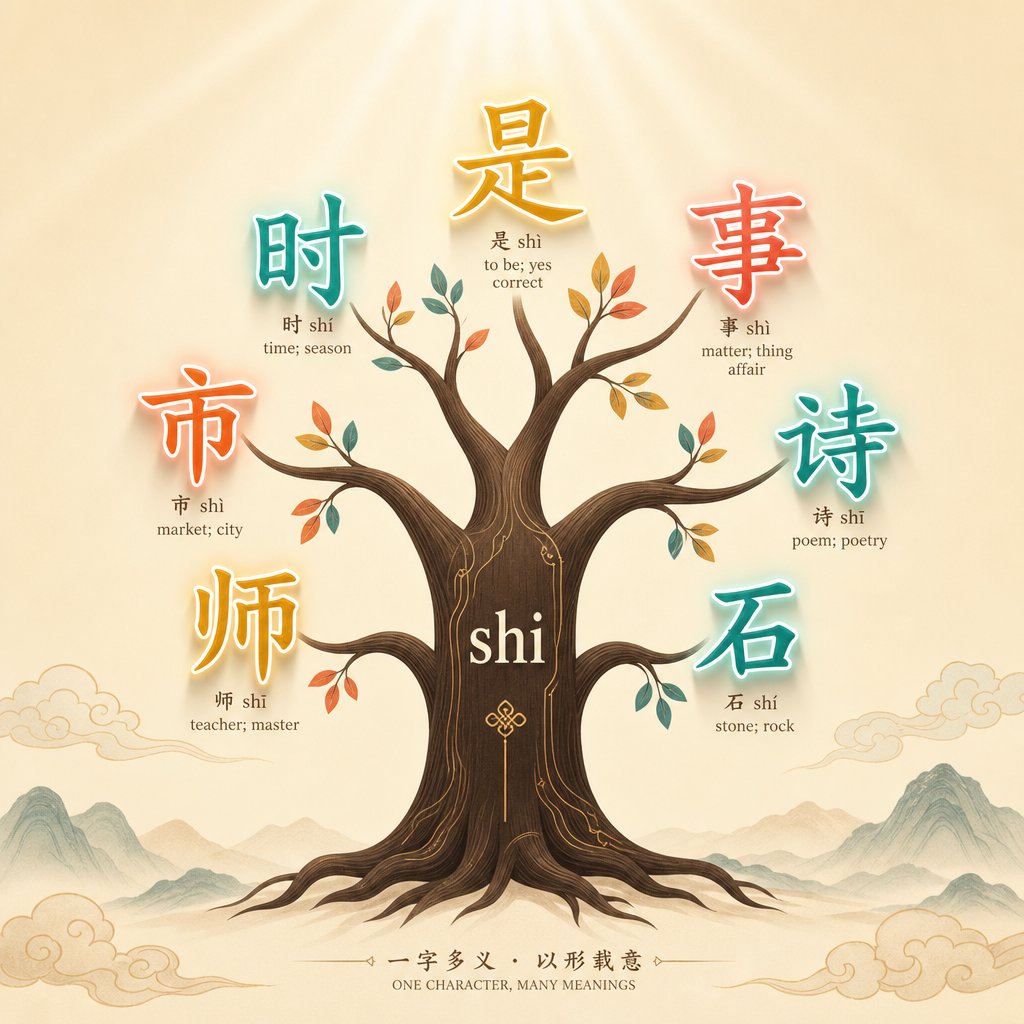
This chinese literary name symbolism was not unique to Cao Xueqin. Classical poetry, opera, and folk tales all exploited the same technique. The "Lion-Eating Poet in the Stone Den" pushes homophony to its extreme: an entire poem written using only variations of the syllable "shi," demonstrating just how many distinct meanings a single sound can carry. While not a naming example per se, it illustrates the raw material Chinese authors work with when crafting meaningful names.
Modern Pop Culture and Homophone Humor
Contemporary creators continue the tradition, though the tone has shifted from philosophical allegory toward humor and social commentary. In Chinese film and television, character names routinely carry homophonic jokes that international audiences miss entirely. A villain named with characters sounding like "no conscience" or a comedic sidekick whose name echoes "always confused" gives Chinese-speaking viewers an extra layer of entertainment that subtitles cannot convey.
Social media has democratized the practice. Fans create homophonic nicknames for celebrities, sometimes affectionate and sometimes mocking, that spread virally because they are easy to type and hard for automated filters to catch. A star's name gets reworked into a sound-alike phrase that comments on their latest scandal or praises their talent, and the pun becomes their unofficial public identity for weeks.
Music adds another dimension. Song titles and artist names built on homophonic ambiguity let creators embed double meanings that reward attentive listeners. A love song title that also sounds like a political statement, or a band name that reads as innocent but echoes something subversive, carries forward the same impulse Cao Xueqin channeled two and a half centuries ago: using the gap between sound and meaning to say two things at once.
The cultural throughline is clear. From 18th-century novels to modern memes, Chinese creators have always understood that in a language with 400 syllables serving thousands of characters, every name is a potential pun. The question is whether that pun works for you or against you, a distinction that matters enormously when the name in question is your own.

How to Avoid Embarrassing Pinyin Name Homophone Mistakes
Whether that name is your own or one you are choosing for the first time, the gap between sound and meaning can work against you in ways a dictionary alone will never reveal. Foreigners selecting a Chinese name and professionals navigating romanized name systems both need a practical method to check chinese name meaning at every layer: tone, character, combination, dialect, and romanized form.
The good news? You do not need to be fluent in Mandarin to avoid the worst pitfalls. What you need is a systematic approach and the willingness to ask the right people the right questions.
Steps to Check Your Chinese Name for Homophone Problems
Think of this as a chinese name homophone checker you can run manually. Each step catches a different category of problem, and skipping any one of them leaves a blind spot where an embarrassing collision can hide.
- Identify all tone variants of your chosen syllables. Write out the pinyin for each syllable in your name and list every tone it can carry. A syllable like "jing" exists in the first tone (京, capital), third tone (景, scenery), and fourth tone (静, quiet). Each tone opens a different set of character options and a different set of homophone neighbors. Use a pinyin table to confirm which tone-syllable combinations are valid in Mandarin.
- Check each character option against inauspicious homophones. For every character you are considering, list the other common characters that share its exact pronunciation and tone. If any of those neighbors carry negative meanings (death, illness, failure, poverty), flag the risk. A character pronounced "si" in the fourth tone might mean "thought" (思), but it sits dangerously close to 死 (death). Context determines whether listeners hear the intended meaning or the unfortunate one.
- Test the full name combination for unintended meanings. Individual characters might be fine on their own, but combining them with a surname can produce an accidental phrase. Read the full name aloud quickly. Does it sound like a common expression, idiom, or slang term? The near-miss with "euthanasia" that one foreigner experienced in Taiwan illustrates this perfectly: his transliterated first name combined with his chosen surname to sound like 安乐死 (euthanasia). Each syllable was harmless alone, but together they formed something no one wants printed on a business card.
- Verify across major dialect groups. If you interact with Cantonese, Hokkien, or Hakka speakers, test how your name sounds in those languages. A name that works beautifully in Mandarin might produce a vulgar word or unfortunate phrase in another Chinese dialect. Ask speakers of those languages directly, since no automated tool reliably catches cross-dialect homophone problems.
- Confirm the romanized version does not create confusion in English contexts. Write your name in plain pinyin without tone marks, exactly as it would appear on a passport or email address. Does it look like an English word? Could it be misread or mispronounced in a way that creates awkwardness? Check whether the romanized form is shared by thousands of other people, which might cause identity confusion in databases and directories.
This five-step process catches the vast majority of homophone problems. But it only works if you go beyond dictionary definitions and into real-world usage, which brings us to the tools and human resources that make vetting reliable.
Tools and Strategies for Disambiguation
If you are figuring out how to choose a chinese name as a foreigner, your first instinct might be to open a dictionary, find a character with a nice meaning, and call it done. That approach misses the most dangerous problems. Dictionaries tell you what a character means in isolation. They do not tell you what it sounds like to a native speaker in the context of a full name, a regional dialect, or contemporary slang.
Here is why dictionary lookups fall short:
- Dictionaries list primary meanings but rarely flag colloquial or slang associations that native speakers hear instantly.
- They do not show you the full homophone neighborhood: all the other characters and words that share your chosen sound.
- They cannot account for regional variation, where a perfectly neutral Mandarin syllable might be vulgar in Cantonese.
- They miss combination effects, where two innocent characters placed together produce an unfortunate phrase.
- They do not reflect generational or cultural connotations that shift over time.
Effective vetting requires layering automated tools with human judgment. Start with a pinyin-to-character lookup tool that shows all characters for a given syllable and tone, not just the most common ones. Radical-based character dictionaries let you explore the full range of options and compare meanings side by side. Use these to build your candidate list, then move to human review.
The human review step is non-negotiable. Ask at least two native speakers to evaluate your name, and choose reviewers from different backgrounds if possible. A speaker from Beijing and one from Guangzhou will catch different problems. Give them the full name (surname plus given name) and ask specifically:
- Does this name sound like any common phrase, idiom, or slang expression?
- Would you find this name strange or funny if you met someone with it?
- Does it remind you of any public figure, fictional character, or brand?
- How does it sound in your home dialect, if different from Mandarin?
- Is there anything about this name that would make you hesitate to use it?
These open-ended questions surface problems that no checklist can anticipate. One reviewer might catch a pop culture reference. Another might notice that your name sounds like a local brand of toilet paper in their hometown. A third might point out that the character combination, while technically positive, reads as old-fashioned or overly grandiose for someone your age.
For those who want additional verification, naming guides recommend anchoring on characters as the most reliable identifier and picking one primary romanized spelling to use consistently across all documents and profiles. This consistency matters because mixing romanization systems (pinyin in one place, Wade-Giles in another) creates exactly the kind of identity fragmentation that makes homophone collisions worse.
A practical tip that many guides overlook: record your name being spoken by a native speaker and save that audio file. When you introduce yourself in professional settings, having a reference recording helps you practice correct tones and gives colleagues a model to follow. Mispronounced tones can accidentally shift your name into homophone territory that the original characters never intended.
The underlying principle is simple. In a language where roughly 400 syllables serve tens of thousands of characters, no name exists in phonetic isolation. Every Chinese name is surrounded by a cloud of sound-alikes, and the only way to navigate that cloud safely is to check your name from multiple angles, through multiple ears, across multiple contexts. The effort is small compared to the cost of discovering, months or years later, that your carefully chosen name has been making people smile for all the wrong reasons.
Frequently Asked Questions About Pinyin Name Homophones
1. Why do so many Chinese names look the same in English?
Mandarin Chinese has only about 400 distinct pinyin syllables representing tens of thousands of characters. When names are romanized on passports, emails, and official documents, tone marks and characters are stripped away. This causes dozens or even hundreds of different names to collapse into a single spelling. Combined with a concentrated surname pool where the top three surnames alone cover over 270 million people, identical romanized names become statistically inevitable in any large Chinese population.
2. How do Chinese parents use homophones when naming children?
Parents deliberately select characters whose pronunciation echoes auspicious words like fu (fortune), cai (wealth), or an (peace). They also actively avoid characters that sound like inauspicious words such as si (death), ku (bitterness), or bai (failure). Many families test names across multiple dialect pronunciations, since a name that sounds fine in Mandarin might create an unfortunate homophone in Cantonese or Hokkien. The full name combination is also checked to ensure the surname and given name together do not accidentally form an embarrassing phrase.
3. What problems do pinyin name homophones cause on passports and official documents?
Chinese passports omit tone marks per official policy, and international systems like airline booking software and banking databases cannot support diacritics. This means tens of thousands of unrelated individuals can share identical romanized names. Consequences include flight booking mix-ups, corporate email collisions requiring arbitrary numbering, university transcript errors, and false positives in financial compliance screening. Common workarounds include adding middle initials, birth years, or adopting Western given names as prefixes.
4. What are Chinese number homophones and how are they used as names online?
Chinese internet users exploit the fact that numbers have fixed Mandarin pronunciations that sound like common phrases. For example, 520 sounds like wo ai ni (I love you), 88 sounds like bai bai (bye-bye), and 666 means awesome because liu sounds smooth. These number sequences function as usernames, handles, and coded messages across social media and gaming platforms. The practice extends to censorship evasion, where users substitute homophones and number codes for blocked words.
5. How can foreigners avoid embarrassing homophone mistakes when choosing a Chinese name?
Follow a five-step vetting process: identify all tone variants of your chosen syllables, check each character against inauspicious homophones, test the full name combination for unintended phrases, verify pronunciation across major dialect groups, and confirm the romanized version does not cause confusion in English. Most importantly, have at least two native speakers from different regional backgrounds review the complete name. Dictionary lookups alone are insufficient because they miss slang associations, combination effects, and regional dialect problems.