Why Pinyin Name Pronunciation Confuses English Speakers
You're scanning a conference agenda, a LinkedIn profile, or a class roster, and there it is: a Chinese name written in familiar Latin letters. You see "Qian Xuesen" or "Zhang Wei" and your brain immediately tries to sound it out using English rules. The result? Almost certainly wrong. This is the core trap of pinyin name pronunciation. The letters look like English, but they represent an entirely different set of sounds.
Pinyin is the official romanization system for Mandarin Chinese, adopted by the People's Republic of China in the late 1950s as a standardized way to represent Chinese character sounds using the 26-letter Latin alphabet. It was designed to be precise and consistent for Mandarin speakers, not intuitive for English readers. That distinction matters more than most people realize.
Pinyin uses the Latin alphabet but reassigns many letter sounds. Reading pinyin like English guarantees mispronunciation.
Consider the letter "q" in pinyin. It doesn't make a "kw" sound. The letter "x" doesn't sound like it does in "box." And "zh" isn't quite the English "j" sound either. When you define pinyin pronunciation on its own terms rather than filtering it through English assumptions, you start to see why so many people stumble. Each letter or letter combination maps to a specific Mandarin sound that was never meant to mirror its English counterpart.
Why Pinyin Letters Mislead English Speakers
English is notoriously inconsistent with its own spelling. Think of how "ough" sounds different in "through," "though," and "thought." Pinyin, by contrast, is remarkably consistent. Each spelling always produces the same sound. The problem isn't inconsistency. It's that the consistent rules belong to a completely different sound system. As linguist Peng Qi notes, there is not a one-to-one mapping between each Latin letter and the corresponding sound in Mandarin. English speakers who assume otherwise will misread nearly every unfamiliar Chinese name they encounter.
This is why pronunciation chinese pinyin requires a mental reset. You're not learning exceptions to English rules. You're learning a parallel system that happens to share the same alphabet.
The Professional Case for Getting Names Right
Chinese names carry deep cultural weight. The family name comes first, symbolizing lineage and heritage. Given names are chosen with care, often reflecting parental aspirations, philosophical ideals, or even the circumstances of a child's birth. Each character in a name holds meaning, and research from Temple University's Center for Chinese Language Instruction emphasizes that mispronouncing a tone can shift a name's meaning entirely. The syllable "wen" in the fourth tone might mean "inquisitive," but in the second tone it could mean "mosquito."
Making the effort to get someone's name right signals respect. In professional settings, whether you're introducing a colleague, addressing a client, or welcoming a new team member, that effort builds rapport and trust. You don't need to achieve native-level mandarin pinyin pronunciation. You just need to stop guessing based on English instincts.
This guide is built around names, not grammar drills or full language courses. The goal is practical: give you enough understanding of chinese pinyin pronunciation to approach any unfamiliar name with confidence rather than anxiety. The sounds themselves are learnable, and the system behind them is logical once you see how the pieces fit together.
How Pinyin Syllables Are Built
The logic behind pinyin is surprisingly compact. Unlike English, where a single word can stretch across multiple unpredictable syllable patterns, every Mandarin syllable follows the same formula. Once you see the structure, parsing any Chinese name becomes a repeatable process rather than a guessing game.
Initial Plus Final Plus Tone Equals One Syllable
Every pinyin syllable is assembled from three components:
- Initial — the opening consonant sound (like "zh" in "Zhang" or "l" in "Li")
- Final — the vowel or vowel-plus-ending that follows (like "ang" or "i")
- Tone — the pitch contour that gives the syllable its meaning (marked by an accent above the vowel)
Think of it like a simple equation: initial + final + tone = one complete syllable. Some syllables skip the initial entirely and start directly with a vowel sound, but the final and tone are always present. This is the entire architecture. A finite set of 23 initials combines with roughly 24 finals, and each combination carries one of four tones (plus a neutral tone). That's it. The system is closed, which means once you learn the pieces, you can handle any combination you encounter.
A mandarin pinyin pronunciation table maps out every valid pairing of initials and finals. Not every combination exists, so the actual number of distinct syllables in Mandarin is only around 400 (before tones multiply the possibilities). For name pronunciation, this is good news: you're working with a limited set of building blocks.
Breaking a Full Name Into Pronounceable Parts
Chinese names typically contain two or three syllables. The family name usually has one syllable, and the given name has one or two. When you see "Wang Xiaoming," you're looking at three syllables: Wang (surname) + Xiao + Ming (given name). Each syllable maps neatly onto the initial-final-tone formula.
Imagine you encounter the name "Liu Chenxi" on a meeting invite. Here's how to break it down: separate it into three syllables (Liu, Chen, Xi), then split each syllable into its initial and final. This parsing step is what turns an intimidating string of letters into manageable, pronounceable pieces. A chinese pronunciation pinyin syllable chart makes this visual, but the table below demonstrates the pattern with common name syllables:
| Syllable | Initial | Final | Tone | Found in Names Like |
|---|---|---|---|---|
| Zhāng | zh | ang | 1st (high, steady) | Zhang Wei |
| Xiǎo | x | iao | 3rd (dip-rise) | Wang Xiaoming |
| Míng | m | ing | 2nd (rising) | Wang Xiaoming |
| Liú | l | iu | 2nd (rising) | Liu Chenxi |
| Chén | ch | en | 2nd (rising) | Liu Chenxi |
You'll notice the pattern is consistent. Every syllable, no matter how unfamiliar it looks at first glance, breaks down the same way. The pinyin chart with pronunciation guides available online follows this exact structure, organizing all valid syllables into a grid of initials along one axis and finals along the other.
This framework gives you a reliable starting point for any name. The next challenge is knowing what each initial and final actually sounds like, because that's where English instincts start to fail.
Pinyin Initials English Speakers Always Get Wrong
English instincts don't just bend pinyin sounds slightly off course. For certain consonants, they send you in a completely wrong direction. The pinyin alphabet pronunciation system reuses familiar letters for sounds that have no direct English match, and this is where most name mispronunciations originate. The good news: once you know which initials are traps, you can correct course quickly.
The X Q and J Sounds English Has No Match For
When English speakers see "x" in a name like "Xie" or "Xu," they reach for the "ks" sound from "box" or the "z" sound from "xylophone." Neither is close. Pinyin "x" sounds like the "sh" in "sheep," but lighter and sharper, produced with your tongue pressed flat behind your lower front teeth while you push air over it. Imagine whispering "she" with a smile. That forward tongue position is the key.
The letter "q" triggers the same confusion. English speakers default to a "kw" sound or a hard "k." In Mandarin, "q" sounds like "ch" in "cheese," but again with that same forward tongue position, pressed behind the lower teeth. Think of saying "cheer" while keeping your tongue tip low and flat. The chinese pinyin j pronunciation follows the same pattern: "j" sounds like the English "j" in "jeep," but softer and more forward in the mouth, closer to a gentle "dg" with the tongue behind the lower teeth.
As Peng Qi's pinyin cheatsheet explains, a useful approximation for j, q, and x is to think of them as zh, ch, and sh with a "y" sound appended, because Mandarin pronunciation rules mandate that "y" quality after these consonants.
Retroflex Zh Ch Sh and R Explained With Mouth Position
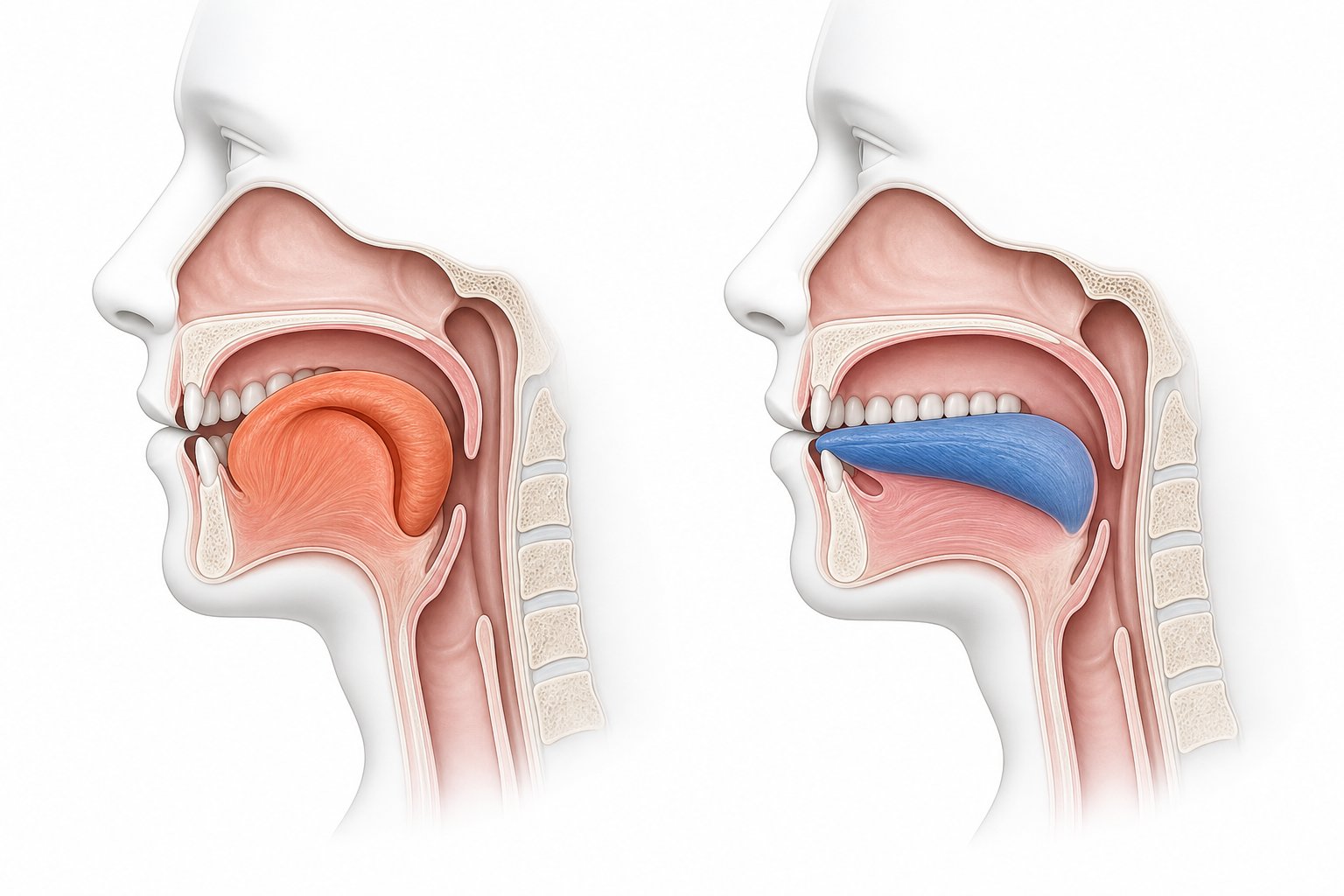
The retroflex group (zh, ch, sh, r) requires curling your tongue tip upward and backward so it points toward the roof of your mouth without touching it. This is the defining mouth position for all four sounds.
- zh — sounds like "j" in "John" or "dr" in "dream," with the tongue curled back
- ch — sounds like "ch" in "chowder," tongue curled back with a puff of air
- sh — sounds like "sh" in "shop," but with the tongue curled further back than in English
- r — the trickiest one. It sounds closer to the "s" in "vision" than the English "r" in "red." Curl your tongue back, let it vibrate slightly, and voice the sound
The critical difference between zh/ch/sh and j/q/x is tongue position. Retroflex sounds curl the tongue back. The j/q/x group pushes the tongue forward and flat. Mixing them up won't make a name unrecognizable, but getting this distinction right dramatically improves your pinyin consonants pronunciation.
C and Z Are Not What You Think
Pinyin "c" never makes a "k" sound. It sounds like the "ts" at the end of "pants" or "boots," but placed at the beginning of a syllable. So the surname "Cai" starts with a sharp "ts" sound, not a "k" or an "s." Pinyin "z" is similarly deceptive. It's not the buzzing "z" from "zoo." It sounds like the "ds" at the end of "beds" or "cards," compressed into a single starting consonant.
Both "c" and "z" feel unnatural at the start of a syllable for English speakers because English rarely begins words with these clusters. Practice by saying "tsai" (for Cai) or "dzang" (for Zang) and you'll land much closer to the correct chinese pinyin initials pronunciation.
| Pinyin Initial | English Speakers Usually Say | Actual Sound (Closest English Approximation) | Example Name |
|---|---|---|---|
| x | "ks" (as in box) or "z" (as in xylophone) | "sh" in "sheep" with tongue flat and forward | Xie, Xu |
| q | "kw" (as in queen) or "k" | "ch" in "cheese" with tongue flat and forward | Qian, Qi |
| j | Hard "j" (as in "jam") | Soft "j" as in "jeep" with tongue behind lower teeth | Jiang, Jin |
| zh | "z" (as in "zoo") | "j" in "John" with tongue curled back | Zhang, Zhao |
| ch | English "ch" (close but tongue too far forward) | "ch" in "chowder" with tongue curled back | Chen, Chu |
| sh | English "sh" (close but tongue too far forward) | "sh" in "shop" with tongue curled further back | Shi, Shen |
| r | English "r" (as in "red") | "s" in "vision" with tongue curled back | Ren, Rui |
| c | "k" (as in "cat") or "s" | "ts" in "pants" at the start of a syllable | Cai, Cui |
| z | Buzzing "z" (as in "zoo") | "ds" in "beds" at the start of a syllable | Zhang (different character), Zou |
Mastering these pinyin initials pronunciation patterns covers the vast majority of consonant errors English speakers make with Chinese names. The consonants set the shape of each syllable, but the vowels and finals that follow them carry their own set of surprises, particularly when pinyin spelling hides the actual sound being produced.
Pinyin Finals and Vowels That Sound Nothing Like English
Consonants give a syllable its opening shape, but the final carries most of the syllable's duration and color. This is where pinyin vowels pronunciation diverges from English in ways that are harder to fake. A misplaced consonant might sound slightly off. A wrong vowel makes the entire syllable unrecognizable.
Vowel Sounds That Have No English Equivalent
The most notorious vowel in Mandarin is ü. English simply doesn't have this sound. To produce it, say "ee" as in "see," then round your lips into a tight circle as if you were about to whistle, keeping your tongue in the "ee" position. The result is a sound that sits between "ee" and "oo" but matches neither. If you speak French, it's the "u" in "tu." If you speak German, it's the "ü" in "über."
Here's the catch: pinyin often hides ü behind a plain "u." When you see "ju," "qu," "xu," or "yu," that "u" is actually ü. The two dots get dropped because j, q, x, and y can only pair with ü, never with a regular "u." So a name like "Xu" isn't pronounced "zoo" or "sue." It's "sh-ü," with that rounded, forward vowel. HSK Course's pinyin guide confirms this spelling rule applies across all combinations of these initials with ü, üe, üan, and ün.
The e pinyin pronunciation trips people up almost as often. Pinyin "e" on its own doesn't sound like the "e" in "bed" or "me." It's closer to the "u" in "duh" or the unstressed "a" in "again" — a relaxed, mid-back vowel produced with a slightly open mouth. However, when "e" appears inside diphthongs like "ei" or "ie," it shifts to sound more like the "e" in "bet." Context determines which version you hear.
A few other chinese pinyin vowels pronunciation patterns catch English speakers off guard:
- ou — sounds like "oa" in "boat," not like "ou" in "out"
- uo — sounds like "w-aw" with a rounded opening, as in "war" without the r
- ian — sounds like "yen," not like "ee-an." The name "Tian" rhymes with "yen," not "teen"
- ang — the "a" is open and broad, like "ah" plus "ng." Think "song" but with "ah" instead of "aw"
- an — the "a" is more closed, closer to the vowel in "ban" or "fan"
- eng — sounds like "ung" in "hung," not like "eng" in "English"
- en — sounds like "en" in "taken," a short neutral vowel plus "n"
The difference between "ang" and "an" or "eng" and "en" matters for names. "Wang" and "Wan" are different surnames. "Cheng" and "Chen" belong to different families. Getting the nasal ending right — whether the sound resonates through the nose with the mouth open (ng) or closes off at the front with the tongue touching the ridge behind your teeth (n) — is a meaningful distinction in pinyin to english pronunciation mapping.
Spelling Shortcuts That Hide the Real Sound
Pinyin has a set of abbreviation rules that silently drop vowels from the written form. The full sound is still spoken, but the spelling doesn't show it. This is one of the most overlooked aspects of chinese pinyin initials and compound finals pronunciation, and it directly affects how you read names.
When you see these shortened spellings, you're actually hearing a longer sound:
- iu is really iou — the name "Liu" is pronounced "lee-oh-oo" glided together, not "lee-oo"
- ui is really uei — the name "Hui" is pronounced "hw-ay," not "hoo-ee"
- un is really uen — the name "Sun" is pronounced "sw-en," not "soon" or "sun"
These abbreviations explain why pinyin to english pronunciation feels inconsistent at first. The spelling looks simple, but a middle vowel has been swallowed. Once you know the hidden sounds exist, names like "Dui," "Jun," and "Niu" suddenly make more sense. You're not missing a sound — the spelling just chose not to show it.
The HSK Course spelling rules section demonstrates this clearly: when "ui" stands alone without an initial, it's written as "wei." When "un" stands alone, it becomes "wen." When "iu" stands alone, it becomes "you." The standalone forms reveal the full pronunciation that the abbreviated forms conceal.
Understanding these pinyin finals pronunciation patterns gives you the vowel toolkit for any Chinese name. The consonants set the entry point, the finals carry the body of the sound, and together they form the syllable. What remains is the element that floats above both: tone, the pitch pattern that can change a name's meaning entirely.
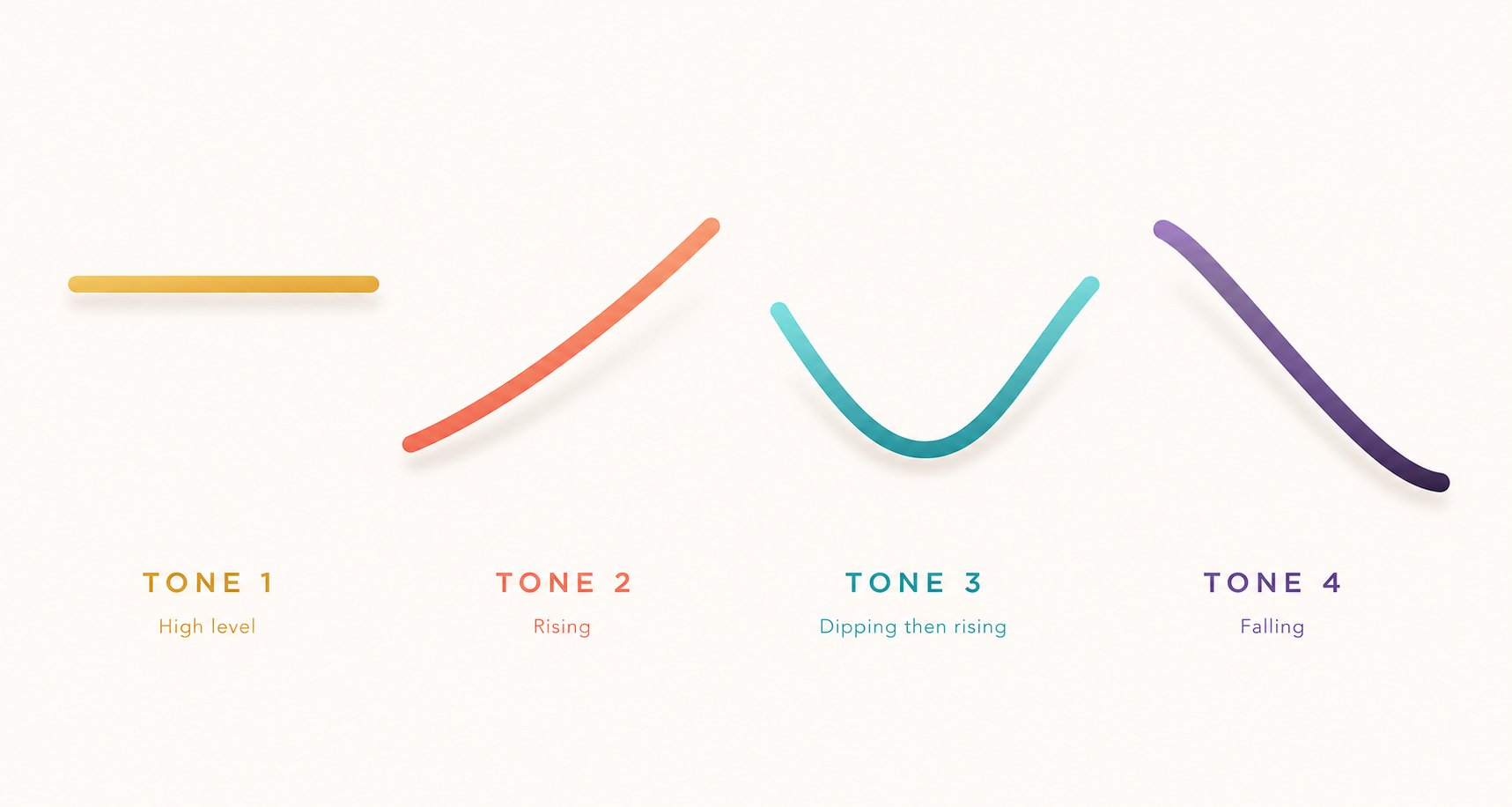
Understanding Tones in Chinese Names
Consonants and vowels build the body of a syllable, but in Mandarin, pitch is just as structural as any letter. Every syllable carries a specific tone, a prescribed rise or fall in your voice that functions like a consonant or vowel does in English. Change the tone, and you change the word. For names, this means two people can share the exact same spelling in pinyin yet have completely different surnames because the pitch pattern differs.
What the Accent Marks Above Vowels Mean
When you see pinyin written with full diacritical marks, those small symbols above the vowels aren't decorative. They're tone indicators, telling you exactly which pitch contour to apply. A flat line (ā) signals first tone. A rising stroke (á) signals second tone. A caron or "v" shape (ǎ) signals third tone. A falling stroke (à) signals fourth tone. No mark at all means a neutral, unstressed tone.
In many professional contexts, names appear without these marks, which strips away tonal information entirely. That's one reason basic pinyin pronunciation guides focus heavily on consonants and vowels. But when tone marks are present, they give you a complete pronunciation blueprint. For chinese pinyin pronunciation, how many tones are there? Four main tones plus one neutral tone, giving Mandarin five distinct pitch patterns total.
The Four Tones Described for Non-Speakers
You already use pitch variation in English every day. You just apply it to sentences rather than individual words. These analogies map each Mandarin tone to a pitch pattern you already produce naturally:
- First tone (ā) — high and steady. Imagine holding a single note while humming, or the sustained "ohhh" a doctor asks you to say. Your pitch stays flat at the top of your comfortable range without dipping or rising.
- Second tone (á) — rising. Think of the pitch your voice makes when you say "What?" or "Huh?" in genuine surprise. It sweeps upward from middle to high, quick and decisive.
- Third tone (ǎ) — low and dipping. Picture saying "well..." in a drawn-out, skeptical way, your voice dropping to a low, slightly creaky register. In connected speech, this tone mostly just stays low rather than completing a full dip-and-rise.
- Fourth tone (à) — sharp and falling. Say "No!" as a firm command, or "Stop!" with authority. Your voice starts high and drops sharply downward. It's short, punchy, and decisive.
The neutral tone is lighter and quicker, with no strong pitch of its own. It appears in grammatical particles and the unstressed second syllable of some words, but it rarely shows up in the meaningful syllables of personal names.
If you want to hear these patterns in action, the most effective approach is to listen pinyin pronunciation audio from native speakers. Text descriptions can only approximate what your ear needs to internalize through repetition.
How Much Tones Matter for Names in Practice
In casual professional settings, getting the consonants and vowels right matters most. A colleague will recognize their name even if your tones aren't perfect, because context fills the gap. But tones can change meaning entirely. The Asia Media Centre's guide to Chinese names notes that names with the same spelling can have different tones and different meanings. The surname "Wáng" (王, king) in second tone is a different family from "Wāng" (汪) in first tone. "Lí" (黎, dawn) in second tone differs from "Lǐ" (李, plum) in third tone. The given name "Méi" (梅, plum blossom) in second tone becomes "Měi" (美, beautiful) in third tone.
For hanyu pinyin pronunciation in everyday interactions, aim for accurate consonants and vowels first, then layer in tones as you grow more comfortable. Even an approximate tone attempt signals effort and respect. To refine further, listen pinyin pronunciation recordings of specific names before important meetings. Many online tools let you type a name and hear it spoken aloud, which bridges the gap between reading about mandarin chinese pinyin pronunciation and actually producing it.
Tones complete the sound profile of any syllable. With initials, finals, and pitch patterns covered, the remaining challenge is practical: when you encounter an unfamiliar name, what's the actual step-by-step process for working through it?
A Step-by-Step Workflow for Any Unfamiliar Name
You've got the building blocks: initials, finals, tones. The question now is how to apply them in real time when an unfamiliar name appears on a meeting invite, a conference badge, or an email signature. This chinese pinyin pronunciation guide distills everything into a repeatable workflow you can use for any name you encounter.
Identifying Surname and Given Name Order
Before you can pronounce a name, you need to know which part is which. Chinese naming conventions place the family name first, followed by the given name. So in "Wang Xiaoming," Wang is the surname and Xiaoming is the personal name. But in Western contexts, many Chinese professionals reverse the order to match English expectations, writing "Xiaoming Wang" instead.
How do you tell which format you're looking at? A few reliable clues:
- If the name appears in a Chinese-language document, academic paper with a Chinese institution, or a formal Chinese context, assume surname-first.
- If a single syllable leads a three-syllable name (like "Li Jiaming"), that single syllable is almost certainly the surname. The Asia Media Centre notes that all top 100 Chinese family names have only one syllable, covering about 85 percent of China's citizens.
- If the name follows a Western given name (like "James Zhang" or "Amy Chen"), the family name has been moved to the end.
- Some professionals capitalize their surname on business cards (e.g., "ZHANG Chen") specifically to prevent confusion.
When in doubt, simply ask. Most people appreciate the effort far more than they mind the question.
A Five Step Process for Any Pinyin Name
This guide to pinyin pronunciation works as a mental checklist you can run through quickly, even mid-conversation:
- Determine the name order. Use the clues above to identify which part is the surname and which is the given name. This tells you how to address the person correctly and where to focus your pronunciation effort first.
- Separate the name into individual syllables. Chinese names are built from discrete syllables, typically one for the surname and one or two for the given name. "Zheng Yuanfang" becomes three syllables: Zheng + Yuan + Fang. Each syllable is a self-contained pronunciation unit.
- Identify the initial and final of each syllable. Split each syllable at the boundary between its opening consonant and the vowel portion that follows. "Zheng" breaks into zh (initial) + eng (final). "Yuan" has no true initial — it starts directly with the final "uan" (preceded by a "y" that acts as a spelling placeholder).
- Map each sound to its closest English approximation. Apply what you know: zh sounds like "j" in "John" with a curled tongue, eng sounds like "ung" in "hung." Work through each syllable's initial and final using the pinyin pronunciation in english mappings from the earlier sections.
- Combine the syllables and practice aloud. Say each syllable slowly, then link them together at natural speed. Pinyin pronunciation practice works best when you say the name out loud several times rather than just reading it silently. Even a few repetitions before a meeting builds muscle memory.
This workflow turns learn pinyin pronunciation from an abstract goal into a concrete action. You don't need to memorize every sound in advance. You just need to know how to break a name apart and look up the pieces you're unsure about.
One important caveat: this entire process assumes the name you're looking at actually uses standard pinyin. Not all Chinese names do. Names from Hong Kong, Taiwan, or older historical sources often follow entirely different romanization systems, and applying pinyin rules to them will lead you astray.
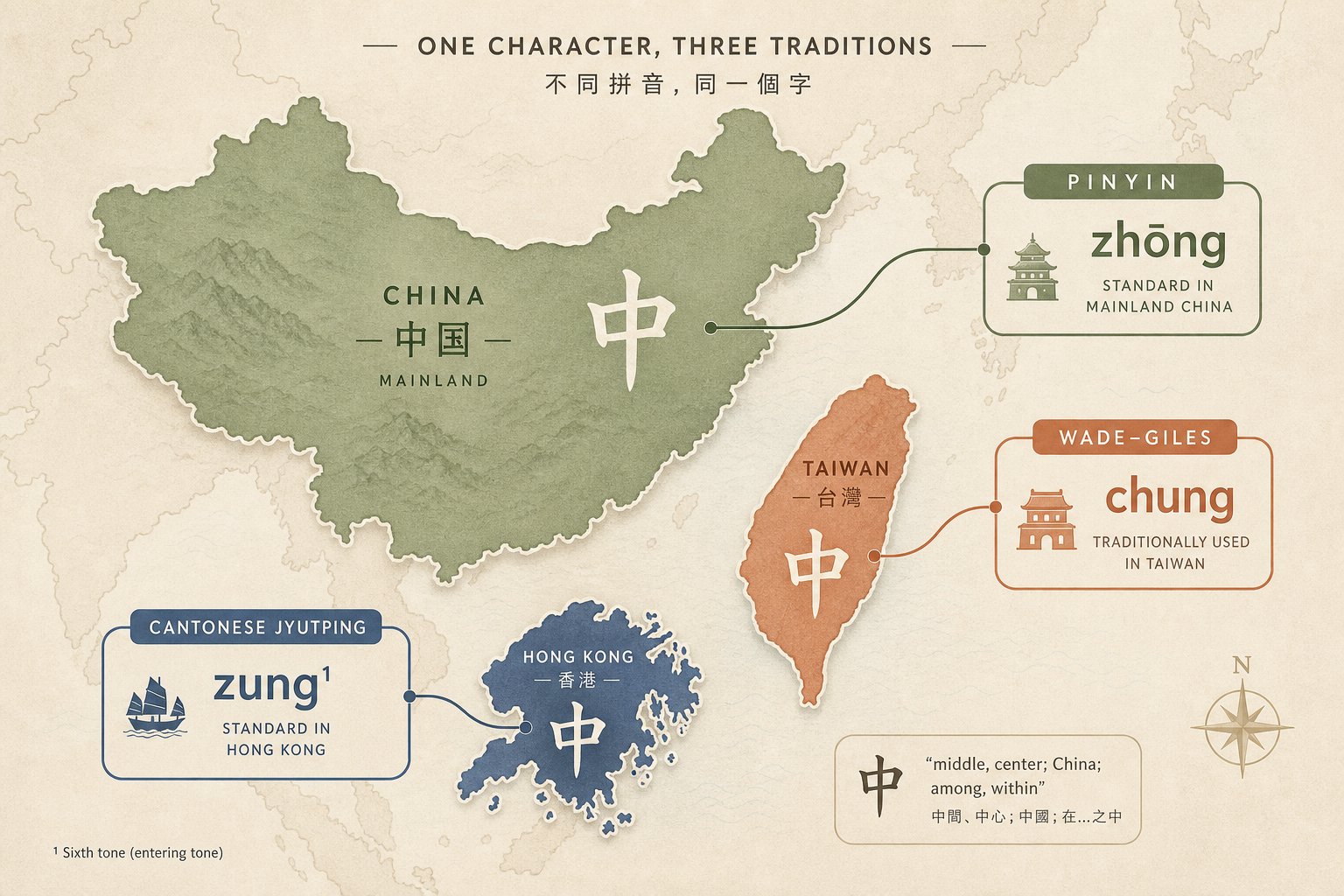
Recognizing Names That Are Not Standard Pinyin
Everything covered so far assumes you're looking at standard pinyin. But here's the complication: a significant number of Chinese names in the English-speaking world don't use pinyin at all. Apply pinyin chinese pronunciation rules to a name romanized in a different system, and you'll produce a sound that's not just slightly off — it may be completely wrong.
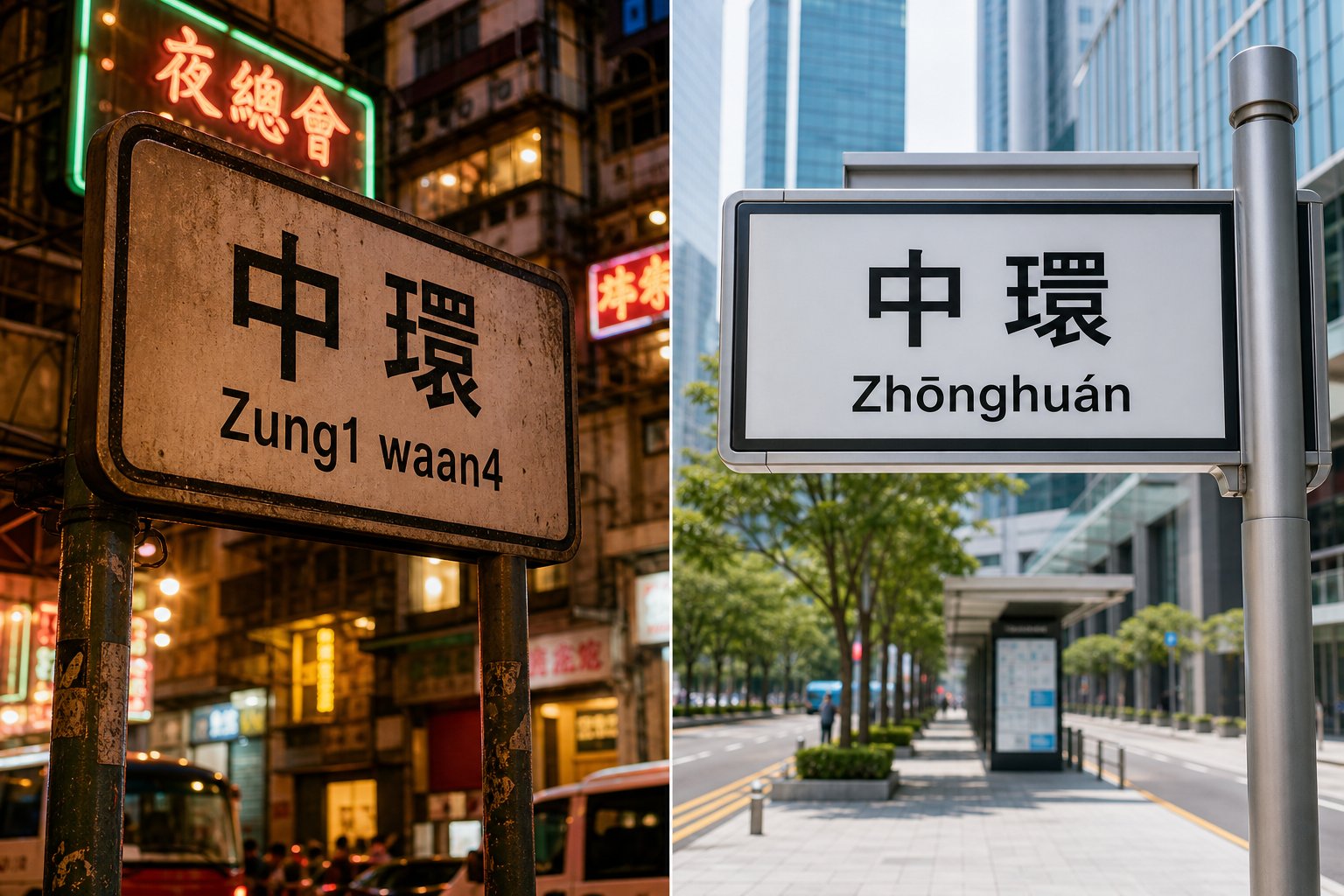
The reason is historical and geographic. Pinyin became China's official romanization standard in the late 1950s, but Chinese communities in Hong Kong, Taiwan, and the global diaspora had already been writing their names using older systems for generations. Those spellings stuck. A person named "Tsai" in Taiwan and a person named "Cai" in mainland China may share the exact same surname character, but their romanized spellings follow different rules entirely.
Pinyin vs Wade-Giles vs Cantonese Romanization
Three major systems account for most Chinese names you'll encounter in English-language contexts:
Pinyin is the standard for mainland China, adopted internationally by the United Nations, the International Organization for Standardization, and most libraries and media outlets. It was designed for Mandarin and represents all Mandarin sounds systematically. When people search for chinese pronunciation pinyin resources, they're almost always looking at this system.
Wade-Giles was developed by British diplomats in the 19th century and remained the dominant romanization for Mandarin in English-language scholarship until the 1980s. It's still commonly used for personal names in Taiwan, where many people retain their Wade-Giles spellings on passports and official documents. Yale University Library's romanization guide notes that well-established Chinese names in Wade-Giles are often not converted to pinyin, citing figures like Chiang Ching-kuo and Lee Teng-hui as examples.
Hong Kong Government Cantonese Romanization (HKG-romanization) is based on 19th-century systems developed by British missionaries and remains the official system for names and places in Hong Kong. Unlike pinyin, which represents Mandarin, this system represents Cantonese pronunciation. Research published in the International Journal of Population Data Science highlights substantial inconsistencies within HKG-romanization: the same vowel sound can be spelled multiple ways, and the system does not capture tones. A single surname character might appear as "yang," "young," "yeung," or "yung" depending on the individual's registration.
This inconsistency is why cantonese pronunciation pinyin mappings are unreliable in one direction. You can't simply apply Mandarin pinyin rules to a Cantonese-romanized name, because the underlying pronunciation is a different language entirely. Cantonese has six tones (compared to Mandarin's four), different vowel inventories, and distinct consonant endings that don't exist in Mandarin.
Consider how place names illustrate the gap between systems. The shanghai pinyin pronunciation "Shànghǎi" maps cleanly because Shanghai uses standard pinyin. But "Hong Kong" itself is a Cantonese romanization — in pinyin, it would be "Xiānggǎng." The two look nothing alike because they represent different spoken languages.
How to Spot Which System a Name Uses
You don't need to be a linguist to identify which romanization system you're looking at. The Library of Congress FAQ on distinguishing Wade-Giles from pinyin provides clear visual markers:
- Apostrophes signal Wade-Giles. If you see an apostrophe within a syllable (like T'ai, Ch'en, or Ts'ui), you're looking at Wade-Giles. These apostrophes indicate aspiration — a puff of air after the consonant. Pinyin doesn't use apostrophes this way.
- Hyphens between given-name syllables suggest Wade-Giles. A name like "Wang T'ieh-jen" or "Tzu-hsi" uses hyphens to separate syllables in the given name. Pinyin joins given-name syllables together without hyphens ("Wang Tieren," "Cixi").
- Syllables starting with B, D, G, Q, X, or Z are pinyin. Wade-Giles never begins syllables with these letters. So if you see "Zhang," "Xu," or "Qian," you're definitely looking at pinyin.
- Syllables starting with HS or TS are Wade-Giles. Pinyin never uses these combinations as initials. "Hsieh" (Wade-Giles) becomes "Xie" in pinyin. "Tsai" becomes "Cai."
- Unusual consonant clusters like Ng, Ts, or double vowels like "oo" suggest Cantonese romanization. Names like "Ng," "Tsang," "Cheung," or "Leung" follow cantonese pinyin pronunciation patterns that have no equivalent in standard Mandarin romanization.
The table below shows how the same Chinese surname appears across all three systems. Notice how dramatically the spellings differ — applying one system's pronunciation rules to another system's spelling guarantees errors:
| Chinese Character | Pinyin (Mandarin) | Wade-Giles (Mandarin) | HKG Cantonese Romanization |
|---|---|---|---|
| 张 | Zhang | Chang | Cheung |
| 蔡 | Cai | Ts'ai | Choi |
| 蒋 | Jiang | Chiang | Tseung |
| 黄 | Huang | Huang | Wong |
| 梁 | Liang | Liang | Leung |
| 陈 | Chen | Ch'en | Chan |
Look at "张": if you see "Cheung" and try to pronounce it using pinyin rules, you'll get nowhere. "Cheung" represents the Cantonese sound "zoeng" — a completely different pronunciation from the Mandarin "Zhang." Similarly, pronouncing "Chiang" as if it were pinyin would give you something close to "chee-ahng," when the Wade-Giles intention is closer to "jee-ahng" (the same sound pinyin writes as "Jiang").
For anyone working with names across multiple Chinese-speaking regions, a chinese text to pinyin zhuyin converter with pronunciation can help identify the underlying character and its correct reading in whichever system applies. These tools take the Chinese character as input and output romanizations in multiple systems, removing the guesswork.
The practical takeaway: before applying any pronunciation rules, identify which system the name uses. If you see apostrophes and hyphens, think Wade-Giles and Taiwan. If you see consonant clusters like "Ng" or endings like "-eung" and "-ong" that don't match Mandarin patterns, think Cantonese and Hong Kong. Only when you're confident the name is standard pinyin should you apply the initial-final-tone framework from the earlier sections of this guide.
With the romanization system identified and the correct pronunciation rules applied, the final piece is having a quick-reference resource you can consult whenever memory fails — a consolidated map of every tricky sound alongside tools that let you hear them spoken aloud.
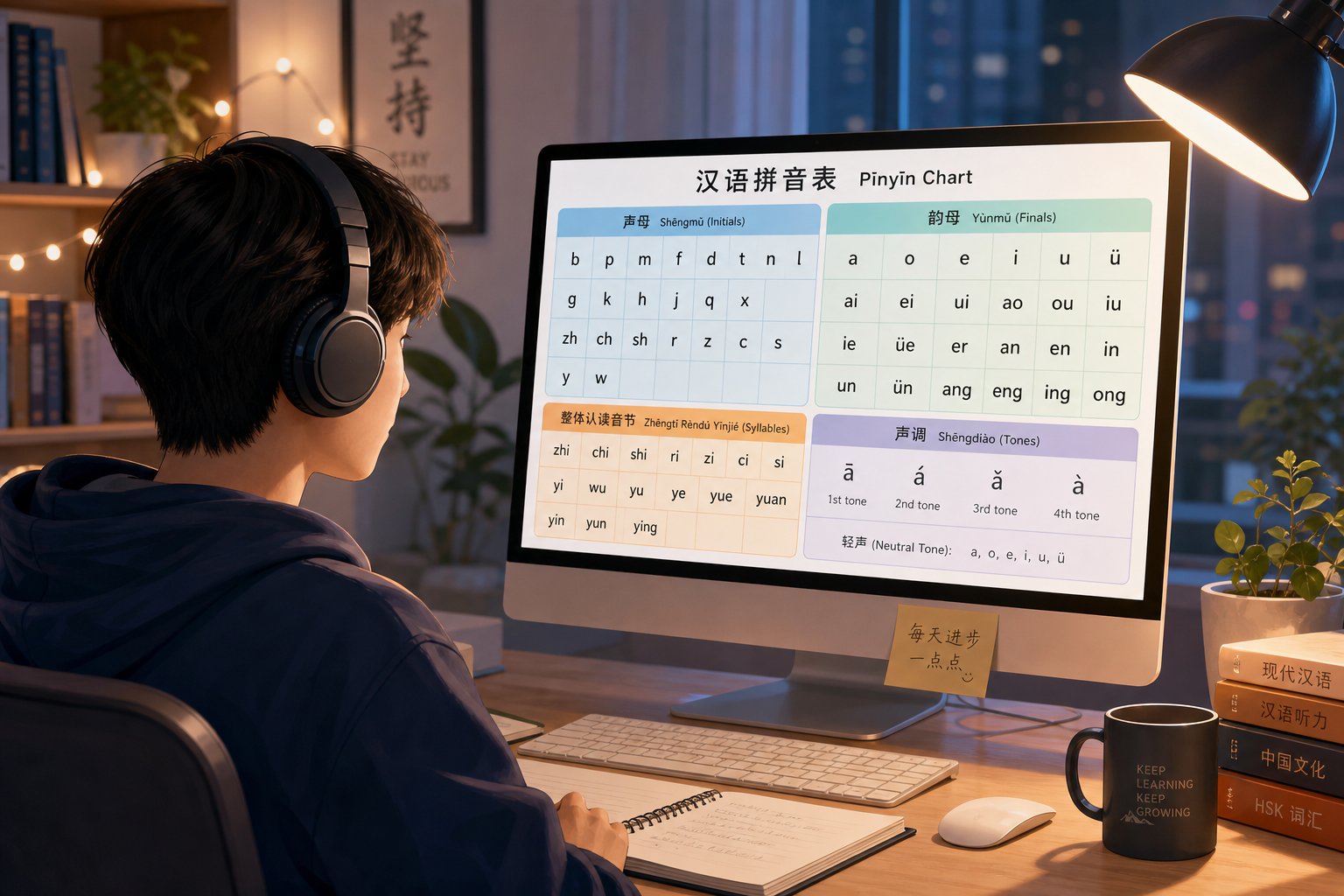
Quick Reference Chart and Pronunciation Resources
Text descriptions can only take you so far. You can read about tongue positions and pitch contours all day, but at some point your ear needs to hear the actual sounds. This section pulls together the most commonly problematic pinyin sounds into a single scannable reference, then points you toward tools that let you hear them spoken by native speakers.
Bookmark this section. The next time you encounter an unfamiliar Chinese name and need a fast refresher, the table below maps every tricky pinyin sound to its closest English approximation alongside common names where that sound appears.
Essential Pinyin to English Sound Map
This pinyin pronunciation chart consolidates the initials, finals, and vowel combinations that cause the most confusion for English speakers. Use it as a quick-lookup reference rather than reading it straight through:
| Pinyin Sound | English Approximation | Common Names With This Sound |
|---|---|---|
| x | "sh" in "sheep" (tongue flat, behind lower teeth) | Xu, Xie, Xia, Xiaoming |
| q | "ch" in "cheese" (tongue flat, behind lower teeth) | Qian, Qi, Qin, Qiang |
| j | Soft "j" in "jeep" (tongue behind lower teeth) | Jiang, Jin, Jia, Junwei |
| zh | "j" in "John" (tongue curled back) | Zhang, Zhao, Zheng, Zhu |
| ch | "ch" in "chowder" (tongue curled back, with air puff) | Chen, Chu, Chang, Cheng |
| sh | "sh" in "shop" (tongue curled further back than English) | Shi, Shen, Shao, Shuang |
| r | "s" in "vision" (tongue curled back, voiced) | Ren, Rui, Rong |
| c | "ts" in "pants" (at start of syllable) | Cai, Cui, Cao, Cen |
| z | "ds" in "beds" (at start of syllable) | Zou, Zeng, Zhu (different character) |
| ü (written u after j/q/x/y) | Say "ee" with tightly rounded lips | Xu, Yu, Lü, Qu |
| e (standalone) | "u" in "duh" (relaxed, mid-back) | He, Ge, Le |
| ian | "yen" (not "ee-an") | Tian, Qian, Jian, Lian |
| iu (= iou) | "ee-oh-oo" glided together | Liu, Niu, Jiu |
| ui (= uei) | "way" (not "oo-ee") | Hui, Dui, Cui, Rui |
| un (= uen) | "w-en" (not "oon") | Sun, Jun, Chun |
| ou | "oa" in "boat" | Zou, Dou, Gou, Zhou |
| ang | "ah" + "ng" (open, broad) | Wang, Zhang, Fang, Yang |
| eng | "ung" in "hung" | Cheng, Zheng, Feng, Meng |
You'll notice this chinese pronunciation pinyin chart focuses on the sounds that diverge most from English expectations. Initials like "m," "n," "l," "f," and "h" work roughly the same as in English and don't need special attention. The table above covers the gaps where English instincts fail.
For a printable version you can keep at your desk, search for a pinyin pronunciation chart pdf from a reputable language-learning source. Several universities and Mandarin programs offer free downloadable charts that organize all valid syllable combinations into a grid format, making it easy to find any specific sound quickly.
Tools and Resources for Hearing Pinyin Aloud
Reading about mouth positions and English approximations gets you close, but hearing native speakers produce these sounds is what locks them into memory. Pinyin audio pronunciation resources bridge the gap between understanding a sound intellectually and recognizing it by ear. Here are the categories of tools worth exploring:
- Interactive pinyin charts with audio. These web-based tools display the full grid of initials and finals. Click any cell and hear a native speaker pronounce that syllable in all four tones. DigMandarin's pinyin chart and Dong Chinese both offer this functionality for free, letting you hear exactly how each sound is produced in isolation.
- Pronunciation comparison apps. A dedicated pinyin pronunciation app like Speechling lets you record yourself saying a syllable, then compare your recording side-by-side with a native speaker's version. This feedback loop is far more effective than silent reading. AccentLab offers a similar approach, using voice-to-text to evaluate whether your pronunciation matches the intended pinyin and tones.
- Character-to-pinyin converters. When you have the Chinese characters for someone's name but aren't sure of the pinyin, conversion tools will generate the romanization with tone marks. This is especially useful for names that might have multiple possible readings.
- Browser extensions for immersive listening. Tools like Language Reactor overlay pinyin and audio on Chinese-language video content. Hovering over any character reveals its pronunciation, which helps you hear names and words in natural conversational context rather than isolated drills.
- Text-to-speech engines. Google Translate and similar services let you type pinyin or Chinese characters and hear them spoken aloud. The quality varies, but for a quick check before a meeting, typing someone's name and hitting the speaker icon gives you a reasonable approximation.
The pinyin pronunciation online landscape has expanded significantly. Between free interactive charts, mobile apps with speech recognition, and browser-based audio tools, you can hear any pinyin syllable pronounced correctly within seconds. The key is building a habit: before an important call or meeting, take thirty seconds to type the name into a pinyin pronunciation tool and listen to it two or three times. That brief investment pays off in confidence and respect.
No single resource replaces all others. Interactive charts work best for systematic study of individual sounds. A pinyin pronunciation app works best for ongoing practice and feedback. Audio converters work best for quick, one-off name checks. Use them in combination based on what you need in the moment.
The underlying principle throughout this guide remains simple: pinyin is a consistent, logical system that just happens to reuse letters you already know for sounds you don't. Once you stop reading it like English and start treating it as its own code, any Chinese name becomes approachable. You won't achieve native-level precision from a reference article alone, but you'll move from helpless guessing to informed approximation, and that shift is what people notice and appreciate.
Frequently Asked Questions About Pinyin Name Pronunciation
1. Why does pinyin sound so different from how it looks in English?
Pinyin was designed for Mandarin speakers, not English readers. It reuses the Latin alphabet but assigns different sounds to many letters. For example, 'q' sounds like 'ch' in cheese, 'x' sounds like a light 'sh,' and 'c' sounds like 'ts' in pants. The system is internally consistent, but its rules belong to Mandarin phonology rather than English phonics. Treating pinyin as a parallel sound code rather than English spelling is the key mental shift.
2. How many tones does Mandarin Chinese have and do they matter for names?
Mandarin has four main tones plus a neutral tone, totaling five distinct pitch patterns. Tones can change a name's meaning entirely. For instance, the surname Wang in second tone means 'king' while a different Wang in first tone represents a completely different family. In casual professional settings, accurate consonants and vowels matter most, but even an approximate tone attempt shows respect and helps distinguish between names that share the same spelling.
3. How can I tell if a Chinese name uses pinyin or a different romanization system?
Look for visual markers. Apostrophes within syllables (like T'ai or Ch'en) indicate Wade-Giles, common in Taiwanese names. Unusual consonant clusters like Ng, Ts, or endings like -eung and -ong suggest Cantonese romanization from Hong Kong. Names starting with Q, X, or Z are almost certainly pinyin, since Wade-Giles never uses these letters as initials. Identifying the system first prevents you from applying the wrong pronunciation rules.
4. What is the easiest way to practice pronouncing a Chinese name before a meeting?
Use a five-step workflow: identify the name order (surname first or last), separate the name into individual syllables, identify each syllable's initial and final, map those sounds to their English approximations, then say the name aloud several times. For a quick audio check, type the name into an interactive pinyin chart or text-to-speech tool to hear a native speaker's version. Even thirty seconds of practice builds noticeable confidence.
5. What are the hidden spelling rules in pinyin that change how names are pronounced?
Pinyin abbreviates certain vowel combinations in writing while the full sound is still spoken. The spelling 'iu' is actually pronounced 'iou' (so Liu sounds like lee-oh-oo glided together). The spelling 'ui' is really 'uei' (Hui sounds like hw-ay). And 'un' is really 'uen' (Sun sounds like sw-en). Additionally, the letter 'u' after j, q, x, and y actually represents the vowel u-umlaut, a sound made by saying 'ee' with rounded lips.