
Why Pronouncing Chinese Names Correctly Still Challenges Most English Speakers
Imagine you're about to walk into a meeting with a new client named Xu Qian. Your brain scans the letters and offers up something like "Zoo Kee-an." You say it with confidence. The room goes quiet for a beat. The name is actually closer to "Shoo Chee-en." That single moment, barely two seconds long, has already shaped how your new contact perceives your preparation and respect.
This isn't a rare scenario. A Namecoach poll cited by MIT Sloan Management Review found that 38% of respondents have had their name mispronounced at work, while 74% of employees admitted they have struggled to pronounce colleagues' names. Some even avoided calling on or introducing those colleagues altogether. For Chinese names written in pinyin, the problem compounds because the romanization system maps sounds that simply do not exist in English onto familiar-looking letters.
Why Getting Chinese Names Right Matters
Names are tied to identity, family, and culture. Research shows that correct name pronunciation promotes belonging and psychological safety, while mispronunciation can induce feelings of alienation and even constitute a form of racial microaggression. In professional settings, the stakes are concrete: strained client relationships, awkward team introductions, and missed networking opportunities. Getting a name right signals that you did your homework. Getting it wrong signals the opposite.
When you mispronounce someone's name repeatedly, you're not just mangling syllables. You're telling them, however unintentionally, that they weren't worth five minutes of preparation.
The Gap Between Seeing a Name and Saying It
English speakers routinely apply familiar phonetic rules to pinyin and get it wrong every time. "Xi" looks like it should rhyme with "ski" or start with a "Z" sound. It doesn't. It's closer to "shee" with a hissing quality English lacks entirely. "Qian" appears to start with a hard "K," but the pinyin "q" represents a sound English has no equivalent for. "Zhang" is not "Zang." "Cui" is not "Coo-ee."
This isn't a failure of effort. It's a structural mismatch between two language systems. The U.S. State Department classifies Mandarin Chinese as a Category IV language, the highest difficulty tier for English speakers, requiring an estimated 2,200 class hours to reach professional proficiency. You don't need 2,200 hours to pronounce a colleague's name. But you do need a tool designed for the job, because English phonetic intuition alone will mislead you every single time.
That's exactly where a pinyin name pronunciation app fits in. Not as a language course, not as a translation dictionary, but as a focused instrument that bridges the gap between seeing a name on a screen and saying it correctly in person. This guide walks you through how pinyin works for names, how these apps help, and how to build a quick preparation habit that pays professional dividends well beyond the first handshake.
How Chinese Names Work in Pinyin
Before you can use any pronunciation tool effectively, you need a basic mental model of how Chinese names are put together. The structure is different from English names, and the sound system adds a layer that no amount of guessing will solve. Think of this section as your chinese name pronunciation guide, scoped to what matters for saying a colleague's name correctly.
Surname Plus Given Name Structure
Chinese names follow a family-first order. The surname comes before the given name, the reverse of standard English convention. So when you see "Wang Xiaoming" on a business card, Wang is the family name and Xiaoming is the given name. Most Chinese surnames are a single syllable, while given names are typically one or two syllables. A three-syllable name almost always breaks down as one-syllable surname plus two-syllable given name.
This matters for pronunciation because it tells you where to segment the name. The Asia Media Centre notes that all of the top 100 Chinese family names have only one syllable, covering roughly 85 percent of China's citizens. Many Chinese professionals capitalize their surname on business cards or email signatures to prevent confusion, so you'll often see "WANG Xiaoming" or "Wang, Xiaoming" in international contexts. Once you identify the surname, you know you're dealing with a single chinese word pinyin syllable to master first.
How Tone Marks Change Name Pronunciation
Here's where pinyin diverges sharply from any romanization system you've encountered. Each syllable in a Chinese name carries one of four tones (plus a neutral tone), and the tone changes the meaning of the syllable entirely. The yin pinyin system uses small diacritic marks above vowels to indicate pitch direction: a flat high pitch, a rising pitch, a dipping pitch, or a sharp falling pitch.
Consider the common given name "Mei." Pronounced with the third tone (dipping pitch), it means "beautiful." Pronounced with the second tone (rising pitch), it means "plum blossom." The letters on the page are identical. The sound your voice makes is not. The British Council highlights a more dramatic example: "wo xiang wen ni" means "I want to ask you," but shift one syllable to a different tone and it becomes "I want to kiss you." In names, wrong tones won't always create embarrassing homophones, but they will make the name unrecognizable to its owner.
Common Surnames and Their Pinyin Sounds
A handful of surnames account for a huge share of the Chinese population. Wang alone is shared by roughly 130 million people. Knowing how to pronounce even five or six common surnames gives you a head start in most professional settings. The challenge is that none of them sound quite the way English spelling suggests.
- Wang (王) - Sounds like "wahng" with a broad "ah" vowel, not like "wang" rhyming with "bang."
- Li (李) - Straightforward "lee," one of the few surnames that maps cleanly to English.
- Zhang (张) - Closer to "jahng" with a soft "j" onset, not a hard "z" sound.
- Liu (刘) - Sounds like "lyoh," blending an "l" with a gliding "yo" vowel.
- Chen (陈) - Pronounced "chuhn" with a softer, slightly retroflex "ch," not a hard English "ch."
- Xu (许) - Sounds like "shoo" with rounded lips, not "zoo" or "ex-oo."
- Huang (黄) - Pronounced "hwahng," with the "hu" gliding quickly into "ahng."
These approximations get you in the right neighborhood, but they're still approximations. The precise sounds, especially for surnames like Zhang, Xu, and Huang, involve tongue positions and airflow patterns that English doesn't use. That's exactly why a dedicated pronunciation app with native speaker audio becomes essential. Reading a description gets you halfway there. Hearing and repeating the actual sound closes the gap.
With the name structure and tone system mapped out, the next question is practical: which specific pinyin sounds trip English speakers up the most, and what's the minimum you need to know before a pronunciation app becomes genuinely useful?
Pinyin Basics You Need to Know for Names
You don't need to learn Mandarin to pronounce a colleague's name. You do need to understand a handful of sounds that pinyin represents differently than English would lead you to expect. Think of this as the minimum viable pinyin practice required before a pronunciation app can actually help you. Without this foundation, you'll hear native audio and still not know what your mouth should be doing.
Initials That Sound Nothing Like English
Pinyin uses familiar Latin letters to represent unfamiliar sounds. The biggest traps are the initials q, x, j, zh, ch, sh, and r. These letters look approachable but produce sounds English speakers have never made.
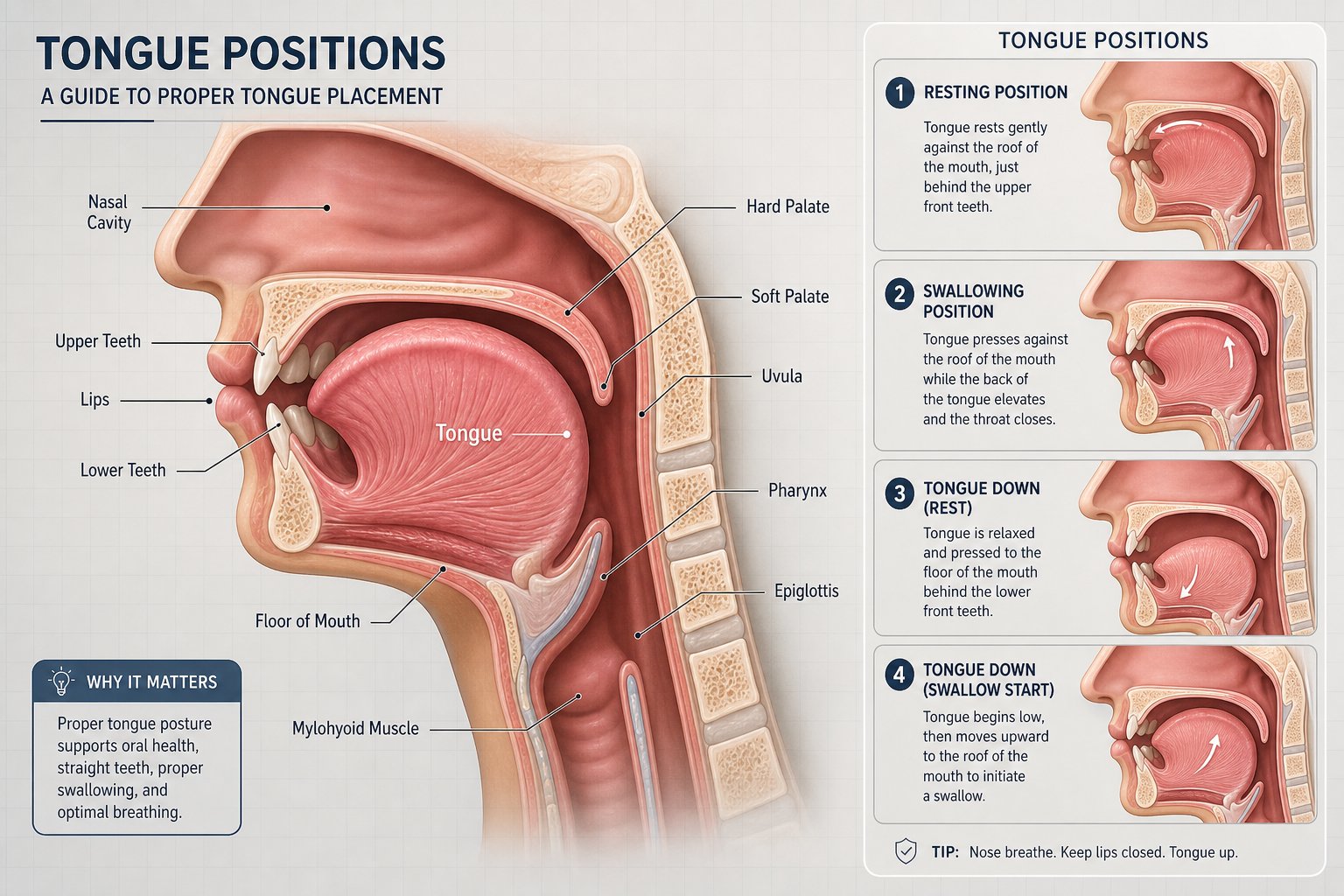
The Allset Learning pronunciation guide makes a key point: the sounds written as x, q, and j in pinyin do not exist in English. For x, you make a "sh"-like sound with the tip of your tongue pressed down behind your lower front teeth. One test: you should be able to smile comfortably while producing it. For q, add a "t" puff of air to that same tongue position, creating something sharper than English "ch." For j, press the middle of your tongue flat against the roof of your mouth and produce an unaspirated sound, nothing like the English "j" in "jump."
The retroflex group (zh, ch, sh, r) requires curling your tongue tip back toward the hard palate. Zh sounds like "j" in "job" with that curl. Ch adds aspiration. Sh is "shoe" with a curled tongue. These show up constantly in surnames like Zhang, Chen, and Shi.
Here's a quick reference for the sounds that matter most when pronouncing names:
| Pinyin Initial | How to Produce It | Name Example |
|---|---|---|
| x | "sh" with tongue tip down, behind lower teeth; you can smile while making it | Xu (许), Xia (夏) |
| q | Add a "t" puff to the x sound; sharper than English "ch" | Qian (钱), Qin (秦) |
| j | Middle tongue flat on roof of mouth; unaspirated, not English "j" | Jiang (蒋), Jin (金) |
| zh | Tongue tip curled back; like "j" in "job" but retroflex | Zhang (张), Zhao (赵) |
| ch | Same curl as zh but with a strong puff of air | Chen (陈), Chu (褚) |
| sh | "sh" in "shoe" with tongue curled back | Shi (施), Shen (沈) |
| r | Tongue curled back; closer to "s" in "pleasure" than English "r" | Ren (任), Rui (芮) |
The Four Tones Applied to Names
If you're new to pinyin tones for beginners, here's the essential concept: Mandarin has four tones plus a neutral (unstressed) tone. Each tone changes the pitch contour of a syllable, and that pitch change alters meaning completely. ThoughtCo's tone guide illustrates this with the syllable "ma": first tone (mā) means mother, second tone (má) means hemp, third tone (mǎ) means horse, and fourth tone (mà) means scold.
Applied to names, here's what each tone sounds like:
- First tone (flat, high pitch): Sustained and level, like humming a single note. The surname Fāng (方) uses this tone.
- Second tone (rising): Pitch goes up, like asking "what?" in English. The given name element Lín (林) uses second tone.
- Third tone (dipping): Pitch drops low then rises slightly. The surname Mǎ (马) uses third tone.
- Fourth tone (falling): Sharp drop from high to low, like a curt command. The surname Zhào (赵) uses fourth tone.
- Neutral tone: Light and unstressed, often appearing in the second syllable of some given names.
When you use a learn pinyin app to practice a name, the tone marks above the vowels tell you exactly which pitch pattern to apply. Ignoring them is like reading English words without stress patterns: technically the same letters, but the result sounds wrong to native ears.
Finals and Vowel Combinations in Names
Beyond initials, certain vowel endings (called "finals") in pinyin don't behave the way English spelling suggests. Three combinations appear frequently in names and consistently mislead English speakers:
- -ian (as in Qian, Jian, Xian): This does not rhyme with English "ee-an." The vowel sounds closer to "yen." Qian is roughly "chee-en," not "kee-an."
- -iu (as in Liu, Jiu, Niu): A hidden vowel lurks here. It's actually pronounced "iou," gliding from "ee" through "oh" to "oo." Liu sounds like "lyoh," not "lee-oo."
- -ui (as in Cui, Hui, Rui): This is actually "uei" compressed. Cui sounds closer to "tsway," not "coo-ee."
The vowel ü deserves special mention. It appears in names like Lü and Nü, and after j, q, and x it's written as plain "u" but still pronounced as ü. To produce it, say "ee" and round your lips tightly without moving your tongue. There's no English equivalent, which is why audio from a pronunciation tool matters so much here.
This is the knowledge that makes a pinyin name pronunciation app useful rather than confusing. Without it, you'd hear native audio and have no framework for replicating what you hear. With it, you know exactly which mouth positions to target and which pitch patterns to follow. The next step is understanding how these apps translate that knowledge into repeatable practice through audio playback, AI scoring, and syllable-level breakdown.
How Pinyin Pronunciation Apps Actually Help You Learn Names
Knowing which sounds to target is one thing. Training your mouth to produce them reliably is another problem entirely. This is the gap a pinyin pronunciation tool is designed to close. These apps don't just show you the correct pinyin spelling or play a sound once. They create a feedback loop: listen, attempt, measure, adjust, repeat. Understanding what's happening under the hood helps you use these tools more effectively and choose the right one for name practice.
Native Speaker Audio vs Text-to-Speech
Most pinyin learning app options deliver audio in one of two ways: pre-recorded native speaker clips or synthesized text-to-speech (TTS) output. The difference matters more than you might expect.
Native speaker recordings capture the natural rhythm, tone transitions, and subtle mouth-shape nuances of real Mandarin speech. When you hear a recorded human say "Xu Qian," you're hearing how the tones flow together in connected speech, not just isolated syllables stitched end to end. High-quality apps record multiple speakers, male and female, at natural conversational speed and at a slower practice speed.
TTS engines have improved dramatically with neural voice synthesis, but they still flatten some tonal transitions and occasionally produce slightly robotic vowel qualities. For pinyin translation tasks, where you just need a rough sense of how characters sound, TTS works fine. For training your ear and mouth to reproduce a specific name accurately, native recordings give you a more reliable target to match against.
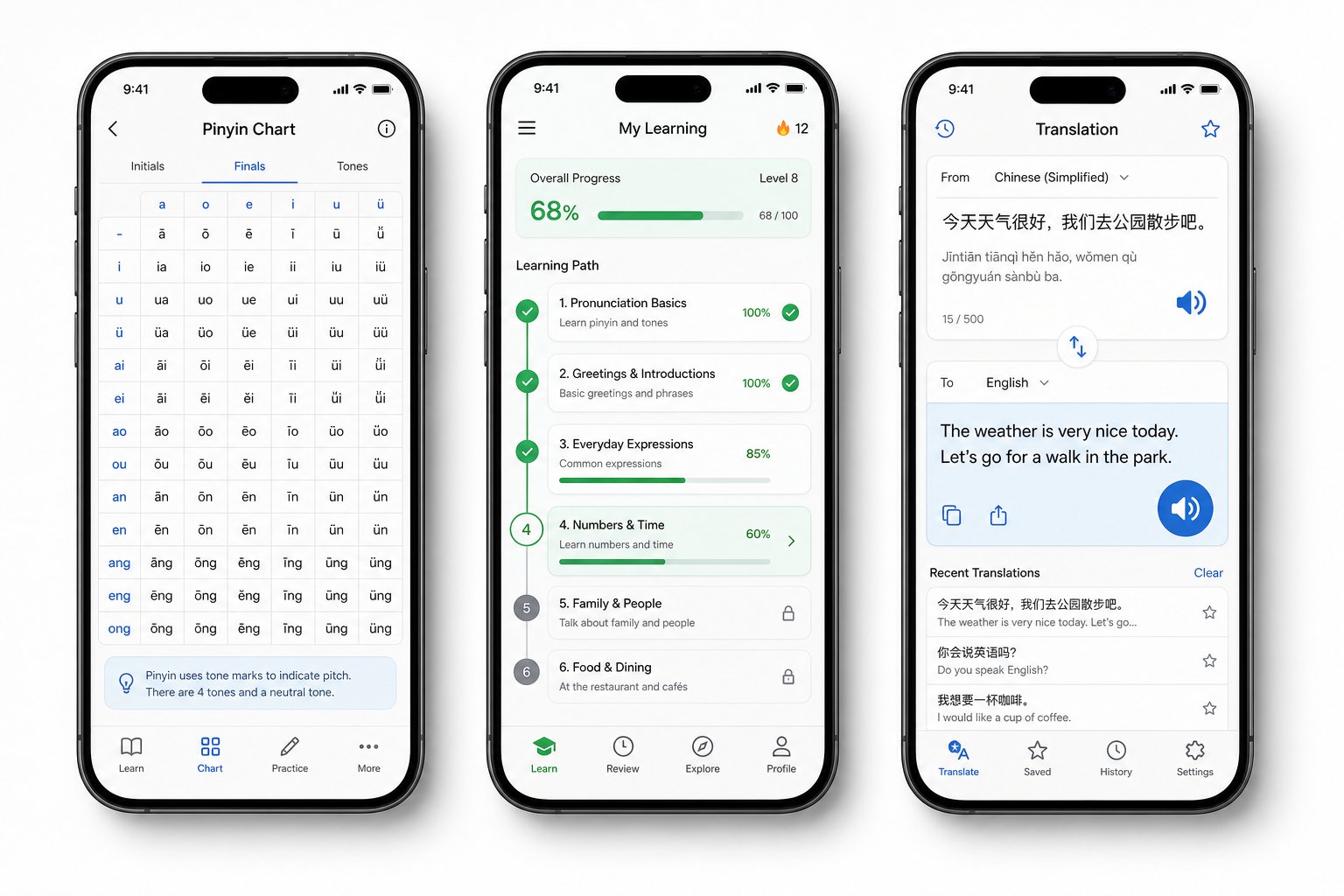
Some apps, like Talk Chineasy, combine an interactive pinyin chart with tap-to-hear audio for every tone and syllable combination. You can isolate the exact initial-final-tone combination in a name and hear it produced clearly before attempting it yourself.
AI Pronunciation Scoring and Feedback
Hearing the correct sound is only half the equation. You also need to know whether your attempt actually matches. This is where AI-powered pronunciation scoring changes the game.
These systems work by comparing your recorded speech against a reference model. The app captures your audio through the microphone, extracts features like pitch contour, duration, and spectral shape, then scores how closely your attempt aligns with native pronunciation patterns. Some tools display this as a simple percentage. Others show a waveform or pitch graph overlaid on the native speaker's, so you can visually spot where your tone drifted flat or your vowel shifted.
The practical value is objectivity. Without scoring, you're guessing whether you sound right. With it, you get measurable feedback on each attempt. Apps like CPAIT (Chinese Pronunciation Assessment and Instruction Tool) have demonstrated that AI scoring can identify specific tonal errors and provide targeted correction prompts. You'll notice the difference immediately: instead of vaguely repeating a name and hoping it sounds close enough, you're zeroing in on the exact syllable and tone that needs adjustment.
Syllable Breakdown for Name Practice
A two-syllable Chinese name contains two distinct sound units, each with its own initial, final, and tone. A three-syllable name has three. The most effective approach is practicing each syllable in isolation before combining them at natural speed.
Quality pronunciation tools let you tap on individual syllables within a name to hear them separately. You practice "Xu" until the score is consistent, then "Qian" until that's solid, then combine them. This syllable-by-syllable method prevents a common problem: getting the first syllable roughly right while the second deteriorates because your attention is split.
Some apps add tone visualization, displaying the expected pitch curve alongside your actual pitch in real time. When you see your third tone failing to dip low enough, or your second tone not rising sharply enough, the correction becomes intuitive. You're not just listening and guessing. You're seeing the gap and closing it with each repetition.
This combination of native audio, AI scoring, and syllable isolation transforms name pronunciation from a passive lookup into active skill-building. The question that follows naturally: what does an efficient practice session actually look like when you have a specific name to prepare for and a meeting in two hours?
Step-by-Step Guide to Practicing a Name Before You Meet Someone
You have a video call in 90 minutes with someone named 刘晓燕. Or maybe you received a LinkedIn connection request from "Cui Zhihao." Either way, you need to go from seeing a name to saying it confidently, and you need a repeatable process that works every time. Here's exactly how to pronounce chinese names using a pronunciation app, broken into steps you can complete in under ten minutes.
Finding the Correct Pinyin for Any Name
Your starting point depends on what you're looking at. If the name is already written in pinyin with tone marks (like Liú Xiǎoyàn), you can skip straight to audio practice. But often you'll encounter Chinese characters in an email signature, a WeChat profile, or a business card. This is where you need to translate chinese characters into pinyin first.
Most pronunciation apps include a text input field where you can paste characters directly. Type or paste the characters, and the app returns the pinyin with tone marks above each syllable. Some apps, like BiangBiang Hanzi, offer a chinese to pinyin camera feature: point your phone at a business card or screen, and the OCR engine recognizes the characters and displays their pinyin conversion in real time. This is particularly useful at conferences or networking events where you receive a physical card with characters you can't type easily.
One important detail: make sure the app displays tone marks, not just bare romanization. "Liu Xiaoyan" without tones is incomplete information. You need "Liú Xiǎoyàn" to know which pitch patterns to apply. If your tool only gives you toneless pinyin, switch to one that includes diacritics or tone numbers.
Breaking Down and Practicing Each Syllable
With the correct toned pinyin in front of you, the practice process follows a clear sequence. Here's the workflow from start to finish:
- Identify each syllable and its tone. For "Liú Xiǎoyàn," you have three syllables: Liú (second tone, rising), Xiǎo (third tone, dipping), and Yàn (fourth tone, falling).
- Listen to native audio for each syllable in isolation. Tap on each syllable individually. Don't try to hear the full name as a blur of sound. Focus on one unit at a time. Notice the pitch movement and the vowel quality.
- Practice each syllable separately. Say "Liú" out loud five or six times. Match the rising pitch. Then move to "Xiǎo," focusing on the dipping tone and the "sh"-like x sound with your tongue tip down. Then "Yàn," with its sharp falling pitch.
- Combine the surname alone. Say "Liú" at natural speed. Since it's a single syllable, this step is quick for most Chinese surnames. For two-character surnames (rare but they exist, like Sīmǎ), practice the pair together.
- Combine all syllables at a slow, deliberate pace. Say "Liú... Xiǎo... yàn" with brief pauses between syllables. Focus on maintaining each tone correctly even as you connect them.
- Speed up to natural conversational pace. Chinese names in real speech flow quickly. Reduce the pauses until the name sounds like a single fluid phrase rather than three chopped-up pieces.
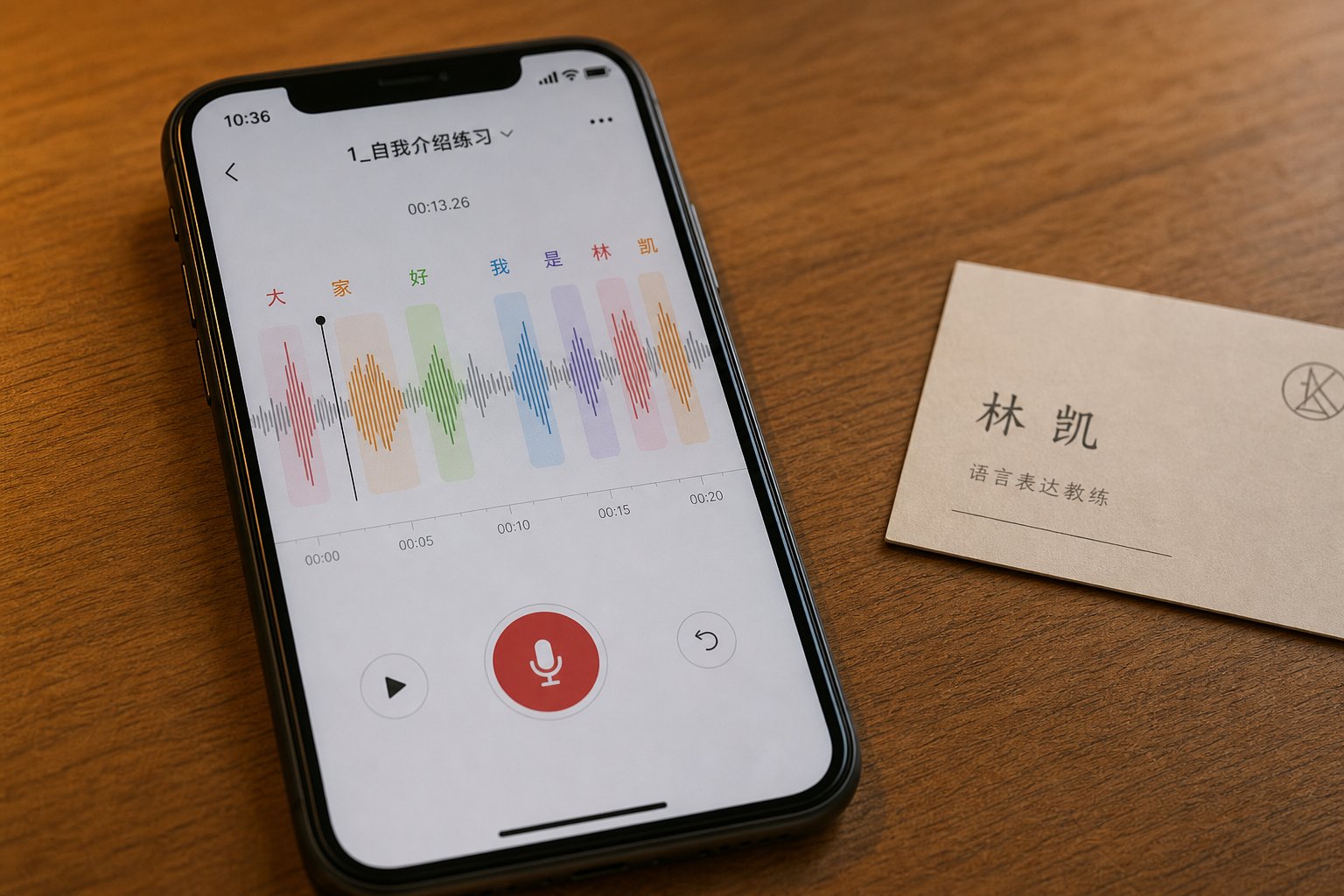
- Record yourself and compare to the native audio. Play back your recording immediately after the reference clip. Listen for tone drift, vowel substitution, or timing differences. If your app offers AI scoring, check which syllable scored lowest and repeat that one.
- Repeat until consistent. Three to five solid repetitions where you feel confident and the audio comparison sounds close is usually enough. You're aiming for recognizable, not perfect.
This entire sequence takes five to eight minutes for a typical three-syllable name. For a two-syllable name, even less.
Recording Yourself and Comparing to Native Audio
The recording step deserves extra attention because it's where most people skip ahead and lose accuracy. When you hear yourself in real time, your brain fills in gaps and assumes you sound better than you do. A recording removes that bias.
Play the native speaker clip, then immediately play your own recording. Listen specifically for three things:
- Tone shape: Did your pitch actually rise, dip, or fall where it should? A common mistake is flattening all tones into a monotone English cadence.
- Initial consonant: Did you produce the correct initial? If the name starts with "X" and you hear yourself making an English "sh" without the tongue-down position, that's your correction target.
- Vowel quality: Did the vowel sound match? Finals like "-ian" and "-iu" have hidden glides that English speakers often simplify.
If your app provides a pitch graph or waveform overlay, use it. Visual feedback makes tone errors obvious in a way that listening alone sometimes doesn't. You'll see your second tone line staying flat instead of rising, or your third tone not dipping low enough before it comes back up.
For names you encounter as characters on a screen or printed card, the camera OCR workflow saves a step. Point, capture, get pinyin, and start practicing, all without needing to figure out how to type unfamiliar characters on your keyboard. Apps with real-time camera recognition display the pinyin overlay directly on the image, so you can see exactly which syllable corresponds to which character.
The whole point of this process is converting uncertainty into confidence before the interaction happens. You're not trying to become fluent. You're trying to say one name well enough that the person across from you feels recognized. That small investment of preparation raises a practical question: with dozens of apps available, which type is actually built for this specific use case rather than a full language curriculum?
Choosing the Best Pinyin App for Names vs Full Language Learning
Not every Chinese language app is built for the same job. Some want to teach you 5,000 vocabulary words over two years. Others just need to tell you how "Zheng Yufei" sounds before your 3 PM call. The gap between these two goals is enormous, and picking the wrong tool means either wading through irrelevant lessons or getting audio that's too generic to help with a specific name.
So how do you find the best pinyin app for names without accidentally signing up for a semester of coursework? You need a clear evaluation framework.
Key Features for Name Pronunciation Specifically
When your goal is pronouncing one person's name correctly, certain features matter far more than others. A gamified vocabulary streak is irrelevant. A syllable-level audio player with tone marks is essential. Here's what to prioritize:
- Custom text input: Can you type or paste any name and get audio? Apps locked to preset vocabulary lists won't help when you need "Zhuang Qiuxia" specifically.
- Individual syllable audio: Can you tap a single syllable and hear it in isolation? Full-phrase audio alone makes it hard to identify which part you're getting wrong.
- Tone marks displayed: Does the app show diacritics or tone numbers? Bare romanization without tones is incomplete data.
- AI pronunciation scoring: Can you record yourself and get measurable feedback? Without scoring, you're guessing at accuracy.
- Offline access: Can you practice on a plane or in a building with poor signal? Conference venues and international travel often mean unreliable connectivity.
- No course commitment required: Can you use the tool immediately for a single name without completing onboarding lessons or subscribing to a curriculum?
If an app checks most of these boxes, it's suited for name preparation. If it requires you to finish Unit 1 before unlocking free input, it's designed for language learners, not professionals with a meeting in an hour.
Dedicated Pinyin Tools vs General Language Apps
Three broad categories of apps touch pinyin pronunciation, and each serves a different primary audience.
Dedicated pinyin trainers focus exclusively on the sound system. They typically offer interactive pinyin charts where you can tap any initial-final-tone combination and hear native audio instantly. Many include recording features and tone visualization. These tools let you input any syllable combination, making them ideal for practicing unfamiliar names. They don't teach grammar, vocabulary, or reading comprehension because that's not their purpose.
General Chinese learning apps like Duolingo and HelloChinese include pinyin sections as part of a broader curriculum. Duolingo, for instance, features an independent pinyin and hanzi section you can access anytime during your study. These apps are excellent for building long-term language skills, but they typically don't let you input a custom name and hear it pronounced. You'll learn how pinyin works in general, which is valuable background knowledge, but you won't get targeted practice on "Cui Zhihao" before tomorrow's meeting.
Translation tools with audio occupy a middle ground. Apps like Google Translate and DeepL let you paste Chinese characters and hear them spoken aloud. They function as a chinese han yu pin yin translator when you need to convert characters to romanized text with pronunciation. The audio quality is generally good thanks to neural TTS engines, and custom input is unlimited. The limitation is that they offer no practice feedback. You hear the name once, but there's no scoring, no syllable isolation, and no way to compare your attempt against the reference.
Translation Apps With Audio Playback
For many professionals, a translator app is the first tool they reach for. You paste characters from an email, tap the speaker icon, and hear the name. This works as a starting point, especially when you need a hanyu pinyin to chinese converter to confirm which characters correspond to which sounds. Google Translate, in particular, offers high-quality audio pronunciation samples and supports real-time camera translation for business cards and signage.
The trade-off is passive listening versus active practice. Hearing a name once doesn't build muscle memory. You need repetition, recording, and feedback to move from "I heard it" to "I can say it." Translation apps excel at the first step but leave you on your own for everything after.
Here's how the three categories compare across the criteria that matter for name pronunciation:
| Evaluation Criteria | Dedicated Pinyin Trainers | General Language Apps | Translator Tools |
|---|---|---|---|
| Custom name input | Yes, any syllable combination | Limited or no custom input | Yes, paste any text |
| Individual syllable audio | Yes, tap-to-hear per syllable | Sometimes, within lessons | Full phrase only |
| Tone marks displayed | Yes, always | Yes, in pinyin sections | Varies by app |
| AI pronunciation scoring | Some apps include it | Rarely for custom input | No |
| Offline access | Often available | Partial (downloaded lessons) | Requires download of language packs |
| No course commitment | Immediate, open access | Requires onboarding or progression | Immediate, open access |
| Best for name practice | Strong | Weak for this specific task | Moderate (listen only) |
The practical takeaway: if you only need to pronounce names correctly before professional interactions, a dedicated pinyin trainer gives you the most relevant features with the least friction. A translator app is your backup for quick lookups when you just need to hear a name once. General language apps are valuable if you want to build broader Chinese skills over time, but they're not optimized for the "I have a meeting in an hour" scenario.
Choosing the right tool is half the equation. The other half is knowing which real-world situations actually demand this preparation, and understanding what's at stake when you walk in prepared versus when you wing it.

Real-World Scenarios Where Getting the Name Right Changes Everything
Having the right tool and knowing how to use it only matters if you actually apply it when the moment counts. And those moments show up more often than most professionals realize. Every time you meet a Chinese colleague, greet a client, or introduce a speaker, you're making a choice: prepare for two minutes beforehand, or gamble on guesswork in real time.
The stakes vary by context, but the underlying principle stays constant. As Dale Carnegie wrote in How to Win Friends and Influence People, a person's name is "the sweetest and most important sound in any language." A NameCoach survey cited by SHRM found that 74 percent of respondents struggled with pronouncing names at work, and 22 percent admitted they avoided introducing someone altogether because they didn't know how to say the person's name. That avoidance has real consequences across every professional setting.
Business Meetings and Client Relationships
Imagine opening a pitch meeting by butchering your prospect's name. The content of your presentation hasn't changed, but the first impression has. Ten percent of respondents in that same NameCoach survey said they botched a major sales opportunity after mispronouncing a prospect's name. In client-facing roles, the name is often the very first word you say. Getting it right signals preparation, cultural awareness, and respect for the relationship.
For recurring client relationships, the stakes compound over time. A one-time slip is forgivable. Repeated mispronunciation after being corrected becomes what researchers call a microaggression. Using a pinyin app to practice before each call until the name sticks in muscle memory prevents that slow erosion of trust.
Academic and Conference Settings
Conference moderators introduce speakers. Panel chairs call on audience members. Thesis advisors present their doctoral candidates. In each case, you're saying someone's name in front of a room full of people. Mispronouncing a presenter's name at an academic conference doesn't just embarrass you. It puts the speaker in the awkward position of correcting you publicly or letting it slide while the audience hears the wrong version.
If you're chairing a session with a presenter named Zhāng Qiūxiá, spending three minutes with a pronunciation tool beforehand means you introduce them with confidence. The speaker feels respected. The audience hears the correct form. And you avoid the painful mid-sentence pause where you squint at your notes and guess.
Customer Service and Hospitality Contexts
Hotels, airlines, medical offices, and financial services all handle client names constantly. When a guest named Huáng Wěi checks into a hotel and the front desk staff says something resembling "Hwang Way" versus a closer approximation of the actual tones, the guest notices. Hospitality is built on making people feel recognized and valued. A name is the most personal piece of that experience.
Customer service teams that serve Chinese-speaking clients can use a chinese helper tool to prepare for scheduled appointments or VIP arrivals. The effort doesn't require fluency. It requires looking up the pinyin, listening to the audio twice, and practicing before the guest walks through the door.
Here's a broader view of where this preparation pays off:
- HR onboarding and team introductions: New hires form first impressions of company culture within hours. When a manager introduces "our new team member, Liú Xiǎoyàn" with correct pronunciation, it sends an immediate signal of inclusion. When they stumble or anglicize the name without asking, it sends the opposite. Trainual's workplace guide notes that mispronunciation can disincentivize employees from participating and even cause them to stop correcting others over time.
- Networking events: You have 30 seconds to make a connection. Saying someone's name correctly in that window creates instant rapport. Saying it wrong creates a correction loop that eats into your limited interaction time and shifts the energy from connection to awkwardness.
- Media and public speaking: Journalists, podcast hosts, and event emcees who pronounce chinese names at work or in public forums set the standard for their entire audience. One correct pronunciation on a broadcast reaches thousands of listeners. One mangled version does the same, but in the wrong direction.
- Internal meetings and cross-office collaboration: Global companies with teams in Shanghai, Shenzhen, or Taipei have employees whose names appear on Slack channels and Zoom tiles daily. Thirteen percent of NameCoach survey respondents said they didn't call on someone in a meeting because they couldn't pronounce the person's name. That's participation lost, ideas unheard, and collaboration undermined by a solvable problem.
None of these scenarios require perfection. Native-level tones aren't the goal. The goal is demonstrable effort. When you convert a name from characters to pin yin, listen to the audio, and practice before the interaction, people notice. They notice because most others don't bother. That contrast is what transforms a two-minute preparation habit into a genuine professional advantage.
The pattern across all these contexts is the same: a small investment of time before the interaction yields outsized returns in trust, rapport, and professional credibility. The final question is how to make that investment consistent rather than something you remember only when the stakes feel high enough.
Putting It All Together and Building Your Name Pronunciation Habit
Every scenario covered in this guide shares one truth: the effort happens before the interaction, not during it. You don't need to become a Mandarin speaker. You need a repeatable two-minute routine that turns an unfamiliar name into a confident greeting.
Your Practical Next Steps
Start here:
- Get a dedicated pinyin name practice app that supports custom text input, syllable-level audio, and tone mark display. Keep it on your phone's home screen so the barrier to use is zero.
- Bookmark a translator tool as your backup. When you encounter characters in an email or on LinkedIn, use it to translate chinese to pinyin quickly. A hanyu to chinese converter works in reverse if you need to confirm which characters match a romanized name you've been given.
- Learn the four tones once. Spend ten minutes understanding the pitch patterns. That single session makes every future name practice session faster because you'll know what the diacritics are asking your voice to do.
- Practice before every scheduled interaction. Calendar invite with a new Chinese contact? That's your cue. Five minutes of syllable-by-syllable repetition is all it takes.
Building a Habit of Name Preparation
Cramming a name thirty seconds before a call produces anxiety, not confidence. Consistent short sessions work better. Treat name preparation the same way you'd review an agenda or scan a client's LinkedIn profile: it's part of your pre-meeting routine, not an emergency measure.
Over time, common syllables and tones become familiar. You'll recognize that "Xu" always has that tongue-down hissing quality, that "-ian" always sounds closer to "yen," and that fourth-tone syllables always drop sharply. Each name you practice builds pattern recognition that makes the next one easier.
Perfection isn't the standard. Recognizable effort is. When you say someone's name and they don't have to correct you, or when they smile because you clearly prepared, that moment carries more professional weight than any slide deck or talking point.
Two minutes of practice with a pronunciation app signals more respect than two hours of polished presentation materials ever could.
The tools exist. The knowledge is in this guide. The only remaining variable is whether you build the habit. Start with the next Chinese name on your calendar.
Frequently Asked Questions About Pinyin Name Pronunciation Apps
1. How do I pronounce a Chinese name written in pinyin?
Start by identifying each syllable and its tone mark. Chinese names follow a surname-first structure, with most surnames being one syllable. Use a pinyin pronunciation app to hear native speaker audio for each syllable individually, then combine them at natural speed. Pay attention to initials like x, q, and zh that sound nothing like their English letter equivalents, and follow the tone marks (flat, rising, dipping, or falling pitch) above each vowel to produce the correct pitch pattern.
2. What is the best app to learn Chinese name pronunciation?
The best app depends on your goal. For pronouncing specific names before meetings, dedicated pinyin trainers with custom text input, syllable-level audio, and AI pronunciation scoring are most effective. They let you paste any name and practice immediately without completing lessons. Translation apps like Google Translate work as quick backups for hearing a name once, but lack practice feedback. General language learning apps are better suited for long-term study rather than preparing for a specific interaction.
3. Why is it so hard for English speakers to pronounce Chinese names?
Pinyin uses familiar Latin letters to represent sounds that do not exist in English. Letters like x, q, and j produce entirely different sounds than English speakers expect. Additionally, Mandarin Chinese uses four tones where pitch direction changes word meaning completely. The U.S. State Department classifies Mandarin as a Category IV language, the highest difficulty tier for English speakers, because the sound systems are structurally incompatible. Standard English phonetic intuition consistently fails when applied to pinyin.
4. How long does it take to learn to pronounce a Chinese name correctly?
With a pinyin pronunciation app, you can practice a specific name in five to eight minutes. The process involves identifying each syllable and tone, listening to native audio, practicing syllables individually, combining them at natural speed, and recording yourself for comparison. You do not need to learn Mandarin. You need a focused routine targeting one name at a time. Over time, common syllables become familiar and each new name takes less effort to prepare.
5. Do Chinese name pronunciation apps work offline?
Many dedicated pinyin trainers offer offline access, which is useful at conferences, during international travel, or in buildings with poor connectivity. Translation apps like Google Translate require downloading language packs in advance for offline use. General language learning apps typically only work offline for previously downloaded lessons. When choosing an app for name practice, check whether offline mode supports custom text input and audio playback, since those are the features you need most in low-connectivity situations.