Why Pinyin Name Pronunciation Trips Up English Speakers
Imagine this: you glance at a meeting invite and see the name "Xu Qiuying" listed as your new project lead. Or maybe a business card lands on your desk reading "Zhang Wei." You want to greet this person correctly, but something feels off. Do you say "Zoo"? "Ksoo"? "Zang"? If you have ever frozen mid-introduction because a Chinese name in pinyin looked nothing like it sounded, you are not alone. This is one of the most common professional stumbling blocks in globally connected workplaces, and it comes down to a single misunderstanding about how pinyin in Chinese actually works.
Why Getting Chinese Names Right Matters
Chinese names carry deep personal and cultural weight. They are not arbitrary labels. As Temple University's Center for Chinese Language Instruction explains, a Chinese name tells the story of a family's ideals and hopes, aspirations that the bearer often embraces throughout life. The characters chosen for a name reflect philosophical traditions, family heritage, and even beliefs about destiny. When you mispronounce someone's name, you are not just mangling a sound. You may be unintentionally saying a completely different word, sometimes one with an embarrassing or offensive meaning.
Consider the name Wang Wen (王问) with a fourth tone on "wen," meaning a smart and inquisitive person. Shift that tone to the second tone and you get Wang Wen (王蚊), which means "mosquito." The stakes are real. Pronouncing a person's name correctly signals respect and cultural understanding, and the effort you put in builds rapport whether you are in a classroom, a boardroom, or a casual introduction. Chinese pronounciation challenges are not a reason to avoid trying. They are a reason to learn the system behind the sounds.
The Gap Between Pinyin and English Sound Assumptions
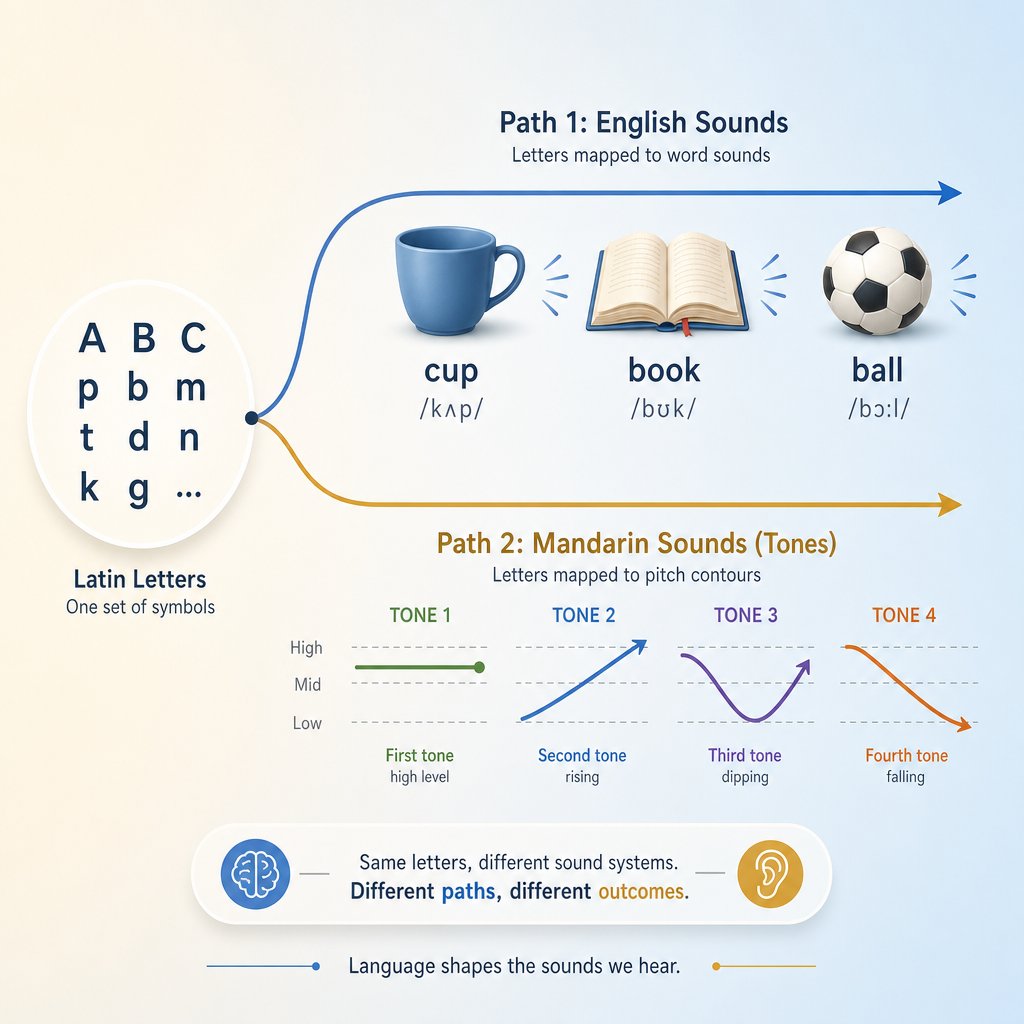
Here is where most English speakers go wrong. They see Latin letters on a page and instinctively apply English phonetics. It feels natural. The letters look familiar. But pinyin was never designed as a phonetic spelling of your name for English readers. It was created as a romanization system for native Mandarin speakers who already knew the sounds and simply needed a way to type and alphabetize them. The result is a coding system where letters like "x," "q," "c," and "zh" represent Mandarin sounds that have no direct English equivalent.
Pinyin letters do not map to English sounds the way most readers assume. This single misunderstanding causes systematic errors in Chinese name pronunciation and is the reason English speakers mispronounce nearly every unfamiliar Chinese name they encounter.
When you try to chinese pronounce a name like "Xu" as if it rhymes with "zoo," or read "Qian" as "kee-ann," you are applying rules from the wrong language entirely. The gap between what pinyin looks like and what it sounds like is not a minor accent issue. It is a completely different sound map. Understanding this distinction is the foundation of effective pinyin name pronunciation practice, and it is exactly what separates people who consistently get names right from those who keep guessing wrong.
English in mandarin chinese contexts uses the same 26 letters to encode an entirely different phonetic reality. The good news? Once you learn the actual sound values behind a handful of tricky initials and finals, the system becomes predictable. Chinese pronunciation in english approximations is possible. You just need the right decoder ring, which is exactly what the sections ahead will provide.
How Pinyin Romanization Actually Works
That decoder ring starts with a mental shift. You need to stop seeing pinyin as phonetic spelling in the English sense and start seeing it for what it actually is: a standardized code. The hanyu pinyin table uses the same 26 Latin letters you already know, but it assigns them to Mandarin sounds based on Chinese phonological categories, not English pronunciation habits. Think of it like musical notation. The symbols on a staff look like dots and lines, but they encode pitch, duration, and rhythm that only make sense once you learn the system. Pinyin works the same way for Mandarin sounds.
Pinyin Is a Code Not a Phonetic Spelling
When linguists define international phonetic alphabet symbols, they create one unique symbol per sound so there is zero ambiguity. Pinyin takes a different approach. It repurposes familiar Latin letters to represent unfamiliar Mandarin sounds, which means the same letter can point to completely different mouth positions depending on whether you are reading English or reading a Chinese pinyin chart. The letter "q" in English cues you to say "kw" as in "queen." In pinyin, "q" represents a sound closer to "ch" in "cheese" but produced with the tongue pressed forward against the palate.
This is why plugging a Chinese name into a phonetic spelling generator built for English will give you garbage output. Those tools map letters to English phonemes. Pinyin maps letters to Mandarin phonemes. The two systems share an alphabet but almost nothing else. Once you accept that pinyin is a code requiring its own lookup table rather than intuitive reading, the mispronunciations stop being random and start becoming predictable, fixable errors.
Letters That Fool English Speakers Every Time
A handful of pinyin initials cause the vast majority of name mispronunciations in English-speaking workplaces. You will encounter these constantly because they appear in some of the most common Chinese surnames and given names. The table below shows what English speakers typically guess versus what the pinyin chart actually indicates.
| Pinyin Letter | What English Speakers Guess | Actual Mandarin Sound | English Approximation |
|---|---|---|---|
| c | "k" as in "cat" | Unaspirated "ts" | "ts" as in "cats" |
| q | "kw" as in "queen" | Aspirated palatal affricate | "ch" as in "cheese" |
| x | "ks" as in "box" | Palatal fricative | "sh" as in "sheep" with tongue forward |
| zh | "z" as in "zoo" | Retroflex affricate | "j" as in "Joe" |
| z | "z" as in "zebra" | Unaspirated "dz" | "ds" as in "fads" |
| r | "r" as in "red" | Retroflex approximant | Between English "r" and "zh" in "vision" |
Notice the pattern. Every single one of these letters triggers an English reflex that lands you on the wrong sound entirely. The name "Cai" is not "kai" but closer to "tsai." "Xu" is not "ksoo" but closer to "shoo" with the tongue positioned near the front teeth. "Zhao" is not "zow" but closer to "jow." These are not subtle accent differences. They are entirely different consonants.
You do not need an ipa alphabet converter or years of linguistics training to get these right. You just need to override six or seven English reflexes with their pinyin equivalents. The pinyin table is consistent: once you learn that "q" always means that forward "ch" sound, it works the same way in every name you will ever encounter, whether it is Qian, Qin, or Qiang. That predictability is the system's greatest strength for anyone committed to getting names right.
Of course, consonants are only half the puzzle. Chinese names also follow a specific structural pattern, with surname placement, syllable count, and stress rhythm all differing from English naming conventions. Understanding that structure helps you know where one syllable ends and the next begins, which directly affects how you apply these sound rules in practice.
Understanding Chinese Name Structure for Better Pronunciation
Knowing which sounds the letters represent is essential, but you also need to know where one name component ends and another begins. Chinese names follow a structure that is the mirror image of English names, and that structure directly shapes how you pace and stress each syllable when speaking.
Surname First and Given Name Second
In English, you hear "Michael Chen" and instinctively know "Michael" is the given name and "Chen" is the surname. Chinese names flip that order entirely. The surname comes first, followed by the given name. So in "Chen Xiaoming," Chen is the family name and Xiaoming is the personal name. As Columbia University's Asia for Educators explains, this ordering reflects a cultural principle: what is most important about a person is that they belong to a family, so the family name leads.
You might wonder: is Mandarin the same as Chinese when people talk about "Chinese names"? Mandarin is the standard spoken language of China, and pinyin specifically romanizes Mandarin pronunciation. So when you see a name written in pinyin, you are looking at its Mandarin sound representation, regardless of what dialect the person's family may speak at home.
Identifying which part is the surname and which is the given name becomes straightforward once you know the pinyin spelling rules. Correct pinyin capitalizes the surname and the given name separately, and two-syllable given names are written as one word with no space or hyphen. For example: "Wang Xiaoli" tells you Wang is the surname (capitalized, one syllable) and Xiaoli is the given name (capitalized, two syllables joined together).
Here are the most common name structures you will encounter:
- Single-syllable surname + two-syllable given name (most common): Li Mingzhu, Zhang Xiaofeng, Wang Jiaming
- Single-syllable surname + single-syllable given name: Chen Wei, Liu Fang, Zhao Yun
- Compound surname + given name (less common): Sima Qian, Ouyang Xiu, Zhuge Liang
The vast majority of Chinese surnames are a single syllable, a single mandarin character. Given names are typically one or two syllables. So when you see a three-syllable Chinese name, you can almost always assume the split is one-plus-two: the first syllable is the surname and the remaining two form the given name.
Stress and Rhythm Patterns in Chinese Names
Here is where English habits create a subtle but important problem. In English, names have clear stress patterns. You say "JEN-ni-fer" with heavy emphasis on the first syllable and lighter, reduced vowels on the rest. English is what linguists call a stress-timed language, meaning some syllables get crushed short while others stretch long.
Mandarin works differently. Research on syllable rhythm in Mandarin shows that the language trends toward giving each syllable relatively equal duration, with average syllable length around 197 milliseconds in natural speech. Rather than one syllable dominating and others shrinking, each syllable in a Chinese name carries its own tone and roughly equal weight. The syllable meaning shifts based on tone, not stress.
So what is a syllable doing in a Chinese name that it does not do in English? It is carrying a tone that functions like a pitch melody, and that tone is the primary way listeners distinguish meaning. If you define syllable in the Mandarin context, each one is a self-contained unit of sound with its own consonant-vowel structure and its own tonal identity. There are no throwaway syllables that get swallowed or mumbled.
When you say "Zhang Xiaoming," resist the English urge to stress "ZHANG" and then rush through "shao-ming." Instead, give each of the three syllables roughly equal time and let the tones do the expressive work. Think of it as three evenly spaced notes rather than one loud beat followed by two quiet ones. This even rhythm is what makes Chinese names sound natural to native speakers, and it is the rhythmic foundation your pinyin name pronunciation practice should build on.
With the structural blueprint in place, the next challenge is producing the individual sounds correctly, especially the initials that have no English counterpart at all.
The Pinyin Sounds That Trip Up Every English Speaker
Six consonants and one vowel. That is all that stands between you and dramatically better Chinese name pronunciation. These sounds appear in hundreds of common names, yet they have no clean English equivalent. The good news is that each one can be approximated using mouth positions you already know how to make. You just need to combine them in ways English never asks you to.
Mastering X Q and Zh in Chinese Names
These three initials show up constantly in Chinese names, and they share a common trait: English speakers map them to the wrong sound category entirely. In chinese language phonetics, each of these represents a distinct place of articulation in the mouth. Understanding the phoneme definition behind each one helps you see why they sound so different from what the letters suggest.
Start with X, as in Xi, Xiao, or Xue. Your English brain sees "x" and wants to say "ks" like in "box." Forget that completely. The pinyin X is a palatal fricative that sounds like "sh" in "sheep" but with your tongue pushed forward and flattened behind your lower front teeth. Imagine whispering "she" while smiling. That forward, hissing quality is the X sound.
Next is Q, found in names like Qian, Qin, and Qiang. This is not "kw" as in "queen." It is an aspirated version of the "ch" in "cheese," again with the tongue pressed forward against the hard palate. The key difference from English "ch" is tongue position: keep it behind your lower teeth rather than curled up toward the roof of your mouth. A puff of air should escape when you release the sound.
Then there is Zh, appearing in Zhang, Zhao, and Zhou. English speakers often read this as a buzzy "z" sound. In reality, Zh sounds much closer to the English "j" in "John" or "dr" in "dream," but with the tongue curled slightly backward (retroflex). If you can say "Joe" with your tongue tip raised toward the roof of your mouth, you are producing something very close to the Zh in Zhang.
The C R and U Sounds English Lacks
The remaining tricky consonants round out the set of sounds that make mandarin phonics feel alien to English ears.
C in names like Cai, Chen, and Cui is never the "k" sound from "cat" or the "s" sound from "city." It is an aspirated "ts," exactly like the ending of "cats" or "boots" but moved to the front of a syllable. Say "tsai" quickly and you have the surname Cai.
R in Ren or Rui is not the English "r" where your tongue floats freely in the middle of your mouth. The Chinese R requires raising your tongue toward the roof of your mouth, similar to the position for "sh" or "zh." The resulting sound sits somewhere between the English "r" in "red" and the "s" in "vision." Think of buzzing the "zh" in "measure" while letting your voice through.
U (written as u in pinyin) appears after j, q, x, and y, where it actually represents the sound "u" that does not exist in English. To produce it, say "ee" as in "see," then round your lips into a tight circle without moving your tongue. That shift from spread lips to rounded lips while holding the "ee" tongue position gives you the correct vowel for names like Lu (when written with the umlaut) and the "u" in Xu, Qu, and Yu.
The table below pulls all six problem sounds together into a quick-reference format. Bookmark this for your next pinyin name pronunciation practice session before a meeting or introduction.
| Pinyin Sound | Example Names | Common English Mispronunciation | Closer English Approximation |
|---|---|---|---|
| X | Xi, Xiao, Xue, Xu | "ks" as in "extra" | "sh" in "sheep" with tongue forward behind lower teeth |
| Q | Qian, Qin, Qiang, Qi | "kw" as in "queen" | "ch" in "cheese" with tongue forward, strong puff of air |
| Zh | Zhang, Zhao, Zhou, Zhu | "z" as in "zoo" | "j" in "John" with tongue curled back |
| C | Cai, Chen, Cui, Cao | "k" as in "cat" or "s" as in "city" | "ts" as in "cats" with a puff of air |
| R | Ren, Rui, Rong | "r" as in "red" | Between "r" and "zh" in "vision," tongue raised to roof |
| U (after j, q, x, y) | Xu, Qu, Yu, Lu | "oo" as in "food" | Say "ee" then round lips tightly without moving tongue |
In the phonemes definition used by linguists, each of these sounds represents a distinct unit of meaning-distinguishing sound in Mandarin. Swap one for another and you change the word entirely. That is why getting these chinese phonetic distinctions right matters so much for names: the difference between "Xu" and "Shu," or "Qi" and "Chi," is not just an accent variation. It is the difference between saying someone's actual name and saying a completely different syllable.
Practice each sound in isolation first. Say "ts-ts-ts" to warm up for C. Whisper "she" with a wide smile for X. Curl your tongue back and say "Joe" for Zh. Once these individual consonants feel natural, you are ready to layer on the element that truly transforms meaning in every Chinese name: tone.

How Tones Transform the Meaning of Chinese Names
You have the consonants down. You know that "Zh" sounds like "J" and "X" sounds like a forward "sh." But here is the thing: even with perfect consonants and vowels, saying a Chinese name on the wrong pitch turns it into a completely different word. Tones are not accent or emphasis. They are the core mechanism that separates one name from another in Mandarin, and skipping them is like dropping vowels from English words and hoping people figure it out.
Four Tones That Change Name Meaning Completely
So how do you define tone in Mandarin? A tone is a prescribed pitch contour applied to every syllable that determines which word you are saying. Mandarin has four main tones plus a neutral tone, and each one gives the same string of letters an entirely different meaning. This is the tonal definition that matters most for names: the syllable "li" pronounced four different ways points to four different surnames and characters.
Consider these tone examples using the syllable "li":
- Li (first tone, flat high) — can represent 黎 (a surname meaning "dawn")
- Li (second tone, rising) — represents 李 (the most common Chinese surname, meaning "plum")
- Li (third tone, dipping) — represents 礼 (meaning "ritual" or "propriety")
- Li (fourth tone, falling) — represents 利 (meaning "benefit" or "sharp")
These are not subtle shades of the same name. They are entirely different tone words pointing to different characters, different families, and different identities. Tones in Mandarin are roughly as important as vowels in English. You would never tell someone named "Ben" that close enough is "Bin" or "Bun." The same logic applies to tones in Chinese names.
Beyond the four main tones, Mandarin also has a neutral tone: an unstressed, short syllable that borrows its pitch from the syllable before it. The neutral tone rarely appears in surnames, but it does show up in some given-name syllables during casual speech, where the second syllable of a two-character given name may lighten slightly.
How to Read and Produce Tone Marks
When you see pinyin written with diacritical marks above the vowels, those small symbols are your pitch instructions. Each mark tells you exactly what your voice should do. Here is how to read and produce each one:
- First tone (macron: ā) — Hold your voice at a steady, high pitch, like the sound you make when a doctor asks you to say "aah." Name example: Fāng (方, a common surname). Keep the pitch flat and resist the urge to let it drop at the end.
- Second tone (acute accent: á) — Start in the middle of your pitch range and rise to the top, like the intonation of a surprised one-word question: "What?" Name example: Wáng (王, the most common surname in China). Let your voice climb steadily upward.
- Third tone (caron: ǎ) — Drop your voice low and let it creep slightly upward at the end. In natural speech, this tone is mostly just low rather than a full dip-and-rise. Name example: Lǐ (李, the second most common surname). Keep it low and relaxed rather than forcing a dramatic scoop.
- Fourth tone (grave accent: à) — Start at the top of your range and drop sharply, like a firm "No!" said to a child reaching for something dangerous. Name example: Zhào (赵, a top-ten surname). Fall quickly and decisively from high to low.
These diacritical marks always sit above the main vowel of a syllable, following a specific placement priority: a takes precedence over o, which takes precedence over e, and so on. When you see "Huáng," the mark sits on the "a" because it ranks highest in the vowel hierarchy. When you see "Liú," the mark goes on the "u" because in an "iu" combination, the final vowel carries the tone.
A practical tip: when practicing, exaggerate the tones at first. Make the first tone unnaturally high and flat. Make the fourth tone dramatically sharp. This overemphasis builds muscle memory faster than timid, half-committed attempts. You can always dial it back once the pitch patterns feel automatic. The goal of any pinyin name pronunciation practice session is to make the correct tone feel as natural as the correct consonant, because in Mandarin, they carry equal weight.
Getting individual tones right on isolated syllables is one thing. But Chinese names are two or three syllables long, and when certain tones land next to each other, they shift. These automatic changes follow predictable rules that directly affect how multi-syllable names actually sound in conversation.
Tone Sandhi Rules Every Name Learner Needs
Mandarin tones do not exist in isolation. When syllables sit next to each other in a name, certain tone combinations trigger automatic shifts in pronunciation. Linguists call this phenomenon tone sandhi, and its intonation meaning is straightforward: the pitch contour of a syllable changes based on what comes after it. If you have ever practiced a name syllable by syllable and then noticed it sounds different when native speakers say the full name at natural speed, tone sandhi is likely the reason.
Third Tone Sandhi in Two-Syllable Names
When two third-tone syllables appear in sequence, the first automatically shifts to second tone. This rule is not optional or stylistic. It is a mandatory phonological change that affects many common Chinese name combinations.
This is the single most important sandhi rule for name pronunciation. Consider the name Lǐ Wěi (李伟). Both syllables carry a third tone in their dictionary form. But no native speaker actually says two dipping tones back to back. Instead, the first syllable rises like a second tone, producing something that sounds like Li Wei (with "Li" rising and "Wei" dipping low). Your ear hears a second tone followed by a third tone, even though both characters are written with third-tone marks.
Here are more name combinations where this rule applies:
- Zhǎng Yǔ — pronounced as Zhang Yu (first syllable rises)
- Mǎ Hǎi — pronounced as Ma Hai (first syllable rises)
- Lǚ Xiǎo — pronounced as Lu Xiao (first syllable rises)
- Shěn Yǐng — pronounced as Shen Ying (first syllable rises)
The pattern is consistent. Any time a surname carries a third tone and the first syllable of the given name also carries a third tone, that surname will sound like a rising second tone in natural speech. This is not sloppy pronunciation. It is how Mandarin works at a structural level, and tone sandhi rules apply universally across all speakers.
For three-syllable names with consecutive third tones, the grouping determines which syllables shift. In a name like Mǎ Xiǎoměi, the given name "Xiaowei" groups together, so the intonations shift within that pair first: "Xiao" rises to second tone while "mei" stays third. The surname "Ma" then interacts with the already-shifted "Xiao," and since "Xiao" is now effectively second tone, "Ma" keeps its original third-tone dip.
When Tones Shift in Natural Speech
Beyond the third-tone sandhi rule, casual speech introduces another layer: the neutral tone. The intonation definition of a neutral tone is an unstressed syllable that loses its original pitch contour and instead takes a short, light quality determined by the preceding tone. In names, this most commonly affects the second syllable of two-syllable given names during fast, informal conversation.
Imagine a coworker named Wang Mingzi. In careful speech, each syllable gets its full tone. But in everyday office chatter, the final syllable "zi" may lighten to a neutral tone, becoming shorter and lower in pitch. This inflectional definition of tone reduction is especially common in northern Mandarin dialects, where unstressed syllables are lighter and shorter than their full-tone counterparts.
For your own practice, here is the practical takeaway: always learn and produce the full tones first. The neutral tone lightening happens naturally at speed and varies by region. If you nail the full tones and the third-tone sandhi rule, you will sound far more accurate than someone who gets the consonants right but ignores pitch entirely. These sandhi patterns are what separate textbook pronunciation from the way real names flow in conversation, and they give your practice sessions a level of authenticity that isolated syllable drills cannot achieve.
With these tonal mechanics in place, the next step is applying everything to the surnames you will encounter most often in professional and academic settings.

Common Chinese Surnames Pronunciation Reference Table
Knowing the rules is one thing. Having a ready-made reference you can glance at thirty seconds before a meeting is another. The pronunciation table below covers the 20 most common Chinese surnames, which together account for the family names of hundreds of millions of people. If you work with Chinese colleagues, clients, or classmates, you will encounter most of these within your first few interactions.
This pinyin pronunciation table breaks each surname into its component parts: the initial consonant, the final vowel sound, and the tone. Think of it as a mandarin pinyin chart focused exclusively on the names you are most likely to need in professional settings. Each English approximation is designed to get you close enough that a native speaker will recognize the name immediately, even if your accent is not perfect.
Top 20 Chinese Surnames with Pronunciation Guides
| Surname (Character) | Pinyin with Tone Mark | Initial + Final Breakdown | English Approximation |
|---|---|---|---|
| 王 | Wang | w + ang (tone 2, rising) | "wahng" with a rising pitch, like asking a question |
| 李 | Li | l + i (tone 3, dipping) | "lee" said low and short |
| 张 | Zhang | zh + ang (tone 1, flat high) | "jahng" held at a steady high pitch |
| 刘 | Liu | l + iu (tone 2, rising) | "lyoh" with voice rising upward |
| 陈 | Chen | ch + en (tone 2, rising) | "chun" (rhymes with "fun") with rising pitch |
| 杨 | Yang | y + ang (tone 2, rising) | "yahng" with rising pitch |
| 黄 | Huang | h + uang (tone 2, rising) | "hwahng" with rising pitch |
| 赵 | Zhao | zh + ao (tone 4, falling) | "jow" (rhymes with "cow") with sharp falling pitch |
| 吴 | Wu | (no initial) + u (tone 2, rising) | "woo" with rising pitch |
| 周 | Zhou | zh + ou (tone 1, flat high) | "joe" held at a steady high pitch |
| 徐 | Xu | x + u (tone 2, rising) | "shoo" (tongue forward) with rising pitch |
| 孙 | Sun | s + un (tone 1, flat high) | "swun" held at a steady high pitch |
| 马 | Ma | m + a (tone 3, dipping) | "mah" said low and slightly creaky |
| 朱 | Zhu | zh + u (tone 1, flat high) | "joo" held at a steady high pitch |
| 胡 | Hu | h + u (tone 2, rising) | "hoo" with rising pitch |
| 郭 | Guo | g + uo (tone 1, flat high) | "gwor" held at a steady high pitch |
| 何 | He | h + e (tone 2, rising) | "huh" with rising pitch |
| 林 | Lin | l + in (tone 2, rising) | "lin" (as in "linen") with rising pitch |
| 高 | Gao | g + ao (tone 1, flat high) | "gow" (rhymes with "cow") held at a steady high pitch |
| 罗 | Luo | l + uo (tone 2, rising) | "lwor" with rising pitch |
Written Approximations for Workplace Use
A few patterns emerge from this mandarin pronunciation chart that make your life easier. Notice how many of the top 20 surnames carry a second tone (rising pitch). Wang, Liu, Chen, Yang, Huang, Wu, Xu, Hu, He, Lin, and Luo all rise. If you default to a rising intonation when unsure about a common surname, you have better-than-even odds of being close.
Also notice the retroflex initials. Zhang, Zhao, Zhou, and Zhu all start with "zh," which sounds like the English "j" with the tongue curled back. These four surnames alone cover a massive portion of the Chinese population. Getting that single "zh" sound right, as covered in the chinese pronunciation guide sections above, instantly improves your accuracy across multiple names.
The trickiest entry on this pinyin pronunciation chart for most English speakers is Xu. The "x" initial combined with the rounded front vowel "u" produces a sound that does not exist anywhere in English. Your closest approximation is "shoo" said with your tongue pressed forward and your lips rounded tightly. Practice this one in isolation a few times before attempting it in conversation.
Keep this mandarin chinese pronunciation guide bookmarked or printed. When you receive a new contact name, scan the surname against this table first. You will nail the family name in seconds, which gives you confidence to tackle the given name that follows. And since given names combine these same initials and finals in longer sequences, the real test comes in stringing multiple syllables together smoothly, which is exactly what a step-by-step walkthrough provides.
Step-by-Step Name Pronunciation Walkthroughs by Difficulty
A reference table gives you the pieces. But stringing those pieces together into a full name at natural speed is where most people stumble. The walkthroughs below take three real Chinese names, break them into their component sounds, and guide you through the exact mouth mechanics for each syllable. Think of this as your pre-meeting rehearsal: five minutes with these steps and you will walk into that introduction with confidence rather than dread.
Beginner Name Walkthrough Wang Wei
This two-syllable name uses sounds that are relatively close to English, making it an ideal starting point for anyone learning to pronounce pinyin accurately. Wang (王) is a second-tone surname, and Wei (伟) is a third-tone given name.
- Say "Wang" (wáng): Start with the English "w" sound, lips rounded. Open into "ah" as in "father," not "a" as in "bang." Add the "ng" ending by pressing the back of your tongue against your soft palate, exactly like the ending of "song." Apply a rising pitch from mid-range to high, like you are asking a one-word question.
- Say "Wei" (wěi): Begin with the same "w" lip rounding. The vowel is "ei," which sounds like "ay" in "way." Drop your pitch low and keep it there. In natural speech, the third tone is mostly just low rather than a dramatic dip-and-rise.
- Combine at even pace: Give both syllables roughly equal length. Resist the English urge to stress "WANG" and swallow "wei." Two even beats, each with its own clear tone.
Common mistake: Saying "wang" to rhyme with "rang" (using the short English "a"). The pinyin "ang" uses the open "ah" vowel. Another frequent error is flattening the third tone on "Wei" into a monotone. Keep it low and slightly creaky.
Intermediate Practice Chen Xiaoming
This three-syllable name introduces the tricky "x" initial and a multi-syllable given name. Chén (陈) is the surname, and Xiǎomíng (小明) is the given name. The mandarin pinyin pronunciation here requires you to manage three distinct tones in sequence.
- Say "Chen" (chén): Produce an English "ch" as in "church" with your tongue curled slightly back (retroflex position). The vowel "en" sounds like "un" in "fun," not "en" in "hen." Apply a rising second tone, letting your voice climb upward.
- Say "Xiao" (xiǎo): Place the tip of your tongue behind your lower front teeth. Push air through the narrow gap between your tongue's middle and the roof of your mouth to create the "x" fricative, a sound like "sh" but brighter and more forward. Add "iao," which sounds like "ee-ow" blended quickly into one syllable. Use a low third tone.
- Say "Ming" (míng): Standard "m" followed by "ing" as in English "sing." Apply a rising second tone.
- Check for tone sandhi: "Xiao" is third tone and "Ming" is second tone, so no sandhi shift occurs here. Each tone stays as written.
- Link all three syllables: Even spacing, three beats. Chén-Xiǎo-Míng. Rising, low, rising.
Common mistake: Pronouncing "Xiao" as "zee-ow" or "eks-ee-ow." The X is never a "z" or "ks" sound. If you can whisper "she" while smiling with your tongue tip down, you have the right starting position. Another error is stressing the surname heavily and rushing through "Xiaoming" as if it were one blurred syllable. Each of the three syllables in this chinese pinyin pronunciation carries equal weight.
Advanced Challenge Xu Qiuying
This name combines two of Mandarin's hardest sounds for English speakers: the "x" initial with the rounded front vowel "u," and the "q" initial. Xú (徐) is the surname, and Qiūyǐng (秋颖) is the given name. If you can nail this pronunciation chinese pinyin combination, you can handle virtually any name you encounter.
- Say "Xu" (xú): Place your tongue tip behind your lower front teeth. Create the "x" fricative as described above. Now here is the hard part: the vowel after x is actually "u" (not "oo"). Say "ee" and then round your lips tightly without moving your tongue. That rounded-lip "ee" is your target vowel. Apply a rising second tone.
- Say "Qiu" (qiū): Keep your tongue tip behind your lower front teeth. Add a burst of air to create the "q" sound, which is like "ch" in "cheese" but with the tongue forward and a strong aspiration. The final "iu" sounds like "yo" as in "yoke" but starting with an "ee" glide. Hold a flat, high first tone.
- Say "Ying" (yǐng): Start with "ee" gliding into "ng" as in "sing." Drop to a low third tone.
- Check for tone sandhi: "Qiu" is first tone and "Ying" is third tone. No consecutive third tones, so no sandhi shift needed.
- Link the full name: Xú-Qiū-Yǐng. Rising, high-flat, low. Three even beats with distinct pitch on each.
Common mistake: Saying "Zoo" for Xu. The initial is not a "z" and the vowel is not "oo." If your lips are rounded but your tongue is in the "ee" position, you are correct. For "Qiu," the error is usually dropping the aspiration and producing a soft English "ch" instead of the breathy, forward "q." Hold your hand in front of your mouth and feel for that puff of air.
These walkthroughs work best when you practice them out loud, not just read silently. Before your next meeting, pull up the name, identify each initial and final using a pronunciation pinyin reference or a pronounce dict tool that provides audio, and run through the steps above. Even two or three repetitions build enough muscle memory that the name flows naturally when you say it in person. The goal is not perfection on the first try. It is showing up prepared enough that your colleague hears genuine effort rather than a wild guess.

Fixing Common Mistakes and Practicing With Confidence
Knowing the mechanics is half the battle. The other half is catching yourself when old habits creep back in and building a practice routine that keeps your pronunciation sharp over time. Below are the errors that echo through conference rooms and classrooms every day, the etiquette that makes your effort land well, and the tools that turn occasional practice into lasting skill.
Most Common Workplace Mispronunciations Fixed
Certain names get mangled so consistently that the errors have become almost standardized among English speakers. Here are the worst offenders and their corrections:
| Name | Common Mispronunciation | Correct Approximation | What Goes Wrong |
|---|---|---|---|
| Xu (徐) | "Zoo" or "Ksoo" | "Shoo" with tongue forward, rising tone | English "x" reflex kicks in |
| Qian (钱) | "Kee-ann" | "Chee-en" with aspiration, rising tone | English "qu" mapping applied |
| Zhang (张) | "Zang" or "Chang" | "Jahng" with tongue curled back, flat high tone | "Zh" read as English "z" or "ch" |
| Cui (崔) | "Koo-ee" | "Tsway" with flat high tone | "C" read as English "k" |
| Zhou (周) | "Zhow" (rhyming with "cow") | "Joe" with flat high tone | "ou" read as English "ow" |
| Rui (瑞) | "Roo-ee" | "Rway" with tongue raised, falling tone | English "r" used without retroflex position |
Each of these errors traces back to the same root cause: applying English letter-sound rules to a system that uses different mappings entirely. A quick glance at the reference table from the previous sections before a meeting eliminates most of these on the spot.
Cultural Etiquette for Asking and Practicing
What happens when you have done your homework but still are not sure? You ask. Workplace communication research consistently shows that asking someone to pronounce their name signals respect, not ignorance. The key is how you frame the question.
- Do say: "I want to make sure I'm saying your name correctly. Would you mind pronouncing it for me?"
- Do repeat it back immediately and ask if you got it right.
- Do practice privately before the next interaction so you retain it.
- Do correct yourself quickly if you slip up, without over-apologizing or making it about your discomfort.
- Do gently correct others when you hear them mispronounce a colleague's name, especially if that colleague is not present or may feel uncomfortable correcting someone senior.
- Don't say "Your name is too hard" or "Can I just call you something else?"
- Don't avoid using someone's name entirely because you are unsure.
- Don't laugh or make a joke about the difficulty of the pronunciation.
- Don't assume a nickname or anglicized name is preferred without asking.
- Don't give up after one attempt. Repeated effort, even imperfect, communicates genuine care.
The effort itself carries weight. As University of Maryland linguistics professor Minglang Zhou notes, Chinese names are not difficult to pronounce once you spot the differences between Chinese and English sound systems. The willingness to learn those differences is what colleagues remember.
Building Long-Term Pronunciation Habits
Chinese pronunciation practice is not a one-time event. Like any physical skill, the mouth positions and pitch patterns fade without reinforcement. Here is how to keep them sharp:
Use a pinyin chart with audio daily. Resources like the DigMandarin pinyin chart with sound let you click any syllable combination and hear it spoken by a native speaker. Spending even two minutes a day clicking through initials that appear in your colleagues' names builds auditory memory that sticks. A pinyin table with audio is the closest thing to having a native speaker on call for quick checks.
Record and compare. Apps like Speechling let you record yourself and compare your pronunciation against native speaker audio. This kind of mandarin pronunciation tool gives you instant feedback on whether your tones are landing correctly or drifting flat. Chinese language pronunciation audio paired with your own recordings reveals gaps your ear alone might miss.
Try the shadowing method. Listen to a native speaker say a name or phrase, then repeat it immediately, matching their pitch, rhythm, and speed. This technique builds muscle memory faster than silent study because it engages your vocal cords and facial muscles simultaneously. An interactive pinyin chart that plays audio on demand makes this easy to do in short bursts throughout the day.
Practice before every new introduction. When a new name appears on your calendar, look it up. Break it into initial, final, and tone using the pinyin table audio references above. Say it out loud three times. That thirty-second investment pays off the moment you greet someone by name without hesitation.
The goal was never perfection. It was showing up prepared, making a genuine attempt, and improving over time. Every name you get right reinforces the system in your memory, making the next unfamiliar name easier to decode. That compounding effect is what turns occasional effort into real fluency with Chinese names, and it starts with the decision to stop guessing and start practicing.
Frequently Asked Questions About Pinyin Name Pronunciation
1. How do you pronounce the X in Chinese names like Xu or Xiao?
The pinyin X is not pronounced like the English 'ks' in 'box.' It is a palatal fricative that sounds similar to 'sh' in 'sheep,' but with your tongue pressed forward and flattened behind your lower front teeth. To produce it, try whispering 'she' while smiling. So the surname Xu sounds closer to 'shoo' with rounded lips, and Xiao sounds like 'shee-ow' blended into one syllable. This forward, hissing quality distinguishes it from both the English 'x' and the standard 'sh' sound.
2. Why do Chinese names have the surname listed first?
Chinese naming convention places the family name before the given name, reflecting a cultural principle that family identity takes precedence over individual identity. In a name like Chen Xiaoming, Chen is the surname and Xiaoming is the personal name. This structure has been standard in Chinese culture for thousands of years. When reading pinyin, you can identify the surname by its position (always first), its capitalization, and the fact that most Chinese surnames are a single syllable while given names are typically one or two syllables written together.
3. What is tone sandhi and how does it affect Chinese name pronunciation?
Tone sandhi is an automatic pitch shift that occurs when certain tones appear next to each other. The most important rule for names is the third-tone sandhi: when two consecutive third-tone syllables appear in sequence, the first one shifts to sound like a second (rising) tone. For example, the name Li Wei where both syllables carry a third tone is actually pronounced with Li rising and Wei dipping low. This is not optional or regional. It is a mandatory phonological rule that applies universally in Mandarin and affects many common name combinations.
4. How can I politely ask someone to pronounce their Chinese name for me?
A respectful approach is to say something like 'I want to make sure I'm saying your name correctly. Would you mind pronouncing it for me?' Then repeat it back immediately and ask if you got it right. Avoid saying the name is 'too hard' or asking to use a nickname instead. The effort itself communicates respect. Practice privately after the interaction so you retain the pronunciation for next time. If you slip up later, correct yourself quickly without over-apologizing or drawing excessive attention to the mistake.
5. Do tones really matter when pronouncing Chinese names in English-speaking settings?
Yes, tones fundamentally change meaning in Mandarin. The same pinyin syllable pronounced with different tones represents entirely different characters and surnames. For instance, Li with a rising second tone means 'plum' and is the second most common Chinese surname, while Li with a falling fourth tone means 'benefit' and points to a different family entirely. Linguists compare tones in Mandarin to vowels in English. Dropping them is equivalent to removing vowels from English words and hoping listeners figure out what you mean. Even an imperfect attempt at the correct tone helps native speakers recognize the intended name.