What Makes Chinese Name Pronunciation Challenging
Imagine you're about to introduce a new colleague at a meeting. You glance at the name on your screen: Xu Qiaoling. Your brain stalls. Is the X like "ks"? Does Qi rhyme with "key"? You want to get it right, but the letters on the page feel like a trap dressed in familiar clothing.
You're not alone. Chinese pronunciation trips up English speakers precisely because pinyin — the official romanization system for Mandarin — uses the same 26 Latin letters sitting on your keyboard. The catch? Many of those letters map to sounds that have nothing to do with their English counterparts. The letter "x" doesn't make a "ks" sound. The letter "q" has no connection to the "kw" you'd expect. And "c" sounds nothing like "cat."
This guide takes a name-first approach to pinyin name pronunciation rules. Rather than walking through abstract phonetic charts, you'll learn the sounds through the actual names you encounter at work, in the news, and in daily life. Chinese name pronunciation becomes far less intimidating when you focus on the specific sounds that show up in real names rather than trying to memorize the entire system at once.
Why Pinyin Letters Mislead English Readers
Here's the core issue: pinyin was never designed for you. It was created in the 1950s as a tool for Chinese speakers learning standard Mandarin — people who already knew the sounds and just needed a way to represent them with Latin letters. As linguist Olle Linge puts it, the most important lesson is that pinyin is not English. You should never guess how something is pronounced based on English spelling conventions.
The system cleverly repurposes letters like x, q, and zh to capture Mandarin sounds that simply don't exist in European languages. Each spelling choice is a deliberate design decision, not an inconsistency. Unlike English, where "ough" can be pronounced five different ways, pronunciation pinyin follows consistent internal rules. The problem is that those rules assume you already speak Mandarin — which, as a learner trying to say someone's name correctly, you probably don't.
This disconnect between pinyin to english reading habits is what creates the uncertainty. Your eyes see familiar letters, your brain reaches for familiar sounds, and the result lands somewhere far from the intended chinese pronunciation.
A Name-First Approach to Learning Pinyin
Instead of memorizing every initial and final in Mandarin's phonetic inventory, this guide organizes the rules around a three-tier confidence framework:
- Tier 1 — Safe to approximate: Sounds where English intuition mostly works (b, p, m, f, d, t, n, l, and others).
- Tier 2 — Slight adjustment needed: Sounds close to English but requiring a small shift in tongue position (zh, ch, sh, r).
- Tier 3 — New mouth positions required: Sounds with no English equivalent that need deliberate practice (x, q, j, c, z).
When you encounter an unfamiliar name, you can quickly sort each syllable into one of these tiers. Nail the easy parts, approximate the medium ones, and give genuine effort to the hard ones. That layered strategy builds real confidence over time.
Mastering just 10-15 tricky sounds covers the vast majority of Chinese names you'll encounter in professional and social settings. You don't need to learn the entire phonetic system — just the pieces that show up in names.
Understanding chinese language pronunciation in english terms is less about perfect mimicry and more about knowing where the real pitfalls are. The sections ahead break down exactly which consonants, vowels, and tones matter most — starting with how Chinese names are structured in pinyin so you can identify what you're looking at before you try to say it aloud.
How Chinese Names Are Structured in Pinyin
Before you can pronounce a name, you need to know what you're looking at. A name in Chinese language follows a structure that's the mirror image of English naming conventions — and understanding that structure gives you a head start on getting the sounds right.
Most mandarin chinese names consist of two or three syllables total. The surname (family name) comes first and is almost always one syllable: Wang, Li, Zhang, Chen. The given name (personal name) follows and is typically one or two syllables. So when you see "Liu Mingyu," Liu is the surname and Mingyu is the two-syllable given name. This chinese naming convention — family name before personal name — is the default in Chinese-speaking contexts.
Surname and Given Name Order
When you encounter an unfamiliar Chinese name, how do you figure out which part is which? A few reliable clues help:
- If the name has two parts separated by a space (e.g., Chen Wei), the first part is almost always the surname.
- If the name has three syllables written as two units (e.g., Zhao Xiaoming), the single-syllable unit is the surname and the two-syllable unit is the given name.
- A small number of surnames are two syllables — Ouyang, Sima, Zhuge — but these are rare enough that you can safely assume one-syllable surnames in most cases.
China's official standard for writing names in pinyin, GB/T 16159-2012, specifies that the surname is capitalized and separated from the given name by a space. Multi-character given names are written as a single joined unit. The correct form is Zhāng Mínghuá — not Zhang Ming Hua, and not Zhangminghua. This matters because splitting a two-syllable given name into separate words can make it look like a middle name and surname, confusing the structure entirely.
If you've ever wondered how to spell my name in chinese or how do you write names in chinese using pinyin, this is the system: one capitalized surname, one space, then the given name as a single word with only its first letter capitalized. Simple in theory — though you'll notice real-world usage varies, especially when people adapt their names for English-speaking contexts by reversing the order or adding a space within the given name.
Different Romanization Systems Explained
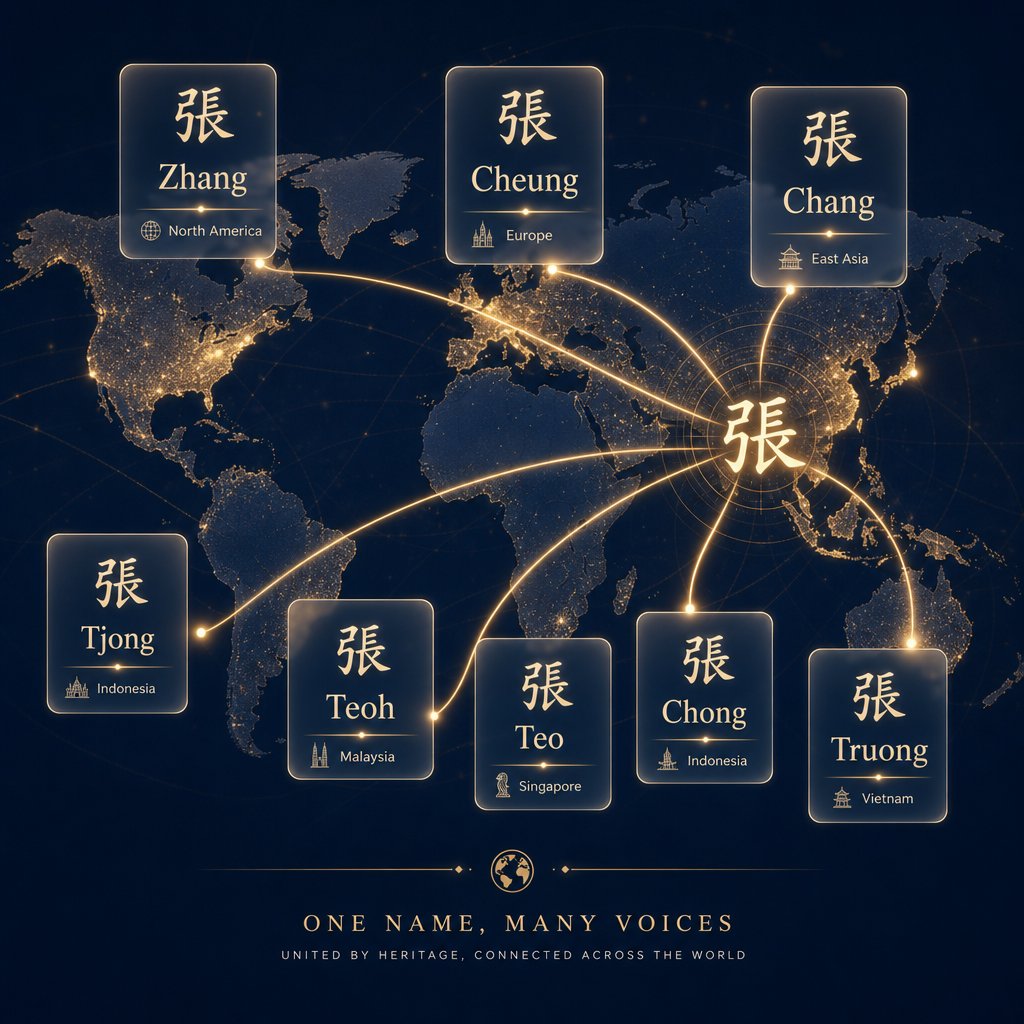
Here's where things get confusing. The same Chinese surname can look completely different depending on which romanization system was used to spell it. Pinyin (Hanyu Pinyin) is the international standard and the system mainland China uses. But you'll also encounter Wade-Giles romanization — common in older texts and still used in some Taiwanese contexts — and Cantonese romanizations used by families from Hong Kong, Macau, and Guangdong province.
The Library of Congress pinyin conversion project highlights several quick ways to distinguish these systems. Wade-Giles uses apostrophes to mark aspiration (like Ts'ai or Ch'en) and hyphens between syllables of given names. Pinyin uses letters like B, D, G, X, Q, and Z at the start of syllables — letters that never begin a Wade-Giles syllable. So if you see a name starting with X or Q, you're looking at pinyin. If you see an apostrophe after a consonant or the combination "hs," it's Wade-Giles.
Cantonese romanizations follow yet another pattern because they represent a different spoken language entirely. A person surnamed 黄 might be Huang in pinyin, Hwang in Wade-Giles, or Wong in Cantonese — all the same character, three different spellings. Context clues like regional origin help: names from mainland China typically use pinyin, names from Taiwan may use Wade-Giles or a local variant, and names from Hong Kong usually reflect Cantonese pronunciation.
The table below maps common surnames across these systems so you can recognize names in chinese regardless of which romanization was used:
| Chinese Character | Pinyin | Wade-Giles | Cantonese |
|---|---|---|---|
| 张/張 | Zhang | Chang | Cheung |
| 陈/陳 | Chen | Ch'en | Chan |
| 黄/黃 | Huang | Hwang | Wong |
| 蔡 | Cai | Ts'ai | Choi |
| 许/許 | Xu | Hsu | Hui |
| 谢/謝 | Xie | Hsieh | Tse |
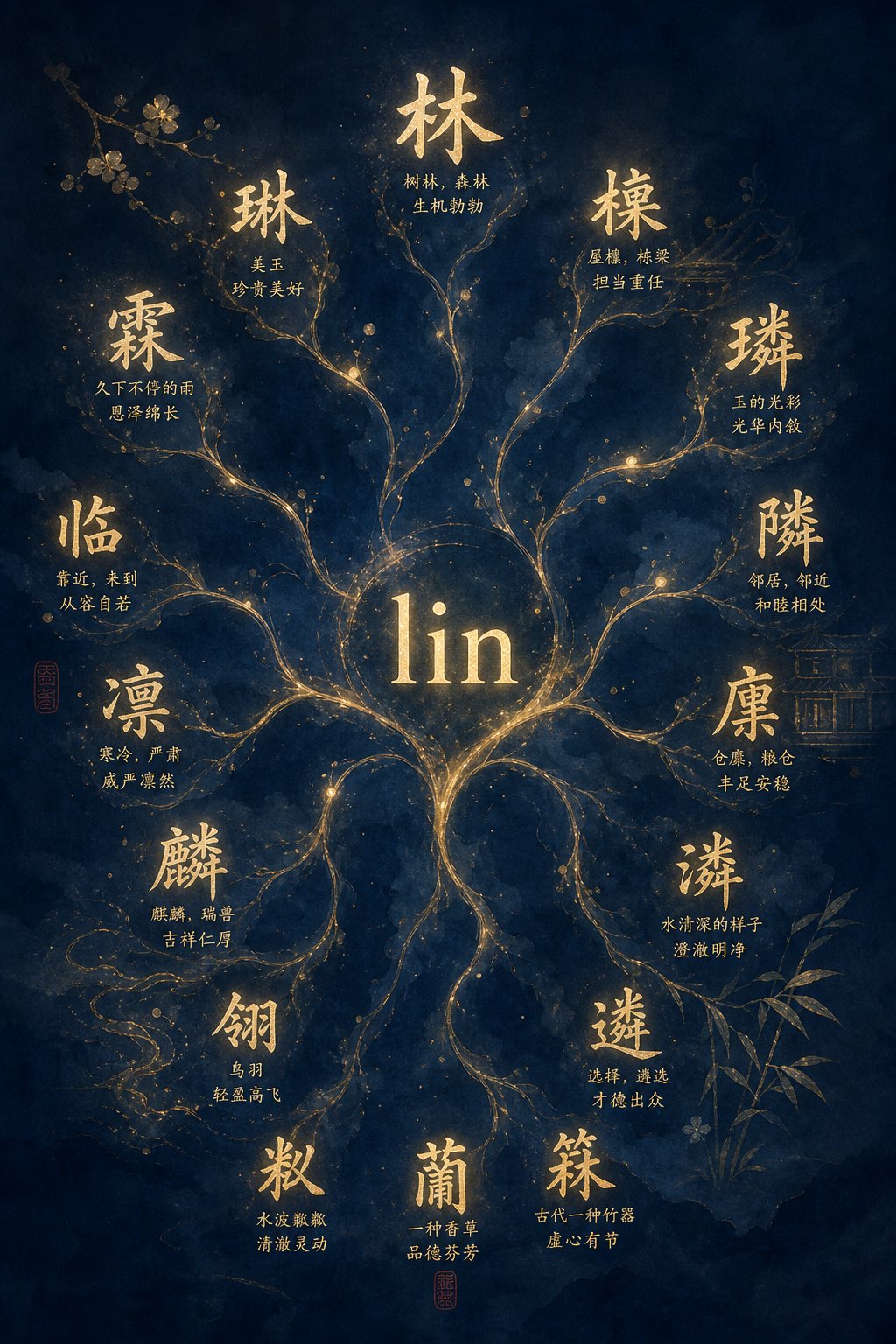
| 林 | Lin | Lin | Lam |
| 吴/吳 | Wu | Wu | Ng |
| 周 | Zhou | Chou | Chow |
| 郭 | Guo | Kuo | Kwok |
Notice how dramatically different these can look. Xu, Hsu, and Hui are all the same surname. Zhou, Chou, and Chow represent the same family name. Once you recognize which system you're dealing with, you can mentally convert to pinyin and apply the pronunciation rules from there. If you want to learn how to write your name in chinese or simply read someone else's name correctly, identifying the romanization system is always step one.
With the structure decoded — surname first, given name joined, romanization system identified — the next challenge is the sounds themselves. And that starts with the consonants, where pinyin's biggest surprises are waiting.
Pinyin Consonants Every English Speaker Should Know
Pinyin has 21 initial consonants, and the good news is that more than half of them behave roughly the way you'd expect. The bad news? The remaining handful are responsible for nearly every mispronounced Chinese name you've ever heard. Rather than marching through these alphabetically, let's sort them by how much effort they demand from an English-speaking mouth.
Consonants That Match English Sounds
These 14 initials are your safe zone when you pronounce mandarin names: b, p, m, f, d, t, n, l, g, k, h, s, w, y. They aren't perfect mirrors of English — b, d, and g are unaspirated in Mandarin, making them sound slightly softer — but the difference is subtle enough that English speakers can use their default pronunciation without causing confusion. If you see a name like Ma Lin or Wang Fei, your instincts will carry you through just fine.
Spend zero energy worrying about these. Save your focus for the two groups below.
Retroflex Sounds in Chinese Names
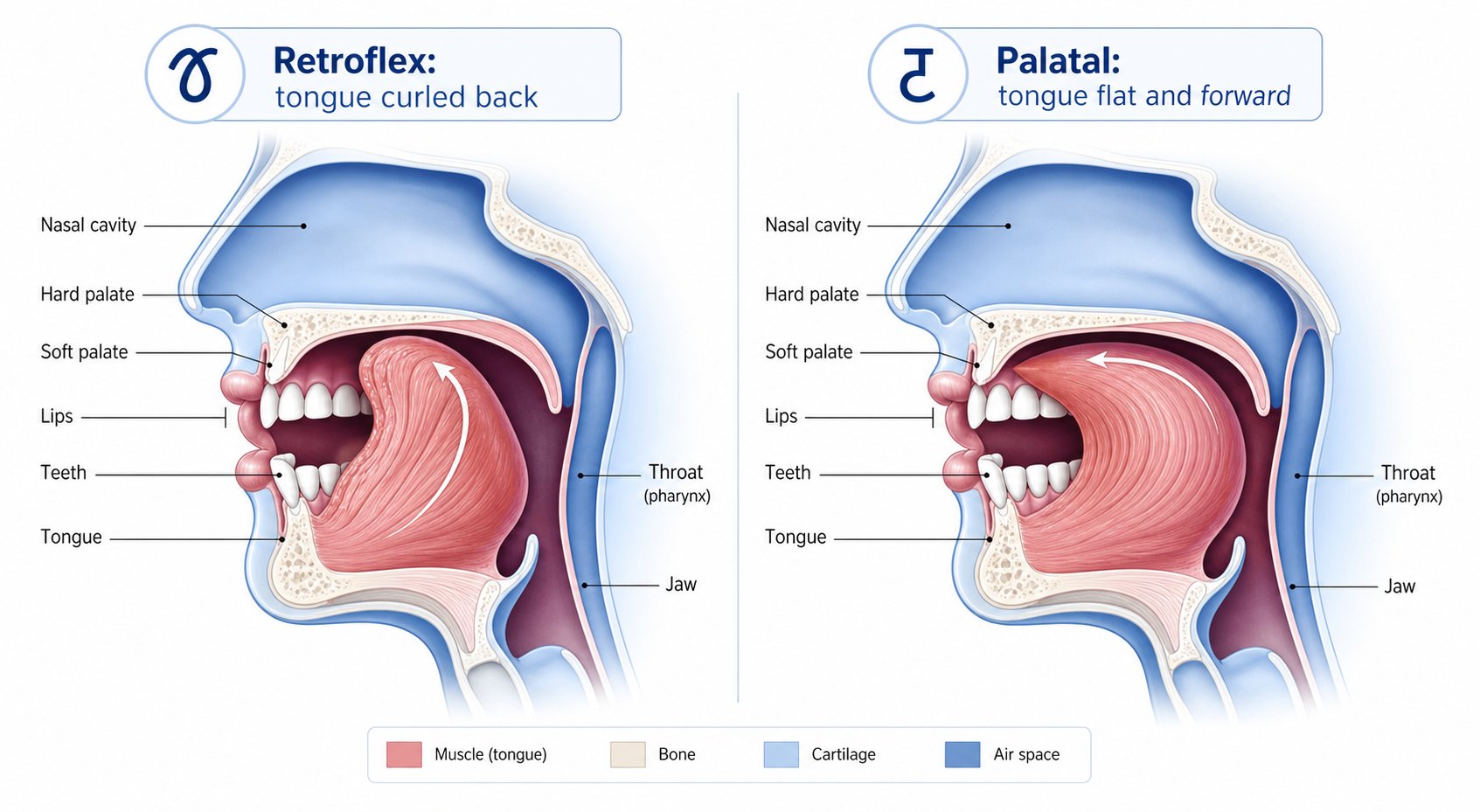
Tier 2 contains four initials that sound close to English but require you to curl your tongue tip backward toward the roof of your mouth. This curling motion — called retroflexion — is the key physical difference.
- zh — Similar to the "j" in "judge," but with the tongue tip curled up to touch the hard palate. You'll hear it in surnames like Zhao, Zhang, and Zhou.
- ch — Like "ch" in "church," again with the tongue curled farther back than English requires. Think of the name Chen or Chu.
- sh — Close to "sh" in "ship," but produced with that same retroflex tongue position. Appears in names like Shen and Shi.
- r — The trickiest of this group. It sits somewhere between the English "r" in "run" and the French "j" in "je." The tongue curls back like sh, but the vocal cords vibrate. You'll encounter it in names like Ren and Rui.
A practical tip: if you simply say the English sounds "j," "ch," "sh," and "r" while pulling your tongue tip slightly backward, you'll land close enough for names like Zheng or Shi to be clearly understood.
The Palatal Sounds That Trick English Speakers
Tier 3 is where English intuition fails completely. These five initials — j, q, x, c, z — require mouth positions that don't exist in English, and they're responsible for the most common name mispronunciations.
The trio of j, q, and x are palatal sounds. The critical technique: press the tip of your tongue flat against the back of your lower teeth and raise the front body of your tongue toward the hard palate. This is the opposite of the retroflex group, where the tongue curls up and back.
- j — Sounds like a soft "j" in "jeep" but with the tongue tip pressed against the lower front teeth. Appears in names like Jia, Jin, and Jiang.
- q — Sounds like "ch" in "cheese" but softer and with strong aspiration, tongue tip still touching the lower teeth. So how do you say Qi? Not "kee" — it's closer to "chee" with a puff of air. Common in names like Qian and Qin.
- x — This is the infamous chinese x. The pronunciation of x in chinese is like a soft "sh" in "sheep," but produced with the tongue flat behind the lower teeth rather than curled back. If you're wondering how to pronounce x in chinese names like Xu, Xie, or Xiao, think "shee-like" but lighter and sharper. The chinese pronunciation x catches English speakers off guard because no English word uses this tongue position.
The remaining two Tier 3 sounds are dental affricates:
- c — Pronounced like "ts" in "cats," never like a "k" or "s." The surname Cai sounds like "tsai," not "kai."
- z — Like "dz" in "adze" — a voiced version of c. The name Zou starts with this buzzing "dz" sound.
The table below maps every pinyin initial to its closest English approximation alongside an example name, giving you a single reference for the chinese x pronunciation and every other consonant you'll encounter:
| Pinyin Initial | Closest English Sound | Example Name | Difficulty Tier |
|---|---|---|---|
| b | "b" in "bat" (softer) | Bai | 1 |
| p | "p" in "pat" | Pan | 1 |
| m | "m" in "mat" | Ma | 1 |
| f | "f" in "fan" | Feng | 1 |
| d | "d" in "dog" (softer) | Deng | 1 |
| t | "t" in "top" | Tang | 1 |
| n | "n" in "nap" | Ning | 1 |
| l | "l" in "lip" | Li, Lin | 1 |
| g | "g" in "go" (softer) | Guo | 1 |
| k | "k" in "kite" | Kong | 1 |
| h | "h" in "hat" (rougher) | Huang, He | 1 |
| s | "s" in "sun" | Sun, Song | 1 |
| w | "w" in "win" | Wang, Wei | 1 |
| y | "y" in "yes" | Yang, Yan | 1 |
| zh | "j" in "judge" (retroflex) | Zhang, Zhao | 2 |
| ch | "ch" in "church" (retroflex) | Chen, Chu | 2 |
| sh | "sh" in "ship" (retroflex) | Shen, Shi | 2 |
| r | Between "r" and French "j" | Ren, Rui | 2 |
| j | Soft "j" (tongue on lower teeth) | Jia, Jiang | 3 |
| q | Soft "ch" (tongue on lower teeth) | Qi, Qian | 3 |
| x | Soft "sh" (tongue on lower teeth) | Xu, Xie, Xiao | 3 |
| c | "ts" in "cats" | Cai, Cui | 3 |
| z | "dz" in "adze" | Zou, Zhang | 3 |
One pattern worth noting: the palatal trio (j, q, x) and the retroflex group (zh, ch, sh) form mirror pairs. Both sets contain an unaspirated stop, an aspirated stop, and a fricative — the difference is entirely tongue position. Retroflex curls the tongue back; palatal presses it forward and flat. Once that physical distinction clicks, you can pronounce x in chinese names and navigate the zh/ch/sh group with the same underlying logic.
Consonants, though, are only half the equation. The vowels and finals that follow them shift and morph depending on context — and a few of those shifts are just as surprising as the consonants themselves.
Vowel Sounds and Finals in Chinese Names
Consonants get you started, but vowels carry the melody of a name. In Mandarin, the vowel portion of a syllable — called the "final" — does far more heavy lifting than you might expect. Some finals are straightforward. Others shapeshift depending on what consonant precedes them, creating traps that even intermediate learners fall into.
Pinyin uses six basic vowel letters: a, o, e, i, u, and ü. At first glance, that looks manageable. The surprise? Several of these letters represent multiple sounds depending on their context. Understanding how to pronounce e in chinese names or why "i" sometimes sounds nothing like "ee" is essential for accurate chinese pronunciation to english conversion. Let's break them down.
Simple Vowels and Their Surprises
Four of the six basic vowels behave predictably enough:
- a — Like the "a" in "father." Open, broad, and relaxed. You'll hear it in names like Fang, Ma, and Yan.
- o — Similar to the "o" in "more" (British English) or "law." Appears in names like Bo and Po.
- u — Like the "oo" in "flute" or "boot." Think of names like Lu, Zhu, and Wu.
- ü — Round your lips as if saying "oo" but try to say "ee" instead. This sound exists in French ("tu") and German ("über") but has no English equivalent. It shows up in names like Lü and Nü.
The two vowels that cause the most confusion are e and i, because each one represents multiple sounds depending on what surrounds it.
The letter "e" has at least three or four distinct pronunciations in pinyin. When it stands alone or appears in syllables like "ge" or "he," it makes a sound between English "uh" and "er" — a back, unrounded vowel that doesn't exist in English. Imagine saying "uh" while pulling your tongue slightly back. In compound finals like "-ei" (as in the name Wei or Mei), it sounds like the "e" in "hey." And in finals like "-en" or "-eng" (as in Shen or Zheng), it reduces to a neutral schwa similar to the "e" in "taken." One letter, multiple sounds — context is everything.
The letter "i" is equally slippery. Most of the time, it sounds like "ee" in "see" — straightforward in names like Li, Min, or Qi. But after the retroflex initials zh, ch, sh, and r, the "i" becomes a "fake i" — a buzzy, tongue-held-in-place sound that doesn't resemble "ee" at all. The same happens after z, c, and s. So the "i" in "Shi" sounds nothing like the "i" in "Li." In Shi, your tongue stays curled back and you produce a muffled, almost consonant-like vowel. In Li, it's a clean, bright "ee." This distinction matters for names like Zhi, Chi, Si, and Ri — all of which use the fake "i" rather than the expected vowel.
The ü Sound and When U Becomes ü
The ü vowel deserves its own section because a hidden rule affects some of the most common Chinese names. Here's the rule: after j, q, and x, the letter "u" is always pronounced as ü — even though the two dots (umlaut) are dropped in standard spelling.
Why? Because j, q, and x never combine with a true "u" sound. There's no ambiguity, so the pinyin creators saved ink by dropping the dots. But this means that when you see "Xu," you shouldn't pronounce it with the "oo" of "boot." The "u" in Xu is actually ü — lips rounded, tongue saying "ee." The same applies to Ju, Qu, Juan, Quan, Xuan, Jun, Qun, and Xun.
Compare these pairs to hear the difference in practice:
- Lu (as in the surname 陆) — rhymes with "too." Standard "oo" sound.
- Lü (as in the surname 吕) — lips rounded like "oo" but the tongue says "ee." Completely different name.
- Shu (as in the name 舒) — true "u," like "shoe."
- Xu (as in the surname 许) — despite looking similar, this is ü, not u. Closer to "shü" with the palatal "x" initial.
Only two initials — n and l — can pair with both u and ü, which is why the umlaut is preserved in those cases: "nü" (女, woman) vs. "nu" (奴, slave), "lü" (绿, green) vs. "lu" (路, road). For every other initial that combines with ü (j, q, x, and the null initial spelled "yu"), the dots disappear but the sound remains. This is one of the most critical english pronunciation of chinese words pitfalls — reading "ju" as "joo" instead of "jü" will land you on the wrong name entirely.
Compound Finals Common in Names
Beyond the simple vowels, Mandarin combines vowels into compound finals and nasal finals that appear constantly in names. Several of these have pronunciations that don't match what English eyes expect. Here are the most frequent ones, grouped by type:
Nasal finals (ending in -n or -ng):
- -ang — Like "ahng" (the "a" is broad, as in "father," not short as in "bang"). Example names: Wang, Yang, Fang, Zhang.
- -eng — A schwa-like "e" followed by "ng." Example names: Zheng, Feng, Cheng.
- -ing — Like "ing" in "sing." Example names: Ming, Ling, Jing.
- -ong — Not like English "ong" in "song." The vowel is closer to "oo" — think "oong." Example names: Dong, Zhong, Yong.
- -ian — This is the big trap. It sounds like "yen," not "ee-an." The name Tian sounds like "tyen," and Qian sounds like "chyen." The vowel in -ian is closer to "e" in "ten" than "a" in "father."
- -uan — Like "wan" (as in "wander"). Example names: Guan, Huan, Duan.
- -üan — The ü sound plus "en." Spelled "yuan" when standalone, "juan/quan/xuan" after j/q/x. Example names: Yuan, Xuan.
Compound finals (vowel combinations):
- -ai — Like the "eye" sound. Example names: Bai, Cai, Dai.
- -ei — Like "ay" in "day." Example names: Wei, Mei, Lei.
- -ao — Like "ow" in "how." Example names: Hao, Tao, Zhao.
- -ou — Like "oh" in "go." Example names: Zhou, Dou, Gou.
- -iu — Actually pronounced "-iou" with a hidden "o" — sounds like "yo" in "yoga." The name Liu sounds like "lyo," not "lee-oo." This is one of pinyin's major omissions where a vowel is dropped from the spelling but still pronounced.
- -ui — Actually pronounced "-uei" — sounds like "way." The name Cui sounds like "tsway," not "tsoo-ee."
These hidden vowels — the "o" in -iu and the "e" in -ui — are among the most overlooked aspects of chinese words in english pronunciation. Pinyin drops them from the spelling to keep things compact, but they're still there in the actual sound. If you remember that "-iu" rhymes with "yo" and "-ui" rhymes with "way," you'll avoid two of the most common vowel errors in Chinese names.
With consonants and vowels mapped out, one major dimension remains: the tonal layer that sits on top of every syllable. Tones don't just add flavor — they can change a name's meaning entirely.
Understanding Tones When Saying Chinese Names
Mandarin is a tonal language, which means the pitch pattern you use on a syllable changes the word entirely. The syllable "ma" can mean mother, hemp, horse, or scold depending on the tone. In names, this distinction is just as real. As Temple University's Center for Chinese Language Instruction illustrates, pronouncing the name Wang Wen with the wrong tone could shift its meaning from "smart and inquisitive" to "mosquito" — not exactly the impression you want to give.
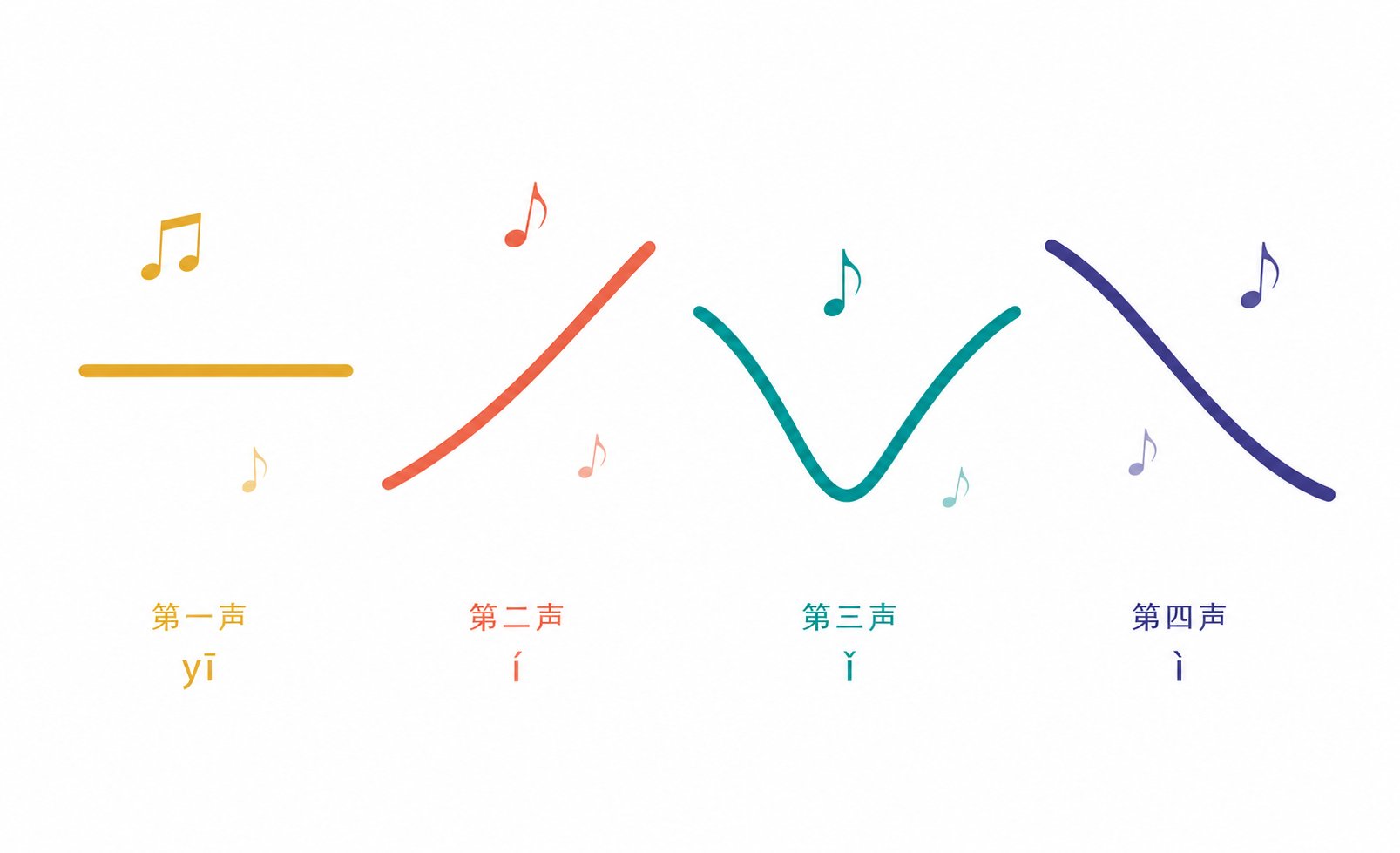
So how do you pronounce mandarin tones? Mandarin has four main tones plus a neutral tone, each marked by a small diacritic above the vowel in properly written pinyin. When you see a name written with tone marks — like Zhāng or Lǐ — those marks are your pronunciation roadmap.
How Each Tone Sounds in Practice
Each tone uses pitch differently. Here's a mandarin chinese pronunciation guide to all four, with analogies that map to sounds English speakers already make:
- Tone 1 (ā) — High and flat. Imagine sustaining a single musical note, or the steady "ahhh" a doctor asks you to hold. It stays level at the top of your pitch range. Example name: Fāng (方).
- Tone 2 (á) — Rising. Like the pitch of your voice when you ask "What?" in surprise. It starts in the middle and climbs up. Example name: Chén (陈).
- Tone 3 (ǎ) — Dipping low. Your pitch drops to the bottom of your range and then rises slightly at the end. Think of the drawn-out, skeptical "well..." you might say when you're not convinced. In natural speech, this tone often just stays low without the final rise. Example name: Lǐ (李).
- Tone 4 (à) — Falling sharply. Like a firm command — "Stop!" — where your pitch drops quickly from high to low. It's short and decisive. Example name: Wàng (旺).
The neutral tone (sometimes called the fifth tone) has no fixed pitch of its own. Instead, it borrows its pitch from the preceding syllable, landing as a short, unstressed sound. As Hacking Chinese explains, the neutral tone is not a separate tone but rather an unstressed syllable that adapts to its environment. You'll encounter it occasionally in name particles or informal speech, but it's rare in the core syllables of given names and surnames.
If you're looking for chinese language pronunciation audio to hear these tones in action, interactive pinyin charts with audio playback let you click any syllable and hear all four tones spoken by native speakers. Tools that let you pronounce chinese words audio-first — hearing before attempting — build the ear-training foundation that makes mandarin name pronunciation far more intuitive over time.
Tone Changes in Two-Syllable Given Names
Here's where tones get tricky in names specifically. Mandarin has a rule called third-tone sandhi: when two third tones appear back-to-back, the first one shifts to a second tone (rising) in actual speech. This happens constantly in two-syllable given names.
Consider the common given name combination Hǎiyǔ (海宇). Both syllables carry the third tone in isolation. But when spoken together, the first syllable shifts: it's actually pronounced Háiyǔ — rising tone followed by dipping tone. The spelling doesn't change, but the spoken reality does. Other examples:
- Yǔxǐ (雨曦) — Pronounced Yúxǐ in connected speech.
- Xiǎoměi (小美) — Pronounced Xiáoměi.
- Kěyǐ (可以) — The word "can" follows the same pattern: pronounced Kéyǐ.
This sandhi rule is automatic for native speakers — they don't think about it. For you, it means that if you see two consecutive third-tone syllables in a given name, pronounce the first one as a rising tone. You'll sound noticeably more natural.
Getting tones perfect on every name you encounter is a long-term project. But even partial effort matters. How do you pronounce mandarin names respectfully? By trying. Native speakers can usually decode an imperfect tone attempt far more easily than a flat, toneless delivery.
Attempting tones, even imperfectly, signals genuine effort and respect to the person whose name you're saying. A name spoken with approximate tones sounds like someone trying. A name spoken with no tonal variation at all sounds like someone who didn't bother.
Tones give you the pitch contour of each syllable. The next step is applying everything — consonants, vowels, and tones together — to the specific surnames you'll encounter most often.
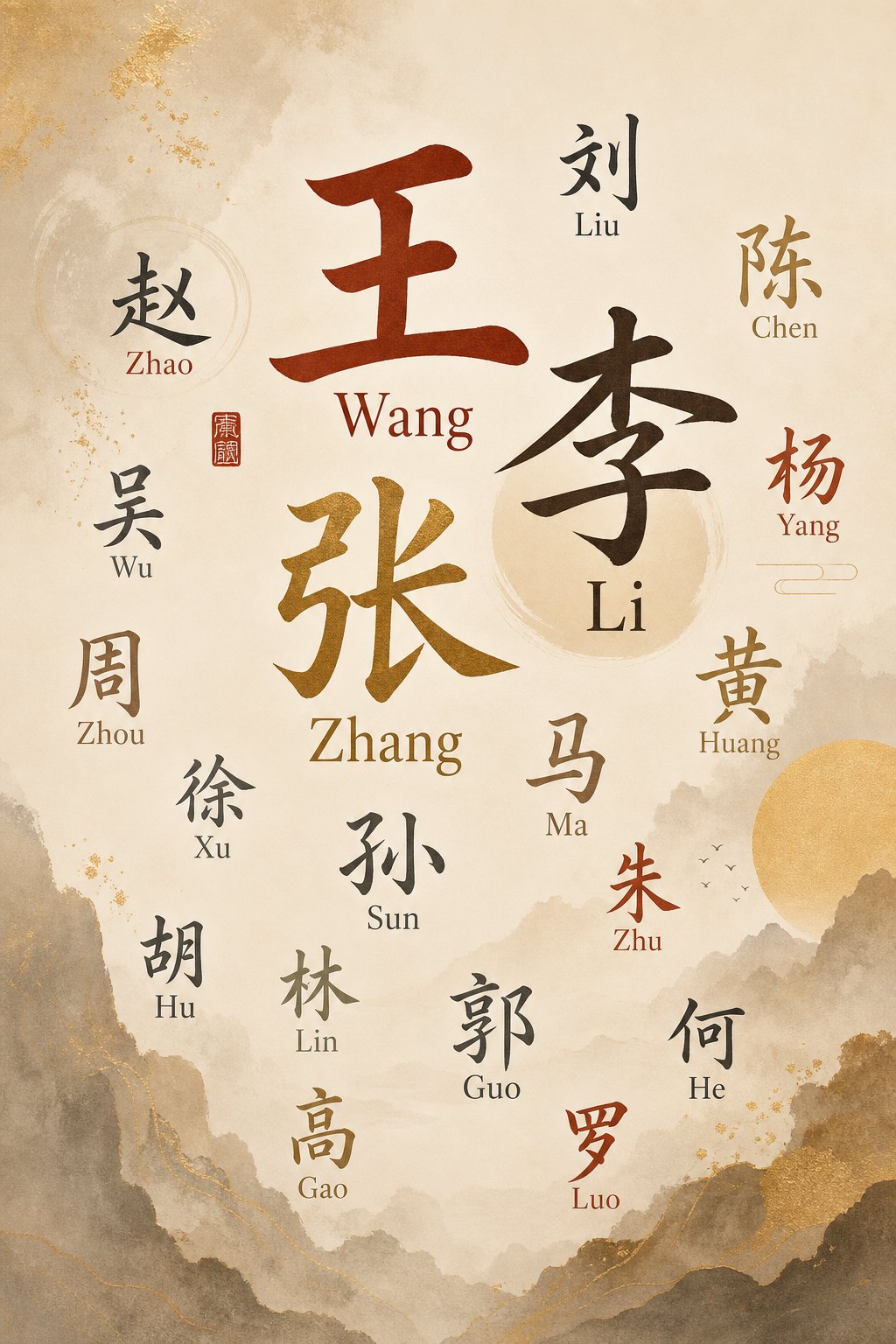
Pronouncing the Most Common Chinese Surnames
You've got the theory — consonant tiers, vowel traps, tone contours. But when you're face-to-face with a new colleague named Zhao Xueling, theory alone won't save you. What you need is a practical, name-by-name breakdown of the surnames you'll actually encounter. The pronunciation of chinese names becomes second nature once you drill the most frequent ones into muscle memory.
China has a remarkably concentrated surname pool. According to Berlitz's guide to Chinese names, the top 20 surnames cover a significant portion of the population — over 1.2 billion people share just these family names. Master how to say chinese names from this list, and you'll handle the majority of introductions with confidence.
Surnames You Can Approximate Confidently
These surnames fall into Tier 1 — your English instincts will get you close enough to be clearly understood. A few minor corrections are all you need:
- Li (李) — Sounds like "lee." Straightforward. This is the second most common surname in China, so you'll encounter it constantly.
- Wang (王) — Not like the English word "wang." The vowel is broad and open: "wahng," rhyming with "song" if you use the "ah" vowel from "father." Think of it as "wah" + "ng."
- Ma (马) — Like "mah" in "mama." Simple and clean.
- Lin (林) — Exactly like the English name "Lynn." No surprises here.
- Yang (杨) — Like "yahng." The same broad "ah" vowel as Wang, not the short "a" in "bang."
- Wu (吴) — Like "woo" in "wood" but held slightly longer. Some English speakers want to add a "w" sound before it — it's already there.
- He (何) — Not like the English pronoun. The "e" here is the Mandarin back vowel — closer to "huh" with a slightly more open mouth. Think halfway between "huh" and "her" without the "r."
- Gao (高) — Like "gow" rhyming with "cow." The "-ao" final always sounds like "ow."
For these names, trust your ears and keep it simple. A confident "wahng" beats a hesitant mumble every time.
Surnames That Require New Sounds
Tier 2 and Tier 3 surnames contain the retroflex, palatal, and affricate sounds covered earlier. Here's where you apply those rules to specific, high-frequency names:
Tier 2 — Retroflex adjustments:
- Zhang (张) — Start with a "j" sound (as in "judge") but curl your tongue back. The vowel is "ahng." Result: "jahng" with a retroflex onset. This is China's third most common surname.
- Chen (陈) — Like "chun" in "church" but with the "en" final (a neutral schwa + n). Sounds close to "chuhn." Curl the tongue back slightly on the "ch."
- Zhao (赵) — Retroflex "j" + the "ao" diphthong ("ow" as in "cow"). Sounds like "jow" with the tongue curled back.
- Zhou (周) — Retroflex "j" + "oh" (like "Joe" but with the retroflex initial). Not "zoo" — the vowel is a rounded "oh."
- Huang (黄) — "Hwahng." The initial "h" blends into a "w" glide before the broad "ahng" ending. English speakers sometimes drop the "h" and say "wahng" — adding the breathy "h" at the start gets you closer.
- Liu (刘) — Remember that "-iu" is actually "-iou" with a hidden vowel. It sounds like "lyo" — a quick "l" followed by "yo" as in "yoga." Not "lee-oo."
Tier 3 — New mouth positions required:
- Xu (徐/许) — The palatal "x" (tongue flat behind lower teeth, producing a light "sh") followed by ü (lips rounded, tongue saying "ee"). The result is something like "shü" but lighter and sharper than English "sh." The surname Xu (许) appears as "Hsu" in Wade-Giles and "Hui" in Cantonese — all the same name, wildly different spellings.
- Xie (谢) — Palatal "x" + the "-ie" final (which sounds like "ye" in "yes"). Result: "shye" with the lighter palatal fricative. Not "zee" or "ksee."
- Zhu (朱) — Retroflex "j" (tongue curled back) + "oo." Sounds like "joo" with the retroflex curl. Not "zoo" — the initial is voiced differently.
- Qian (钱) — Palatal "ch" (tongue on lower teeth, aspirated) + "-ian" (which sounds like "yen"). Result: "chyen" with a puff of air. Not "kee-an."
- Cai (蔡) — The "ts" affricate + "eye." Sounds like "tsai" — identical to the alternate spelling "Tsai" used in Taiwan. If you've ever wondered about the tsao pronunciation pattern, it follows the same logic: "ts" + the vowel, never a "k" sound.
The table below serves as your quick-reference guide for the pronunciation chinese names you'll meet most often. Bookmark it, screenshot it, or keep it open during video calls:
| Pinyin Surname | English Approximation | Common Alternate Spellings | Notes on Common Errors |
|---|---|---|---|
| Wang (王) | "wahng" | Wong (Cantonese) | Not like English "wang" — use the broad "ah" vowel |
| Li (李) | "lee" | Lee | Straightforward; no common errors |
| Zhang (张) | "jahng" (retroflex) | Chang (Wade-Giles), Cheung (Cantonese) | Not a buzzing "z" sound — it's a retroflex "j" |
| Liu (刘) | "lyo" | Lau (Cantonese) | Not "lee-oo" — the hidden vowel makes it "lyo" |
| Chen (陈) | "chuhn" (retroflex) | Ch'en (Wade-Giles), Chan (Cantonese) | The "e" is a schwa, not "eh" as in "hen" |
| Yang (杨) | "yahng" | Yeung (Cantonese) | Broad "ah" vowel, not short "a" as in "bang" |
| Huang (黄) | "hwahng" | Hwang (Wade-Giles), Wong (Cantonese) | Don't drop the initial "h" — it's "hw" not just "w" |
| Zhao (赵) | "jow" (retroflex) | Chao (Wade-Giles) | Retroflex "j" + "ow" as in "cow" |
| Wu (吴) | "woo" | Ng (Cantonese) | Simple — just a clean "woo" sound |
| Zhou (周) | "joe" (retroflex) | Chou (Wade-Giles), Chow (Cantonese) | Not "zoo" — retroflex initial with rounded "oh" |
| Xu (徐) | "shü" (palatal, lips rounded) | Hsu (Wade-Giles), Tsui (Cantonese) | Never "zoo" — palatal x + ü vowel |
| Sun (孙) | "swun" | Suen | The "u" has a slight "w" onset; not like English "sun" |
| Ma (马) | "mah" | Ma | No common errors — same across systems |
| Zhu (朱) | "joo" (retroflex) | Chu (Wade-Giles) | Retroflex "j" — not a flat "z" or English "j" |
| Lin (林) | "lin" | Lam (Cantonese), Lim (Hokkien) | Identical to English "Lynn" |
| He (何) | "huh" (open) | Ho (Cantonese) | Not the English pronoun — the vowel is a back "uh" |
| Guo (郭) | "gwaw" | Kuo (Wade-Giles), Kwok (Cantonese) | The "-uo" sounds like "waw" — not "oo-oh" |
| Xie (谢) | "shye" (palatal) | Hsieh (Wade-Giles), Tse (Cantonese) | Not "zee" or "ksee" — palatal x + "ye" |
| Qian (钱) | "chyen" (palatal) | Ch'ien (Wade-Giles) | Not "kee-an" — palatal "ch" + "yen" |
| Cai (蔡) | "tsai" | Ts'ai (Wade-Giles), Choi (Cantonese) | Never a "k" sound — it's "ts" as in "cats" |
A pattern emerges from this table: the surnames that trip people up almost always contain one of the Tier 3 initials (x, q, c) or a vowel combination with a hidden sound (-iu, -uo, -ui). If you can identify those elements in a name before you speak, you're already ahead of most English speakers attempting chinese names and pronunciation for the first time.
Knowing how to pronounce a chinese name from this list gives you solid footing. But what about the mistakes that persist even after you've learned the rules? The gap between knowing the correct sound and actually producing it in conversation is where the most stubborn errors live — and they follow predictable patterns worth examining directly.
Common Mistakes English Speakers Make With Chinese Names
Knowing the rules and applying them in real time are two different things. Even after studying the consonant tiers and vowel traps, English speakers tend to fall into the same predictable errors — over and over, across different names. The patterns are so consistent that you can almost predict which part of a name someone will stumble on before they open their mouth.
Below is a ranked list of the most frequent mistakes, showing how people typically mispronounce chinese words and what the correction sounds like. If you recognize your own habits here, you're not alone — and the fix is usually simpler than you think.
- Xu — Said as "zoo" → Correct: "shü" (palatal x + rounded ü vowel)
- Qi — Said as "kee" → Correct: "chee" (palatal aspirated ch, tongue on lower teeth)
- Zhang — Said as a buzzing "zang" → Correct: "jahng" (retroflex j, not a flat z)
- Cai — Said as "kai" or "sai" → Correct: "tsai" (ts as in "cats")
- Liu — Said as "lee-oo" → Correct: "lyo" (hidden vowel makes it rhyme with "yo")
- -ang finals (Wang, Yang) — Said with short "a" as in "bang" → Correct: broad "ahng" as in "father" + ng
- Xie — Said as "zee" or "ksee" → Correct: "shye" (palatal x + "ye" as in "yes")
- Zhu — Said as "zoo" → Correct: "joo" with tongue curled back (retroflex)
- Cui — Said as "koo-ee" → Correct: "tsway" (ts + hidden vowel in -ui)
- Qian — Said as "kee-an" → Correct: "chyen" (palatal ch + "-ian" sounds like "yen")
Notice a theme? Mistakes 1, 2, 7, and 10 all involve the palatal initials x and q. Mistakes 5 and 9 involve hidden vowels in compound finals. These two categories account for the vast majority of errors when English speakers try to pronounce chinese names.
The X and Q Trap
Why do x and q cause more confusion than any other pinyin letters? Because English already has strong associations with both. Your brain sees "x" and reaches for "ks" or "z." It sees "q" and expects "kw." Neither is remotely close to the actual Mandarin sound.
Here's a memorable technique that works for both: smile and say "sh" for x, smile and say "ch" for q. The smile shape naturally flattens your tongue forward and down — exactly the palatal position these sounds require. As pronunciation research confirms, the physical difference between x/q (tongue forward, "smile" shape) and sh/ch (tongue curled back) is the single most important distinction to drill. If you can feel the difference between a smile-shaped mouth and a curled-tongue mouth, you can reliably produce both pairs.
A quick self-test: say "she" with a big grin, keeping your tongue tip touching your lower front teeth. That light, hissing sound is very close to the chinese pronunciation in english terms for "x." Now say "cheese" with the same grin and tongue position — that's "q." Practice these two sounds for five minutes and you'll handle names like Xu, Xiao, Qi, and Qin with far more accuracy than before.
Vowel Combinations That Fool English Ears
Beyond the consonant traps, four vowel combinations consistently mislead English speakers. The issue is that pinyin abbreviates certain finals, dropping vowels from the spelling while keeping them in the pronunciation. If you read these finals the way they're written, you'll miss the hidden sounds entirely.
- -ian sounds like "yen," not "ee-an." The name Tian is "tyen," Jian is "jyen." English speakers who read it as two separate syllables ("ee" + "an") produce something unrecognizable.
- -iu sounds like "yo," not "ee-oo." As Hacking Chinese explains, the spelling drops an "o" — the actual pronunciation is "-iou." Liu is "lyo," Niu is "nyo."
- -ui sounds like "way," not "oo-ee." The hidden "e" makes the actual pronunciation "-uei." Hui is "hway," Dui is "dway."
- -uo sounds like "waw," not "oo-oh." Guo is "gwaw," Luo is "lwaw." The two vowels blend into a single smooth glide rather than two distinct syllables.
The pattern: whenever you see a two-letter vowel combination after a consonant and your instinct is to pronounce each letter separately, stop. These finals are single blended sounds, not sequences of individual vowels. That shift in thinking — from spelling out each letter to hearing a unified sound — is what separates awkward attempts from natural-sounding chinese pronounce efforts.
How to Respectfully Ask About Pronunciation
Even with all these rules internalized, you'll encounter names that stump you. That's normal. What matters is how you handle the uncertainty. Asking someone to help you say their name correctly isn't awkward — it's respectful. Most people appreciate the effort far more than they mind the question.
Here are culturally appropriate ways to ask:
- "I want to make sure I'm saying your name correctly — could you say it for me once?"
- "I'd love to pronounce your name the way you prefer. Can you help me with it?"
- "Am I close with [your attempt]? I want to get it right."
A few things to keep in mind: listen for the full syllable shape rather than just the initial consonant. Repeat it back immediately and ask if you're close. If the name has a sound you know you struggle with (like x or q), acknowledge it honestly — "I know I'm not quite getting that first sound" — and try again. People notice when you're genuinely working at it versus performing politeness.
The question "chinese how to pronounce this name?" running through your head is completely valid. Turning that internal question into an external, respectful ask transforms an awkward moment into a connection. You're telling someone their name matters enough to get right — and that message lands regardless of whether your tones are perfect on the first try.
These common mistakes and their fixes give you a diagnostic checklist: when a name feels wrong coming out of your mouth, check whether you've fallen into the x/q trap, flattened a vowel combination, or defaulted to English letter values. With that awareness in place, the final step is building a repeatable mental process you can apply to any unfamiliar name — turning scattered rules into an automatic habit.

Putting Pinyin Name Rules Into Practice
Rules scattered across consonant charts and vowel tables aren't much help in the two seconds between reading a name and saying it out loud. What you need is a repeatable mental process — a quick internal routine that converts any unfamiliar Chinese name into a confident spoken attempt. Think of it as a chinese pronunciation guide you carry in your head rather than on a reference sheet.
Your Quick Mental Checklist for Any Chinese Name
When you encounter a new name, run through these five steps before you speak:
- Identify surname vs. given name. The first unit (usually one syllable) is the family name. Everything after the space is the given name.
- Break into syllables. Each Chinese character maps to one syllable. A two-character given name like Minghua has two syllables: Ming + hua.
- Check each initial consonant against the tricky-sounds list. Is there an x, q, j, c, z, zh, ch, sh, or r? If yes, flag it — that's where your effort goes. If the initials are all Tier 1 (b, p, m, f, d, t, n, l, g, k, h, s, w, y), relax and trust your English instincts.
- Identify the vowel or final. Watch for the hidden-vowel traps: -iu (sounds like "yo"), -ui (sounds like "way"), -ian (sounds like "yen"). Check whether a "u" after j, q, or x is actually ü.
- Attempt tones if tone marks are present. High-flat, rising, dipping, falling — even a rough approximation adds clarity and shows respect.
This five-step scan takes seconds once you've internalized it. You don't need a chinese name pronunciation tool open on your phone for every introduction — just this mental checklist and the willingness to try.
Building Pronunciation Confidence Over Time
Start with the names you encounter daily. A colleague named Xu, a client named Qian, a public figure named Xi — these become your anchor points. Practice them until the mouth positions feel automatic, then expand outward. Each name you master reinforces the patterns for the next one.
Well-known figures make excellent practice targets precisely because you can hear their names spoken by native speakers in news broadcasts and interviews. Use those audio examples as a free chinese language pronunciation guide — listen, mimic, and compare. Over time, you'll notice that how to pronounce chinese names stops feeling like a puzzle and starts feeling like pattern recognition. The same handful of initials and finals recombine in predictable ways.
Pronouncing chinese names accurately is a skill that compounds. The first few names feel effortful. By the twentieth, you're recognizing syllable shapes before you consciously analyze them. You'll start hearing the difference between retroflex and palatal sounds in real conversation, and your mouth will know how to pronounce names in english contexts without defaulting to English letter values.
Even imperfect pronunciation that shows genuine effort is appreciated. Consistent practice with these rules will steadily improve your accuracy — and the person whose name you're saying will notice that you cared enough to try.
Frequently Asked Questions About Pinyin Name Pronunciation
1. How do you pronounce the letter X in Chinese pinyin names?
The pinyin X is a palatal fricative produced by pressing your tongue tip flat against the back of your lower teeth while pushing air through a narrow gap. It sounds like a lighter, sharper version of English 'sh.' For names like Xu or Xiao, think of saying 'sh' while smiling — the smile shape naturally positions your tongue correctly. It never makes the 'ks' or 'z' sounds English speakers associate with the letter X.
2. Why do Chinese names have different spellings like Zhang, Chang, and Cheung?
These variations come from different romanization systems representing the same Chinese character. Pinyin (Zhang) is the mainland China standard, Wade-Giles (Chang) appears in older texts and some Taiwanese contexts, and Cantonese romanization (Cheung) reflects Hong Kong and Guangdong pronunciation. You can identify the system by looking for clues: names starting with X or Q use pinyin, names with apostrophes after consonants use Wade-Giles, and names from Hong Kong typically use Cantonese spelling.
3. Do tones really matter when pronouncing Chinese names?
Yes, tones change meaning in Mandarin. The same syllable spoken with different pitch patterns can represent entirely different words and characters. While native speakers can often figure out your intent from context, attempting tones — even imperfectly — shows respect and significantly improves comprehension. Start by learning the four basic patterns: high-flat, rising, dipping, and falling. Even a rough approximation sounds more natural than completely flat delivery.
4. What is the correct order for Chinese names — surname first or last?
In Chinese convention, the surname (family name) always comes first, followed by the given name. Most surnames are one syllable (Li, Wang, Chen), while given names are one or two syllables. So in 'Liu Mingyu,' Liu is the family name and Mingyu is the personal name. However, some Chinese people reverse the order when in English-speaking contexts, so when unsure, it is perfectly appropriate to ask which part is the family name.
5. How do I politely ask someone to help me pronounce their Chinese name?
A direct, sincere approach works best. Try phrases like 'I want to make sure I say your name correctly — could you say it for me?' or 'Am I close with [your attempt]? I want to get it right.' Listen carefully to the full syllable shape, repeat it back immediately, and ask if you are close. Most people genuinely appreciate the effort and are happy to help. Acknowledging difficulty honestly — rather than avoiding the name — builds connection and shows respect.