Understanding Pinyin Name Order and Why It Matters
Imagine you receive an email from a new colleague named Wang Xiaoming. Which part is the surname? Which part do you use when you reply with "Dear Mr..."? If you guessed wrong, you just called someone by their given name in a formal email, and that is more common than you might think.
The core rule behind pinyin surname and given name order is straightforward: the surname (姓, xing) comes first, and the given name (名, ming) comes second. In the example above, Wang is the family name and Xiaoming is the personal name. This is the exact opposite of most Western naming conventions, where a given name like "John" precedes the family name "Smith."
In standard pinyin, the surname always precedes the given name.
That single rule governs every properly formatted Chinese name in pinyin. Yet it trips up millions of people every year across business emails, academic citations, government forms, and casual introductions. The chinese name definition itself reflects this structure: a name in Chinese is built family-first, individual-second, encoding a cultural priority that places lineage before the self.
Why Pinyin Name Order Confuses Non-Chinese Speakers
The confusion is not about intelligence. It is about pattern recognition. English speakers are trained from childhood to hear the first element of any name as the given name. When you hear "Wang Xiaoming," your brain instinctively treats "Wang" as a first name and "Xiaoming" as a last name. This leads to awkward situations: addressing someone as "Mr. Xiaoming" instead of "Mr. Wang," or filing a contact under the wrong letter entirely.
The problem compounds when Chinese people adapt their names for Western contexts by reversing the order themselves. You might encounter the same person listed as "Wang Xiaoming" on one document and "Xiaoming Wang" on another. Without understanding how Chinese names work, there is no reliable way to tell which format you are looking at.
Who This Guide Helps
This article is a practical reference for a specific problem: identifying which part of a pinyin name is the surname and which is the given name. It is not a guide to Chinese name pronunciation, name choosing, or the broader cultural significance of chinese names. Instead, it focuses on the structural and formatting rules that let you confidently parse any pinyin name you encounter.
You will find this useful if you are:
- A professional addressing Chinese colleagues or clients in emails and meetings
- An academic citing Chinese authors in papers and bibliographies
- Someone filling out official forms where surname and given name fields must be correct
- A Chinese speaker deciding how to present your own name internationally so others get it right
The chinese for name, "mingzi" (名字), literally combines the characters for "name" and "character," reflecting how tightly identity and written language are linked in this system. Understanding the chinese name structure at a practical level means you will never second-guess which part of a pinyin name belongs in which field again.
The real challenge, though, is not memorizing the rule. It is applying it when names appear in different formats, lengths, and contexts, which is exactly what the structural breakdown ahead addresses.
How Chinese Names Are Structured in Pinyin
Knowing the rule "surname first, given name second" is only half the battle. The other half is recognizing where the surname ends and the given name begins when you are staring at a string of pinyin syllables. This is where understanding the structural anatomy of a Chinese name gives you a practical edge.
A standard Chinese name consists of two or three characters total. The surname is almost always one character (one syllable in pinyin), and the given name is one or two characters. There are no chinese middle names in the Western sense. When a given name has two characters, they function together as a single unit, not as a first name plus a middle name. This compact structure, just names and characters working together in two or three syllables, is what makes Chinese names so efficient and so easy to misread if you do not know the pattern.
The Three-Character Name Pattern
Here is the statistical reality that makes identification much easier than you might expect. Research from the IFLA Cataloguing Section on Chinese personal names shows that approximately 84.3% of Chinese names follow a three-character pattern: one-character surname plus two-character given name. In pinyin, this means the first syllable is the surname and the remaining two syllables form the given name.
Take the name "Li Jinze" as an example. "Li" is the one-character surname, and "Jinze" is the two-character given name written as a single joined unit. When you encounter a pinyin name with this structure, you can be confident more than eight times out of ten that the first syllable stands alone as the family name.
This pattern holds true across both male chinese given names and chinese given names female. Whether the name is Zhang Weiming or Chen Yuxin, the structural logic is identical: one syllable for the family, two syllables for the individual.
Two-Character and Four-Character Names
About 14.0% of Chinese names have only two characters total: a one-character surname plus a one-character given name. In pinyin, these appear as two separate syllables of roughly equal weight, like "Yao Ming" or "Zhang Wei." The chinese name first name distinction here is trickier because both parts look similar in length. Context and surname recognition become your primary tools.
Four-character names are rare but do exist. They typically involve a two-character compound surname (like Sima or Ouyang) paired with a two-character given name. These account for a small fraction of the population, but recognizing them prevents you from incorrectly splitting the surname in half.
Capitalization as a Clue
Formal pinyin formatting gives you a visual shortcut. In many academic, governmental, and professional contexts, the surname is either capitalized normally (with only the first letter uppercase) while appearing as a distinct word, or written entirely in uppercase to eliminate ambiguity. You will often see formats like "ZHANG Weiming" or "SIMA Qian" on conference badges, journal articles, and official documents.
This capitalization convention exists precisely because pinyin surname and given name order can be hard to parse without it. When you spot a name where one element is fully uppercased, that element is almost certainly the surname, regardless of its position in the string.
The table below breaks down several example names into their component parts, showing how the structure works across different name chinese characters patterns:
| Full Name in Pinyin | Surname | Given Name | Structure Type |
|---|---|---|---|
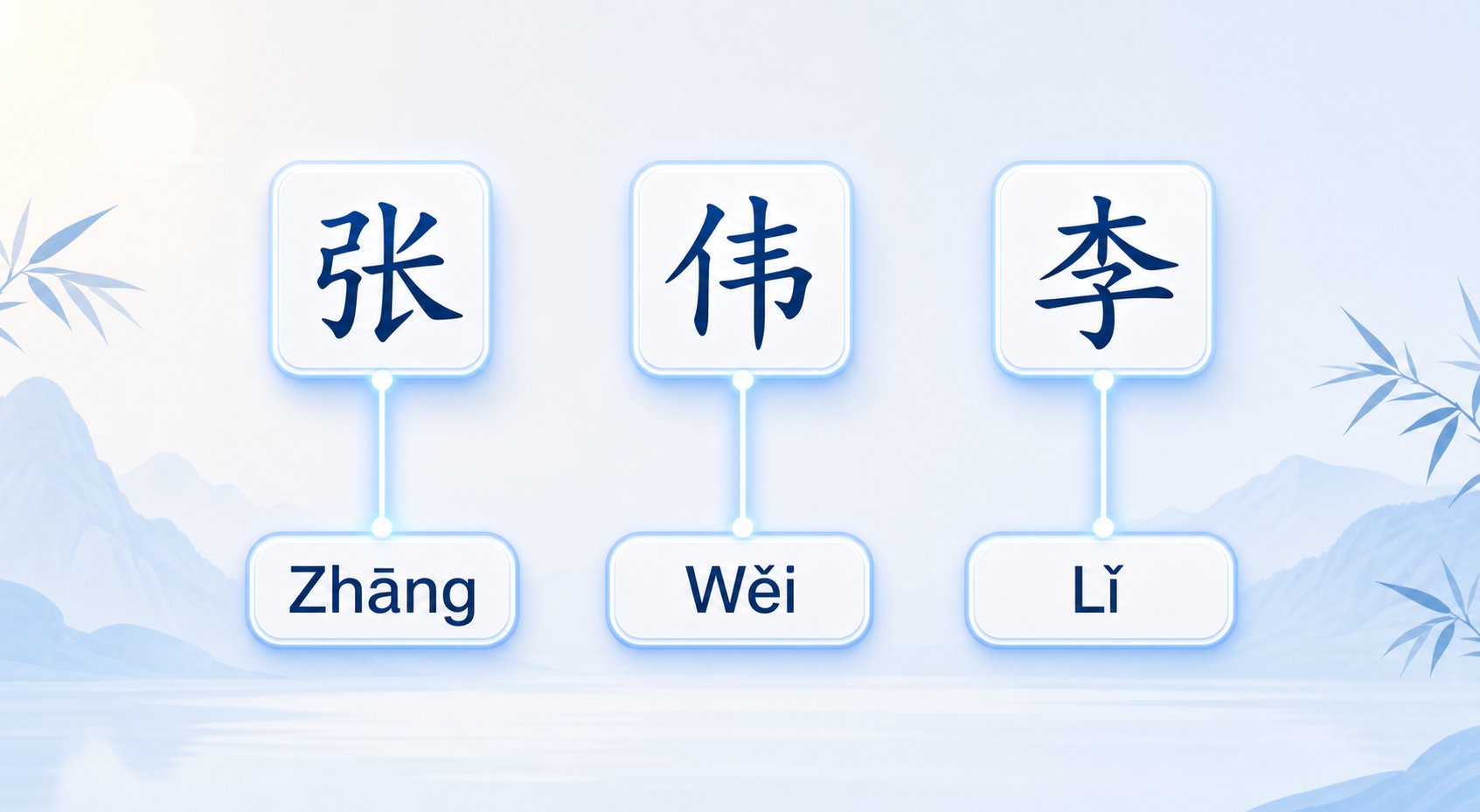
| Zhang Wei | Zhang (张) | Wei (伟) | 1 + 1 character |
| Li Jinze | Li (李) | Jinze (金泽) | 1 + 2 characters |
| Wang Xiaoming | Wang (王) | Xiaoming (小明) | 1 + 2 characters |
| Sima Qian | Sima (司马) | Qian (迁) | 2 + 1 character |
| Ouyang Xiu | Ouyang (欧阳) | Xiu (修) | 2 + 1 character |
Notice how the compound surnames Sima and Ouyang each take up two syllables. If you mistakenly treat only the first syllable as the surname, you end up splitting the family name and misidentifying the given name entirely. This is why recognizing common chinese first names and surnames as distinct units matters so much in practice.
These structural patterns give you a reliable heuristic: when you see a pinyin name, check whether the first syllable matches a known surname, then count the remaining syllables. One surname syllable plus one or two given name syllables accounts for over 98% of all Chinese names you will encounter. The formatting variations that affect how clearly these parts are separated, particularly hyphenation and spacing choices, introduce their own set of recognition challenges.
Common Chinese Surnames in Pinyin You Should Know
Counting syllables and checking capitalization will get you far, but the single fastest shortcut for identifying a chinese last name in pinyin is simple recognition. If you can spot a common surname on sight, you instantly know where the family name ends and the given name begins, no guesswork required.
Here is the good news: you do not need to memorize thousands of names. China has roughly 4,000 surnames in active use, but the top 100 chinese surnames account for about 84.77% of the entire population. In practice, learning to recognize just the top 20 or 30 covers the vast majority of chinese family names you will encounter in professional and academic settings.
The Most Frequent Monosyllabic Surnames
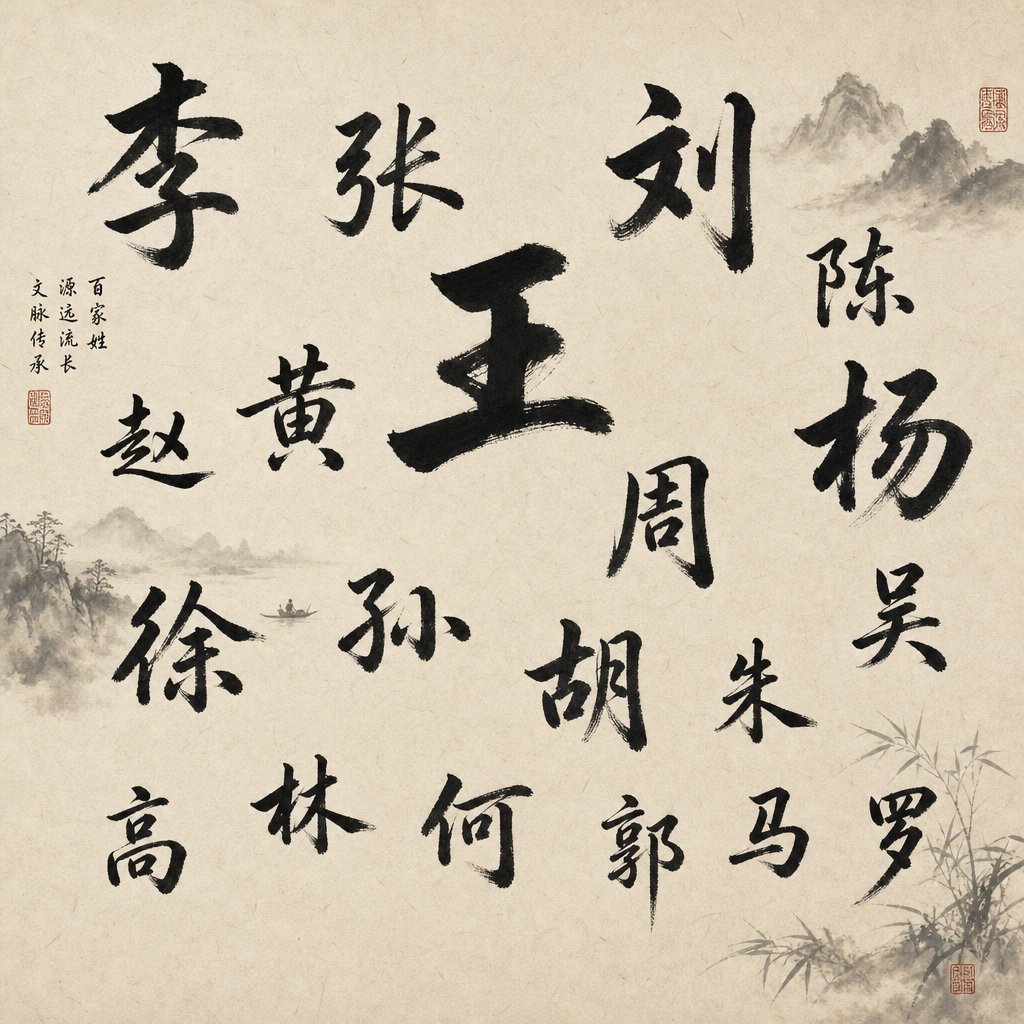
Almost all common chinese last names are a single character, which means a single syllable in pinyin. The following list represents the 20 most popular chinese last names based on data from China's Seventh National Population Census. Familiarize yourself with these, and you will recognize the surname in the majority of pinyin names you come across:
- Li (李, lǐ) - approximately 7.94% of the Han population
- Wang (王, wáng) - approximately 7.65%
- Zhang (张, zhāng) - approximately 7.07%
- Liu (刘, liú) - approximately 5.38%
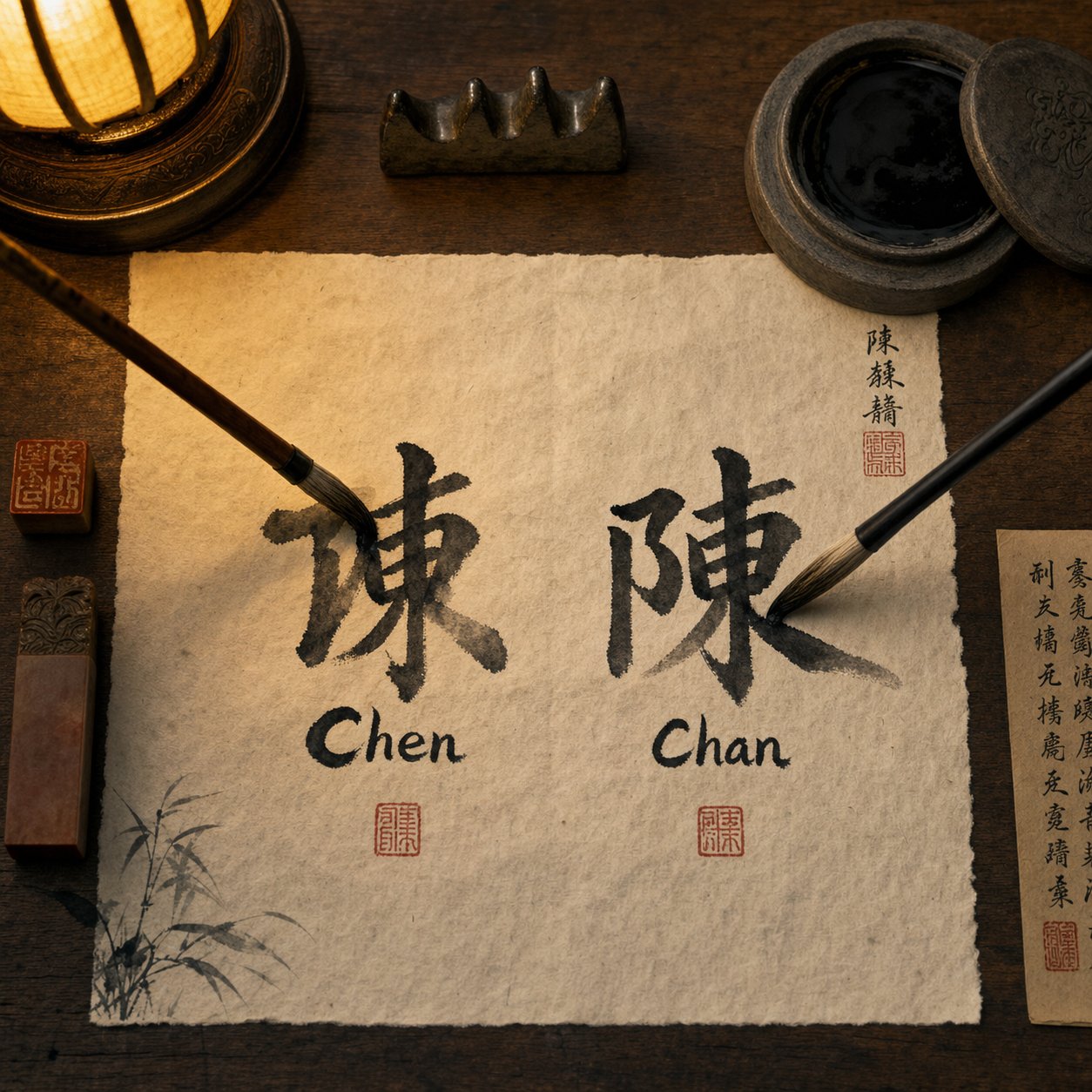
- Chen (陈, chén) - approximately 4.53%
- Yang (杨, yáng)
- Huang (黄, huáng)
- Zhao (赵, zhào)
- Zhou (周, zhōu)
- Wu (吴, wú)
- Xu (徐, xú)
- Sun (孙, sūn)
- Zhu (朱, zhū)
- Ma (马, mǎ)
- Hu (胡, hú)
- Guo (郭, guō)
- Lin (林, lín)
- He (何, hé)
- Gao (高, gāo)
- Liang (梁, liáng)
Notice how short these are. Each one is a single syllable, rarely more than five letters in pinyin. When you see a name like "Huang Liming," your brain can immediately flag "Huang" as the surname because it matches this list. The remaining "Liming" is the given name. That recognition happens in a fraction of a second once you have internalized even the top ten most common chinese surnames.
The top five alone, Wang, Li, Zhang, Liu, and Chen, each represent more than 70 million people worldwide. Together they cover roughly a third of China's population. So statistically, about one in three chinese last names you encounter will be one of these five.
Compound Surnames You Should Recognize
Not every chinese surname is a single syllable. A small but important group of compound surnames use two characters, which means two syllables in pinyin. These are the ones that cause the most splitting errors, because people unfamiliar with them will treat the first syllable as the entire surname and the second syllable as part of the given name.
Compound surnames represent only about 2% of the Chinese population, but failing to recognize them leads to incorrectly splitting the family name in half.
The most commonly encountered compound surnames include:
- Ouyang (欧阳, ōuyáng) - the most common compound surname, with roughly 910,000 bearers
- Sima (司马, sīmǎ) - historically associated with the role of "Master of the Horse"
- Zhuge (诸葛, zhūgě) - famously borne by the strategist Zhuge Liang
- Shangguan (上官, shàngguān) - derived from an ancient official title
- Situ (司徒, sītú) - meaning "Minister over the Masses"
- Xiahou (夏侯, xiàhóu) - tracing back to descendants of Yu the Great
- Huangfu (皇甫, huángfǔ) - an ancient noble lineage
- Huyan (呼延, hūyán) - originating from the Xiongnu people
Many of these compound surnames derive from Zhou dynasty noble titles, official positions, or place names. They are rare in everyday encounters, but they appear frequently in historical texts, literature, and occasionally in modern professional contexts. When you see a pinyin name that starts with two syllables matching any of these pairs, treat both syllables as the surname.
A practical tip: if you encounter a name with four syllables and the first two match a known compound surname, the structure is compound surname plus given name. "Ouyang Xiu" is Ouyang (surname) + Xiu (given name), not Ou (surname) + Yang Xiu (given name). Getting this wrong does not just cause confusion; it fundamentally misidentifies the person's family lineage.
Recognition of these common surnames, both single and compound, gives you a reliable anchor point. But even when you can identify the surname correctly, the way the given name is formatted in pinyin introduces its own layer of variation, particularly around hyphenation and spacing conventions that differ by region and era.
Hyphenation and Spacing Rules That Affect Recognition
You have identified the surname. You know the remaining syllables form the given name. But then you encounter the same person's name written three different ways across three different documents: "Wang Xiaoming," "Wang Xiao-ming," and "Wang Xiao Ming." All three refer to the same individual, yet each format changes how easily you can tell where the surname stops and the given name starts. This variation in chinese name writing is one of the most common sources of confusion for anyone working with pinyin names across regions and institutions.
Joined Given Names in Standard Pinyin
The official standard is clear. The Zhongguo Wenzi Gaige Weiyuanhui (China's Committee for the Reform of the Chinese Written Language) established that a two-syllable given name should be written as a single joined unit with no hyphen and no space. Under this rule, the name pinyin format looks like this: surname as one word, given name as one word. "Zhou Enlai" rather than "Zhou En-lai" or "Zhou En Lai."
The reasoning is practical. The given name functions as a single semantic unit, not two separate words. Splitting it with a hyphen or space implies a division that does not exist in the original Chinese. Writing chinese names in this joined format also makes surname identification immediate: the first word is the surname, the second word is the entire given name. No ambiguity.
Hyphenated Forms and Regional Differences
Despite the mainland standard, names with a hyphen between given name syllables remain extremely common, particularly in Taiwan. Consider the names of Taiwan's recent leaders: Lee Teng-hui, Chen Shui-bian, Tsai Ing-wen. The pattern is consistent: surname as one unit, then the two-syllable given name split by a hyphen with a lowercase letter after it.
This hyphenated style has become a regional marker. As one analysis notes, the hyphen-plus-lowercase pattern is so distinctive that it immediately signals a Taiwanese context, regardless of which romanization system was used for the actual syllables. Mainland China's format joins the given name syllables ("Li Denghui"), while Taiwan's format hyphenates them ("Li Deng-hui"). Both maintain surname-first order, but the visual presentation differs significantly.
Older romanization systems like Wade-Giles also used hyphens in given names, which means historical texts and legacy databases often contain hyphenated forms even for mainland Chinese individuals. When you encounter names in chinese writing systems from before the 1980s, expect hyphens regardless of the person's origin.
When Spacing Creates Ambiguity
The most problematic format is when each syllable of the given name is written as a separate word with spaces: "Wang Xiao Ming." This creates a three-word string where it becomes genuinely difficult to determine which parts belong together. Is this a compound surname "Wang Xiao" plus given name "Ming"? Or surname "Wang" plus given name "Xiao Ming"?
This spaced format appears in Singapore, on some older official documents, and occasionally when database systems force each chinese name letters syllable into a separate field. It strips away the visual grouping that makes surname identification intuitive. Without recognizing "Wang" as a common surname, a reader unfamiliar with chinese names in chinese letters has no formatting cue to rely on.
The table below shows how a single name looks across all three formats and the impact each has on readability:
| Format | Example | Surname Clarity | Common Region/Context |
|---|---|---|---|
| Joined (standard) | Wang Xiaoming | High - two distinct words, first is surname | Mainland China (official) |
| Hyphenated | Wang Xiao-ming | High - hyphen signals given name continuation | Taiwan, older systems |
| Fully spaced | Wang Xiao Ming | Low - three separate words, grouping unclear | Singapore, some databases |
| All caps surname + joined | WANG Xiaoming | Very high - capitalization eliminates doubt | Academic papers, passports |
The key takeaway: when you see a hyphen between the second and third syllables of a name, those hyphenated syllables almost certainly form the given name together. When you see three evenly spaced words, fall back on surname recognition. And when you see the joined format with just two words, the first word is the surname, full stop.
These formatting differences are not random personal choices. They reflect deliberate decisions by governments and standards bodies, each with their own official rules about how chinese name pronunciation should translate into written roman letters. Understanding which standards govern which contexts is the next piece of the puzzle.
Official Standards for Pinyin Name Formatting
The formatting differences you see across documents are not accidents or personal preferences. They trace back to specific international and national standards, each designed to solve the same problem: how to convert chinese names in chinese language into roman letters consistently. The good news? Every single one of these standards agrees on one thing: the surname comes first.
ISO 7098 and National Standards Explained Simply
Three major standards govern how chinese names into english romanization should work:
ISO 7098:2015 is the international standard for romanization of Modern Chinese (Putonghua). Published by the International Organization for Standardization, it provides rules for converting Chinese script into the Latin alphabet for use in documentation, bibliographies, catalogues, and indices. It specifies that personal names maintain their native order, meaning the surname in chinese always precedes the given name. Tone marks are included in the standard form, and the surname and given name are written as separate capitalized words.
GB/T 28039-2011 is China's national standard specifically for spelling Chinese personal names in pinyin. Implemented on February 1, 2012, it covers both Han Chinese names and ethnic minority names, providing rules for cultural education, publishing, and information processing. It mandates the joined format for given names (no hyphen, no space between syllables) and confirms surname-first order as the default.
The United Nations romanization system for Chinese, adopted by the UN Conference on the Standardization of Geographical Names, also follows Hanyu Pinyin conventions. It aligns with ISO 7098 on personal name order and formatting principles.
What differs between these standards is not the order but the details: whether tone marks are required, whether the surname should be fully capitalized, and how to handle edge cases like compound surnames. Think of it this way: they all agree on the grammar of pinyin name order but disagree slightly on the punctuation.
All official Chinese standards, whether international (ISO 7098), national (GB/T 28039-2011), or UN-adopted, maintain surname-first order in pinyin without exception.
How Passports and Official Documents Format Pinyin Names
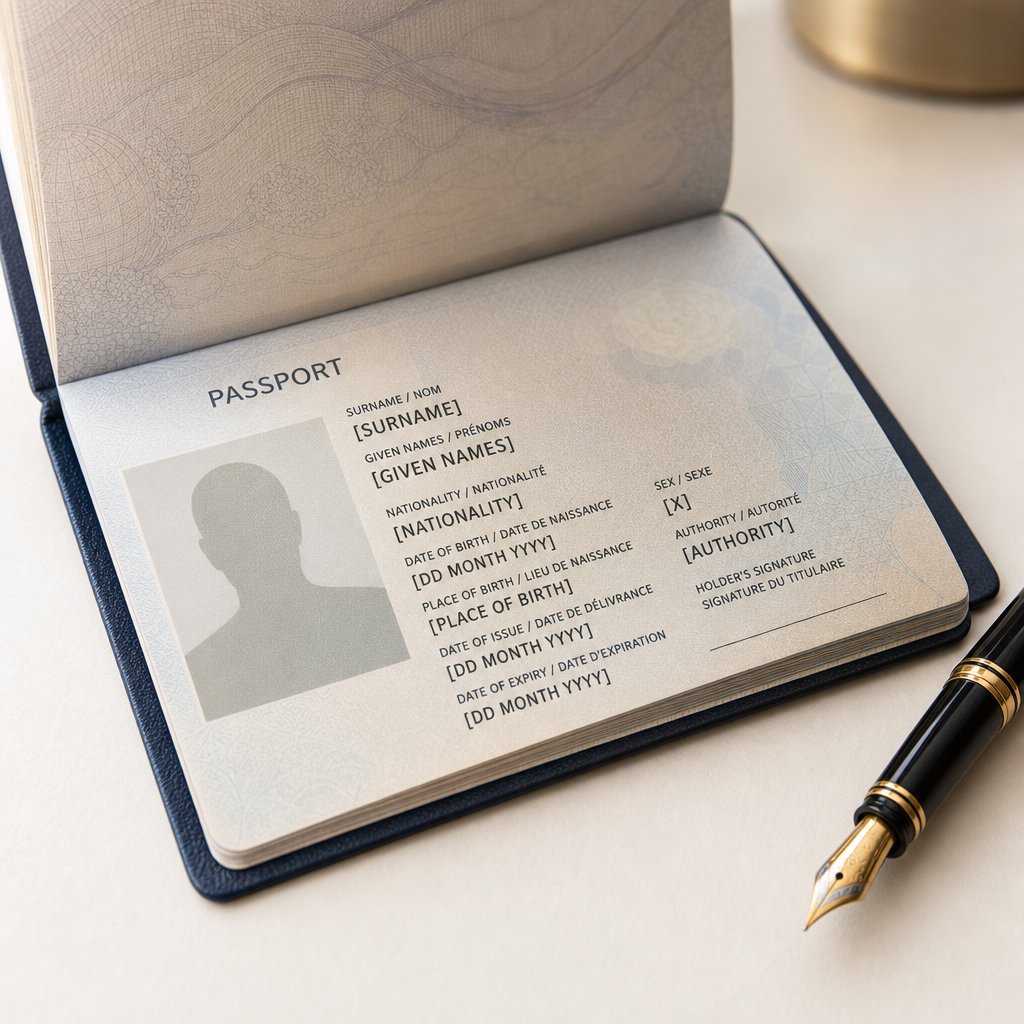
Chinese passports offer the clearest example of standards in action. The surname (last name in chinese) appears on its own line in all capital letters, with the given name printed below it, also in capitals but on a separate line. Tone marks are omitted entirely. So a person named Zhang Weiming would see their passport display ZHANG on one line and WEIMING on the next.
This format eliminates ambiguity completely. There is no question about which part is the surname because the document physically separates the two components. It also strips away the diacritical marks that indicate tones, since machine-readable zones on travel documents cannot process them.
Compare this to how the same name might appear elsewhere:
| Context | Format Example | Surname Position | Tone Marks |
|---|---|---|---|
| Chinese passport | ZHANG / WEIMING (separate lines) | First, isolated on own line | No |
| Academic journal | ZHANG Weiming or Zhang, W. | First, often all-caps | Sometimes |
| Business card (China) | Zhang Weiming | First | Rarely |
| Email signature (international) | Weiming Zhang | Last (reversed for Western readers) | No |
You will notice that the further a document moves from official government use toward informal international communication, the more likely the name order gets reversed. Passports and national ID cards strictly follow GB/T 28039-2011. Academic papers often follow ISO 7098 or journal-specific style guides. But email signatures and social media profiles? Those are a free-for-all where individuals choose whatever format they think their audience will understand.
This is why people sometimes search for a chinese name converter tool, hoping software can sort out the order automatically. While such tools exist, they typically rely on the same surname-recognition approach covered earlier in this guide. No algorithm can reliably determine name order without a database of known surnames to reference.
Understanding what is chinese writing called in technical contexts helps clarify why these standards exist at all. The Chinese writing system uses logographic characters (often referred to as hanzi), and what is chinese script called in romanization contexts is simply "pinyin" when converted to Latin letters. The standards above exist because that conversion is not self-evident. Unlike alphabetic scripts where transliteration is relatively direct, converting hanzi to pinyin requires explicit rules about word boundaries, capitalization, and sequencing, especially for personal names where the surname and given name have no grammatical marker between them.
These official standards give you a reliable framework for formal contexts. But real life rarely stays within the boundaries of official documents. People adapt, reverse, and hybridize their name presentations constantly when moving between Chinese and Western environments, which creates a different kind of challenge entirely.
Navigating Name Order Reversal in International Settings
Here is the reality that makes pinyin surname and given name order tricky in practice: Chinese people do not always keep their names in surname-first order when operating in Western contexts. Some reverse the order entirely. Some keep it. Some switch depending on the audience. And many do not signal which format they are using, leaving you to figure it out on your own.
This is not a hypothetical problem. As one professional indexer working with East Asian names notes, both naming conventions frequently appear in the same document. Historical figures, politicians, and scholars from within China are often presented surname-first, while Chinese Americans, Chinese Canadians, or scholars published by Western presses typically appear given-name-first. You cannot assume all names in a single text follow the same convention.
Recognizing Reversed Name Order in Western Contexts
When a Chinese person moves to an English-speaking country, they face a choice: keep the traditional order or flip it to match local expectations. There is no universal rule for what people choose, but patterns emerge. Mainland Chinese professionals in formal or academic contexts tend to preserve surname-first order more often. Those who have lived in English-speaking countries for years, or who frequently interact with Western colleagues, are more likely to adopt given-name-first order. Some adopt chinese names for english names entirely, introducing themselves as "David Wang" or "Lisa Chen," which sidesteps the ordering question but introduces a different kind of ambiguity around their full legal name.
The challenge intensifies with an asian name that appears in isolation, without context. "Wei Zhang" and "Zhang Wei" could be the same person using different conventions, or two entirely different people. Without additional signals, a chinese name translation from characters to pinyin gives you no grammatical marker indicating which element is the surname.
Context Clues That Reveal Name Order
When you encounter an unfamiliar pinyin name and need to determine which part is the surname, work through these steps systematically:
- Check capitalization patterns. If one element is fully uppercased (ZHANG Wei or Wei ZHANG), the uppercased element is the surname regardless of its position.
- Look for a comma. Formats like "Zhang, Wei" or "Wang, Xiaoming" use the comma to signal that the surname has been placed first in an inverted format, following Western bibliographic convention.
- Scan for recognizable surnames in either position. If you spot "Wang," "Li," "Zhang," "Liu," or "Chen" anywhere in the name, that element is almost certainly the surname. This works whether the name is written surname-first or given-name-first.
- Consider the source context. Academic papers, government documents, and Chinese-published materials typically maintain surname-first order. Social media profiles, informal introductions, and documents produced in Western countries more often use given-name-first.
- Count syllables and check structure. A two-syllable element like "Xiaoming" or "Weiguo" is almost always a given name. Single-syllable elements could be either, so rely on surname recognition.
- Look at how the author or document refers to the person on subsequent mentions. As indexing professionals point out, subsequent references typically use the surname alone, which reveals which element the writer considers the family name.
- When all else fails, ask. A brief, respectful question is always better than a wrong assumption.
Regional conventions also provide clues. Cantonese names from Hong Kong often use romanization systems other than pinyin (Jyutping or informal romanizations like "Leung" instead of "Liang"), and they frequently appear in Western order with an English given name prepended. A name like "Andy Lau" follows Western order, with "Lau" as the surname. Recognizing these patterns across different Chinese-speaking regions helps you avoid applying mainland pinyin assumptions universally to every asian name you encounter.
Academic Citation Rules for Chinese Names in Pinyin
Academic writing adds another layer because citation styles have their own rules for handling chinese names english translation into bibliographic entries. The good news is that most major styles converge on a similar approach, but the details matter if you are writing a paper or building a bibliography.
University library guides for citing Chinese sources outline how the three major styles handle this:
- APA style naturally lists all authors surname-first ("Zhang, W." or "Wang, X."), so Chinese names in their original order fit the format without modification. The surname appears before the comma, initials after.
- Chicago style recommends keeping Chinese names in their original surname-first order in both footnotes and bibliography entries. When the name is already surname-first, no inversion or comma is needed. Chinese characters often follow the romanization in parentheses.
- MLA style also inverts names for bibliography entries, placing the surname first followed by a comma. For Chinese names already in surname-first order, the convention is to maintain that order without adding an unnecessary comma, though practice varies by publisher.
The critical point across all styles: you need to correctly identify the surname before you can cite it properly. An english name chinese name pairing, like "Xiaoming (David) Wang," requires you to recognize "Wang" as the surname regardless of where it appears in the person's preferred informal presentation. Misidentifying the surname does not just create a formatting error. It makes the citation unsearchable, because anyone looking for that author's other work will search under the wrong name.
For scholars published by Western presses, the safest approach is to check how they list themselves in their own publications. Faculty pages, journal bylines, and library catalogue entries typically clarify which element is the surname. When indexing or citing asian surnames names from a text that mixes conventions, the recommendation from experienced indexers is to verify each name individually rather than assuming a blanket convention applies to all names in the document.
These identification strategies work well when you are the one reading and interpreting names. But what about the other direction, when you are the one presenting your name to an international audience, or when you need to ask someone directly about their name order without causing awkwardness? That requires a different kind of practical guidance.

Practical Etiquette for Using and Presenting Pinyin Names
Knowing how to identify name order is one thing. Knowing how to handle it gracefully in real interactions, whether you are presenting your own name or asking about someone else's, is where cultural fluency actually lives. This section tackles both sides: strategies for Chinese speakers navigating international contexts, and etiquette guidance for non-Chinese speakers who want to get it right without making things awkward.
Presenting Your Pinyin Name to International Audiences
If you are a Chinese speaker wondering how to write your name in chinese pinyin for an international audience, you have several proven strategies. The goal is the same in every case: make it immediately clear which part is your surname so others can address you correctly.
The most effective approaches, ranked by clarity:
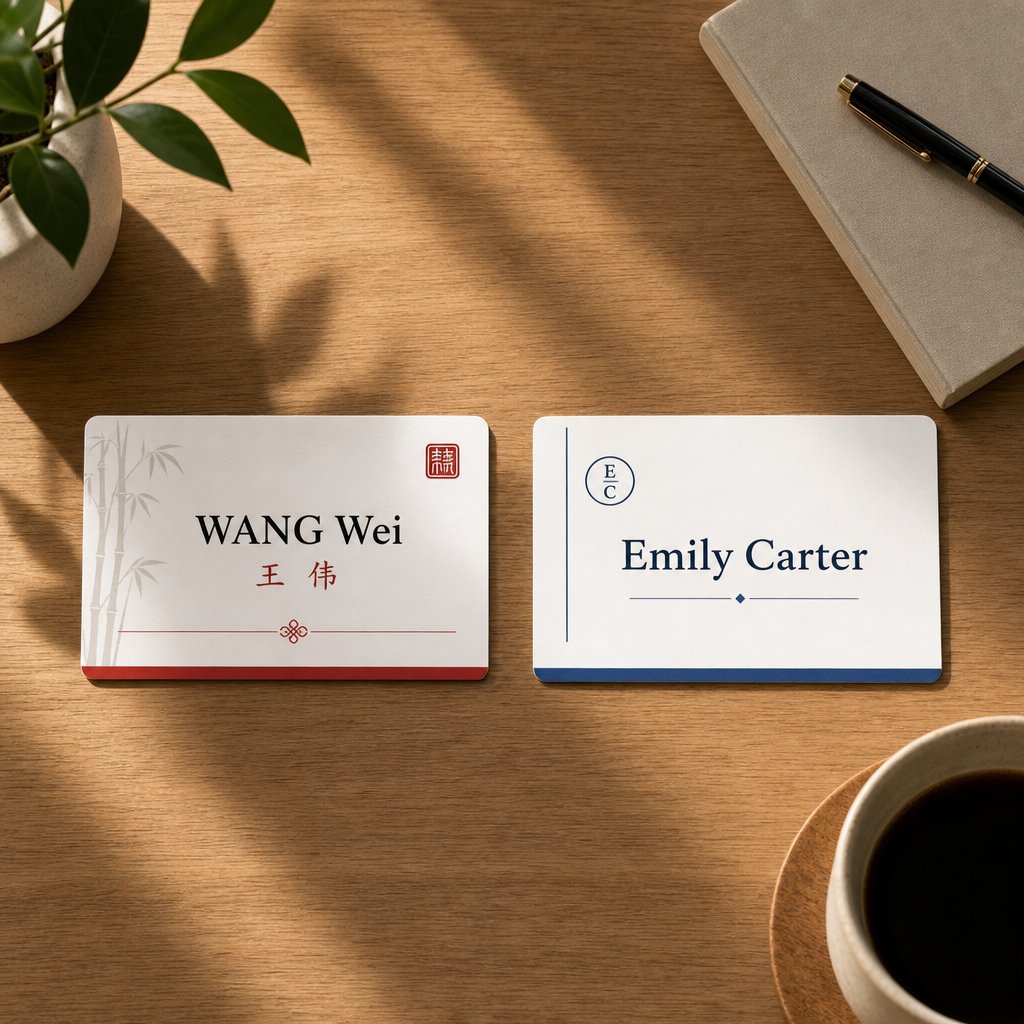
- All-caps surname: WANG Xiaoming. This is the format used on Chinese passports and in many academic journals. The visual weight of the capitalized element leaves zero doubt about which part is the family name.
- Comma after surname: Wang, Xiaoming. This follows Western bibliographic convention and signals inversion explicitly. It works well on CVs, publication lists, and formal correspondence.
- Western name plus Chinese name: David Wang Xiaoming, or David Wang (Wang Xiaoming). This approach is common among professionals who interact frequently with Western colleagues. The English given name provides a familiar entry point while preserving the full legal name.
- Parenthetical clarification: Wang Xiaoming (surname: Wang). Slightly more verbose, but eliminates all ambiguity on first contact, especially useful in email signatures or conference name badges.
Context matters when choosing a format. For job applications, match the convention used in your target country's application system. Many international HR platforms ask for "family name" and "given name" in separate fields, which solves the ordering problem entirely. For academic publishing, check the journal's author guidelines. Most journals in the sciences accept the all-caps surname format. For email signatures, pick one format and use it consistently so colleagues learn your name structure once and remember it.
People sometimes search "what is my chinese name" or "chinese my name" when trying to figure out how their name should appear in different romanization systems. If your name is already in pinyin, the answer is straightforward: keep the surname first and use one of the disambiguation strategies above. The underlying structure does not change. Only the visual formatting adapts to your audience.
How to Politely Ask About Name Order
For non-Chinese speakers, the simplest etiquette rule is this: asking is always better than guessing wrong. A respectful question shows cultural awareness. A wrong assumption, like calling someone by their given name as if it were their surname, shows the opposite.
Here are natural ways to ask without making it feel like an interrogation:
- "How would you like me to address you?" - open-ended and respectful, works in any professional context
- "Which part of your name is your family name?" - direct and clear, appropriate in business settings
- "Should I call you Mr./Ms. [first element] or Mr./Ms. [second element]?" - shows you are aware of the ordering difference and want to get it right
- "Do you have a preferred name for everyday use?" - useful when someone may have adopted a Western given name
- "I want to make sure I address you correctly. Is [X] your surname?" - acknowledges the potential for confusion without making it the other person's problem
The question "what is your name in chinese" might cross your mind when meeting someone who introduces themselves with a Western name. Many Chinese professionals use an English name socially but retain their Chinese name for official purposes. If you are curious, a simple "Do you also go by a Chinese name?" is perfectly appropriate in casual settings. Just do not press if someone prefers their Western name in that context.
Common Mistakes to Avoid When Addressing Chinese Colleagues
Understanding chinese honorifics and forms of address prevents the most embarrassing missteps. In Chinese business culture, the standard form of address is surname plus title. The equivalent of "Mr." in chinese is "xiansheng" (先生), and "Ms." is "nushi" (女士). So "Mr. Wang" becomes "Wang xiansheng," and "Ms. Chen" becomes "Chen nushi." The surname always comes first in this construction, mirroring the broader name order rule.
The most common mistakes to avoid:
- Using the given name as if it were the surname. If someone introduces themselves as "Chen Wei," addressing them as "Mr. Wei" is wrong. Wei is the given name. The correct form is "Mr. Chen." As cross-cultural business guides emphasize, only family and very close friends use the given name alone. Doing so prematurely signals a familiarity that has not been earned.
- Defaulting to the given name in casual settings. Even in relaxed environments, wait for explicit permission before using someone's given name. The threshold for first-name basis is higher in Chinese professional culture than in most Western workplaces.
- Assuming a Western name replaces the Chinese name. When someone introduces themselves as "David Wang," their legal and professional name is still Wang plus their Chinese given name. "David" is a convenience, not a replacement. Use it socially, but use the full name on formal documents.
- Splitting a compound surname. Addressing someone named Ouyang Fei as "Mr. Ou" splits their family name in half. The correct form is "Mr. Ouyang."
- Over-apologizing for confusion. A brief "Sorry, I want to make sure I have this right" is fine. A lengthy apology about how confusing Chinese names are makes the other person feel like their name is a burden. Keep it light and move on.
If you have ever wondered how do i say my name in chinese or how to say my name is chinese during an introduction, the phrase is "wo jiao [name]" (我叫...). Chinese speakers introducing themselves this way will typically state their surname first, giving you a natural cue. Listen for the first syllable and match it against common surnames you have learned. That single habit will save you from most addressing errors before they happen.
These etiquette principles work in live interactions. But what about situations where you are looking at a name on paper or screen with no one to ask? That is where a quick-reference framework for the most common presentation formats becomes essential.
Quick Reference Guide to Pinyin Name Order Rules
Everything above distills into a handful of reliable principles you can apply in seconds. Bookmark this section for the next time you encounter an unfamiliar pinyin name and need to act fast.
Quick-Reference Rules for Pinyin Name Order
Three tools solve the vast majority of cases:
- The default rule: In standard pinyin, the surname comes first. If no other signals are present, treat the first element as the family name.
- Capitalization check: A fully uppercased element (WANG, OUYANG) is the surname, regardless of where it sits in the string.
- Surname recognition: Scan for any of the most common chinese names used as surnames: Wang, Li, Zhang, Liu, Chen, Yang, Huang, Zhao, Zhou, Wu. Spotting one instantly anchors the family name.
The reference grid below maps the most frequent presentation formats you will encounter, showing what order each uses and how to identify the surname at a glance:
| Format | Example | Name Order | How to Spot the Surname |
|---|---|---|---|
| Standard pinyin | Wang Xiaoming | Surname first | First word is the surname |
| All-caps surname | WANG Xiaoming | Surname first | Uppercased element |
| Comma-inverted | Wang, Xiaoming | Surname first (bibliographic) | Element before the comma |
| Western-reversed | Xiaoming Wang | Given name first | Recognize common surname in last position |
| Western name added | David Wang Xiaoming | Western given + surname + Chinese given | Middle element matches a known surname |
| Hyphenated (Taiwan) | Wang Xiao-ming | Surname first | First word; hyphenated portion is the given name |
| Passport format | WANG / XIAOMING | Surname first (separate line) | First line is the surname |
When you see a common chinese name like "Zhang Wei" or "Li Na" in any of these formats, the identification process takes a fraction of a second once you know what to look for. The most popular chinese names in everyday use, whether in business, academia, or media, almost always follow one of the seven patterns above.
Edge Cases and Exceptions Worth Knowing
A few situations break the standard pattern:
- Western name prepended: "David Wang Xiaoming" or "Jessica Li Yuhan" places a Western given name first, the Chinese surname second, and the Chinese given name last. The surname sits in the middle, identifiable only through recognition.
- Stage names and pen names: Performers and writers sometimes adopt names that do not follow surname-plus-given-name structure at all. A stage name like "Jay Chou" uses Western order, while his Chinese name Zhou Jielun follows standard pinyin order. Pen names may be entirely invented and lack a real surname component.
- Courtesy name (zi): In classical and historical contexts, a courtesy name was a separate name given at adulthood, used by peers as a sign of respect. The poet Li Bai, for example, had the courtesy name Taibai. These names follow their own conventions and should not be confused with modern given names. You will encounter them primarily in literary and historical references.
- Generation names shared among siblings: In some families, siblings share one character of their given name as a generation name. For example, Wang Qingzhao and Wang Qingxi share "Qing" as the generational marker. This does not change the surname-given order, but it can help confirm which part is the given name when you see multiple family members listed together.
For typical chinese names in professional and academic settings, edge cases are rare. The standard rule, surname first, covers the overwhelming majority of situations. When exceptions appear, they almost always involve someone deliberately adapting their name for a Western audience, which means the context itself signals that something non-standard is happening.
Your two most reliable tools remain the same regardless of context: check for capitalization cues, and recognize common surnames on sight. Build those habits, and popular chinese names will never trip you up again.
Frequently Asked Questions About Pinyin Name Order
1. Which comes first in a Chinese name written in pinyin, the surname or given name?
In standard pinyin, the surname (family name) always comes first, followed by the given name (personal name). For example, in 'Wang Xiaoming,' Wang is the surname and Xiaoming is the given name. This order is mandated by all official Chinese romanization standards, including ISO 7098 and GB/T 28039-2011, and is the opposite of most Western naming conventions where the given name precedes the family name.
2. How can I tell which part of a pinyin name is the surname?
Use three reliable methods: First, check capitalization. A fully uppercased element like WANG or ZHANG is almost always the surname. Second, recognize common surnames. The top five Chinese surnames (Wang, Li, Zhang, Liu, Chen) cover roughly one-third of the population. Third, count syllables. In about 84% of Chinese names, the first single syllable is the surname and the remaining two syllables form the given name. If a comma appears (Wang, Xiaoming), the element before the comma is the surname.
3. Why do some Chinese people reverse their name order in English?
Many Chinese people flip their name to given-name-first order when in Western contexts to match local expectations and reduce confusion. This is especially common among those living in English-speaking countries or working with international colleagues. However, there is no universal rule. Some maintain surname-first order in all contexts, while others switch depending on the audience. This inconsistency is why learning to recognize common Chinese surnames is so valuable for correct identification.
4. What is the difference between hyphenated and joined pinyin given names?
Mainland China's official standard requires given name syllables to be joined without a hyphen (Wang Xiaoming), treating the given name as a single semantic unit. Taiwan commonly uses a hyphenated format with a lowercase letter after the hyphen (Wang Xiao-ming). Both formats maintain surname-first order, but the joined format makes surname identification easier because the name appears as exactly two words, with the first word being the surname.
5. How should I cite a Chinese author's name in academic papers?
APA style naturally lists authors surname-first, so Chinese names in their original order fit without modification (Zhang, W.). Chicago style recommends keeping Chinese names in surname-first order without adding an inversion comma. MLA also places surnames first in bibliography entries. The critical step is correctly identifying which element is the surname before formatting the citation. Check the author's own publications or faculty page if uncertain, as misidentifying the surname makes the citation unsearchable.