What Is Two Character Given Name Pinyin
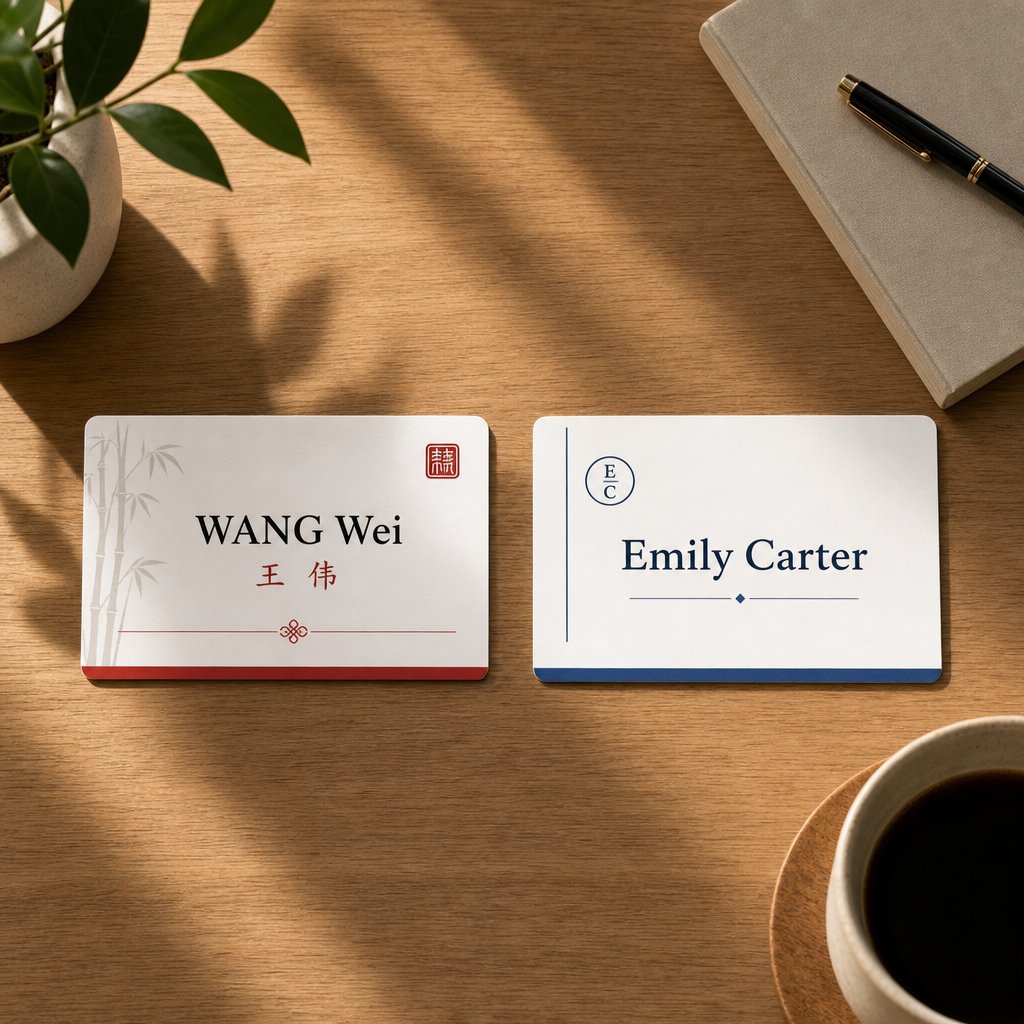
Imagine you're filling out an international form and your Chinese given name has two characters. Do you write it as one word, hyphenate it, or split it into two? If you've ever hesitated at that moment, you're not alone. The romanization of two character given name pinyin is one of the most common sources of confusion for anyone dealing with Chinese names in English contexts.
Here's the basics. Most Chinese given names consist of two characters, and Hanyu Pinyin is the official system for converting those characters into Latin letters. A name in Chinese language follows a surname-first structure, and the given name portion, usually two syllables, needs to be spelled out in a standardized way. The problem is that "standardized" means different things depending on who you ask.
What Makes Two-Character Given Names Unique in Pinyin
Single-character given names are straightforward. You write one syllable, capitalize it, and move on. Two-character given names introduce a choice that doesn't exist in most Western naming systems: how do you represent two syllables that together form one personal name? The characters 小平, for instance, could appear as Xiaoping, Xiao-Ping, or Xiao Ping. All three show up in real documents, publications, and databases. Each format carries different implications for readability, official compliance, and whether a system even recognizes the name correctly.
This ambiguity is unique to names and characters that function as a single semantic unit but contain multiple phonetic components. Unlike compound surnames, which have their own established conventions, the two-syllable given name sits in a gray zone where personal preference, regional practice, and official rules often conflict.
Why Romanization of Chinese Given Names Causes Confusion
The confusion runs deep because no single authoritative English-language resource addresses this specific topic comprehensively. Names in Chinese follow clear rules when written in characters, but the moment you transliterate them into the Roman alphabet, multiple systems and traditions compete for authority. Wade-Giles used hyphens. Modern pinyin joins syllables. Passport offices in different regions apply their own formatting. Academic publishers have house styles that may override everything else.
Should a two-character given name be written as one joined unit (Mingzhu), hyphenated (Ming-Zhu), or separated as two words (Ming Zhu)?
That single question drives real-world consequences, from rejected visa applications to mismatched airline tickets to confused HR databases. The answer depends on which standard you follow, which country issued your documents, and what context you're writing for. The rest of this article breaks down exactly what the official rules say, where they diverge, and how to get it right for your specific situation.
Understanding Chinese Name Structure and Pinyin Basics
The formatting question only makes sense once you understand how Chinese names are built. Unlike Western names, where a given name like "Michael" stands alone as a single unit, Chinese names follow a completely different architecture. Getting the structure right is the first step toward understanding why two character given name pinyin causes so many headaches.
Chinese naming conventions arrange names as follows: family name first, then given name. There's no middle name in the Western sense, though the two-character given name sometimes gets mistaken for a first-plus-middle combination. That misunderstanding is where many formatting errors begin.
How Chinese Name Structure Differs from Western Names
Think of a Chinese full name as a compact two-part system. The surname signals family identity and comes first because, culturally, the family unit takes precedence over the individual. The given name follows and serves as the personal identifier. Here's how the structural components break down:
- Surname (family name): Typically one character/one syllable. Example: Wang (王), Li (李), Zhang (张). The most common chinese last names in mainland China, Wang, Li, and Zhang, are shared by over 270 million people.
- Given name (personal name): Most commonly two characters/two syllables. Example: Xiaoping (小平), Jinping (近平), Mingzhu (明珠).
- Full name in pinyin: Surname + given name with a space between them. Example: Wang Xiaoping, Xi Jinping, Deng Xiaoping.
A small number of chinese surnames are compound, meaning they consist of two characters, such as Ouyang, Zhuge, or Shangguan. There are roughly 81 compound surnames in Chinese, but they cover a tiny fraction of the population. The vast majority of people carry a single-character surname, which is why a three-syllable Chinese name almost always means one-syllable surname plus two-syllable given name.
This is fundamentally different from how Western names work. In English, "John Michael Smith" has clear boundaries: first name, middle name, last name. In Chinese, "Wang Xiaoming" has only two parts: Wang is the surname, and Xiaoming is the entire given name, not two separate names.
Single vs Two Character Given Names in Practice
Not all chinese first names have two characters. Some given names are a single character, like Chen (晨) or Xiu (秀). When a given name has just one character, pinyin formatting is simple: you write the surname, add a space, and write the single-syllable given name with a capital letter. Wang Xiu. Done.
Two-character given names are far more common, though, and they introduce the formatting complexity this article addresses. Consider Xi Jinping. His surname is Xi (习), and his given name consists of two characters: 近平. In correct pinyin, the given name is written as a single joined unit, Jinping, with only the first letter capitalized. The full name reads Xi Jinping, not Xi Jin Ping or Xi Jin-Ping.
Among common chinese names, you'll find two-character given names across all demographics. Popular chinese first names male examples include Jianguo (建国), Weiming (伟明), and Zhiqiang (志强). Common chinese first names female examples include Meiling (美玲), Xiuying (秀英), and Fangfang (芳芳). In each case, the two characters of the given name form a single semantic unit, often chosen because the combined meaning carries an aspiration or blessing, like "brave and strong" or "beautiful and wise."
The reason single-character and two-character given names get treated differently in pinyin romanization comes down to syllable count. A single syllable can't be split or hyphenated. Two syllables can, and that's where competing conventions emerge. Some people split them because it looks more familiar to Western eyes. Others hyphenate because older romanization systems did. The official standard joins them, but not everyone knows that, and not every system enforces it.
Understanding this structural foundation matters because the formatting rules covered next, the official government standards, exist specifically to resolve the ambiguity that two-character given names create. Without knowing how chinese names work at a structural level, those rules feel arbitrary. With this context, they make perfect sense.
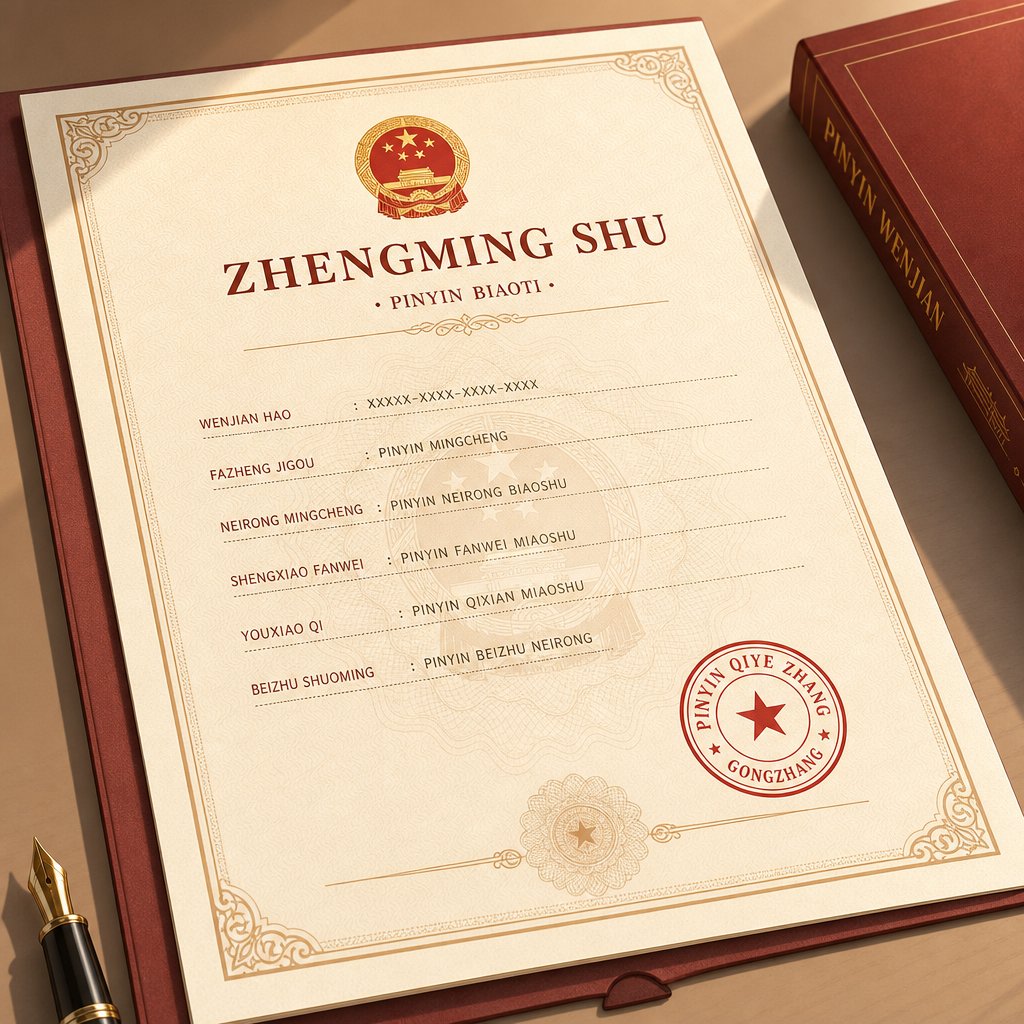
Official Chinese Government Standards for Name Pinyin
The structural logic of Chinese names is one thing. The legally binding rules for how to spell them in pinyin are another. China doesn't leave this to personal preference. Two national standards govern exactly how name chinese characters should be romanized, and they're unambiguous about the correct format for two-character given names.
GB/T 28039-2011 and Chinese Name Romanization Rules
The primary standard is GB/T 28039-2011, officially titled "The Chinese Phonetic Alphabet Spelling Rules for Chinese Names." Issued on October 31, 2011, and implemented on February 1, 2012, this document was drafted by the Ministry of Education's Institute of Applied Linguistics. It applies to education, publishing, Chinese information processing, and any context where Chinese names need pinyin representation.
The standard's core rule for given names is straightforward: the surname and given name are separated by a space, the surname comes first, and a two-character given name is written as a single joined unit. No hyphen. No space between syllables. One capital letter at the start. So if someone's given name consists of the characters 明珠, the correct chinese name translation into pinyin is Mingzhu, not Ming-Zhu or Ming Zhu.
GB/T 28039-2011 also addresses compound surnames, pen names, aliases, and minority language names, but for the vast majority of Han Chinese names, the rule is simple: join the given name syllables into one word.
The companion standard is GB/T 16159, titled "Basic Rules of the Chinese Phonetic Alphabet Orthography." Originally issued earlier and revised in 2012, this document covers broader pinyin orthography, including word spacing, capitalization, and punctuation. Its rules on proper nouns reinforce what GB/T 28039-2011 says about names: capitalize the first letter of each part (surname and given name), and write multi-syllable given names as a single continuous word.
How National Standards Define Correct Pinyin Spelling
When you need to do a chinese name convert from characters to pinyin for any official purpose, these two standards are the authority. Together, they establish a clear chinese name definition in romanized form: surname as one capitalized word, given name as one capitalized word, space between them. That's it.
Here's how the three common formatting approaches compare under these national standards:
| Format | Example | Official Status (GB/T 28039-2011) |
|---|---|---|
| Joined (no space, no hyphen) | Wang Mingzhu | Correct. This is the prescribed format. |
| Hyphenated | Wang Ming-Zhu | Incorrect. Hyphens are not used in standard pinyin for given names. |
| Separated (space between syllables) | Wang Ming Zhu | Incorrect. Creates ambiguity about which syllable is the surname. |
The separated format is especially problematic. Writing "Wang Ming Zhu" makes it look like a three-part name, and systems unfamiliar with Chinese naming conventions might interpret "Ming" as a middle name or even a second surname. The joined format eliminates that ambiguity entirely.
These standards apply directly to official documents: passports, national ID cards, academic transcripts, and any government-issued paperwork in mainland China. The chinese name in chinese language follows its own character-based conventions, but the moment that name appears in a Latin-alphabet context on a Chinese official document, GB/T 28039-2011 dictates the format.
The rules are clear on paper. The complication is that China's national standards don't exist in isolation. International bodies have their own romanization guidelines, and they don't always align perfectly with what Beijing prescribes.
International Standards and How They Differ
China's national standards set the rules domestically, but what happens when those names cross borders? International organizations have their own romanization frameworks, and understanding where they agree or diverge from GB/T 28039-2011 is essential for anyone converting chinese names into english for global use.
ISO 7098 and UN Guidelines for Chinese Name Romanization
The key international standard is ISO 7098, formally titled "Information and documentation — Romanization of Chinese." Now in its third edition, this standard provides rules for converting modern Chinese text into Latin script. When it comes to personal names, ISO 7098 aligns closely with China's national approach: given name syllables are joined into a single unit, the surname is separated by a space, and only the initial letter of each part is capitalized.
The United Nations also adopted Hanyu Pinyin as its system for romanizing Chinese geographical names in 1977, and this decision extended to personal names in official UN documentation. The UN's romanization guidelines follow the same joined-syllable convention for given names, reinforcing the format prescribed by GB/T 28039-2011.
So where's the disagreement? In practice, it's minimal between these modern standards. All three systems say the same thing: write Wang Mingzhu, not Wang Ming-Zhu or Wang Ming Zhu. The real divergence comes from older romanization systems that still influence how people write names today.
The Library of Congress Pinyin Conversion Project illustrates this transition clearly. When the Library of Congress shifted from Wade-Giles to pinyin in 2000, its guidelines specified that "the syllables of the given name are connected, with only the first letter being capitalized." This institutional shift reflected the broader global movement toward a single, consistent format.
| Standard | Given Name Format | Example (王明珠) | Hyphen Used? |
|---|---|---|---|
| GB/T 28039-2011 (China) | Joined, one capital | Wang Mingzhu | No |
| ISO 7098 (International) | Joined, one capital | Wang Mingzhu | No |
| UN Romanization Guidelines | Joined, one capital | Wang Mingzhu | No |
| Wade-Giles (historical) | Hyphenated, both capitalized | Wang Ming-Chu | Yes |
Historical Evolution from Wade-Giles to Modern Pinyin
Why do names with a hyphen still appear everywhere if every modern standard rejects them? The answer is historical inertia. The Wade-Giles system, developed in the mid-19th century and dominant in English-language scholarship for over a hundred years, routinely hyphenated multi-syllable Chinese words, including given names. Under Wade-Giles, Mao Zedong was Mao Tse-tung. Deng Xiaoping was Teng Hsiao-p'ing. The hyphen was a core feature of the system, used to separate syllables while signaling they belonged together.
When the People's Republic of China officially adopted Hanyu Pinyin in 1958, it eliminated the hyphen for given names entirely. The logic was simple: a two-character given name is one word, so it should be written as one word. Decades passed before international institutions caught up. ISO adopted pinyin-based romanization in 1982. The UN followed. The Library of Congress didn't complete its conversion until 2000.
That timeline matters. Generations of scholars, diplomats, and publishers spent their careers writing names with a hyphen in Wade-Giles style. Books, databases, and citation records built over decades still carry those formats. When someone today writes "Xiao-Ping" instead of "Xiaoping," they're often unconsciously following a convention that was officially superseded but never fully disappeared from practice.
There's also a practical reason the hyphenated format persists: readability. For readers unfamiliar with Mandarin phonology, "Xiaoping" can look like a single unfamiliar block of letters. "Xiao-Ping" visually breaks it into digestible pieces. This readability argument has no official standing in any current standard, but it explains why some publishers and individuals still prefer it.
If you need to name translate chinese characters into pinyin for any formal or international purpose, the answer is consistent across every current authority: join the syllables. The hyphen belongs to history. The separated format never had official backing from any major standard. Whether you're working with an english to chinese name conversion tool or formatting a name manually, the joined format is the only one recognized by both Chinese and international standards today.
Still, standards describe the ideal. The real world is messier, especially when it comes to capitalization, tone marks, and the tricky apostrophe rule that prevents syllable-boundary confusion.
Capitalization and Tone Mark Rules Explained
Joining two syllables into one word is only half the battle. The details of how you capitalize, mark tones, and handle ambiguous syllable boundaries determine whether your pinyin is technically correct or just close enough to cause problems.
Capitalization Rules for Joined Given Name Syllables
The rule is simple but frequently broken: when a two-character given name is written as a single joined unit, only the first letter gets capitalized. No intercaps. No second capital letter mid-word. The given name is one word, so it follows the same capitalization logic as any other word in a Latin-script language.
Here are the key formatting rules with examples:
- One capital letter only: Mingzhu (correct) vs. MingZhu (incorrect). The intercap style treats the given name as two separate words fused together, which contradicts the whole point of joining them.
- Surname and given name both capitalized separately: Wang Mingzhu (correct) vs. wang mingzhu (incorrect). Each part of the full name is a proper noun and gets its own initial capital.
- No all-caps for individual parts: Wang Mingzhu (correct) vs. WANG MINGZHU (acceptable only in contexts where all-caps is required, like machine-readable passport zones).
You'll notice the AllSet Learning pinyin rules put it plainly: "two-syllable given names should be written as one word (no space), with no intercaps, and not hyphenated." That covers the three most common errors in a single sentence.
Where this gets tricky is with character surnames that are compound. If someone has the surname Ouyang (欧阳) and the given name Mingzhu (明珠), the full name reads Ouyang Mingzhu. Three visible "parts" appear, but the structure is still two units: compound surname + given name. Without knowing that Ouyang is a surname in chinese naming conventions, a reader might parse it as Ou Yangmingzhu or Ou Yang Mingzhu. Context and spacing are the only cues in pinyin, which is why correct formatting matters so much for compound surnames paired with two-character given names.
Tone Marks and Apostrophes in Two-Character Names
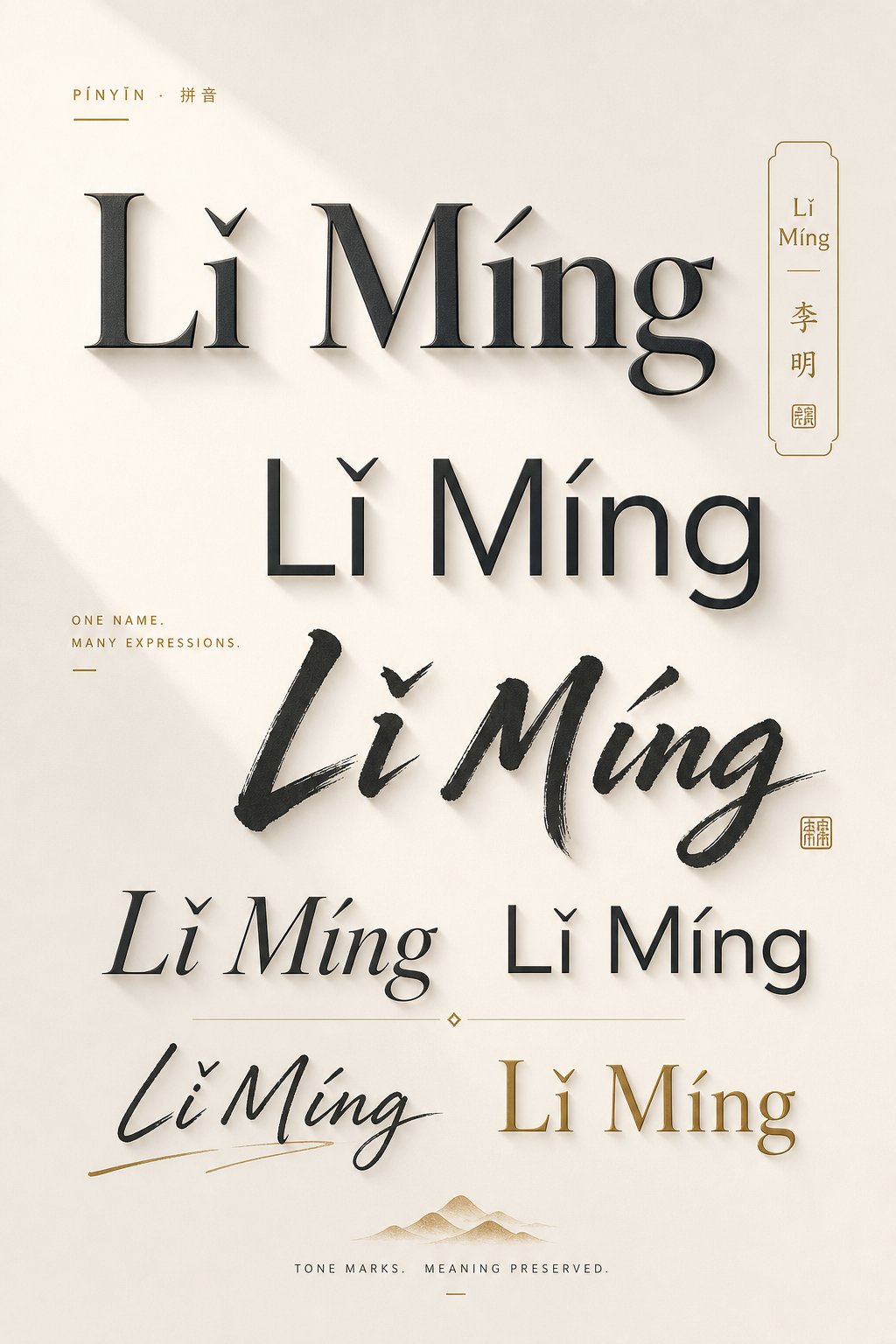
When tone marks are included, the standard placement rules apply to each syllable independently, even though the syllables are written as one word. The MIT pinyin spelling guide explains the core principle: the tone mark goes on the vowel that appears earliest in the sequence a, o, e, i, u, u. The one exception is when i and u occur together, in which case the tone mark falls on whichever comes last.
- Tone marks apply per syllable: Mingzhu with tones becomes Mingzhu (ming2zhu1). Each syllable retains its own tone mark on the correct vowel, regardless of being joined.
- Apostrophe for ambiguous boundaries: If the second syllable of a given name starts with a, o, or e, an apostrophe separates it from the first syllable. Example: the given name 西安 as a hypothetical name would be Xi'an, not Xian. Without the apostrophe, "Xian" reads as a single syllable meaning "first" (先).
- No apostrophe when boundaries are clear: Mingzhu needs no apostrophe because "zh" can only begin a new syllable. The boundary is unambiguous.
The apostrophe rule matters most for understanding mandarin name meaning when reading pinyin aloud. Consider a given name like Chang'ai (长爱). Without the apostrophe, "Changai" could be misread as "chan-gai," completely altering the chinese name meaning and pronunciation. The apostrophe isn't decorative; it's a disambiguation tool that preserves the intended syllable structure.
These rules, capitalization, tone placement, and apostrophe usage, work together to make joined given names readable and unambiguous. They're consistent across GB/T 28039-2011 and ISO 7098. But knowing the rules and seeing them applied consistently in the real world are two very different things, especially when you cross regional borders within the Chinese-speaking world.
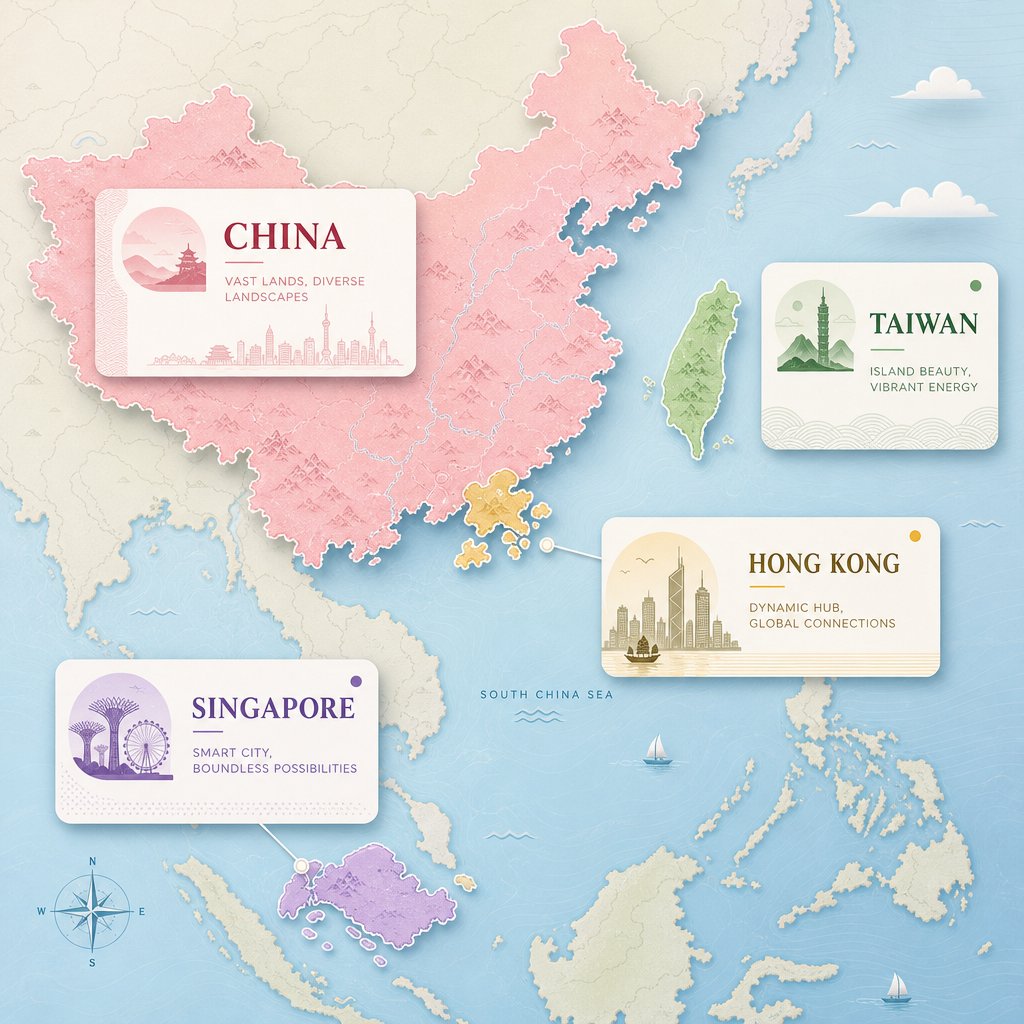
Regional Differences Across Chinese-Speaking Areas
The rules from the previous section apply cleanly in mainland China. Step outside those borders, though, and the same two-character given name can look completely different on paper. Each major Chinese-speaking region has its own conventions for romanizing names, which is why a single person's asian name might appear in three different formats depending on which passport or ID card they're holding.
Mainland China Passport and ID Card Formatting
Mainland China enforces the GB/T 28039-2011 standard on all official documents. Passports, national ID cards, and academic transcripts all use the joined format with one capital letter. If your given name characters are 英文, your passport reads Yingwen. No hyphen, no space, no exceptions. The machine-readable zone at the bottom of the passport displays the name in all caps with the surname and given name separated by specific delimiters, but the visual name field always follows the joined convention.
This consistency makes mainland Chinese documents the easiest to parse. When you see a name like Wang Mingzhu on a PRC passport, you know immediately that Wang is the surname and Mingzhu is the complete given name.
Taiwan, Hong Kong, and Singapore Variations
Taiwan tells a different story. The standard pattern for Taiwanese names uses a hyphen between the two syllables of the given name, with a lowercase letter after the hyphen. Think of names like Tsai Ing-wen, Ma Ying-jeou, or Chen Shui-bian. This hyphenated style has been the default for decades, regardless of which romanization system is used underneath. The hyphen plus lowercase second syllable is what visually marks an asian name as Taiwanese rather than mainland Chinese.
Hong Kong operates differently again. Because the dominant language is Cantonese rather than Mandarin, cantonese names use entirely different romanized spellings. The character 王 becomes Wong instead of Wang. The character 刘 becomes Lau instead of Liu. Beyond the spelling differences, Hong Kong residents commonly write their given name as two separate words. A name like 光明 might appear as Kwong Ming rather than Kwongming or Kwong-Ming. This separated format is the local norm, even though it creates the same surname-boundary confusion that mainland standards specifically try to avoid.
Singapore adds yet another layer of variation. Prominent Singaporean names like Lee Kuan Yew and Lee Hsien Loong follow a separated format similar to Hong Kong's convention. The romanization often reflects Hokkien, Teochew, or Cantonese pronunciation rather than Mandarin, and given name syllables typically appear as separate words. There's no single enforced system, so the way a family name is spelled can signal which dialect group a person's ancestors belong to.
Here's how the same hypothetical given name (明珠, meaning "bright pearl") would appear across regions:
| Region | Romanization System | Given Name Format | Full Name Example |
|---|---|---|---|
| Mainland China | Hanyu Pinyin | Joined, one capital | Wang Mingzhu |
| Taiwan | Various (often Wade-Giles or mixed) | Hyphenated, lowercase second syllable | Wang Ming-chu |
| Hong Kong | Cantonese romanization | Separated, both capitalized | Wong Ming Chu |
| Singapore | Dialect-based (varies) | Separated, both capitalized | Ong Meng Choo |
Notice that the same two characters produce four visually distinct names. The surname changes. The given name format changes. Even the phonetic spelling changes because different dialects pronounce the same characters differently. This is why you might encounter multiple formats for the same person if they hold documents from different jurisdictions, or if their name has been transliterated by different institutions over time.
The practical takeaway? Regional context determines format. A name written with a hyphen likely originates from Taiwan. Cantonese names with separated syllables point to Hong Kong. Fully joined pinyin signals mainland China. Recognizing these patterns helps you identify where a document was issued and which conventions to follow when you need to reproduce the name accurately. It also explains why databases and international forms struggle with Chinese names: they're designed for one format, but the real world delivers at least four.
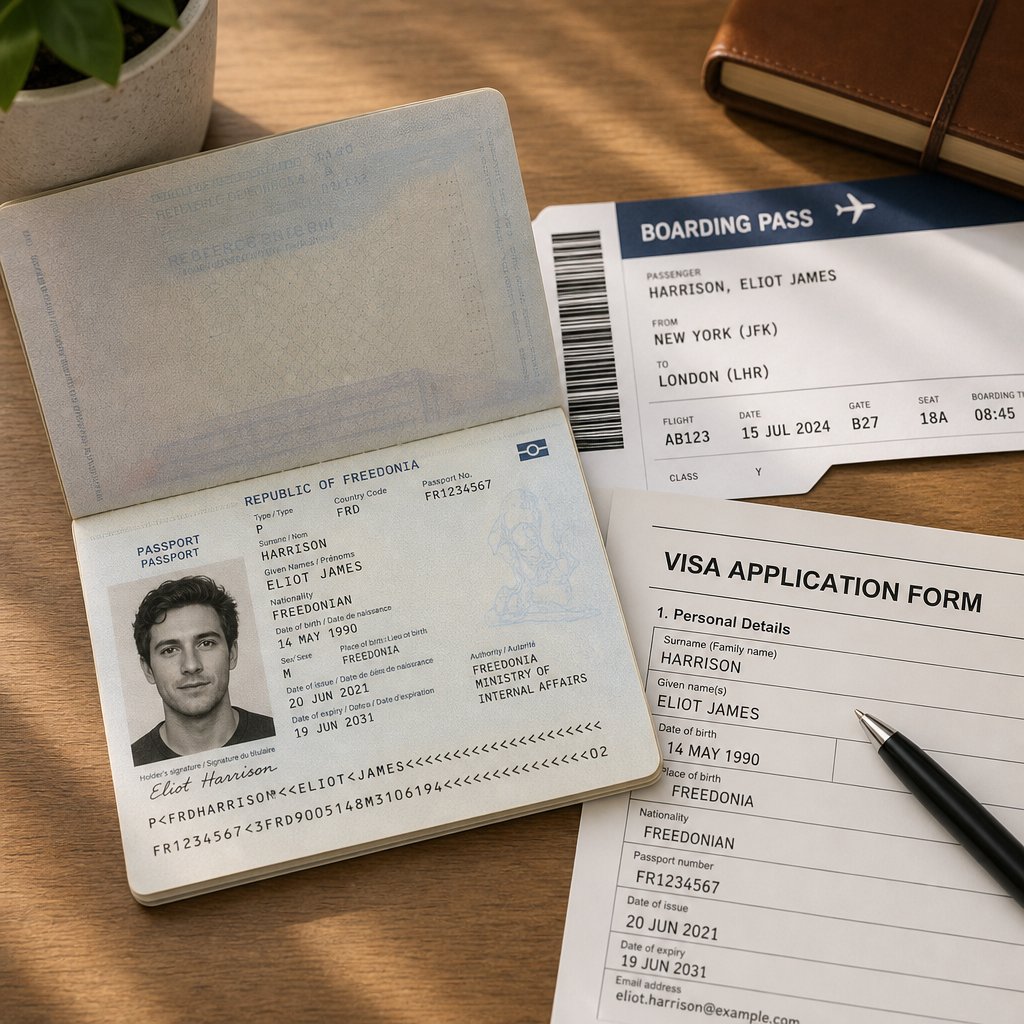
Practical Applications for Documents and Forms
Regional conventions explain why formats vary. But when you're staring at a blank form field with a blinking cursor, what matters is getting it right for that specific context. The gap between official standards and everyday practice is wide, and the consequences of choosing wrong range from minor inconvenience to rejected applications.
Passports and Official International Documents
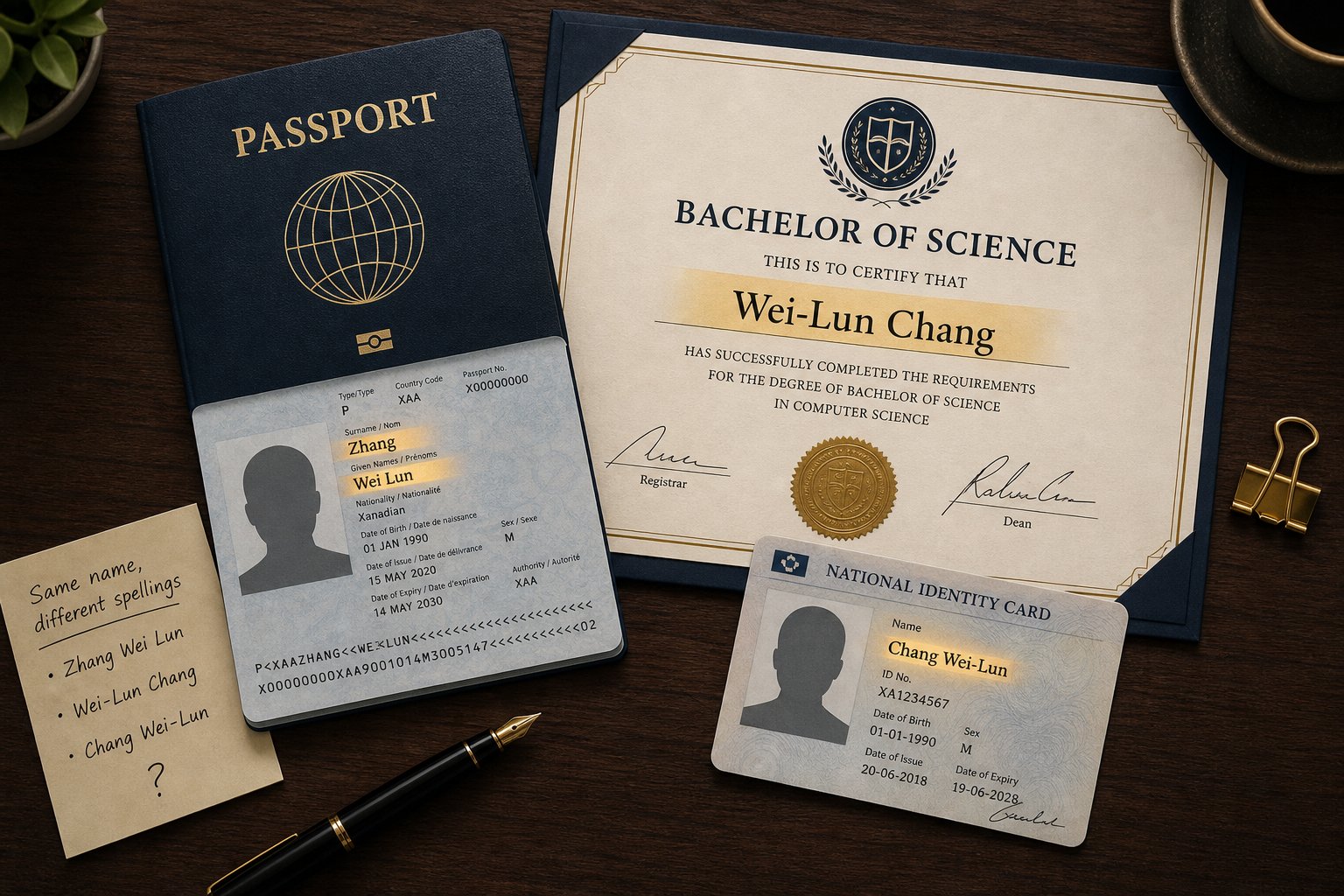
Your passport is the anchor document. Every other form you fill out internationally should match what appears there. For mainland Chinese passports, the given name appears as a single joined unit in the visual zone (e.g., MINGZHU) and follows the same convention in the machine-readable zone. If your passport says WANG MINGZHU, then your visa application, airline booking, and hotel reservation all need to say exactly that.
The problem? Many people don't realize their passport already settled the formatting question for them. They wonder "what is my chinese name supposed to look like in English" and start experimenting with hyphens or spaces on other documents. That mismatch is where trouble begins. Immigration officers compare names character by character. A visa that reads "Ming Zhu" won't match a passport that reads "Mingzhu," and that discrepancy can trigger delays or outright rejection.
China Airlines' traveler name guidelines illustrate this clearly: passengers must enter their name exactly as it appears on their passport, with no spaces or punctuation in the given name field. A passport showing CHUN-HAO (Taiwanese format) gets entered as CHUNHAO in the booking system. The airline strips the hyphen because their system doesn't accept it. If you book with a space or hyphen that doesn't match your travel document, you risk being denied boarding.
Academic Publishing and Professional Contexts
Academic journals present a different challenge. Many publishers have house styles that override official pinyin conventions. Some journals separate given name syllables to help non-Chinese reviewers parse the name. Others follow the author's preference. The result is that the same researcher might appear as "Li Xiaoming" in one citation index and "Li Xiao-Ming" in another, fragmenting their publication record.
For anyone using a chinese name converter tool or doing a chinese translation for names in a professional setting, consistency matters more than perfection. Pick one format, ideally the one on your passport, and use it everywhere. Your professional email signature, conference badges, journal submissions, and LinkedIn profile should all match. A fragmented identity across databases makes it harder for collaborators to find your work and harder for citation trackers to attribute it correctly.
Database administrators face the inverse problem. When building systems that handle Chinese names, you'll encounter every possible format. Some users enter their english name chinese name pair (like "David / Wang Mingzhu"), others submit only pinyin, and still others use regional variants. Robust systems need to accommodate names without spaces, names with hyphens, and names with spaces between given name syllables, then normalize them for search and matching purposes.
Here's step-by-step guidance for correctly formatting a two-character given name in pinyin for international use:
- Check your passport. Whatever format appears there is your baseline. All other documents should match it exactly.
- Join the syllables if starting fresh. If you're applying for a first passport or have a choice, use the joined format (Mingzhu) per GB/T 28039-2011. It's recognized by every current international standard.
- Capitalize only the first letter. Write Mingzhu, not MingZhu. The intercap format has no official backing anywhere.
- Drop tone marks for official forms. Passports, visas, and airline systems don't use them. Reserve tone marks for linguistic or educational contexts.
- Use the apostrophe only when needed. If the second syllable starts with a, o, or e, insert an apostrophe (e.g., Chang'an). Otherwise, leave it out.
- Keep the same format across all platforms. Your visa, bank account, university enrollment, and professional profiles should use identical spelling to avoid mismatches.
- Note your format preference for publishers. When submitting academic work, include a note specifying how your name should appear in citations to prevent editors from reformatting it.
People sometimes ask about chinese names for english names, the practice of adopting a Western given name for international use. Using an English name like "David Wang" sidesteps the formatting question entirely for casual contexts, but it doesn't help on legal documents. Your passport, visa, and official records will always use your pinyin name, so getting that format right remains essential regardless of whether you also go by an English name socially.
The pinyin transliteration standard exists precisely because inconsistencies in name formatting create real compliance risks. As one compliance resource notes, "inconsistencies in name transliteration can lead to significant delays in visa processing or complications in validating legal signatures." This isn't theoretical. It happens routinely when the name on a chinese name from english name conversion doesn't match what appears on the source document.
The practical reality is that most systems are less forgiving than most people expect. Airlines, immigration databases, and banking systems perform exact-match comparisons. A single extra space or missing hyphen can flag a name as unverified. The safest approach is always the simplest: match your passport, use the joined format when you have a choice, and stay consistent across every document and platform you touch.
Even with perfect formatting knowledge, though, mistakes happen. Some errors are so common they've become almost normalized, which makes them harder to spot and easier to repeat.
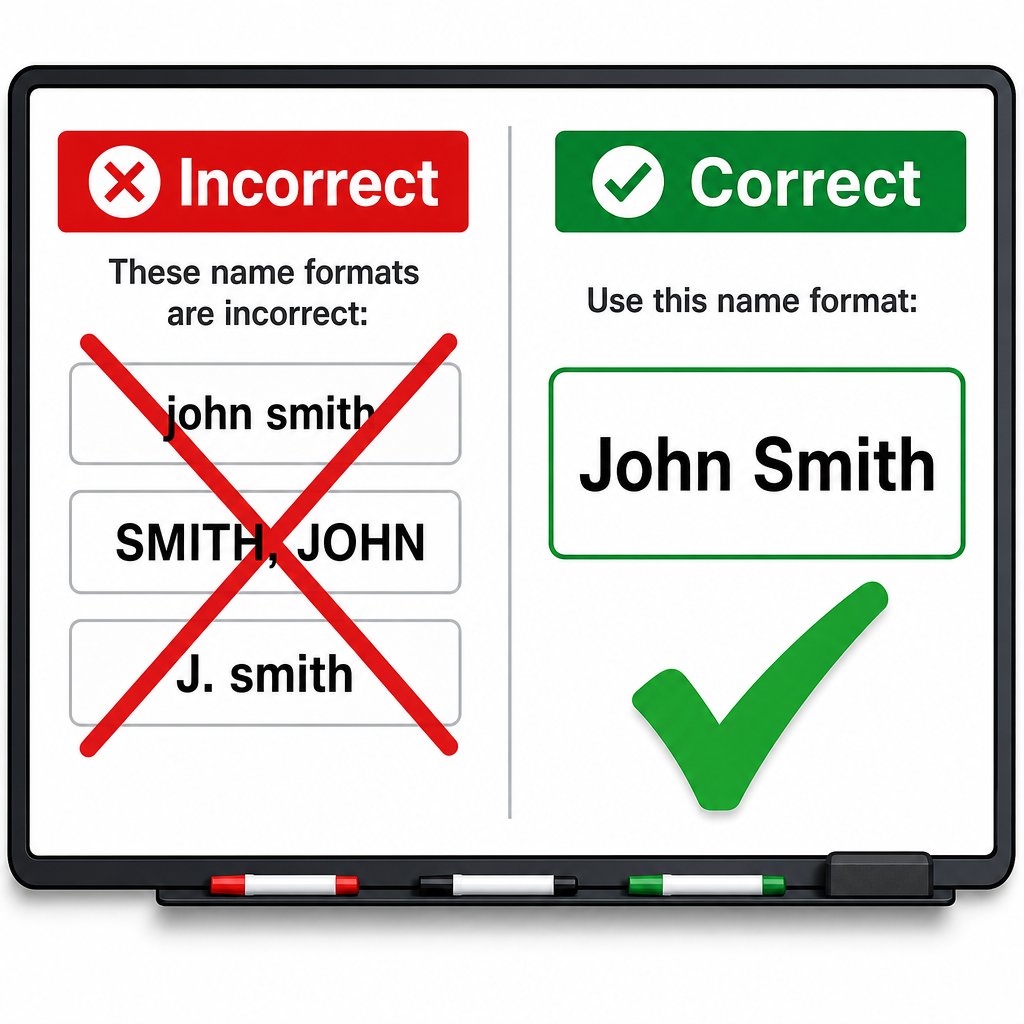
Common Mistakes and How to Avoid Them
Some pinyin formatting errors are so widespread that people assume they're correct. They show up on resumes, visa applications, academic papers, and airline bookings. The problem isn't ignorance of Chinese culture. It's that the wrong formats look reasonable to anyone unfamiliar with the official rules. Here's what goes wrong most often and how to fix it before it costs you a rejected document or a fragmented identity in a database.
Formatting Errors That Cause Document Rejections
The most common chinese name interpretation mistake is treating a two-character given name as two separate words. When someone writes "Wang Ming Zhu" instead of "Wang Mingzhu," they've turned a two-part name into what looks like a three-part name. Immigration systems, airline databases, and banking platforms perform exact-match comparisons against passport data. A single extra space can flag the entry as a mismatch.
The intercap error, writing "MingZhu" instead of "Mingzhu," is equally problematic. It signals that the writer thinks the given name contains two independent words joined for convenience. It doesn't. The given name is one word, and it follows the same capitalization logic as any other proper noun in a Latin-script language.
Here's a breakdown of the most frequent errors alongside their corrections:
| Common Error | Correct Format | Why It Matters |
|---|---|---|
| Wang Ming Zhu (space between given name syllables) | Wang Mingzhu | The space makes "Zhu" look like a separate name or surname, causing database misidentification. |
| Wang Ming-Zhu (hyphen with second capital) | Wang Mingzhu | Hyphens are not part of standard pinyin. This format follows obsolete Wade-Giles conventions. |
| Wang MingZhu (intercap) | Wang Mingzhu | Intercaps imply two separate words. No current standard supports this format. |
| wang mingzhu (no capitals) | Wang Mingzhu | Both surname and given name are proper nouns and require initial capitalization. |
| WANG MING ZHU (all caps with space) | WANG MINGZHU | Even in all-caps contexts like passport MRZs, the given name has no internal space. |
| Omitting apostrophe: Xian (meaning 西安 as a name) | Xi'an | Without the apostrophe, the syllable boundary disappears and pronunciation changes entirely. |
Each of these errors can trigger real consequences. A visa application where the name doesn't match the passport format may be returned for correction, adding weeks to processing time. An airline ticket with a space in the given name field won't match the machine-readable zone of a mainland Chinese passport, potentially resulting in denied boarding. Academic citation databases will treat "Li Xiao Ming" and "Li Xiaoming" as two different researchers, splitting a publication record that should be unified.
How to Distinguish Surname Boundaries from Given Name Syllables
The trickiest error involves misreading where the surname ends and the given name begins. This is especially relevant for anyone managing Chinese names in databases or processing forms. Consider the name Xu Shaoxiong. If written with spaces as "Xu Shao Xiong," a system unfamiliar with Chinese naming conventions might misidentify it as "Xiong Shao Xu" when reordering to surname-last format. The second syllable of the given name gets mistaken for the last name in chinese naming order.
This confusion multiplies with compound surnames. If you see "Ouyang Ming," is that the compound surname Ouyang plus a single-character given name Ming? Or is it the surname Ou plus the given name Yangming? Without the joined format, there's no way to tell from pinyin alone. Understanding chinese surnames meaning and structure, knowing which combinations are established family names versus given name syllables, is the only reliable way to parse ambiguous cases.
A few practical rules help prevent surname-boundary confusion:
- Most surnames are one syllable. If a name has three syllables total (like Wang Mingzhu), the first is almost certainly the surname and the remaining two form the given name.
- Compound surnames are rare and well-documented. Fewer than 10 traditional two-character surnames remain in common chinese name usage. If you're unsure whether a two-syllable unit is a compound surname, check against established lists.
- The joined format eliminates ambiguity. "Ouyang Mingzhu" is unambiguous: Ouyang is the surname, Mingzhu is the given name. "Ouyang Ming Zhu" introduces doubt about whether Zhu might be a separate element.
- Context helps. Chinese last name meanings and their associated characters are well-catalogued. Cross-referencing against known surname lists resolves most edge cases.
The underlying principle is simple: every formatting rule for two character given name pinyin exists to prevent exactly these kinds of misidentification. Joining syllables, using one capital letter, and reserving spaces only for the surname-given name boundary aren't arbitrary style choices. They're disambiguation tools. When you follow them, your name reads correctly in any system. When you don't, you're relying on the reader to guess where one part of your name ends and another begins, and guessing is where errors happen.
Frequently Asked Questions About Two Character Given Name Pinyin
1. Should a two-character Chinese given name be written as one word or two in pinyin?
According to both Chinese national standard GB/T 28039-2011 and international standard ISO 7098, a two-character given name should be written as a single joined word with only the first letter capitalized. For example, the given name 明珠 is correctly written as Mingzhu, not Ming Zhu or Ming-Zhu. This joined format eliminates ambiguity about where the surname ends and the given name begins, which is critical for official documents, database systems, and immigration processing.
2. Why do some Chinese names use hyphens between given name syllables?
Hyphenated given names typically originate from Taiwan or follow the older Wade-Giles romanization system that was dominant in English-language contexts for over a century. Taiwan's standard convention uses a hyphen with a lowercase second syllable, as seen in names like Tsai Ing-wen. While no current international standard supports hyphens for pinyin given names, the format persists due to historical inertia and because some readers find hyphenated names easier to parse visually.
3. Can a wrong pinyin format on documents cause real problems?
Yes, formatting inconsistencies between documents create measurable risks. Immigration officers and airline systems perform exact-match comparisons against passport data. A visa application showing 'Ming Zhu' will not match a passport reading 'Mingzhu,' potentially triggering processing delays or denial. Similarly, airline bookings with extra spaces or hyphens that differ from the passport's machine-readable zone can result in denied boarding. Academic researchers also face fragmented citation records when their name appears in multiple formats across databases.
4. How do I know if a Chinese name has a compound surname or a two-character given name?
Most Chinese surnames are a single syllable, so a three-syllable name like Wang Mingzhu almost always breaks down as one-syllable surname plus two-syllable given name. Compound surnames like Ouyang, Zhuge, or Shangguan are rare, with fewer than 10 remaining in common use. When the joined format is applied correctly, ambiguity disappears: 'Ouyang Mingzhu' clearly shows Ouyang as the surname and Mingzhu as the given name. Cross-referencing against established compound surname lists resolves edge cases.
5. Do I need to include tone marks when writing my Chinese name in pinyin on official forms?
No. Passports, visa applications, airline systems, and most official international forms do not use tone marks. These systems only accept basic Latin letters without diacritics. Tone marks are reserved for linguistic, educational, or academic contexts where precise pronunciation guidance is needed. When tone marks are used, standard placement rules apply to each syllable independently, even though the given name syllables are written as one joined word.