The Living Tradition of Choosing Baby Names From Tang Poetry
Imagine gifting your child a name that carries over a thousand years of literary beauty in just one or two characters. For Chinese families, this isn't a romantic fantasy. It's a living practice woven into the fabric of how parents choose chinese baby names, generation after generation.
The Ancient Art of Poetry-Based Naming in Chinese Culture
In Chinese culture, naming a child is far more than picking something that sounds pleasant. It's an act of storytelling. As author Wendy Chen describes, Chinese parents often choose names that reflect the hopes of the family, whether for their child's personality or future. A single name can signal sibling bonds, generational identity, and even a family's place in history.
At the heart of this tradition sits a practice known as 取名于诗, or selecting name characters directly from classical poetry.
取名于诗 (qu ming yu shi) is the centuries-old Chinese naming custom of drawing a child's given name characters from revered lines of poetry, embedding literary meaning, aesthetic beauty, and ancestral aspiration into a person's identity from birth.
This approach to traditional chinese names goes beyond surface-level meaning. When you pull a character from a famous poem, you're anchoring your child's name to a specific image, emotion, and cultural moment. The name carries the weight of the full verse behind it, giving even common chinese names an unexpected layer of depth when their poetic origin is understood.
Chinese naming conventions have always prized layered significance. A name might reference nature, moral virtue, or historical ambition. Poetry-based naming simply elevates this practice by tying each character to a recognized literary masterpiece, one that educated speakers will instantly recall.
Why Tang Dynasty Poems Remain the Premier Naming Source
So why the Tang Dynasty specifically? China's poetic tradition spans thousands of years, yet the Tang era (618-907 CE) consistently stands as the gold standard for poetry-derived names. Three qualities make it unmatched.
First, linguistic precision. Tang poets worked within strict tonal and structural rules, especially in regulated verse (律诗). Every character was chosen with surgical care. That economy of language means each word already functions like a compressed jewel of meaning, perfect for naming.
Second, emotional range. Tang poetry covers everything from moonlit longing and mountain solitude to fierce ambition and battlefield loyalty. Whatever quality you hope to plant in your child's identity, there's a Tang verse that captures it with startling clarity.
Third, cultural prestige. The Tang Dynasty is widely regarded as the pinnacle of Chinese literary achievement. Names drawn from Li Bai, Du Fu, or Wang Wei carry instant recognition among Chinese speakers worldwide. They signal education, taste, and respect for heritage without needing explanation.
For families exploring ancient chinese names and their meanings, Tang poetry offers a rare combination: characters that are aesthetically beautiful when written, melodic when spoken, and rich with story when understood. Whether you're a Chinese-speaking family continuing a generational tradition or a diaspora family seeking a culturally grounded name that resonates across borders, these verses remain a wellspring of inspiration.
The real question isn't whether Tang poetry makes a worthy naming source. It's which poet, which verse, and which character best fits the life you're imagining for your child.
Six Master Poets and Their Naming Strengths
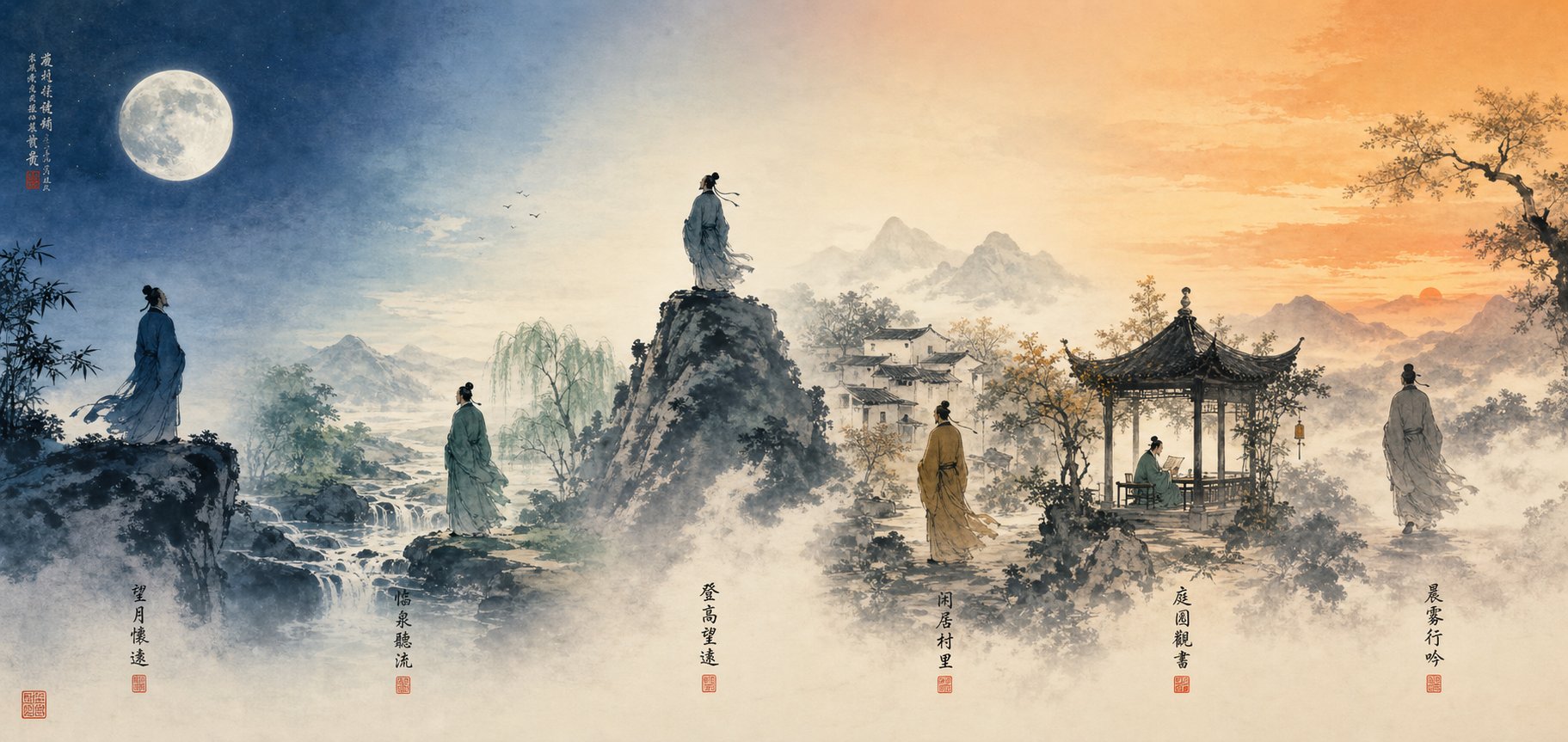
Each Tang Dynasty poet brought a distinct voice to the page, and that voice shapes the kind of names their work inspires. Choosing a poet is like choosing a palette. Li Bai paints in bold, sweeping strokes. Wang Wei works in quiet watercolor. Understanding these differences helps you zero in on the verses most likely to yield the name you're looking for.
The Tang Dynasty spanned nearly three centuries, and scholars typically divide it into four literary periods: Early Tang, High Tang (also called the Flourishing Tang), Mid-Tang, and Late Tang. The poets below represent the High, Mid, and Late periods, each era carrying its own emotional climate. High Tang poets wrote with expansive confidence during China's golden age. Mid-Tang voices turned more reflective as political turbulence set in. Late Tang poets channeled elegance tinged with melancholy. These moods filter directly into the names their characters produce.
Li Bai and Wang Wei as Sources for Distinctive Names
Li Bai (701-762) earned the title "Supernatural Being of Poem" for good reason. His work brims with great momentum, rich imagination, and elegant style, reflecting the full sweep of human experience during the High Tang period. When you draw names from Li Bai, you'll find characters tied to moonlight, wine, cosmic ambition, and untamed freedom. His poetry tends to yield names that feel bold and distinctive, suited for children whose parents want a name suggesting imagination and fearlessness. Think soaring cranes, luminous moons, and rivers that rush toward the sea. Many famous chinese names trace back to his verses, and his lines work well for both boys and girls depending on which image you select.
Wang Wei (701-761), by contrast, is the poet of stillness. Known as the master of landscape and pastoral poetry, his verses describe pine forests lit by moonlight, clear streams running over stones, and bamboo groves at dusk. His naming strength lies in tranquility, spiritual depth, and harmony with nature. If you want a name that evokes calm intelligence rather than fiery ambition, Wang Wei is your poet. His characters lean toward understated beauty, making them especially popular for names that feel serene and grounded. Wang Wei wrote elegant and exquisite verses whose tranquil feeling translates naturally into names for both boys and girls.
Du Fu and Bai Juyi for Names of Character and Depth
Du Fu (712-770), the "Saint of Poem," documented the realities of his turbulent era with unflinching honesty. His poetry is extensive and profound, marked by careful craftsmanship and moral seriousness. Names drawn from Du Fu carry weight. They suggest resilience, scholarly discipline, and ethical strength. His strict use of metrical verse means every character sits in precise balance, giving his ancient china characters a structural elegance that translates well into naming. Du Fu's work tends to inspire names suited for boys, particularly those evoking perseverance, loyalty, and intellectual rigor, though his nature imagery offers options for girls as well.
Bai Juyi (783-846) wrote during the Mid-Tang period with a deliberate goal: accessibility. His poems were meant to be understood by common people, yet they carry surprising emotional complexity. His most celebrated works, like "Song of Eternal Lament" (长恨歌), blend narrative storytelling with lyrical beauty. Names from Bai Juyi often carry warmth, compassion, and a grounded humanity. His relaxed and comprehensible style produces characters that feel approachable yet meaningful. He's an excellent source for names that balance poetic elegance with everyday warmth, working well for both boys and girls.
Li Shangyin and Meng Haoran for Lyrical Elegance
Li Shangyin (813-858) belongs to the Late Tang, a period when poets turned inward. His work is famous for its rich literary grace, combining magnificent form with deep emotional resonance. Li Shangyin's poetry is layered, allusive, and often romantically charged. Names drawn from his verses tend toward the elegant and evocative, carrying a sense of mystery and refined beauty. His characters are particularly popular for girl names, though his more contemplative lines offer sophisticated options for boys. If you're drawn to china dynasty names that feel poetic without being obvious, Li Shangyin delivers.
Meng Haoran (689-740) was a High Tang poet who never held official office, choosing instead a life close to nature. His pastoral poetry shares territory with Wang Wei's, but with a warmer, more personal touch. Meng Haoran's verses capture friendship, seasonal change, and the quiet pleasures of rural life. Names from his work feel gentle and lyrical, carrying an unhurried grace. He's an underused naming source compared to Li Bai or Du Fu, which means characters drawn from his poems often feel fresh and distinctive rather than overly familiar.
| Poet | Era | Dominant Themes | Naming Tone | Best Suited For |
|---|---|---|---|---|
| Li Bai (李白) | High Tang (701-762) | Moonlight, freedom, cosmic ambition, imagination | Bold, expansive, luminous | Both (boys and girls) |
| Wang Wei (王维) | High Tang (701-761) | Mountains, streams, solitude, spiritual calm | Tranquil, refined, natural | Both (boys and girls) |
| Du Fu (杜甫) | High Tang (712-770) | Moral strength, perseverance, social conscience | Serious, structured, resilient | Primarily boys |
| Bai Juyi (白居易) | Mid-Tang (772-846) | Human emotion, narrative beauty, compassion | Warm, accessible, grounded | Both (boys and girls) |
| Li Shangyin (李商隐) | Late Tang (813-858) | Romance, allusion, layered emotion, mystery | Elegant, evocative, romantic | Primarily girls |
| Meng Haoran (孟浩然) | High Tang (689-740) | Friendship, seasons, pastoral simplicity, dawn | Gentle, lyrical, unhurried | Both (boys and girls) |
You'll notice that the High Tang poets dominate this list. That's no accident. The era's open-minded confidence and artistic freedom produced verses with the broadest emotional range, giving parents the widest selection of characters to work with. But don't overlook the Mid and Late Tang voices. Their more introspective tones produce names with a subtlety and emotional depth that the bolder High Tang lines sometimes lack.
Matching a poet's sensibility to the feeling you want your child's name to carry is the first real decision in this process. The next step is finding the specific verse, the exact line, where the right character lives.
Girl Names Drawn From Tang Dynasty Verses
Finding the right verse is where the magic happens. Each poem offers a different emotional landscape, and for chinese girl names rooted in Tang poetry, three thematic currents stand out: moonlit nature, floral beauty, and quiet inner grace. Below you'll find specific characters drawn from real poem lines, complete with their literary context, so you can trace each name back to its source.
Girl Names From Moonlight and Nature Imagery
Tang poets returned to moonlight and natural landscapes obsessively, and these images produce some of the most beautiful chinese names for girls. The characters below carry the stillness and luminosity of the natural world.
- 瑶 (Yao) - Meaning: precious jade, celestial. Source: Li Bai, "清平调" (Qingping Melody). Line: "若非群玉山头见,会向瑶台月下逢" (ruo fei qun yu shan tou jian, hui xiang yao tai yue xia feng) - "If not seen atop the Jade Mountain, then met beneath the moon at the Jasper Terrace." Li Bai wrote this poem in praise of imperial beauty during the High Tang, linking jade and moonlight into a single image of radiance.
- 晓 (Xiao) - Meaning: dawn, first light. Source: Meng Haoran, "春晓" (Spring Dawn). Line: "春眠不觉晓" (chun mian bu jue xiao) - "In spring sleep, one is unaware of dawn." This character captures the gentle arrival of morning, suggesting freshness and new beginnings.
- 清 (Qing) - Meaning: clear, pure. Source: Wang Wei, "山居秋暝" (Autumn Evening in the Mountain). Line: "明月松间照,清泉石上流" (ming yue song jian zhao, qing quan shi shang liu) - "Bright moon shines through the pines, clear spring flows over stones." Wang Wei's pastoral masterpiece gives this character a sense of crystalline purity tied to mountain solitude.
Girl Names Inspired by Flowers and Seasonal Beauty
Floral imagery runs deep in the tradition of female chinese names, and Tang poets elevated it beyond simple prettiness. These characters carry the weight of seasonal cycles and natural resilience.
- 桂 (Gui) - Meaning: osmanthus, cassia. Source: Wang Wei, "鸟鸣涧" (Bird Singing Stream). Line: "人闲桂花落,夜静春山空" (ren xian gui hua luo, ye jing chun shan kong) - "At leisure, osmanthus blossoms fall; the night is still, the spring mountain empty." Osmanthus symbolizes nobility and autumn elegance in Chinese culture.
- 芳菲 (Fangfei) - Meaning: fragrant blossoms, flourishing beauty. Source: Bai Juyi, "大林寺桃花" (Peach Blossoms at Dalin Temple). Line: "人间四月芳菲尽" (ren jian si yue fang fei jin) - "By April in the human world, fragrant blossoms have faded." As a two-character name, 芳菲 captures the fullness of spring in bloom. This is a strong example of ancient chinese names female families have drawn from for centuries.
- 莲 (Lian) - Meaning: lotus. Source: Wang Wei, "山居秋暝" (Autumn Evening in the Mountain). Line: "莲动下渔舟" (lian dong xia yu zhou) - "Lotus stirs as the fishing boat descends." The lotus carries deep cultural meaning in China, representing purity rising from muddy water.
Girl Names Evoking Grace and Inner Strength
Not every name needs to reference a flower or a moon. Some of the most compelling chinese girl names and meanings come from characters that suggest composure, brilliance, or quiet power.
- 华 (Hua) - Meaning: splendor, the prime of life. Source: Li Shangyin, "锦瑟" (The Ornate Zither). Line: "一弦一柱思华年" (yi xian yi zhu si hua nian) - "Each string, each fret, recalls the splendid years." Here 华 evokes youth at its most luminous, a name suggesting brilliance and vitality.
- 静 (Jing) - Meaning: serene, still. Source: Wang Wei, "鸟鸣涧" (Bird Singing Stream). Line: "夜静春山空" (ye jing chun shan kong) - "The night is still, the spring mountain empty." This character suggests composed strength rather than passivity, a calm that holds depth.
- 润 (Run) - Meaning: nourishing, gentle moisture. Source: Du Fu, "春夜喜雨" (Happy Rain on a Spring Night). Line: "润物细无声" (run wu xi wu sheng) - "Nourishing all things softly, without sound." Du Fu's celebration of spring rain gives this character a sense of quiet generosity and nurturing power.
One thing worth noting: the same character can shift meaning depending on which poem anchors it. Take 清 (qing). In Wang Wei's mountain verse, it evokes crystalline spring water and spiritual purity. But in a poem about autumn frost, the same character might lean toward coldness or austerity. When you choose a name, you're choosing the poem's emotional context as much as the character's dictionary definition. This is what separates poetry-based naming from simply picking characters with pleasant meanings.
The names above lean toward imagery traditionally associated with femininity in Chinese culture, but Tang poetry doesn't draw rigid gender lines. Many of these ancient chinese girls names work because of their emotional resonance, not because the characters are inherently gendered. The same poetic tradition offers equally rich territory for boys, where mountains, ambition, and moral courage take center stage.
Boy Names Rooted in Tang Poetic Imagery
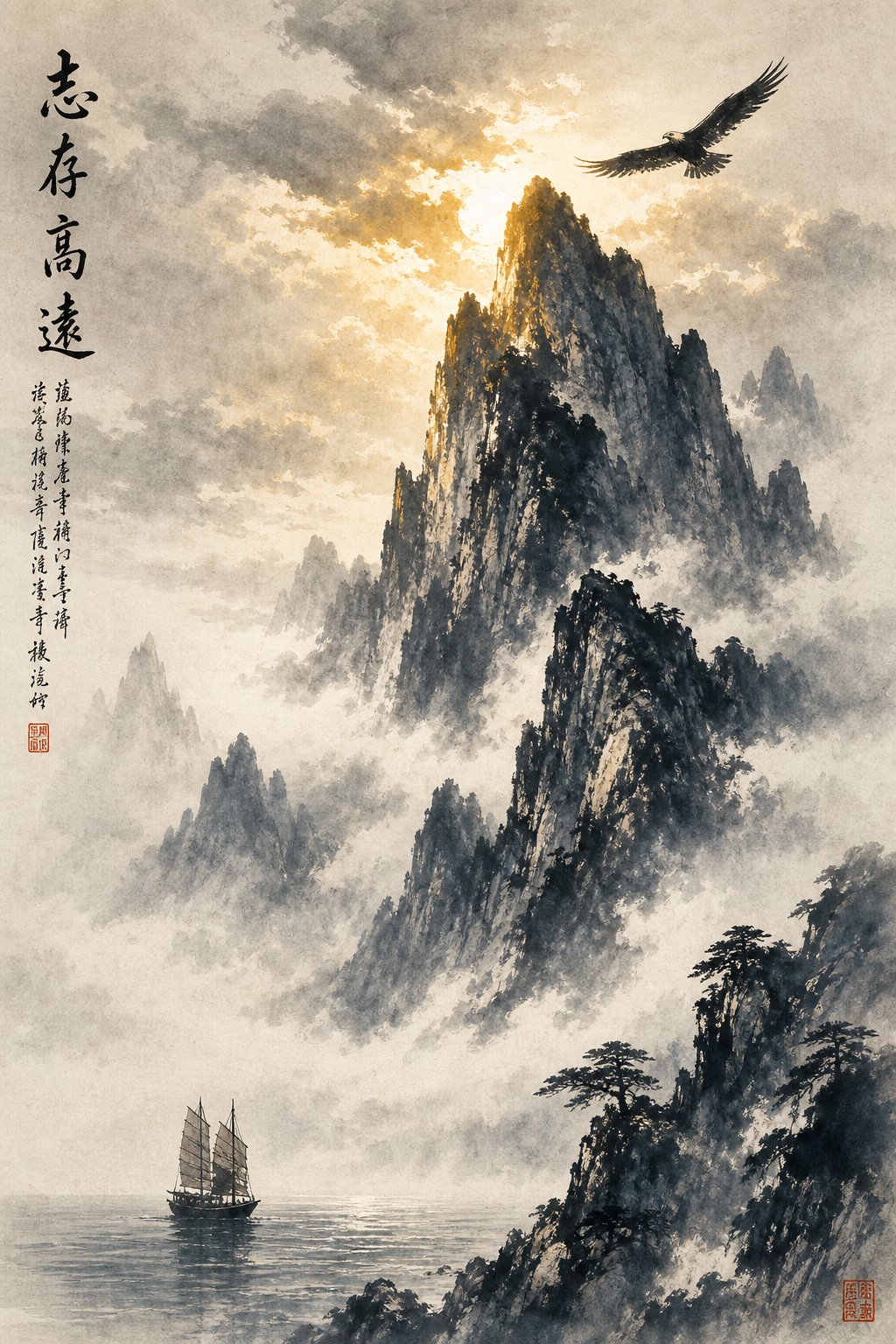
Mountains that dwarf the viewer, sails set against open ocean, a friend's parting cup of wine. Tang poets channeled these images into verses that still resonate as sources for male chinese given names. In Chinese naming tradition, characters tied to landscape grandeur, upward ambition, and moral loyalty have long mapped to masculine identity. The reasoning is cultural rather than linguistic: mountains suggest steadfastness, journeys suggest purpose, and bonds between men in classical poetry suggest integrity. These associations make Tang verse an especially rich source for chinese names for men that carry both beauty and backbone.
Boy Names From Mountain and Landscape Poetry
Tang poets treated mountains as metaphors for human aspiration. Standing at a summit meant seeing beyond ordinary limits. These characters carry that energy.
- 凌 (Ling) - Meaning: to soar above, to surmount. Source: Du Fu, "望岳" (Gazing at Mount Tai). Line: "会当凌绝顶,一览众山小" (hui dang ling jue ding, yi lan zhong shan xiao) - "I shall ascend the highest peak; all other mountains will seem small." Du Fu wrote this in his youth, and the character 凌 captures the act of rising above all obstacles. As a name, it suggests someone destined to surpass limitations.
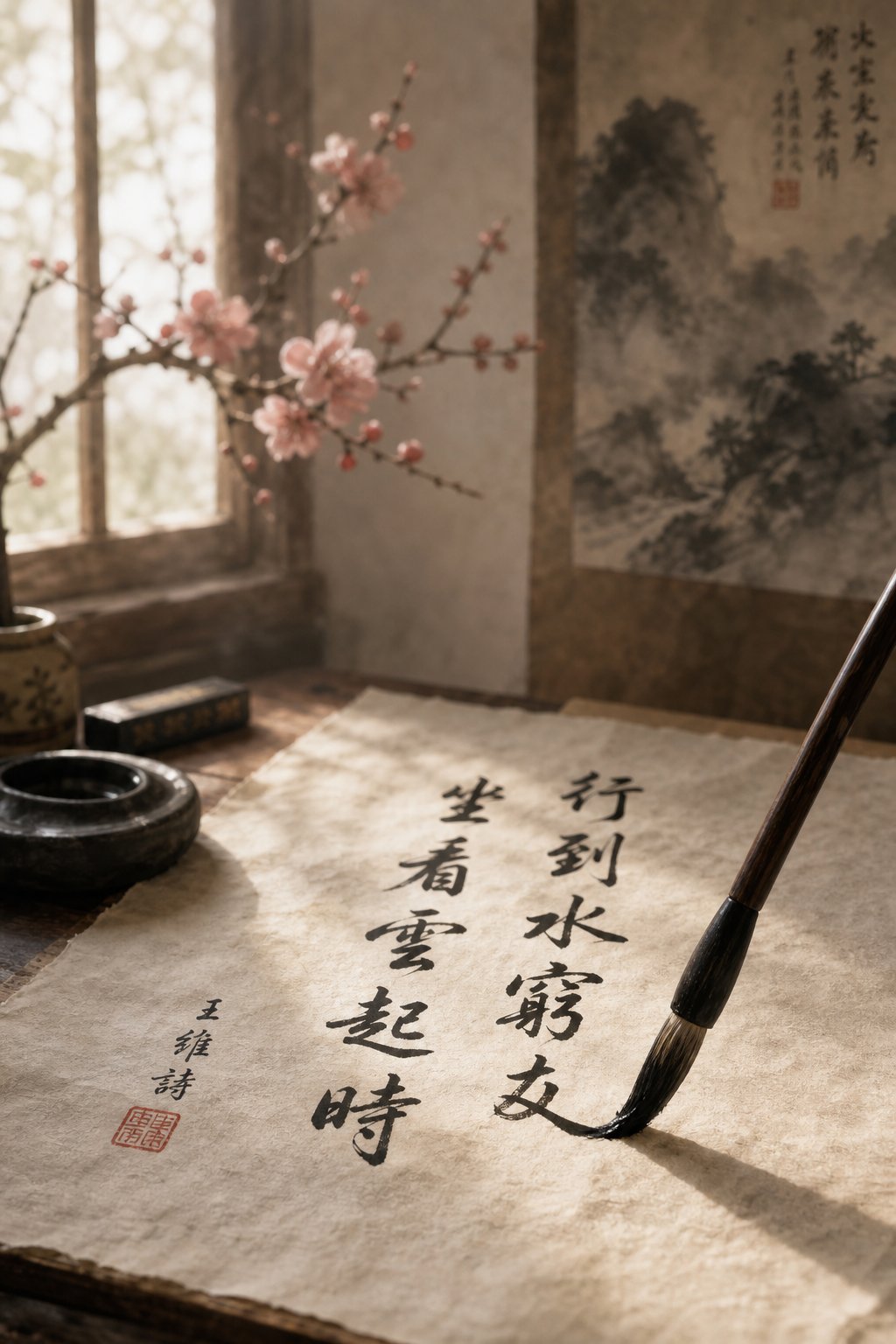
- 云 (Yun) - Meaning: cloud, lofty spirit. Source: Wang Wei, "终南别业" (My Retreat at Zhongnan). Line: "行到水穷处,坐看云起时" (xing dao shui qiong chu, zuo kan yun qi shi) - "Walk to where the water ends, sit and watch the clouds arise." Wang Wei's line describes finding possibility where others see dead ends. The character 云 as a name suggests expansiveness and calm confidence.
- 飞 (Fei) - Meaning: to fly, to soar. Source: Li Bai, "望庐山瀑布" (Watching the Waterfall at Lu Mountain). Line: "飞流直下三千尺,疑是银河落九天" (fei liu zhi xia san qian chi, yi shi yin he luo jiu tian) - "The torrent flies straight down three thousand feet, as if the Milky Way were falling from the ninth heaven." Li Bai's waterfall poem gives 飞 a sense of unstoppable natural force, making it one of the more powerful chinese male names drawn from landscape poetry.
Boy Names Reflecting Ambition and Scholarly Virtue
Scholarly ambition in Tang poetry isn't quiet or modest. It's cosmic. Poets imagined themselves as mythical birds crossing oceans and sails catching world-shaping winds. These characters channel that drive.
- 鹏 (Peng) - Meaning: the great roc, a mythical bird of enormous power. Source: Li Bai, "上李邕" (To Li Yong). Line: "大鹏一日同风起,扶摇直上九万里" (da peng yi ri tong feng qi, fu yao zhi shang jiu wan li) - "One day the great roc rises with the wind, spiraling upward ninety thousand li." Li Bai wrote this as a young man asserting his future greatness. 鹏 is among the most recognizable masculine chinese names, suggesting limitless potential.
- 帆 (Fan) - Meaning: sail. Source: Li Bai, "行路难" (Hard Roads). Line: "长风破浪会有时,直挂云帆济沧海" (chang feng po lang hui you shi, zhi gua yun fan ji cang hai) - "A time will come to ride the wind and cleave the waves, hoisting cloud-white sails to cross the vast sea." This poem acknowledges difficulty before declaring triumph inevitable. 帆 as a chinese male first name carries that forward momentum, the certainty of eventual arrival.
Boy Names Inspired by Friendship and Loyalty Themes
Tang poets wrote some of history's most celebrated farewell poems, and the characters within them speak to loyalty, honor, and deep human connection. These chinese given names male families have favored for generations carry emotional weight without sentimentality.
- 君 (Jun) - Meaning: gentleman, noble person, a term of deep respect. Source: Wang Wei, "送元二使安西" (Farewell at Wei City). Line: "劝君更尽一杯酒,西出阳关无故人" (quan jun geng jin yi bei jiu, xi chu yang guan wu gu ren) - "I urge you, drink one more cup of wine; west of Yang Pass, there are no old friends." Wang Wei's farewell poem is among the most memorized in Chinese literature. 君 suggests someone worthy of respect and trust.
- 英 (Ying) - Meaning: heroic, outstanding, the best among peers. Source: Du Fu, "蜀相" (The Prime Minister of Shu). Line: "出师未捷身先死,长使英雄泪满襟" (chu shi wei jie shen xian si, chang shi ying xiong lei man jin) - "He died before his campaign succeeded, forever making heroes weep into their robes." Du Fu's tribute to the legendary Zhuge Liang gives 英 a sense of noble sacrifice and enduring admiration.
You'll notice these names don't rely on brute-force imagery. The most powerful chinese male names from Tang poetry work because they compress an entire narrative into a single character. 凌 isn't just "high." It's the act of climbing beyond what seemed possible. 帆 isn't just "sail." It's the decision to cross an ocean despite uncertainty. That narrative compression is what separates a poetry-derived name from one chosen out of a dictionary.
Selecting the right character is only half the equation, though. Whether you use one character or two from a poem line changes the name's rhythm, weight, and meaning entirely.
Single Character Versus Two-Character Poetry Names
Picture two names pulled from the same Li Bai line. One uses a single character, 帆 (fan), letting that lone sail carry all the meaning. The other takes two adjacent characters, 云帆 (yunfan), combining "cloud" and "sail" into a phrase that moves like the poem itself. Both are valid chinese given names. But they feel completely different on the tongue, on paper, and in the mind of anyone who hears them.
This choice, one character or two, shapes everything about how a poetry-derived name lands. It affects rhythm, visual balance, and how much of the poem's original meaning travels with the name.
When a Single Poetic Character Makes the Strongest Name
A single-character given name places enormous weight on one image. There's nowhere to hide. The character must be strong enough to stand alone after the surname, carrying its poetic resonance without support. Think of 凌 (ling) from Du Fu's Mount Tai poem. Paired with a one-syllable surname like 李 (Li), you get 李凌, a two-syllable chinese full name that hits clean and sharp.
Single-character names work best when the character itself is vivid and self-contained. Characters like 飞 (fei, to fly), 瑶 (yao, precious jade), or 清 (qing, pure) don't need a partner to communicate their meaning. They function like a single brushstroke that completes the painting.
The trade-off? Fewer syllables mean less tonal variety. If your surname and given name share the same tone, the name can sound flat or monotonous when spoken aloud. Single-character names also tend to be more common, since the pool of standalone poetic characters is smaller than the pool of two-character combinations.
Crafting Two-Character Names From a Single Poem Line
Two-character names open up a different possibility: capturing a phrase's internal rhythm. When you take 明月 (mingyue, bright moon) from Li Bai or 芳菲 (fangfei, fragrant blossoms) from Bai Juyi, you're preserving the poem's own music. The characters were already designed to sit together. Their tones already complement each other. You're borrowing a fragment of the poet's craftsmanship directly.
But not every pair of adjacent characters in a poem line works as a name. You need to evaluate whether the two characters form a natural compound or whether they belong to separate grammatical units. In the line "明月松间照" (bright moon shines through pines), 明月 functions as a unit meaning "bright moon." That works. But 松间 (between pines) feels like a fragment rather than a name, because it's a prepositional phrase rather than a noun or image.
A practical test: ask whether the two characters together name chinese characters that form a recognizable image or concept on their own, outside the poem. If a native speaker would understand the pair as a meaningful phrase without needing the full verse for context, it likely works as a name. If the pair only makes sense within the poem's grammar, separate them.
| Aspect | Single-Character Name | Two-Character Name |
|---|---|---|
| Advantages | Clean, memorable, visually balanced with longer surnames | Richer meaning, tonal variety, preserves poetic rhythm |
| Challenges | Higher risk of tonal flatness, more common overlaps | Must verify characters form a natural compound, longer overall name |
| Examples | 李凌 (Li Ling), 王静 (Wang Jing) | 李云帆 (Li Yunfan), 王芳菲 (Wang Fangfei) |
| Best Suited For | One-character surnames needing crisp rhythm | Names where layered meaning or tonal contrast matters |
Surname length plays a role here too. In chinese names first last structure, the surname comes first. A two-character surname like 欧阳 (Ouyang) already fills two syllables, so a single-character given name keeps the full name at three syllables, which sounds balanced. A one-character surname like 李 (Li) paired with a single-character given name produces a two-syllable name that can feel abrupt, making two-character given names the more natural fit.
Ultimately, the decision comes down to what you want the name to do. A single character distills one poetic image into its purest form. A two-character combination lets you carry a fragment of the poem's own voice into your child's name. Both approaches honor the source. They just honor it differently.
Whichever structure you choose, the characters still need to sound right when spoken aloud. Tonal pairing between surname and given name determines whether a poetry-derived name flows like music or stumbles like mismatched notes.
Tonal Pairing and Stroke Count Principles for Poetry Names
A character can carry perfect poetic meaning and still produce a name that sounds awkward when spoken aloud. Mandarin is a tonal language with four distinct tones, and the way those tones interact across a full name determines whether it flows like a melody or stumbles like clashing chords. When you're pulling characters from Tang poetry for a baby name, understanding chinese name meanings goes beyond semantics. You need to hear the name, not just read it.
Tonal Harmony Between Surname and Poetry-Derived Given Name
Imagine calling your child's name across a park. Does it carry? Does it rise and fall naturally? That's tonal harmony at work. In Mandarin, the four tones are: first tone (high and level), second tone (rising), third tone (dipping), and fourth tone (falling). A well-constructed name moves through contrasting tones, creating a sense of rhythm.
Here's where it gets practical. Take the character 凌 (ling, second tone, rising) from Du Fu's Mount Tai poem. Pair it with the surname 王 (Wang, second tone), and you get Wang Ling, two rising tones in a row. The name feels like it's climbing without ever landing. But pair 凌 with the surname 李 (Li, third tone, dipping), and you get Li Ling, a dip followed by a rise, a natural arc that sounds balanced and clear.
The same principle applies to two-character given names. Consider 云帆 (Yunfan) from Li Bai. 云 is second tone (rising), 帆 is first tone (level). With the surname 赵 (Zhao, fourth tone, falling), you get Zhao Yunfan: falling, rising, level. That's a complete tonal journey in three syllables. With the surname 吴 (Wu, second tone), you get Wu Yunfan: rising, rising, level. Two consecutive rising tones at the start create a slight monotony that a native speaker would notice.
The general guideline for chinese name interpretation through sound: avoid stacking identical tones, especially two third tones in sequence, which forces an awkward pronunciation shift in natural speech.
Stroke Count Balance and Visual Aesthetics in Character Selection
Sound is only half the equation. A Chinese name is written as often as it's spoken, on documents, seals, and red envelopes. The visual balance of written characters matters just as much as their tonal flow. Stroke count is the primary tool for evaluating this balance.
A character like 静 (jing, serene) has 14 strokes. Pair it with the surname 丁 (Ding, 2 strokes), and the written name looks lopsided: a tiny character followed by a dense one. But pair 静 with 赵 (Zhao, 9 strokes in simplified), and the visual weight distributes more evenly. Neither character overwhelms the other on the page.
This doesn't mean every character must have the same stroke count. It means the overall composition should feel intentional. A light surname can pair beautifully with a moderately complex given name, creating a sense of visual progression. What you want to avoid is extreme imbalance, like pairing 一 (yi, 1 stroke) with 馨 (xin, 20 strokes).
When selecting characters from Tang poetry, you're often choosing between several candidates that carry similar meaning chinese names could benefit from. Tonal fit and stroke balance become the tiebreakers. Here's a step-by-step process for evaluating any poem-derived name:
- Identify your surname's tone and stroke count. Write down the tone number (1-4) and count the strokes. This is your fixed starting point.
- List candidate characters from your chosen poem line. Note each character's tone, stroke count, and meaning.
- Test tonal flow by saying the full name aloud. Speak it as if calling someone across a room. If you stumble or the name feels flat, the tones likely clash.
- Check for homophone collisions. Say the full name quickly and listen for unintended words or phrases that emerge from the combined syllables.
- Evaluate visual balance by writing the full name. Write all characters side by side. Does one character dominate visually? Does the composition feel proportional?
- Verify the china name meaning still holds. After filtering for sound and form, confirm the character's poetic meaning remains the primary association, not overshadowed by tonal or visual concerns.
This process reveals why naming from poetry is genuinely a multi-dimensional challenge. A character might score perfectly on meaning but fail on tone. Another might look stunning in calligraphy but sound clumsy with your specific surname. The goal isn't perfection on every axis. It's finding the candidate where sound, form, and meaning align well enough that no single dimension undermines the others.
Even after running through these checks, there's one more layer of due diligence that trips up many families, especially those working across languages or generations. Characters that read beautifully in a Tang poem may carry meanings today that the original poet never intended.
Common Mistakes When Choosing Names From Classical Poetry
Classical Chinese and modern Mandarin are separated by over a thousand years of linguistic drift. A character that meant one thing in Li Bai's era can mean something entirely different in a WeChat conversation today. For diaspora families and non-native speakers working from translations, this gap creates real pitfalls. You might select a character that looks poetic on paper but triggers laughter, confusion, or worse when a native speaker hears it. Understanding what a chinese name mean in its modern context, not just its Tang Dynasty context, is essential before committing ink to a birth certificate.
Archaic Meanings That Shifted in Modern Chinese
Tang poetry uses classical Chinese (文言文), a literary register that differs significantly from the spoken Mandarin of today. Some characters retained their original meanings. Others evolved, narrowed, or flipped entirely. When you're pulling old chinese names from ancient verses, you need to verify the modern reading.
Consider the character 卑 (bei). In classical poetry, it could appear in contexts meaning "humble" or "modest" with a neutral or even positive connotation, describing someone who doesn't seek glory. In modern Chinese, 卑 almost exclusively carries negative weight: lowly, inferior, contemptible. Naming a child with this character based on its poetic sense of humility would land poorly with any contemporary Chinese speaker.
Another example: 妾 (qie). In Tang poetry, this character appears frequently as a first-person pronoun used by women in love poems, roughly meaning "I" or "your humble one." It carries romantic delicacy in verse. In modern usage, 妾 means "concubine." No amount of poetic context rescues that association for a child's name.
The character 薄 (bo/bao) shows up in beautiful Tang lines describing thin mist or delicate light. But in modern Chinese, 薄 frequently connotes "heartless" or "fickle" (薄情). A name meant to evoke morning haze might instead suggest emotional coldness to anyone who hears it.
Homophone Pitfalls and Unintended Associations
Chinese is famously rich in homophones, words that sound identical but carry wildly different meanings. When you combine a surname with a poetry-derived given name, the resulting sound can accidentally spell out an unintended word or phrase. This is one of the most common reasons an otherwise good chinese name falls apart in practice.
The mechanics are straightforward. You choose a character for its meaning, but when spoken aloud with the surname, the combined syllables sound nearly identical to an unfortunate word. For instance, the characters 思 (si, to think) and 旺 (wang, prosperous) both have positive meanings individually. Combined, 思旺 (siwang) sounds almost identical to 死亡 (siwang), the word for "death."
This problem intensifies with poetry names because you're often selecting characters for their literary beauty without testing how they interact with a specific surname. A character like 诗 (shi, poetry) seems like a natural fit for a poetry-derived name. But pair it with the surname 杨 (Yang), and 杨诗 (Yang Shi) can sound uncomfortably close to 养尸 (yang shi, "raising a corpse") depending on regional pronunciation.
The safest approach? Say the full name aloud quickly, multiple times, and listen for any words or phrases that emerge from the blurred syllables. Better yet, ask several native speakers from different regions to do the same test, since homophone sensitivity varies between Mandarin, Cantonese, and other dialect groups.
Characters That Look Poetic but Carry Modern Baggage
Some characters pass the archaic-meaning test and the homophone test but still trip up families because of modern slang, internet culture, or pop-culture associations that didn't exist when the poem was written.
- 日 (ri) - In poetry, it means "sun" or "day" and appears in countless beautiful lines. In modern colloquial usage across many regions, it functions as a vulgar expletive similar to "fuck." Despite its poetic pedigree, using 日 in a child's name invites crude jokes.
- 草 (cao) - Originally meaning "grass" and appearing in pastoral Tang poetry with gentle, natural connotations. In modern internet slang, 草 has become a stand-in for a profanity with the same pronunciation. A name meant to evoke meadows and simplicity now risks triggering a very different reaction.
- 翠 (cui) - Meaning "jade-green" or "kingfisher," this character appears in gorgeous Tang landscape poetry. However, in some modern contexts, 翠 has acquired associations with vulgarity through homophone slang. While less universally problematic than 日 or 草, it requires regional verification.
- 琼 (qiong) - A classical character meaning "fine jade" found in old chinese names and Tang verses alike. While still usable, it has become so strongly associated with a specific generation of naming (1960s-1980s) that it can feel dated rather than timeless to younger Chinese speakers. What a chinese good name sounds like shifts with generational taste.
The pattern here is clear: characters exist in living language, not just in the poems where you found them. A name that would have been perfectly elegant in the Tang Dynasty may now carry slang meanings, generational dating, or pop-culture baggage that undermines its poetic intent.
Before finalizing any poetry-derived name, run it through a simple verification process. Search the character on Chinese social media platforms to see how it's actually used in conversation. Ask native speakers of different ages whether the name triggers any unintended associations. And check whether the character has become so common in a particular era's naming trends that it reads as a period piece rather than a timeless choice. Finding good chinese names from Tang poetry means honoring both the poem's original beauty and the reality of how language lives today.
These pitfalls multiply for families navigating between languages and cultures. A character that passes every test in Mandarin might still present challenges when transliterated into English or spoken by non-Chinese family members, which raises a different set of practical questions entirely.
Tang Poetry Names for International and Diaspora Families
For families living between languages, a poetry-derived name faces a test that Li Bai never imagined: can it survive a roll call in a London classroom, a doctor's office in Toronto, or a job application in Sydney? The answer depends on how thoughtfully you choose. Some Tang poetry characters transliterate into English with graceful ease. Others produce pinyin spellings that English speakers mangle into something unrecognizable. Knowing the difference before you commit saves your child years of correction.
Choosing Poetry Names That Work Across Languages
The core challenge is phonetic. Mandarin names use sounds that don't always map cleanly onto English phonology. Characters with pinyin spellings like "Qi," "Xu," or "Zhi" trip up English speakers because the consonant combinations don't exist in their language. Meanwhile, characters spelled "Ming," "Lan," or "Kai" feel intuitive to pronounce across most Western languages without instruction.
When evaluating a poetry character for cross-cultural use, ask three questions:
- Does the pinyin spelling suggest the correct pronunciation to an English reader, or will they default to a wrong sound?
- Does the name contain Mandarin-specific sounds (zh, x, q, c as "ts") that require explanation every time?
- Is the name short enough that non-Chinese speakers will remember and use it comfortably?
Characters like 明 (Ming), 安 (An), 凯 (Kai), and 兰 (Lan) score well on all three counts. Their pinyin spellings read almost identically in English, French, and Spanish. A teacher seeing "Ming" on a roster will pronounce it close enough to correct without coaching. These are popular chinese names in diaspora communities precisely because they reduce daily friction.
For families who also use cantonese names, the calculation shifts slightly. Cantonese romanization (Jyutping or Yale) produces different spellings than Mandarin pinyin for the same character. The character 明 becomes "ming" in both systems, making it doubly versatile. But 云 (yun in Mandarin) becomes "wan" in Cantonese, which English speakers handle differently. If your family uses Cantonese at home, test the name in both romanization systems to ensure it works in whichever one appears on official documents.
Pairing Tang Poetry Names With Western Names
Many diaspora families give their children both a Chinese poetry name and a Western first name. The two names might share a sound, a meaning, or simply coexist as separate identities for separate contexts. Each approach has its logic.
Sound-linking pairs a Western name with a mandarin chinese names character that shares a syllable. For example, the Western name "Chloe" pairs naturally with 清 (Qing) since both begin with a similar hard consonant followed by a vowel. "Liam" echoes 凌 (Ling). These pairings create a subtle phonetic bridge between the child's two names without forcing either one to compromise.
Meaning-linking connects the names through shared symbolism rather than sound. A child named "Dawn" in English might carry 晓 (Xiao, first light) from Meng Haoran's "Spring Dawn" as their Chinese name. "Jasper" pairs conceptually with 瑶 (Yao, precious jade). This approach lets each name stand fully in its own language while sharing a deeper thread.
Some families simply choose independently, giving a Western name for daily use in English-speaking environments and a chinese english names combination that lives on official documents and within family contexts. There's no wrong method. The key is ensuring neither name undermines the other when spoken together, since some combinations produce awkward rhythms or unintended sounds when a full legal name is read aloud.
Accessibility Levels From Beginner to Literary Sophistication
Not every family has the same relationship to classical Chinese. A third-generation diaspora family in Vancouver and a literature professor in Beijing bring very different levels of context to a poetry name. Both deserve options that feel authentic rather than forced. The table below organizes unique chinese names from Tang poetry into three tiers based on how much cultural and linguistic background they assume.
| Level | Name | Pinyin | Pronunciation Guide (English Speakers) | Meaning | Source Poem |
|---|---|---|---|---|---|
| Beginner | 明月 (F/M) | Mingyue | MING-yoo-eh | Bright moon | Li Bai, "Quiet Night Thought" (静夜思) |
| Beginner | 安 (F/M) | An | AHN | Peace, tranquility | Wang Wei, "Farewell at Wei City" (送元二使安西) |
| Beginner | 凯 (M) | Kai | KYE (rhymes with "sky") | Triumph, victory | Du Fu, various regulated verses |
| Intermediate | 云帆 (M) | Yunfan | YOON-fahn | Cloud sail, boundless ambition | Li Bai, "Hard Roads" (行路难) |
| Intermediate | 清 (F) | Qing | CHING (soft "ch") | Clear, pure | Wang Wei, "Autumn Evening in the Mountain" (山居秋暝) |
| Intermediate | 晓 (F) | Xiao | SHEE-ow | Dawn, first light | Meng Haoran, "Spring Dawn" (春晓) |
| Advanced | 芳菲 (F) | Fangfei | FAHNG-fay | Fragrant blossoms in full bloom | Bai Juyi, "Peach Blossoms at Dalin Temple" (大林寺桃花) |
| Advanced | 凌 (M) | Ling | LING (as in English) | To soar above, surmount | Du Fu, "Gazing at Mount Tai" (望岳) |
| Advanced | 瑶 (F) | Yao | YOW (rhymes with "now") | Precious jade, celestial | Li Bai, "Qingping Melody" (清平调) |
The "Beginner" tier features characters whose pinyin spellings align closely with English phonetics and whose meanings are immediately graspable. These work well for families where non-Chinese-speaking grandparents, teachers, and friends will use the name daily. The "Intermediate" tier introduces sounds that require brief explanation but remain manageable, characters like 清 (Qing) where you might say "it's pronounced like 'ching'" once and people remember. The "Advanced" tier includes names whose full beauty depends on knowing the source poem, names that reward literary knowledge but may need more context in cross-cultural settings.
Whichever tier resonates, the underlying principle stays the same. A mandarin names choice rooted in Tang poetry should feel like a gift, not a burden, to the person who carries it. That means considering not just what the name means in its poetic origin, but how it will function in the daily reality of your child's life: spoken by teachers who've never studied Chinese, typed into systems that may not handle tonal marks, and carried across whatever borders your family's story crosses. The best poetry names manage all of this while still holding their thousand-year-old beauty intact.
Frequently Asked Questions About Tang Dynasty Poetry Baby Names
1. How do Chinese parents traditionally choose baby names from poetry?
The practice called 取名于诗 (qu ming yu shi) involves selecting one or two characters directly from classical poem lines. Parents identify a verse whose imagery or emotion matches their hopes for the child, then extract specific characters that carry both standalone meaning and the poem's broader context. The Tang Dynasty (618-907 CE) is the most popular source due to its linguistic precision, emotional range, and cultural prestige among Chinese speakers worldwide.
2. Which Tang Dynasty poets are best for choosing girl names versus boy names?
Li Shangyin's romantically charged, layered verses are especially popular for girl names evoking elegance and mystery. Wang Wei's nature poetry works well for girls seeking serene, tranquil names. For boys, Du Fu's morally serious verses inspire names of resilience and scholarly strength, while Li Bai's bold imagery suits names suggesting ambition and fearlessness. Both Bai Juyi and Meng Haoran produce characters that work equally well for either gender.
3. What mistakes should I avoid when picking a name from classical Chinese poetry?
Three common pitfalls exist. First, characters whose meanings shifted over centuries, like 卑 (bei) which moved from 'humble' to 'inferior.' Second, homophone collisions where the full name sounds like an unfortunate word, such as combined syllables accidentally spelling 死亡 (death). Third, characters that acquired modern slang meanings, like 草 (cao, grass) which now functions as internet profanity. Always test names with native speakers of different ages and regions before finalizing.
4. Should I choose a single-character or two-character name from a poem line?
Single-character names place all weight on one vivid image and work best with one-character surnames that need crisp rhythm. Two-character names preserve the poem's internal music and offer richer tonal variety. The key test for two-character names is whether the adjacent characters form a natural compound that native speakers recognize as a meaningful phrase outside the poem's grammar. Surname length also matters: two-character surnames like 欧阳 pair better with single-character given names for balanced syllable count.
5. How can diaspora families choose Tang poetry names that work in English-speaking countries?
Focus on characters whose pinyin spellings align with English phonetics. Names like Ming, An, Kai, and Lan require no pronunciation coaching for English speakers. Avoid characters with Mandarin-specific sounds like zh, x, or q that consistently confuse non-Chinese speakers. Families can also pair a Chinese poetry name with a Western name through sound-linking (matching a shared syllable) or meaning-linking (matching shared symbolism, like Dawn paired with 晓 meaning first light).