What Defines a Taoist Chinese Name
When you hear a Chinese name like 德明 (De2ming2) or 自然 (Zi4ran2), something deeper than pleasant sound is at work. These are not names chosen for trendiness or family obligation alone. They carry encoded philosophical principles, tiny capsules of Taoist thought compressed into one or two characters. But what separates a specifically Taoist name from a Confucian or Buddhist one?
Confucian-influenced names tend to emphasize social virtues: loyalty (忠, zhong1), filial piety (孝, xiao4), and scholarly ambition (志, zhi4). Buddhist names lean toward compassion, enlightenment, and detachment from suffering. Taoist names, by contrast, orient toward harmony with the natural order, spontaneity, and the paradox of effortless action. Where a Confucian name might encode what a person should become within society, a Taoist name encodes what a person already is within the cosmos.
What Makes a Name Specifically Taoist
The distinction lives in the characters themselves. Taoist Chinese names draw from a specific philosophical vocabulary: naturalness, emptiness, flow, return, softness, and the mysterious Tao. Characters like 道 (dao4, the Way), 玄 (xuan2, mystery), 清 (qing1, clarity), and 朴 (pu3, uncarved simplicity) signal a Taoist worldview. These characters do not merely describe desirable traits. They point toward a cosmological relationship between the named person and the universe itself.
The character 道 offers a useful illustration. As China Daily explains, 道 consists of 首 (head) and the pictographic form of 走 (walk), suggesting one who goes out into the world to become enlightened. In Taoist naming, this character carries the weight of the entire philosophical tradition within a single stroke pattern.
Naming as Spiritual Practice in Taoism
In Taoist tradition, naming is not a casual family decision. It is a spiritual act tied to the concept of 命 (ming4), which means both "name" and "destiny" depending on tone and context. This is not coincidence. Taoists understood naming as an act that shapes fate, a moment where language intersects with cosmic forces.
In general Chinese naming, parents select characters for auspicious meaning and pleasant sound. In Taoist naming, the act itself is a form of spiritual alignment, an attempt to harmonize a new life with the flow of the Tao before the child speaks a single word.
Traditional Chinese naming already involves careful consideration of meaning, tone, and even stroke count and elemental balance. Taoist naming takes this further by treating the name as a philosophical statement, a declaration of the child's relationship to the natural order rather than merely a wish for prosperity or strength.
Whether you are a parent searching for chinese names and meanings rooted in ancient wisdom, a writer building characters with authentic depth, a philosophy student tracing ideas across cultures, or someone reconnecting with heritage, understanding taoist names requires looking past the surface beauty of characters and into the cosmology they contain. Each stroke carries intention. Each radical holds a worldview.
That worldview begins with a handful of core philosophical concepts, each one generating its own family of characters used in naming for centuries.
Taoist Philosophy Behind Name Characters
Four philosophical pillars shape how Taoist families select characters for given names. Each concept carries a distinct vision of how a person should relate to the world, and each generates a cluster of characters that appear again and again across centuries of naming tradition. When you understand these pillars, you start reading a tao name not as decoration but as a compressed philosophical statement.
- Ziran (自然, zi4ran2) - Naturalness, spontaneity, "self-so"
- Pu (朴, pu3) - Uncarved simplicity, raw potential
- Wu Wei (无为, wu2wei2) - Effortless action, non-forcing
- Dao (道, dao4) - The Way, the ineffable source of all things
Ziran and Pu as Naming Principles
Ziran literally translates as "self-so" or "of-itself-thus." It points to the state of things acting according to their own nature without external coercion. As a naming principle, ziran inspires characters that evoke unforced existence: 然 (ran2, "so/thus"), 真 (zhen1, "true/authentic"), and 素 (su4, "plain/unadorned"). A name like 天然 (Tian1ran2) does not just mean "natural" in the ecological sense. It declares that the named person belongs to the spontaneous unfolding of heaven itself.
Pu takes this further. The Internet Encyclopedia of Philosophy notes that in the Daodejing, sages "manifest naturalness and plainness, becoming like uncarved wood (pu)." The character 朴 contains the wood radical 木 (mu4) on the left, signaling raw timber before any carving tool touches it. Names built from this concept include 朴 (pu3, "simple"), 淳 (chun2, "pure/honest"), and 璞 (pu2, "uncut jade"). Each character encodes the Taoist conviction that original nature, untouched by social conditioning, holds the highest value.
How Wu Wei Shapes Character Selection
Wu wei is often misunderstood as passivity. It is not. As one Taoist resource explains, wu wei is "a very active process" where a person selects "the minimal and natural actions" that promote harmony rather than force outcomes. The concept translates into names through characters that suggest flowing, yielding, and quiet strength.
Consider these wu wei-inspired name characters:
- 静 (jing4) - Stillness, tranquility. Radical: 青 (qing1, blue-green) + 争 (zheng1, contend), suggesting peace found beyond contention.
- 柔 (rou2) - Softness, flexibility. Contains 木 (wood) yielding under 矛 (spear), embodying strength through suppleness.
- 逸 (yi4) - Ease, freedom from constraint. The movement radical 辶 (walk) combined with 兔 (rabbit), evoking a hare moving without effort.
- 淡 (dan4) - Mild, light, without excess. Water radical 氵plus 炎 (flame), suggesting fire tempered by water into calm.
Each of these characters carries the tao meaning name practitioners seek: not a wish for the child to do nothing, but a hope that they will act with the grain of reality rather than against it.
The Paradox of Naming the Unnameable Tao
Here is where Taoist naming confronts its deepest tension. The opening line of the Daodejing states plainly: the tao that can be named is not the eternal Tao. If the Way resists all labels, how can anyone place it inside a person's name?
Taoist families resolved this paradox not by naming the Tao directly, but by naming around it. They chose characters that gesture toward the Tao without claiming to capture it. The character 玄 (xuan2, "dark/mysterious") appears in names like 玄德 (Xuan2de2), pointing toward the unknowable depth from which virtue emerges. The character 幽 (you1, "hidden/secluded") suggests what lies beyond perception. And 虚 (xu1, "emptiness/void") names the fertile space from which all creation arises.
Even 道 (dao4) itself appears in given names, but traditionally with a companion character that softens the claim. A name like 道生 (Dao4sheng1, "born of the Way") does not presume to contain the Tao. It acknowledges origin rather than possession. This is the philosophical humility embedded in Taoist naming: the name points, it does not grasp.
These philosophical principles do not operate in isolation. In practice, they interact with structural conventions that govern how Chinese names are built, how lineage is encoded, and how Taoist priests traditionally guided families through the naming process.
How Taoist Names Are Structured and Chosen
Every Chinese name follows a basic architecture: surname first, given name second. A person named 张道生 is Zhang (surname) Daosheng (given name). Simple enough on the surface. But when you look at the chinese behind the name in a Taoist context, that two- or three-character structure becomes a vessel for lineage, cosmology, and spiritual intention all at once.
Surname and Given Name in Taoist Context
The surname (姓, xing4) connects a person to ancestral lineage and is inherited, not chosen. The given name (名, ming2) is where Taoist philosophy enters. Given names in Chinese can be one or two characters. Taoist families historically favored two-character given names because the pairing allowed one character to carry lineage information while the other encoded philosophical meaning. Imagine a name like 李清玄 (Li3 Qing1xuan2). Li is the surname. Qing (clarity) might mark the generation, while Xuan (mystery) carries the Taoist philosophical weight. This dual function turns a simple name into a layered document of identity.
Generational Names and Taoist Lineage
The practice of generational naming, called 辈分 (bei4fen4), assigns one shared character to everyone born in the same generation of a family or monastic order. This character appears in the same position within the given name for all members of that generation, creating a visible thread of succession.
Taoist monastic lineages adopted this system with particular rigor. Each sect maintained a generational poem, a sequence of characters drawn from Taoist scripture that determined naming order across centuries. A disciple's name immediately revealed which generation of transmission they belonged to and which master's lineage they carried. Research on Chinese monastic naming shows that since the Ming Dynasty, generational names became essential markers of sectarian identity, with monks sometimes altering previous names to demonstrate legitimate succession within a particular lineage. Taoist orders followed parallel conventions, using generational characters to map spiritual genealogy across dozens of generations.
For anyone exploring chinese names behind the name, this generational layer adds a dimension invisible to outsiders. Two strangers sharing the same generational character instantly recognize each other as spiritual siblings within the same transmission line.
The Role of Taoist Priests in Naming Ceremonies
Selecting a name was rarely a solitary family decision. Taoist priests (道士, dao4shi4) or fortune tellers versed in Taoist cosmology traditionally guided the process, consulting the child's birth time and aligning the name with celestial and elemental forces. The ceremony followed a deliberate sequence:
- Record the birth data - The exact year, month, day, and hour (the Four Pillars or 八字, ba1zi4) are documented to map the child's cosmological profile.
- Analyze elemental balance - The priest determines which of the Five Elements are strong, weak, or absent in the birth chart.
- Consult generational requirements - If the family follows a generational poem, the fixed character for that generation is identified.
- Select complementary characters - Characters are chosen to balance elemental deficiencies while encoding Taoist philosophical meaning.
- Verify stroke count and tonal harmony - The total stroke count is checked against numerological principles, and the name is spoken aloud to ensure pleasing sound and avoid homophones with inauspicious words.
- Confirm auspicious timing - The name is formally bestowed at a cosmologically favorable moment, completing the alignment between child, name, and universe.
This process reveals something essential about behindthename chinese traditions rooted in Taoism: the name is not merely chosen. It is calculated, balanced, and ritually activated. The priest functions as a mediator between the family's hopes and the cosmic forces already shaping the child's life.
Of all the factors a Taoist priest weighs during this ceremony, none carries more systematic influence than the Five Elements theory, which maps specific characters to specific elemental energies and dictates which ones a child's name requires.
Five Elements Theory and Taoist Name Balance
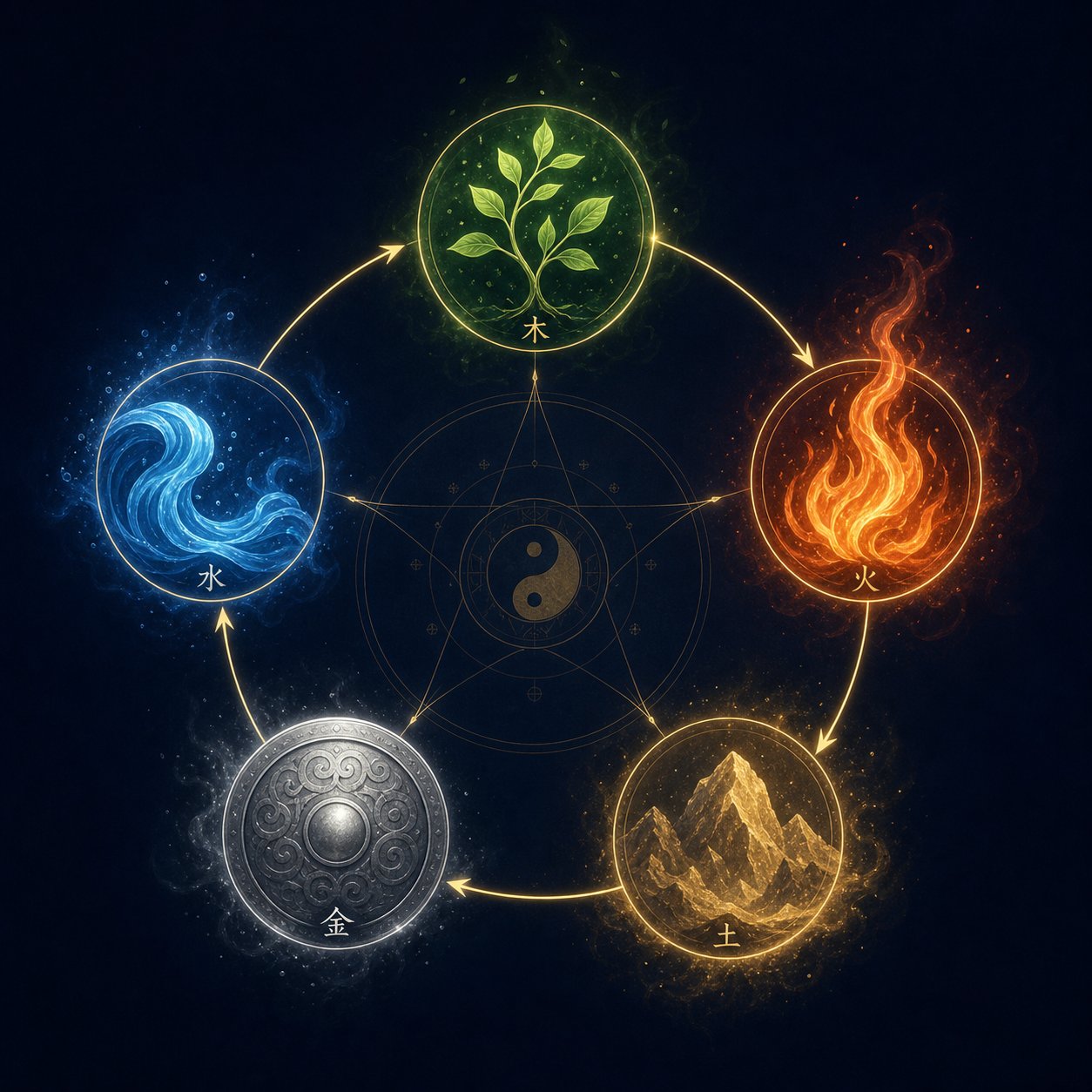
The Five Elements are not decorative metaphors. They are the operating system behind how Taoist naming actually works. When a priest examines a child's birth chart and selects characters to restore balance, the framework guiding every decision is Wu Xing (五行, wu3xing2) — five phases of energy that cycle through all natural phenomena, including the moment a person enters the world.
Understanding Wu Xing in Name Selection
A common mistranslation renders Wu Xing as "Five Elements," which suggests static materials like those on a periodic table. The character 行 (xing2) actually means "movement" or "phase." As MingShu explains, Wu Xing is better understood as Five Movements — dynamic patterns of energy describing how the universe transforms. These five phases are:
- Wood (木, mu4) - Expanding, growing upward. The energy of spring.
- Fire (火, huo3) - Ascending, radiating outward. The energy of summer.
- Earth (土, tu3) - Stabilizing, centering. The transitional energy between seasons.
- Metal (金, jin1) - Contracting, refining. The energy of autumn.
- Water (水, shui3) - Descending, flowing. The energy of winter.
These phases exist in dynamic relationship through two cycles. The Generating Cycle (相生, xiang1sheng1) describes how each phase nourishes the next: Wood feeds Fire, Fire creates Earth, Earth bears Metal, Metal collects Water, Water nourishes Wood. The Controlling Cycle (相克, xiang1ke4) describes how each phase restrains another: Water quenches Fire, Fire melts Metal, Metal cuts Wood, Wood parts Earth, Earth dams Water. Both cycles operate simultaneously in a healthy system, and both matter when constructing a name.
So how does this connect to a newborn? The child's BaZi (八字, ba1zi4) birth chart — calculated from the exact year, month, day, and hour of birth — maps the distribution of all five phases at the moment of arrival. A BaZi naming specialist reads this chart to identify three things: which elements are dominant, which are missing or weak, and the strength of the Day Master (日主, ri4zhu3), the core element representing the child's self.
Here is where most people get it wrong. The popular folk formula says "whatever element is missing, add it to the name." Sounds logical, but it is a fundamental misreading of the system. The classical text Ziping Zhenjuan (子平真诠) makes clear that the quality of a birth chart lies not in whether all five elements are present, but in whether the chart pattern is clear and the Useful God (喜用神, xi3yong4shen2) is strong. Sometimes a missing element is actually a Harmful God whose absence benefits the child. The correct approach identifies the Useful God first, then selects characters embodying that element.
Characters for Each of the Five Elements
Chinese characters carry elemental associations through their radicals — the structural components that classify each character. This is what makes Chinese uniquely suited to elemental naming. You can literally see the element inside the character. A name built with the water radical 氵visually announces its elemental allegiance in every written instance.
The following table shows chinese names with meaning organized by element, including the radicals that signal elemental belonging, pinyin with tone numbers, and the qualities each character brings to a name:
| Element | Common Radicals | Character | Pinyin | Meaning | Naming Quality |
|---|---|---|---|---|---|
| Wood (木) | 木 (wood), 艹 (grass) | 林 (lin2) | lin2 | Forest | Growth, community, abundance |
| Wood (木) | 木 (wood), 艹 (grass) | 芳 (fang1) | fang1 | Fragrant | Virtue recognized naturally |
| Wood (木) | 木 (wood), 艹 (grass) | 桐 (tong2) | tong2 | Paulownia tree | Nobility, attracts the phoenix |
| Wood (木) | 木 (wood), 艹 (grass) | 松 (song1) | song1 | Pine | Endurance, evergreen integrity |
| Fire (火) | 火 (fire), 灬 (fire dots) | 煜 (yu4) | yu4 | Radiant, glowing | Inner brilliance shining outward |
| Fire (火) | 火 (fire), 灬 (fire dots) | 炎 (yan2) | yan2 | Flame, blazing | Passion, intensity of spirit |
| Fire (火) | 日 (sun) | 旭 (xu4) | xu4 | Dawn light | New beginnings, rising energy |
| Fire (火) | 日 (sun) | 昱 (yu4) | yu4 | Brilliant light | Illumination, clarity of purpose |
| Earth (土) | 土 (earth), 山 (mountain) | 坤 (kun1) | kun1 | Earth, feminine principle | Receptivity, nurturing strength |
| Earth (土) | 土 (earth), 山 (mountain) | 岳 (yue4) | yue4 | Great mountain, peak | Enduring eminence, stability |
| Earth (土) | 土 (earth), 山 (mountain) | 峻 (jun4) | jun4 | Steep, majestic | Towering character, lofty ambition |
| Earth (土) | 土 (earth), 山 (mountain) | 培 (pei2) | pei2 | To cultivate | Patient nurturing, building foundations |
| Metal (金) | 金 (metal), 钅 (metal variant) | 铭 (ming2) | ming2 | To inscribe, engrave | Lasting significance, sharp memory |
| Metal (金) | 金 (metal), 钅 (metal variant) | 锐 (rui4) | rui4 | Sharp, keen | Decisive clarity, piercing intellect |
| Metal (金) | 金 (metal), 钅 (metal variant) | 鑫 (xin1) | xin1 | Prosperity (triple gold) | Abundance, concentrated strength |
| Metal (金) | 金 (metal), 钅 (metal variant) | 钧 (jun1) | jun1 | Noble weight, celestial music | Authority, cosmic harmony |
| Water (水) | 氵(water), 雨 (rain) | 涵 (han2) | han2 | To contain, nurture | Depth, inclusive wisdom |
| Water (水) | 氵(water), 雨 (rain) | 泽 (ze2) | ze2 | Marsh, beneficence | Generosity flowing to all |
| Water (水) | 氵(water), 雨 (rain) | 润 (run4) | run4 | To moisten, enrich | Quiet nourishment, gentle influence |
| Water (水) | 氵(water), 雨 (rain) | 澄 (cheng2) | cheng2 | Limpid, clear | Purity of mind, settled clarity |
Notice how chinese names meanings shift depending on elemental context. The character 润 (run4) does not just mean "moist" in a literal sense. Within the Wu Xing framework, it carries the full weight of Water's philosophical associations: wisdom, adaptability, the quiet power that wears away stone. Every character in the table above functions simultaneously as a word, an elemental force, and a philosophical statement.
Balancing Elements Through Name Characters
Imagine a child born with a birth chart dominated by Fire — strong summer energy, ascending and radiating, but lacking grounding. A name stacked with more Fire characters would intensify an already excessive force. Instead, a practitioner might select Water characters (which control Fire in the Ke cycle) or Earth characters (which Fire generates, thereby draining its excess). The name becomes a counterweight, a subtle correction applied every time it is spoken or written.
This is also where chinese names with dark meanings become a real concern. Some characters carry the correct elemental radical but hold inauspicious connotations. The character 沉 (chen2), for instance, belongs to Water through its 氵radical, but it means "to sink" or "to submerge" — hardly what any parent wants encoded into a child's identity. Similarly, 灭 (mie4) carries Fire energy but means "to extinguish" or "to destroy." Elemental correctness alone is never sufficient. The character must also carry positive semantic weight, sound harmonious with the surname, and look balanced in written form.
The practical process works across multiple levels simultaneously. The character's meaning provides the most direct Five Element signal. The radical offers visual and structural confirmation. And in classical practice, even the phonetics of a character carry elemental associations through the ancient Five Tones system (五音, wu3yin1), where specific sound categories correspond to specific elements. A skilled practitioner weighs all three levels when selecting the final characters.
What makes this system distinctly Taoist rather than merely cosmological is the underlying philosophy: the goal is not to accumulate power but to restore harmony. A Taoist name does not try to make a child dominant in any element. It seeks the dynamic equilibrium that mirrors the Tao itself — all five phases flowing, generating, and regulating each other in continuous balance. The name becomes a small model of the universe working correctly.
This elemental framework did not emerge in isolation. It grew alongside centuries of Taoist literary tradition, and many of the most beloved name characters trace directly back to specific passages in sacred texts that gave them their philosophical resonance.
Names Drawn from Sacred Taoist Texts
The Five Elements system provides the structural logic for balancing a name, but the characters themselves often carry authority because of where they first appeared. Many of the most resonant Taoist given names trace back to specific lines in two foundational texts: the Daodejing (道德经, dao4de2jing1) and the Zhuangzi (庄子, zhuang1zi3). These works function as living reservoirs of naming vocabulary, lending each borrowed character the weight of centuries of philosophical commentary.
Names Inspired by the Tao Te Ching
The Daodejing's opening chapter alone has generated some of the most enduring mythical chinese names in the tradition. Consider the famous first line:
dao4 ke3 dao4, fei1 chang2 dao4. ming2 ke3 ming2, fei1 chang2 ming2. — The Way that can be told is not the eternal Way. The name that can be named is not the eternal name.
From this single passage, multiple scholarly translations confirm how the characters 常 (chang2, "eternal/constant"), 名 (ming2, "name"), and 道 (dao4, "Way") entered the naming tradition with built-in philosophical gravity. The closing lines of Chapter 1 offer even richer material:
xuan2 zhi1 you4 xuan2, zhong4 miao4 zhi1 men2. — Mystery upon mystery, the gate of all marvelous things.
That single sentence gave Chinese naming two of its most beloved characters: 玄 (xuan2, "dark mystery") and 妙 (miao4, "marvelous/subtle"). These are not uncommon chinese names in historical records — they appear across dynasties precisely because their textual origin grants them philosophical legitimacy no invented character can match.
Here are specific names distilled from Daodejing passages:
- 玄德 (Xuan2de2) — "Mysterious Virtue." From Chapter 51: the Tao gives life, and De (virtue) nourishes it. This pairing names the hidden power that sustains without claiming credit.
- 道生 (Dao4sheng1) — "Born of the Way." From Chapter 42: "The Tao gives birth to one, one gives birth to two." Names the origin point of all creation.
- 常清 (Chang2qing1) — "Eternally Clear." Draws on 常 from Chapter 1 and 清 (clarity) from Chapter 45, where "clarity and stillness become the rectifier of the world."
- 若水 (Ruo4shui3) — "Like Water." From Chapter 8: "The highest good is like water." One of the most recognizable Taoist name references.
- 知白 (Zhi1bai2) — "Knowing the White." From Chapter 28: "Know the white, keep to the black." Encodes the Taoist principle of holding opposites in awareness.
Characters Drawn from the Zhuangzi
Where the Daodejing offers compressed aphorisms, the Zhuangzi provides sweeping imagery. Its opening chapter, Xiaoyaoyou (逍遥游, xiao1yao2you2, "Free and Easy Wandering"), has inspired chinese mythology names for over two millennia. The text opens with a creature of impossible scale:
bei3 ming2 you3 yu2, qi2 ming2 wei2 kun1. kun1 zhi1 da4, bu4 zhi1 qi2 ji3 qian1 li3 ye3. — In the Northern Sea there is a fish called Kun. The Kun is so vast, no one knows how many thousands of miles it spans.
This passage, as literary analysis of the Xiaoyaoyou confirms, is not merely a fantastical image but "a symbolic expression of spiritual freedom." The Kun fish transforms into the Peng bird, spreading its wings ninety thousand miles. Both creatures became naming characters that carry the full philosophical weight of boundless transformation.
- 鹏 (Peng2) — The great Peng bird. Represents limitless aspiration and the capacity to transcend ordinary constraints. Extremely popular in male given names.
- 逍遥 (Xiao1yao2) — "Free and Easy." Used as a literary name or courtesy name (字, zi4) to signal spiritual independence from worldly concerns.
- 梦蝶 (Meng4die2) — "Dreaming Butterfly." From the famous passage where Zhuangzi dreams he is a butterfly and wakes uncertain which is real. A poetic female name encoding the fluidity of identity.
- 天游 (Tian1you2) — "Heavenly Wandering." Combines the cosmic scope of 天 with the Zhuangzi's central metaphor of spiritual roaming.
- 知鱼 (Zhi1yu2) — "Knowing the Fish." From the famous debate between Zhuangzi and Huizi about whether one can know the happiness of fish. Names the capacity for intuitive understanding beyond logic.
What separates these text-derived names from generic pleasant-sounding characters is provenance. Each one carries a specific philosophical argument compressed into its syllables. When someone is named 若水, every literate Chinese speaker hears Chapter 8 of the Daodejing echoing behind it — water that benefits all things without competing, that settles in places others disdain. The name does not merely describe a quality. It cites a source.
These sacred texts also shaped how later generations imagined their legendary figures — the immortals, goddesses, and sages whose names became templates for Taoist naming across all of Chinese culture.
Famous Taoist Figures and Immortal Names
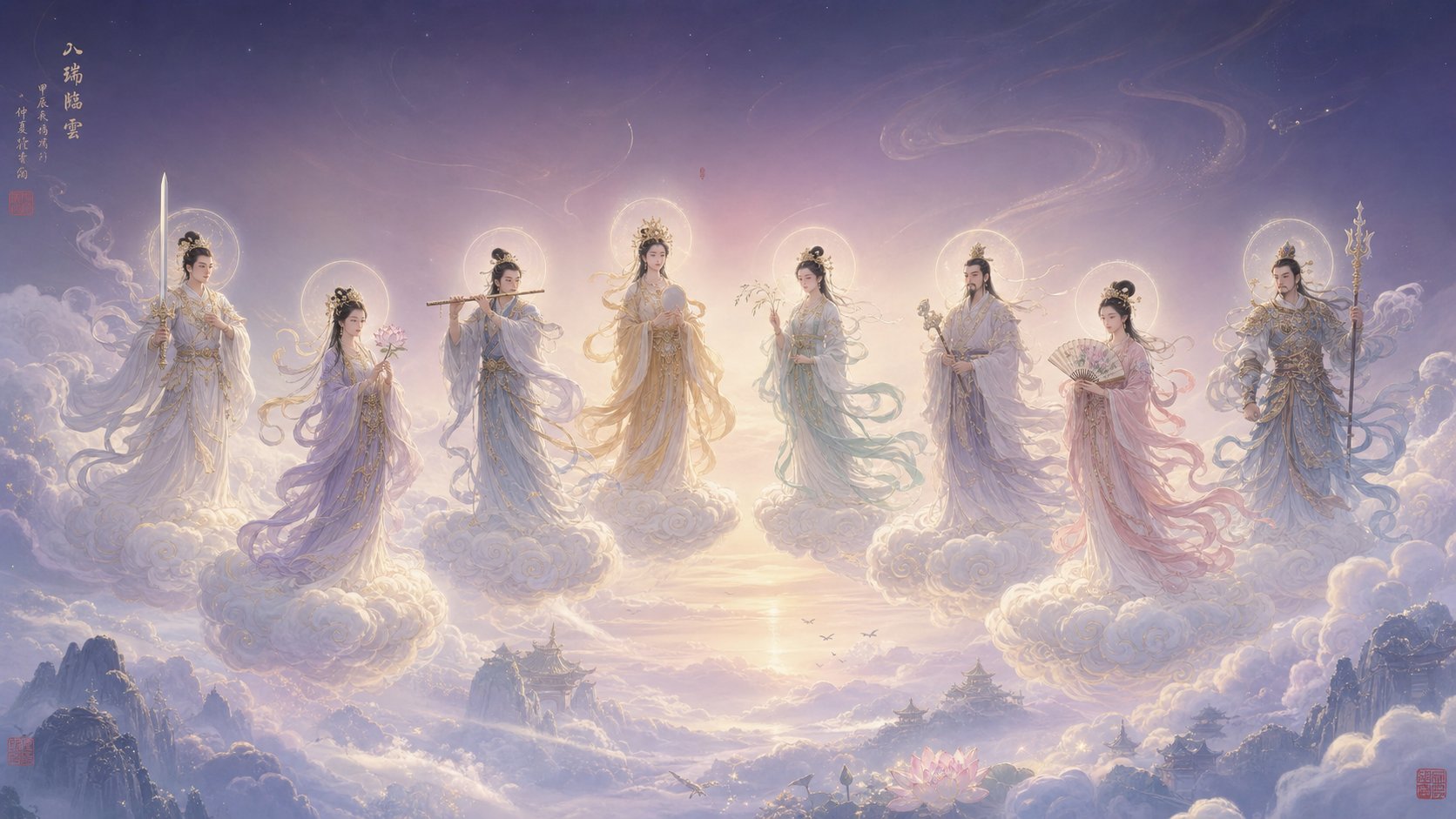
Sacred texts gave Taoist naming its vocabulary. But the figures who lived those texts — or who legend says transcended mortality through them — gave that vocabulary a human face. The Eight Immortals, Taoist goddesses, and warrior sages each carry names that function as compressed philosophical lessons. For anyone seeking chinese goddess names, names of chinese warriors, or simply deeper naming inspiration, these legendary figures offer templates that have shaped Chinese naming for over a thousand years.
Names of the Eight Immortals and Their Meanings
The Ba Xian (八仙, ba1xian1) — the Eight Immortals — are among the most recognizable figures in Taoist tradition. The word xian (仙) itself combines the radical for "person" (人) with "mountain" (山), literally depicting a person who has ascended to the mountains and achieved transcendence. Popular during the Tang and Song Dynasties, these figures represent the powers that come with transcending ordinary human limitations through Taoist practice.
What makes their names particularly useful for naming study is that each one encodes a different aspect of Taoist philosophy — from scholarly detachment to compassionate healing to carefree wandering. Consider how their names break down etymologically:
| Figure | Chinese | Pinyin | Literal Meaning | Taoist Principle |
|---|---|---|---|---|
| Lu Dongbin | 吕洞宾 | Lu3 Dong4bin1 | Lu of the Cave Guest | The scholar-wanderer; wisdom through detachment from worldly ambition |
| He Xiangu | 何仙姑 | He2 Xian1gu1 | The Female Celestial Being | Feminine transcendence; spiritual purity through ascetic practice |
| Li Tieguai | 李铁拐 | Li3 Tie3guai3 | Iron-Crutch Li | Spirit over form; the body as temporary vessel |
| Han Xiangzi | 韩湘子 | Han2 Xiang1zi3 | Han of the Xiang River | Harmony through music; art as spiritual cultivation |
| Cao Guojiu | 曹国舅 | Cao2 Guo2jiu4 | Imperial Brother-in-Law Cao | Renunciation of power; virtue over status |
| Zhang Guolao | 张果老 | Zhang1 Guo3lao3 | Old Zhang of the Fruit | Reversal of convention; riding backward through life |
| Zhongli Quan | 钟离权 | Zhong1li2 Quan2 | Zhongli of Concentrated Power | Inner alchemy; transforming base nature into gold |
| Lan Caihe | 蓝采和 | Lan2 Cai3he2 | Blue Gathering Harmony | Gender fluidity; freedom from social categories |
Lu Dongbin stands out as perhaps the most popular naming inspiration. His original name, Lu Yan (吕岩, Lu3 Yan2), means "cliff" or "rock" — solidity and permanence. His immortal name replaces that earthly stability with dong (洞, "cave") and bin (宾, "guest"), reframing identity as a visitor passing through hollow spaces. The shift from rock to cave-guest captures the entire Taoist journey from attachment to freedom in two characters.
Lan Caihe's name deserves special attention. The three characters — blue (蓝), gather (采), and harmony (和) — create an image of someone collecting gentleness from the world. Taoist scholars note that Lan Caihe was depicted as neither definitively male nor female, symbolizing a carefree existence beyond the concerns and responsibilities of ordinary life. The name itself mirrors this: 和 (he2) means harmony, balance, the dissolution of opposites.
Taoist Goddess and Female Deity Names
He Xiangu (何仙姑) is the only woman among the Eight Immortals, but the broader Taoist pantheon offers rich chinese goddess names that carry distinct philosophical weight. These names do not merely feminize male concepts. They draw on Taoism's deep reverence for yin energy, receptivity, and the creative void.
Key female figures and their naming significance:
- Xi Wangmu (西王母, Xi1 Wang2mu3) — "Queen Mother of the West." The character 母 (mu3, mother) combined with 王 (wang2, sovereign) places feminine creative power at the cosmic center. Her name encodes the Taoist principle that the feminine precedes and generates all things.
- Mazu (妈祖, Ma1zu3) — "Ancestral Mother." Though sometimes classified as folk religion, Mazu's name uses 祖 (zu3, ancestor/origin), connecting feminine divinity to the source-point of existence itself.
- Bixia Yuanjun (碧霞元君, Bi4xia2 Yuan2jun1) — "Sovereign of the Azure Clouds." The character 碧 (bi4) combines jade (玉) and stone (石), while 霞 (xia2) means rosy clouds at dawn. Her name paints the liminal space between earth and heaven — a distinctly Taoist threshold.
- He Xiangu (何仙姑) — Born with six hairs on her head, she achieved immortality through ascetic diet and spiritual vision. The character 姑 (gu1) means "maiden" or "aunt," grounding celestial transcendence in familial warmth.
For parents seeking female chinese warrior names with Taoist resonance, characters drawn from these figures — 仙 (xian1, immortal), 碧 (bi4, jade-green), 霞 (xia2, rosy clouds), 瑶 (yao2, precious jade) — carry both strength and philosophical depth without defaulting to masculine martial imagery.
Warrior Sages and Sword Immortal Names
Taoism is not all stillness and yielding. The tradition produced warrior sages whose names of chinese warriors reflect a different facet of the philosophy: the idea that true martial power flows from spiritual alignment rather than brute force. Lu Dongbin himself carried a magic sword said to dispel evil spirits, and his literary legacy spawned an entire genre of sword immortal (剑仙, jian4xian1) naming.
The founders of Taoism set the template. Laozi (老子, Lao3zi3) means simply "Old Master" — a name that encodes the Taoist reverence for age, experience, and the wisdom that accumulates through patient observation. Zhuangzi (庄子, Zhuang1zi3) means "Master Zhuang," where 庄 (zhuang1) carries meanings of "solemn," "dignified," and "a village" — grounding philosophical mastery in earthly simplicity rather than celestial grandeur.
Warrior-sage names blend martial imagery with Taoist philosophy:
- 真武 (Zhen1wu3) — "True Martial." Name of Zhenwu, the Taoist god of the north. 真 (true/authentic) before 武 (martial) insists that genuine power requires alignment with truth.
- 纯阳 (Chun2yang2) — "Pure Yang." Lu Dongbin's Taoist title. Names the achievement of complete internal refinement through alchemical practice.
- 长生 (Chang2sheng1) — "Eternal Life." Not a boast but a philosophical position: that life aligned with the Tao has no natural endpoint.
- 玄武 (Xuan2wu3) — "Dark Warrior." Combines mystery (玄) with martial power (武), naming the paradox of strength rooted in the unknowable.
These names reveal something essential about Taoist martial philosophy. The warrior is not someone who conquers others but someone who has conquered the separation between self and cosmos. The sword cuts through illusion, not enemies. When modern writers create chinese warrior names for fiction, the most authentic choices draw on this principle — power expressed through alignment rather than domination.
Every figure profiled here shares one quality: their names connect human identity to forces larger than the individual. The immortals tie themselves to caves, rivers, and mountains. The goddesses claim clouds, jade, and dawn light. The warriors name themselves after cosmic truths. This pattern — anchoring identity in the natural world — extends far beyond legendary figures into the everyday practice of Taoist naming, where elements of landscape become the raw material for encoding philosophy into a child's identity.
Nature-Themed Taoist Names and Their Deeper Meaning
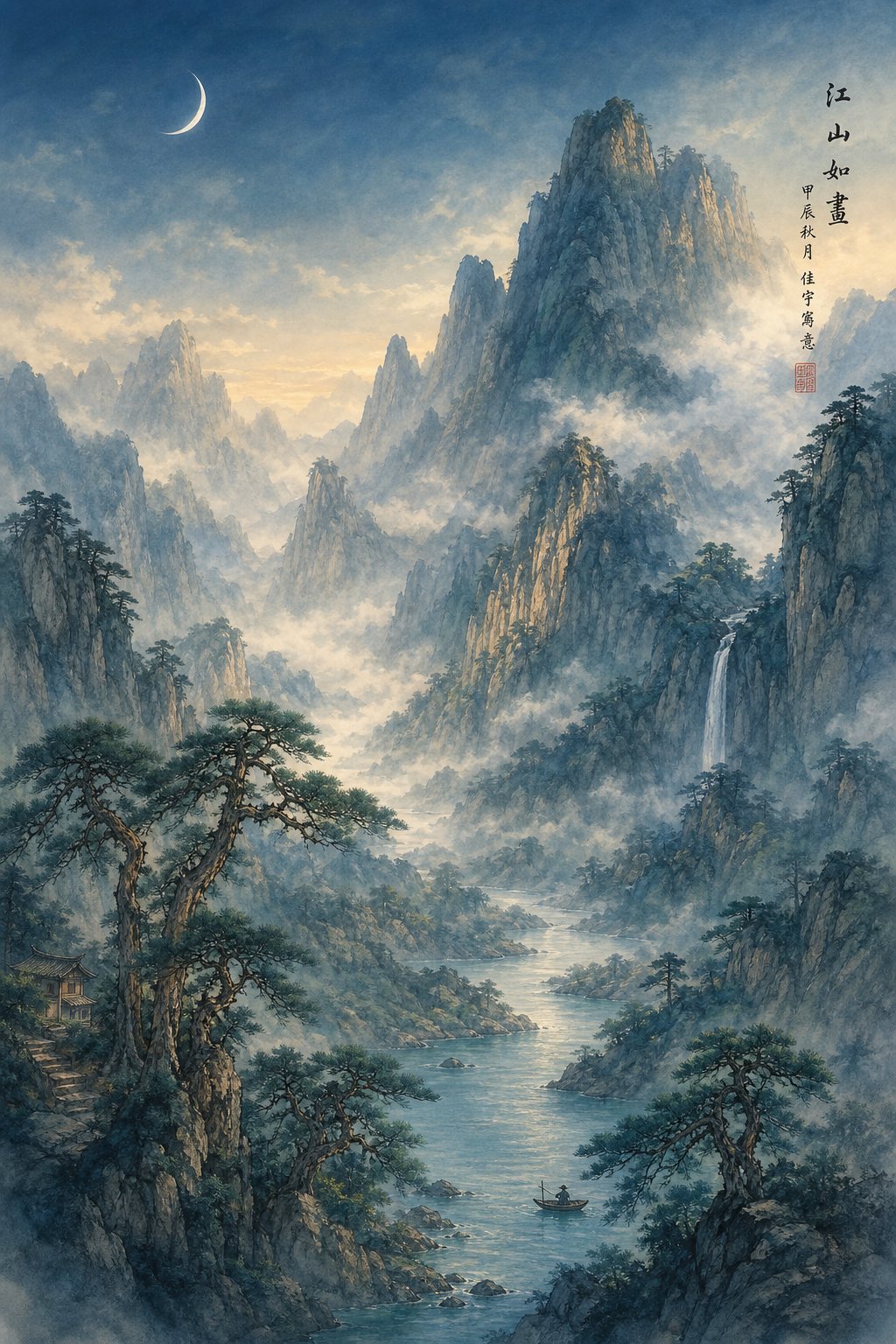
Immortals named themselves after caves, rivers, and mountains for a reason. In Taoist cosmology, nature is not scenery. It is the Tao made visible. Every cloud, every jade stone, every current of water enacts a philosophical principle in physical form. When parents draw on nature imagery for a child's name, they are not simply choosing something that sounds pretty. They are binding that child's identity to a specific force within the cosmic order.
This distinction matters. A name like 云 (yun2, cloud) might seem like a generic poetic choice. But within Taoist thought, clouds represent the union of yin and yang — water lifted into air, earth meeting heaven. As Chinese symbolism research documents, clouds are considered lucky precisely because they embody this fusion of opposites, and their five-colored form represents the five blessings of life. The character carries cosmological weight that a surface reading misses entirely.
Water and Cloud Names in Taoist Cosmology
Water holds a privileged position in Taoist philosophy. Chapter 8 of the Daodejing declares it the closest analogy to the highest good — it benefits all things without competing, settles in places others reject, and flows without forcing. Cloud and mist extend water's symbolism upward, representing transformation and the liminal space between earth and heaven. Moon names carry yin energy in its purest form, connecting the named person to cycles, intuition, and the reflective feminine principle.
Wind names operate differently. Wind is invisible force — you see its effects but never its form. This makes it a natural metaphor for wu wei, action without visible actor. Mist names encode the Taoist love of ambiguity, the refusal to draw hard boundaries between things.
Mountain and Jade Characters for Strength and Purity
Mountains are yang energy made solid. In Taoist geography, five sacred mountains anchor the five directions and five elements, each one a pillar holding heaven and earth in relationship. A mountain name does not simply mean "strong." It means "connected to the axis between worlds." The character 山 (shan1) itself is a pictogram of three peaks — a visual reminder that mountains mediate between the human realm and the celestial.
Jade carries even deeper resonance. Valued above gold in Chinese tradition, jade symbolizes immortality and incorruptible virtue. The Jade Emperor (玉皇, Yu4huang2) is the supreme deity in popular Taoist tradition. When jade appears in a name, it claims kinship with the imperishable — not wealth, but the quality of enduring unchanged through time.
The following table organizes ancient chinese names for men and women by nature category, showing how each character connects to specific Taoist cosmological principles rather than mere aesthetics:
| Category | Character | Pinyin | English Meaning | Taoist Significance |
|---|---|---|---|---|
| Water | 溪 | xi1 | Mountain stream | The Tao flowing through the lowest paths, finding its way without force |
| Water | 澜 | lan2 | Great wave | Accumulated power released naturally, momentum without aggression |
| Water | 渊 | yuan1 | Deep pool, abyss | Unfathomable depth; the Tao as inexhaustible source |
| Cloud | 霄 | xiao1 | Sky, heavens | The uppermost reach where earthly water becomes celestial vapor |
| Cloud | 霁 | ji4 | Sky clearing after rain | Renewal after difficulty; the natural return to clarity |
| Cloud | 岚 | lan2 | Mountain mist | The veil between visible and invisible worlds |
| Moon | 皓 | hao4 | Bright, luminous | Yin radiance — illumination without heat, wisdom without aggression |
| Moon | 瑶 | yao2 | Precious jade, moonlike | The Queen Mother's jade pond; feminine immortality |
| Mountain | 嵩 | song1 | Lofty peak | Songshan, the central sacred mountain; earth element stability |
| Mountain | 崇 | chong2 | Lofty, sublime | Reverence for what towers above human concerns |
| Jade | 琼 | qiong2 | Fine jade | Incorruptible essence; the immortal within the mortal |
| Jade | 璟 | jing3 | Jade luster | Inner virtue made visible without effort — natural radiance |
| Wind | 飒 | sa4 | Rustling wind | Wu wei in motion — invisible force producing visible effect |
| Wind | 翔 | xiang2 | Soaring, gliding | The Peng bird's effortless flight; freedom from constraint |
| Mist | 濛 | meng2 | Drizzling mist | The Tao before differentiation — formless potential |
| Mist | 朦 | meng2 | Hazy, dim | Embracing ambiguity; refusing false clarity |
Notice how each character does double duty. 渊 (yuan1) is not just "deep" — it names the specific quality of inexhaustibility that the Daodejing attributes to the Tao itself. 霁 (ji4) is not just "clear sky" — it encodes the Taoist conviction that difficulty resolves naturally when you stop forcing outcomes. These are chinese fantasy names in the truest sense: each one imagines a relationship between a person and a cosmic force.
Jianghu-Style Names with Taoist Roots
The jianghu (江湖, jiang1hu2) — literally "rivers and lakes" — is the fictional world of wandering martial artists in wuxia literature. The best cool chinese names jianghu draws from are not invented from thin air. They pull directly from the Taoist nature vocabulary above, combining characters into names that sound both poetic and philosophically grounded. A chinese swordsman name built on authentic Taoist principles carries a resonance that purely invented names cannot match.
Here are jianghu-inspired names with genuine Taoist philosophical grounding:
- 凌霄 (Ling2xiao1) — "Ascending Beyond the Sky." 凌 means to rise above or surpass; 霄 is the highest heavens. Names the Taoist aspiration to transcend ordinary limitations. Works for chinese warrior names that emphasize spiritual mastery over brute strength.
- 云隐 (Yun2yin3) — "Hidden in Clouds." Combines cloud imagery with 隐 (yin3, to conceal/withdraw). Encodes the Taoist sage's preference for obscurity over fame.
- 寒江 (Han2jiang1) — "Cold River." Evokes solitary clarity — the lone fisherman on a winter river, needing nothing beyond the present moment. A classic ancient chinese names for men pattern.
- 清风 (Qing1feng1) — "Clear Wind." Pairs purity (清) with invisible force (风). The name of someone who influences without being seen, who passes through without disturbing.
- 玄霜 (Xuan2shuang1) — "Mysterious Frost." 玄 carries the Daodejing's sense of unfathomable depth; 霜 (frost) adds sharpness and impermanence. A name for someone whose power is quiet but cutting.
- 逸尘 (Yi4chen2) — "Beyond the Dust." 逸 (ease, transcendence) combined with 尘 (dust, the mundane world). Names the act of stepping free from worldly entanglement — a core Taoist ideal.
- 墨渊 (Mo4yuan1) — "Ink Abyss." 墨 (ink) suggests scholarship and art; 渊 (abyss) names inexhaustible depth. A chinese fantasy names choice that grounds creative power in Taoist cosmology.
- 霜剑 (Shuang1jian4) — "Frost Sword." Combines natural imagery with martial identity. The frost does not attack — it simply arrives when conditions align. This is wu wei applied to combat.
What separates these from generic wuxia invention is philosophical coherence. Each name above can be traced back to a specific Taoist concept: transcendence, concealment, clarity, effortless action, or the embrace of mystery. They sound striking because they mean something precise within a tradition that has spent millennia refining its relationship with the natural world.
These nature-rooted names feel timeless, but naming conventions have never been static. The characters families choose, the principles they prioritize, and even who gets to select a Taoist-inspired name have all shifted dramatically across dynasties and into the present day.
Modern Practice and Cultural Sensitivity
Naming conventions have never been frozen in amber. The characters parents choose reflect the philosophical currents of their era as much as any personal preference. What is striking about the present moment is not that Taoist principles have disappeared from Chinese naming — it is that they are returning with renewed intention after decades of dormancy.
Taoist Naming in Contemporary Chinese Families
A growing number of young Chinese parents are reaching back into classical texts for their children's names. As Global Times reported, a mother in Chengdu named her daughter 驰柔 (Chi2rou2) — drawing directly from Chapter 43 of the Daodejing, which speaks of softness mastering hardness. She described the name as a "first life gift" carrying cultural tradition "beyond value." This is not an isolated case. Provincial newborn name lists across Sichuan and Yunnan show a clear trend toward names rooted in classical Chinese philosophy and poetry.
Cultural sociologist Xu Shumin characterizes this shift as young parents "reclaiming traditional Chinese culture as a living aesthetic in everyday life." The post-1990 generation, raised during a period of parallel technological advancement and cultural revival, treats naming as a form of identity expression — much like wearing Hanfu or practicing calligraphy. Chinese names and their meanings have become a site of deliberate cultural engagement rather than passive inheritance.
The practical mechanics have also modernized. Where families once consulted Taoist priests in person, many now use BaZi analysis apps and online naming consultants who still apply Five Elements theory and stroke-count numerology. The philosophical framework persists even as the delivery method changes.
Historical Shifts Across Dynasties
This revival gains perspective when you trace how naming preferences shifted across generations. Each era left its fingerprint on the characters parents favored:
- Tang and Song Dynasties — Peak popularity for names drawn from Taoist and Buddhist texts. Characters like 玄 (xuan2), 道 (dao4), and 仙 (xian1) appeared freely in given names.
- Ming and Qing Dynasties — Generational naming poems became rigidly codified. Taoist monastic lineages and clan genealogies dictated character selection across centuries. One village in Jinhua, Zhejiang Province still assigns names from an 80-character poem, rotating one character every five years for all descendants.
- Post-1949 era — Revolutionary names dominated. Characters like 建国 (jian4guo2, "build the nation"), 爱民 (ai4min2, "love the people"), and 永军 (yong3jun1, "support the army") reflected political identity over philosophical tradition.
- 1980s-1990s — Names shifted toward individual aspiration. Characters like 伟 (wei3, "great"), 强 (qiang2, "powerful"), and later 梦 (meng4, "dream") and 雨 (yu3, "rain") reflected economic ambition and then romantic individualism.
- 2020s — Classical revival. Names like 砚舟 (Yan4zhou1, "inkstone boat," from a Song Dynasty poem) and 扶苏 (Fu2su1, from the Book of Songs) signal a conscious return to literary and philosophical roots.
The pattern is clear: Taoist naming principles recede during periods of political upheaval and return during periods of cultural confidence. The current revival is not nostalgia. It is a generation choosing philosophical depth over the china warrior name bravado of their grandparents' era or the romantic softness of their parents' generation.
Cultural Sensitivity for Non-Chinese Parents
For non-Chinese parents drawn to Taoist-inspired names, the philosophical richness is genuinely accessible — but the linguistic and cultural terrain contains real pitfalls. Chinese is a tonal language where a single mispronounced syllable can transform meaning entirely. As naming experts warn, the character 思 (si1, "to think") paired with 旺 (wang4, "prosperous") sounds nearly identical to 死亡 (si3wang2, "death"). These are not edge cases. They are the everyday reality of a language with hundreds of homophones.
Here are practical guidelines for approaching these names respectfully:
- Do learn the tonal pronunciation of any name you choose. Tone numbers (1-4) are not optional decoration — they determine meaning.
- Do consult a native Mandarin speaker to check for homophone collisions and unintended slang meanings.
- Do research the specific philosophical context of characters rather than relying on dictionary translations alone.
- Do consider using Taoist-inspired names as middle names or courtesy names if you are uncertain about full cultural adoption.
- Don't adopt names of revered historical figures like Laozi or Zhuangzi directly — this reads as presumptuous, similar to a foreigner naming themselves "Shakespeare."
- Don't combine characters based solely on individual meanings without checking how they interact as a pair. Two beautiful characters can produce an awkward or offensive compound.
- Don't select characters with rare or complex stroke counts (16+ strokes) that create practical difficulties in daily writing.
- Don't ignore gender conventions in character selection. Characters like 柔 (rou2) and 霞 (xia2) carry feminine associations, while 刚 (gang1) and 峰 (feng1) read as masculine. Mismatches cause confusion in Chinese social contexts.
A Taoist name is not an aesthetic accessory. It is a philosophical statement embedded in a living linguistic system. Honoring that depth means engaging with the tradition on its own terms — learning the tones, understanding the cosmology, and recognizing that each character carries centuries of accumulated meaning no translation can fully convey.
The most respectful approach treats Taoist naming as what it has always been: a practice of alignment. Whether you are Chinese or not, the question is the same one Taoist priests have asked for centuries — not "what sounds good?" but "what is true to this person's relationship with the world?" When that question guides the process, the name that emerges carries authentic weight regardless of who chose it.
Frequently Asked Questions About Taoist Chinese Names
1. What is the difference between a Taoist name and a regular Chinese name?
A Taoist name encodes philosophical principles about harmony with the natural order, spontaneity, and effortless action into its characters. While regular Chinese names may prioritize pleasant sound or auspicious meaning, and Confucian names emphasize social virtues like loyalty and filial piety, Taoist names specifically draw from concepts like naturalness (ziran), simplicity (pu), and the ineffable Tao. Characters such as 道 (dao, the Way), 玄 (xuan, mystery), and 清 (qing, clarity) signal a distinctly Taoist worldview that positions the named person within the cosmos rather than within society.
2. How does Five Elements theory affect Chinese name selection?
Five Elements (Wu Xing) theory plays a systematic role in Taoist name selection by analyzing a child's birth chart to identify which elemental energies are dominant, weak, or absent. A practitioner identifies the Useful God (the element that most benefits the chart's balance) and selects characters containing radicals associated with that element. For example, water-deficient charts might receive characters with the water radical (氵) like 涵 (han, to contain) or 泽 (ze, beneficence). The goal is not to fill every missing element but to restore dynamic equilibrium that mirrors the Tao's natural balance.
3. Can non-Chinese parents use Taoist-inspired names for their children?
Non-Chinese parents can respectfully use Taoist-inspired names, but should navigate several important considerations. Learning tonal pronunciation is essential since tone changes alter meaning entirely. Consulting a native Mandarin speaker helps avoid homophone collisions or unintended slang. Parents should research the philosophical context behind characters rather than relying on dictionary translations alone. Using Taoist names as middle names or courtesy names offers a respectful entry point. Avoid directly adopting names of revered figures like Laozi, and always check how paired characters interact as a compound.
4. What are some popular Taoist names from the Tao Te Ching?
Several enduring names trace directly to passages in the Daodejing. 若水 (Ruoshui, 'Like Water') comes from Chapter 8's teaching that the highest good resembles water. 玄德 (Xuande, 'Mysterious Virtue') derives from Chapter 51's description of the Tao's hidden nurturing power. 道生 (Daosheng, 'Born of the Way') references Chapter 42's cosmogony. 知白 (Zhibai, 'Knowing the White') encodes Chapter 28's principle of holding opposites in awareness. Each name carries the philosophical weight of its source passage, giving it authority beyond surface aesthetics.
5. What role do Taoist priests play in traditional Chinese naming ceremonies?
Taoist priests traditionally served as mediators between a family's hopes and cosmic forces during naming. They followed a structured process: recording the child's exact birth time to create a Four Pillars (BaZi) chart, analyzing elemental balance to identify strengths and deficiencies, consulting generational naming requirements, selecting characters that balance elemental needs while carrying philosophical meaning, verifying stroke count and tonal harmony, and finally bestowing the name at a cosmologically favorable moment. This ritual approach treats naming as spiritual alignment rather than casual selection.