Why Certain Chinese Name Pairings Bring Bad Fortune
Imagine picking two beautiful Chinese characters for a child's name — each one carrying meanings of strength, wisdom, or grace — only to discover that spoken aloud, the full name sounds exactly like a phrase for "impotence" or "stomach ache." This is the reality of unlucky Chinese name combinations: the problem is never a single character in isolation. It is the collision between surname and given name that produces disaster.
In Chinese, a name is structured surname-first (姓 xìng) followed by the given name (名 míng), typically forming a two- or three-character phrase. Each character carries its own meaning, but the real test happens when you say the full name out loud. A name that looks elegant on paper can sound identical to an embarrassing or inauspicious word in spoken Mandarin. This phenomenon is called 谐音梗 (xiéyīn gěng) — homophone-based wordplay — and it is the single most common source of names that mean bad luck in Chinese culture.
What Makes a Chinese Name Combination Unlucky
The concept of 谐音梗 works like this: Mandarin has a limited number of syllables (roughly 400 without tones, about 1,600 with tones), which means many completely different characters share identical or near-identical pronunciations. When a surname and given name are combined, the resulting sound may overlap perfectly with an unrelated word or phrase — often one that is vulgar, morbid, or simply ridiculous.
Consider the name 杜子腾 (Dù Zǐténg). The character 杜 is a common surname, 子 suggests "son" or "scholar," and 腾 means "to soar." Individually, these are fine characters. Spoken together, though, the name sounds exactly like 肚子疼 (dùzi téng) — "stomach ache." The 2010 Chinese Census reportedly uncovered real people carrying names like this, confirming that these combinations exist in the wild, not just in theory.
A Chinese character is never unlucky on its own. Luck in Chinese naming is determined entirely by combination — how surname and given name interact in sound, meaning, stroke count, and elemental energy together.
The Layers of Chinese Name Analysis
Homophone traps are only one dimension. Families serious about avoiding unlucky names evaluate a name across multiple layers simultaneously:
- Tonal patterns: How the tones of each character flow together when spoken aloud, and whether that flow echoes something negative.
- Stroke count numerology (笔画 bǐhuà): The total strokes across all characters are checked against numerological charts for auspicious or inauspicious totals.
- Five Elements balance (五行 wǔxíng): Each character carries an elemental association — wood, fire, earth, metal, or water — and destructive elemental cycles within a name are considered harmful.
- Cultural and ancestral taboos (避讳 bìhuì): Using characters from an ancestor's or emperor's name is traditionally forbidden.
- Cross-dialect pronunciation: A name safe in Mandarin might produce names meaning unlucky phrases in Cantonese or Hokkien.
Professional name consultants — practitioners of 姓名学 (xìngmíngxué, "name science") — cross-reference all these layers before approving a name. The belief that a name shapes destiny is not fringe superstition; it is a living practice that millions of families engage in when a child is born. Even in modern cities, name consultants stay busy because the consequences of unlucky names feel real to the people carrying them.
This guide provides full Chinese characters, pinyin romanization, and English translations for every example, making it a complete English-language reference for understanding how lucky in Chinese naming culture actually works — and how easily things go wrong when any single layer is overlooked.
The most dramatic failures, though, start with sound. And sound in Chinese is governed by something deceptively simple: the way a surname's syllable merges with the syllables that follow it.
Stroke Count Numerology and Unlucky Number Patterns
Sound is only the surface layer. Beneath pronunciation, every Chinese character carries a hidden numerical identity: its stroke count. In Chinese numerology, the total number of brushstrokes across a full name is not just a physical property of the writing — it is a measure of the name's energetic fortune. A name can sound beautiful and carry poetic meaning, yet still be classified as inauspicious if its strokes add up to the wrong number.
How Stroke Count Numerology Works in Names
The system is called 笔画数理 (bǐhuà shùlǐ), and it operates through a framework known as the Five Formations (五格). Rather than simply totaling all strokes, practitioners calculate five separate numerical values from a name's characters:
- Heavenly Formation (天格): Surname strokes + 1. Represents ancestral fortune and early life influences.
- Human Formation (人格): Last surname character strokes + first given name character strokes. This is the most important formation — it reflects core personality and adult destiny.
- Earthly Formation (地格): Sum of all given name character strokes. Governs career development and youth opportunities.
- External Formation (外格): Total Formation minus Human Formation. Reflects social relationships and external perception.
- Total Formation (总格): Sum of every stroke in the full name. Represents overall life trajectory and late-life fortune.
Each resulting number is then evaluated as auspicious or inauspicious based on Chinese numbers theory. Stroke counting follows traditional (繁体) character forms, not simplified ones — so a character that looks simple in modern writing may carry a higher stroke count in numerological calculation. This catches many people off guard.
Inauspicious Numbers and Their Impact on Name Selection
So what does 4 mean in numerology within the Chinese naming context? The number 4 (四 sì) is the most widely recognized chinese bad luck number because its pronunciation nearly mirrors 死 (sǐ, death). This association runs deep — you will find buildings in China skipping the 4th floor, phone numbers avoiding the digit, and names carefully steered away from stroke totals of 4, 14, 24, or 44.
The number 14 deserves special attention in 14 numerology. Spoken in certain dialects, 十四 (shísì) sounds like 实死 (shísǐ) — "certainly die." When a name's Human Formation or Total Formation lands on 14, traditional practitioners flag it immediately regardless of how elegant the characters appear on paper.
Here is how common unlucky chinese numbers map onto name stroke analysis:
| Stroke Total | Fortune Rating | Associated Meaning | Reasoning |
|---|---|---|---|
| 2 | Inauspicious | Separation, instability | Symbolizes division and lack of independence |
| 4 | Inauspicious | Death, endings | 四 (sì) sounds like 死 (sǐ, death) |
| 9 | Inauspicious | Suffering, incompletion | Associated with exhaustion at the end of a cycle |
| 10 | Inauspicious | Emptiness, void | Fullness tipping into nothingness; new cycle without foundation |
| 14 | Highly Inauspicious | "Will certainly die" | Combines 实 (certainly) + 死 (death) in sound |
| 19 | Inauspicious | Hardship, obstacles | Fire element excess leading to burnout |
| 20 | Inauspicious | Emptiness, failure | Water without containment; efforts dissipating |
Consider a practical example. Imagine naming a child 陈佳宁 (Chén Jiāníng) — "Chen" as surname, with characters meaning "excellent" and "peaceful." Beautiful meaning, pleasant sound. But run the stroke count: 陈 (10 strokes in traditional form) + 佳 (8) + 宁 (14 in traditional form) = Total Formation of 32, and a Human Formation of 10 + 8 = 18. The Human Formation reduces to 9 (1+8=9), which falls into the inauspicious category — symbolizing suffering and incompletion despite the name's surface-level grace.
This is precisely why 4 in chinese culture extends far beyond avoiding a single digit. The entire stroke count system treats numbers as carriers of energy, and landing on the wrong total can override even the most carefully chosen characters. A name consultant would catch this conflict instantly and suggest swapping one character for a synonym with a different stroke count — preserving the intended meaning while shifting the numerology into safer territory.
Numbers, though, are only one axis of evaluation. Each of those carefully counted strokes also carries an elemental signature — wood, fire, earth, metal, or water — and when those elements clash within a single name, a different category of misfortune emerges entirely.
Homophone Disasters in Chinese Name Pairings
Stroke counts operate silently on paper. Homophones, on the other hand, announce themselves the moment someone calls your name across a crowded room. Mandarin Chinese has roughly 1,600 distinct syllables when tones are included — a remarkably small inventory for a language with tens of thousands of characters. The result? Countless characters share identical or near-identical pronunciations, and when a surname locks into the wrong given name, the spoken combination becomes a phrase no parent intended.
Common Surname Traps and Sound-Alike Disasters
Certain surnames are repeat offenders. The surname 吴 (Wu) is especially dangerous because it sounds exactly like 无 (wu, "without" or "lacking"). Pair it with the wrong given name and you get names meaning bad luck, poverty, or incompetence — regardless of what the written characters actually say.
The surname 杨 (Yang) creates similar problems. Its sound overlaps with 阳 (yang, "sun" or "male") and 羊 (yang, "sheep"), opening the door to unintended animal references or awkward double meanings. Meanwhile, 王 (Wang) — one of the most common Chinese surnames — sounds like 亡 (wang, "death" or "to perish") in certain tonal contexts, making it a minefield when paired with characters related to endings or loss.
Here are real examples of how these surnames collide with given names to produce unfortunate homophones:
- 吴用 (Wu Yong) — Intended: "Wu" + "to use/useful." Sounds like: 无用 (wuyong), meaning "useless." This is actually a character name in the classic novel Water Margin, used deliberately for irony.
- 吴德 (Wu De) — Intended: "Wu" + "virtue/morality." Sounds like: 无德 (wu de), meaning "without virtue" or "immoral."
- 吴福 (Wu Fu) — Intended: "Wu" + "fortune/blessing." Sounds like: 无福 (wu fu), meaning "without fortune" — a name literally meaning unlucky.
- 杨伟 (Yang Wei) — Intended: "Yang" + "great/mighty." Sounds like: 阳痿 (yangwei), meaning "impotence." This is perhaps the most cited example of boy names that mean unlucky things through sound alone.
- 王丹 (Wang Dan) — Intended: "Wang" + "red/cinnabar." Sounds like: 完蛋 (wandan), meaning "finished" or "doomed" in colloquial speech.
- 杨桃 (Yang Tao) — Intended: "Yang" + "peach." Sounds like: 杨桃 (yangtao), the starfruit — harmless, but reduces a girl's name to a fruit, which many families find undignified. Among girl names that mean unlucky associations, object-homophones like this carry a subtler but persistent stigma.
- 吴聊 (Wu Liao) — Intended: "Wu" + "to chat/connect." Sounds like: 无聊 (wuliao), meaning "boring" or "bored."
When Good Characters Create Bad Sounds Together
Not all homophone collisions carry equal weight. There is a clear hierarchy of severity. Mildly awkward combinations — names that sound like everyday objects or minor adjectives — cause social embarrassment but are not considered spiritually harmful. A name that sounds like "boring" or "starfruit" invites teasing at school but does not trigger the same alarm as names meaning bad luck tied to death or destitution.
Seriously inauspicious homophones fall into a different category entirely. Names that echo 死 (si, death), 亡 (wang, perish), 穷 (qiong, poverty), or 败 (bai, defeat) are treated as genuinely dangerous. Traditional belief holds that speaking such sounds repeatedly — every time someone calls the name — reinforces negative energy around the person. A name like 吴寿 (Wu Shou), intended to mean "Wu" + "longevity," sounds like 无寿 (wu shou, "without longevity") — effectively wishing a shortened life on the bearer every time it is spoken aloud.
The critical takeaway: you cannot evaluate a Chinese name by reading it alone. You must say it. Speak the full name at normal conversational speed, listen for overlap with common words or phrases, and test it across different tonal interpretations. What looks like poetry on paper may sound like a curse in the air — and in a culture where names are spoken thousands of times over a lifetime, that sound carries real weight.
Sound, however, does not exist in a single dialect. The same characters pronounced in Cantonese, Hokkien, or Teochew produce entirely different syllables — and entirely different homophone risks that Mandarin-only evaluation will never catch.
Five Elements Clashes and Zodiac Conflicts in Names
Pronunciation and stroke counts deal with what you can hear and count. The Five Elements system operates on a deeper, invisible layer — the energetic relationship between characters sitting side by side in a name. Two characters can sound lovely together, add up to a favorable stroke total, and still be considered an unlucky combination because their elemental natures are locked in a destructive cycle.
Five Elements Theory Applied to Naming
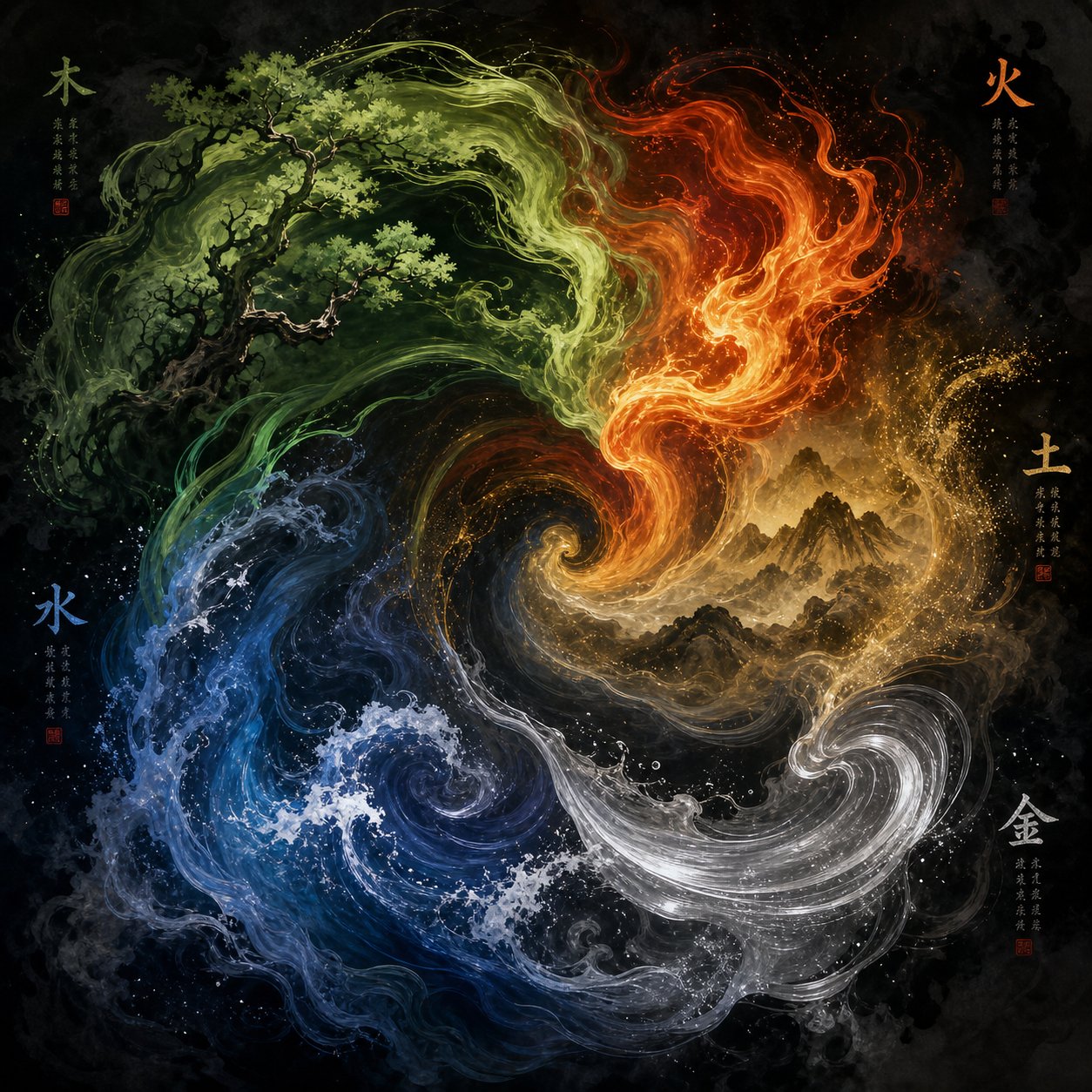
Wu Xing (五行) — often translated as the Five Elements but more accurately understood as five phases of energy — assigns every Chinese character to one of five categories: Wood (木 mu), Fire (火 huo), Earth (土 tu), Metal (金 jin), and Water (水 shui). The assignment is not arbitrary. Characters carry elemental identity primarily through their radicals — the structural components that make up each character. A character containing the water radical (氵) like 涵 (han, "to contain") belongs to Water. A character built with the wood radical (木) like 林 (lin, "forest") belongs to Wood.
These five phases interact through two fundamental cycles. The Generating Cycle (相生 xiangsheng) describes how each element nourishes the next: Wood feeds Fire, Fire creates Earth, Earth bears Metal, Metal collects Water, Water nourishes Wood. This is the supportive, creative flow. A name where the surname's element generates the given name's element is considered harmonious.
The problem arises with the Controlling Cycle (相克 xiangke) — the destructive relationships where one element overpowers another. When a name's characters fall into a controlling relationship, the name carries internal conflict. Here are the five destructive pairings that create unlucky name energy:
- Wood parts Earth (木克土): Tree roots break through soil, dominating and destabilizing it. A Wood-surname paired with an Earth given name suggests the self undermining its own foundation.
- Earth dams Water (土克水): Earth blocks and absorbs Water's flow. This combination implies stagnation — wisdom and adaptability being smothered by rigidity.
- Water quenches Fire (水克火): Water extinguishes flames. A name carrying this clash suggests passion, ambition, and visibility being constantly suppressed.
- Fire melts Metal (火克金): Intense heat destroys Metal's structure. This pairing implies discipline and clarity being burned away by chaos or impulsiveness.
- Metal cuts Wood (金克木): An axe chops down trees. A Metal-dominant name attacking its own Wood element suggests growth and vitality being severed.
Imagine a name where the surname carries strong Fire energy and the given name characters are Metal-dominant. Fire melts Metal — so the name's internal dynamic is one of self-destruction. The person's identity (surname) is energetically attacking their aspirations (given name). Traditional practitioners view this as a name working against its bearer from the inside out.
Zodiac Birth Year and Character Selection Conflicts
The wu xing system does not operate in isolation. Which elements are beneficial or harmful depends entirely on the individual — specifically, on their BaZi (八字) birth chart, calculated from the year, month, day, and hour of birth. These four data points produce eight characters (the "Eight Characters" that give BaZi its name), each carrying its own elemental weight.
A BaZi reading reveals which elements are dominant, which are weak, and which are completely absent from a person's birth chart. The naming goal is to compensate for deficiencies and avoid reinforcing excesses. Someone born in a year dominated by Water energy who already has excessive Water in their chart would be harmed by a name loaded with Water-radical characters — even though those characters might be beautiful in isolation. The name would flood an already overflowing system.
The 12 zodiac animals add another constraint. Each animal corresponds to an earthly branch with its own elemental association, and certain elements clash with specific zodiac signs. In systems related to numerology 12 — the twelve-year zodiac cycle — a child born in a Metal-heavy year like the Year of the Monkey might need Wood or Water characters to restore balance, while Fire characters could intensify existing imbalances. The number 6 in chinese culture connects to the earthly branch 巳 (si, Snake) in some traditional counting systems, carrying Fire energy that would conflict with Metal-dominant charts.
Professional name consultants cross-reference all of this simultaneously. They map the child's BaZi chart, identify the weakest element, confirm which elements sit in destructive relationship with the chart's existing structure, and only then select characters whose radicals supply the missing energy without triggering a controlling cycle. A name that ignores this analysis — even one with chinese 3-character elegance, perfect stroke counts, and clean pronunciation — can still be classified as fundamentally unlucky because it fights the bearer's innate elemental blueprint.
This elemental evaluation assumes a single pronunciation system. But Chinese is not one language — it is a family of dialects, each with its own tonal landscape and phonetic inventory. A name balanced for Mandarin speakers may carry entirely different elemental resonances when filtered through Cantonese or Hokkien pronunciation traditions.
Cross-Dialect Traps That Make Names Unlucky
Mandarin is not the only pronunciation that matters. Across southern China, Hong Kong, Taiwan, and Southeast Asian Chinese communities, families speak Cantonese, Hokkien, Teochew, Hakka, and dozens of other regional varieties — each with its own tonal system, phonetic inventory, and homophone landscape. A name that passes every Mandarin test with flying colors can sound like a curse word the moment it crosses into another dialect.
Names That Sound Fine in Mandarin but Fail in Cantonese
Why does this happen? Mandarin has four tones. Cantonese has six (some analyses count nine). Hokkien operates with seven or eight depending on the regional variety. These tonal differences mean that two characters sharing a tone in Mandarin may land on completely different tones in Cantonese — and suddenly overlap with an inauspicious word that does not exist as a risk in standard Mandarin.
Consider how numbers shift across dialects. The way you count numbers in chinese 1-10 changes dramatically between Mandarin and Cantonese. Four in chinese Mandarin is "si" (fourth tone), but in Cantonese it is "sei" — which sounds even closer to the Cantonese word for death (sei, second tone) than the Mandarin pairing does. Seven in chinese Cantonese is "cat" — phonetically close to certain vulgar terms in some sub-dialects. Even 8 in chinese, universally considered lucky, shifts pronunciation from Mandarin "ba" to Cantonese "baat," altering which characters it might accidentally echo.
Here is how specific name combinations behave differently across dialect systems:
| Name Characters | Mandarin Pronunciation | Cantonese Pronunciation | Hokkien Pronunciation | Unlucky Reading (Dialect) |
|---|---|---|---|---|
| 陈思思 (Si Si) | Chen Sisi ("to think") | Can4 Si1 Si1 (neutral) | Tan Su Su (neutral) | None — safe across dialects |
| 何秀芬 (Xiu Fen) | He Xiufen ("elegant fragrance") | Ho4 Sau3 Fan1 (neutral) | Ho Siu Hun (sounds like "good stinky") | Hokkien — resembles "smelly" |
| 刘建仁 (Jian Ren) | Liu Jianren ("establish benevolence") | Lau4 Gin3 Jan4 (sounds like "cheap person") | Lau Kian Jin (neutral) | Cantonese — 贱人 (jin jan, "despicable person") |
| 朱志富 (Zhi Fu) | Zhu Zhifu ("aspire to wealth") | Zyu1 Zi3 Fu3 (neutral) | Tu Ti Hu (sounds like "pig getting rich") | Hokkien — 朱 sounds like "pig" (tu) |
| 魏生生 (Sheng Sheng) | Wei Shengsheng ("life/vitality") | Ngai6 Saang1 Saang1 (sounds like "not yet born") | Gui Senn Senn (neutral) | Cantonese — echoes 未生 ("unborn") |
Navigating Multi-Dialect Name Evaluation
Families in multilingual regions face a compounding challenge. In Hong Kong, a child will hear their name in Cantonese at home, Mandarin at school, and possibly English in professional settings. Malaysian and Singaporean Chinese families often navigate Hokkien, Teochew, Cantonese, and Mandarin simultaneously. The name must survive all of them.
This is why families in Guangdong province and Southeast Asian Chinese communities traditionally consult elders fluent in multiple dialects before finalizing a name. A grandmother who speaks Teochew might catch a homophone that a Mandarin-educated parent would never notice. The practice of reading a proposed name aloud in every family dialect — testing it at conversational speed, in different tonal registers — remains one of the most practical safeguards against cross-dialect disasters.
Even the way china numbers 1-10 are pronounced shifts enough between dialects to alter which numeric homophones a name might accidentally trigger. Mandarin chinese numbers follow one phonetic pattern, but the same digits in Cantonese or Hokkien open entirely different collision paths. A name containing a character pronounced like "four" in Cantonese carries death associations even if its Mandarin reading is completely unrelated to the number.
The dialect dimension reveals something important: unlucky name combinations are not fixed properties of characters. They are emergent — arising from the specific phonetic system applied to those characters. A name is only as safe as the narrowest dialect it must pass through. And for diaspora families straddling multiple linguistic worlds, that means the evaluation process multiplies with every dialect spoken in the household.
Dialect pronunciation, though, is only one layer of inherited constraint. Older than any homophone concern is a naming taboo rooted in family hierarchy itself — the ancient practice of avoiding characters that belong to ancestors, where the violation is not awkward sound but outright disrespect toward the dead.
Generational Taboos and Ancestor Name Violations
Homophones embarrass. Elemental clashes unbalance. But among all the ways a Chinese name can go wrong, one category carries a weight beyond personal misfortune — it offends the dead. The practice of 避讳 (bihuì, "name avoidance") is one of the oldest naming constraints in Chinese cultures, predating even the Qin dynasty. Violating it does not just produce an unlucky name. It signals disrespect toward the entire family lineage.
Ancestor Name Avoidance and Its Consequences
The rule is straightforward: you do not use any character that appears in the name of a direct ancestor, a living elder, or historically, the reigning emperor. If your grandfather's name contains the character 明 (míng, "bright"), that character is off-limits for every descendant in the generations below him. Using it anyway — even paired with completely different characters — is considered a direct affront to his position in the family hierarchy.
This taboo shaped entire dynasties. Emperor Xuan of Han changed his own given name from Bingyi (病已), which contained two extremely common characters, to Xun (詢) — a far rarer character — specifically to ease the burden on his subjects who were required to avoid writing or speaking the imperial name. Emperor Taizong of Tang initially allowed partial avoidance of his name characters (世民, Shimin), but his son Emperor Gaozong later enforced full avoidance, forcing the chancellor Li Shiji to drop a character and become simply Li Ji.
Within families, the consequences were social rather than legal — but no less serious. A child named with an ancestor's character was seen as "stepping on" that ancestor's identity, disrupting the spiritual hierarchy between living and dead. Traditional belief held that this confusion between generations invited misfortune not just for the child but for the entire family branch.
In traditional families, naming a child with a grandfather's character is not merely a faux pas — it is treated as an act that disturbs ancestral peace and invites generational misfortune upon the household.
Generational Naming Poems and Breaking the Order
Many Chinese clans formalized name avoidance through 辈分诗 (bèifēn shī) — generational naming poems. These are sequences of characters, often composed centuries ago by a clan patriarch, where each character designates a specific generation. Every person born into that generation must use the assigned character as one element of their given name. The poem might read something like: 国正天心顺 (guó zhèng tiān xīn shùn) — meaning the first generation uses 国, the next uses 正, then 天, then 心, then 顺, cycling through the poem indefinitely.
This system accomplishes two things simultaneously. It prevents accidental reuse of ancestor characters by assigning each generation a unique marker. And it makes generational relationships instantly visible — you can tell someone's seniority within the clan just by identifying which poem-character sits in their name. Among the many fascinating stuff about ancient China's social organization, few systems are as elegantly self-enforcing.
Breaking the poem's order — skipping a generation character, using one from a higher generation, or abandoning the system entirely — creates what traditional families consider an unlucky name combination by default. The name loses its place in the generational map, and the person becomes symbolically unmoored from clan identity. In cultures of Chinese diaspora communities across Southeast Asia, some families still maintain these poems across ten or more generations, while urban mainland families have largely abandoned the practice since the mid-twentieth century.
This generational divide itself creates tension. Grandparents who take bìhuì seriously may view a modern name choice as not just stylistically different but spiritually dangerous. Younger parents who dismiss the taboo as outdated superstition may not realize they have triggered genuine distress in older relatives — or that the name they chose duplicates a great-great-grandfather's character recorded in a family genealogy book they have never opened.
The collision between ancient taboo and modern indifference raises a broader question: which sources of name misfortune are timeless, and which are products of their era? Some unlucky combinations have roots in classical literature and centuries-old superstition. Others were invented last year by internet slang — and the gap between these two worlds is where the most surprising naming disasters now emerge.
Traditional Versus Modern Sources of Name Misfortune
A name deemed perfectly respectable in 1985 can become a punchline in 2025. Classical sources of name misfortune — references to death, poverty, or ancestral violation — have remained stable for centuries. But the internet moves fast, and Chinese online culture generates new slang, new homophones, and new taboo associations at a pace that no generational naming poem ever anticipated. The result is a split landscape: some unlucky Chinese name combinations were always unlucky, while others became unlucky overnight.
Classical Texts and Traditional Superstition Origins
Traditional sources of name misfortune draw from a well-established canon. Classical literature, folk sayings, and religious texts created a fixed list of associations that families have avoided for generations. The chinese word for lucky — 吉 (ji) — appears in countless names precisely because its opposite, 凶 (xiong, "inauspicious" or "fierce"), carries such weight in traditional cosmology. Names that accidentally echo phrases from funeral rites, Buddhist sutras about suffering, or historical figures associated with tragedy have been flagged as problematic for centuries.
Consider the name 梅良心 (Mei Liangxin). The surname 梅 (Mei) is common and harmless. The given name 良心 means "conscience" or "good heart" — an admirable quality. But spoken together, the name sounds like 没良心 (mei liangxin), meaning "heartless" or "without conscience." This collision has existed as long as the surname 梅 has been paired with moral-virtue characters. It is documented in traditional naming guides going back to the Qing dynasty.
Similarly, names echoing classical swear words in chinese — insults rooted in literary or historical usage — have always been avoided. A name sounding like 畜生 (chusheng, "beast/animal" used as a grave insult) or 败家 (baijia, "family ruiner") carries weight that transcends any era. These associations are baked into the language itself and will likely remain inauspicious for as long as Mandarin is spoken.
Internet Slang and Modern Homophone Embarrassments
Modern misfortune works differently. Chinese internet language — 网络用语 (wangluo yongyu) — evolves so rapidly that a name can shift from neutral to embarrassing within a single viral cycle. China Daily has documented how Chinese netizens continuously coin new slang expressions, many built on homophone wordplay that can retroactively taint existing names.
Imagine you were named 翟明 (Zhai Ming) twenty years ago — a dignified name meaning "bright" paired with a scholarly surname. Then the internet popularized 渣男 (zha nan, "scumbag man"), and suddenly your surname's sound carries an association it never had before. Or consider how the explosion of gaming culture turned 菜 (cai, "vegetable") into slang for "terrible at something" — making any name that sounds like 菜鸟 (cainiao, "noob") a source of playground mockery that did not exist a generation ago.
Here is how traditional and modern sources of name misfortune compare:
- Traditional: 吴福 (Wu Fu) sounds like 无福 ("without fortune") — has been unlucky for centuries, rooted in folk belief about invoking poverty.
- Modern: 马化腾 (Ma Huateng) — the name of Tencent's founder became so famous that anyone sharing it faces constant jokes. Celebrity-name overlap is a purely modern problem.
- Traditional: 王八 (Wang Ba) sounds like 王八 ("tortoise" — a severe traditional insult implying a cuckolded man). This has been avoided since imperial times.
- Modern: Names sounding like 绿茶 (lu cha, "green tea") — internet slang for a manipulative woman — only became problematic after the term went viral around 2013.
- Traditional: 梅寿 (Mei Shou) sounds like 没寿 ("without longevity") — a death-adjacent homophone avoided across all eras.
- Modern: Names resembling 躺平 (tang ping, "lying flat") or 摆烂 (bai lan, "letting things rot") carry new negative connotations tied to generational attitude shifts that simply did not exist before 2021.
The speed of this evolution creates a generational blind spot. Older name consultants trained in classical 姓名学 may catch every traditional taboo — stroke count conflicts, elemental clashes, ancestral violations — yet miss that a proposed name now sounds like a viral meme or a popular swear phrase among teenagers. Luckily in chinese naming practice, younger family members often serve as an informal filter, catching modern slang overlaps that formal consultation misses.
This gap drives a growing number of legal name changes. BBC Worklife reports that name-change applications in Hong Kong have increased annually, with practitioners like Mak Ling-ling noting that around 60 to 70% of adult clients seek changes specifically to shed bad luck. Some of these clients carry names cursed by traditional numerology — stroke totals landing on inauspicious numbers, or elemental conflicts identified decades after birth. But an increasing share are people whose names became embarrassing only recently, after internet culture assigned new meaning to their name's sound.
The number-slang crossover illustrates this perfectly. In online culture, numbers carry coded meanings: 88 means "bye-bye" (from the sound ba-ba), 520 means "I love you," and combinations like nine 88 can signal farewell or departure in chat contexts. A name whose characters produce numeric homophones — especially ones tied to endings or separation — picks up baggage it never carried in the pre-internet era. The number chinese 8 has always been considered lucky (sounding like 发, "to prosper"), but even lucky numbers acquire ironic or slang meanings online that can complicate a name's reception among younger generations.
The practical lesson is clear: evaluating a name for unlucky associations is not a one-time event. A name must be stress-tested not only against classical taboos and dialect pronunciations but also against the living, shifting vocabulary of internet culture. What sounds fine today may not survive the next wave of viral slang — and for families who take naming seriously, that means the evaluation process itself needs updating as frequently as the language evolves.
Catching these collisions — both ancient and modern — is precisely what professional name consultants are trained to do. But their methodology varies widely, and understanding how they systematically screen for every category of misfortune reveals just how many layers a single name must survive before it is declared safe.
How Name Consultants Identify Unlucky Combinations
Professional name evaluation is not guesswork dressed up in tradition. It is a structured, repeatable methodology — part linguistic analysis, part numerological calculation, part cultural cross-referencing. Practitioners of 姓名学 (xingmingxue, "name science") follow a systematic process that screens every proposed name against multiple failure modes simultaneously. Understanding their methodology helps you see exactly where unlucky Chinese name combinations hide — and gives you a framework for catching problems yourself.
The Professional Name Evaluation Process
When a family brings a proposed name to a consultant, the evaluation does not start with intuition or personal taste. It follows a fixed sequence designed to catch conflicts at every layer. Think of it as a multi-stage filter: a name must pass each stage cleanly, and failure at any single point sends it back for revision.
Here is the step-by-step methodology a consultant follows when screening a name for inauspicious combinations:
- Collect birth data and calculate BaZi (八字): The consultant records the child's birth year, month, day, and hour. These four pillars produce eight characters, each carrying elemental weight. This chart reveals which of the five elements are strong, weak, or absent — establishing what the name must supply and what it must avoid.
- Identify the target elemental profile: Based on the BaZi reading, the consultant determines which elements the name should contain (to compensate for deficiencies) and which elements would cause harm (by reinforcing excesses or triggering destructive cycles). This narrows the pool of acceptable characters before a single name is even proposed.
- Select candidate characters by radical and meaning: Characters are chosen whose radicals align with the needed elements. A child lacking Water in their chart might receive characters containing the water radical (氵), like 涵 (han, "to contain") or 泽 (ze, "marsh/grace"). Meaning is considered simultaneously — the characters must express the family's aspirations while fitting the elemental prescription.
- Calculate stroke counts across all Five Formations (五格): Using traditional (繁体) character forms, the consultant tallies strokes for each formation — Heavenly, Human, Earthly, External, and Total. Each resulting number is checked against numerological charts. Landing on inauspicious totals like 4, 9, 10, 14, 19, or 20 disqualifies the combination. In systems where 10 meaning numerology represents emptiness or a cycle collapsing into void, even a name with beautiful characters gets flagged if its Total Formation hits that number.
- Test pronunciation for homophone collisions in Mandarin: The full name is spoken aloud at conversational speed. The consultant listens for overlap with negative words or phrases — death, poverty, vulgarity, insults. Both exact homophones and near-homophones (differing by a single tone) are flagged.
- Cross-check pronunciation in relevant dialects: If the family speaks Cantonese, Hokkien, Teochew, or Hakka, the name is tested in each applicable dialect. Different tonal systems produce different collision risks, and a name must survive every dialect the bearer will encounter regularly.
- Verify against ancestor names (避讳 bihuì): The consultant reviews the family genealogy — or asks the family directly — to confirm that no proposed character duplicates one used by a direct ancestor or living elder. If the family maintains a generational naming poem (辈分诗), the correct generation character must be incorporated.
- Screen for modern slang and cultural associations: The name is evaluated against current internet slang, celebrity names, and pop culture references. This step catches problems that classical texts cannot — names that have become punchlines due to viral memes or newly coined expressions.
- Final tonal flow and aesthetic check: The consultant evaluates how the tones move across the full name. Mandarin's four tones create melodic patterns — a name stuck on a single tone (e.g., three consecutive fourth-tone characters) sounds harsh and aggressive. Ideal names alternate tones for a smooth, pleasant rhythm.
Each step functions as a gate. A name that clears all nine stages is considered safe. Failure at any point — even one — sends the consultant back to step three to select alternative characters. This is why the process often takes multiple sessions. Families may bring a favorite character only to discover it fails at step four (wrong stroke count) or step six (sounds terrible in grandmother's Hokkien dialect).
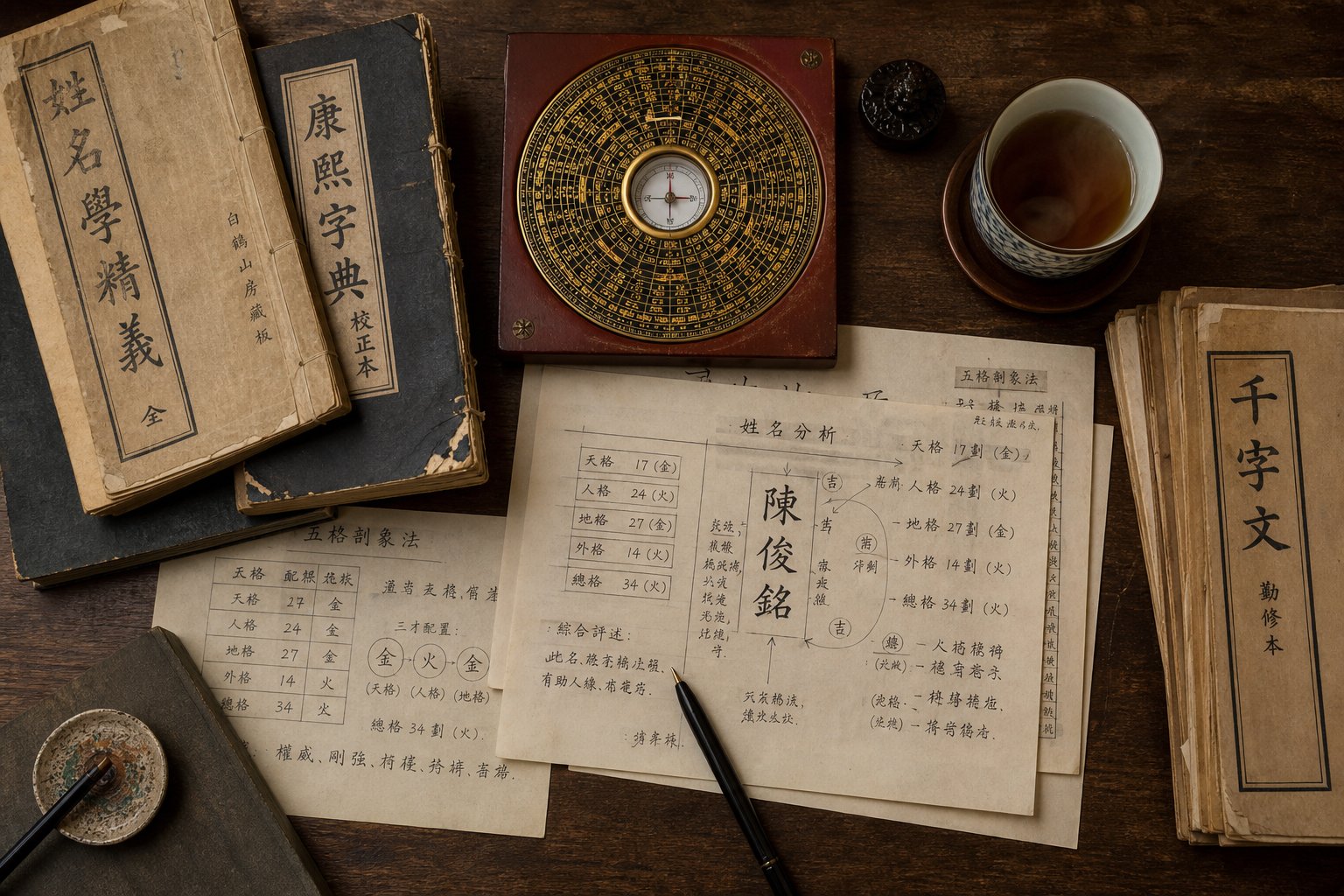
The tools consultants use have evolved significantly. Traditional practitioners relied on handwritten stroke-count charts, printed reference books like the 康熙字典 (Kangxi Dictionary) for authoritative stroke counts, and personal knowledge of dialect pronunciations. Modern consultants supplement these with specialized software that instantly calculates all Five Formations, flags known homophone collisions, and cross-references elemental compatibility with BaZi charts. Some platforms even incorporate databases of internet slang updated quarterly — a concession to how quickly the modern linguistic landscape shifts.
Self-Checking Your Name for Unlucky Patterns
Not everyone has access to a professional consultant, and not every situation warrants one. If you are choosing a Chinese name as a non-native speaker, evaluating a name given to you years ago, or simply curious about how to find your numerology profile within a Chinese name, you can perform a basic self-check using the same framework consultants follow — just at a simplified level.
Start with the most accessible test: say the full name aloud, quickly, five times in a row. Listen for any word or phrase that emerges from the blurred syllables. Ask a native Mandarin speaker to do the same — they will catch homophones your non-native ear might miss. If the family has roots in a specific dialect region, find a speaker of that dialect and repeat the test.
For stroke count evaluation, look up each character's traditional (繁体) form and count strokes carefully. The chinese number system used in name numerology follows traditional character forms exclusively — simplified characters give incorrect counts. Add the surname strokes plus one for the Heavenly Formation. Combine the last surname character's strokes with the first given-name character's strokes for the Human Formation. Sum all given-name strokes for the Earthly Formation. Check each total against the inauspicious numbers table from earlier in this article.
Elemental analysis requires identifying each character's radical. Characters with 氵(water), 木 (wood), 火 (fire), 土 (earth), or 金/钅 (metal) radicals carry obvious elemental assignments. Characters without clear elemental radicals require deeper analysis — this is where professional consultation becomes valuable. If you can identify the radicals, check whether your name's elements fall into any of the five destructive pairings (Wood-Earth, Earth-Water, Water-Fire, Fire-Metal, Metal-Wood).
When should you seek professional help rather than self-checking? Consider consultation warranted if:
- You are naming a newborn and want comprehensive BaZi-based analysis
- Your family maintains generational naming traditions you are unsure how to navigate
- The name must function across three or more dialect systems
- You have identified a potential problem but are unsure of its severity
- You are considering a legal name change and want confirmation that the new name is clear across all layers
The chinese numeration system embedded in stroke-count analysis — where each number from 1-10 chinese carries specific energetic meaning — is nuanced enough that self-evaluation catches obvious problems but may miss subtle ones. A Total Formation of 14 is clearly inauspicious and easy to spot. But understanding whether a Human Formation of 23 is favorable or problematic requires reference tables that distinguish between numbers carrying "wood energy success" versus "fire energy excess." Professional consultants memorize these distinctions; casual evaluators need published charts.
The gap between self-checking and professional evaluation mirrors the difference between checking your own blood pressure at home and getting a full cardiac workup. The home check catches emergencies. The professional assessment catches the subtle patterns that compound over time. For something as permanent as a name — spoken thousands of times across a lifetime — the thoroughness of professional methodology often justifies its cost, especially when the alternative is discovering an unlucky combination only after years of carrying it.
Practical Guide to Avoiding Unlucky Name Pairings
Knowing how consultants work is one thing. Putting that knowledge into action — whether you are naming a newborn, adopting a Chinese name for yourself, or re-evaluating a name you have carried for decades — requires a clear, actionable framework. The categories of misfortune covered throughout this article can feel overwhelming when taken together: homophones, stroke counts, elemental clashes, dialect traps, ancestral taboos, internet slang. But they compress neatly into a single checklist you can run through before committing to any name.
Quick-Reference Checklist for Name Evaluation
Use this as a screening tool. A name does not need to score perfectly on every dimension — but it should clear the high-severity items without exception and pass the lower-severity items in the dialects and contexts where it will actually be used.
- Homophone test (Mandarin): Say the full surname + given name aloud at conversational speed. Does it sound like any negative word or phrase — death, poverty, insults, vulgarity, illness? If yes, discard or revise.
- Homophone test (family dialects): Repeat the spoken test in Cantonese, Hokkien, Teochew, Hakka, or any dialect spoken regularly in the household. A name only needs to survive the dialects it will actually encounter.
- Stroke count numerology: Calculate the Five Formations using traditional character stroke counts. Flag any formation landing on 4, 9, 10, 14, 19, or 20. The Human Formation and Total Formation carry the most weight.
- Five Elements compatibility: Identify each character's elemental radical. Confirm no destructive cycle exists between surname and given name elements. If BaZi data is available, verify the name supplies missing elements without reinforcing excesses.
- Ancestor name avoidance (避讳): Check the proposed characters against names of grandparents, great-grandparents, and any living elders. If a generational naming poem exists, confirm the correct generation character is used.
- Modern slang and pop culture scan: Search the full name's sound against current internet slang, meme phrases, and celebrity names. Ask someone under 25 whether the name triggers any associations you might not be aware of.
- Tonal flow: Confirm the name does not stack three or more identical tones in sequence. Alternating tones produce a more pleasant spoken rhythm and reduce homophone collision risk.
- Visual balance: Ensure the characters are not excessively complex (difficult to write) or so simple they look unfinished beside the surname. This is aesthetic rather than superstitious, but it affects how the name is perceived on documents and forms.
Is 4 a lucky number? In Chinese naming, definitively not — and that single data point illustrates why this checklist matters. A name can feel right intuitively yet carry a hidden numeric or phonetic problem that only systematic screening reveals. Similarly, is 7 a lucky number? In Chinese culture, seven occupies an ambiguous position — associated with togetherness (七夕, Qixi Festival) but also with ghostly energy (the seventh lunar month is Ghost Month). Context determines whether a stroke total of 7 helps or hinders.
Balancing Tradition and Personal Choice
Here is the honest reality: not every family weighs these factors equally. A highly traditional family in rural Fujian may reject a name over a single stroke-count conflict. A cosmopolitan family in Shanghai might care only about homophones and ignore numerology entirely. Diaspora families in Vancouver or Sydney often prioritize how the name sounds in English alongside its Chinese evaluation. What is a lucky number — or an unlucky one — depends heavily on who you ask and where they grew up.
Chinese luck beliefs exist on a spectrum, not a binary. Lucky number 8 is nearly universal in its positive reception — few families would object to a name whose stroke total lands on 8 or 18. But is 9 a lucky number? Opinions split. Some traditions view 9 as the highest single digit, symbolizing longevity and imperial power (the emperor's robes featured nine dragons). Others flag it as exhaustion at the end of a cycle. Your family's regional background and personal beliefs determine which interpretation applies.
The practical advice: match your level of screening to your family's actual beliefs and the cultural context where the name will live. At minimum, every name deserves the spoken homophone test — it costs nothing, takes thirty seconds, and catches the most publicly embarrassing problems. Beyond that, decide how deep to go based on how much weight your family places on numerology, elemental theory, and ancestral tradition.
For non-native speakers adopting a Chinese name, the calculus is slightly different. You are unlikely to have a BaZi chart calculated at birth or a generational naming poem to follow. Focus on the homophone test, basic stroke-count screening, and — critically — asking native speakers from multiple dialect backgrounds to react to the name honestly. Pandaist's naming guide emphasizes that ease of pronunciation and positive meaning are the foundational priorities, with deeper numerological analysis as an optional layer for those who want it.
Regardless of whether you personally believe a name shapes destiny, understanding these systems enriches your cultural literacy in a concrete way. You will recognize why a Chinese colleague winces at a particular name combination. You will understand why a friend's grandmother vetoed a beautiful-sounding name. You will grasp why name consultants remain busy professionals in an era of smartphones and AI — because the layers of analysis are genuinely complex, and the stakes feel real to the families navigating them. That understanding, more than any single checklist item, is what transforms a foreign naming system from opaque superstition into legible cultural logic.
Frequently Asked Questions About Unlucky Chinese Name Combinations
1. What makes a Chinese name combination unlucky?
A Chinese name becomes unlucky not because of any single character but because of how the surname and given name interact together. The most common issue is homophone collision, where the full name spoken aloud sounds identical to a negative word or phrase in Mandarin or other dialects. Beyond sound, names are also evaluated through stroke count numerology, Five Elements compatibility, ancestral naming taboos, and modern slang associations. A name must pass all these layers to be considered safe.
2. Why is the number 4 considered unlucky in Chinese names?
The number 4 (si) is considered the most inauspicious number in Chinese culture because it sounds nearly identical to the word for death (si). In name numerology, this extends beyond the digit itself. If a name's stroke count total lands on 4, 14, 24, or 44 in any of the Five Formations calculations, traditional practitioners flag it as carrying death-adjacent energy. The number 14 is especially feared because it can sound like 'certainly die' in certain dialects.
3. Can a Chinese name be unlucky in one dialect but fine in another?
Yes, this is a well-documented problem for families in multilingual regions. Mandarin has four tones while Cantonese has six and Hokkien has seven or eight, creating entirely different homophone landscapes. A name like Liu Jianren sounds dignified in Mandarin but resembles 'despicable person' in Cantonese. Families in Hong Kong, Guangdong, and Southeast Asia must test proposed names across every dialect spoken in the household to avoid cross-dialect traps.
4. How do professional Chinese name consultants evaluate names?
Professional consultants follow a nine-step methodology. They start by calculating the child's BaZi birth chart to determine elemental needs, then select characters with appropriate radicals. Next they calculate stroke counts across all Five Formations, test pronunciation for homophones in Mandarin and family dialects, verify against ancestor names, screen for modern slang associations, and check tonal flow. A name must pass every stage cleanly, and failure at any single point sends it back for revision.
5. How can I check if my Chinese name has an unlucky combination?
Start with the simplest test: say your full name aloud quickly five times and listen for any negative words that emerge from the blurred syllables. Have native speakers in Mandarin and any relevant family dialects do the same. For stroke count analysis, look up each character's traditional form and calculate the Five Formations totals, checking against inauspicious numbers like 4, 9, 10, 14, 19, and 20. For elemental analysis, identify each character's radical to determine its element and check for destructive cycles between them.