Why Uyghur and Chinese Naming Systems Are Worlds Apart
Imagine two people standing in the same government office, filling out the same form, yet their names operate on completely different logic. One person's name traces a patronymic chain rooted in Turkic and Islamic tradition. The other's places a hereditary surname first, drawn from thousands of years of logographic writing. These aren't minor formatting differences. They reflect two fundamentally distinct philosophies about identity, family, and belonging.
Uyghur naming vs Chinese naming isn't just a linguistic curiosity. It's a window into how entire civilizations encode who a person is, where they come from, and what their community values most.
Why Naming Systems Reveal Cultural Identity
A name is never just a label. In both Uyghur and Chinese traditions, it functions as a cultural marker, carrying the weight of religion, lineage, language, and worldview in a handful of syllables.
The Uyghur language belongs to the Turkic family, and its naming conventions reflect centuries of Islamic faith and Central Asian heritage. A Uyghur name like Alim Tohti tells you the person's given name and their father's name, not a fixed family surname. Chinese names, by contrast, place the inherited surname first, followed by a given name composed of characters chosen for their meaning and tonal beauty. The structure itself signals a different relationship between individual and lineage.
Even the pronunciation of Uighur names presents challenges when forced into Mandarin phonetics, a tension that shapes real lives and official documents for the 维吾尔族 (Uyghur ethnic group) across the region.
What This Comparison Covers
This article ranks and compares the six most significant differences between these naming traditions, from structural foundations to bureaucratic collisions. Whether you're a student of cultural linguistics, a writer building authentic characters, a genealogist tracing Central Asian lineage, or simply curious about how names work across cultures, you'll find a structured breakdown that no single resource currently offers. Each difference is evaluated for its cultural weight, linguistic distinctiveness, and real-world impact on identity.
How We Ranked These Naming Differences
Comparing two naming systems that evolved on entirely separate cultural tracks requires more than a side-by-side list. You need a framework that accounts for why certain differences carry more weight than others in people's daily lives, legal identities, and cultural survival.
Evaluation Criteria for Naming Traditions
Each difference in this comparison is ranked according to five criteria, weighted by how directly it affects identity on paper and in practice:
- Structural complexity - How fundamentally does the difference alter the architecture of a name? A patronymic system versus a hereditary surname isn't a surface-level variation. It reshapes how generations connect.
- Cultural significance - How deeply is the difference tied to religion, philosophy, or worldview? Names rooted in Islamic faith carry different cultural stakes than names built from logographic characters encoding Confucian ideals.
- Practical impact on identity documents - Does the difference create real friction when a person crosses bureaucratic systems? This criterion captures what happens when Uyghur patronymic names collide with forms designed for Chinese surname-first conventions.
- Linguistic distinctiveness - How far apart are the phonological, scriptural, and morphological foundations? A modified Arabic script and a logographic writing system produce names that function on incompatible linguistic logic.
- Relevance to diaspora communities - Does the difference affect how Uyghurs living outside the region preserve or lose their naming identity? This matters for communities where do the Uyghurs live today, scattered across Central Asia, Turkey, Europe, and North America.
Sources and Research Framework
This comparison synthesizes two primary streams of scholarship. The first is academic research on what scholars call hybrid name culture in Xinjiang, a concept developed by Asad Sulayman in work published through Routledge that examines how Uyghur naming practices have been forced into compromise with Chinese bureaucratic norms since the mid-twentieth century. The second is advocacy documentation from the Uyghur Human Rights Project (UHRP), whose language guide for journalists and researchers provides detailed recommendations on rendering Uyghur names accurately in Latin script rather than defaulting to Pinyin transliterations.
Coverage in xinjiang news outlets and uyghur china news reporting often defaults to Chinese-system conventions when presenting Uyghur names, a pattern the UHRP guide specifically addresses. No single competitor resource currently provides a structured, ranked comparison of these naming traditions across all six dimensions. This synthesis fills that gap by combining linguistic scholarship, human rights documentation, and cross-cultural naming research into one accessible framework.
The differences that follow are ordered from most to least impactful, starting with the structural foundation that makes these two systems fundamentally incompatible.
Patronymic Identity vs Hereditary Surname System
The single most significant difference between Uyghur and Chinese naming comes down to one question: does your name connect you to your father, or to an unbroken ancestral line? The answer splits these two systems at their root.
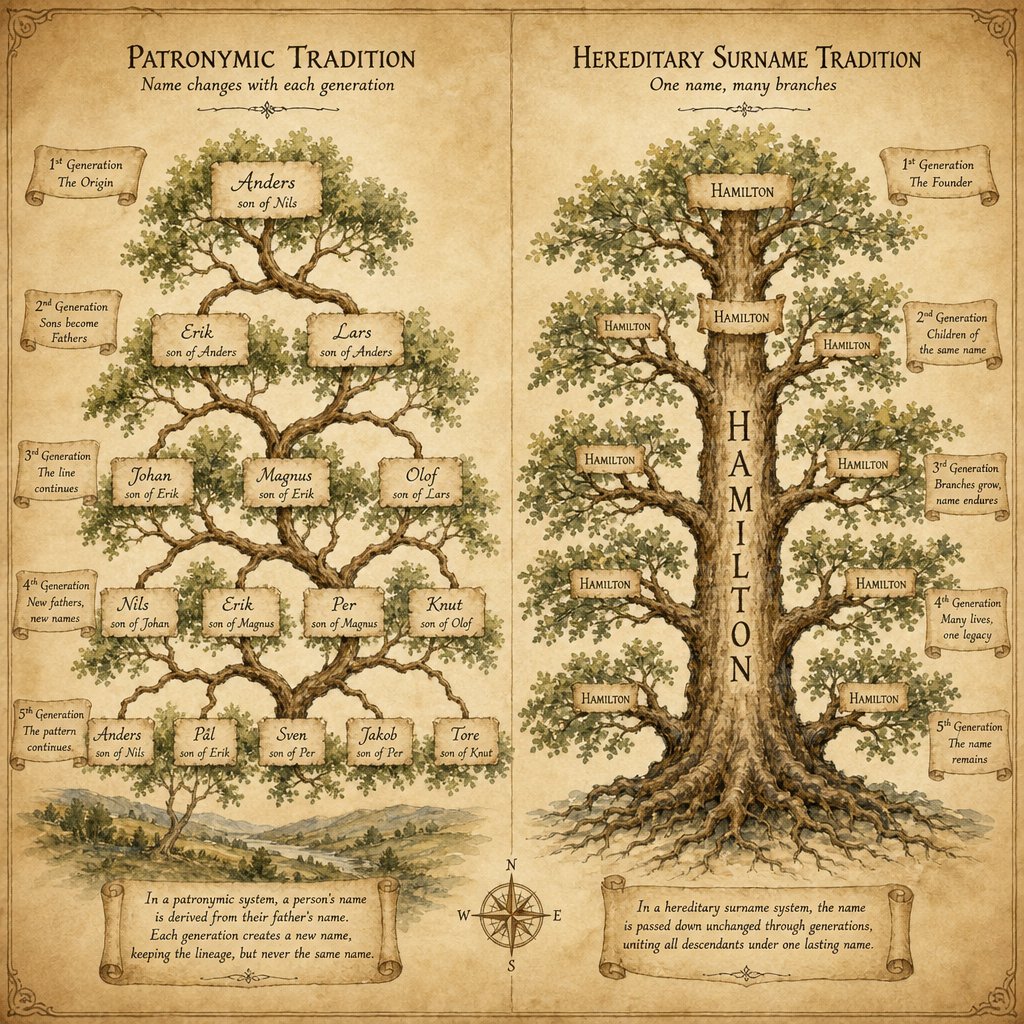
Uyghur names follow a patronymic model. Chinese names follow a hereditary surname model. These aren't two flavors of the same thing. They represent incompatible assumptions about how identity passes between generations.
The Uyghur Patronymic Model Explained
In the Uyghur tradition, a person's full name consists of their given name followed by their father's given name. Take the name Alim Tohti. "Alim" is the individual's personal name. "Tohti" is his father's first name, functioning as a patronymic rather than a fixed family surname. Alim's children won't carry "Tohti" forward. If Alim has a son named Arafat, that child becomes Arafat Alim.
The UHRP language guide illustrates this clearly with a hypothetical family:
- Husband: Memet Abduqadir
- Wife: Amangul Niyaz
- Children: Arafat Memet, Arfiya Memet
Notice that husband and wife don't share a last name. The children carry their father's given name, not a surname inherited across generations. Only siblings share the same second name. This means Uyghur names shift with every generation, creating a chain of individual links rather than a fixed family label.
Because of this structure, Uyghurs generally don't refer to each other by their patronymic alone. Calling someone "Mr. Tohti" would be like calling someone by their father's first name, which feels odd in Uyghur social context. The convention is to use the given name: "Mr. Alim" or "Dr. Rahile," not "Dr. Dawut."
The Chinese Hereditary Surname Structure
Chinese names operate on the opposite principle. The surname comes first, it's inherited from the father, and it persists unchanged across centuries. A name like Zhang Wei (张伟) places the hereditary surname Zhang at the front, followed by the given name Wei. Zhang's children, grandchildren, and descendants five hundred years from now will all carry the surname Zhang.
China has roughly 400 active surnames covering its population of over 1.4 billion people. The top three alone, Li, Wang, and Zhang, account for more than 270 million individuals. In traditional families, given names often include a generation character shared among siblings or cousins, creating a layered structure: surname + generation name + individual name.
This system is built for bureaucratic continuity. It assumes every person carries a stable, inheritable family identifier that links them to a traceable lineage. Unlike the patronymic model used by Uyghurs in chinese administrative contexts, the hereditary surname is designed to be permanent and searchable across records.
Other Muslim minorities within China's borders navigate this differently. Chinese Hui people, for instance, largely adopted Chinese hereditary surnames centuries ago while maintaining Islamic given names, creating a hybrid that fits the bureaucratic system more easily. Uyghur naming never underwent this adaptation.
Why This Difference Matters Most
The structural clash becomes concrete the moment a Uyghur person encounters a form with a "surname" field. The patronymic system has no fixed surname to offer. What gets entered? Often, the father's given name is forced into the surname slot, creating a false equivalence that distorts the name's meaning and breaks the patronymic logic entirely.
| Component | Uyghur System | Chinese System |
|---|---|---|
| Name order | Given name + father's given name | Surname + given name |
| "Last name" source | Father's personal name (patronymic) | Inherited family surname |
| Generational continuity | Shifts every generation | Surname unchanged for centuries |
| Shared name among siblings | Yes (father's name) | Yes (surname, sometimes generation character) |
| Shared name between spouses | No | No (women retain maiden surname) |
| Number of active "surnames" | Not applicable (infinite variation) | ~400 surnames cover most of the population |
| Bureaucratic compatibility | Conflicts with surname-first forms | Designed for surname-first systems |
This table captures why the patronymic-versus-hereditary divide ranks as the most impactful difference. It's not a matter of preference or style. The two systems make fundamentally different assumptions about what a "last name" even is. For Uyghur names forced into the administrative framework of the Xinjiang Uygur Zizhiqu (Xinjiang Uyghur Autonomous Region), this mismatch creates identity distortions that ripple through passports, school records, property deeds, and every other document that assumes a stable surname exists.
Some Uyghurs in the diaspora have adopted fixed family surnames to navigate international systems, but within the homeland, the patronymic tradition remains the cultural norm. The tension between these two models isn't abstract. It shapes how millions of people appear, or disappear, on paper.
Structural architecture tells you how a name is built. But what fills that structure, the raw material of meaning and belief, reveals an equally profound divide.
Religious Roots vs Philosophical Character Meanings
Where do the sounds and syllables of a name actually come from? For Uyghurs, the answer is overwhelmingly faith. For Chinese naming, it's philosophical aspiration encoded in characters. This second-ranked difference reveals how deeply religion and worldview shape the raw material of personal identity in each tradition.
Islamic and Turkic Roots in Uyghur Names
Approximately 80 to 85 percent of Uyghur names are of Arabic or Persian origin, a reflection of the community's centuries-long relationship with Islam in China. Like most Muslim communities worldwide, Uyghurs began drawing from the Quran and Islamic history as a source of names after converting to Islam. These aren't borrowed or foreign elements. They're deeply embedded cultural inheritance, as natural to Uyghur identity as Biblical names are in Western societies.
Common Uyghur name roots and their meanings include:
- Muhammad / Memet - "praised one," from the Prophet's name
- Fatima / Patimah - daughter of the Prophet, meaning "one who abstains"
- Nurullah - "light of God" (Arabic nur + Allah)
- Abdulla - "servant of God"
- Shemshiddin - "sun of the faith" (Persian/Arabic)
- Gulnur - "rose light" (Persian gul + Arabic nur)
- Yultuzay - "star and crescent" (Turkic)
- Hoja - title for a Sufi religious teacher
- Khalifa - "successor" or "ruler" in Islamic tradition
Notice how these names blend Arabic theological vocabulary, Persian poetic imagery, and Turkic nature words. A single name can carry layers of meaning that connect its bearer to Islamic faith, Central Asian landscape, and Turkic linguistic heritage simultaneously.
Philosophical Meaning in Chinese Character Names
Chinese names draw from an entirely different well. Each character (Hanzi) carries independent meaning, tonal pronunciation, and often centuries of literary association. Parents select characters not for religious devotion but for the aspirations, virtues, or qualities they want to bestow on a child. As Temple University's Center for Chinese Language Instruction explains, a person's name tells the story of their parents' ideals and hopes, aspirations that the bearer often embraces throughout life.
Common Chinese naming characters and their meanings include:
- Wei (伟) - "great, mighty" (one of the most popular male name characters)
- Yu (玉) - "jade," symbolizing purity and moral virtue
- Zhi (志) - "ambition, will"
- Hui (慧) - "wisdom, intelligence"
- Mei (美) - "beauty"
- Jian (建) - "to build, establish"
- Xin (信) - "trust, faithfulness"
- Ming (明) - "bright, brilliant"
The selection process involves more than meaning alone. Parents consider how characters sound together, whether tonal combinations flow smoothly, and whether any homophone might carry an unfortunate association. A character pronounced "chou" would be avoided regardless of its written meaning because it sounds too close to characters meaning "ugly" or "stench." This phonetic-semantic interplay has no parallel in Uyghur naming, where sound carries the name and meaning comes from the source language.
How Religion Shapes Name Selection
The depth of Islamic roots in Uyghur naming becomes starkly visible when you look at what authorities have targeted for removal. A UHRP briefing documented a province-wide ban on 29 names determined to express Islamic faith, including Islam, Quran, Mecca, Imam, Hajj, Medina, Fatima, and Aysha. Parents were told their children could not register for a hukou, attend school, or access healthcare if they carried banned names. Those with existing banned names were forced to change them.
Human Rights Watch research revealed the same pattern applied to place names: all villages containing the word "mazar" (shrine) lost it from their names, as did those containing "hoja" (religious teacher) and "khalifa" (ruler). The systematic removal of these elements from both personal and geographic names illustrates just how thoroughly faith permeates Uyghur naming culture. You can't strip the Islamic roots without dismantling the naming tradition itself.
When you consider how many muslims in china practice naming traditions tied to their faith, the Uyghur case stands out for the degree of state intervention. The muslim china population includes roughly 25 million people across multiple ethnic groups, including Hui, Kazakh, and Uyghur communities. Yet the naming restrictions have fallen most heavily on Uyghurs, whose patronymic system and Arabic-Persian vocabulary make their names visibly distinct from the Chinese norm in ways that other muslim Chinese communities' names often are not.
Chinese names, by contrast, rarely trigger political scrutiny because their meaning is encoded in characters that don't signal religious affiliation. A name meaning "great ambition" or "beautiful jade" carries philosophical weight without marking its bearer as belonging to a particular faith community. This asymmetry, where one system's naming material is politically neutral and the other's is treated as a security concern, transforms what should be a cultural difference into a site of active erasure.
Faith and philosophy shape what names mean. But the scripts that carry those names onto paper introduce yet another layer of incompatibility, one that determines how a name looks, sounds, and survives translation.
Script and Phonological Foundations of Each System
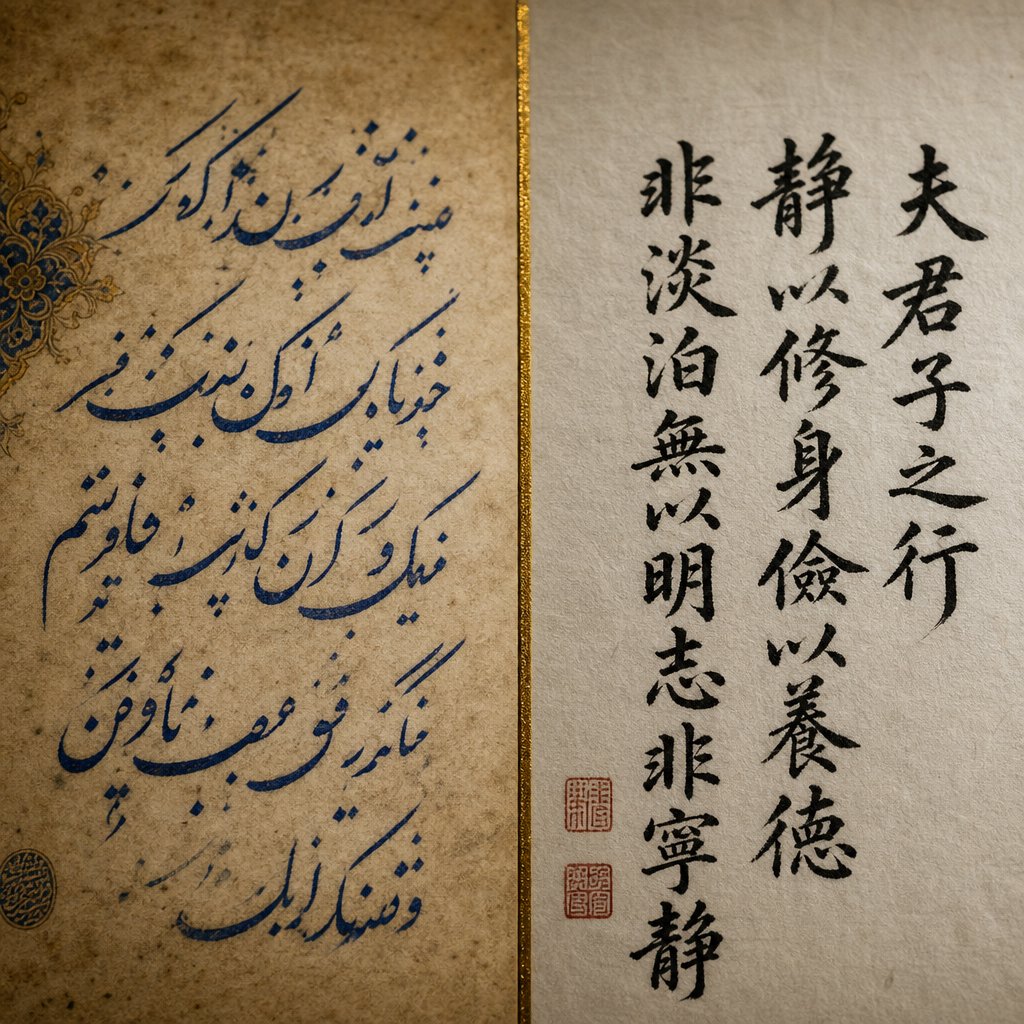
A name doesn't just carry meaning. It lives inside a writing system that determines how it looks on paper, how it sounds when spoken aloud, and what happens when someone tries to translate it. The third key difference between these naming traditions sits at the level of script itself: Uyghur names are written in a modified Arabic alphabet that flows right to left, while Chinese names are built from logographic characters where each symbol carries independent meaning.
These aren't just different fonts. They're fundamentally different technologies for encoding human language into written form, and they shape what's possible in a name.
Arabic-Derived Script and Phonetic Naming
The Uyghur script (ئۇيغۇر ئەرەب يېزىقى) is an alphabet derived from the Perso-Arabic writing tradition. It uses 33 letters, including 8 vowel characters and 25 consonants, written right to left in cursive form. Unlike standard Arabic, which often omits short vowels, the modern Uyghur orthography writes all vowels explicitly, making it a true alphabet rather than an abjad.
The adoption of Uyghur script in its current form dates to 1982, when the Chinese government reinstated the modified Perso-Arabic alphabet after experiments with Cyrillic and Latin alternatives. This script allows direct phonetic rendering of Arabic and Persian names. When a Uyghur parent names their child "Nurullah," the script captures each sound faithfully because it was designed to handle exactly those phonemes: the uvular fricative /ʁ/, the voiceless uvular fricative /χ/, and vowels like /ø/ and /y/ that are native to Turkic languages.
Uyghur pronunciation includes sounds that have no equivalent in Mandarin Chinese, such as "gh" (/ʁ/), "kh" (/χ/), and the front rounded vowels "ö" and "ü." The script handles these natively. Mandarin Pinyin does not.
Logographic Characters and Tonal Meaning
Chinese names exist in a completely different scriptural universe. Each character is a logograph, a single unit that carries meaning, pronunciation, and tone simultaneously. The character 維吾爾 (Weiwu'er, the Chinese rendering of "Uyghur") illustrates this perfectly: each syllable is a separate character chosen primarily for its phonetic approximation, not its meaning.
When Chinese parents name a child, they're selecting from thousands of characters, each with a fixed pronunciation and semantic content. The character 明 (ming, "bright") can't be stretched or modified to accommodate a foreign sound. It is what it is. This means Chinese names are constrained by the available character inventory in ways that alphabetic names simply aren't. You can't invent a new character for a new sound.
Chinese is also tonal. The syllable "ma" means "mother" in first tone, "hemp" in second tone, "horse" in third tone, and "scold" in fourth tone. Uyghur is not a tonal language. This mismatch means that when a Uyghur name gets transliterated into Chinese characters, the tonal dimension is imposed artificially, sometimes creating unintended meanings or awkward associations that the original name never carried.
How Script Shapes Name Possibilities
The practical consequence becomes visible the moment you compare how the same person's name appears across systems. The UHRP language guide documented a prominent example: Uyghur skier Dilnigar Ilhamjan, whose name appeared in international media as "Dinigeer Yilamujiang" because outlets defaulted to the Pinyin rendering of her Chinese-transliterated name.
The xinjiang pronunciation of Uyghur names through Mandarin phonetics systematically strips away sounds that Pinyin cannot represent. Consider what happens across multiple names:
| Uyghur Script | Uyghur Latin (ULY) | Chinese Pinyin | What's Lost |
|---|---|---|---|
| دىلنىگار ئىلھامجان | Dilnigar Ilhamjan | Dinigeer Yilamujiang | "gh" becomes "g"; syllable boundaries shift |
| كۈرەش تاھىر | Kuresh Tahir | Kurexi Tayier | "sh" becomes "xi"; vowel quality changes |
| ئۆركەش | Orkesh | Wu'er Kaixi | Name restructured entirely; unrecognizable |
| ئەرکىن تۇنىياز | Erkin Tuniyaz | Alken Tuniaz | Initial vowel altered; spelling inconsistent |
The table reveals a pattern. Uyghur script preserves the original phonetic identity of a name because it was built to handle those sounds. Chinese characters approximate the sounds using available syllables, often splitting single Uyghur phonemes across multiple characters or collapsing distinct sounds into the nearest Mandarin equivalent. The result isn't just a different spelling. It's a different name.
An alphabetic script gives names infinite phonetic flexibility. A logographic script gives names layered semantic depth. Neither is superior, but they produce names that operate on incompatible logic. When one system must represent names from the other, something always breaks, and the direction of that breakage is rarely symmetrical. Uyghur names forced into Chinese characters lose phonetic precision. Chinese names rendered in Uyghur script lose semantic resonance.
Script determines what a name can sound like. But naming traditions also encode something more personal: how gender, family role, and marital status shape the name a person carries through life.
How Gender Shapes Names in Both Traditions
In both Uyghur and Chinese cultures, a person's gender influences what name they receive. But the mechanisms differ sharply, and so do the consequences for how a woman's identity appears on paper throughout her life. This fourth-ranked difference reveals how each system handles femininity, marriage, and the relationship between a woman's name and her family of origin.
Uyghur Women's Names and Marital Identity
Uyghur women's names draw heavily from Persian poetic vocabulary and Islamic female figures. Where a Uyghurs Muslim girl might receive a name honoring a figure from the Quran, she's equally likely to carry a name built from Persian words for flowers, light, or celestial imagery. The result is a naming tradition where femininity is expressed through lyrical, nature-rooted language.
Common examples of Uyghur women's names include:
- Gulnur - "rose light" (Persian gul + Arabic nur)
- Aynur - "moonlight" (Turkic ay + Arabic nur)
- Mahire - "skilled, talented" (Arabic)
- Patimah / Fatima - daughter of the Prophet Muhammad
- Meryem - Mary, mother of Jesus in Islamic tradition
- Dilnur - "heart's light" (Persian dil + Arabic nur)
Here's what makes the Uyghur system distinctive for women: marriage changes nothing about a woman's name. Because the patronymic system ties a person to their father's given name, Uyghur women carry their father's name as their identifier for life. A woman named Amangul Niyaz remains Amangul Niyaz after marriage. She doesn't become "Mrs. Memet." Her children carry their father's name, but she keeps her own patronymic unchanged. Identity stays rooted in the family she was born into, not the one she married into.
Chinese Gendered Character Selection
Chinese naming takes a different approach to gender. Parents select characters that carry associations considered appropriate for a daughter or a son. For girls, characters evoking beauty, grace, gentleness, or natural elegance appear frequently. As the reference material from Chinese Name Translator explains, Chinese parents spend weeks choosing characters that will travel with their child through life, embedding values into identity itself.
Common characters in Chinese women's names include:
- Mei (美) - "beauty"
- Hui (慧) - "wisdom, intelligence"
- Yu (玉) - "jade," symbolizing purity
- Xiu (秀) - "elegant, graceful"
- Fang (芳) - "fragrant"
- Jing (静) - "quiet, serene"
Some characters, like Ren (仁, benevolence) or Zhi (智, wisdom), cross gender lines because their virtues are considered universal. But many naming characters carry strong gender coding that parents rarely violate. A boy named with characters for "fragrant" or "graceful" would raise eyebrows. A girl named with characters for "mighty" or "martial" would too, though this has loosened in recent decades.
How Marriage Affects Names Differently
In Chinese tradition, women historically retained their maiden surname after marriage. A woman surnamed Li who married a man surnamed Zhang remained Li in formal contexts, though she might be addressed socially as "Zhang-taitai" (Mrs. Zhang). Modern Chinese law preserves this: women keep their birth surname on official documents. Children typically take the father's surname, though taking the mother's surname is legally permitted.
The contrast with Uyghur women is subtle but important. Both systems allow women to keep their pre-marriage name. But in the Chinese system, what stays constant is the hereditary surname, a link to patrilineal ancestry. In the Uyghur system, what stays constant is the patronymic, a link to one specific person: her father. One preserves a lineage. The other preserves a relationship.
For Uyghur women in the diaspora, this distinction carries practical weight. International documents often assume a woman's "maiden name" differs from her "married name." Uyghur women have no married name to offer. Their patronymic isn't a maiden name in the Western sense either. It's simply their name, unchanged by any life event except, in some cases, bureaucratic force.
Among other Muslim minorities in China, the hui ethnicity navigated this differently. Hui women adopted Chinese hereditary surnames generations ago, meaning their names already fit the expected bureaucratic pattern. Uyghur women's names, built on the patronymic model and filled with Persian-Arabic vocabulary, remain visibly distinct in ways that create friction with standardized forms.
Gender shapes what a name contains and how it persists through life transitions. But the most acute pressure on these naming systems comes not from cultural tradition but from bureaucratic collision, when two incompatible logics meet on a single government form.
When Two Naming Systems Collide on Documents
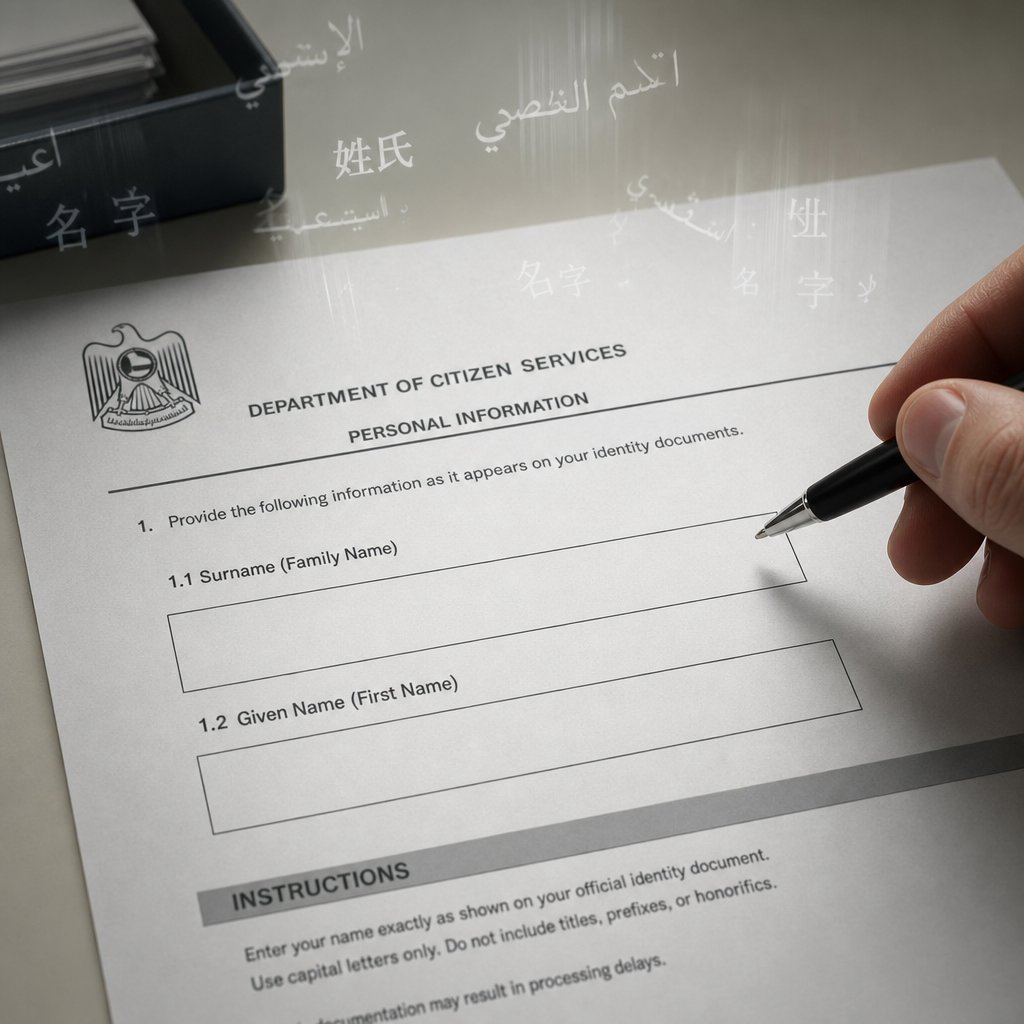
Picture a government office in urumqi city. A Uyghur man named Alim Tohti sits across from a clerk holding a form with two fields: "surname" and "given name." The form assumes every person has a hereditary family name. Alim doesn't. His name means "Alim, son of Tohti." There's no surname to extract. Yet the form demands one. What happens next is the fifth most significant difference between these naming traditions, and it plays out millions of times across the region.
Forced Surname Assignment on Official Documents
Chinese bureaucratic systems are architected around the hereditary surname. Identity cards, bank accounts, school registrations, and medical records all assume a stable family name occupying the first field. When Uyghur patronymic names enter this system, officials face an impossible fit. The most common solution is to split the name artificially: the father's name gets pushed into the "surname" slot, and the given name fills the second field.
This creates a false equivalence. "Tohti" isn't a surname. It's one man's given name, borrowed temporarily as an identifier for his son. But once it lands in the surname field of an official database, the system treats it as a hereditary family name. BBC Monitoring reported that Xinjiang authorities announced plans to "clear up" inconsistencies in ethnic minority names, with officials acknowledging that documents "are built around accommodating short, Mandarin names, often no longer than three Chinese characters, or ten Latin alphabet characters." Radio Free Asia noted that authorities had already "corrected" 20 million names on social security accounts where data was deemed "non-standardised."
For urumqi china people navigating daily life, this means a single person might appear under different name configurations across different documents, depending on which clerk processed which form and how they chose to split the patronymic.
The Hybrid Name Culture Problem
Academic researcher Asad Sulayman, in work published through Routledge, describes what emerges from this collision as "hybrid name culture" in Xinjiang. It's a naming practice that belongs to neither the Uyghur patronymic tradition nor the Chinese hereditary system. Instead, it's a bureaucratic artifact, a name that exists only because a form required it.
Some Uyghur families, particularly in uerumqi china and other urban centers, have begun adopting fixed surnames across generations simply to reduce administrative friction. A father might decide that his patronymic will become the family's permanent surname going forward, freezing what was once a shifting generational marker into a static label. The tradition bends to fit the form rather than the form accommodating the tradition.
When the state renames places and restructures personal names to fit a single administrative logic, it practices what scholars call toponymic colonialism: the assertion of political authority through the power to name. Applied to personal naming, it transforms identity documents from records of who a person is into records of who the state says they should be.
This concept connects personal naming directly to geographic renaming. Human Rights Watch documented that over 630 Uyghur communities had their names changed, with references to xinjiang china religion systematically stripped from village names containing words like "mazar" (shrine), "hoja" (religious teacher), or "khalifa" (successor). The same logic that renames a village renames a person. Both operations replace culturally specific identifiers with ones that fit the dominant administrative framework.
Practical Consequences for Identity
The consequences ripple outward. When china xinjiang news outlets report on Uyghur individuals, they typically render names in the Chinese bureaucratic format, surname first, reinforcing the hybrid as though it were authentic. International media then picks up the Pinyin version of an already-distorted name, compounding the erasure.
Consider the practical chain:
- A Uyghur person's patronymic name is split to fit a Chinese form
- The father's name becomes a fixed "surname" in the database
- Official documents now show a name that follows neither Uyghur nor Chinese conventions
- Xinjiang uyghur news coverage uses the bureaucratic version as the default
- Diaspora family members may not recognize the official rendering of a relative's name
China uighur news reporting rarely explains this distortion to readers. The hybrid name appears authoritative because it sits on an official document, even though it was produced by forcing a round peg into a square hole. For Uyghurs in uerumqi china and across the region, the document doesn't reflect their identity. It reflects the system's inability to accommodate it.
The collision on forms produces names that look wrong in both traditions. But there's a further layer of distortion that happens at the level of sound itself, when Uyghur phonemes must pass through the narrow filter of Pinyin transliteration.
Transliteration Challenges and Representation
Bureaucratic forms distort the structure of Uyghur names. Transliteration distorts their sound. This sixth difference operates at the phonemic level, where specific Uyghur consonants and vowels simply have no equivalent in Mandarin Chinese, and Pinyin lacks the letters to represent them. The result isn't minor mispronunciation. It's systematic phonetic erasure that renders names unrecognizable to the people who bear them.
Phonemes Lost in Pinyin Translation
Uyghur contains several phonemes that Mandarin Chinese does not use. The voiced uvular fricative "gh" (/ʁ/), the voiceless uvular fricative "kh" (/χ/), and the voiceless postalveolar fricative "sh" (/ʃ/) all exist natively in Uyghur but have no direct Pinyin counterpart. When a name containing these sounds must be rendered in Chinese characters and then back into Latin script via Pinyin, the original phonetic identity collapses.
The UHRP transliteration chart makes this visible. In Uyghur Latin script (ULY), "gh" represents a distinct sound. In Pinyin, it becomes a plain "g." The Uyghur "kh" becomes "h." The Uyghur "ch" becomes "q." And "sh" becomes "x." Each substitution strips away a phoneme that carries meaning for anyone who knows how Uyghurs pronounce their own names.
As Language Log's analysis of Xinjiang proper nouns documented, the medial consonant in the word "Uyghur" itself illustrates the problem perfectly. English speakers, Mandarin speakers, and Uyghur speakers all hear and reproduce that "gh" differently. Mandarin renders it as "w" (维吾尔, Weiwu'er), while the actual uyghur pronunciation retains a voiced fricative that neither English nor Chinese phonology accommodates natively.
| Uyghur Latin (ULY) | Pinyin Rendering | Phonetic Information Lost |
|---|---|---|
| Dilnigar Ilhamjan | Dinigeer Yilamujiang | "gh" flattened to "g"; syllable count inflated; "lh" split across syllables |
| Kuresh Tahir | Kurexi Tayier | "sh" becomes "xi"; "h" reinterpreted; vowel quality altered |
| Orkesh | Wu'er Kaixi | Name completely restructured; original unrecognizable |
| Gheni | Geni | Uvular fricative "gh" reduced to velar stop "g" |
| Khotan | Hetian | "Kh" uvular fricative lost; vowel shifted; final consonant altered |
The pattern is consistent. Every uyghur transliteration that passes through Pinyin loses phonemic detail that the original script preserved. It's not a matter of accent or regional variation. The sounds literally don't exist in the target system.
Why UHRP Recommends Uyghur-Origin Spellings
The Uyghur Human Rights Project explicitly recommends that journalists and researchers use Uyghur-origin spellings rather than Pinyin transliterations. Their reasoning is straightforward: Pinyin versions of Uyghur names "often render the names very differently from their Uyghur originals." The guide documents cases where the same official appeared under multiple Pinyin spellings across different news articles, making it impossible for readers to recognize they were reading about the same person.
The case of Erkin Tuniyaz is instructive. His name appeared as "Erken Tuniyaz" in some outlets and "Alken Tuniaz" in others, both derived from inconsistent Pinyin renderings. Observers failed to connect that the official who claimed all Uyghurs had been released from camps was the same person who later addressed the UN Working Group on Arbitrary Detention. Mistransliteration didn't just distort a name. It fractured public accountability.
UHRP's recommendation centers on ULY (Uyghur Latin Yeziqi) as the preferred Latin-script standard. Unlike Pinyin, ULY was designed specifically to represent Uyghur phonology. It preserves the "gh," the "kh," the front rounded vowels, and the syllable boundaries that make a name recognizable to its bearer. The pronunciation of Uyghurs' names stays intact when ULY is used because the script was built for exactly those sounds.
The Identity Cost of Mistransliteration
For Uyghur communities scattered across Central Asia, Turkey, Europe, and North America, diaspora pronunciation of names becomes a marker of cultural preservation. When a family in Istanbul says "Dilnigar" and a news anchor in Washington says "Dinigeer," they're not talking about two different people, but the phonetic gap makes it sound that way. The question of how to pronounce diaspora community members' names correctly isn't academic. It determines whether a person is recognized or erased in public discourse.
Imagine searching for a detained relative online. You know her as Gulnigar Memet. Official records list her as Guinigeer Maimaiti. Search engines treat these as different people. Databases don't cross-reference them. The uighur pronunciation of a name and its Pinyin shadow exist in parallel universes that rarely intersect digitally.
This matters beyond individual cases. When researchers compile detention lists, when journalists track officials' statements, when genealogists trace family connections, the transliteration gap creates systematic blind spots. A name that can't be consistently spelled can't be consistently tracked. And a person who can't be tracked becomes, functionally, invisible.
The uyghurs pronunciation of their own names carries phonemes that Pinyin was never designed to handle. Every time a media outlet defaults to the Chinese rendering, it reinforces a version of the name that the person themselves might not recognize spoken aloud. UHRP's recommendation isn't about linguistic purism. It's about ensuring that when you pronounce Uyghur names, you're actually saying the name the person was given, not a bureaucratic approximation filtered through a system built for a different language entirely.
Each of these six differences, from structural architecture to transliteration loss, compounds the others. Taken together, they form a complete picture of two naming systems that operate on incompatible logic at every level.
The Definitive Side-by-Side Naming Comparison
Six differences. Two systems built on incompatible logic at every level, from how a name is structured to how it survives translation across scripts. What follows is the complete synthesis: a single reference resource that captures the full scope of uyghur naming vs chinese naming in one place, ranked by real-world impact and organized for practical use.
Complete Comparison Table
This table consolidates every major dimension explored throughout this article. You'll notice that the two systems diverge not on one axis but on all of them simultaneously, which is what makes cross-system representation so difficult.
| Dimension | Uyghur Naming System | Chinese Naming System |
|---|---|---|
| Structure | Patronymic: given name + father's given name. Shifts every generation. No fixed surname. | Hereditary: surname + given name (sometimes with generation character). Surname unchanged for centuries. |
| Cultural roots | Arabic, Persian, and Turkic origins. Deeply tied to Islamic faith and Central Asian heritage. | Logographic characters carrying philosophical aspirations, Confucian virtues, and tonal aesthetics. |
| Script | Modified Perso-Arabic alphabet (33 letters, right-to-left). Phonetic and alphabetic. | Logographic characters (Hanzi). Each character carries independent meaning, pronunciation, and tone. |
| Gender conventions | Women's names draw from Persian poetic vocabulary and Islamic female figures. No name change at marriage; patronymic stays for life. | Women's names often use characters for beauty, grace, or virtue. Women retain birth surname on documents; children typically take father's surname. |
| Bureaucratic fit | Conflicts with surname-first forms. Father's name often force-assigned as "surname," creating hybrid names belonging to neither tradition. | Designed for and by the bureaucratic system. Surname-first format is the administrative default. |
| Transliteration | ULY (Uyghur Latin Yeziqi) preserves native phonemes like "gh," "kh," and front rounded vowels. | Pinyin renders Uyghur names through Mandarin phonology, systematically stripping phonemes that don't exist in Chinese. |
Which Differences Matter Most and Why
Not all six differences carry equal weight. Some are primarily linguistic curiosities. Others reshape how a person appears in legal systems, media coverage, and family records. Here's the final ranking, ordered by cumulative impact on identity:
- Patronymic vs hereditary surname - The foundational incompatibility. Every other problem flows from this structural mismatch. A system with no fixed surname cannot fit cleanly into one that requires it.
- Religious roots vs philosophical character meanings - Islamic naming vocabulary has been actively targeted for removal, making this difference not just cultural but political. Chinese character names carry no comparable vulnerability.
- Script and phonological foundations - An alphabetic script built for Turkic phonemes versus a logographic system built for tonal Mandarin. Translation between them always loses information, and the loss flows in one direction.
- Gender and marital naming - The patronymic system's treatment of women's names (unchanged by marriage, tied to father for life) creates friction with international document systems that assume name changes at marriage.
- Bureaucratic collision - The practical site where structural incompatibility becomes lived experience. Hybrid names emerge that belong to neither tradition, fragmenting identity across documents.
- Transliteration distortion - The final layer of erasure. Pinyin renderings make names unrecognizable to their bearers and unsearchable across databases, creating systematic invisibility.
These six dimensions don't operate in isolation. They compound. A patronymic name (difference 1) built from Arabic-Persian religious vocabulary (difference 2) written in a Perso-Arabic script (difference 3) given to a woman who keeps it unchanged through marriage (difference 4) gets forced into a surname-first form (difference 5) and then transliterated through Pinyin into something unrecognizable (difference 6). Each layer strips away another piece of the original identity.
The Uyghur naming tradition traces its roots back through centuries of Turkic civilization, including the historical uyghur khanate and the broader khaganate system that governed Central Asian Turkic peoples. These weren't isolated communities. They were sophisticated states with literary traditions, diplomatic conventions, and naming practices that predate Chinese administrative presence in the region by centuries. Understanding this historical depth matters because it reframes the naming collision not as a minor bureaucratic inconvenience but as the compression of an ancient, living tradition into a system that was never designed to hold it.
Key Takeaways for Writers and Researchers
If you're a journalist, fiction writer, genealogist, or researcher working with Uyghur and Chinese names, these practical guidelines will help you respect both traditions:
- Ask the person. The UHRP language guide makes this its primary recommendation. Uyghurs often have strong preferences about which version of their name to use publicly.
- Use Uyghur-origin spellings, not Pinyin. Write "Dilnigar Ilhamjan," not "Dinigeer Yilamujiang." The ULY rendering preserves the name's phonetic identity.
- Don't treat the patronymic as a surname. "Tohti" in "Alim Tohti" is a father's given name, not a family name. Referring to someone as "Mr. Tohti" misrepresents the naming convention. Use "Mr. Alim" unless the individual prefers otherwise.
- Respect Chinese naming order. In Chinese names, the surname comes first. "Zhang Wei" is Mr. Zhang, not Mr. Wei. Don't reverse the order to match English conventions unless the person has adopted a Westernized format.
- Provide alternate spellings when possible. If you must use a Pinyin rendering for an official context, note the Uyghur-origin spelling alongside it so readers and researchers can cross-reference.
- Recognize that siblings share a patronymic, not a "family name." In genealogical research, tracing Uyghur lineage requires following the patronymic chain generation by generation, not searching for a single recurring surname.
For researchers tracking uyghur population growth and demographic patterns, the naming system itself creates methodological challenges. Without fixed surnames, standard genealogical software and census tools designed for surname-based populations struggle to link family members across generations. Diaspora communities in East Turkistan advocacy networks, Central Asia, and Turkey have developed their own conventions, with some families adopting fixed surnames for practical reasons while others maintain the patronymic tradition as an act of cultural preservation.
Names are not neutral data fields. They are the smallest unit of cultural identity that a person carries into every interaction, every document, every system. When two naming traditions collide and only one has the power to define the form, the other doesn't just get translated. It gets overwritten. Understanding these differences isn't academic. It's the first step toward accurate representation and the preservation of a naming tradition that has survived for centuries and deserves to survive for centuries more.
The gap between these two systems isn't something that better software or smarter forms can fix. It reflects a deeper truth: naming is never just administrative. It's cultural, spiritual, and political. Writers who grasp these six differences won't just avoid errors. They'll produce work that honors the full complexity of both traditions, giving readers the context they need to understand why a name on paper is never just a name.
Frequently Asked Questions About Uyghur and Chinese Naming Systems
1. Do Uyghurs have last names or surnames?
Uyghurs do not use hereditary surnames in the way Chinese or Western naming systems do. Instead, they follow a patronymic convention where a person's given name is followed by their father's given name. For example, in the name Alim Tohti, Alim is the personal name and Tohti is the father's first name. This patronymic shifts every generation, so siblings share the same second name but their children will carry a different one. Some Uyghurs in the diaspora have adopted fixed surnames for practical reasons, but the patronymic tradition remains the cultural norm within the community.
2. Why are Uyghur names spelled differently in Chinese media versus international media?
The discrepancy comes from transliteration systems. Chinese media renders Uyghur names through Mandarin Pinyin, which lacks letters for Uyghur-specific sounds like 'gh' and 'kh.' International outlets sometimes copy the Pinyin version, producing names like 'Dinigeer Yilamujiang' instead of the Uyghur-origin spelling 'Dilnigar Ilhamjan.' The Uyghur Human Rights Project recommends using Uyghur Latin script (ULY) spellings because they preserve the original phonetic identity of the name, making it recognizable to the person who bears it.
3. How do Chinese names differ structurally from Uyghur names?
Chinese names place a hereditary surname first, followed by a given name composed of one or two characters chosen for meaning and tonal harmony. This surname passes unchanged through generations. Uyghur names reverse this logic entirely: the personal given name comes first, followed by the father's given name as a patronymic identifier. Chinese names assume a permanent family label traceable across centuries, while Uyghur names create a chain where each generation's identifier shifts based on the father-child relationship.
4. Do Uyghur women change their names after marriage?
No. In the Uyghur patronymic system, a woman carries her father's given name as her identifier for life, regardless of marital status. Marriage does not alter her name in any way. A woman named Amangul Niyaz remains Amangul Niyaz after marriage, and her children carry their father's given name rather than hers. This differs from many Western traditions where women adopt a husband's surname, though it shares some similarity with Chinese convention where women also retain their birth surname on official documents.
5. What happens when a Uyghur patronymic name is entered into Chinese government forms?
Chinese bureaucratic forms require a surname field, which creates an impossible fit for Uyghur patronymic names that have no hereditary surname. Officials typically force the father's given name into the surname slot, creating a hybrid name that belongs to neither tradition. This can result in the same person appearing under different name configurations across different documents, depending on how each clerk chose to split the name. Scholars describe this phenomenon as 'hybrid name culture,' where bureaucratic pressure produces names that misrepresent both the Uyghur and Chinese naming conventions.