What Zibei Means and Why It Matters in Chinese Naming
Imagine looking at the names of your father, his brothers, and all their same-generation cousins — and noticing they all share one identical character. That shared character isn't a coincidence. It's a zibei generation name, and it carries centuries of family history in a single syllable.
Defining Zibei in Chinese Characters and Pinyin
So what does zibei mean in Chinese? The term is written as 字辈 (zìbèi) in Chinese characters. Breaking it down character by character gives you a clear picture of its function:
- 字 (zì) — character or word
- 辈 (bèi) — generation or rank
Put them together, and you get something like "generational character" — a single Chinese character assigned to an entire generation within a family clan. Every person born into that generation carries this character as part of their given name.
A zibei generation name is a predetermined Chinese character shared by all family members of the same generation, embedded within their given names to mark generational position within a clan's lineage.
This isn't just a naming preference or a trend. It's a structured system — a Chinese generational character naming system where the pool of characters and the order they follow are decided beforehand by a family's forefathers. Think of it as a built-in code that instantly tells other clan members exactly where you sit on the family tree.
How Zibei Differs From Other Chinese Naming Concepts
Chinese naming involves several layered concepts, and they're easy to confuse if you're encountering them for the first time. Here's how zibei fits alongside the others:
| Term | Chinese | Pinyin | What It Refers To |
|---|---|---|---|
| 姓 | xìng | Surname or family name, shared by the entire clan | |
| Mingzi | 名字 | míngzì | Full given name (may include the generation character) |
| Zibei | 字辈 | zìbèi | The specific generation character within the given name |
| Beifen | 辈分 | bèifèn | Generational rank or seniority within the clan |
You'll notice that beifen and zibei sound related — and they are. Beifen refers to your generational rank as a concept, while zibei is the actual character in your name that signals that rank. Your xing tells people which clan you belong to. Your zibei tells people which generation of that clan you represent.
This distinction matters because the zi bei Chinese characters meaning points to something deeper than a label. It's a naming mechanism that turns an abstract family hierarchy into something visible, portable, and immediately recognizable in everyday life. When someone in the clan sees your name, they don't need to ask how you're related — the generation character does the talking.
Of course, knowing the definition only scratches the surface. The real question is: where exactly does this character sit inside a full Chinese name, and how does the three-part structure actually work?
How a Zibei Character Fits Inside a Chinese Name
A Chinese name might look like a short string of characters, but each position carries a distinct job. Understanding the Chinese name structure — three characters explained in sequence — reveals exactly how generational names work in practice.
The Three-Part Structure of a Chinese Name
Most traditional Chinese names follow a three-character formula. Imagine it as three slots, each with a specific role:
| Position | Name Element | Shared With | Example (Jia Family) |
|---|---|---|---|
| 1st character | Surname (xing/姓) | Entire clan | 贾 (Jiǎ) |
| 2nd character | Generation character (zibei/字辈) | All same-generation cousins | 珍 (Zhēn) |
| 3rd character | Individual character | No one — unique to the person | 妮 (Nī) |
Using a real-world pattern: siblings named Jia Zhenni, Jia Zhenhai, and cousins named Jia Zhenhua, Jia Zhendong, and Jia Zhenxing all share the generational name element "Zhen" in the second position. The surname tells you they're all Jias. The generation character tells you they're all the same generation. Only the third character distinguishes one person from another.
Some clans flip the order, placing the individual character second and the generation character third. The logic stays the same — one slot belongs to the generation, one belongs to the individual — but the position swaps. If you're trying to spot the pattern in your own family, compare names across siblings and cousins rather than assuming a fixed position.
Where the Generation Character Sits in Your Name
English speakers sometimes compare the generation character to a middle name. The analogy is useful as a starting point, but it undersells what's happening. A Western middle name is typically chosen for personal or aesthetic reasons. A Chinese middle name generation character is assigned by a system that predates your birth by generations — sometimes centuries.
Here's what makes this powerful: if you know how Chinese generational names work, you can decode family relationships on sight. Two strangers sharing the surname Wang and the generation character "De" immediately know they belong to the same generation of the same clan. Someone with the generation character from the next line in the poem? That's the generation below — a nephew or niece in clan terms, regardless of actual age.
This built-in readability turns every name into a map coordinate. Your surname is the clan. Your generation character is the row. Your individual character is you. Three characters, and anyone in the family can place you on the tree without asking a single question.
But where does that generation character actually come from? It isn't chosen at random or picked from a baby name book. It's pulled from a pre-written sequence — a poem composed long before you were born — and that poem is the engine driving the entire system.
The Generation Poem That Governs Zibei Names
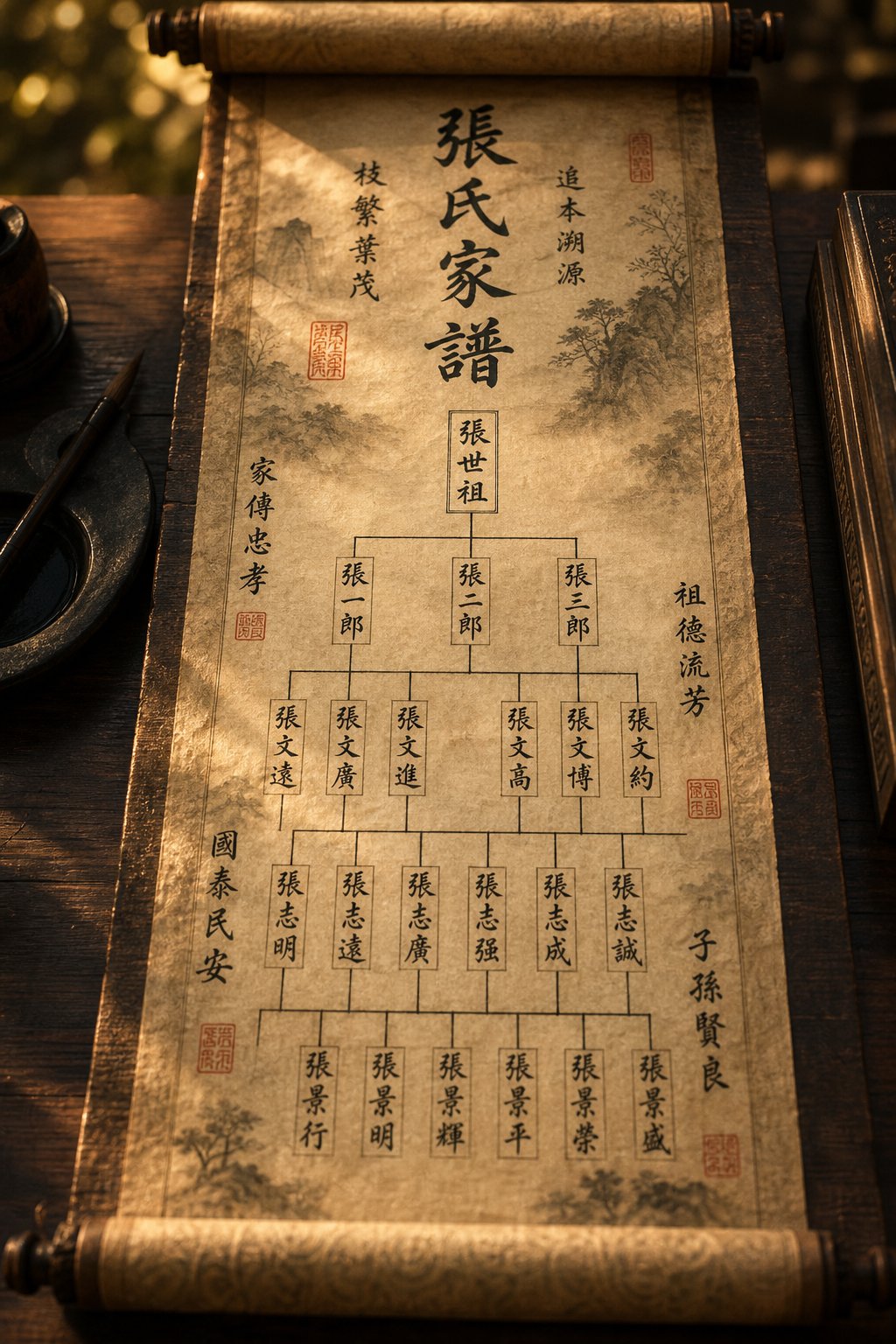
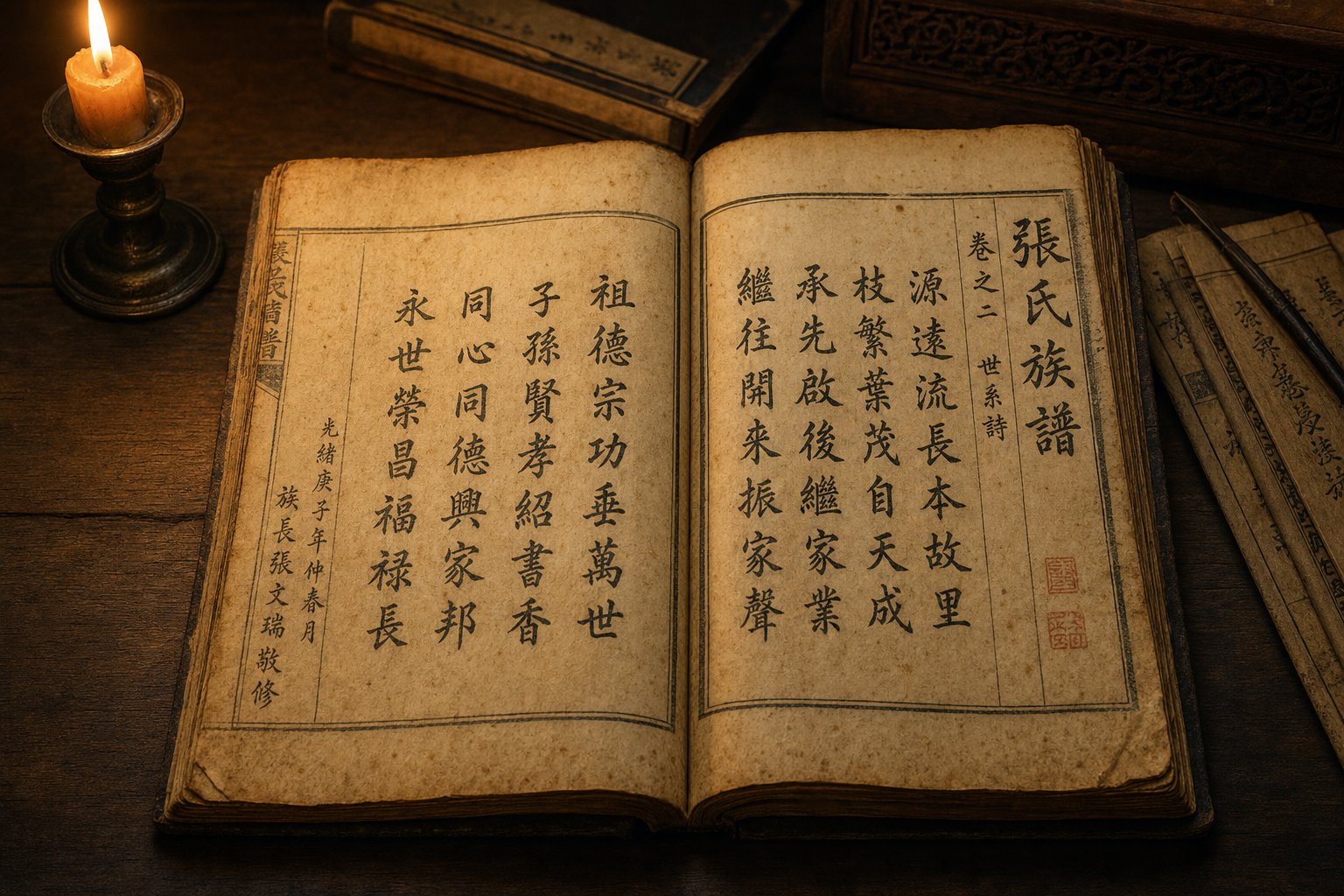
That pre-written sequence has a name: the generation poem, or zibei shi (字辈诗). It's a carefully composed string of characters — sometimes a dozen, sometimes hundreds — where each character in order corresponds to one generation of the family. The first character goes to the founding generation, the second to their children, the third to their grandchildren, and so on down the line. Every person born into a given generation receives that generation's character as part of their name.
Sounds simple enough in concept. But the Chinese generation poem zibei shi explained in full reveals something far more deliberate than a random list of characters. These poems are literary compositions with rules, authorship, and purpose.
What Is a Generation Poem and Who Writes It
A generation poem isn't something one parent scribbles on a napkin. Historically, these poems were composed by a committee of clan elders or by the founding ancestor of a new lineage branch. The occasion was significant — typically the establishment of a new clan genealogy, a major geographic migration, or a formal renewal of the family records. Those who set off to form new clan branches attributed special importance to the generation poem, as it provided their new lineage with a sense of legitimacy and continuity.
So how are generation characters chosen in Chinese families? The elders didn't pick characters at random. They followed a set of literary and cultural principles:
- Auspicious meaning — Characters should carry positive connotations. You'll often find characters like 俊 (jun, meaning talented), 豪 (hao, meaning grand or heroic), or 德 (de, meaning virtue).
- Non-repeating — No character should appear twice in the poem. Each generation gets its own unique marker.
- Coherent poetic structure — The characters aren't just a list. They're arranged in ordered lines, usually in sets of five or seven characters, sometimes following rhyme schemes. The result often reads as a meaningful verse expressing hopes for the clan's prosperity, moral character, and longevity.
- Forward-looking vision — The poem encodes the family's aspirations for future generations. It might express wishes for scholarly achievement, loyalty, wisdom, or harmony.
Think of it this way: the elders were writing a message to descendants they would never meet, embedding values and identity into the very names those descendants would carry. The Chinese clan naming poem tradition turns naming into an act of intergenerational communication.
How Generation Poems Are Recorded in Clan Genealogies
These poems didn't float around as oral tradition alone. They were formally recorded in the front pages of the family's zupu (族谱) — the clan genealogy book that served as the official record of lineage, ancestors, and family rules. The zupu family genealogy book generation poem section gave every branch of the family a shared reference point, ensuring that even distant cousins in faraway villages would name their children using the correct character for their generation.
Here's how the sequential assignment works in practice:
- The clan elders compose a generation poem — say, 20 characters long.
- The first character is assigned to the current generation at the time of composition.
- When that generation's children are born, they receive the second character.
- Grandchildren receive the third character, great-grandchildren the fourth, and so on.
- Once the poem's final character is reached, the clan may compose a new poem, extend the existing one, or — in some cases — cycle back to the beginning.
A poem of 20 characters covers 20 generations. At roughly 25 to 30 years per generation, that's 500 to 600 years of naming mapped out in advance. Some poems stretch far longer — FamilySearch notes that generation poems can vary in length from around a dozen characters to hundreds, depending on the clan's ambition and foresight.
Because generation poems for the same surname can vary by location, they also function as a kind of fingerprint. If you know even a handful of characters from your family's poem, you can potentially match them to a specific zupu and trace your branch back to a particular village or region. Two families sharing the surname Li might have completely different generation poems — but two Li families sharing the same poem almost certainly share a common ancestor and geographic origin.
This is what makes the generation poem more than a naming convention. It's a genealogical tool, a literary artifact, and a clan identifier rolled into one. And for some families, these poems carry an authority that goes beyond the clan itself — backed by imperial decree and spanning nearly a hundred generations.
A Historical Example From the Descendants of Confucius
No family illustrates the power of the zibei system better than the Kong clan — the direct descendants of Confucius. Their generation naming tradition is one of the longest-running and most meticulously documented in Chinese history, spanning over 80 generations and more than 2,500 years. It's also one of the few cases where the generation poem wasn't just a family decision — it was imperially sanctioned.
The Kong Family Generation Poem Across Centuries
Before the Ming dynasty, Kong descendants chose names relatively freely. That changed when Emperor Taizu Zhu Yuanzhang bestowed ten official generation characters upon the clan, starting from the 56th generation. From that point forward, no Kong family member could name a child arbitrarily — names had to follow the imperially granted sequence.
The poem grew over time through additional imperial decrees:
- Ming Hongwu era — 10 characters established for the 56th through 65th generations.
- Qing Qianlong era (1740) — 10 more characters added, covering the 66th through 75th generations.
- Qing Daoguang era (1839) — Another 10 characters for the 76th through 85th generations.
- Republic era (1919) — Kong Lingyi, the 76th-generation Duke Yansheng, registered 20 additional characters with the Beiyang Government, extending coverage through the 105th generation.
The result is a 50-character Kong family generation name poem spanning 50 generations:
Xi Yan Gong Yan Cheng, Hong Wen Zhen Shang Yin, Xing Yu Chuan Ji Guang, Zhao Xian Qing Fan Xiang, Ling De Wei Chui You, Qin Shao Nian Xian Yang, Jian Dao Dun An Ding, Mao Xiu Zhao Yi Chang, Yu Wen Huan Jing Rui, Yong Xi Shi Xu Chang.
The Kong Mansion even issued a formal notice to all clan members: names must strictly follow the imperially bestowed generational characters. Anyone who ignored the sequence would not be permitted entry into the genealogy — effectively erased from the official family record.
Why the Confucius Lineage Is the Most Famous Zibei Example
What makes the descendants of Confucius naming system so remarkable is its readability. When you encounter a Kong descendant named Kong Decheng, the character "De" (德) immediately tells you he belongs to the 77th generation. His grandson Kong Chuizhang carries "Chui" (垂) — the 79th generation character. Without asking a single question, you know exactly how many generations separate them from Confucius himself.
This precision held across enormous scale. By the 1990s, the generational gap among living Kong clan members in Qufu alone spanned 11 generations — from the 69th "Ji" generation to the 80th "You" generation. People of vastly different ages could share the same generation rank, while a young child might technically outrank an elderly relative. The generation character kept all of this legible.
The Kong clan zibei characters list also demonstrates something practical about the system's longevity. With 50 characters covering generations 56 through 105, and roughly 25-30 years per generation, the poem maps out over a thousand years of future naming. The foresight behind those imperial generation names from the Ming and Qing dynasty periods ensured that even today — with approximately three million Kong descendants scattered across the globe — the system still functions as a unifying identifier.
The Kong example proves that zibei isn't just a quaint tradition. It's a technology for maintaining family coherence across time, distance, and scale. But the system served purposes far deeper than identification alone — purposes rooted in the very philosophy Confucius himself taught.
The Cultural Purpose Behind Generational Naming
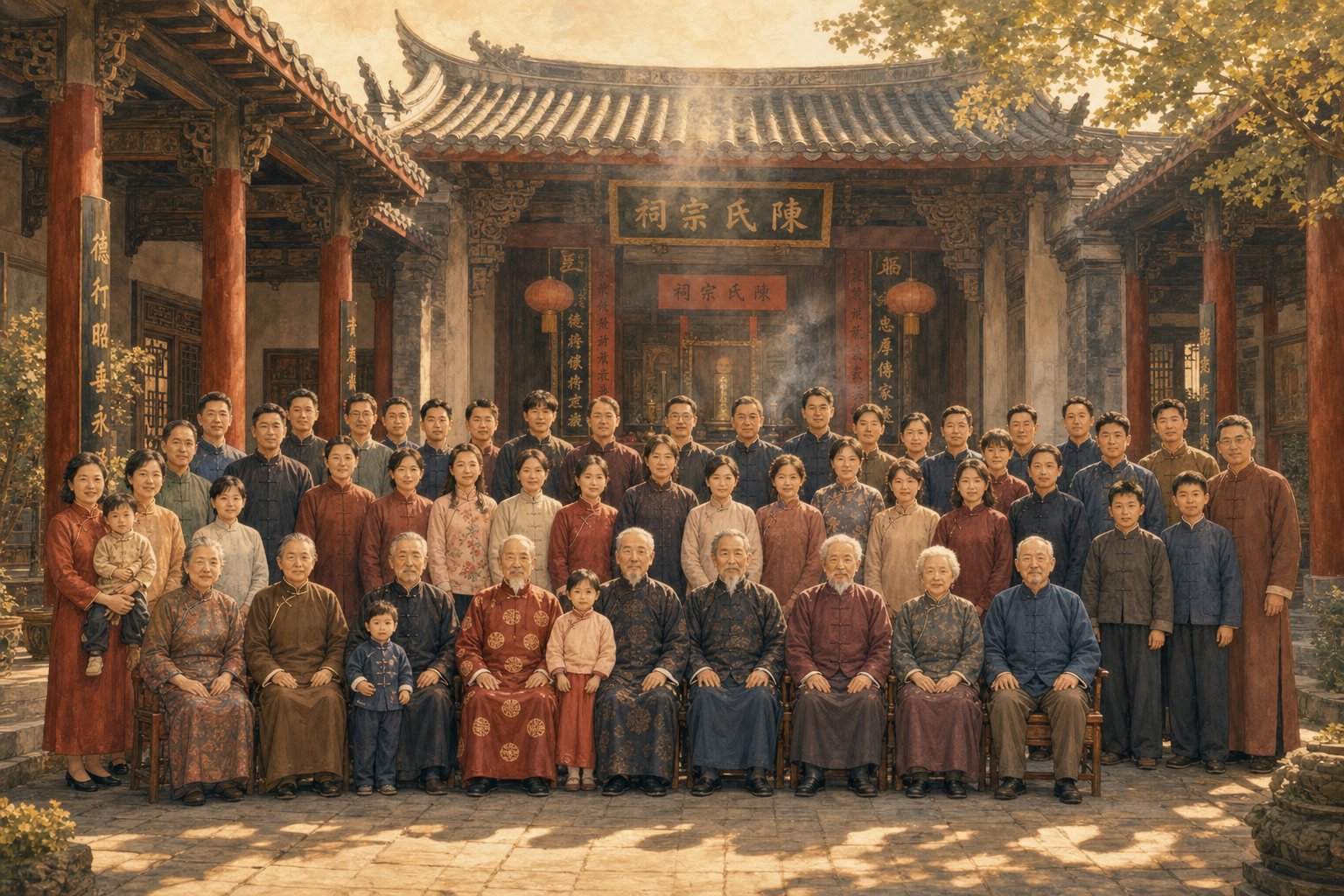
Confucius taught that social harmony begins at home — with proper relationships between parent and child, elder and younger. The zibei system didn't just borrow from that philosophy. It operationalized it. Every generation character embedded in a name carried a set of cultural expectations far heavier than simple identification. Understanding the cultural significance of Chinese generation names means looking past the naming mechanics and into the value system that made them necessary.
Confucian Values Embedded in the Naming System
At its core, the zibei tradition is an expression of filial piety — xiao (孝) — the foundational Confucian virtue that demands respect for parents, ancestors, and elders. When you carry a generation character in your name, you're publicly declaring your place in a chain of obligation. You acknowledge those who came before you and accept responsibility toward those who come after.
This connects directly to ancestral reverence. The generation poem itself was composed by forefathers, sometimes centuries earlier. By naming a child according to that poem, parents aren't just following a rule — they're honoring the wishes of ancestors they may never have met. The act of naming becomes a ritual of continuity, linking the living to the dead in a tangible, everyday way.
The zongfa lineage system of the Zhou dynasty established that family members were ranked and distinguished through generational markers (beifen/辈份), and that reverence for the lineage head symbolized reverence for the High Ancestor of the entire clan. Zibei carried this principle forward into naming — making hierarchy visible not just in ritual settings, but in the simple act of introducing yourself.
Chinese clan naming and filial piety are inseparable here. The generation character reminds every clan member that they exist not as isolated individuals, but as links in a chain stretching backward and forward through time. Individualism takes a back seat to collective identity. Your name says: you belong to something larger than yourself.
How Zibei Maintained Social Order Within Clans
So how does zibei enforce family hierarchy in practical terms? Imagine a large clan gathering where dozens of relatives meet — some elderly, some young, many strangers to each other. Without generation characters, sorting out who owes deference to whom would require lengthy introductions and genealogical detective work. With zibei, a glance at someone's name reveals their generational rank instantly.
The beifen generational rank system explained in simple terms works like this: if your generation character comes from the fifth line of the poem and someone else's comes from the third, they outrank you by two generations — regardless of actual age. A 30-year-old could technically be the "uncle" of a 60-year-old in clan terms. The generation character settles the question before anyone needs to ask.
This clarity served several critical social functions:
- Hierarchy enforcement — Younger generations knew exactly whom to address with honorific titles and defer to in family decisions. Confucian values in Chinese naming traditions made respect automatic rather than negotiable.
- Marriage regulation — Traditional Chinese society adhered to the principle of "no marriage between members of the same clan" (tongxing bu hun/同姓不婚), a rule dating back to Zhou dynasty etiquette. Generation characters made it easy to identify clan members and enforce this prohibition, serving as a safeguard against consanguineous unions.
- Ancestral connection — Each generation character traced back to the original poem, which traced back to the clan's founding ancestor. Carrying the character meant carrying the ancestor's legacy forward.
- Clan unity across distance — When branches of a family scattered to different provinces or even different countries, the shared generation poem kept them connected. Two strangers meeting thousands of miles from their ancestral village could confirm kinship through their generation characters alone.
- Identity preservation — In a society where millions shared common surnames like Wang, Li, or Zhang, the generation character narrowed identity from "one of a million Wangs" to "a specific generation of a specific Wang lineage from a specific place."
The marriage regulation function deserves special attention. Since the Zhou dynasty, Chinese kinship categorization operated on a "clan surnames" basis rather than a purely biological one. Members sharing the same surname and lineage were considered too closely related to marry — even if the actual blood connection was dozens of generations removed. The generation character made this boundary unmistakable. If two people shared the same surname and could identify their respective positions in the same generation poem, marriage was off the table.
Taken together, these functions reveal that zibei was never just about names. It was a governance tool — a way for clans to maintain internal order without relying on external authority. The generation character encoded rules about respect, marriage, and belonging directly into personal identity. You didn't need to memorize a rulebook. You just needed to know your name and theirs.
All of this raises a practical question for anyone with Chinese heritage: how do you actually find your own generation character if no one in your immediate family has mentioned it?
How to Identify Your Zibei Generation Name
Maybe you have a Chinese name but never thought much about its structure. Or maybe a grandparent once mentioned something about a "family character" that you didn't fully understand at the time. Either way, finding your own generation character is less mysterious than it sounds — it just requires a bit of detective work and the right questions.
Steps to Find Your Own Generation Character
If you're wondering how to find your Chinese generation name, the process is surprisingly straightforward. You don't need access to ancient archives or a degree in Chinese linguistics. You need names — specifically, the names of people in your generation and the generations around you.
- Start with your own Chinese name. Write out the full name in characters. If your name has three characters, the first is your surname. The second and third are your given name. One of those two given-name characters is potentially your generation character — most commonly the first one after the surname, though some families place it second.
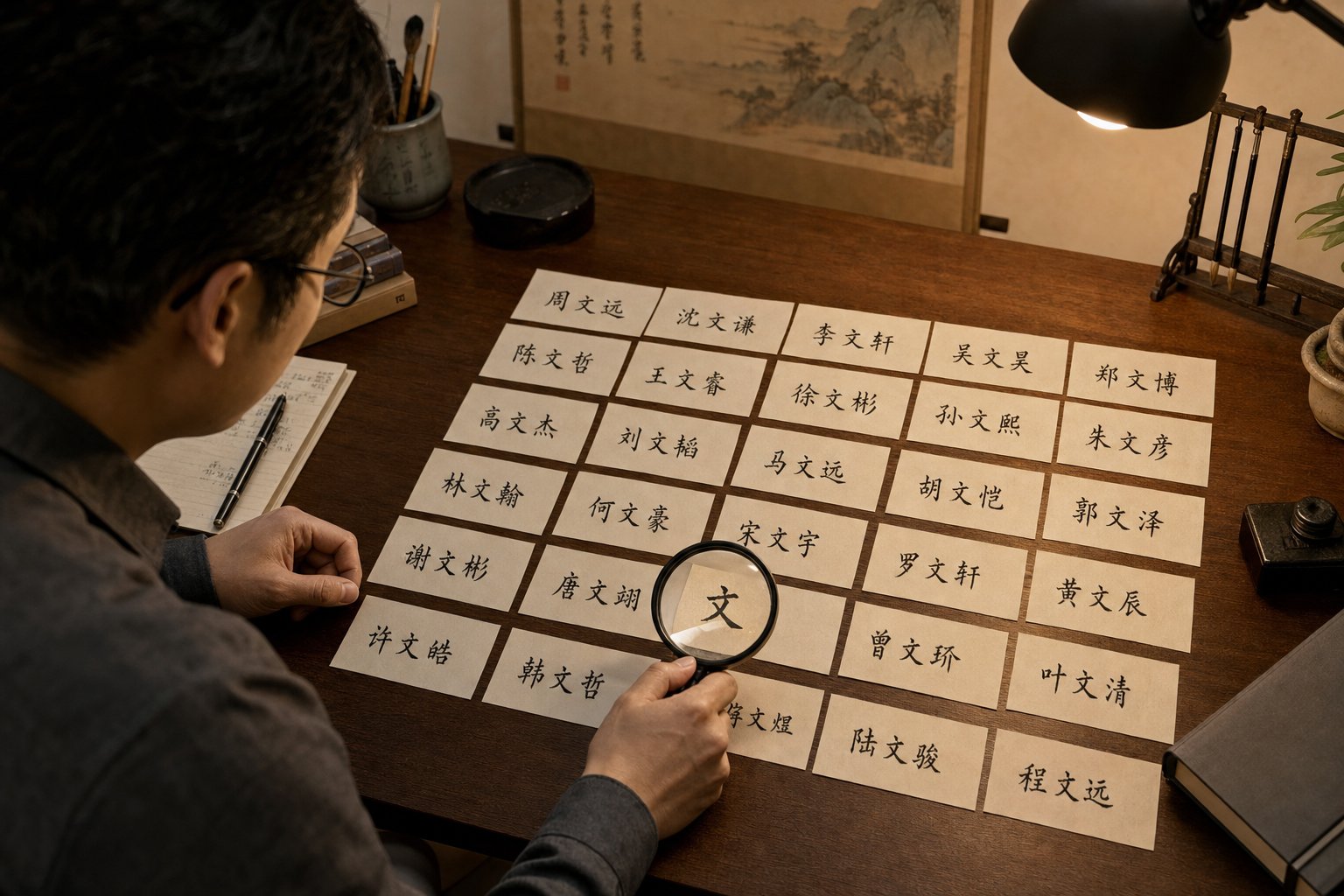
- Compare with siblings. If you have brothers or sisters with Chinese names, line them up. Look for the character that repeats across all siblings. That repeated character is almost certainly the zibei. For example, if your siblings are named 李明华, 李明辉, and 李明珊, the shared character "明" is the generation marker.
- Expand to same-generation cousins. This is where the pattern becomes unmistakable. Check the Chinese names of your paternal cousins — children of your father's brothers. If they share the same character your siblings share, you've confirmed it. The generation character links not just siblings but the entire generational cohort within the clan.
- Look one generation up and one generation down. Check your father's name and your uncles' names for their shared character. Then check your children's generation (or your niblings' names) for theirs. If you can identify three consecutive generation characters, you likely have a fragment of your family's generation poem.
- Ask older family members directly. Grandparents, great-aunts, and elderly uncles are often the last people who remember the full poem or at least several characters from it. Ask specifically: "Does our family have a zibei poem?" or "What generation character did our family use?" This knowledge tends to live in the oldest generation and can disappear quickly if not recorded.
- Search for your family's genealogy book (zupu). If your family maintained a jiapu (家谱), the generation poem is typically recorded in its opening pages. Many zupu have been digitized or indexed. FamilySearch's jiapu search tool allows you to search using generation characters as identifiers — because each clan's poem is unique, even a handful of characters can act like a fingerprint to locate your family's records.
Even if your family's genealogy book doesn't include a formally written poem, you can often recognize repeating patterns in the names across generations. Children and cousins sharing a character is itself evidence of the tradition at work — a hidden poem even if it was never explicitly recorded as one.
Edge Cases and Common Confusion Points
The steps above work cleanly for many families, but real life introduces complications. Here are the questions that trip people up most often.
What happens when a generation poem runs out of characters?
A poem of 20 characters covers 20 generations — roughly 500 to 600 years. Eventually, every poem reaches its final character. When that happens, clans historically took one of three approaches: composing an entirely new poem to extend the sequence, adding additional lines to the existing poem (as the Kong family did multiple times through imperial decree), or in rarer cases, cycling back to the beginning. The choice depended on the clan's organization and whether active elders or a clan council still existed to make such decisions. For many families today — especially those whose clan structures dissolved during the 20th century — the poem simply stopped being used before it ran out.
Do women have generation names in Chinese culture?
This is one of the most common questions from people researching their heritage. The honest answer: it varied, but the tradition was primarily created for male descendants. Brothers and paternal male cousins received the shared generation character as a matter of course. Daughters were often excluded — their names might be chosen freely without reference to the poem, reflecting the patrilineal structure of traditional Chinese kinship.
That said, the practice wasn't universally male-only. FamilySearch notes that in some families, daughters also received a generation character — either matching the males' character or drawn from a separate, parallel poem designated for female members. The variation depended heavily on region, time period, and individual clan rules. If you're a woman trying to identify your zibei character, check whether your paternal aunts or female cousins share a character in their names. The pattern may be there even if it wasn't formally acknowledged.
How are adopted children handled?
In traditional clan practice, adoption wasn't just a legal arrangement — it was a genealogical one. When a child was formally adopted into a clan, they typically received the generation character appropriate to their new generational position. This wasn't optional or decorative. Receiving the zibei character signified full incorporation into the lineage, granting the adopted child the same genealogical standing as biological descendants. Without the generation character, a person couldn't be entered into the zupu — and without zupu entry, they weren't officially part of the clan.
What if my name only has two characters?
Single-character given names (surname plus one character) became increasingly popular from the mid-20th century onward, particularly in mainland China. These names typically don't contain a generation character at all. By the time single-character names grew common, many families had already moved away from the zibei tradition. If your Chinese name is only two characters, your family may have stopped using the system before your generation — but your parents' or grandparents' names might still contain the pattern.
What if no one in my family knows the poem?
This is increasingly common, especially in diaspora communities several generations removed from China. If direct family knowledge has been lost, your best path is searching digitized genealogy records. Even three or four consecutive generation characters — pulled from the names of your grandfather, father, and their same-generation relatives — can be enough to match against indexed zupu collections and potentially reconnect you with your clan's full poem and ancestral village.
The search itself is worth undertaking soon. The generation that remembers these poems firsthand is aging, and once that oral knowledge is gone, only written records remain. For diaspora families especially, the window for asking the right questions is narrowing — which raises a broader question about where the zibei tradition stands today and whether it still has a future.
Zibei in the Modern World and Diaspora Communities
The tradition survived dynastic collapses, civil wars, and mass migrations across centuries. Yet in the span of a few decades, the zibei system went from near-universal practice to something many young Chinese people have never heard of. Are Chinese generation names still used today? The answer depends heavily on where you look — and who you ask.
Why Zibei Naming Is Declining in Urban China
Research by Li Zhonghua and Edwin Lawson tracked generation name usage across four time periods and found a dramatic pattern. In the pre-Mao era (1940-1949), over 90% of Chinese men used their generation names. By the second Mao period (1960-1976), that figure had plummeted to just 41.2%. The decline wasn't gradual — it was a collapse driven by specific, identifiable forces.
Four major factors explain why Chinese generational naming is disappearing in urban areas:
- Urbanization breaking up clan villages. The zibei system depended on families living together in ancestral villages where generational hierarchy was a daily reality. As millions migrated to cities, they left behind the clan structures that made generation characters meaningful. Far from the hierarchic relations of their home villages, urban migrants had little practical reason to maintain the naming tradition. As Lu and Millward noted, "the sense of clans is blunted, and many families no longer use generation names."
- The breaking of traditional ties to the land. In the traditional rural economy, farming bound families to a specific place for generations. That geographic stability made the zupu a living document and the generation poem a shared reference point. Once families scattered across provinces and cities, the poem lost its audience. There was no clan council to enforce it, no village elders to consult, no genealogy book sitting in the ancestral hall.
- Political upheaval and the "feudal" label. During the Cultural Revolution (1966-1976), generation names were attacked as relics of feudal patriarchal society. Many young people dropped their generation characters entirely, replacing them with politically charged names containing characters like 卫东 (Weidong, "protect Mao Zedong") or 红卫 (Hongwei, "Red Guard"). Fathers didn't dare use generation names for newborns during this period. The Li and Lawson study found that the percentage of men with no generation name at all jumped from 2.7% in the pre-Mao era to 49% during the second Mao period — a staggering reversal.
- The one-child policy and simplified family structures. Introduced in 1979, the policy meant that for an entire generation, most urban families had no siblings to compare names with — and no cousins on the paternal side to reveal the shared character. The generation poem needs a generation of multiple children to be visible. A single child carrying a generation character is just... a name. The social context that made the character meaningful evaporated.
Globalization added another layer. As Western naming conventions gained cultural prestige, many parents prioritized unique, individualistic names over clan-assigned characters. The two-character name pattern (surname plus one given-name character) became fashionable precisely because it left no room for a generation character. The Chinese naming traditions modern decline isn't just about forgetting — it's about a fundamental shift in what names are expected to do. Names became expressions of individual identity rather than markers of collective belonging.
The Revival of Zibei Among Diaspora Communities
Here's what makes the story more complicated than a simple narrative of loss: the tradition didn't die. It retreated to specific contexts — and in some unexpected places, it's growing again.
The Li and Lawson study found a statistically significant recovery in generation name usage during the post-Mao period (1977-1983). Men using generation names rose from 41.2% back to 53%. The researchers concluded it was "a little too early" to declare the generation name extinct, noting that the end of the Cultural Revolution brought "the revival of traditional Chinese culture" in naming practices.
In rural communities and among prominent lineage families, the tradition never fully stopped. Families with well-maintained zupu — particularly in southern provinces like Guangdong, Fujian, and Jiangxi where clan culture remained strongest — continued assigning generation characters through the turbulent decades. In Taiwan, where the Cultural Revolution never occurred, many families maintained unbroken zibei traditions, and some clans even extended the practice to daughters as an expression of family unity and gender equality.
The most interesting development, though, is happening in diaspora communities. Overseas Chinese genealogy research involving zibei has surged as second- and third-generation immigrants seek to reconnect with their heritage. For someone whose grandparents emigrated from Guangdong in the 1940s, the generation poem offers something no DNA test can provide: a specific place in a specific family's story. It answers not just "where did I come from" but "who am I in relation to everyone else who came from there."
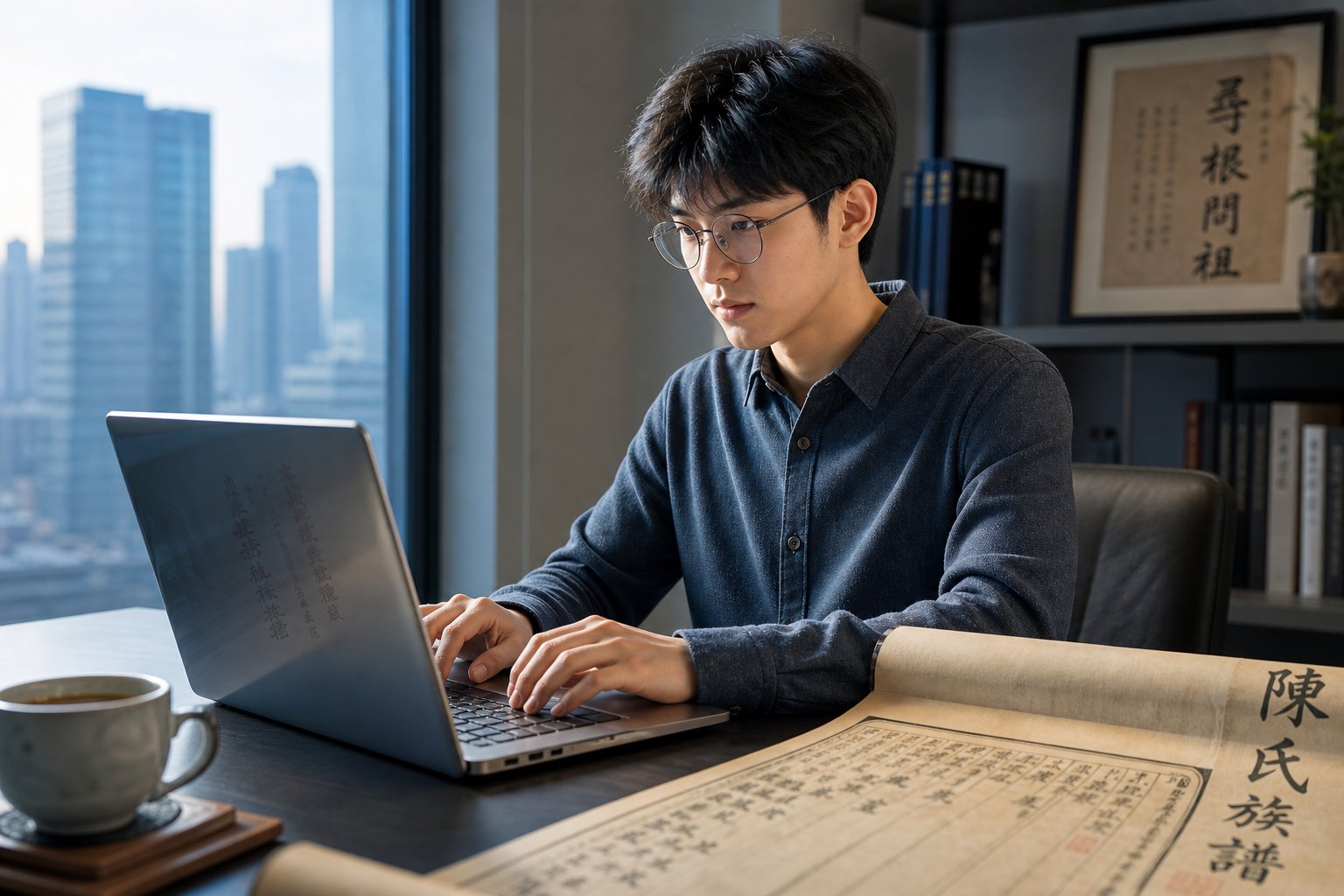
Digital tools have accelerated this. Digitized zupu collections, online surname databases, and genealogy platforms now allow diaspora researchers to match fragments of generation poems against indexed records — potentially identifying their ancestral village and clan branch from thousands of miles away. What once required a physical trip to a crumbling ancestral hall can now begin with a search query.
This matters for a practical reason. The generation that carries firsthand knowledge of these poems — the grandparents and great-aunts who memorized the characters as children — is aging out. Every year, oral knowledge disappears that written records may not preserve. For anyone with Chinese heritage who has ever wondered about the patterns hidden in their family's names, the window for asking is open but narrowing. The zibei tradition may be declining as a living naming practice, but as a tool for understanding where you come from and how your family organized itself across centuries, its value is only growing.
Connecting Zibei to Your Own Family Story
When English speakers hear "generation name," they often think of societal cohort labels — Baby Boomers, Gen X, Millennials, Gen Z. These Western generational labels group millions of strangers by birth year, defined by shared cultural moments and economic conditions. Chinese generation names vs Western generational labels couldn't be more different in their logic. Zibei doesn't care what decade you were born in. It cares which branch of which family tree you belong to and exactly how many generations separate you from a specific ancestor.
Zibei Versus Western Generational Labels
A Western generational label is assigned externally by sociologists and marketers. It tells you something about the era someone grew up in — but nothing about their family. Zibei works in the opposite direction. It tells you nothing about the broader society and everything about a person's place within their lineage. Two Kong descendants born 40 years apart might share the same generation character, while two cousins born the same year might carry different ones if their branches diverged. The system tracks family time, not calendar time.
This distinction matters for anyone trying to research Chinese family naming history. If you approach Chinese genealogy expecting Western-style generational categories, you'll miss the real structure entirely. The generation poem is the key — and it unlocks connections that no birth-year cohort ever could.
Key Takeaways for Understanding Your Heritage
Understanding zibei for heritage research comes down to a handful of core ideas:
- Zibei (字辈) is a shared generation character drawn from a pre-composed poem, assigned to every family member born into the same generation of a clan.
- It sits within the given name — typically the first character after the surname — functioning as a generational coordinate that anyone in the family can read.
- It connects you to centuries of family history through a single character that traces back to a poem composed by your ancestors, often recorded in the clan's jiapu or zupu.
- It can be rediscovered by comparing names across siblings and cousins, consulting elder relatives, and searching digitized genealogy collections.
If there's one action worth taking away from all of this, it's simple: ask. Talk to the oldest members of your family while they're still here. Ask whether your family has a generation poem. Ask what character your grandfather shared with his brothers. Write it down. Even a fragment of three or four characters can serve as a key to unlocking your clan's full genealogical record through resources like FamilySearch or Ancestry's Asian heritage collections.
The zibei tradition may be fading as a living naming practice, but as a tool for understanding who you are and where you fit in a story stretching back generations — maybe centuries — it remains one of the most elegant systems any culture has devised. The hidden poem is still there in your family tree. You just have to look for it.
Frequently Asked Questions About Zibei Generation Names
1. What does zibei mean in Chinese?
Zibei (字辈) combines two Chinese characters: 字 (zi, meaning character or word) and 辈 (bei, meaning generation or rank). Together, the term refers to a predetermined character that all family members born into the same generation share as part of their given name. It functions as a generational marker within a clan's lineage, allowing anyone familiar with the system to identify a person's exact position on the family tree simply by reading their name.
2. How do I find my Chinese generation name?
Start by writing out your full Chinese name and comparing it with the names of your siblings and paternal cousins. The character that repeats across all same-generation relatives is your zibei. If you cannot identify a pattern, ask older family members whether your family has a generation poem. You can also search digitized genealogy collections like FamilySearch using even a few consecutive generation characters to locate your clan's records and ancestral village.
3. Are Chinese generation names still used today?
Usage has declined significantly in urban China due to urbanization, the one-child policy, and the Cultural Revolution's rejection of traditional naming. However, the practice persists in rural communities, prominent lineage families, and parts of Taiwan. Interestingly, diaspora communities are increasingly researching their zibei as part of heritage and genealogy projects, using digital tools to reconnect with ancestral records.
4. Do women receive zibei generation characters in Chinese families?
Traditionally, the zibei system was designed primarily for male descendants within the patrilineal clan structure. Daughters were often named freely without reference to the generation poem. However, practices varied by region and time period. Some families assigned daughters the same generation character as males, while others maintained a separate parallel poem for female members. In modern practice, families that still use the system increasingly include daughters.
5. What is a Chinese generation poem (zibei shi)?
A generation poem (字辈诗) is a pre-composed sequence of characters — often structured as a verse with lines of five or seven characters — where each character corresponds to one successive generation. Clan elders or founding ancestors composed these poems using auspicious, non-repeating characters that express hopes for the family's future. The poems are recorded in the clan genealogy book (zupu) and can span 20 to 50 or more characters, mapping out centuries of naming in advance.