What Wuxing Means for Chinese Naming Traditions
Imagine choosing a name for your child that does more than sound pleasant. A name designed to bring balance to their life path, rooted in a philosophical system over two thousand years old. That is exactly what wuxing in Chinese names accomplishes.
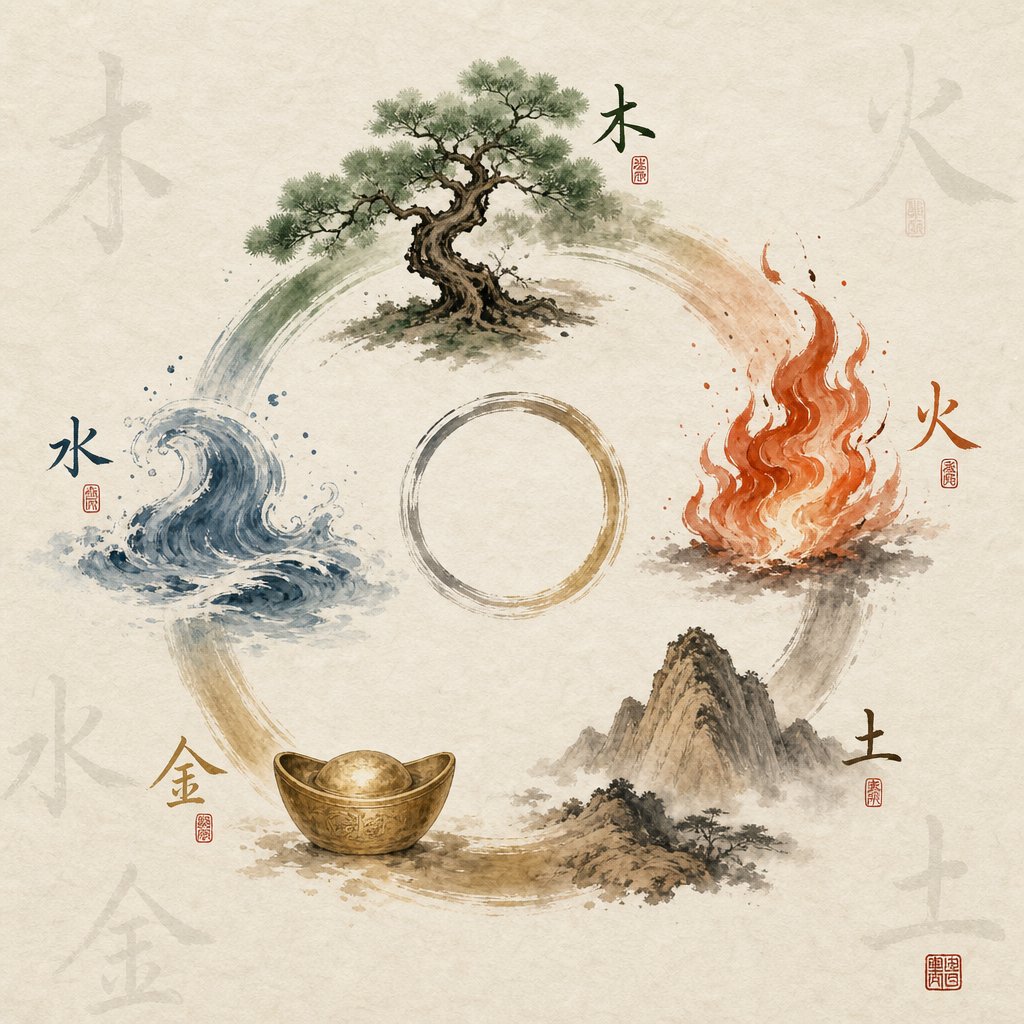
Wuxing (五行) is the Chinese five-phase system of Wood, Fire, Earth, Metal, and Water used to select name characters that harmonize with a person's birth chart.
The character xing (行) literally means "to move" or "to walk." This is why scholars prefer translating wuxing as "five phases" or "five movements" rather than "five elements." These are not static substances like entries on a periodic table. They describe an order of transformations — dynamic patterns of energy flowing from one state to the next, each phase giving rise to the one that follows.
Defining Wuxing and Its Role in Naming
Each phase carries distinct energy. Wood (mu, 木) represents growth and expansion. Fire (huo, 火) embodies radiance and action. Earth (tu, 土) provides stability and grounding. Metal (jin, 金) brings clarity and refinement. Water (shui, 水) offers wisdom and adaptability. For centuries, Chinese parents have selected name characters tied to specific phases to strengthen areas where a child's birth chart shows weakness. A name heavy in Water-associated characters, for instance, might be chosen for a child whose chart lacks that contemplative, flowing energy.
This practice intensified alongside the development of BaZi (八字) birth chart analysis, which maps a person's elemental profile based on their exact time of birth. The name becomes a deliberate tool for restoring equilibrium — not a random label, but a carefully calibrated complement to the energies a child already carries.
Why Elemental Balance Matters in a Chinese Name
You might wonder: is this superstition? The honest answer is that it depends on who you ask. For many families, wuxing naming is a living tradition that weaves together philosophy, linguistics, and deeply held family values. It is less about predicting the future and more about intention — embedding hope, balance, and cultural continuity into the very characters a person will carry for life.
The practice blends rigorous structural thinking (which radical belongs to which phase, how phases interact) with personal meaning. It asks parents to consider not just how a name sounds, but how it fits within a larger cosmological framework. Whether you approach it as metaphysics or as a rich cultural exercise in thoughtful naming, the system offers a structured path from birth data to character selection.
This guide walks you through that full journey: from understanding the five phases, to reading a birth chart, to classifying characters by element, to pairing them using the generating and overcoming cycles. By the end, you will have the practical knowledge to evaluate — or even participate in — the process of crafting a name grounded in one of China's oldest philosophical traditions.
Historical Roots of Five Phase Naming in China
The five-phase framework did not appear overnight. Its roots stretch back thousands of years, long before anyone thought to apply it to personal names. Understanding that timeline helps you appreciate why wuxing in Chinese names carries such cultural weight — it draws on one of the oldest continuous intellectual traditions in human history.
From Ancient Philosophy to Naming Practice
The earliest known reference to the five phases appears in the Hong Fan (洪范, "Comprehensive Order") chapter of the Shujing (书经, Book of Documents). Scholars date this text to approximately the 4th century BCE, though it claims to record much older wisdom. The Hong Fan lists Water, Fire, Wood, Metal, and Earth as fundamental forces and describes their natures: water moistens and descends, fire burns and ascends, wood bends and straightens, metal yields and changes, earth receives seeds and gives crops. Even at this early stage, the text insists that when these five processes fall into disorder, chaos follows in both nature and human affairs.
But here is the key distinction: the Hong Fan was concerned with governance and cosmic order, not baby names. The philosophical system existed for centuries as a tool for understanding nature, politics, and medicine before anyone systematically applied it to personal naming. Think of it as a long incubation period — the theory matured across multiple domains before reaching the naming table.
During the Warring States period (403-221 BCE), the scholar Zou Yan (邹衍, c. 305-240 BCE) systematized wuxing into a comprehensive cosmological framework. He introduced the idea that dynastic transitions followed five-phase cycles, and that each phase possessed a personified virtue governing historical destiny. This was the moment wuxing moved from describing natural phenomena to explaining human fate — a conceptual leap that would eventually make naming applications possible.
How the Han Dynasty Systematized Elemental Correspondences
The real explosion happened during the Han dynasty (202 BCE-220 CE). Han thinkers, particularly Dong Zhongshu (董仲舒, 179-104 BCE), wove wuxing into virtually every aspect of Chinese intellectual life. They formalized the two great cycles: the "mutual production" (xiangsheng, 相生) sequence where Wood produces Fire, Fire produces Earth, Earth produces Metal, Metal produces Water, and Water produces Wood; and the "mutual conquest" (xiangke, 相克) sequence governing which phase overcomes which. The Huainanzi (淮南子, 139 BCE) declared that "the natural qualities of Heaven and Earth do not exceed five," effectively standardizing the number and establishing wuxing as the universal explanatory framework for Chinese cosmology.
Still, systematic naming based on five-phase theory did not become widespread until much later. The practice intensified during the Song dynasty (960-1279 CE) and Ming dynasty (1368-1644 CE), when BaZi (八字, Eight Characters) fortune analysis became popularized among ordinary families. Classical texts like San Ming Tong Hui (三命通会, "The Comprehensive Mastery of Fate Calculation") from the Ming period codified the methods for reading birth charts and identifying elemental deficiencies. Once families could diagnose which phase their child lacked, the logical next step was to compensate through the name.
If you are familiar with Western traditions, you might compare this to the Greek system of four elements — earth, air, fire, and water. The comparison is useful but limited. As the Internet Encyclopedia of Philosophy notes, the Greek elements were typically understood as "fixed substantial essences" — unchanging building blocks of matter. The Chinese phases, by contrast, describe "ever-changing material forces." The character xing (行) means movement, walking, process. What are the 5 elements in the Chinese system? They are not elements at all in the Western sense. They are modes of transformation.
This distinction matters enormously for naming. A name built on static elements would be a label — fixed and final. A name built on dynamic phases is something else entirely: a catalyst. It is meant to set energy in motion, to initiate a pattern of growth and change that unfolds across a lifetime. The elemental powers embedded in a name character are not inert properties sitting inside the ink strokes. They are directional forces, each one flowing toward the next in an endless cycle of becoming.
By the Ming dynasty, this understanding had crystallized into a practical art. Families consulted specialists who could read a birth chart, identify which phases were weak or absent, and recommend characters whose elemental associations would restore balance. The philosophical framework was ancient, but its application to naming was a relatively late — and remarkably elegant — innovation.
That innovation depended on one critical tool: the BaZi birth chart, which translates a person's exact moment of birth into an elemental profile. Without it, there would be no way to know which phases a name should strengthen.
Reading a Birth Chart to Find Elemental Gaps
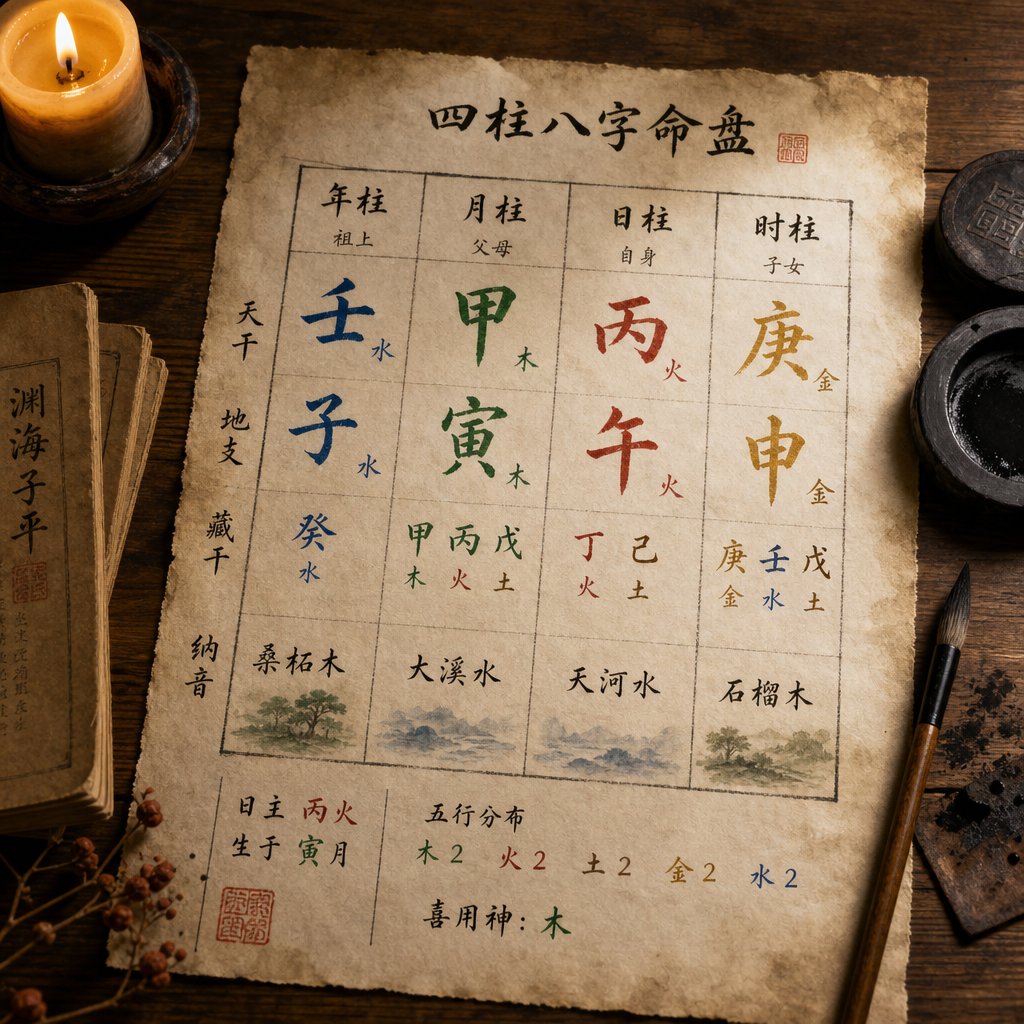
The BaZi (八字) chart is where theory meets diagnosis. It takes the abstract framework of the chinese elements and applies it to a specific person at a specific moment in time. Think of it as an elemental fingerprint: no two charts are identical, and each one reveals a unique distribution of Wood, Fire, Earth, Metal, and Water that a name can then address.
How Birth Year Month Day and Hour Map to Elements
BaZi literally means "Eight Characters." The system takes four units of time from your birth — year, month, day, and hour — and converts each into a pair of characters drawn from the ancient Gan-Zhi (干支) system. Each pair consists of one Heavenly Stem (天干, tiangan) and one Earthly Branch (地支, dizhi). Four time units multiplied by two characters each gives you eight characters total. Hence the name.
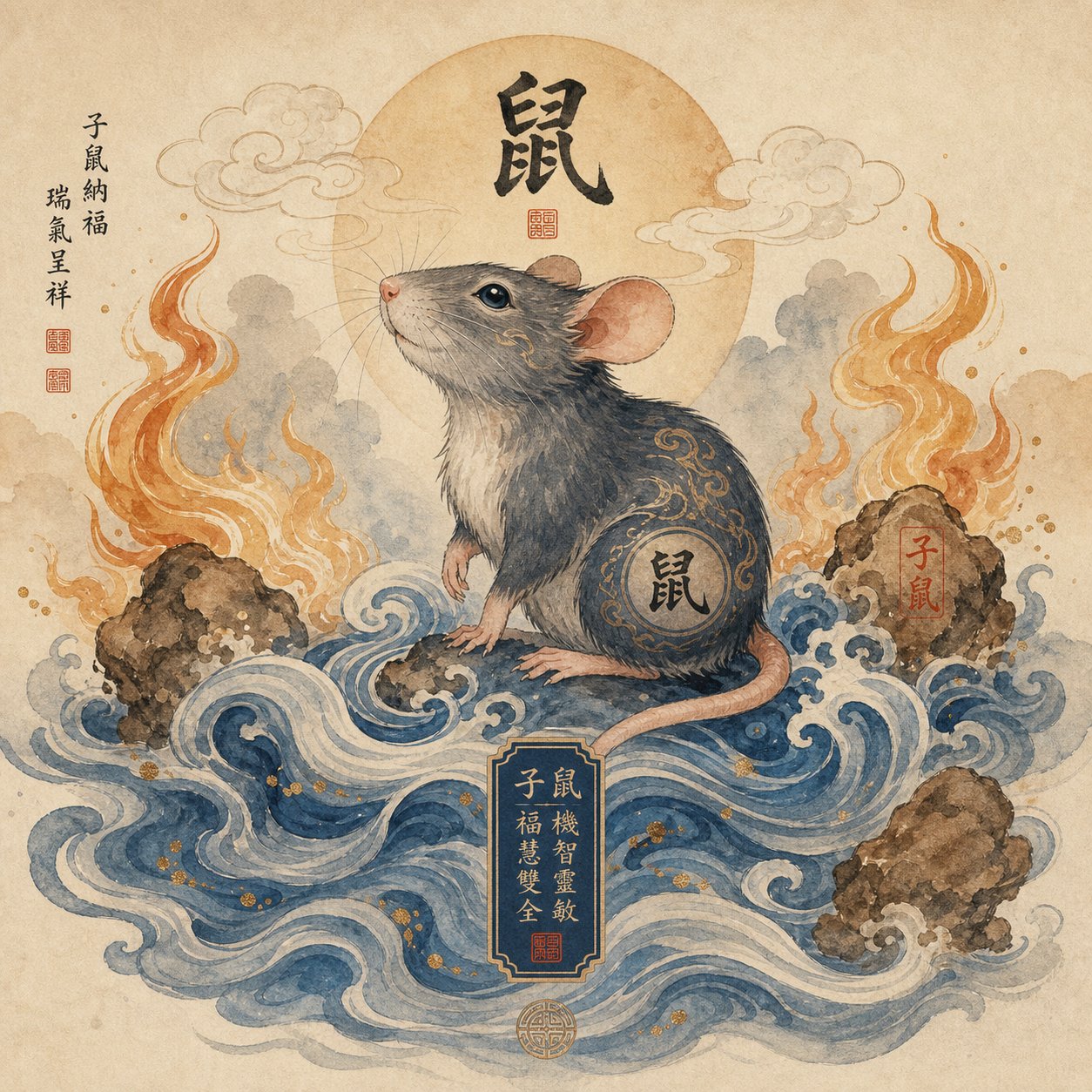
Every Heavenly Stem and Earthly Branch carries a specific elemental association. The ten Heavenly Stems cycle through the five phases in Yin and Yang pairs: Jia (甲) and Yi (乙) are Wood, Bing (丙) and Ding (丁) are Fire, Wu (戊) and Ji (己) are Earth, Geng (庚) and Xin (辛) are Metal, Ren (壬) and Gui (癸) are Water. The twelve Earthly Branches — which you may recognize as the twelve zodiac animals — also carry elemental associations, though these are more complex since some branches contain multiple "hidden stems" within them.
Here is a simplified example for someone born on a specific date and hour:
| Pillar | Time Unit | Heavenly Stem | Earthly Branch | Associated Elements |
|---|---|---|---|---|
| Year Pillar (年柱) | Birth Year | Yi (乙) — Yin Wood | Hai (亥) — Water | Wood, Water |
| Month Pillar (月柱) | Birth Month | Ren (壬) — Yang Water | Zi (子) — Water | Water, Water |
| Day Pillar (日柱) | Birth Day | Jia (甲) — Yang Wood | Yin (寅) — Wood | Wood, Wood |
| Hour Pillar (时柱) | Birth Hour | Gui (癸) — Yin Water | Mao (卯) — Wood | Water, Wood |
Look at this chart and you will notice something immediately: it is saturated with Water and Wood. There is no Fire, no Earth, and no Metal anywhere in the main stems and branches. The Day Pillar's Heavenly Stem — called the Day Master (日主, rizhu) — represents the person's core identity. In this case, the Day Master is Yang Wood (甲), meaning this individual is fundamentally a "Wood person."
Identifying Elemental Deficiency in a Birth Chart
A balanced chart ideally contains some representation of all five phases, though perfect balance is rare. What practitioners look for is not mathematical equality but functional harmony. The critical question is: which elements does the Day Master need to thrive?
In the example above, the chart is cold and wet — heavy Water feeding abundant Wood, with no Fire to provide warmth or drive. A professional BaZi reader would identify Fire as the most urgently needed element. They might also note that Earth and Metal are absent, but the priority depends on what specifically supports or regulates the Day Master. This is where beginners often stumble: the goal is not simply to count elements and add whatever is missing. It is to identify what practitioners call the "Useful God" (用神, yongshen) — the favorable element that most effectively harmonizes the chart.
When parents wade elemental analysis for their child's chart, they are essentially asking: what does this particular configuration of energy need to function at its best? The answer becomes the prescription that guides name selection.
What Lacking an Element Means for Name Selection
If the birth chart reveals a Fire deficiency, the name becomes the primary vehicle for introducing that energy. Parents would seek characters associated with Fire — those containing the fire radical (火 or 灬), or characters whose meanings evoke brightness, warmth, and illumination. Water in chinese (水, shui) might appear abundantly in the birth chart, but if the chart is already drowning in it, adding Water-associated name characters would only deepen the imbalance.
This is the practical logic: the birth chart diagnoses, and the name treats. A chart heavy in one phase and deficient in another creates a clear directive. The name does not need to carry the entire corrective burden alone — life choices, environment, and relationships all contribute — but it is the first and most permanent intervention a family can make.
Full BaZi analysis is genuinely complex. It accounts for hidden stems within Earthly Branches, seasonal strength variations, and interactions between pillars through combinations and clashes. Traditionally, families consulted specialists for this work. Modern parents, however, often use simplified approaches — focusing on the birth year's element or the Day Master alone — and these partial methods remain culturally valid even if less precise. Online calculators can generate a basic chart in seconds, giving families a starting point before deciding whether to wade elemental details more deeply with a professional.
Either way, the chart provides the essential information: which phases are present, which are absent, and which the name should carry. The next challenge is determining exactly which characters belong to which element — a classification problem with three distinct solutions.
Three Methods for Classifying a Character's Element
You have a birth chart showing a Fire deficiency. You know the name needs Fire energy. But how do you determine whether a specific character actually belongs to Fire — or Wood, or Water? This is where many parents hit a wall. The classification system is not arbitrary, but it is layered. Three distinct methods exist, each with its own logic and level of acceptance.
Classification by Radical and Character Component
The most widely used method looks at a character's radical (部首, bushou) — the structural component that traditionally categorizes it in dictionaries. Since Chinese characters are built from recurring components, and many of those components directly reference natural materials, the radical often signals elemental identity at a glance.
Here are the primary radicals and components associated with each of the 5 elements of life:
- Wood (木): Characters with the 木 radical — 林 (lin, forest), 桦 (hua, birch), 柏 (bai, cypress), 松 (song, pine), 梓 (zi, catalpa). Also characters with 艹 (grass radical) — 芳 (fang, fragrant), 蕊 (rui, stamen), 荣 (rong, flourishing).
- Fire (火): Characters with the 火 radical or its variant 灬 (four dots at the bottom) — 炎 (yan, flame), 烨 (ye, brilliant), 煜 (yu, radiant), 灿 (can, splendid), 熙 (xi, prosperous). Also the 日 (sun) radical in some interpretations — 晖 (hui, sunlight), 昊 (hao, vast sky).
- Earth (土): Characters with the 土 radical — 坤 (kun, earth/feminine), 城 (cheng, city), 培 (pei, to nurture), 垚 (yao, high ground). Also 山 (mountain) radical characters — 岚 (lan, mountain mist), 峰 (feng, peak).
- Metal (金): Characters with 金 or its simplified radical form 钅 — 铭 (ming, inscription), 锋 (feng, sharp edge), 鑫 (xin, prosperous), 银 (yin, silver), 钰 (yu, precious jade and metal).
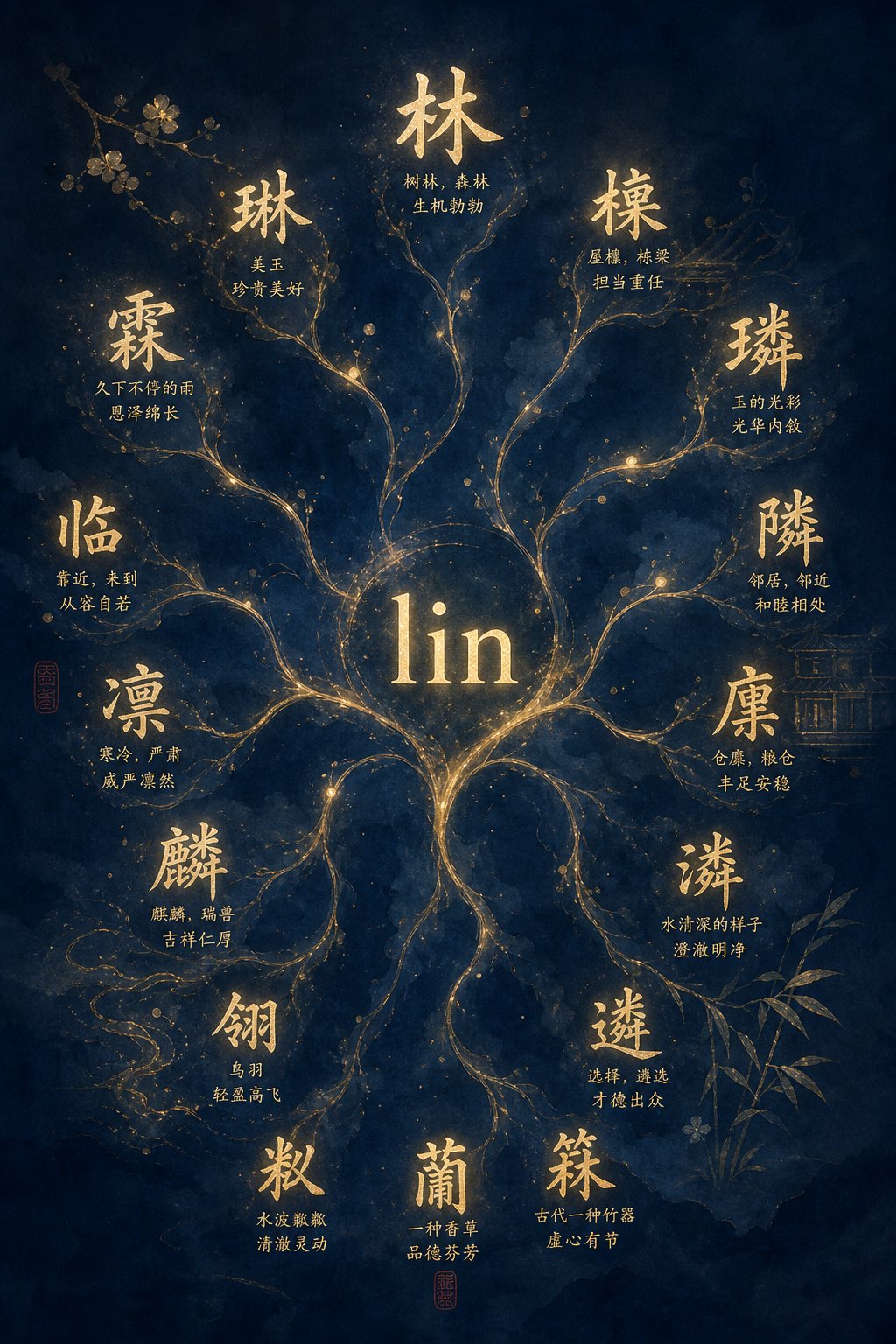
- Water (水): Characters with 水 or its radical form 氵(three-dot water) — 浩 (hao, vast), 涵 (han, to contain), 淑 (shu, gentle), 泽 (ze, marsh/grace), 溪 (xi, stream). Also 雨 (rain) radical — 霖 (lin, continuous rain), 霏 (fei, falling rain).
This method is straightforward and visual. When you see 氵on the left side of a character, you can confidently assign it to Water. When you spot 木 as a component, that character carries Wood energy. For parents comparing chinese zodiac elements wood vs earth in their child's chart, the radical method offers the clearest path to identifying which characters will supply the needed phase.
Classification by Semantic Meaning
Some characters lack an obvious elemental radical but carry unmistakable elemental meaning. Consider 森 (sen, dense forest). Its radical is technically 木, so it falls neatly into Method 1. But what about 海 (hai, ocean)? It does contain the 氵radical — again, Method 1 handles it. The semantic method becomes essential for characters where the radical is ambiguous or unrelated to any element.
Take 翔 (xiang, to soar). Its radical is 羽 (feather), which does not map directly to any phase. But soaring through the sky evokes upward movement and expansion — qualities associated with Wood. Or consider 晨 (chen, morning). The 日 (sun) component suggests Fire, and the meaning of dawn breaking reinforces that warmth and brightness. The semantic approach asks: what does this character mean, and which phase does that meaning most naturally evoke?
Characters like 慧 (hui, wisdom) present interesting cases. Wisdom is traditionally linked to Water in five-phase philosophy — the same correspondence that connects Water to the kidneys in traditional Chinese medicine (where even specific points like spleen 6 reflect elemental relationships between Earth and other phases). So 慧 is classified as Water through meaning, even though its radical structure does not point there directly.
Classification by Stroke Count
The third and most esoteric method assigns elements based on a character's total stroke count, using a numerological mapping system. The traditional formula divides stroke counts as follows: numbers ending in 1 or 2 belong to Wood, 3 or 4 to Fire, 5 or 6 to Earth, 7 or 8 to Metal, and 9 or 0 to Water. A character with 11 strokes would be classified as Wood; one with 14 strokes would be Fire.
This method is the least intuitive and the most contested. A character meaning "ocean" with a stroke count mapping to Metal creates an obvious contradiction with both its radical and its meaning. For this reason, stroke-count classification is rarely used as a primary tool. It appears most often in formal name-analysis consultations where practitioners layer multiple systems — including stroke-count numerology (五格剖象法, wuge pouxiang fa) — to evaluate a name's overall auspiciousness.
The hierarchy of precedence among these three methods is generally accepted as follows: radical-based classification takes priority because it is the most visible and widely recognized. When a character's radical is ambiguous or does not correspond to any element, meaning-based classification fills the gap. Stroke-count classification serves as a supplementary layer, most relevant to practitioners who integrate numerological systems into their analysis. For most families selecting wood signs or fire characters for a name, the first two methods provide all the guidance needed.
Understanding these classification methods gives you the vocabulary to evaluate any character's elemental identity. The 5 elements of life are not stamped onto characters in a single uniform way — they emerge through structure, meaning, and number, with each lens offering a slightly different view. Armed with this knowledge, the next question becomes: how do you pair two classified characters so they work together rather than against each other?
Using the Sheng and Ke Cycles to Pair Name Characters
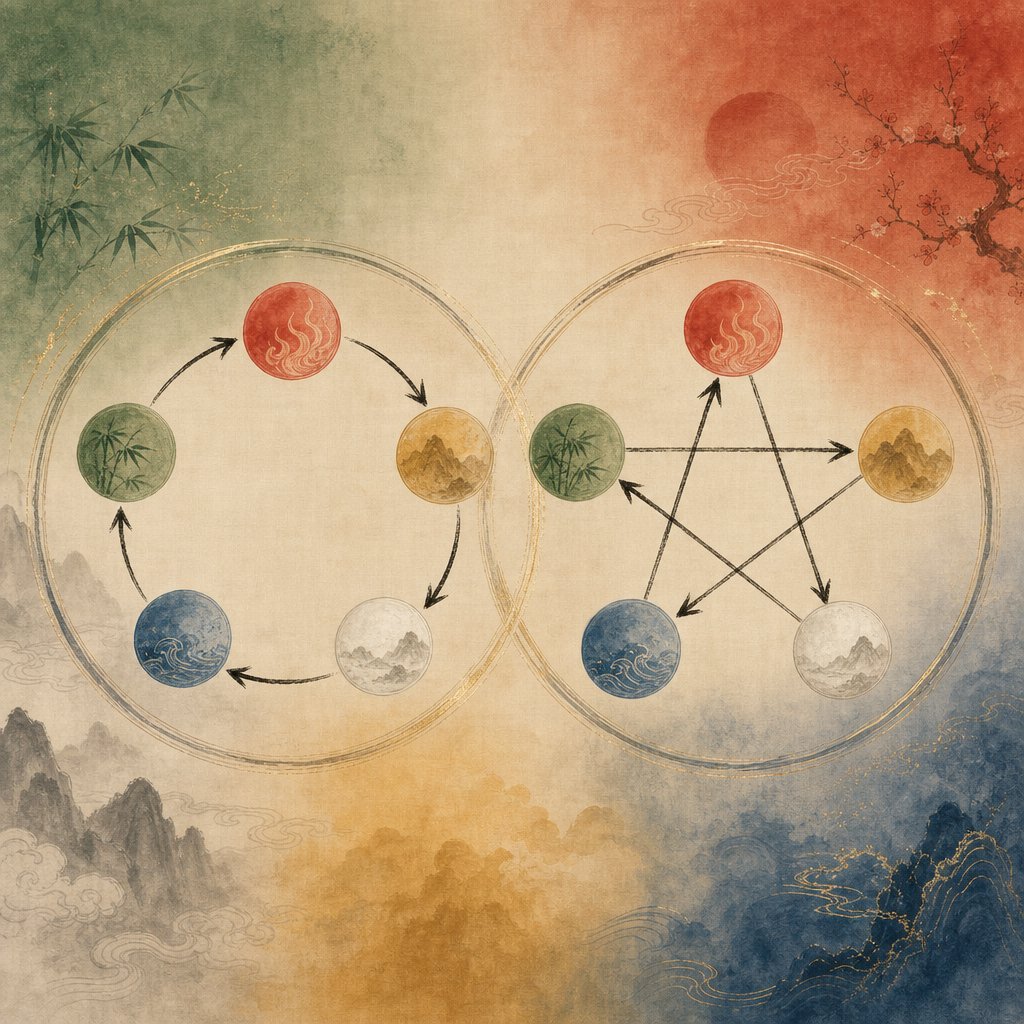
Knowing a character's element is only half the equation. The real craft of wuxing in Chinese names lies in how two characters interact once placed side by side. A Wood character next to a Fire character creates a very different energetic relationship than a Wood character next to a Metal character. The five elements do not exist in isolation — they relate to each other through two fundamental cycles that determine whether a name flows harmoniously or pulls against itself.
The Generating Cycle for Harmonious Character Pairing
The generating cycle (相生, xiangsheng) describes how each phase naturally nourishes the next in a continuous loop of support. When you ask "what are the five elements and how do they connect?" — this cycle is the answer. Each phase feeds energy forward, creating momentum rather than resistance.
| Source Element | Relationship | Receiving Element | Natural Metaphor |
|---|---|---|---|
| Wood (木) | feeds → | Fire (火) | Wood fuels flames |
| Fire (火) | creates → | Earth (土) | Ash enriches soil |
| Earth (土) | bears → | Metal (金) | Ore forms within earth |
| Metal (金) | collects → | Water (水) | Metal condenses moisture |
| Water (水) | nourishes → | Wood (木) | Rain feeds trees |
When two characters in a given name follow this generating sequence, they create what practitioners call internal harmony. The first character's energy flows naturally into the second, producing a sense of forward motion and mutual support. Imagine a name containing 林 (lin, forest — Wood) paired with 煜 (yu, radiant — Fire). Wood feeds Fire. The name carries an inherent logic: growth fueling brilliance, vitality sparking illumination. The energy moves in one direction without friction.
This is the same principle behind the kanji for fire (火) appearing in Japanese names influenced by Chinese five-phase theory — the generating relationships cross linguistic borders because the underlying philosophy is structural, not language-specific.
The Overcoming Cycle and Combinations to Avoid
The overcoming cycle (相克, xiangke) describes how each phase restrains or controls another. This is not destruction — it is regulation. In nature, these checks prevent any single force from overwhelming the system. In a name, however, placing two characters in an overcoming relationship creates internal tension that most families prefer to avoid.
| Controlling Element | Relationship | Controlled Element | Natural Metaphor |
|---|---|---|---|
| Wood (木) | parts → | Earth (土) | Roots break soil |
| Earth (土) | dams → | Water (水) | Banks contain floods |
| Water (水) | extinguishes → | Fire (火) | Water quenches flame |
| Fire (火) | melts → | Metal (金) | Heat reshapes metal |
| Metal (金) | chops → | Wood (木) | Axe fells trees |
Consider a name pairing 铭 (ming, inscription — Metal) with 林 (lin, forest — Wood). Metal chops Wood. The first character's energy actively suppresses the second. Rather than flowing forward, the name contains a built-in conflict. For parents seeking balance and harmony, this combination works against the very purpose of elemental naming.
A practical way to remember: if you trace the four elements of the overcoming cycle from any starting point, you skip one phase each time. Wood overcomes Earth (skipping Fire), Earth overcomes Water (skipping Metal), and so on. The generating cycle moves to the immediate neighbor; the overcoming cycle leaps over one to control the next.
How Surname Element Interacts with Given Name Elements
Here is where many families overlook a critical detail: the surname carries its own elemental identity, and it comes first. The full name — surname plus given name — should ideally flow in generating order across all two or three characters.
Take the surname 林 (Lin). Its radical is 木, making it a Wood-element surname. If the given name's first character belongs to Fire and the second to Earth, the full name flows: Wood (surname) → Fire (first given character) → Earth (second given character). Each phase feeds the next in perfect generating sequence. The name Li Jinze (李金泽) demonstrates this principle beautifully — Li (李) contains the Wood radical, Jin (金) is Metal, and Ze (泽) is Water. While Wood does not directly generate Metal, the given name characters themselves follow the generating cycle: Metal produces Water.
What happens when the surname's element clashes with the given name? If your surname is Metal-element and your child needs Wood characters based on their birth chart, you face a direct overcoming relationship — Metal chops Wood. Skilled practitioners handle this by inserting a bridging element. Metal generates Water, and Water generates Wood. So a Water-element character placed as the first given name character creates a smooth chain: Metal (surname) → Water (first character) → Wood (second character). The conflict dissolves into flow.
Not every family applies this level of rigor. Some focus only on the relationship between the two given name characters and treat the surname as fixed context rather than an active participant. Both approaches are culturally valid. The key principle remains consistent: characters in a generating relationship support each other, characters in an overcoming relationship resist each other, and the direction of flow matters as much as the elements themselves.
These cycles give you a decision framework for evaluating any character combination. But knowing the rules and applying them are different challenges. The five elements only become truly useful when you can see the full process in action — from birth chart diagnosis through final character selection, with cycle compatibility checked at every step.
Popular Naming Characters Organized by Element
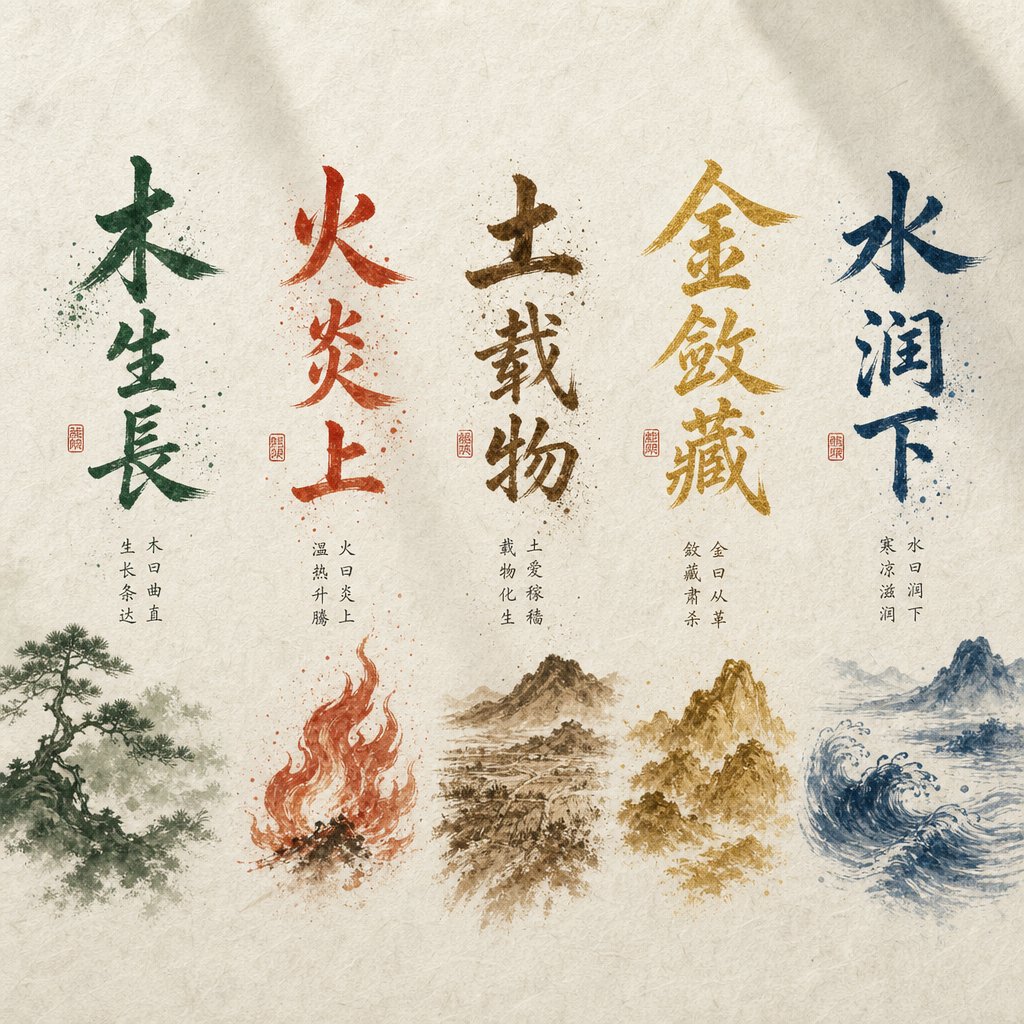
Cycles and classification methods give you the logic. But when you sit down to actually choose characters, you need a concrete palette to work from. This section breaks down each phase into its most popular naming characters — organized so you can match elemental need to real options for boys and girls, check generating cycle compatibility at a glance, and understand the qualities each character brings to a name.
Think of this as your reference table. Bookmark it, return to it, and use it alongside the birth chart analysis and cycle-pairing principles covered earlier.
| Element | Common Radicals | Popular Male Characters | Popular Female Characters | Qualities Invoked | Best Paired With |
|---|---|---|---|---|---|
| Wood (木) | 木, 艹, 竹 | 柏 (bai), 林 (lin), 梓 (zi), 松 (song) | 芷 (zhi), 桂 (gui), 蕊 (rui), 荣 (rong) | Growth, vitality, flexibility, renewal | Fire (Wood feeds Fire) |
| Fire (火) | 火, 灬, 日 | 煜 (yu), 炎 (yan), 灿 (can), 昊 (hao) | 煦 (xu), 晗 (han), 烨 (ye), 曦 (xi) | Brilliance, warmth, passion, illumination | Earth (Fire creates Earth) |
| Earth (土) | 土, 山, 石 | 坤 (kun), 峰 (feng), 坚 (jian), 垚 (yao) | 岚 (lan), 安 (an), 培 (pei), 圣 (sheng) | Stability, nurturing, reliability, grounding | Metal (Earth bears Metal) |
| Metal (金) | 金, 钅 | 铭 (ming), 锋 (feng), 钧 (jun), 铮 (zheng) | 钰 (yu), 鑫 (xin), 钦 (qin), 银 (yin) | Strength, clarity, decisiveness, refinement | Water (Metal collects Water) |
| Water (水) | 水, 氵, 雨 | 浩 (hao), 泽 (ze), 海 (hai), 霖 (lin) | 涵 (han), 淑 (shu), 清 (qing), 润 (run) | Wisdom, adaptability, depth, fluidity | Wood (Water nourishes Wood) |
Wood Element Characters for Growth and Vitality
Wood characters carry the energy of spring — upward movement, new beginnings, and organic expansion. 梓 (zi) refers to the catalpa tree, traditionally valued for craftsmanship and musical instruments. It suggests someone who can be shaped into something beautiful. 柏 (bai), the cypress, stays green year-round and symbolizes endurance through hardship. For girls, 芷 (zhi, angelica herb) evokes natural elegance, while 桂 (gui, cassia) connects to the moon legend and scholarly achievement. Wood pairs best with Fire characters in a two-character given name, creating a flow from growth into brilliance.
Fire Element Characters for Brilliance and Warmth
Fire names radiate energy. 煜 (yu) describes sunlight filtering through clouds — illumination without harshness. 灿 (can) means resplendent, like fireworks against a dark sky. The gentler 煦 (xu) evokes comfortable warmth rather than blazing intensity, making it popular for both boys and girls. Anyone who has watched animated works like Fog Hill of the Five Elements (雾山五行) will recognize how Fire characters in Chinese storytelling carry connotations of passion and decisive action. In naming, Fire pairs naturally with Earth — ash enriching soil, energy settling into stability.
Earth Element Characters for Stability and Nurturing
Earth provides the foundation. 坤 (kun), one of the eight trigrams, represents the receptive and maternal principle — the ground that enables all other growth. 安 (an, peace) is among the most beloved naming characters across centuries, carrying simplicity and universal appeal. 峰 (feng, peak) draws on the mountain radical to suggest achievement built on solid ground. Earth sense energy systems in Chinese philosophy position this phase at the center, mediating between all others. Earth characters pair forward with Metal, creating a sequence of stability yielding strength.
Metal Element Characters for Strength and Clarity
Metal names feel decisive and enduring. 铭 (ming) means to inscribe — carving something into metal so it will not be forgotten. 锋 (feng) is the sharp edge of a blade, suggesting someone who cuts through confusion. 钧 (jun) originally referred to an ancient unit of weight, carrying connotations of substance and gravitas. These characters share the quality of precision, much like iron wind metals forged under pressure into something refined and purposeful. Metal's generating partner is Water, so pairing 铭 with a Water character like 泽 creates smooth forward flow.
Water Element Characters for Wisdom and Adaptability
Water names carry depth. 泽 (ze) means grace or nourishment — rain that benefits all living things without asking anything in return. 涵 (han, to contain) suggests someone with vast inner capacity. 清 (qing, clear) evokes moral transparency and simplicity. 润 (run, to moisten) describes someone who brings comfort to others just by being present. Water pairs forward with Wood, completing the cycle back to growth and renewal.
One practical note: some characters carry multiple elemental associations, and handling that ambiguity matters. Take 淇 (qi) — it contains the Water radical 氵, but its right component 其 has no strong elemental signal. Here, the radical wins. But consider 森 (sen, dense forest): it is built from three 木 components, making it unambiguously Wood despite sometimes appearing in contexts that evoke the dark, still quality of Water. When a character sends mixed signals, apply the hierarchy from the previous section — radical first, then meaning, then stroke count. The principle of 五行相生相克 (mutual generation and overcoming) only works cleanly when each character's elemental identity is settled before you start checking compatibility.
With this reference in hand, you have the raw materials for building a name. The remaining challenge is assembling them into a coherent whole — walking through the complete process from birth chart to final selection, step by step, while avoiding the mistakes that trip up even well-intentioned families.
A Complete Naming Example and Common Mistakes to Avoid
Theory is useful. Seeing it applied to a real scenario is better. Let's walk through the entire process — from a hypothetical birth chart to a finished name — so you can see how each concept connects in practice.
Step by Step from Birth Chart to Final Name
Imagine a baby girl born in a year and hour dominated by Water and Wood. Her simplified BaZi chart shows abundant Water (three instances across the pillars), strong Wood (two instances), a trace of Earth, and zero Fire or Metal. Her Day Master is Yin Water (癸), making her fundamentally a Water person already swimming in more Water. The diagnosis is clear: Fire is the most urgently needed phase, with Metal as a secondary benefit.
Here is the step-by-step process her family follows:
- Identify the elemental gap. Chart analysis reveals Fire is completely absent. Metal is also missing. Fire becomes the priority because it directly warms and regulates excessive Water.
- Determine the surname's element. The family surname is 林 (Lin), which carries the Wood radical (木). Wood is the surname's fixed elemental identity.
- Select the first given name character. Since Wood feeds Fire in the generating cycle, a Fire character placed immediately after the Wood surname creates natural flow. The family chooses 煜 (yu, radiant) — a Fire character with the 火 radical, meaning sunlight breaking through clouds.
- Select the second given name character. Fire creates Earth in the generating cycle. An Earth character would continue the flow. But the chart also lacks Metal, and Earth bears Metal. The family chooses 安 (an, peace) — an Earth character suggesting stability and calm.
- Verify the full sequence. The complete name reads: 林煜安 (Lin Yuān). The elemental flow is Wood (林) → Fire (煜) → Earth (安). Each phase feeds the next along the generating cycle. No overcoming relationships exist between adjacent characters.
- Check meaning and sound. "Radiant peace" carries a beautiful semantic pairing. The tonal sequence — Lin (second tone), Yu (fourth tone), An (first tone) — moves through different tones without awkward repetition.
The elemental wheel turns smoothly through this name: growth fueling brilliance, brilliance settling into stability. Every character earns its place on both elemental and aesthetic grounds.
Checking Cycle Compatibility and Surname Flow
Notice how the surname was not treated as decoration. It actively participates in the elemental sequence. If the family had ignored it and placed a Water character first — say, 涵 (han) — the result would be Wood (surname) feeding... Water? That reverses the generating direction. Wood does not feed Water; Water feeds Wood. The name would contain a logical break, disrupting the flow that makes wuxing naming effective.
This brings us to the mistakes that trip up even well-intentioned families. Some are subtle, others surprisingly common:
- Over-correcting the imbalance. Loading both given name characters with the same missing element — say, two Fire characters — risks creating excess where there was deficiency. Balance means supplementing, not flooding. The magic phases of the cycle work through variety, not repetition.
- Ignoring the surname's element entirely. Treating the surname as a fixed label outside the system wastes one-third of the name's elemental potential. The surname is the first spoke on the elemental wheel — it sets the direction everything else follows.
- Choosing characters solely for elemental properties. A character might be perfect elementally but carry an awkward meaning, clash tonally with the surname, or look visually unbalanced in calligraphy. As the four-dimensional naming framework emphasizes, element is one dimension among four — sound, form, and meaning must also be satisfied.
- Confusing the generating cycle direction. Wood feeds Fire, not the reverse. Fire creates Earth, not the reverse. The sequence only flows one way. Reversing it does not create a weaker version of harmony — it creates no elemental relationship at all.
- Forgetting that elements water fire air earth belong to a different tradition. The Western four-element system (earth, water, air, fire) does not map onto wuxing. Substituting "air" for Metal or conflating the two frameworks leads to misclassification.
One final consideration: wuxing naming does not operate in isolation. Many families also weigh generational name characters (字辈, zibei) that honor lineage, tonal patterns across the full name, and stroke-count numerology for additional auspiciousness. These systems can complement five-phase selection or occasionally conflict with it. When they do, families must prioritize — and that prioritization is itself a personal and cultural choice, not a formula with a single correct answer.
The worked example above represents a relatively straightforward case: a clear deficiency, a cooperative surname, and available characters that satisfy multiple dimensions simultaneously. Real naming decisions are not always this clean. But the underlying logic holds regardless of complexity — diagnose the gap, select characters that fill it, verify cycle compatibility across the full name, and confirm that meaning and sound hold up alongside the elemental math.
Modern Approaches for Contemporary and Cross-Cultural Families
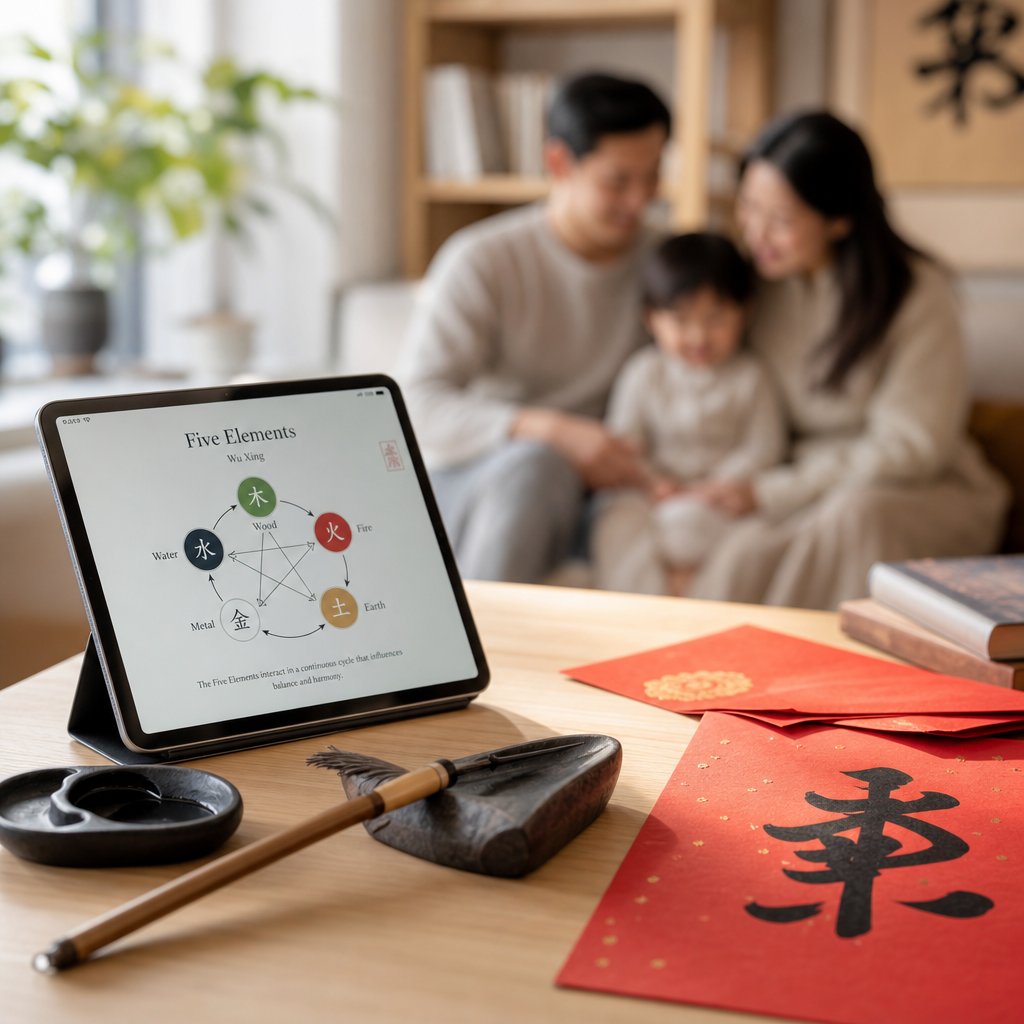
Not every family naming a child has access to a BaZi specialist, reads classical Chinese, or lives in a cultural context where five-phase naming is the default. Diaspora families, mixed-heritage households, and non-Chinese parents choosing Chinese names for adopted children or language study all face a practical question: how much of this system can you meaningfully engage with, and how much should you?
Simplified Approaches for Modern Families
Many contemporary Chinese parents — including those living in mainland China — use a streamlined version of elemental naming. Rather than commissioning a full BaZi analysis with all four pillars, hidden stems, and seasonal adjustments, they focus on the birth year's element alone. A child born in a Water year might receive a name with Wood or Fire characters to complement that single data point. This approach captures the spirit of five-phase naming without requiring specialist consultation.
Is it less precise? Yes. Is it culturally invalid? Not at all. Think of it as a spectrum of engagement. At one end, a professional practitioner calculates all elementals 5 phases across eight characters, weighs the Day Master's strength, identifies the Useful God, and recommends characters that satisfy elemental, tonal, and calligraphic requirements simultaneously. At the other end, a parent simply chooses a character associated with an element they feel their child needs — perhaps Fire for warmth and confidence, or Water for adaptability and depth. Both approaches participate in the same tradition. The difference is resolution, not authenticity.
Online BaZi calculators have made the middle ground more accessible than ever. A parent can input a birth date, receive a basic elemental breakdown, and use that information to guide character selection without needing to interpret classical texts. The modern naming approach treats Five Elements principles as one consideration among many rather than the sole determining factor — and this flexibility is itself a valid cultural position.
Wuxing Naming for Diaspora and Cross-Cultural Families
For Chinese families living abroad, naming often involves navigating two linguistic worlds simultaneously. A name needs to work in Mandarin (or Cantonese, Hokkien, or another dialect) and also coexist with an English or other Western name. Research from the University of Nottingham Ningbo shows that mainland Chinese students increasingly adopt English names alongside their Chinese ones, with uniqueness and personal identity driving those choices. The reverse also applies: diaspora families want Chinese names that feel distinctive and meaningful, not generic.
Wuxing naming offers these families something valuable — a structured framework for making choices that might otherwise feel overwhelming. When you are selecting characters across cultural and linguistic boundaries, having a clear criterion ("my child's chart needs Fire") narrows the field productively. It transforms an open-ended creative challenge into a guided one.
Mixed-heritage households face an additional layer. A non-Chinese parent might ask what does water represent in this system, or why Metal is preferred over Earth for their child. These are legitimate questions, and the answers — Water carries wisdom and adaptability, Metal brings clarity and decisiveness — provide intuitive entry points that do not require deep philosophical background. The elemental associations are concrete enough to resonate across cultural contexts.
For non-Chinese parents choosing a Chinese name for an adopted child, sensitivity matters. The name is not a costume; it is a connection to heritage. Engaging with five-phase principles — even at a simplified level — demonstrates respect for the tradition behind the characters rather than selecting them purely for aesthetic appeal.
Balancing Tradition with Personal Meaning
Here is the honest reality: no name can satisfy every criterion perfectly. Elemental balance is one dimension. But a character's visual beauty in calligraphy, its pronunciation across dialects (a name that sounds elegant in Mandarin might carry unfortunate homophones in Cantonese), its recognizability in international contexts, and its personal resonance for the family all compete for priority.
The most successful modern names tend to satisfy elemental considerations and at least two other dimensions. A character like 涵 (han, to contain — Water) works internationally because its pinyin romanization is simple and pronounceable. 安 (an, peace — Earth) functions similarly. Characters with complex stroke counts or obscure meanings may be elementally perfect but practically burdensome for a child who will write their name thousands of times.
Wuxing naming — whether applied rigorously through full BaZi consultation or lightly through elemental awareness — connects a child's name to thousands of years of Chinese philosophical tradition. It offers a framework where intention meets structure, where a parent's hopes for their child find expression not just in meaning but in cosmological alignment. The depth of engagement is a personal choice, not a measure of authenticity. A family that selects one Fire character based on birth year alone participates in the same living tradition as a family that commissions a comprehensive elemental analysis. Both are saying the same thing: this name is not random. It was chosen with care, with knowledge, and with the belief that words carry energy worth shaping.
Frequently Asked Questions About Wuxing in Chinese Names
1. How do I find out which element my child's name needs based on their birth chart?
You can determine your child's needed element through BaZi (Eight Characters) analysis. This system converts the birth year, month, day, and hour into four pairs of characters, each tied to a specific element. The Day Master (the Heavenly Stem of the Day Pillar) represents the child's core identity. By mapping all eight characters to their elemental associations, you identify which phases are overrepresented and which are absent. The missing or weak element becomes the target for name selection. Modern parents often use online BaZi calculators for a simplified reading or consult specialists for full analysis including hidden stems and seasonal strength.
2. What is the difference between the generating cycle and the overcoming cycle in Chinese naming?
The generating cycle (xiangsheng) describes how each element naturally supports the next: Wood feeds Fire, Fire creates Earth, Earth bears Metal, Metal collects Water, and Water nourishes Wood. Characters following this sequence in a name create harmony and forward flow. The overcoming cycle (xiangke) describes how each element restrains another: Wood parts Earth, Earth dams Water, Water extinguishes Fire, Fire melts Metal, and Metal chops Wood. Placing characters in an overcoming relationship creates internal tension, which most families avoid when constructing a name.
3. How do I know which Chinese character belongs to which element?
Three classification methods exist. The most accepted is radical-based: characters with the water radical (氵) belong to Water, those with the wood radical (木) to Wood, fire radical (火 or 灬) to Fire, earth radical (土) to Earth, and metal radical (金 or 钅) to Metal. When radicals are ambiguous, the semantic method classifies by meaning — a character meaning 'ocean' belongs to Water regardless of its radical. The third method uses stroke count with a numerological formula, though this is the least commonly applied in modern practice.
4. Does the surname's element matter when choosing a Chinese name?
Yes, the surname actively participates in the elemental sequence of a full name. Since the surname comes first, it sets the starting point for generating cycle flow. Ideally, the full name moves in generating order from surname through given name characters. If the surname's element clashes with the needed element, practitioners insert a bridging element between them. For example, a Metal surname paired with a Wood-needing child can use a Water character as the first given name character, creating a smooth Metal to Water to Wood chain.
5. Can diaspora or non-Chinese families use wuxing principles when choosing a Chinese name?
Absolutely. Wuxing naming offers a structured framework that works across cultural boundaries. Many families use simplified approaches, focusing on the birth year element rather than full BaZi analysis. The elemental associations — Water for wisdom, Fire for brilliance, Wood for growth, Metal for strength, Earth for stability — provide intuitive entry points that do not require deep philosophical background. Engaging with five-phase principles at any level demonstrates respect for the tradition and transforms character selection from an open-ended challenge into a guided, meaningful process.