Why the Year of the Goat Name Holds Layers of Meaning
In Chinese culture, a name is never just a label. Every character chosen for a person, a place, or even a zodiac animal carries philosophical weight, historical resonance, and layered intention. Chinese names are composed of characters known as Hanzi, and each one can hold cultural, historical, and spiritual significance that shapes identity and destiny. So when you look at the year of the goat name meanings, you're not simply asking "which animal is it?" You're stepping into a system where a single character encodes centuries of symbolism.
Why the Zodiac Animal's Name Carries Deep Meaning
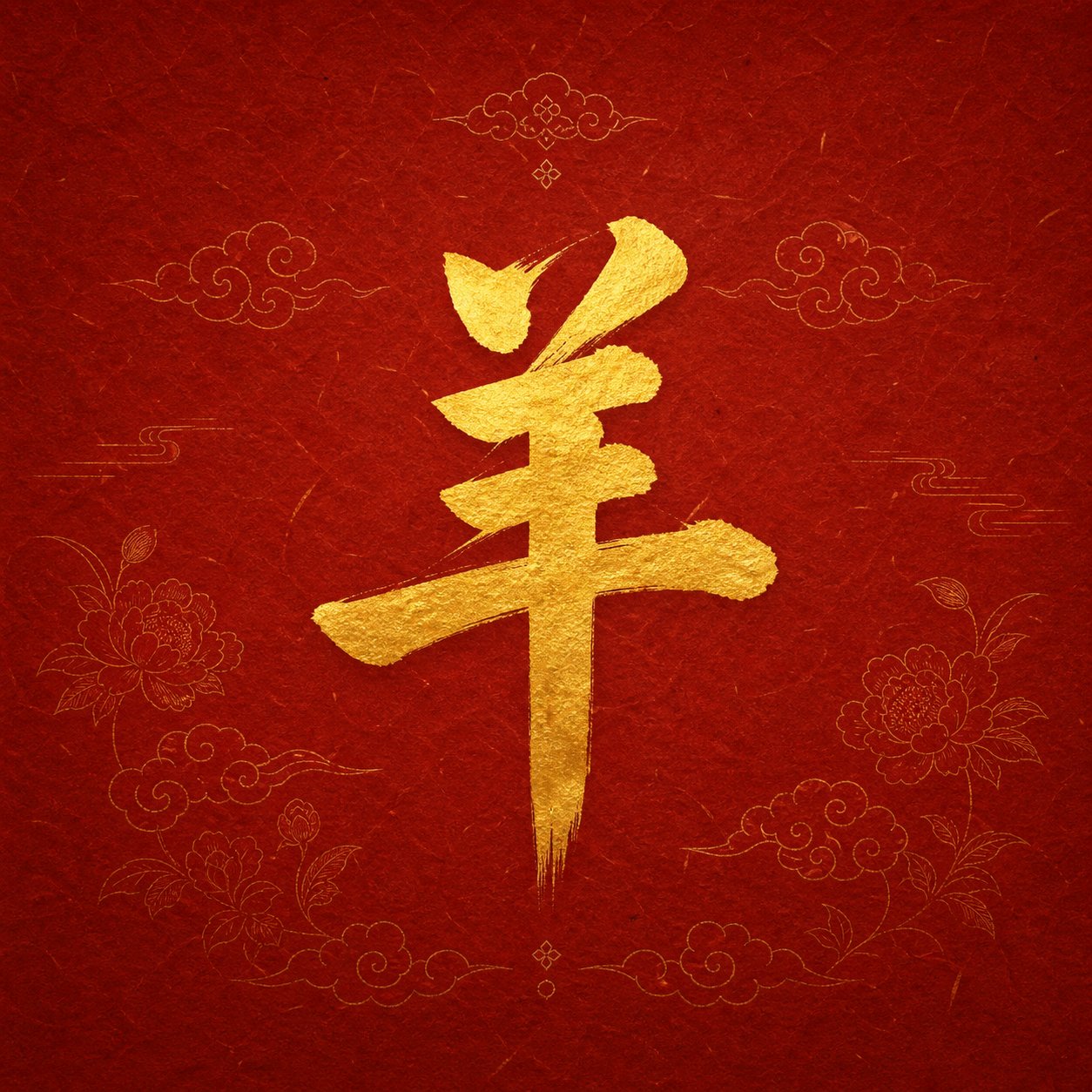
The eighth sign of the Chinese zodiac is written as 羊 (yang). Here's what makes it uniquely fascinating: that one character simultaneously refers to a goat, a sheep, and a ram. Unlike English, which forces you to pick one animal, Chinese lets all three coexist within the same word. The year of the goat and sheep are, linguistically speaking, the same year. There is no confusion in Chinese. The question of whether it's the year of sheep or goat is a problem that only surfaces in translation.
Lala Zuo, a Chinese language and culture professor at the U.S. Naval Academy, put it simply: "I don't think there's a wrong translation. I think there are various ways of translation. It really depends on the context."
The Unique Ambiguity of the Eighth Zodiac Sign
This ambiguity is not a flaw in the language. It's a feature of Chinese naming philosophy.
In Chinese thought, a name that holds multiple meanings is richer than one that is narrowly defined. The character 羊 embraces ambiguity as intentional depth, not imprecision.
The year of the goat, the year of the sheep, even the year of the lamb all point back to the same character. And that character doesn't just name an animal. It lives inside dozens of other Chinese words connected to beauty, goodness, and auspiciousness. The name meanings operate on multiple layers: literal (the animal), symbolic (what it represents), linguistic (how it connects to other characters), and personal (how it shapes zodiac readings and even baby names).
Understanding these layers requires looking beyond the English translation debate and into the character itself, its ancient origins, and the web of meaning it carries through the Chinese writing system.
The Character 羊 and Its Ancient Linguistic Roots
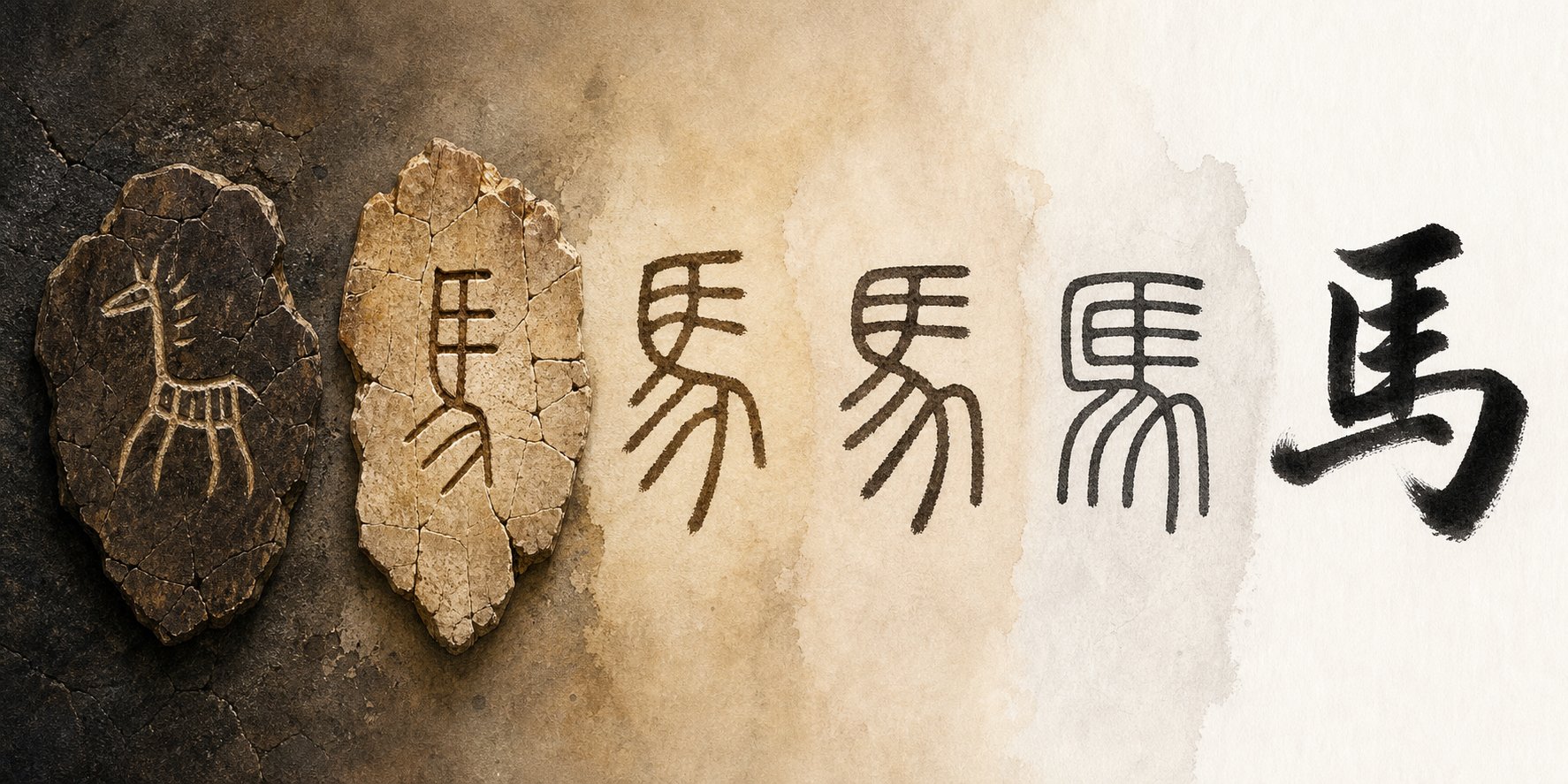
The character at the center of this entire discussion is 羊. Pronounced yang in Mandarin with a rising second tone (yang rising in pitch, like asking a question), it's a six-stroke character that has remained remarkably stable across more than three thousand years of written Chinese. To understand what the goat in Chinese truly signifies within the zodiac, you need to trace this character back to its earliest known form.
Oracle Bone Origins of the Character 羊
Imagine a sheep or goat staring directly at you. Two curved horns sweep outward. A narrow face tapers to a pointed mouth. That frontal view of the animal's head is exactly what ancient scribes carved into turtle shells and ox bones during the Shang Dynasty (roughly 1600-1046 BC). This is oracle bone script, the oldest verified form of Chinese writing, and the character 羊 originated there as a clear pictogram: downward-curving horns at the top, an arrow-like shape representing the mouth below.
From oracle bone script, the character moved through several evolutionary stages:
- Bronze script (inscribed on ritual vessels) - the horns became more stylized, the body slightly more geometric
- Seal script (standardized during the Qin Dynasty) - the form grew more balanced and symmetrical
- Clerical script (developed for administrative efficiency) - strokes flattened and straightened into the recognizable form used today
- Regular script - the modern standard, where 羊 appears with its familiar horizontal strokes and central vertical line
Throughout this entire evolution, one thing never changed: the character never specified which type of horned ruminant it depicted. The oracle bone carving could be a goat's head or a sheep's head. The ambiguity was baked in from the very beginning.
Modern Compounds That Distinguish Goat From Sheep
Modern Mandarin does have ways to specify exactly which animal you mean. It just requires adding a second character to form a compound word. Think of 羊 as the broad category, and these compounds as the subcategories:
- 山羊 (shānyáng) - literally "mountain sheep/goat," meaning goat. The character 山 (shān) means mountain, reflecting where goats typically graze.
- 绵羊 (miányáng) - literally "cotton/soft sheep," meaning sheep. The character 绵 (mián) means soft or cotton-like, referencing the woolly fleece.
- 公羊 (gōngyáng) - literally "male sheep/goat," meaning ram. The character 公 (gōng) means male or public.
- 羔羊 (gāoyáng) - literally "young sheep/goat," meaning lamb. The character 羔 (gāo) means a young animal.
You'll notice each compound uses 羊 as its base and adds a descriptor to narrow the meaning. On its own, 羊 remains deliberately inclusive. It's the genus, not the species.
Why the Zodiac Keeps 羊 Deliberately Vague
So why doesn't the Chinese zodiac simply use 山羊 or 绵羊 to settle the debate once and for all? The answer connects to both history and philosophy.
The Chinese zodiac first appeared after the Shang Dynasty, during a period when people did not differentiate between sheep and goats in language or in sacrificial offerings. Researcher Huang Yang, a prominent scholar on the role of sheep and goats in Chinese culture, notes that both species had long histories of domestication in China and appeared on oracle bone scripts since prehistoric times. The distinction simply wasn't culturally relevant when the zodiac system took shape.
There's also a deeper reason. In ancient Chinese thought, sheep and goats were regarded as auspicious livestock. The character 羊 shared its origin with the concept of "auspicious" itself. Using the single, encompassing character preserves that broader symbolic resonance. A compound word like 山羊 would narrow the chinese animal goat to one specific creature and strip away the layered cultural meaning that makes the chinese sign of the goat so rich.
The zodiac isn't a zoological classification system. It's a symbolic one. And 羊 as the chinese symbol for sheep, goat, and ram simultaneously carries far more cultural weight than any single compound ever could. The character functions as a vessel holding thousands of years of meaning, from sacrificial rituals to concepts of beauty and virtue embedded in the writing system itself.
Those embedded meanings, hidden inside dozens of other Chinese characters that contain the 羊 radical, reveal just how deeply this sign connects to positive cultural values far beyond the animal itself.
Goat, Sheep, or Ram and What Each Name Implies
Every time a new 羊 year rolls around, English-language media faces the same dilemma: which animal goes in the headline? Goat? Sheep? Ram? The debate resurfaces with predictable regularity, and publications often hedge their bets by listing all three. But here's the thing: this confusion is entirely a product of translation. In Chinese, there is no debate. It's 羊年 (yangnian), and that's the end of it.
The Western Translation Problem
The core issue is structural. English demands specificity where Chinese embraces breadth. When Western journalists, astrologers, and calendar publishers need to render 羊 into English, they're forced to choose a single animal from a category that was never meant to be split. The result? Some outlets go with "goat," others pick "sheep," and a few opt for "ram." Chinese social media users have found this genuinely amusing. As The Chairman's Bao reported, Chinese netizens laughed at Western media's indecision, with one commenter joking that by the same logic, we'd need to ask whether the Year of the Tiger means South China tiger or Manchurian tiger.
The confusion doesn't exist in Chinese because 羊 functions as a hypernym, a word that covers an entire category. English has equivalents for other zodiac animals. "Rooster" works for 鸡 (ji). "Ox" works for 牛 (niu). But for 羊, there's simply no single English word that encompasses goat, sheep, and ram without choosing sides. The goat chinese zodiac label is just one valid rendering among several.
What Scholars and Cultural Practitioners Say
Academics who specialize in Chinese culture have weighed in consistently on this point. Emeritus Professor Colin Mackerras of Griffith University, a leading scholar of Chinese studies, has noted that the ambiguity is inherent to the character and that insisting on one translation over another misses the point entirely. The Chinese sign the goat and the chinese star sign goat are Western constructs layered onto a concept that resists such narrow framing.
Lala Zuo, a Chinese language and culture professor at the U.S. Naval Academy, confirmed this perspective: "I don't think there's a wrong translation. I think there are various ways of translation. It really depends on the context." She added that in ancient times, the character leaned toward goat, and that goats are more commonly seen across China, both north and south.
Cultural practitioners like Susan Levitt, a Taoist astrologer, offer a different angle. She argues that "Sheep" is the most appropriate English term because the sign is essentially Yin and feminine. In her view, calling it a zodiac ram introduces Yang masculine energy that doesn't match the sign's gentle, nurturing archetype. She also cautions that the ram goat label can create false associations with Western astrology's Aries the Ram, a fiery and combative sign that shares almost nothing with the eighth Chinese zodiac animal.
Does the Name Choice Change Your Zodiac Reading
Here's the practical question most people want answered: if you identify with the sheep zodiac rather than the goat, does your personality profile actually change?
The short answer is no, not within authentic Chinese astrology. Your zodiac reading is determined by the character 羊 and its associated Earthly Branch (未, wei), not by whichever English word a translator selected. The personality traits, elemental interactions, and compatibility readings all derive from the Chinese system, where the ram chinese zodiac, the goat, and the sheep are one and the same creature.
That said, the English word you choose does carry different cultural connotations, and those connotations can subtly shade how you interpret the sign's meaning. The star sign of the ram, for instance, evokes strength and assertiveness. "Sheep" suggests gentleness and community. "Goat" implies independence and sure-footedness. None of these is wrong. They're each highlighting a different facet of what 羊 contains.
| English Translation | Key Symbolic Traits | Cultural Connotations | Traditions That Favor This Term |
|---|---|---|---|
| Goat | Independence, creativity, resilience, sure-footedness | Mountain-dwelling, self-reliant, slightly unconventional | Vietnamese zodiac (Mui), Southern Chinese imagery, most Western astrology books |
| Sheep | Gentleness, empathy, artistic nature, community-mindedness | Pastoral, nurturing, Yin-feminine, peaceful | Korean zodiac (Yang), Mongolian zodiac, Tibetan zodiac, Taoist practitioners |
| Ram | Determination, leadership, strength, protective instinct | Masculine, powerful, assertive, Yang energy | Chinese New Year imagery (for visual strength), some Japanese interpretations |
The table above illustrates how each translation emphasizes a different dimension of the same sign. Vietnamese tradition, for example, firmly uses "goat" because, as Columbia University Vietnamese language instructor James Lap explained, "In Vietnam, there is no sheep or ram at all because the weather is so hot." Korean tradition leans toward "sheep" because, as Korean language instructor Sang-Seok Yoon noted, "the most prototypical image of yang for Korean people is sheep."
The real takeaway? The debate itself reveals something important about how meaning works across languages. In Chinese, 羊 holds all these qualities simultaneously. The gentleness of the sheep, the independence of the goat, the determination of the ram: they coexist without contradiction. Choosing one English word inevitably narrows what was designed to be broad.
This breadth becomes even more striking when you look beyond the animal itself and into the Chinese writing system, where the 羊 radical appears inside characters for beauty, goodness, and righteousness, encoding positive meaning at a level far deeper than any single translation can capture.
Hidden Meanings of 羊 in the Chinese Writing System
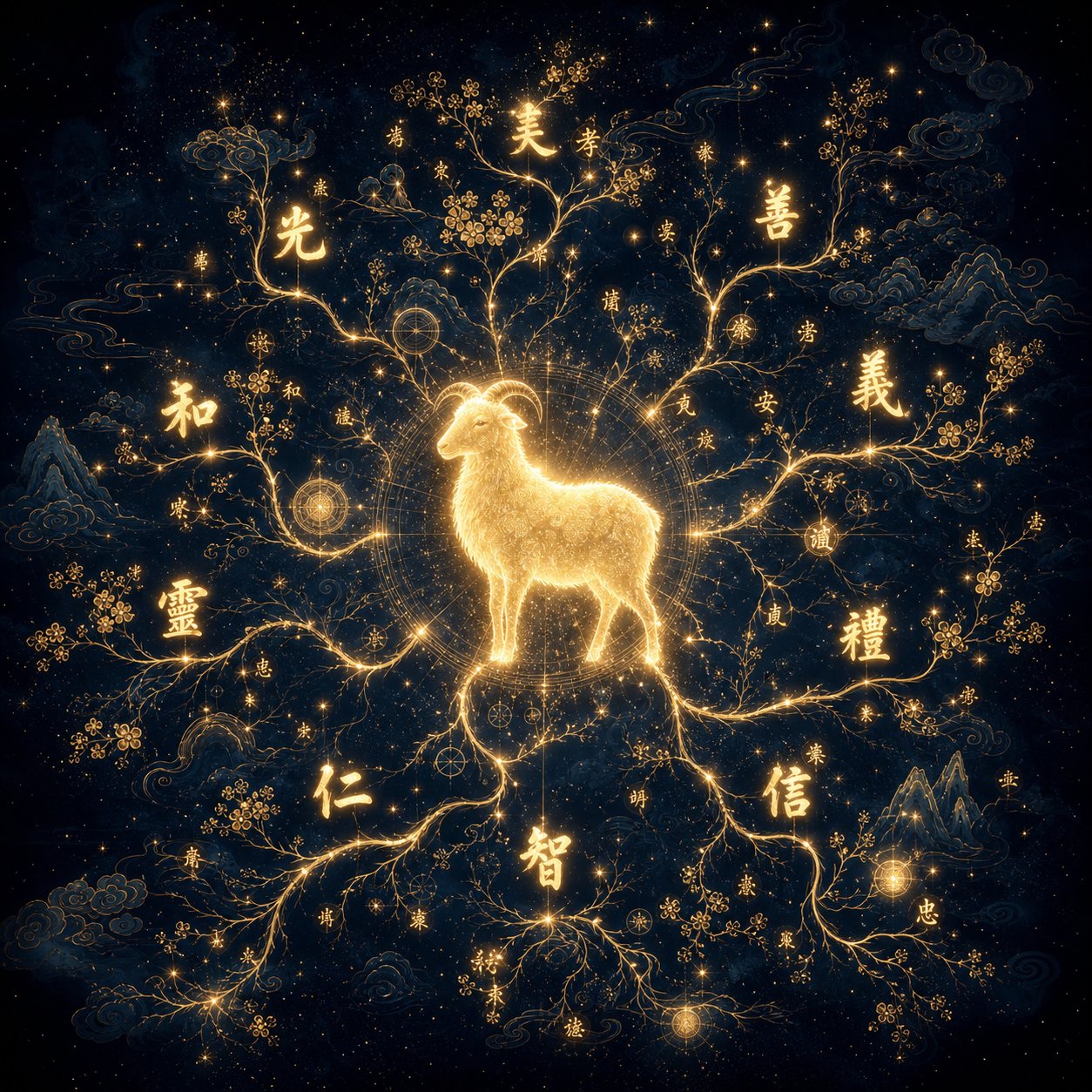
Here's where the year of the goat meaning goes far deeper than any single animal. The character 羊 doesn't just sit inside the zodiac. It lives inside dozens of other Chinese characters, and nearly all of them carry overwhelmingly positive meanings. Beauty. Goodness. Auspiciousness. Righteousness. The goat zodiac animal isn't just named with a neutral label. It's named with a character that the Chinese writing system treats as a building block of virtue itself.
To understand why, you need a quick primer on how Chinese characters work. Many characters are built from smaller components that contribute meaning or sound. When 羊 appears as a component inside another character, it often carries its symbolic associations along with it. Think of it like a root word in English: "bene" (good) shows up in "benefit," "benevolent," and "benediction," coloring each word with positivity. The 羊 component works similarly, except it's visual rather than phonetic.
How 羊 Lives Inside the Character for Beauty
The most striking example is 美 (mei, beauty). Traditional Chinese etymology breaks this character into two parts: 羊 (sheep/goat) on top and 大 (da, big) on the bottom. The cultural reading? A large, well-fed sheep or goat is beautiful. In agrarian society, a plump flock represented prosperity, health, and aesthetic pleasure. That association became so deeply embedded that the very concept of beauty carries the goat symbolism within its written form.
Whether you're describing a beautiful painting, a beautiful person, or a beautiful idea, you're writing a character that contains 羊 at its core. The connection between the chinese zodiac animal sheep and the concept of beauty isn't metaphorical. It's structural, built directly into the writing system.
Goodness, Auspiciousness, and Righteousness
Beauty is just the beginning. The 羊 component appears across a constellation of characters tied to moral and spiritual virtue:
- 善 (shan, goodness) - Contains 羊 at the top. This character encompasses kindness, benevolence, and moral excellence. As Yin Hubin of the China Academy of Social Sciences noted, 羊 is "a symbol of blessing and fortune and represents good things," partly because of its presence in characters like this one.
- 祥 (xiang, auspiciousness) - Combines the ritual/spirit radical 礻with 羊. In ancient Chinese, 羊 and 祥 were actually interchangeable. The character links animal sacrifice to divine blessing, prosperity, and harmony.
- 義/义 (yi, righteousness) - The traditional form 義 places 羊 over 我 (wo, me/self). The cultural interpretation: the lamb above the self represents righteousness. This character encompasses justice, honesty, loyalty, and moral duty.
- 羞 (xiu, modesty/shyness) - Contains 羊 as a component, connecting the gentle, non-aggressive nature of the animal to the virtue of humility and self-effacement.
- 鲜 (xian, fresh/delicious) - Combines 鱼 (fish) with 羊 (sheep/goat), suggesting that the finest flavors come from these two sources. Even taste and freshness carry the 羊 imprint.
Notice the pattern. These aren't random associations. They form a coherent web: beauty, goodness, divine blessing, moral righteousness, modesty. The character 羊 functions as a linguistic marker of positive human values throughout the Chinese writing system.
What This Means for Goat Zodiac Symbolism
So what does a goat symbolize when its very name is woven into the fabric of Chinese moral philosophy? This is where chinese astrology the goat becomes far more interesting than Western horoscope columns typically convey.
The personality traits assigned to the goat of the zodiac are not arbitrary. They flow directly from the linguistic DNA of the character 羊 itself: beauty, goodness, auspiciousness, righteousness, and modesty are encoded into the sign at the level of written language.
When Chinese astrologers describe people born under this sign as gentle, artistic, empathetic, and morally sensitive, they're drawing on associations that are literally written into the character. The goat symbolism in Chinese culture isn't about stubbornness or climbing mountains. It's about a creature so deeply associated with positive qualities that its name became the root of words for beauty and virtue.
This linguistic reality also challenges the folk superstition that the goat year is "unlucky." How could a sign whose name lives inside 美, 善, and 祥 carry bad fortune? The writing system itself argues otherwise, embedding blessing and goodness into the very strokes of 羊.
These embedded meanings don't exist in isolation, though. They shift and transform depending on which Asian culture is interpreting the eighth zodiac sign, and what native-language term each tradition uses to name it.
How Asian Cultures Name and Interpret the Eighth Zodiac Sign
The character 羊 may hold all its meanings simultaneously in Chinese, but the moment you cross a national border, the eighth zodiac sign takes on a distinctly different flavor. Each Asian culture that adopted the twelve-animal cycle chose its own word for this sign, and that word quietly shapes how people interpret the zodiac sheep personality. The chinese zodiac sheep is not quite the same creature as the Japanese hitsuji or the Vietnamese mui, even though they share a common origin.
Chinese 羊 and Its Encompassing Nature
In the chinese year of the sheep, the operative character remains 羊 (yang, second tone). As explored earlier, this single character refuses to narrow itself. It holds goat, sheep, and ram in one stroke-set, and that breadth is the point. The chinese astrology year of the sheep emphasizes gentleness, creativity, and artistic sensitivity. Because 羊 connects linguistically to beauty (美), goodness (善), and auspiciousness (祥), the chinese star sign sheep carries an unusually rich symbolic payload that no other zodiac animal can match at the level of written language.
The zodiac year sheep in Chinese tradition also pairs with the Earthly Branch 未 (wei), which corresponds to the hours of 1-3 PM and the month of July in the traditional calendar. But in everyday conversation, Chinese speakers refer to the sign by its animal name, 羊, rather than its branch character.
Japanese 未 Hitsuji and the Earthly Branch Connection
Japan flips that convention. In the Japanese zodiac system, known as eto (干支), the eighth sign is formally written as 未 rather than 羊. Both characters are read as hitsuji, but they carry different weight. As Japanese cultural sources explain, 羊 refers to the actual animal (you'll see it in words like 羊の毛, sheep's wool), while 未 functions specifically as the zodiac symbol.
Why does this matter? The kanji 未 originally depicted tree branches that haven't fully grown. It symbolized a stage of incomplete development, a transitional moment. This adds a layer of meaning absent from the Chinese interpretation: the sheep zodiac in Japan carries connotations of potential, reflection, and gentle transition. In traditional belief, 未 represents gentleness, compassion, family harmony, and peaceful relationships. The sign corresponds to July, a time of looking back on the first half of the year and preparing calmly for what comes next.
Those born under this sign in Japanese tradition are described as imaginative, creative, and compassionate. They see art everywhere and can transform the mundane into the extraordinary. Their sensitivity is both a gift and a vulnerability. The personality archetype leans heavily toward the gentle, woolly sheep rather than the independent mountain goat.
Korean and Vietnamese Interpretations
Korean uses 양 (yang), a direct phonetic borrowing from the Chinese pronunciation. But the mental image it conjures is specific. Sang-Seok Yoon, a Korean language instructor at the University of Iowa, explained the distinction clearly: "China is big and there are many different types of one animal, but Korea is small and the most prototypical image of yang for Korean people is sheep." The year of the sheep chinese origin becomes, in Korean culture, unambiguously a sheep. This shapes the personality reading toward softness, community orientation, and artistic temperament.
Vietnam takes the opposite path entirely. The Vietnamese zodiac uses Mui (Mùi), and the animal is firmly a goat. James Lap, a Vietnamese language instructor at Columbia University, offered a practical explanation: "In Vietnam, there is no sheep or ram at all because the weather is so hot." Geography settled the translation question. The Vietnamese personality archetype for this sign leans toward independence, resilience, and adaptability, traits more commonly associated with goats than with flock-minded sheep.
| Culture | Native Term | Literal Meaning | Associated Animal Image | Key Personality Traits | Cultural Connotations |
|---|---|---|---|---|---|
| Chinese | 羊 (yang) | Goat/sheep/ram (undifferentiated) | Generic horned ruminant | Gentle, artistic, empathetic, creative | Beauty, goodness, auspiciousness; linked to moral virtue through writing system |
| Japanese | 未 (hitsuji) | "Not yet complete" (Earthly Branch character) | Soft, woolly sheep | Imaginative, compassionate, reflective, sensitive | Transition, potential, family harmony; associated with July and calm preparation |
| Korean | 양 (yang) | Sheep (phonetic borrowing from Chinese) | Domestic sheep | Gentle, community-minded, artistic, nurturing | Softness, group harmony, pastoral peace |
| Vietnamese | Mùi | Goat (Earthly Branch name) | Mountain goat | Independent, resilient, adaptable, sure-footed | Self-reliance, tropical practicality; no sheep exist in Vietnam's climate |
What emerges from this comparison is something you won't find in most zodiac guides: the personality archetype of the sheep zodiac isn't fixed. It shifts depending on which word a culture uses and which animal that word conjures. A Korean born in a 양 year inherits a softer, more communal archetype than a Vietnamese person born in a Mùi year. Same zodiac position, different cultural lens, subtly different personality reading.
These cultural variations operate at the level of naming and imagery. But there's another system that transforms the sign's meaning even more dramatically: the Five Element cycle, which layers Wood, Fire, Earth, Metal, or Water onto each Goat year, creating ten distinct personality subtypes within a single zodiac animal.
Five Elements That Transform the Goat Name's Meaning
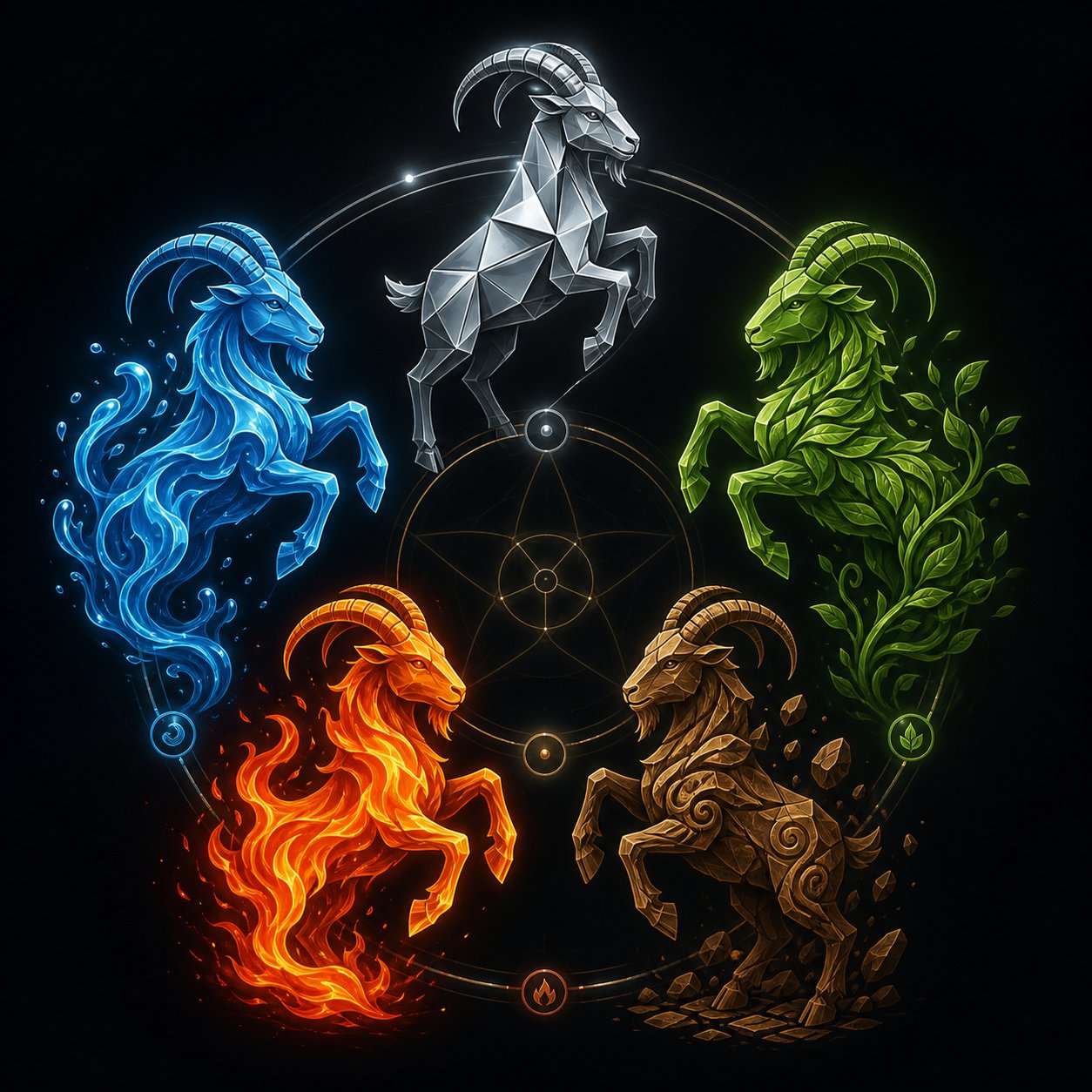
The character 羊 carries its own deep symbolism, but it never appears in isolation within the Chinese astrological system. Every Goat year is paired with one of five elemental energies: Wood (木 mu), Fire (火 huo), Earth (土 tu), Metal (金 jin), or Water (水 shui). These elements cycle through the zodiac on a sixty-year rotation, meaning each specific element-animal combination only repeats once every six decades. The result? Not one Goat archetype, but five distinctly different ones.
The Five Elements as Name Modifiers
Think of the Five Elements as adjectives that modify the noun 羊. A Metal Goat is still a Goat, still carrying all the linguistic associations of beauty, goodness, and auspiciousness explored earlier. But the Metal prefix sharpens those qualities, adding structure and determination. A Water Goat softens them, emphasizing emotional fluidity and selflessness.
This system means that someone born in a 2003 chinese zodiac year (Water Goat) and someone born in a 1991 chinese zodiac element year (Metal Goat) share the same base sign but express it through fundamentally different energetic lenses. The chinese zodiac sign of 2003 emphasizes adaptability and compassion, while the chinese zodiac 1991 emphasizes ambition and inner resolve. Same character, same radical embedded in beauty and virtue, but a noticeably different personality flavor.
The upcoming 2027 chinese zodiac year brings the Fire Goat, a combination that last appeared in 1967. Fire intensifies the Goat's expressive and creative tendencies, adding warmth, frankness, and a desire for clarity in all things.
Complete Element-Year Mapping for the Goat Sign
The table below maps every Goat year from 1931 through 2027 to its corresponding element, along with the specific lunar calendar dates that define each year's boundaries. Remember, Chinese zodiac years follow the lunar calendar, so they begin in late January or February rather than January 1.
| Element | Goat Years | Lunar Start - End Dates | Core Traits | Strengths | Challenges |
|---|---|---|---|---|---|
| Metal (Gold) | 1931, 1991 | Feb 17, 1931 - Feb 5, 1932; Feb 15, 1991 - Feb 3, 1992 | Ambitious, kind-hearted, responsible | Strong sense of duty, determination, principled leadership | Stubbornness, difficulty compromising, rigidity under pressure |
| Water | 1943, 2003 | Feb 5, 1943 - Jan 24, 1944; Feb 1, 2003 - Jan 21, 2004 | Selfless, helpful, emotionally perceptive | Deep empathy, adaptability, willingness to sacrifice for others | Over-giving, difficulty setting boundaries, emotional vulnerability |
| Wood | 1955, 2015 | Jan 24, 1955 - Feb 11, 1956; Feb 19, 2015 - Feb 7, 2016 | Amicable, gentle, compassionate | Creativity, cooperative spirit, natural growth mindset | Over-reliance on others' approval, indecisiveness in conflict |
| Fire | 1967, 2027 | Feb 9, 1967 - Jan 30, 1968; Feb 6, 2027 - Jan 25, 2028 | Frank, honest, expressive | Clarity of communication, warmth, organizational ability | Impatience, bluntness that may alienate sensitive people |
| Earth | 1919, 1979 | Feb 1, 1919 - Feb 19, 1920; Jan 28, 1979 - Feb 15, 1980 | Righteous, straightforward, loyal | Reliability, moral grounding, steadfast friendships | Resistance to change, excessive caution, self-limitation |
How Each Element Shifts Personality Meaning
What's fascinating about this system is how each element reshapes the core Goat qualities without contradicting them. The metal goat chinese zodiac type, for instance, takes the sign's natural gentleness and adds an iron backbone. These individuals are described as ambitious and kind-hearted with a strong sense of responsibility, but sometimes too stubborn to bend. The 2003 chinese zodiac element, Water, does the opposite: it dissolves rigidity and amplifies the Goat's empathetic nature. China Highlights describes Water Goats as "always ready to help others" and willing to "sacrifice their own interests for others."
Wood Goats (1955, 2015) channel the sign's creativity most visibly. Bill Gates and Steve Jobs were both born in 1955, the Wood Goat year, and their careers reflected the element's emphasis on growth, innovation, and collaborative vision. Fire Goats (1967, 2027) bring the chinese zodiac 2027 energy of directness and passion. Earth Goats (1919, 1979) ground the sign in practical loyalty and moral consistency.
Each elemental variation tells you something different about how the name 羊 expresses itself across generations. The character stays the same. The embedded meanings of beauty, goodness, and auspiciousness remain constant. But the element determines which facet shines brightest in any given sixty-year window, creating a personality profile that feels specific and personal rather than generic.
These elemental layers add nuance, but the deeper question remains: how do all these linguistic and symbolic meanings actually translate into the personality traits that zodiac readings assign to people born under this sign?
Goat Zodiac Personality Rooted in Name Symbolism
The character 羊 encodes beauty, goodness, auspiciousness, and righteousness directly into its strokes. It lives inside 美, 善, 祥, and 义. So when a chinese horoscope goat reading describes someone as gentle, artistic, empathetic, and morally sensitive, those traits aren't pulled from thin air. They flow from the linguistic DNA of the name itself. The year of the goat personality is, in a very real sense, a personality written into the Chinese language thousands of years before any horoscope column existed.
From Name Meaning to Personality Profile
Imagine you're reading a chinese zodiac goat personality description for the first time. You'll notice a consistent cluster of traits across nearly every source: creativity, compassion, gentleness, artistic talent, and a deep desire for harmony. Where do these come from? They map directly onto the characters that contain 羊 as a component:
- Creativity and artistic sensibility - derived from 美 (mei, beauty). The goat zodiac personality carries an innate aesthetic awareness because its name literally builds the concept of beauty. People born under this sign are described as elegant artists and creative workers who see the world through an aesthetic lens.
- Compassion and empathy - derived from 善 (shan, goodness/benevolence). The goat chinese zodiac personality includes deep concern for others, a willingness to forgive, and an instinct to nurture. These individuals tend to put others' needs above their own.
- Desire for harmony and peace - derived from 祥 (xiang, auspiciousness). The sign's association with divine blessing and good fortune manifests as a personality that seeks tranquility, avoids conflict, and creates calm environments.
- Moral sensitivity and integrity - derived from 义 (yi, righteousness). The chinese zodiac goat personality includes a strong internal compass, a sense of fairness, and discomfort with dishonesty or injustice.
- Modesty and gentleness - derived from 羞 (xiu, modesty/shyness). The sign's quiet, non-aggressive nature connects to this character's meaning, producing people who lead through softness rather than force.
This isn't coincidence or creative interpretation. The chinese horoscope year of the goat personality profile is a cultural reading of what the character 羊 already means within the writing system. StudyCLI notes that people born in the Year of the Goat are "benevolent, upright and kind, easily influenced by the unfortunate experiences of others," and "often elegant artists or creative workers." Those descriptions echo the very characters that 羊 inhabits.
Debunking the Unluckiest Zodiac Myth
If the linguistic evidence points so strongly toward positive meaning, why does a persistent folk belief claim the Goat year is unlucky? The superstition centers on a saying: 十羊九不全 (shi yang jiu buquan), which translates roughly to "out of ten goats, nine are incomplete." According to ChinaSource's research, this phrase likely originated in the late Qing Dynasty, when Empress Dowager Cixi (born in a Goat year) was blamed for national decline. Court ministers Zeng Guofan and Li Hongzhang were also "sheep," and public anger at the country's disintegration got projected onto their shared zodiac sign.
The superstition has real consequences. Birth rates in China drop measurably during Goat years as couples delay pregnancy to avoid the perceived bad luck. LTL Language School reports that unlike the Year of the Dragon, when birth rates rise rapidly, the Year of the Goat sees a sharp decline, affecting everything from school enrollment to demand for national services.
But scholars who study the character's etymology find the superstition linguistically incoherent. The second-century dictionary by Xu Shen stated plainly: "Sheep is Xiang" (auspicious). Late Qing scholar Wang Guowei confirmed in his Guan Tang Collection that 祥 (auspicious) is the classical Chinese character for sheep. The character 羊 and the concept of blessing were originally the same word.
In Chinese, many important terms use the character for sheep to express beautiful concepts. Beauty, goodness, righteousness, and auspiciousness all contain 羊. Reexamining the meaning of sheep in Chinese culture breaks people away from the "Unlucky Year of the Sheep" myth.
Strengths That Flow From the Name's Symbolism
Goat astrology, when grounded in the character's actual linguistic heritage rather than folk superstition, reveals a sign of remarkable depth. The strengths associated with this zodiac position aren't generic positive adjectives. They're specific qualities encoded into the writing system:
- Resilience disguised as gentleness - Goats are often portrayed as aloof from worldly affairs, presenting a picture of peacefulness. But as StudyCLI observes, "although goats are associated with mildness and gentleness, they also exhibit the noble trait of perseverance in the face of difficulty."
- Generosity rooted in moral conviction - The 义 (righteousness) connection means Goat-year people don't just give. They give because their internal sense of justice demands it.
- Creative vision that transforms environments - The 美 (beauty) connection produces people who don't just appreciate art. They instinctively reshape their surroundings toward harmony and aesthetic coherence.
- Emotional intelligence that builds community - The 善 (goodness) connection manifests as an ability to forgive faults, understand challenges, and create spaces where others feel safe.
The year of the goat personality, properly understood, is not about weakness or bad luck. It's about a sign whose very name carries the weight of Chinese civilization's highest values. The folk superstition is a late historical accident. The linguistic evidence stretches back millennia and tells a completely different story: one of beauty, virtue, and blessing woven into the fabric of written language itself.
These personality insights remain somewhat abstract until you see how they translate into concrete practice. In Chinese-speaking families, the meanings embedded in 羊 directly influence one of the most personal decisions parents ever make: choosing a name for a child born under this sign.
Naming Children Born Under the Sign of the Goat
All the linguistic symbolism, elemental layers, and cultural associations explored so far converge in one deeply personal practice: choosing a name for a baby born in a Goat year. In Chinese-speaking families, naming isn't a casual exercise in what sounds nice. It's a deliberate act of encoding meaning, fortune, and identity into the characters a child will carry for life. And for children born during zodiac sheep years, the process draws directly on everything the character 羊 represents.
The next goat year arrives in 2027 (February 6, 2027 through January 25, 2028), making this a Fire Goat year. Parents expecting a chinese new year goat baby will face the same question families have navigated for centuries: which characters will harmonize with the sign's energy and set the child on a favorable path?
Lucky Radicals and Characters for Goat-Year Babies
In the Chinese Name Analysis System (八字生肖姓名学), every character in a name is evaluated for its radical composition, stroke count, and compatibility with the child's zodiac sign. For babies born in the years of goat chinese zodiac, certain radicals are considered especially auspicious because they align with the animal's natural environment and behavior. Goats graze on grass, shelter in enclosures, and thrive alongside their zodiac allies (Pig and Rabbit in the San He trinity).
According to Master Jo Ching of DestinyAsia Global Consultancy, the following radicals and character types bring positive energy to Goat-year children:
- 艹 (grass radical) - Characters like 菁, 莉, 蓉, 茂, 菊, and 莆 contain this radical, signifying abundant grazing and nourishment. Since goats feed on plants rather than meat, names with the grass radical suggest a life of good support, helpful people, and easier paths to success.
- 宀 (roof radical) - Characters like 宏, 定, 富, and 容 symbolize shelter and protection. A goat under a roof is safe and cared for, translating to quality of life, peace, and career achievement.
- 豕 (pig radical) and 卯 (rabbit-related shapes) - Characters like 家, 豪, 逸, and 卿 form the San He (三合) or Three-Harmony relationship with the Goat sign. Pig, Rabbit, and Goat create an extremely powerful auspicious trinity in BaZi astrology.
- Snake and Horse shapes (巳, 午) - Characters like 通, 建, 廷, 南, 朱, and 骏 relate to the San Hui (三会) or Three-Seasonal Summer relationship. Snake, Horse, and Goat together form this seasonal bond, adding fire-element support.
- 山 (mountain) and 谷 (valley) radicals - Characters like 山, 丘, 谷, and 岳 reflect the goat's natural habitat. These suggest adaptability, resilience, and comfort in any living condition.
Equally important is knowing which radicals to avoid. The chinese calendar year of the goat carries specific taboos rooted in the animal's nature and astrological clashes:
- 氵(water radical) - Characters like 清, 涵, 港, and 溫 are considered inauspicious. Goats fear water because their sweat glands sit beneath their hooves. Wet feet block those glands and threaten survival. In naming, water radicals suggest punishment and hardship.
- 王 (king radical) - Characters like 珍, 玉, 玲, and 瑜 imply sacrifice. Historically, the closest a goat gets to a king is as an offering in the palace. Names with this radical suggest a life of giving to others with little return.
- 丑/牛 (ox-related) - Characters containing ox shapes create a direct zodiac clash. Goat and Ox have conflicting energies, one of the six major clashes in BaZi.
- 心/忄(heart radical) - Characters like 思, 慧, 愛, and 志 reference flesh and meat. Since goats only eat plants, heart-radical characters suggest effort that doesn't match reward.
Five Elements Theory in Name Selection
Beyond radical compatibility, parents also consider when is the year of the goat in relation to the Five Elements cycle. A Fire Goat baby (2027) needs different elemental balancing than a Water Goat baby (2003) or a Wood Goat baby (2015). The child's birth date, hour, and the specific elemental composition of their BaZi chart all influence which characters will create harmony.
For the 2027 chinese new year Fire Goat, names that incorporate earth-element characters can help ground the fire energy, while wood-element characters feed the fire constructively. Water-element names, already problematic for the Goat sign generally, become doubly cautious for Fire Goats since water extinguishes fire.
The middle character in a three-character Chinese name governs relationships with peers, siblings, and spouse. The last character governs career, finances, and health. A name expert evaluates each position independently, ensuring that when is the next year of the goat arrives, parents have characters that work harmoniously across all three positions.
Connecting Zodiac Meaning to Personal Identity
What makes this practice so compelling is how it closes the loop on everything the character 羊 encodes. The beauty embedded in 美, the goodness in 善, the auspiciousness in 祥: these aren't just abstract linguistic observations. They become active design principles when parents select characters for their child's name. A Goat-year baby named with the grass radical carries the sign's nurturing abundance. One named with mountain characters inherits its resilience. The zodiac meaning becomes personal identity, written into the characters a person signs on documents, introduces themselves with, and carries through every stage of life.
This is the final layer of year of the goat name meanings: the sign doesn't just describe who you are. In Chinese naming philosophy, it actively shapes the energy surrounding your path. The character 羊, with its three-thousand-year history of encoding virtue into written language, becomes not just a zodiac label but a living blueprint for how a name can carry blessing, beauty, and purpose forward into a new generation.
Year of the Goat Name Meanings: Frequently Asked Questions
1. Is it the Year of the Goat or the Year of the Sheep?
Both are correct translations of the same Chinese character 羊 (yang). In Chinese, there is no distinction because 羊 encompasses goat, sheep, and ram simultaneously. The confusion only arises in English translation. Vietnamese tradition uses goat because sheep don't exist in their climate, while Korean tradition favors sheep as the prototypical image. Within authentic Chinese astrology, your zodiac reading remains identical regardless of which English word you choose.
2. What does the character 羊 mean beyond the animal itself?
The character 羊 functions as a building block inside numerous Chinese characters tied to positive values. It appears within 美 (beauty), 善 (goodness), 祥 (auspiciousness), 义 (righteousness), and 羞 (modesty). This means the zodiac sign's name carries embedded associations with virtue and blessing at the structural level of the writing system, making it one of the most symbolically rich zodiac animals.
3. Why is the Year of the Goat considered unlucky by some people?
The superstition traces back to the late Qing Dynasty when Empress Dowager Cixi, born in a Goat year, was blamed for national decline. The phrase 十羊九不全 (nine out of ten goats are incomplete) emerged from political anger rather than linguistic or cultural tradition. Scholars point out this belief contradicts the character's etymology, since ancient dictionaries equated 羊 directly with 祥 (auspiciousness), and the writing system embeds the character inside words for beauty, goodness, and blessing.
4. How do the Five Elements change the Year of the Goat personality?
Each Goat year pairs with one of five elements on a sixty-year cycle, creating distinct personality subtypes. Metal Goats (1931, 1991) are ambitious and principled. Water Goats (1943, 2003) are selfless and emotionally perceptive. Wood Goats (1955, 2015) are creative and cooperative. Fire Goats (1967, 2027) are frank and expressive. Earth Goats (1919, 1979) are loyal and morally grounded. The base traits of gentleness and creativity remain, but each element shifts which qualities dominate.
5. What are lucky name characters for babies born in the Year of the Goat?
Chinese naming experts recommend characters containing the grass radical (艹) for abundance, the roof radical (宀) for protection, and mountain radicals (山) for resilience. Characters related to the Pig and Rabbit zodiac signs are also favorable since they form the San He auspicious trinity with the Goat. Parents should avoid water radicals (氵), king radicals (王), and ox-related shapes, as these conflict with the Goat sign's energy according to BaZi astrology principles.