The Zhang Surname and Its Enduring Legacy in Chinese History
Imagine sharing your last name with the entire population of Germany. That is the reality for people who carry the Zhang surname. Consistently ranked among the top three most common surnames in China, Zhang is carried by roughly 90 million people within mainland China alone, with millions more spread across the global diaspora. Is Zhang a Chinese name? It is one of the most quintessentially Chinese names in existence, with roots stretching back over 4,000 years to the era of legendary emperors and bronze-age warfare.
Zhang ranks as the third most common surname in China, shared by approximately 90 million people, representing nearly 7% of the nation's population.
Why Zhang Ranks Among China's Most Common Surnames
China has the world's largest population but one of the smallest surname pools. Only about 6,000 surnames remain in active use, and almost 86% of the population shares just 100 of those names. The five most common surnames alone, Wang, Li, Zhang, Liu, and Chen, account for over 433 million people, roughly 30% of all Chinese citizens. Within this concentrated landscape, the Zhang last name has held its position near the top for centuries. Given how few surnames pair with a limited set of popular given names, "Zhang Wei" is often cited as the most common full name in China, shared by hundreds of thousands of individuals.
The Chinese Surname System and Zhang's Place Within It
Chinese surnames carry a weight that goes far beyond identification. As early as the third millennium BC, the legendary Yellow Emperor is said to have ordered people to adopt hereditary family names. By the Song Dynasty (960-1279 AD), the classic poem Baijiaxing, or Hundred Family Surnames, listed over 500 surnames and became a standard text for teaching young scholars to read. The expression laobaixing, meaning "one hundred old surnames," became the Chinese term for ordinary folk.
Unlike Western naming traditions, where church or state authorities maintained identity records, Chinese families and clans kept all the documentation themselves. Your surname reveals your family origin, clan history, migration patterns, and regional distribution. For anyone researching their heritage, finding the correct Chinese surname is the essential first step. The Zhang surname, as one of the most common in China, connects its bearers to a vast network of clan genealogies, ancestral halls, and historical records that span millennia.
What follows is a journey through that history, from a legendary archer who first drew a bow to the millions of Zhang descendants now living on every continent. The story of how one clan grew from a single family into a global population larger than most countries begins, as all Chinese surname stories do, with the character itself.
Etymology of the Zhang Character From Oracle Bones to Modern Script
Every Chinese character tells a story, and few tell one as vivid as 張 (zhang in chinese). When you look at this character closely, you'll notice it is not a single abstract symbol. It is a picture built from two meaningful parts, each pointing back to a specific moment in legendary history: the invention of the bow and arrow.
Breaking Down the Bow Radical and Its Meaning
The traditional form 張 is composed of two distinct elements:
- 弓 (gong) on the left side, meaning "bow." This is the radical, the semantic anchor that tells you the character relates to archery or stretching.
- 長 (chang) on the right side, meaning "long" or "to stretch." In the simplified form 张, this component appears as 长.
Put them together and the zhang meaning becomes clear: to stretch a bow, to draw it open, to spread wide. Imagine the physical motion of pulling a bowstring taut. That action, that tension between the bow and the archer's arm, is encoded directly into the character's structure.
In modern usage, 张 has evolved beyond its archery roots. It now serves as a measure word for flat objects like sheets of paper, tickets, or tables, retaining the sense of something spread open or laid flat. But as a surname, it preserves its oldest meaning: the one who draws the bow.
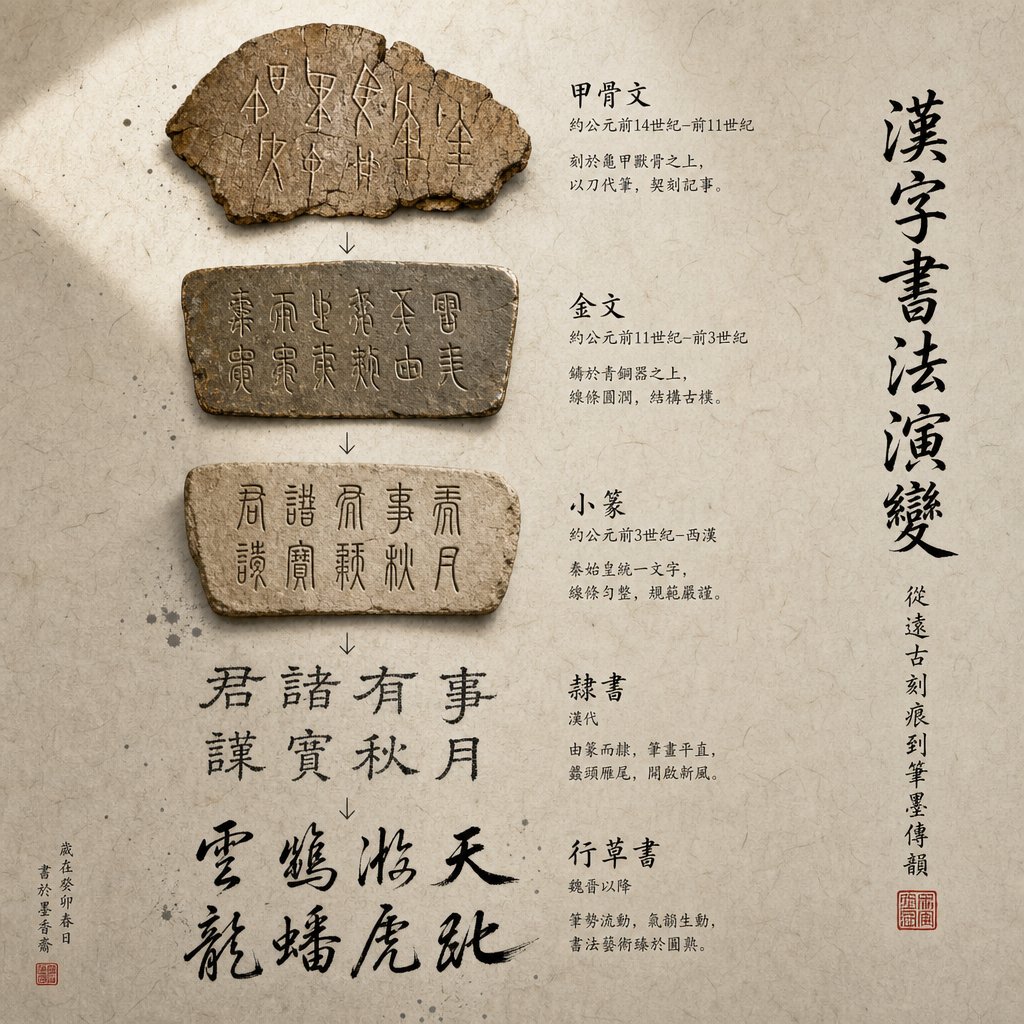
How the Zhang Character Evolved Through Script Eras
Chinese writing has undergone dramatic transformations over four millennia. The character for Zhang traveled through each of these stages, gradually shifting from a pictographic sketch toward the streamlined form used today.
| Script Era | Approximate Period | Character Form | Key Features |
|---|---|---|---|
| Oracle Bone Script | c. 1200-1050 BC (Shang Dynasty) | Pictographic form | A recognizable bow shape with a figure stretching it; highly pictorial |
| Bronze Inscriptions | c. 1050-500 BC (Zhou Dynasty) | Early standardized form | Bow radical becomes more distinct; right component stabilizes |
| Seal Script (篆书) | c. 500-200 BC (Warring States to Qin) | Rounded, symmetrical form | Elegant curves; both components clearly separated but balanced |
| Clerical Script (隶书) | c. 200 BC-200 AD (Han Dynasty) | Flattened, angular form | Horizontal strokes emphasized; transition toward modern appearance |
| Regular Script (楷书) | c. 200 AD onward | 張 | Standard traditional form used in calligraphy and print |
| Simplified Script | 1956 onward (PRC) | 张 | Right component simplified from 長 to 长; left radical 弓 unchanged |
You'll notice something interesting across this timeline: the bow radical 弓 on the left remained remarkably stable through every era. Even in the earliest oracle bone carvings, the curved shape of a bow is unmistakable. The right side underwent more change, gradually losing its pictographic detail as scribes prioritized speed and uniformity over illustration.
The Connection Between the Character and the Bow Inventor Legend
The character's structure is not coincidental. It directly references the story of Hui, grandson of the Yellow Emperor, who is credited with inventing the bow and arrow. According to traditional genealogical accounts, Hui was the son of Qing Yangshi (青阳氏), the Yellow Emperor's fifth son. One night, Hui observed a formation of stars shaped like a bow, known as the Heavenly Bow constellation (天弓星). Inspired by this celestial pattern, he crafted the first bow and arrow.
The Yellow Emperor, recognizing the military and practical significance of this invention, appointed Hui as "First Bow" (弓正, Gong Zheng), the official in charge of bow production. As a permanent honor, Hui received the surname 張, a character that literally encodes his achievement: the act of drawing a bow. The Old Chinese pronunciation has been reconstructed by linguists as *C.tran, evolving through Middle Chinese "Trjang" into the modern Mandarin "Zhang."
This origin story explains why the zhang meaning carries such specific imagery. Unlike surnames derived from place names or official titles, Zhang belongs to a smaller category of Chinese surnames that describe a physical action or craft. The character is, in essence, a frozen verb: to stretch, to draw, to open. Every person who carries the name 张 or 張 today carries a four-thousand-year-old reference to that legendary moment when an ancestor looked up at the stars and saw the shape of a weapon that would change history.
The character's dual nature, part action and part identity, also hints at something deeper about how the Zhang clan multiplied. A surname rooted in a military innovation carried prestige. And prestige, as the next chapter reveals, attracted multiple unrelated lineages who adopted the name through very different historical paths.
Legendary Origins and Multiple Ancestral Lineages of Zhang
Prestige attracts imitation. A surname tied to military innovation and imperial favor did not stay confined to a single bloodline for long. The zhang last name origin is not one story but several, each documented in classical genealogical texts and each producing a distinct branch of descendants who carry the same character on their family registers today.
The Yellow Emperor Lineage Through Zhang Hui
The dominant origin theory traces the surname directly to the Yellow Emperor's lineage. According to the Yuanhe Xingzuan (元和姓纂), a Tang dynasty genealogical encyclopedia compiled around 812 AD: "Hui, the fifth son of Shaohao Qingyang, observed the Bow-star constellation, first created bows and arrows, presided over sacrifices to the Bow-star, and was granted the surname Zhang." The New Book of Tang (新唐书) corroborates this account in its Table of Chancellor Genealogies, stating that Hui served as Gong Zheng, the official in charge of bow production, and that "his descendants were bestowed the surname Zhang."
Hui's descendants settled in a place called Qingyang, which corresponds to modern-day Qinghe County in Hebei Province. This settlement became so central to Zhang identity that a folk saying emerged: "天下张姓出清河," meaning "all Zhang descendants under heaven come from Qinghe." Genealogies compiled across nine southern provinces, and even overseas clan associations in Malaysia and Taiwan, consistently identify Qinghe as the ancestral homeland and use "Qinghe Hall" (清河堂) as their primary hall name.
Alternative Origin Stories and Adopted Lineages
The last name zhang origin is more complex than a single ancestor, though. The Tongzhi (通志), a 12th-century encyclopedic history by Zheng Qiao, records a second major lineage: during the Spring and Autumn period (770-476 BC), the state of Jin had a senior official named Xie Zhang (解张), whose courtesy name was Zhang Hou (张侯). His descendants adopted his courtesy name as their surname. The Tongzhi notes that "from then on, the state of Jin had the Zhang clan for generations," and that after Jin split into three successor states, these Zhang families served in the states of Han and Zhao.
Beyond these two primary lineages, several other paths led families into the Zhang surname:
- Zhang Liao's surname change (Three Kingdoms era): The famous Wei general Zhang Liao (169-222 AD) was originally a descendant of the Nie (聂) clan, specifically of Nie Yi, the instigator of the Mayi Conspiracy. His family changed their surname to Zhang to avoid political retaliation, and all subsequent descendants carried the new name.
- Zhuge Liang's imperial grant: During the Three Kingdoms period, Long Youna (龙佑那), a chieftain of the southern peoples residing in Yunnan, received the surname Zhang as a bestowed honor from Zhuge Liang, the Chancellor of Shu. His descendants adopted it permanently.
- Surname changes during political upheaval: Throughout various dynasties, families facing persecution or seeking political advantage changed their original surnames to Zhang, blending into the larger clan network.
Ethnic Minority Assimilations Into the Zhang Clan
The zhang name origin expanded further through centuries of ethnic integration. According to historical records, peoples including the Xianbei, Xiongnu, Khitan, Jurchen, and Uyghur adopted the Zhang surname during various periods of sinicization. These changes accelerated under policies implemented during the Tang, Song, Yuan, Ming, and Qing dynasties, such as the Jimi system (loose-rein governance) and the policy of replacing native chieftains with state-appointed officials. Today, individuals with the Zhang surname can be found among the Achang, Naxi, Lisu, Yao, Zhuang, Li, Gaoshan, and Tibetan ethnic groups.
What does this mean for modern descendants? Two people named Zhang may share no common ancestor at all. Their families could trace back to the Yellow Emperor's grandson, a Jin dynasty official, a Wei general who changed his name, a Yunnan chieftain honored by a chancellor, or an ethnic minority family that adopted a Han surname centuries ago. This is essential genealogical knowledge: when tracing your Zhang ancestry, identifying which lineage your branch belongs to is the critical first step before any meaningful research can begin.
These multiple origin streams fed into a single surname pool that grew steadily through each successive dynasty. The mechanisms behind that growth, from imperial appointments to civil service examinations, turned a collection of unrelated families into one of history's largest clan networks.

How the Zhang Clan Rose Through Every Chinese Dynasty
A surname does not become one of the three most common in a nation of 1.4 billion by accident. The zhang family name grew through deliberate mechanisms: military achievement, intellectual brilliance, imperial appointments, and a civil service system that rewarded talent regardless of birth. Each dynasty offered new opportunities, and Zhang families seized them consistently across more than two thousand years.
Zhang Clan Growth During the Zhou and Han Dynasties
During the Western Zhou period (1046-771 BC), the earliest Zhang families held hereditary positions related to bow production and military supply. Their role was practical but limited in scope. The real expansion began during the Warring States era and accelerated dramatically under the Han dynasty (206 BC-220 AD), when two figures elevated the zhang chinese identity from regional clan to nationally recognized name.
The first was Zhang Liang (c. 251-189 BC), one of the "Three Prominences of the Early Han Dynasty." Born into an aristocratic family from the state of Han, Zhang Liang dedicated his life to overthrowing the Qin dynasty after it annexed his homeland. He attempted to assassinate the First Emperor with a 120-catty iron hammer, failed, fled as a fugitive, and eventually became the chief strategist behind Liu Bang's rise to power. His counsel at the Feast at Hong Gate, his Xiayi Plan after the devastating defeat at Pengcheng, and his diplomatic handling of Han Xin's ambitions all proved decisive. After the Han dynasty's founding in 202 BC, Zhang Liang was enfeoffed as Marquis of Liu, then retired to practice Taoism. His eighth-generation descendant, Zhang Daoling, would later found the Celestial Masters school of Daoism.
The second transformative figure was Zhang Heng (78-139 AD), a polymath whose contributions spanned astronomy, mathematics, seismology, and literature. He invented the world's first seismoscope, improved the armillary sphere, calculated pi to a new level of precision, and served as Chief Astronomer at the imperial court. For chinese zhang families, these two men demonstrated that the surname could produce both military strategists and scientific geniuses, a combination that attracted prestige and patronage.
Peak Influence in the Tang and Song Eras
The Tang dynasty (618-907 AD) marked the golden age of Zhang political influence. The meritocratic civil service examination system, fully institutionalized under the Tang, opened government positions to anyone who could pass rigorous literary and policy tests. Zhang families invested heavily in educating their sons, and the results were remarkable. Tang records list multiple Zhang chancellors, including Zhang Jiuling (678-740 AD), the celebrated poet-statesman who served as chief minister under Emperor Xuanzong.
The Song dynasty (960-1279 AD) continued this pattern. Zhang Zai (1020-1077 AD) became one of the founding philosophers of Neo-Confucianism, and his famous "Western Inscription" remains a cornerstone of Chinese ethical thought. Zhang Zeduan painted Along the River During the Qingming Festival, one of the most celebrated works in Chinese art history. These cultural contributions cemented the surname's association with scholarship and refinement, among the most valued traits in chinese male surnames during the imperial era.
Consolidation and Population Boom in Ming and Qing Periods
The Ming (1368-1644) and Qing (1644-1912) dynasties brought population explosions that multiplied Zhang numbers into the tens of millions. Government-organized resettlements, expanded agricultural land, and relative political stability allowed large families to grow without the disruptions of constant warfare. Zhang Juzheng (1525-1582), the powerful Grand Secretary under the Wanli Emperor, implemented sweeping fiscal reforms that stabilized the Ming state for decades. His prominence further elevated the surname's standing among the educated gentry class.
| Dynasty | Period | Key Zhang Figure | Contribution |
|---|---|---|---|
| Western Han | 206 BC - 9 AD | Zhang Liang | Chief strategist in founding the Han dynasty |
| Eastern Han | 25 - 220 AD | Zhang Heng | Invented seismoscope; polymath astronomer |
| Eastern Han | 25 - 220 AD | Zhang Zhongjing | Father of Chinese clinical medicine |
| Three Kingdoms | 220 - 280 AD | Zhang Fei | Legendary general of Shu Han |
| Tang | 618 - 907 AD | Zhang Jiuling | Poet and chief minister under Xuanzong |
| Song | 960 - 1279 AD | Zhang Zai | Founding philosopher of Neo-Confucianism |
| Song | 960 - 1279 AD | Zhang Zeduan | Painted the Qingming scroll masterpiece |
| Ming | 1368 - 1644 AD | Zhang Juzheng | Grand Secretary; major fiscal reformer |
| Qing | 1644 - 1912 AD | Zhang Zhidong | Self-Strengthening Movement leader; modernizer |
Notice the pattern across this table. In every era, at least one Zhang figure rose to national prominence through a different path: military strategy, scientific invention, philosophical writing, artistic mastery, or political reform. This diversity was not coincidental. With multiple unrelated lineages feeding into the same surname pool, and with the examination system rewarding individual merit rather than inherited status, the Zhang clan functioned less like a single family and more like a distributed network. Each branch that produced a chancellor or a scholar attracted marriage alliances, land grants, and social prestige that fueled further growth.
The cumulative effect of two millennia of sustained achievement was a surname that did not merely survive dynastic transitions but thrived through them. Yet political success alone does not explain how Zhang families ended up concentrated in specific provinces rather than evenly distributed across China. That geographic clustering traces back to something more disruptive: war, rebellion, and forced migration.

Migration Patterns That Spread Zhang Across China
War does not just destroy. It scatters people, and scattered people carry their surnames into new territory. The Zhang clan's geographic spread across China was not a gradual, peaceful diffusion. It was driven by catastrophic events that uprooted millions from the Yellow River heartland and pushed them south, west, and eventually into every province of the empire.
From the Yellow River Cradle to Southern Provinces
The earliest Zhang families clustered around the Yellow River basin, specifically in what is now Hebei and Henan. Qinghe County in Hebei, the legendary homeland of Zhang Hui, served as the ancestral center. This matches the broader pattern of Chinese civilization: research on historical spatial development confirms that north China was the cradle of Han civilization, with the majority of the population residing in the north during the early period (c. 2-200 AD).
But proximity to nomadic steppe peoples made the north a target for repeated invasions. Each invasion triggered a wave of refugees fleeing south, and Zhang families moved with them. The result, over roughly a thousand years, was a decisive shift in population gravity from north to south.
War and Rebellion as Migration Catalysts
Three major migration waves reshaped where Zhang families lived. Each was triggered by a specific military catastrophe:
- The Disaster of Yongjia (311 AD): Xiongnu-descended Zhao forces overran the Western Jin capital at Luoyang, forcing the government and aristocratic families to flee south. An estimated 900,000 people, roughly 5.6% of the population, relocated. Han elites, including Zhang clan members, moved alongside royal family members to establish new roots south of the Yangtze.
- The An Lushan Rebellion (755 AD): A Sogdian military commissioner named An Lushan staged a rebellion that overran northern China during the Tang dynasty. The emperor fled southwest to Sichuan, while elite families scattered to the Jiangnan region near the lower Yangtze River Valley. Approximately 2.5 million people, or 4.7% of the population, abandoned the north. Zhang families with the surname chang (the Wade-Giles romanization common in Taiwan) can often trace their southern migration to this period.
- The Jingkang Incident (1125-1142 AD): Jurchen invaders captured the Song emperor and occupied northern China, forcing the court to retreat and establish the Southern Song dynasty at Hangzhou. This was the largest wave: an estimated 5 million people, a staggering 11% of the population, migrated south. Many settled in Zhejiang, where Chinese communities of Zhang descent remain concentrated today.
These migrations were not random dispersals. Research shows that destinations receiving large-scale inflows during the third wave experienced significantly higher population density and urbanization that persisted for centuries afterward. The Jiangnan region, a popular destination during the second and third waves, emerged as China's single most prosperous area by 1270 AD and has remained so ever since.
A fourth, distinct migration pattern occurred during the Ming dynasty (1368-1644). Rather than fleeing war, families were relocated by government order. The Ming court organized mass resettlements from Shanxi province, particularly from the famous gathering point at the Old Locust Tree in Hongtong County. Zhang genealogies from Hebei, Shandong, Henan, and Sichuan frequently record founding ancestors who "migrated from Hongtong County, Shanxi during the early Ming Dynasty." Later, during the Qing dynasty, the "Migration from Huguang to Sichuan" policy repopulated war-devastated Sichuan with families from Hubei and Hunan, many carrying the surname Chang or Zhang depending on their dialect group.
Where Zhang Families Concentrate in China Today
These historical movements explain why Zhang populations cluster where they do. The heaviest concentrations today appear in:
- Henan and Shandong: The original Yellow River heartland, where families that never migrated or returned after upheavals remained rooted.
- Hebei: Home to Qinghe, the ancestral homeland, and a major recipient of Ming-era Shanxi resettlements.
- Sichuan: Repopulated during the Qing dynasty by Huguang migrants, many of whom were Zhang families from Hubei and Hunan.
- Guangdong and Zhejiang: Terminal destinations for southern migration waves, where Changs Chinese communities (using Cantonese or other southern dialect romanizations) established deep roots.
Physical markers of these migration routes still stand. Zhang ancestral halls (祠堂) dot the landscape from Qinghe in the north to Guangdong in the south. These halls served as gathering places for worship, dispute resolution, and genealogy maintenance. The Qinghe Zhang Ancestral Hall remains a pilgrimage site for Zhang descendants worldwide, while smaller branch halls in Fujian, Jiangxi, and Guangdong mark the endpoints of specific migration paths.
To keep track of which branch came from where, Zhang families developed the hall name system (堂号). A hall name functions as a sub-identifier within the larger surname, distinguishing one regional lineage from another. The most prestigious is "Qinghe Hall" (清河堂), used by branches claiming descent from the original Yellow Emperor lineage. But dozens of others exist: "Bairen Hall" (百忍堂) traces to Zhang Gongyi of the Tang dynasty, who famously wrote the character for "endurance" one hundred times when Emperor Gaozong asked how his family maintained harmony across nine generations living under one roof. Other branch hall names reference geographic origins, ancestral achievements, or ethical principles that defined a particular lineage's identity.
This system meant that two Zhang families meeting for the first time could immediately determine whether they shared a common ancestor or belonged to entirely separate lineages. Your hall name told people not just your surname but your story: where your ancestors lived, when they migrated, and which branch of the vast Zhang network you belonged to. It was, in effect, an address system for a clan too large to know itself without one.
The same migrations that spread Zhang families across China's provinces eventually carried them beyond China's borders entirely. And when they crossed those borders, the single character 张 fractured into a dozen different spellings, each one a linguistic fingerprint of the dialect spoken in the village they left behind.
Every Romanization Variant of Zhang Mapped to Dialect and Region
A single Chinese character. Over a dozen different spellings in the Roman alphabet. If your last name is Chang, Cheung, Teo, or Jang, you might not immediately realize you share the same surname as someone named Zhang. Yet all of these spellings trace back to one character: 張. The difference lies not in the written Chinese but in how your ancestors pronounced it, and which immigration official tried to write down what they heard.
Mandarin Romanizations and Regional Pinyin Variants
In standard Mandarin, 張 is pronounced in the first tone with a retroflex initial: Zhāng. Under the Hanyu Pinyin system adopted by the People's Republic of China in 1958, this becomes "Zhang," the spelling most familiar to people in mainland China and increasingly in international contexts.
The older Wade-Giles romanization system, developed in the 19th century and still widely used in Taiwan until recently, renders the same sound as "Chang." If your last name is Chang, there is a strong chance your family emigrated from Taiwan or left China before Pinyin became standard. Taiwan officially recommended "Zhang" as the first translation option for 張 starting in 2017, but generations of Taiwanese families already carry "Chang" on their passports and legal documents. The chang last name remains the sixth most common Chinese American surname, reflecting decades of emigration under the Wade-Giles system.
This single Mandarin-to-English gap already creates confusion. Someone with the last name Chang in the United States could be a Zhang from Taiwan, a Zhang from pre-1949 mainland China, or even a Korean Chang. Context and family history are the only reliable ways to distinguish them.
Cantonese and Southern Dialect Spellings
Southern Chinese dialects diverge dramatically from Mandarin in pronunciation, and the romanizations reflect that divergence. The Cantonese pronunciation of 張 sounds nothing like "Zhang" to an English speaker. In Jyutping, the standard Cantonese romanization, it is rendered as "Zoeng1." But on passports and identity documents in Hong Kong, the conventional spelling is Cheung.
The cheung surname is immediately recognizable in Hong Kong. Pop icon Jacky Cheung, one of the "Four Heavenly Kings" of Cantopop, carries this spelling. If your cheung last name traces to Hong Kong or the Cantonese-speaking diaspora in Canada, Australia, or the UK, your ancestors almost certainly spoke Cantonese as their primary dialect.
In Macau and parts of Malaysia, the same Cantonese pronunciation gets spelled as Cheong, reflecting Portuguese-influenced romanization conventions in Macau and local transcription practices in Southeast Asia. Meanwhile, Hakka speakers pronounce 張 with a different initial consonant entirely, producing Chong. For anyone researching the chong last name origin, the answer typically points to Hakka-speaking communities in Guangdong, Fujian, or their diaspora in Southeast Asia, particularly Malaysia and Singapore where Hakka immigrants settled in large numbers.
Further south in the dialect spectrum, Hokkien and Teochew speakers produce yet another sound. Their pronunciation of 張 is romanized as Teo or Teoh, spellings common among Chinese communities in Malaysia, Singapore, and Thailand. The Foochow (Eastern Min) dialect renders it as Tiong or Diong, found primarily among Chinese Filipinos and Fuzhou emigrants in Southeast Asia.
Korean and Vietnamese Cognates of Zhang
The character 張 traveled beyond Chinese dialect groups into entirely separate languages. In Korea, the same Hanja character is read as 장, romanized as Jang (Revised Romanization) or Chang (McCune-Reischauer). The jang last name origin traces to Korean clans that adopted Chinese characters for their surnames during periods of heavy Chinese cultural influence. Korean Jangs are ethnically Korean, not Chinese, though the written character is identical.
In Vietnam, 張 became the surname Trương (or Truong without diacritics). Trương ranks eighth among Vietnamese surnames, carried by approximately 2.2% of the population. Vietnamese bearers include ethnic Kinh (Vietnamese), Chinese-Vietnamese, Cham, and other minority groups. A less common Vietnamese reading of the same character produces the surname Trang.
| Romanization | Dialect / Language | Primary Regions |
|---|---|---|
| Zhang | Mandarin (Pinyin) | Mainland China, international usage |
| Chang | Mandarin (Wade-Giles) | Taiwan, older diaspora communities, United States |
| Cheung | Cantonese | Hong Kong, Canada, Australia, UK |
| Cheong | Cantonese (Portuguese-influenced) | Macau, Malaysia |
| Chong | Hakka | Malaysia, Singapore, Guangdong |
| Teo / Teoh | Hokkien / Teochew | Malaysia, Singapore, Thailand |
| Tiong / Diong | Eastern Min (Foochow) | Philippines, Malaysia, Fuzhou |
| Tsan / Tsaon | Wu (Shanghainese) | Shanghai region |
| Jang / Chang | Korean | South Korea, Korean diaspora |
| Trương / Trang | Vietnamese | Vietnam, Vietnamese diaspora |
| Tjang / Tjong | Indonesian adaptations | Indonesia |
Why does one character produce such wildly different spellings? Two forces are at work. First, Chinese "dialects" are really separate languages with distinct phonological systems. Mandarin, Cantonese, Hakka, Hokkien, and Wu diverged from a common ancestor over a thousand years ago, and their pronunciations of the same character can be as different as English "water" and German "Wasser." Second, there was never a single standardized system for writing Chinese sounds in the Roman alphabet. Immigration officials in British Hong Kong, Portuguese Macau, Dutch Indonesia, and American ports each transcribed what they heard using their own language's spelling conventions.
The practical takeaway? Your surname spelling is a dialect fingerprint. If you carry the last name Chang, your family likely spoke Mandarin and emigrated via Taiwan or used the Wade-Giles system. A Cheung points to Cantonese-speaking Hong Kong. A Teo or Teoh signals Hokkien or Teochew roots in southern Fujian or eastern Guangdong. And a Jang almost certainly indicates Korean heritage rather than Chinese. Knowing which romanization your family uses is the first step toward identifying your ancestral dialect group, and from there, narrowing down the specific region and even village your ancestors called home.
These spelling variations did not just create confusion on paper. They shaped entire communities abroad, determining which clan associations emigrants could join, which temples they worshipped at, and which neighborhoods they settled in. The story of how Zhang families carried their surname across oceans reveals just how deeply dialect identity influenced life in the diaspora.
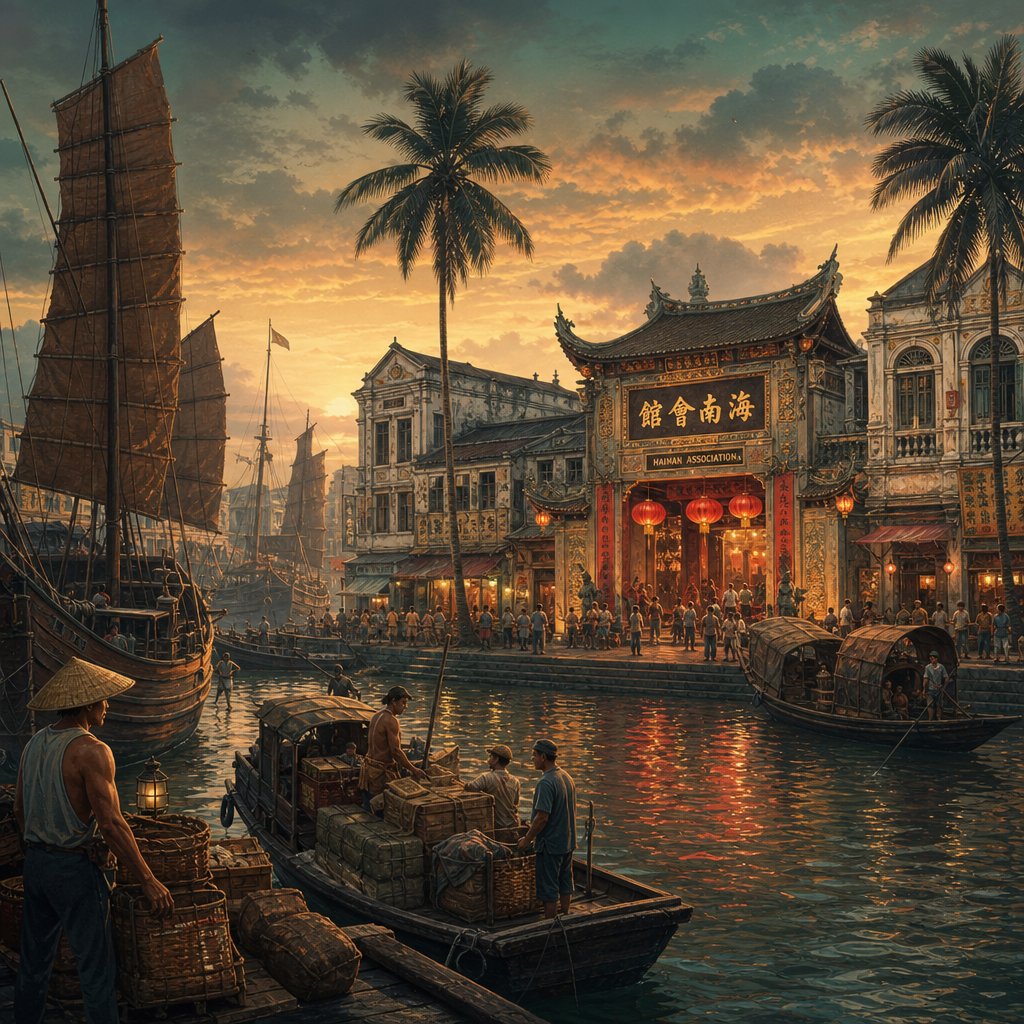
The Zhang Diaspora From Southeast Asia to the Americas
Dialect shaped spelling, but it also shaped destiny. The specific southern Chinese province your Zhang ancestors left, and the decade they left it, determined which country they landed in, which spelling became permanent on their documents, and which community they joined on the other side. The global Zhang diaspora did not emerge all at once. It unfolded in distinct waves, each driven by different forces and depositing families in different corners of the world.
Early Zhang Migration to Southeast Asia
The earliest Zhang emigrants were merchants, not refugees. During the Ming dynasty (1368-1644), traders from Fujian and Guangdong established commercial footholds across the South China Sea. Cambridge University Press research confirms that these southeastern coastal provinces were the primary sources of outward migration, with lineage and native-place associations organizing communities abroad. Zhang families from Hokkien-speaking Fujian settled in the Philippines, Malaysia, and Indonesia, where their surname became Teo, Teoh, or Tjong on local records. Cantonese-speaking Zhangs from Guangdong gravitated toward Malaya and Singapore, registering as Cheong or Chong depending on whether they spoke standard Cantonese or Hakka.
The scale exploded during the Qing dynasty. Between the 1840s and 1920s, an estimated 20 million Chinese moved to Southeast Asia, building on centuries of regional trading routes. The coolie labor system, forced open by the Opium Wars, sent hundreds of thousands of workers to plantations and mines across British Malaya, the Dutch East Indies, and French Indochina. By the early 1940s, approximately 8.5 million Chinese lived abroad, with over 90% concentrated in Southeast Asia. Zhang families were well represented in this flow, particularly from Fujian and Guangdong where the surname ranked among the most common.
The dialect group that dominated emigration to a specific country determined which Zhang spelling took root there. Hokkien speakers dominated migration to the Philippines and parts of Malaysia, establishing Teo and Teoh as the local Zhang variants. Cantonese speakers dominated Hong Kong emigration routes to British colonies, making Cheung the standard in those destinations. The cheung last name origin, for most families carrying it today in Canada or Australia, traces directly to this Cantonese emigration pipeline through Hong Kong.
Zhang Families in the Americas and Europe
Migration to the Americas followed a different timeline and carried different political baggage. Chinese laborers arrived in the United States during the Gold Rush era and the transcontinental railroad construction of the 1860s. Many came from Guangdong's Taishan region, and their surnames were transcribed using whatever system the port official preferred. The chang last name origin in the United States often traces to this period or to later Taiwanese immigration under the Wade-Giles system.
The Chinese Exclusion Act of 1882 slammed the door shut for decades, but it did not stop all movement. Zhang families continued arriving in Peru, Jamaica, Cuba, and Suriname, where labor demands remained high and restrictions were less severe. In Peru, the Chang spelling became standard. In Jamaica and Suriname, Chong and Jong emerged as dominant variants, reflecting the Hakka dialect background of many emigrants to those regions.
A major shift came after 1949. The establishment of the People's Republic of China triggered a wave of emigration among Nationalist-aligned families, intellectuals, and professionals who fled to Taiwan, Hong Kong, and from there to the United States, Canada, and Europe. These families typically carried the chang family name on their documents, using Wade-Giles romanization. Is Chang a Korean last name? It can be, since Korean families also romanize 장 as Chang under the McCune-Reischauer system. But in North America, the majority of people with the Chang surname are of Chinese or Taiwanese descent from this post-1949 wave.
The most recent migration stream began after Deng Xiaoping's reforms in the late 1970s. Research published in PMC highlights that post-reform Chinese emigrants were increasingly drawn from educated and professional classes. By the early 2000s, around 460,000 Chinese students were studying abroad annually, with roughly half in the United States. These newer arrivals use Pinyin, so they register as "Zhang" rather than Chang or Cheung. The chang name origin question, then, often comes down to timing: pre-1979 emigrants typically carry older romanizations, while recent arrivals use the mainland standard.
- Malaysia and Singapore: Teoh, Teo, Cheong, Chong, Tiong (Hokkien, Teochew, Cantonese, Hakka, and Foochow speakers)
- Hong Kong and Macau: Cheung and Cheong (Cantonese)
- Taiwan: Chang (Wade-Giles Mandarin)
- United States and Canada: Zhang (recent Pinyin), Chang (Taiwanese/older), Cheung (Hong Kong Cantonese)
- Australia and United Kingdom: Cheung (Hong Kong Cantonese), Zhang (recent mainland)
- Indonesia: Tjong, Tio, Thio, and Indonesian-adapted names like Setiawan or Prasetyo
- Peru: Chang, Chion (Cantonese)
- Jamaica and Suriname: Chong, Jong (Hakka)
- Vietnam: Trương (Sino-Vietnamese reading)
- South Korea: Jang, Chang (Korean reading of the same Hanja character)
How Diaspora Communities Maintained Clan Identity
Leaving China did not mean leaving the clan behind. Zhang emigrants recreated their kinship networks abroad through clan associations, sometimes called "kongsi" in Southeast Asia or "tong" in North America. The Zhang Clan Association of Singapore, for example, organizes annual gatherings, community activities, and dinner events that keep members connected to their shared heritage. Similar organizations exist in Malaysia, Thailand, the Philippines, and across North America.
These associations served practical functions beyond nostalgia. In the 19th and early 20th centuries, they provided new arrivals with housing, employment connections, dispute mediation, and funeral arrangements. They maintained genealogy records linking overseas branches back to specific villages in China. They also pooled funds to send remittances home, build schools in ancestral villages, and maintain ancestral halls that the emigrants themselves might never see again.
The connection was not purely one-directional. UNESCO reports that since the 1980s, over two-thirds of foreign investment accepted by the Chinese government has come from overseas Chinese. Zhang families in Southeast Asia who had built commercial empires over generations became significant investors in China's Special Economic Zones. The relationship between diaspora and homeland shifted from sentimental attachment to active economic partnership.
Indonesia presents a unique case. Under Suharto-era assimilation policies (1966-1998), ethnic Chinese were pressured to adopt Indonesian-sounding names. Zhang families became Setiawan, Prasetyo, Susantio, or Tjandra, often incorporating fragments of their original surname into the new one. The original Chinese identity was suppressed publicly but preserved privately through family records and clan networks. After the fall of Suharto, many Indonesian-Chinese families began reclaiming their heritage, reconnecting with Zhang clan associations and searching for ancestral records in Fujian and Guangdong.
Whether spelled Zhang, Chang, Cheung, Teo, or Tjong, these diaspora communities share a common challenge: bridging the gap between the name on their passport and the character in their family's genealogy book. That bridge requires more than knowing your spelling variant. It requires understanding how to pronounce the original, and why so many people get it wrong.
How to Pronounce Zhang and Its Spelling Variants
Knowing your surname's spelling is one thing. Saying it correctly is another. If you've ever introduced yourself as Zhang and watched someone's face go blank, or heard a barista call out "Zang" or "Zyang," you already know the struggle. The pronunciation of Zhang trips up English speakers because it contains a sound that simply does not exist in English. Here's how to get it right.
Pronouncing Zhang in Mandarin Chinese
The Mandarin zhang pronunciation has two parts: the initial consonant "zh" and the final "ang." The final is easy. It sounds exactly like the "ahng" in "song" if you open the vowel wider, like the "a" in "father" followed by the "ng" in "sing." No surprises there.
The tricky part is the "zh" initial. How do you pronounce zhang correctly? Think of the English "j" sound in "judge," but pull your tongue further back. Instead of pressing the tip of your tongue against the ridge just behind your upper teeth (where English "j" lives), curl it back so the underside of the tongue tip touches the hard palate. According to Columbia University's Asia for Educators guide, the pinyin "zh" is pronounced like an English "j." That's a useful starting approximation: "Zhang" sounds close to "Jahng" to untrained ears. But the retroflex curl gives it a slightly heavier, more rounded quality that distinguishes it from a flat English "j."
The tone matters too. Zhang is spoken in the first tone, a high, flat pitch held steady from start to finish, like humming a single note. No rise, no dip, no fall. Imagine saying "Jahng" while holding a steady high note, and you're close.
Common mispronunciation: "Zang" (rhyming with "bang"). The "zh" is not a "z." It is closer to "j" with the tongue curled back. Think "Jahng," not "Zang" and not "Zyang."
Why do English speakers struggle with this? Linguists note that the "zh" sound requires placing the sides of your tongue lightly against the roof of your mouth while producing a voiced buzzing vibration, a motor pattern that English never asks you to perform. The closest English equivalent, the "j" in "judge," uses a different tongue position and lacks that retroflex curl. If you want to zhang pronounce it accurately, practice curling your tongue tip upward and back before releasing the sound. It feels unnatural at first, but the muscle memory builds quickly.
A practical tip: say the English word "jar" slowly. Now say it again, but before the "j" comes out, pull your tongue tip back about half a centimeter further than normal. The resulting sound lands much closer to the Mandarin "zh." Pair that with the open "ahng" final and a steady high pitch, and you have a serviceable pronunciation zhang speakers will recognize.
How Cheung, Chang, and Other Variants Sound
Here's where it gets interesting. The pronunciation of zhang in Mandarin is only one version of how this surname sounds. The Cantonese "Cheung" and the Wade-Giles "Chang" are not just different spellings of the same sound. They represent genuinely different pronunciations rooted in different dialect systems.
Chang (Wade-Giles): This is actually the same Mandarin sound as Zhang. The Wade-Giles system uses "ch" without an apostrophe to represent the unaspirated retroflex that Pinyin writes as "zh." So "Chang" and "Zhang" are two ways of writing the same pronunciation. If someone's surname is spelled Chang and they are from Taiwan or a Mandarin-speaking background, you say it exactly like Zhang: "Jahng" with a retroflex initial and first tone.
Cheung (Cantonese): This one sounds different. The Cantonese pronunciation is approximately "Jerng" (rhyming loosely with a clipped "turn" but with a harder initial). The vowel is rounder and shorter than the Mandarin "ahng," and the initial consonant sits further forward in the mouth. If you hear someone say their name is Cheung, do not say "Zhang" back to them. They are using a Cantonese pronunciation that is its own distinct sound.
Teo/Teoh (Hokkien): This variant sounds nothing like either Mandarin or Cantonese versions. The Hokkien pronunciation drops the nasal ending entirely and shifts the initial to a "t" sound, producing something close to "Tee-oh" with a rising tone.
How do you say zhang if you're unsure which system someone uses? Ask. A person named Cheung from Hong Kong, a person named Chang from Taipei, and a person named Zhang from Beijing are all carrying the same Chinese character, but they may prefer very different pronunciations based on their family's dialect heritage. The spelling on their name is your best clue to which sound they grew up hearing at home.
Getting the pronunciation right is a small act of respect, but it signals something larger: a willingness to engage with the history behind the name. That same willingness drives many Zhang descendants toward a deeper question. Not just how to say the name, but how to trace it back through generations to a specific village, a specific branch, and a specific ancestor recorded in a genealogy book that may be centuries old.
Tracing Your Zhang Ancestry and Finding Your Branch Lineage
Knowing how to say your surname is the starting point. Knowing where it came from, which branch you belong to, and which ancestors carried it before you is the deeper journey. For the roughly 90 million people worldwide who carry some variant of the Zhang name, the path backward through time runs through a specific type of document: the clan genealogy book.
Understanding Zhang Clan Genealogy Books
Chinese families have maintained written genealogies called jiapu (家谱) or zupu (族谱) for centuries. These are not simple family trees. They are comprehensive records that can span dozens of generations and hundreds of pages, documenting everything from lineage charts and migration histories to ancestral instructions, family rules, and even poetry.
What exactly do Zhang genealogy books contain? According to extant Zhang genealogies, the core content typically includes:
- Lineage and origins: A detailed record of generational succession. Some books, like the Zhangpu Meitian genealogy, trace 29 consecutive generations.
- Generation poems (字辈诗): Poems created to standardize naming across generations. Each generation receives one character from the poem as the first character of their given name, so brothers and cousins share that character. If you know your generation character, you can pinpoint exactly where you sit in the family timeline.
- Founding ancestor and migration records: The name of the first ancestor who migrated to a specific location, when they arrived, and which larger branch they split from.
- Ancestral instructions and family rules: Ethical guidelines covering filial piety, education, community harmony, and service to the nation.
- Surname origin tracing: Nearly all Zhang genealogies record the founding myth of Hui creating bows and arrows and being granted the surname Zhang, with the phrase "the ancestral roots lie in Qinghe" appearing across genealogies from nine southern provinces and even overseas.
The Qing Dynasty through the Republic of China era (roughly 1644-1949) was the peak period for genealogy compilation. Clan leaders would preside over the process, sometimes establishing dedicated teams and even submitting completed volumes to local government for filing. Wars and financial hardship frequently interrupted these efforts. The Songzi Zhang family of Hubei, for example, saw their genealogy revision delayed by both the Northern Expedition and the War of Resistance Against Japan.
Sounds like ancient history? These books are still being compiled. The Qinghe Yanpai Yunxiao Xilin Zhang Family Genealogy was completed in September 2002. The Zhangtang Village genealogy dates to 2005. Modern compilations continue the tradition while incorporating digital tools for preservation.
Using Your Romanization and Region to Identify Your Branch
The zhang name meaning, "to draw a bow," is shared by every branch. But the hall name system (堂号) is what distinguishes one Zhang lineage from another. Think of it as a surname within a surname (surname 中文 researchers call it a sub-clan identifier). When you know your hall name, you can narrow millions of potential relatives down to a specific regional branch.
The most common Zhang hall names include:
| Hall Name | Chinese | Origin Story | Associated Region |
|---|---|---|---|
| Qinghe Hall | 清河堂 | Original homeland of Zhang Hui's descendants | Hebei (Qinghe County) |
| Bairen Hall | 百忍堂 | Zhang Gongyi wrote "endurance" 100 times for the emperor | Shandong, widespread |
| Jingjian Hall | 敬谏堂 | Named for Zhang Jiuling's courageous counsel to the Tang emperor | Guangdong, Fujian |
| Xiaoyu Hall | 孝友堂 | Honoring filial piety and fraternal love | Jiangxi, Hunan |
Overseas Zhang families overwhelmingly use "Qinghe Hall" as their identifier. The Malaysia Zhang Family Association is formally named the "Sabah Qinghe Hall Zhang Family Association." The Pingtung County genealogy in Taiwan is titled the "Qinghe Bairin Genealogy." If your family uses a different hall name, that distinction is a valuable clue pointing to a specific branch and migration path.
Your romanization variant adds another layer. A Cheung from Hong Kong searching for ancestors will look in Guangdong genealogies. A Teoh from Penang will search Fujian records. A Chang from California might trace back to Taiwan and from there to a specific mainland province. Chinese last name meanings are encoded not just in the character itself but in the entire system of hall names, generation poems, and regional branches that surround it.
Resources for Connecting With Your Zhang Heritage
Ready to begin? Here is a practical framework for starting your Zhang genealogical research:
- Identify your romanization variant. Is your family name Zhang, Chang, Cheung, Teo, Chong, or something else? This tells you which dialect group your ancestors spoke and narrows the geographic origin to a specific region of China.
- Interview older family members. Ask about your ancestral village (祖籍), hall name (堂号), generation poem (字辈), and any known founding ancestors. Even fragments of information, like a province name or a village mentioned in passing, can unlock entire genealogies. Your ancestral village is the key to finding the right family line in surname-based genealogy books.
- Search for your jiapu online. FamilySearch hosts digitized jiapu records that you can search for free using your surname in Chinese characters, your family's hometown (down to the village level if possible), and any known honored ancestors. Start by viewing images toward the end of the book and look for your closest known relative.
- Check library and archive holdings. Libraries across Zhejiang, Guangdong, Fujian, and other provinces hold physical Zhang genealogies from the Ming and Qing dynasties. The Guangdong Provincial Archives has digitized over 13,000 genealogy volumes and continues to expand its collection. The Chinese Academy of Sciences Library and Zhejiang Provincial Library both hold multiple editions of Qinghe Zhang genealogies.
- Connect with a Zhang clan association. Organizations like the Singapore Zhang Clan Association, the Sabah Qinghe Hall Zhang Family Association in Malaysia, and various North American Zhang associations maintain records linking overseas branches to ancestral villages. They can often identify which sub-branch your family belongs to based on your hall name and region of origin.
- Build your tree and work backward. Document every generation you can confirm, then use that chain to connect to the published genealogy. Generation poems are especially powerful here: if you know your generation character and your grandfather's generation character, you can locate exactly where your family fits within a specific jiapu.
One important reality check: not every Zhang family will find a neat connection to a published genealogy. Some branches were too poor or too disrupted by war to maintain records. Some genealogies were destroyed during the Cultural Revolution. And some families belong to lineages that adopted the Zhang surname through ethnic assimilation or imperial grant, meaning their origins lie outside the traditional Qinghe framework entirely. Among the thousands of Chinese surnames, Zhang is far from one of the rarest chinese surnames, which means the sheer volume of records can be both a blessing and a challenge. The abundance of documentation is enormous, but so is the task of finding your specific thread within it.
Digitization is changing the landscape rapidly. Archives in Guangdong, Fujian, and Zhejiang are scanning fragile handwritten genealogies and making them searchable online. Clan associations that once operated through mailed newsletters now maintain websites and social media groups connecting descendants across continents. The gap between a diaspora family in Toronto or Melbourne and their ancestral village in Fujian or Guangdong has never been narrower.
Whether your passport says Zhang, Chang, Cheung, Teo, or Trương, the character behind it is the same one that was first written on oracle bones over three thousand years ago. The genealogy system built around that character, from hall names to generation poems to village-level jiapu, represents one of the longest continuous traditions of family record-keeping anywhere in the world. Your name is not just a label. It is an invitation to trace a thread that connects you to a specific ancestor, a specific village, and a story that stretches back to the age of bronze and bow.
Frequently Asked Questions About the Zhang Surname
1. What does the Zhang surname mean in Chinese?
The character 張 (zhang) combines the bow radical 弓 on the left with the component 長 (long/stretch) on the right, literally meaning 'to stretch a bow' or 'to draw open.' This meaning traces back to the legendary ancestor Zhang Hui, grandson of the Yellow Emperor, who is credited with inventing the bow and arrow after observing a bow-shaped star constellation. The surname preserves this ancient reference to archery, making it one of the few Chinese surnames that encodes a physical action rather than a place name or official title.
2. Why are Zhang, Chang, and Cheung the same surname?
Zhang, Chang, Cheung, Teo, Chong, and Jang all represent the single Chinese character 張, spelled differently because of dialect pronunciation and romanization systems. 'Zhang' uses Mandarin Pinyin (mainland China standard), 'Chang' uses the older Wade-Giles system common in Taiwan, 'Cheung' reflects Cantonese pronunciation from Hong Kong, 'Teo' comes from Hokkien speakers in Southeast Asia, 'Chong' represents Hakka dialect, and 'Jang' is the Korean reading of the same character. Your family's spelling serves as a linguistic fingerprint indicating which dialect group and emigration route your ancestors followed.
3. How do you correctly pronounce the surname Zhang?
The Mandarin pronunciation of Zhang starts with a retroflex 'zh' sound, which is similar to the English 'j' in 'judge' but with the tongue curled further back toward the hard palate. The final 'ang' sounds like the 'a' in 'father' followed by the 'ng' in 'sing.' It is spoken in the first tone, meaning a high, flat pitch held steady. A common mistake is pronouncing it as 'Zang' (rhyming with bang). A closer English approximation is 'Jahng' with a slightly heavier initial consonant.
4. How can I trace my Zhang family ancestry back to China?
Start by identifying your romanization variant (Zhang, Chang, Cheung, Teo, etc.) to determine your ancestral dialect group and likely region of origin. Interview older relatives about your ancestral village, hall name (堂号), and generation poem characters. Then search digitized genealogy databases like FamilySearch for jiapu records matching your surname, hometown, and known ancestors. Connecting with Zhang clan associations in Singapore, Malaysia, or North America can also help identify your specific branch lineage and link you to published genealogies spanning dozens of generations.
5. Is Zhang related to the Korean surname Jang or Chang?
The Korean surname Jang (장) uses the same Chinese character (張) as the Chinese Zhang, but Korean Jang families are ethnically Korean, not Chinese. Korean clans adopted Chinese Hanja characters for their surnames during periods of heavy Chinese cultural influence. While the written character is identical, the Korean pronunciation and clan histories are entirely separate from Chinese Zhang lineages. In North America, both Chinese and Korean families may spell their surname as 'Chang,' so family history and ethnic background are the only reliable ways to distinguish them.