Zhang and Cheung Are the Same Surname in Different Clothing
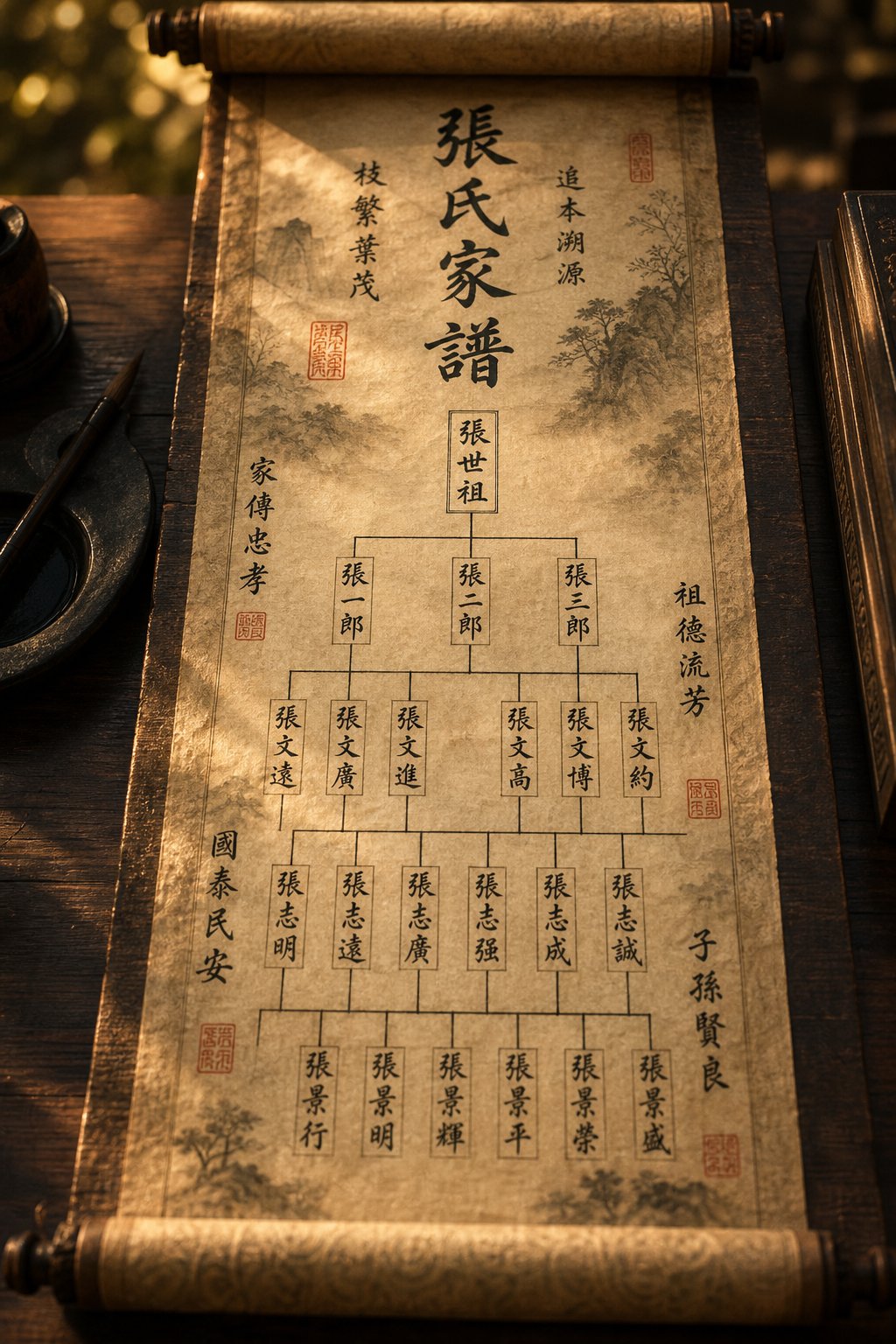
Imagine two cousins at a family reunion. One introduces herself as Cheung, the other as Zhang. A bystander might assume they married into different families. In reality, they share the same bloodline, the same ancestral character, and the same origin story stretching back thousands of years. The only difference? One family settled in Hong Kong, the other in Beijing.
Why Zhang and Cheung Cause So Much Confusion
The zhang surname and the cheung surname look nothing alike on paper. Different letters, different length, different phonetics. You would never guess they represent the exact same Chinese character unless someone told you. That disconnect trips up genealogy researchers, immigration officers, and even family members separated by geography and dialect.
The root cause is simple: Chinese is not one spoken language. Mandarin speakers pronounce the character 張 as "Zhang." Cantonese speakers pronounce it as "Cheung." When these pronunciations get converted into English letters through different romanization systems, you end up with spellings that appear completely unrelated. The zhang last name in a mainland Chinese passport and the Cheung on a Hong Kong identity card point to the same ancestral lineage.
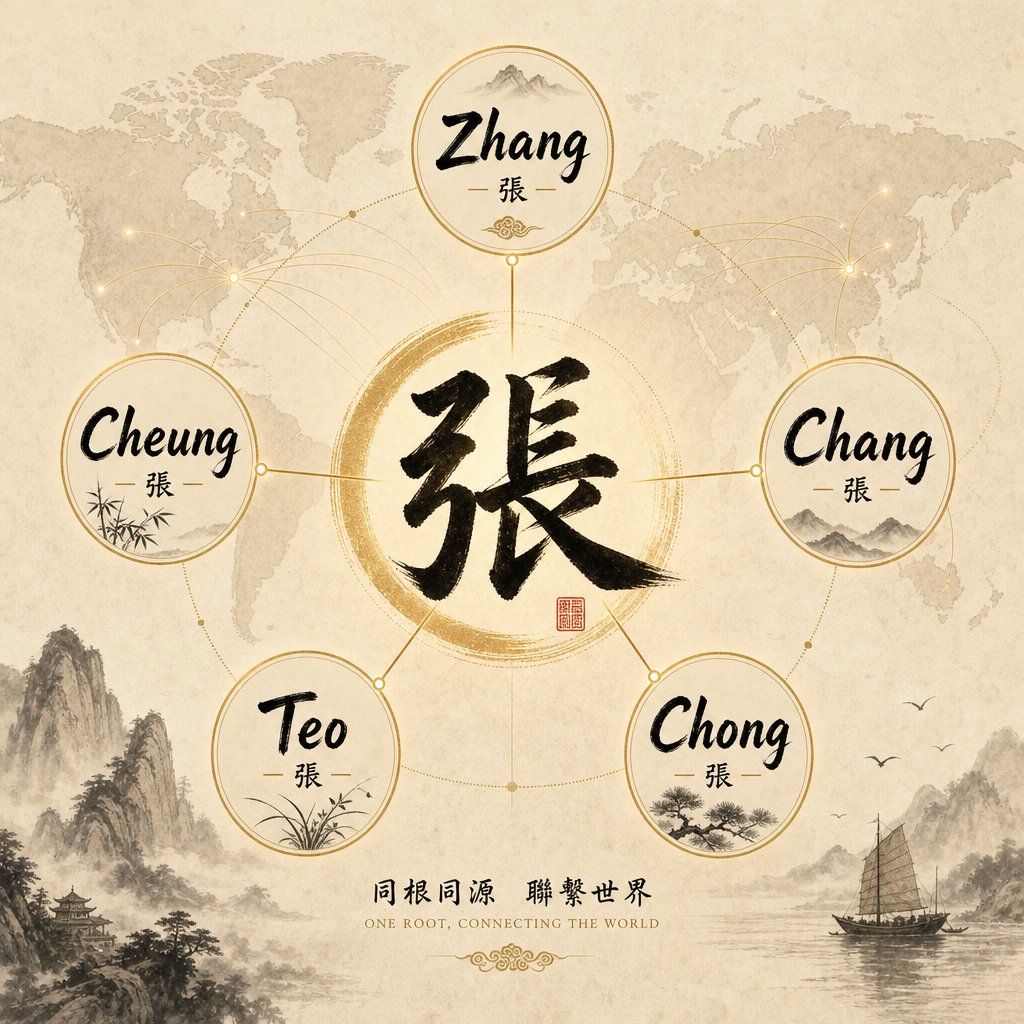
Both Zhang and Cheung trace back to the single ancestral character 張 — one of the most common surnames in China, ranked #3 among all Chinese family names. The spelling difference reflects dialect and romanization, not different family origins.
What This Guide Covers
This article breaks down exactly how one character produces so many different English spellings. You will find the linguistic mechanics behind each variant, a region-by-region breakdown of where each spelling dominates, and practical guidance for anyone trying to connect family across romanization boundaries. Whether you are researching ancestry, verifying a family connection, or simply curious about why these names look so different, the answers all lead back to the same place: the character 張 and the dialects that bring it to life.
The real story begins with that character itself and what it originally meant.
How We Compared These Surname Spelling Variants
When you see two completely different English spellings for a Chinese surname, how do you determine whether they share the same origin? You cannot rely on the letters alone. A structured framework is needed, one that accounts for the linguistic, geographic, and historical forces that shape how a single character ends up written half a dozen different ways in Latin script.
Evaluation Criteria for Surname Variants
To compare Zhang, Cheung, and the other variants you will encounter in this guide, we evaluated each spelling across five dimensions. These criteria apply not only to this specific surname pair but to any common surname in China that appears under multiple romanized forms.
- Romanization system — Which official or informal system produced the spelling? Pinyin, Jyutping, Wade-Giles, and other frameworks each follow distinct rules for converting sounds into letters.
- Dialect pronunciation — Which Chinese dialect or language group does the speaker use? Mandarin, Cantonese, Hokkien, and Hakka all pronounce the same character differently, and those phonetic differences drive the spelling variations.
- Geographic distribution — Where is this spelling most commonly found? Regional dominance tells you whether a variant ties to mainland China, Hong Kong, Taiwan, Southeast Asia, or specific diaspora communities.
- Historical context — When and why did this romanization emerge? Colonial-era systems, government standardization efforts, and immigration waves all left their mark on how surnames appear in official records.
- Practical documentation impact — How does this spelling affect passports, immigration paperwork, and genealogy databases? Different romanizations of the same surname (中文) can create real barriers when families try to prove shared lineage across borders.
Sources and Linguistic Framework
Chinese characters can be romanized in many different ways depending on the time in history, location, and dialect involved. For Mandarin alone, systems include Pinyin, Wade-Giles, Yale, Gwoyeu Romatzyh, and others. Cantonese adds Jyutping, Sidney Lau, Yale Cantonese, and more. Each system has its own rules for tones, spelling, and spacing. Understanding chinese last name meanings across these systems requires looking past the surface-level letters and identifying the underlying character.
The framework here is straightforward: the Chinese character is the constant, and every romanized spelling is a variable output determined by dialect plus system. When you apply this lens, seemingly unrelated surnames collapse into a single origin point. This same logic extends well beyond Zhang and Cheung to dozens of other surname pairs where one character produces multiple English spellings that confuse researchers and families alike.
With the evaluation criteria in place, the logical starting point is the character itself: what 張 actually means, where it came from, and why it became one of the most widespread surnames in Chinese history.
The Original Character 張 and What It Means
Every spelling variant in this surname family traces back to a single source: the character 張 in traditional Chinese, or 张 in its simplified form. Before examining how different dialects and romanization systems produce such wildly different English spellings, you need to understand what this character actually represents. Its structure, meaning, and legendary origin story explain why it became one of the most widespread family names in human history.
The Meaning Behind 張 and 张
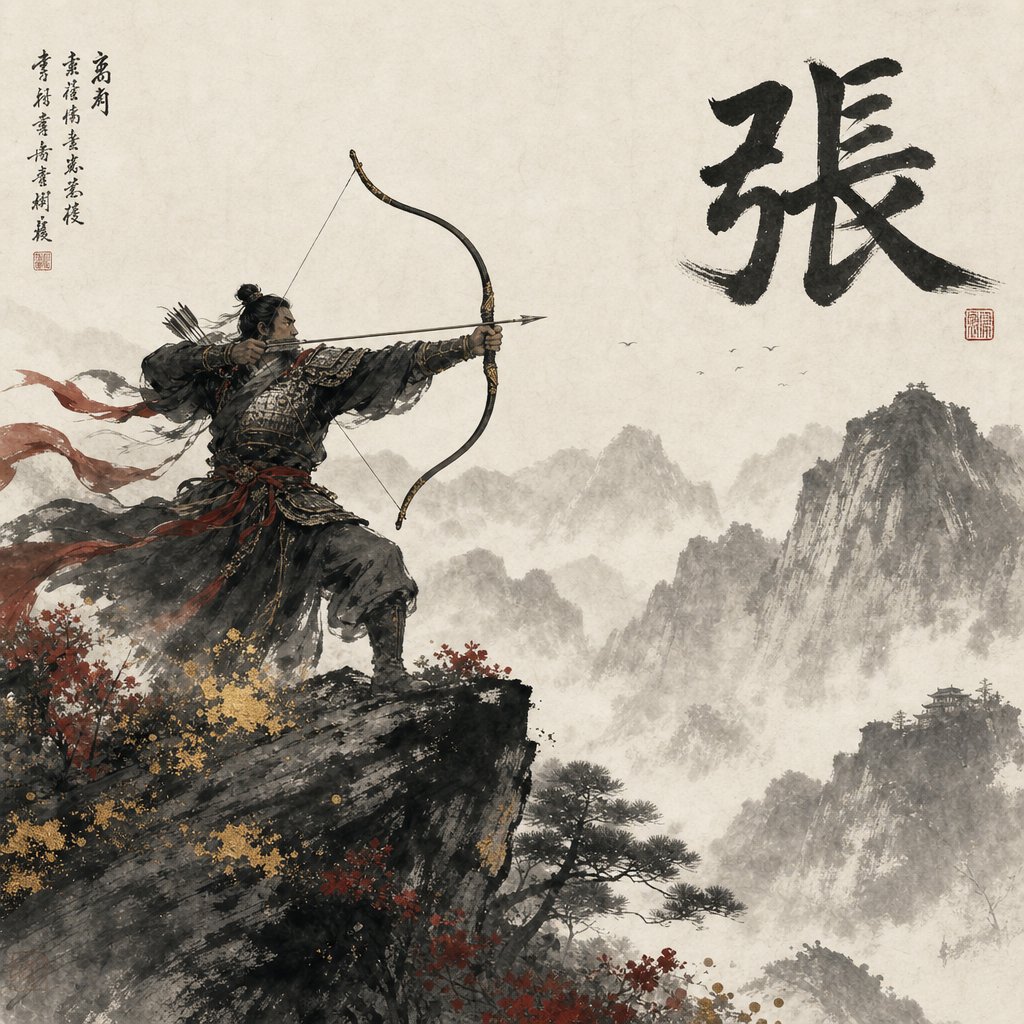
Look closely at the traditional character 張 and you will notice it is built from two components. The left side is 弓 (gong), meaning "bow" as in the weapon. The right side is 長 (chang), meaning "long" or "to stretch." Together, they form a phonosemantic compound where 弓 carries the meaning and 長 indicates the sound.
The zhang name meaning at its core is "to draw a bow" or "to stretch open" — an image of an archer pulling back a bowstring, extending it to its full length before release.
In modern usage, 张 has evolved beyond its martial origins. It now serves as a measure word for flat objects like sheets of paper, tables, or photographs. You might hear someone say "yi zhang zhi" (one sheet of paper) in everyday Mandarin. But as a surname, the character retains its ancient connection to archery and the act of spreading or opening wide.
The simplified form 张 functions identically. Mainland China adopted character simplification in the 1950s, reducing stroke counts for common characters. The traditional 張 (11 strokes) became 张 (7 strokes), but the meaning, pronunciation, and genealogical identity remain unchanged. When you see zhang in chinese texts, whether traditional or simplified, you are looking at the same surname.
Why Zhang Is Among the Most Common Surnames in China
The legendary origin of this surname reaches back to the Yellow Emperor (Huang Di), a semi-mythical figure considered the ancestor of Chinese civilization. According to traditional accounts documented by genealogical researchers, the Yellow Emperor's grandson Zhang Hui invented the bow and arrow after being inspired by the Heavenly Bow constellation. For this achievement, he was appointed "First Bow" (弓正) and granted the surname 張, literally encoding his contribution into his family name.
His descendants settled in Qinghe, in what is now Hubei province, giving rise to a folk saying: "天下张姓出清河" — all Zhang descendants come from Qinghe. Over millennia, the clan branched outward through military service, political appointments, and migration. Additional lineages joined the surname through adoption, imperial grants, and name changes to avoid political persecution. Zhang Liao, a famous general of the Three Kingdoms period, originally bore the surname Nie but changed it to Zhang to distance his family from a disgraced ancestor.
These multiple origin streams, combined with thousands of years of population growth, pushed the surname to extraordinary prevalence. China's National Citizen ID Information System recorded 87.5 million bearers of this surname in mainland China alone, making it the third most common surname after Wang and Li. Globally, the number exceeds 100 million people. That scale means zhang in chinese communities worldwide is not just common — it is practically ubiquitous.
With a character this widespread, the question becomes: what happens when 100 million people speaking different dialects all need to write their surname in English? The answer starts with Mandarin and the Pinyin system that produces the spelling most Westerners encounter first.
Zhang as the Mandarin Pinyin Standard
When the People's Republic of China needed a single, consistent way to write Chinese sounds in Latin letters, the result was Hanyu Pinyin. Officially introduced on February 11, 1958, this system was developed by a committee of Chinese linguists led by Zhou Youguang. It replaced the older Wade-Giles system for official use and eventually became the global default. The International Organization for Standardization adopted it as ISO 7098 in 1982, and the United Nations followed in 1986. Today, virtually every mainland Chinese passport, government record, and international publication uses Pinyin to render Chinese names into English.
That is why the spelling "Zhang" dominates modern contexts. If you encounter this surname on a business card, academic paper, or visa application from someone born in the PRC, Pinyin is almost certainly the system behind it.
How Pinyin Produces the Spelling Zhang
In Mandarin, the character 張 is pronounced with a retroflex initial sound followed by the vowel combination "ang." Pinyin represents that retroflex initial as "zh" — a two-letter combination that signals the tongue curls back toward the roof of the mouth before releasing. The final "-ang" maps directly to the open vowel plus nasal ending. Put them together and you get "zhang" (first tone: zhāng).
The "zh" spelling looks strange to English readers because no common English word starts with those two letters in sequence. This is by design. Pinyin prioritizes systematic consistency over intuitive readability for English speakers. Every retroflex sound in Mandarin uses this "zh" initial — think "zhong" (middle), "zhu" (bamboo), or "zhi" (know).
Pronouncing Zhang Correctly in Mandarin
So how do you pronounce zhang? The most common mistake is treating "zh" like the "z" in "zoo." It is closer to the "j" in "judge," but with your tongue pulled slightly further back. Imagine saying "jah" while curling your tongue tip toward the hard palate — that gets you close to the correct zhang pronunciation.
Here is a practical breakdown:
- "Zh" — similar to the English "j" sound, but retroflex (tongue curled back). Think of the "dg" in "edge" with your tongue positioned further back in your mouth.
- "ang" — rhymes with "song" in some American English dialects, or the "ong" in "gong" but with a wider, more open "ah" vowel at the start.
- Tone — as a surname, it carries the first tone (high and flat), so your pitch stays level and elevated throughout.
A quick approximation for English speakers: pronounce zhang like "jahng" with a flat, high pitch. That is not perfect, but it is close enough for everyday conversation. The pronunciation of zhang trips people up mainly because English has no retroflex affricates — the tongue position simply does not exist in standard English phonology.
If you have ever heard someone zhang pronounce it as "zang" or "chang," those are common mispronunciations. The correct pronunciation zhang sits somewhere between the English "j" and "ch" sounds, occupying a phonetic space that feels unfamiliar to most Western ears. Knowing how to say zhang correctly is a small courtesy that native speakers genuinely appreciate.
The Pinyin spelling dominates in mainland China, international academia, and most modern media. But cross the border into Hong Kong or Macau, and the same character takes on an entirely different English form — one shaped by Cantonese phonology and a colonial history that never adopted Pinyin at all.

Cheung as the Cantonese Romanization
Hong Kong never switched to Pinyin. That single historical fact explains why millions of people carry the cheung last name instead of Zhang on their passports, bank accounts, and birth certificates. The character is identical — 張 — but the sound that comes out of a Cantonese speaker's mouth is fundamentally different from what a Mandarin speaker produces. And the system used to capture that sound in English letters has its own distinct logic.
How Cantonese Pronunciation Creates Cheung
In Cantonese, the character 張 is pronounced roughly like "jeung" with a rising tone. The initial consonant is softer than Mandarin's retroflex "zh" — closer to an English "ch" or soft "j." The vowel combination shifts from Mandarin's open "ang" to a rounder "eung" sound. When early romanization efforts tried to capture this pronunciation for English readers, the spelling "Cheung" emerged as the dominant convention.
Two formal Cantonese romanization systems confirm this mapping:
- Jyutping — the system developed by the Linguistic Society of Hong Kong renders 張 as Zoeng1. The "z" initial in Jyutping represents an unaspirated affricate, and the "oeng" captures the rounded vowel-nasal combination.
- Yale Cantonese — this older academic system, designed at Yale University for American learners, renders the same character as Jēung. The "j" initial and "eung" final map closely to how "Cheung" looks on paper.
Neither system directly outputs "Cheung" as a spelling. The name as it appears on Hong Kong identity documents follows an informal, government-standardized romanization that predates both Jyutping and Yale. Hong Kong's Immigration Department has used its own conventions since the colonial era, and those conventions crystallized "Cheung" as the standard English rendering for 張 in official records. Once a spelling enters your passport, it becomes your legal identity — and it stays.
Where You Will Encounter the Cheung Spelling
The cheung last name origin ties directly to Cantonese-speaking regions and their diaspora networks. Global surname data shows approximately 360,615 people bearing this spelling worldwide, with the overwhelming concentration in Hong Kong — 281,857 individuals, or roughly 1 in every 26 residents. That makes Cheung one of the most common family names in Hong Kong, alongside Chan, Leung, and Lau.
Beyond Hong Kong, the Cheung spelling follows Cantonese migration patterns established over the past 150 years:
- Canada — 14,203 bearers, concentrated in Vancouver and Toronto where Cantonese-speaking immigrants settled heavily from the 1970s onward.
- United States — 26,157 bearers, with the surname rising from the 3,672nd most common American surname in 1990 to 2,069th by 2000, reflecting continued immigration.
- England — 7,744 bearers, largely in London and Manchester, tied to Hong Kong's colonial relationship with Britain.
- Australia — 4,344 bearers, primarily in Sydney and Melbourne.
- Singapore — 5,388 bearers, reflecting the city-state's significant Cantonese community.
- Macau — 4,857 bearers, the other major Cantonese-speaking territory alongside Hong Kong.
Why did Hong Kong never adopt Pinyin? The answer is political and administrative. Under British colonial rule from 1841 to 1997, Hong Kong developed its own romanization conventions independent of mainland China. When the PRC standardized Pinyin in 1958, Hong Kong was a British territory with no obligation to follow Beijing's linguistic policies. After the 1997 handover, Hong Kong retained its own systems under the "one country, two systems" framework. Cantonese remains the dominant spoken language, and the government continues issuing identity documents using Cantonese romanization rather than Mandarin Pinyin.
The result is a permanent split in how the same zhang chinese character appears in English across the border. A family with roots in Guangdong province might have one branch that moved to Shenzhen and carries the surname Zhang on PRC documents, while another branch settled in Hong Kong and carries Cheung. Same character, same ancestors, same clan — different paperwork. Celebrities like Jacky Cheung, Leslie Cheung, and Maggie Cheung all bear the same surname character 張 that mainland stars spell as Zhang.
This geographic split in romanization does not stop at Mandarin and Cantonese. Older romanization systems — particularly Wade-Giles, still common in Taiwan and pre-1979 Western texts — introduce yet another spelling for the same character, one that creates an entirely different layer of confusion.
The Wade-Giles Variant Chang and Why It Causes Extra Confusion
Here is where things get genuinely tricky. If Zhang is the Mandarin Pinyin spelling and Cheung is the Cantonese version, what about "Chang"? You will find this spelling across Taiwanese passports, older academic texts, library catalogs, and millions of diaspora records from before 1979. It represents the same character 張 — but it also represents a completely different, unrelated surname. That overlap is where serious genealogical mistakes happen.
Wade-Giles and the Chang Spelling for 張
Before Pinyin existed, the English-speaking world relied on Wade-Giles to romanize Mandarin Chinese. Developed by British diplomat Thomas Francis Wade in 1867 and refined by Herbert Giles in 1892, this system dominated Western academia, diplomacy, and library science for over a century. Under Wade-Giles rules, the character 張 is written as "Chang" — specifically "Chang1" with a superscript tone number that almost nobody includes in everyday use.
The reason Wade-Giles produces "Chang" instead of "Zhang" comes down to how the system handles retroflex consonants. Where Pinyin uses "zh" to represent the unaspirated retroflex affricate, Wade-Giles uses "ch" without an apostrophe. The aspirated version (what Pinyin writes as "ch") becomes "ch'" with an apostrophe in Wade-Giles. That apostrophe is critical — it distinguishes two entirely different sounds. But in practice, people drop it constantly. Typists omit it, databases strip it, and handwritten records ignore it. The result is that "Chang" on paper could represent either the aspirated or unaspirated initial, collapsing two distinct Pinyin sounds (zh and ch) into one ambiguous spelling.
Taiwan used Wade-Giles as its de facto standard for decades, and the majority of Taiwanese people still romanize their legal names using this system. That means someone named 張 in Taipei carries "Chang" on their passport, while their cousin in Shanghai carries "Zhang." Same character, same Mandarin pronunciation, different romanization policy. The chang surname appears throughout Taiwanese government records, older American immigration files, pre-1979 Western academic publications, and any English-language text about China written before Pinyin became the international standard.
The 2000 U.S. Census ranked "Chang" as the 424th most common surname in the United States and the 6th most common among Chinese Americans — well ahead of the Pinyin variant "Zhang." That ranking reflects decades of Taiwanese and pre-Pinyin immigration to the U.S., where families registered under Wade-Giles spellings that have since become permanent legal identities.
Chang for 張 vs Chang for 常 — A Critical Distinction
Here is the trap that catches genealogy researchers off guard. The spelling "Chang" does not exclusively belong to 張. It is also the standard Pinyin romanization of a completely different character: 常 (Cháng), meaning "constant" or "ordinary." These two surnames share zero ancestral connection. Different characters, different meanings, different clan origins, different lineage histories. Yet they look identical in English.
When you encounter the chang last name origin in a family record, you cannot assume which character it represents without additional context. Someone researching their chang name origin might be tracing the wrong family tree entirely if they confuse 張 with 常.
The following table breaks down the critical differences:
| Feature | Chang (張) | Chang (常) |
|---|---|---|
| Chinese Character (Traditional) | 張 | 常 |
| Chinese Character (Simplified) | 张 | 常 |
| Pinyin Spelling | Zhāng (first tone) | Cháng (second tone) |
| Wade-Giles Spelling | Chang1 | Ch'ang2 |
| Meaning | To draw a bow; to stretch open | Constant; ordinary; often |
| Ranking in China | #3 (approx. 87.5 million bearers) | #87 (approx. 2.4 million bearers) |
| Primary Regions | All of China; Taiwan; global diaspora | Henan, Shanxi, Hebei provinces |
| Cantonese Romanization | Cheung | Sheung / Soeng |
| Korean Romanization | Jang (장) | Sang (상) |
Notice the Wade-Giles column. Technically, 常 should be written as "Ch'ang" with an apostrophe indicating aspiration, while 張 is "Chang" without one. But when that apostrophe gets dropped — which happens constantly in informal records — both become indistinguishable on paper. This is not a minor academic point. It directly affects whether a genealogy database connects you to the right family.
People sometimes ask: is chang a Korean last name? The answer is yes, but with the same ambiguity problem. In Korean, 張 is romanized as Jang (장), while 常 becomes Sang (상). The spelling "Chang" appears in older McCune-Reischauer romanizations of the Korean surname Jang, adding yet another layer of cross-cultural confusion. A Korean person named Chang and a Taiwanese person named Chang might share the same underlying character 張 — or they might not. Context and the original character are the only reliable identifiers.
For anyone researching the chang surname in historical records, the safest approach is to locate the original Chinese character whenever possible. English spellings alone cannot tell you which family you are looking at. If the record predates Pinyin and comes from a Mandarin-speaking context, "Chang" almost certainly maps to 張 given its vastly larger population. But "almost certainly" is not good enough when you are trying to prove a family connection.
The confusion does not end with Wade-Giles. Southern Chinese dialects — Hokkien, Teochew, Hakka — each produce their own distinct romanizations of 張, and Southeast Asian immigration patterns scattered those variants across an even wider geographic range.
Other Dialect Variants from Teo to Chong
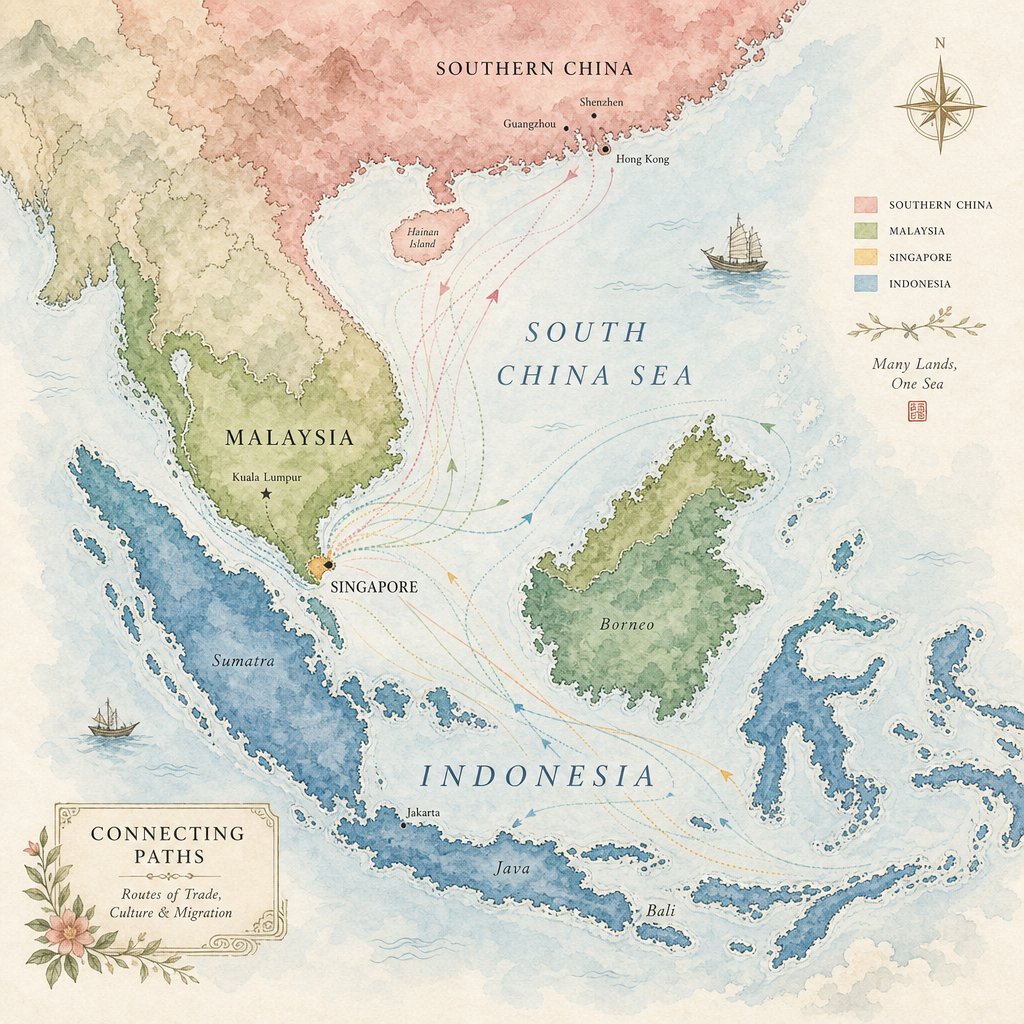
Zhang, Cheung, and Chang get most of the attention because they represent the three largest romanization systems. But the zhang family name does not stop at three spellings. Southern China is home to dozens of mutually unintelligible dialect groups, each with its own pronunciation of 張 — and each producing a romanized spelling that looks nothing like the others. When speakers of these dialects emigrated to Southeast Asia over the past two centuries, they carried those pronunciations with them and locked them into official records.
Hokkien, Teochew, and Hakka Variants of 張
Southern Chinese dialects diverged from Mandarin centuries ago, preserving older phonological features that Mandarin lost. The character 張 sounds dramatically different depending on whether you are hearing it in Hokkien, Teochew, Hakka, or Hainanese. Each dialect community developed its own informal romanization conventions — often influenced by colonial administrators, missionaries, or local registration clerks who wrote down what they heard.
Here is how the same character appears across these dialect groups:
- Teo — Hokkien and Teochew romanization, dominant in Singapore, Penang, and parts of Taiwan. The initial consonant shifts to an unaspirated "t" sound, and the vowel shortens dramatically compared to Mandarin. A Hokkien-speaking Singaporean named 張海明 would romanize their name as "Teo Hai Ming" rather than "Zhang Haiming."
- Tiong — Another Hokkien variant, particularly common among Fujianese communities in Malaysia and Indonesia. The "-iong" ending reflects a different sub-dialect pronunciation within the broader Hokkien family. The same Singaporean reference notes that a Hokkien-speaking family might also use "Tiong Hai Ming" for the same character.
- Chong — Hakka romanization, found primarily among Hakka communities in Malaysia, Indonesia, and parts of southern China. The chong last name origin traces to the Hakka pronunciation of 張, where the initial consonant becomes a "ch" and the vowel rounds into "ong." Hakka-speaking families in Sabah, Sarawak, and West Kalimantan commonly carry this spelling.
- Tio — Hainanese romanization, used by families from Hainan Island who settled across Southeast Asia. The pronunciation strips down to a short, clipped syllable that barely resembles the Mandarin original.
- Tsang — An alternate Cantonese romanization that appears in some older Hong Kong records and among Cantonese speakers in Southeast Asia. It reflects a slightly different transcription convention from the more common "Cheung."
- Cheong — A variant Cantonese or Malaysian romanization, sometimes seen in Malaysia and Macau. It splits the difference between "Cheung" and "Chong" phonetically.
- Jang — Korean romanization of the same character 張 (written 장 in Hangul). The jang last name origin connects to the same ancestral character that crossed into Korea centuries ago through cultural exchange with China.
Every single one of these spellings points back to the same character 張 — ranked #3 among all Chinese surnames. The dialect variants are not corruptions or errors. They are legitimate phonetic representations of how real communities actually pronounce this character in daily life.
How Southeast Asian Immigration Multiplied Spelling Variants
Southern China — Fujian, Guangdong, Hainan, and the Hakka heartlands — was the primary source of Chinese emigration to Southeast Asia from the 18th century onward. Hokkien speakers settled heavily in Singapore, Penang, the Philippines, and Taiwan. Teochew speakers concentrated in Thailand, Cambodia, and parts of Malaysia. Hakka communities established themselves in Borneo, Java, and the Malay Peninsula's tin-mining regions. Each group brought its own pronunciation of 張 and registered it with local colonial authorities — Dutch, British, Spanish, or Portuguese — who wrote down what they heard using whatever romanization conventions seemed reasonable at the time.
The result? A single extended clan scattered across six countries might carry five different surname spellings. Imagine a family reunion where one cousin from Beijing introduces himself as Zhang, another from Hong Kong says Cheung, a third from Singapore goes by Teo, a fourth from Kuching is Chong, and a fifth from Taipei writes Chang. None of their passports match. Yet they all trace their lineage to the same ancestral character and potentially the same clan branch.
Singapore illustrates this fragmentation particularly well. The city-state's Chinese population descends from Hokkien, Teochew, Cantonese, Hakka, and Hainanese immigrants who arrived over different periods. Singaporean naming conventions allow families to romanize their surnames according to their dialect heritage rather than defaulting to Mandarin Pinyin. The romanized version on a Singaporean passport and National Registration Identity Card is the official spelling — meaning "Teo" is not an informal nickname but a legal identity with the same weight as "Zhang" on a PRC passport.
This dialect-driven fragmentation creates a practical challenge that goes beyond linguistics. When official documents in different countries record the same family under different spellings, proving shared ancestry requires looking past the English letters entirely. The unifying thread is always the Chinese character itself — and the next section addresses what happens when families separated by these spelling differences try to reconnect across borders and bureaucracies.
Practical Implications for Identity and Family Research
Linguistics is one thing. Paperwork is another. When a grandmother in Hong Kong carries "Cheung" on her identity card and her grandson in Shanghai carries "Zhang" on his passport, the shared bloodline is obvious to the family. It is far less obvious to an immigration officer, a genealogy database, or a government clerk processing a family reunification application. The zhang last name origin and the Cheung last name origin point to the same character — but bureaucracies do not read Chinese characters. They read English letters. And when those letters do not match, real problems follow.
Passport and Immigration Documentation Challenges
Imagine you are sponsoring a relative for immigration. Your passport says Zhang. Theirs says Cheung. A third family member's old Taiwanese documents say Chang. You are all descendants of the same 張 clan, but your paperwork tells three different stories. For reviewing authorities like USCIS, this kind of inconsistency is not automatically understood as a dialect variation — it can look like an identity discrepancy that triggers Requests for Evidence, processing delays, or outright rejection.
The core issue is that romanized spellings became permanent legal identities the moment they entered official records. A family that split between Hong Kong and mainland China in the 1950s locked in two different romanization systems across two different governments. Decades later, when descendants try to prove familial relationships across those systems, the surname mismatch creates friction at every step.
Common scenarios where this causes real headaches:
- Family-based visa petitions — A petitioner named Zhang sponsoring a sibling named Cheung must explain why their surnames differ. Without documentation linking both spellings to the same character 張, the relationship appears unverified.
- Inheritance and property claims — Proving you are the rightful heir to a relative whose legal name used a different romanization requires additional sworn statements, translator's notes, or court orders.
- Name consistency across translated documents — Birth certificates, marriage records, and academic transcripts issued in different countries may each use a different romanization. When these documents are translated into English by different services at different times, the variations compound. Professional translators can include explanatory notes confirming that multiple spellings refer to the same person, but applicants need to know this option exists.
- Dual nationality or residency situations — A person born in Hong Kong (Cheung on birth certificate) who later obtains PRC residency (Zhang on mainland ID) carries two legal spellings of their own name. Crossing borders with mismatched documents invites scrutiny.
The practical solution in immigration contexts is proactive disclosure. Listing all romanization variants in the "other names used" section of application forms — and attaching a certified translator's note explaining the linguistic basis for the difference — transforms a potential red flag into a documented, explainable fact. An affidavit of identity, notarized and sworn, can further bridge the gap by explicitly stating that Zhang, Cheung, and Chang all refer to the same individual or family bearing the character 張.
Genealogy Research Barriers Across Romanization Systems
For anyone tracing the last name zhang origin through historical records, romanization inconsistency is the single biggest obstacle after language barriers themselves. Genealogy databases index by English spelling. Search for "Zhang" and you will miss every record filed under Cheung, Chang, Teo, Chong, or Tsang. Search for "Cheung" and you will miss the mainland Chinese records entirely. The same family tree fragments across multiple search queries that most researchers never think to run.
This problem is not hypothetical. FamilySearch notes that the surname 陳 alone has been romanized as Chen, Chan, Chin, Chinn, Ching, Chun, Tan, Tang, Tin, Ting, Tjin, and Jin — and the same fragmentation applies to 張. A researcher looking for their zhang name origin who only searches one spelling will miss entire branches of their family tree sitting in databases under variant romanizations.
Compounding the difficulty: historical records from the 19th and early 20th centuries often lack the original Chinese character entirely. Colonial immigration registers in British Malaya, the Dutch East Indies, Australia, and North America typically recorded only the romanized version — whatever the clerk heard and however they chose to spell it. Without a standardized romanization system, immigration officials were left to guess at the spelling based on whatever sounds they could hear. Two brothers arriving at the same port on different days might end up with different surname spellings depending on which clerk processed them.
Actionable steps for overcoming these barriers:
- Start with the Chinese character, not the English spelling. If you know your family's surname is 張, you have the universal key. Every romanized variant is just a derivative of this single character.
- Search all known variants. Run separate queries for Zhang, Cheung, Chang, Teo, Tiong, Chong, Tsang, Cheong, and Jang. Each spelling may unlock records invisible under other searches.
- Identify your family's dialect group. Knowing whether your ancestors spoke Cantonese, Hokkien, Hakka, or Mandarin narrows down which romanization they likely used — and which records to prioritize.
- Cross-reference geographic context. A "Chang" in a 1960s Taiwanese record almost certainly represents 張 via Wade-Giles. A "Teo" in a 1920s Singapore record points to Hokkien pronunciation of the same character. Geography tells you which romanization system was in play.
- Look for original Chinese characters in source documents. Tombstones, clan association records, old letters, and some immigration files preserve the character itself. That single piece of information resolves all ambiguity permanently.
The underlying principle is straightforward: the Chinese character 張 is the constant. Every English spelling is a variable that depends on dialect, era, location, and the individual clerk or system that produced it. Families separated by these spelling differences are not separated by blood — only by the accidents of history that determined which romanization system captured their name at which moment in time.
With all these variants and their practical consequences laid out, a consolidated reference becomes essential — a single table where every known spelling of 張 maps to its dialect, system, and region of use.
Full Comparison Table of All 張 Surname Variants
You have seen how dialect, geography, and colonial history fragment a single character into a dozen English spellings. Keeping all those variants straight in your head is impractical — especially when you are scanning immigration records, searching genealogy databases, or trying to confirm whether two people share the same ancestral surname. What you need is a single reference you can return to whenever a new spelling surfaces.
The tables below consolidate everything discussed so far into two scannable formats: one organized by spelling variant, the other by region. Bookmark these. They will save you hours of guesswork.
Complete Romanization Variant Reference Table
This table covers the major romanized spellings of the character 張 you are most likely to encounter in official documents, genealogy records, and everyday life. Every row represents the same surname character and the same chang family name lineage — only the English letters differ.
| Spelling Variant | Dialect Group | Romanization System | Primary Region of Use | Chinese Character |
|---|---|---|---|---|
| Zhang | Mandarin | Hanyu Pinyin | Mainland China, international academia | 張 / 张 |
| Cheung | Cantonese | Hong Kong Government Romanization | Hong Kong, UK, Canada, Australia | 張 |
| Chang | Mandarin | Wade-Giles | Taiwan, older U.S. records, pre-1979 texts | 張 |
| Teo | Hokkien / Teochew | Informal dialect romanization | Singapore, Penang, parts of Taiwan | 張 |
| Tiong | Hokkien | Informal dialect romanization | Malaysia (Sarawak, Sabah), Indonesia | 張 |
| Chong | Hakka | Informal dialect romanization | Malaysia, Indonesia (Borneo, Java) | 張 |
| Tsang | Cantonese (alternate) | Older Cantonese romanization | Some Hong Kong records, Southeast Asia | 張 |
| Cheong | Cantonese / Malaysian | Informal romanization | Malaysia, Macau | 張 |
| Tio | Hainanese | Informal dialect romanization | Hainan diaspora in Southeast Asia | 張 |
| Jang | Korean pronunciation | Revised Romanization of Korean | South Korea | 張 (장) |
| Truong / Trương | Vietnamese pronunciation | Vietnamese alphabet (Quoc Ngu) | Vietnam | 張 |
Notice that the last column never changes. Whether the surname chang, last name chang, or any other variant appears on a document, the underlying character remains 張. That character is your anchor point in any research scenario.
Quick Identification Guide by Region
When you encounter a surname in a record and want to quickly assess whether it might represent 張, the geographic context tells you which spelling to expect. This second table flips the perspective — start with the region, and you will know which romanized form is standard there.
| Region | Expected Spelling(s) for 張 | Romanization System in Use |
|---|---|---|
| Mainland China (post-1958) | Zhang | Hanyu Pinyin |
| Hong Kong | Cheung, Tsang | HK Government Romanization |
| Macau | Cheong, Cheung | Portuguese-influenced romanization |
| Taiwan | Chang | Wade-Giles (traditional) |
| Singapore | Teo, Cheong, Chong | Dialect-based (Hokkien, Cantonese, Hakka) |
| Malaysia | Teo, Teoh, Chong, Tiong, Cheong | Dialect-based (varies by state) |
| Indonesia | Tjong, Tio, Thio | Dutch-influenced dialect romanization |
| Vietnam | Truong, Trương | Quoc Ngu |
| South Korea | Jang (older: Chang) | Revised Romanization / McCune-Reischauer |
| United States (pre-1980 records) | Chang, Cheung, Chong | Wade-Giles or dialect-based |
| United States (post-1980 records) | Zhang, Cheung, Chang | Pinyin or inherited family spelling |
| United Kingdom | Cheung, Chang | HK Government or Wade-Giles |
| Canada | Cheung, Chang, Zhang | Mixed (reflects immigration waves) |
| Australia | Cheung, Chong, Zhang | Mixed (Cantonese and Hakka dominant) |
Two patterns emerge from this regional breakdown. First, the spelling you encounter is almost entirely predictable once you know the region and time period of the record. A surname chang in a 1970s Taiwanese passport is 張 via Wade-Giles. A "Teo" in a 1930s Singapore birth register is 張 via Hokkien pronunciation. Second, countries with diverse Chinese immigrant populations — the U.S., Canada, Australia — contain multiple spellings simultaneously, reflecting different waves of immigration from different dialect regions.
These tables give you the lookup tool. The final piece is knowing what to do with it — how to apply this information when you are actively researching a family connection, resolving a documentation conflict, or extending this same logic to other Chinese surname pairs that fragment in exactly the same way.
Final Recommendations and a Framework for Other Surname Pairs
You now have the reference tables, the linguistic background, and the practical context. The question is: what do you actually do with all of this? The answer depends on why you are here. A genealogy researcher needs a different action plan than someone resolving a passport discrepancy or someone who simply wanted to understand why their colleague's surname looks nothing like their cousin's.
Recommendations for Genealogy Researchers
If you are actively tracing a family line connected to the character 張, follow this sequence to avoid missing branches or chasing the wrong clan:
- Identify the Chinese character first. Ask older family members, check tombstones, look at clan association records, or examine any document that preserves the original script. The character 張 is your universal key — every romanized spelling is secondary.
- Determine your family's dialect group. Did your ancestors speak Cantonese, Hokkien, Hakka, Mandarin, or Teochew? This tells you which romanization they likely used when they emigrated and which records to search first.
- Search every known variant spelling. Run separate queries for Zhang, Cheung, Chang, Teo, Tiong, Chong, Tsang, Cheong, Jang, and Truong. A single missed variant could mean an entire branch of your family tree stays hidden.
- Cross-reference region and time period. A "Chang" in a 1965 Taiwanese record is Wade-Giles for 張. A "Teo" in a 1920s Singapore ledger is Hokkien for the same character. Let geography and era narrow your interpretation.
- Connect with clan associations. Zhang/Cheung clan organizations exist in Hong Kong, Singapore, Malaysia, and major Western cities. These groups maintain genealogical records indexed by the Chinese character, bypassing romanization confusion entirely.
The principle underlying every step is the same: English spellings are outputs of a system. The Chinese character is the input. Work backward from the output to the input, and the fragmentation resolves itself.
Applying This Framework to Other Chinese Surname Pairs
Everything you have learned about Zhang and Cheung applies directly to dozens of other Chinese surname pairs that confuse researchers and families in exactly the same way. The pattern is identical: one character, multiple dialects, multiple romanization systems, multiple English spellings that look completely unrelated.
Consider these common examples:
- 王 — Wang / Wong / Ong / Heng — Wang is Mandarin Pinyin, Wong is Cantonese, Ong is Hokkien, and Heng is Teochew. Same character, same meaning ("king"), same ancestral lineage.
- 陳 — Chen / Chan / Tan / Chin / Ting — The chan last name origin traces to the Cantonese pronunciation of 陳, while Chen is Mandarin Pinyin and Tan is Hokkien. Someone researching the last name chan in Hong Kong records and Chen in mainland databases is looking at the same chan family name split across dialect lines. Over 30 romanizations of this single character have been documented.
- 黃 — Huang / Wong / Ng / Ooi / Wee — Huang is Pinyin, Wong is Cantonese (yes, the same spelling as 王 in Cantonese — another layer of confusion), Ng is another Cantonese variant, and Ooi is Hokkien.
- 鍾/锺 — Zhong / Chung / Choong / Cheong — The chung last name origin connects to the character 鍾 (or 锺), meaning "bell" or "clock." In Mandarin Pinyin it becomes Zhong, but the chung surname dominates in Taiwan, Hong Kong, and Malaysia. The last name chung appears across both Chinese and Korean communities — in Korean, the chung family name can represent 鄭 (Jeong) or 鍾 (Jong), adding cross-cultural complexity similar to what we saw with Chang.
- 林 — Lin / Lam / Lim / Hayashi — Lin is Pinyin, Lam is Cantonese, Lim is Hokkien, and Hayashi is the Japanese reading of the same character.
The framework is reusable because the underlying mechanism never changes. A Chinese character holds the identity. Dialect determines the sound. A romanization system converts that sound into English letters. Different combinations of dialect and system produce different spellings — but the character, and therefore the family, remains one.
Whether you are untangling Zhang from Cheung, Chan from Chen, or Chung from Zhong, the resolution path is always the same: find the character, identify the dialect, and let the romanization table do the rest. The English spelling is never the surname. The character is.
Frequently Asked Questions About Zhang vs Cheung Surname
1. Are Zhang and Cheung the same last name?
Yes, Zhang and Cheung both represent the Chinese character 張. Zhang comes from Mandarin Pinyin, used in mainland China, while Cheung is the Cantonese romanization standard in Hong Kong and Macau. The difference is purely linguistic — both spellings indicate the same ancestral lineage, the same clan history, and the same family origin stretching back thousands of years to the Yellow Emperor's grandson Zhang Hui.
2. Why are Chinese surnames spelled differently in different countries?
Chinese surnames get spelled differently because China has multiple dialect groups (Mandarin, Cantonese, Hokkien, Hakka) that each pronounce the same character differently. When these pronunciations are converted to English letters, different romanization systems — Pinyin, Wade-Giles, Jyutping, and informal colonial-era conventions — produce distinct spellings. Political history also plays a role: Hong Kong never adopted Pinyin due to British colonial rule, and Taiwan retained Wade-Giles. The result is one character like 張 appearing as Zhang, Cheung, Chang, Teo, or Chong depending on where and when it was recorded.
3. How do you pronounce the surname Zhang correctly?
The surname Zhang is pronounced roughly like 'jahng' with a high, flat tone. The 'zh' initial is a retroflex sound — position your tongue curled back toward the roof of your mouth, similar to the English 'j' in 'judge' but further back. The 'ang' portion rhymes with the 'ong' in 'gong' but starts with a wider 'ah' vowel. Common mispronunciations include 'zang' and 'chang,' both of which miss the correct tongue position.
4. Is Chang the same surname as Zhang and Cheung?
Chang can represent the same surname 張 when it comes from the Wade-Giles romanization system, commonly used in Taiwan and older Western records. However, Chang is also the Pinyin spelling for a completely different character 常 (meaning 'constant'), which has no ancestral connection to 張. The only way to confirm which surname Chang represents is to identify the original Chinese character. Geographic and historical context helps: a Chang from Taiwan almost certainly carries 張, while context from other regions may require further verification.
5. How can I find out if relatives with different surname spellings share the same Chinese family name?
Start by identifying the original Chinese character behind each spelling — ask older family members, check tombstones, or look at clan association records. Then determine each person's dialect group (Cantonese, Hokkien, Hakka, Mandarin) and the region where their name was registered. Cross-reference the spelling with known romanization tables for that dialect and region. For example, Cheung from Hong Kong, Zhang from Beijing, and Teo from Singapore all map to 張. Clan associations in major cities maintain genealogical records indexed by character rather than romanized spelling, which can confirm shared lineage definitively.