What an Acrostic Name Poem Is and Why It Matters
Imagine writing a poem where the first letters of each line, read top to bottom, spell out someone's name. That single structural choice transforms a piece of writing from something general into something deeply personal. This is the core idea behind an acrostic name poem, and it's why people keep searching for the right name poem generator to help them create one.
What Is an Acrostic Name Poem
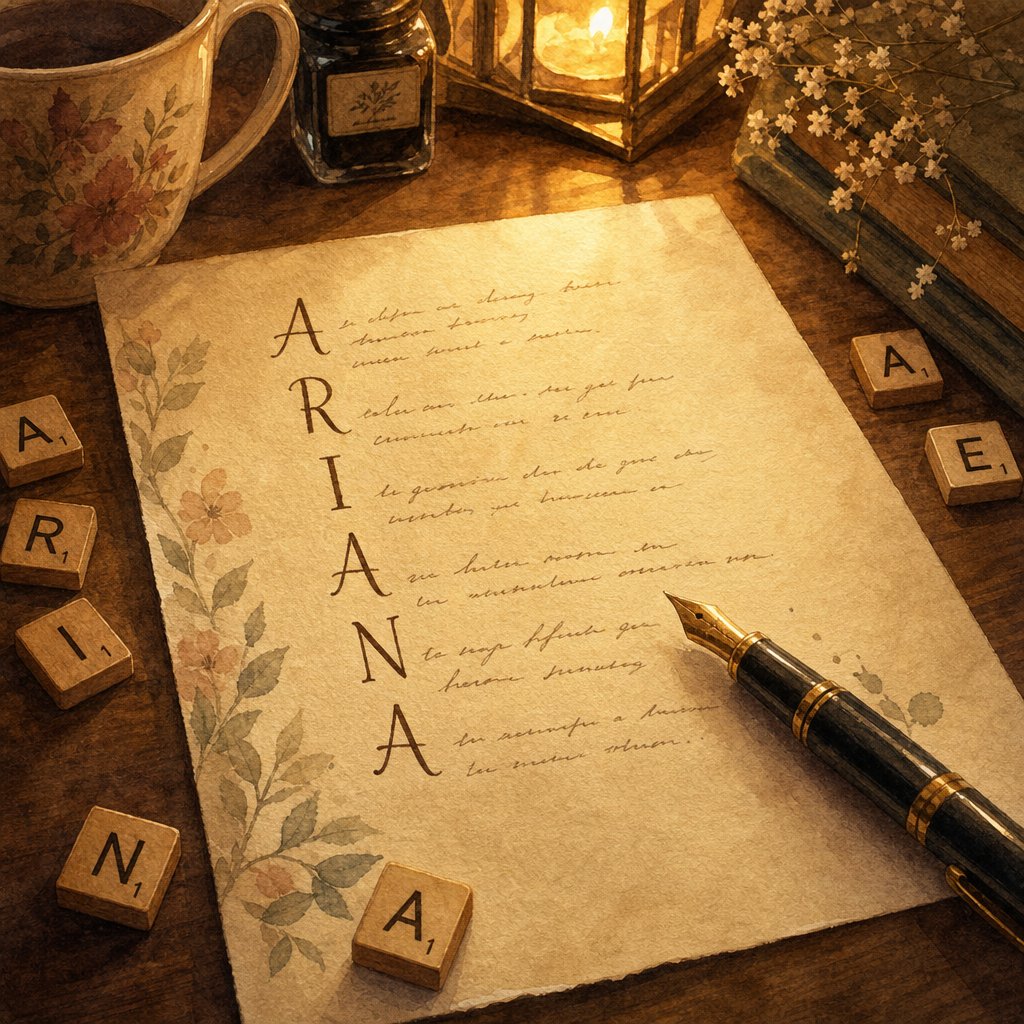
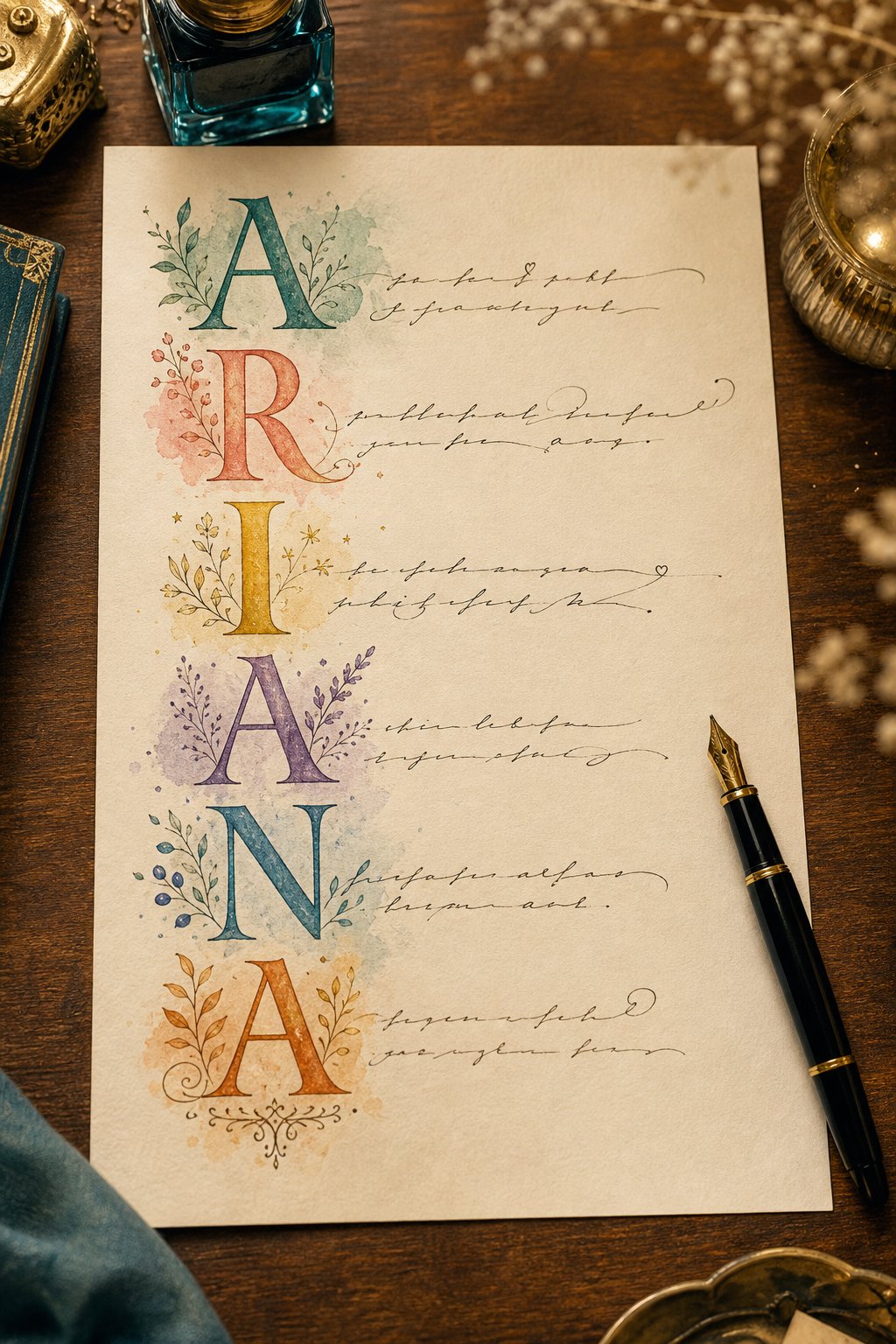
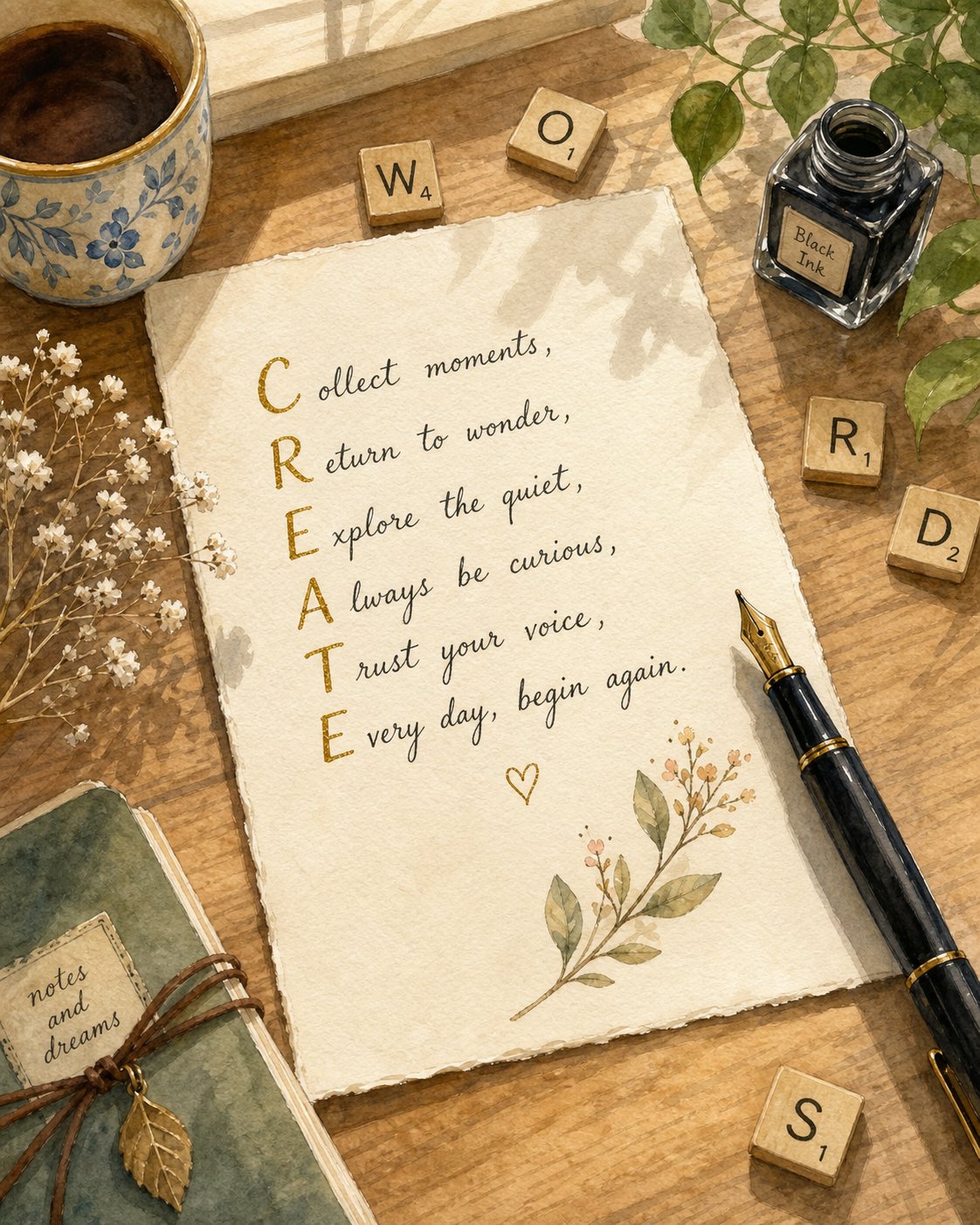
An acrostic name poem is a verse in which the first letter of each line spells out a person's name when read vertically, with each line describing a quality, memory, or sentiment connected to that person.
The Poetry Foundation defines an acrostic broadly as "a poem in which the first letter of each line spells out a word, name, or phrase when read vertically." A name acrostic narrows that concept to one specific purpose: honoring an individual by building the entire poem around who they are, letter by letter.
You'll notice the difference immediately when you compare it to a generic poem. A standard verse might describe love, gratitude, or admiration in broad strokes. An acrostic name poem anchors every line to a specific letter, which forces the writer to think carefully about what each part of that name represents.
Why Name Poems Carry Emotional Weight
When you spell out someone's name in a poem, you're saying something beyond the words on the page. You're telling the recipient that the poem could only exist because of them. It can't be recycled or repurposed for someone else. That exclusivity is what gives personalized poetry its emotional punch.
Think about receiving a birthday card with a generic message versus one where every line connects back to your identity. The acrostic name format creates that same feeling of being truly seen. Whether you write one by hand or use an acrostic name poem generator as a starting point, the structure itself carries meaning before a single descriptive word is chosen.
This article walks through both paths: crafting these poems manually and using generator tools effectively. The goal is to help you produce something that feels authentic, regardless of where the first draft comes from.
The Surprising History Behind Acrostic Poems
That personal, name-driven structure you just read about didn't appear out of nowhere. The acrostic form stretches back thousands of years, rooted in sacred texts and literary gamesmanship long before anyone thought to type a name into a generator tool.
Ancient Origins From Greece to the Hebrew Bible
The word itself comes from the Greek akros ("at the end") and stichos ("line" or "verse"), sometimes rendered as "akrostik" in older transliterations. Britannica traces the earliest known examples to the prophecies of the Erythraean Sibyl, where initial letters on leaves were arranged to form words. Greek poets of the Alexandrine period used acrostics as signatures, embedding their names into verse as a kind of authorial watermark.
Roman writers Ennius and Plautus adopted the technique too, crafting acrostics that spelled out play titles in their arguments. Medieval monks carried the tradition forward across centuries of manuscript culture.
Hebrew scribes took an acrostic in a different direction entirely. Rather than spelling names, they structured entire poems around the 22-letter Hebrew alphabet. Scholars identify fourteen alphabetic acrostic poems in the Old Testament, including Psalms 25, 34, 111, 112, and the famous Psalm 119, where each group of eight lines begins with a successive letter. Proverbs 31:10-31 praises the "wife of noble character" from aleph to tav, essentially A to Z. These weren't decorative tricks. The alphabetic constraint became a vessel for artistic wordplay, alliteration, and structural meaning.
Acrostics in Modern Literature and Culture
Edgar Allan Poe brought the form closer to what we recognize in a name poem today. He wrote an acrostic poem spelling "Elizabeth" for a female admirer, intentionally misspelling "Xanthippe" as "Zantippe" to make the letter Z fit his constraint. The poem functioned as an acrostic cipher of sorts, hiding the recipient's name in plain sight for those who knew where to look. The Edgar Allan Poe Society notes it was never published in his lifetime, discovered only in 1911.
That evolution, from sacred alphabetic structure to personal name encoding, is exactly the lineage today's acrostic name poem generators draw from. Here are notable examples across eras:
- Erythraean Sibyl prophecies (ancient Greece) - initial letters on leaves forming words
- Psalm 119 (Hebrew Bible) - 176 verses structured around 22 alphabet letters
- Ennius and Plautus (Roman era) - play titles spelled in acrostic form
- Medieval monks - devotional acrostics in manuscript traditions
- Edgar Allan Poe (1829) - hidden-name acrostics for personal recipients
What started as divine structure and literary signature gradually became something more intimate: a way to honor a specific person by weaving their identity into the architecture of a poem. That shift from sacred to personal is exactly why writing one by hand still carries weight, even when tools exist to automate the process.
How to Write an Acrostic Name Poem by Hand
Knowing the history is one thing. Sitting down with a blank page and a name you care about is something else entirely. So how do you make an acrostic poem that actually sounds like it came from you and not from a template? The answer starts well before you write a single line.
Brainstorming Traits and Memories for Each Letter
The biggest mistake people make when learning how to write acrostic poems is jumping straight into line construction. Instead, spend time gathering raw material first. Think of it as building a word bank tailored to one specific person.
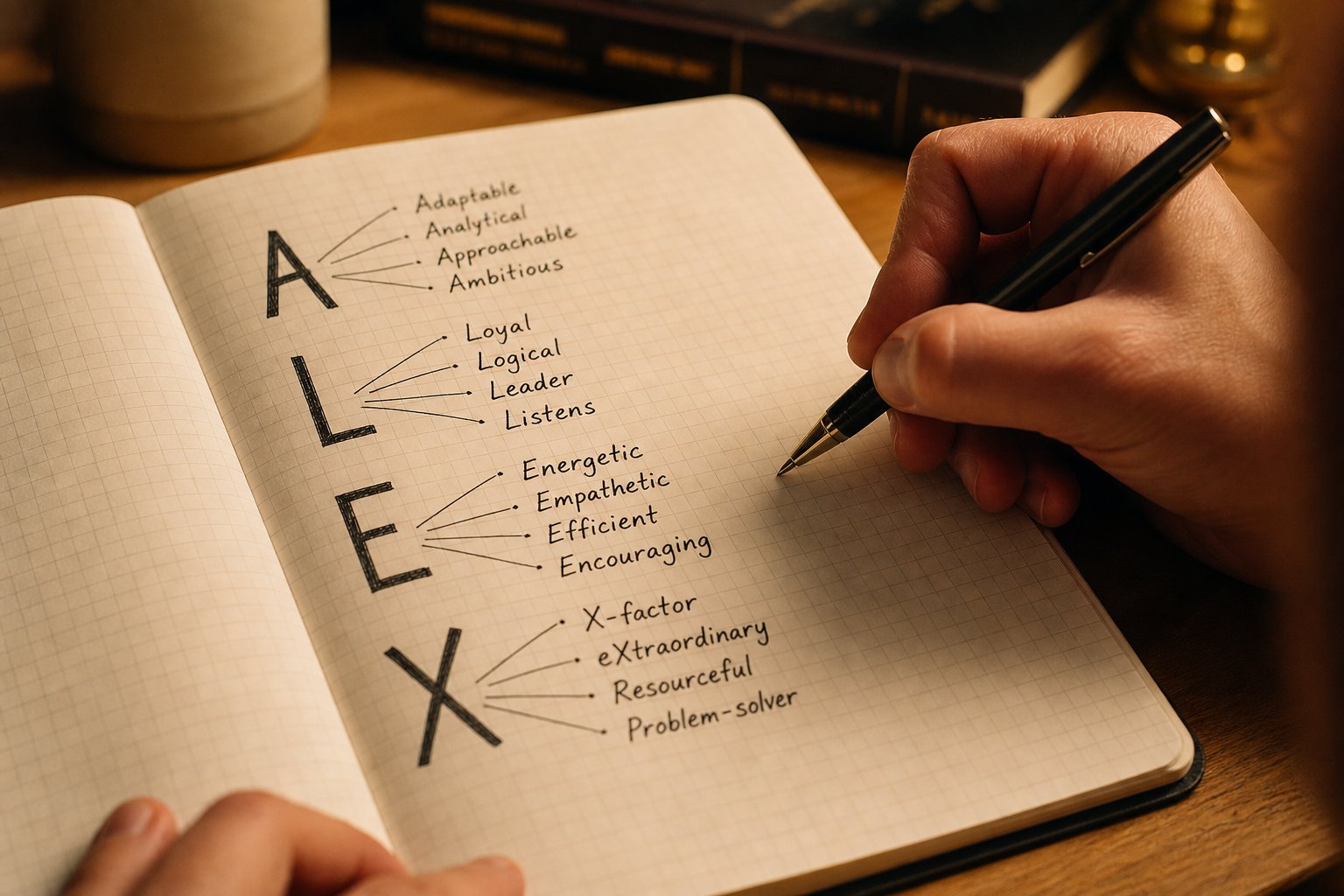
- Write the name vertically. Put each letter on its own line with plenty of space beside it.
- Map personality traits. For each letter, brainstorm adjectives, qualities, or roles that describe the person. If the name is SARAH, the S might connect to "steadfast," "silly when tired," or "sings in the car."
- Pull from shared memories. What moments define your relationship? A road trip, a late-night conversation, the way they laugh. Jot these beside whichever letter they might fit.
- Gather sensory details. What do you associate with this person? The smell of their kitchen, the sound of their voice on the phone, the color of their favorite jacket. Concrete details make poems feel real.
- Match and assign. Look at your collected material and pair the strongest ideas with each letter. You don't need to use everything. Pick what resonates most.
This brainstorming phase is where you create a poem with a name that feels genuinely personal rather than generic. The richer your raw material, the easier the actual writing becomes.
One Line Per Trait vs Free-Form Style
When you sit down to write an acrostic poem, you'll naturally gravitate toward one of two structural approaches.
The one-trait-per-line style assigns a single characteristic or image to each letter. Each line stands alone as its own complete thought. This works well for shorter names and when you want a punchy, list-like rhythm. It's also the easier approach for beginners figuring out how to make an acrostic poem for the first time.
The free-form style lets sentences flow across multiple lines, with each line simply happening to start with the next letter. The poem reads more like natural speech or prose poetry. This approach suits longer names and writers comfortable with enjambment, where a thought carries over from one line to the next without a hard stop.
Neither style is better. A romantic anniversary poem might benefit from flowing sentences, while a playful poem for a child might land better with one vivid image per line.
Drafting and Refining Your Lines
Your first draft won't be your final draft, and that's fine. Poet Jon Davis argues that "all revision is composition," meaning the rewriting process is where the real poem emerges.
Start by reading your draft aloud. Your ear catches awkward rhythms and forced phrasing that your eyes skip over. Listen for lines that feel stuffed with too many syllables or ones that land flat compared to their neighbors.
Check for emotional coherence. Does the poem build toward something, or does it feel like a random list? Even in the one-trait-per-line style, there should be a sense of progression, maybe moving from external qualities to internal ones, or from everyday observations to deeper feelings.
Finally, hunt for cliches. If a line could describe anyone, it's not personal enough. Replace "Always there for me" with something only this person does. Specificity is what separates a forgettable poem from one that makes someone cry.
Of course, some letters in a name cooperate more than others. A name full of common letters like S, M, and R practically writes itself. But what happens when you hit an X, a Z, or a Q?
Solving Difficult Letters in Names
Every name has at least one letter that makes you stare at the page. Maybe it's the X in Alexander, the Q in Jacqueline, or the V in Vivian. These letters feel limiting because your brain defaults to a tiny pool of common words. The fix isn't to force a single word into place. It's to expand what counts as a valid starting point.
Strategies for Letters Like X Z and Q
The most natural-sounding lines often start with a phrase rather than a standalone adjective. Instead of hunting for one perfect X-word, write a line where X begins a thought that flows into a full sentence. "X-ray vision for spotting when I need help" reads far better than jamming "Xenial" into a line about your friend.
Here's the key shift: treat difficult letters as creative constraints, not dead ends. You can use less common vocabulary, lean on adjectives and adverbs, or even start with a word that emphasizes the letter's sound. PoemShorts suggests options like "Xenial" (meaning hospitable) and "X-factor" for the letter X, while noting that words like "eXtraordinary" work when you emphasize the X sound visually.
Here are acrostic words and phrase options for the trickiest letters:
| Letter | Single Words | Phrase Starters |
|---|---|---|
| Q | Quirky, Quiet, Quick-witted, Queenly, Questing | Quietly you remind me... / Quick to laugh when... |
| U | Unique, Unstoppable, Unafraid, Uplifting, Unconditional | Under every worry, you... / Unwilling to let me give up... |
| V | Vibrant, Visionary, Vivid, Valuable, Velvet | Vividly I remember when... / Voice like warmth on a cold day... |
| X | Xenial, X-factor, Xylographic | X marks the moment you... / eXactly the person I needed... |
| Z | Zealous, Zesty, Zen, Zenith | Zero hesitation when... / Zen-like calm in every storm... |
Notice how the phrase starters create room for personal detail. A line beginning with "Zero hesitation when" can end with something specific to your person: "...when I called at 2 a.m." or "...when jumping into something new." The difficult letter becomes invisible once the sentence carries meaning.
Building a Personal Word Bank for Any Name
Rather than scrambling for acrostic poem words for each letter in the moment, build your bank ahead of time. This works for every letter, not just the hard ones.
Start by writing the full name vertically. For each letter, generate three categories of words that start with that letter:
- Trait words - adjectives describing personality (words that start with A for acrostic poems might include Ambitious, Artful, Authentic, Anchored, Aligned)
- Action words - verbs capturing what the person does (Advocates, Anchors, Arrives, Awakens)
- Scene words - nouns or phrases that set a memory in motion (April morning, attic full of records, arms wide open)
A thesaurus helps here, but don't just look up synonyms for obvious words. Search for the feeling you want to convey. If you want to express warmth for the letter K, you might land on "Kindred" or "Kinetic" rather than the predictable "Kind." The goal is finding a words for acrostic poems that surprise the reader while still ringing true.
Write down at least five options per letter. You won't use them all, but having choices means you can pick the word that fits the poem's rhythm and emotional arc rather than settling for whatever came to mind first. This preparation is what separates a poem that sounds crafted from one that sounds forced, and it's exactly the kind of personal input that no generator can replicate on its own.
Matching Tone and Style to Every Occasion
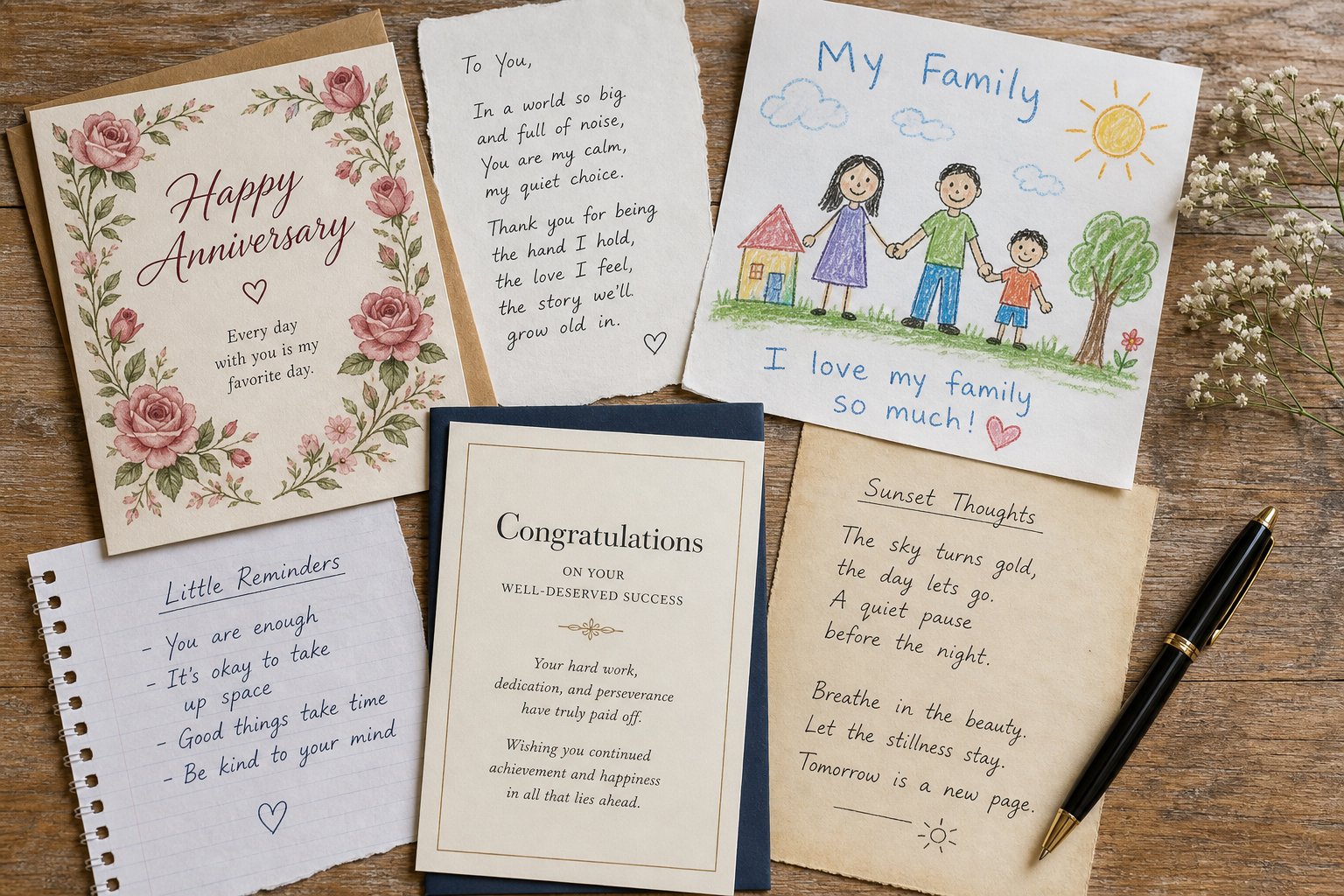
A strong word bank gives you raw material, but raw material alone doesn't determine how a poem lands. The same name can produce wildly different poems depending on who you're writing for and why. An acrostic poem with your name written by a romantic partner should feel nothing like one written by a coworker at a retirement party. Context shapes everything: word choice, sentence length, emotional depth, even punctuation.
Think of it this way. You wouldn't use the same voice in a love letter and a birthday card for a seven-year-old. The acrostic structure stays constant, but the tone inside that structure needs to flex. Here's how to calibrate it for the most common occasions.
Romantic and Anniversary Name Poems
When writing for a partner, you have permission to go deep. Metaphor, sensory language, and emotional vulnerability all belong here. Lines can reference intimate moments, physical details, or feelings you wouldn't share publicly. The vocabulary can be richer and more layered because your audience is one person who already knows the context.
A poem with name letters written for a spouse might include lines like "Mornings when your hand finds mine before your eyes open" or "Anchored to you through every uncertain season." Notice how these lines are specific without being generic. They reference shared physical reality rather than abstract declarations like "Amazing in every way."
For anniversary poems, consider weaving in timeline markers. Reference the year you met, a place that matters to both of you, or a private joke that only the two of you would understand. This specificity is what makes a name poem creator tool's output feel flat by comparison, and it's exactly what your editing pass should add.
Name Poems for Children and Students
Writing acrostic with names for kids requires a completely different register. Shorter words, playful sounds, and concrete images work best. A first-grader doesn't need metaphor. They need to see themselves reflected in language they already use.
The Poetry Foundation notes that for young or beginning student poets, "there's a magic to making poems out of one's own name." Elementary-age children respond to acrostics because the structure is simple enough to grasp immediately: write your name down the side, then fill in each line. The constraint actually helps rather than limits, giving kids a clear starting point instead of a blank page.
For poems written about children, keep lines to five or six words. Use action verbs and sensory details they'd recognize: favorite foods, games they play, sounds they make when laughing. A poem maker with names for a child named LEO might read: "Loves building towers taller than himself / Eats pancakes shaped like dinosaurs / Opens every door expecting adventure."
Professional and Friendship Occasions
Workplace poems walk a tighter line. You want warmth without intimacy, humor without inside jokes that exclude others, and praise without sounding like a performance review. Stick to professional qualities, team contributions, and lighthearted observations about work habits.
For friends, the tone opens up but stays grounded. You can be funny, sarcastic, or sentimental depending on the friendship's natural register. The key is matching how you actually talk to this person. If your texts are full of dry humor, your acrostic should reflect that voice rather than suddenly turning poetic.
Memorial poems deserve special mention. These carry the heaviest emotional weight and benefit from restraint. Simple, concrete memories often land harder than grand statements about loss. A line like "Thursdays when you called just to check in" says more than "Taken too soon from this world."
| Occasion | Tone | Vocabulary Level | Example Phrase |
|---|---|---|---|
| Romantic / Anniversary | Intimate, vulnerable, sensory | Rich, metaphorical | "Restless until your voice steadies me" |
| Children (ages 5-10) | Playful, concrete, energetic | Simple, action-based | "Jumps into puddles shoes and all" |
| Teens / Students | Encouraging, slightly humorous | Moderate, relatable | "Never backs down from a challenge" |
| Colleagues / Professional | Warm, respectful, light | Clean, specific to role | "Always first to volunteer for the hard projects" |
| Friends | Authentic to the friendship's voice | Casual, may include humor | "Keeper of every embarrassing story since 2012" |
| Memorial / Remembrance | Gentle, restrained, concrete | Simple, memory-driven | "Sunday mornings smelling like your coffee" |
The table above isn't a rigid formula. It's a starting framework you can adjust based on your relationship and the recipient's personality. What matters most is consistency within the poem. If you start with a playful tone, don't suddenly shift into heavy sentiment on line four. Let the emotional register stay coherent from the first letter to the last.
With tone dialed in, the next question becomes practical: what happens when you don't want to start from scratch? Generator tools can produce a first draft in seconds, but understanding how they work, and where they fall short, determines whether that draft becomes something worth giving.
How Acrostic Name Poem Generators Actually Work
You type a name, click a button, and lines of poetry appear on screen. It feels like magic, but the technology behind an acrostic poem generator follows a logical process. Understanding that process helps you evaluate which tools produce usable drafts and which spit out filler you'll need to rewrite entirely.
How Generator Tools Create Poems From Names
The typical workflow looks like this: you enter a name, select a tone or theme (romantic, funny, inspirational), and the tool returns a poem where each line starts with the corresponding letter. Some tools ask for additional context, like the person's relationship to you or a few descriptive words. Others work from the name alone.
Behind the scenes, the acrostic poem maker maps each letter to language that fits the selected tone. The simplest versions pull from a pre-built database of words and phrases tagged by letter and category. More advanced tools use language models trained on large text corpora to construct original sentences that begin with the required letter while maintaining coherent meaning across the full poem.
Research into computational poem generation shows that modern approaches combine multiple modules addressing syntax, semantics, and poetic structure. Some systems even evaluate generated output through fitness functions that assess phonetic quality, emotional impact, and semantic coherence, iteratively refining results before presenting them to the user.
Simple Builders vs AI-Powered Generators
Not every acrostic poem builder works the same way. The quality gap between tool types is significant.
A basic acrostic maker operates like a lookup table. It stores lists of adjectives and short phrases organized by starting letter. When you enter "MARIA," it retrieves one pre-written option for M, one for A, and so on. The result reads like a random collection of compliments rather than a cohesive poem. These template-based tools are fast but produce generic output that could describe anyone.
An AI-powered acrostic name generator works differently. Language models like GPT-2 and its successors generate text by predicting contextually appropriate next words based on patterns learned from massive datasets. When constrained to start each line with a specific letter, these models can still produce sentences that flow naturally and relate to each other thematically. The poem acrostic generator powered by this technology creates lines that feel connected rather than randomly assembled.
The difference shows up most clearly in coherence. A template tool might produce "Marvelous spirit / Amazing friend / Radiant smile / Incredible heart / Always caring." Technically correct, but flat. An AI-powered acrostic generator can produce lines that build on each other, reference a consistent theme, and vary sentence structure.
When evaluating any tool, look for these features:
- Tone or theme selection beyond just "positive" or "negative"
- Ability to input context about the person, not just their name
- Output that varies sentence length and structure across lines
- Options to regenerate or refine specific lines without starting over
- Coherence between lines rather than isolated, disconnected statements
- Support for longer names without quality degradation on later letters
Even the best tools have limits, though. They don't know your person. They can't reference the trip you took together or the way they hum while cooking. That's where the real work begins: taking generated output and making it sound like something only you could have written.
Editing AI-Generated Poems Into Something Personal
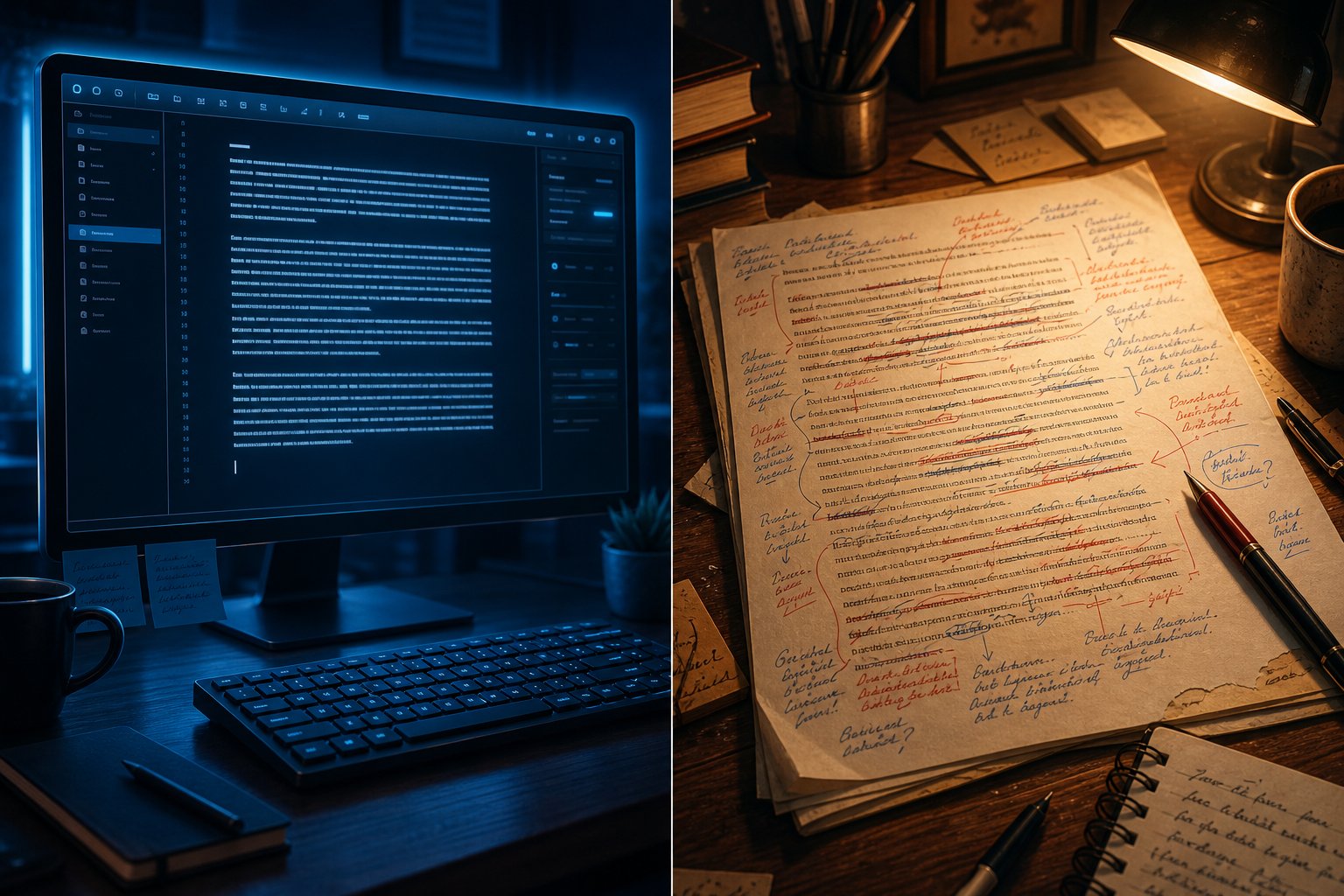
A generator gives you a starting point, not a finished gift. The gap between raw output and a poem that makes someone feel seen is where your voice enters the picture. Acrostic AI tools can handle structure and vocabulary, but they can't replicate the specificity of your relationship with another person. Closing that gap requires a deliberate editing pass, one that strips away the generic and replaces it with the real.
Think of the generated draft as modeling clay. A professional editor working with AI-generated poetry found that even after the writer's own revisions, the poem still had problems with rhythm, repeated ideas, and inconsistent structure. The takeaway? AI gives you something to shape, but the shaping is where the poem actually becomes yours.
Identifying Generic Lines That Need Revision
Before you rewrite anything, you need to spot what's weak. Generic lines share a few telltale traits. They could describe literally anyone. They rely on vague superlatives. They sound like greeting card filler rather than something a specific human would say to another specific human.
Here's what to flag when you create an acrostic poem from generator output:
- Universal compliments - Lines like "Amazing in every way" or "Radiating kindness wherever you go" apply to anyone. If you could swap in a different name and the line still works, it needs revision.
- Stacked adjectives without context - "Loving, loyal, and luminous" sounds polished but says nothing concrete about your person.
- Cliched metaphors - "Shining like a star" or "Heart of gold" signal that the tool pulled from its most statistically common associations.
- Filler transitions - Phrases like "In every way" or "Through and through" pad line length without adding meaning.
A useful test: read each line and ask, "Would this surprise the person I'm writing for?" If the answer is no, that line is a candidate for replacement. The goal when you write an acrostic poem isn't just structural correctness. It's recognition. The recipient should feel known, not merely complimented.
Adding Personal Details and Shared Memories
Generic lines die the moment you inject something only you and the recipient would understand. This is the step where you create an acrostic poem that no tool could have produced alone.
Replace abstract praise with concrete scenes. Instead of "Joyful spirit that lights up a room," try "January when you drove three hours just to bring me soup." Instead of "Always there when I need you," try "Answering the phone at 2 a.m. without ever sounding annoyed."
Before: "Kindness flows from everything you do." After: "Kept every terrible drawing I made you in elementary school."
Notice what changed. The revised line references a specific action, a specific time period, and a detail that only this relationship contains. It's no longer interchangeable. It belongs to one person and one recipient.
When editing, pull from these categories of personal material:
- Inside jokes or recurring bits between you
- Sensory details: how their house smells, what music plays in their car, the sound of their laugh
- Specific dates, places, or events you shared
- Habits or quirks only people close to them would notice
- Direct quotes or phrases they always say
You don't need to replace every line. Even two or three hyper-specific details scattered through the poem transform the entire piece from generic to intimate. The generated lines that already work can stay. Your job is surgical: find the hollow spots and fill them with something real.
Polishing Rhythm and Flow
Personal details make a poem meaningful. Rhythm makes it feel like a poem rather than a list of nice things. After you've swapped in your specific content, read the whole piece aloud. Your ear will catch what your eyes miss.
Listen for these issues:
- Line length inconsistency - If one line has four syllables and the next has eighteen, the poem feels lopsided. You don't need perfect uniformity, but aim for a general range. Lines between six and twelve syllables tend to read comfortably.
- Rhythmic monotony - Five lines in a row starting with an adjective creates a droning pattern. Vary your sentence openings: start some with verbs, some with nouns, some with prepositional phrases.
- Awkward sound collisions - Two hard consonants crashing together ("strict trust") or unintentional rhymes in non-rhyming poems pull the reader out of the moment.
Count syllables if a line feels off. You don't need to follow a strict meter, but awareness of syllable count helps you trim bloated lines and expand thin ones. A line that felt perfect in your head might land flat when spoken because it rushes past too quickly or drags on one beat too long.
One final check: does the poem build toward something? Even a short five-line acrostic benefits from a sense of movement. Maybe the first lines describe external qualities and the last line turns inward. Maybe the tone shifts from playful to sincere on the final letter. That small arc is what separates a polished poem from a pleasant but forgettable list.
With your edited poem reading smoothly and sounding like you, the next step is practical: having ready-made structural templates that match different name lengths and styles, so you can repeat this process efficiently for any name and any occasion.
Templates and Examples for Acrostic Name Poems
Editing techniques sharpen a poem, but starting from a solid structural framework makes the entire process faster. Whether you're working from generator output or writing from scratch, having a reliable acrostic poem template for your specific name length removes guesswork about line proportions, pacing, and overall shape. Think of these templates as scaffolding: they hold the structure in place while you build something personal inside it.
Blank Templates for Short and Long Names
Name length changes how a poem feels. A three-letter name like EVE produces something punchy and concentrated. A nine-letter name like ELIZABETH demands more variation in line weight to avoid monotony. The blank acrostic poem template you choose should account for this difference.
For short names (3-5 letters), each line carries more weight because there are fewer of them. You can afford longer, more detailed lines since the poem won't feel overwhelming. Think of each line as a full sentence or even two clauses joined together.
For medium names (6-8 letters), balance becomes important. If every line runs long, the poem feels dense and exhausting. Mix shorter punchy lines with longer descriptive ones to create rhythm. This is where the one-trait-per-line and free-form styles from earlier really diverge in feel.
For long names (9+ letters), brevity per line keeps the poem readable. Readers lose the thread if they're processing twelve lines of complex imagery. Shorter lines also let the name itself become more visually prominent on the page, which reinforces the acrostic structure.
Here's a name acrostic poem template framework scaled to each length category:
| Name Length | Letter Position | Suggested Line Length | Style Notes |
|---|---|---|---|
| Short (3-5 letters) | Each letter | 8-15 words per line | Rich detail per line; each line can hold a full scene or memory |
| Medium (6-8 letters) | Lines 1-2 | 8-12 words | Open with grounding detail or context-setting imagery |
| Medium (6-8 letters) | Lines 3-5 | 5-10 words | Vary between short punches and medium descriptions |
| Medium (6-8 letters) | Final 1-2 lines | 8-12 words | Close with emotional weight or a callback to the opening |
| Long (9+ letters) | Lines 1-3 | 5-8 words | Establish tone quickly without overloading |
| Long (9+ letters) | Middle lines | 4-7 words | Keep momentum; one image or trait per line |
| Long (9+ letters) | Final 2-3 lines | 6-10 words | Build toward a closing statement that resonates |
A practical way to use this: write the name vertically, note which position category each letter falls into, and use the suggested word count as a target rather than a rule. If a line needs to run long because the memory demands it, let it. The template guides proportion, not precision.
Completed Examples Showing Range of Styles
Templates give you structure. Finished examples show you what's possible inside that structure. Below are acrostic samples across four distinct tones, each using a different common name to demonstrate how letter combinations inspire different creative directions.
Romantic tone - JAMES (short name, rich lines):
Jaw set with quiet determination, but soft the moment you look at me.
J - Jaw set with quiet determination, but soft the moment you look at me
A - Always reaching for my hand without thinking about it, like reflex
M - Mornings with you smell like coffee and sound like rain on the window
E - Every argument ends with your arms open first
S - Steady in ways I'm still learning to trust
Notice how each line runs 8-14 words, fitting the short-name template. The tone stays intimate and sensory throughout, with specific physical details grounding the emotion.
Humorous tone - RACHEL (medium name, varied lines):
R - Refuses to admit she's wrong about pineapple on pizza
A - Accidentally iconic in every candid photo
C - Chronically five minutes late but worth the wait
H - Has strong opinions about fonts
E - Expert-level snack hoarder, desk drawer as evidence
L - Laughs so loud the neighbors probably know her jokes
The humor here comes from specificity. "Strong opinions about fonts" is funnier than "funny and quirky" because it paints an actual person. The shorter middle lines (H and E) create a quicker rhythm that suits comedy.
Inspirational tone - DANIEL (medium name):
D - Driven by something deeper than ambition alone
A - Arms open to people others overlook
N - Never the loudest voice, always the most listened to
I - Integrity that costs him something and he pays it anyway
E - Eyes fixed forward even when the path isn't clear
L - Leaves every room a little better than he found it
This example of acrostic poem name writing shows how inspirational tone differs from romantic. The language is admiring but not intimate. It describes character observed from the outside rather than experienced in close relationship.
Childlike tone - EMMA (short name, simple language):
E - Eats spaghetti with her fingers when nobody's looking
M - Makes up songs about her cat every morning
M - Mud puddles are her favorite shoes' worst enemy
A - Always asks "but why?" one more time
Short words, concrete actions, and playful imagery. A child reading this poem would immediately recognize themselves in it. The repeated M shows how the same letter can go in completely different directions within one poem.
These acrostic poem templates aren't meant to be copied word for word. They're meant to show you the range available within the same structural constraint. A generator might produce the skeleton of any of these styles, but the specific details, the pineapple pizza argument, the spaghetti fingers, the coffee-scented mornings, those come from you. Use the acrostic poem name template that matches your occasion, plug in your person's name, and let the examples above calibrate your sense of what each tone actually sounds like on the page.
With templates in hand and editing skills sharpened, the creative possibilities extend well beyond the standard format. The basic acrostic is just one variation in a family of structural poetry techniques, and the finished poem itself is just one form a meaningful gift can take.
Creative Variations and Gift Ideas for Name Poems
The standard acrostic format, where the first letter of each line spells a name downward, is only one way to play with this structure. Once you're comfortable writing and editing within that constraint, a whole family of related forms opens up. These variations add layers of complexity and surprise, turning a simple name poem into something that rewards closer reading.
Creative Variations Beyond the Basic Format
A double acrostic takes the concept further by making both the first and last letters of each line spell out words or names. Imagine a poem where the left side spells SARAH and the right side spells LOVED. Every line must start and end with specific letters, which dramatically narrows your word choices but produces a result that feels almost puzzle-like in its precision. This format works especially well for wedding poems where two names or two concepts interlock.
Mesostic poems shift the name to the middle of each line rather than the beginning. The target letter appears somewhere within the line, often capitalized or bolded to make the vertical name visible. Poet John Cage popularized this form, and it creates a more subtle effect. The name emerges from inside the language rather than leading it. For readers who find standard acrostics too obvious, a mesostic feels like a hidden message waiting to be discovered.
An acronym name poem compresses the idea even further. Instead of a full line per letter, each letter represents a single word, and those words together form a phrase or sentence that captures the person. KATE might become "Kind And Truly Empathetic." It's less poetic but works well for quick cards, social media posts, or classroom activities where brevity matters. Some people use an acronym poem generator to brainstorm these compressed versions before expanding them into full acrostic lines.
You can also explore an acrostic puzzle generator approach, where the poem doubles as a word game. Hide the name within a longer piece of writing and challenge the recipient to find it. This works beautifully for birthday scavenger hunts, classroom activities, or playful love notes where discovery is part of the gift.
Turning Your Poem Into a Meaningful Gift
A poem sitting in a notes app doesn't carry the same weight as one presented with intention. How you deliver the finished piece matters almost as much as what it says. The format you choose should match the occasion and the recipient's personality.
Personalized poetry endures in ways other gifts don't. As Fourth Foray Poetry notes, "unlike other celebratory gestures, poetry endures. It can be framed, recited, or passed down, ensuring the memory of the celebration lasts forever." That permanence is what makes presentation worth thinking about.
Here are practical ways to turn your acrostic name poem maker output, refined through your personal editing, into a gift worth keeping:
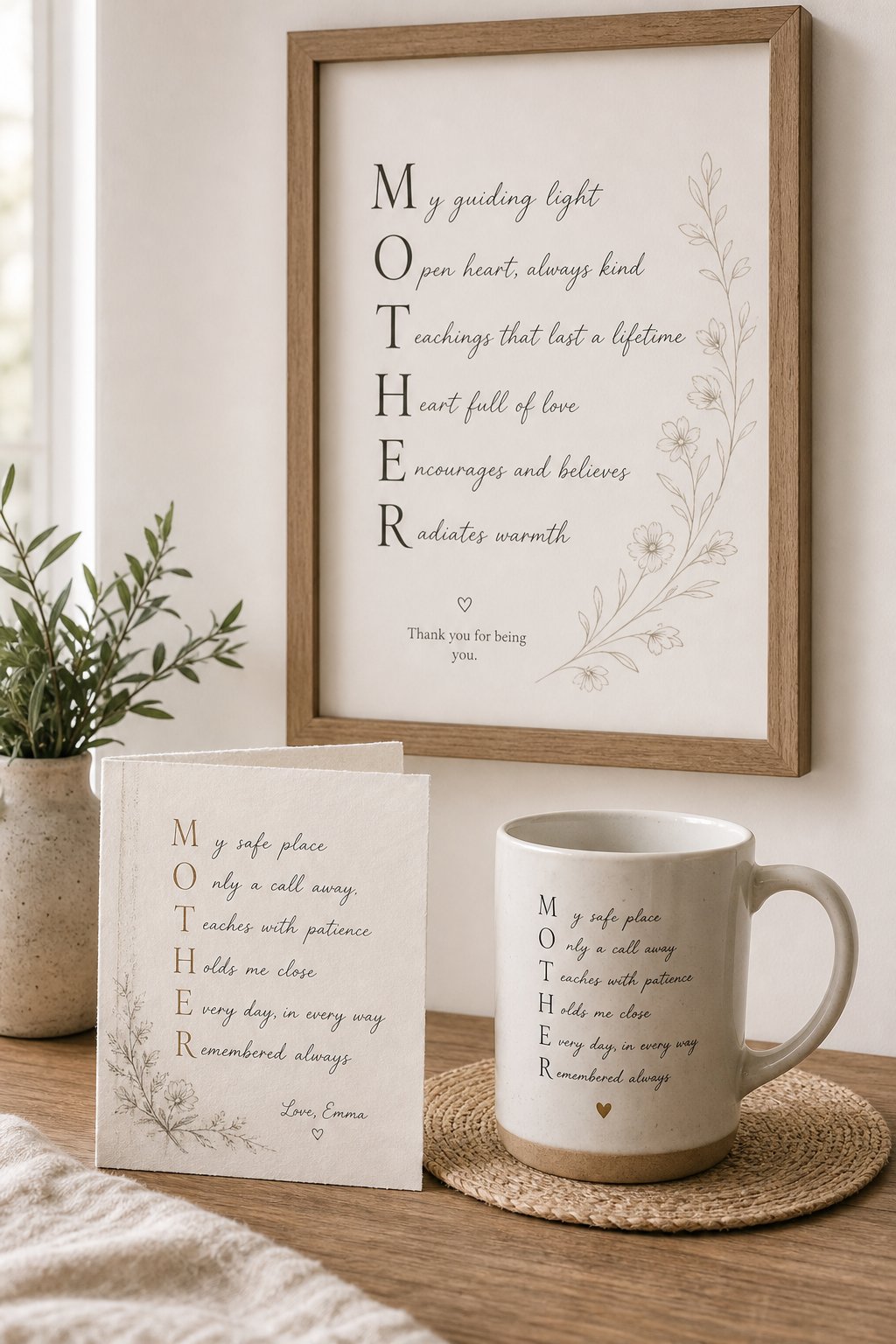
- Framed calligraphy - Hand-letter the poem or commission a calligrapher. Bold or color the first letter of each line so the name pops visually. This works for weddings, nursery decor, and memorial tributes.
- Handwritten inside a card - Sometimes the simplest delivery hits hardest. Write the poem by hand on quality cardstock. The imperfection of handwriting adds warmth that printed text can't match.
- Paired with illustration - Commission or create a small illustration for each line. A children's name poem paired with drawings of each described scene becomes a keepsake page they'll revisit for years.
- Digital animated reveal - For tech-savvy recipients, create a short video or animation where each line appears one at a time, building the name letter by letter. Share via text or social media for birthdays and announcements.
- Engraved or printed on objects - Transfer the poem onto a mug, cutting board, jewelry box, or ornament. The acrostic maker for names gives you the draft; a print-on-demand service gives you the physical object.
- Read aloud at an event - Birthdays, weddings, retirements, and memorials all have moments where spoken words carry power. Reading a name poem aloud lets the audience watch the name emerge line by line.
- Scrapbook or memory book page - Surround the poem with photos that correspond to each line. If one line references a camping trip, place that photo beside it.
The best approach combines a name poems generator for structural inspiration with the manual techniques covered throughout this article. Start with a tool to overcome the blank-page problem. Then brainstorm personal details, swap out generic lines, polish rhythm, and choose a presentation format that fits the occasion. That workflow, from generated draft to personally crafted gift, is how you produce something that sounds like you wrote it. Because by the end of the process, you did.
Frequently Asked Questions About Acrostic Name Poems
1. What is an acrostic name poem generator?
An acrostic name poem generator is a tool that takes a person's name as input and produces a poem where the first letter of each line spells out that name vertically. Basic versions pull from pre-built word lists, while AI-powered generators use language models to construct coherent, thematically connected lines. The best tools allow you to select tone, add context about the person, and regenerate individual lines for better results.
2. How do you write an acrostic poem with someone's name?
Start by writing the name vertically on paper. For each letter, brainstorm personality traits, shared memories, and sensory details connected to that person. Then choose between two styles: one complete thought per line, or free-form sentences that flow across lines. Draft your lines, read them aloud to check rhythm, and revise any that sound generic or forced. The key is specificity - replace universal compliments with concrete details only your recipient would recognize.
3. What words can I use for difficult letters like X, Z, and Q in acrostic poems?
For difficult letters, use phrase starters rather than forcing a single word. For X, try 'X marks the moment you...' or use words emphasizing the X sound like 'eXactly.' For Z, options include 'Zealous,' 'Zen-like calm,' or 'Zero hesitation when...' For Q, consider 'Quietly you remind me...' or words like 'Quick-witted' and 'Quirky.' Building a personal word bank with trait words, action words, and scene words for each letter makes the process much easier.
4. Can I use an acrostic poem generator for a wedding or memorial?
Yes, but the generated output needs careful editing to match the occasion's emotional weight. For weddings, consider a double acrostic where both the first and last letters spell meaningful words, such as two names interlocking. For memorials, replace generic praise with specific, restrained memories like 'Thursdays when you called just to check in.' Use the generator for structural inspiration, then swap in personal details that honor the relationship authentically.
5. What is the difference between an acrostic poem and a mesostic poem?
In a standard acrostic poem, the target name is spelled by the first letter of each line, making it immediately visible along the left margin. A mesostic poem places the target letters somewhere within the middle of each line, often bolded or capitalized so the name emerges vertically through the center of the text. Mesostics feel more subtle and puzzle-like, rewarding closer reading. Poet John Cage popularized this variation as a way to embed names as hidden messages within longer texts.