Why 羊 Makes the Goat Year Uniquely Auspicious in Chinese Culture
Imagine a language where the word for a single animal is physically built into the characters for beauty, goodness, righteousness, and divine blessing. That language is Chinese, and that animal is the goat. The character 羊 (yang) does not just name a creature. It functions as a building block inside dozens of characters that express the most positive concepts in the entire writing system. No other zodiac animal comes close to this level of linguistic presence in words associated with virtue and fortune.
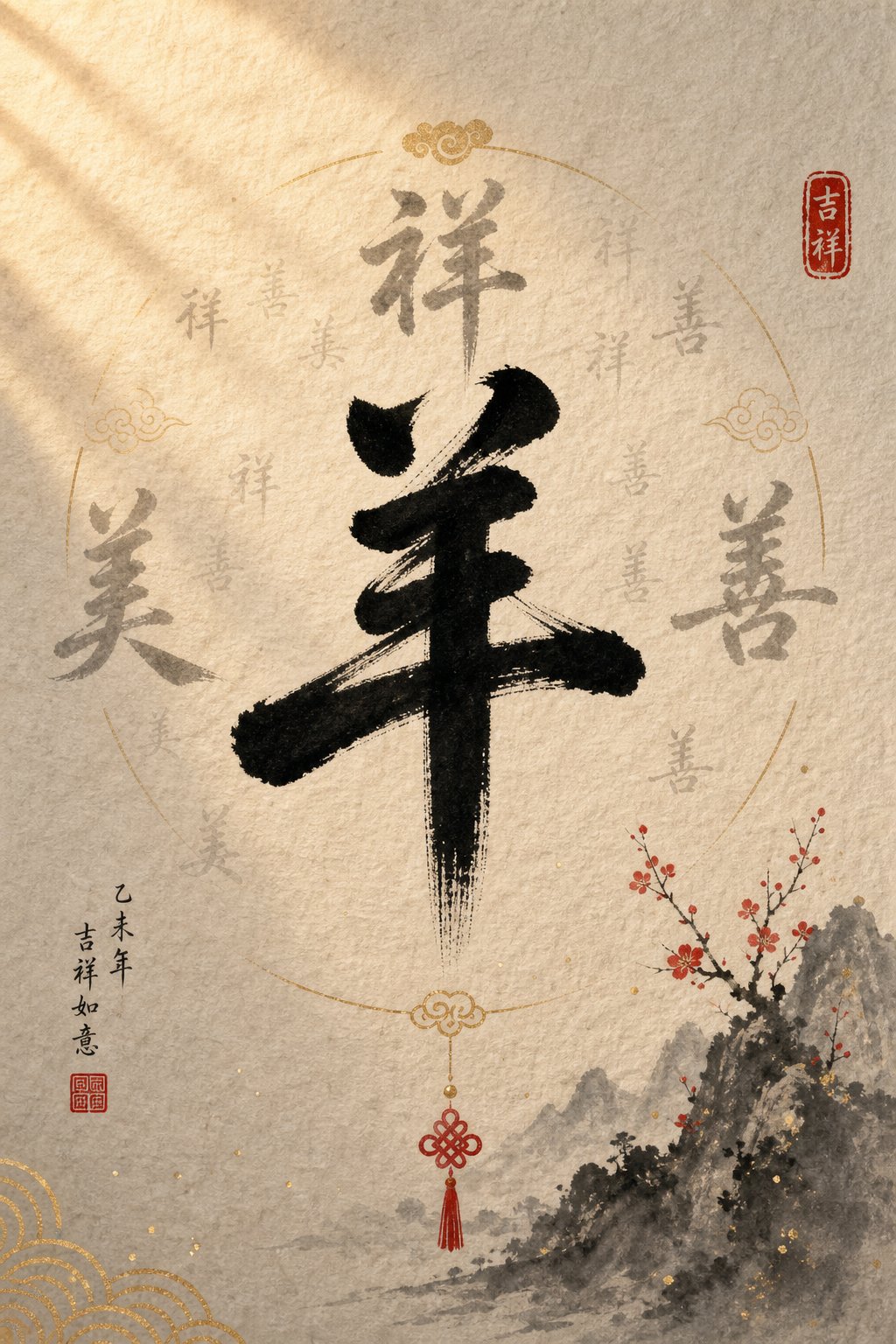
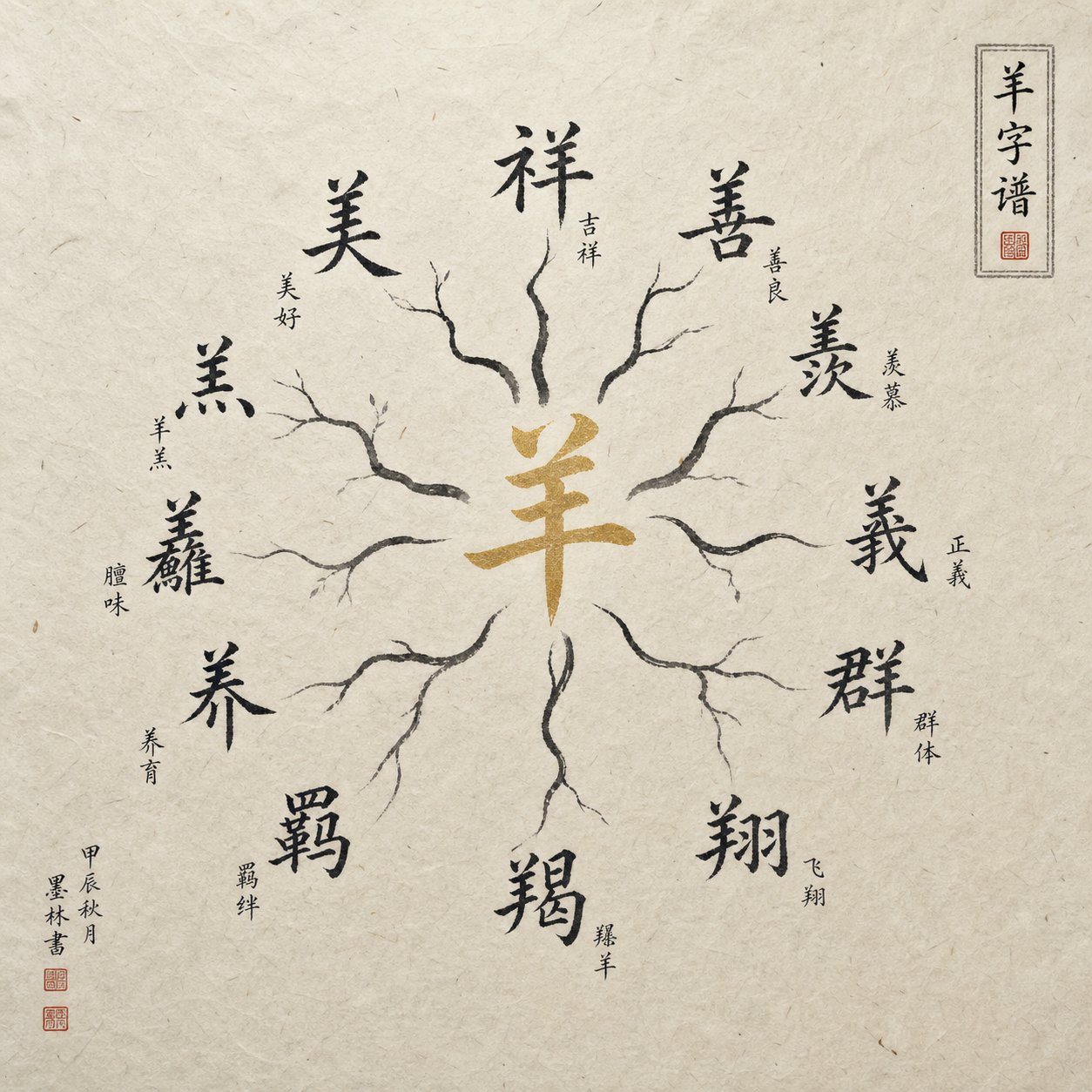
This is what makes auspicious characters for goat year celebrations so deeply rooted in the language itself. The concept of 吉祥字 (jixiangzi), or auspicious characters, refers to specific Chinese characters chosen for their lucky meanings and used in calligraphy, decorations, greetings, and names. Every zodiac year has its own set of blessings, but the Goat year draws from a uniquely rich well. Characters like 祥 (auspiciousness), 美 (beauty), 善 (goodness), and 義 (righteousness) all contain 羊 as a core component. The luck is not symbolic or abstract. It is structural, woven into the very strokes of the writing system.
Why the Goat Is Linguistically the Most Blessed Zodiac Sign
In Chinese astrology, the goat is the eighth sign in the zodiac cycle, associated with gentleness, creativity, and compassion. But beyond personality traits, the goat chinese zodiac sign holds a distinction no other animal can claim: its character serves as a semantic radical in an extraordinary number of positive words. The chinese zodiac goat is, by the structure of the written language, the most blessed sign.
You might have heard the folk superstition that being born in a year of the goat brings bad luck. This belief, sometimes called "十羊九不全" (nine out of ten goats face hardship), has no basis in classical Chinese thought. In fact, the oldest etymological evidence says the opposite.
The Cultural Weight of 羊 in Chinese Writing
The Shuowen Jiezi (说文解字), China's first comprehensive character dictionary compiled around 100 CE by Xu Shen, defines 羊 with a single powerful word:
羊,祥也。(Yang means auspiciousness.)
This is not a poetic interpretation. It is the dictionary's official definition. Xu Shen recognized that 羊 and 祥 (auspiciousness) share the same ancient pronunciation and the same root meaning. The Kangxi Dictionary echoes this, noting that characters for goodness (善), beauty (美), and righteousness (義) all derive their positive meaning from the 羊 component.
Why did ancient Chinese culture assign such weight to this animal? The answer lies in pastoral life. Goats and sheep provided food, clothing, and sacrificial offerings. They were gentle, communal, and essential to survival. Over millennia, these associations crystallized into the writing system itself, making 羊 a permanent carrier of positive meaning in chinese astrology the goat tradition and far beyond.
The real question, then, is not whether the year of the goat is lucky. It is how many layers of luck are hidden inside the characters themselves, waiting to be read.
The Sheep Goat and Ram Translation Puzzle Explained
So which animal are we actually talking about? If you have searched for the year of the goat and sheep online, you have probably noticed that English sources cannot seem to agree. Some call it the Year of the Sheep. Others say Goat. A few insist on Ram. The confusion is real, but it stems from a simple linguistic fact: Chinese does not draw the same lines between these animals that English does.
Understanding the 羊 Translation Challenge
The character 羊 (yang) is a general term covering the entire Caprinae subfamily. It refers to goats, sheep, and rams without distinguishing between them. As Lala Zuo, a Chinese language and culture professor at the U.S. Naval Academy, explains: "I don't think there's a wrong translation. I think there are various ways of translation. It really depends on the context." The chinese symbol for sheep and the symbol for goat are, in fact, the same character.
Chinese only makes distinctions when you add qualifiers. A goat is 山羊 (mountain yang), a sheep is 绵羊 (soft yang), and a ram is 公羊 (male yang). The base character 羊 on its own? It is all of them and none of them specifically. Zhao Shu of the Beijing Research Institute of Culture and History put it plainly: "This 'yang' is fictional. It does not refer to any specific kind."
Different cultures even interpret the same zodiac animal differently. In Korea, the prototypical image is a sheep. In Vietnam, the year of the sheep chinese calendar is understood exclusively as a goat year because, as Vietnamese language instructor James Lap notes, "In Vietnam, there is no sheep or ram at all because the weather is so hot." The ram chinese zodiac interpretation tends to appear in Western astrology-influenced sources that emphasize masculine energy.
Here are the three common English translations and where you will typically encounter each:
- Goat — preferred in mainland Chinese contexts and Vietnamese traditions; reflects the animal most commonly seen across China historically
- Sheep — favored in Korean, Mongolian, and Tibetan interpretations; common in older English-language references to the chinese zodiac animal sheep
- Ram — used in Western astrology crossover content and some decorative art contexts; emphasizes strength and assertiveness
Why the Distinction Does Not Affect Auspicious Meaning
Here is what matters for anyone exploring the year of the goat/sheep and its lucky characters: the translation debate is entirely irrelevant to the auspicious meaning embedded in the writing system. The radical 羊 inside characters like 祥, 美, and 善 does not mean "goat" or "sheep" specifically. It carries the abstract sense of gentleness, value, and divine favor that ancient Chinese culture associated with the entire category of yang animals.
Whether you picture a mountain goat, a woolly sheep, or a curly-horned ram when you read about this zodiac sign, the characters built on 羊 hold the same positive power. The blessings encoded in the radical do not change based on which English word a translator chose. This article uses "Goat" as the primary term because it aligns with the most common mainland Chinese interpretation, but every reference to 羊 embraces the full breadth of the character's meaning.
With the naming question settled, the real richness lies in how 羊 functions inside individual characters, building meaning stroke by stroke.
Auspicious Characters with the 羊 Radical and Their Etymological Roots
Picture a single radical acting like a seed of goodness, sprouting into character after character that means something beautiful, virtuous, or sacred. That is exactly what 羊 does inside the Chinese writing system. The goat zodiac symbol is not just an animal sign. It is a semantic engine powering some of the most positive words in the language.
When you break these characters apart, you will notice that 羊 consistently contributes a sense of value, purity, or divine favor. This is not coincidence. It is the direct result of how deeply ancient pastoral communities revered the chinese animal goat as a provider of food, warmth, and sacrificial offerings to the gods.
祥 美 善 義 — Characters Built on the Goat Radical
Each character below contains 羊 as a structural component. Some use it as a radical (the primary meaning-bearing element), while others embed it as a phonetic or semantic hint. Either way, the goat in chinese writing leaves its mark on the meaning.
| Character | Pinyin | Decomposition | Literal Meaning | Cultural Significance |
|---|---|---|---|---|
| 祥 | xiang | 示 (divine/altar) + 羊 (goat) | Auspiciousness, good omen | A goat presented at the altar signals divine blessing; the core character of 吉祥 (good fortune) |
| 美 | mei | 羊 (goat) + 大 (large) | Beauty, excellence | A large, well-fed goat represented the ideal of beauty and abundance in agrarian life |
| 善 | shan | 羊 (goat) + 言-related elements | Goodness, virtue, kindness | Gentle speech and gentle nature combined; the goat's docile temperament as moral ideal |
| 義 / 义 | yi | 羊 (goat) + 我 (self/weapon) | Righteousness, justice | Sacrificing a goat (or oneself like a goat) for a greater cause; moral duty |
| 羡 | xian | 羊 (goat) + 欠 (lacking/yearning) | Admiration, envy | Gazing longingly at another's fine goat; desire for what is good and valuable |
| 鲜 | xian | 鱼 (fish) + 羊 (goat) | Freshness, deliciousness | Fish and goat meat together represent the pinnacle of fresh, flavorful food |
| 群 | qun | 君 (ruler/leader) + 羊 (goat) | Flock, group, community | A leader among goats; the natural social order of a harmonious community |
Look at the pattern. 祥 places the goat at the altar. 美 celebrates the goat's physical form. 善 honors its temperament. 義 elevates its role as a sacrifice. Every angle of the goat's relationship with human life becomes a character expressing something admirable.
How 羊 Functions as a Semantic Component of Goodness
Why does one animal dominate so many virtuous characters? The goat chinese zodiac meaning traces back to the realities of ancient Chinese pastoral culture. Goats and sheep were among the earliest domesticated animals in the Yellow River valley. They provided meat, milk, wool, and hide. They were gentle enough for children to tend and valuable enough to offer as sacrifices to ancestors and deities.
As etymologist Lo Lung-chih has noted, characters with the sheep radical tend to be associated with moral virtues and legal concepts. A large, plump goat was the finest sacrificial offering that could be served to the gods. The phrase "leading a sheep and bringing wine" indicated a gift to be highly prized. This cultural weight crystallized into the writing system over thousands of years.
The chinese zodiac sign goat carries all of this embedded meaning. When you write 祥 during a Goat year celebration, you are not just choosing a lucky word. You are activating a character whose very structure says: "a goat before the divine equals blessing." When you hang a scroll featuring 美 or 善, the goat radical inside quietly reinforces the zodiac connection, creating a layered resonance between the year's animal and the character's meaning.
This is what separates the chinese sign of the goat from every other zodiac animal. A dragon year might feature dragon imagery, but the character 龙 does not build outward into dozens of virtue words. The goat zodiac animal, by contrast, is linguistically generative. It seeds goodness across the entire vocabulary.
These individual characters are powerful on their own, but their real magic emerges when they combine into four-character idioms and festival-specific blessings designed for Goat year celebrations.
General Auspicious Characters vs Goat Year Specific Blessings
Every Lunar New Year, certain characters appear on doorways, red envelopes, and paper cuttings regardless of which animal rules the cycle. Walk through any Chinatown in January or February and you will see 福 (fortune), 禄 (prosperity), and 寿 (longevity) everywhere. These are universal blessings, appropriate for a Dragon year, a Tiger year, or any other. They carry no zodiac-specific connection.
But during a chinese calendar year of the goat, something different happens. Calligraphers and decoration makers reach for a second layer of characters, ones that resonate with the ruling animal on a structural level. This is where the 羊-radical characters come alive with doubled meaning.
General Lunar New Year Characters vs Goat-Specific Characters
Think of it as two tiers of festive language. The first tier works every year. The second tier activates only when the zodiac aligns.
Universal characters (used every Lunar New Year):
- 福 (fu) — fortune, blessing
- 禄 (lu) — prosperity, official salary
- 寿 (shou) — longevity
- 喜 (xi) — happiness, joy
- 财 (cai) — wealth
Goat-year-specific characters (carry extra resonance during the chinese zodiac year of goat):
- 祥 (xiang) — auspiciousness, containing 羊 at the altar
- 美 (mei) — beauty, built from 羊 + 大
- 善 (shan) — goodness, rooted in the goat's gentle nature
- 義 (yi) — righteousness, the goat as moral sacrifice
- 鲜 (xian) — freshness, fish and goat combined
When a calligrapher writes 祥 during a chinese new year goat celebration, the character does double duty. It means "auspiciousness" on its surface, and it visually contains the year's zodiac animal within its strokes. Viewers who recognize the 羊 radical experience a moment of layered delight, seeing the year's spirit embedded inside the blessing itself. Skilled artisans exploit this overlap deliberately, choosing scrolls and paper cuttings that feature as many 羊-radical characters as possible to create what Chinese aesthetics calls "meaning within meaning" (意中有意).
The Power of Homophonic Wordplay with 羊 and 阳
Chinese culture loves 谐音 (xieyin), or homophonic wordplay, where one word's sound evokes another word's meaning. During a chinese year goat celebration, this technique adds yet another dimension of luck.
The character 羊 (yang, second tone) sounds nearly identical to 阳 (yang, second tone), which means sunlight, positive energy, and the active principle in yin-yang philosophy. This is not a loose resemblance. The two characters share the same pinyin and the same tone. In spoken blessings and written puns, 羊 effortlessly substitutes for 阳, turning every goat reference into a simultaneous invocation of warmth, vitality, and cosmic positivity.
Consider the phrase 喜气洋洋 (xiqi yangyang), meaning "overflowing with joy." The character 洋 (yang) shares the same sound as 羊. During chinese new year the goat celebrations, this everyday idiom takes on a festive double meaning. Listeners hear "goat" echoing inside "joy," reinforcing the idea that the Goat year itself overflows with happiness. Decoration makers sometimes even replace 洋 with 羊 in playful calligraphy, making the pun visual as well as auditory.
This phonetic link between 羊 and 阳 also connects the Goat year to the I Ching concept of yang energy returning in spring. The chinese calendar goat year traditionally falls in a period associated with renewal and increasing light. When people say the Goat year brings positive energy, they are not speaking metaphorically. They are activating a linguistic bridge where the animal's name literally sounds like the word for positivity itself.
These layered connections between sound, structure, and meaning reach their fullest expression in four-character idioms, where every syllable carries weight and every pun multiplies the blessing.
三羊开泰 and Essential Goat Year Idioms Decoded
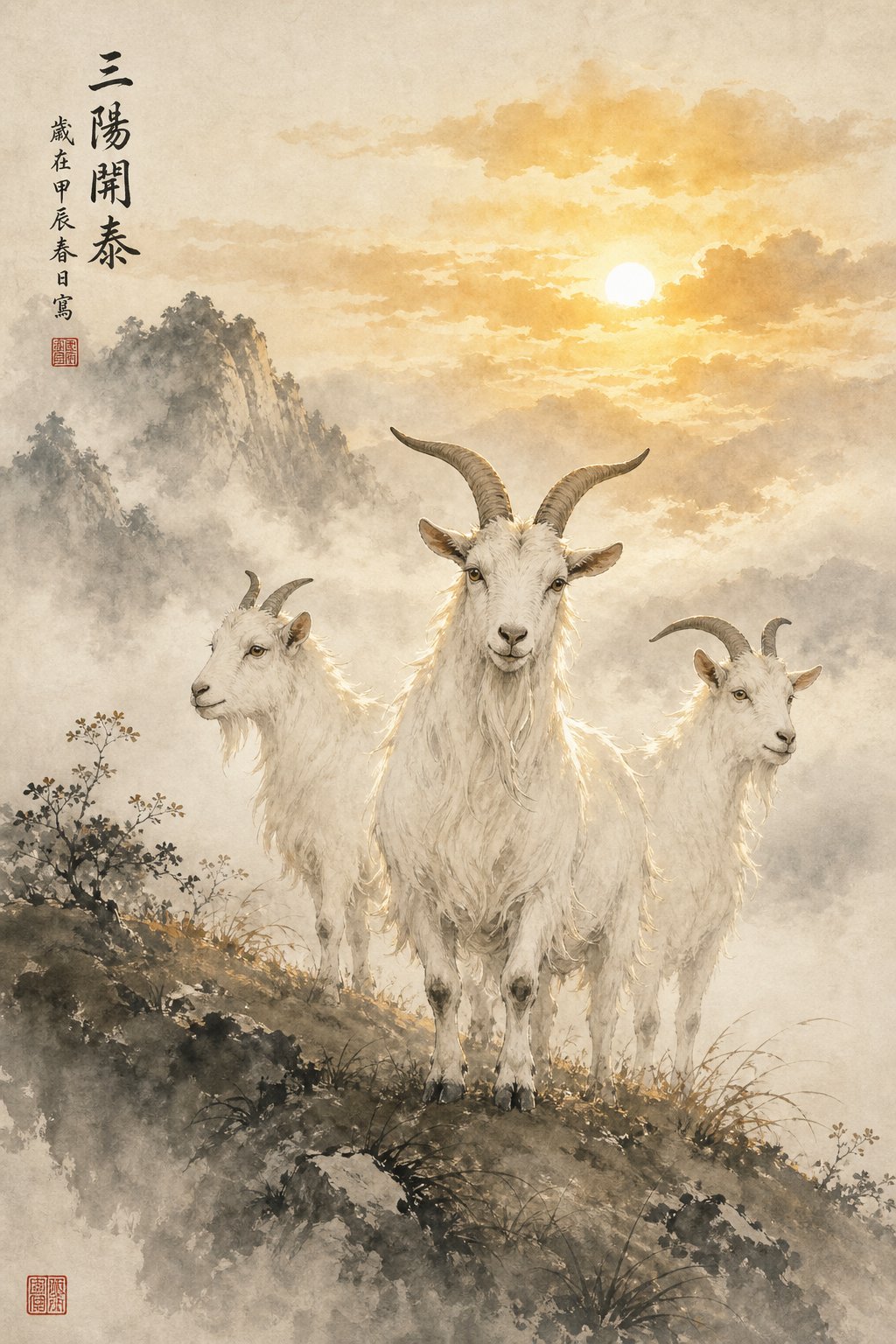
Of all the blessings associated with the year of goat celebrations, one phrase towers above the rest: 三羊开泰 (san yang kai tai). You will find it on scrolls, red envelopes, and greeting cards every time the Goat year rolls around. It sounds elegant. It looks beautiful in calligraphy. But what does it actually mean, and where does it come from? The answer takes us back over two thousand years to one of China's oldest philosophical texts.
三羊开泰 — Origin Story from the I Ching
The phrase originates not as 三羊开泰 (three goats open peace) but as 三阳开泰 (three yang energies open peace). The original version comes directly from the I Ching (易经), China's ancient Book of Changes, and its system of hexagram divination.
Here is the cosmological logic. The I Ching assigns specific hexagrams to each month of the lunar calendar. Among its sixty-four hexagrams, ancient scholars mapped the seasonal cycle like this:
The Kun hexagram (坤), with six yin lines, represents the tenth lunar month. The Fu hexagram (复), with one yang line rising from below, represents the eleventh month. The Lin hexagram (临), with two yang lines, represents the twelfth month. The Tai hexagram (泰), with three yang lines below three yin lines, represents the first month of the new year — the return of spring and the triumph of positive energy.
Three yang lines below. That is the key image. The hexagram 泰 (Tai, meaning Peace or Prosperity) shows heaven's energy rising from the earth, signaling renewal, harmony, and the end of winter's dormancy. "Three yang open tai" became a traditional New Year greeting expressing the wish that positive energy would flood in with the spring.
So how did goats enter the picture? Through the homophonic bridge we explored earlier. Because 羊 (yang, goat) and 阳 (yang, positive energy) share identical pronunciation, the phrase naturally transformed into 三羊开泰. The substitution is both phonetic and visual. Three goats became the artistic representation of three yang forces, and painters began depicting three goats or sheep standing together as a symbol of the blessing. By the Ming Dynasty, this connection was fully established. The Ming-era drama "Nao Zhong Kui" (闹钟馗) features a scene where the Three Yang Lords celebrate the New Year accompanied by "three sheep princes" (三个绵羊太子), with the three sheep explicitly symbolizing the three yang energies.
Let's break the phrase down character by character to see how every piece carries meaning:
- 三 (san) — three; refers to the three yang lines in the Tai hexagram
- 羊/阳 (yang) — goat (surface meaning) / positive cosmic energy (deeper meaning); the homophonic pun that makes the phrase work
- 开 (kai) — to open, to begin, to usher in
- 泰 (tai) — peace, prosperity, grandeur; the name of the I Ching hexagram representing spring's arrival
Together, the year of the goat meaning embedded in this phrase is: "Three goats (three yang forces) usher in an era of peace and prosperity." It is simultaneously a cosmological statement about seasonal energy, a zodiac blessing for the Goat year, and a visual motif for artists. Few four-character phrases in Chinese pack this many layers into so few strokes.
For anyone born under the zodiac sign of the goat, this idiom carries personal resonance. It suggests that the Goat personality — gentle, creative, community-oriented — naturally aligns with the cosmic forces of renewal that the Tai hexagram represents.
Essential Four-Character Idioms for Goat Year Celebrations
三羊开泰 is the crown jewel, but it is far from the only four-character idiom deployed during the year of the goat zodiac celebrations. Chinese festive language thrives on these compact phrases, each one a miniature poem. Here are the essential idioms you will encounter, broken down so you can understand exactly what each character contributes:
| Idiom | Pinyin | Character-by-Character Breakdown | Overall Meaning |
|---|---|---|---|
| 三羊开泰 | san yang kai tai | 三 (three) + 羊 (goat/yang) + 开 (open) + 泰 (peace) | Three goats usher in prosperity; spring's positive energy arrives |
| 吉祥如意 | ji xiang ru yi | 吉 (lucky) + 祥 (auspicious, contains 羊) + 如 (as) + 意 (wished) | May everything be as auspicious as you wish |
| 羊年大吉 | yang nian da ji | 羊 (goat) + 年 (year) + 大 (great) + 吉 (fortune) | Great fortune in the Goat year |
| 喜气洋洋 | xi qi yang yang | 喜 (joy) + 气 (energy) + 洋 (overflowing, sounds like 羊) + 洋 (overflowing) | Overflowing with joyful energy; goat-sound pun doubles the festivity |
| 洋洋得意 | yang yang de yi | 洋 (abundant/goat-sound) + 洋 + 得 (achieve) + 意 (satisfaction) | Brimming with satisfaction and success |
| 羊致清和 | yang zhi qing he | 羊 (goat) + 致 (bring about) + 清 (clarity) + 和 (harmony) | The goat brings clarity and harmony |
Notice how 吉祥如意 contains the character 祥, which itself holds the 羊 radical inside it. When spoken during a year of goat chinese zodiac celebration, this everyday blessing gains an extra etymological kick. The goat is hiding inside the word "auspicious," which is hiding inside the idiom about good fortune. Layers within layers.
喜气洋洋 deserves special attention. In everyday usage, it simply means "full of joy." The 洋 characters mean "overflowing" or "vast." But because 洋 (yang) sounds exactly like 羊 (yang), the phrase becomes a phonetic celebration of the Goat year itself. Calligraphers sometimes write it as 喜气羊羊 during festivals, replacing the water-radical 洋 with the actual goat character 羊 to make the pun unmistakably visual. This playful substitution appears on everything from paper cuttings to smartphone greeting cards.
The zodiac sign of the goat, then, is not just represented by a single character or a single blessing. It generates an entire ecosystem of idioms where sound, structure, and meaning reinforce each other. Whether you are writing a greeting card, choosing a calligraphy scroll, or simply wishing someone well at a New Year gathering, these phrases give you options ranging from the cosmologically profound (三羊开泰) to the warmly colloquial (喜气洋洋).
These idioms work beautifully as standalone blessings, but their energy shifts depending on which of the five elemental cycles the Goat year falls within. A Wood Goat year calls for different tonal emphasis than a Metal Goat year, and the characters chosen to accompany these idioms change accordingly.
Auspicious Characters by Element for Each Goat Year Type
Not all Goat years carry the same energy. Chinese astrology layers a sixty-year cycle on top of the twelve-year zodiac, assigning one of five elements — Wood, Fire, Earth, Metal, or Water — to each occurrence. The element shapes the year's personality, and it also shapes which auspicious characters resonate most powerfully during celebrations. A Wood Goat year calls for growth-oriented blessings. A Metal Goat year demands characters associated with refinement and abundance. Choosing the right characters for the right elemental cycle is how you move from generic well-wishing to precision-crafted fortune.
Here is the full breakdown of Goat years by element, based on the sixty-year cycle: Wood Goat years include 1955 and 2015. Fire Goat years include 1967 and 2027. Earth Goat years include 1919 and 1979. Metal Goat years include 1931 and 1991. Water Goat years include 1943 and 2003. If you are looking up the 2003 chinese zodiac element, for example, you will find it is Water. Someone born in that year is a Water Goat — gentle, selfless, and fluid in their approach to life.
Wood Goat and Fire Goat Auspicious Characters
The wood goat chinese zodiac personality is defined by compassion, collaboration, and organic growth. People born in Wood Goat years (1955, 2015) are described as amicable, gentle, and naturally generous. The element of Wood in Chinese philosophy represents spring, upward movement, and living things putting down roots. Auspicious characters for a Wood Goat year should mirror this energy.
The ideal character is 茂 (mao), meaning flourishing or luxuriant. It evokes dense vegetation, thriving crops, and abundant life. Paired with 羊-radical blessings, it creates greetings like 茂盛祥和 — "flourishing and auspiciously harmonious." Other strong choices include 荣 (rong, glory/prosperity, with its grass radical suggesting living growth) and 萌 (meng, sprouting/budding). These characters channel the Wood element's essence: things growing upward, branching outward, and coming alive.
Fire Goat years (1967, 2027) carry a different charge entirely. The Fire element brings warmth, courage, and visibility. People born under the fire goat tend to be more ambitious and action-oriented than other Goat types, balancing the sign's natural gentleness with unusual determination. The next Goat year, 2027, will be a Fire Goat year, making these characters especially relevant for anyone planning ahead.
The standout character for Fire Goat celebrations is 煌 (huang), meaning brilliant or radiant. It contains the fire radical (火) and suggests something glowing with inner light. A Fire Goat year greeting might read 辉煌祥瑞 — "brilliantly auspicious and blessed." The character 炽 (chi, blazing/passionate) and 焕 (huan, glowing/renewed) also align beautifully, capturing the warmth and vitality that Fire brings to the Goat's gentle nature.
Earth Metal and Water Goat Blessing Variations
The earth goat chinese zodiac represents stability, honesty, and grounded strength. Earth Goat years (1919, 1979) produce individuals who are practical, reliable, and deeply loyal. The Earth element in Chinese thought corresponds to the center, to harvest, and to solid foundations. Characters chosen for Earth Goat blessings should feel anchored and secure.
稳 (wen, stable/steady) is the defining character here. It suggests a ship that does not rock, a foundation that does not crack. An Earth Goat greeting like 稳如泰山,祥瑞满堂 — "steady as Mount Tai, with auspiciousness filling the hall" — combines elemental grounding with 羊-radical fortune. The character 厚 (hou, thick/generous/substantial) also works well, evoking the richness of fertile earth.
For the metal goat chinese zodiac (1931, 1991), the energy shifts toward precision, ambition, and material prosperity. If you are researching the chinese zodiac 1991, you will find it corresponds to a Metal (Gold) Goat — ambitious, kind-hearted, and driven by a strong sense of responsibility. The character 鑫 (xin) is perfect for this element. Composed of three 金 (gold/metal) characters stacked together, it literally triples the metal energy and means "prosperous" or "abundant wealth." A Metal Goat blessing might read 鑫羊纳福 — "the golden goat welcomes fortune." The character 锐 (rui, sharp/keen) adds an edge of refinement and clarity that suits the Metal element's cutting precision.
The water goat chinese zodiac (1943, 2003) embodies selflessness, adaptability, and nourishing care. The chinese zodiac 2003 falls in this category, producing people who sacrifice their own interests for others and flow around obstacles rather than confronting them head-on. Water in Chinese philosophy represents wisdom, depth, and the ability to sustain life without force.
润 (run, nourishing/moist/smooth) is the essential Water Goat character. It describes rain that soaks into dry soil, kindness that penetrates without pressure. A Water Goat greeting like 润泽祥和,福如东海 — "nourishing and auspiciously harmonious, fortune vast as the eastern sea" — captures both the element's fluid nature and the 羊-radical's embedded blessing. 泽 (ze, grace/moisture/beneficence) and 涵 (han, to contain/to nurture) round out the Water Goat vocabulary, each suggesting depth and quiet generosity.
| Element | Goat Type (Years) | Recommended Characters | Sample Greeting |
|---|---|---|---|
| Wood (木) | Wood Goat (1955, 2015) | 茂 (flourishing), 荣 (glory), 萌 (sprouting) | 茂盛祥和 — Flourishing and auspiciously harmonious |
| Fire (火) | Fire Goat (1967, 2027) | 煌 (brilliant), 炽 (blazing), 焕 (glowing) | 辉煌祥瑞 — Brilliantly auspicious and blessed |
| Earth (土) | Earth Goat (1919, 1979) | 稳 (stable), 厚 (substantial), 坤 (earth/receptive) | 稳如泰山,祥瑞满堂 — Steady as Mount Tai, auspiciousness fills the hall |
| Metal (金) | Metal Goat (1931, 1991) | 鑫 (triple gold/prosperity), 锐 (sharp/keen), 铭 (inscribed) | 鑫羊纳福 — The golden goat welcomes fortune |
| Water (水) | Water Goat (1943, 2003) | 润 (nourishing), 泽 (grace), 涵 (nurturing) | 润泽祥和,福如东海 — Nourishing harmony, fortune vast as the eastern sea |
The practical takeaway? When writing greetings, choosing calligraphy scrolls, or selecting characters for red envelopes, match the element to the specific Goat year you are celebrating or honoring. A person born in a chinese zodiac 1991 Metal Goat year will feel a deeper connection to blessings featuring 鑫 and gold-related imagery than to Water or Wood characters. Someone celebrating the upcoming 2027 Fire Goat year should lean toward radiance and warmth in their chosen phrases.
This elemental specificity transforms generic zodiac blessings into personalized ones. It is the difference between saying "Happy Goat Year" and saying "May your Metal Goat brilliance attract threefold prosperity" — one is polite, the other lands with precision and cultural depth.
These element-matched characters gain even more power when woven into the formal parallel structure of Spring Festival couplets, where tonal balance and visual symmetry turn individual blessings into architectural poetry.
Spring Festival Couplets Crafted for Goat Year Celebrations
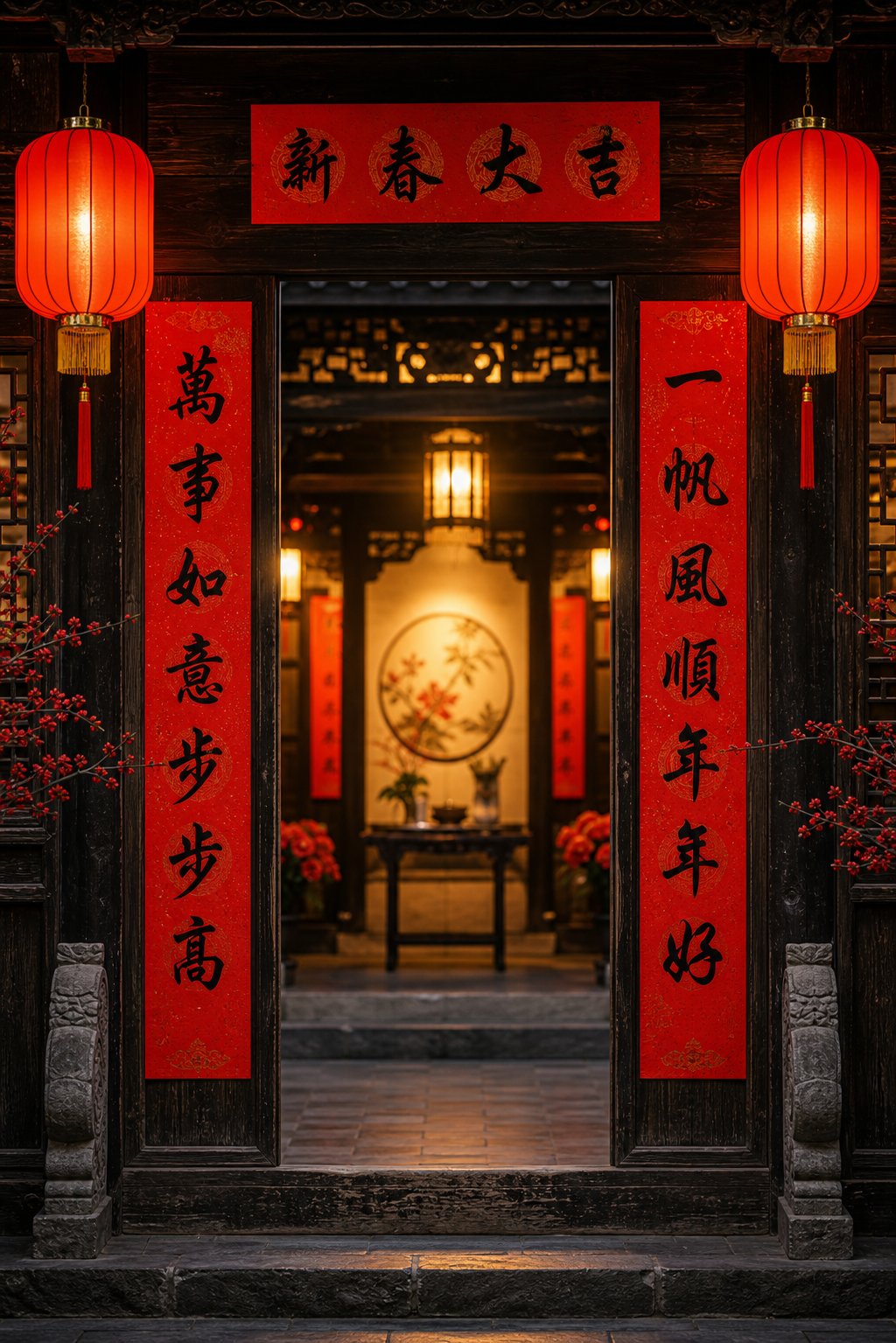
Spring couplets (春联) are the architectural poetry of Chinese New Year. Pasted on either side of a doorway, they transform an entrance into a gateway of blessings. Each couplet follows a strict three-part structure: a top line (上联) on the right side of the door, a bottom line (下联) on the left, and a horizontal scroll (横批) across the top that summarizes the theme in four characters. During a chinese zodiac year of the goat, skilled calligraphers weave 羊-radical characters and goat-related wordplay into this parallel framework, creating couplets that are both structurally elegant and zodiac-specific.
Structure and Rules of Goat Year Spring Couplets
Couplet composition is governed by tonal balance. Classical Chinese distinguishes between level tones (平声) and oblique tones (仄声). The rule is simple: the last character of the top line must end in an oblique tone, and the last character of the bottom line must end in a level tone. Beyond this, corresponding characters in each line should contrast tonally and match grammatically — noun mirrors noun, verb mirrors verb.
The character 羊 (yang, second tone) is a level-tone character, which means it naturally fits at the end of a bottom line. Characters like 祥 (xiang, second tone) also carry level tones, making them ideal bottom-line closers. Meanwhile, 善 (shan, fourth tone) and 美 (mei, third tone) are oblique-tone characters suited for top-line endings. This tonal flexibility gives calligraphers plenty of room to position goat-related characters throughout a couplet without breaking the rules.
Sample Couplets with Full Character Translations
Here are complete Goat year couplets you might see displayed during celebrations like chinese new year 2003 (Water Goat) or the upcoming 2027 chinese new year (Fire Goat). Each example shows how 羊-radical characters integrate into the parallel structure.
上联: 三羊开泰迎春至 / 下联: 万象更新送福来 / 横批: 吉祥如意
- Top line: 三 (three) + 羊 (goats) + 开 (open) + 泰 (peace) + 迎 (welcome) + 春 (spring) + 至 (arrives)
- Bottom line: 万 (ten thousand) + 象 (phenomena) + 更 (renew) + 新 (new) + 送 (deliver) + 福 (fortune) + 来 (comes)
- Horizontal scroll: 吉祥如意 — Auspicious as wished (祥 contains 羊)
- Full meaning: Three goats usher in peace as spring arrives; all things renew as fortune comes
Notice how the top line deploys 三羊开泰 directly, while the horizontal scroll uses 祥 — embedding the goat radical in a less obvious but equally powerful position.
上联: 羊毫挥洒千般美 / 下联: 善笔描绘万里春 / 横批: 美善同辉
- Top line: 羊 (goat) + 毫 (brush) + 挥洒 (flourish) + 千般 (a thousand kinds of) + 美 (beauty)
- Bottom line: 善 (virtuous) + 笔 (pen) + 描绘 (depict) + 万里 (ten thousand li of) + 春 (spring)
- Horizontal scroll: 美善同辉 — Beauty and goodness shine together
- Full meaning: The goat-hair brush flourishes a thousand beauties; the virtuous pen depicts ten thousand miles of spring
This couplet is especially clever. 羊毫 (goat-hair brush) is the actual term for the soft calligraphy brush made from goat hair, so the zodiac reference doubles as a concrete object. 美 closes the top line (oblique tone, third tone — correct for a top line ending), while 春 closes the bottom line (level tone, first tone — correct for a bottom line ending). Both 美 and 善 contain the 羊 radical, meaning the goat appears three times across the couplet in different forms.
上联: 瑞雪兆丰年岁美 / 下联: 祥云迎福日增辉 / 横批: 羊年大吉
- Top line: 瑞雪 (auspicious snow) + 兆 (foretells) + 丰年 (abundant year) + 岁 (year) + 美 (beautiful)
- Bottom line: 祥云 (auspicious clouds) + 迎 (welcome) + 福 (fortune) + 日 (days) + 增辉 (grow brighter)
- Horizontal scroll: 羊年大吉 — Great fortune in the Goat year
- Full meaning: Auspicious snow foretells a bountiful and beautiful year; auspicious clouds welcome fortune as days grow brighter
Here, 祥 in the bottom line carries the hidden 羊 radical, while 美 in the top line does the same. The horizontal scroll makes the zodiac connection explicit. This layered approach — subtle in the couplet body, direct in the scroll — is a hallmark of skilled Goat year composition.
Whether you are celebrating a past lunar new year 1979 (Earth Goat) or preparing for the 2027 year of the chinese zodiac (Fire Goat), these couplet patterns remain timeless. The structure stays fixed. Only the elemental flavor shifts — a Fire Goat year might swap 瑞雪 for 暖阳 (warm sun), while a Water Goat year could feature 润泽 (nourishing moisture) in place of 祥云.
Couplets give auspicious characters their most formal stage. But these same characters also live in far more intimate settings — handwritten on red envelopes, spoken aloud in New Year greetings, and even woven into the names of babies born under the Goat sign.
How to Use Goat Year Characters in Greetings Gifts and Decorations
Knowing the etymology behind 羊-radical characters is one thing. Putting them to work in real celebrations is where the knowledge becomes personal. Whether you are addressing a red envelope, greeting an elder, naming a newborn, or hanging calligraphy in your home, the right character in the right place transforms a generic gesture into one that resonates with cultural depth. Here are five practical applications, each grounded in the goat characteristics chinese zodiac tradition of gentleness, creativity, and communal warmth.
Red Envelopes and New Year Greetings with Goat Characters
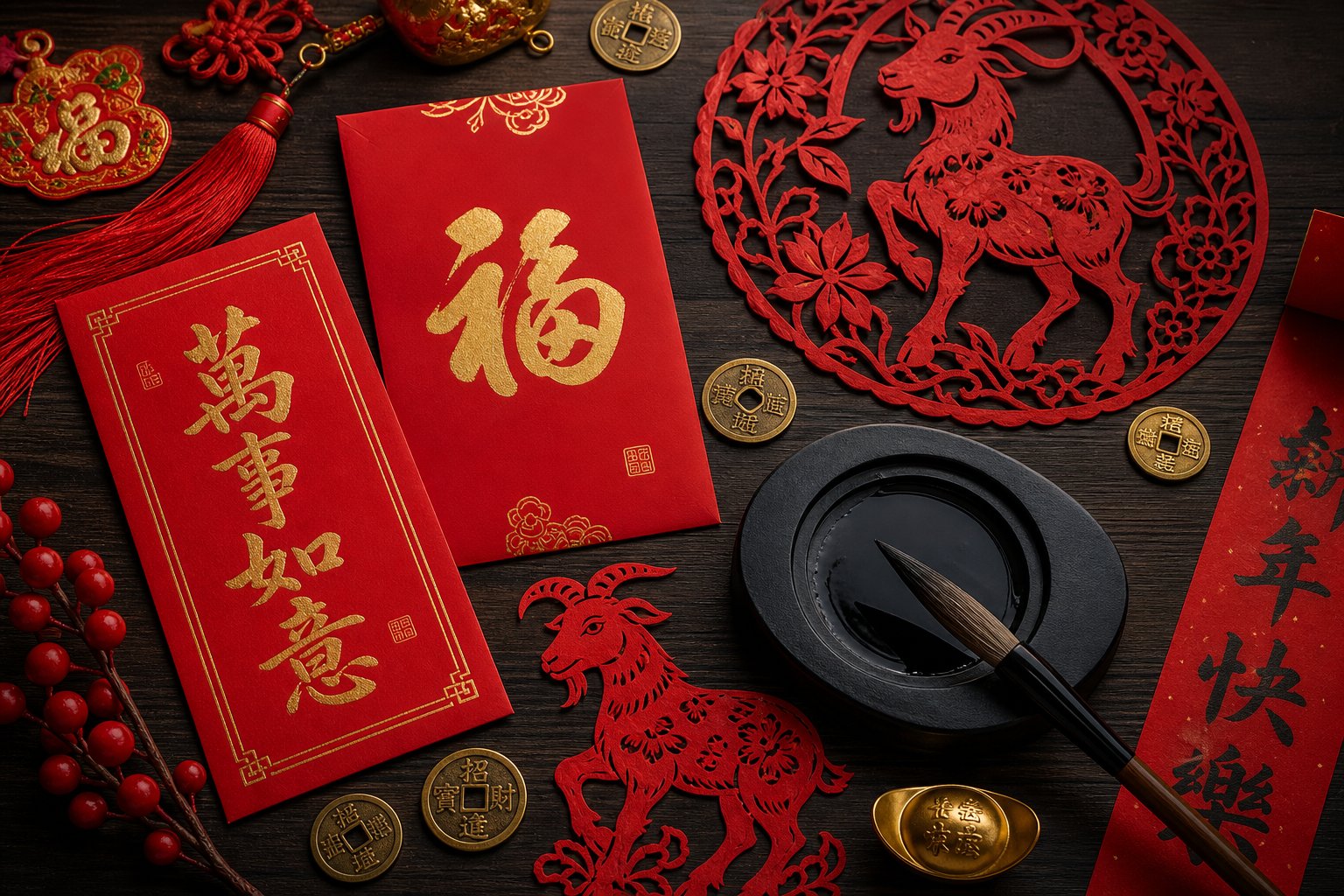
Red envelopes (红包) carry more symbolic weight than the money inside them. The red paper itself represents energy, happiness, and good luck. During a Goat year, writing auspicious characters directly on the envelope adds a zodiac-specific blessing that generic printed designs cannot match.
The best characters to write on Goat year red envelopes are 祥 (auspiciousness) and 善 (goodness) — both contain the 羊 radical and carry appropriate formality for monetary gifts. Place the character on the front flap, centered, using black or gold ink. For a more elaborate touch, write 三羊开泰 across the top or 吉祥如意 beneath the seal. Avoid writing directly over the opening — the character should greet the recipient before they access the contents.
Spoken greetings (拜年话) during Goat year gatherings should match the audience. Here are complete blessings organized by context:
- For elders: 祝您羊年身体康健,福寿安康 (zhu nin yang nian shenti kangjian, fu shou ankang) — "Wishing you good health in the Goat year, with fortune, longevity, and peace." Respectful, warm, and health-focused.
- For peers and friends: 羊年大吉,喜气洋洋 (yang nian da ji, xiqi yangyang) — "Great fortune in the Goat year, overflowing with joy." Casual, festive, and phonetically playful with the 羊/洋 pun.
- For business associates: 三羊开泰,万事如意 (san yang kai tai, wanshi ruyi) — "Three goats usher in prosperity; may all things go as you wish." Formal, auspicious, and appropriate for professional settings.
- For children: 美羊羊,快乐成长 (mei yangyang, kuaile chengzhang) — "Beautiful little goat, grow up happily." Playful, affectionate, and easy for kids to remember.
The year of the goat personality — gentle, artistic, and family-oriented — naturally shapes the tone of these greetings. Unlike Tiger year blessings that emphasize power, or Dragon year wishes focused on ambition, Goat year language leans toward harmony, beauty, and shared joy. This reflects the broader chinese zodiac goat personality: warmth over dominance, community over competition.
Naming and Decoration Ideas Using 羊 Radical Characters
Parents choosing names for babies born in Goat years often draw from the same pool of auspicious characters. The chinese zodiac goat traits of creativity, compassion, and refinement guide naming philosophy. Characters containing the 羊 radical pair well with elements that balance the goat's gentle nature:
- 祥 + 瑞 (xiangrui) — double auspiciousness; suitable for either gender
- 美 + 琪 (meiqi) — beauty and jade; a feminine name suggesting elegance
- 善 + 文 (shanwen) — goodness and culture; a scholarly masculine name
- 义 + 博 (yibo) — righteousness and breadth; suggests moral strength
The character of a goat — docile, artistic, sometimes perceived as too soft — means naming experts often pair 羊-radical characters with stronger elements like 刚 (firm), 毅 (resolute), or 峰 (peak) to create balance. A name like 善毅 (shanyi, "virtuous and resolute") combines the goat radical's gentleness with unwavering determination.
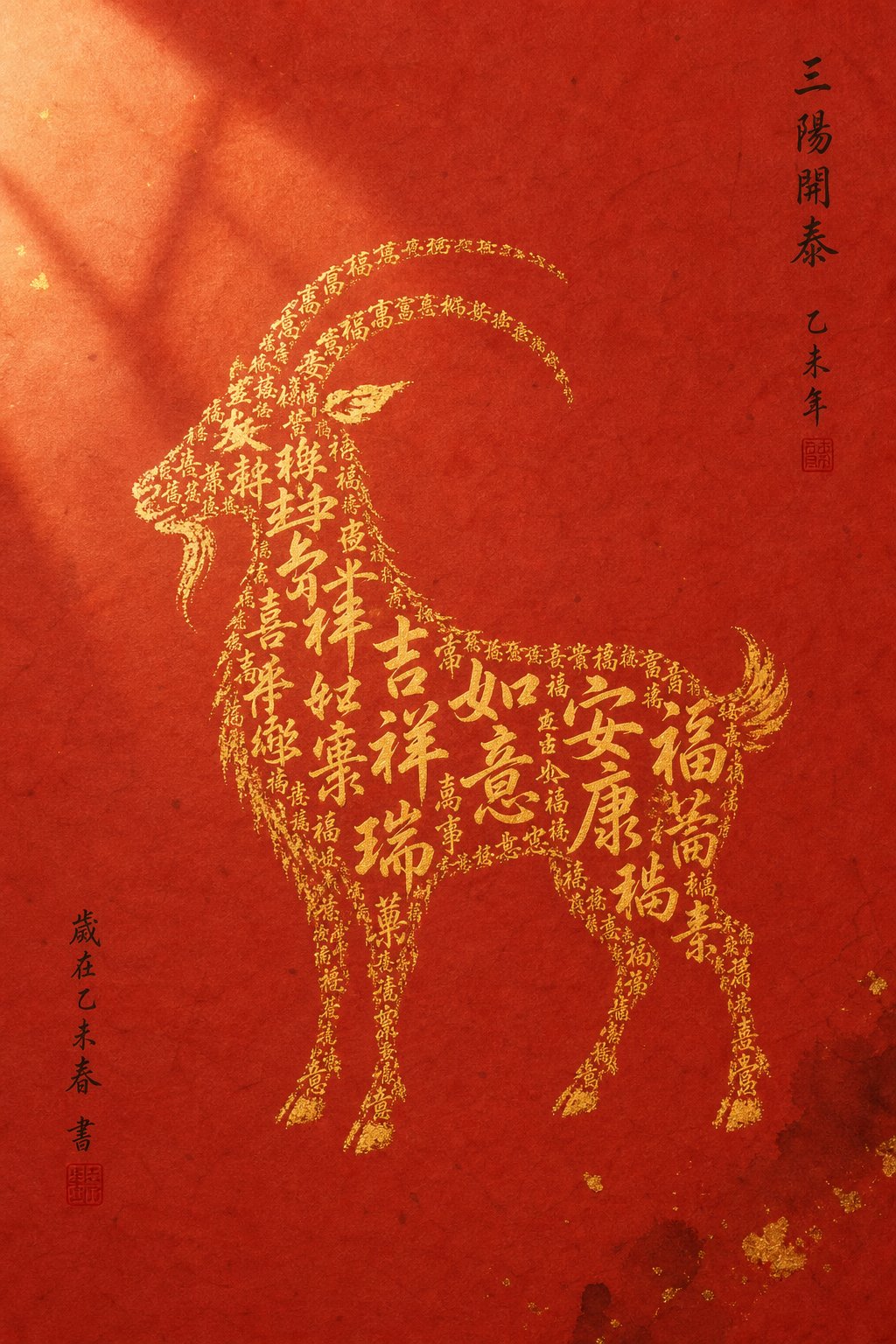
For home decorations, paper cuttings (窗花) featuring 羊 silhouettes surrounded by 祥, 美, and 善 create layered visual blessings. Hang them on windows where light passes through, making the characters glow. Door hangings should feature the horizontal scroll format — 三羊开泰 or 羊年大吉 in gold on red paper, mounted above the doorframe. Calligraphy scrolls work best in pairs flanking a central 福 character, with each scroll featuring a different 羊-radical character.
For those wanting to practice writing these characters themselves, here is a stroke order guide for the two most commonly used Goat year characters:
- Writing 祥 (xiang, 10 strokes): Begin with the 示 (altar) radical on the left — dot, horizontal, vertical, dot, dot. Then write the 羊 component on the right — dot, dot, horizontal, horizontal, horizontal, vertical. The left radical should be slightly narrower than the right component. Keep the three horizontal strokes of 羊 evenly spaced.
- Writing 善 (shan, 12 strokes): Start with the 羊 component on top — dot, dot, horizontal, horizontal, horizontal, vertical (stopping short). Then write the bottom portion — horizontal, vertical, horizontal, dot, horizontal, horizontal. The top 羊 section should sit compactly above the wider base. The final horizontal stroke anchors the entire character.
- Writing 美 (mei, 9 strokes): Write 羊 on top first — dot, dot, horizontal, horizontal, horizontal, vertical. Then add 大 below — horizontal, left-falling stroke, right-falling stroke. The vertical stroke of 羊 extends downward to become the center of 大, connecting the two components into one fluid structure.
Understanding the characteristics of goat chinese zodiac culture helps you choose which application matters most. Someone with strong goat zodiac personality traits — artistic, detail-oriented, and aesthetically driven — might gravitate toward calligraphy practice and handmade decorations. A more socially focused person might prioritize perfecting spoken greetings. The zodiac goat characteristics of empathy and generosity also make red envelope giving especially meaningful for Goat-year natives, who tend to put genuine thought into the blessings they share.
These practical applications bring individual characters and idioms into lived experience. But for quick reference during the bustle of actual celebrations, having everything consolidated in one scannable table saves time and prevents the awkward pause of forgetting a phrase mid-greeting.
Complete Reference Table of Goat Year Auspicious Characters and Phrases
Celebrations move fast. When you are mid-conversation at a New Year gathering or addressing a red envelope five minutes before guests arrive, you need everything in one place. This reference consolidates every auspicious character, idiom, and greeting covered throughout this article into a single scannable resource. Bookmark it for the next time the years of goat chinese zodiac cycle comes around — whether that is the upcoming 2027 chinese zodiac year (Fire Goat) or any future Goat year in the sixty-year cycle.
If you are wondering when is the year of the goat, the most recent and upcoming years are: 1943, 1955, 1967, 1979, 1991, 2003, 2015, 2027, and 2039. These zodiac sheep years repeat every twelve years, each paired with a different element.
Complete Character Reference with Pinyin and Meanings
| Chinese | Pinyin | English Meaning | Best Context | Formality Level |
|---|---|---|---|---|
| 祥 | xiang | Auspiciousness, divine blessing | Calligraphy, red envelopes, couplets | Formal |
| 美 | mei | Beauty, excellence | Decorations, names, paper cuttings | Neutral |
| 善 | shan | Goodness, virtue | Names, scrolls, moral blessings | Formal |
| 義/义 | yi | Righteousness, justice | Names, literary contexts | Formal |
| 鲜 | xian | Freshness, deliciousness | Food-related blessings, casual use | Casual |
| 群 | qun | Community, flock | Group blessings, team greetings | Neutral |
| 三羊开泰 | san yang kai tai | Three goats usher in prosperity | Scrolls, formal greetings, couplets | Formal |
| 吉祥如意 | ji xiang ru yi | Auspicious as wished | Universal greeting, cards, decorations | Formal |
| 羊年大吉 | yang nian da ji | Great fortune in the Goat year | Spoken greetings, horizontal scrolls | Neutral |
| 喜气洋洋 | xi qi yang yang | Overflowing with joy (goat pun) | Casual greetings, social media, cards | Casual |
| 洋洋得意 | yang yang de yi | Brimming with satisfaction | Career and achievement contexts | Neutral |
| 羊致清和 | yang zhi qing he | The goat brings clarity and harmony | Calligraphy, literary greetings | Formal |
Greetings Organized by Social Context and Formality
| Chinese Greeting | Pinyin | English Meaning | Best Context | Formality Level |
|---|---|---|---|---|
| 祝您羊年身体康健,福寿安康 | zhu nin yang nian shenti kangjian, fu shou ankang | Wishing you health in the Goat year, with fortune and longevity | Elders, respected figures | High |
| 三羊开泰,万事如意 | san yang kai tai, wanshi ruyi | Three goats bring prosperity; may all go as wished | Business associates, colleagues | High |
| 羊年大吉,喜气洋洋 | yang nian da ji, xiqi yangyang | Great Goat year fortune, overflowing with joy | Friends, peers, social media | Medium |
| 美羊羊,快乐成长 | mei yangyang, kuaile chengzhang | Beautiful little goat, grow up happily | Children | Low (playful) |
| 辉煌祥瑞 (Fire Goat) | huihuang xiangrui | Brilliantly auspicious and blessed | 2027 celebrations, Fire Goat natives | Medium |
| 鑫羊纳福 (Metal Goat) | xin yang na fu | The golden goat welcomes fortune | 1991 natives, wealth-focused blessings | Medium |
| 润泽祥和 (Water Goat) | runze xianghe | Nourishing and auspiciously harmonious | 1943 and 2003 natives, gentle blessings | Medium |
| 茂盛祥和 (Wood Goat) | maosheng xianghe | Flourishing and auspiciously harmonious | 1955 and 2015 natives, growth wishes | Medium |
| 稳如泰山,祥瑞满堂 (Earth Goat) | wen ru taishan, xiangrui mantang | Steady as Mount Tai, auspiciousness fills the hall | 1979 natives, stability-focused blessings | High |
A few quick tips for choosing the right phrase in the moment:
- When in doubt, 吉祥如意 works for anyone in any setting — it is the safest all-purpose Goat year blessing
- Use 三羊开泰 when you want to sound culturally knowledgeable; it signals familiarity with goat years chinese astrology and I Ching philosophy
- Match element-specific greetings to the recipient's birth year for a personalized touch — someone born in a 1943 chinese zodiac Water Goat year will appreciate 润泽祥和 more than a generic phrase
- For the chinese zodiac 2027 Fire Goat year specifically, lean toward warmth and radiance language: 煌, 辉, 焕
- Spoken greetings for elders always use 您 (nin, formal "you") rather than 你 (ni, casual "you")
- On red envelopes, single characters (祥, 善, 美) work better than full phrases — they are visually cleaner and easier to write with a brush
- Social media posts can mix and match freely; 喜气洋洋 paired with goat emojis captures the playful spirit of the years of the goat without being overly formal
This table covers the full spectrum from the deeply traditional to the casually modern. Whether you are a calligraphy enthusiast preparing scrolls months in advance or someone who just needs the right four characters for a last-minute WeChat message, the phrases above have you covered across every formality level and social context the Goat year brings.
Frequently Asked Questions About Auspicious Characters for Goat Year
1. What are the most auspicious characters for the Year of the Goat?
The most powerful auspicious characters for Goat year celebrations all contain the 羊 (goat/sheep) radical. These include 祥 (xiang, auspiciousness), 美 (mei, beauty), 善 (shan, goodness), and 義 (yi, righteousness). Each character structurally embeds the goat within its strokes, creating a direct etymological link between the zodiac animal and positive meaning. The Shuowen Jiezi dictionary, compiled around 100 CE, explicitly defines 羊 as meaning auspiciousness, confirming this connection dates back nearly two millennia.
2. What does 三羊开泰 mean and where does it come from?
三羊开泰 (san yang kai tai) is the quintessential Goat year blessing meaning 'three goats usher in peace and prosperity.' It originates from the I Ching hexagram 泰 (Tai/Peace), which features three yang lines below three yin lines, representing spring's return and positive energy triumphing. The phrase works through homophonic wordplay: 羊 (goat) sounds identical to 阳 (yang/positive energy), so three goats visually and phonetically represent three yang forces opening an era of harmony. By the Ming Dynasty, this pun was fully established in art and literature.
3. Is the Year of the Goat the same as the Year of the Sheep or Ram?
Yes, they all refer to the same zodiac year. The Chinese character 羊 is a general term covering goats, sheep, and rams without distinguishing between them. Chinese only specifies with qualifiers like 山羊 (mountain goat) or 绵羊 (sheep). Different cultures interpret the animal differently — Vietnam sees a goat, Korea pictures a sheep, and some Western sources use ram. For auspicious characters, the distinction is irrelevant because the 羊 radical carries the same positive connotations regardless of which English translation is used.
4. How do the five elements affect Goat year auspicious characters?
Each Goat year pairs with one of five elements in the sixty-year cycle, and the element shapes which characters resonate most. Wood Goat years (1955, 2015) favor growth characters like 茂 (flourishing). Fire Goat years (1967, 2027) suit 煌 (brilliant). Earth Goat years (1919, 1979) align with 稳 (stable). Metal Goat years (1931, 1991) pair with 鑫 (triple gold prosperity). Water Goat years (1943, 2003) connect to 润 (nourishing). Matching the element to your greetings creates personalized, culturally precise blessings.
5. How can I use Goat year auspicious characters in real celebrations?
There are five main applications. Write 祥 or 善 on red envelopes using black or gold ink. Use spoken greetings matched to your audience — 三羊开泰,万事如意 for business contacts, 羊年大吉,喜气洋洋 for friends. Choose 羊-radical characters like 祥瑞 or 美琪 for baby names. Create paper cuttings with goat silhouettes surrounded by auspicious characters for window decorations. Practice calligraphy of key characters like 祥 (10 strokes) and 善 (12 strokes) for handmade scrolls and cards.