The Ancient Roots of the Cai Family Name
Imagine discovering that your last name traces back to a royal bloodline over 3,000 years old. For the millions of people who carry the Cai surname, or one of its many spelling variants, that is exactly the case. The character 蔡 connects a vast network of families across China, Taiwan, Southeast Asia, and the global diaspora to a single ancient source: the royal house of the Zhou Dynasty.
The Cai surname ranks as the 38th most common surname in mainland China and climbs to 9th in Taiwan, where it is typically romanized as Tsai. In Singapore, spelled as Chua, it holds the 8th position. These numbers represent tens of millions of people bound by a shared ancestral thread, even when their name looks completely different on paper.
This article traces the full arc of cai surname history, from the founding of an ancient state in present-day Henan province through centuries of migration, cultural achievement, and linguistic transformation. You will find the meaning of the name Cai rooted in its character etymology, the political drama that created the surname, the famous figures who carried it, and the reason your family might spell it Tsai, Chua, Choi, or any of a dozen other ways.
What the Cai Surname Represents
The Cai last name is not simply a family identifier. It is a direct marker of descent from King Wen of Zhou, one of the most revered figures in Chinese civilization. Around 1046 BCE, King Wu of Zhou granted his younger brother Ji Du a fief that became the State of Cai, centered on what is now Shangcai County in Henan. When that state eventually fell after nearly 600 years of existence, its people adopted the name of their homeland as a surname. The cai name meaning, at its core, carries the weight of royal lineage and a lost kingdom.
Why Cai Surname History Matters Today
If you have ever wondered why your family name is spelled one way while a relative spells it differently, or why someone named Chua in the Philippines shares ancestry with someone named Tsai in Taipei, the answer lies in dialect, migration, and colonial history. Understanding the Cai surname is really about understanding how one Chinese character traveled across languages, borders, and centuries.
The single character 蔡 appears as Cai, Tsai, Chua, Choi, Choy, Chai, Chae, and Thai across more than a dozen countries, making it one of the most widely dispersed yet least recognized surname networks in the world.
The story begins with a single Chinese character and the ancient rituals that gave it meaning.
The Character 蔡 and Its Etymology
A surname is more than a label. In Chinese culture, it is a compressed history lesson written in a single character. To understand the full c a i meaning as a surname, you need to look at what the character 蔡 originally described before it ever became a family name.
The Original Meaning of the Character 蔡
The character 蔡 is built from two components. On top sits the grass radical (艹), signaling a connection to plant life. Below it rests an element related to claws or grasping, associated with sacrificial actions. Together, these components point to the character's earliest recorded meanings: wild grass and the large tortoise used in ancient divination rituals.
The Shuowen Jiezi, China's oldest comprehensive dictionary, defines 蔡 as "the disordered growth of grass" (草生之散亂也). Yet classical texts reveal a second, more ceremonial meaning. The Zuo Zhuan references a "da cai" (大蔡), a large tortoise presented as a ritual object. FamilySearch confirms this dual nature, noting that 蔡 originally referred to "the tortoise used in ancient rituals of divination." These tortoises had their shells heated and cracked to interpret messages from the spirit world, a practice central to Shang and early Zhou governance.
So the character carried associations with both wild vegetation and sacred ritual long before it became attached to a place, a state, and eventually a surname.
How the Character Evolved Over Millennia
Like all Chinese characters, 蔡 transformed visually across thousands of years of writing history. Each script stage reshaped its appearance while preserving its core structure.
| Script Stage | Approximate Period | Key Features |
|---|---|---|
| Oracle Bone Script | c. 1200-1050 BCE | Pictographic form showing grass and claw elements in angular strokes carved into bone |
| Bronze Inscriptions | c. 1050-500 BCE | Rounder, more fluid strokes cast into ritual vessels; grass radical becomes more distinct |
| Seal Script | c. 500-200 BCE | Standardized form with balanced proportions; components clearly separated |
| Clerical Script | c. 200 BCE-200 CE | Flattened strokes, angular turns replace curves; closer to modern form |
| Regular Script (Modern) | c. 200 CE-present | The 蔡 we recognize today, with 艹 clearly atop the lower component |
The character remained unchanged through China's 20th-century simplification reforms, so cai in Chinese looks identical whether written in traditional or simplified script.
Pronunciation Across Chinese Dialects
How do you pronounce Cai? The answer depends entirely on which Chinese dialect your family speaks. In standard Mandarin, the cai pronunciation is "Cai" with a falling fourth tone (Cài), rhyming roughly with "tsai." But across southern China and the diaspora, the same character sounds dramatically different.
| Dialect Group | Pronunciation | Common Romanization |
|---|---|---|
| Mandarin | Cài (falling tone) | Cai, Tsai |
| Cantonese | Coi3 | Choi, Choy |
| Hokkien (Minnan) | Chhoa / Chua | Chua, Chuah |
| Teochew | Chua | Chua |
| Hakka | Tshai | Chai, Tsai |
These dialect readings explain why someone asking how to pronounce Cai will get five different answers from five different Chinese communities. Each pronunciation preserves a layer of linguistic history, some retaining sounds closer to ancient Chinese than modern Mandarin does. The Hokkien "Chua" reading, for instance, reflects phonological patterns that predate the northern sound shifts by centuries.
This linguistic diversity set the stage for something remarkable: when Cai families migrated across Asia, each group carried their own pronunciation into a new writing system, creating the web of spelling variants that connects millions of people to a single ancient character.

The Rise and Fall of the Ancient State of Cai
A character tied to divination grass and sacred tortoises became the name of a kingdom. That kingdom, in turn, became the surname of millions. So what is a Cai in historical terms? It is a state, a political entity that survived for nearly 600 years in the heart of ancient China before its people scattered and carried its name as their own.
Cai Shu Du and the Founding of the State
The State of Cai was born from a family arrangement at the dawn of the Zhou Dynasty. After King Wu of Zhou overthrew the Shang Dynasty around 1046 BCE, he distributed territories to his brothers and allies. His fifth younger brother, Ji Du, received the fief of Cai, centered on present-day Shangcai County in Henan province.
A common error in many English-language sources is misidentifying Cai Shu Du as a son of King Wu. The historical record is clear: he was a son of King Wen of Zhou and a younger brother of King Wu. Both men shared the same mother, Tai Si, the principal consort of King Wen. According to the Shiji (Records of the Grand Historian), King Wen had ten sons by Tai Si, with Ji Fa (King Wu) being the second and Ji Du (Cai Shu Du) the fifth.
Cai Shu Du's initial role was not simply territorial governance. King Wu appointed him alongside another brother, Guan Shu Xian, to monitor Wu Geng, the son of the last Shang king. They were stationed in the former Shang heartland as supervisors, ensuring the conquered population did not rebel. The arrangement worked while King Wu lived.
The Rebellion and Its Aftermath
King Wu's death changed everything. His son, King Cheng, was too young to rule, so the Duke of Zhou (another brother, Ji Dan) assumed regency. Cai Shu Du and Guan Shu viewed this as a power grab. They spread rumors that the Duke of Zhou intended to usurp the throne, then allied with Wu Geng and eastern Yi tribes in open revolt. This conflict is known as the Rebellion of the Three Guards.
The Duke of Zhou responded decisively. He led a military campaign eastward, executed Wu Geng, killed Guan Shu, and exiled Cai Shu Du. The founder of the Cai fief died in banishment, his territory stripped away.
The story could have ended there. Instead, Cai Shu Du's son, Ji Hu, took a different path. He reformed his conduct, demonstrated loyalty to the Zhou court, and served capably as a minister in the state of Lu. Impressed, the Duke of Zhou recommended that King Cheng restore the Cai fief to Hu. The young man was re-enfeoffed and became known as Cai Zhong, the true restorer of the Chinese Cai lineage that would endure for centuries.
Six Centuries of the State of Cai
From its restoration under Cai Zhong until its final destruction, the State of Cai endured as a small but strategically located polity in the upper Huai River basin. It sat between powerful neighbors, and that geography defined its fate. The state had 25 rulers across roughly 600 years, and what cai means in the context of Zhou-era politics is essentially a buffer state caught between giants.
The dominant threat came from Chu, the expansionist southern kingdom that steadily swallowed smaller states. Cai was conquered, restored, relocated, and ultimately consumed. Here is the chronological arc of its major political events:
- c. 1046 BCE - King Wu enfeoffs Cai Shu Du at Shangcai (upper Cai) in modern Henan.
- c. 1042 BCE - Cai Shu Du joins the Three Guards Rebellion and is exiled; the fief is dissolved.
- c. 1040 BCE - Ji Hu (Cai Zhong) is re-enfeoffed, restoring the State of Cai.
- 684 BCE - Chu defeats Cai at the Battle of Shen and captures Duke Ai, marking the beginning of Cai's decline.
- 657 BCE - Duke Huan of Qi conquers Cai after a diplomatic insult involving Duke Mu's sister.
- 531 BCE - King Ling of Chu lures Duke Ling of Cai into a trap, kills him, and destroys the state for the first time.
- 528 BCE - King Ping of Chu restores Cai under Duke Ping; the capital moves to Xincai (new Cai).
- 506 BCE - Cai allies with the State of Wu to invade Chu and briefly occupy its capital.
- 493 BCE - Under pressure from Chu, Duke Zhao relocates the capital again to Zhoulai, also called Xiacai (lower Cai), in modern Anhui.
- 491 BCE - Cai nobles assassinate Duke Zhao, fearing further relocations.
- 447 BCE - King Hui of Chu conquers Cai permanently. The last marquis flees, and the state ceases to exist.
Each capital relocation pushed the state further from its original heartland and deeper into dependency on outside powers. By the time Cai fell for the last time, it had been reduced from a respected Zhou vassal to a puppet caught between Chu and Wu.
The state was gone, but its people remained. As surnames became universal during the Qin Dynasty that followed, the former subjects of Cai adopted their lost kingdom's name as a permanent marker of identity. A political entity that lasted six centuries became a family name that has now endured for more than twenty-four.
Four Distinct Origins of the Cai Surname
A single state produced the majority of Cai families, but not all of them. The surname Cai, as it exists today, flows from at least four separate historical streams. Some families trace their lineage directly to Zhou Dynasty royalty. Others arrived at the same name through entirely different circumstances: government positions, ethnic assimilation, or political survival. If you carry the last name Cai, your specific origin story depends on which of these paths your ancestors walked.
Understanding these distinct origins matters because the meaning of name Cai shifts depending on which lineage you belong to. For the majority, it signals descent from a lost kingdom. For others, it marks a moment of cultural transformation or a deliberate choice made under pressure.
- Path 1: Ji surname lineage from King Wen of Zhou (c. 1046 BCE onward) - Royal descent through Cai Shu Du and the State of Cai
- Path 2: Official titles and place names (Zhou through Han dynasties) - Families who adopted Cai based on administrative roles or geographic associations
- Path 3: Ethnic minority adoption (Tang through Qing dynasties) - Non-Han peoples who took the surname through sinicization, intermarriage, or imperial grants
- Path 4: Voluntary or forced name changes (Yuan Dynasty and later) - Families of other surnames who became Cai for political or survival reasons
The Royal Ji Surname Lineage
The overwhelming majority of people who bear the name Cai descend from the Ji (姬) clan, the royal house of the Zhou Dynasty. This is the origin path covered in the previous section: King Wen's son Ji Du received the Cai fief, his descendants ruled for nearly 600 years, and when the State of Cai fell to Chu in 447 BCE, its people adopted the state name as their surname.
What makes this lineage dominant is simple math. The State of Cai existed for six centuries and governed a substantial population across multiple cities. When surnames became universal during the Qin unification, every former subject of that state, not just the ruling family, could claim the name. Nobles, soldiers, farmers, and artisans all became Cai. This single event created a surname population base that dwarfed all other origin paths combined.
The Ji surname connection also links Cai families to a broader network of Zhou-descended surnames. The Zhou royal house produced dozens of modern Chinese surnames through the same mechanism: a fief name becoming a family name. Surnames like Zheng, Lu, Wei, and Wu all share this pattern. Cai families from this lineage are, in a genealogical sense, distant cousins of all these clans.
Adoption by Ethnic Minorities Across Dynasties
Not every family named Cai has Han Chinese roots. Across more than a thousand years of Chinese history, non-Han ethnic groups adopted the surname through several distinct mechanisms. Each case reflects a specific political moment and a particular relationship between minority communities and the Chinese state.
During the Tang Dynasty (618-907), intermarriage between Han Chinese Cai families and neighboring peoples along the empire's frontiers created new Cai lineages among Turkic and other Central Asian groups. These were organic adoptions, driven by proximity and family ties rather than government policy.
The pattern intensified during the Yuan Dynasty (1271-1368) under Mongol rule. Muslim communities in southeastern China, particularly in Fujian province, adopted Chinese surnames as part of their integration into local society. The Hui ethnic group in Quanzhou, a major port city on the Maritime Silk Road, produced several Cai lineages during this period. Some of these families trace their ancestry to Arab and Persian merchants who settled in China generations earlier.
The Manchu conquest that established the Qing Dynasty (1644-1912) brought another wave of surname adoption. As Manchu bannermen settled across China and intermarried with local populations over generations, many abandoned their multi-syllable Manchu clan names in favor of single-character Chinese surnames. Families from clans like Caijia and similar-sounding Manchu names gravitated toward Cai as a natural phonetic match.
Southern ethnic minorities, including groups in what is now Guangdong, Guangxi, and Yunnan, also adopted the surname Cai through centuries of contact with Han settlers. Imperial policies encouraging sinicization, combined with practical advantages of carrying a recognized Chinese surname for trade and civil service examinations, motivated these changes. The result is that the surname Cai today spans multiple ethnic identities within China.
Name Changes During Political Upheaval
Chinese history is punctuated by moments when changing your surname was not a cultural choice but a survival strategy. The Yuan Dynasty provides the clearest examples. When Mongol rulers restructured Chinese society into a rigid hierarchy, some families changed their surnames to avoid persecution, escape debts, or sever ties with disgraced clans.
The practice of imperial surname grants also fed new members into the Cai clan. As the South China Morning Post notes, Chinese emperors routinely bestowed surnames on loyal subjects as rewards. While the most famous cases involve imperial surnames like Li or Zhu, regional rulers and powerful families also extended their own surnames to retainers and allies. Some families received the Cai name through such grants and passed it to all subsequent generations.
During the Ming-Qing transition in the 17th century, another round of surname changes occurred. Families loyal to the fallen Ming Dynasty sometimes changed their names to avoid Manchu reprisals. Others adopted new surnames when fleeing to southern China or overseas. In these cases, the name Cai might have been chosen for its prevalence in a new community, making it easier to blend in and avoid detection.
These politically motivated changes mean that two families sharing the surname Cai might have no genealogical connection whatsoever. One might descend from Zhou royalty while the other traces back to a Yuan-era merchant family or a Manchu bannerman. The name is the same, but the stories behind it diverge completely.
This multiplicity of origins raises a natural question: if the surname Cai contains such diverse lineages, who were the individuals that made it famous? The answer spans papermaking, poetry, calligraphy, and revolution.
Notable Figures Who Shaped the Cai Legacy
A surname gains its reputation through the people who carry it. For the Cai clan, that reputation rests on contributions so fundamental they reshaped civilization itself. From the material that made books possible to the calligraphy that elevated writing into art, Cai chinese cultural achievements span nearly two thousand years and touch fields as varied as engineering, poetry, music, and military strategy.
Few surname clans can claim credit for an invention as world-changing as paper, a father-daughter literary dynasty, one of the Song Dynasty's greatest calligraphers, and a military hero who prevented the restoration of imperial rule in the 20th century, yet the Cai family produced all four.
Cai Lun and the Invention of Paper
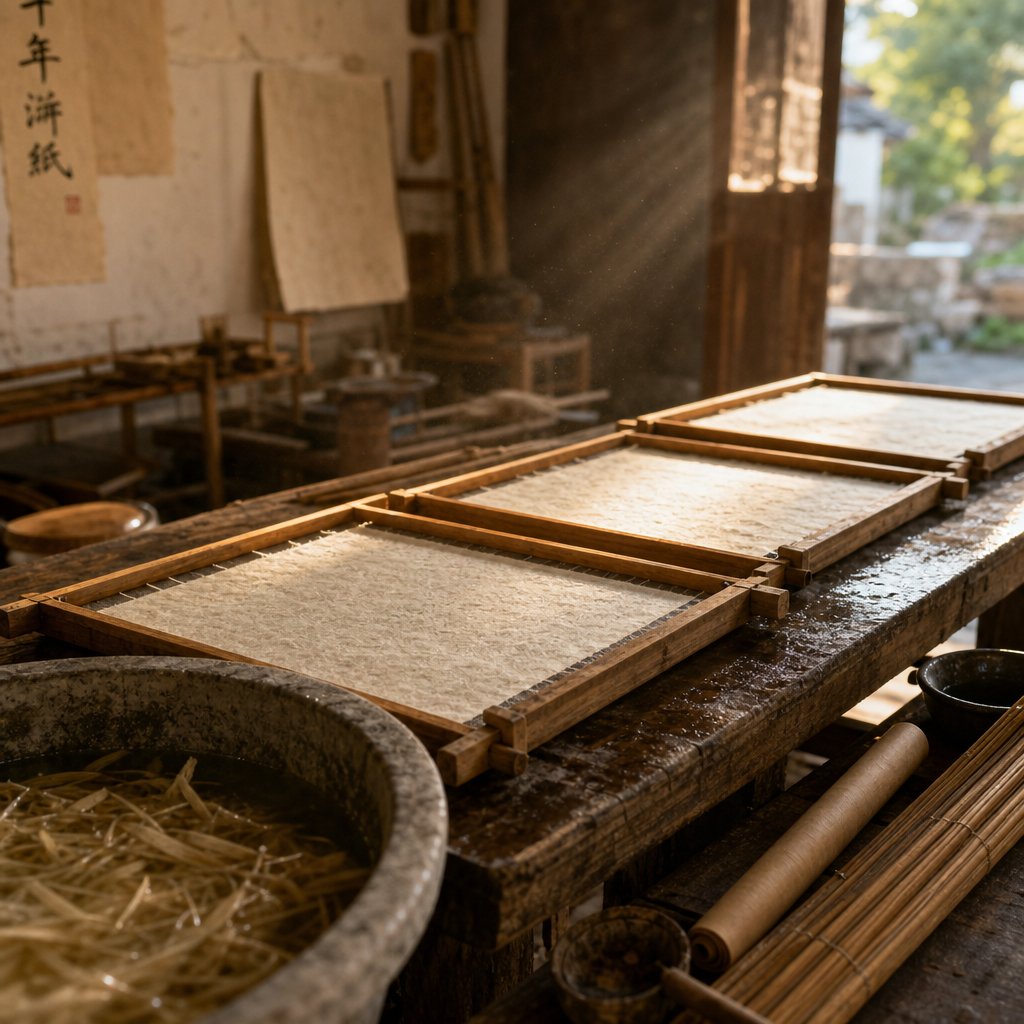
You are reading this on a medium that exists because of a man named Cai Lun. In 105 CE, Cai Lun, the director of the Imperial Workshops at Luoyang, presented Emperor He of Han with a refined papermaking process that used soaked and pressed plant fibers dried in sheets on wooden frames. While archaeological evidence shows primitive paper types existed from the 2nd century BCE using hemp, Cai Lun's innovation was systematic: he experimented with tree bark, hemp ends, old rags, and fishnets to create a material that was lighter, cheaper, and more practical than the bamboo strips and silk that scholars had relied on for centuries.
The impact was not immediate, but it was total. Paper replaced cumbersome writing surfaces, made literacy accessible beyond the aristocracy, and eventually enabled block printing, moveable type, and the explosion of knowledge that followed. The combination of brush, ink, and paper established calligraphy and painting as China's most revered art forms for the next two millennia. Paper was so valued during the Tang Dynasty that it was used to pay tribute and taxes to the state.
Cai Lun's process spread along the Silk Road, reaching Baghdad after the Battle of Talas in 751 CE when Arab forces captured Chinese papermakers. From there it traveled to medieval Europe, transforming communication across the entire world. A single court official from the Cai clan set in motion a chain of innovation that would not be superseded until the digital age.
Cai Yong and Cai Wenji — A Literary Dynasty
If Cai Lun gave the world its writing surface, Cai Yong (132-192 CE) showed what could be done with it. Born in Chenliu Commandery in present-day Henan, Cai Yong was a polymath of the Eastern Han Dynasty: astronomer, calligrapher, historian, mathematician, musician, politician, and writer. He studied composition, mathematics, astronomy, and music under Hu Guang, one of the highest-ranking officials in the Han court, and became known for literary skills so refined that he was constantly commissioned to write eulogies and memorial inscriptions.
His most enduring scholarly achievement came in 175 CE. Fearing that political factions were altering the Confucian classics to support their views, Cai Yong petitioned Emperor Ling to have the Five Classics engraved in stone. The emperor approved, and the resulting Xiping Stone Classics, completed in 183 CE, set the canonical text for future generations of scholars. He also wrote treatises on playing the guqin, pharmacology, ceremonial practice, and the art of seal script calligraphy.
Cai Yong's life ended tragically. When the warlord Dong Zhuo seized power in 189 CE, he forced Cai Yong into service with the threat of clan extermination. After Dong Zhuo's assassination in 192 CE, the new strongman Wang Yun imprisoned Cai Yong for allegedly mourning his former patron. Despite pleas from other officials to spare the scholar so he could complete his history of the Han Dynasty, Wang Yun refused. Cai Yong died in prison, and many of his works were lost in the turmoil that followed.
His daughter, Cai Yan, known by her courtesy name Wenji, inherited her father's genius and endured even greater hardship. She is remembered as one of China's greatest female poets and musicians. Captured by Xiongnu nomads during the chaos of the late Han, she spent twelve years on the steppe before being ransomed back by the warlord Cao Cao, who admired her father's legacy. Her poem "Eighteen Songs of a Nomad Flute" (Hujia Shiba Pai) remains one of the most emotionally powerful works in classical Chinese literature, expressing the anguish of separation from her children left behind among the Xiongnu. The father-daughter pair represents a literary dynasty within the broader Cai clan, their combined works spanning history, music theory, poetry, and calligraphy.
Cai Xiang and the Song Dynasty Golden Age
Cai Xiang (1012-1067) carried the Cai name into the cultural peak of the Song Dynasty. Born in Xianyou County in Fujian province, he passed the imperial jinshi examination in 1030 CE and rose to become Secretariat Drafter of the Duanming Court, handling written communications for the imperial government. Alongside Su Shi, Huang Tingjian, and Mi Fu, Cai Xiang is regarded as one of the Four Great Calligraphic Masters of the Song Dynasty.
His talents extended well beyond the brush. While serving as a prefect in Fujian, Cai Xiang oversaw the construction of the Wan'an Bridge at Quanzhou, a major engineering achievement that connected communities across the Luo River. He also pioneered the manufacturing of a superior Dragon Tribute Tea Cake, so prized that it was said to be harder to obtain than gold. His essay "The Record of Tea," written between 1049 and 1053, remains a foundational text in Chinese tea culture.
Cai Xiang embodied the Song ideal of the scholar-official: a man equally accomplished in governance, art, literature, and practical engineering. His calligraphy, his bridge, and his tea scholarship each represent a different facet of the Cai clan's recurring pattern of excellence across multiple disciplines.
Cai E and the Defense of the Republic
The Cai legacy did not end with imperial China. In the early 20th century, Cai E (1882-1916) emerged as one of the most consequential cai military figures in modern Chinese history. A Hunanese general trained in Japan, he initially supported the 1911 Revolution that ended two thousand years of imperial rule. When Yuan Shikai, the president of the new Republic, declared himself emperor in 1915, Cai E organized the National Protection War from Yunnan province to oppose the restoration.
Despite suffering from throat cancer, Cai E led his forces against Yuan Shikai's armies and rallied other provinces to the republican cause. Yuan's imperial project collapsed within months, and the would-be emperor died in June 1916. Cai E himself died later that same year at age 34, but his military campaign had preserved the republican form of government at a moment when it could easily have been extinguished. He remains a symbol of principled resistance in Chinese political memory.
From paper to poetry, from bridges to battlefields, the individuals who carried the Cai surname left marks that transcended their own lifetimes. Their geographic spread also tells a story: Cai Lun in the Han capital, Cai Yong in Henan, Cai Xiang in Fujian, Cai E in Yunnan. The clan's talent dispersed as its people migrated, and that migration created something else entirely: a single surname fractured into a dozen different spellings across the world's writing systems.
From Cai to Tsai to Chua — Romanization Variants Explained
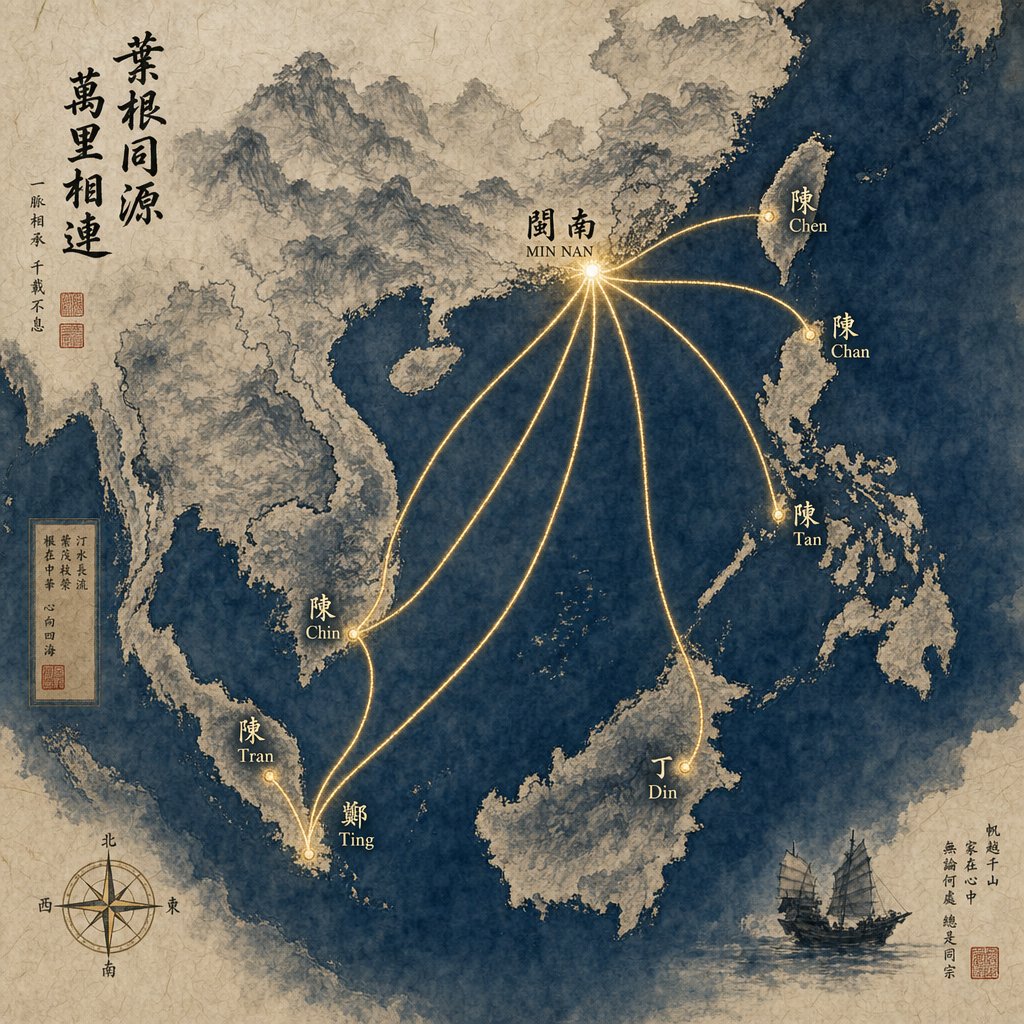
A family reunion of everyone descended from the character 蔡 would fill a stadium, yet half the attendees might not recognize each other's last names on paper. The tsai surname in Taiwan, the chua last name in the Philippines, the choi last name in Hong Kong, and the choy surname in Malaysia all trace back to the same single character. How did one name become so many?
The answer lies in the collision between Chinese dialect diversity and Western alphabets. When different communities romanized their spoken pronunciation of 蔡, each group produced a different spelling. No central authority coordinated the process. Hokkien speakers wrote what they heard. Cantonese speakers did the same. Colonial administrators in different countries applied their own transliteration rules. The result is a surname that looks like a dozen unrelated names unless you know the history behind each spelling.
Mandarin Romanizations — Cai and Tsai
The two most common Mandarin-based spellings reflect two competing romanization systems. "Cai" comes from Hanyu Pinyin, the standard adopted by the People's Republic of China in 1958 and now used internationally. "Tsai" comes from Wade-Giles, an older system developed by British diplomats in the 19th century. The key difference? Wade-Giles uses "ts" where pinyin uses "c," and adds an apostrophe to mark aspiration (Ts'ai in strict notation, though the apostrophe is often dropped in personal names).
The tsai last name origin is straightforward: Taiwan adopted Wade-Giles for official romanization before pinyin existed, and most Taiwanese families registered their names under that system. When you see the surname Tsai on a passport or business card, you are almost certainly looking at a Taiwanese family. Former President Tsai Ing-wen is the most globally recognized bearer of this spelling. To pronounce Tsai correctly, say "tsai" with a falling tone, rhyming with "eye" preceded by a "ts" sound. If you have ever wondered how to pronounce Tsai, think of it as identical to "Cai" in sound, just different on paper.
Mainland Chinese families use "Cai" exclusively because pinyin is the only official romanization system there. So geography, not genealogy, determines whether a Mandarin-speaking family spells their name Cai or Tsai.
Southern Dialect Variants — Chua, Choi, and Choy
Southern China's dialect groups diverged from northern Mandarin centuries ago, and their pronunciations of 蔡 sound nothing alike. This is where the real spelling diversity begins.
The chua last name dominates in Southeast Asia. Hokkien and Teochew speakers from Fujian and eastern Guangdong pronounce 蔡 as "Chhoa" or "Chua," and they carried this pronunciation to the Philippines, Singapore, Malaysia, and Indonesia during centuries of maritime migration. In Singapore, Chua ranks as the 8th most common surname. In Malaysia, the variant "Chuah" appears frequently, reflecting a slightly different Hokkien sub-dialect transcription. Filipino families of Chinese descent overwhelmingly use "Chua," sometimes with hispanicized derivatives like Chuapoco or Tuazon from the Spanish colonial era.
Cantonese speakers produce a completely different sound: "Coi" in Jyutping notation, romanized as Choi or Choy in everyday use. The choi last name appears throughout Hong Kong, Macau, and Cantonese-speaking communities in Malaysia. The choy surname is essentially the same pronunciation with a slightly different English transcription, common among older Hong Kong families and those in Western countries. Celebrities like Charlene Choi and Elizabeth Choy carry these Cantonese-derived spellings.
Hakka speakers say "Tshai," typically romanized as Chai or Chay. This reading appears in Hakka communities across Malaysia, Singapore, and Brunei. In the Fuzhou dialect of northern Fujian, the character becomes "Chai" as well, though through a different phonological path.
Beyond Chinese dialects, the surname crossed into other Asian languages entirely. In Korean, 蔡 is read as "Chae" (채). In Vietnamese, it becomes "Thai" or "Sai." In Japanese, it is "Sai." Each represents the character filtered through a different linguistic tradition.
Understanding Your Specific Spelling
If you carry any variant of this surname and want to identify your dialect origin, the spelling itself is your first clue. The table below maps each major romanization to its source dialect, primary geographic regions, and approximate scale.
| Romanization | Dialect/Language | Primary Regions | Approximate Bearers |
|---|---|---|---|
| Cai | Mandarin (Pinyin) | Mainland China | ~6-7 million |
| Tsai | Mandarin (Wade-Giles) | Taiwan | ~1.3 million |
| Chua / Chuah | Hokkien / Teochew | Philippines, Singapore, Malaysia, Indonesia | ~1-2 million |
| Choi / Tsoi | Cantonese | Hong Kong, Macau, Malaysia | ~500,000+ |
| Choy | Cantonese (variant) | Hong Kong, Western diaspora | ~100,000+ |
| Chai / Chay | Hakka | Malaysia, Singapore, Brunei | ~100,000+ |
| Chae | Korean | South Korea | ~120,000 |
| Thai / Sai | Vietnamese | Vietnam | ~200,000+ |
| Toy / Toi | Taishanese | Overseas Cantonese communities | Smaller communities |
| Tjoa / Tjhai | Indonesian Dutch spelling | Indonesia, Netherlands | Smaller communities |
Your spelling tells you which dialect community your ancestors belonged to and, by extension, which region of China they likely left. A family named Chua almost certainly traces to Fujian or eastern Guangdong. A family with the last name Tsai connects to Taiwan or, further back, to Mandarin-speaking regions. The surname Tsai and the surname Chua are the same name, separated only by the dialect their ancestors spoke and the port from which they sailed.
These spelling differences are not just linguistic curiosities. They shaped where families settled, which communities they joined, and how they were perceived in their new countries. The same diaspora that scattered one surname into a dozen spellings also scattered Cai families across every continent, creating migration patterns that still define where these families concentrate today.
Migration Patterns and the Global Cai Diaspora
Spelling variants did not appear randomly. Each one maps to a specific migration route, a particular century, and a community that carried the character 蔡 from one homeland to another. The Cai surname began in a single county in Henan province. Over 2,500 years, it spread across every province in China, then leapt overseas to become one of the most geographically dispersed Chinese surname networks in the world.
Tracing these movements reveals why the chua surname dominates in the Philippines while Tsai prevails in Taiwan, and why Guangdong province alone holds 15% of all Cai bearers in mainland China. Geography is not random. It is the residue of history.
From Henan to Fujian — Internal Migration
The original Cai heartland sat in what is now Shangcai County, Henan, the site of the ancient State of Cai. After the state fell in 447 BCE, its people initially dispersed across the Central Plains, settling in Henan, Hubei, Anhui, Shandong, and Hunan during the Warring States and Qin-Han periods. In the area of eastern Henan and western Shandong, the Jiyang Cai lineage formed, producing many of the clan's most famous scholars and officials during the Han Dynasty.
The first major southward push came during the late Western Jin Dynasty (early 4th century CE). When northern China collapsed into warfare among competing warlords and nomadic invaders, millions of Han Chinese fled south. Cai families entered the Jiangsu and Zhejiang regions on a large scale during this period, establishing new roots far from their ancestral territory.
The Tang Dynasty (618-907) brought the decisive migration that shaped the surname's modern distribution. Two major waves carried Cai families into Fujian province. The first occurred during the Huang Chao Rebellion (875-884 CE), when widespread destruction in the north drove entire clans southward. Cai Yongyuan is recognized as the founding ancestor of the Cai lineage's entry into Fujian. The second wave came in the final years of the Tang, when Cai families from Henan followed the warlords Wang Chao and Wang Shenzhi into Fujian, initially settling in Ninghua County before spreading further south.
By the Song Dynasty (960-1279), the transformation was complete. Fujian had become the province with the largest Cai population, holding about 21% of all Cai bearers nationwide. The clan's center of gravity had shifted permanently from the Yellow River basin to the southeastern coast. After two generations in Ninghua, some branches relocated to Meizhou in Guangdong, establishing the lineage that would eventually number nearly one million descendants.
This concentration in Fujian and Guangdong was not incidental. It positioned the Cai clan at the departure points for overseas migration during the centuries that followed.
The Southeast Asian Diaspora
When Cai families began crossing the sea, they left from the ports of Fujian and Guangdong. Their destinations were shaped by trade routes, colonial labor demands, and existing community networks. Each destination received a different dialect group, which is why the chua family name dominates in some countries while other variants appear elsewhere.
Taiwan received the earliest and largest wave. During the late Ming Dynasty, the loyalist military leader Koxinga relocated officials and soldiers surnamed Cai to Taiwan in the 17th century. Subsequent migration from Fujian and Guangdong during the Qing Dynasty built on this foundation. Today, Tsai ranks among the top 10 surnames in Taiwan, with an estimated 1.3 million bearers. The island's Cai population descends overwhelmingly from Hokkien-speaking Fujian families.
The Philippines became home to one of the largest overseas Cai communities. Hokkien traders from Fujian had been visiting the Philippine archipelago since the Song Dynasty, but permanent settlement accelerated during the Spanish colonial period (1565-1898). These families carried the Hokkien pronunciation "Chua," and the surname Chua is now one of the most recognizable Chinese-Filipino surnames. FamilySearch records show the Philippines as the country with the most Chua family entries in their global database.
Malaysia and Singapore received Cai migrants from multiple dialect groups, creating a mix of spellings. Hokkien speakers brought the surname Chua and the variant chuah, while Cantonese speakers introduced Choi and Choy. Hakka migrants added Chai. In Singapore, Chua ranks as the 8th most common surname, reflecting the dominance of Hokkien speakers among the city-state's Chinese population. Malaysian Cai families settled primarily in Penang, Malacca, and the west coast states, areas with established Hokkien and Teochew trading communities.
Indonesia presents a unique case. Dutch colonial authorities required Chinese residents to adopt fixed surnames, and many Hokkien-speaking Cai families registered under Dutch-influenced spellings like Tjoa or Tjhai. After Indonesian independence, assimilation policies in the 1960s led some families to adopt Indonesian-sounding names, though many have since reclaimed their Chinese surnames.
Vietnam received Cai migrants who adopted the Vietnamese reading "Thai" or retained "Sai." These families settled primarily in the Mekong Delta and Ho Chi Minh City (formerly Saigon), areas with large ethnic Chinese communities engaged in rice trading and commerce.
- Taiwan (Tsai) — 17th century onward, primarily from Fujian; ~1.3 million bearers
- Philippines (Chua) — Song Dynasty trade contacts, major settlement from 16th century; one of the largest Chinese-Filipino surname groups
- Singapore (Chua) — 19th century labor migration from Fujian; 8th most common surname
- Malaysia (Chua / Chuah / Choi) — 18th-19th century from Fujian, Guangdong, and Hakka regions
- Indonesia (Tjoa / Chua) — 17th-19th century from Fujian; Dutch-era spelling variants
- Vietnam (Thai / Sai) — 17th-19th century from Guangdong and Fujian
- Thailand (Chua / Chai) — 18th-19th century from Teochew-speaking eastern Guangdong
Cai Families in the Western World
Western migration came later and followed different patterns. The California Gold Rush and railroad construction of the mid-19th century drew the first significant wave of Chinese immigrants to North America, though Cai families were a small fraction of this early movement. The majority of early Chinese immigrants to the United States came from Cantonese-speaking Guangdong, so the spellings Choi, Choy, and Toy appeared first in American records.
The 20th century brought larger numbers. Taiwanese students and professionals migrating to the United States and Canada from the 1960s onward carried the Tsai spelling into Western countries. Southeast Asian Chinese fleeing political instability, particularly after the fall of Saigon in 1975 and anti-Chinese violence in Indonesia in 1965 and 1998, brought the Chua spelling to Australia, the United States, and Europe.
Today, Cai families under various spellings live on every inhabited continent. The largest Western concentrations appear in the United States (California, New York, Texas), Canada (Vancouver, Toronto), Australia (Sydney, Melbourne), and the United Kingdom (London). Each community reflects a specific migration wave: Cantonese arrivals from the 19th century, Taiwanese professionals from the mid-20th century, and Southeast Asian refugees from the late 20th century.
These global communities are scattered, but they are not disconnected. The same clan records and ancestral halls that tracked internal migrations within China for centuries now serve as bridges between diaspora communities separated by oceans and spelling systems.
Tracing Your Cai Ancestry Through Clan Records
Clan records and ancestral halls are not relics of a vanished world. They are active research tools, and for anyone investigating their tsai surname origin, chua last name origin, or choi surname origin, they represent the most direct path back through the centuries. The challenge is knowing where to look and how to read what you find.
Understanding Cai Clan Records and Zupu
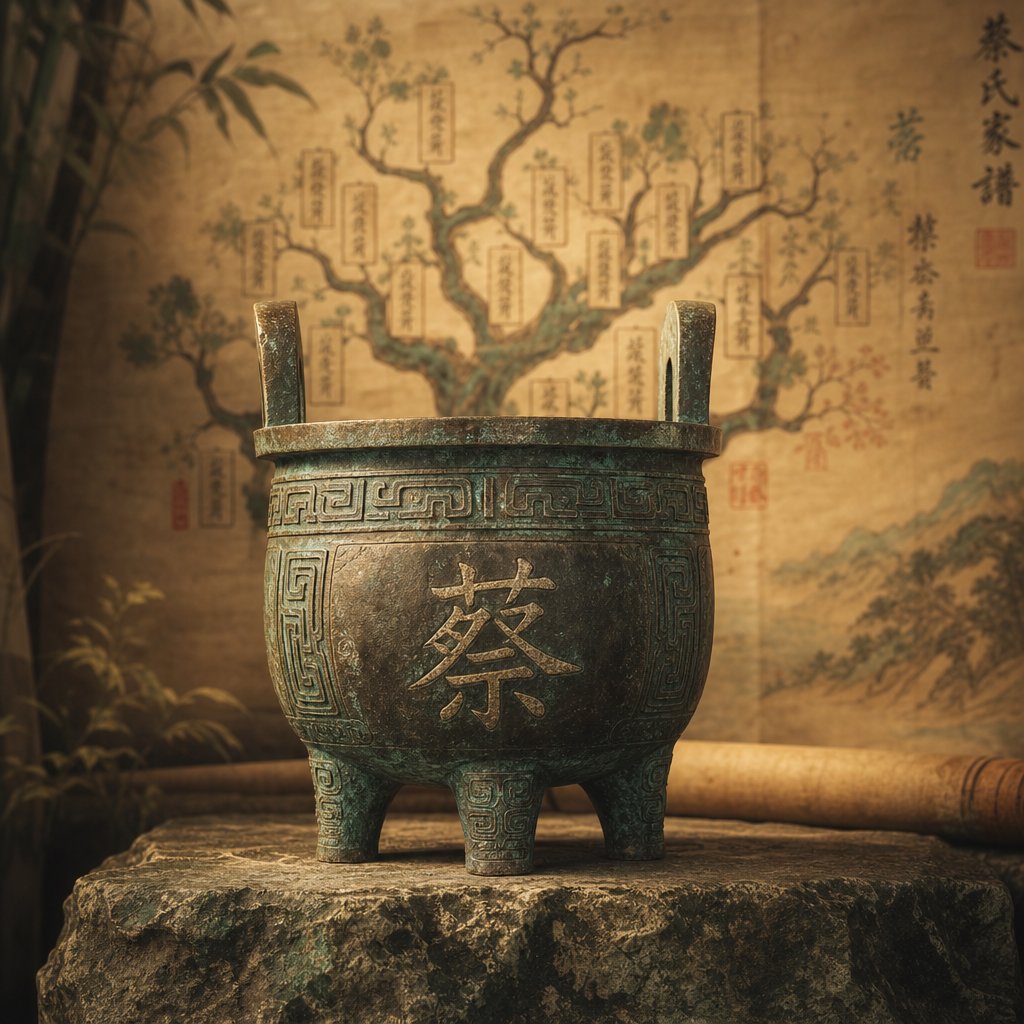
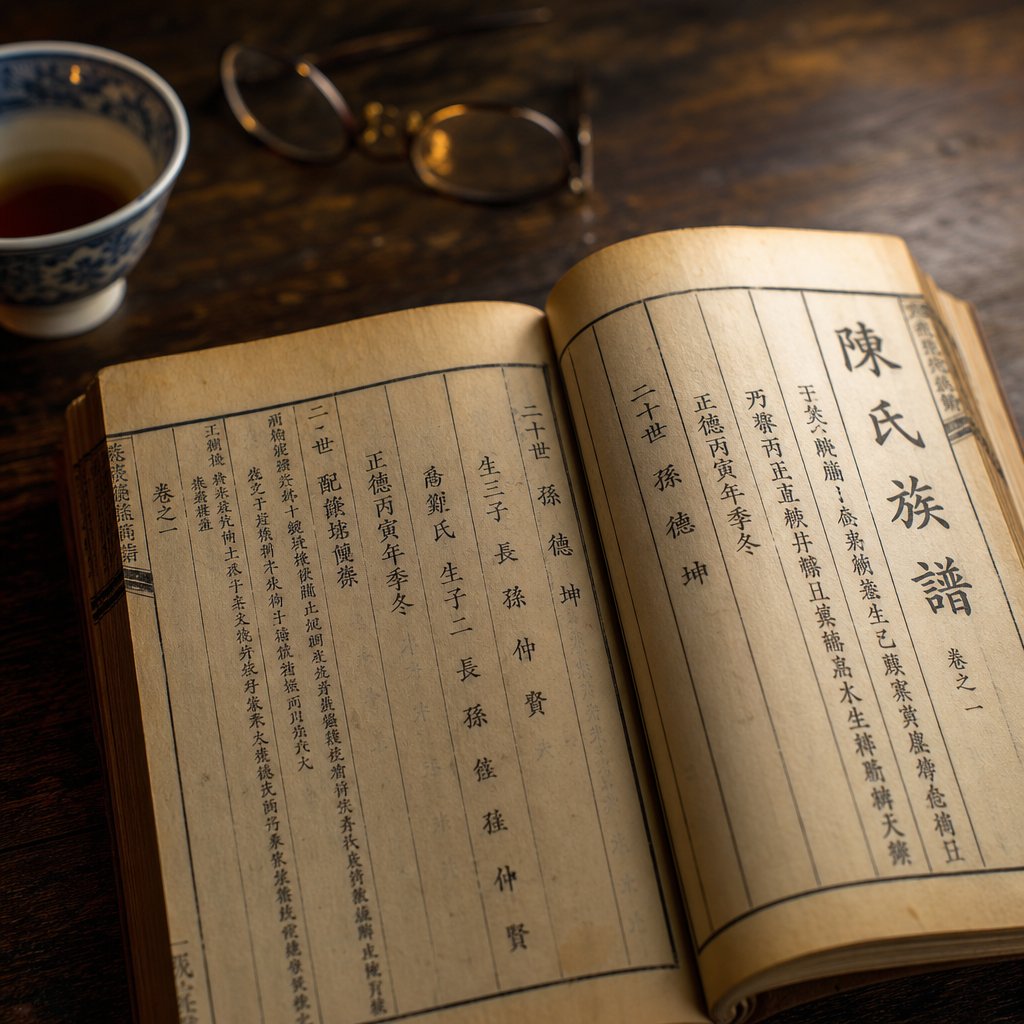
A zupu (族谱), also called a jiapu (家谱), is a traditional genealogy book maintained by a Chinese clan. Think of it as a combination of family tree, local history, and rulebook, all bound into a single volume that might span dozens of generations. For Cai families, some zupu trace lineages all the way back to Cai Zhong, the son who restored the State of Cai after his father's exile.
What does a typical Cai zupu contain? According to FamilySearch's jiapu research guide, these records go far beyond simple name lists. A well-preserved zupu typically includes:
- Pedigree charts tracing male descendants generation by generation from a founding ancestor
- Biographical entries for notable clan members
- Migration histories documenting when and why branches relocated
- Generation poems (字辈) that determined naming conventions for each generation
- Ancestral portraits and cemetery maps
- Family rules and moral teachings
- Records of ancestral hall construction and maintenance
The generation poem is particularly useful for researchers. If you know the character assigned to your grandfather's generation, you can pinpoint exactly where your branch sits within the broader clan structure. Many Cai families still follow these naming conventions, even in the diaspora.
Zupu were traditionally updated every 20 to 30 years during major clan gatherings. Older editions were sometimes destroyed when new ones were compiled, but many families kept multiple copies distributed among senior branch members. This redundancy means that even when one copy was lost to war or political upheaval, others may have survived in unexpected places.
Major Ancestral Halls and Their Locations
The ancestral hall (祠堂, citang) served as far more than a place of worship. It functioned simultaneously as a community center, school, courthouse, and repository for clan records. For Cai families researching their last name tsai origin or any other variant, these halls are often the physical starting point for genealogical work.
Key Cai ancestral halls still standing include:
- Shangcai County, Henan — The original homeland of the State of Cai. The Cai ancestral temple here commemorates Cai Shu Du and serves as a pilgrimage site for Cai descendants worldwide.
- Putian and Xianyou, Fujian — Home to some of the largest Cai clan populations in China. Multiple ancestral halls here preserve records dating to the Tang and Song dynasties, reflecting the clan's deep roots in the region after southward migration.
- Chaozhou and Shantou, Guangdong — Teochew-speaking Cai communities maintain halls that connect directly to the diaspora in Thailand, Singapore, and Malaysia.
- Jinmen (Kinmen) and Tainan, Taiwan — Taiwanese Cai halls preserve records brought from Fujian during the 17th-19th century migrations. These are essential for anyone tracing their tsai name origin back to the mainland.
Visiting an ancestral hall in person remains one of the most effective research methods. Local elders often possess knowledge that never made it into written records, and the halls themselves may house zupu editions unavailable anywhere else.
Modern Tools for Tracing Cai Ancestry
You do not need to book a flight to Henan to begin your research. Digitization efforts over the past two decades have made thousands of Chinese genealogies accessible online. The FamilySearch Chinese Genealogy Collection holds digitized images of clan genealogies searchable by surname, province, and county. The Shanghai Library's online jiapu database offers another major repository, with records spanning centuries.
DNA testing adds a complementary layer, though with important caveats. Y-chromosome testing can confirm whether two Cai males share a patrilineal ancestor, which is useful for connecting branches separated by centuries of migration. However, because the Cai surname has four distinct origin paths, a DNA match between two Cai families is not guaranteed. Two families might share the surname without sharing any genetic ancestry at all. Autosomal DNA tests from services like 23andMe or AncestryDNA can identify regional origins (Fujian vs. Guangdong, for example) but cannot confirm surname-specific lineages on their own.
Community organizations also play a vital role. Cai clan associations operate in Singapore, Malaysia, Taiwan, the Philippines, and major Western cities. These groups maintain membership records, organize ancestral hall visits, and sometimes fund new zupu compilations that incorporate overseas branches.
If you are ready to begin, here is a practical sequence that moves from what you already know toward what the records can reveal:
- Identify your dialect group from your spelling. Chua points to Hokkien or Teochew origins in Fujian or eastern Guangdong. Tsai indicates Mandarin-speaking ancestry, likely through Taiwan. Choi or Choy signals Cantonese roots. This single step narrows your search region dramatically.
- Interview living relatives. Ask for any Chinese characters associated with your family name, your ancestral village name, and any generation poem characters used in naming. Even fragments are valuable.
- Search digitized collections. Use FamilySearch's jiapu image search with your surname character 蔡 and any known province or county information.
- Contact a Cai clan association. Organizations in your country of residence or your ancestral region may already have compiled records that include your branch.
- Visit your ancestral village if possible. Local elders, surviving ancestral halls, and village-level records often contain information that has never been digitized.
- Consider Y-DNA testing. If you want to confirm a connection to a specific Cai lineage or verify a link between two branches, a Y-chromosome test provides biological evidence independent of paper records.
Persistence matters more than perfection in this process. Even if someone tells you your family's zupu was destroyed during the Cultural Revolution, copies may survive with distant relatives or overseas clan members who emigrated before the 1960s. As FamilySearch notes, many families have been surprised to discover that their records still exist in places like Malaysia, Singapore, or the United States.
The records you uncover will not just confirm names and dates. They will place your family within the broader demographic patterns that define where Cai families live today and why certain regions hold such concentrated populations of this surname.
Where Cai Families Live Today and Why
Genealogical records tell you where your ancestors came from. Demographics tell you where they ended up. The modern distribution of the cai name across the world is not a random scatter. It is a map drawn by centuries of migration, and every concentration of Cai families in a particular region corresponds to a specific historical event covered earlier in this article.
Population and Ranking in China Today
In the historical Hundred Family Surnames (Baijiaxing), compiled during the early Song Dynasty, 蔡 held the 155th position. That ranking reflected political prestige at court, not actual population size. The modern picture looks very different. As of 2019, Cai ranks as the 38th most common surname in mainland China, placing it firmly among the nation's major surname groups. With China's population exceeding 1.4 billion, that ranking translates to an estimated 6 to 7 million bearers on the mainland alone.
The surname's density is not evenly spread. Fujian, Guangdong, and Zhejiang provinces hold disproportionately large Cai populations, a direct consequence of the Tang Dynasty southward migrations. Henan, the original homeland of the State of Cai, retains a significant population as well, though it no longer dominates. If you overlay a map of modern Cai population density onto the migration routes described earlier, the correlation is almost exact: the clan is thickest where its ancestors settled during the 9th and 10th centuries.
Global Distribution and Concentration Patterns
Outside mainland China, the cai name in English appears under various spellings, but the demographic weight is unmistakable. Taiwan stands out as the single most concentrated Cai territory relative to population size. With the surname ranking 9th on the island, roughly 1.3 million Taiwanese bear the name Tsai. That prominence traces directly to Koxinga's 17th-century military relocations and subsequent Qing-era migration from Fujian.
Southeast Asia holds the next largest concentrations. Singapore, where Chua ranks 8th, has approximately 22,800 bearers of that spelling alone. In Malaysia, Forebears surname data records over 47,000 people named Chua, with additional thousands under the Choi and Chai variants. The Philippines counts more than 51,000 Chua bearers, concentrated in Metro Manila and the major trading cities of Luzon.
What does Cai mean in terms of global reach? The table below captures the surname's standing across its major population centers:
| Country/Region | Primary Spelling | Approximate Rank | Estimated Bearers |
|---|---|---|---|
| Mainland China | Cai | 38th | ~6-7 million |
| Taiwan | Tsai | 9th | ~1.3 million |
| Singapore | Chua | 8th | ~22,800 |
| Malaysia | Chua / Chuah / Choi | 79th (Chua alone) | ~47,400+ |
| Philippines | Chua | 133rd | ~51,400 |
| South Korea | Chae | Uncommon | ~120,000 |
| Vietnam | Thai / Sai | Varies by region | ~200,000+ |
| United States | Chua / Tsai / Choi | Varies | ~10,000+ combined |
| Australia | Chua / Tsai | Varies | ~2,000+ |
Each row in that table corresponds to a migration wave. Singapore's Chua families descend from 19th-century Hokkien laborers. The Philippines' Chua population traces to Fujian traders who arrived during the Spanish colonial period. Taiwan's Tsai families reflect both military settlement and agricultural migration from the same Fujian source region. The pattern is consistent: wherever Hokkien or Teochew speakers settled in large numbers, the Chua spelling dominates. Wherever Mandarin speakers established communities, Cai or Tsai appears instead.
The Cai Surname in a Connected World
For most of history, a Chua family in Manila had no practical way to connect with a Tsai family in Taipei or a Choi family in Hong Kong, even though all three descended from the same ancient lineage. Language barriers, geographic distance, and different spelling systems made the shared origin invisible. That isolation is ending.
Digital genealogy platforms now allow searches across romanization variants, linking records that were previously siloed by spelling. Clan associations that once operated within a single country have established international networks, hosting reunions that bring together Cai descendants from a dozen nations. DNA testing provides biological confirmation of connections that paper records alone could never prove, bridging gaps where zupu were lost or destroyed.
The cai in english may appear as a dozen different spellings, but the underlying identity is singular. One character, written the same way for over three thousand years, connects a farmer in Henan to a tech executive in Singapore to a university student in California. What separates them is dialect, geography, and the accidents of colonial romanization. What unites them is a story that began with a Zhou prince, a lost kingdom, and a name that refused to disappear.
Frequently Asked Questions About the Cai Surname
1. What is the origin of the Cai surname?
The Cai surname primarily originates from the Zhou Dynasty royal house around 1046 BCE. King Wu of Zhou granted his brother Ji Du a fief called Cai in present-day Henan province. After the State of Cai fell to the State of Chu in 447 BCE, its people adopted the state name as their family surname. This Ji lineage accounts for the vast majority of Cai bearers today, though three additional origin paths exist: adoption from official titles, ethnic minority sinicization during the Tang through Qing dynasties, and voluntary or forced name changes during political upheavals like the Yuan Dynasty.
2. Why is the same Chinese surname spelled Cai, Tsai, Chua, and Choi?
All these spellings represent the single Chinese character 蔡 romanized through different dialect pronunciations. Cai uses Mandarin pinyin (mainland China), Tsai uses the Wade-Giles system (Taiwan), Chua reflects the Hokkien/Teochew pronunciation (Philippines, Singapore, Malaysia), and Choi represents the Cantonese reading (Hong Kong, Macau). When Chinese families emigrated to different countries, each community wrote their spoken pronunciation into the local alphabet, creating over a dozen spelling variants from one character.
3. How do you pronounce the surname Cai?
In standard Mandarin, Cai is pronounced with a falling fourth tone, sounding like 'tsai' and rhyming roughly with 'eye' preceded by a 'ts' sound. However, pronunciation varies dramatically by dialect: Cantonese speakers say 'Coi,' Hokkien speakers say 'Chua,' Teochew speakers also say 'Chua,' and Hakka speakers say 'Tshai.' The Mandarin pronunciation is what most people encounter in international contexts, but the southern dialect readings are equally valid and historically older.
4. Who are the most famous people with the Cai surname?
The most historically significant Cai figures include Cai Lun, who refined the papermaking process in 105 CE and transformed global communication; Cai Yong, an Eastern Han polymath who oversaw the carving of the Confucian classics in stone; his daughter Cai Wenji, one of China's greatest female poets; Cai Xiang, a Song Dynasty calligraphy master who also engineered the Wan'an Bridge; and Cai E, a Republican-era general who led the National Protection War against Yuan Shikai's attempt to restore imperial rule in 1915-1916.
5. How can I trace my Cai family ancestry?
Start by identifying your dialect group from your surname spelling, as this narrows your ancestral region. Chua points to Fujian or eastern Guangdong, Tsai to Taiwan, and Choi to Cantonese-speaking areas. Interview living relatives for village names or generation poem characters. Then search digitized genealogy collections like FamilySearch's jiapu database using the character 蔡 and any known location details. Contacting a Cai clan association in your country or ancestral region can connect you to compiled records, and Y-DNA testing can biologically confirm lineage connections between separated branches.