Are Huang and Wong Actually the Same Surname
You've seen both spellings on business cards, in family trees, and across immigration documents. Maybe a relative spells it Huang while another branch of the family goes by Wong. Are these two completely different surnames, or is something else going on?
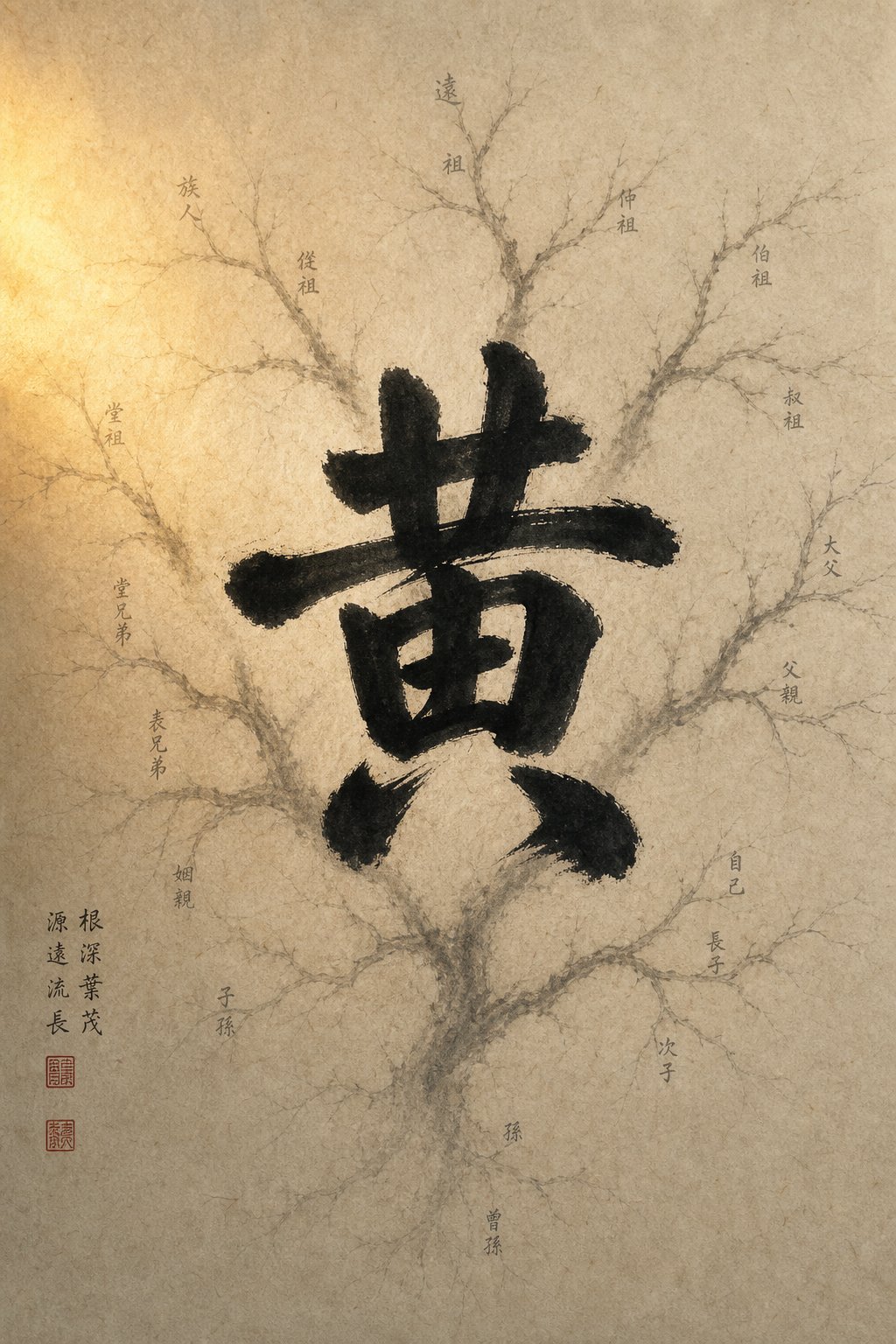
The short answer: yes, the Huang surname and the Wong surname are the same family name. Both trace back to the identical Chinese character 黃. The difference comes down to dialect. Mandarin speakers romanize 黃 as "Huang," while Cantonese speakers romanize it as "Wong." Same character, same ancestry, different pronunciation systems.
Huang and Wong are the same surname (黃) spelled differently because of dialect-based romanization systems.
Why Huang and Wong Cause So Much Confusion
The confusion runs deep, especially for diaspora families separated by generations and geography. Without a standardized romanization system to transcribe Chinese into other languages, immigration officials were left to guess at the spelling based on whatever sounds they could hear. A family from Guangdong province arriving in San Francisco in the 1880s would have their name recorded as "Wong" because they spoke Cantonese. Their cousins emigrating decades later through a Mandarin-based system would become "Huang." Same clan, same ancestral village, completely different paperwork.
This isn't just a linguistic curiosity. For families trying to reconnect across borders, the spelling gap creates real barriers. A Chinese Wong searching genealogical databases may never find their Huang relatives unless they understand that both spellings point to the same character 黃. The emotional weight here is significant — imagine discovering that a branch of your family you thought was unrelated actually shares your exact lineage, just filtered through a different port of entry.
What This Comparison Covers
This article breaks down the key differences and connections between these two spellings across several dimensions:
- The shared Chinese character and its ancient origins
- Why Wong in Chinese can actually refer to two unrelated surnames
- A complete dialect-to-romanization mapping for 黃
- How immigration history locked in specific spellings for specific families
- Pronunciation guidance for both variants
- Practical steps for verifying your own surname's true character
Whether you carry the Huang surname, the Wong surname, or a variant like Ng, Ooi, or Uy, the story begins with the same 12-stroke character and the same ancient clan. The spelling on your passport is simply a record of which dialect your ancestors spoke and which country they landed in.
How We Researched and Organized This Comparison
Sorting out the relationship between the surname Huang and the surname Wong requires pulling from several distinct fields. A single romanization table won't cut it. You need linguistics, immigration history, and clan genealogy working together to paint the full picture.
Sources and Romanization Systems Analyzed
This comparison draws on three primary categories of evidence. First, dialect linguistics: we consulted the major romanization systems used to transcribe Chinese characters into Latin script, including Hanyu Pinyin (the standard for Mandarin), Jyutping (the Linguistic Society of Hong Kong's system for Cantonese), and Wade-Giles (the older academic system still found in many historical texts). Each system produces a different spelling for the same character based on how that character sounds in a given dialect.
Second, historical immigration records. Databases like FamilySearch's Chinese emigration and immigration collections contain passenger lists, exclusion case files, and arrival manifests dating back to the 1880s. These records show exactly how port officials transcribed Chinese names and reveal patterns in how the Huang family name became "Wong" on one document and "Huang" on another. Third, clan genealogy records (族谱 and 家谱) that trace lineage back to shared ancestors regardless of modern spelling differences.
One important clarification: this comparison focuses specifically on the character 黃. The Wong family name in Cantonese can also represent the entirely unrelated character 王, which carries a different chinese name definition and origin. We address that ambiguity in a dedicated section below.
Criteria for Ranking Differences
To organize the information in a way that's genuinely useful for families researching their roots, we evaluated each point of comparison against five criteria:
- Linguistic origin — which dialect or romanization system produced the spelling
- Regional prevalence — where each variant is most commonly found today
- Historical context — how immigration waves and government policies shaped naming
- Practical impact on families — whether the difference creates real barriers to reconnection
- Frequency of confusion — how often people mistake one variant for an unrelated name
Understanding the chinese name definition behind each spelling matters because it determines whether two families share ancestry or simply share a coincidental romanization. The distinction between 黃 and 王 is the clearest example of why surface-level spelling tells you almost nothing without the underlying character.
Same Chinese Character with Different Romanizations
Here's the fact that resolves the entire debate: the chinese character huang and the Cantonese spelling "Wong" both represent 黃. One character. One meaning. One ancestral lineage. The only thing that differs is the sound each dialect assigns to that character and, by extension, the letters used to capture that sound on paper.
The Character 黃 and Its Meaning
The character 黃 means "yellow" in Chinese. That might sound unremarkable until you consider what yellow represents in Chinese culture. Yellow is one of the five sacred colors in traditional Chinese cosmology, symbolizing earth, centrality, and imperial authority. The ancient oracle bone form of this character depicted a jade pendant or ornament, connecting it to nobility and preciousness long before it became a surname.
When you see huang in chinese writing, you're looking at a character that carries roughly 4,000 years of cultural weight. The huang meaning extends beyond a simple color — it evokes the Yellow River (黄河), the cradle of Chinese civilization, and the Yellow Emperor himself. The character evolved through bronze inscriptions during the Zhou dynasty, small seal script during the Qin dynasty, and eventually into its modern simplified form 黄.
So why does this matter for surnames? Because when the ancient Huang Kingdom fell in 648 BCE, its people adopted the name of their lost state as a family identifier. The character 黃 became their permanent marker of identity, carried forward through every generation regardless of which dialect those generations eventually spoke.
Historical Origins from Huang Di to Modern Surnames
The huang last name origin traces back to multiple noble lineages, but the most widely documented path runs through the legendary Yellow Emperor, Huang Di (2697-2595 BCE). He's considered the mythological ancestor of all Han Chinese people, and his name literally means "Yellow Emperor" because huang also means yellow.
From Huang Di, the lineage passes through Emperor Zhuanxu to Lu Zhong, and then to Hui Lian (惠连), who is recognized as the founding ancestor of the Huang Kingdom (黃國). This kingdom was located in modern-day Huangchuan, Henan Province, and existed through the Xia, Shang, and Western Zhou dynasties.
Another significant huang name origin connects to the Jin Tian Clan (金天氏). Tai Tai, a great-grandson of Shaohao (who was himself a son of the Yellow Emperor), served as a water official and was granted territory at the Fen River region. One of the kingdoms he established was also named Huang. A third origin stream comes from the Huang Yi (黄夷) tribe, part of the ancient Dongyi people of eastern China, who used the yellow oriole bird as their totem.
All three origin paths converge on the same character: 黃. And all three produced descendants who eventually spread across China's dialect regions, carrying the character with them while pronouncing it differently.
Why One Character Became Two Spellings
Imagine a family in northern China saying 黃 aloud. In Mandarin, the sound comes out as "Huang" — a single syllable starting with an "hw" blend. Under the Pinyin romanization system (standardized in the 1950s), that sound gets written as H-U-A-N-G.
Now imagine a branch of that same family in Guangdong province, speaking Cantonese. They look at the identical character 黃 and pronounce it "Wong" — a rounder, shorter sound with no "h" at the beginning. Under Cantonese romanization systems like Jyutping, that sound gets written as W-O-N-G.
Neither pronunciation is wrong. Neither is a corruption of the other. Mandarin and Cantonese are not mutually intelligible — they diverged centuries ago and developed completely different phonetic systems. Mandarin uses four tones; Cantonese uses nine. The same character can sound entirely different depending on which system you grew up speaking.
| Character | Mandarin Pinyin | Cantonese Romanization | Meaning | Origin |
|---|---|---|---|---|
| 黃 | Huang | Wong | Yellow | Huang Kingdom (黃國), Yellow Emperor lineage, Jin Tian Clan |
This table captures the entire huang vs wong surname question in a single row. The character is the same. The meaning is the same. The ancestral origin is the same. Only the dialect — and therefore the romanization — differs. Families who carry the huang chinese surname and families who carry the Wong spelling share a common ancestor stretching back over four millennia. The spelling split happened not because of different bloodlines, but because of different sounds assigned to one shared written symbol.
That single-character, dual-spelling reality gets even more complicated when you learn that "Wong" doesn't always mean 黃. In Cantonese, the exact same romanization can point to an entirely different character with an entirely different history — a problem that trips up genealogists and family researchers constantly.
The Wong Ambiguity Problem That Confuses Everyone
Here's where things get genuinely tricky. If your last name is Wong, you might assume you already know your wong meaning and origin. But the romanization "Wong" in Cantonese is a homophone — it maps to at least two completely unrelated Chinese characters with completely different histories. The wong chinese character on your family's ancestral tablet could be 黃 (yellow), or it could be 王 (king). These are not variants of the same name. They are separate surnames with separate founders, separate clan histories, and separate ancestral halls.
This ambiguity is the single biggest source of confusion in wong surname origin research, and most online resources gloss over it entirely.
Wong from 黃 vs Wong from 王
In Cantonese, both 黃 and 王 are pronounced "wong4" — identical tone, identical sound. Native Cantonese speakers have developed verbal workarounds to distinguish them in conversation. They'll say 黃色嘅黃 ("Wong as in the color yellow") or 三劃王 ("three-stroke Wong") to clarify which character they mean. But on paper, in English, both families simply write "Wong."
The wang chinese character 王 means "king" and traces its origins to royal descendants of the Zhou dynasty and Shang dynasty. Its most ancient lineage connects to Bi Gan, an uncle of King Zhou of Shang, whose descendants adopted 王 because they were of princely blood. Another major branch descends from Prince Qiao, son of King Ling of Zhou, whose family became known as the "Wang family" due to their royal heritage.
The character 黃, as covered in the previous section, means "yellow" and traces to the ancient Huang Kingdom and the Yellow Emperor lineage. Completely different story. Completely different ancestors. Same English spelling.
| Attribute | Wong (黃) | Wong (王) |
|---|---|---|
| Chinese Character | 黃 | 王 |
| Meaning | Yellow | King |
| Mandarin Romanization | Huang | Wang |
| Cantonese Romanization | Wong | Wong |
| Origin | Huang Kingdom (黃國), Yellow Emperor | Zhou dynasty royalty, Bi Gan of Shang |
| Ancestral Hall Name (堂號) | 江夏堂 (Jiangxia Hall) | 太原堂 (Taiyuan Hall) |
| Population in China | ~33 million | ~107 million |
| Related Spellings | Huang, Ng, Ooi, Uy, Vong | Wang, Ong, Heng, Vuong |
Look at that table carefully. The wang surname (王) is actually the most common surname in mainland China, with over 107 million bearers. The Huang surname (黃) ranks around 7th with approximately 33 million. Both are massive clans, but they share zero genealogical connection despite sharing the same Cantonese spelling.
How to Tell Which Wong You Are
If you're a Wong trying to trace your wong last name origin, you need to figure out which character your family actually carries. Here are the most reliable methods:
- Ask elder family members directly. Older generations often know the Chinese character even if they can't write it. Ask them to describe it or draw it. 黃 has 12 strokes and a "grass" radical (艹) on top. 王 has just 4 strokes — three horizontal lines crossed by one vertical line.
- Check your ancestral hall name (堂號). This is the most definitive identifier. Wong families from 黃 almost universally use 江夏堂 (Jiangxia Hall), named after the Jiangxia commandery in Hubei province where the Huang clan consolidated. Wong families from 王 typically use 太原堂 (Taiyuan Hall), referencing the Wang clan's stronghold in Shanxi province.
- Identify your ancestral village and dialect group. If your family came from Taishan, Kaiping, or other Cantonese-speaking areas of Guangdong, both 黃 and 王 are possible. But if you know the specific village, clan association records can confirm the character.
- Look at family documents. Old immigration papers, marriage certificates from Hong Kong or Macau, or any document that includes Chinese characters alongside the English spelling will settle the question immediately.
Why This Distinction Matters for Genealogy
Imagine spending months tracing your wong surname meaning and family tree, connecting with other Wong families online, only to discover you've been researching the wrong clan entirely. A Wong from 黃 and a Wong from 王 share no common ancestor — not in the last 4,000 years, at least. Their genealogy books (族谱) are entirely separate documents maintained by entirely separate clan associations.
This matters practically because the chinese character for wong determines which genealogical databases, which clan associations, and which ancestral villages are relevant to your search. The Jiangxia Huang clan has extensive records tracing back to the fall of the Huang Kingdom in 648 BCE. The Taiyuan Wang clan maintains separate records tracing to Zhou dynasty royalty. Mixing them up doesn't just waste time — it can lead you to build an entirely fictional family history.
For diaspora families who've lost touch with their Chinese-language records, this ambiguity is especially painful. A third-generation Chinese-American named Wong may have no idea whether their great-grandparents carried 黃 or 王. The romanization alone tells them nothing. Only the underlying character — preserved in old documents, ancestral tablets, or the memories of elder relatives — can resolve the question.
The good news: once you've confirmed your character, the path forward becomes much clearer. If your Wong traces to 黃, then you share ancestry with every Huang, every Ng, every Ooi, and every Huynh in the world — a global clan connected by one ancient character, scattered across dozens of romanization systems by the winds of dialect and migration.
Every Romanization Variant of 黃 Mapped by Dialect
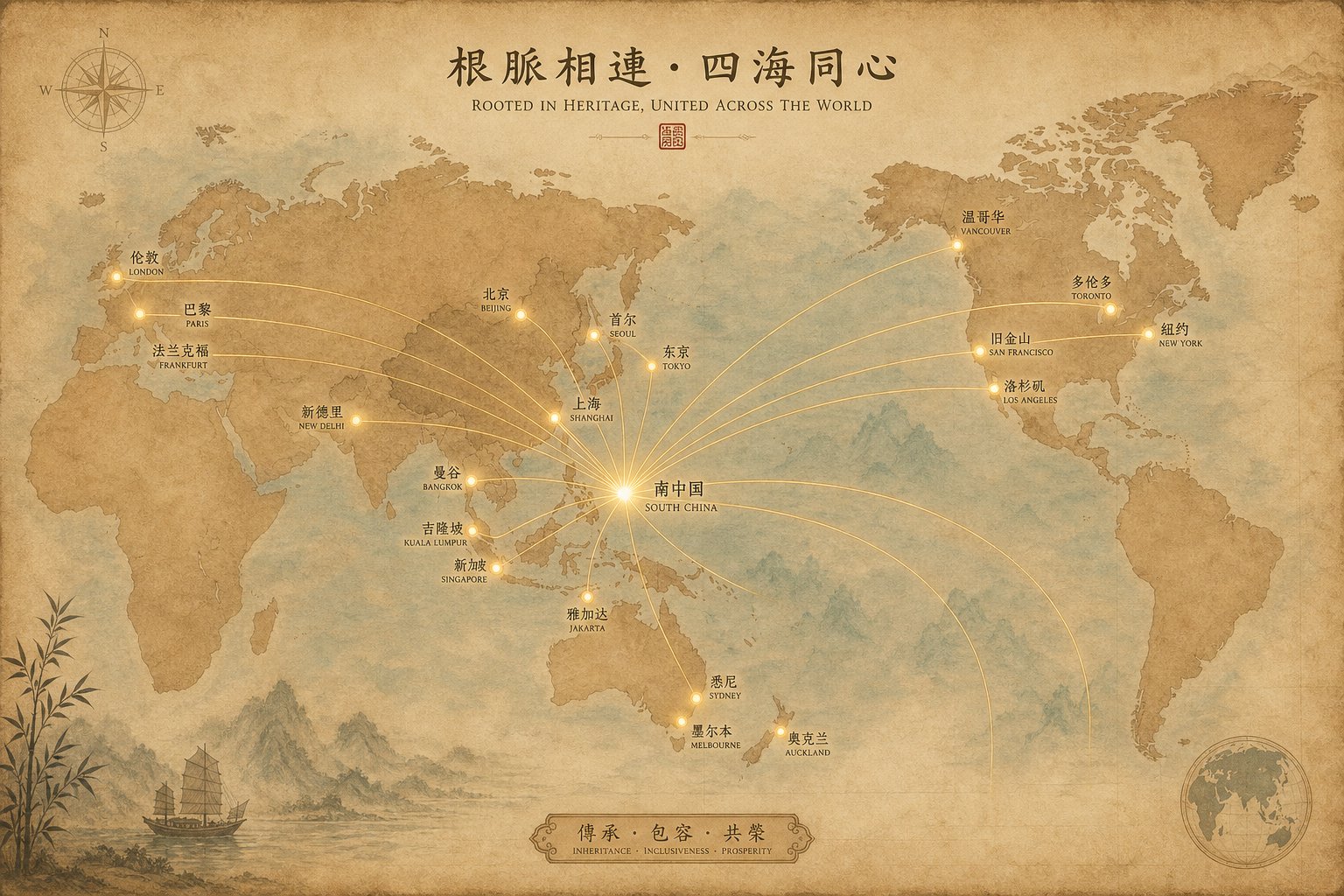
Confirming that your family carries 黃 is only half the puzzle. The other half is recognizing just how many different spellings that single character has produced across languages, dialects, and countries. A Wong in San Francisco, an Ng in Singapore, a Uy in Manila, and a Hwang in Seoul all trace to the same 12-stroke character. The huang traditional chinese form 黃 stayed constant on paper — but the sounds people attached to it splintered into over a dozen romanizations as communities spread across Asia and beyond.
This section serves as a consolidated reference. Bookmark it if you're doing genealogical research, because searching for only one spelling means missing entire branches of your family tree.
Complete Romanization Variants of 黃 by Dialect
Each Chinese dialect group pronounces 黃 differently, and each country's immigration system transcribed those sounds using its own conventions. The result is a sprawling list of spellings that all point back to one ancestor.
| Dialect / Language | Romanization(s) | Region Where Common | Approximate Population |
|---|---|---|---|
| Mandarin (Pinyin) | Huang | Mainland China, Taiwan, post-1970s immigrants worldwide | ~33 million |
| Mandarin (Wade-Giles) | Huang | Older academic texts, some Taiwanese documents | Included in Mandarin total |
| Cantonese (Jyutping: wong4) | Wong | Hong Kong, Macau, US, UK, Canada, Australia | ~4-5 million diaspora |
| Hokkien (Southern Min) | Ng, Ooi, Wee, Oey | Singapore, Malaysia, Taiwan, Indonesia | ~3-4 million diaspora |
| Hokkien (Philippine adaptation) | Uy, Ong | Philippines | ~500,000+ |
| Teochew (Chaozhou) | Ng, Ooi, Wee | Thailand, Cambodia, Singapore, Guangdong | ~1-2 million |
| Hakka | Vong, Wong, Wang | Guangdong, Taiwan, Mauritius, Suriname | ~2-3 million |
| Hainanese | Wee | Hainan, Singapore, Malaysia | ~500,000 |
| Korean | Hwang (황) | South Korea, Korean diaspora worldwide | ~644,000 (South Korea) |
| Vietnamese | Hoang, Huynh | Vietnam, Vietnamese diaspora (US, Australia, France) | ~5-6 million |
Notice how Hokkien alone produces at least four different spellings depending on which country the family settled in. A family in Penang became "Ooi." Their relatives in Manila became "Uy." Same dialect, same pronunciation, different local transcription conventions.
Korean and Vietnamese Cognates
The surname hwang in Korean (황) isn't just a coincidental sound-alike. It shares the same Chinese character origin — the Hanja for Hwang is 黃, identical to the Chinese form. Wikipedia's entry on the Korean Hwang surname records that the Korean branch traces to Hwang Rak (黃洛), a Han dynasty diplomat who arrived in Korea around AD 28 after being lost at sea during a voyage to Vietnam. The 2000 South Korean census counted 644,294 people with the surname Hwang across 68 distinct clan branches.
If you've ever wondered how to pronounce Hwang, it sounds roughly like "hwahng" — very close to the Mandarin pronunciation but with a slightly sharper initial consonant. English speakers often trip over it because the "hw" blend feels unfamiliar at the start of a syllable.
The hoang family name in Vietnamese splits into two variants based on regional dialect. Northern Vietnamese speakers use "Hoang" (Hoàng), while southern Vietnamese speakers use "Huynh" (Huỳnh). Both represent 黃. The hoang last name origin connects to centuries of Chinese cultural influence on Vietnam, where Chinese characters (chữ Hán) were used in official documents until the early 20th century. Vietnamese bearers of this surname number in the millions, making it one of the most common family names in Vietnam.
Taken together, estimates suggest over 29 million people worldwide carry some variation of 黃 as their surname — spanning Huang, Wong, Ng, Ooi, Uy, Hwang, Hoang, Huynh, Vong, Wee, and more.
Ranking Variants by Global Frequency
When you sort all these romanizations by how many people carry each spelling, the ranking looks like this:
- Huang — by far the largest group, covering mainland China's 33+ million bearers plus growing international usage
- Hoang / Huynh — Vietnam's massive population makes this the second-largest cluster at 5-6 million
- Wong — dominant across Hong Kong and the older English-speaking diaspora, roughly 4-5 million
- Ng — spread across Hokkien and Teochew communities in Southeast Asia, 3-4 million
- Ooi / Wee — concentrated in Malaysia and Singapore, 1-2 million
- Hwang — Korean bearers, approximately 644,000 in South Korea alone
- Uy / Ong — Philippine adaptations, 500,000+
- Vong — Hakka variant found in smaller diaspora pockets
This ranking matters for practical research. If you're searching genealogical databases, start with the most common variant for your family's region, then expand outward. A family from Fujian province should search Ng, Ooi, and Wee before trying Wong or Huang. A family from Guangdong should start with Wong and then check Huang for any relatives who emigrated through Mandarin-based systems.
The sheer number of variants explains why so many families lose track of each other across borders. But it also means that once you understand the mapping, your potential pool of relatives expands dramatically. Every spelling on this list is a door into the same ancestral hall — you just need to know which door belongs to your dialect group and which country your branch landed in.
How Immigration History Determined Your Spelling
Dialect maps and romanization tables explain why 黃 can be spelled a dozen different ways. But they don't explain why your specific family ended up with the spelling they carry today. That answer lives in immigration history — the particular decade your ancestors left China, the port they departed from, the country they arrived in, and the official who wrote their name down for the first time in English.
The wong last name didn't become dominant in the English-speaking world by accident. It became dominant because the earliest and largest waves of Chinese emigration to the United States, Canada, Australia, and the United Kingdom came overwhelmingly from one region: Guangdong province. And in Guangdong, people spoke Cantonese.
Why Early Immigrants Became Wong
The California Gold Rush of 1848 and the construction of the Transcontinental Railroad in the 1860s drew tens of thousands of laborers from the Pearl River Delta region of Guangdong. These men came from counties like Taishan, Kaiping, Xinhui, and Enping — all Cantonese-speaking areas. When they arrived at Angel Island or other ports of entry, they pronounced 黃 as "Wong." That's what the immigration clerk heard, and that's what got written on the manifest.
This pattern repeated across decades. From the 1850s through the early 1900s, Cantonese speakers made up the vast majority of Chinese immigrants to English-speaking countries. The result was that "Wong" became the default English spelling for 黃 in these nations. Wong remains the 3rd most common Chinese surname in America and the most common Chinese surname in Ontario, Canada — a direct legacy of those early Cantonese-speaking arrivals.
The wong name origin for any given family in the US, UK, or Australia almost always traces to this specific migration corridor: Guangdong to an English-speaking port, processed by an official who transcribed Cantonese sounds into English letters.
How Port-of-Entry Officials Shaped Spellings
Here's something that surprises many people: your ancestors likely didn't choose their own romanized spelling. Immigration officials unfamiliar with Chinese sounds would simply guess how best to spell a migrant's name. There was no standardized system. No interpreter was guaranteed. The clerk at the desk made a judgment call, and that judgment became your family's legal identity in their new country.
This process was inconsistent even within the same port. One official might write "Wong," another might write "Wung" or "Vong" for the same sound. Hokkien speakers from Fujian province fared even worse — the nasal "Ng" sound baffled English-speaking clerks who sometimes recorded it as "Eng," "Ang," or simply dropped it entirely.
The huang last name only became common in Western countries much later, primarily after the 1960s and 1970s when immigration policies shifted and new waves of migrants arrived from Mandarin-speaking regions — or from Taiwan, where Pinyin and Wade-Giles systems produced "Huang" as the standard romanization. Families who emigrated after China adopted Pinyin in 1958 were far more likely to arrive with "Huang" on their documents, regardless of which dialect they actually spoke at home.
This means the spelling on your passport is essentially a timestamp. It tells you roughly when and where your family entered the immigration system. "Wong" signals an earlier arrival through Cantonese-speaking channels. "Huang" signals a later arrival through Mandarin-based systems. Same character, same clan — different era, different bureaucracy.
Country-Specific Patterns Across the Diaspora
The last name wong origin story plays out differently depending on which country a family landed in. Each nation's immigration system, dominant Chinese dialect community, and local transcription habits produced distinct patterns:
- United States — Wong dominates among families who arrived before the 1960s. Post-1965 immigration reform brought Mandarin speakers, making Huang increasingly common. Wong is still the 3rd most common Chinese surname in America overall.
- Canada — Similar to the US pattern. Wong is the most common Chinese surname in Ontario, reflecting heavy early Cantonese immigration to British Columbia and later to Toronto.
- Australia — Wong was near-universal among early Chinese arrivals during the gold rush era (1850s-1860s). Recent decades have seen Huang grow as mainland Chinese immigration increased.
- United Kingdom — Wong predominates, tied to Hong Kong immigration waves especially around the 1997 handover.
- Malaysia — Multiple spellings coexist: Wong (Cantonese communities), Ooi and Ng (Hokkien communities in Penang and elsewhere), Wee (Teochew communities).
- Singapore — Ng and Ooi are more common than Wong due to the large Hokkien and Teochew populations. Wong appears among Cantonese-speaking families.
- Philippines — Uy and Ong dominate, reflecting Hokkien origins of most Chinese-Filipino families. Wong appears less frequently.
- Vietnam — Hoang (north) and Huynh (south) are the standard forms, shaped by Vietnamese phonetics rather than English transcription.
Notice the pattern: wherever Cantonese speakers arrived first and in the largest numbers, Wong became the default. Wherever Hokkien or Teochew speakers dominated, Ng, Ooi, or Uy took hold instead. And wherever Mandarin-based systems controlled the paperwork — whether through later immigration waves or government standardization — Huang emerged.
The most striking consequence of all this? Siblings from the same family could end up with entirely different surname spellings. Imagine two brothers leaving the same village in Guangdong in the 1930s. One sails to San Francisco and becomes "Wong." The other takes a ship to Manila and becomes "Uy" — because the Philippines' Chinese community was predominantly Hokkien-speaking, and local conventions transcribed 黃 differently. Same parents, same ancestral tablet, same character. Two completely different legal identities in two different countries.
For families trying to reconnect across these borders, understanding the immigration layer is essential. The spelling isn't a clue to ancestry — it's a clue to geography and timing. Once you strip away the romanization and look at the underlying character, the family connections become visible again. But you have to know what sounds like what in order to hear those connections clearly.
Pronunciation Differences Between Huang and Wong
Knowing the spelling is one thing. Saying it correctly is another challenge entirely. The pronunciation of huang trips up English speakers more than almost any other Chinese surname, and even "Wong" gets mangled in ways that would surprise native Cantonese speakers. If you've ever hesitated before saying someone's name aloud — or cringed when someone butchered yours — this section is for you.
How to Correctly Pronounce Huang in English
The most common mistake? Splitting "Huang" into two syllables: "hoo-ahng." That's not how it works. In Mandarin, 黃 is a single syllable. The IPA transcription is /xwɑŋ/, but for practical purposes, think of it as one smooth sound that blends "hw" into "ahng" without any pause in between.
Think of Huang as one syllable — hwahng — not two separate sounds.
The "h" at the beginning isn't a hard English "h" either. It sits further back in the throat, closer to the "ch" in the Scottish word "loch" but softer. Most English speakers approximate it well enough by just saying "hwahng" quickly, letting the "w" glide naturally into the vowel. If you can say "want" without thinking about it, you already have the mouth shape for the second half of the sound.
So how do you pronounce huang in everyday conversation? Rhyme it with "song" but start with "hw" instead of "s." That gets you close enough for respectful communication. The Mandarin second tone (a rising pitch) applies to 黃, meaning the voice lifts slightly upward — but in English contexts, getting the consonants and vowel right matters more than nailing the tone.
The Cantonese Pronunciation of Wong
"Wong" is far more intuitive for English speakers, but it still gets mispronounced. The Cantonese pronunciation huang's counterpart sounds almost exactly like the English word "wrong" — just drop the "r." The IPA is /wɔːŋ/, with a rounded "o" vowel and a nasal ending. It doesn't rhyme with "gong" (which has a shorter, flatter vowel). It rhymes with "long" spoken with a slightly rounder mouth.
The Cantonese tone for 黃 is tone 4 — a low falling tone. Again, English speakers don't need to worry about tone in casual settings, but it's worth knowing that native speakers say it with a downward pitch, giving it a slightly heavier, more grounded sound than you might expect.
Why Jensen Huang's Name Trips People Up
If you've watched any NVIDIA keynote, you've probably heard how do you say huang attempted by news anchors and tech journalists with varying success. Jensen Huang, the company's CEO, has become the most prominent bearer of this surname in global media — and his name has turned pronunciation huang into a surprisingly common search query.
The confusion comes from English phonetics having no native "hw" + "ahng" combination. Broadcasters often land on "hoo-ahng," "hwang" (rhyming with "bang"), or even "hyoo-ahng." The correct huang pronunciation is closer to what Jensen himself uses in interviews: a quick, single-syllable "hwahng" where the lips round slightly on the "w" before opening into the "ah" vowel.
Here's a quick reference for both names:
| Surname | IPA | English Approximation | Common Mispronunciations |
|---|---|---|---|
| Huang | /xwɑŋ/ | "hwahng" (one syllable) | "hoo-ahng," "hwang" (rhymes with bang), "hyoo-ang" |
| Wong | /wɔːŋ/ | "wrong" without the "r" | "wahng," "wung," rhyming with "gong" |
The irony is that both pronunciations represent the same character. If you can pronounce huang correctly and you can say Wong correctly, you're producing two completely different sounds for the same written symbol — a perfect demonstration of why dialect-based romanization created so much confusion in the first place. The spelling tells you which sound system a family used. But the character underneath remains 黃 regardless of whether your tongue shapes it into "hwahng" or "wong."
Of course, pronunciation only tells you how a name sounds in isolation. The deeper question for many families is what happens when that sound lands in a new country and gets surrounded by cousins who say it completely differently — a reality that plays out across every continent where the 黃 diaspora has settled.
Regional Variants Across the Chinese Diaspora
A family reunion for the 黃 clan would look unlike any other gathering on earth. Picture it: a Chinese-Australian named Wong sits next to a Chinese-Filipino named Uy. Across the table, a Malaysian named Ooi chats with a Vietnamese-American named Huynh. A Korean-Canadian named Hwang passes dishes to a Singaporean named Ng. None of their passports match. All of their ancestral tablets carry the same 12-stroke character.
This isn't hypothetical. It's the lived reality of one of the world's largest surname clans, scattered across dozens of countries with spellings so different that family members can sit in the same room without realizing they share blood.
Same Ancestor with Different Spellings Worldwide
The origin of surname Ng, for example, puzzles many people who encounter it for the first time. How can two letters represent a full surname? The answer lies in Hokkien and Teochew phonetics, where 黃 is pronounced as a single nasal consonant — a sound that English has no clean way to spell. Immigration clerks in Singapore and Malaysia did their best, landing on "Ng." Their counterparts in the Philippines heard something closer to "Uy" or "Ong" from the same Hokkien-speaking migrants. Same sound, different ears, different paperwork.
What makes this remarkable is the scale. According to My China Roots, the Huang clan has spelling variations spanning over 30 distinct romanizations across all dialect groups and countries. That's not 30 different families — it's one family wearing 30 different name tags depending on where life took them.
When you see wong in chinese writing, you're looking at 黃 filtered through Cantonese phonetics. When you see wong in chinese characters on a Hong Kong identity card or a Macau residency document, the character is right there beside the English spelling. But strip away the English, and a Wong from Toronto and an Ooi from Penang are reading the same symbol on their ancestral shrine.
Diaspora Frequency Data by Country
The table below maps the most common spelling of 黃 in each major diaspora country, along with the dialect that produced it and a rough population estimate. Use this as a starting point for genealogical searches — if your family settled in a particular country, the dominant spelling there is likely what ended up on your documents.
| Country / Region | Most Common Spelling(s) | Dialect Origin | Estimated Population |
|---|---|---|---|
| Mainland China | Huang | Mandarin | ~33 million |
| Vietnam | Huynh (south), Hoang (north) | Sino-Vietnamese | ~5-6 million |
| Hong Kong / Macau | Wong, Vong | Cantonese | ~800,000 |
| United States / Canada | Wong, Huang, Ng | Cantonese, Mandarin, Hokkien | ~1-2 million |
| Malaysia | Ooi, Ng, Wong, Wee | Hokkien, Teochew, Cantonese | ~1.5 million |
| Singapore | Ng, Ooi, Wee, Wong | Hokkien, Teochew, Cantonese | ~300,000 |
| Philippines | Uy, Ong, Ng | Hokkien | ~500,000+ |
| Indonesia | Oei, Oey, Ng | Hokkien | ~400,000+ |
| South Korea | Hwang | Korean (Hanja: 黃) | ~644,000 |
| Taiwan | Huang, Ng | Mandarin, Hokkien | ~1.4 million |
| Australia | Wong, Huang | Cantonese, Mandarin | ~150,000 |
| United Kingdom | Wong | Cantonese | ~100,000 |
| Thailand / Cambodia | Ng, Ung | Teochew | ~200,000 |
A few things jump out from this data. Vietnam alone accounts for 5-6 million bearers of 黃 under the Huynh and Hoang spellings — making it the second-largest national population after mainland China. Malaysia's diversity is also striking: four different spellings coexist in one country because Hokkien, Teochew, and Cantonese communities all settled there in significant numbers.
The chinese character for yellow — 黃 — ties every row in that table together. Whether the local system transcribed it as "Uy" in Manila or "Vong" in Macau, the underlying identity is the same. The spelling is geography. The character is genealogy.
The Emotional Impact of Reconnecting Across Spellings
For diaspora families, discovering that a stranger with a completely different last name shares your ancestor can be a profound experience. Imagine growing up as a Huynh in Houston, assuming your Vietnamese surname has nothing to do with the Wongs in your neighborhood — only to learn that both families trace to the same Jiangxia Hall (江夏堂) and the same ancient Huang Kingdom.
This reconnection happens through a few key channels:
- Clan associations. Organizations like the Singapore Huang Clan Association and similar groups in Malaysia, the US, and Australia actively welcome members regardless of spelling. They organize gatherings where Wongs, Ngs, Oois, and Huangs meet under the shared banner of 黃.
- Ancestral hall names (堂號). The Jiangxia Hall name is the universal identifier for 黃 families worldwide. If your family references 江夏堂 in any context — on a plaque, in a genealogy book, during ancestral worship — you belong to this clan regardless of what your passport says.
- Village of origin. Many Huang families can trace their branch to a specific village in Fujian or Guangdong province. Clan genealogy books (族谱) record which sub-branches migrated where, making it possible to connect a Wong in Vancouver to an Ooi in Kuala Lumpur through a shared ancestral village.
- Genealogy books (族谱). These multi-volume records maintained by clan elders list every generation by their Chinese name and character — not by romanization. A zupu doesn't care whether you spell it Wong or Ng. It records 黃 and your generational poem name, linking you to every other branch regardless of country or dialect.
The emotional weight here is real. My China Roots reports that many families they assist are stunned to discover relatives in countries they never expected — connected by a character they couldn't read but always carried. A third-generation Chinese-Australian named Wong finds cousins in the Philippines named Uy. A Vietnamese-American named Huynh discovers a branch of the family in Singapore going by Ng. The surnames looked nothing alike on paper, but the ancestral tablet in the family shrine told the truth all along.
This is what makes the huang vs wong surname question so much more than a linguistics exercise. It's a map of human migration, written in the gap between how a character sounds and how a clerk decided to spell it. Every variant is a breadcrumb trail leading back to the same origin point — and for families willing to follow those trails, the reward is a sense of belonging that spans continents, centuries, and alphabets.
Side-by-Side Comparison of Huang and Wong
All the dialect history, immigration context, and pronunciation guidance covered above boils down to a set of concrete differences you can scan in seconds. If you're short on time or just need a quick reference to share with a relative, this section puts everything in one place.
Huang vs Wong at a Glance
| Attribute | Huang | Wong |
|---|---|---|
| Chinese Character | 黃 | 黃 (or 王 — see note below) |
| Dialect Origin | Mandarin | Cantonese |
| Meaning | Yellow | Yellow (if 黃) / King (if 王) |
| Pronunciation | /xwɑŋ/ — "hwahng" (one syllable) | /wɔːŋ/ — "wrong" without the "r" |
| Countries Where Common | Mainland China, Taiwan, post-1970s diaspora | Hong Kong, US, UK, Canada, Australia (pre-1960s arrivals) |
| Related Variants | Hwang (Korean), Hoang/Huynh (Vietnamese) | Ng, Ooi, Uy, Wee, Vong (other dialect romanizations of 黃) |
| Historical Origin | Huang Kingdom (黃國), Yellow Emperor lineage | Same as Huang when character is 黃 |
| Romanization System | Hanyu Pinyin / Wade-Giles | Cantonese Jyutping / traditional Hong Kong romanization |
| Population Estimate | ~33 million (mainland China) | ~4-5 million (Cantonese diaspora) |
| Ancestral Hall Name | 江夏堂 (Jiangxia Hall) | 江夏堂 (if 黃) / 太原堂 (if 王) |
One critical note on that table: the last name Wang (王) also romanizes as "Wong" in Cantonese, which is why the Wong column carries a caveat. Is Wang a Chinese name related to Huang? Not at all. The wang family name means "king" and traces to Zhou dynasty royalty — a completely separate lineage. If your family is Wong, confirming whether you carry 黃 or 王 is the single most important step before any genealogical research.
Key Takeaways for Family Research
- Huang and Wong both derive from the Chinese character 黃 — they are the same surname, not two different ones.
- Dialect determines spelling: Mandarin produces Huang, Cantonese produces Wong, Hokkien produces Ng or Ooi, and so on.
- Wong can also represent 王 (king/Wang) — an entirely unrelated surname that happens to share the same Cantonese romanization.
- Immigration history locked in spellings: earlier Cantonese-speaking arrivals became Wong; later Mandarin-system arrivals became Huang.
- Pronunciation differs significantly: Huang is one syllable ("hwahng"), Wong sounds like "wrong" minus the "r."
- All variants — Wong, Huang, Ng, Ooi, Uy, Hwang, Huynh — can trace to the same ancestor if the underlying character is 黃.
With these facts in hand, the practical question becomes: how do you actually verify which character your family carries and start connecting with relatives who spell it differently? That process is more straightforward than most people expect — and it starts with a single conversation.
How to Determine Your Surname's True Origin
You've seen the tables, the dialect maps, and the immigration patterns. The question now is personal: what does your family's spelling actually trace back to? Is Huang a Chinese last name in your lineage, or does your Wong connect to 黃 or to 王? The answer isn't hiding in a database somewhere — it's usually closer than you think, waiting in the memory of a relative or on a faded document in a family drawer.
Here's a step-by-step process to pin down your surname's true Chinese character and start building connections across spelling differences.
Steps to Verify Your Surname's Chinese Character
- Ask elder family members about the Chinese character. This is your most reliable starting point. Grandparents, great-aunts, or older cousins may know the character even if they can't write it fluently. Ask them to draw it, describe it, or tell you its meaning. If they say "yellow," you're looking at 黃. If they say "king," it's 王. Even a rough sketch — as one genealogist notes, a character that looks like "a sheep with a box on its back" — can be enough to identify the correct surname.
- Check your ancestral hall name (堂號). The hall name is the definitive clan identifier. For 黃 families, the universal hall name is 江夏堂 (Jiangxia Hall). If anyone in your family references Jiangxia — on a plaque, in a genealogy book, during Qingming festival — your Wong or Huang traces to 黃. The wong chinese symbol on your ancestral tablet paired with this hall name settles the question completely.
- Identify your family's dialect group and ancestral village. Knowing whether your family spoke Cantonese, Hokkien, Teochew, or Hakka narrows the romanization path immediately. Legacy Tree Genealogists recommends looking at historical immigration patterns to your family's destination country — most Californian Chinese came from Cantonese-speaking Szeyup, most Filipino Chinese from Hokkien-speaking Fujian, most Jamaican Chinese from Hakka-speaking areas near Shenzhen.
- Consult genealogy records or clan associations. Chinese clan associations exist in nearly every country with a significant diaspora. The Huang clan associations in Singapore, Malaysia, the US, and Australia maintain membership records and can help verify your character. Online resources like My China Roots also provide surname lookup tools that connect romanizations to their source characters.
- Cross-reference with romanization tables and old documents. Immigration certificates, grave markers, and marriage records from Hong Kong or mainland China often include both the Chinese character and the English spelling side by side. Even a single document with the wong chinese symbol written next to the romanized name gives you definitive proof. Check family archives, request records from national archives, or visit ancestral graves where inscriptions typically use traditional Chinese characters.
Resources for Tracing Your Clan History
Once you've confirmed your character, several resources can help you dig deeper:
- FamilySearch's China Collection of Genealogies (1239-2014) — a free, searchable database containing over 13 million images of Chinese genealogy records organized by surname. It lists 434 Chinese family names in both Pinyin and Chinese characters.
- Clan genealogy books (族谱) — multi-generational records maintained by clan elders that list family members by Chinese name, not romanization. If your branch is recorded, it connects you to every other branch regardless of spelling.
- U.S. National Archives Chinese Exclusion Act case files — available through NARA, these files often contain Chinese characters alongside English names for immigrants processed between 1882 and 1943.
- Grave markers and ancestral tablets — traditional Chinese tomb inscriptions include the deceased's full name in Chinese characters, their ancestral village, and sometimes their hall name. These are among the most reliable primary sources for confirming a surname's true character.
So can someone named Huang and someone named Wong be from the same family? Yes — absolutely and unambiguously, if both trace to 黃. The define wong question and the meaning of wong question have the same answer when the character is confirmed: it means "yellow," it connects to the ancient Huang Kingdom, and it links you to a global clan of over 29 million people who spell the name differently but share the same blood.
The wong definition your family carries isn't locked inside the English letters on your birth certificate. It lives in the character your ancestors wrote for centuries before any immigration clerk tried to spell it phonetically. Whether your passport reads Huang, Wong, Ng, Ooi, Uy, Hwang, or Huynh, the path back to 黃 is open to anyone willing to ask the right questions — starting with the simplest one of all: what character did our family carry before the spelling was chosen for us?
If you've been hesitant to start this research because the language barrier feels insurmountable, take heart. As one Chinese-Canadian genealogist puts it: "It will be hard but it's not impossible." Every family that reconnects across a spelling difference proves that the character 黃 is stronger than any romanization system — and that the bonds of clan identity survive even when the letters on the page look nothing alike.
Frequently Asked Questions About Huang vs Wong Surname
1. Are Huang and Wong the same last name?
Yes, Huang and Wong represent the same Chinese character 黃, meaning 'yellow.' The difference is purely dialectal: Mandarin speakers romanize it as Huang, while Cantonese speakers romanize it as Wong. Both trace back to the ancient Huang Kingdom and share the same ancestral lineage through the Yellow Emperor. Families carrying either spelling can be directly related, separated only by which dialect their ancestors spoke when their name was first transcribed into English.
2. How do I know if my Wong surname is 黃 or 王?
The most reliable methods are asking elder family members about the character's meaning (yellow for 黃, king for 王), checking your ancestral hall name (江夏堂 Jiangxia Hall indicates 黃, while 太原堂 Taiyuan Hall indicates 王), and examining old family documents that include Chinese characters. The two surnames are completely unrelated despite sharing the same Cantonese romanization, so confirming the correct character is essential before beginning any genealogical research.
3. Why is the surname Huang so hard to pronounce in English?
English lacks the 'hw' + 'ahng' sound combination that Mandarin uses for 黃. Many English speakers incorrectly split it into two syllables ('hoo-ahng'), but it should be pronounced as a single syllable: 'hwahng,' rhyming with 'song' but starting with 'hw.' The initial consonant sits between an English 'h' and the 'ch' in Scottish 'loch,' which makes it unfamiliar to most non-Mandarin speakers.
4. Can someone named Ng, Ooi, or Uy be related to someone named Huang or Wong?
Absolutely. Ng (Hokkien/Teochew), Ooi (Hokkien in Malaysia), Uy (Hokkien in the Philippines), Wong (Cantonese), and Huang (Mandarin) all derive from the same character 黃. Each spelling reflects a different Chinese dialect and the country where the family settled. A Filipino named Uy and an Australian named Wong could share the same ancestor, with the spelling difference caused entirely by immigration geography and local transcription conventions.
5. What is the difference between the Korean surname Hwang and the Chinese surname Huang?
Both share the same origin character 黃 (written as 황 in Korean Hangul). The Korean Hwang surname traces to Hwang Rak, a Han dynasty diplomat who arrived in Korea around AD 28. While the ancestral character is identical, Korean Hwang families developed their own distinct clan branches over nearly 2,000 years in Korea. The pronunciation is similar to Mandarin Huang, sounding roughly like 'hwahng' with a slightly sharper initial consonant.