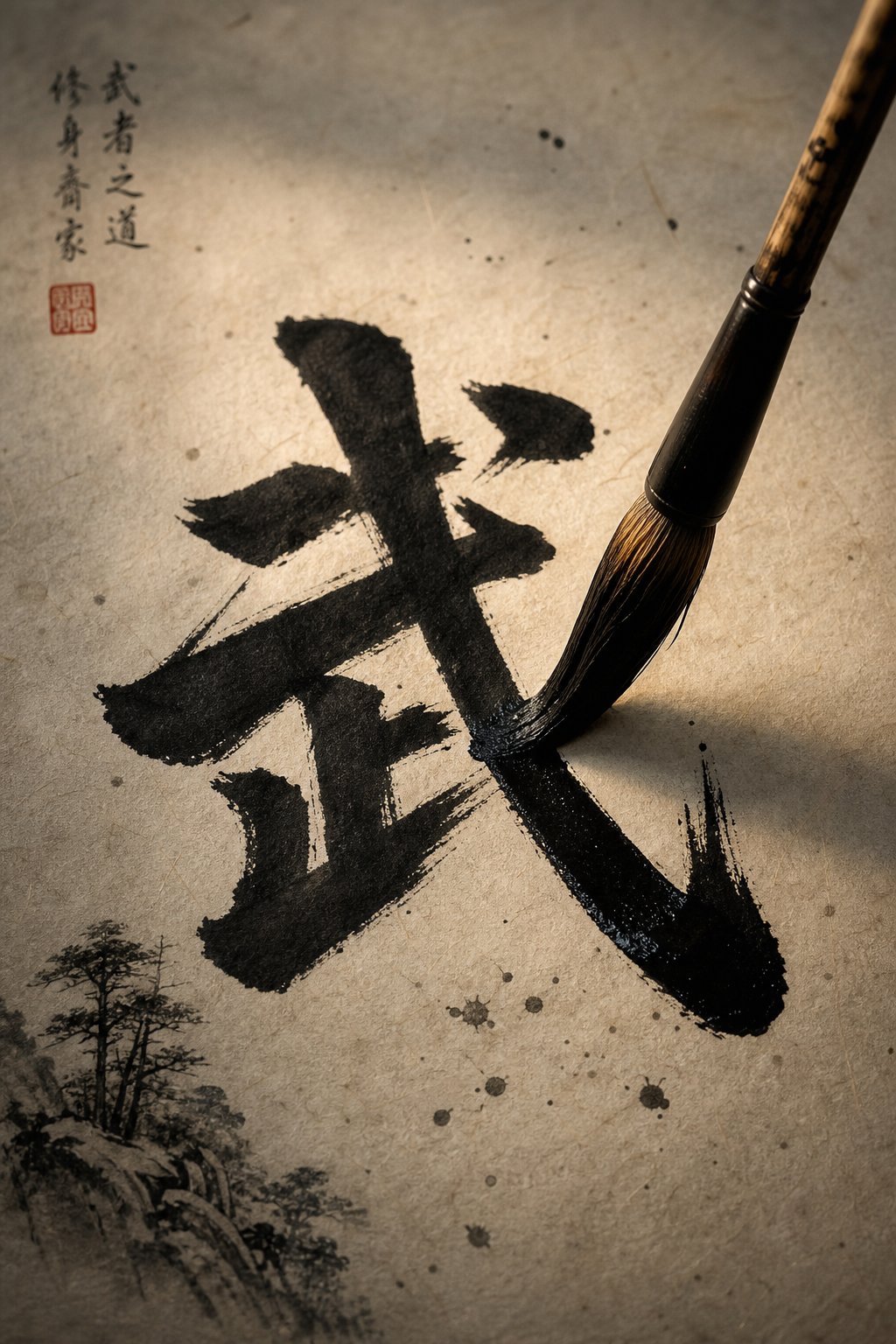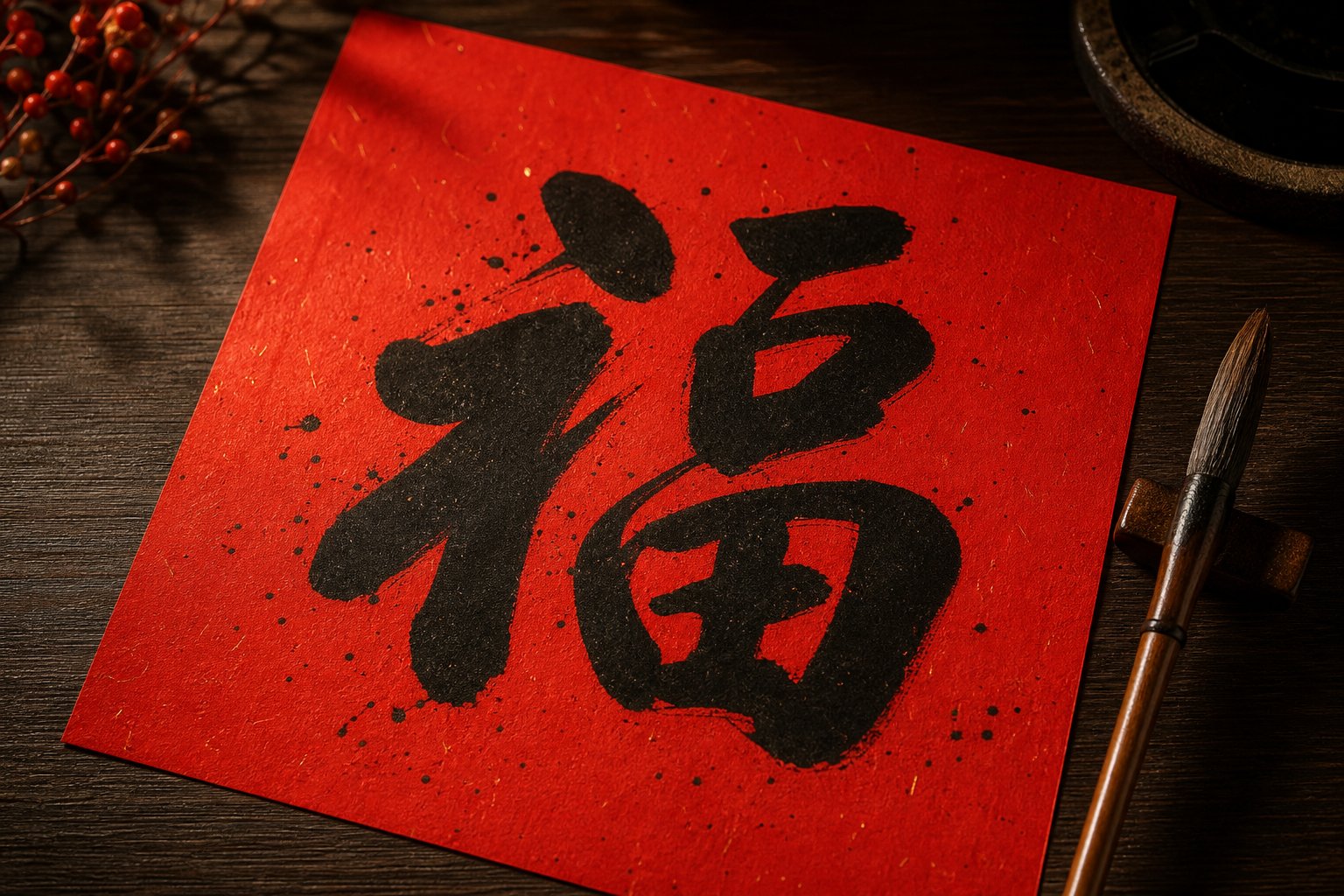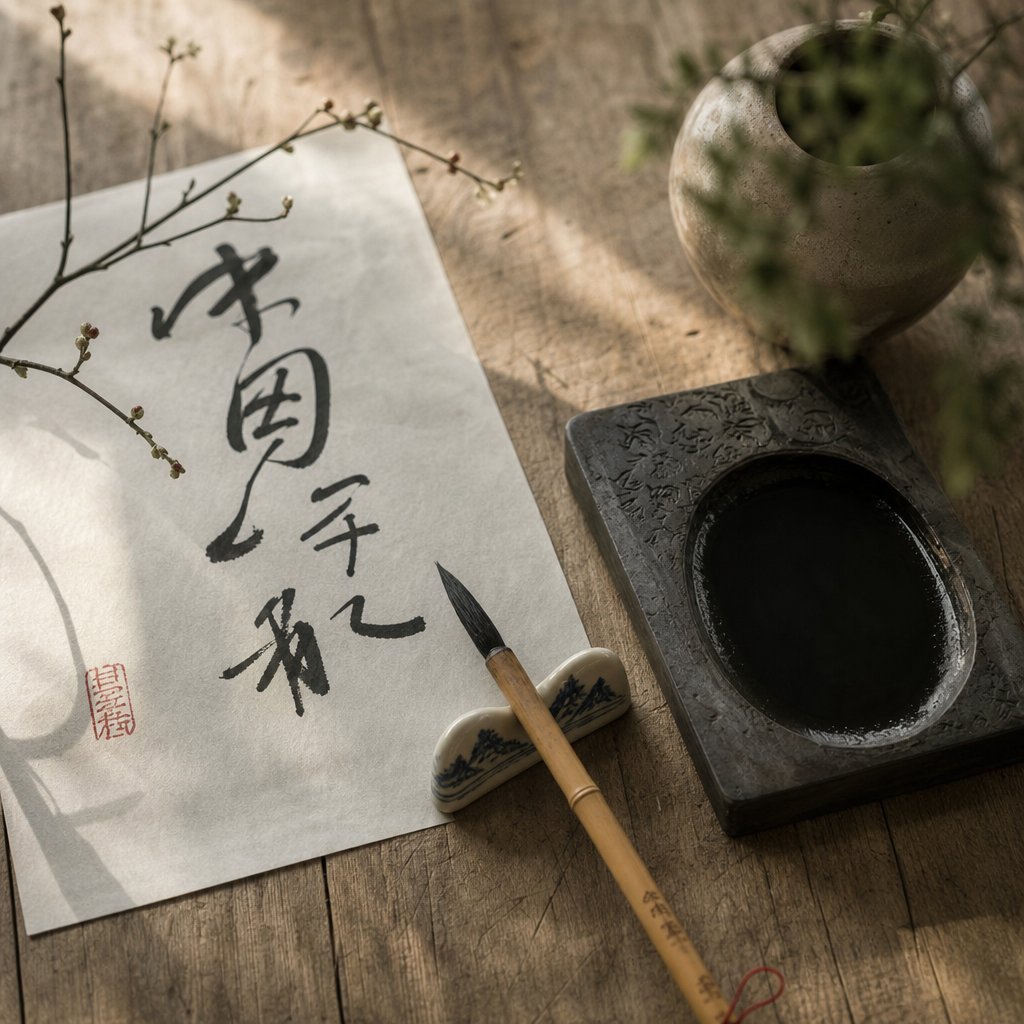
The Ancient Art of Finding Stillness Through Brushwork
Chinese calligraphy as meditation is a movement-based mindfulness practice in which the deliberate act of guiding a brush across paper becomes the focal point for present-moment awareness. Unlike app-guided sessions that keep you tethered to a screen, this centuries-old discipline engages your hands, your breath, and your full sensory attention through the tactile interplay of ink, bristle, and fiber. The result is a form of contemplative focus that produces both inner calm and a tangible artifact of your practice.
What Makes Calligraphy a Meditation Practice
Imagine sitting at a table with nothing but a brush, a stone, and a sheet of blank paper. No notifications. No guided voice in your earbuds. Just the quiet rhythm of grinding ink and the soft resistance of hair meeting paper. Each stroke demands precise coordination of hand, arm, and breath. You notice pressure, angle, speed, and the way ink bleeds differently depending on how long you pause. Distractions lose their grip because the brush requires your full presence to respond.
This is the essence of what Chinese philosophy calls ren shu he yi, or human-calligraphy unity. The concept describes a state where the boundary between practitioner and practice dissolves. Your intention flows directly into the brush, and the brush becomes an extension of your awareness rather than a separate tool you are operating. Ming dynasty scholar Wang Yangming captured this idea when he described how he stopped rushing to write and instead sat in quiet reflection, forming characters in his mind until the brush followed the heart.
What separates calligraphy in Chinese tradition from ordinary handwriting is this integrative quality. Each stroke requires you to coordinate mental visualization, physical execution, and breath in a single gesture. The repetitive yet varied nature of the practice promotes a state of flow where self-consciousness fades and absorption takes over. Emerging research links this kind of mindfulness-based art practice to lower stress, improved emotional regulation, and enhanced cognitive flexibility.
The physical act of brush meeting paper creates presence independent of meaning. You do not need to understand a character to feel the pull of ink into fiber, the weight of a downstroke, or the lift of breath between movements. The meditation lives in the motion itself.
Why You Do Not Need to Read Chinese
Here is the barrier that stops most people before they start: the assumption that you need to speak or read Mandarin to practice. You do not. Think of Chinese characters not as words you must decode, but as structured patterns of movement. As one calligraphy instructor puts it, the Chinese language is built on ancient paintings, carrying both visual and literal meaning. If you can draw a stick figure, you can trace a brushstroke.
When the goal is meditation rather than linguistic mastery, meaning becomes optional. What matters is the sequence of movements, the pressure variations, and the breath coordination each stroke demands. A horizontal line practiced fifty times with full attention is no less meditative than one written by a scholar who knows its etymology. In fact, not knowing the meaning can be an advantage. It removes the temptation to judge your output as "correct" or "incorrect" language and keeps your attention where it belongs: on the physical sensation of the brush in motion.
This reframe turns chinesecalligraphy from an intimidating linguistic pursuit into an accessible, screen-free mindfulness tool. The practice asks only for your willingness to slow down, pick up a brush, and pay attention to what your hand is doing right now.
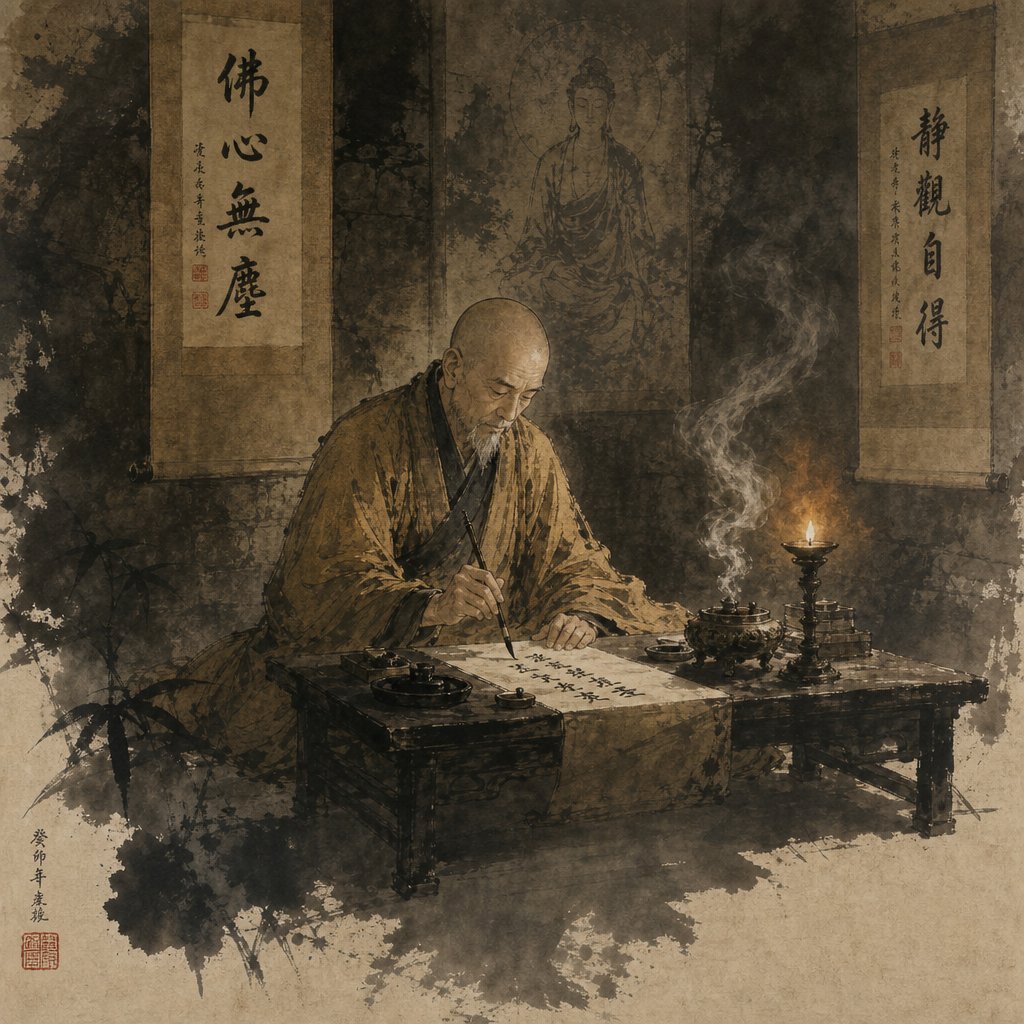
The philosophical roots behind this unity of mind and brush stretch back thousands of years, shaped by Buddhist monks, Daoist hermits, and Confucian scholars who each brought their own contemplative traditions to the ink stone.
Historical Roots of Calligraphy as Contemplative Practice
The connection between brush and inner stillness did not emerge from a single moment in history. It grew across millennia, layered by successive generations of monks, scholars, and physicians who each recognized that the act of writing could quiet the mind as effectively as seated meditation. Ancient chinese calligraphy was never purely functional. From its earliest forms, it carried spiritual weight.
Buddhist and Daoist Roots of Contemplative Writing
The earliest known Chinese writing dates to the Shang Dynasty (1600-1046 B.C.), when scribes inscribed oracle bone script for divination rituals tied to state affairs. These marks were functional, not artistic. Yet the very act of carving characters into bone for sacred purposes planted a seed: writing as a bridge between the human and the spiritual.
Buddhism arrived in China during the Han Dynasty (202 B.C.-220 A.D.), likely traveling the Silk Road, and quickly syncretized with Daoism. By the Tang Dynasty (618-907 A.D.), monastic life was firmly established, and Buddhist monks had woven calligraphy into their contemplative routines. The practice aligned naturally with meditation principles. Zen Buddhists developed hitsuzendo, a style of calligraphy rooted in the concept of mu-shin (no-mind), where creation arises from a state in which thought and emotion effectively cease to exist. Skillful Zen calligraphy was not merely art. It was evidence that the practitioner had touched a higher state of awareness.
The Song Dynasty poet Su Shih captured this relationship in a poem to the monk Ts'an-liao: "With quietude you comprehend the myriad movements of things, with emptiness you encompass ten thousand scenes." Su Shih believed that meditation practice helped chinese calligraphers achieve unparalleled stillness and intention in their brushwork, rather than limiting their expression as some critics argued.
Daoist philosophy contributed a parallel thread. The concept of Tien-ren-he-yi (the harmony between humanity and nature) taught that the finest calligraphy must be natural and authentic. The Eastern Han scholar Tsai Yong (133-192 CE) wrote that before writing, one must "meditate and contemplate, go as the heart goes, keep words within, breathe peacefully, be fully mindful in a most solemn manner." This instruction reads like a meditation manual, centuries before the term "mindfulness" entered Western vocabulary.
How Ancient Scholars Used Brush and Ink for Inner Cultivation
Traditional chinese calligraphy was embedded in a broader system of self-cultivation called xiushen, literally "body-fixing" or "body cultivation." In Chinese philosophy, the body and mind form a single whole. Writing practiced through the body is simultaneously a refinement of the mind. Confucius placed calligraphy among the Six Arts required for educating the ideal person, alongside rites, music, archery, chariotry, and mathematics. The brush was a tool for building character, not just recording it.
Traditional Chinese Medicine reinforced this view by framing calligraphy as a practice that harmonizes qi flow. The controlled breathing, upright posture, and focused intention required during brush practice mirror the principles underlying qigong and acupuncture. Daoist Abbot Yang Xu, writing on the relationship between calligraphy and longevity, drew direct connections between regular brush practice and the nourishment of vital energy.
Here is how the contemplative dimension of calligraphy evolved across key periods:
- Shang Dynasty (1600-1046 B.C.) - Oracle bone inscriptions establish writing as a sacred, ritualistic act connecting humans to spiritual forces
- Han Dynasty (202 B.C.-220 A.D.) - Buddhism arrives in China; Confucian scholars formalize calligraphy as one of the Six Arts for self-cultivation
- Jin Dynasty (266-420 A.D.) - Calligraphy matures as an art form under Wang Xizhi; contemplative intention becomes inseparable from brushwork
- Tang Dynasty (618-907 A.D.) - Buddhist monk Huaisu masters cursive script as spiritual expression; Zen calligraphy traditions crystallize
- Song Dynasty (960-1279 A.D.) - Scholar-monks like Wuzhun Shifan blend Zen meditation with calligraphic practice; critics articulate the link between inner stillness and brush quality
Each era deepened the understanding that the brush is not merely a writing instrument but a vehicle for inner transformation. The monks who practiced cursive script as a release from earthly fetters, the Confucian scholars who saw each stroke as moral refinement, and the Daoist physicians who linked breath and brushwork to longevity all contributed to the same insight: moving ink across paper, done with full presence, changes the person holding the brush.
This rich philosophical lineage raises a practical question. If ancient practitioners experienced measurable calm through their brush practice, can modern science confirm what they felt? Researchers have begun measuring exactly that.
The Science Behind Brush Meditation and Stress Reduction
What the ancient scholars described as inner stillness, modern researchers can now measure with heart rate monitors, blood pressure cuffs, and respiratory sensors. Over the past two decades, a growing body of clinical research has examined what happens inside the body during calligraphy practice. The findings confirm what practitioners in calligraphy China traditions have known for centuries: brush meditation produces real, measurable physiological changes consistent with deep relaxation.
Measured Physiological Changes During Brush Practice
A 2014 experimental study published in Psychology Research and Behavior Management directly compared Chinese calligraphic handwriting to seated meditation over eight weeks. Participants who practiced calligraphy showed a significant decrease in heart rate (p=0.003) and a significant increase in skin temperature (p=0.019), both classic indicators of parasympathetic nervous system activation. The calligraphy group actually demonstrated a greater decline in heart rate than the meditation group (p=0.033), suggesting that brush practice may be at least as effective as traditional stillness-based meditation for calming cardiovascular arousal.
A separate randomized controlled trial published in the International Journal of Nursing Studies found that calligraphy art chinese practice gradually lowered participants' systolic blood pressure (p=0.007) and respiration rate (p=0.000) as the intervention progressed over four weeks. The study also noted elevated concentration levels (p=0.032) and improved mood disturbance among those practicing brush writing.
What makes these results compelling is the pattern they reveal. The body responds to focused brushwork the way it responds to other validated relaxation techniques: heart rate slows, blood pressure drops, breathing deepens, and peripheral blood flow increases (reflected in rising skin temperature). These are hallmarks of the parasympathetic "rest and digest" response overriding the sympathetic "fight or flight" state that chronic stress keeps activated.
| Physiological Marker | During/After Calligraphy Practice | Resting State (No Intervention) |
|---|---|---|
| Heart Rate | Decreased | No significant change |
| Systolic Blood Pressure | Gradually decreased | No significant change |
| Respiration Rate | Decreased | No significant change |
| Skin Temperature | Increased | No significant change |
| Muscle Tension (EMG) | Slightly increased (active engagement) | Decreased |
| Concentration Level | Elevated | No significant change |
Notice the interesting paradox in the muscle tension row. Unlike seated meditation, which relaxes the muscles entirely, chinese calligraphy calligraphy keeps the hands and arms actively engaged while the cardiovascular and respiratory systems slow down. Researchers describe this as the body being physically active while the mind enters a calm, focused state, a unique integration of movement and stillness that distinguishes brush practice from passive relaxation.
What the Research Means for Your Daily Practice
These clinical numbers translate into something you can feel. When your heart rate drops and your breathing slows during a session, you experience it as a settling sensation, a quiet shift from mental chatter to absorbed focus. The rising skin temperature means blood is flowing to your extremities rather than pooling in your core, which is what happens when your body stops bracing for threat.
A large-scale randomized controlled trial with 150 participants found that calligraphy activity improved mood progressively over a 24-week period, with measurable gains accumulating session by session. This suggests that the benefits are not just acute. They build over time, much like a fitness practice strengthens the body through consistent repetition.
For someone starting out, the practical takeaway is straightforward. You do not need to practice for hours or achieve artistic mastery to trigger these physiological shifts. The research protocols typically involved sessions of 20 to 45 minutes. Even within a single session, the body begins responding to the rhythmic, focused nature of brush movement. The repetitive coordination of breath, visual attention, and fine motor control appears to activate the same parasympathetic pathways that make yoga, tai chi, and mindfulness meditation effective stress interventions.
The difference is that calligraphy gives your hands something purposeful to do, which can make sustained attention easier for people who find sitting still uncomfortable. Your mind has a concrete anchor: the next stroke, the next character, the next breath synchronized with the brush's descent. That tangible focus is precisely what makes the practice accessible, and it raises a practical question about which tools best support this meditative state.
Choosing the Four Treasures for Meditation-Focused Practice
The tools for chinese calligraphy have been refined over thousands of years, but their traditional name reveals something important about their purpose. Chinese scholars called them the Four Treasures of the Study: brush, ink, paper, and inkstone. Not the four tools. Not the four supplies. Treasures. Each one was chosen and cared for as a companion in contemplative work, not merely a means to produce text.
When your goal is meditation rather than exhibition-quality art, your selection criteria shift. You are not chasing the crispest line or the most archival-grade paper. You are choosing tools that slow you down, engage your senses, and support sustained presence. Think of it this way: a meditation cushion does not need to be beautiful. It needs to hold you comfortably while you sit. The same principle applies here.
The Japanese concept of shoshin, or beginner's mind, works in your favor. Because you are not trying to produce characters a calligraphy master would approve of, you are free to select tools based entirely on how they feel in your hands and how they support your attention. Performance pressure disappears when the goal is process, not product.
Selecting Your Brush for Meditative Flow
The brush is the one truly irreplaceable element. A traditional calligraphy instructor describes it as a living thing full of energy and vitality, because it is made from organic materials that respond differently depending on pressure, speed, and ink load. For meditation-focused practice, you want a brush that offers gentle resistance and clear tactile feedback without demanding expert control.
A combination-hair brush works well for beginners. These blend stiffer brown hair (horse, weasel, or wolf) with softer white hair (goat or sheep), giving you enough spring to feel the paper's surface while remaining forgiving of inconsistent pressure. Look for a medium-thick brush around 10 inches in total length with a tip length of about 2 inches. This size lets you write characters large enough to involve your whole arm rather than just your fingers, which keeps the movement meditative rather than cramped.
Skip decorative handles. A simple bamboo shaft keeps your attention on the bristle's contact with paper rather than the object in your hand.
Ink Grinding as a Centering Ritual
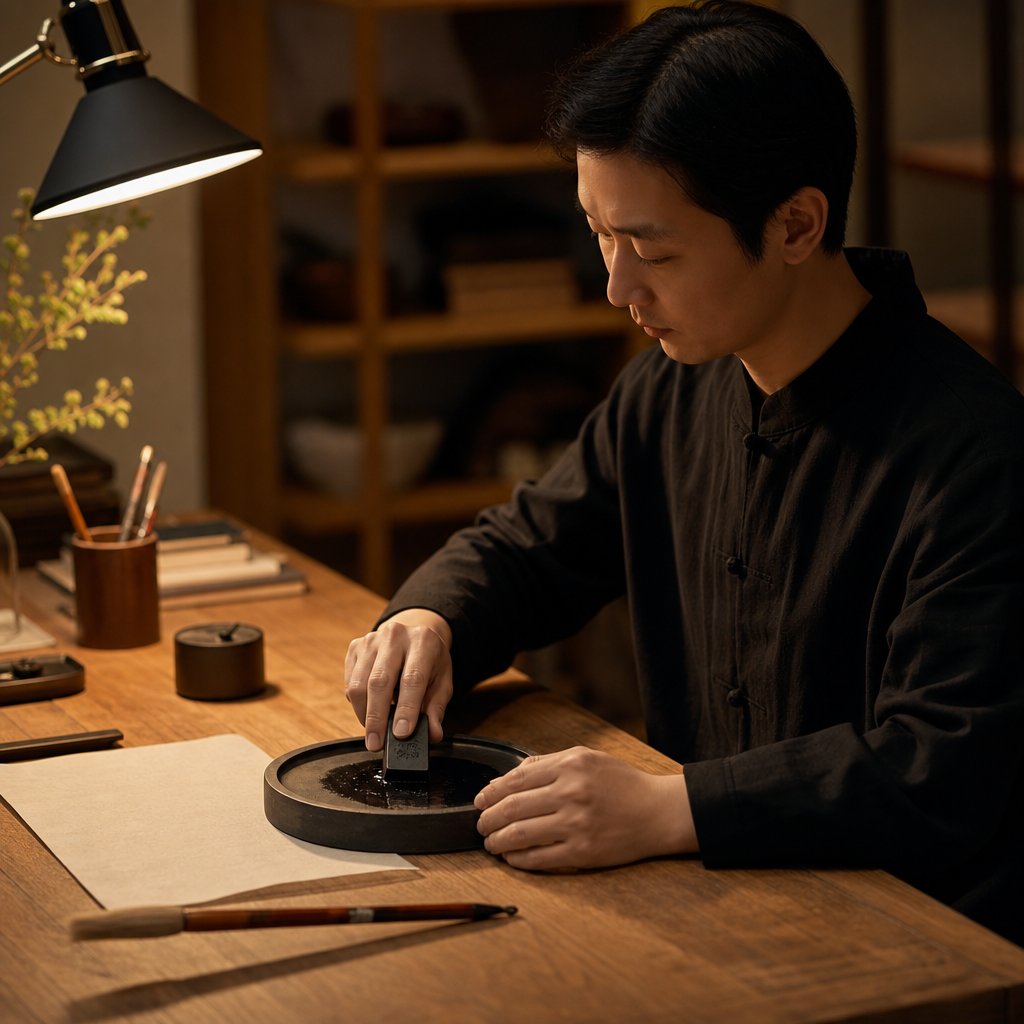
Here is where chinese brush and ink practice diverges most clearly from ordinary writing. Traditional ink in chinese calligraphy comes as a solid stick made from soot and animal-hide glue, often blended with fragrances. You grind it against a wet inkstone in slow, circular motions until the liquid reaches the density you want. This process takes several minutes, and that is the point.
Grinding ink is your transition ritual. It bridges the busy mind you carried to the table and the focused state you need for brushwork. The repetitive motion, the faint scent of the ink stick, and the visual feedback of darkening water all serve as sensory anchors. Many practitioners report that by the time their ink is ready, their breathing has already slowed and their mental chatter has quieted. The meditation begins before the first stroke.
If you are not ready to invest in a stick and stone, bottled sumi ink is a reasonable substitute. You lose the grinding ritual, but you can replace it with a few minutes of conscious breathing while you arrange your workspace.
Paper and Stone for Mindful Practice
Paper choice affects your flow state more than you might expect. Absorbent practice paper (often called "maobian" or raw xuan paper) lets ink bleed and spread quickly, which forces you to commit to each stroke without hesitation. That immediacy keeps you present. Less absorbent paper gives you more control but can encourage fussiness and second-guessing, which pulls you out of meditative absorption.
For daily meditation sessions, inexpensive practice paper or even newsprint works perfectly. Save the archival-quality sheets for when you want to keep a piece. The willingness to use disposable paper reinforces non-attachment to results.
The inkstone itself can be simple. A flat ceramic dish or even a small bowl will hold your ink. Traditional stone inkstones are beautiful objects, but their meditative contribution is primarily through the grinding ritual rather than the material itself.
Here is a concise list of what you need to begin a meditation-focused chinese brush ink practice:
- Combination-hair brush (medium size) - provides balanced tactile feedback and forgiveness for varied pressure
- Ink stick and inkstone - the grinding process serves as your centering ritual and sensory transition into practice
- Absorbent practice paper - encourages commitment to each stroke and discourages perfectionism
- Felt pad or wool blanket - placed beneath the paper to absorb excess ink and cushion your brush contact
- Paperweight - keeps your sheet stable so you can focus on movement rather than adjusting materials
- Water dish and cloth - for rinsing your brush between strokes, adding another tactile pause to the rhythm
You will notice that nothing on this list is expensive or difficult to find. The total investment for a meditation-quality setup runs far less than a year of app subscriptions, and the tools last for years with basic care. What matters is not the price of your materials but the intention you bring to them. Each object on your table becomes part of the ritual container that signals to your nervous system: it is time to slow down.
With your tools selected and your space prepared, the next question becomes practical. How do you actually structure a session from the moment you sit down to the moment you set the brush aside?
A Complete Step-by-Step Calligraphy Meditation Session
Knowing which tools to gather is one thing. Knowing what to do once they are arranged in front of you is another. Most resources on writing chinese calligraphy focus on stroke technique or character formation, skipping the contemplative framework that transforms practice into meditation. What follows is a complete session structure you can use tonight, whether you have been holding a brush for years or picked one up for the first time this week.
Preparing Your Space and Body
Your environment shapes your nervous system before you touch the brush. A cluttered table with a phone buzzing nearby will keep your sympathetic system on alert no matter how perfect your posture is. Spend two or three minutes creating a container for your practice. Clear the surface. Silence devices. If possible, dim overhead lighting and use a desk lamp that illuminates your paper without glare.
Sit on a firm chair with your feet flat on the floor, hip-width apart. Your table height should allow your forearm to rest parallel to the surface without hunching your shoulders upward. Spine straight but not rigid. Imagine a thread pulling gently from the crown of your head. Let your shoulders drop. Place both hands on your thighs, palms down, and close your eyes for five slow breaths. Inhale through the nose for a count of four, hold for two, exhale through the mouth for six. This brief settling period signals to your body that the pace of the day is over.
The Complete Session From First Breath to Final Stroke
Once your breathing has slowed and your posture feels grounded, move through the following sequence. Each step builds on the previous one, gradually deepening your focus until writing in chinese calligraphy becomes an unbroken stream of attention.
- Arrange your materials with intention. Place the inkstone to your upper left (or upper right if left-handed), paper centered in front of you, brush resting on its holder, felt pad beneath the paper. Treat each placement as a deliberate act rather than a hurried setup.
- Begin grinding ink. Add a small spoonful of water to the inkstone. Hold the ink stick vertically and move it in slow, steady circles. Match your breathing to the rhythm: inhale on one rotation, exhale on the next. Continue for three to five minutes until the ink reaches a rich, dark consistency. Notice the faint scent, the sound of stone against stone, the gradual darkening of the water.
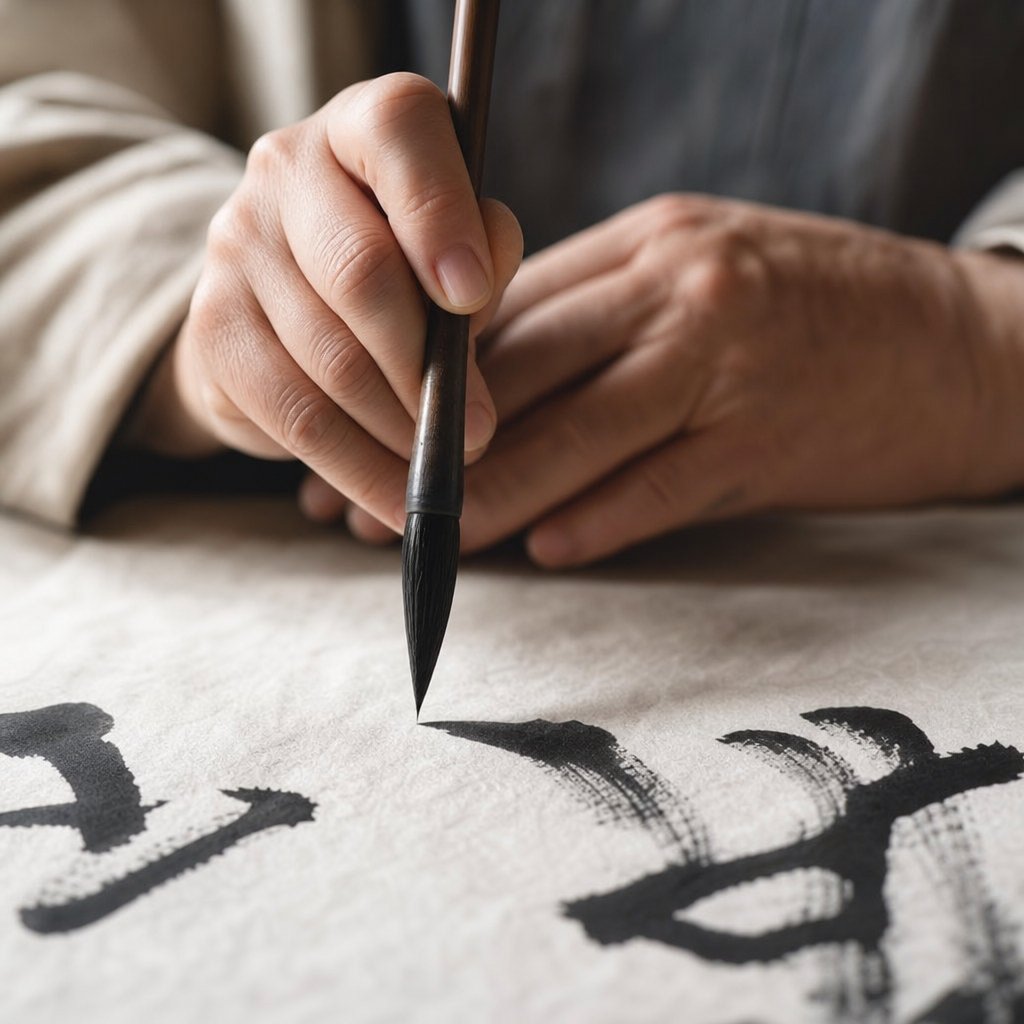
- Load your brush. Dip the bristles into the ink, then gently press them against the stone's edge to remove excess. Feel the weight of the loaded brush in your hand. Hold it vertically, about two-thirds up the shaft, with your fingers relaxed rather than gripping.
- Practice a single basic stroke. Start with the horizontal stroke (heng). Inhale as you position the brush above the paper. Exhale as you press down and draw the brush steadily to the right. Pause. Lift. Return to the starting position. Repeat this stroke ten to fifteen times, focusing entirely on the sensation of bristle meeting fiber.
- Expand to a simple character or stroke set. Move to the vertical stroke (shu), then the dot (dian). If you feel ready, combine them into the character yong (forever), which contains all eight fundamental strokes. There is no rush. Stay with whatever stroke holds your attention.
- Practice without correction. Resist the urge to compare one stroke to the previous one. Each mark exists on its own. If your mind wanders, notice the wandering without judgment and return your attention to the next point of brush contact.
- Close the session deliberately. When you feel ready to stop, set the brush down gently on its rest. Place both hands on your thighs again. Take three deep breaths. Open your eyes slowly. Rinse your brush in clean water, pressing the bristles gently against the dish to release ink. This cleaning ritual serves as your transition back to ordinary activity.
The entire sequence, from first breath to final rinse, creates a clear arc. You enter through stillness, move through focused action, and exit through care for your tools. That arc is what distinguishes mandarin calligraphy practiced as meditation from calligraphy practiced as penmanship drill.
How Long Should a Session Last
If you are new to this practice, aim for 15 to 20 minutes total, including the ink grinding and closing ritual. That is enough time for your parasympathetic nervous system to engage without the session feeling like an obligation you need to endure. As your comfort grows, sessions naturally lengthen. Many experienced practitioners settle into 30 to 45 minutes, though some find that even 10 focused minutes on a busy morning shifts their baseline for the rest of the day.
How do you know the meditation is working? Look for these signals: your breathing has slowed without conscious effort, time feels compressed (twenty minutes passes and it feels like five), your inner monologue has quieted, and you notice sensory details you missed at the start, like the texture of paper grain or the sound of the brush lifting. These are markers of meditative absorption, not artistic achievement. The quality of your characters is irrelevant. What matters is the quality of your attention.
A consistent session structure gives your practice a reliable shape. But within that shape, the real depth emerges from one specific skill: learning to synchronize your breath with each individual stroke so that movement and respiration become a single, unified rhythm.
Coordinating Breath and Brush for Moving Meditation
Every chinese brush stroke has a beginning, a middle, and an end. So does every breath. When you align these two rhythms deliberately, something shifts. The brush stops being a tool you are operating and becomes an extension of your respiratory cycle. Inhale gathers intention. Exhale releases it through the bristles. The pause between breaths becomes the pause between strokes. This synchronization is what transforms brush calligraphy chinese practitioners have studied for centuries into a genuine moving meditation rather than a handwriting exercise.
The principle is simple: your breath leads, and your hand follows. Deep, steady breathing activates the parasympathetic nervous system, helping calm the mind and release tension from the body. When you tie that calming breath directly to each stroke, you create a feedback loop. The slower you breathe, the more deliberate your strokes become. The more deliberate your strokes, the more naturally your breathing slows. Each reinforces the other until the distinction between breathing practice and writing practice disappears entirely.
Mapping Breath to the Eight Basic Strokes
The character yong (永), meaning "everlasting" or "forever," is one of the most celebrated meditation objects in calligraphy in chinese art traditions. It embodies eight brush strokes that also happen to be the eight different kinds of strokes used in all Chinese calligraphy. Practice this single character, and you are practicing every fundamental movement the brush can make. That makes it a complete breath-coordination exercise contained in one elegant form.
Each of the eight strokes has a distinct shape, direction, and duration. These differences naturally map to different breath patterns. A quick dot requires a short, focused exhale. A long horizontal stroke calls for a slow, sustained release of air. A hook demands a brief hold at the turning point before the breath shifts direction along with the brush. Here is how each stroke pairs with your breathing:
| Stroke (Chinese Name) | Movement Description | Breath Pattern |
|---|---|---|
| Dot (dian) | Quick press downward with a small circular motion | Short inhale on approach, brief sharp exhale on contact |
| Horizontal (heng) | Steady movement from left to right on a slight upward angle | Inhale on entry loop, slow sustained exhale across the stroke |
| Vertical (shu) | Downward pull from top to bottom | Inhale at top, long exhale descending, brief hold at endpoint |
| Hook (gou) | Vertical descent with a sharp upward flick at the base | Exhale on descent, quick inhale on the upward hook |
| Rising (tiao) | Short upward stroke angling to the right | Inhale on placement, quick exhale lifting toward two o'clock |
| Left-falling (wan/pi) | Curved descent slanting to the lower left | Inhale at start, gradual exhale tapering with the stroke |
| Right-falling (na) | Descent to the lower right with a widening press at the end | Inhale at start, slow exhale with increasing pressure, hold at the widest point |
| Turning (zhe) | Horizontal stroke that pivots into a vertical descent | Exhale on horizontal, brief hold at the turn, exhale again on descent |
You will notice a consistent pattern across the table. Inhale happens during preparation and lifting. Exhale happens during contact and movement. Holds happen at transition points where the brush changes direction. This mirrors the natural rhythm of effort and release in the body. You gather energy on the inhale and express it through the exhale, just as you gather intention before a stroke and release it through the brush.
The beauty of using yong as your meditation object is that you never run out of depth. The character cycles through dots, horizontals, verticals, hooks, rising strokes, falling strokes, and turns in a single flowing sequence. Each repetition gives you eight opportunities to synchronize breath and movement. Write it ten times, and you have practiced eighty breath-stroke coordinations in roughly five minutes.
Three Repeatable Exercises for Immediate Practice
Theory only becomes meditation when you put the brush to paper. These three exercises move from simple to complex, and you can try any of them during your next session. Each one builds the breath-stroke connection through repetition and focused attention.
Exercise 1: Single Stroke Breathing (5 minutes)
Choose one stroke, the horizontal (heng) works well for beginners. Inhale deeply through your nose as you position the brush above the paper. As you exhale slowly through your mouth, press down and draw the brush steadily to the right. When your exhale ends, lift the brush. Pause. Inhale again as you return to the starting position. Repeat this cycle without rushing. Your only goal is to make the length of the stroke match the length of your exhale. If your breath runs out before the stroke finishes, make the next stroke shorter. If you have breath remaining when the stroke ends, extend the next one slightly. After ten repetitions, you will find a natural stroke length that matches your respiratory rhythm perfectly. That match is the feeling you are looking for.
Exercise 2: Vertical Descent with Counted Breath (5 minutes)
The vertical stroke (shu) lends itself to counted breathing because of its longer duration. Inhale for a count of four as you hold the brush at the top of the paper. Begin your exhale and simultaneously press down, counting to six as you draw the brush steadily toward the bottom of the page. At the endpoint, hold your breath for a count of two while you complete the finishing loop or needle-point taper. Lift. Rest for one full breath cycle before beginning the next stroke. This exercise trains you to sustain attention through the full arc of a movement rather than rushing to finish.
Exercise 3: Full Yong Character as Breath Meditation (10 minutes)
Once you are comfortable coordinating breath with individual strokes, write the complete character yong as a continuous breath meditation. Follow the traditional stroke order: dot, horizontal, vertical, hook, rising, left-falling, right-falling, turning. Between each stroke, take one full recovery breath (inhale and exhale) with the brush lifted from the paper. This pause prevents you from rushing through the character and gives your attention a reset point. Write the character slowly, five to eight times, treating each one as a fresh beginning rather than a repetition. You are not trying to make them look identical. You are trying to make each one feel fully inhabited by your breath.
As you practice these exercises over days and weeks, the conscious coordination gradually becomes unconscious. You stop thinking "inhale now, exhale now" and simply notice that your breath and brush are already moving together. That shift from deliberate synchronization to effortless unity is one of the clearest signs that your practice is deepening. It also reveals where the real challenges live, because the moments when breath and brush fall out of sync are precisely the moments when your mind has wandered, your body has tensed, or your inner critic has started judging the work on the page.
Overcoming Common Obstacles in Calligraphy Meditation
The moment breath and brush fall out of sync is rarely random. Something pulled you out of the flow. Maybe you glanced at the character you just finished and thought, "that looks terrible." Maybe your shoulder crept up toward your ear without you noticing. Maybe you started mentally rehearsing tomorrow's meeting mid-stroke. Every meditator encounters resistance. What makes caligraphy chinese practice unique is that the resistance leaves visible evidence on the page. A tense shoulder produces a rigid line. A distracted mind produces a wobbly one. The paper becomes a mirror, and not everyone likes what they see.
This visibility is both the practice's greatest teaching tool and its most common trap. In seated meditation, a wandering mind leaves no trace. You notice it, return to the breath, and move on. In calligraphy, a wandering mind leaves ink on paper. That ink can trigger a cascade of judgment that pulls you further from presence rather than closer to it. Learning to work with these obstacles, rather than fighting them, is where the real meditation happens.
Releasing Perfectionism and the Inner Critic
Perfectionism is the single most common barrier to meditative absorption during brush practice. Letters and characters are precise forms. A half-millimeter shift in angle or pressure can change a stroke's entire character. That precision invites a particular kind of mental torment: the belief that each mark must meet some external standard before the practice "counts." Calligraphy teacher Melissa Dinwiddie describes how nothing activates perfectionist gremlins quite like calligraphy, because the forms are so small and exact that any deviation feels catastrophic.
The antidote is what Dinwiddie calls intentional imperfectionism. This is not sloppiness or settling for mediocrity. It is the practice of acknowledging that you are human, accepting where you are in the learning process, and forgiving yourself for not being a master yet. In meditation terms, this is simply non-judgment: observing what arises without labeling it good or bad.
When you catch yourself comparing your horizontal stroke to a chinese calligrapher whose work you admire, notice the comparison without following it. You do not need to argue with the thought or pretend it did not arise. Just name it silently, "comparing," and return your attention to the next point of brush contact. The stroke you just finished is already dry. It cannot be changed. The only stroke that matters is the one forming under your brush right now.
The tangible artifact calligraphy produces can become either a trap or a teacher. A trap when you judge it. A teacher when you let it show you exactly where your attention was, without demanding that it should have been somewhere else.
Another strategy: turn the page. Literally. When a sheet fills with strokes that trigger your inner critic, flip it over or set it aside and begin on fresh paper. You are not practicing to accumulate beautiful pages. You are practicing to accumulate moments of presence. The paper is disposable. Your attention is not.
Working With Physical Tension and Frustration
Physical tension is the body's version of perfectionism. When you grip the brush too tightly, hunch your shoulders, or lock your wrist, you are bracing against the possibility of making a mistake. The body tightens in anticipation of failure before failure even occurs. This tension then produces exactly the stiff, lifeless strokes you were trying to avoid, creating a frustration loop that feeds itself.
Good writing posture is not about rigid rules. It is about attentiveness. Your shoulders should rest away from your ears, softly open and balanced. Your forearm should glide across the table rather than hovering with muscular effort. If you notice tension building, pause. Set the brush down. Take three breaths. Shake out your fingers. Rotate your wrists gently. These micro-breaks are not interruptions to your meditation. They are part of it. Noticing tension and choosing to release it is mindfulness in action.
Here are the most common obstacles paired with meditation-rooted strategies for working through them:
- Perfectionism and attachment to outcome - Practice non-judgment. Name the critical thought ("judging") and return to the physical sensation of the next stroke. Use inexpensive paper to reinforce that results are disposable.
- Frustration with brush control - Reframe difficulty as feedback, not failure. A wobbly line means your hand is learning, not that you are doing it wrong. Slow down rather than trying harder.
- Comparing your work to masters - Remember that every chinese calligrphy master produced thousands of imperfect pages before their surviving masterworks. You are seeing their endpoint, not their process.
- Inability to quiet the inner monologue - Do not try to silence thoughts. Instead, anchor attention to a single sensory detail: the sound of bristle on paper, the smell of ink, the feeling of breath in your belly. Thoughts continue. You simply stop following them.
- Physical tension in shoulders and wrist - Build body scans into your session. Every five strokes, briefly check in: Are my shoulders dropped? Is my grip relaxed? Am I breathing? Adjust without self-criticism.
- Impatience with slow progress - Shift your success metric from "how good does this look" to "how present was I during this stroke." A fully attended ugly stroke is a better meditation than a beautiful stroke made on autopilot.
Each of these obstacles shares a common root: attachment to outcome over process. The practice of nonjudgmental awareness teaches that meditation is the chance to give yourself permission to feel exactly what you feel, even when you are not as okay as you would like to be. Applied to calligraphy, this means allowing a bad session to be a bad session without concluding that you are bad at the practice. The frustration itself becomes the object of meditation. You notice it, breathe with it, and pick up the brush again.
Over time, these obstacles do not disappear. They simply lose their power to derail you. The inner critic still speaks, but you stop mistaking its voice for truth. The shoulder still tenses, but you catch it sooner. The comparison to masters still arises, but it carries curiosity instead of despair. This gradual shift in your relationship to difficulty is not unique to calligraphy. It is the same capacity that makes any meditation practice valuable in daily life. And it raises a natural question: how does this brush-based path compare to other movement practices that promise similar benefits?
How Calligraphy Meditation Compares to Other Mindful Movement
Tai chi, yoga, walking meditation, calligraphy. All of these practices blend physical activity with present-moment awareness. All of them activate the parasympathetic nervous system and reduce stress. Yet they differ in ways that matter when you are choosing which one fits your life, your body, and your temperament. Understanding those differences helps you pick the practice you will actually sustain rather than the one that sounds most appealing in theory.
Calligraphy Versus Tai Chi and Yoga as Moving Meditation
Tai chi and yoga are the most widely recognized forms of moving meditation. Both involve synchronizing breath with physical movement, and both carry extensive research backing their mental health benefits. Tai chi consists mostly of flowing movements performed while standing. Yoga incorporates static poses held in standing, seated, kneeling, or lying positions. Both demand a certain amount of physical space, enough room to extend your arms and shift your weight without bumping furniture.
Asian calligraphy, by contrast, happens at a table. Your body stays seated. The movement lives in your fingers, wrist, arm, and breath rather than your legs and torso. This distinction is not trivial. If you have limited mobility, chronic pain in your lower body, or simply live in a small apartment, the spatial and physical demands of tai chi or yoga can become barriers. A calligraphy practice needs roughly two square feet of table surface and a chair.
Harvard Health notes that tai chi and yoga share benefits like improved balance, flexibility, strength, and mood. Calligraphy meditation does not build leg strength or improve balance. What it offers instead is fine motor engagement, progressive cognitive challenge, and a tangible record of each session. You finish a yoga class with nothing but a memory of how it felt. You finish a calligraphy session with ink on paper, a physical artifact that marks where your attention was.
| Dimension | Calligraphy Meditation | Tai Chi | Yoga | Walking Meditation |
|---|---|---|---|---|
| Space Required | Small table surface | Open floor area (6-8 ft clearance) | Mat-sized floor space | Path or room to walk |
| Physical Demand | Minimal (seated, upper body only) | Low to moderate (standing, full body) | Low to high (varies by style) | Low (walking pace) |
| Mobility Requirements | Seated; accessible for most physical limitations | Standing balance required | Floor transitions often required | Ambulatory ability required |
| Learning Curve | Moderate (brush control takes practice) | Moderate to steep (long movement sequences) | Moderate (pose alignment) | Gentle (walking is familiar) |
| Time Per Session | 15-45 minutes | 20-60 minutes | 30-90 minutes | 10-30 minutes |
| Tangible Output | Yes (ink on paper) | No | No | No |
| Progressive Skill Development | High (characters, scripts, styles) | High (forms, weapons, push hands) | High (advanced poses, sequences) | Low (limited progression) |
| Screen-Free | Yes | Yes (though often taught via video) | Yes (though often taught via video) | Yes |
Notice the tangible output row. This is where east asian calligraphy stands alone among movement-based meditation practices. Every session produces something you can see, touch, and reflect on later. For some people, that artifact sustains motivation in a way that purely internal practices cannot. You are not just meditating. You are building a visible record of your attention over time.
Who Benefits Most From Brush-Based Mindfulness
Asian calligraphy art as meditation tends to resonate most strongly with people who share certain characteristics. If you recognize yourself in any of these descriptions, brush practice may suit you better than alternatives:
- People who struggle with stillness. If seated meditation feels unbearable because your hands have nothing to do, calligraphy gives them purposeful work while your mind settles.
- Those with limited physical mobility. Wheelchair users, people recovering from surgery, or anyone with chronic lower-body pain can practice fully from a seated position.
- Visual and tactile learners. If you process the world through touch and sight rather than abstract thought, the sensory richness of ink, brush, and paper provides natural anchors for attention.
- People who need progressive challenge. Walking meditation offers limited skill progression. Calligraphy offers a lifetime of deepening mastery across scripts, styles, and characters, which keeps long-term practitioners engaged.
- Anyone seeking a screen-free ritual. If your stress comes partly from digital overload, a practice that requires zero technology offers a genuine counterweight.
When might another practice be more appropriate? If your primary goal is cardiovascular fitness or full-body flexibility, tai chi or yoga will serve you better. If you need something you can do while commuting or during a lunch break without any supplies, walking meditation wins on convenience. Calligraphy asks you to sit down, prepare materials, and commit to a defined session. That structure is a strength for people who crave ritual, but a limitation for those who need meditation they can access anywhere, anytime.
The real answer, of course, is that these practices are not competitors. Many people combine them. A morning yoga flow for the body, an evening calligraphy session for the mind. What matters is finding the entry point that you will return to consistently. And consistency raises the final practical question: how do you structure your first weeks of practice so that initial curiosity becomes a lasting habit?
Building a Progressive Calligraphy Meditation Practice
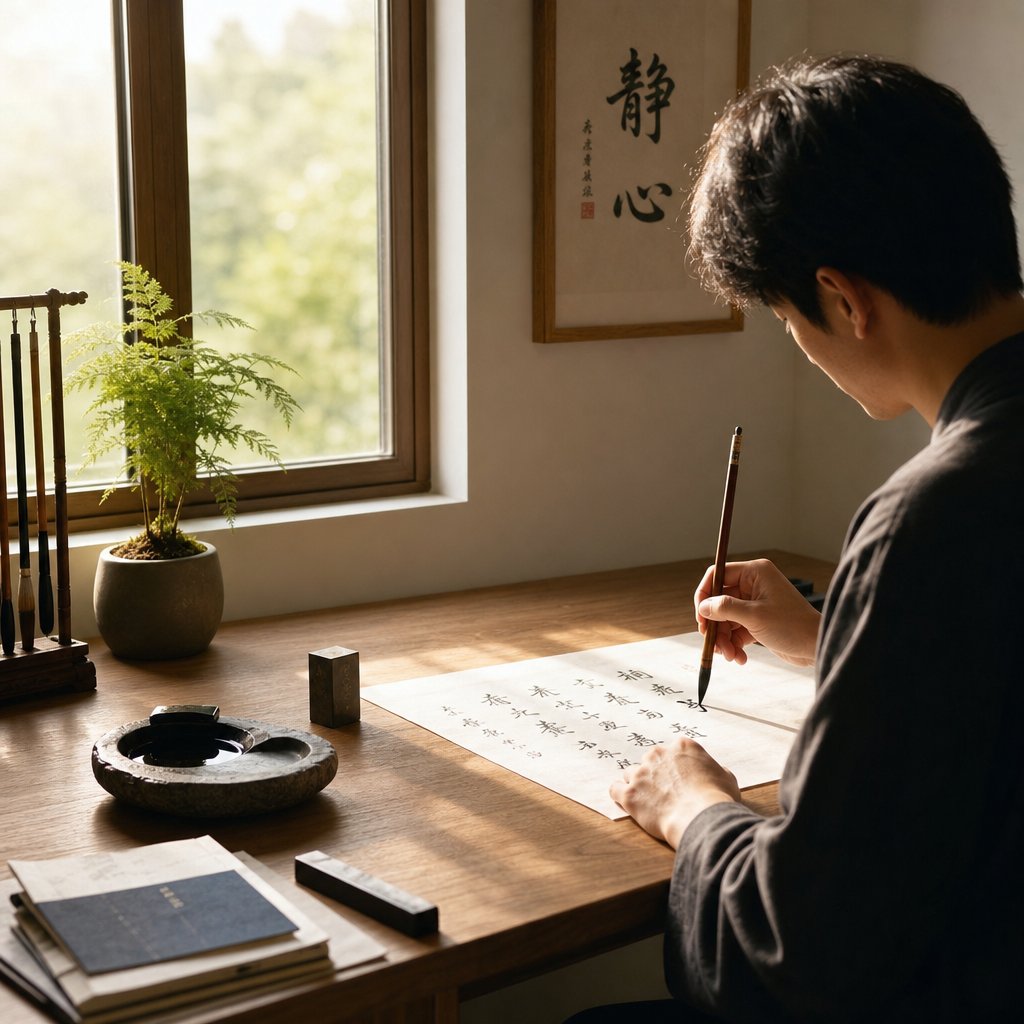
Curiosity gets you to the table once. Structure keeps you coming back. The difference between a fleeting experiment and a lasting practice is a clear progression that gives you just enough challenge to stay engaged without overwhelming you into quitting. What follows is a four-week framework designed to carry you from tentative first strokes into genuine meditative absorption, with guidance on where the path leads after that initial month.
Your First Four Weeks of Practice
Aim for four to five sessions per week rather than daily perfection. Missing a day is normal. Missing three in a row is where habits dissolve. Each session starts at 15 minutes and grows organically as your focus deepens. Here is the progression:
- Week 1: Single Stroke Meditation. Choose one stroke, the horizontal (heng) or vertical (shu), and repeat it for your entire session. Focus exclusively on breath coordination. Do not attempt characters. Your only metric is presence: were you aware of the brush touching paper, or did your mind drift? Fifteen minutes, four to five days.
- Week 2: Stroke Vocabulary Expansion. Add two or three new strokes (dot, hook, left-falling). Practice each one individually for several minutes before rotating to the next. Begin noticing how different strokes evoke different breath rhythms. Extend sessions to 20 minutes if it feels natural.
- Week 3: Character as Meditation Object. Introduce the character yong (永) or another simple form that combines multiple strokes. Write it slowly, treating each repetition as a complete breath cycle. The shift from isolated strokes to integrated characters adds cognitive engagement without sacrificing meditative depth. Twenty to 25 minutes.
- Week 4: Free-Flow Sessions. Alternate between structured character repetition and unstructured exploration. Spend half your session on familiar strokes, then allow the brush to move without a predetermined plan. Follow impulse. Let ink pool or thin. This is where conscious technique begins yielding to unconscious absorption. Twenty-five to 30 minutes.
After this initial month, frequency matters more than duration. Three focused sessions of 20 minutes will deepen your practice faster than one marathon weekend effort. Motor learning research consistently shows that distributed practice, short sessions spread across multiple days, builds skill and automaticity more effectively than massed practice. Your brain consolidates what you practiced during sleep, so each session builds on the last even when you feel stuck.
Signs Your Practice Is Deepening
Progress in meditation does not look like progress in skill acquisition. You may not notice it happening until you look back over several weeks. Watch for these quiet shifts:
- Breath synchronization becomes automatic. You stop thinking "inhale now" and simply notice that your breathing and brushwork are already aligned.
- Time distortion increases. Sessions that felt long in week one now feel short. Thirty minutes passes before you think to check.
- The inner critic loses volume. Judgmental thoughts still arise, but they no longer derail your focus. You notice them and return to the brush without emotional charge.
- Physical tension resolves earlier. Your shoulders drop within the first minute rather than staying clenched for half the session.
- Ink grinding becomes genuinely calming. What felt like a chore in week one now feels like the moment your nervous system downshifts.
As months pass, the practice naturally expands beyond individual characters. Many practitioners find themselves drawn toward calligraphy chinese painting traditions, where brush, ink, and meditative presence merge into visual expression that transcends written language. The same breath coordination and flow state that guide your strokes can guide a bamboo stalk across rice paper or a mountain emerging from mist. Chinese writing painting traditions have always treated calligraphy and painting as two branches of the same contemplative tree, united by brush, ink, and the practitioner's inner state.
This evolution is not something you need to plan for. It emerges on its own when the foundation is solid. A sustainable calligraphy painting chinese practice simply means showing up, grinding your ink, and letting the brush meet the paper with whatever attention you have available today. Some sessions will feel transcendent. Others will feel flat. Both count. The only session that fails is the one you skip entirely.
Frequently Asked Questions About Chinese Calligraphy as Meditation
1. Do I need to know Chinese to practice calligraphy meditation?
No linguistic knowledge of Chinese is required. When the goal is meditation rather than language mastery, characters function as structured movement patterns rather than words to decode. The meditative benefit comes from coordinating breath, pressure, and brush movement, not from understanding meaning. Many practitioners find that not knowing the characters actually removes performance pressure and keeps attention focused on physical sensation rather than correctness.
2. How long should a calligraphy meditation session last for beginners?
Beginners should aim for 15 to 20 minutes per session, including the ink grinding ritual and closing. This duration is sufficient to activate the parasympathetic nervous system without the session feeling like an obligation. As comfort grows over weeks of practice, sessions naturally extend to 30 or 45 minutes. Even 10 focused minutes can shift your baseline stress level for the rest of the day.
3. What supplies do I need to start calligraphy meditation?
You need a combination-hair brush for balanced tactile feedback, an ink stick and inkstone for the centering grinding ritual, absorbent practice paper that encourages stroke commitment, a felt pad beneath the paper, a paperweight, and a water dish for rinsing. Bottled sumi ink can substitute for the stick and stone if you prefer. The total cost is modest and the tools last years with basic care.
4. Is calligraphy meditation scientifically proven to reduce stress?
Yes. Clinical research published in peer-reviewed journals has documented measurable physiological changes during calligraphy practice, including decreased heart rate, lowered blood pressure, reduced respiration rate, and increased skin temperature. One study found that calligraphy produced a greater decline in heart rate than traditional seated meditation. These markers indicate parasympathetic nervous system activation consistent with validated relaxation techniques.
5. How does calligraphy meditation compare to tai chi or yoga?
Calligraphy meditation requires minimal physical space, is fully accessible from a seated position, and produces a tangible artifact each session. Unlike tai chi or yoga, it does not build cardiovascular fitness or full-body flexibility. However, it offers progressive cognitive challenge, fine motor engagement, and works well for people with limited mobility or those who find stillness-based meditation difficult because their hands need purposeful activity.