Why Totok and Peranakan Surnames Tell Different Stories
Imagine you come across two Southeast Asian families with Chinese roots. One carries the surname Chen, spelled exactly as it would be in mainland China. The other goes by Tan, a dialect-inflected version of the same character. Same origin, different paths. That single spelling difference can reveal centuries of divergent history, intermarriage, and cultural adaptation. This is the heart of the totok vs peranakan surnames divide, and it runs deeper than most people realize.
What Totok and Peranakan Actually Mean
These two terms describe fundamentally different relationships between Chinese migrants and their adopted homelands in Southeast Asia. The distinction shaped not just cultural identity but the very names families passed down through generations.
Totok (sometimes spelled totog) means "pure" or "full-blooded" in Malay and Javanese, referring to Chinese migrants who arrived relatively recently and retained their original Chinese identity, language, and surnames unchanged.
Peranakan derives from the Malay root word "anak," meaning "child." The term is an adjective meaning "born of" or "locally born," describing someone with heritage from elsewhere who has blended into the indigenous cultures of the Malay-Indonesian archipelago.
The Peranakan Museum in Singapore notes that the meaning of peranakan suggests someone locally born but with heritage from somewhere else, representing a mixture of cultures. Peranakans developed hybrid identities, blending Chinese ancestry with Malay, Javanese, and other local traditions. Totok families, by contrast, maintained a distinctly Chinese identity even after settling abroad.
Why Surnames Carry Identity Weight in Southeast Asia
In Chinese culture, the surname is not just a family label. It connects you to a lineage, a dialect group, a geographic origin, and a clan history stretching back centuries. When Chinese traders and laborers migrated to Southeast Asia, their surnames traveled with them. What happened to those surnames after arrival tells you which side of the totok-peranakan spectrum a family landed on.
Totok families kept their surnames in standard Chinese forms, often using Mandarin-based romanizations. Peranakans, having intermarried with local populations and adopted local languages over generations, adapted their surnames to fit dialect pronunciations or even replaced them entirely with indigenous-sounding names. Your surname, in other words, is a compressed archive of your ancestors' choices about belonging.
How Migration Waves Created the Naming Divide
Chinese presence in Southeast Asia stretches back to the thirteenth century, when early traders and sojourners established footholds in port cities across what is now Indonesia, Malaysia, and Singapore. Research on Chinese Indonesians confirms that many came as sojourners intending to return home, but some stayed as economic migrants and created growing communities. Those early arrivals, predominantly Hokkien and Teochew speakers, married local women and produced the first peranakan lineages.
Later waves, particularly the nineteenth-century labor migrants contracted from southern China during the Dutch colonial period, arrived in larger numbers and maintained stronger ties to Chinese language and customs. These later arrivals became the totok communities. The timing of your ancestors' migration, whether they arrived as fifteenth-century traders or nineteenth-century laborers, often determined whether your family surname would evolve or stay fixed.
This timeline created a naming spectrum rather than a clean binary. Some families sit squarely on one end. Others occupy a gray zone where dialect spelling, geographic context, and generational shifts all play a role in classification.
How We Classified Totok and Peranakan Surnames
If surnames sit along a spectrum rather than in neat boxes, how do you figure out where a particular name falls? You need a framework. When researchers and genealogists classify Peranakan Chinese surnames versus totok ones, they rely on three interlocking factors that together paint a clearer picture than any single data point could.
Three Factors That Determine Surname Classification
Think of these criteria as layers of context. Each one narrows the possibilities, and together they give you a reliable read on heritage.
- Dialect group origin (Hokkien, Teochew, Hakka, Cantonese) — The dialect behind a surname's romanization is the strongest single indicator. Hokkien and Teochew speakers dominated early trade migration, so their surnames are more likely to appear in peranakan forms. Hakka and Cantonese speakers arrived in larger numbers during later labor waves, making their surnames more likely to remain in totok form.
- Migration wave timing — Families who arrived during the 13th- through 16th-century trade era had centuries to assimilate. Those who came during the massive 19th-century labor migration, often bringing wives from China, had far less time and less incentive to blend in. Earlier arrival correlates strongly with peranakan naming patterns.
- Geographic settlement (Indonesia, Malaysia, Singapore) — Where a family settled shaped how much pressure they faced to adapt. Indonesia's assimilation policies pushed surnames furthest from their Chinese origins. Malaysia's Baba Nyonya communities retained Chinese surnames while adopting Malay customs. Singapore culture and traditions blended British colonial influence with Chinese dialect romanizations, creating yet another naming pattern.
The Assimilation Spectrum From Totok to Peranakan
Here is the key point: these categories are not binary. A family might show peranakan traits in one factor and totok traits in another. Imagine a Hokkien-origin family that arrived in the 19th century and settled in Singapore. Their dialect group suggests peranakan tendencies, but their late arrival and settlement in a city with strong Chinese institutions might mean they kept a more totok identity. The surname alone does not tell the whole story, but it does tell a story.
Professor Danny Wong Tze Ken of the University of Malaysia describes Chinese migration to Southeast Asia as possibly the longest migration process in world history, spanning at least 18 centuries. Within that vast timeline, families who intermarried with indigenous populations early on developed distinctly local identities. The intermarried definition here is literal: Chinese men marrying Malay, Javanese, or Thai women, producing children who grew up bilingual and bicultural. Over generations, their surnames shifted to reflect dialect pronunciation rather than standard Mandarin.
Families arriving later, especially after 1850, came in far greater numbers and often settled within established Chinese communities divided along linguistic lines: Hokkien, Teochew, Hainanese, Cantonese, and Hakka. These communities maintained Chinese schools, temples, and clan associations that reinforced original naming conventions. The result was a preserved totok surname form even after decades abroad.
So when you encounter a Chinese Southeast Asian surname, the question is not simply "totok or peranakan?" It is "where does this name sit on the spectrum, and which dialect group does it point to?" That dialect question is where the real genealogical detail lives.
Hokkien Surnames and the Peranakan Heartland
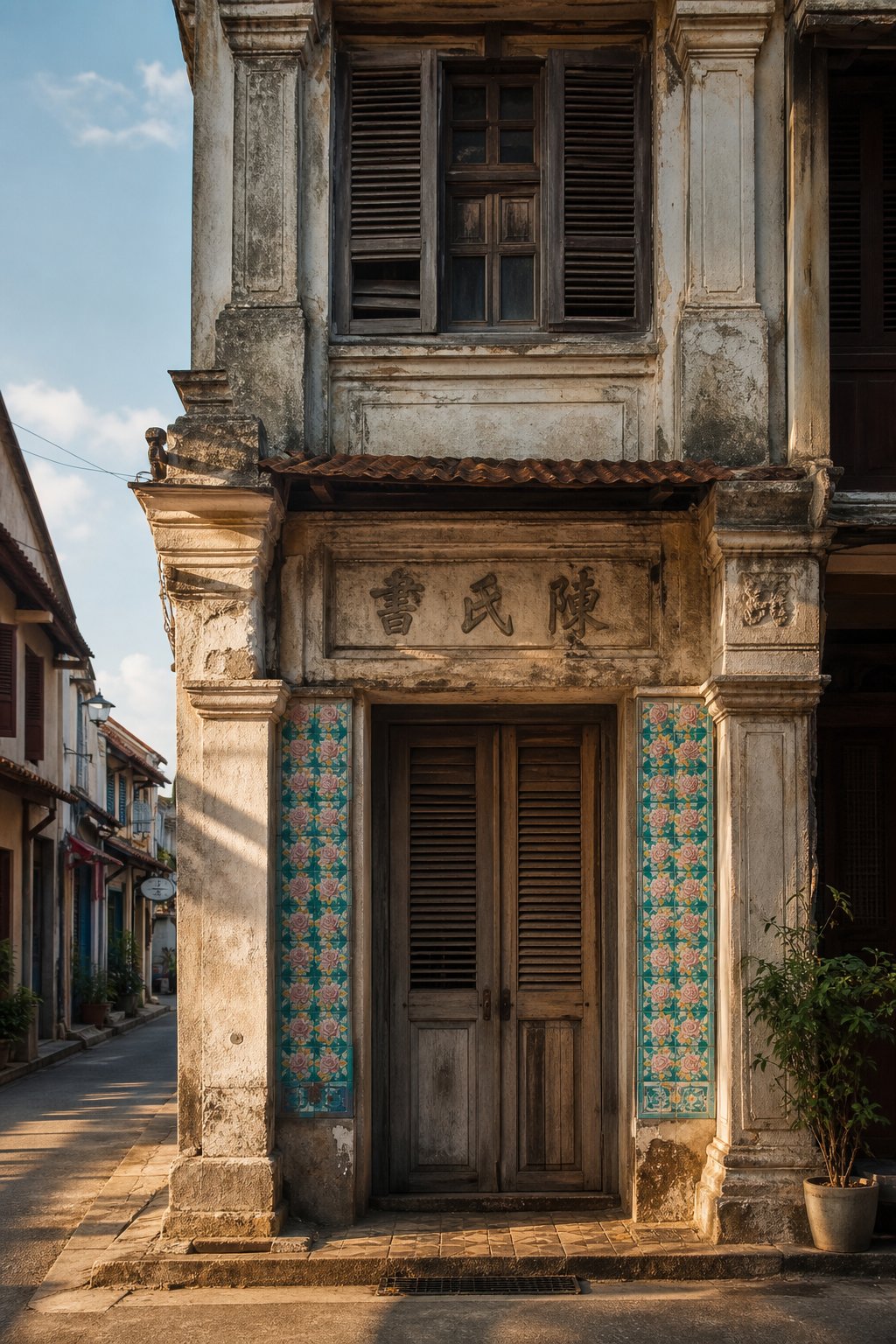
The dialect question leads directly to one group that dominates peranakan genealogy: Hokkien speakers. If you trace the oldest baba nyonya families in Penang, Malacca, or Java, you will find Hokkien surnames appearing again and again. This is not coincidence. It is a direct consequence of who arrived first, who stayed longest, and who married into local communities centuries before other dialect groups showed up in significant numbers.
Why Hokkien Speakers Dominate Peranakan Lineages
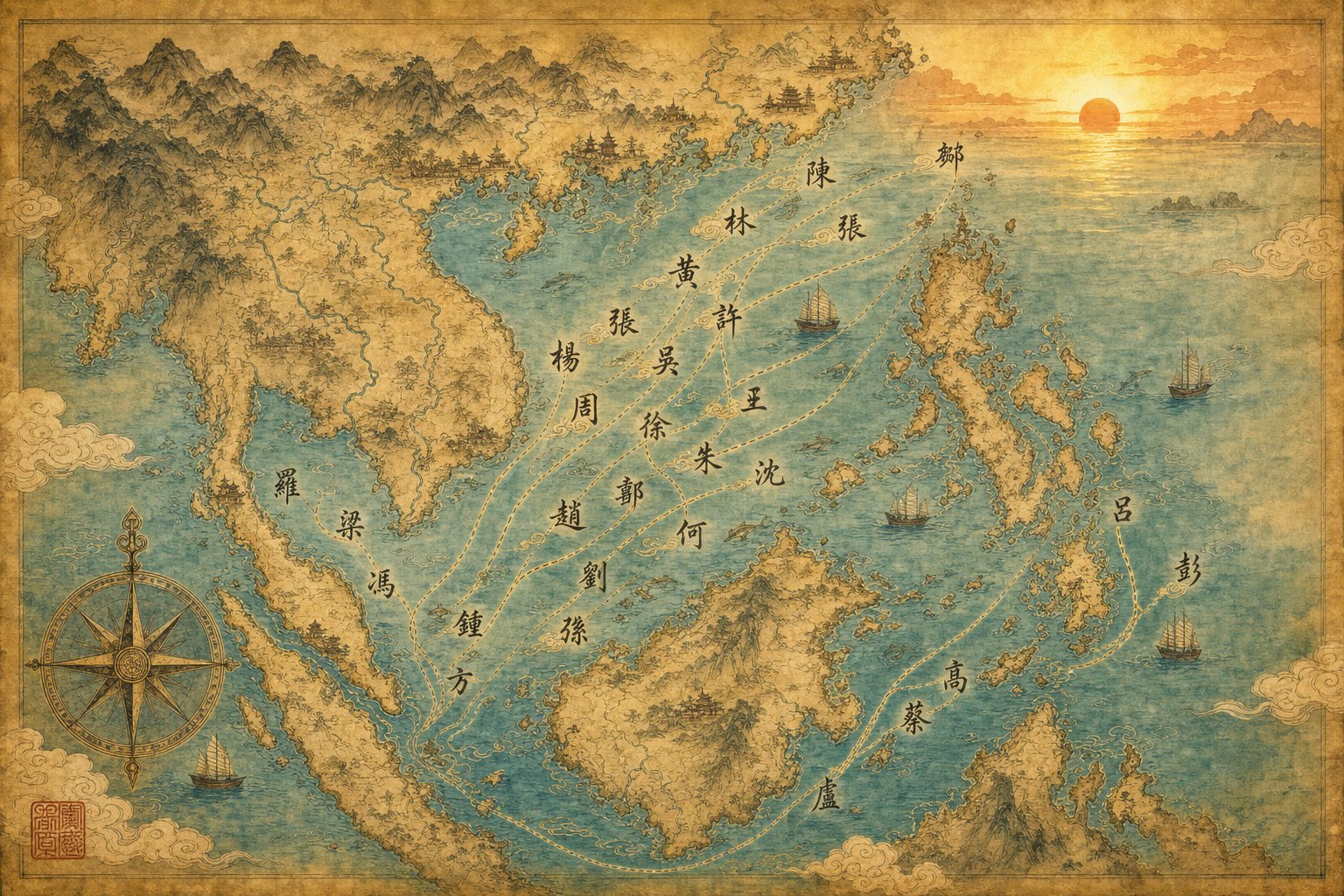
Hokkien traders from the southeastern provinces of Fujian and Guangdong were among the earliest Chinese to establish commercial footholds in Southeast Asia. Exiting from ports like Xiamen (Amoy) and Guangzhou (Canton) as early as the fifteenth century, these merchants carved trading networks across Siam, the western Malay Peninsula, northern Borneo, Sumatra, and the Philippines. According to research on the Baba Nyonya of George Town, Hokkien traders "bravely carved a commercial niche" across the region, cultivating patronage networks with local rulers and chiefs to sustain their enterprises.
Here is the critical detail: these early Hokkien sojourners arrived during a period when very few Chinese women traveled abroad. Imperial sanctions during the Qing dynasty discouraged or outright banned emigration, and the traders who defied those restrictions came alone. Natural instincts and practical needs led them to seek local female companionship. Some entered formal marriages with Malay, Acehnese, Javanese, Balinese, and Bugis women. From these unions, the baba nyonya peranakan communities emerged.
The timeline matters enormously. Hokkien families who settled in Malacca from the fifteenth century had over 400 years of local integration before the massive nineteenth-century labor migrations brought fresh waves of Chinese immigrants. By the time those later arrivals showed up, Hokkien peranakan families had already developed hybrid identities, blending Chinese patriarchal traditions with indigenous matrilocal influences in language, cuisine, and dress. Their surnames, while still recognizably Chinese in origin, had long since shifted to dialect-based spellings that reflected how names were actually spoken in Hokkien rather than how they would be written in standard Mandarin.
Common Hokkien Peranakan Surnames and Their Mandarin Equivalents
When you encounter a Chinese surname in Malaysia or Singapore, the romanization itself often reveals whether it follows Hokkien dialect pronunciation or Mandarin pinyin. A baba peranakan family that has been rooted in Penang for five generations will spell their name the way it sounds in Hokkien. A totok family that arrived more recently, or one that maintained strong ties to Chinese-language education, will use the Mandarin form.
The character 陈, for instance, is pronounced "Chen" in Mandarin but "Tan" in Hokkien. The character 林 becomes "Lim" rather than "Lin." The character 王, which means "king" and is the most common surname in China, shifts from "Wang" in Mandarin to "Ong" in Hokkien. These are not different surnames. They are the same Chinese characters, rendered through different phonetic lenses.
Here is a reference table comparing the most common Hokkien peranakan romanizations against their Mandarin totok equivalents:
| Chinese Character | Mandarin (Totok Form) | Hokkien (Peranakan Form) | Meaning |
|---|---|---|---|
| 陈 / 陳 | Chen | Tan | Ancient kingdom name |
| 林 | Lin | Lim | Forest |
| 王 | Wang | Ong | King |
| 吴 / 吳 | Wu | Goh | Ancient state name |
| 蔡 | Cai | Chua | Ancient state name |
| 黄 / 黃 | Huang | Ng / Ooi | Yellow |
| 李 | Li | Lee | Plum |
| 张 / 張 | Zhang | Teo / Teoh | To stretch (bow) |
| 刘 / 劉 | Liu | Lau / Low | Historical surname |
| 谢 / 謝 | Xie | Cheah / Chia | Gratitude |
You will notice that some of these Hokkien forms, like "Lee" for 李, overlap with romanizations used in other contexts. This is where geographic and generational context becomes essential. A "Lee" in Singapore likely reflects Hokkien pronunciation, while a "Lee" in Hong Kong points to Cantonese origins for the same character.
Totok Hokkien Surnames That Stayed Unchanged
Not every Hokkien-origin family became peranakan. Hokkien speakers who arrived during the nineteenth-century labor migrations, or those who came with wives from China, often maintained totok identity. These families sent their children to Chinese-medium schools, participated in clan associations organized by surname and dialect, and used Mandarin-based romanizations on official documents.
A nonya from a long-established Penang family might spell her surname "Tan," while a totok Hokkien woman from the same city whose grandparents arrived in the 1890s might use "Chen." Same character, same dialect origin, but the spelling signals a fundamentally different relationship to local culture. The totok family retained Mandarin as their reference point for romanization. The peranakan family used the sound of their spoken dialect, the language of their daily lives, as the basis for their written name.
This pattern holds across all the major Hokkien surnames. Totok families write "Lin" where peranakan families write "Lim." Totok families use "Wang" where peranakan families use "Ong." The distinction is consistent enough that surname romanization alone can serve as a preliminary indicator of where a family sits on the totok-peranakan spectrum, though it should never be treated as definitive proof without additional context.
Hokkien surnames set the template for understanding how dialect pronunciation maps onto heritage identity. But Hokkien speakers were not the only dialect group navigating this divide. Teochew speakers, who settled heavily in Thailand and parts of Malaysia, developed their own distinctive naming patterns, and their story introduces an entirely different set of complications.
Teochew Surnames Across the Totok-Peranakan Divide
Teochew speakers present a fascinating complication. Unlike Hokkien families, whose peranakan naming patterns stayed relatively consistent across Malaysia and Indonesia, Teochew communities scattered across vastly different political environments. The same Teochew surname can look completely different depending on whether the family settled in Thailand, Cambodia, Malaysia, or Singapore. In some cases, the Chinese surname vanished entirely, replaced by a fully indigenous name that leaves no visible trace of Chinese ancestry.
Teochew Migration Patterns and Settlement Areas
Teochew people originate from the Chaoshan region of eastern Guangdong province, a coastal area with a long seafaring tradition. Their migration routes fanned out across mainland Southeast Asia and the Malay Archipelago, but with a distinct geographic concentration. Thailand and Cambodia absorbed the largest Teochew populations, while significant communities also took root in Singapore, Penang, and parts of Indonesia.
The timing of Teochew migration overlaps with both the early trade era and the later labor period. Some Teochew traders established themselves in Siam (modern Thailand) as early as the seventeenth century, building commercial relationships with the Thai royal court. Others arrived during the nineteenth-century tin mining boom in Malaya or the pepper and gambier plantations of Singapore. This split in arrival timing means Teochew surnames occupy a wide band on the totok-peranakan spectrum, depending heavily on which country the family ended up in.
In Thailand, Teochew speakers became the dominant Chinese dialect group, comprising an estimated 56 percent of all ethnic Chinese in the country. Their sheer numbers and early integration into Thai society created conditions for deep assimilation. In Malaysia and Singapore, Teochew communities coexisted alongside larger Hokkien populations and maintained stronger dialect-group identity through clan associations and temples.
Distinctive Teochew Surname Romanizations
Teochew pronunciation differs significantly from both Hokkien and Mandarin, producing romanizations that can confuse anyone unfamiliar with the dialect. Some Teochew surnames look identical to Hokkien ones but represent different characters or different tonal values. Others are unique enough to immediately signal Teochew origin.
Consider the surname "Tan." In Hokkien, Tan represents 陈 (Chen in Mandarin). In Teochew, Tan also represents 陈, but with a different tonal pronunciation (dang5 in Teochew peng'im). The romanization looks the same on paper, which means you cannot distinguish a Hokkien Tan from a Teochew Tan by spelling alone. You need geographic and contextual clues.
Other Teochew romanizations are more distinctive. The character 张 (Zhang in Mandarin) becomes "Teo" in Teochew, a spelling rarely used by other dialect groups. The character 佘 (She in Mandarin) becomes "Seah" or "Siah." The character 王 (Wang in Mandarin) becomes "Heng" rather than the Hokkien "Ong." These unique forms serve as reliable dialect markers.
Data from The Teochew Store's surname database lists the top Teochew surnames by population in the Chaoshan region: Tan (陈) at 1.52 million, Lim (林) at 1.05 million, Ng (黄) at 900,000, and Goh (吴) at 600,000. You will notice that several of these romanizations overlap with Hokkien forms. The overlap is not accidental. Teochew and Hokkien are closely related Southern Min languages, and their surname pronunciations share common roots. The differences emerge in less common surnames and in tonal distinctions that romanization systems often fail to capture.
Here is a comparison of key Teochew surname romanizations against their Mandarin and Hokkien equivalents:
| Chinese Character | Mandarin (Totok Form) | Teochew Romanization | Hokkien Romanization | Teochew Population |
|---|---|---|---|---|
| 陈 / 陳 | Chen | Tan (dang5) | Tan | 1.52 million |
| 林 | Lin | Lim (lim5) | Lim | 1.05 million |
| 黄 / 黃 | Huang | Ng (ng5) | Ng / Ooi | 900,000 |
| 张 / 張 | Zhang | Teo (dien1) | Teo / Teoh | 510,000 |
| 刘 / 劉 | Liu | Lau / Low (lau5) | Lau | 370,000 |
| 王 | Wang | Heng (heng5) | Ong | 430,000 |
| 佘 | She | Seah / Siah (sia5) | Seah | 36,000 |
| 谢 / 謝 | Xie | Chia / Seah (zia7) | Cheah / Chia | 260,000 |
| 郑 / 鄭 | Zheng | Tay / Teh (den7) | Tay | 560,000 |
| 杨 / 楊 | Yang | Yeo / Yeoh (ien5) | Yeoh | 360,000 |
Notice how "Heng" for 王 is distinctly Teochew. If you encounter someone with the surname Heng in Singapore or Thailand, that single spelling points strongly toward Teochew heritage. Similarly, "Tay" or "Teh" for 郑 is a Teochew marker that distinguishes it from the Hokkien "Tay" (which can also be used) or the Mandarin "Zheng."
How Thai Teochew Peranakans Differ From Malaysian Teochew
Here is where the totok-peranakan divide gets dramatic. In Thailand, Teochew assimilation went further than anywhere else in Southeast Asia. Thai Teochew families did not just adapt their surname romanizations. Many abandoned Chinese surnames altogether, adopting fully Thai names that bear no visible connection to their Chinese origins.
A study on Chinese assimilation in Thailand found that Chinese Thais mostly adopt Thai values, speak the Thai language, attend Thai schools, join Thai associations, and celebrate Thai religious festivals. Their Chinese identity becomes secondary, expressed primarily through family associations and ancestor worship in the home. This deep integration extended to naming. A Teochew family surnamed Tan (陈) in China might become "Sae-Tang" or "Chinnawat" in Thailand, with the original Chinese character invisible to anyone unfamiliar with the family's history.
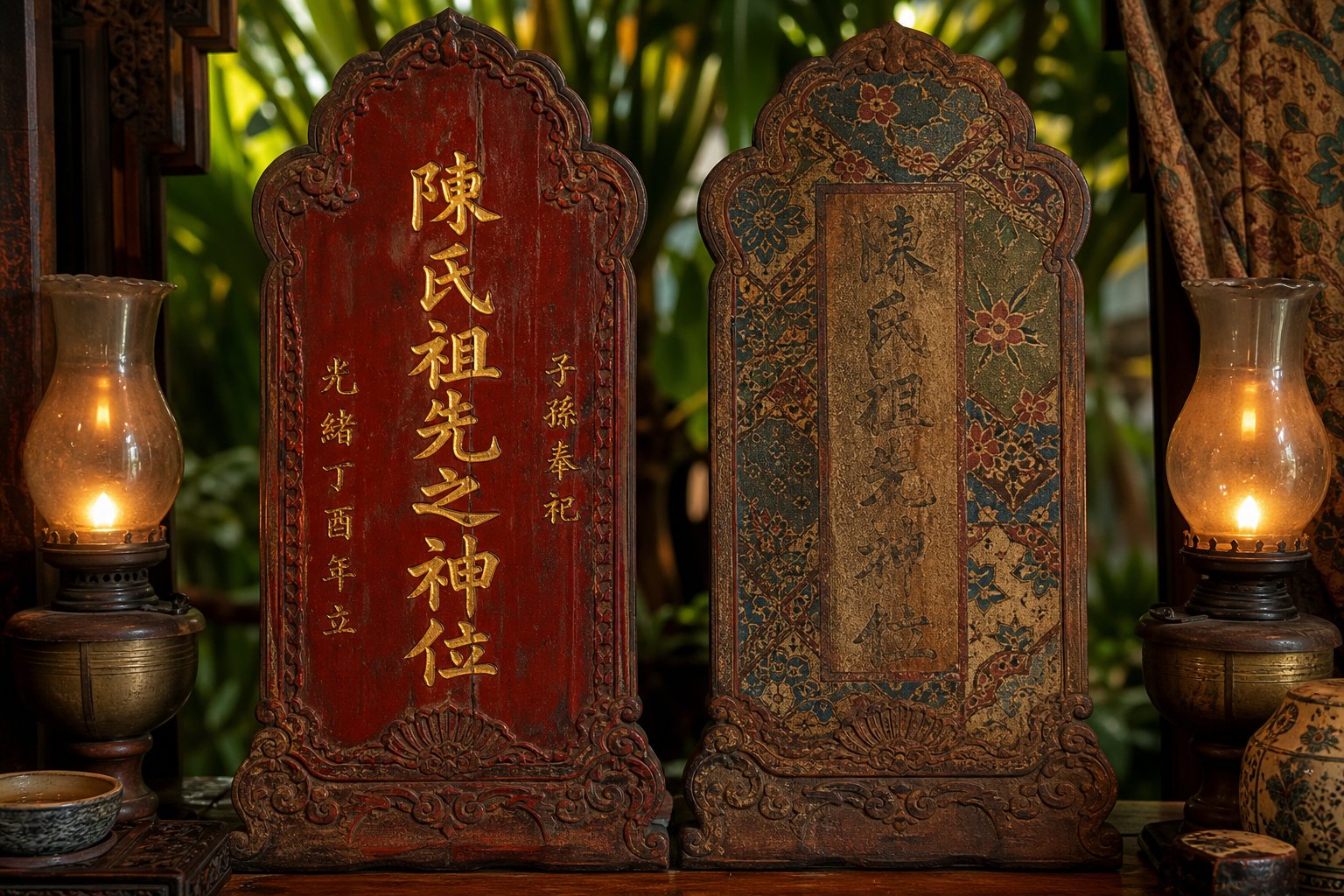
Thai naming law required all citizens to adopt Thai-style surnames beginning in 1913 under King Vajiravudh's Surname Act. Unlike Indonesia's later forced name changes, this was a universal policy applied to all Thai citizens, not specifically targeting ethnic Chinese. But the effect on Teochew families was profound. Over generations, the Thai surname became the primary identity marker, and the original Chinese surname survived only in family memory, temple records, or ancestral tablets.
Contrast this with Malaysian Teochew communities. In Penang and Johor, Teochew families retained their Chinese surnames in dialect romanization. A Malaysian Teochew family still goes by Tan, Lim, Teo, or Seah on official documents. They may have adopted Malay cultural practices, much like the baba and nyonya communities of Malacca, but their surnames remain recognizably Chinese. The nonya meaning of cultural hybridity applies here too: you can be culturally blended while keeping your ancestral name intact.
Singapore sits between these extremes. Teochew Singaporeans retained Chinese surnames and often used dialect romanizations on identity documents. The colonial British administration recorded names phonetically, locking in Teochew pronunciations as official spellings. A Teochew Singaporean surnamed "Teo" (张) carries that spelling on their national identity card, a permanent record of dialect heritage that connects Thai Singapore Teochew diaspora communities back to a shared linguistic root, even when the Thai branch long ago adopted a completely different name.
This cross-country divergence means that tracing Teochew lineages requires more detective work than Hokkien ones. A Hokkien "Tan" in Malaysia and a Hokkien "Tan" in Indonesia (before ganti nama) are clearly the same surname in the same dialect. A Teochew "Tan" in Singapore and a "Sae-Tang" in Thailand require genealogical knowledge to connect. The surname alone does not bridge the gap.
The Teochew case illustrates a broader principle: government policy can accelerate or freeze the totok-peranakan naming spectrum. Thailand's universal surname law pushed Teochew families toward complete assimilation. Malaysia's multicultural framework preserved dialect surnames. And Indonesia, as we will see, imposed something far more disruptive: a targeted policy of forced name changes that affected totok and peranakan families in fundamentally different ways.
Hakka and Cantonese Surnames With Totok Roots
Government policy shaped Teochew naming outcomes dramatically. But for two other major dialect groups, Hakka and Cantonese, the decisive factor was not policy. It was timing. These communities arrived later, settled differently, and as a result, their surnames lean heavily toward the totok end of the spectrum. If you encounter a Wong, Chan, Chong, or Yap in Southeast Asia, you are likely looking at a family whose heritage Chinese identity remained relatively intact across generations.
Why Hakka Surnames Lean Totok
Hakka speakers are known as the "Guest People" (kejia, 客家), a name reflecting their history of internal migration within China before they ever reached Southeast Asia. According to research on Hakka origins, the term first appeared during the Ming and Qing dynasties when Hakka migrants from Jiaying Prefecture (modern Meizhou) registered as "foreign households" in areas where they competed for resources with established Cantonese-speaking populations. This pattern of arriving as outsiders and maintaining distinct identity repeated itself when Hakka speakers migrated to Southeast Asia.
The critical difference between Hakka and Hokkien migration is timing. While Hokkien traders established footholds in Malacca and Java as early as the fifteenth century, Hakka speakers arrived in Southeast Asia primarily during the nineteenth-century mining boom. They came to work tin mines in Malaya and gold mines in Borneo, often recruited as contract laborers. This late arrival, roughly 300 to 400 years after the first Hokkien peranakan lineages formed, meant Hakka families had far less time to assimilate.
There is another factor. Many Hakka migrants arrived in organized groups, sometimes bringing wives or marrying within the Hakka community abroad. Malay Chinese communities organized along dialect lines, and Hakka clan associations actively maintained linguistic and cultural cohesion. Families preserved Chinese kinship terminology, so a Hakka child still knew the proper term for paternal grandma in Chinese (a po or nai nai, depending on sub-dialect) rather than switching to Malay equivalents. This cultural infrastructure kept surnames anchored in their original forms.
Common Hakka surname romanizations reflect their own dialect pronunciation, distinct from both Hokkien and Mandarin. The character 张 (Zhang in Mandarin, Teo in Hokkien) becomes "Chong" in Hakka. The character 黄 (Huang in Mandarin) becomes "Fong" or "Wong." The character 刘 (Liu in Mandarin) becomes "Liew" or "Lew." The character 叶 (Ye in Mandarin) becomes "Yap" or "Yip." These spellings are dialect-specific, but because Hakka families maintained totok identity, they used them consistently without further adaptation into local languages.
Cantonese Naming Conventions in Southeast Asia
Cantonese speakers followed a similar pattern. Originating from Guangdong province and Hong Kong, they migrated to Southeast Asia in significant numbers during the nineteenth century, drawn by the same economic opportunities that attracted Hakka laborers. In Malaysia and Singapore, Cantonese communities concentrated in urban areas, particularly Kuala Lumpur and Ipoh, where they dominated certain trades like tin smelting, carpentry, and later, food service.
Cantonese romanizations are among the most recognizable Chinese surname forms in the English-speaking world, partly because of Hong Kong's global cultural influence. The character 黄 becomes "Wong" (not "Fong" as in Hakka or "Ng" as in Hokkien). The character 陈 becomes "Chan" (not "Tan" as in Hokkien). The character 李 becomes "Lee" or "Lei." The character 吴 becomes "Ng" (shared with Hokkien in this case). These forms are so widely known that many people assume they are the "standard" Chinese romanizations, when in fact they represent one dialect among several.
Like Hakka families, Cantonese speakers in Southeast Asia largely maintained totok naming conventions. Their late arrival, strong community institutions, and continued cultural ties to Guangdong and Hong Kong all reinforced surname preservation. A Cantonese "Wong" in Kuala Lumpur carries the same spelling as a "Wong" in Hong Kong, a continuity that reflects unbroken totok identity rather than local adaptation.
Later Migration Waves and Surname Preservation
Why did timing matter so much? The answer comes down to community infrastructure and marriage patterns. Nineteenth-century migrants arrived in larger numbers than the early traders. They formed dense, dialect-specific neighborhoods. They built schools that taught in Chinese. They established clan associations organized by surname. All of this created an ecosystem where Chinese identity, including surname forms, was actively maintained rather than gradually diluted through intermarriage.
When you are trying to use dialect romanization as a heritage indicator, it helps to understand both its strengths and its limits:
Pros of Using Dialect Romanization as a Heritage Indicator
- Dialect-specific spellings (Chong, Fong, Liew for Hakka; Wong, Chan for Cantonese) reliably identify the ancestral dialect group
- Later-arriving dialect groups like Hakka and Cantonese show more consistent romanization patterns because they had less time to diverge
- Cantonese romanizations are well-documented due to Hong Kong's standardized systems, making verification straightforward
- Hakka and Cantonese surnames in Southeast Asia closely match their forms in China, making cross-border genealogical connections easier
Cons of Using Dialect Romanization as a Heritage Indicator
- Some romanizations overlap between dialects. "Ng" can be Cantonese (吴) or Hokkien (黄), representing entirely different characters
- "Lee" appears in Cantonese, Hakka, and even some Hokkien contexts, making it ambiguous without additional information
- Colonial-era registration officers sometimes misspelled or standardized names inconsistently, creating false dialect signals
- Families who switched to Mandarin-medium education may have changed their romanization from dialect form to pinyin, obscuring their actual heritage
- In Indonesia, forced name changes erased dialect romanizations entirely, making this indicator useless for post-1966 Indonesian Chinese surnames
The Hakka and Cantonese cases reinforce a clear pattern: the later a dialect group arrived in Southeast Asia, the more likely their surnames remained in recognizable Chinese forms. These families did not have centuries of intermarriage pulling their names toward local adaptation. They arrived, built communities, and held on. But holding on became dramatically harder when governments intervened directly. Indonesia's 1966 regulation did not just nudge surnames toward local forms. It demanded wholesale replacement, and the impact on totok families who had preserved their names for generations was nothing short of erasure.
Indonesianized Peranakan Surnames After Forced Name Changes
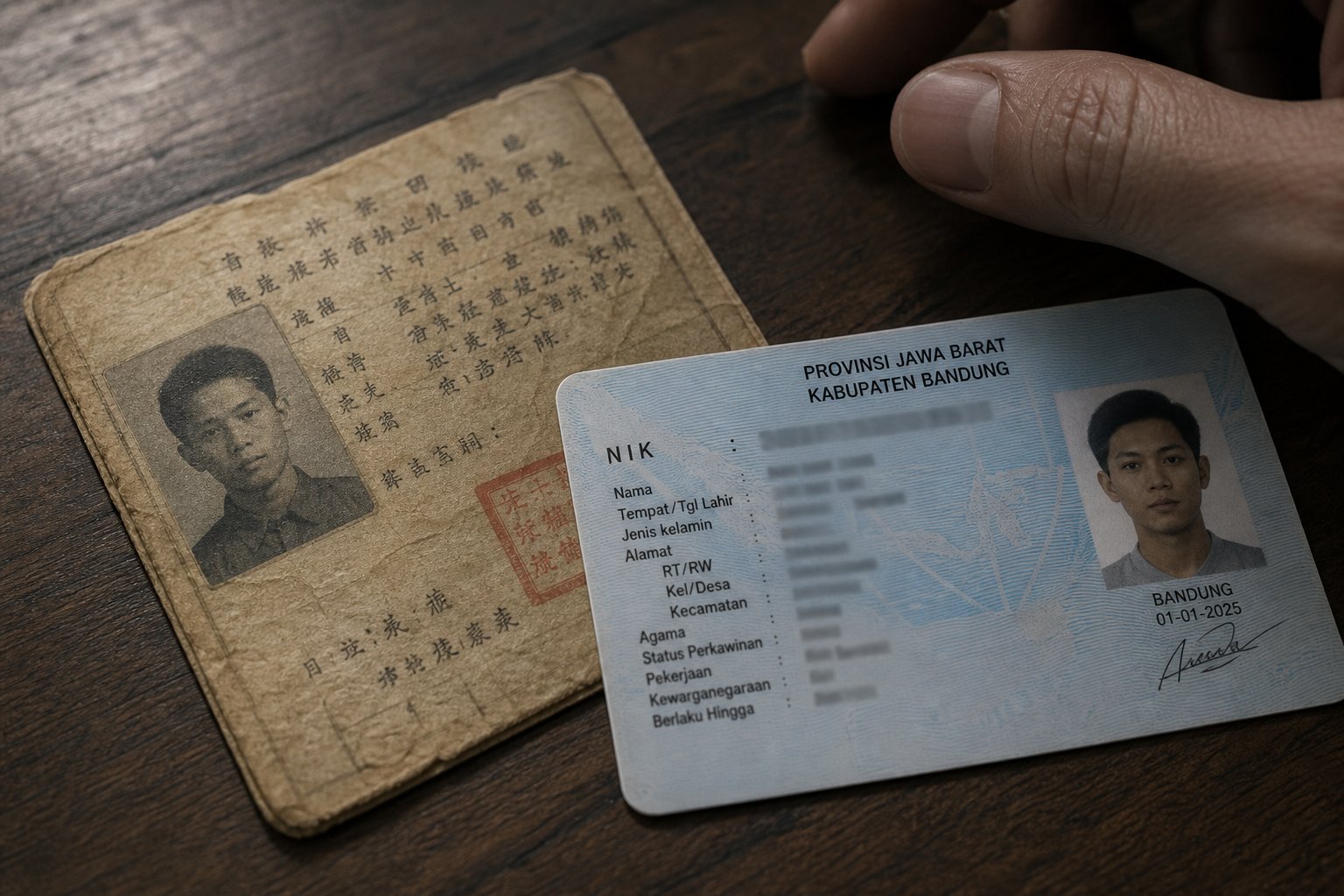
Imagine your government telling you tomorrow that your family name is no longer acceptable. Not because you did anything wrong, but because the name sounds too foreign. That is exactly what happened to millions of Chinese Indonesians in 1966. The Cabinet Presidium Decision 127 (known as PP 127/1966) did not merely encourage assimilation. It instructed Chinese Indonesians to change their names into Indonesian-sounding ones. Overnight, surnames that families had carried for centuries became liabilities.
This single regulation reshaped the entire landscape of Chinese Indonesian naming. It severed genealogical threads, erased dialect markers, and created a generation that grew up without knowing their ancestral surnames. For anyone tracing totok vs peranakan heritage through Indonesian family names, ganti nama is the fault line that makes everything before 1966 and everything after look like two completely different naming systems.
The Ganti Nama Regulation and Forced Name Changes
When Suharto's New Order regime took power in the mid-1960s, it launched an aggressive assimilation strategy targeting Chinese Indonesians. The logic was blunt: if Chinese Indonesians looked, sounded, and were named like other Indonesians, the perceived "Chinese problem" would disappear. PP 127/1966 was one piece of a broader campaign that also banned public celebration of Chinese New Year, prohibited Chinese-language publications, and restricted the practice of Chinese cultural traditions.
The name-change policy was not optional. Chinese Indonesians faced bureaucratic pressure, social stigma, and practical barriers if they refused. Official documents, school registrations, and business licenses all required Indonesian-sounding names. Some families complied immediately. Others resisted quietly for years before the weight of daily discrimination forced their hand. The South China Morning Post reports that the 1967 regulation compelled all Indonesians of Chinese ancestry to abandon their Chinese names in favor of Indonesian ones, followed by a ban on the public use of Mandarin and expression of Chinese culture.
The result was a mass renaming event unlike anything else in Southeast Asian history. Families had to invent new surnames on the spot, often trying to preserve some phonetic echo of their Chinese name within an Indonesian-sounding construction. The creativity was remarkable, but the loss was profound. As one researcher at Singapore Management University noted, "The Indonesian government spent over 30 years making sure that the Chinese don't identify themselves as Chinese."
How Totok and Peranakan Families Responded Differently
Here is where the totok-peranakan divide becomes painfully visible. Peranakan families in Java, many of whom had already been speaking Malay or Javanese for generations, found the transition comparatively smoother. Their peranakan culture already blended Chinese and local elements. Some had already adopted Indonesian given names before the regulation. For them, ganti nama was an acceleration of a process already underway, uncomfortable but not identity-shattering.
Totok families experienced it as erasure. These were families who had maintained Chinese-medium education, spoke Mandarin or dialect at home, and organized their social lives around clan associations tied to their surnames. For a totok family surnamed Liem (林) who still sent their children to Chinese school and celebrated festivals according to the Chinese calendar, being forced to become "Salim" or "Halim" was not assimilation. It was amputation.
The baba java communities, peranakans who had been rooted in Javanese culture for centuries, often chose Javanese-sounding names that fit naturally into their existing social world. A peranakan baba nyonya family in Semarang might adopt a name like "Sutanto" or "Wijaya" without feeling a dramatic rupture, because they already navigated Javanese society daily. Totok families in the same city, who had maintained distinctly Chinese households, faced a far sharper break between their private identity and their public name.
The naming strategies families used reveal this difference clearly. Peranakan families tended to choose names that blended smoothly into local naming conventions, sometimes with only a faint phonetic nod to the original surname. Totok families more often tried to embed their Chinese surname audibly within the new Indonesian name, creating hybrid constructions that preserved at least a trace of the original.
| Original Chinese Surname | Dialect Form | Common Indonesianized Versions | Phonetic Strategy |
|---|---|---|---|
| 陈 (Chen) | Tan | Sutanto, Tanujaya, Tanoko | "Tan" embedded in prefix or suffix |
| 林 (Lin) | Lim | Halim, Salim, Limanto | "Lim" preserved as syllable |
| 王 (Wang) | Ong | Ongkowidjaja, Ongko, Sugiong | "Ong" retained at start or end |
| 黄 (Huang) | Oei / Oey | Wijaya, Oeijanto | "Oei" (pronounced "we") becomes "Wi" |
| 李 (Li) | Lie | Suryalie, Liemena | "Lie" woven into compound name |
| 吴 (Wu) | Goh / Go | Gozali, Sutedjo | "Go" at start or fully replaced |
| 蔡 (Cai) | Chua / Tjoa | Sutjahjo, Tjoanda | "Tjoa" adapted to Javanese phonetics |
| 刘 (Liu) | Lau / Liem | Salim, Lauwidjaja | "Lau" or "Liem" as base syllable |
Notable examples illustrate the pattern. Business tycoon Sudono Salim's Chinese name was Liem Sioe Liong, with "Salim" preserving the "Lim" sound. Kompas newspaper founder Petrus Kanisius Ojong retained "Ojong" from his Chinese name Auwjong Peng Koen. Businessman Sukanto Tanoto carried the surname Chen (Tan in dialect), visible in "Tanoto." The surname Wijaya became popular among families whose Chinese name was Oei, because "Oei" sounds like "we" in Indonesian, making "Wijaya" a natural phonetic bridge.
You will notice that people familiar with these patterns can often reverse-engineer the original Chinese surname from the Indonesian version. A "Sutanto" is almost certainly a Tan. A "Halim" is likely a Lim. A name ending in "-widjaja" or "-wijaya" often points to Oei or Ong. This decoding ability persists in Indonesian society, which means the regulation partially failed at its stated goal of making Chinese ancestry invisible.
The Balik Nama Movement and Surname Reclamation
After Suharto's fall in 1998 and the subsequent Reform era, the legal pressure to maintain Indonesian names lifted. Chinese New Year became a national holiday in 2002. Mandarin education returned. And gradually, a movement emerged: balik nama, meaning "return to name."
Some families began legally restoring their Chinese surnames for the next generation. Hwely Ongkowijoyo of Surabaya is one example. His grandparents had converted the family name Wang (Ong in Hokkien) to Ongkowijoyo under the 1967 regulation. In 2013, Ongkowijoyo named his newborn daughter Vivian Wang, legally reviving the original surname after two generations. His wife explained that "Ongkowijoyo sounded like it was from another era" and that change was needed to move with the times.
The balik nama movement is not universal. Many Chinese Indonesians have grown comfortable with their Indonesian names, which now carry their own generational weight. Others never knew their original Chinese surnames at all. Technology platforms like My China Roots are helping bridge this gap by digitizing Chinese genealogy books (zupu) and making them searchable. The company has acquired more than 15,000 genealogy books in digital format, with roughly a third linked to the coastal provinces of Fujian and Guangdong, where most Chinese Indonesians trace their ancestry.
For younger generations, the choice is increasingly personal rather than political. Some adopt dual naming, using a Chinese surname in family contexts and their Indonesian name professionally. Others formally change their legal name back. The trend reflects a broader shift in peranakan culture toward openly embracing Chinese heritage rather than concealing it.
The ganti nama regulation created a unique genealogical challenge: in Indonesia, the same family lineage can appear under three different names across three generations, making surname-based heritage tracing far more complex than in Malaysia or Singapore.
This complexity becomes especially clear when you compare how the same Chinese surname evolved across different countries. A family surnamed Chen might appear as Tan in Malaysia, Chan in Singapore, and Sutanto in Indonesia. Same ancestor, same character, three completely different modern identities shaped by three different national policies toward their Chinese minority populations.
Malaysian and Singaporean Peranakan Surnames Compared
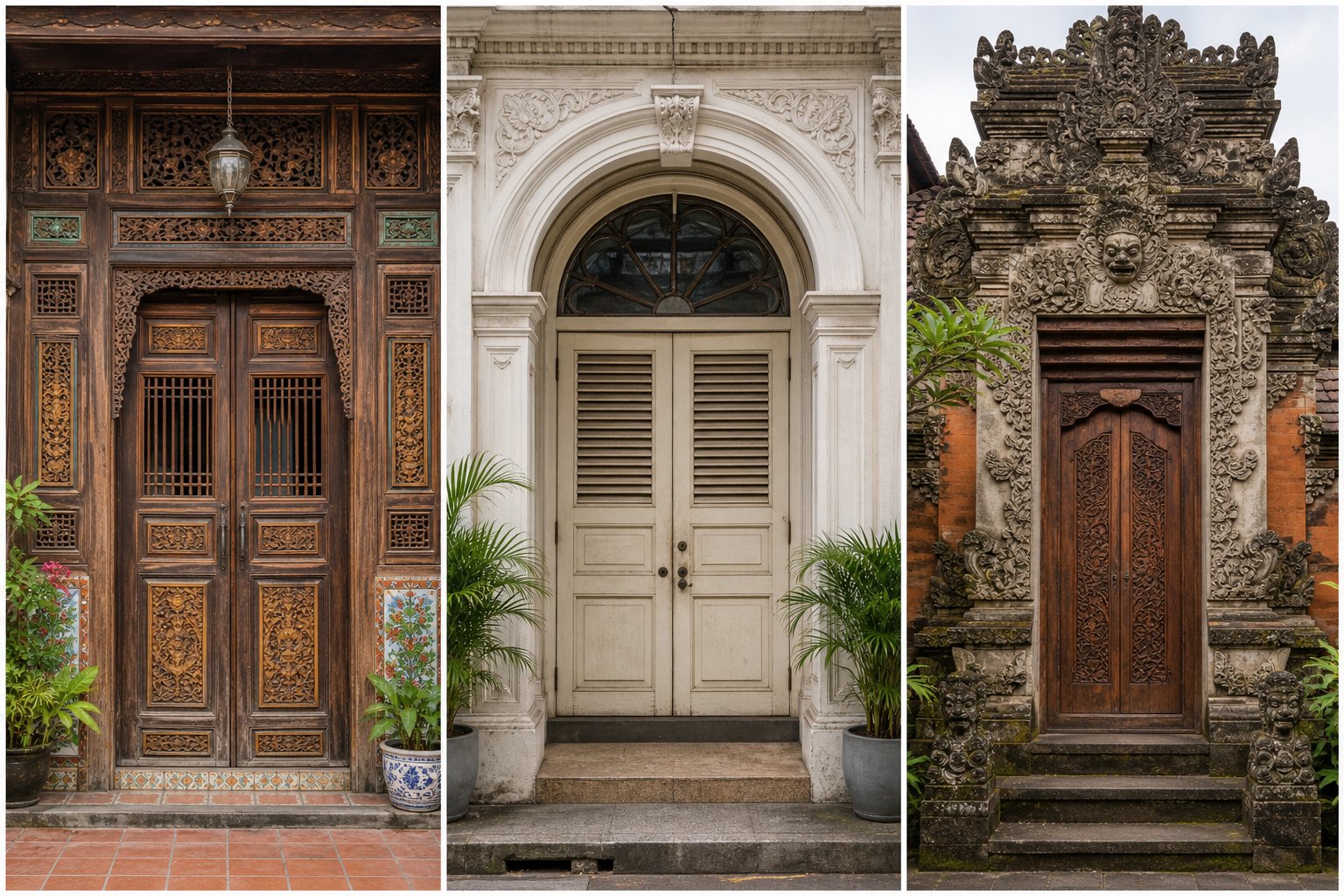
A family surnamed Chen that split into three branches centuries ago might today appear as Tan in Penang, Chan in Singapore, and Sutanto in Jakarta. Same ancestor, same character on the ancestral tablet, three completely different modern identities. The divergence is not random. It reflects how each country's political environment, colonial history, and cultural norms shaped what happened to Chinese surnames over time. Malaysia preserved them in dialect form. Singapore locked them into English-influenced romanizations. Indonesia erased them entirely.
Understanding these cross-country patterns is essential for anyone trying to reconnect family branches separated by geography and policy.
Malaysian Baba Nyonya Surname Patterns
The Baba Nyonya of Malacca and Penang represent one of the oldest peranakan communities in Southeast Asia. Their ancestors settled in the Straits of Malacca as early as the fifteenth century, intermarrying with local Malay women and developing a hybrid culture that blended Chinese patrilineal traditions with Malay language, dress, and cuisine. Yet despite centuries of cultural blending, these families kept their Chinese surnames largely intact.
Why? Malaysia's multicultural framework never demanded that ethnic Chinese abandon their names. Under both British colonial rule and post-independence governance, Chinese Malaysians retained the right to register their surnames in dialect romanization. A Baba family in Malacca surnamed Tan (陈) has carried that spelling for generations, even as they speak Baba Malay at home, cook peranakan cuisine with rempah and coconut milk, and wear the nonya kebaya with batik sarong for ceremonial occasions.
The result is a distinctive pattern: culturally Malay-influenced, linguistically hybrid, but onomastically Chinese. You will find Baba Nyonya families named Tan, Lim, Ong, Goh, and Chua whose daily lives look nothing like a totok Chinese household, yet whose surnames are indistinguishable from those of recently arrived Chinese immigrants. The surname alone cannot tell you whether a Malaysian "Tan" is a fifth-generation peranakan whose great-grandmother wore traditional clothes of Singapore and Malacca or a totok family that arrived in the 1920s. You need additional context: geographic roots, family language, and cultural practices.
Prominent Baba Nyonya families illustrate this preservation. The Tan, Lim, and Ong clans of Malacca maintained their surnames across centuries while simultaneously developing a culture so distinct from mainland Chinese norms that newly arriving totok immigrants in the nineteenth century barely recognized them as Chinese. The cultural gap was enormous. The naming gap was not.
Singaporean Straits Chinese Naming Conventions
Singapore's straits chinese peranakan community shares roots with the Malaccan Baba Nyonya but developed under different pressures. British colonial administration shaped how names were recorded, and English-language education created a naming layer that Malaysian peranakans did not experience to the same degree.
The National Library of Singapore notes that straits chinese were born in the British-controlled Straits Settlements of Singapore, Penang, and Malacca, and during colonial times were also known as the "King's Chinese" in reference to their status as British subjects. This English-language orientation profoundly influenced naming conventions. Many Peranakan families adopted English given names alongside their Chinese surnames, creating combinations like "Tan Jiak Kim" or "Lim Boon Keng" where the surname remains in Hokkien dialect form but the given name reflects English-educated sensibilities.
According to Singapore's naming conventions, Chinese Singaporean names are romanized based on their pronunciation in different Chinese dialects. The character 陈 (Chen in Mandarin pinyin) is romanized as "Tan" in Hokkien or Teochew and "Chan" in Cantonese. These dialect-based romanizations appear on passports, birth certificates, and national identity cards as the official spelling of a person's name.
This is a crucial distinction from mainland China, where the Chinese characters are the official version. In Singapore, the romanized dialect spelling is the legal name. A Singaporean whose identity card reads "Chan" carries a permanent, government-issued record of Cantonese heritage. Someone whose card reads "Tan" signals Hokkien or Teochew roots. The colonial-era practice of phonetic registration effectively froze dialect identity into official documentation.
Notable straits chinese figures demonstrate the pattern. Lee Kuan Yew, Singapore's first prime minister, carried a Hokkien-romanized surname (Lee for 李). Wee Kim Wee, the fourth president, bore a Hokkien surname (Wee for 黄). Seah Liang Seah, a prominent community leader, carried the distinctly Teochew surname Seah (佘). These names are recognizably Chinese, rendered in dialect pronunciation, and paired with English-influenced given names or generation names. No Indonesian-style erasure occurred.
Cross-Country Comparison of the Same Lineage
Imagine a single ancestor surnamed 陈 (Chen) who had three grandsons in the eighteenth century. One settled in Malacca, one in Singapore, and one in Java. By the twenty-first century, their descendants carry names that look completely unrelated to an outsider. The Malaccan branch is "Tan." The Singaporean branch might be "Tan" (Hokkien) or "Chan" (Cantonese, if the family shifted dialect affiliation through marriage). The Javanese branch is "Sutanto" or "Tanujaya."
Here is how the same original Chinese surnames manifest across all three countries:
| Chinese Character | Malaysia (Dialect Romanization) | Singapore (Dialect Romanization) | Indonesia (Post-Ganti Nama) | Key Difference |
|---|---|---|---|---|
| 陈 (Chen) | Tan | Tan (Hokkien) / Chan (Cantonese) | Sutanto, Tanujaya | Indonesia embeds "Tan" within longer name |
| 林 (Lin) | Lim | Lim | Halim, Salim, Limanto | Indonesia uses "lim" as suffix or fragment |
| 黄 (Huang) | Ng / Ooi (Hokkien) / Wong (Cantonese) | Ng / Wong | Wijaya, Oeijanto | Indonesia converts "Oei" sound to "Wi" |
| 李 (Li) | Lee | Lee / Lei | Suryalie, Liemena | Indonesia weaves "Lie" into compound |
| 王 (Wang) | Ong | Ong / Heng (Teochew) | Ongkowidjaja | Indonesia extends "Ong" with Javanese suffix |
| 吴 (Wu) | Goh | Goh / Ng (Cantonese) | Gozali | Indonesia replaces entirely or keeps "Go" |
| 张 (Zhang) | Teo / Teoh | Teo / Chong (Hakka) | Sutedjo | Indonesia adapts "Teo" to "Tedjo" |
Notice the pattern. Malaysia and Singapore both preserve the original dialect romanization as a standalone surname. The difference between them is subtle: Singapore's system tends to be more standardized because colonial registration created fixed official spellings, while Malaysian Chinese sometimes show more variation in how the same character gets romanized across states. But both countries leave the Chinese surname visible and recognizable.
Indonesia is the outlier. The ganti nama policy did not just change the romanization system. It buried the Chinese surname inside a longer Indonesian-sounding construction or replaced it altogether. Reconnecting an Indonesian "Sutanto" to a Malaysian "Tan" requires either family knowledge or genealogical research. The phonetic clue is there for those who know where to look, but it is not obvious to the uninitiated.
This three-way comparison reveals something important about the totok vs peranakan surname question: the same family can appear totok in one country and peranakan in another, depending entirely on what the local government allowed or demanded. A "Tan" in Penang and a "Sutanto" in Surabaya might share identical ancestry and identical cultural practices, yet their names tell completely different stories to an outside observer. Geography did not just influence naming. It determined it.
With these country-specific patterns mapped out, the practical question becomes: how do you pull all of this together into a single reference framework? When you encounter a Chinese Southeast Asian surname in the wild, what systematic process can you follow to decode what it reveals about heritage?
Complete Totok vs Peranakan Surname Comparison Table
You have seen how Hokkien, Teochew, Hakka, and Cantonese surnames each behave differently across Malaysia, Singapore, and Indonesia. You have seen how government policy, migration timing, and dialect origin all push a surname toward one end of the spectrum or the other. The question now is practical: when you encounter a Chinese Southeast Asian surname, how do you read it quickly and accurately?
This section consolidates everything into a single reference framework. Think of it as a decoder ring for totok vs peranakan surnames, organized by dialect group and country, with an honest assessment of how much each indicator can actually tell you.
The Definitive Totok vs Peranakan Surname Reference
The table below compares surname characteristics across all four major dialect groups. Each row shows how the same Chinese character appears in its totok (Mandarin) form, its peranakan form in Malaysia and Singapore, and its Indonesianized form after ganti nama. The final column rates how reliably that particular surname signals heritage when encountered without additional context.
| Dialect Group | Chinese Character | Totok Form (Mandarin) | Peranakan Form (Malaysia/Singapore) | Peranakan Form (Indonesia) | Heritage Indicator Strength |
|---|---|---|---|---|---|
| Hokkien | 陈 | Chen | Tan | Sutanto, Tanujaya | Strong — dialect spelling clearly distinguishes from Mandarin |
| Hokkien | 林 | Lin | Lim | Halim, Salim | Strong — one-letter difference but consistent pattern |
| Hokkien | 王 | Wang | Ong | Ongkowidjaja | Strong — no overlap with other dialect forms |
| Hokkien | 黄 | Huang | Ng / Ooi / Wee | Wijaya, Oeijanto | Moderate — "Ng" overlaps with Cantonese for 吴 |
| Hokkien | 吴 | Wu | Goh | Gozali | Strong — "Goh" is distinctly Hokkien |
| Teochew | 张 | Zhang | Teo | Sutedjo | Strong — "Teo" is a reliable Teochew marker |
| Teochew | 王 | Wang | Heng | Rare (often fully replaced) | Strong — "Heng" for 王 is exclusively Teochew |
| Teochew | 佘 | She | Seah / Siah | Rare | Strong — uncommon surname with distinctive spelling |
| Teochew | 郑 | Zheng | Tay / Teh | Sutedja | Moderate — "Tay" can overlap with Hokkien usage |
| Hakka | 张 | Zhang | Chong | Rare (later arrivals, fewer in Indonesia) | Strong — "Chong" is distinctly Hakka |
| Hakka | 黄 | Huang | Fong / Vong | Rare | Strong — clearly different from Hokkien and Cantonese forms |
| Hakka | 叶 | Ye | Yap / Yip | Rare | Moderate — "Yap" appears in some Cantonese contexts too |
| Cantonese | 陈 | Chen | Chan | Rare (small Cantonese population in Indonesia) | Strong — "Chan" is unmistakably Cantonese |
| Cantonese | 黄 | Huang | Wong | Rare | Strong — globally recognized Cantonese form |
| Cantonese | 吴 | Wu | Ng | Rare | Moderate — overlaps with Hokkien "Ng" for 黄 |
A few patterns jump out immediately. Hokkien and Teochew surnames appear most frequently in Indonesian peranakan forms because those dialect groups dominated early migration to Java and Sumatra. Hakka and Cantonese forms rarely appear in Indonesianized versions because those communities were smaller in Indonesia and arrived later, often maintaining totok identity until the ganti nama regulation forced changes on everyone regardless of assimilation level.
Beyond Surnames — Other Heritage Indicators
A surname is one data point. When you are trying to determine where someone falls on the totok-peranakan spectrum, several other naming elements provide additional signal:
- Presence of a Chinese given name — Totok families typically give children a full Chinese name (surname plus two-character given name) alongside any local name. Peranakan families, especially in Indonesia, may have no Chinese given name at all after the second or third generation.
- Dialect vs Mandarin romanization — A surname spelled in dialect form (Tan, Lim, Goh) suggests either peranakan heritage or pre-1980s registration in Singapore and Malaysia. A Mandarin pinyin spelling (Chen, Lin, Wu) on a Southeast Asian document suggests either totok identity or a more recent migrant.
- Country of origin — An Indonesian surname that sounds vaguely Chinese but follows Indonesian phonetics (ending in -to, -ja, -man) almost certainly reflects post-1966 ganti nama. A Malaysian or Singaporean surname in dialect form tells you the family retained Chinese naming but may or may not be peranakan culturally.
- Generational markers — Traditional Chinese families use generation names (zi bei, 字辈) where siblings and cousins share one character in their given name. The presence of generation naming in a family strongly suggests totok practice. Its absence across multiple generations suggests peranakan drift away from Chinese naming conventions.
- Cultural material markers — Families who maintained peranakan identity often show it through material culture: peranakan tiles in ancestral homes, a peranakan ring passed down as heirloom jewelry, or ceremonial dress combining Chinese silhouettes with Malay textiles. These artifacts corroborate what the surname suggests but cannot prove on its own.
When Surnames Alone Cannot Tell the Full Story
Here is the honest limitation. A surname like "Tan" in Malaysia could belong to a fifth-generation Baba Nyonya family whose ancestors intermarried with Malay women in the 1500s. It could also belong to a totok Hokkien family that arrived in 1910 and simply registered their name in dialect form because that is how the colonial clerk wrote it down. Both families are "Tan." Their heritage stories are completely different.
Similarly, a "Wong" in Singapore might be a Cantonese totok family with strong ties to Guangdong, or it could be a Cantonese family that has lived in Singapore for four generations and identifies culturally as Straits Chinese. The surname tells you dialect group. It does not tell you degree of assimilation.
And in Indonesia, the problem inverts. A "Wijaya" might be a Chinese Indonesian whose original surname was Oei, or it might be a Javanese family with no Chinese ancestry at all. The Indonesianized surname obscures rather than reveals, which is precisely what the policy intended.
Surnames are the starting point of heritage analysis, not the conclusion. They reliably indicate dialect group and country of registration, but determining where a family sits on the totok-peranakan spectrum requires layering surname data with migration timing, cultural practices, and family oral history.
The real power of surname analysis comes when you combine it with these additional indicators in a systematic process. Knowing that "Chong" points to Hakka heritage is useful. Knowing that a "Chong" family in Sabah with no generation names, no Chinese given names for the youngest generation, and a grandmother who wore traditional dress in Singapore-style kebaya tells you something far richer about where that family actually sits on the identity spectrum. The surname opens the door. Everything else walks you through it.
How to Trace Your Heritage Through Surname Patterns
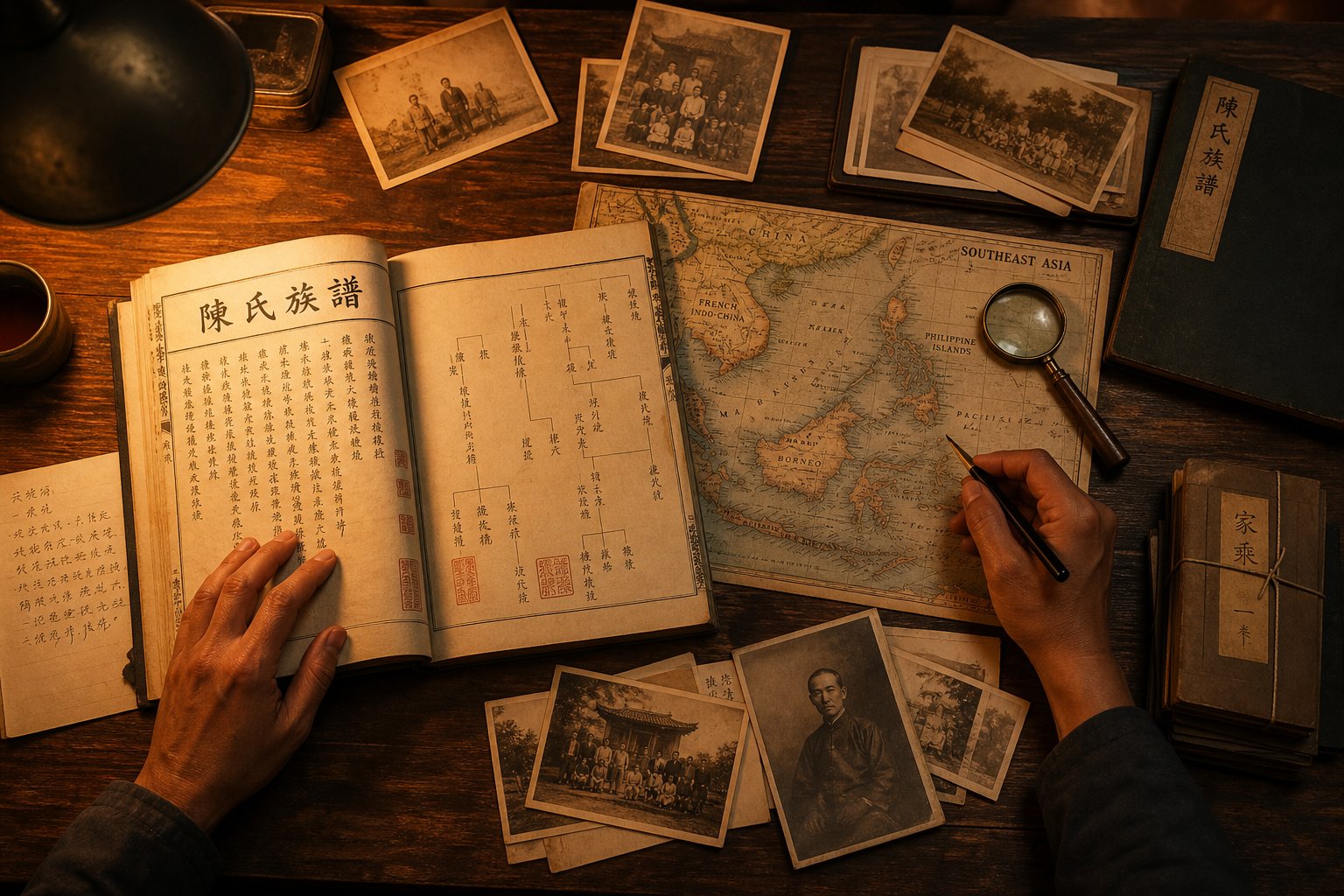
The reference tables and dialect comparisons above give you the raw data. But when you are sitting with your own family name, trying to figure out what it actually reveals, you need a process. Not a guess. A structured sequence that moves from the most obvious clues to the subtler ones, building a picture layer by layer.
Step-by-Step Surname Heritage Analysis
Here is a practical framework you can apply to any Chinese Southeast Asian surname. Work through these steps in order, because each one narrows the possibilities left by the previous one.
- Identify the dialect group from the romanization. Start with the spelling itself. Is it "Tan" (Hokkien or Teochew), "Chan" (Cantonese), or "Chong" (Hakka)? Cross-reference the surname against the dialect comparison tables. If the romanization matches a known dialect form, you have your first anchor point. If it looks Indonesian (ending in -to, -ja, -wan), skip to step four.
- Check migration wave timing. Ask family elders or consult available records: when did the family arrive in Southeast Asia? Arrival before the 1800s strongly suggests peranakan lineage. Arrival during the nineteenth-century labor migrations points toward totok identity. If no one knows, look for indirect clues like whether the family maintained Chinese-language education or participated in clan associations.
- Consider geographic context. Where did the family settle? A Hokkien "Tan" in Malacca carries different heritage weight than a Hokkien "Tan" in Medan. Malaysia and Singapore preserved dialect surnames regardless of assimilation level, so the surname alone is less diagnostic there. In Thailand, full surname replacement signals deep peranakan integration.
- Look for ganti nama patterns. If the surname is Indonesian-sounding, check whether it contains a phonetic echo of a Chinese surname. "Sutanto" contains "Tan." "Halim" contains "Lim." "Ongkowidjaja" contains "Ong." If you can identify the embedded Chinese syllable, you can often determine both the original surname and the dialect group.
- Layer in non-surname indicators. Does the family use Chinese given names? Are there generation names shared among cousins? Does the family possess cultural artifacts like vintage chinese silk embroidery, ancestral tablets with Chinese characters, or heirloom jewelry? Each additional data point moves you closer to a confident classification.
This process will not always produce a definitive answer. But it will reliably narrow the field from "unknown" to "probably Hokkien peranakan" or "likely Hakka totok," which is often enough to guide further genealogical research.
Limitations of Surname-Based Classification
Honesty matters here. Surnames are powerful clues, but they are not proof. A validation study on surname-based ethnic identification found that Chinese surname lists achieved a positive predictive value of 91.9% for identifying Chinese-origin individuals in Canada, but sensitivity dropped significantly for people who were locally born rather than immigrants. The longer a family has been settled, the less reliably their surname predicts self-identified ethnicity.
The same principle applies to the totok-peranakan question. A surname tells you dialect group and registration context. It does not tell you whether a family speaks Mandarin at home, celebrates Chinese festivals, or identifies culturally as peranakan. South east asian women who married into Chinese families sometimes adopted their husband's surname without any Chinese ancestry themselves, further complicating the picture.
Colonial-era registration also introduced noise. Immigration officials unfamiliar with Chinese phonetics sometimes guessed how best to spell a migrant's name, producing inconsistent romanizations that do not cleanly map to any single dialect. The surname 陈 alone can appear as Chen, Chin, Chan, Chinn, Tan, Dan, Tin, Tjin, or Ting depending on who wrote it down and when.
Modern Naming Trends Blurring the Totok-Peranakan Line
The totok-peranakan binary made more sense in the early twentieth century, when communities were more clearly separated by language, education, and social networks. Today, those boundaries are dissolving. Intermarriage between dialect groups is common. Chinese-medium and English-medium educated families intermingle. A young Singaporean might carry a Hokkien-romanized surname, speak Mandarin at home, consume nyonya culture through food and fashion, and feel no particular allegiance to either category.
Dual-identity naming is increasingly normal. Indonesian Chinese families give children both a Chinese name and an Indonesian name. Malaysians register dialect surnames officially while using Mandarin pinyin in professional contexts. Singaporeans whose identity cards read "Tan" might introduce themselves as "Chen" in business settings with mainland Chinese partners. The fixed surname that once locked you into one identity category now coexists with fluid, context-dependent naming.
Even the nya name meaning embedded in "Nyonya" is shifting. What once specifically described a married peranakan woman now functions as a broader cultural brand, applied to cuisine, fashion, and heritage tourism. The traditional singaporean dress associated with nyonya culture, the kebaya paired with batik, is worn by women across the spectrum regardless of whether their family history is strictly peranakan or totok.
Your surname is the first chapter of your heritage story, not the entire book. It points you toward a dialect group, a migration era, and a geographic context, but the full picture emerges only when you combine that starting point with family memory, cultural practice, and historical records.
The totok-peranakan divide was never a wall. It was always a spectrum, shaped by timing, geography, policy, and personal choice. Your surname carries the weight of those forces compressed into a few syllables. Learning to read what it holds is the beginning of understanding where you come from and how your family navigated the space between two worlds.
Frequently Asked Questions About Totok vs Peranakan Surnames
1. What is the difference between totok and peranakan?
Totok refers to full-blooded Chinese migrants who arrived relatively recently in Southeast Asia and retained their original Chinese identity, language, and surnames unchanged. Peranakan describes locally born descendants of earlier Chinese migrants who intermarried with indigenous populations and developed hybrid cultural identities. The word totok means 'pure' or 'full-blooded' in Malay and Javanese, while peranakan derives from 'anak' (child), meaning 'locally born.' The distinction is not binary but exists on a spectrum influenced by dialect group, migration timing, and geographic settlement.
2. How can I tell if a Chinese surname is Hokkien or Cantonese?
Dialect-specific romanizations serve as reliable markers. Hokkien surnames include Tan (陈), Lim (林), Ong (王), Goh (吴), and Chua (蔡). Cantonese versions of similar characters appear as Chan (陈), Lam (林), Wong (黄), and Ng (吴). For example, the character 陈 is 'Tan' in Hokkien but 'Chan' in Cantonese, while 黄 becomes 'Ng' or 'Ooi' in Hokkien but 'Wong' in Cantonese. Geographic context helps confirm dialect origin since Hokkien speakers dominate in Penang and Singapore while Cantonese communities concentrated in Kuala Lumpur and Ipoh.
3. Why do Chinese Indonesians have Indonesian-sounding surnames?
In 1966, the Suharto regime issued Cabinet Presidium Decision 127 (PP 127/1966), which instructed all Chinese Indonesians to change their names into Indonesian-sounding ones. This forced name change policy, known as ganti nama, was part of a broader assimilation campaign that also banned Chinese-language publications and public celebration of Chinese New Year. Families often tried to preserve phonetic echoes of their original surnames within new Indonesian constructions. For instance, Tan became Sutanto or Tanujaya, Lim became Halim or Salim, and Ong became Ongkowidjaja. Since 1998, some families have begun reclaiming their Chinese surnames through the balik nama movement.
4. What does Baba Nyonya mean in relation to peranakan surnames?
Baba Nyonya refers specifically to the peranakan Chinese communities of the Straits Settlements, particularly Malacca, Penang, and Singapore. 'Baba' denotes the men and 'Nyonya' the women of these communities. Their ancestors were primarily Hokkien traders who married local Malay women from the fifteenth century onward. Despite developing a deeply hybrid culture blending Chinese and Malay traditions in language, cuisine, and dress, Baba Nyonya families largely retained their Chinese surnames in Hokkien dialect romanization. A Baba Nyonya family surnamed Tan has carried that spelling for centuries while speaking Baba Malay at home and practicing blended cultural traditions.
5. Can a surname alone prove totok or peranakan heritage?
No, a surname is a starting point for heritage analysis rather than definitive proof. Surnames reliably indicate dialect group and country of registration, but they cannot determine degree of cultural assimilation on their own. A Malaysian 'Tan' could belong to a fifth-generation Baba Nyonya family or a totok Hokkien family that arrived in the 1920s. Accurate classification requires layering surname data with additional indicators including migration timing, presence of Chinese given names, use of generation names, family language practices, and cultural artifacts. In Indonesia, the challenge is even greater since Indonesianized surnames like 'Wijaya' could indicate Chinese ancestry or have no Chinese connection at all.