What Chinese Character Etymology Reveals About Every Stroke
Imagine looking at the character 休 and seeing nothing but a jumble of lines. Then someone tells you it combines 人 (a person) with 木 (a tree), painting a picture of someone leaning against a tree to rest. Suddenly, the character makes perfect sense. That shift from confusion to clarity is exactly what Chinese character etymology delivers.
休 = 人 (person) + 木 (tree) = to rest. A person leaning against a tree. One decomposition, and the character is locked in memory forever.
What Chinese Character Etymology Actually Means
At its core, this field studies how Chinese characters were originally formed, why their components were chosen, and how those components evolved over centuries. Each sinogram carries a story baked into its structure, a record of how ancient scribes encoded meaning and sound into visual form. If you have ever wondered what is Chinese writing called in linguistic terms, the formal answer is a logographic system, where each character (often called Chinese hanzi) represents a meaningful unit of language rather than a single sound.
But etymology goes deeper than simple labels. As the Outlier Linguistics team frames it, understanding a character's functional components and how they operate is the foundation for both predictability and long-term recall. You are not just memorizing shapes. You are learning the system's internal logic.
Why Etymology Transforms How You See Characters
Without etymological knowledge, Chinese characters look arbitrary. With it, patterns emerge everywhere. You start recognizing that characters share phonetic elements, that radicals signal meaning categories, and that what appears random is actually a structured code developed over three thousand years.
This article covers the full picture: the six traditional formation categories, the historical evolution from oracle bones to modern script, the phonetic patterns that govern the vast majority of characters, and practical strategies for applying this knowledge at every learning stage. Whether you are a beginner trying to remember your first hundred characters or an advanced learner curious about historical phonology, the etymological lens changes everything that follows.
Six Ways Chinese Characters Were Originally Formed
Every Chinese symbol you encounter was built according to one of six formation principles. These six categories, known as 六书 (liushu), were first systematized in the Shuowen Jiezi dictionary around 100 CE. Think of them as the blueprint behind every character ever created. Once you understand these categories, the origin of Chinese characters stops feeling mysterious and starts feeling logical.
Pictographs and Ideographs as Visual Building Blocks
The most intuitive category is pictographs (象形 xiangxing). These characters started as simplified drawings of physical objects. The character 山 (shan) looks like three peaks of a mountain. 水 (shui), the word for water in Chinese, originally depicted flowing streams. And 火 (huo, fire) resembles flames rising upward. These are the characters people love to show beginners because the visual connection is immediate.
Here is the catch: pictographs account for only about 4% of all Chinese characters. They form the foundation, but they are far from the whole story.
Simple ideographs (指事 zhishi) take a slightly more abstract approach. Instead of drawing an object, they use iconic marks to point at a concept. The character 上 (shang, above) places a short stroke above a horizontal line, indicating "up." Flip that arrangement and you get 下 (xia, below). The character 本 (ben, root) adds a stroke at the base of 木 (tree) to highlight where roots grow. These are sometimes called "self-explanatory characters" because their meaning reveals itself once you know where to look.
Compound Ideographs and the Logic of Combination
When a single picture or indicator is not enough, compound ideographs (会意 huiyi) combine two or more elements to express a new meaning. You already saw 休 (rest) in the introduction. Here are a few more:
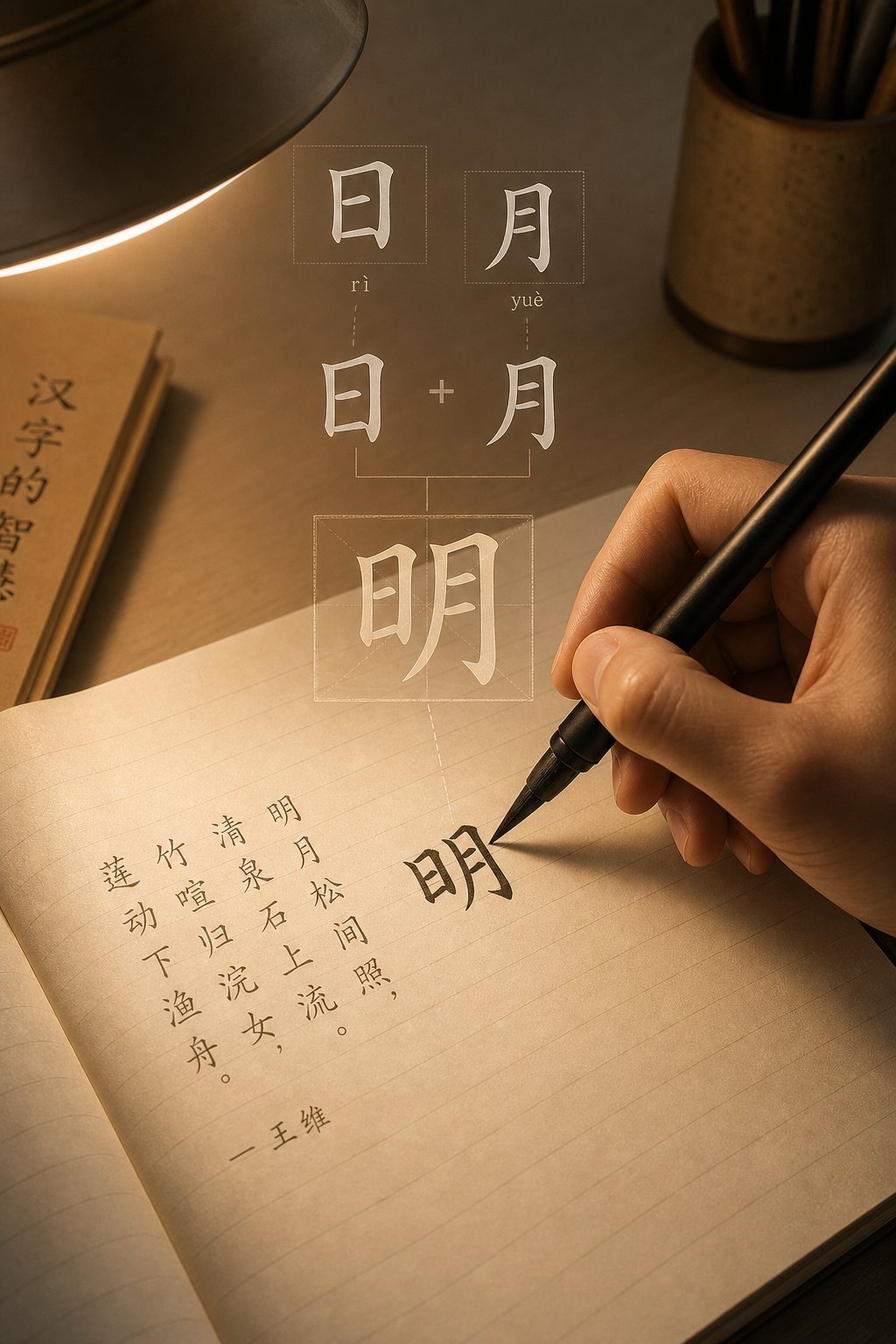
- 明 (ming, bright) = 日 (sun) + 月 (moon) shining together
- 林 (lin, forest) = 木 (tree) + 木 (tree), multiple trees grouped
- 看 (kan, to look) = 手 (hand) + 目 (eye), a hand shading the eyes to see
- 好 (hao, good) = 女 (woman) + 子 (child), traditionally interpreted as a mother with her child
The character 好 is one of the most frequently cited examples of chinese meanings and symbols working together. Each component contributes a piece of the overall concept, and the combination creates something neither part expresses alone.
Phono-Semantic Compounds and the Majority Rule
Here is where the real scale lives. Over 80% of all Chinese characters are phono-semantic compounds (形声 xingsheng). Each one pairs a semantic component (hinting at meaning) with a phonetic component (suggesting pronunciation). This is the mechanism that allowed the writing system to expand from a few hundred pictographs into tens of thousands of characters.
Consider how "mom in chinese" is written: 妈 (ma). The left side is 女 (nu, female), telling you the character relates to women. The right side is 马 (ma, horse), which contributes nothing about horses here. It simply signals the pronunciation "ma." Meaning on one side, sound on the other. That is the formula.
The remaining two categories are less about creating new characters and more about repurposing existing ones. Transfer characters (转注 zhuanzhu) involve pairs like 考 (kao, to examine) and 老 (lao, old), which may share an etymological root and were once interchangeable but drifted apart in meaning over time. This category is the smallest and most debated among scholars.
Loan characters (假借 jiajie) work like a rebus. When ancient scribes needed to write an abstract word, they borrowed a character with the same pronunciation. The character 来 (lai) originally depicted wheat, but because it sounded like the word for "to come," it was borrowed for that meaning. A new character, 麦 (mai), was later created to carry the original "wheat" meaning. This rebus works the same way English speakers might draw an eye to represent "I" in a puzzle.
| Chinese Name | English Name | Formation Logic | Example | Component Breakdown |
|---|---|---|---|---|
| 象形 (xiangxing) | Pictograph | Stylized drawing of an object | 山 (mountain) | Depicts three peaks |
| 指事 (zhishi) | Simple Ideograph | Iconic mark indicating an abstract idea | 上 (above) | Stroke pointing upward above a line |
| 会意 (huiyi) | Compound Ideograph | Two or more elements combined for new meaning | 明 (bright) | 日 (sun) + 月 (moon) |
| 形声 (xingsheng) | Phono-Semantic Compound | Semantic component + phonetic component | 妈 (mother) | 女 (female, meaning) + 马 (ma, sound) |
| 转注 (zhuanzhu) | Transfer Character | Characters with shared roots that diverged in meaning | 考 / 老 | Originally interchangeable; now distinct |
| 假借 (jiajie) | Loan Character | Existing character borrowed for its sound (rebus) | 来 (to come) | Originally meant "wheat"; borrowed for sound |
The practical takeaway is clear: if you are learning mandarin characters and want to decode unfamiliar ones, focus your energy on phono-semantic compounds. They dominate the writing system. Pictographs give you a satisfying starting point, compound ideographs offer memorable stories, but phono-semantic logic is what scales. The question is how reliably those phonetic clues still work after thousands of years of sound change, and that is exactly where the historical timeline becomes essential.
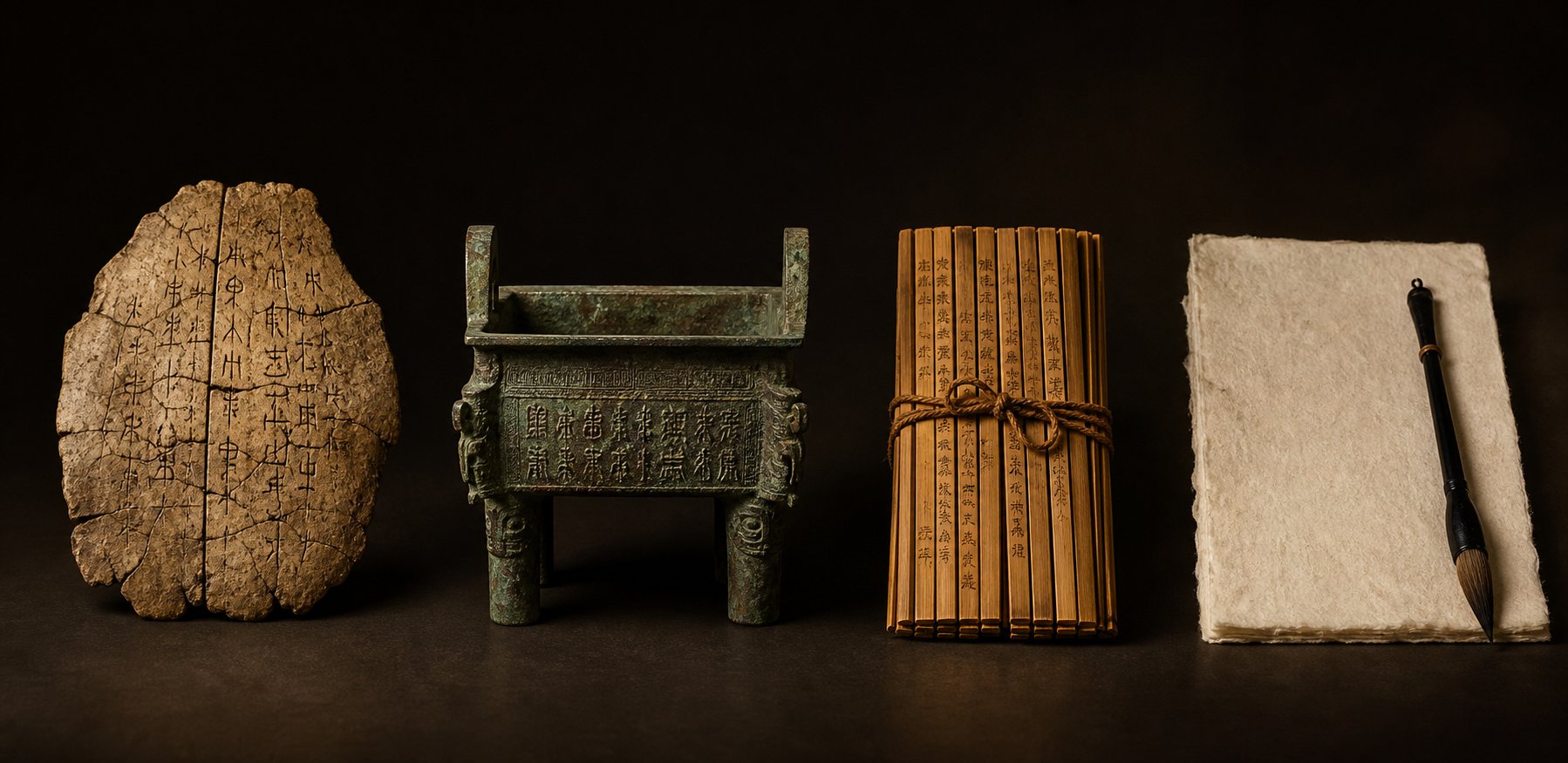
From Oracle Bones to Regular Script: The Evolution of Chinese Writing
Three thousand years of continuous use means three thousand years of change. The history of Chinese characters is not a clean, linear progression from pictures to modern strokes. It is a layered story shaped by the materials scribes wrote on, the speed governments demanded, and the sheer momentum of millions of hands writing millions of documents. Understanding this chinese character evolution is what separates reliable etymology from guesswork.
Oracle Bones and Bronze as the Earliest Evidence
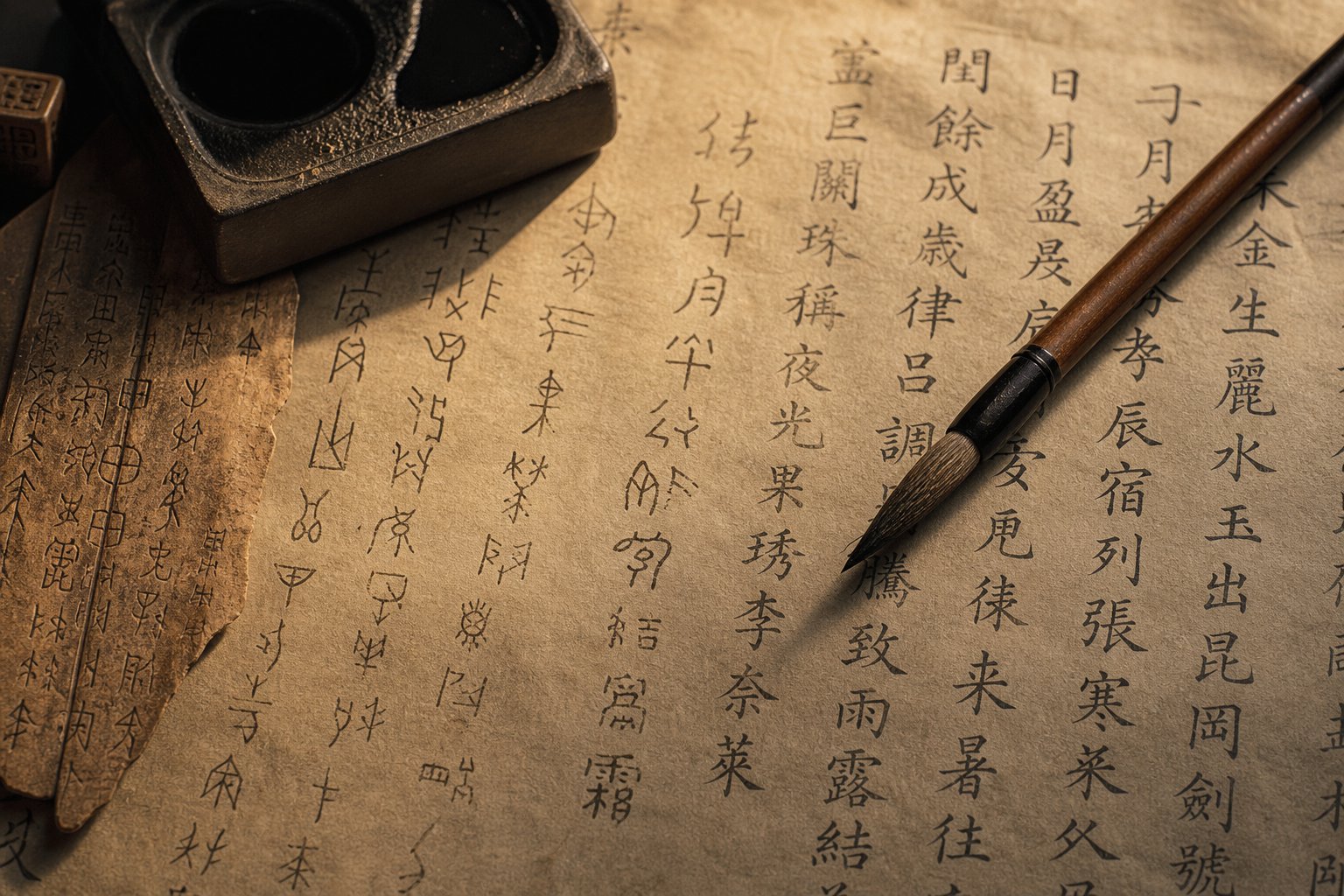
The earliest chinese writing we can conclusively identify comes from the late Shang dynasty, around 1200-1350 BCE. Oracle bone inscriptions (甲骨文) were carved into turtle shells and animal scapulae for divination purposes. These are not the oldest form of the script itself, just the oldest that survived. As Outlier Linguistics notes, evidence suggests bamboo was also used for writing during the Shang period, but none of those texts have been recovered.
Here is something most people miss: oracle bone script was already a simplified, specialized style. Because scribes carved into hard materials, they squared off curves and turned filled shapes into outlines. The more pictographic versions of the same characters appeared on bronze vessels (金文), which served as the formal script of the era. A character like 貝 (cowrie shell) clearly resembled an actual shell in its bronze form but looked far more abstract on bone. The ancient chinese script was never one single style at any given time. Formal and popular versions always coexisted.
How Administrative Needs Drove Script Simplification
Each major transition in the evolution of chinese writing was driven by practical pressure, not artistic choice. Here is the timeline:
- Oracle Bone Script (甲骨文), ca. 1200 BCE - Carved into shell and bone for divination. Angular, simplified for carving. Coexisted with more pictographic bronze forms.
- Bronze Inscriptions (金文), Shang through Spring and Autumn period - Cast or engraved on ritual vessels. More pictographic and formal. Gradually linearized under the influence of brush writing.
- Seal Script (篆书), Qin standardization, 221 BCE - The Qin state imposed its relatively conservative script as the empire-wide standard. Small seal script (小篆) became the official formal style, recorded later in the Shuowen Jiezi dictionary.
- Clerical Script (隶书), Qin through Han dynasty - Evolved from Qin popular brush writing on bamboo strips, not invented from scratch as tradition claims. Flattened vertical structures, introduced angular strokes, and prioritized writing speed for government administration.
- Regular Script (楷书), Han dynasty onward - Refined clerical forms into the stable, square characters used today. Became the standard by the Tang dynasty and remains the basis for both traditional and simplified Chinese.
Notice the pattern: the popular script of one era, shaped by speed and convenience, became the formal script of the next. History chinese characters scholars track shows that brush writing on bamboo consistently drove change faster than formal inscriptions on stone or bronze.
The Path From Seal Script to Modern Regular Script
The transition from seal to clerical script is where the most etymological damage occurred. Seal script still preserved many visual connections to earlier pictographic forms. Clerical script broke those connections. Thick, curved strokes became flat and angular. Components that once depicted recognizable objects were reduced to abstract arrangements of lines. The character 馬 (horse), for instance, went from a form that clearly showed a mane, legs, and tail in bronze script to a stack of horizontal strokes that no longer resembles any animal.
This matters enormously for anyone studying history in chinese writing systems. When you look at a modern character and try to decompose it into meaningful parts, you are often looking at a corrupted form. Components that appear meaningless today made perfect sense in seal script or earlier. Some radicals merged with others. Some phonetic elements were distorted beyond recognition. Without consulting historical forms, you risk inventing explanations for shapes that are simply the residue of centuries of graphic drift.
The chinese characters for history itself, 史 (shi), illustrate this perfectly. In oracle bone script, it depicted a hand holding a writing instrument. By regular script, that visual logic is nearly invisible unless you already know what to look for. This is precisely why folk etymologies flourish: modern forms invite creative storytelling that has nothing to do with actual origins.
Why Phonetic Components Matter in Most Mandarin Characters
Graphic corruption over centuries makes modern characters look arbitrary. But here is the thing: even when the visual logic has faded, the phonetic logic often remains intact. And that phonetic logic governs the vast majority of the writing system. Roughly 80% of all Chinese characters are phono-semantic compounds, characters built from one component that hints at meaning and another that signals pronunciation. If you only learn one structural principle about writing in Chinese language, this is the one that pays off most.
How Semantic and Phonetic Components Work Together
The formula is straightforward. Every phono-semantic compound contains two functional parts:
- Semantic component (also called the radical or meaning component) - places the character in a broad category. Think of it as a label: "this word relates to water," or "this word relates to speech."
- Phonetic component - suggests how the character is pronounced. It does not contribute meaning. It is there purely for sound.
Imagine you encounter the character 洋 (yang, ocean) for the first time. Break it apart: the left side is 氵(the water radical), telling you this word belongs to the water category. The right side is 羊 (yang, sheep). Sheep have nothing to do with oceans. But 羊 is pronounced yang, and so is 洋. The sheep component is a phonetic marker, nothing more.
This same pattern repeats across thousands of chinese mandarin characters. Take the component 女 (nu, female). When it appears on the left side of a character, it functions as a semantic component signaling that the word relates to women or femininity. The character 吗 (ma), the question particle, works differently. Its left side is 口 (kou, mouth), indicating the character relates to speech or sounds produced by the mouth. The right side is 马 (ma, horse), providing the pronunciation. The mouth radical 口 appears in dozens of characters related to speaking, asking, or vocal sounds, including particles like 吧 (ba), which also pairs 口 with a phonetic element (巴, ba).
Once you see this pattern, you cannot unsee it. The semantic component narrows the meaning category. The phonetic component gives you a pronunciation guess. Together, they form a system that allowed ancient scribes to write any word in the spoken language without inventing a brand-new picture for each concept.
Sound Series and Why One Phonetic Spawns Dozens of Characters
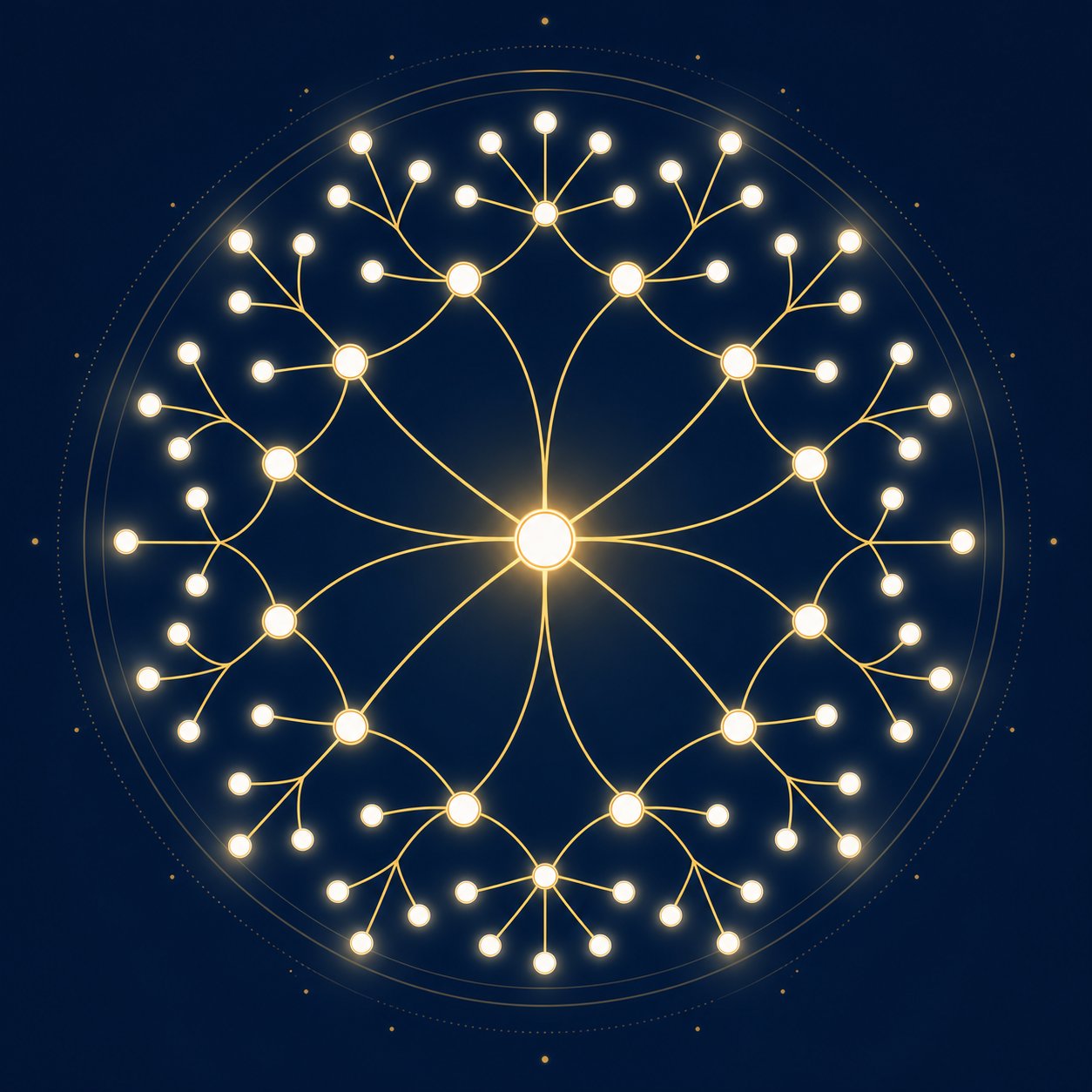
Here is where the system becomes genuinely powerful for learners. Phonetic components do not appear in just one or two characters. They generate entire families called sound series (谐声系列 xiesheng xilie). Every character in a sound series shares the same phonetic element, which means they share similar pronunciations.
The classic example is 青 (qing, blue-green). Pair it with different semantic components and you get a whole cluster of related-sounding characters:
- 清 (qing) = 氵(water) + 青 = clear, pure
- 请 (qing) = 讠(speech) + 青 = to invite, please
- 情 (qing) = 忄(heart) + 青 = emotion, feeling
- 晴 (qing) = 日 (sun) + 青 = sunny, clear weather
- 睛 (jing) = 目 (eye) + 青 = eyeball
- 靖 (jing) = 立 (stand) + 青 = peaceful, quiet
Notice how the semantic components tell you the meaning domain (water, speech, heart, sun, eye) while 青 consistently delivers a pronunciation in the qing/jing range. If you memorize one phonetic component and its sound value, you unlock pronunciation clues for every character in that series. Native speakers do this intuitively. When they encounter an unfamiliar character containing 青, they instinctively guess it sounds something like "qing." Learners who understand chinese and pinyin relationships through phonetic components develop the same instinct.
Some phonetic components are remarkably consistent. The component 唐 (tang) appears in 糖 (tang, sugar), 塘 (tang, pond), 搪 (tang, to ward off), and 溏 (tang, muddy). Every single one is pronounced tang. Learn the phonetic once, and the entire series falls into place.
Why Phonetic Components Often Do Not Match Modern Pronunciation
If the system were perfectly regular, learning mandarin characters would be far simpler. The complication is time. These characters were created over two thousand years ago, and spoken Chinese has changed dramatically since then. Sound shifts in Old and Middle Chinese have scrambled many phonetic connections that were once transparent.
Consider the phonetic 也 (ye). It appears in 他 (ta, he), 她 (ta, she), 地 (di, ground), and 池 (chi, pond). In modern Mandarin, these pronunciations seem unrelated. But historical phonology research shows that in Old Chinese, these characters shared much closer pronunciations. Centuries of tonal splits, initial consonant changes, and vowel shifts pulled them apart. The writing system preserved the old phonetic grouping even as the spoken language moved on.
This drift explains why some phonetic components feel unreliable today. A learner sees 每 (mei) inside 海 (hai, sea) and wonders what happened. The answer: in earlier stages of Chinese, the pronunciations were far more similar. The mismatch is not a flaw in the system. It is a fossil record of how the language sounded centuries ago.
The table below illustrates this pattern using the phonetic 方 (fang). You will see both regular matches and drifted pronunciations within a single sound series:
| Shared Phonetic | Derived Character | Meaning | Modern Pronunciation | Match Quality |
|---|---|---|---|---|
| 方 (fang) | 房 | room, house | fang | Exact match (tone differs) |
| 方 (fang) | 放 | to release | fang | Exact match (tone differs) |
| 方 (fang) | 防 | to prevent | fang | Exact match (tone differs) |
| 方 (fang) | 芳 | fragrant | fang | Exact match |
| 方 (fang) | 访 | to visit | fang | Exact match (tone differs) |
| 方 (fang) | 纺 | to spin (thread) | fang | Exact match (tone differs) |
| 方 (fang) | 旁 | beside | pang | Initial shifted (f- to p-) |
The 方 series is one of the most regular in modern Mandarin. Nearly every character retains the "fang" sound, with only tonal variation. But the last entry, 旁 (pang), shows how even a highly regular series can contain drift. In Old Chinese, the f- and p- initials were not yet distinguished, so 旁 fit perfectly into the series. Modern learners see it as an outlier, but historically it belongs.
The practical lesson is this: phonetic components give you a strong guess, not a guarantee. Across the full inventory of characters, studies suggest phonetic components predict the exact syllable (ignoring tone) roughly 40% of the time, and predict at least the initial or final correctly in a much higher percentage. Even imperfect clues beat no clues at all. When you combine phonetic guessing with semantic-component context, you have a powerful decoding strategy that no amount of rote memorization can replicate.
Still, this power comes with a risk. Because phonetic connections are not always obvious in modern pronunciation, people invent meaning-based stories to explain components that are actually there for sound. That gap between how components function and how they appear to function is exactly where bad etymological explanations take root.
How to Spot Bad Chinese Character Explanations
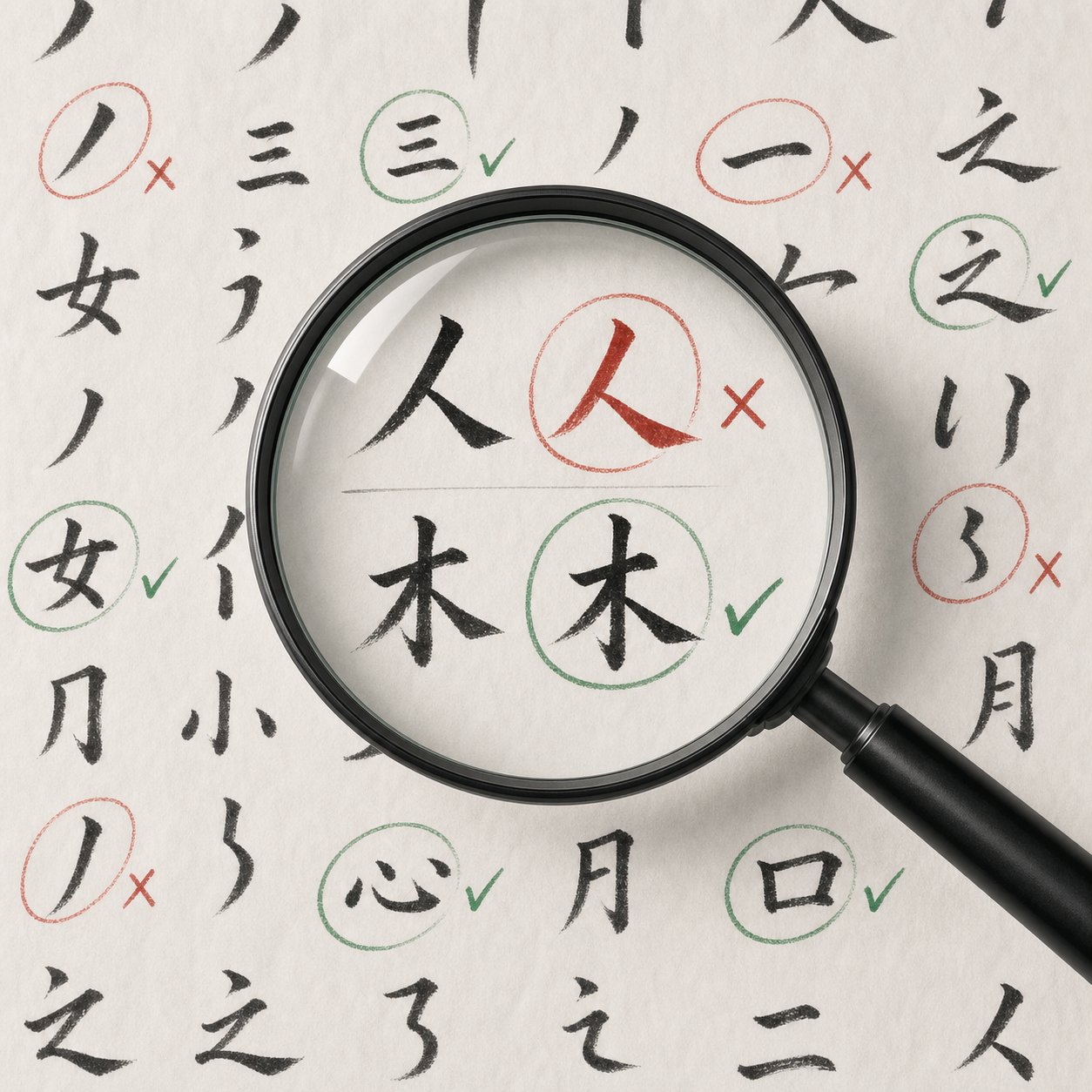
Meaning-based stories feel satisfying. They wrap a character in a neat narrative, and the brain latches on. The problem is that satisfaction and accuracy are two different things. A huge portion of the chinese symbols and meanings explanations circulating online, in apps, and even in published textbooks are folk etymology: creative interpretations that have no basis in the character's actual history. Knowing how to tell the difference protects you from building your understanding on a foundation of fiction.
Common Folk Etymology Traps and Why They Persist
Folk etymology thrives because it fills a gap. Learners want to know why a character looks the way it does, and a compelling story is easier to share than a nuanced explanation involving Old Chinese phonology. Consider the character 識 (shi, to know). People routinely break it into 言 (speech) + 音 (sound) + 戈 (lance) and invent a story connecting those three meanings. But as Outlier Linguistics demonstrates, the actual functional components are 言 (meaning: speech) and 戠 (sound: zhi). The 戠 component is a single phonetic unit, not two separate meaningful pieces. Breaking it further hides the real sound connections to characters like 職 (zhi), 織 (zhi), and 幟 (zhi).
This pattern repeats constantly. Someone sees a component, assigns it a meaning based on its modern standalone use, and weaves a story. The character 高 (gao, tall) gets decomposed into 亠 (lid) + 口 (mouth) + 冋, and people try to explain why a lid and a mouth make something tall. In reality, 高 is simply a picture of a tall building. The internal components are corrupted remnants of the original drawing, not meaningful building blocks. Trying to extract meaning from them is like reading significance into the shape of a crack in old pottery.
The same issue plagues popular explanations of what are chinese writing symbols called "hieroglyphics" by casual observers. That comparison itself is a form of folk etymology at the system level, implying every character is a little picture. It ignores the fact that over 80% of chinese word symbols are phono-semantic compounds where at least one component carries no pictorial meaning whatsoever.
How to Evaluate Etymological Claims Critically
You do not need a PhD in paleography to spot unreliable claims. Here are the red flags:
- The explanation only works with the modern (or simplified) form. If someone explains a character by referencing components that only exist in the simplified version, they are analyzing a 1950s administrative decision, not a 3,000-year-old invention.
- Every component is treated as a meaning contributor. In most characters, at least one component is there purely for sound. If an explanation assigns meaning to every single piece, it is almost certainly wrong for phono-semantic compounds.
- The reasoning is anachronistic. Explanations that rely on modern cultural associations ("this component means X because in today's society...") ignore that the character was created in a completely different era with different conceptual frameworks.
- No historical forms are referenced. Reliable etymology traces a character back through regular script, clerical script, seal script, and ideally bronze or oracle bone forms. If the explanation only looks at the modern shape, it is working with corrupted data.
- The explanation cannot account for other characters sharing the same component. As Harmen Mesker points out, if 公 (gong) is supposedly a meaning component in 訟 (song, litigation), then you need to explain why it also appears in 松 (song, pine tree), 蚣 (gong, centipede), and 衳 (zhong, underwear). The meaning-based explanation collapses. The sound-based explanation holds: all these characters end in "-ong."
- The source provides no citations or cross-references. Scholarly etymology points to specific historical dictionaries, archaeological evidence, or phonological reconstructions. Folk etymology just tells a story.
The Dong Chinese component taxonomy offers a practical framework for sorting this out. Instead of assuming every component carries meaning, it classifies components into distinct functional roles: meaning, sound, iconic (the component's shape depicts something), remnant (a leftover from an earlier form), simplified (introduced during simplification), deleted (a component that was removed), distinguishing (added to differentiate from a similar character), and unknown. This taxonomy acknowledges what folk etymology refuses to: that many components in modern characters simply do not function the way they appear to.
The Difference Between Mnemonics and Real History
Does this mean creative stories are useless? Not at all. A mnemonic that helps you remember a character is doing its job, even if it has nothing to do with actual origins. The danger is not in using mnemonics. It is in confusing them with etymology and then building further conclusions on that false foundation.
When someone tells you that 想 (xiang, to think) means "the appearance of a tree reflected in the heart" because it contains 相 (appearance) and 心 (heart), that might help you remember the character. But if you then conclude that all characters work this way, you will misidentify phonetic components as meaning components across thousands of china symbols. You will miss the sound series connections that actually make the system predictable.
The same caution applies to popular websites listing asian symbol meanings without scholarly sourcing. Many of these sites present folk interpretations as established fact, creating a cycle where bad explanations get repeated until they feel authoritative through sheer repetition.
A mnemonic helps you remember one character. Understanding how components actually function helps you decode thousands.
The practical rule is simple: use whatever memory trick works for you, but label it honestly. Know when you are using a mnemonic shortcut and when you are looking at real history. That distinction becomes especially important when you cross the traditional-simplified divide, where the same character's components can tell very different stories depending on which version you are reading.
How Simplification Changed Etymological Connections
The traditional-simplified divide is not just a matter of stroke count. It is an etymological fault line. When the People's Republic of China promulgated its simplified character standard beginning in 1956, the reforms reduced writing complexity for millions of learners. But they also rewired the internal logic of hundreds of characters. Depending on whether you study traditional Chinese or simplified Chinese, the same word can tell you a completely different story about its own origins.
This matters because etymology is only as transparent as the form you are reading. A character that clearly displays its semantic and phonetic components in one system may look like an arbitrary arrangement of strokes in the other. Understanding the main simplification methods helps you see through the surface and recover the structural logic underneath, regardless of which system you use.
When Simplification Preserves Etymological Logic
Not all simplifications damage etymological transparency. The most systematic reform involved reducing frequently occurring components across the board. The speech radical 言 was shortened to 讠in every character where it appeared: 說 became 说, 話 became 话, 語 became 语. The semantic function is preserved perfectly. You still see a speech-related marker on the left and a phonetic component on the right. The character's internal logic remains intact. You just write fewer strokes to express it.
The same applies to the silk radical 糹becoming 纟, the metal radical 釒becoming 钅, and the food radical 飠becoming 饣. In each case, the simplified radical still occupies the same position, still signals the same meaning category, and still pairs with the same phonetic component. A learner of simplified Chinese can decode these phono-semantic compounds just as easily as someone reading traditional forms.
Characters like 沒有 (meiyou, to not have) demonstrate this preservation clearly. The simplified form 没有 retains the water radical 氵on the left of 没, keeping the etymological structure visible. The simplification here is minimal and non-destructive. Whether you write 沒有 or 没有, the component relationships remain legible.
Another category of harmless simplification involves officializing longstanding shorthand. The character 為 (wei, to do) had been written 为 since at least the Song dynasty. The simplified form simply made centuries of popular usage official. No etymological information was lost because the abbreviated form had already replaced the original in people's hands long before the reform.
When Simplification Obscures Original Meaning
The problems emerge when simplification removes, replaces, or merges components in ways that sever the connection between a character's form and its origin. The most famous example is 愛 (ai, love) becoming 爱.
Look at the traditional form 愛. In the middle sits 心 (xin, heart). Whatever the character's full etymological history, that heart component created a visible semantic anchor: love involves the heart. The simplified 爱 removed 心 entirely, replacing the internal structure with a streamlined shape that no longer contains any recognizable meaning-bearing element. As one detailed etymological analysis demonstrates, the full story of 愛 is far more complex than the folk explanation suggests. It is actually a phono-semantic compound with 㤅 (ai) as the phonetic over 夊 (sui, walk slowly) as the semantic. But the traditional form at least preserved 心 within the phonetic component 㤅, giving learners a visible hook. The simplified form erases even that.
The character 发 presents an even more dramatic case. It does double duty for two completely unrelated traditional characters: 髮 (fa, hair) and 發 (fa, to emit/send). In traditional Chinese, these are visually distinct. 髮 contains the hair radical 髟 at the top, clearly marking it as hair-related. 發 has a completely different structure. Merging both into 发 means a single simplified form now carries two etymological histories with no visual way to distinguish them. Context alone tells you which word is meant.
The character 樂 (le/yue) in traditional Chinese is a complex form depicting a musical instrument, connecting to its dual meanings of "music" (yue) and "joy" (le). Its simplified form 乐 strips away most of that visual complexity. The etymological story becomes harder to tell from the modern shape alone.
Practical Implications for Learners of Either System
The simplification methods that cause etymological damage fall into three main categories:
- Component replacement - A complex phonetic is swapped for a simpler one. The new phonetic may or may not preserve the sound connection. Example: 鄰 (lin, neighbor) becomes 邻, replacing the phonetic 粦 with the simpler 令 (ling). The sound hint shifts slightly but remains in the ballpark.
- Component deletion - Part of the character is simply removed. Example: 廣 (guang, wide) becomes 广, deleting the phonetic element 黃 entirely. The semantic shell remains, but the phonetic information vanishes.
- Character merging - Two or more distinct characters collapse into one simplified form. Example: 後 (hou, behind) and 后 (hou, empress) both become 后. Two separate etymological histories now share a single written form.
The table below compares selected characters across both systems, rating how much etymological information survives the simplification process:
| Traditional Form | Simplified Form | Etymological Transparency | What Was Lost or Preserved |
|---|---|---|---|
| 語 (yu, language) | 语 | High - fully preserved | Speech radical shortened but still recognizable; phonetic 吾 unchanged |
| 愛 (ai, love) | 爱 | Low - key component removed | 心 (heart) deleted from the phonetic component 㤅 |
| 髮 (fa, hair) | 发 | Very low - merged with 發 | Hair radical 髟 deleted; now identical to unrelated 發 (to emit) |
| 請 (qing, to invite) | 请 | High - fully preserved | Speech radical shortened; phonetic 青 unchanged. Sound series intact |
| 廣 (guang, wide) | 广 | Low - phonetic deleted | Phonetic 黃 removed entirely; only the semantic shell 广 remains |
| 聽 (ting, to listen) | 听 | Very low - complete replacement | Original structure (ear + virtue + heart) replaced by unrelated 口 + 斤 |
| 龍 (long, dragon) | 龙 | Medium - simplified but recognizable | Overall shape condensed; no component logic was clear in either form |
What does this mean in practice? If you are learning traditional vs simplified Chinese characters, your etymological experience will differ significantly. Traditional Chinese preserves more internal structure, making component analysis more rewarding. Simplified Chinese is faster to write and memorize initially, but some characters require you to look up the traditional form before the etymology makes sense.
Neither system is "correct" in absolute terms. The traditional form of 愛 already represents a corruption of the original seal script structure. And simplified characters like 请 preserve their phonetic series just as clearly as their traditional counterparts. The key is knowing when you can trust the form in front of you and when you need to look deeper. That awareness, knowing which characters lost information and which kept it, is itself a practical skill that transforms how effectively you can apply etymology to actual memorization.
Using Etymology to Actually Remember Characters
Knowing that simplification altered etymological connections is one thing. Turning that knowledge into a memorization strategy that works at your current level is another. The question most learners actually care about is practical: how do I use character origins to remember more characters with less effort? The answer depends entirely on where you are in your learning journey. Etymology is not a single technique. It is a toolkit that scales with your proficiency.
How many chinese characters are there in total? Estimates range from 50,000 to over 100,000 if you count rare characters in historical dictionaries. But functional literacy requires only 3,000 to 4,000. The goal is not to memorize every character ever written. It is to build a system in your head that makes each new character easier than the last. Etymology provides that system, but only if you apply the right layer at the right time.
Beginner Stage and Building a Foundation With Pictographs
When you are learning your first 200-300 characters, etymology means something simple: learn the basic building blocks and understand what they depict. Start with high-frequency pictographs like 人 (person), 木 (tree), 水 (water), 火 (fire), 山 (mountain), 日 (sun), and 月 (moon). These are the atoms of the writing system. Every compound character you encounter later will contain some combination of these foundational pieces.
At this stage, your focus should be on the most common semantic components (often overlapping with traditional radicals). Learn what 氵means (water), what 忄signals (heart/emotion), what 讠indicates (speech). You do not need historical phonology yet. You need pattern recognition.
Here is a before-and-after example of how even basic etymological awareness transforms memorization:
- Without etymology: You encounter 泉 (quan, spring/fountain). It looks like a random arrangement of strokes. You write it twenty times, forget it by Thursday, write it twenty more times.
- With etymology: You recognize 白 (white/pure) on top and 水 (water) on the bottom. A spring is pure water emerging from the ground. As DigMandarin's analysis shows, the oracle bone form actually depicted water flowing from an underground opening, and knowing both the modern components and their ancient origins gives your brain multiple hooks to hold onto.
The difference is not just efficiency. It is durability. Characters learned through understanding stick in long-term memory because they connect to existing knowledge rather than floating in isolation.
At this stage, you should also practice how to draw chinese characters with correct stroke order. When you understand that a component like 木 appears in dozens of characters (林, 森, 休, 本, 果, 桌), writing it becomes automatic muscle memory. Chinese handwriting improves naturally when you stop seeing characters as monolithic shapes and start seeing them as arrangements of familiar pieces. Whether you use a chinese character drawer app or pen and paper, the principle is the same: recognize the parts, then assemble them.
Intermediate Stage and Unlocking Phonetic Patterns
Once you know 500-1,000 characters, something shifts. You start encountering characters that share components but mean completely different things. This is where phonetic component awareness becomes your most powerful tool.
The intermediate leap looks like this:
- Without phonetic awareness: You see 清, 请, 情, 晴 and treat each as a separate memorization task. Four characters, four independent efforts.
- With phonetic awareness: You recognize 青 (qing) as the shared phonetic. You already know it. Now you only need to learn which semantic component pairs with it: water (clear), speech (invite), heart (emotion), sun (sunny). Four characters, one pattern, four quick associations.
This is the stage where Hacking Chinese's advice becomes especially relevant: you do not need elaborate mnemonics for characters whose structure already tells you the pronunciation. Simply recognizing the phonetic pattern is often enough. Save your mnemonic energy for the exceptions, the characters where sound drift has made the phonetic connection opaque.
Intermediate learners benefit from actively studying productive phonetic components, the ones that generate large sound series. Components like 方 (fang), 青 (qing), 唐 (tang), and 包 (bao) each appear in ten or more characters. Learning these phonetics is like learning prefixes and suffixes in English: one piece of knowledge unlocks a whole family of words.
This is also the stage where you can start to draw mandarin characters from memory more reliably. When you know that 请 is simply 讠+ 青, you are not recalling a complex shape. You are assembling two familiar components. The cognitive load drops dramatically.
Advanced Stage and Historical Connections
Advanced learners (2,000+ characters) encounter diminishing returns from surface-level component analysis. Many characters at this level contain corrupted components, obscure phonetics, or rare characters whose origins are not obvious from modern forms alone. This is where historical phonology and script evolution become genuinely useful.
At this stage, you might investigate why 每 (mei) appears inside 海 (hai, sea) despite the pronunciation mismatch. The answer lies in Old Chinese reconstructions where both shared a closer sound. You might trace a character back through seal script to discover that what looks like two unrelated components was originally a single pictograph that got split apart during the clerical script transition.
Advanced etymological study also helps with rare characters you encounter in classical texts, literary names, or specialized vocabulary. When you meet an unfamiliar character, you can often decode it on the spot: identify the semantic component to guess the meaning domain, identify the phonetic component to guess the pronunciation, and cross-reference with known sound series. This is functional literacy at a level that rote memorization simply cannot achieve.
Etymology helps most when a character's structure is still transparent. For corrupted forms or highly irregular characters, a simple mnemonic often works faster. The skill is knowing which tool fits which character.
The table below compares three approaches to character learning, each with distinct strengths depending on your stage and goals:
| Approach | Best For | Strengths | Limitations | Time Investment |
|---|---|---|---|---|
| Etymology-based learning | Intermediate to advanced learners building systematic knowledge | Creates durable memory; reveals patterns across character families; scales with proficiency; enables decoding of unfamiliar characters | Requires upfront study of components and phonetics; some characters have opaque or debated origins; not all etymologies are beginner-friendly | Moderate upfront, decreasing over time as patterns compound |
| Rote memorization (repeated writing) | Absolute beginners learning first 50-100 high-frequency characters | Simple to execute; no prerequisite knowledge needed; builds handwriting muscle memory | Does not scale; forgetting rate is high without understanding; each character is an isolated effort; no transfer to new characters | High per character, remains high indefinitely |
| Mnemonic stories (creative associations) | Any learner struggling with specific problem characters | Highly memorable for individual characters; fun and engaging; works even for corrupted or irregular forms | Time-consuming to create; does not reveal system-level patterns; can conflict with real etymology if confused with fact; does not help decode new characters | High per character, but targeted to problem cases |
The most effective learners do not pick one approach exclusively. They use rote practice for basic stroke patterns, etymology for systematic decoding, and mnemonics as a targeted rescue tool for characters that resist both other methods. As Olle Linge puts it, mnemonics are powerful but expensive. Use them when you need them. Do not use them when understanding the structure is already enough.
What ties all three stages together is a single principle: the more you understand about how a character was built, the less raw memorization you need. Etymology is not an academic luxury. It is the difference between learning characters one at a time forever and building a self-reinforcing system where each new character becomes easier because of the ones you already know. The remaining question is where to look when you want to verify a character's real origin rather than relying on guesswork, and that requires knowing which resources you can actually trust.
Trusted Resources for Chinese Character Lookup and Research
Verifying a character's real origin means consulting sources that go beyond surface-level decomposition. The internet is full of etymology chinese characters content, but quality varies wildly. Some databases are built on decades of paleographic research. Others are auto-generated breakdowns that treat every component as meaningful regardless of its actual function. Knowing which tools to reach for, and what each one does well, saves you from building your understanding on unreliable foundations.
Free Online Databases for Character Research
You do not need to spend money to access serious etymological data. Several free resources offer genuine scholarly depth, each with a different focus:
- Chinese Etymology (hanziyuan.net) - Richard Sears' database. This is the go-to chinese character finder for historical glyph forms. The site contains roughly 100,000 ancient character images spanning oracle bone, bronze, seal, and early clerical scripts. Sears, known as "Uncle Hanzi," has spent nearly 50 years collecting and digitizing these forms. Strengths: unmatched breadth of historical images; lets you visually trace how a character changed across script stages. Limitations: minimal interpretation or explanation accompanies the images; you need existing knowledge to make sense of what you are seeing. Best for: visual verification of how a character looked in earlier periods.
- Shuowen Jiezi (说文解字) - The foundational classical dictionary. Compiled by Xu Shen around 100 CE, this is the earliest systematic analysis of Chinese character structure. It categorizes characters by radical and explains their formation logic based on small seal script forms. Strengths: the historical starting point for all Chinese character etymology; still cited in modern scholarship. Limitations: reflects 2nd-century understanding, which later research has sometimes corrected; written in classical Chinese; some analyses are now considered inaccurate based on oracle bone evidence discovered centuries later. Best for: understanding the traditional scholarly framework and checking how classical scholars interpreted a character. Multiple digitized versions are available free online.
- CHISE Project - Academic-grade character data. Developed by researchers in Japan, CHISE (Character Information Service Environment) provides detailed structural and variant data for CJK characters. Strengths: extremely thorough variant tracking; useful for cross-referencing character forms across Japanese, Chinese, and Korean usage. Limitations: interface is technical and research-oriented; not designed for casual learners. Best for: advanced researchers investigating character variants, encoding issues, or cross-linguistic comparisons.
- Zhongwen.com - Component relationship mapping. One of the oldest chinese character lookup sites on the web, Zhongwen.com maps characters into a tree structure showing how components relate to each other. Strengths: intuitive visual layout showing parent-child component relationships; free and simple to navigate. Limitations: some etymological information is outdated or unreliable; the interface has not been updated significantly since the 1990s; does not distinguish between meaning and sound components consistently. Best for: quickly seeing which characters share a given component, then verifying the relationships elsewhere.
Dictionaries and Apps With Etymological Depth
Free databases give you raw data. Curated dictionaries give you interpretation. The difference matters when you want to understand not just what a character looked like historically, but why it looks the way it does today and how its components actually function.
- Outlier Dictionary of Chinese Characters - The gold standard for learners. Available as a paid add-on within the Pleco dictionary app, this resource was built by a team of paleographers and linguists who manually analyze every entry. Its six-aspect framework covers: functional components, how those components function (meaning vs. sound vs. remnant), corrupted components, sound series connections, meaning derivation trees, and historical forms. Each entry is written by hand with cited references, not auto-generated. Strengths: the most reliable learner-facing etymology resource available in English; distinguishes clearly between what a component does and what it appears to do; constantly updated with new entries. Limitations: coverage is still expanding (thousands of characters covered, but rarer ones may not have entries yet); requires purchasing through Pleco. Best for: any learner who wants accurate, accessible explanations of character structure without needing to read academic Chinese. As Hacking Chinese's detailed review notes, no other resource combines current academic research with a format students can actually use.
- Dong Chinese - Component taxonomy and learning integration. This app classifies every component using a clear taxonomy: meaning, sound, iconic, remnant, simplified, deleted, distinguishing, and unknown. Strengths: transparent about what each component does and does not do; integrates etymology into a broader learning platform with graded reading and vocabulary tools; free tier available. Limitations: less historical depth than Outlier for individual characters; better as a learning companion than a deep research tool. Best for: intermediate learners who want component-function labels integrated into their daily study workflow.
- Arch Chinese - Structured learning with visual aids. This platform offers animated stroke order, radical breakdowns, and character composition diagrams. Strengths: clean interface; useful for beginners learning to draw a chinese character correctly; includes worksheets and practice tools. Limitations: etymological depth is shallow compared to Outlier or academic sources; better for structural basics than historical accuracy. Best for: beginners building handwriting skills and basic component recognition.
- Chinese characters books worth consulting. For offline study, Cecilia Lindqvist's China: Empire of Living Symbols offers accessible character stories with historical context. Harbaugh's Chinese Characters: A Genealogy and Dictionary maps component relationships systematically. For academic depth, Qiu Xigui's Chinese Writing remains the standard scholarly reference in English translation. Each serves a different audience, from casual readers to serious researchers.
How to Cross-Reference Sources for Accuracy
No single resource is infallible. The Shuowen Jiezi predates oracle bone discoveries by nearly two millennia. Richard Sears' site provides images without interpretation. Even the Outlier Dictionary acknowledges ongoing scholarly debates for certain characters. The solution is a cross-referencing workflow that triangulates claims across multiple sources.
When you want to verify a character's true origin, here is a practical sequence:
- Start with the Outlier Dictionary (if available for that character). Read the functional component breakdown and note whether each part is classified as meaning, sound, or remnant.
- Check historical forms on hanziyuan.net. Look at the oracle bone and bronze script images. Do they support the Outlier explanation? Can you see the original pictographic logic?
- Verify the phonetic connection. If a component is labeled as phonetic, check whether other characters sharing that component have similar pronunciations. Dong Chinese or a sound series list can confirm this quickly.
- Consult the Shuowen Jiezi entry for the classical interpretation. Note where it aligns with modern analysis and where later discoveries have revised it.
- Flag discrepancies. If sources disagree, that is normal. Character etymology involves genuine scholarly debate. The important thing is recognizing where certainty ends and interpretation begins.
This workflow takes minutes once you are familiar with the tools. Over time, it becomes second nature. You stop accepting character explanations at face value and start evaluating them against evidence. That habit, more than any single resource, is what separates informed learners from those who unknowingly repeat folk etymology. The tools exist. The historical record is accessible. The only requirement is the willingness to look one layer deeper than the first explanation you find.
Frequently Asked Questions About Chinese Character Etymology
1. What percentage of Chinese characters are phono-semantic compounds?
Approximately 80-90% of all Chinese characters are phono-semantic compounds. These characters combine a semantic component that hints at the meaning category with a phonetic component that suggests pronunciation. For example, the characters 清, 请, 情, and 晴 all share the phonetic element 青 (qing) paired with different semantic radicals indicating water, speech, heart, and sun respectively. This makes phonetic component recognition the single most useful etymological skill for learners.
2. How can you tell if a Chinese character explanation is folk etymology?
Key red flags include: the explanation only works with the modern or simplified form rather than historical versions, every component is treated as a meaning contributor when at least one is likely phonetic, the reasoning relies on modern cultural associations rather than ancient context, no historical script forms are referenced, and the explanation cannot account for other characters sharing the same component. Reliable etymology traces characters back through seal script and earlier forms using cited scholarly sources.
3. What is the difference between traditional and simplified Chinese characters in terms of etymology?
Traditional characters generally preserve more internal etymological structure, making component analysis more transparent. Simplification sometimes maintained this logic, as when radicals like 言 were shortened to 讠 without changing their function. However, some simplifications obscured origins by deleting components (like removing 心 from 愛 to create 爱) or merging unrelated characters into one form (like 髮 and 發 both becoming 发). Learners of simplified Chinese may need to consult traditional forms to understand certain characters' true origins.
4. What are the six categories of Chinese character formation?
The six categories (六书 liushu) are: pictographs (象形, stylized drawings like 山 for mountain), simple ideographs (指事, abstract indicators like 上 for above), compound ideographs (会意, combined elements like 明 from sun plus moon meaning bright), phono-semantic compounds (形声, meaning plus sound like 妈 from female plus the sound ma), transfer characters (转注, related characters that diverged in meaning), and loan characters (假借, characters borrowed for their sound like a rebus).
5. What are the best resources for researching Chinese character origins?
The most reliable resources include Richard Sears' hanziyuan.net for historical glyph images spanning oracle bone to clerical script, the Outlier Dictionary of Chinese Characters (via Pleco app) for expert functional component analysis, Dong Chinese for its component taxonomy classifying parts as meaning, sound, remnant, or other roles, and the classical Shuowen Jiezi dictionary for traditional scholarly interpretations. Cross-referencing multiple sources helps verify claims and avoid folk etymology.