Why Chinese Characters Follow Predictable Structural Patterns
Imagine trying to assemble furniture without knowing the pieces fit together by design. That frustration mirrors what many learners feel when they first encounter the Chinese writing system. Characters look impossibly complex, almost random. But here is the thing most people figure out too late: every single Chinese character follows a set of architectural rules that make the whole system learnable and logical.
So what is Chinese writing called, exactly? The characters are known as Hanzi, and the system itself is often described as logographic, meaning each symbol represents a word or meaningful unit rather than a single sound. Unlike alphabetic writing, where a limited set of letters combines into words, Hanzi operates on a fundamentally different principle. People sometimes refer to them as chinese hieroglyphics due to their visual complexity, but that comparison is misleading. Chinese characters are far more systematic than ancient Egyptian hieroglyphs ever were.
What Makes Chinese Characters Structured
Chinese character structure rules are the spatial and compositional patterns that govern how strokes, components, and radicals arrange themselves within a character. Think of them as the grammar of visual design. Just as English sentences follow subject-verb-object order, Chinese characters follow predictable layouts: left-right divisions, top-bottom splits, enclosures, and more.
These rules connect every layer of the system into one coherent framework. Strokes combine into components. Components serve as radicals or phonetic elements. Radicals and phonetic elements slot into specific positions within a fixed spatial structure. When you understand this hierarchy, you stop seeing thousands of unrelated pictures and start recognizing a finite set of patterns repeating across the entire writing system.
A common question newcomers ask is how many letters in the china alphabet. The answer is that there is no alphabet at all. The Chinese writing system contains tens of thousands of characters, though knowledge of roughly 3,000 characters covers about 99% of what appears in newspapers and magazines. What are chinese writing symbols called? They are called characters, or Hanzi, and each one is a self-contained unit built from smaller, reusable parts.
The Character Square Principle
Every Chinese character, no matter how simple or complex, must fit inside the same uniform square space. This concept is called 方块字 (fangkuaizi), literally "square block characters." A character with three strokes occupies the same imaginary box as one with thirty strokes. This principle was standardized during the Qin Dynasty under Prime Minister Li Si around 220 BC, and it remains the foundation of how characters are written and displayed.
The square constraint is what forces structural rules to exist in the first place. When you have to fit multiple components into a fixed space, you need consistent rules about where each piece goes, how large it should be relative to its neighbors, and how its shape might compress to maintain balance. Without these rules, characters would collapse into illegible tangles.
Understanding structure transforms character learning from rote memorization into logical pattern recognition. You stop memorizing thousands of isolated pictures and start seeing a system with a finite number of building blocks arranged in predictable ways.
This is the shift that separates struggling learners from confident ones. The structural patterns of Chinese characters are not infinite. In fact, the IT world recognizes only 12 fundamental spatial configurations for how components combine. Twelve patterns to account for tens of thousands of characters. That ratio alone should tell you how powerful these rules are.
The question, then, is not whether Chinese characters have structure. It is how deep that structure goes, from the individual stroke all the way up to the complete character, and how each layer connects to the next.
Building Blocks of Every Chinese Character
That layered depth, from stroke to complete character, follows a clear hierarchy. Every piece of Chinese hanzi can be broken down into smaller units, and those units combine according to consistent rules. When you grasp this hierarchy, you gain a mental framework for analyzing any character you encounter, no matter how unfamiliar it looks at first glance.
Here is the structural hierarchy from smallest to largest:
- Strokes — the individual pen or brush movements that form the smallest visual units
- Components — groups of strokes that combine into recurring sub-units with consistent shapes
- Radicals — specific components that carry semantic or phonetic information and serve as indexing keys
- Complete Characters — the final assembled unit, built from one or more components arranged in a defined structural layout
Each level feeds into the next. You cannot understand components without knowing strokes, and you cannot decode a full character without recognizing its components. This is the chinese root system of the entire writing architecture.
From Strokes to Components
Chinese characters use a finite set of basic stroke types. The core strokes include the horizontal (横), vertical (竖), left-falling (撇), right-falling (捺), dot (点), hook (钩), turning (折), and rising (提). Every character in existence is built from combinations of these fundamental movements. Think of them like the atoms of the writing system.
When strokes group together into recognizable, repeating units, they form components of chinese characters. For example, the three short strokes that make up 氵 always appear together and always signal a connection to water. The component 口 (mouth) shows up inside dozens of characters. These recurring clusters are the real vocabulary of the structural system. Once you can spot them, complex characters stop looking like tangled messes and start looking like assemblies of familiar parts.
Chinese character radicals are a special subset of components. A radical is the component within a character that dictionaries use for indexing, and it typically provides a clue about meaning. The water radical 氵 tells you a character relates to liquid or flow. The speech radical 讠 signals language or communication. Chinese language radicals function as semantic signposts, narrowing down a character's meaning category before you even know its pronunciation.
Not every component is a radical, though. Many characters also contain a phonetic component, a part that hints at pronunciation rather than meaning. In the character 妈 (ma, mother), the left component 女 is the radical indicating "woman," while the right component 马 (ma, horse) provides the sound clue. This pairing of semantic and phonetic elements is the engine behind most of the writing system.
How Character Formation Types Shape Structure
The way a character was originally formed directly influences its structural layout. Chinese scholars classified all characters into six formation categories called 六书 (liushu):
- Pictographs (象形字) — characters that depict objects visually, like 山 (mountain) or 日 (sun)
- Simple ideographs (指事字) — characters expressing abstract ideas through iconic form, like 上 (up) and 下 (down)
- Compound ideographs (会意字) — characters combining two or more pictographs to create new meaning, like 休 (rest) from 人 (person) + 木 (tree)
- Phono-semantic compounds (形声字) — characters pairing a meaning component with a sound component, like 河 (river) from 氵 (water) + 可 (ke, sound)
- Transfer characters (转注字) — characters whose meanings shifted through mutual influence over time
- Loan characters (假借字) — characters borrowed for their sound to represent unrelated words
Here is the structural insight that matters most: pictographs and simple ideographs tend to be single-unit characters. They are compact, indivisible blocks like 日, 山, or 火. You cannot split them into a left side and a right side because they were drawn as whole pictures from the start.
A chinese compound character, on the other hand, almost always divides into distinct spatial zones. Compound ideographs split into two or more visible sections. And phono-semantic compounds, which account for over 80% of all Chinese characters, overwhelmingly use left-right or top-bottom divisions. The semantic chinese radical typically sits on the left or top, while the phonetic component occupies the right or bottom.
This is not a coincidence. When a character needs to house two independent pieces of information, meaning and sound, it requires a structural layout that clearly separates them. Left-right and top-bottom splits accomplish exactly that. So the dominance of phono-semantic compounds in the writing system directly explains why left-right structure is the most common layout you will encounter.
Recognizing a character's formation type gives you immediate structural expectations. See a single compact form? Likely a pictograph or ideograph. See a clear left-right or top-bottom division? Almost certainly a chinese compound built from semantic and phonetic parts. Those expectations speed up everything, from reading to writing to dictionary lookup, because you already know where to look for meaning and where to look for sound.
How Radicals Transform Based on Position
Knowing that a character splits into semantic and phonetic zones is one thing. Recognizing those zones when the pieces look different from their standalone forms is another challenge entirely. This is where many learners hit a wall: the same radical can wear a completely different disguise depending on where it sits inside a character.
So what are radicals in chinese, really? A radical is the component of a character used for dictionary indexing, typically carrying a semantic clue about meaning. But here is the catch that trips people up: radicals do not always look the same. Their shape shifts based on their position within the character square. Once you understand why and how these transformations happen, identifying radical chinese characters becomes far more intuitive.
Common Radical Transformations by Position
When a radical moves from standing alone to sharing space with other components, it often compresses, narrows, or reshapes entirely. The chinese radical definition stays the same, the meaning it carries does not change, but its visual form adapts to fit the available space. Think of it like handwriting getting smaller when you need to squeeze a word into a tight margin.
Here are the most common chinese characters radicals transformations you will encounter:
| Original Form | Position | Transformed Form | Example Character |
|---|---|---|---|
| 人 (person) | Left side | 亻 | 他 (he), 你 (you) |
| 水 (water) | Left side | 氵 | 河 (river), 洗 (wash) |
| 火 (fire) | Bottom | 灬 | 热 (hot), 黑 (black) |
| 刀 (knife) | Right side | 刂 | 刖 (cut off), 别 (separate) |
| 心 (heart) | Left side | 忄 | 快 (fast), 忙 (busy) |
| 手 (hand) | Left side | 扌 | 推 (push), 拉 (pull) |
| 犬 (dog) | Left side | 犭 | 狗 (dog), 猫 (cat) |
Notice a pattern? Most transformations happen when a radical moves to the left side of a character. That is because left-right structure is the most common layout, and the left component must narrow itself to leave room for the phonetic element on the right. The radical compresses horizontally, losing width but preserving its essential strokes in a recognizable way.
The fire radical is a notable exception. When 火 appears at the bottom of a character, it flattens into four dots (灬) spread horizontally beneath the upper component. This makes sense spatially: a bottom-position element needs to be wide and short rather than tall and narrow.
Why Radicals Change Shape
The reasoning behind these transformations comes back to the character square principle. Every character must fit within the same uniform space regardless of how many components it contains. When two or three parts share that fixed square, something has to give. Components compress and reshape to maintain visual balance and legibility.
This is not arbitrary. Centuries of calligraphic tradition refined these variant forms. Brush mechanics played a role too: certain stroke combinations flow more naturally when compressed in specific directions. The variant combining forms you see today are the result of thousands of years of writers optimizing for both speed and clarity within the square constraint.
Understanding chinese radical meanings becomes much easier once you accept that a radical's identity is defined by its semantic content, not its exact visual shape. The three dots 氵 and the full character 水 both mean water. The narrow 亻 and the standalone 人 both mean person. The form changes, but the meaning stays constant. This is the key insight for reading common chinese radicals fluently: learn to recognize the family resemblance across variant forms rather than memorizing each shape as a separate entity.
A practical tip: when you encounter an unfamiliar chinese character radical on the left side of a character, try mentally expanding it back to its full standalone form. Those three dots? Water. That single vertical stroke with a slanted tick? Person. That vertical line with a hook and a dot? Heart. Training yourself to reverse-engineer these compressions is one of the fastest ways to unlock the meaning layer of characters you have never seen before.
These positional transformations also explain why the same radical can appear in different spots across different characters. The fire radical shows up on the left as 火 in 烤 (roast) but flattens to 灬 at the bottom in 照 (shine). Same meaning, different position, different shape. The structural layout of the character dictates which variant form the radical takes, which brings us to the question of how many layout categories actually exist and what each one looks like.
The Complete Guide to Structural Layout Categories
The answer is surprisingly compact. All chinese characters, from the simplest to the most visually dense, fit into a handful of structural layout categories. These categories describe how components divide the character square, where each piece sits relative to the others, and how space is shared. Once you can identify which category a character belongs to, you immediately know its internal architecture.
Here is a complete overview of the primary structural types you will encounter across chinese mandarin characters:
| Structure Type | Chinese Name | Description | Example Characters |
|---|---|---|---|
| Left-Right | 左右结构 | Two components side by side, dividing the square vertically | 好, 明, 把, 词 |
| Top-Bottom | 上下结构 | Two components stacked, dividing the square horizontally | 花, 想, 笑, 药 |
| Left-Middle-Right | 左中右结构 | Three components arranged side by side | 谢, 做, 衡, 斑 |
| Top-Middle-Bottom | 上中下结构 | Three components stacked vertically | 意, 莫, 喜, 莹 |
| Single-Unit | 独体字 | One indivisible component filling the entire square | 大, 日, 人, 山 |
Left-Right and Top-Bottom Structures
Left-right structure dominates the system. If you are learning mandarin characters and want to prioritize your effort, this is where to focus first. The majority of everyday characters split into a left component and a right component. Typically, the left side carries the radical (providing a meaning clue) while the right side holds the phonetic element (hinting at pronunciation). Characters like 好 (good), where 女 sits on the left and 子 on the right, or 明 (bright), where 日 pairs with 月, follow this pattern cleanly.
Top-bottom structure is the second most common layout. Here, the character square splits horizontally. One component sits above, another below. In 花 (flower), the grass radical 艹 rests on top while 化 occupies the bottom. In 想 (think), 相 stacks above 心. You will notice that top-bottom characters often place the semantic radical at the top, though this is not a universal rule.
The practical takeaway? When you encounter an unfamiliar character, your first instinct should be to check whether it splits left-right. Statistically, you will be correct more often than not. If it does not divide vertically, check for a horizontal split next. These two patterns alone cover the vast majority of every chinese character you will read in newspapers, textbooks, and daily life.
Three-Part Structural Divisions
Some characters squeeze three distinct components into the same square. Left-middle-right structure (左中右结构) arranges three parts side by side. In 谢 (thank), the speech radical 讠 sits on the left, 身 occupies the middle, and 寸 fills the right. In 做 (do), 亻 is on the left, 古 in the center, and 攵 on the right. Each component compresses significantly to share the horizontal space equally.
Top-middle-bottom structure (上中下结构) stacks three layers vertically. The character 意 (meaning/intention) layers 立 on top, 日 in the middle, and 心 at the bottom. 莫 (do not) places 艹 above, 日 in the center, and 大 below. These three-part characters tend to be visually dense, but recognizing the divisions makes them far less intimidating.
Three-part structures are less common than their two-part counterparts, so they deserve attention but not panic. Treat them as extensions of the same principle: the character square divides into zones, and each zone holds one component with a specific role.
Single-Unit Characters
At the opposite end of the spectrum sit the chinese basic characters that cannot be divided at all. These are called 独体字 (single-component characters), and they include some of the oldest and most fundamental characters in the system: 大 (big), 日 (sun), 人 (person), 口 (mouth), 手 (hand), 田 (field).
Single-unit characters account for a small proportion of all chinese characters, but they punch far above their weight. They serve as the building blocks that combine to form compound characters. The character 木 (wood), for instance, can generate over 400 compound characters when used as a component. Learning these indivisible units first gives you the raw materials to decode thousands of more complex characters later.
Recognizing whether a character is a single unit or a compound is your first analytical step. If it cannot be split into separate meaningful parts, it is a 独体字. If it clearly divides into two or three zones, you are looking at a compound character whose structure type tells you exactly where to find its radical and phonetic clues.
These five primary categories handle the straightforward cases. But what about characters where one component wraps around another, partially or fully enclosing it? Those enclosure structures follow their own set of spatial rules, and they fill a gap that most learners never get systematic instruction on.
Enclosure and Semi-Enclosure Structural Patterns
Enclosure structures are where chinese character structure rules get genuinely interesting. Instead of dividing the square into side-by-side or stacked zones, one component wraps around another, creating a frame-and-content relationship. You will find these patterns across both simplified and traditional chinese characters, and they appear frequently enough that ignoring them leaves a real gap in your reading ability.
The logic is intuitive once you see it: an outer component forms a boundary, and an inner component sits inside that boundary. The variation comes from how much of the boundary is closed. Is the inner component fully surrounded? Partially enclosed on two sides? Three sides? Each variation has its own name, its own spatial rules, and its own stroke order implications.
Full Enclosure Characters
Full enclosure (全包围结构) is the most straightforward version. One component completely surrounds another on all four sides. The outer frame is typically the radical 囗 (not to be confused with 口, which is smaller), and the enclosed element sits centered inside it.
Classic examples include 国 (country), where 玉 sits inside the frame, 回 (return), where a smaller 口 nests inside a larger one, and 囚 (prisoner), where 人 is enclosed by 囗. In traditional chinese writing, you will also encounter 國 (the traditional form of 国), which places the more complex component 或 inside the same enclosing frame.
The spatial rule here is clear: the enclosed component must be slightly smaller than the frame, centered both horizontally and vertically. It should not touch the walls of the outer boundary. Think of it like a picture inside a frame, with consistent margins on all sides. This visual breathing room keeps the character legible even at small sizes in chinese text.
Semi-Enclosure Variants Explained
Semi-enclosure structures are where most learners lose track, because there are multiple variants depending on which sides are open. Each variant positions the "frame" component differently, leaving one or more sides exposed. Here is the complete breakdown:
| Enclosure Type | Chinese Term | Open Side | Example Characters |
|---|---|---|---|
| Top-left enclosure | 左上包围 | Bottom and right open | 厅, 病, 庆, 居 |
| Top-right enclosure | 右上包围 | Bottom and left open | 句, 司, 可, 包 |
| Bottom-left enclosure | 左下包围 | Top and right open | 建, 远, 过, 毯 |
| Top-three-sides enclosure | 上三包围 | Bottom open | 同, 问, 向, 风 |
| Bottom-three-sides enclosure | 下三包围 | Top open | 凶, 画, 函, 幽 |
| Left-three-sides enclosure | 左三包围 | Right open | 区, 匹, 匠, 医 |
Each variant creates a different visual dynamic. Top-left enclosure characters like 病 (sick) use radicals such as 疒 that wrap around the top and left, leaving the enclosed component to extend toward the bottom-right. The enclosed part should partially protrude beyond the frame to avoid looking cramped.
Bottom-left enclosure is especially common because it includes the walking radical 辶 (as in 远, 过, 建). Here, the enclosed component sits above and to the right, while the radical sweeps underneath with its characteristic long tail extending past the upper element. This creates a sense of forward motion in the character, which is fitting since many 辶 characters relate to movement.
Top-three-sides enclosure wraps the top, left, and right while leaving the bottom open. Characters like 同 (same) and 问 (ask) use the frame radical 冂 or 门 to create this structure. The enclosed component hangs inside without a floor beneath it. Bottom-three-sides enclosure does the reverse: 凶 (fierce) uses 凵 to cradle the inner component from below and both sides, leaving the top exposed.
Left-three-sides enclosure, seen in characters like 区 (area) and 匹 (measure word), uses the radical 匚 to wrap the left, top, and bottom while the right side stays open. These chinese language blocks have a distinctive boxy appearance that makes them easy to spot once you know what to look for.
A useful pattern to remember: the open side of a semi-enclosure is where the enclosed component "breathes." It extends slightly in that direction, preventing the character from feeling visually suffocated. This subtle asymmetry is what gives enclosed characters their balanced, natural appearance.
Beyond enclosures, there is one more structural category worth knowing: the overlapping or intersecting structure (穿插结构, also called 交叉结构). These characters cannot be cleanly divided into left-right, top-bottom, or enclosure patterns because their components interlock or overlap. Examples include 坐 (sit), where two 人 shapes straddle 土, and 爽 (refreshing), where four 乂 shapes pierce through 大. The character 巫 (witch) and 承 (bear/support) also fall into this category.
Intersecting structures are uncommon compared to the other layout types, but they appear in enough everyday characters that you should recognize the pattern. The key identifier: if you cannot draw a clean dividing line, horizontal or vertical, that separates the character into independent zones, you are likely looking at an overlapping structure.
With all structural categories mapped out, from simple left-right splits to full enclosures to intersecting forms, the next question becomes practical: how do components share space within these layouts, and what determines whether one part gets more room than another?
Proportion Balance and Stroke Order in Chinese Handwriting
Knowing that a character splits left-right or sits inside an enclosure is only half the picture. The other half is understanding how much space each component gets. When you draw chinese characters, the proportions between parts are not random or left to personal taste. They follow specific rules rooted in centuries of calligraphic practice, and getting them wrong is the difference between a character that looks natural and one that looks like a beginner forced puzzle pieces together.
Balance is a core principle in Chinese philosophy, and it shows up directly in the written language. Every component within the character square has an expected size, position, and relationship to its neighbors. These proportion rules are what make chinese handwriting look polished rather than awkward, and they apply whether you are writing with a brush, a ballpoint pen, or a stylus on a tablet.
Component Proportion Rules
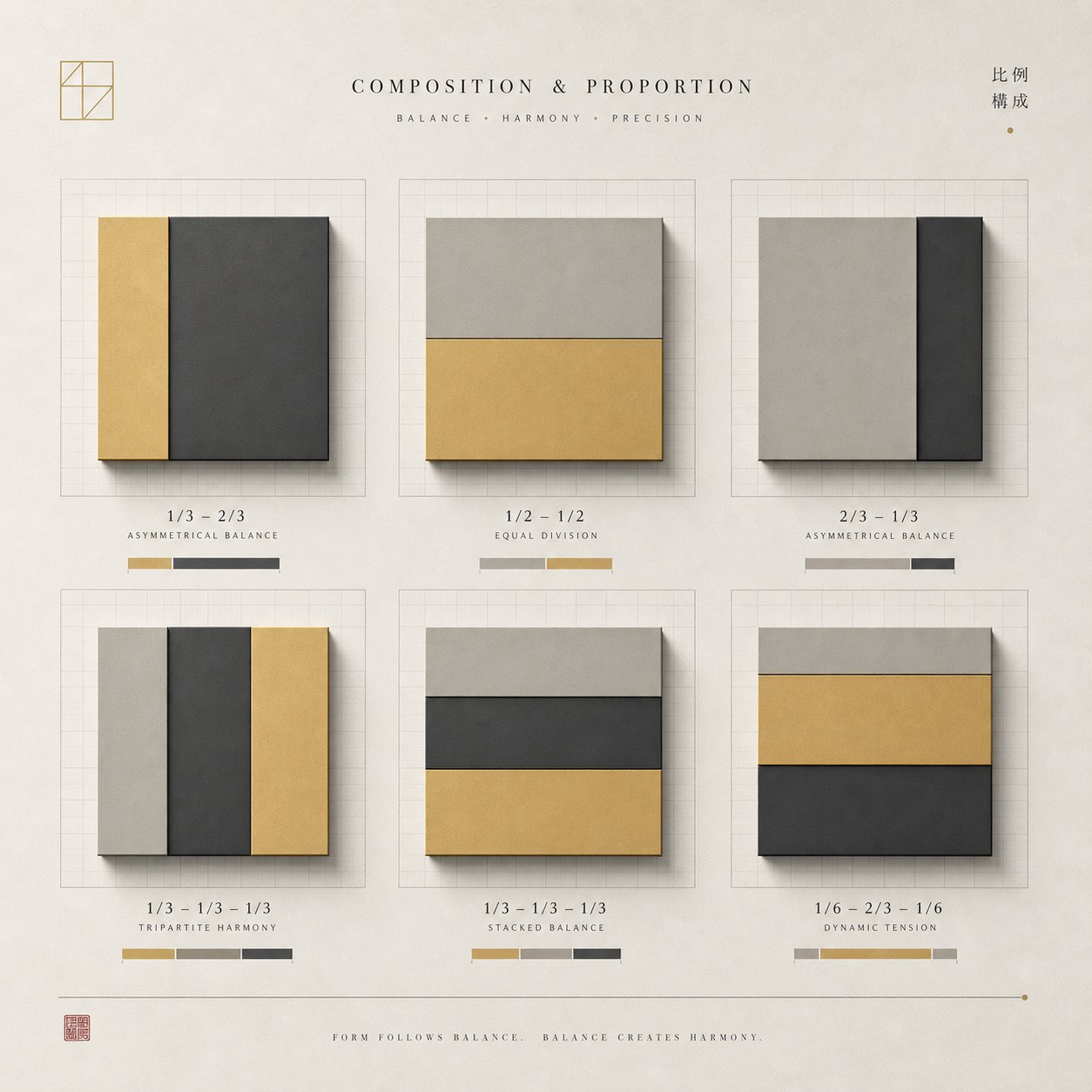
The most important proportion rule for left-right structures: the left component is usually narrower than the right. In many cases, the split follows a one-third to two-thirds ratio, where the left radical compresses into roughly one-third of the square while the right component expands to fill the remaining two-thirds. You can see this clearly in characters like 语 (language), 打 (hit), and 杨 (poplar tree), where the left-side radical narrows itself to give the right component room to breathe.
This ratio is not absolute, though. When the right component has fewer strokes or lacks a dominant horizontal or vertical stroke, the proportions can flip to two-thirds left and one-third right. Characters like 邻 (neighbor) and 彩 (color) demonstrate this reversed ratio, where the bulkier content sits on the left and a slim radical like 阝 or 彡 occupies the right edge.
For top-bottom structures, proportions depend on the visual weight of each component. A general guideline: the component with more strokes or greater complexity gets more vertical space. But shape also matters. Characters with a horizontal stroke or the 人 shape in the middle tend to form a diamond silhouette, as seen in 茶 (tea) and 安 (peace). Characters with a wide bottom component like 心 or 灬 create a trapezoid shape, wider at the base, as in 思 (think) and 烈 (fierce). Characters with a wide top and narrow bottom form an inverted trapezoid, like 宝 (treasure) and 学 (study).
Three-part structures follow their own proportional logic. In left-middle-right characters, the ratio shifts based on which section contains the dominant stroke. When the rightmost component has a strong horizontal stroke, the proportions tend toward 1:1:2, giving that right section extra width. When the right component features a vertical stroke instead, all three parts share space more equally at roughly 1:1:1. Characters like 谢 (thank) and 湖 (lake) illustrate the first pattern, while 例 (example) and 哪 (which) show the second.
Enclosure structures have their own spatial contract: the enclosed component must sit slightly smaller than its frame, with consistent margins on all sides. It should never touch the enclosing strokes. This creates visual breathing room that keeps the character legible. The inner component also centers itself within the available space rather than drifting toward any edge.
How Stroke Order Follows Structure
Here is something that surprises many learners: stroke order is not a separate system you memorize independently. It flows directly from structural layout. Once you identify a character's structure type, you already know the general sequence for writing it.
The core principle is straightforward:
- Left-right structure — write the left component completely before starting the right component
- Top-bottom structure — write the top component completely before starting the bottom component
- Full enclosure — write the outer frame first (left vertical, then top-right corner), fill in the inside, then close the bottom
- Top-three-sides enclosure — write the outer frame first, then the inside content
- Bottom-left enclosure — write the inside content first, then the enclosing radical underneath
These are not arbitrary conventions. They evolved from the physical mechanics of brush writing. When writing in chinese with a traditional brush, the hand moves most naturally from top to bottom and left to right. Completing one component before moving to the next prevents the brush from backtracking across wet ink. The outside-before-inside rule for enclosures establishes the frame so the writer knows exactly how much space remains for the interior content.
The official standard for simplified character stroke order is China's 1997 publication 《现代汉语通用字笔顺规范》 (Modern Chinese Commonly Used Character Stroke Order Standard), issued by the National Language and Character Working Committee. For traditional characters, the Taiwan Ministry of Education maintains its own standard, and Hong Kong follows《香港小学学习字词表》. Minor differences exist between these standards, mostly reflecting historical shifts from vertical to horizontal writing orientation, but the fundamental structural logic remains consistent across all of them.
Beyond the macro-level rules, finer stroke order principles also tie back to structure. Horizontal strokes come before vertical strokes when they cross. Left-falling diagonals come before right-falling diagonals. Center vertical strokes come before outside "wings" in symmetrical characters like 小 and 水. Cutting strokes that pass through a character are written last, as in 中 where the long vertical comes after the enclosure. Each of these rules optimizes for the natural flow of the writing instrument within the structural framework.
Why do these proportion and order rules matter practically? Because when you draw mandarin characters with correct proportions and proper stroke sequence, the result looks balanced and natural without conscious effort. The rules encode visual harmony into the physical act of writing. Learners who skip this understanding often produce characters that are technically correct in their components but visually off, like a face with all the right features in slightly wrong positions.
Writing in chinese language becomes significantly more fluid once you internalize these connections. You stop thinking about each stroke as an isolated decision and start feeling the structural logic guide your hand. The character's layout tells you where to begin, which direction to move, and how much space each part deserves. Proportion and stroke order are not extra rules layered on top of structure. They are structure, expressed through the motion of writing.
This is also why chinese cursive styles remain legible despite their dramatic simplification of strokes. Cursive writers can abbreviate and connect strokes freely because the underlying proportional relationships and structural sequence stay intact. The skeleton of the character, its spatial architecture, persists even when individual strokes blur together. Structure is what holds everything in place.
With proportion rules governing how components share space and stroke order governing how they unfold in time, you have the complete toolkit for writing any character correctly. The remaining question is how to apply all of this when you encounter a character you have never seen before, breaking it down step by step from structure type to radical identification to final stroke sequence.
How to Analyze Any Unfamiliar Character
Encountering a character you have never seen before can feel like staring at a locked door. But with structural analysis as your key, you can decode chinese meanings and symbols systematically rather than guessing or giving up. The process is the same every time, regardless of complexity. You identify the layout, locate the radical, check for transformations, assess proportions, and derive stroke order. Let's walk through this at four increasing levels of difficulty.
Step-by-Step Structural Analysis
Here is the universal process for breaking down any unfamiliar character:
- Identify the overall structure type — Is the character a single indivisible unit, or does it split into zones? Look for vertical dividing lines (left-right), horizontal dividing lines (top-bottom), or enclosing frames.
- Locate the radical — Find the component that provides a semantic clue. Consulting a radicals chinese list helps you match what you see to known meaning categories.
- Note any radical transformations — Has the radical compressed or reshaped from its standalone form? Recognize variant forms like 氵 for 水 or 忄 for 心.
- Determine component proportions — How does each part share the square? Apply the proportion rules: narrower left, wider right for most left-right characters; complexity-based vertical distribution for top-bottom characters.
- Derive stroke order from structure — Let the layout dictate sequence. Left before right, top before bottom, outside before inside for enclosures.
This five-step method works like a decision tree. Think of it as a chinese character tree where each branch narrows your analysis until you reach a complete understanding of the character's architecture. Let's apply it to four real examples.
Example 1: Single-unit character — 永 (yong, eternal)
First glance: can you draw a clean dividing line through this character? No. There is no left-right or top-bottom split. The strokes interlock into one unified form. Structure type: single-unit (独体字). Since it cannot be divided, the entire character functions as its own radical. No transformations apply. Proportions are governed by the internal balance of strokes rather than component relationships. Stroke order follows the standard top-to-bottom, left-to-right flow within the single unit. This character famously contains all basic stroke types, which is why calligraphers use it for practice.
Example 2: Two-component left-right — 清 (qing, clear)
A vertical dividing line clearly separates this character into two zones. Structure type: left-right (左右结构). The left component is 氵, which you recognize as the transformed form of 水 (water). That is your radical, telling you this character relates to liquid or clarity. The right component is 青 (qing), serving as the phonetic element and hinting at pronunciation. Proportions follow the standard one-third left, two-thirds right ratio since the radical is slim and the phonetic component is more complex. Stroke order: complete the three dots of 氵 first, then write 青 from top to bottom.
Example 3: Three-part character — 谢 (xie, thank)
This character has three distinct vertical sections. Structure type: left-middle-right (左中右结构). The leftmost component is 讠, the transformed form of 言 (speech), serving as the radical. It signals that this character relates to language or communication. The middle component is 身 (body), and the right component is 寸 (inch/measure). All three compress horizontally to share the square. Proportions are roughly equal across the three sections, with slight narrowing on the left radical. Stroke order proceeds left to right: complete 讠 first, then 身, then 寸.
Example 4: Enclosed character — 国 (guo, country)
An outer frame wraps completely around an inner component. Structure type: full enclosure (全包围结构). The radical is the outer frame 囗 (enclosure radical), and the enclosed component is 玉 (jade). No radical transformation occurs here since 囗 only appears in this enclosing role. Proportions require the inner 玉 to sit centered and slightly smaller than the frame, with even margins on all sides. Stroke order follows the enclosure rule: write the left vertical and top horizontal of the frame first, fill in 玉 inside, then close the frame with the bottom horizontal stroke.
Notice how the same five steps apply regardless of complexity. The process scales. Whether you are doing a chinese character lookup in a dictionary or trying to translate chinese symbols you spotted on a sign, this analytical framework gives you a consistent entry point.
Common Structural Mistakes to Avoid
Even with a clear process, certain errors trip learners up repeatedly. Being aware of them saves you from developing bad habits that become harder to fix later.
Mistake 1: Wrong component proportions. This is the most common handwriting error. Learners give equal width to both sides of a left-right character when the left radical should be narrower. Or they make the top and bottom components equal height when one should dominate. The fix: before writing, consciously decide the ratio. Check a chinese characters radicals list with example characters to see how proportions work in practice. Studying printed fonts also helps calibrate your eye for correct spacing.
Mistake 2: Misidentifying the structure type. Some characters look like they could be either top-bottom or single-unit. The character 本 (ben, root/origin) is a single-unit character, not a top-bottom combination of 木 and a horizontal stroke. Similarly, 末 (mo, end) is one indivisible unit despite looking like it could split. The test: can both "halves" stand alone as independent components with their own meanings? If not, you are looking at a single-unit character. Experienced learners note that this confusion between single-unit and compound characters is one of the most persistent analytical errors.
Mistake 3: Confusing similar-looking structures. Characters like 裹 (guo, wrap) and 衷 (zhong, heartfelt) both appear to have top-bottom-enclosure patterns, but their internal divisions differ. 裹 is top-middle-bottom (衣 splits around 果), while 衷 is also a split of 衣 around 中. Learners often mistake these for simple top-bottom characters and write the components in the wrong order. The key is recognizing when a component wraps around another rather than simply sitting above or below it.
Mistake 4: Ignoring radical transformations. Writing the full form 心 when the character calls for the compressed 忄, or using 水 when 氵 is needed, produces characters that look wrong even if the "meaning" is technically present. Each position demands its specific variant form. When you study chinese writing and meaning together, pay attention to which form appears in which position. A reliable chinese characters radicals list will show both standalone and transformed variants side by side.
These mistakes share a common root: rushing to write before completing the analytical step. The five-step process takes seconds once internalized, but skipping it leads to errors that compound over time. Characters written with wrong proportions or misidentified structures become muscle memory, and retraining muscle memory is far harder than building it correctly from the start.
Structural analysis also reveals something powerful about chinese words symbols and meanings: the system is not arbitrary. Every character encodes information about its meaning and pronunciation through its spatial arrangement. The radical's position tells you where to look for semantic content. The phonetic component's position tells you where to look for sound clues. And the overall layout tells you how the character was constructed, connecting you to the logic that generated it in the first place.
This analytical skill transforms how you interact with unfamiliar characters. Instead of seeing an opaque symbol and reaching for a translation app, you can extract partial information immediately. You might not know the exact pronunciation, but you can identify the meaning category from the radical. You might not know the precise meaning, but the phonetic component gives you a pronunciation guess. Structural awareness turns every unfamiliar character from a complete mystery into a partially solved puzzle, and that partial knowledge is often enough to figure out the rest from context.

Practical Benefits of Mastering Chinese Character Structure
That ability to extract partial information from any unfamiliar character is not just an academic exercise. It translates directly into faster learning, better retention, and real confidence when reading Chinese in the wild. Structural awareness pays dividends across every skill you use as a learner, from flipping through a dictionary to writing characters from memory weeks after you first studied them.
Here is what changes when you internalize these patterns:
- Faster dictionary lookup — Knowing what is a radical in chinese and where it sits within a character lets you find entries efficiently. Instead of counting total strokes and scrolling through hundreds of results, you identify the radical, determine its position (left, top, enclosing frame), and jump straight to the correct section. Digital dictionaries use the same logic: handwriting recognition works better when you write components in the structurally correct order.
- Stronger memorization — Structural patterns create logical memory hooks. When you learn that 清 (clear), 请 (please), and 情 (emotion) all share the phonetic component 青 but pair it with different radicals (water, speech, heart), you are building a web of associations rather than memorizing three isolated symbols. Research into effective character memorization confirms that understanding how a character represents sound and meaning reduces the mental work required to retain it long-term.
- Improved handwriting — Correct proportions and stroke order flow naturally from structural understanding. You stop guessing where to start or how much space each part deserves. The layout type tells you the ratio, the component positions tell you the sequence, and the result looks balanced without conscious effort.
- Ability to decode unfamiliar characters — Over 80% of chinese characters are phono-semantic compounds. Recognizing the radical gives you the meaning category. Identifying the phonetic component gives you a pronunciation guess. Even partial accuracy narrows your options dramatically when combined with context.
- Reduced confusion between similar characters — Characters like 清, 晴, 睛, and 精 look nearly identical to untrained eyes. Structural awareness lets you see that each pairs a different radical (water, sun, eye, rice) with the same phonetic element. The radical difference is the meaning difference, and knowing where to look for it prevents mix-ups.
Structural Rules for Dictionary Lookup
How many chinese radicals are there? The traditional Kangxi system uses 214, though modern simplified dictionaries sometimes reduce this to around 200. Either way, that is a manageable number. Learning even the 40 most common radicals and their positional variants covers the vast majority of characters you will encounter in daily reading.
The lookup process becomes almost mechanical once you know the structural rules. See a left-right character? The radical is almost certainly on the left. See a top-bottom character? Check the top component first. See an enclosure? The frame itself is usually the radical. These positional expectations cut your search time dramatically compared to the stroke-counting method that beginners often default to.
For digital tools, structural knowledge still matters. Handwriting input on phones and tablets relies on stroke order to narrow candidates. When you write components in the correct structural sequence, the recognition algorithm identifies your character faster and more accurately. You also develop the ability to describe characters verbally, useful when asking a teacher or native speaker about something you cannot type: "it has the water radical on the left and something that looks like 青 on the right" gets you to 清 instantly.
Using Structure to Memorize and Decode Characters
People often ask how many chinese characters are there, and the answer can feel overwhelming. Estimates range from 50,000 to over 100,000 if you count historical and variant forms. But here is the reframe that structural understanding provides: you do not need to memorize tens of thousands of unique pictures. You need to learn a few hundred components and understand the rules for how they combine. The system is generative, not arbitrary.
Consider how many characters in chinese share the phonetic component 方 (fang): 房 (room), 放 (release), 防 (prevent), 访 (visit), 纺 (spin), 芳 (fragrant). Each pairs 方 with a different radical, and each radical tells you the meaning category. Once you know 方 signals a "fang" sound, every new character containing it becomes partially pre-learned before you even open a textbook. The Hacking Chinese framework calls this building "intuition" for how characters express sound and meaning, and it develops naturally as you pay attention to structural patterns.
So what are chinese symbols called when you break them down this way? They are still called characters, or Hanzi, but your relationship to them changes completely. They stop being opaque symbols and start being transparent assemblies of familiar parts. How many chinese symbols are there stops being a terrifying question and starts being an irrelevant one, because the real number that matters is how many components and patterns you recognize, not how many finished characters you have memorized one by one.
If you are wondering where to focus your effort first, the answer is clear: master left-right structure before anything else. It accounts for the largest share of everyday characters, it is where most radical transformations occur, and it is the layout that phono-semantic compounds overwhelmingly use. Get comfortable identifying the radical on the left and the phonetic element on the right, and you have a working framework for the majority of what you will read.
From there, expand to top-bottom structures, then enclosures. Each new pattern you add multiplies your decoding ability because the same components recombine across different layouts. The radical 氵 works the same way whether it appears in a left-right character like 河 or a more complex three-part character like 湖. The structural position changes, but the semantic signal stays constant.
Chinese character structure rules are not extra information layered on top of character learning. They are the foundation that makes character learning possible at scale. Without them, every new character is an isolated memorization task. With them, every new character is a variation on patterns you already understand. The system was designed to be learnable. Thousands of years of writers, scholars, and educators refined these patterns precisely so that new learners could enter the system and build outward from a finite set of principles. Trust the architecture. It was built for you.
Frequently Asked Questions About Chinese Character Structure Rules
1. What are the main structural layout types in Chinese characters?
Chinese characters follow five primary structural layouts: left-right (左右结构), top-bottom (上下结构), left-middle-right (左中右结构), top-middle-bottom (上中下结构), and single-unit (独体字). Additionally, there are enclosure structures including full enclosure and six semi-enclosure variants. Left-right structure is the most common, accounting for the majority of everyday characters, making it the best starting point for learners.
2. Why do Chinese radicals change shape in different positions?
Radicals transform their appearance to maintain visual balance within the fixed character square. When a radical shares space with other components, it must compress or reshape to fit. For example, 水 (water) becomes 氵 on the left side, and 火 (fire) flattens into 灬 at the bottom. These changes are driven by centuries of calligraphic tradition and the physical mechanics of brush writing, but the semantic meaning of the radical remains constant regardless of its visual form.
3. How does stroke order relate to character structure?
Stroke order is not a separate memorization task but flows directly from structural layout. Left-right characters are written left component first, then right. Top-bottom characters proceed from top to bottom. Enclosure structures follow an outside-before-inside-then-close sequence. These conventions evolved from brush writing mechanics, where completing one component before moving to the next prevents backtracking across wet ink and ensures balanced proportions.
4. How many structural patterns exist for Chinese characters?
The IT and typography world recognizes approximately 12 fundamental spatial configurations for Chinese characters. These include five primary division types (left-right, top-bottom, left-middle-right, top-middle-bottom, and single-unit), a full enclosure type, six semi-enclosure variants, and an overlapping or intersecting structure. This small number of patterns accounts for tens of thousands of characters, demonstrating how systematic the writing system truly is.
5. What is the best way to analyze an unfamiliar Chinese character?
Follow a five-step process: first, identify the overall structure type by looking for vertical or horizontal dividing lines or enclosing frames. Second, locate the radical that provides a meaning clue. Third, check whether the radical has transformed from its standalone form. Fourth, determine component proportions based on the layout type. Fifth, derive stroke order from the structure. This method works consistently regardless of character complexity and turns unfamiliar symbols into partially solved puzzles.