Why Your Chinese Surname Holds the Key to Your Ancestry
Imagine starting a genealogical search with nothing more than a romanized last name and a few family stories about a great-grandfather who arrived on a boat from South China. That is the reality for millions of descendants in the Chinese diaspora. Chinese family tree surname tracking is the research methodology that turns that single surname into a roadmap, connecting you to clan histories, ancestral villages, and lineage records that can stretch back thousands of years.
What Chinese Surname Tracking Actually Involves
At its core, this approach uses Chinese surnames as the primary organizing principle for genealogical research. Unlike Western genealogy, which often relies on vital records and census data, Chinese ancestry research revolves around clan-based documents called jiapu that are organized entirely by surname. Your Chinese last name is not just an identifier passed down through generations. It is a key that unlocks a specific set of clan genealogies, migration histories, and regional archives tied to your lineage.
In Chinese culture, surnames are not mere labels. They are living links to clan histories spanning thousands of years, rooted in filial piety and the deep obligation to honor one's ancestors.
This tradition of ancestor veneration means that Chinese family names were meticulously recorded across dynasties, creating an unbroken paper trail that few other cultures can match.
Why Surnames Are the Key to Chinese Genealogy
Many people exploring my Chinese roots for the first time feel overwhelmed by the language barrier or the sheer age of the records. The good news is that Chinese family tree research has a built-in starting point: your surname. Because clan genealogies are filed by family name and geographic origin, even limited knowledge gives you a workable entry point. Whether you spell it Wong, Huang, or Ng, that surname narrows your search to a specific set of historical documents.
This guide is methodology-first. It works regardless of which platforms or tools you use, focusing instead on the research logic behind tracing Chinese family names from a romanized spelling all the way back to an ancestral village. The process begins with understanding where your surname came from and how it evolved over millennia.
How Chinese Surnames Originated and Evolved Over Millennia
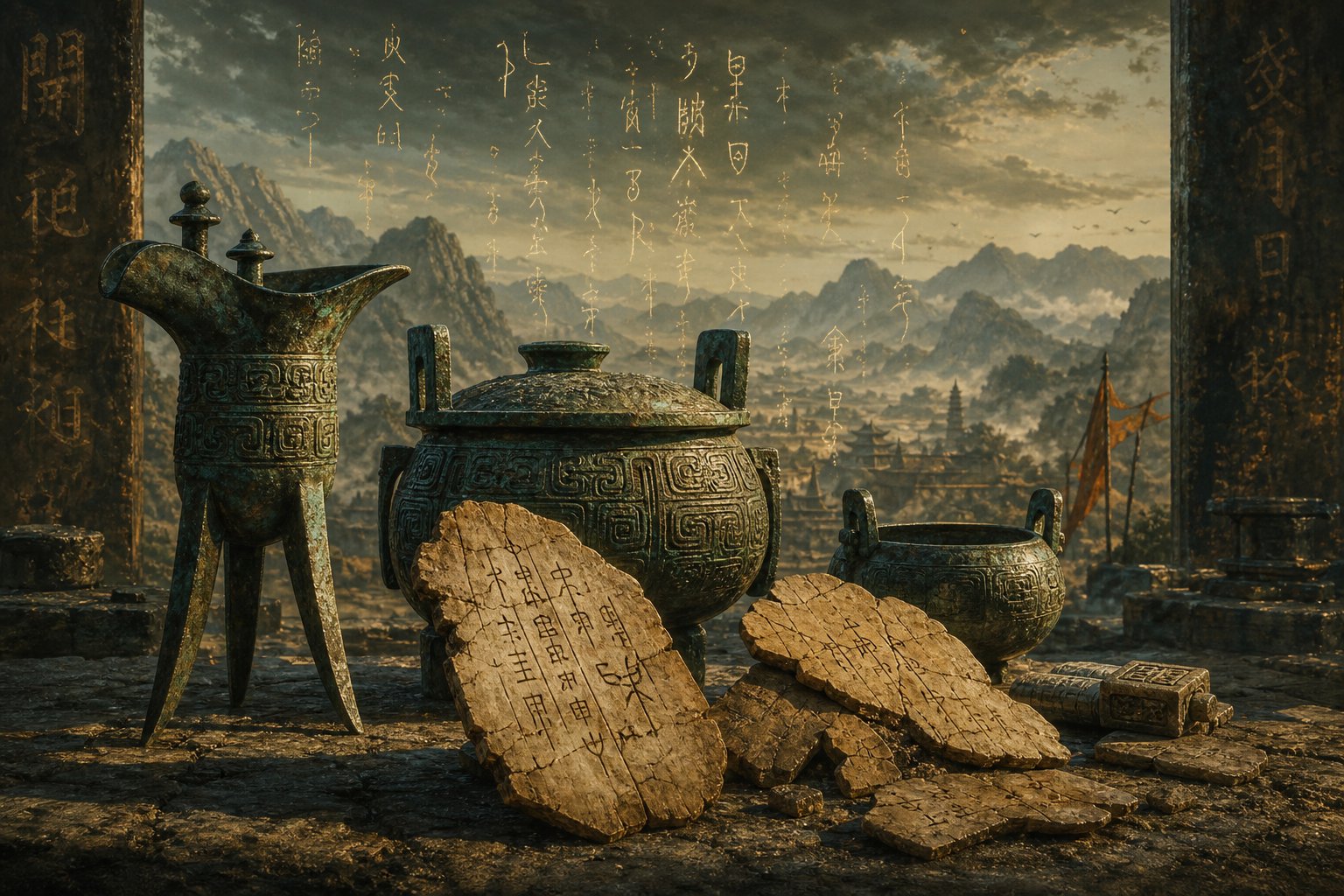
Every Chinese surname carries a story encoded in its characters, one that often traces back to a feudal territory, a royal grant, or an occupation held during the earliest dynasties. Understanding the chinese name origin of your family name is not just academic curiosity. It is a practical research step that tells you where to look for clan records and which historical migrations shaped your lineage.
Ancient Origins of Chinese Surnames
The earliest ancient chinese surnames emerged over 4,000 years ago during the matriarchal period. Historians trace them to Eight Ancient Surnames: Ji (姬), Jiang (姜), Yao (姚), Gui (妫), Si (姒), Ying (嬴), Yun (妘), and Ji (姞). Notice something? Many of these contain the radical for "woman" (女), reflecting their matrilineal origins. These were called xing (姓), meaning clan names tied to bloodline and ancestry.
As populations grew during the Shang and Zhou dynasties, a second layer appeared: shi (氏), or lineage names. These identified a person's present status rather than their deep origin. A shi could derive from a feudal fief, a noble title, a political role, or even a geographic feature near one's home. For example, the Yellow Emperor's surname was Ji (姬), but his descendants who received the fief of Zhou used Zhou as their shi. Others who governed a place called Yang adopted Yang as theirs.
Think of xing as your deep ancestral root and shi as a branch label showing where your particular line settled or what role it played. This dual system meant that dozens of distinct shi could all trace back to a single xing.
How Surnames Evolved Across Dynasties
The Spring and Autumn Period (770-403 BC) and the Warring States Period (403-221 BC) shattered the old feudal order. Vassal states rose and fell, and when a kingdom perished, its people often adopted the state's name as their new surname to honor their origins. The surname Wu (吴), for instance, came from the State of Wu, founded by a Zhou Dynasty royal. After the state collapsed, its people carried the name forward.
By the Han Dynasty (202 BC - 220 AD), the distinction between xing and shi had fully merged into the single-surname system used today. This merger is why understanding chinese surnames and meanings requires looking past the modern character to its deeper historical layers. A single ancient xing like Ji (姬) eventually produced dozens of common modern surnames, including Wang (王), Zhou (周), Wu (吴), Zheng (郑), and Yang (杨), each one tracing back to a specific fief or noble title granted during the Zhou Dynasty.
The meaning of chinese last names often reflects these origins directly. Wang (王) means "king" because Zhou Dynasty royals adopted it after their kingdoms fell. Zhang (张) means "to draw a bow" because the ancestor who received this name invented the bow and arrow. Shi (史) means "historian" because it derived from the occupation of court record-keepers.
Regional Variants and Dialect Splits
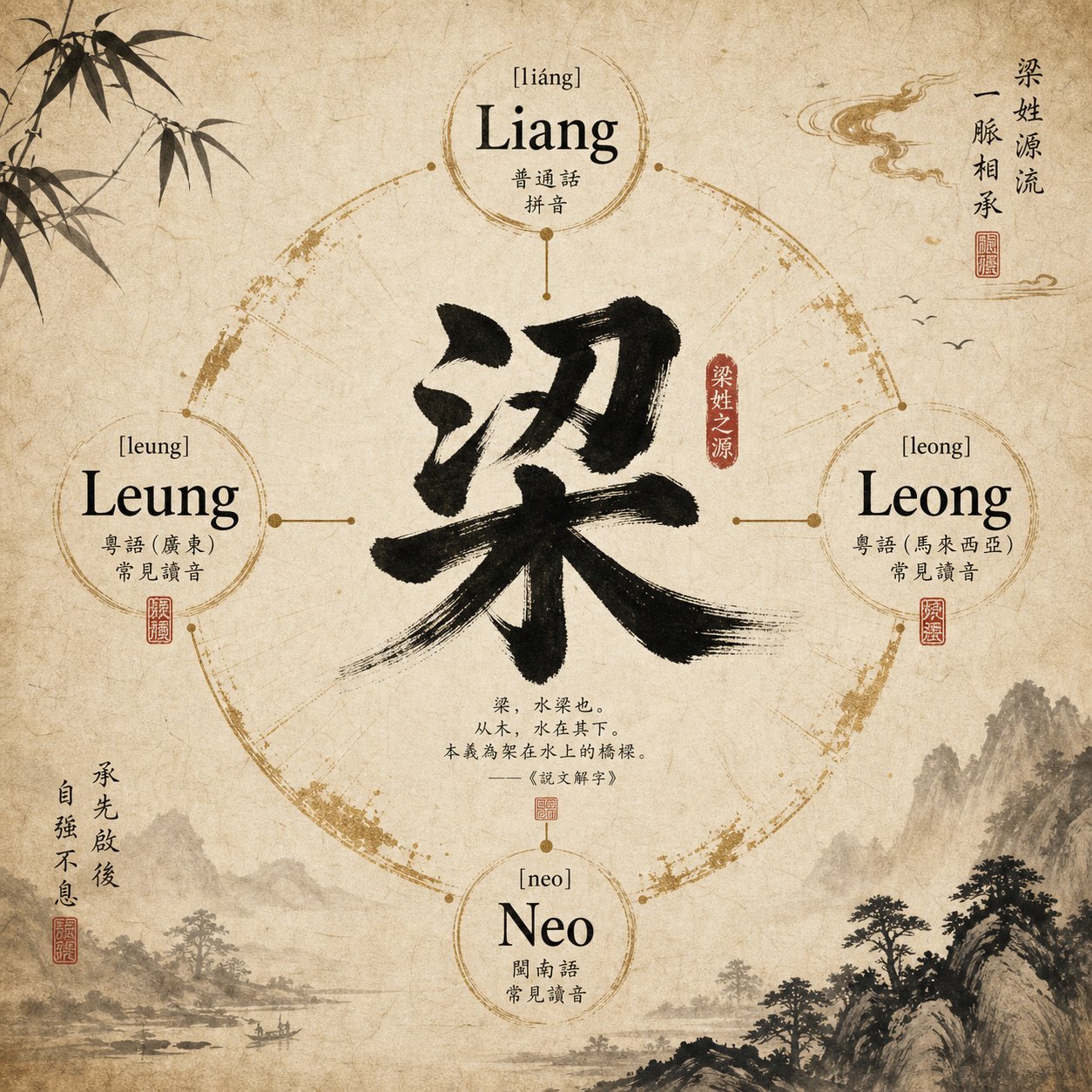
Here is where chinese family names and meanings become especially relevant for diaspora researchers. As populations migrated south across dynasties, the same written character developed radically different pronunciations in regional dialects. A single surname character could sound completely unrecognizable depending on whether your ancestors spoke Mandarin, Cantonese, Hokkien, or Teochew.
| Chinese Character | Mandarin (Pinyin) | Cantonese (Jyutping) | Hokkien (POJ) | Original Meaning |
|---|---|---|---|---|
| 陈 | Chen | Chan | Tan | Display, explain; from State of Chen |
| 黄 | Huang | Wong | Ng / Ooi | Yellow; from ancient territory |
| 林 | Lin | Lam | Lim | Forest; from Shang Dynasty noble |
| 吴 | Wu | Ng | Goh | Vast; from State of Wu |
| 李 | Li | Lei | Lee | Plum; royal surname of Tang Dynasty |
These dialect splits explain why two families with the same ancestral surname can carry completely different romanized last names today. A researcher tracing the surname "Chan" and another tracing "Tan" might be looking at the exact same lineage, just filtered through different dialect pronunciations of 陈. Of the 12,000 surnames recorded throughout Chinese history, about 25 percent remain in use, but the romanization variants multiply that number dramatically for overseas descendants.
This evolution from ancient chinese last names to modern dialect variants is precisely why effective surname research demands you identify not just the romanized spelling but the original character, the dialect group, and the historical period of migration. Each of those layers narrows your search toward a specific clan genealogy and ancestral region.
Chinese Naming Conventions and Generation Poems Explained
Knowing the correct character behind your surname is a critical first step. But Chinese names contain another layer of genealogical data that most researchers overlook: a built-in generational tracking system embedded directly in the name itself.
The Three-Part Structure of Chinese Names
A family name in chinese always comes first, reflecting the cultural priority of lineage over individuality. After the surname, a traditional Chinese name contains two more elements: the generation character and the personal character. Together, these three parts form a compact genealogical statement.
Consider the name Li Yaomin (李耀明). "Li" is the surname. "Yao" is the generation character, shared by all siblings and patrilineal cousins born into the same generation. "Ming" is the personal character, unique to that individual. When you encounter a family tree in chinese records, you will notice brothers and cousins carrying names like Li Yaohui, Li Yaojun, and Li Yaoping. That repeating "Yao" is not coincidence. It is a deliberate marker showing these individuals belong to the same generational tier.
This structure means that even a partial list of chinese family tree names can reveal family relationships at a glance. Siblings and cousins share the generation character, while the personal character distinguishes them from one another.
Generation Poems as Lineage Tracking Tools
Where do these generation characters come from? Most established clans composed a generation poem, called zibei (字辈), that assigned one character per generation in a fixed sequence. Each successive character in the poem represents the next generation. A poem might read something like: "Yi Li Zhi Xin Ren" (义礼智信仁). The first generation uses Yi as their generation character, the second uses Li, the third uses Zhi, and so on.
Imagine you discover that your grandfather's middle character is "Zhi" and a distant relative's is "Xin." You immediately know that relative belongs to the generation after your grandfather's, without needing any other documentation. This is why generation poems function as a fingerprint for a family tree chinese researchers can use to match individuals to specific lineage branches.
These poems typically contain sets of five or seven characters per line, sometimes rhyming, sometimes not. They often express virtuous ideals: characters meaning "loyalty," "wisdom," or "heroic" appear frequently. According to My China Roots, families who set off to form new clan branches placed special importance on the generation poem because it gave their new lineage a sense of legitimacy and connection to the original clan.
Generation poems also vary by location. Two branches of the same surname in different provinces might use entirely different poems, which helps researchers distinguish between unrelated clans that happen to share a family name in chinese genealogical records.
Here is how to identify and use a generation poem within your own family:
- Gather the full Chinese names of as many relatives as possible across multiple generations, including parents, grandparents, uncles, and cousins.
- Look for a repeating character in the same position across names within each generation. Brothers and patrilineal cousins will typically share this character.
- Arrange the shared characters in generational order, from oldest known ancestor to youngest. This sequence is a fragment of your generation poem.
- Cross-reference your fragment against published jiapu records or clan association databases for your surname and region. Even three or four consecutive characters can identify your specific lineage branch.
- Use the matched poem to place unconnected relatives into the correct generational tier, filling gaps in your family tree in chinese names and relationships.
Not every family maintained this tradition. Single-character given names became more common in the mid-twentieth century, and many families, especially in urban areas, stopped using generation characters altogether. Still, if your ancestors came from rural southern China or overseas Chinese communities, there is a strong chance the pattern exists in your family's names, waiting to be recognized.
Generation poems point you toward a specific clan genealogy document. Knowing even a partial sequence gives you a powerful search key for locating the jiapu that records your lineage in full detail.
Mapping Romanized Surnames Back to Chinese Characters
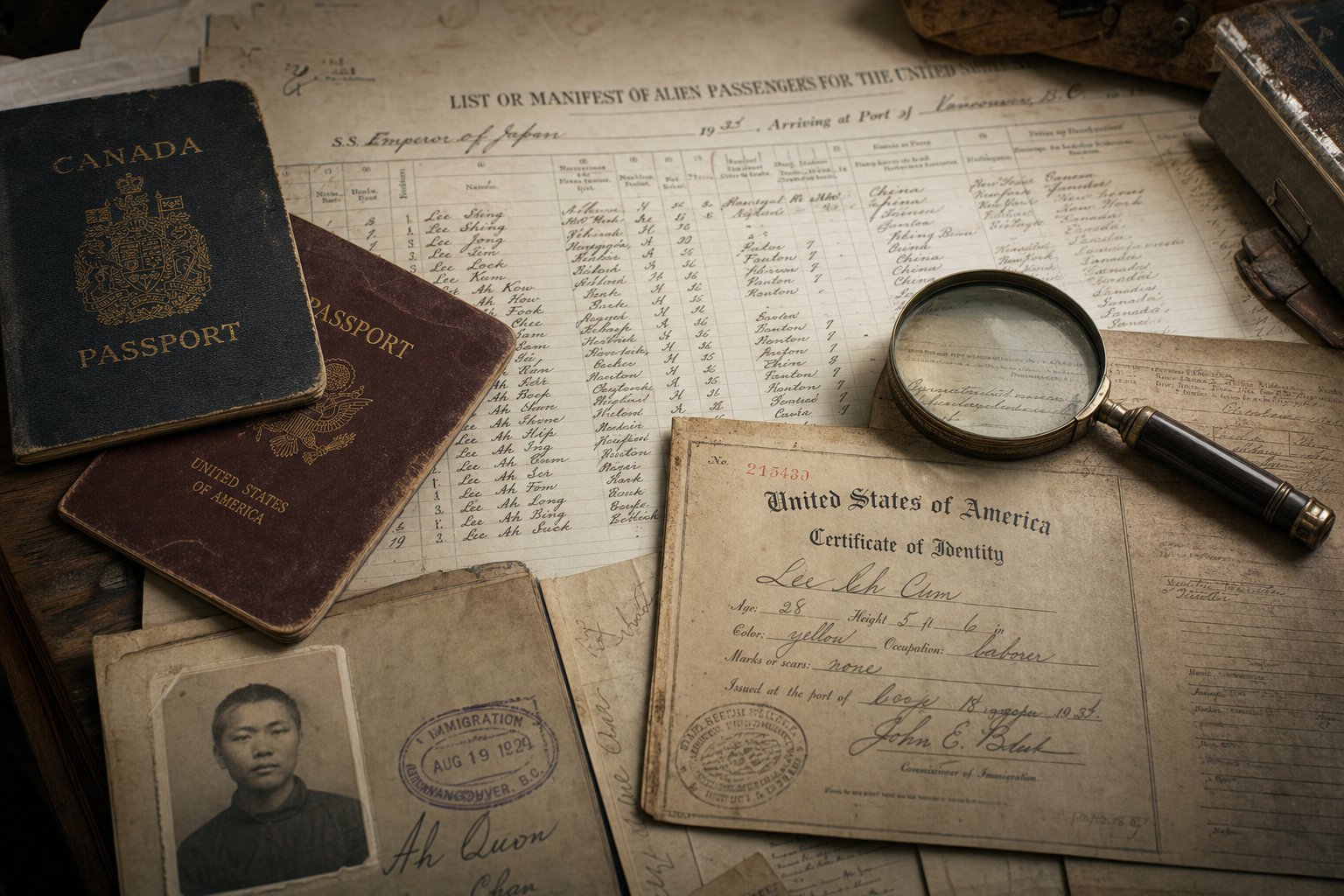
Generation poems and naming conventions only work once you have the correct Chinese character for your surname. For diaspora descendants, that is often the hardest step. You might know your chinese last name as "Chan" or "Tan" or "Chin," but which character does it actually represent? The answer depends on dialect, era of migration, and sometimes the whim of an immigration clerk who wrote down what they thought they heard.
Why One Romanized Name Can Mean Multiple Characters
Chinese is a tonal, logographic language. Multiple characters can share identical or near-identical pronunciations, and a single character can sound completely different across dialects. When those sounds get filtered through a romanization system, the result is a many-to-many mapping problem. One romanized spelling can point to several unrelated surnames, and one chinese surname character can appear under dozens of different spellings.
Consider the romanization "Fung." According to My China Roots, this single spelling corresponds to at least eight distinct characters: 方, 房, 洪, 冯, 范, 凤, 丰, and 封. Each of those characters represents a completely different clan with a separate origin story, separate jiapu records, and separate ancestral villages. Picking the wrong one sends your entire research down the wrong path.
The reverse problem is equally common. The character 陈 alone has been romanized in over 30 different ways, including Chan, Chen, Chin, Tan, Tchen, Tjin, and Zen. A Stanford University study on Chinese record linkage found that the surname 杨 (yang in Pinyin) was variously recorded as Young, Yeo, Yong, Yeung, Yeang, and Yung in historical U.S. census records. Members of the same family, even the same individual at different times, could be recorded with entirely different transliterations of their surname in chinese records.
This is not a minor inconvenience. It is the central obstacle in chinese family tree surname tracking for anyone starting from a romanized name.
Cross-Referencing Wade-Giles, Pinyin, Jyutping, and Hokkien Systems
The confusion multiplies because no single romanization standard existed for most of Chinese history. Different systems emerged at different times, in different regions, for different purposes. When you encounter a romanized chinese name surname in old documents, you need to identify which system produced it before you can trace it back to a character.
Here are the major systems you will encounter:
- Pinyin - The modern standard for Mandarin, adopted by the PRC in 1958. Most post-1980 records from mainland China use this system.
- Wade-Giles - The older academic romanization for Mandarin, common in pre-1979 Western publications and Taiwanese records.
- Jyutping - The standardized system for Cantonese, though many older Cantonese romanizations predate it and follow no formal system.
- Hokkien POJ (Pe-oh-ji) - A romanization system for Southern Min dialects, common among emigrants from Fujian and parts of Guangdong.
The following table shows how the same chinese surname character produces different romanized spellings depending on which dialect and system recorded it:
| Chinese Character | Pinyin (Mandarin) | Wade-Giles (Mandarin) | Jyutping (Cantonese) | Hokkien (POJ) |
|---|---|---|---|---|
| 陈 (Chen clan) | Chen | Ch'en | Can / Chan | Tan |
| 曾 (Zeng clan) | Zeng | Tseng | Zang / Chan | Chan |
| 杨 (Yang clan) | Yang | Yang | Joeng / Yeung | Iunn / Young |
| 黄 (Huang clan) | Huang | Huang | Wong | Ng / Ooi |
| 林 (Lin clan) | Lin | Lin | Lam | Lim |
| 王 (Wang clan) | Wang | Wang | Wong | Ong / Heng |
| 李 (Li clan) | Li | Li | Lei / Lee | Lee |
| 何 (He clan) | He | Ho | Ho | Ho |
Notice how "Chan" appears under both 陈 (Cantonese) and 曾 (Hokkien). If your last name chinese records show as "Chan," you cannot determine the correct character without knowing your family's dialect. Similarly, "Wong" could be 黄 (Cantonese) or 王 (Cantonese), two entirely different clans. Context is everything.
How Surnames Were Altered in Diaspora Countries
Dialect-based romanization is only part of the puzzle. Once Chinese emigrants arrived in their destination countries, local officials, language barriers, and cultural pressures further transformed how a surname in chinese was recorded on paper.
In the Americas, surnames were frequently shortened or anglicized. Immigration officers at Angel Island and Ellis Island wrote down phonetic approximations, sometimes dropping syllables entirely. The Stanford study documented how U.S. census enumerators, "accustomed to European names," recorded Chinese names in "odd ways" with no consistent approach to name order or spelling. Fully 79 percent of Chinese individuals in the 1880 U.S. census were missing either a first or last name in the indexed records.
In Southeast Asia, different patterns emerged. Chinese surnames were adapted to local languages: 陈 became "Trần" in Vietnam, "Tan" in Indonesia and the Philippines, and "Chan" in Thailand. Some families adopted entirely local surnames while keeping their Chinese name for private use. In Malaysia and Singapore, dialect-group romanizations persisted because large Hokkien, Teochew, and Cantonese communities maintained their linguistic identities.
In Europe, transliteration followed yet another logic. French colonial records in Indochina used French phonetic conventions. Dutch records in Indonesia applied Dutch spelling rules. A surname that reads "Tjin" in old Dutch-Indonesian documents likely corresponds to the same character as "Chen" in Pinyin or "Chan" in Cantonese.
These layers of alteration mean that tracing a chinese last name back to its original character requires detective work across multiple systems and historical contexts.
A Methodology for Identifying Your Correct Character
You do not need to master every romanization system. You need a systematic process for narrowing down the possibilities. Here is a practical approach:
- Identify your family's dialect group. Ask older relatives what language was spoken at home. Cantonese, Hokkien, Teochew, Hakka, and Mandarin each produce distinct romanization patterns. Even a single remembered phrase or food term can identify the dialect.
- Check immigration and ship records. Early immigration documents sometimes recorded the Chinese character alongside the romanized name. Chinese Exclusion Act case files, for example, often contain signatures in both formats.
- Cross-reference the romanized spelling against dialect-specific surname databases. Input your spelling into resources that map romanizations to characters by dialect. If "Ho" appears in a Cantonese-speaking family, it almost certainly corresponds to 何. In a Hokkien family, the same spelling might point elsewhere.
- Use the destination country as a filter. If your ancestors settled in Indonesia, Dutch-era romanization conventions apply. If they went to the U.S. before 1950, expect inconsistent phonetic spellings influenced by Cantonese or Taishanese pronunciation.
- Validate against known surname frequency data. Some character mappings are far more common than others. The Stanford study found that "Ho" mapped to 何 in 100 percent of cases in their New York Exclusion File database, while "Fong" split across three different characters with no single dominant match.
- Confirm with clan associations or older family documents. Gravestone inscriptions, ancestral tablets, old letters, and clan association membership records often preserve the original character even when all other records use romanized forms.
Getting the character right is not optional. Every subsequent step in your research, from locating a jiapu to identifying your ancestral village, depends on knowing exactly which surname you are tracing. A single character difference means an entirely different clan, different migration history, and different set of genealogical records.
Single and Compound Surnames and What They Mean for Research
Once you have identified the correct Chinese character for your surname, the next question shapes your entire research strategy: is it a single-character surname or a compound surname? This distinction affects how many clan genealogies you need to sift through, how far back your records might reach, and how precisely you can pinpoint your ancestral origins.
Single-Character vs Compound Surnames
The vast majority of Chinese people carry a single-character surname (单姓). Names like Wang (王), Li (李), Zhang (张), and Chen (陈) are among the most popular chinese last names, each shared by tens of millions of people. The most common chinese surname, Wang, is carried by over 100 million individuals in mainland China alone. When your surname falls into this category, you are working with an enormous pool of potential clan genealogies, which means additional identifiers like dialect, province of origin, and generation poem become essential for narrowing your search.
Compound surnames (复姓) are a different story entirely. These two-character surnames are far rarer, carried by only a few million people combined. China currently has fewer than 100 compound surnames still in active use, down from over 1,000 in ancient times. Ouyang (欧阳) leads the group with over 1.1 million bearers, followed by Shangguan (上官) with roughly 88,000 people, then Huangfu (皇甫), Linghu (令狐), Zhuge (诸葛), Situ (司徒), and Sima (司马).
The origins of compound surnames are remarkably specific, which is what makes them so useful for genealogical research:
- Sima (司马) - Derived from an ancient official title meaning "master of horses," a military position responsible for cavalry and warfare logistics during the Zhou Dynasty.
- Ouyang (欧阳) - A geographic surname meaning "south of Ou Mountain," tracing to the royal family of the State of Yue during the Spring and Autumn Period.
- Zhuge (诸葛) - Combined from the place name Zhu and the surname Ge, originating in the State of Qi. Its most famous bearer, Zhuge Liang, served as strategist during the Three Kingdoms period.
- Shangguan (上官) - Derived from a noble title bestowed during the Warring States period. Tu Lan of the State of Chu received this designation, and his descendants adopted it as their surname.
- Situ (司徒) - From the official title meaning "master of land and people," an administrative role overseeing civil affairs and rituals.
- Linghu (令狐) - A geographic surname from a place called Linghu in the ancient State of Jin, located in modern-day Shanxi province.
Notice the pattern. Compound surnames almost always trace to a specific noble family, official title, or geographic location. This precision is a gift for researchers. If your surname is Zhuge, you are not sorting through hundreds of unrelated clans. You are looking at a single lineage with a well-documented origin point.
Many compound surnames disappeared over the centuries. Some were simplified into single-character forms. Descendants of the Ouyang family, for instance, may carry just Ou (欧) or Yang (杨) today. Others were lost entirely when families had only female offspring and the surname passed out of use. One compound surname, Xushi (许世), reportedly has only a single inheritor remaining, a descendant of a Ceylon prince who settled in Quanzhou during the 15th century.
What Rare Surnames Reveal About Your Lineage
The Hundred Family Surnames (百家姓), a Song Dynasty text compiled around 960 AD, listed 504 surnames in a rhyming poem format. It became the standard reference for Chinese surnames for nearly a thousand years. The poem opens with "Zhao Qian Sun Li" (赵钱孙李), placing the Song imperial surname Zhao first as a mark of political respect rather than frequency. Out of the roughly 12,000 surnames recorded throughout Chinese history, only about 3,000 remain in use today.
If your surname does not appear among the common chinese last names, that rarity is actually an advantage. Here is why: a common surname in china like Li or Wang has hundreds of distinct clan genealogies spread across every province. Identifying which Li clan is yours requires extensive cross-referencing of dialect, region, and generation poem data. A rare or uncommon chinese surname, by contrast, may have only a handful of jiapu in existence. Fewer clans means fewer possibilities, which means faster identification of your specific lineage.
Rare surnames often point to very specific historical events. Some originated from ethnic minority groups who adopted Chinese-style names. Others trace to a single ancestor who changed their surname to escape political persecution or honor a geographic feature. The surname Xie (解), for example, traces to a single fief granted during the Zhou Dynasty in what is now Shanxi province. If you carry that surname, your ancestral search area is already narrowed to a specific region before you even begin.
Uncommon chinese surnames also tend to cluster geographically. Because fewer people carry them, the bearers often remain concentrated near the original ancestral village rather than dispersing widely. This clustering means that surname density maps can pinpoint your family's origin with surprising accuracy when you are working with a rare name.
Whether your surname is shared by a hundred million people or a few thousand, the research logic remains the same: identify the character, determine the dialect, and locate the clan genealogy. The difference is scale. Common surnames demand more filtering. Rare ones hand you a shorter list of possibilities from the start, often leading directly to a single clan document that records your lineage in detail.
Understanding Jiapu Clan Genealogies and Their Structure
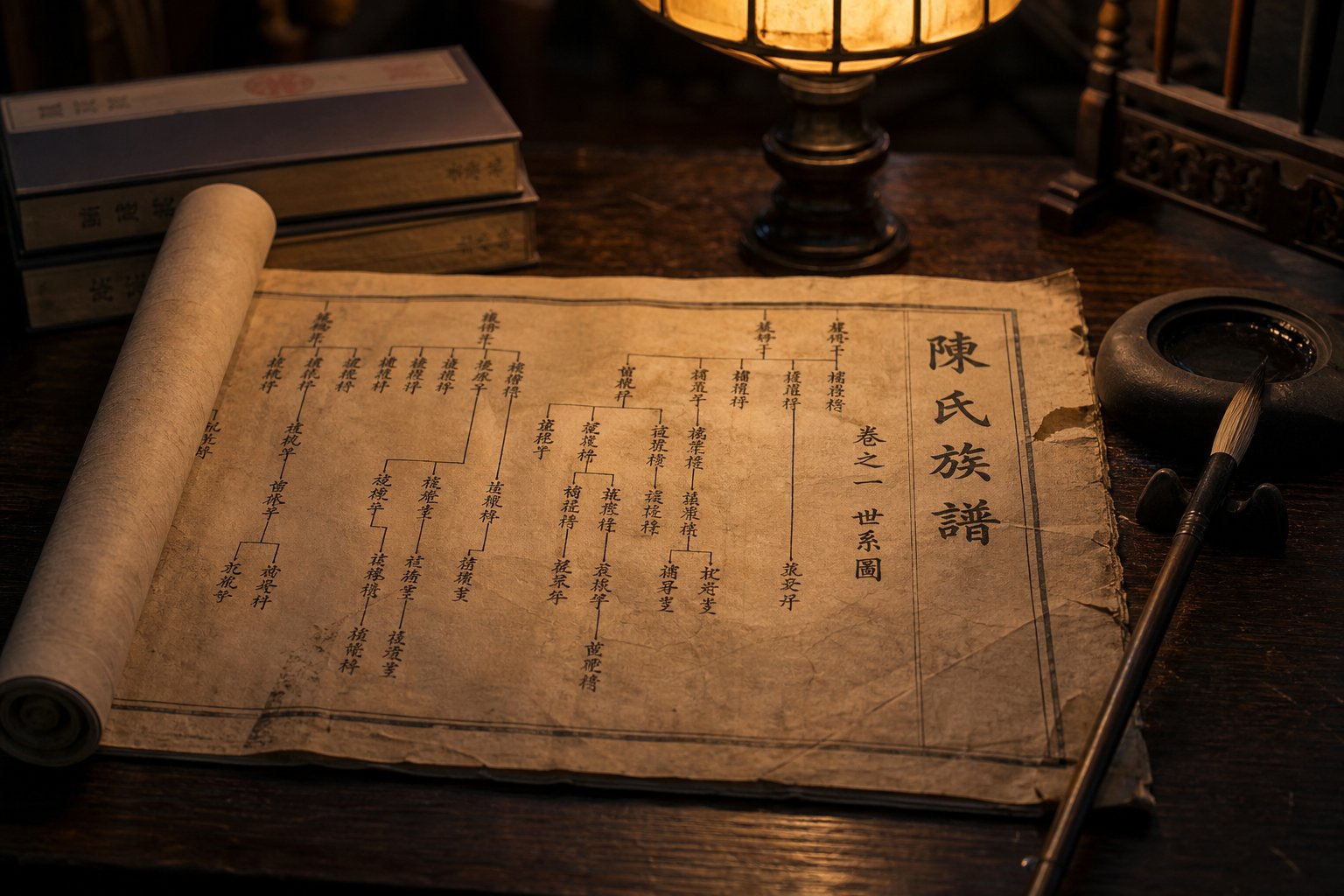
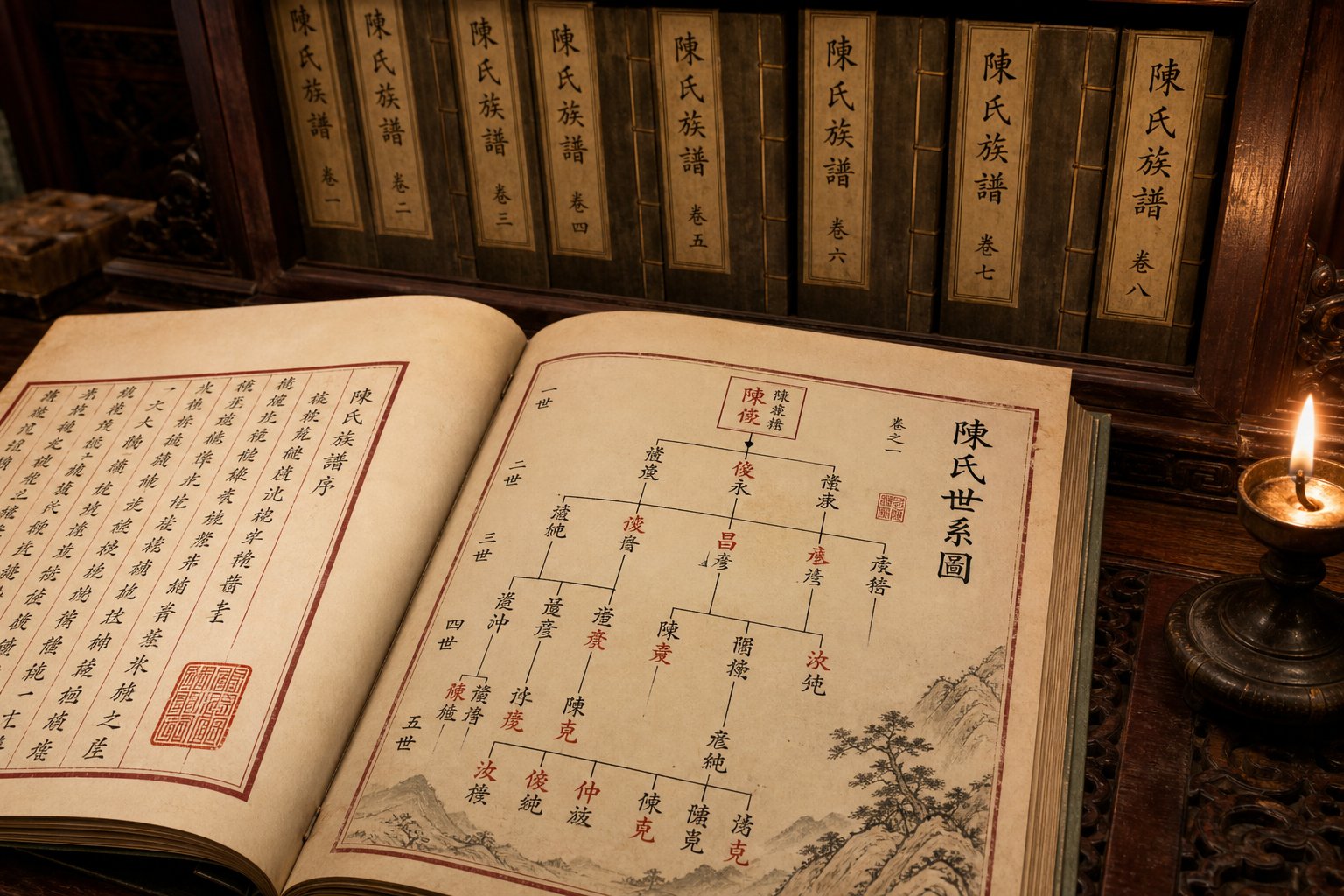
Every step so far, identifying your character, dialect, and generation poem, has been building toward one goal: locating your clan's jiapu. A jiapu (家谱), also called a zupu (族谱), is the single most powerful document in chinese genealogy. It is a comprehensive clan record that traces all descendants from a founding ancestor downward, generation by generation, organized entirely by your chinese family name. Unlike Western genealogies that work upward from an individual, a jiapu starts at the top and maps every branch of the family tree beneath it.
Think of it this way: if your surname is the key, the jiapu is the vault it opens. These documents can span hundreds of years of lineage data, sometimes reaching back 20 or 30 generations. Research from the University of Cambridge confirms that Chinese genealogies gained widespread societal importance during the Ming (1368-1644) and Qing (1636-1912) dynasties, when lineages organized villages, owned collective properties, and supported education and poor relief. Documenting membership based on common descent became essential, leading to widespread compilation across all social classes.
What a Jiapu Contains and How It Is Organized
Every jiapu is different in length and detail, but most follow a recognizable structure. According to FamilySearch's Jiapu Guide, the contents divide into three broad categories: introductions and origins, ancestral and family details, and records and charts. Here is the typical section breakdown:
- Preface (序) - Written by a respected clan elder or invited scholar, this section explains why the jiapu was compiled or updated. It often includes the date of compilation and names of contributors. Multiple prefaces may exist if the document was revised across different dynasties.
- Surname origin narrative (姓氏源流) - Traces the clan's surname back to its earliest known ancestor, explaining how the family name originated and which historical figure founded the lineage. This section connects your specific branch to the broader surname history covered earlier in this guide.
- Migration history (迁徙记录) - Documents where the clan moved over centuries, from the original settlement through each major relocation. For diaspora researchers, this section can reveal the exact village your chinese ancestors left before emigrating overseas.
- Generation poem (字辈/班辈) - The full poem assigning one character per generation. If you identified a partial sequence from your family's names, this section confirms whether you have found the correct jiapu.
- Pedigree chart (世系图) - The core genealogical data. This chart maps every male descendant from the founding ancestor forward, showing parent-child relationships across all generations. Common styles include the Su Style (蘇式), which uses a hanging-pearl layout, and the Ou Yang Style (歐陽式), which arranges entries horizontally.
- Biographical entries (传记) - Short biographies of notable clan members, recording achievements, official positions, and significant life events. Newer jiapu sometimes include entries for ordinary members as well.
- Family rules and teachings (家规/家训) - Codes of conduct governing clan behavior, from marriage expectations to property inheritance guidelines. These reveal the social values your ancestors lived by.
- Ancestral portraits and cemetery maps - Visual records showing the locations of ancestral graves and sometimes painted likenesses of founding ancestors or distinguished members.
- Property records and postscript - Documentation of collectively owned land, ancestral halls, and charitable funds. The postscript notes the circumstances of the compilation's completion.
Reading and Extracting Information from Clan Records
Sounds overwhelming? The good news is you do not need to read the entire document to extract useful genealogical data. The pedigree chart alone can place your known ancestors within the broader lineage. Each entry in the chart typically records a person's given name, generation number, birth and death dates (often by reign year rather than Western calendar), spouse's surname, number of sons, and sometimes burial location.
Traditional jiapu focused almost exclusively on male descendants. Wives were usually recorded only by their maiden surname, and daughters rarely appeared at all. Cambridge researcher Ying Dai notes that this reflects the genealogy's original purpose: answering the question "Who is my father's father's father's... father?" However, a small proportion of contemporary jiapu compiled since the 1980s have begun tracking female descendants and their offspring for one to three generations, reflecting modern values of gender equality.
The pedigree charts come in several visual formats. The Su Style resembles a cascading tree with names hanging like pearls on strings. The Ou Yang Style reads more like a table, with each generation occupying a horizontal row. The Pagoda Style arranges names in a triangular shape widening downward. Recognizing which style your jiapu uses helps you navigate its structure without reading every character.
How to Locate Your Clan Genealogy
Here is the practical question: where do these documents actually exist? Many jiapu were destroyed during China's Cultural Revolution (1966-1976), when genealogies were condemned as relics of feudal culture. Families burned their own records under political pressure. Yet copies survived, often in unexpected places.
Overseas Chinese communities preserved many jiapu that no longer exist in mainland China. Families who emigrated to Malaysia, Singapore, or the United States before the 1960s sometimes carried their clan records with them. FamilySearch notes that "even if someone says your family's jiapu has been lost, there may still be hope" because distant relatives or overseas clan members often retained copies.
Start your search in these locations:
- The Shanghai Library - Holds one of the largest jiapu collections in the world, with a searchable online database organized by surname and region.
- FamilySearch collections - The Family History Library in Salt Lake City houses millions of microfilmed Chinese records, including clan genealogies from various provinces and time periods.
- Clan associations - Surname-based organizations in diaspora communities (especially in Southeast Asia) often maintain their own jiapu copies and can connect you with lineage-specific records.
- Ancestral villages - Local elders, ancestral halls, or village committees sometimes retain jiapu that survived the Cultural Revolution by being hidden or buried.
- University libraries - Academic institutions in China, Taiwan, Japan, and the West hold genealogy collections for scholarly research.
When searching these resources, you will need three pieces of information: your surname character, your ancestral province or county, and ideally a fragment of your generation poem. These three data points together can identify your specific clan's jiapu among the thousands that exist for any given surname.
The genealogy chinese families compiled was never meant to gather dust. It was a living document, updated every few decades to incorporate new generations. If your clan's jiapu has not been revised since the early twentieth century, the trail does not end there. The migration history section within that document often contains the exact geographic clues needed to trace your ancestors' path from their village to wherever they settled abroad.

Tracing Surname Migration Patterns to Your Ancestral Village
A jiapu's migration history section tells you where your clan moved over centuries. But what if you have not yet located your jiapu? What if all you know is a romanized surname, a dialect, or the country your ancestors settled in? Surname distribution patterns across China can work backward from those clues to narrow your search to a specific province, county, or even township.
China last names are not scattered randomly across the map. They cluster in distinct geographic zones shaped by thousands of years of migration, war, and resettlement. Understanding those patterns turns your surname into a geographic pointer.
Major Historical Migration Waves and Surname Distribution
Chinese population history follows a clear directional pattern: north to south, repeated across multiple dynasties. Each wave carried surnames from the Yellow River basin into southern and southeastern China, creating layered settlement patterns that persist today.
The first major wave occurred during the fall of the Western Jin Dynasty (around 311 AD), when northern aristocratic families fled south to escape nomadic invasions. This migration, called the Yongjia Crossing, brought surnames like Wang, Xie, and Liu into the Yangtze River region. A second massive displacement followed the An Lushan Rebellion (755 AD) during the Tang Dynasty, pushing millions further south into Fujian and Guangdong. The third and largest wave came with the fall of the Northern Song Dynasty in 1127, when the imperial court relocated to Hangzhou and millions of northerners followed into Zhejiang, Jiangxi, and beyond.
A study published in the American Journal of Physical Anthropology analyzing 1.28 billion Chinese citizens confirmed that these historical migrations left measurable imprints on modern surname distributions. The researchers found that prefectures in southern China, particularly in Guangdong and Fujian, show power-law-like surname distributions with high concentrations of a few dominant surnames. This pattern reflects geographic isolation and long-term drift in mountainous terrain. Northern prefectures, especially in the northeast, display more even surname distributions shaped by recent large-scale migrations like the "Rush to Northeast" movement of the 19th and 20th centuries.
What does this mean for your research? If your family carries a surname that dominates a specific southern county, your ancestors likely settled there early and stayed put for centuries. If your surname appears evenly across a broad northern region, your lineage may trace to one of the more recent resettlement waves.
Using Surname Density Maps to Narrow Your Search
Surnames in china are not evenly distributed. Chen (陈) is the most common surname in Guangdong and Fujian but ranks much lower in northern provinces. Wang (王) dominates the north but thins out in the deep south. Li (李) clusters heavily in Hebei and Henan. These density patterns reflect centuries of localized population growth from founding ancestors who settled in specific regions.
For diaspora researchers, the practical value is enormous. If you know your surname character and your family's dialect, you can cross-reference those two data points against surname density maps to identify the most likely province of origin. From there, you narrow to a county, and from a county, you search for the specific jiapu that matches your generation poem or other family details.
Research approaches differ significantly depending on which province your ancestors left. The following table maps the major emigration provinces to their dialects, romanization patterns, and typical overseas destinations:
| Province | Primary Dialect(s) | Common Romanization System | Typical Destination Countries | Key Research Notes |
|---|---|---|---|---|
| Guangdong (Pearl River Delta) | Cantonese | Informal Cantonese romanization, Jyutping | USA, Canada, Australia, UK | Cantonese surnames like Wong, Chan, Lau dominate early immigration records in North America |
| Guangdong (Taishan / Sze Yup) | Taishanese (Hoisan Wa) | Non-standard dialect romanization | USA (especially pre-1965), Canada | Cantonese last names from this region use Taishanese pronunciation, not standard Cantonese |
| Fujian (Fuzhou area) | Fuzhounese (Eastern Min) | Foochow Romanized | USA (especially New York), Japan | Large-scale clandestine migration since the 1980s; distinct from Hokkien speakers |
| Fujian (Southern) | Hokkien (Southern Min) | Pe-oh-ji (POJ) | Philippines, Indonesia, Malaysia, Singapore | Mandarin surnames like Tan, Lim, Ong reflect Hokkien pronunciation of common characters |
| Guangdong (Chaoshan) | Teochew | Peng'im, informal romanization | Thailand, Cambodia, Vietnam, Singapore | Teochew romanizations differ from both Cantonese and Hokkien for the same characters |
| Guangdong (Meizhou / Eastern) | Hakka | Informal Hakka romanization | Malaysia, Indonesia, Mauritius, Jamaica | Hakka communities often settled in areas other dialect groups avoided |
| Zhejiang (Wenzhou, Qingtian) | Wu dialects | No standard system; Pinyin-adjacent | Italy, Spain, France, Netherlands | Dominant source of Chinese migration to southern Europe since the 1980s |
| Northern provinces (various) | Mandarin | Pinyin, Wade-Giles | USA, Canada, Australia (post-1980) | Mandarin last names in Pinyin spelling indicate post-reform-era migration |
You will notice a pattern: destination country correlates strongly with province of origin. If your family settled in Thailand, the odds heavily favor Teochew-speaking ancestors from the Chaoshan region of Guangdong. If they went to the Philippines or Indonesia, Hokkien speakers from southern Fujian are the most likely source. Families in Canada and the United States before 1965 overwhelmingly trace to the Sze Yup (Four Counties) area of Guangdong, particularly Taishan.
A Columbia University study on emigration from China confirmed that Fujian province alone accounts for nearly 18 percent of Chinese international migrants, with distinct streams flowing to different destinations. Coastal Fuzhou sent emigrants primarily to the United States, while interior Mingxi county sent them to Europe, especially Italy, Hungary, and Austria. These two streams from the same province carry different dialect markers and different romanization patterns for their china surnames.
This destination-to-origin mapping works in reverse too. If you know your family spoke Cantonese but settled in Peru rather than the United States, that unusual combination narrows your search further. It might point to a specific recruitment wave or labor contract that drew workers from a particular county during a specific decade.
The same study noted that geographic proximity shaped migration routes: Fujianese going to Europe tended to emigrate legally through overland routes, while those heading to the United States relied on clandestine channels due to distance and restrictive policies. These different pathways left different paper trails. Legal European migrants appear in passport records and visa applications. Clandestine U.S. migrants show up in exclusion case files, coaching papers, and sometimes only in community oral histories.
Knowing which trail to follow depends entirely on identifying the correct province of origin. And identifying the province depends on the clues embedded in your surname's romanization, your family's dialect, and the country where they ultimately settled. Each of those data points eliminates possibilities until you are left with a manageable search area, one where a specific clan genealogy and ancestral village can finally be located.
Of course, locating the right province and even the right county still leaves a practical challenge: most of these records are written entirely in Chinese. For descendants who do not read the language, navigating databases, archives, and clan documents requires a different set of strategies altogether.
Navigating Chinese Genealogical Records Without Reading Chinese
You have identified your surname character, narrowed your ancestral province, and maybe even pinpointed a likely county of origin. Then you open a genealogical database and every field, every menu, every record is in Chinese. For millions of diaspora descendants, this is where the trail goes cold. It does not have to.
The language barrier is real, but it is not insurmountable. Researchers who cannot read Chinese have been successfully tracing their lineages for decades using a combination of technology, community resources, and professional help. The key is knowing which strategies work for which situations and how to prepare before you start.
Practical Strategies for Non-Chinese Speakers
You do not need fluency. You need a handful of recognizable characters, the right digital tools, and a willingness to lean on communities that have already solved many of these problems. Here are the most effective approaches:
- Use browser-based translation on genealogical databases. Tools like Google Translate's browser extension can render entire Chinese-language websites into rough English. The translations are imperfect, but they make navigation possible. The Shanghai Library's jiapu database, for example, becomes usable once you can read the search fields and filter options. Copy-paste your surname character into the search box and let the translated interface guide you through the results.
- Learn to recognize 15 to 20 key genealogical characters. You do not need to read Chinese fluently. Historical records are highly formulaic. If you can spot characters for "born" (生), "died" (卒), "married" (配), "son" (子), "daughter" (女), "first" (长), "second" (次), and your own surname, you can extract the core data from a pedigree chart. FamilySearch maintains a Chinese Genealogical Word List specifically designed for researchers who need to decode records without full language proficiency.
- Leverage clan associations in diaspora communities. Surname-based organizations exist in nearly every city with a significant Chinese population. A Wong clan association in San Francisco, a Tan family association in Singapore, or a Lin lineage society in Manila often maintains its own records, connects members with shared ancestry, and can help interpret documents. These groups frequently have bilingual members who bridge the language gap.
- Connect with surname-specific research groups online. Facebook groups, Reddit communities, and dedicated forums exist for many common surnames. Searching for your surname character alongside terms like "genealogy" or "jiapu" often surfaces active communities where members share translations, compare generation poems, and help newcomers navigate records. A comprehensive list of chinese last names organized by romanization and character can help you find the right group even if you only know the romanized spelling.
- Use AI-powered translation for handwritten documents. Older jiapu are often handwritten in classical Chinese, which standard translation tools struggle with. However, newer AI tools can now process photographs of handwritten text with increasing accuracy. Upload a clear photo of a jiapu page and you may get a workable rough translation, enough to identify names, dates, and relationships even if the literary passages remain opaque.
- Cross-reference with digitized collections that offer English interfaces. FamilySearch's China Collection of Genealogies (1239-2014) provides browsable images with English-language metadata. You can search by surname and location without reading Chinese, then examine the actual document images with translation assistance.
These approaches work best in combination. Use translated databases to identify promising records, learn enough characters to confirm you are looking at the right document, then bring specific pages to a community group or professional for detailed interpretation.
Working with Genealogical Researchers in China
Sometimes technology and community support are not enough. If your research requires visiting archives, interviewing village elders, or reading through hundreds of pages of classical Chinese text, hiring a professional genealogical researcher in China becomes the most efficient path forward.
This is where many people feel uncertain. How do you find a reliable researcher? How do you communicate what you need? How do you evaluate their work when you cannot read the source material yourself?
Start by understanding what these researchers actually do. A professional genealogist in China can visit county archives, locate jiapu held in private hands, photograph ancestral graves, interview elderly villagers who remember oral family histories, and translate relevant sections of clan documents into English. Some specialize in specific provinces or dialect groups, which matters because local knowledge and dialect fluency dramatically affect their ability to access records and communicate with village sources.
To evaluate potential researchers, look for these indicators:
- Specific experience with your surname's province of origin, not just general Chinese genealogy expertise
- Willingness to provide sample translations or previous work examples
- Clear communication about what is achievable versus what is speculative
- Transparent pricing, typically structured as a flat fee for initial research plus additional fees for fieldwork or extended searches
- References from previous clients, ideally other diaspora descendants who faced similar language barriers
Clan associations and online genealogy communities are often the best source of researcher recommendations. Members who have already completed their own searches can point you toward professionals who delivered results and away from those who did not.
Before you engage a researcher, prepare everything you already know. The more information you provide upfront, the less time and money gets spent on preliminary work you could have done yourself. Gather the following:
- Your surname in Chinese characters, if identified, along with any alternative romanizations your family has used
- The dialect your family spoke, even if you only know it from food terms, holiday customs, or a few remembered phrases
- Immigration documents, ship manifests, or exclusion case files that mention places of origin
- Any known generation names or fragments of a generation poem
- Names and birth years of the oldest ancestors you can identify
- The destination country and approximate decade of emigration
- Photographs of ancestral tablets, gravestones, or old letters that contain Chinese characters
A researcher armed with this package can skip weeks of preliminary investigation and move directly to locating your specific clan's records. Without it, they are starting from scratch, which costs more and takes longer.
Key Resources for Starting Your Surname Research
Whether you work independently or hire help, certain resources serve as reliable starting points for chinese family tree surname tracking regardless of your language ability. The landscape of available tools has expanded significantly, and knowing where to begin saves considerable time.
For identifying your surname character and its variants, a chinese surnames list organized by romanization system is essential. Several online databases map romanized spellings to their possible character matches across Cantonese, Hokkien, Hakka, and Mandarin. These let you input "Tan" or "Wong" and see every character that romanization could represent, along with the dialect context for each match.
For locating clan genealogies, the major repositories include:
- Shanghai Library Genealogy Database - The largest single collection, with over 30,000 jiapu titles searchable by surname and region
- FamilySearch Historical Records - Millions of microfilmed Chinese records including clan genealogies, immigration files, and vital records, many with browsable digital images
- National Library of China - Holds genealogies and local gazetteers that complement jiapu research
- Clan association archives - Particularly strong for overseas Chinese lineages that maintained records independently of mainland collections
- University special collections - Columbia University, the University of British Columbia, and several Japanese universities hold significant Chinese genealogy collections
For immigration records that bridge the gap between your overseas family and their Chinese origins, look to the national archives of whichever country your ancestors entered. U.S. National Archives hold Chinese Exclusion Act case files with detailed family information. The National Archives of Australia, Canada, and the UK each maintain their own collections of Chinese immigration records, often containing birthplace details and sometimes Chinese-character signatures.
A list of chinese last names cross-referenced with their geographic concentrations, dialect pronunciations, and known clan genealogy locations would be the ideal single resource. No perfect version exists yet, but combining a chinese surname list database with FamilySearch's catalog and the Shanghai Library's holdings gets you close. Each resource fills gaps the others leave.
The language barrier feels like a wall, but it is more like a series of locked doors. Each strategy you apply, whether it is learning a few characters, joining a clan association, using translation technology, or hiring a professional, opens another door. Most successful researchers use all of these approaches at different stages, starting with what they can do independently and bringing in specialized help when they hit a document or archive that demands it.
Frequently Asked Questions About Chinese Family Tree Surname Tracking
1. How do I find the Chinese character for my romanized surname?
Start by identifying your family's dialect group, as the same romanized spelling can correspond to multiple Chinese characters depending on whether your ancestors spoke Cantonese, Hokkien, Hakka, or Mandarin. For example, 'Chan' could represent either 陈 (Cantonese) or 曾 (Hokkien). Cross-reference your spelling against dialect-specific surname databases, check immigration records that may contain Chinese-character signatures, and consult clan associations or gravestone inscriptions that often preserve the original character. Knowing your family's destination country and approximate migration era also helps narrow the possibilities, since different romanization conventions applied in different regions and time periods.
2. What is a jiapu and how can it help trace my Chinese ancestry?
A jiapu (家谱) is a comprehensive clan genealogy document organized by surname that traces all descendants from a founding ancestor downward across generations. It typically contains a surname origin narrative, migration history, generation poems, pedigree charts with birth and death dates, biographical entries of notable members, and family rules. Jiapu can span 20 to 30 generations and are held in repositories like the Shanghai Library, FamilySearch collections, clan associations, and sometimes ancestral villages. Locating your clan's jiapu requires knowing your surname character, ancestral province, and ideally a fragment of your generation poem.
3. What are generation poems and how do they work in Chinese genealogy?
Generation poems (字辈 or zibei) are pre-composed sequences of characters where each character is assigned to one generation within a clan. Every person born into that generation uses the assigned character as their middle name. For instance, if the poem reads 'Yi Li Zhi Xin Ren,' the first generation uses Yi, the second uses Li, and so on. By identifying the repeating middle character across siblings and cousins in your family, you can reconstruct a fragment of your poem and use it to match your lineage to a specific jiapu, determine generational relationships between relatives, and distinguish your clan branch from others sharing the same surname.
4. Can I research my Chinese family tree if I don't read Chinese?
Yes. Effective strategies include using browser translation tools on Chinese genealogical databases, learning 15 to 20 key genealogical characters like those for 'born,' 'died,' and 'married,' joining surname-based clan associations that often have bilingual members, and connecting with online research communities for your specific surname. AI-powered translation tools can now process photographs of handwritten jiapu pages with increasing accuracy. For deeper research requiring archive visits or classical Chinese interpretation, hiring a professional genealogical researcher in China who specializes in your ancestral province is the most efficient option.
5. How does knowing my family's dialect help with Chinese surname research?
Your family's dialect is one of the most powerful clues for narrowing your ancestral origins. Dialect determines how your surname character was romanized, which province your ancestors likely came from, and which destination countries they typically emigrated to. Cantonese speakers predominantly left from the Pearl River Delta for North America and Australia. Hokkien speakers emigrated from southern Fujian to Southeast Asia. Teochew speakers went mainly to Thailand and Cambodia. Even a few remembered food terms or phrases can identify the dialect, which then points you toward the correct romanization system, the right geographic search area, and the appropriate clan genealogy collections.