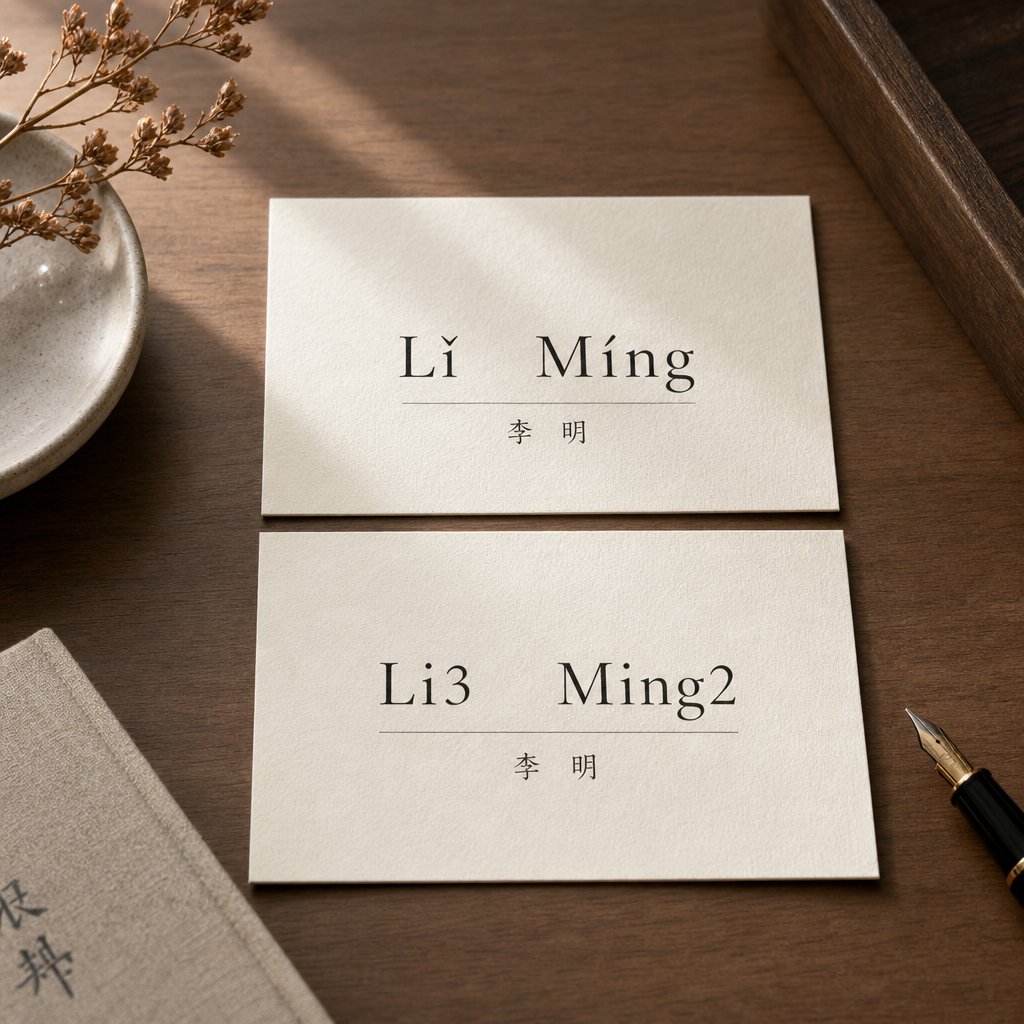
Why the Same Chinese Name Gets Spelled Multiple Ways
Imagine pulling out your passport, birth certificate, and university transcript and placing them side by side. Your name is written in Chinese characters on each original document, yet the English spellings tell three different stories. Your passport reads "Chen Wei-Lin," your birth certificate says "Tan Bee Leng," and your diploma lists "Chan Wai Lam." Same person. Same Chinese characters. Three completely different romanized versions. If this sounds familiar, you are dealing with one of the most persistent identity documentation challenges faced by Chinese-speaking communities worldwide.
What Chinese Name Romanization Inconsistency Means
Chinese name romanization inconsistency is the phenomenon where identical Chinese characters produce multiple Latin-alphabet spellings depending on the dialect spoken, the romanization system applied, the historical era of the document, and the jurisdiction where it was issued.
This is not a translation error in the traditional sense. The romanization of Chinese names involves converting characters that carry meaning and sound into alphabetic letters that approximate pronunciation. The problem is that no single standard has ever governed this process universally. Mandarin, Cantonese, Hokkien, and Hakka speakers all pronounce the same characters differently. Governments in mainland China, Taiwan, Hong Kong, Singapore, and Malaysia have each adopted their own conventions at different points in history. The result is a landscape where one person's name can legitimately appear in four or five different romanized forms across their official documents.
Who Is Affected by Variant Spellings
This issue touches millions of people. Anyone in the Chinese diaspora whose documents were issued across different time periods, jurisdictions, or dialect communities is likely carrying name discrepancies across their translated documents. First-generation immigrants whose birth certificates reflect one system and passports another. Second-generation individuals whose parents romanized the family surname based on dialect rather than Pinyin. Professionals whose academic credentials use a spelling that differs from their legal identity documents. The scope is enormous, and the consequences range from minor inconvenience to serious legal and administrative complications.
What makes romanized Chinese names particularly prone to variation is the sheer number of competing systems and dialects involved. Unlike languages where a single dominant transliteration standard exists, Chinese name romanization sits at the intersection of linguistic diversity, colonial history, political change, and personal choice. Each of these forces has left its mark on how names appear in the Latin alphabet.
This article breaks down exactly why these inconsistencies exist, what real-world problems they create, and what individuals and institutions can do to manage them. The causes run deeper than most people realize, stretching back through decades of competing romanization systems that each claimed authority over how Chinese characters should be rendered in English.
Historical Romanization Systems Behind the Confusion
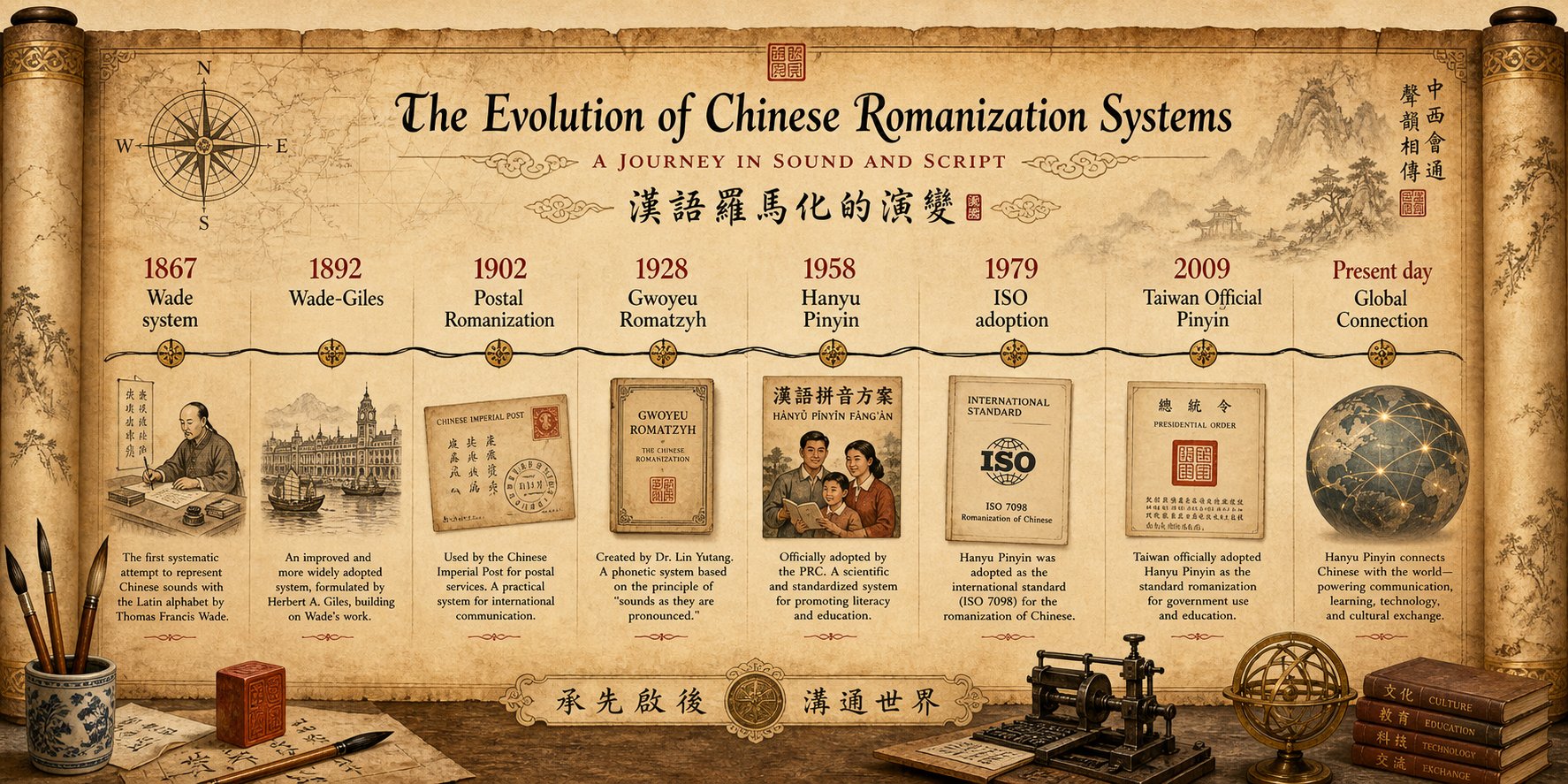
Competing spelling systems did not appear overnight. They accumulated over more than a century of political shifts, colonial governance, and standardization efforts that rarely aligned with one another. Understanding the chinese name pinyin romanization history helps explain why your grandfather's passport spells the family name one way while your own spells it another.
Wade-Giles vs Pinyin and the Great Divide
The Wade-Giles system, devised in 1867 by Thomas Wade and later refined by Herbert Giles, dominated English-language romanization of Chinese names for over a hundred years. Libraries, academic journals, and government documents across the Western world relied on it. If you encounter spellings like "Teng" instead of "Deng" or "Chou" instead of "Zhou," you are looking at Wade-Giles conventions still embedded in someone's identity documents.
In 1958, the People's Republic of China announced the adoption of Hanyu Pinyin, a system that had been two decades in development. International recognition followed gradually. The United Nations adopted Hanyu Pinyin in 1986 as its official romanization standard, and libraries, museums, and educational organizations worldwide shifted their cataloging systems accordingly. This created a clear before-and-after line: documents issued before the late 1970s almost certainly used Wade-Giles or pinyin system of romanization for chinese names, while newer PRC-issued documents use Hanyu Pinyin exclusively.
The problem? Millions of people had already built legal identities, property records, and professional credentials under the older system. A wade-giles to pinyin chinese name conversion is not just a linguistic exercise. It means reconciling decades of paperwork that no longer matches current standards.
Colonial and Regional Systems That Persist Today
Taiwan's romanization journey adds another layer. During the Democratic Progressive Party era, the government promoted Tongyong Pinyin as an alternative that could handle Hoklo and Hakka alongside Mandarin. Street signs, official documents, and tourism materials adopted this system. Then in 2009, the government transitioned back to Hanyu Pinyin, leaving a generation of documents carrying Tongyong spellings that differ from both Wade-Giles and standard Pinyin. The result, as one observer noted, was a "hodge-podge" of competing systems visible even on city street signs.
Hong Kong followed yet another path entirely. Under British colonial administration, the government developed its own romanization conventions based on Cantonese pronunciation rather than Mandarin. These spellings remain standard on Hong Kong identity cards and passports today. Macau's Portuguese-influenced system produced still different results, rendering the same characters through a Lusophone phonetic lens.
The table below illustrates how a single romanization chinese name can look completely different depending on which system was applied:
| Chinese Character | Hanyu Pinyin | Wade-Giles | Hong Kong Government |
|---|---|---|---|
| 張 | Zhang | Chang | Cheung |
| 黃 | Huang | Huang | Wong |
| 李 | Li | Li | Lee |
| 周 | Zhou | Chou | Chow |
| 謝 | Xie | Hsieh | Tse |
You will notice that some characters produce nearly identical results across systems while others diverge dramatically. The surname 謝, for instance, becomes "Xie," "Hsieh," or "Tse" depending entirely on which authority issued the document and when.
Older generations carry these legacy spellings because their documents were issued under systems that no longer hold official status. Changing a legal name is expensive, bureaucratically complex, and emotionally fraught. Many people simply live with the mismatch, which means the inconsistency perpetuates itself across family lines and institutional records. The systems may have changed, but the names on existing documents did not change with them.
These system-level differences only tell part of the story. The same character can also sound completely different depending on which Chinese dialect the speaker uses, and that phonetic reality has produced an even wider range of spelling variants across diaspora communities.
How Dialect Differences Multiply Spelling Variants
Romanization systems get most of the blame for spelling chaos, but dialect is the deeper engine driving variation. Mandarin is only one of many Chinese languages. Cantonese, Hokkien, Teochew, and Hakka speakers pronounce the same written characters in fundamentally different ways, and when those pronunciations get written down in Latin letters, the results look like entirely unrelated names. Two people sharing the exact same surname character can carry romanized Chinese names that appear to have nothing in common.
Consider the character 王. In Mandarin it is "Wang." In Cantonese it becomes "Wong." Hokkien speakers pronounce it "Ong," and Teochew speakers say "Heng." These are not alternate spellings of the same sound. They are genuinely different pronunciations rooted in distinct phonological systems that diverged centuries ago. When romanizing Chinese names, the dialect spoken at the time of document creation determines the spelling far more than any official standard does.
Cantonese Romanization and Hong Kong Naming Conventions
Cantonese has its own rich phonetic landscape, with six practical tones and a syllable structure that includes final consonants like -p, -t, and -k that Mandarin lost long ago. These features produce romanized spellings that look nothing like their Pinyin equivalents. The surname 謝 is "Xie" in Mandarin Pinyin but "Tse" in Cantonese. The surname 張 is "Zhang" in Mandarin but "Cheung" in Cantonese. The phonetic gap is enormous.
Several competing systems exist for writing Cantonese in Latin letters. Jyutping, developed by the Linguistic Society of Hong Kong, is considered the most consistent and scientifically rigorous system available. It uses predictable letter-to-sound mappings and handles tones systematically. The older Sidney Lau system, designed for adult learners in the 1970s, uses a different notation style and remains familiar to many Hong Kong residents who studied it in language courses.
Neither system, however, is what actually appears on most Hong Kong identity documents. The Hong Kong government uses its own informal romanization conventions that predate both Jyutping and Sidney Lau. These conventions were established during the colonial era and remain standard on ID cards and passports. A person born in Hong Kong will carry a romanized Chinese name based on Cantonese pronunciation rendered through this government system, not Pinyin, not Jyutping, and not any other formal linguistic standard. The result is a spelling that reflects spoken Cantonese but follows no published rulebook that outsiders can easily reference.
Hokkien, Teochew, and Hakka Spelling Patterns
Move south and southeast from Guangdong, and the variation multiplies further. Hokkien, spoken widely in Fujian province, Taiwan, and across Southeast Asian Chinese communities in Singapore, Malaysia, the Philippines, and Indonesia, has its own romanization tradition. The Pe̍h-oe-ji system, developed by Presbyterian missionaries in the 19th century, provides a structured way to write Hokkien in Latin letters. It uses diacritics and specific letter combinations that differ sharply from both Pinyin and Cantonese romanization.
Teochew, closely related to Hokkien but distinct in pronunciation, produces yet another set of spellings. Hakka, spoken in scattered communities across southern China and Southeast Asia, adds its own layer. In practice, most romanized Chinese people names from these dialect groups were never written using any formal linguistic system at all. Immigration clerks, school administrators, and civil registrars in places like Singapore and Malaysia simply wrote down what they heard, using English spelling conventions to approximate sounds that English was never designed to capture.
The following list shows how a single surname character can fragment into multiple spellings depending on dialect:
- 陳 (Chen in Mandarin Pinyin): Chan (Cantonese), Tan (Hokkien/Teochew), Chin (Hakka), Ting (some Hakka sub-dialects)
- 林 (Lin in Mandarin Pinyin): Lam (Cantonese), Lim (Hokkien/Teochew), Lim or Lam (Hakka)
- 黃 (Huang in Mandarin Pinyin): Wong (Cantonese), Ng or Ooi (Hokkien), Ung (Teochew), Vong (Hakka)
- 張 (Zhang in Mandarin Pinyin): Cheung (Cantonese), Teo or Teoh (Hokkien), Tio (Teochew), Chong (Hakka)
- 劉 (Liu in Mandarin Pinyin): Lau (Cantonese), Low (Hokkien), Liew or Lew (Hakka)
- 李 (Li in Mandarin Pinyin): Lee (Cantonese/Hakka), Lee or Lei (Hokkien)
In territories with a sizeable Chinese diaspora like Singapore and Malaysia, the way a family name is spelled functions as a signifier of the region a person's ancestors hail from. A person surnamed "Wong" is understood to have Cantonese heritage, likely tracing roots to Guangdong province or Hong Kong. Someone surnamed "Ong" with the same character is identified as Hokkien, with probable ancestral ties to Fujian. The spelling itself carries cultural and geographic information that community members read instinctively.
This is why most real-world spelling variation among romanized Chinese people names stems from dialect rather than from competing romanization standards alone. Two people can both have perfectly "correct" romanizations of the same character and still end up with names that look completely unrelated on paper. The inconsistency is not an error. It is a faithful record of linguistic diversity, frozen into legal documents at specific moments in time. But that faithfulness creates serious practical problems when modern systems need to match, verify, or link those names across databases and jurisdictions.

Migration Era and Destination Country Effects on Spelling
Dialect and system differences explain why variant spellings exist in theory. But the specific spelling that ends up on any given document often came down to something far less systematic: the moment a person crossed a border, the clerk who processed them, and the country that received them. Chinese name spelling differences tied to immigration are not just linguistic artifacts. They are records of human encounters at specific points in history, shaped by who was asking, who was answering, and what tools either party had available.
Migration Patterns That Shaped Name Spellings
Picture an immigration hall in San Francisco in 1920, or a port authority office in Sydney in 1955. A Chinese migrant arrives carrying documents written entirely in characters. The receiving officer speaks no Chinese. The migrant speaks limited English, possibly none at all. What happens next determines how that person's name will appear on every official record in their new country for the rest of their life.
In many cases, the officer simply listened and wrote down what they heard, using English phonetic intuition to approximate unfamiliar sounds. A Cantonese speaker saying their surname might have it recorded as "Chun," "Chan," or "Chung" depending on the officer's ear, regional accent, and handwriting. There was no standardized reference chart. There was no interpreter in most cases. The result was a romanization shaped as much by the listener's linguistic background as by the speaker's actual pronunciation.
Different destination countries compounded this randomness with their own conventions. British colonial administrators in Malaya and Hong Kong applied English spelling logic. Dutch officials in the East Indies used Dutch phonetics, which is why Chinese surnames spelled differently abroad sometimes carry "oe" where English speakers would write "u." French administrators in Indochina applied yet another phonetic framework. A family that split across multiple migration destinations could end up with entirely different surname spellings in each country, all derived from the same spoken pronunciation filtered through different European language conventions.
Romanization is not purely systematic. It is shaped by human decisions at specific historical moments, where the era of migration, the destination country's language, and the individual clerk's interpretation all converge to produce a spelling that becomes permanent legal identity.
The timing of migration mattered enormously too. Chinese diaspora name romanization variants from the 19th century reflect an era with no international standards whatsoever. Those from the mid-20th century might show partial influence from Wade-Giles if the receiving country's bureaucracy had adopted it. Post-1980 arrivals from mainland China are more likely to carry Pinyin spellings, but only if their documents were issued after the PRC standardized its passport romanization practices. A family that migrated in waves across different decades could accumulate three or four different surname spellings across its members, each one perfectly legitimate for its time and place.
Personal Choice and Adaptation in Diaspora Communities
Beyond bureaucratic happenstance, personal agency played a significant role. Many migrants actively chose to modify their romanized names to function better in their new linguistic environment. A person named "Xu" in Pinyin might adopt "Hsu" or "Shoo" because English speakers could not pronounce the Mandarin "x" sound. Someone surnamed "Ng" in Cantonese might add a vowel and become "Eng" or "Ang" because their new neighbors could not parse a syllable with no vowel at all.
These adaptations were practical survival decisions. A name that employers, teachers, and neighbors could pronounce meant fewer barriers in daily life. Some individuals anglicized further, choosing phonetically similar English names or hybrid constructions. Others maintained their original romanization precisely because it preserved dialect identity and family continuity. Neither choice was wrong, but both contributed to the proliferation of variants within single families and communities.
This is why chinese surnames spelled differently abroad is not always a matter of competing systems or dialect variation. Sometimes siblings carry different romanizations because they migrated at different times, through different ports, processed by different officers. Sometimes a parent changed their own spelling after arrival while the children's birth certificates preserved the original version. Sometimes one branch of a family followed a community convention in their Chinatown while another branch assimilated into a different spelling norm elsewhere.
The cumulative effect is a diaspora where the same Chinese character can appear as five, six, or even more distinct romanized spellings across a single extended family's documents. Each spelling tells a story about when someone moved, where they landed, and what compromises they made to build a life in a new language. These stories are embedded permanently in legal records, and they create a tangle of documentation challenges that modern verification systems were never designed to untangle.

Real-World Consequences of Inconsistent Name Romanization
Those layers of history, dialect, and personal adaptation might seem like interesting linguistic trivia until you try to open a bank account, apply for a visa, or pass a background check. The moment a chinese name mismatch on documents enters a modern administrative system, abstract spelling variation becomes a concrete problem with financial, legal, and professional consequences. Automated systems do not know that "Chan," "Chen," and "Tan" can all represent the same person with the same surname character. They see three different strings of letters and treat them as three different identities.
Identity Verification Failures in Digital Systems
Most identity verification processes today rely on exact or near-exact string matching. When you submit your name for a background check, a visa application, or a financial compliance screening, the system compares what you entered against databases, watchlists, and official records. As identity verification specialists note, businesses must set internal logic called "match requirements" that determine how much variation in a name will still trigger a match. The challenge is a spectrum: strict matching misses legitimate mentions of a person whose name is spelled differently across documents, while loose matching floods the system with false positives.
For someone whose romanized Chinese name appears as "Xie" on their passport but "Hsieh" on their university degree and "Tse" on their Hong Kong birth certificate, this spectrum becomes a trap. Strict systems fail to connect these records to the same person. Loose systems flag them as potential fraud because the variation looks suspicious to an algorithm that cannot distinguish legitimate dialect-based spelling from identity fabrication.
The problem compounds when verification involves transliteration. Converting non-Latin characters into Latin equivalents is, as verification professionals acknowledge, "an extremely complicated process" whose performance "can vary drastically depending on the language." Chinese presents one of the hardest cases because the same character can legitimately romanize into multiple completely different spellings. A system that transliterates 陳 as "Chen" will not automatically recognize "Tan" or "Chan" as equivalent results.
Duplicate identity records are another downstream effect. When a person's name appears differently across government databases, the system may create multiple profiles for the same individual. This fragments their history, making it impossible to pull a complete record when one is needed. Conversely, overly aggressive fuzzy matching can merge records of genuinely different people who happen to share similar-looking romanizations, creating false links that are equally damaging.
Banking, Property, and Legal Document Mismatches
Chinese name spelling inconsistency legal problems extend well beyond inconvenience. When the name on a property deed does not match the name on a current passport, ownership disputes arise. When a bank account was opened under one romanization and the account holder later renewed their passport with a different spelling, access to funds can be frozen until equivalence is proven. These are not hypothetical edge cases. They are routine experiences for people whose documents span multiple romanization conventions.
Here are specific scenarios where inconsistency causes measurable harm:
- Denied visa applications: Immigration authorities reject applications when the name on supporting documents (bank statements, employment letters, property titles) does not exactly match the passport name.
- Frozen bank accounts: Financial institutions flag accounts for review when identity documents presented at renewal or for large transactions carry a different spelling than the original account registration.
- Rejected insurance claims: Insurers deny payouts when the policyholder's name does not match the name on medical records, death certificates, or beneficiary designations.
- Failed employment verification: Background check services cannot confirm work history when previous employers recorded a different romanization than what appears on the candidate's current identification.
- Academic credential rejection: Universities and professional licensing boards refuse to validate transcripts when the name on the degree does not match the applicant's legal identity documents.
- Property transfer complications: Land registries block sales or inheritance transfers when deed names and current identification carry different spellings of the same Chinese name.
What makes these failures particularly frustrating is that the person has done nothing wrong. They did not misspell their own name. They did not commit fraud. They simply exist at the intersection of multiple legitimate romanization conventions, and the systems processing their documents lack the contextual understanding to recognize that. A human reviewer familiar with Chinese naming conventions would immediately see that "Wong" and "Huang" can represent the same character. An automated system sees two unrelated five-letter strings and flags a discrepancy.
The gap between human contextual knowledge and machine string-matching logic is where most of the damage occurs. Organizations that process identity documents at scale, including banks, immigration agencies, insurers, and universities, increasingly rely on automated verification pipelines that were designed for populations where one person carries one consistent name spelling across all records. That assumption breaks down entirely when applied to anyone who carries a romanized Chinese name shaped by the forces described in earlier sections of this article.
Resolving these mismatches is possible, but the burden falls almost entirely on the individual. Each jurisdiction has its own rules for proving that two different spellings refer to the same person, and navigating those rules requires knowing exactly what documentation each country accepts.
Country-Specific Rules for Proving Name Equivalence
Knowing that your documents carry different spellings is one thing. Proving to a government agency or financial institution that those spellings all belong to you is another challenge entirely. Every country has its own framework for how to link different spellings of a Chinese name, and the accepted documentation, costs, and processing timelines vary significantly. What works in Singapore may be irrelevant in Canada. What satisfies a UK passport examiner may not meet Australian requirements.
US and Canadian Approaches to Name Equivalence Proof
In the United States, there is no single federal process for proving name equivalence. The approach depends on what you need the proof for. If you are updating a Social Security card or passport, you typically need to file a court-ordered name change petition with your local court, which involves paperwork, a filing fee, and often a court appearance before a judge. Alternatively, affidavits and statutory declarations can serve as supporting evidence when the goal is not to change your name but to demonstrate that two spellings refer to the same person. Immigration attorneys frequently prepare these affidavits for clients whose naturalization certificates, birth certificates, and passports carry different romanizations.
The practical reality? Costs range from under $100 for a notarized affidavit to $500 or more for a court-ordered name change, depending on the state. Processing times vary from a few weeks to several months. Some states require publication of the name change in a local newspaper, adding both time and expense.
Canada handles name changes at the provincial level, which means requirements differ between Ontario, British Columbia, Quebec, and other provinces. Most provinces accept a legal name change application supported by identity documents showing the link between old and new names. Certified translations of Chinese-language documents are typically required. Quebec adds a layer of complexity because its civil law system treats name changes differently than common law provinces. Fees generally range from CAD $110 to $175 depending on the province, with processing times of several weeks to a few months.
UK, Australian, and Singaporean Documentation Requirements
The UK system offers multiple pathways. According to His Majesty's Passport Office guidance, acceptable evidence of a name change includes deed polls, statutory declarations, and affidavits. A chinese name variant statutory declaration must be witnessed by a solicitor, notary public, justice of the peace, or commissioner for oaths. The declaration must include the legal statement prescribed under the Statutory Declarations Act 1835 and be signed in the new name. Importantly, if a person cannot provide contemporaneous evidence showing every link between their old and new names, the Passport Office requires a statutory declaration covering all names used, when each was used, and the circumstances around each change.
Unenrolled deed polls are also accepted as evidence, provided they are signed in both the old and new name, witnessed by at least one person, carry wet signatures, and are dated. These can even be drawn up by the individual themselves at no cost beyond the witness requirement. Enrolled deed polls, registered with the Supreme Court, carry more formal weight but involve court fees.
Australia relies heavily on statutory declarations supported by certified translations. To prove chinese name equivalence in legal documents, individuals typically need a statutory declaration from a qualified witness (Justice of the Peace, solicitor, or pharmacist, depending on the state) plus a NAATI-certified translation of the original Chinese-language documents showing the characters that link the variant spellings. Some states also accept affidavits. Costs are relatively low for the declaration itself, but certified translation fees can add $50 to $150 per document.
Singapore uses a deed poll process administered through the Registry of Births and Deaths or a solicitor. Individuals can formally adopt a new romanization or link existing variants through a deed poll that references the original Chinese characters. Supporting documents typically include the NRIC (National Registration Identity Card), birth certificate, and any other identity documents showing the variant spellings. Fees for a solicitor-prepared deed poll generally range from SGD $50 to $200.
The table below compares key requirements across these jurisdictions:
| Jurisdiction | Primary Document Accepted | Approximate Cost | Processing Time | Chinese Character Evidence Required? |
|---|---|---|---|---|
| United States | Court order or notarized affidavit | $100 - $500+ | 2 weeks - 3 months | Helpful but not always mandatory |
| United Kingdom | Deed poll or statutory declaration | GBP 0 - 45 (unenrolled deed poll can be free) | Immediate to a few weeks | Not explicitly required but strengthens the case |
| Canada | Provincial name change application | CAD $110 - $175 | 4 - 12 weeks | Certified translation required |
| Australia | Statutory declaration + certified translation | AUD $0 - $50 (declaration) + translation fees | Immediate to a few weeks | Yes, via NAATI-certified translation |
| Singapore | Deed poll via solicitor or registry | SGD $50 - $200 | 1 - 4 weeks | Yes, original documents with characters needed |
A few patterns emerge from this comparison. Countries with common law traditions (UK, Australia, Singapore) tend to accept statutory declarations and deed polls as relatively straightforward proof. The US system is more fragmented because name law is state-level, making court orders the most universally recognized but also the most expensive option. Across all jurisdictions, having the original Chinese characters visible on at least one document dramatically simplifies the process of proving equivalence, because it gives the reviewing authority a single reference point that connects all the variant romanizations.
One critical caveat: requirements change. Immigration rules, passport office policies, and registry procedures are updated regularly. The UK Passport Office guidance alone has gone through 24 versions. Always verify current rules directly with the relevant authority before preparing documentation. A chinese romanization of name foreign tool or legal service can help navigate the specifics, but the final word belongs to the issuing agency processing your application.
Understanding what each country requires is the first step. The next challenge is building a personal strategy that consolidates your existing variants into a coherent documentation package you can deploy whenever a mismatch surfaces.

How to Resolve and Manage Your Own Name Variants
Knowing what documentation each country accepts gives you the legal framework. But where do you actually start when your name appears differently across a passport, a degree, a birth certificate, and a bank account? The answer is a structured personal strategy that lets you consolidate chinese name spelling across documents without necessarily changing your legal name everywhere at once.
Choosing and Maintaining a Consistent Romanization
The single most impactful decision you can make is selecting one primary romanization and using it consistently on all new documents going forward. This does not erase the variants already embedded in your existing records, but it stops the problem from growing. When choosing, consider which spelling already appears on your most important current document, typically your passport, since that is the identity anchor most institutions reference first. If your passport spelling works for you, build everything else around it.
What if you genuinely dislike the spelling on your passport? You can apply for a new passport with a corrected romanization in many jurisdictions, though the process varies. Mainland China allows name romanization corrections on passport renewals. Taiwan, Hong Kong, and Singapore each have their own amendment procedures. The key principle: pick one spelling, commit to it for all future documents, and treat everything else as a variant to be linked rather than replaced.
Documenting Existing Variants for Future Use
Here is where most people go wrong. They wait until a mismatch causes a problem, then scramble to prove equivalence under time pressure. A better approach is to build your documentation proactively. The following chinese name variant resolution steps give you a systematic process to audit and consolidate your records before a crisis hits:
- Inventory all documents carrying your name. Gather your passport, birth certificate, academic transcripts, marriage certificate, driver's license, property deeds, employment records, and any immigration paperwork. List every distinct spelling that appears.
- Identify the original Chinese characters. Find at least one document that shows your name in Chinese characters. This is the anchor that connects all variants. If no current document shows characters, request a copy from the issuing authority or ask a family member who holds one.
- Obtain a statutory declaration or notarized statement. Prepare a formal document that lists every romanized variant you have identified, states that all variants refer to the same person, and references the Chinese characters as the common source. Have this witnessed or notarized according to your country's requirements.
- Get a certified translation if needed. If your anchor document is in Chinese, obtain a certified translation from an accredited translator (NAATI in Australia, ATA in the US, or equivalent in your jurisdiction) that explicitly maps the characters to your chosen primary romanization.
- Request consular supporting documentation. Chinese consulates can provide a notarized "Same Person Declaration" confirming that multiple name variants belong to one individual. This document holds significant legal value, particularly for immigration, financial, and property matters. The process involves verifying your identity through your passport or ID card at a Notary Public Office, and the resulting declaration may need further consular authentication depending on where you intend to use it.
- Store copies securely and keep them accessible. Maintain both physical and digital copies of your statutory declaration, certified translations, and any consular documents. You will need them repeatedly over the years for banking, property transactions, visa applications, and credential verification.
When does a full legal name change become necessary? In most cases, supporting documentation like statutory declarations and same-person declarations is sufficient to prove equivalence without formally changing your name. A legal name change is typically only required when an institution refuses to accept supporting documentation, when you want all future government-issued documents to carry a single consistent spelling, or when the mismatch is causing repeated failures in automated verification systems that cannot be resolved through manual review.
If you do pursue a legal name change, keep certified copies of the court order or deed poll permanently. You will still need to prove the link between your old and new names for any records that predate the change. A name change does not retroactively update your university degree, your previous employment records, or property deeds filed under the old spelling. It simply gives you a formal legal bridge between the two.
The goal of this entire process is not perfection. It is preparedness. You are building a paper trail that any institution, human reviewer, or legal authority can follow from one variant to another, with the Chinese characters serving as the Rosetta Stone that ties everything together. Individual effort goes a long way, but the friction would be far lower if the organizations processing these documents were better equipped to handle variant spellings in the first place.
Organizational Strategies for Handling Romanization Variants
Individuals can build their own documentation bridges, but the friction they face is largely a design problem on the institutional side. Banks, universities, government agencies, and employers all maintain systems that were built around a simple assumption: one person, one name, one spelling. That assumption fails spectacularly when applied to romanized Chinese words and people names, where legitimate variation is the norm rather than the exception. Organizations that serve diverse populations need infrastructure and policies that account for this reality rather than treating every spelling discrepancy as a red flag.
Database Design for Handling Name Variants
The most fundamental fix is structural. Handling chinese name variants in databases starts with a schema that accommodates multiple valid spellings for a single identity record. Instead of a single "name" field that must match exactly across all interactions, systems need dedicated alias fields where alternate romanizations can be stored and searched alongside the primary name. When a person registers as "Chen Wei" but their academic transcript says "Tan Bee," both spellings should live in the same record, linked to the same unique identifier.
This is not a novel concept. Financial compliance systems have been grappling with this challenge for years. As IMTF's research on name screening notes, names can vary due to phonetic spelling, nicknames, shortened forms, misspellings, cultural differences, translations, and transliterations. Unlike unique numeric identifiers such as Social Security Numbers, names are not unique to a person and can be written in myriad ways. Systems that rely on exact string matching for Chinese names will inevitably produce both false positives and false negatives at unacceptable rates.
Fuzzy matching chinese romanized names requires algorithms that go beyond simple edit-distance calculations. Standard techniques like Levenshtein Distance measure how many character changes separate two strings, but they give equal weight to all changes without considering cultural or linguistic context. "Chen" and "Chan" are only one letter apart, which edit-distance catches easily. But "Xie" and "Tse" are three characters apart despite representing the same surname, and "Huang" and "Wong" share almost no letters at all. Conventional fuzzy matching fails here because the variation is not a typo or minor misspelling. It is a fundamentally different phonetic rendering of the same underlying character.
More sophisticated approaches combine multiple techniques. Phonetic matching methods like Soundex and Metaphone attempt to match names by sound rather than spelling, but their precision drops significantly for non-Latin scripts and transliterated names. Statistical methods using cosine similarity or TF-IDF can compare names across scripts but require training data and tuning. A two-pass hybrid method that first uses broad phonetic recall to narrow candidates, then refines results with statistical precision scoring, tends to outperform any single algorithm applied alone. The key insight is that no one technique handles all the ways Chinese names vary, so layering complementary methods produces better accuracy.
For organizations building or upgrading their systems, the practical architecture looks like this: store the original script (Chinese characters) whenever available, maintain a primary romanization field plus multiple alias fields, index all variants for search, and apply transliteration-aware matching logic that understands dialect-based variation rather than treating it as error.
Institutional Policies That Reduce Friction
Technology alone does not solve the problem if front-line staff do not understand why a person's documents carry different spellings. Training is essential. Intake staff at banks, universities, immigration offices, and HR departments need to understand that Chinese name romanization inconsistency is a predictable, legitimate phenomenon rather than evidence of fraud or carelessness. A brief training module covering the basics, that Mandarin, Cantonese, and Hokkien produce different romanizations of the same characters, and that historical systems like Wade-Giles still appear on older documents, can dramatically reduce unnecessary escalations and document rejections.
Beyond training, organizations should adopt explicit policies for accepting variant documentation. The following best practices reduce friction for individuals while maintaining institutional security:
- Implement alias fields in all identity records. Allow multiple name spellings to be stored and searched as part of a single profile. Do not force individuals to choose one spelling and discard all others.
- Accept statutory declarations and same-person declarations as proof of equivalence. Establish clear internal guidelines on what supporting documentation satisfies name-linking requirements, and communicate those requirements to applicants upfront.
- Train intake and verification staff on Chinese naming conventions. Cover dialect-based variation, historical romanization systems, and the difference between a legitimate variant and a suspicious discrepancy. Update training materials as standards evolve.
- Use transliteration-aware search in all name-matching processes. Deploy matching algorithms that account for phonetic variation across Chinese dialects, not just typographical similarity. Test these systems against known variant pairs to verify recall.
- Store original Chinese characters when provided. Characters serve as the definitive link between all romanized variants. Systems that capture and index the original script gain a reliable anchor for resolving ambiguity.
- Flag rather than reject mismatches for human review. When automated systems detect a name discrepancy, route the case to a trained reviewer rather than issuing an automatic denial. Many mismatches resolve instantly once a human with cultural context examines the documents.
- Publish clear guidance for applicants. Tell people what documentation you accept for proving name equivalence before they apply, not after a rejection. Reduce the cycle of submission, rejection, resubmission that wastes time on both sides.
Some organizations are already moving in this direction. Financial compliance platforms now support screening across 24 or more languages and multiple scripts, recognizing that global operations require matching capabilities far beyond Latin-alphabet exact matching. Name-matching systems in the KYC and AML space routinely handle Han script alongside transliterated variants, using deep learning models to bridge the gap between a name written in characters and its multiple possible romanizations.
Looking ahead, interoperability between systems remains the biggest unsolved challenge. A person's name might be stored as "Cheung" in a Hong Kong banking system, "Zhang" in a mainland Chinese government database, and "Chang" in a US university record. Cross-border data sharing, digital identity frameworks, and international credential verification all depend on systems that can recognize these as the same person without requiring the individual to manually prove it every time. Emerging standards around digital identity and verifiable credentials offer a path forward, potentially allowing individuals to carry a cryptographically signed identity document that links all their name variants to a single verified source. Until those standards mature, the burden remains split between individuals who must document their variants and organizations that must build systems flexible enough to accommodate them.
The core principle is straightforward: design for the reality that romanized Chinese names vary, rather than treating variation as an exception to be handled after it causes a failure. Organizations that internalize this principle will serve their Chinese-heritage clients and constituents more effectively while reducing the operational cost of manual remediation, rejected applications, and compliance false positives. The inconsistency is not going away. The question is whether institutional systems will finally catch up to a linguistic reality that has existed for over a century.
Frequently Asked Questions About Chinese Name Romanization Inconsistency
1. Why does the same Chinese surname get spelled differently on different documents?
A single Chinese surname character can produce multiple romanized spellings because of three overlapping factors: dialect pronunciation (Mandarin, Cantonese, Hokkien, and Hakka each pronounce the same character differently), the romanization system in use when the document was issued (Wade-Giles, Hanyu Pinyin, or regional government conventions), and the jurisdiction where the document was created. For example, the character 陳 becomes Chen in Mandarin Pinyin, Chan in Cantonese, and Tan in Hokkien. Each spelling is legitimate for its linguistic and historical context, but together they create mismatches across a person's official records.
2. How can I prove that two different romanized spellings of my Chinese name belong to the same person?
The most effective approach combines several documents: a statutory declaration or notarized affidavit listing all your name variants, a certified translation of any Chinese-language document showing the original characters, and potentially a Same Person Declaration from a Chinese consulate. The original Chinese characters serve as the anchor connecting all variants. Requirements differ by country: the UK accepts deed polls and statutory declarations, Australia requires NAATI-certified translations alongside statutory declarations, and the US may require a court order depending on the purpose. Building this documentation proactively, before a mismatch causes a rejection, saves significant time and stress.
3. What is the difference between Wade-Giles and Pinyin romanization for Chinese names?
Wade-Giles was developed in 1867 and dominated English-language romanization of Chinese for over a century. Hanyu Pinyin was adopted by the PRC in 1958 and gained international recognition from the late 1970s onward. The two systems render the same Mandarin sounds with different letter combinations: Wade-Giles writes 'Teng' where Pinyin writes 'Deng,' and 'Chou' where Pinyin writes 'Zhou.' Documents issued before the late 1970s almost universally use Wade-Giles, while newer PRC documents use Pinyin exclusively. People whose records span this transition often carry both spellings across their paperwork.
4. Can automated identity verification systems handle Chinese name romanization variants?
Most standard identity verification systems struggle with Chinese name variants because they rely on exact or near-exact string matching. Conventional fuzzy matching techniques like Levenshtein Distance work for minor typos but fail when the variation is a completely different phonetic rendering, such as 'Huang' versus 'Wong' for the same character. More advanced systems use layered approaches combining phonetic matching, statistical methods, and transliteration-aware algorithms trained on dialect-based variation. Organizations can improve accuracy by storing original Chinese characters, maintaining alias fields, and routing flagged mismatches to human reviewers with cultural context rather than issuing automatic rejections.
5. Do I need a legal name change to fix Chinese name romanization inconsistency across my documents?
In most cases, a full legal name change is not necessary. Supporting documentation such as statutory declarations, same-person declarations from consulates, and certified translations typically suffice to prove that variant spellings refer to the same individual. A legal name change becomes necessary only when institutions refuse to accept supporting documentation, when you want all future government documents to carry one consistent spelling, or when repeated automated verification failures cannot be resolved through manual review. Even after a legal name change, you will still need to prove the link between old and new names for pre-existing records like degrees and property deeds.