What Chinese Surname Exogamy Rules Mean and Why They Persisted
What Is Chinese Surname Exogamy
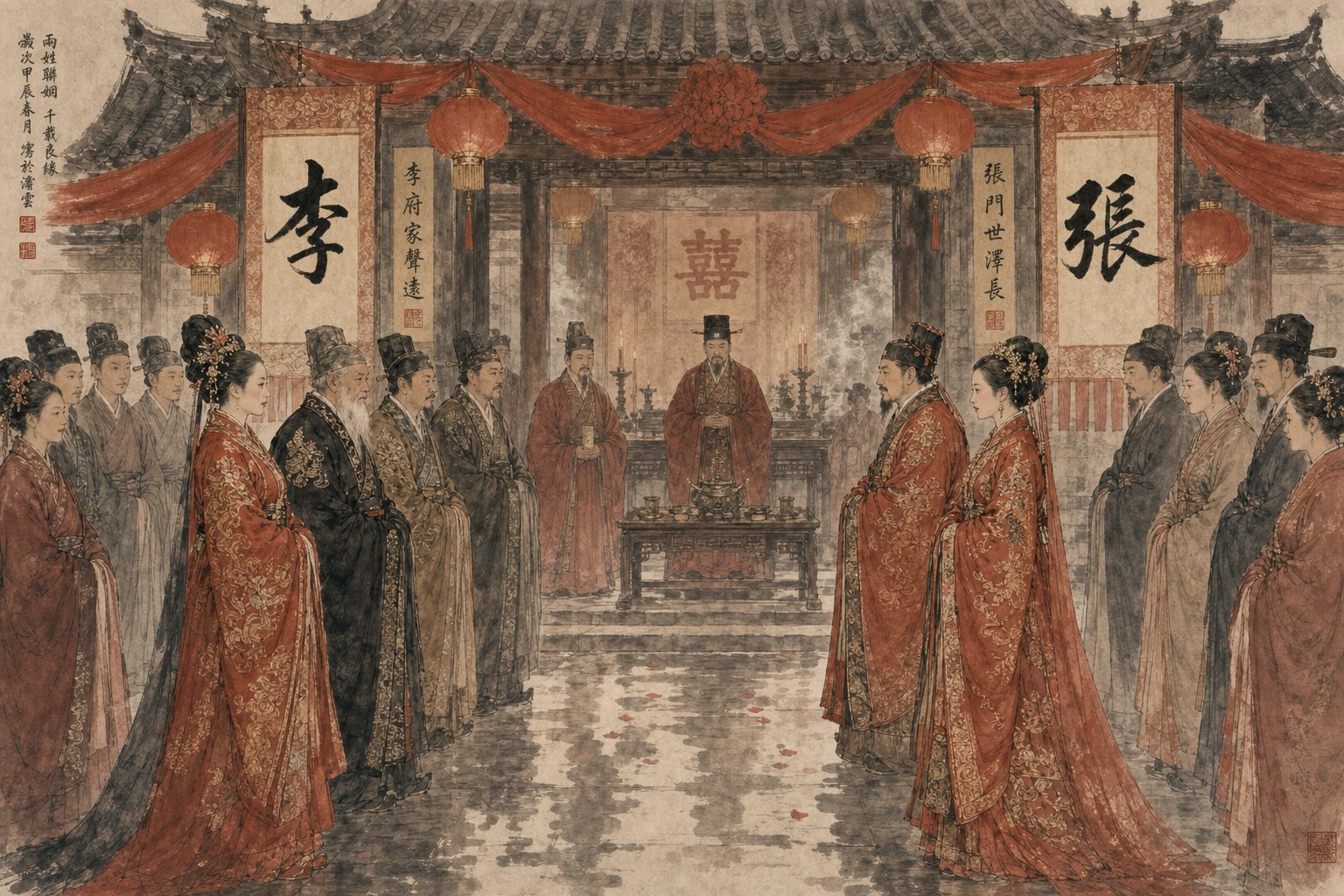
Chinese surname exogamy, known as tongxing bu hun (同姓不婚), is the rule that two people sharing the same surname cannot marry. Unlike Western incest taboos, which focus on traceable biological kinship, this prohibition operated on a different logic entirely: your Chinese surname alone determined who was off-limits. It didn't matter if you lived thousands of miles apart or couldn't trace a common ancestor within dozens of generations. If your chinese last names matched, marriage was forbidden.
This single rule shaped marriage patterns across Chinese civilization for over 2,000 years, from the Western Zhou dynasty through the late Qing era. It was enforced through ritual custom, community pressure, and eventually criminal law.
"They were distinguished by surnames... even after a hundred generations, marriage between them was not permitted; such was the way of Zhou." — Book of Rites (Liji), Da Zhuan
That passage captures the rule's absolute character. A hundred generations. No exceptions. Among common chinese names like Wang, Li, and Zhang, this meant millions of potential partners were automatically excluded from consideration, regardless of any actual blood connection.
Why Surname-Based Marriage Rules Matter
Why should you care about an abolished marriage rule? Because chinese surnames carry layers of meaning that most naming systems don't. They functioned simultaneously as identity markers, kinship indicators, political tools, and moral boundaries. Understanding how chinese names operated within the exogamy system reveals how deeply naming and social control were intertwined in Chinese culture.
This article traces the full arc of that system: its origins in ancient clan structures, the philosophical arguments that justified it, the legal codes that enforced it with corporal punishment, and its eventual abolition in the twentieth century. Each chinese surname carried the weight of this tradition, whether its bearer knew it or not.
The story begins not with surnames as we know them today, but with a much older system of clan markers that divided society into clearly defined marriage groups.
Ancient Origins of Surname-Based Marriage Prohibitions
Imagine a world where surnames originate from just twenty or thirty clan names, and every person carrying the same name is considered family. That's the world of early China. The marriage prohibition didn't emerge from a society with thousands of chinese family names. It was designed for a tiny set of ancestral markers where shared identity genuinely implied shared blood.
From Matrilineal Xing to Patrilineal Shi
Ancient chinese names operated on a two-tier system that looks nothing like modern surname practice. The first tier was the xing (姓), an ancestral clan name tied to deep lineage. The second was the shi (氏), a branch name indicating a specific noble house or territorial holding within that larger clan.
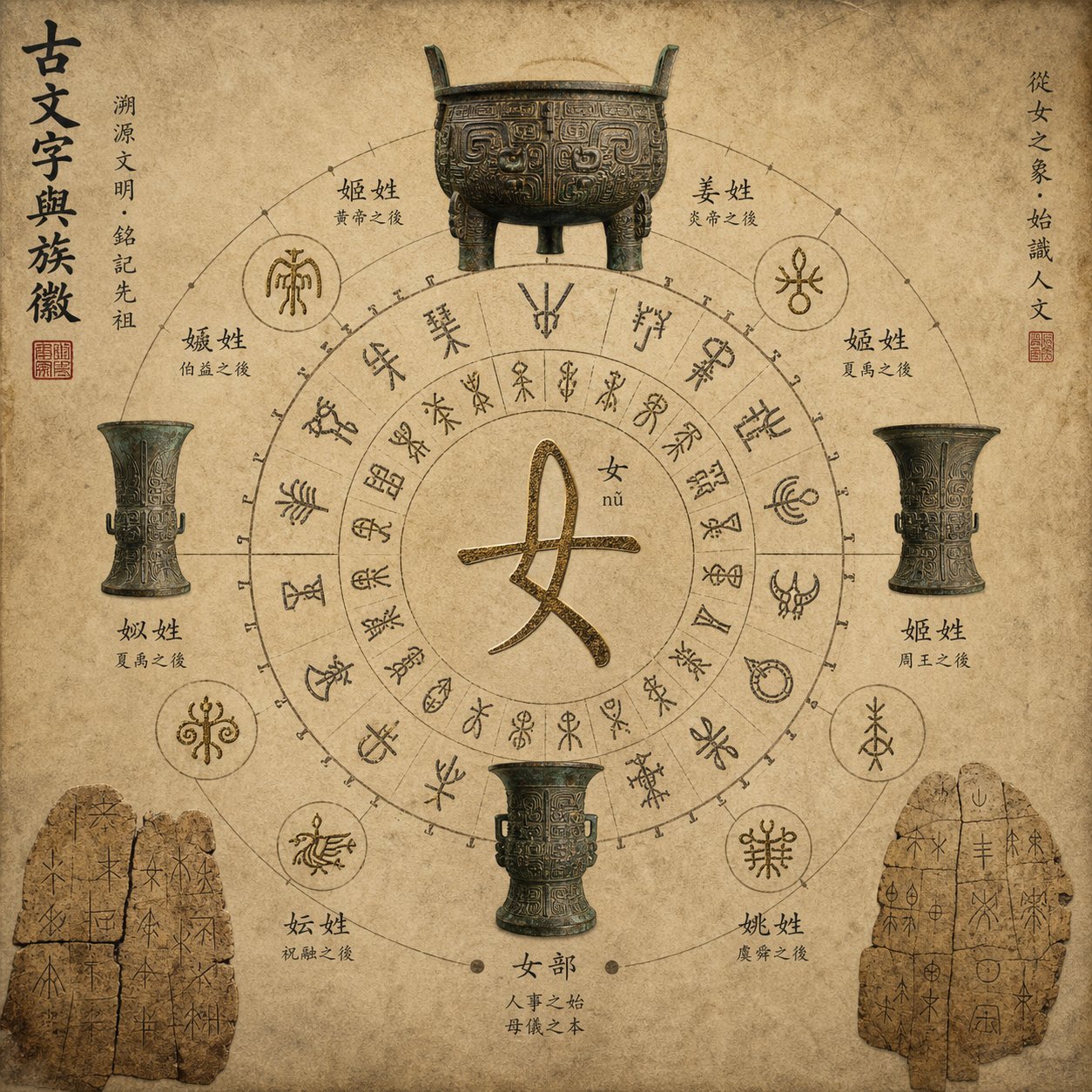
Here's what makes the xing system remarkable: the character itself contains the female radical (女) combined with the character for "birth" (生). Many of the earliest xing also carry this female radical — Ji (姬), Jiang (姜), Yao (姚), Ying (嬴), Si (姒). This linguistic evidence, combined with the system's structure, suggests these clan markers originally traced through maternal lines. Scholars have identified roughly eight to thirty of these ancient xing, depending on the source and period examined.
The shi system worked differently. As the Zhou feudal order expanded and noble houses subdivided their territories among descendants, new branch names proliferated. A nobleman held both a xing (marking his deep clan identity) and a shi (marking his specific lineage or fief). Crucially, the exogamy rule applied only to the xing. Two men with different shi but the same xing could not marry each other's daughters. Two men with different xing but similar social standing could.
| Dimension | Xing (姓) — Clan Name | Shi (氏) — Lineage Name |
|---|---|---|
| Origin | Ancient matrilineal clan markers | Derived from fiefs, titles, or official posts |
| Function | Marked exogamic group boundaries | Distinguished noble branches within a clan |
| Inheritance pattern | Originally maternal, later paternal | Paternal, tied to political succession |
| Number in circulation | Roughly 20-30 during Zhou | Hundreds, growing over time |
| Relationship to exogamy | Directly determined marriage eligibility | No bearing on marriage restrictions |
This distinction matters because it reveals the original logic of the prohibition. When only twenty or thirty xing existed, sharing one genuinely indicated a common ancestral line. The rule made biological sense at that scale.
How Zhou Political Alliances Shaped Exogamy
The Zhou dynasty didn't just inherit the exogamy system — it turned surname-based marriage into a tool of statecraft. The clearest example is the relationship between the two dominant clans: Ji (姬), the surname of the Zhou royal house, and Jiang (姜), the surname of their most important allies.
Research published in Early China argues that Ji and Jiang were not two originally separate peoples who formed an alliance through intermarriage. Rather, they were the two leading, intermarrying clans of a single people. The mythological mother of the Zhou ancestor Hou Ji (Lord Millet) was named Jiang Yuan — literally embedding the Jiang surname into the Zhou origin story.
After the Zhou conquest of the Shang dynasty around 1046 BCE, this intermarriage pattern became political infrastructure. The Zhou kings enfeoffed relatives and allies across conquered territory, and marriage politics required rulers of originally non-Zhou states to adopt clan names of the same kind. Marrying a Ji daughter to a Jiang lord, or vice versa, cemented loyalty and created kinship obligations that bound the feudal network together.
You'll notice the elegance of this system: exogamy forced the ruling class to build alliances outward. A Ji lord couldn't marry within his own clan, so every marriage became a diplomatic act. The prohibition against same-surname marriage wasn't just a family rule — it was the engine driving political integration across the early Zhou polity.
The Warring States Merger That Changed Everything
The tidy separation between xing and shi began breaking down during the Spring and Autumn period (770-476 BCE). As feudal hierarchies weakened and social mobility increased, the functional distinction blurred. By the Warring States period (475-221 BCE), people increasingly used shi names in contexts where xing had previously applied.
The final collapse came with the Qin unification in 221 BCE and the subsequent Han dynasty. Commoners, who had previously lacked formal surnames entirely, began acquiring them. The old shi branch names became the new xing surnames. Where chinese roots once traced back to a handful of clan markers, the system now encompassed thousands of distinct family names — most of which were originally shi rather than ancient xing.
Here's the paradox this created: the exogamy rule, designed for a system of twenty to thirty clan names where shared identity reliably indicated kinship, was now applied to thousands of surnames where it often didn't. Two people named "Wang" in the Han dynasty might trace their surname to completely different origins — one from a royal title, another from a place name — yet the prohibition still applied to them as if they shared a common ancestor.
The cultural logic had outrun its biological foundation. But rather than weakening the rule, this expansion actually entrenched it further. Confucian scholars and legal authorities treated the prohibition as a matter of ritual propriety rather than mere genetics, giving it a philosophical justification that didn't depend on actual relatedness.
That philosophical scaffolding — built from both moral reasoning and folk beliefs about heredity — would prove remarkably durable across the next two millennia.
Philosophical Foundations Behind the Marriage Prohibition
A rule that outlasts dozens of dynasties needs more than tradition behind it. It needs reasons people find convincing across centuries of social change. Chinese surname exogamy drew its staying power from two very different intellectual sources — one grounded in moral philosophy, the other in something closer to folk biology. Together, they made the prohibition nearly impossible to argue against.
The Confucian Ritual Propriety Argument
For Confucian thinkers, marriage wasn't primarily about love or even reproduction. It was a ritual act (li, 禮) that established proper relationships between families and maintained the social order. When you understand chinese surnames and meanings through this lens, every surname carried a web of kinship obligations. Marrying someone with the same surname collapsed the boundary between "inner" and "outer" kin — two categories that Confucian ethics kept carefully separated.
The logic worked like this: your surname marked you as belonging to a patrilineal descent group. Everyone within that group owed each other specific duties — mourning obligations, ancestral sacrifices, mutual aid. Marriage was supposed to create new bonds between different groups, extending the network of social obligation outward. A same-surname marriage short-circuited that function. It turned what should be an alliance between two distinct families into something uncomfortably close to a transaction within one family.
Confucian scholars framed this as a violation of differentiation (bie, 別) — the principle that healthy social order depends on clearly distinguishing roles and relationships. Husband and wife must come from different origins so their union creates genuine complementarity. When the meaning of chinese last names pointed to a shared origin, that complementarity vanished, and the marriage lost its ritual legitimacy.
Proto-Eugenic Folk Beliefs About Same-Surname Offspring
The second justification operated on entirely different ground. Classical texts preserve a persistent folk belief that same-surname marriages produced weak, sickly, or infertile offspring. The Zuozhuan, a historical commentary dating to the 4th century BCE, states this plainly:
"When a man takes a wife, he does not take one of the same surname. Therefore, when buying a concubine, if her surname is unknown, divination is performed. Same-surname unions are not fruitful." — Zuozhuan, Zhao Gong Year 25
This wasn't a one-off remark. The phrase tongxing bu fan (同姓不蕃) — "same surname offspring do not prosper" — appears across multiple classical sources as received wisdom. Centuries before anyone understood genetics, Chinese thinkers had arrived at an intuition about inbreeding depression: that mating within too narrow a group produced diminishing returns.
The reasoning was observational rather than scientific. In a world of small communities where same-surname individuals genuinely shared recent ancestors, the correlation between same-surname marriage and poor reproductive outcomes would have been visible enough to generate a lasting folk theory. Chinese surname meanings tied people to ancestral lines, and those lines, when crossed back upon themselves, seemed to produce weaker descendants.
Why Two Justifications Made the Rule Unshakeable
Here's what made this combination so resilient: the two arguments covered each other's weaknesses. If someone questioned the biological claim — pointing out that two people named Chen from provinces a thousand miles apart couldn't possibly be close relatives — the Confucian response didn't need biology at all. The prohibition was about ritual correctness, social structure, and moral order. Actual genetic relatedness was beside the point.
Conversely, if someone challenged the ritual argument as mere convention — arbitrary rules imposed by ancient sages — the proto-eugenic belief gave the prohibition a practical, consequences-based justification. Violate this rule and your children will suffer. That's a powerful deterrent regardless of your philosophical commitments.
This dual foundation meant that no single line of criticism could dismantle the prohibition. A skeptic had to defeat both arguments simultaneously, and since they operated in completely different domains — ethics versus biology, social order versus reproductive outcomes — doing so required a kind of intellectual revolution that wouldn't arrive until the twentieth century.
The philosophical arguments, however compelling, remained abstract without enforcement. What transformed a moral principle into lived reality was the apparatus of law — criminal codes that attached specific, escalating punishments to violations of the same-surname marriage ban.

Legal Codification and Penalties Across Dynasties
Philosophical arguments persuade. Laws compel. The same-surname marriage prohibition spent centuries as a matter of ritual custom and moral expectation before it acquired the force of criminal punishment. Tracing that transition reveals how deeply the Chinese state invested in controlling marriage through the surname in chinese kinship systems.
From Cultural Taboo to Criminal Law
During the Zhou and early imperial periods, enforcement relied primarily on community norms and clan pressure rather than state punishment. The Book of Rites articulated the prohibition, but no surviving Zhou-era legal code specifies a penalty for violation. That changed decisively with the Northern Wei dynasty, which issued an imperial edict in 484 CE explicitly banning same-surname marriage.
The real turning point came with the Tang Code (Tanglü shuyi), compiled in 653 CE. This was China's most influential legal code, serving as the template for criminal law across East Asia for centuries. It didn't merely discourage same-surname unions — it criminalized them with specific, graduated penalties. The Song dynasty adopted the Tang framework largely intact, and the Ming and Qing codes continued the tradition with modifications.
Here's how penalties escalated across major dynasties:
- Northern Wei (484 CE): Imperial edict prohibiting same-surname marriage; enforcement details left to local officials.
- Tang dynasty (653 CE): Two years of penal servitude for marrying someone of the same surname. If the couple also shared the same lineage (tongzong), the punishment escalated to that for illicit sexual intercourse — a far more severe charge.
- Song dynasty (960-1279): Followed the Tang Code. Offenders received caning and were forced to separate.
- Ming dynasty (1368-1644): Sixty strokes of the heavy bamboo for each party, plus mandatory divorce.
- Qing dynasty (1644-1912): Same penalty as Ming law — sixty strokes and forced separation — but with an important practical distinction between same-surname and same-clan cases.
Notice the shift between Tang and Ming penalties. The Tang Code imposed imprisonment; the Ming and Qing codes substituted corporal punishment plus annulment. In both frameworks, the marriage itself was voided — it had no legal standing regardless of whether children had been born.
Tongxing Bu Hun Versus Tongzong Bu Hun
Understanding how do chinese names work in the legal context requires grasping a distinction that became increasingly important after the Qin-Han surname merger: tongxing bu hun (同姓不婚, no marriage between same surnames) versus tongzong bu hun (同宗不婚, no marriage within the same clan lineage).
These are related but not identical concepts. Tongxing refers to anyone sharing the same chinese last name, regardless of whether they can trace a common ancestor. Tongzong refers specifically to people who belong to the same documented patrilineal descent group — people whose genealogical records confirm shared ancestry.
By the Ming and Qing periods, lawmakers recognized the absurdity of treating all bearers of a common surname as relatives. Millions of people named Li or Zhang clearly didn't descend from a single ancestor. So while both the Ming Code and Qing Code superficially maintained the tongxing prohibition, in practice they focused enforcement on tongzong cases — marriages between people with documented clan connections. Individuals sharing a surname but belonging to demonstrably different lineages could often marry without legal consequence.
The late Qing legal reforms made this distinction explicit. During the dynasty's final revision of marriage law, the same-surname prohibition was formally merged with the broader prohibition against marriage between close relatives. The standalone tongxing rule effectively disappeared from the statute books, replaced by a tongzong standard that required actual kinship rather than mere surname coincidence.
The Wu Fu System and Marriage Boundaries
Behind both prohibitions sat a more elaborate framework for measuring kinship distance: the wu fu (五服) system, or five degrees of mourning. This system classified relatives into five concentric circles based on the mourning garments worn at their funeral — from the coarsest unhemmed sackcloth (for parents) to the lightest fabric (for distant cousins).
The wu fu system determined far more than funeral attire. It established the legal boundaries of marriage prohibition within the kinship network. Relatives within the five degrees of mourning were absolutely forbidden from marrying — this was the tongzong prohibition at its strictest. Beyond the fifth degree, the question became murkier and varied by dynasty and region.
Think of it as two overlapping systems. The surname rule (surname 中文: 同姓不婚) cast the widest net, potentially excluding millions. The wu fu system drew a tighter, more precise circle around actual kin. Where these two systems intersected — same surname and within five degrees of mourning — penalties were harshest. Where they diverged — same surname but no traceable kinship — enforcement gradually softened over the centuries.
Children born from prohibited unions occupied an uncomfortable legal gray area. While they weren't formally classified as illegitimate in the way Western legal systems might categorize them, the forced annulment of their parents' marriage and the social stigma attached to the violation created real disadvantages. Their parents' union was treated as void, and community knowledge of the transgression could follow a family for generations.
The law provided the framework, but enforcement on the ground depended on something more immediate than distant magistrates and imperial codes. It depended on the people who actually arranged marriages: clan elders, matchmakers, and neighbors who knew exactly which surname every family in the village carried.
How Clans and Communities Enforced the Rule in Practice
Imperial law codes meant little without someone on the ground checking surnames before a wedding could proceed. In practice, enforcement happened at the village level — through clan organizations, genealogical records, and the social pressure of people who had known your family for generations.
Clan Genealogies as Enforcement Tools
The clan system (zongzu) maintained detailed genealogy records called zupu or jiapu. These weren't dusty archives gathering cobwebs. They were living documents, regularly updated and consulted whenever a marriage was proposed. Before a matchmaker could finalize arrangements, she checked both families' genealogies to confirm different surnames and — in stricter communities — to verify no hidden kinship connections existed.
Clan elders served as gatekeepers. They controlled access to ancestral halls, managed communal property, and held veto power over marriages that violated exogamy norms. A young man hoping to marry a woman with the same surname faced not just parental disapproval but potential expulsion from clan resources — land, irrigation rights, and the social safety net that lineage membership provided.
Matchmakers operated within this system as both facilitators and enforcers. Their professional reputation depended on arranging legitimate unions. Proposing a same-surname match would damage their credibility and livelihood. So the prohibition was built into the marriage market's infrastructure at every level.
Southern Versus Northern Regional Differences
Geography shaped how the rule played out in daily life. Southern China — particularly Guangdong, Fujian, and parts of Jiangxi — developed a distinctive settlement pattern: single-surname villages where every resident shared the same family name. In a village where everyone carries the chen surname or the huang surname, enforcement was automatic. You simply couldn't marry locally. The rule was self-evident because there was no one of a different surname nearby to confuse the matter.
But this created intense demographic pressure. Young people in single-surname villages had to look elsewhere for spouses, sometimes traveling considerable distances. This drove elaborate inter-village matchmaking networks and, in Cantonese-speaking regions, contributed to distinctive marriage customs. Researchers tracing the wong last name origin and other cantonese surnames have documented how southern lineage villages maintained detailed records precisely because the exogamy rule forced outward marriage and required careful tracking of which neighboring villages held compatible surnames.
Northern China presented a different picture. Greater surname diversity within individual communities meant the prohibition was less burdensome — you had plenty of potential partners with different surnames nearby. But that same diversity made monitoring harder. Without the automatic enforcement of a single-surname village, clan elders and matchmakers bore more responsibility for checking genealogies and catching violations before they occurred.
| Dimension | Southern China | Northern China |
|---|---|---|
| Enforcement strictness | Very high — single-surname villages made violations immediately visible | Moderate — relied more on matchmaker diligence and genealogy checks |
| Demographic context | Common chinese surnames concentrated in single-lineage settlements; limited local marriage options | Greater surname diversity within villages; more local options available |
| Primary enforcement mechanism | Village structure itself; community visibility | Clan elders, matchmakers, and genealogy records |
| Demographic pressure created | High — forced long-distance spouse searches and inter-village networks | Low — rule rarely constrained marriage choices significantly |
| Common exceptions | Adopted surnames, ethnic minority communities, proven lack of common ancestor | Same-surname different-origin cases accepted more readily; less genealogical documentation available |
Documented Exceptions to the Rule
The prohibition was powerful, but it wasn't absolute everywhere. Several recognized exceptions existed across Chinese history.
The most common involved families who could demonstrate no shared ancestor within five generations. Particularly after the Ming-Qing distinction between tongxing and tongzong became standard, communities sometimes permitted marriages between same-surname individuals whose genealogies clearly showed separate origins. Two families named Huang living in the same county but tracing their wong last name origin to entirely different ancestral lines might receive community approval — especially if clan elders from both sides confirmed the lack of connection.
Adopted surnames created another gray area. When a man took his wife's surname (a practice called ruzhui, entering the bride's family) or when families adopted children who carried their natal surname into a new lineage, the biological reality diverged from the surname record. Communities handled these cases inconsistently. Some treated the adopted surname as fully binding for exogamy purposes; others looked past the surname to actual blood ties.
Ethnic minorities within China's borders often maintained their own marriage systems. Manchu, Mongol, and various southern ethnic groups had kinship structures that didn't map neatly onto Han surname logic. When these communities adopted Chinese surnames — sometimes voluntarily, sometimes under political pressure — they didn't always absorb the exogamy rules that came with them. The result was a patchwork: Han communities enforcing the prohibition strictly, neighboring minority communities ignoring it, and mixed communities negotiating somewhere in between.
These exceptions reveal something important about how the rule actually functioned. It wasn't a rigid, universally applied law so much as a social norm with varying degrees of strictness depending on region, class, and the specific circumstances of each proposed match. The further you moved from the centers of Confucian orthodoxy and strong clan organization, the more flexibility appeared.
Yet even where exceptions existed, the rule shaped something subtler than marriage choices alone. It shaped how women moved through society — how they were named, where they belonged, and what identity they carried from one family into another.

How Surname Exogamy Shaped Women's Identity and Position
Here's a paradox worth sitting with: the same system that restricted women's marriage choices also preserved something most patriarchal societies erased — their name. In much of the Western world, a woman historically lost her surname at marriage, absorbed entirely into her husband's family identity. In China, the opposite happened. A married woman kept her natal surname precisely because the exogamy system demanded it.
Why Married Women Kept Their Natal Surnames
The logic was structural, not sentimental. If the entire marriage system depended on distinguishing between surname groups, then a woman entering her husband's household needed to remain visibly marked as an outsider — someone from a different clan. Her surname was proof that the marriage was legitimate, that no exogamy violation had occurred. Erasing it would have undermined the very system that governed who could marry whom.
In practice, this meant a woman's identity after marriage was expressed through a combination of names. Common chinese full names for married women typically placed the husband's surname before the wife's natal surname, creating a compound that signaled both her current household and her origin clan. A woman born with the surname Lin who married into the Chen family might be referred to as Chen-Lin shi — marking her as belonging to the Chen household while retaining her Lin identity.
Research published in the Journal of Family History examining nineteenth-century Taiwan found that this prefixing practice likely developed from legal and property documents rather than everyday speech. Women needed their dual-surname identity recorded in contracts, land deeds, and court proceedings. The naming convention wasn't decorative — it had legal force.
This created what scholars describe as a "dual outsider" status. A married woman was no longer fully part of her natal family, having left their household. Yet she was never fully absorbed into her husband's lineage either — her different surname marked her as permanently from elsewhere. She existed in the space between two families, belonging completely to neither.
Marriage Markets and Women's Autonomy
The exogamy rule shaped the marriage market in ways that both constrained and, paradoxically, empowered women. On the constraint side, the prohibition narrowed the pool of eligible matches. In single-surname villages, every local man was off-limits. Families had to search further afield, negotiate across community boundaries, and invest more heavily in matchmaker networks. Women had no say in these arrangements — they were moved between surname groups as part of alliance-building between families.
But the system also created leverage. Because a bride represented a connection to her natal clan — a connection made visible by her retained surname — her family of origin maintained a stake in her wellbeing. Dowry negotiations reflected this ongoing relationship. A generous dowry signaled the natal family's continued investment in their daughter and, by extension, their willingness to intervene if she was mistreated. The bride's surname wasn't just an identity marker; it was a reminder that another clan stood behind her.
Widows found particular power in this arrangement. A widow who retained her husband's surname prefix could invoke her position within his family to claim property rights, resist forced remarriage, or advocate for her children's inheritance. Her dual name — combining both surnames — gave her standing in both families simultaneously. The naming system that marked her as an outsider also gave her a foothold no one could easily remove.
The Taiwanese Experience
These dynamics persisted longer in Taiwan than on the mainland, making the island a valuable case study for understanding how surname exogamy shaped women's lives. While China's 1950 Marriage Law swept away the legal framework of surname-based restrictions, Taiwan maintained its version of the prohibition until 1998. For nearly five additional decades, taiwanese surnames carried the full weight of exogamy tradition.
Taiwanese last names followed the same patterns as mainland Chinese surnames — the same common surnames (Chen, Lin, Huang, Zhang) dominated — but the island's smaller population and tighter community networks meant enforcement remained more personal and immediate. In rural Taiwan, everyone knew which families carried which taiwan last names, and matchmakers operated within well-mapped surname geographies.
The practice of women retaining their surnames after marriage remains deeply rooted in Chinese and Taiwanese culture. As one Chinese-Australian woman explained her decision not to take her fiance's surname: "My reasons are simple... I think my parents would feel very angry if I changed my last name." This sentiment echoes centuries of tradition where a woman's surname was never hers to give away — it belonged to her natal lineage and served as permanent evidence of proper exogamic marriage.
The persistence of taiwanese surnames as identity markers — even after legal abolition of the marriage prohibition — reveals how deeply the exogamy system shaped cultural assumptions about naming and belonging. Women in Taiwan today keep their surnames not because the law requires it for exogamy purposes, but because generations of that requirement made surname retention feel natural, even essential to personal identity.
Yet all of this operated on an assumption that shared surnames meant shared blood. As China's population grew into the hundreds of millions, that assumption became increasingly disconnected from genetic reality — raising the question of whether the prohibition ever made biological sense for the vast majority of same-surname pairs.
Genetic Reality Versus Cultural Assumptions About Shared Ancestry
The exogamy rule rested on a simple premise: same surname equals shared blood. For the twenty or thirty ancient xing clans of the Zhou dynasty, that premise held up reasonably well. But what happens when a single surname is shared by tens of millions of people scattered across a continent-sized country? Does the wang last name still signal kinship when over 92 million people carry it?
The short answer is no. And population genetics has spent decades proving why.
When Surnames Stop Indicating Kinship
Consider the scale involved. The most common chinese last names each encompass populations larger than most countries. Wang alone accounts for roughly 7% of China's population. Li follows close behind. Zhang, Liu, Chen — each of these surnames represents a demographic bloc so vast that any assumption of shared ancestry between two random bearers is statistically meaningless.
This wasn't always the case. When the surname system was young and populations were small, sharing a name genuinely implied a traceable genealogical connection. But centuries of population growth, migration, surname adoption by unrelated groups, and imperial grants of new surnames shattered that link. Many of the most common chinese surnames have multiple independent origins — the wang last name, for instance, derives from at least a dozen separate ancestral lines, including descendants of various royal houses who adopted "Wang" (meaning "king") as a surname after losing power.
Two people named Wang meeting in modern Shanghai are about as likely to share a meaningful common ancestor as two random strangers picked from the general population. The surname tells you almost nothing about genetic proximity at that scale.
Population Genetics and Common Surname Clusters
Research from the Institute of Genetics at the Chinese Academy of Sciences has formalized this intuition with data. Their analysis of surname distributions across the Song dynasty, Ming dynasty, and modern periods revealed two critical findings. First, Chinese surnames show remarkable historical inheritance stability — the same surnames that were common a thousand years ago remain common today. Second, and more relevant to the exogamy question, surnames split into two fundamentally different categories: common and rare.
The roughly 100 most common chinese surnames — less than 5% of all Chinese surnames in existence — account for more than 85% of the population. Meanwhile, rare surnames, representing over 95% of all surname types, are carried by only about 15% of the population. These two categories behave very differently in genetic terms.
For common surnames, the distribution pattern reflects broad population migrations and historical mixing. Two people sharing a common surname in different provinces likely inherited that name through entirely separate historical pathways. Their "shared" surname is a statistical artifact of convergent naming rather than evidence of descent from a single ancestor.
- Wang (王): Over 92 million bearers. At least 12 documented independent origins. Two random Wang individuals share no more genetic similarity than two people with different surnames from the same region.
- Li (李): Over 93 million bearers. Origins include the ancient Ying clan, Turkic adoptions during the Tang dynasty, and imperial surname grants. Genetic clustering is negligible among unrelated Li families.
- Zhang (张): Over 84 million bearers. Multiple origin stories trace to different ancestral figures. Regional Zhang populations show more genetic affinity with local non-Zhang neighbors than with distant Zhang populations.
- Liu (刘): Over 72 million bearers. Includes descendants of the Han imperial house and numerous unrelated lineages who adopted the name.
- Chen (陈): Over 63 million bearers. Dominant in southern China but with distinct northern lineages of separate origin.
The research further demonstrated that common surname distributions act as reflections of regional genetic composition — they track population migration patterns rather than creating them. In other words, surnames follow genes, not the other way around. The degree of genetic similarity between two populations correlates with their surname overlap, but within any single common surname, the genetic diversity is enormous.
Rare Surnames and Actual Genetic Proximity
Rare last names tell a completely different story. Uncommon surnames — those carried by only a few thousand or even a few hundred people — tend to cluster geographically and show genuine genetic coherence. The same research found that rare surnames are "of regional characteristic and relative isolation." When your surname is shared by only a small, localized population, the odds that you and another bearer descend from a common ancestor increase dramatically.
This creates an ironic inversion of the exogamy rule's practical effect. For the most common chinese surnames — the ones most people actually carry — the prohibition was biologically pointless. Two people named Li from different provinces had no meaningful genetic connection. But for uncommon surnames concentrated in a single county or village, same-surname marriage might genuinely involve close relatives. The rule applied equally to both situations, getting the biology backwards in the majority of cases while accidentally being correct for a small minority.
Population genetics research has also connected surname inheritance patterns to Y-chromosome evolution, since both surnames and Y chromosomes pass through paternal lines. This parallel transmission means that studying surname distributions can serve as an approach to understanding paternal genetics — but only for rare, geographically isolated surnames where the correlation between name and genes remains intact. For the most common chinese last names, the signal has long since dissolved into noise.
So the exogamy system's biological logic was both right and wrong simultaneously. Right in principle — marrying within a narrow kinship group does carry genetic risks. Wrong in application — because surnames, especially common ones, had stopped reliably marking kinship boundaries centuries before the rule was finally abolished. That abolition, when it came, arrived through legal reform rather than scientific argument — though the genetic evidence would have supported the change long before lawmakers acted.

Modern Abolition and Whether Social Stigma Still Persists
Laws can be repealed in a single legislative session. Cultural instincts take longer to fade. The formal abolition of same-surname marriage prohibitions happened at different speeds across the Chinese-speaking world, and the gap between legal freedom and social acceptance reveals just how deeply these rules embedded themselves in everyday thinking about asian last names and family identity.
Legal Abolition in the PRC and Taiwan
The People's Republic of China made the cleanest break. The 1950 Marriage Law — one of the first major pieces of legislation after the Communist revolution — swept away the entire traditional marriage framework. Arranged marriages, concubinage, bride prices, and surname-based restrictions all fell together. The law established free-choice marriage as a fundamental right, and same-surname unions became legally indistinguishable from any other marriage. No transition period, no exceptions, no lingering statutory language.
Taiwan's path was slower and more complicated. The ROC Civil Code, brought from the mainland in 1949, retained a version of the same-surname prohibition. For nearly five decades after the PRC abolished the rule, couples in Taiwan with matching surnames still faced a legal barrier. It wasn't until a 1998 amendment to the Civil Code that Taiwan formally removed the restriction, replacing it with a narrower prohibition against marriage between close blood relatives — the same standard used in most modern legal systems.
Overseas Chinese communities navigated the transition without formal legislation of their own. Singapore and Malaysia, home to large populations carrying cantonese last names and other southern Chinese surnames, never codified the prohibition into their post-independence legal systems. The rule persisted as custom rather than law, enforced through family pressure and community expectation rather than state power.
| Jurisdiction | Method of Abolition | Year | What Replaced It |
|---|---|---|---|
| PRC (Mainland China) | 1950 Marriage Law — complete legislative replacement | 1950 | Free-choice marriage; prohibition limited to close blood relatives |
| ROC (Taiwan) | Amendment to Civil Code Article 983 | 1998 | Prohibition narrowed to relatives within six degrees of kinship |
| Singapore | Never codified; faded as social custom | No formal date | Women's Charter (1961) governs marriage without surname restrictions |
| Malaysia | Never codified for Chinese community; governed by civil marriage law | No formal date | Law Reform (Marriage and Divorce) Act 1976 — no surname provisions |
Lingering Social Stigma in Rural Communities
Legal abolition didn't erase the discomfort overnight. Imagine telling your grandmother — someone who grew up in a world where same-surname marriage was literally criminal — that you plan to marry someone with the same asian family name. In many families, particularly in rural areas and among older generations, the reaction ranges from quiet disapproval to outright refusal to attend the wedding.
Research from Taiwan offers the clearest quantitative picture of this lingering effect. A 2026 study published in PLOS One analyzed nationwide marriage databases and found that same-surname marriages were significantly less common than random chance would predict in 2018 data — consistent with the historical taboo still shaping behavior decades after legal abolition. The observed frequency of same-surname marriages was only 3.29% in 2018, lower than statistical expectation given surname distributions in the population.
But here's the striking finding: by 2023, that pattern had weakened considerably. Same-surname marriages rose to 4.34% of all unions, and the statistical gap between observed and expected frequencies became inconsistent across different surname pairs. Some surnames still showed avoidance; others didn't. The researchers attributed this shift to rapid socio-cultural liberalization in Taiwan and generational turnover — older couples who married under the taboo's influence were being replaced in the database by younger couples who didn't share those concerns.
A questionnaire survey of Taiwanese university students confirmed this generational divide. When asked to rate the attractiveness of faces labeled with various surnames, students showed no significant difference in ratings based on whether the face shared their own surname. The traditional aversion simply didn't register for this generation. As the study's authors noted, "the significance of surname match/mismatch in partner choice may have diminished, potentially due to rapidly changing socio-cultural environments."
Rural communities, however, tell a different story. In villages where clan organizations remain active and genealogical records are still maintained, older residents continue to view same-surname marriage with suspicion. The prohibition may have left the law books, but it hasn't left the conversation at family dinner tables — particularly in southern Chinese communities where single-surname villages persist and cantonese last names carry strong lineage associations.
Surname Identity in the Age of DNA Testing
Something unexpected is happening: just as the old surname taboo fades, new technologies are creating fresh intersections between surname identity and marriage decisions. Genealogy apps, DNA testing services, and digitized clan records are giving people tools to explore their ancestry with a precision that traditional genealogies never offered.
Consumer DNA testing can now tell you whether two people sharing the same surname actually share recent ancestors — answering the question that the exogamy rule could only guess at. For couples with matching asian family names who face family pressure, a genetic test showing no meaningful relatedness provides concrete evidence to counter traditional objections. The old rule operated on surname as a proxy for kinship; modern genetics can bypass the proxy entirely.
Yet this technology cuts both ways. Renewed interest in clan heritage — fueled by genealogy platforms and digitized zupu records — sometimes reactivates surname consciousness rather than dissolving it. People who never thought much about their surname's history find themselves exploring ancestral connections, joining surname associations, and attending clan gatherings. This doesn't necessarily translate into marriage avoidance, but it keeps surname identity culturally salient in ways that pure legal abolition might otherwise have eroded.
The underlying question is whether modern genetic counseling has functionally replaced the exogamy rule's original purpose. Pre-marital genetic screening — increasingly common in China and Taiwan — can identify actual carrier status for recessive conditions, providing far more useful information than surname matching ever could. In this sense, the rule hasn't been abandoned so much as superseded by a more precise tool addressing the same underlying concern about offspring health.
The trajectory is clear: from absolute prohibition to lingering stigma to generational indifference. But the speed of that transition varies enormously depending on where you look — urban versus rural, young versus old, mainland versus diaspora. And the broader significance of this shift extends well beyond China, touching every East Asian society where surnames once functioned as kinship boundaries.
Broader Significance of Surname Exogamy in East Asian Culture
China's same-surname marriage prohibition didn't exist in isolation. It radiated outward across East Asia, shaping how surnames in asia functioned as social boundaries wherever Chinese cultural influence took root. Tracing that influence reveals just how deeply naming systems and kinship logic intertwined across the region.
Surname Exogamy Across East Asia
Korea offers the most striking parallel. The Joseon dynasty adopted Confucian marriage norms wholesale, prohibiting marriage between people sharing both the same surname and the same ancestral origin (dongseong dongbon). Unlike China's broader same-surname rule, the Korean version required matching both surname and clan seat — a stricter standard in some ways, looser in others. This prohibition on marriage korea maintained as customary law survived Japanese colonization, post-war legal codification, and decades of constitutional challenges before South Korea's Constitutional Court finally ruled it unconstitutional in 1997, with formal abolition following in 2005.
Vietnam's Le dynasty similarly adopted same-surname marriage restrictions modeled on Chinese law. The phrase Mien la cung ho ("as long as the same surname") persisted in Vietnamese culture long after formal enforcement ended. Even Japan, which developed a fundamentally different surname system, shows traces of exogamic thinking in its historical clan structures.
The pattern is consistent: wherever Confucian kinship logic shaped social organization, surnames became marriage boundaries. The specific rules varied — marriage korea prohibited required matching both surname and ancestral seat, while China's rule applied to surname alone — but the underlying principle remained the same. Asian names and surnames carried moral weight that Western naming systems never acquired.
What This Rule Reveals About Chinese Kinship Logic
Step back from the details and a larger picture emerges. Chinese surname exogamy wasn't simply a marriage rule. It was the point where four systems converged: naming, kinship, politics, and law. Your surname told society who you were related to, who you could marry, which clan owed you protection, and which legal obligations bound you. No single cultural marker in Western societies carries that density of function.
This convergence explains both the rule's extraordinary durability and its eventual collapse. As long as surnames reliably tracked kinship, the system worked. Once population growth and surname adoption severed that connection — once chinese family names and meanings diverged from actual genealogical reality — the rule became a cultural fossil. It persisted through institutional inertia and philosophical justification long after its practical foundation had eroded.
The abolition story is equally revealing. Legal modernization didn't defeat the taboo through argument. It simply declared the old framework irrelevant and moved on. The PRC's 1950 Marriage Law didn't refute Confucian reasoning about ritual propriety — it replaced the entire value system. Taiwan's 1998 reform was gentler but achieved the same result: substituting verifiable kinship for surname-based assumption.
Relevance for Genealogy and Cultural Research
For anyone researching their ancestry, understanding exogamy rules unlocks patterns that would otherwise seem arbitrary. Why did your great-grandmother travel from a distant village to marry? Why do genealogy records (zupu) meticulously document the surnames of wives brought into the lineage? Why do asia surnames appear in specific geographic clusters? The exogamy system shaped all of these patterns, and recognizing its influence makes genealogical research far more productive.
Students of Chinese culture gain something broader: an appreciation for how deeply surnames structured social life. These weren't just labels. They were moral categories, political tools, and biological claims rolled into a single character. Understanding chinese family names and meanings requires grasping this layered significance — something no simple translation can convey.
A Chinese surname is never just a name. It is a claim about origin, a marker of belonging, and a boundary that once determined whom you could love. Even now, long after the law has moved on, the surname remembers.
The exogamy rule is gone. But the surnames it shaped — and the identities built around them — remain as living connections to a system that organized one of humanity's largest civilizations for over two thousand years.
Frequently Asked Questions About Chinese Surname Exogamy Rules
1. What is the Chinese same-surname marriage prohibition (tongxing bu hun)?
Tongxing bu hun (同姓不婚) is the traditional Chinese rule forbidding marriage between two people who share the same surname. Unlike Western incest taboos that focus on traceable biological relationships, this prohibition used the surname itself as the sole criterion for determining marriage eligibility. The rule persisted for over 2,000 years, enforced through community pressure, clan organizations, and eventually criminal law codes that imposed penalties ranging from corporal punishment to forced annulment.
2. When was the same-surname marriage ban abolished in China and Taiwan?
Mainland China abolished the prohibition through the 1950 Marriage Law, which eliminated all traditional marriage restrictions as part of sweeping social reform after the Communist revolution. Taiwan took considerably longer, maintaining the restriction in its Civil Code until a 1998 amendment removed it. South Korea, which had adopted a similar rule under Confucian influence, didn't abolish its version until 2005. In overseas Chinese communities like Singapore and Malaysia, the rule was never formally codified into post-independence law but faded gradually as social custom.
3. Do people with the same Chinese surname actually share a common ancestor?
For the vast majority of common surnames, no. Population genetics research shows that surnames like Wang (92+ million bearers), Li (93+ million), and Zhang (84+ million) each have multiple independent origins. Two random people sharing a common surname are no more genetically related than two people with different surnames from the same region. However, rare surnames carried by small, geographically concentrated populations do show genuine genetic clustering, meaning same-surname individuals with uncommon names may indeed share meaningful recent ancestry.
4. What were the legal penalties for violating the same-surname marriage rule?
Penalties escalated across dynasties. The Tang Code (653 CE) imposed two years of penal servitude for same-surname marriage, with harsher punishment if the couple also shared a documented lineage. The Ming and Qing dynasties prescribed sixty strokes of the heavy bamboo for each party plus mandatory divorce. In all periods, the marriage itself was legally voided regardless of whether children had been born. The distinction between tongxing (same surname) and tongzong (same clan) became increasingly important, with later dynasties focusing enforcement on cases involving documented kinship rather than mere surname coincidence.
5. Does social stigma against same-surname marriage still exist today?
Research from Taiwan shows the stigma is fading but hasn't disappeared entirely. A 2026 PLOS One study found same-surname marriages were still statistically underrepresented in 2018 data, though by 2023 the avoidance pattern had weakened considerably. University students showed no aversion to same-surname partners in controlled studies. However, in rural communities where clan organizations remain active — particularly in southern China and among older generations — same-surname marriage can still provoke family disapproval or social discomfort, even though it carries no legal consequence.