Why Chinese Surnames Trip Up English Speakers
You see the name in your inbox or on a conference badge: Zhang, Xu, Qian. Your brain tries to sound it out using English rules, and what comes out barely resembles the actual pronunciation. This is not a failure of effort. It is a predictable collision between two writing systems that use the same 26 letters to represent entirely different sounds.
Chinese surnames are romanized primarily through a system called pinyin, which maps Mandarin sounds onto the Latin alphabet. The problem? Pinyin was never designed with English speakers in mind. It was built for native Mandarin speakers who already knew the sounds and simply needed a way to type and transcribe them. The result is a system where familiar-looking letters produce unfamiliar sounds, and guessing based on English instincts leads you astray almost every time.
That gap between what you see on paper and what you should actually say is exactly why pronouncing Chinese names feels so uncertain. This chinese surname pronunciation guide closes that gap with plain-English approximations you can use immediately, no linguistics background required.
Why English Phonetic Instincts Fail With Chinese Surnames
Consider a few letters that trip people up constantly. The letter X in pinyin sounds close to "sh" in English, not like the X in "xylophone." Q sounds like "ch" in "cheese," not like the Q in "queen." Zh produces a sound similar to the J in "judge," and C sounds like "ts" in "boots." These are not edge cases. They appear in some of the most common Chinese surnames: Xu, Qin, Zhang, Cai.
As one pinyin pronunciation resource puts it plainly: there is not a one-to-one mapping between each Latin letter and the corresponding sound. English speakers who try to read pinyin as if it were English will mispronounce the majority of Chinese surnames they encounter. The pronunciation of chinese names requires a different mental framework, one where you set aside letter-sound associations you have used your entire life.
Most mispronunciations of Chinese surnames stem from a single mistake: applying English letter-sound rules to a system that was designed exclusively for Mandarin.
How This Guide Is Organized for Quick Lookup
This guide is structured around what you actually see in writing. Instead of organizing by linguistic categories or tone groups, it uses a reverse-lookup approach. You start with the romanized spelling you encounter on a business card, in an email signature, or on a LinkedIn profile, and trace it directly to a usable English approximation.
Think of it as a practical reference for how to pronounce chinese surnames in real situations: before a client call, ahead of a presentation, or when introducing a new colleague. Each section builds on the last, moving from the sound system basics through an alphabetical surname table you can bookmark and return to whenever you need it.
Whether you are looking to understand the full pinyin system or just need a quick answer for one specific name, the structure lets you find what you need without reading front to back. The goal is simple: give you enough to pronounce chinese names with confidence and respect, even if you never study Mandarin formally.
How Chinese Names Work and Why Surnames Matter Most
Before diving into specific sounds, it helps to understand the architecture of Chinese names. The structure itself causes confusion for English speakers, because it flips the order you expect. Knowing how do chinese names work gives you a head start: you will know which part of the name to focus on and why a relatively short list of surnames covers the vast majority of people you will meet.
Surname First and Given Name Second
Chinese names place the family name first and the given name second. If you see the name Zhang Wei, Zhang is the surname and Wei is the given name. This is the opposite of English naming conventions, and it creates a common mix-up: English speakers often assume the first word they see is a personal name, when it is actually the family name shared by an entire lineage.
The surname is almost always a single syllable, one Chinese character. The given name that follows is typically one or two syllables. So when you encounter a three-syllable Chinese name like Wang Xiaoming, the pattern is straightforward: the lone syllable at the front (Wang) is the surname, and the two-syllable portion (Xiaoming) is the personal name. According to the Cultural Atlas, many Chinese people capitalize their surname on business cards specifically to prevent this confusion.
This matters for pronunciation because the chinese name first name you think you are reading may actually be the family name. Getting the structure right is the first step toward getting the sound right.
Why So Few Surnames Cover So Many People
China has the world's largest population but one of the smallest surname pools. Only about 6,000 surnames are in active use, and the concentration at the top is staggering. The five most common chinese last names alone, Wang, Li, Zhang, Liu, and Chen, are shared by more than 433 million people, roughly 30 percent of the population. Almost 86 percent of Chinese citizens share just 100 surnames.
For comparison, the United States reported 6.3 million surnames in its 2010 census, despite having less than a quarter of China's population. The practical takeaway? Learning to pronounce even the top ten most common chinese surnames covers a huge percentage of the Chinese names you will encounter professionally.
Here are the approximate top 10 most common chinese family names:
- Wang (王) - wáng
- Li (李) - lǐ
- Zhang (张) - zhāng
- Liu (刘) - liú
- Chen (陈) - chén
- Yang (杨) - yáng
- Huang (黄) - huáng
- Zhao (赵) - zhào
- Wu (吴) - wú
- Zhou (周) - zhōu
If you learn to pronounce just these ten surnames correctly, you are equipped to handle a significant portion of the Chinese names you will come across in meetings, emails, and introductions.
How Chinese Names Appear in Western Contexts
In practice, you will not always see Chinese names in their traditional surname-first order. Many people reverse their name arrangement when living or working in English-speaking environments. Zhang Wei might introduce himself as Wei Zhang, placing the given name first to match local expectations. Others adopt a Western first name entirely, becoming something like "David Zhang" or "Emily Chen."
Some people also use their Chinese given name as a kind of chinese middle names equivalent in Western documents, formatting their name as David Wei Zhang. The Cultural Atlas notes this pattern: [Western given name] [Chinese given name] [family name]. This flexibility means the surname, the part that stays consistent across all formats, is your most reliable anchor for correct pronunciation.
Regardless of how someone arranges their name in English contexts, the Chinese surname remains unchanged. It is the element that connects a person to their family history, and it is the element you are most likely to encounter repeatedly across different people. That concentration, hundreds of millions sharing the same handful of surnames, is precisely why mastering the pronunciation of even a small set of chinese last names pays off so broadly.
The real challenge, of course, is not knowing which part of the name to say. It is knowing how to say it. That requires understanding how pinyin maps sounds to letters, starting with the vowels and consonants that behave nothing like their English counterparts.
The Pinyin Sound System in Plain English
Pinyin uses the same 26 letters you already know, but many of them produce sounds your mouth has never associated with those letters. This chinese pronunciation guide breaks the system into three groups: vowels that behave differently than you expect, consonants you can trust, and the six initials that cause the most damage when mispronounced. Once you internalize these mappings, you will be able to pronounce chinese words with far more accuracy than guessing allows.
Vowel Sounds That Differ From English
Pinyin vowels are the backbone of every surname syllable. Some map cleanly to English sounds, but several do not. Here are the key differences you need to know:
- a - sounds like the "a" in "father" or "spa," never like "cat" or "cake." Exception: in "an," it shifts slightly closer to the "a" in "ban."
- e - sounds like the "u" in "huh" or the "a" in "again" when standing alone. In combinations like "ei" or "ie," it sounds like the "e" in "bet."
- i - sounds like "ee" in "sheep," not the short "i" in "bit." Exception: after zh, ch, sh, z, c, and s, it becomes a buzzy vowel with no English equivalent.
- o - sounds like "or" in "short" without the trailing r sound.
- u - sounds like "oo" in "food." But after j, q, x, or y, it actually represents the u sound, which is produced by saying "ee" while rounding your lips tightly.
- ao - sounds like "ow" in "cow" or "about."
- ou - sounds like "oh" as in "go."
- iu - sounds like "yo" in "trio."
These vowel mappings cover the sounds you will encounter in the vast majority of common surnames. When you see "Zhao," for instance, the "ao" gives you the "ow" sound, not a long "a."
Consonant Initials That Match English
Good news: roughly half of pinyin consonants behave almost exactly like their English counterparts. You can trust these letters to sound familiar:
b, p, m, f, d, t, n, l, g, k, h
If you see a surname starting with any of these, your English instincts will serve you well. Li, Ma, Tang, Gao, Han, Deng, Fan, Peng — all of these begin with sounds that work the same way in both systems. One small note: b, d, and g in Mandarin are softer and unaspirated (less puff of air) compared to English, but the difference is subtle enough that English speakers will still be understood clearly.
No consonant in pinyin is ever silent, including h. The surname "He" is always pronounced with a clear "h" sound at the front.
The Six Confusing Initials Explained
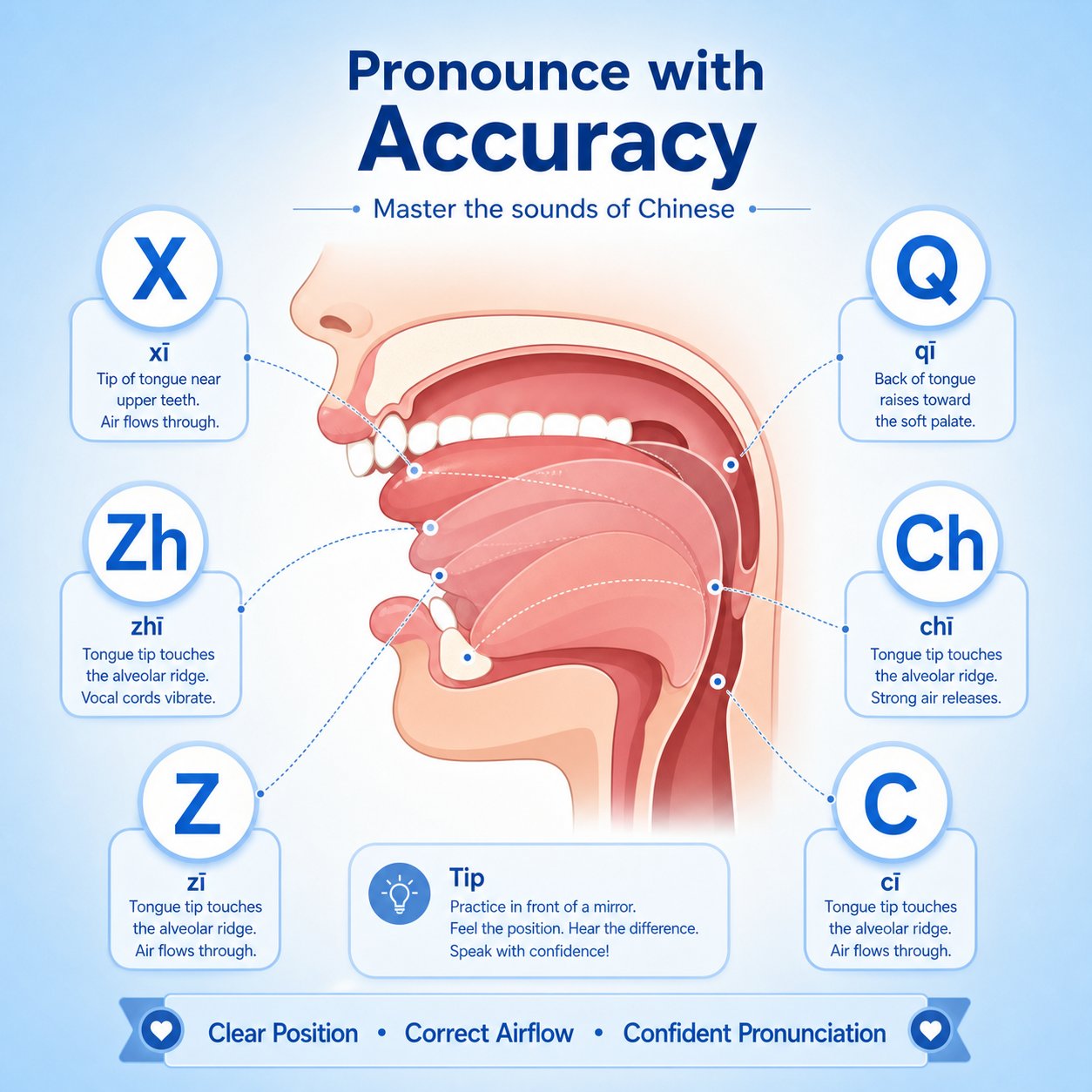
This is where most mispronunciation happens. If you want to know how to pronounce chinese words that start with X, Q, Zh, Ch, Z, or C, you need to override your English instincts entirely. These six initials appear in some of the most frequent surnames (Xu, Xie, Qian, Zhang, Chen, Zhou, Zhu, Cai), making them essential for any mandarin chinese pronunciation guide.
How do you pronounce chinese words starting with these letters? The table below gives you a practical breakdown for each:
| Pinyin Initial | English Approximation | Common Mistake | Mouth Position Tip |
|---|---|---|---|
| X | Between "sh" and "s" — like "sh" in "she" but with tongue positioned forward | Pronouncing it as English "z" or "ks" | Place your tongue flat in the middle of your mouth, halfway between the "sh" and "s" positions. Smile slightly and push air through. |
| Q | Like "ch" in "cheese" but lighter and sharper | Pronouncing it as "kw" like in "queen" | Touch your tongue to the roof of your mouth close to your front teeth (not far back). Add a puff of air as you release. |
| Zh | Like "j" in "judge" with tongue curled back | Pronouncing it as English "z" in "zoo" | Curl the tip of your tongue backward toward the hard palate. Release with a "j" sound. No puff of air. |
| Ch | Like "ch" in "chop" with tongue curled back | Confusing it with the lighter "Q" sound | Same curled tongue position as Zh, but release with a strong puff of air. Think "church" with your tongue pulled back. |
| Z | Like "ds" in "reads" or "dz" said quickly | Pronouncing it as the buzzy English "z" in "zebra" | Touch your tongue tip to the ridge just behind your upper front teeth. Release a quick "d" into "s" in one motion. |
| C | Like "ts" in "cats" or "boots" | Pronouncing it as "k" or "s" like English C | Same tongue position as Z (behind upper front teeth), but release with a strong aspirated "ts" — a clear puff of air follows. |
A useful pattern to notice: Zh and Ch are "retroflex" pairs (tongue curled back), while Z and C are "dental" pairs (tongue near the teeth). X and Q sit in between, with the tongue flat and forward. Pairing them this way helps you remember which mouth shape goes with which letter.
With these six initials mapped correctly, you can pronounce mandarin surnames that stump most English speakers. The consonant is only half the equation, though. Mandarin is a tonal language, and the same syllable said with a different pitch contour carries a completely different meaning.
Understanding the Four Tones Without Audio
Mandarin is a tonal language, which means pitch is not just expressive decoration the way it is in English. It is structural. The same syllable pronounced with a different pitch contour becomes a completely different word. For chinese names and pronunciation, this has a direct consequence: the surname Wang said with a rising tone (wáng, meaning "king") is a different word entirely from wang said with a falling tone (wàng, meaning "to forget"). Getting the tone right is part of getting the name right.
What Tones Are and Why They Matter for Names
Imagine if the English word "bat" meant one thing when you said it in a high steady voice, something else when your voice rose like a question, a third thing when your voice dipped low, and a fourth thing when your voice dropped sharply. That is how Mandarin works, except it applies to every single syllable in the language.
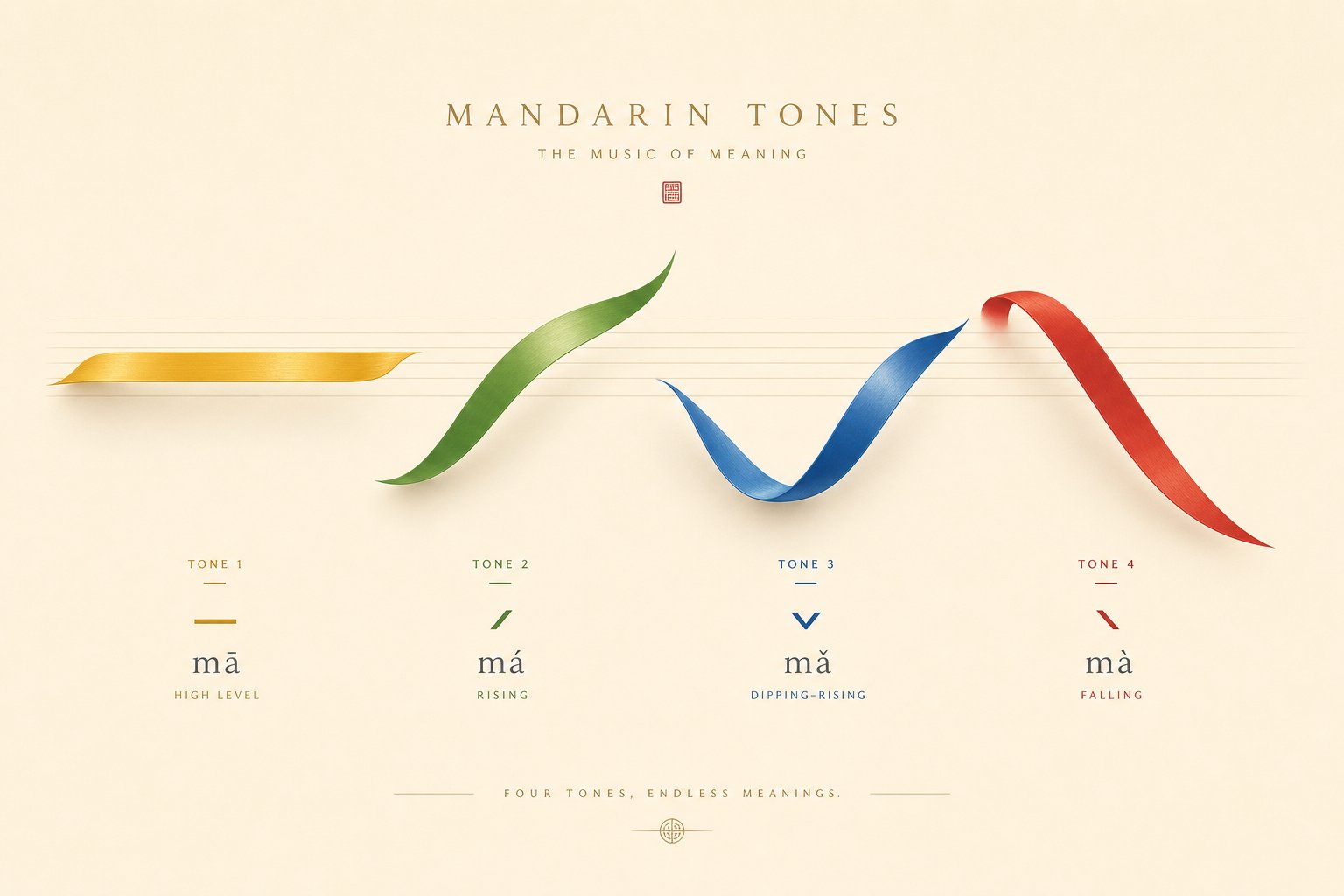
Mandarin has four main tones plus a neutral (unstressed) tone. Tones are differences in pitch that change the meaning of a spoken syllable, functioning much like vowels do in English. You would never tell an English learner that the difference between "bit" and "beat" does not matter. Tones carry the same weight in Mandarin.
For surnames specifically, tone accuracy signals that you have done your homework. A colleague named Wáng (王, second tone) may not correct you if you say it flat, but they will notice the effort when you get the rising pitch right. Chinese pronunciation in english contexts often drops tones entirely, which is understandable but avoidable with a little practice.
Four Tones Described Through English Speech Patterns
You already produce every one of these pitch patterns in everyday English. You just never had to attach meaning to them at the syllable level. Here is each tone mapped to something your voice already does naturally:
- First Tone (high flat) — pitch direction: steady and high. Think of the sound you make when humming "hmm" while thinking, holding a single steady note. Your voice stays level at the top of your comfortable range without rising or falling. Example surname: Fāng (方). Keep the pitch flat and elevated, like sustaining a musical note.
- Second Tone (rising) — pitch direction: low to high. This is the pitch your voice takes when you say "What?" in genuine surprise. It starts in the middle of your range and climbs upward. Example surname: Wáng (王). Let your voice rise the way it does when you ask a one-word question.
- Third Tone (dipping/low) — pitch direction: mid to low, then slightly up. Say "well..." with hesitation, as if you are about to deliver bad news. Your voice dips down and may creep back up slightly at the end. In natural speech, this tone is often just low without much rise. Example surname: Lǐ (李). Drop your pitch to the bottom of your range and keep it there.
- Fourth Tone (falling) — pitch direction: high to low. Say "Stop!" as a sharp command. Your voice starts high and drops decisively. It is quick and assertive, like slamming a door shut with your voice. Example surname: Zhào (赵). Start at the top and let your pitch fall fast.
These analogies are not perfect, but they give you a physical reference point. The key insight for mandarin name pronunciation is that tones are about the direction and shape of your pitch, not about hitting a specific musical note. Everyone's voice sits at a different absolute pitch. What matters is the relative movement: flat, rising, low, or falling.
How Tones Show Up in Common Surnames
To make this concrete, here is how tones distribute across some of the most frequent surnames you will encounter:
| Tone | English Analogy | Pitch Shape | Example Surnames |
|---|---|---|---|
| 1st (high flat) | Humming "hmm" while thinking | — (steady high) | Zhāng (张), Fāng (方), Gāo (高) |
| 2nd (rising) | Saying "What?" in surprise | ↗ (low to high) | Wáng (王), Chén (陈), Huáng (黄) |
| 3rd (dipping/low) | Saying "well..." with hesitation | ↘↗ (dip low) | Lǐ (李), Zhǎo (找 — note: Zhào 赵 is 4th tone) |
| 4th (falling) | Saying "Stop!" as a command | ↘ (high to low) | Zhào (赵), Xiè (谢), Wèi (魏) |
Notice that some of the most common surnames cluster in the second tone (Wáng, Chén, Yáng, Huáng). This is useful to know because it means the "surprised question" pitch pattern will serve you frequently.
A Practical Note on Tones in Conversation
Here is the honest truth: getting tones perfect as a non-native speaker is difficult, and most Chinese speakers do not expect you to nail them flawlessly. Research on Mandarin communication shows that context helps listeners fill in gaps, and a person's name spoken in context (during an introduction, in a meeting) provides more cues than a name spoken in isolation.
That said, pronunciation in chinese carries meaning at every level. Even a single tone error can shift a name's meaning in ways that range from confusing to embarrassing. The chinese pronunciation of names like Wáng versus Wàng, or Wèi versus Wéi, involves real semantic differences. Getting the consonants and vowels right while approximating the correct tone is far better than guessing at everything. And getting the tone right on top of that moves you from "acceptable" to "impressive."
Approximate pronunciation with correct consonants, vowels, and a reasonable attempt at tone will always communicate more respect than avoiding someone's name or mumbling through it.
Think of tones as the final layer of polish in your pronunciation chinese names toolkit. Master the consonant and vowel mappings from the previous section first. Then layer in the tone using the analogies above. You do not need to sound like a native Mandarin speaker. You need to sound like someone who cared enough to try, and that effort registers clearly.
With the sound system and tones covered, the next step is putting them together: matching specific surnames to their full pronunciation, tone included, in a format you can reference before any meeting or introduction.
Common Chinese Surnames With English Pronunciation
This is the section you will bookmark. Below you will find the most common chinese last names organized alphabetically by their romanized spelling, the version you see on business cards, email signatures, and LinkedIn profiles. Each entry includes the pinyin with tone mark, a plain-English sound approximation, and the traditional meaning behind the chinese surname.
A quick note on how to use these tables: the "English Approximation" column gives you a pronunciation close enough to be recognized and respected. It is not a perfect phonetic transcription, but it will get you far closer than guessing. For the tricky initials (X, Q, Zh, Z, C), refer back to the pinyin sound system section if you need a refresher on mouth position.
Understanding chinese surname meanings also adds context. Many of these names trace back thousands of years to ancient kingdoms, natural features, or occupations. Knowing that a chinese last name carries historical weight can deepen your appreciation for why correct pronunciation matters to the person who bears it.
Surnames Starting A Through H
This group contains several of the most popular chinese last names, including Chen and Huang, which rank among the top ten nationwide. Pay special attention to surnames beginning with C, which uses the "ts" sound rather than the English "k" or "s."
| Romanized Spelling | Pinyin + Tone | English Approximation | Meaning |
|---|---|---|---|
| Cai | Cài | "tsai" (like "ts" + "eye") | Ancient state of Cai / firewood |
| Chang | Cháng | "chahng" (like "ch" in "charge" + "ahng") | Constant, enduring |
| Chen | Chén | "chun" (like "churn" without the r) | Exhibit, display |
| Cheng | Chéng | "chung" (like "chunk" without the k) | Journey, procedure |
| Cui | Cuī | "tsway" (like "ts" + "way") | Towering, lofty |
| Deng | Dèng | "dung" (like "dung" with a shorter vowel) | Place name origin |
| Dong | Dǒng | "dohng" (like "dong" in "ding-dong") | Supervise, direct |
| Du | Dù | "doo" (like "do") | Birchleaf pear tree |
| Fan | Fàn | "fahn" (like "fun" with an "ah" vowel) | Model, pattern |
| Feng | Féng | "fung" (like "fun" + g) | Gallop |
| Gao | Gāo | "gow" (like "cow" with a g) | Tall, high |
| Guo | Guō | "gwor" (like "gw" + "or") | Outer city wall |
| Han | Hán | "hahn" (like "Han" in "Han Solo") | Ancient Han state |
| He | Hé | "huh" (like "huh" with a rising pitch) | What, which |
| Hu | Hú | "hoo" (like "who") | Beard, whiskers |
| Huang | Huáng | "hwahng" (like "hw" + "ahng") | Yellow |
Surnames Starting J Through Q
This range includes Li, the second most common chinese last name in China with approximately 100 million bearers. It also contains surnames starting with Q, which is one of the most frequently mispronounced initials. Remember: Q in pinyin sounds like "ch" in "cheese," never like "kw."
| Romanized Spelling | Pinyin + Tone | English Approximation | Meaning |
|---|---|---|---|
| Jiang | Jiāng | "jee-ahng" (like "j" + "ee" + "ahng") | River |
| Jin | Jīn | "jin" (like "jean") | Gold |
| Kong | Kǒng | "kohng" (like "cone" + g) | Opening; family of Confucius |
| Lei | Léi | "lay" (like "lay") | Thunder |
| Li | Lǐ | "lee" (like "Lee") | Plum |
| Liang | Liáng | "lee-ahng" (like "lee" + "ahng") | Bridge, beam |
| Lin | Lín | "lin" (like "lean") | Forest |
| Liu | Liú | "lee-oh" (like "Leo") | Kill, destroy |
| Lu | Lù | "loo" (like "Lou") | Land |
| Luo | Luó | "lwor" (like "lw" + "or") | Net |
| Ma | Mǎ | "mah" (like "ma") | Horse |
| Mao | Máo | "mow" (like "cow" with an m) | Hair, fur |
| Meng | Mèng | "mung" (like "among" without the a) | First, eldest |
| Peng | Péng | "pung" (like "punk" without the k) | Sound of drums |
| Qian | Qián | "chee-en" (like "ch" + "ee" + "en") | Money, coins |
| Qin | Qín | "chin" (like "chin") | Ancient Qin state |
Surnames Starting R Through Z
This final group is the largest and contains the single most common chinese surname in China: Wang, with over 100 million bearers. It also holds the highest concentration of tricky initials: Zh, X, Z, and Y. You will find chinese surnames meaning everything from "king" and "summer" to "leaf" and "red" in this section, reflecting the deep historical roots behind chinese last name meanings.
| Romanized Spelling | Pinyin + Tone | English Approximation | Meaning |
|---|---|---|---|
| Ren | Rén | "run" (like "run" with tongue curled back on the r) | Responsibility, duty |
| Shao | Shào | "show" (like "shower" without the -er) | Place name origin |
| Shen | Shěn | "shun" (like "shun") | Sink, submerge |
| Shi | Shí | "shr" (like "sure" said quickly) | Stone; also History (史, shǐ) |
| Song | Sòng | "sohng" (like "song" with a rounder o) | Song Dynasty / pine |
| Su | Sū | "soo" (like "Sue") | Revive |
| Sun | Sūn | "swun" (like "sw" + "un") | Grandson, descendant |
| Tang | Táng | "tahng" (like "tongue" with an "ah") | Tang Dynasty / hall |
| Wan | Wàn | "wahn" (like "wan" in "wander") | Ten thousand |
| Wang | Wáng | "wahng" (like "w" + "ahng", not like "wang" in English) | King, monarch |
| Wei | Wèi | "way" (like "way") | Height; ancient state of Wei |
| Wu | Wú | "woo" (like "woo") | Ancient state of Wu |
| Xia | Xià | "shee-ah" (like "sh" + "ee" + "ah") | Summer |
| Xiao | Xiāo | "shee-ow" (like "sh" + "ee" + "ow") | Mournful, desolate |
| Xie | Xiè | "shee-eh" (like "sh" + "ee" + "eh") | Thanks, gratitude |
| Xu | Xú | "shü" (like "she" with tightly rounded lips) | Gentle, slow |
| Yan | Yán | "yen" (like Japanese "yen") | Handsome, dignified |
| Yang | Yáng | "yahng" (like "y" + "ahng") | Willow, poplar |
| Yao | Yáo | "yow" (like "y" + "ow" in "cow") | Elegant, handsome |
| Ye | Yè | "yeh" (like "yeah") | Leaf |
| Yu | Yú | "yü" (like "you" with tightly rounded lips) | Surplus; also a place name |
| Yuan | Yuán | "yoo-en" (like "you" + "en") | Long robe |
| Zeng | Zēng | "dzung" (like "ds" + "ung") | Once, ancestor |
| Zhang | Zhāng | "jahng" (like "j" in "jar" + "ahng") | To stretch a bow; archer |
| Zhao | Zhào | "jow" (like "j" in "jar" + "ow" in "cow") | Exceeding, surpassing |
| Zheng | Zhèng | "jung" (like "j" in "jar" + "ung") | Ancient state of Zheng |
| Zhou | Zhōu | "joe" (like the name "Joe") | Circumference; Zhou Dynasty |
| Zhu | Zhū | "joo" (like "j" in "jar" + "oo") | Red, vermilion |
These tables cover the chinese surnames and meanings you are most likely to encounter in professional and social settings. Together, the surnames listed here account for the vast majority of Chinese people you will meet, email, or collaborate with. A few patterns worth noting as you scan the tables:
- Surnames starting with Zh all use the "j" in "jar" sound with the tongue curled back.
- Surnames starting with X all use a forward "sh" sound followed by a vowel.
- The "eng" ending (Deng, Feng, Cheng, Meng, Peng, Zeng, Zheng) always sounds like "ung" in "lung," not like "eng" in "English."
- The "ang" ending (Wang, Yang, Zhang, Huang, Tang) uses the open "ah" vowel plus "ng," sounding like "ahng."
Keep this reference handy before
Diaspora Spelling Variations and Romanization Systems
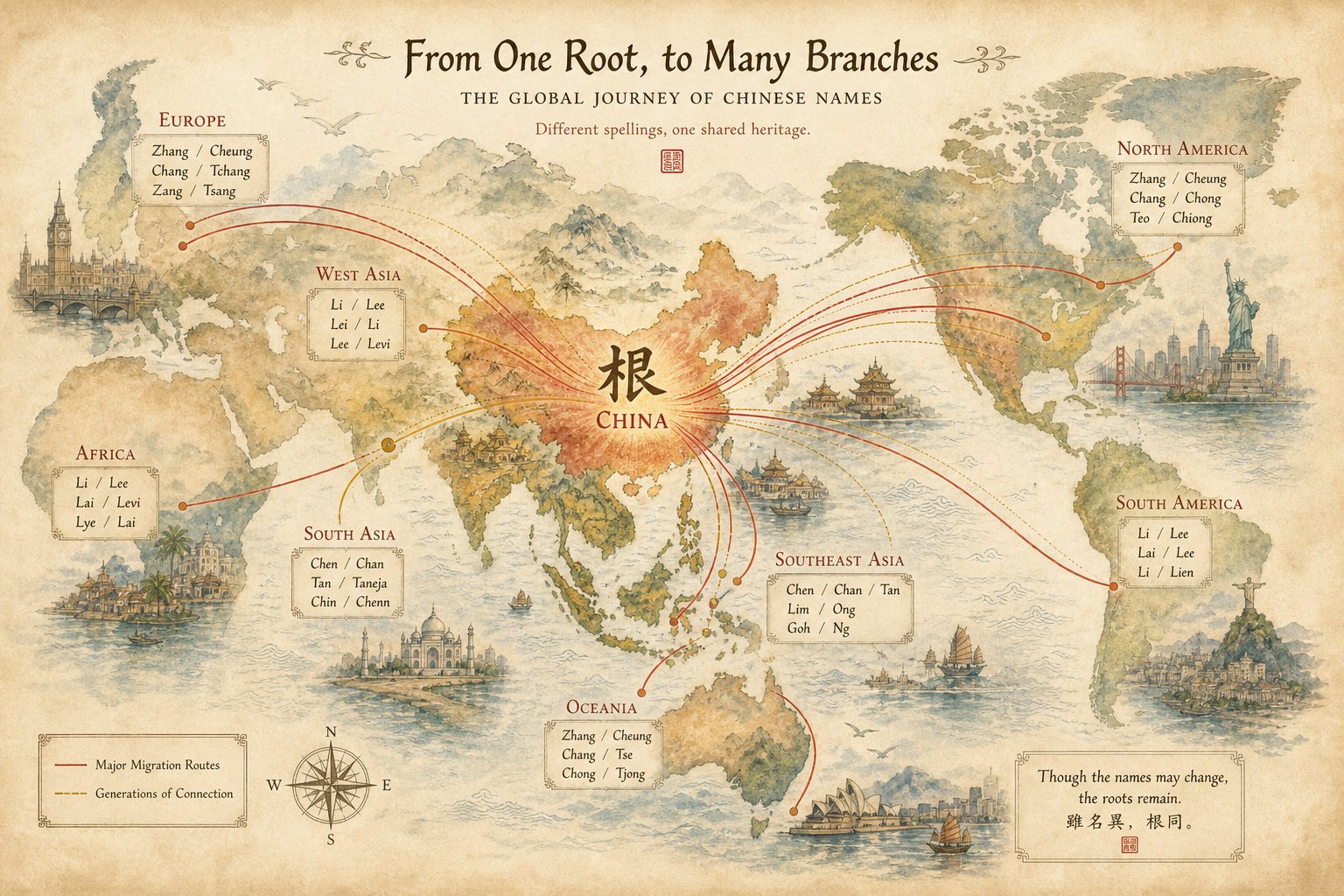
You have learned how to pronounce Zhang, Chen, and Wang using pinyin. But what happens when you encounter someone named Cheung, Chan, or Wong? These are not different surnames. They are the same Chinese characters, romanized through entirely different systems based on dialect, geography, and family history. This is one of the most confusing aspects of Chinese names for English speakers, and it is also one of the most important to understand.
A single Chinese character can appear in half a dozen different spellings depending on whether the bearer's family emigrated from Guangdong, Fujian, Hong Kong, Taiwan, or mainland China. The spelling you see on someone's business card reflects their family's linguistic heritage, not a misspelling or alternate name. Recognizing these variations helps you connect unfamiliar spellings back to the pronunciation patterns you already know.
Why the Same Surname Has Multiple Spellings
Chinese is not one language. It is a family of related languages and dialects that share a written script but sound dramatically different when spoken. Mandarin is the official language of mainland China, but Cantonese dominates Hong Kong and much of the diaspora in Southeast Asia, Canada, and the United States. Hokkien and Teochew are common among Chinese communities in Singapore, Malaysia, and the Philippines.
When Chinese families emigrated over the past two centuries, they romanized their names based on how they actually pronounced them in their home dialect, not based on Mandarin pinyin. The result? The character 王 appears as Wang in Mandarin pinyin, Wong in Cantonese romanization, Ong in Hokkien, and Vong in Macanese Portuguese transliteration. All four spellings represent the same single character meaning "king."
The Asia Media Centre explains this clearly: in territories with a sizeable Chinese diaspora, such as Singapore and Malaysia, the way a family name is spelled can be a signifier of the region a person's ancestors hail from. A person with the surname Wong is understood to have Cantonese heritage, likely with ancestral connections to Guangdong province or Hong Kong.
Beyond dialect differences, multiple romanization systems have been used historically:
- Pinyin — the current standard in mainland China, adopted in 1958. Most younger immigrants from the mainland use this system.
- Wade-Giles — an older system developed in the 19th century, still common among Taiwanese families and in older academic texts. It produces spellings like Chiang (pinyin: Jiǎng) and Teng (pinyin: Dèng).
- Cantonese romanization — used in Hong Kong, Macau, and Cantonese-speaking diaspora communities. No single official standard exists, so spellings can vary even within this system.
- Hokkien/Teochew romanization — common in Singapore, Malaysia, Taiwan (for Taiwanese Hokkien speakers), and the Philippines.
Understanding wong in chinese contexts illustrates this perfectly. Wong is the Cantonese romanization of both 黃 (Huáng in pinyin, meaning "yellow") and 王 (Wáng in pinyin, meaning "king"). These are two completely different characters that happen to sound identical in Cantonese. In Mandarin, they are distinct: Huáng versus Wáng. So when you meet someone named Wong, you may be looking at either surname, and only context or asking directly will clarify which one.
Mapping Diaspora Spellings Back to Mandarin Pinyin
The table below maps the most common alternate spellings you will encounter back to their Mandarin pinyin equivalents. This is especially useful when you have learned the pinyin pronunciation but encounter a diaspora spelling in the wild.
| Spelling You See | Origin System | Mandarin Pinyin | Pronunciation |
|---|---|---|---|
| Wong | Cantonese | Wáng (王) or Huáng (黄) | "wahng" or "hwahng" |
| Ong | Hokkien | Wáng (王) | "wahng" |
| Vong | Macanese | Wáng (王) or Huáng (黄) | "wahng" or "hwahng" |
| Chan | Cantonese | Chén (陈) | "chun" (like churn without the r) |
| Tan | Hokkien/Teochew | Chén (陈) | "chun" |
| Chin | Hakka | Chén (陈) | "chun" |
| Lee / Lei | Cantonese / Wade-Giles | Lǐ (李) | "lee" |
| Ly | Vietnamese-Chinese | Lǐ (李) | "lee" |
| Ng / Wu | Cantonese / Mandarin | Wú (吴) | "woo" |
| Goh | Hokkien | Wú (吴) | "woo" |
| Cheung / Cheong | Cantonese | Zhāng (张) | "jahng" |
| Teo / Teoh | Hokkien | Zhāng (张) | "jahng" |
| Lau / Low | Cantonese / Hokkien | Liú (刘) | "lee-oh" |
| Liew / Lew | Hakka | Liú (刘) | "lee-oh" |
| Ooi / Wee | Hokkien | Huáng (黄) | "hwahng" |
| Chiang / Chiang | Wade-Giles | Jiǎng (蒋) | "jee-ahng" |
A few patterns emerge from this table. The chen last name origin traces back to an ancient kingdom in modern-day Henan province, and the Asia Media Centre notes that in Cantonese and Hakka, the surname is pronounced "Chan" or "Chun," while the tan last name spelling is used by Hokkien speakers for the same character. So if you meet someone named Chan, Tan, or Chin, there is a good chance they share the same last name Chen, just filtered through a different dialect.
The li surname follows a similar pattern. In Mandarin pinyin it is Lǐ, but the Cantonese and older romanization systems produce "Lee" or "Lei." The wang last name origin connects to the character meaning "king," and its diaspora variants (Wong, Ong, Vong) reflect the geographic spread of Chinese emigration over centuries. The huang name origin ties to the character for "yellow," one of the oldest surnames in Chinese civilization, appearing as Wong, Ooi, Wee, or Ng depending on dialect.
How to Handle Uncertainty About Which System Someone Uses
Here is the practical reality: you cannot always tell which romanization system someone's name uses just by looking at it. And you do not need to. The spelling on someone's name is their family's chosen representation, shaped by generations of history, migration, and personal identity. It should be respected exactly as written.
What this pronunciation guide gives you is the ability to approximate the sound correctly regardless of the system. If you see "Chan" and recognize it as the Cantonese form of Chen, you know the Mandarin pronunciation is "chun." But the person themselves may prefer the Cantonese pronunciation "chahn." The safest approach combines two strategies:
- Use the spelling as a clue to identify the likely underlying character and its general sound family.
- Ask the person directly how they prefer their name pronounced. Many diaspora Chinese have a preferred pronunciation that blends their heritage dialect with local speech patterns.
Someone named Wong who grew up in Toronto may pronounce their name exactly as it looks in English. Someone named Wong who recently arrived from Hong Kong may use the Cantonese pronunciation with its distinct tonal quality. Both are correct for that individual.
The key insight is that romanization is a bridge, not a cage. It connects a Chinese character to a written form that English speakers can read, but it does not dictate a single "right" pronunciation across all contexts. Your job is to get close enough to show respect, and to be open to correction when offered.
Spelling variations explain why the same name looks different on paper. But even when the spelling is standard pinyin, English speakers still stumble on specific surnames over and over. The next section tackles those repeat offenders directly, breaking down the most commonly mispronounced surnames and showing you exactly where the error happens and how to fix it.
Common Mispronunciations and How to Fix Them
Knowing the rules is one thing. Catching yourself in the act is another. Certain Chinese surnames get mangled so consistently by English speakers that the wrong pronunciation has almost become the default in Western workplaces. If you want to know how to pronounce chinese names correctly, start by unlearning the specific mistakes below. Each one traces back to a single bad assumption about how a pinyin letter should sound.
Zhang Is Not "Zang" and Zh Is Not English Z
This is arguably the most common error. English speakers see "Zhang" and produce something like "zang" or "zaang," treating Zh as the buzzy "z" in "zebra." It is not. To pronounce zhang correctly, think of the "j" in "judge" but with your tongue curled slightly backward toward the roof of your mouth. The sound is closer to "jahng" than anything starting with a z.
Here is the mouth position: curl the tip of your tongue back so it almost touches the hard palate (the ridge behind your upper teeth). Release with a voiced "j" sound, no puff of air. ASU's pronunciation guide describes it as pronouncing "jerk" in English but stopping before the "rk." That truncated "jer-" is your Zh sound. Apply it to Zhang (jahng), Zhao (jow), Zhou (joe), and Zhu (joo).
Xu and Xie Are Not "Zoo" and "Zy"
The chinese pronunciation x trips up nearly everyone. English has no standalone "X" sound at the beginning of words, so speakers default to "z," "ks," or "eks." None of these are close. The pronunciation of x in chinese is a forward "sh" sound, produced with the tongue flat and low, its tip resting behind the lower front teeth while the middle of the tongue rises toward the palate.
Think of saying "she" but with a slight smile, pulling the sound forward in your mouth. That gives you the X initial. So Xu sounds like "shü" (the "sh" plus rounded-lip "ee"), and Xie sounds like "shee-eh." If you have been saying "zoo" for Xu or "zy" for Xie, the fix is straightforward: replace the z with that forward sh sound. The chinese x pronunciation sits between English "sh" and "s," closer to "sh" but lighter and more hissed. Once you hear it in your head as a breathy "sh," surnames like Xia ("shee-ah"), Xiao ("shee-ow"), and Xin ("shin") fall into place.
Qian and Qin Are Not "Kwee-an" and "Kwin"
English speakers see Q and reflexively add a "w" after it, producing "kwee-en" for Qian or "kwin" for Qin. In pinyin, Q has nothing to do with the "kw" combination. It sounds like "ch" in "cheese" but lighter, with the tongue positioned forward near the teeth and a puff of air on release. Qian is "chee-en," and Qin is "chin." No "kw" anywhere.
The common mistake is conflating Q with Ch. Both sound like English "ch," but Q is produced with the tongue forward (think smiling position), while Ch curls the tongue back (retroflex). For surname purposes, pronouncing Q as a standard English "ch" gets you 90 percent of the way there.
Here are the ten most commonly mispronounced surnames, with the error and the correction side by side:
- Zhang — not "zang" → say "jahng"
- Xu — not "zoo" or "eks-oo" → say "shü"
- Xie — not "zy" or "ex-ee" → say "shee-eh"
- Qian — not "kwee-an" → say "chee-en"
- Qin — not "kwin" → say "chin"
- Zhao — not "zow" → say "jow" (j as in judge)
- Zhu — not "zoo" → say "joo" (tongue curled back)
- Cai — not "kai" or "say" → say "tsai" (ts + eye)
- Cui — not "koo-ee" → say "tsway"
- Zheng — not "zeng" → say "jung" (j as in judge + ung)
Notice the pattern: every error on this list comes from reading pinyin letters as if they were English. The Zh/Z confusion, the X-as-z assumption, the Q-as-kw reflex, and the C-as-k mistake are all the same underlying problem expressed through different letters. Once you internalize that Zh = j (tongue back), X = sh (tongue forward), Q = ch (tongue forward), and C = ts, you eliminate the majority of mispronunciations in one sweep.
Fixing these sounds is the mechanical part. The social part, how to handle pronunciation gracefully in real conversations, ask for help without awkwardness, and recover when you stumble, requires a different kind of preparation.

How to Ask About and Practice Name Pronunciation
You have the phonetic tools now. You know that Zhang starts with a "j" sound, that Xu uses a forward "sh," and that Q never means "kw." But real life is messier than a reference table. Sometimes you encounter a name cold, with no time to look it up. Sometimes you try and get it wrong. The question is not whether you will stumble. It is what you do next. Knowing how do you pronounce chinese names on paper is only half the skill. The other half is navigating the human moment gracefully.
How to Ask Someone About Their Name Pronunciation
Asking is not awkward. Avoiding is. Research from the University of Washington found that 73% of people have had their name mispronounced, and 43% said it made them feel disrespected. Meanwhile, people overwhelmingly appreciate being asked. The discomfort lives in your head, not theirs.
Here are three scripts that work in professional and social settings:
- "I want to make sure I say your name correctly — could you help me with the pronunciation?"
- "Would you mind saying your name for me? I want to get it right."
- "I've seen your name in writing but haven't heard it spoken — how do you say this name?"
These work because they signal effort, not ignorance. You are telling the person their name matters enough to get right. As TED speaker Gerardo Ochoa explains, the people who listen, slow down, and try again are the ones who build real connection. He calls them "calibrators," and they are the category everyone should aim for.
If you have time before a meeting, use a chinese name pronunciation tool like NameCoach or sites like Pronounce Names to hear audio recordings. Many professionals now include phonetic spellings or pronounce chinese names audio clips in their email signatures or LinkedIn profiles. Check before you ask.
What to Do When You Get It Wrong
You will mispronounce someone's name at some point. The recovery matters more than the mistake. Keep it brief: correct yourself, say it again correctly, and move on. Do not spiral into a long apology that centers your embarrassment over their name.
A simple "Sorry — Shee-eh, right?" after mispronouncing Xie is all you need. Then practice afterward so you get it right next time. Coming back the following day and using the name correctly, unprompted, communicates more than any apology could.
What you want to avoid is what Ochoa calls the "evader" response: asking for a nickname, shortening the name without permission, or simply never using it. Dr. Geetanjali Chander at UW Medicine puts it plainly: "When individuals look at my name and say, 'I'm just going to call you G,' I feel disrespected." The same applies when someone avoids saying a Chinese surname because they are unsure how to say chinese names correctly. Avoidance is not politeness. It is erasure.
Why Making the Effort Matters Professionally
In workplace settings, client relationships, and academic environments, how to pronounce a chinese name correctly is a form of cultural competence. It signals that you see the person, not just their role. It also has practical stakes. Mispronouncing a client's name in a pitch meeting or a colleague's name in a team introduction creates friction that correct pronunciation would have prevented entirely.
Attempting correct pronunciation, even imperfectly, communicates more respect than avoiding someone's name entirely.
You do not need to sound like a native Mandarin speaker. You need to sound like someone who prepared. This guide exists as a reference you can return to before any meeting, introduction, or presentation where you want to pronounce chinese name correctly. Bookmark the surname tables. Review the tricky initials. Practice the tone patterns. Each time you use someone's name with care, you are telling them they belong in the room, and that is worth every second of preparation.
Frequently Asked Questions About Chinese Surname Pronunciation
1. Why do Chinese surnames have so many different spellings?
Chinese surnames get spelled differently because of regional dialects and romanization systems. The same character can appear as Wang (Mandarin pinyin), Wong (Cantonese), or Ong (Hokkien) depending on the bearer's family heritage and country of emigration. Pinyin is the mainland China standard, Wade-Giles is common in Taiwan, and Cantonese romanization dominates in Hong Kong and much of the overseas diaspora. The spelling on someone's name reflects their family's linguistic background, not a variant or misspelling.
2. How do you pronounce X, Q, and Zh in Chinese names?
These three initials cause the most confusion for English speakers. X sounds like a forward 'sh' (so Xu is 'shü' and Xie is 'shee-eh'). Q sounds like 'ch' in 'cheese' with a puff of air (so Qian is 'chee-en' and Qin is 'chin'). Zh sounds like the 'j' in 'judge' with the tongue curled back (so Zhang is 'jahng' and Zhao is 'jow'). None of these follow English letter-sound rules, which is why guessing leads to consistent mispronunciation.
3. Which part of a Chinese name is the surname?
In traditional Chinese naming order, the surname comes first and the given name follows. So in Zhang Wei, Zhang is the family name and Wei is the personal name. However, many Chinese people reverse this order in Western contexts, placing their given name first to match English conventions. Some also adopt a Western first name entirely, like 'David Zhang.' The surname is almost always one syllable and one character, making it the shorter element in a full name.
4. Do tones really matter when pronouncing Chinese surnames?
Yes, tones carry meaning in Mandarin. The same syllable with a different pitch contour becomes a different word entirely. Wang with a rising tone (second tone) means 'king,' while wang with a falling tone (fourth tone) means 'to forget.' That said, getting consonants and vowels right while approximating the tone is far better than guessing at everything. Most Chinese speakers appreciate the effort even if your tones are not perfect, especially when context makes the intended name clear.
5. What is the best way to ask someone how to pronounce their Chinese name?
Direct, respectful asking works best. Phrases like 'I want to make sure I say your name correctly — could you help me with the pronunciation?' signal effort rather than ignorance. Research shows 73% of people have had their name mispronounced and most appreciate being asked. Avoid shortening someone's name without permission or substituting a nickname. If you mispronounce it, correct yourself briefly and move on without over-apologizing, then practice so you get it right next time.