How Chinese Surname Translation Actually Works
Imagine two cousins with the same Chinese family name showing up at an immigration office with completely different English spellings on their passports. One says "Chan," the other says "Chen." Neither is wrong. Both are translating the exact same character: 陳. This is the reality of chinese surname translation rules, a system where a single character can produce half a dozen valid English spellings depending on where you are, what dialect you speak, and which romanization standard applies.
Why Chinese Name Order Creates Translation Challenges
So how do chinese names work at a structural level? Chinese names place the surname first and the given name second. The family name is almost always one syllable, while the given name is typically one or two syllables. The top 100 chinese surnames are all single-syllable and cover roughly 85 percent of the population. When you encounter a three-syllable name like Wang Xiaoming, the first syllable is the family name and the remaining two form the given name.
This reversed order compared to Western naming conventions creates immediate confusion in English-language contexts. Which part is the first name? Which is the last? Early Chinese immigrants to English-speaking countries often had their names recorded incorrectly, with given names mistakenly registered as chinese last names and vice versa.
The Core Problem of One Character Multiple Spellings
The deeper challenge goes beyond name order. The character 王 alone can be romanized as Wang, Wong, Ong, or Heng depending on whether you are reading it in Mandarin, Cantonese, Hokkien, or Teochew. Typical chinese names like 李, 張, and 林 each carry multiple valid English spellings shaped by dialect, geography, and historical era. These are not errors or inconsistencies. They reflect genuine phonetic differences across Chinese languages that share a written script but sound nothing alike.
Chinese surname translation is not a simple one-to-one mapping between character and spelling. It is a system governed by regional jurisdiction, historical romanization standards, and dialect pronunciation, where multiple correct answers exist simultaneously.
This article serves as a practical, multi-jurisdictional reference for navigating these chinese family names across different systems, regions, and contexts. The rules are knowable, but they require understanding which system applies where and why.
Romanization Systems That Shape Surname Spelling
If a single Chinese character can produce multiple English spellings, the obvious question is: who decides which spelling is correct? The answer lies in romanization systems, the standardized methods for converting Chinese characters into Latin script. Each system applies different phonetic logic, and each emerged from a distinct political and linguistic context. When you translate name chinese characters into English, the system you use determines the result.
Hanyu Pinyin vs Wade-Giles for Surname Spelling
Hanyu Pinyin is the international standard, adopted by Mainland China in 1958 and recognized by the United Nations and the U.S. Library of Congress. It maps Mandarin pronunciation to Latin letters using conventions that sometimes surprise English speakers. The letter q represents a "ch" sound, x sounds like "sh," and zh is a retroflex "j." For surnames, Pinyin produces clean, unambiguous spellings: Zhang, Chen, Huang.
Wade-Giles, developed by British diplomats Thomas Wade and Herbert Giles in the 19th century, takes a different approach. It uses apostrophes to distinguish aspirated from unaspirated consonants. The surname 張 becomes Chang in Wade-Giles versus Zhang in Pinyin. The surname 陳 becomes Ch'en with an apostrophe, distinguishing it from Chen (which would represent a different sound). Here is the critical problem: the apostrophe is almost always omitted in practice, making it impossible to determine the correct pronunciation from the spelling alone. This is why you will often see chinese names written in english that look identical under Wade-Giles but actually represent different characters.
Tongyong Pinyin briefly served as Taiwan's official system from 2002 to 2008. It differs from Hanyu Pinyin in roughly 20 percent of syllables, using spellings like Jhang instead of Zhang. The system was ultimately replaced by Hanyu Pinyin for most public signage, though personal names registered during that era may still carry Tongyong spellings.
Cantonese and Hokkien Romanization Systems
Southern Chinese dialects have their own romanization traditions entirely separate from Mandarin-based systems. Jyutping is the linguistic standard for Cantonese, though Hong Kong's actual surname spellings follow older colonial-era conventions rather than any single formal system. A name in chinese language that reads as Chen in Mandarin becomes Can4 in Jyutping notation, but appears as Chan on Hong Kong identity documents.
For Hokkien speakers in Taiwan, Singapore, Malaysia, and the Philippines, the Pe̍h-ōe-jī (POJ) system romanizes the same surnames into yet another set of spellings. The character 黃 is N̂g or Ui in POJ, reflecting a pronunciation that bears almost no resemblance to the Mandarin Huang.
The table below shows how five of the most common surname characters appear under each major system, illustrating why chinese names english translation is never a straightforward task:
| Character | Hanyu Pinyin | Wade-Giles | Jyutping (Cantonese) | Hokkien POJ |
|---|---|---|---|---|
| 陳 | Chen | Ch'en | Can4 (Chan) | Tan |
| 林 | Lin | Lin | Lam4 (Lam) | Lim |
| 黃 | Huang | Huang | Wong4 (Wong) | N̂g / Ui |
| 李 | Li | Li | Lei5 (Lee) | Li |
| 張 | Zhang | Chang | Zoeng1 (Cheung) | Tiu / Teo |
Notice that some surnames like 林 (Lin) remain nearly identical across Mandarin-based systems but diverge sharply in Cantonese and Hokkien. Others like 張 produce a different spelling in every single column. These differences are not random. They reflect centuries of separate phonetic evolution across dialect groups, combined with political decisions about which system to standardize and when.
The coexistence of these systems means that knowing the surname中文 character alone is never enough to predict its English spelling. You also need to know which romanization tradition applies, and that depends almost entirely on geography and jurisdiction.
Regional Variations in Surname Romanization
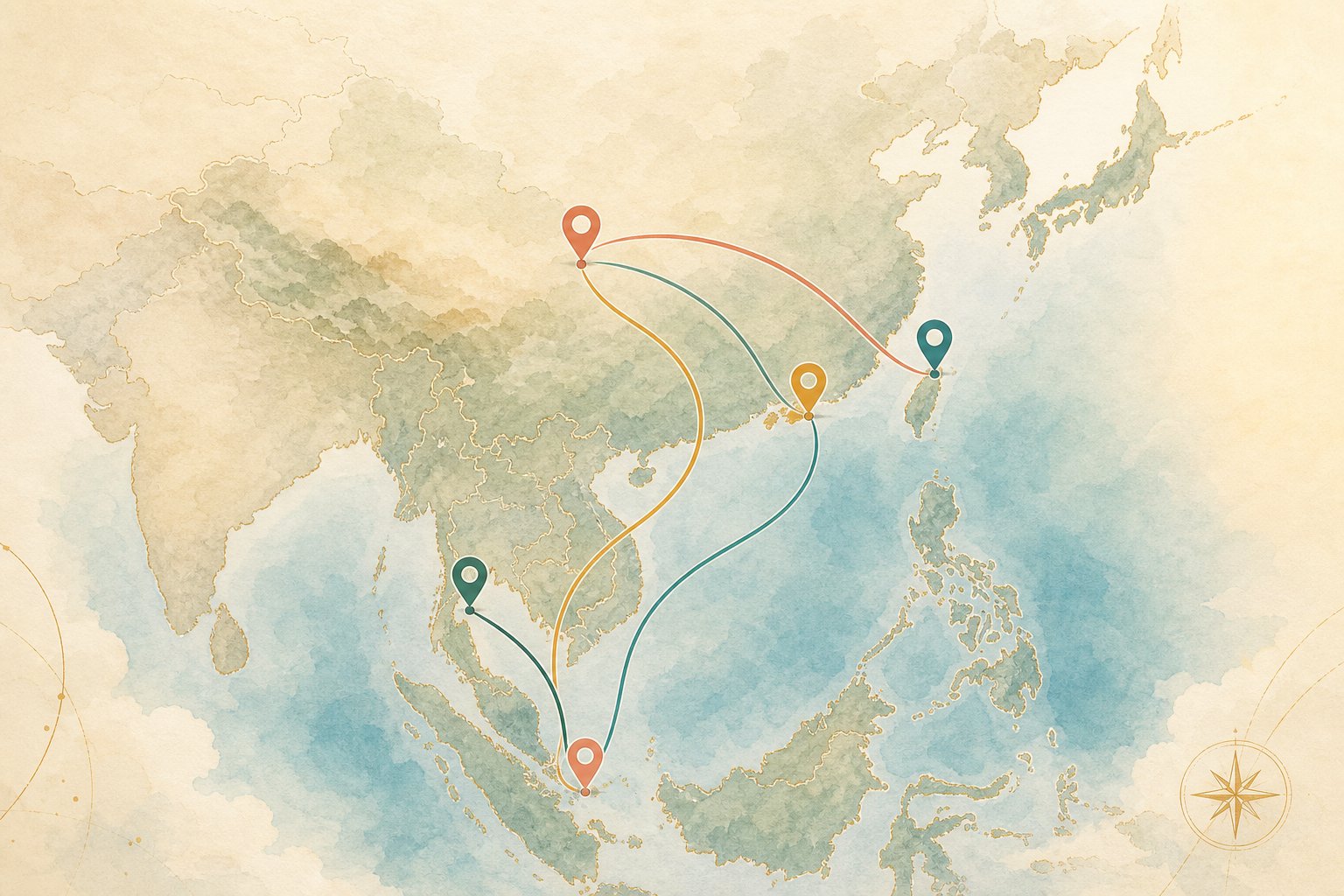
Geography and jurisdiction shape everything. The same family that spells its name Chen in Beijing might spell it Chan in Hong Kong, Tan in Singapore, and Chin in a Hakka community in Sabah. Each spelling is correct within its own regional context. Understanding which region produces which spelling is the practical core of navigating the most common chinese surnames in English.
Mainland China and Taiwan Surname Differences
Mainland China enforces the simplest rule: all surnames on official documents use Hanyu Pinyin, no exceptions. Since the government standardized this system for passports and identity cards, every person surnamed 陳 is officially Chen, every 張 is Zhang, and every 黃 is Huang. There is no room for personal preference or dialect variation in official records.
Taiwan takes a more flexible approach. The Ministry of Foreign Affairs allows passport applicants to choose their own romanization, though the default has shifted over time. People who registered names before 2002 often carry Wade-Giles spellings. Those who registered between 2002 and 2008 may have Tongyong Pinyin versions. And since 2009, Hanyu Pinyin has been the recommended default, though individuals can still opt for Wade-Giles or other systems if they prefer. The result? Two Taiwanese citizens with the surname 張 might appear as Chang (Wade-Giles) and Zhang (Pinyin) on their respective passports, both perfectly legal.
Hong Kong and Southeast Asian Surname Conventions
Hong Kong operates without a single mandated romanization standard. Surname spellings on Hong Kong identity cards follow Cantonese pronunciation using informal conventions inherited from the colonial era. There is no official system like Jyutping governing these spellings. Instead, common usage has solidified certain forms: Wong for 黃, Chan for 陳, Cheung for 張. These spellings are consistent across the population but do not follow any published standard.
Southeast Asian Chinese communities present the most diverse picture. In Singapore and Malaysia, names are romanized based on the pronunciation in a person's ancestral dialect. A Hokkien family surnamed 黃 spells it Ng or Wee, while a Cantonese family with the same character uses Wong, and a Teochew family might write Ung. In the Philippines, generations of Hokkien-speaking Chinese immigrants adopted Spanish-influenced spellings, turning 陳 into Tan and 林 into Lim, forms that remain standard today.
The table below maps the most common chinese last names across six regional conventions, showing how a single character fans out into multiple valid spellings:
| Character | Mainland China (Pinyin) | Taiwan (Wade-Giles) | Hong Kong (Cantonese) | Singapore/Malaysia (Hokkien) | Hakka |
|---|---|---|---|---|---|
| 王 (Wang) | Wang | Wang | Wong | Ong / Heng | Vong |
| 李 (Li) | Li | Li | Lee | Lee / Li | Li |
| 張 (Zhang) | Zhang | Chang | Cheung | Teo / Tio | Chong |
| 劉 (Liu) | Liu | Liu | Lau | Lau | Liew |
| 陳 (Chen) | Chen | Ch'en | Chan | Tan | Chin |
| 楊 (Yang) | Yang | Yang | Yeung | Yeo / Iu | Yong |
| 黃 (Huang) | Huang | Huang | Wong | Ng / Wee | Vong |
| 林 (Lin) | Lin | Lin | Lam | Lim | Lim |
| 吳 (Wu) | Wu | Wu | Ng | Goh | Ng |
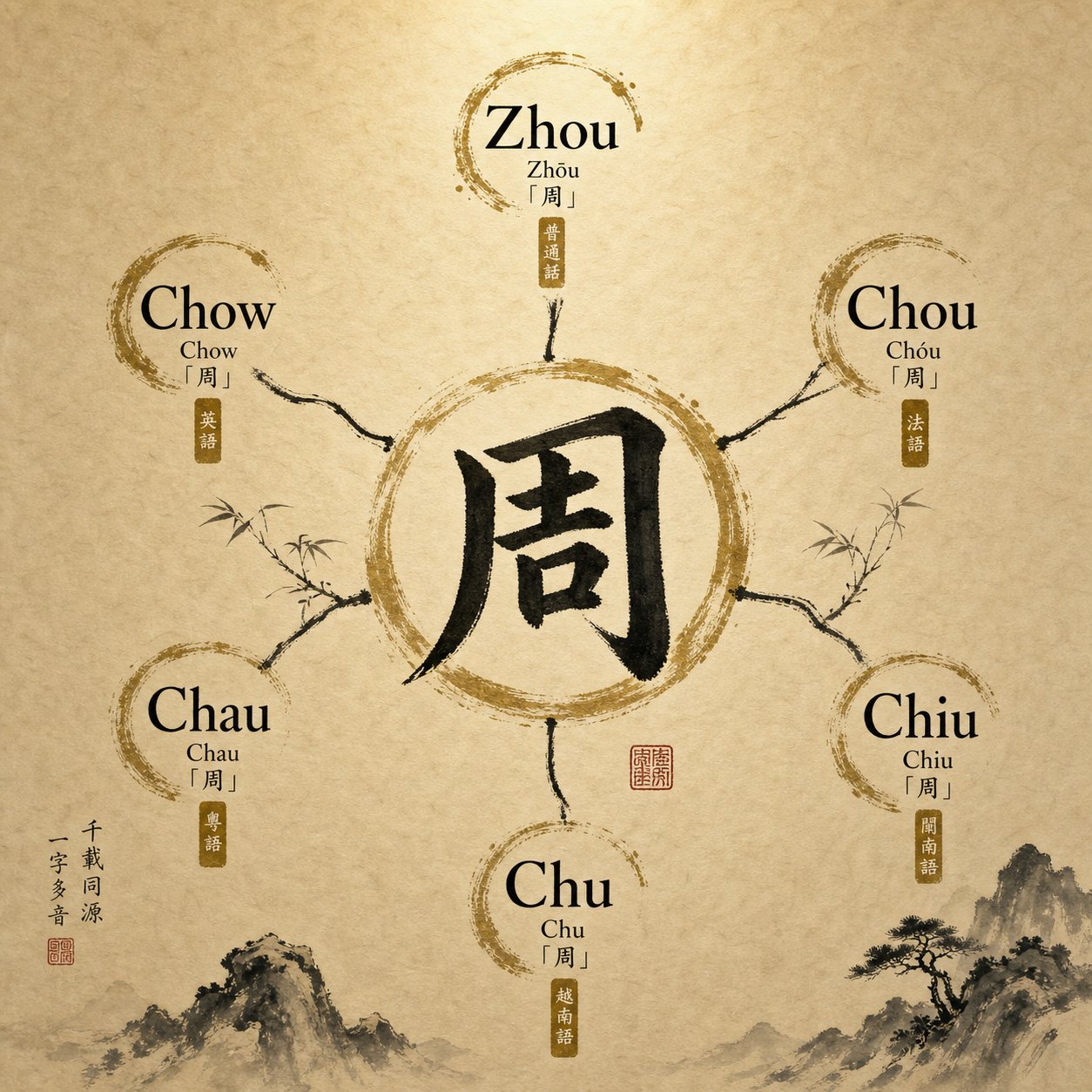
| 周 (Zhou) | Zhou | Chou | Chow | Chew / Jee | Chew |
These ten surnames alone account for a significant share of the Chinese population. Census data indicates that the top 100 most popular chinese last names cover approximately 85 percent of all Chinese people, which means the regional variation patterns shown above apply to the vast majority of name translation scenarios you will encounter.
You'll notice a pattern: Mandarin-based systems (Pinyin and Wade-Giles) tend to produce similar or identical results for many surnames, while Cantonese and Hokkien spellings diverge dramatically. The surname 吳 is a striking example. It is Wu in Mandarin, Ng in both Cantonese and Hakka (a syllable with no vowel that baffles English speakers), and Goh in Hokkien. These are not alternative transliterations of the same sound. They are entirely different pronunciations of the same written character, each faithfully captured by its regional spelling convention.
This regional diversity means that when you encounter common chinese last names in English, the spelling itself often tells you where the person or their family originated. A surname of Tan almost certainly points to Hokkien roots in Southeast Asia. Cheung signals Hong Kong or Cantonese heritage. Chou suggests a Taiwan connection from the Wade-Giles era. The romanized spelling functions as a kind of geographic and linguistic fingerprint, encoding dialect and migration history into a handful of letters.
Dialect Pronunciation and Overseas Surname Spelling
Regional spelling tables reveal the what, but dialect pronunciation explains the why. Each romanized surname is a phonetic snapshot of how a specific Chinese dialect group actually says the character out loud. Four major dialect groups drive the vast majority of overseas surname spellings, and understanding them turns seemingly random asian surnames names into a readable map of linguistic heritage.
Cantonese Dialect Surname Spellings
Cantonese dominates surname spellings in Hong Kong, Macau, and emigrant communities from Guangdong province. If you have ever wondered about wong in chinese, the answer is straightforward: 黃 is pronounced "wong" in Cantonese because the initial "h" sound in Mandarin shifts to a "w" in Cantonese phonology, and the vowel changes entirely. The huang name origin traces back to an ancient kingdom, but the spelling Wong versus Huang is purely a matter of which dialect is doing the talking.
Cantonese preserves final consonants that Mandarin has lost over centuries, which is why you see spellings like Lam (林) instead of Lin, or Leung (梁) instead of Liang. The li surname 李 becomes Lee in Cantonese, reflecting a longer vowel sound. These are not approximations or corruptions. They are accurate transcriptions of a living language spoken by tens of millions of people.
Here are common surname pairs showing Cantonese versus Mandarin spelling:
- Wong / Huang (黃)
- Chan / Chen (陳)
- Lam / Lin (林)
- Ng / Wu (吳)
- Leung / Liang (梁)
- Cheung / Zhang (張) - a useful reference if you ever need to pronounce zhang in a Cantonese context
- Lee / Li (李)
Hokkien and Teochew Surname Patterns
Hokkien speakers, concentrated in Taiwan, Singapore, Malaysia, and the Philippines, produce yet another set of spellings. The tan last name is one of the most recognizable: 陳 is pronounced "Tan" in Hokkien, bearing no phonetic resemblance to either the Mandarin "Chen" or the Cantonese "Chan." Similarly, 黃 becomes Ng, Wee, or Ooi depending on the specific Hokkien sub-dialect. A single surname character like 陳 has been romanized as Chen, Chan, Chin, Tan, Tang, Tin, Tjin, and over a dozen other variants across dialect communities.
Teochew, closely related to Hokkien but distinct in pronunciation, is common among Chinese communities in Thailand and parts of Southeast Asia. The character 王 becomes Heng in Teochew rather than Ong (Hokkien) or Wong (Cantonese). Teochew speakers pronounce 黃 as Ng or Ung, overlapping with some Hokkien forms but diverging in tonal quality.
Hakka communities, scattered across Taiwan, parts of Southeast Asia, and globally, add a fourth layer. Hakka pronunciations often split the difference between Cantonese and Mandarin: 張 is Chong (neither Cheung nor Zhang), and 劉 is Liew (neither Lau nor Liu).
The key takeaway is that none of these variant spellings represent mistakes or informal nicknames. Each one faithfully records how a real dialect group pronounces the character. When official documents enter the picture, though, these dialect-driven spellings collide with government-mandated standards, creating a tension between personal linguistic identity and bureaucratic consistency.
Official Rules for Passports and Legal Documents
That tension between dialect identity and bureaucratic standards becomes very real the moment you apply for a passport. Every jurisdiction with a significant Chinese population has codified its own rules for how a chinese surname appears on legal documents, and these rules vary dramatically. What counts as your official name in one country may not match your family's spelling tradition at all.
PRC Passport Surname Rules
Mainland China leaves zero room for ambiguity. The Regulations on Chinese Phonetic Spelling mandate that all passports, identity cards, and official documents use Hanyu Pinyin exclusively. If your chinese last name is 陳, your passport says Chen. If it is 張, your passport says Zhang. There is no application process to request an alternative, no form to cite dialect preference, and no exception for family tradition. The order of chinese names on PRC passports follows the Chinese convention: surname first, given name second, with the surname in all capitals and the given name written as a single unspaced unit (e.g., ZHANG Xiaoming).
This rigid standardization simplifies things domestically but creates friction for anyone who emigrates or interacts with overseas relatives whose documents carry different spellings of the same surname chinese character.
Taiwan and Hong Kong Legal Name Standards
Taiwan takes a notably different approach. The Guidelines for Transliteration of Chinese issued by Taiwan's Ministry of Education state that Hanyu Pinyin is the officially adopted system for romanization, and citizens are encouraged to use it for passports and household registration transcripts. However, the guidelines also specify that "the choice of the concerned party shall override the above-mentioned principles." The Enforcement Rules of the Passport Act, administered by the Ministry of Foreign Affairs, allow applicants to select their preferred romanization system, whether that is Hanyu Pinyin, Wade-Giles, or another established method. The catch: once you register a romanized spelling, you must maintain consistency across subsequent documents unless you formally apply for a change.
In Taiwan, personal choice overrides the default romanization standard for passport names, but once registered, that choice becomes a binding legal record requiring formal procedures to alter.
Hong Kong's system is different again. The Immigration Department romanizes names on Hong Kong Identity Cards (HKID) and passports using Cantonese pronunciation, following informal conventions rather than a single codified standard like Jyutping. A person surnamed 黃 will have Wong on their HKID. A person surnamed 陳 will have Chan. These spellings are assigned based on established Cantonese romanization norms, and while applicants can request specific spellings, the default reflects Cantonese phonetics.
Singapore operates a bilingual registration system where citizens have both a Chinese character name and a romanized name recorded at birth. The romanized chinese surname typically reflects the family's dialect group: Hokkien, Teochew, Cantonese, or Hakka. Unlike Mainland China, Singapore does not impose Pinyin. A child born to a Hokkien family surnamed 陳 is registered as Tan, while a Cantonese family with the same character registers as Chan. Both are equally official.
When Emigration Creates Document Conflicts
The real complications surface when people move between jurisdictions. Imagine a family where the grandfather emigrated from Guangdong to Hong Kong in the 1960s and holds a passport reading "Chan." His son later moved to Mainland China for work and obtained PRC documents reading "Chen." A granddaughter born in Singapore is registered as "Tan" because the family's ancestral dialect is Hokkien. Three generations, one surname character, three official spellings, all legally valid in their respective jurisdictions.
No single romanized spelling of a Chinese surname is universally "correct." Legal correctness depends entirely on which jurisdiction issued the document and which romanization standard that jurisdiction enforces.
This jurisdictional fragmentation creates practical headaches for immigration applications, property transfers, and inheritance claims where officials need to verify that Chan, Chen, and Tan all refer to the same family. Some countries accept statutory declarations or affidavits linking variant spellings. Others require certified translation documents proving the connection between the Chinese character and its multiple romanized forms.
The rules are clear within each system. The difficulty arises at the borders between them, where a single family's documents may tell contradictory stories about what their surname actually "is" in English. Formatting conventions add another layer of complexity, because even within a single jurisdiction, the way a name appears on a passport differs from how it should look on an academic paper or a business card.
Formatting Rules for Names in Different Contexts
Knowing the correct romanized spelling is only half the problem. How you format that spelling, including capitalization, spacing, punctuation, and name order, changes depending on where the name appears. A passport, an academic journal, and a business card each follow different conventions, and getting the format wrong can cause just as much confusion as getting the spelling wrong.
Capitalization and Spacing Conventions
The question people ask most often is simple: when writing a chinese name first name last name, which comes first in English? The answer depends entirely on context. In Chinese-language settings, the surname always leads. In English-language settings, conventions split. Some style guides preserve the Chinese order (Zhang Xiaoming), while others reverse it to match Western expectations (Xiaoming Zhang). Neither is inherently wrong, but mixing them inconsistently within a single document creates real problems.
Academic publishing adds its own layer. Many international journals use the convention of capitalizing the entire surname to eliminate ambiguity about which part is the family name. When you see ZHANG Xiaoming in an author list, there is no question about first name and last name in chinese naming. The all-caps surname signals the family name regardless of its position. Legal documents like passports take this further, capitalizing everything and separating surname from given name with a comma.
The table below shows how the same name should appear across different contexts:
| Context | Format | Example |
|---|---|---|
| Academic (Chinese order) | SURNAME Given name | ZHANG Xiaoming |
| Academic (Western order) | Given name SURNAME | Xiaoming ZHANG |
| Passport / Legal (PRC) | SURNAME, GIVENNAME (no space) | ZHANG, XIAOMING |
| Passport / Legal (Taiwan) | SURNAME, GIVEN-NAME (hyphenated) | CHANG, HSIAO-MING |
| Business Card (international) | Given name Surname | Xiaoming Zhang |
| Business Card (Chinese order) | Surname Given name | Zhang Xiaoming |
| Email Signature | Given name Surname or preferred form | Xiaoming Zhang (张小明) |
| Casual / Informal | Given name only or English name | Xiaoming |
You'll notice that the first name last name chinese convention flips depending on audience. For international correspondence, placing the given name first reduces confusion for Western recipients. For communications within Chinese-speaking contexts, preserving surname-first order is standard. Many professionals solve this by bolding or capitalizing their surname on business cards regardless of position, making the chinese name first name distinction immediately clear.
A related point of confusion involves chinese middle names. Strictly speaking, traditional Chinese names do not have middle names in the Western sense. A two-character given name like Xiaoming is a single unit, not a first name plus a middle name. However, some people split their given name across the "first name" and "middle name" fields on English-language forms, writing "Xiao" as a middle name and "Ming" as a first name, or vice versa. This creates inconsistencies across documents and should generally be avoided. The full given name belongs in one field.
Hyphenation and Apostrophe Rules in Pinyin
Hyphenation is where Taiwanese and Mainland conventions diverge most visibly. PRC passports write two-syllable given names as a single unspaced word: Xiaoming. Taiwanese passports traditionally hyphenate them: Hsiao-Ming. Both approaches aim to signal that the two syllables form one given name rather than a surname-plus-given-name pair, but they do it differently. If you encounter a hyphenated name like Li-Wei, you can reasonably guess a Taiwanese connection.
Apostrophes serve a completely different function. In Hanyu Pinyin, an apostrophe separates syllables that would otherwise be ambiguous. The classic example is Xi'an (西安), the city. Without the apostrophe, "Xian" could be read as a single syllable meaning something entirely different. For names, this rule applies when a syllable beginning with a, o, or e follows another syllable. The surname 皮 followed by the given name 安 would be written Pi'an, not Pian. Omitting the apostrophe changes the pronunciation and potentially the meaning.
The Chinese Ministry of Education's own guidelines have historically contradicted each other on details like whether to hyphenate given names and whether to capitalize only the first letter or all letters of the surname. A 1998 regulation required no hyphen and capitalization of the first letter of both surname and given name. A 2000 regulation from the same ministry required all letters of the surname capitalized and a hyphen between surname and given name. These inconsistencies at the regulatory level explain why you encounter so many formatting variations in practice.
The practical rule? Match the formatting standard of your specific context. Academic papers follow journal guidelines. Legal documents follow jurisdictional rules. Business communications follow whatever makes the name unambiguous to the recipient. When in doubt, capitalizing the surname and keeping the given name as one unhyphenated word (ZHANG Xiaoming) is the most widely understood international convention for making the first name last name chinese distinction clear at a glance.
Handling Surname Inconsistencies Within Families
Formatting rules help when you are dealing with one person's name in one context. But what happens when the same family, sharing the same ancestral surname character, shows up in official records under three or four different English spellings? This is not a hypothetical edge case. It is the lived reality of millions of Chinese diaspora families whose documents span multiple eras, jurisdictions, and dialect traditions.
Why Family Members Have Different Surname Spellings
Picture a family reunion where the grandfather's tombstone reads "Ch'en," his daughter's Canadian passport says "Chan," and his grandson's PRC travel document shows "Chen." All three are romanizations of the same character: 陳. The chen last name traces back over 3,000 years to the ancient state of Chen during the Zhou Dynasty, yet its modern English spelling fractures along generational and geographic lines.
This happens because each family member's name was recorded under different circumstances. A grandparent who emigrated in the 1950s likely had their name transcribed by an immigration official unfamiliar with Chinese phonetics, or registered under the Wade-Giles system dominant at the time. There was no standardized romanization system in place for much of the 20th century, and officials often guessed how to spell the unfamiliar sounds they were hearing. Their children, born abroad in a Cantonese-speaking community, naturally adopted the local dialect spelling. And grandchildren who later obtained Mainland Chinese documents or studied in China received Pinyin-based spellings by default.
The same pattern applies to the wang last name origin story. 王 has been romanized as Wang, Wong, Ong, Heng, and Vong across different periods and communities. A single extended family can easily contain all five variants depending on where each branch settled.
Here are the most common scenarios that produce surname inconsistencies within one family:
- Different emigration periods: a relative who left China in the 1940s carries a Wade-Giles or unofficial colonial-era spelling, while one who left in the 2000s carries Pinyin
- Marriage across dialect groups: a Cantonese-speaking parent (Chan) marries into a Hokkien-speaking family (Tan), and children may adopt either spelling or a third one entirely
- Adoption of local naming conventions: families in Thailand, Indonesia, or the Philippines often modified surnames to fit local language patterns, turning Tan into Tandiono or Chen into Sae-Chin
- Government-mandated system changes: Taiwan's shift from Wade-Giles to Tongyong Pinyin to Hanyu Pinyin means siblings registered in different years may carry different official spellings
- Immigration officer errors: names recorded phonetically by officials who misheard or misspelled the original pronunciation, creating permanent legal variants
Resolving Inconsistencies for Legal and Genealogy Purposes
For immigration paperwork and legal claims like inheritance or property transfers, the key challenge is proving that Chan, Chen, and Tan all refer to the same family. Most immigration authorities accept a statutory declaration or affidavit that links the variant spellings to a single Chinese character. Some jurisdictions require a certified translation from a sworn translator confirming the connection. Gather every document you can that shows the Chinese character alongside its romanized form, since that character is the constant thread connecting all the variants.
For genealogy research, the approach is different. If you know your family spells the last name Chen but your older relatives' records show Ch'en or Tan, you are not looking at different families. You are looking at the same chen last name origin filtered through different romanization systems. FamilySearch recommends starting with the Chinese character itself and working outward, since the character remains stable even as its English spellings multiply across generations. Search databases using every known variant: for 陳 alone, that means checking Chen, Ch'en, Chan, Chin, Tan, Tin, Tjin, and Ting.
Keep a family name concordance, a simple document listing every romanized spelling your family has used alongside the original character, the dialect it reflects, and the era it was registered. This becomes invaluable when filling out immigration applications that ask whether you have ever been known by another name, or when connecting branches of a family tree that appear unrelated on paper but share the same ancestral character.
These generational spelling shifts are predictable once you understand the systems behind them. Less predictable are the surnames that trip up even native speakers, characters with multiple valid pronunciations in Mandarin itself that add yet another layer of translation complexity.
Surnames with Multiple Valid Pronunciations
Dialect variation and regional systems are not the only sources of confusion. Some Chinese characters carry multiple valid pronunciations within Mandarin itself, and the correct reading changes depending on whether the character is being used as a surname or as an ordinary word. Even native speakers stumble on these, which means translators and immigration officials get them wrong regularly.
Surnames with Non-Standard Mandarin Readings
Consider the character 單. As a common word meaning "single" or "simple," it is pronounced Dan. As a surname, it is pronounced Shan. The romanization difference is dramatic: a person surnamed 單 should appear as Shan on their passport, not Dan. Get it wrong, and you have created a legal document with an incorrect phonetic representation of someone's name.
This pattern repeats across dozens of chinese surnames and meanings. The character 樂 means "music" when read as Yue and "happy" when read as Le, but as a surname it is specifically Yue. The character 區 means "area" or "district" when pronounced Qu, but as a surname it becomes Ou. The character 仇 means "hatred" or "enemy" when read as Chou, but as a surname it is Qiu. In each case, the surname reading is the less common pronunciation, which is exactly why people default to the wrong one.
The table below maps these tricky characters with their correct surname pronunciation versus the common misreading:
| Character | Correct Surname Reading | Correct Romanization | Common Misreading | Incorrect Romanization |
|---|---|---|---|---|
| 單 | Shan (4th tone) | Shan | Dan (1st tone) | Dan |
| 樂 | Yue (4th tone) | Yue | Le (4th tone) | Le |
| 區 | Ou (1st tone) | Ou | Qu (1st tone) | Qu |
| 仇 | Qiu (2nd tone) | Qiu | Chou (2nd tone) | Chou |
| 華 | Hua (4th tone) | Hua | Hua (2nd tone) | Hua (same spelling, wrong tone) |
| 朴 | Piao (2nd tone) | Piao | Pu (3rd tone) | Pu |
| 繆 | Miao (4th tone) | Miao | Miu (4th tone) | Miu |
| 查 | Zha (1st tone) | Zha | Cha (2nd tone) | Cha |
Notice that 華 presents a unique case. Both the surname reading (Hua, 4th tone) and the common reading (Hua, 2nd tone) produce the same Pinyin spelling. The difference is tonal, invisible in standard romanization. This is one of the rare situations where Pinyin cannot fully capture the distinction, though the meaning shifts significantly: the surname Hua (華) connects to an ancient clan, while the common word hua means "magnificent" or "Chinese."
Common Mispronunciation Traps
Why do these errors persist? Because most people encounter these characters far more often in their common-word usage than as surnames. You read 仇 as "enemy" a hundred times before you ever meet someone surnamed Qiu. Your brain defaults to the familiar pronunciation. Translators working from written documents face the same problem: without context confirming the character is a surname, they may apply the standard dictionary reading and produce an incorrect romanization.
Understanding chinese name meaning and character etymology can help avoid these traps. Take the li surname 李, the most common surname in China. The character 李 literally means "plum" (the fruit), and this li plum connection is not just trivia. It helps with identification in contexts where you need to distinguish 李 (Li, plum) from 黎 (Li, dawn) or 厲 (Li, stern), all of which romanize identically in Pinyin. Knowing that a person's surname means "plum" confirms you are looking at 李 and not one of its homophones.
This principle extends broadly. Many chinese last names and meanings are tightly linked: 林 means "forest," 王 means "king," 張 means "to stretch a bow." When you understand the meaning of chinese last names, you gain a second verification layer beyond pronunciation alone. If a document references the surname character meaning "plum," you know the romanization should be Li (李), not any of the other Li-sounding surnames that carry different characters and different chinese surname meanings entirely.
The practical risk here is real. A passport officer or translator who reads 單 as Dan instead of Shan has created a document that does not match the bearer's actual name. Airline systems, visa applications, and bank records that rely on exact spelling matches will flag the discrepancy. For the small but significant set of multi-pronunciation surnames, the only safeguard is knowing the correct reading in advance or confirming directly with the name bearer.
These pronunciation traps represent the final layer of complexity in the translation system itself. With all the rules now mapped, from romanization systems and regional conventions to dialect patterns, legal standards, formatting norms, and multi-reading characters, the remaining question is how to apply them together when facing a real-world decision about your own name or someone else's.

Practical Scenarios and Decision-Making Guide
Rules are only useful if you can apply them under pressure, standing at a passport counter, submitting a journal manuscript at deadline, or staring at an immigration form that asks for "all other names you have been known by." Every layer of complexity covered so far, romanization systems, regional conventions, dialect patterns, legal standards, formatting norms, and multi-reading characters, converges the moment you need to make a concrete decision about how your name appears on a document that matters.
Applying Translation Rules to Real Scenarios
Here are the situations that trip people up most often, along with how the rules apply in each case:
Applying for a passport when your family uses a non-Pinyin spelling. If you are a PRC citizen, you have no choice: Hanyu Pinyin is mandatory. But if you hold a Taiwanese passport, the Guidelines for Transliteration of Chinese confirm that personal choice overrides the default system. You can retain your family's Wade-Giles or dialect-based spelling as long as you register it consistently. In Hong Kong, Cantonese romanization is the default, and your HKID spelling typically carries forward to your passport automatically. The key in every case: match what is already on your existing legal documents unless you are prepared to formally apply for a name change.
Publishing academic papers with consistent name formatting. Journals increasingly require ORCID identifiers to link publications regardless of name variations, but your romanized name still needs to be consistent across submissions. Pick one form and stick with it. If your passport says Chang but you prefer Zhang, most journals will accept either, but switching between them fragments your publication record. Many researchers add their Chinese characters in parentheses after their romanized name to eliminate ambiguity entirely.
Registering a business internationally. Company registration offices in most countries accept whatever romanized spelling appears on your passport or national ID. The complication arises when you want the business name to match across jurisdictions. A person whose Hong Kong documents say "Chan" but whose Mainland documents say "Chen" may need to choose one spelling for international trademark registration and file supporting documents linking both forms to the same individual.
Filling out immigration paperwork. Immigration forms routinely ask for aliases and former names. If your family has used multiple romanizations of the same surname character across generations or jurisdictions, list every variant. Failing to disclose that your grandfather's immigration records say "Tan" while your passport says "Chen" can trigger fraud flags during background checks. A statutory declaration linking the variants to a single Chinese character resolves this cleanly.
Conducting genealogy research across dialect groups. Start with the Chinese character, not the English spelling. If you only know your family spells it "Goh," work backward: Goh is the Hokkien romanization of 吳. Then search records under Wu, Ng, Goh, and every other known variant. Databases like FamilySearch allow wildcard searches, but you need to know which variants to try. The regional tables from earlier in this article give you that list.
Your Decision-Making Checklist
When you need to determine the correct romanization for any Chinese surname, work through these steps in order:
- Identify the jurisdiction. Which country or region is issuing the document or setting the standard? PRC mandates Pinyin. Hong Kong defaults to Cantonese. Taiwan allows personal choice. Singapore follows dialect registration.
- Determine the relevant dialect. Is the person (or their family) Mandarin-speaking, Cantonese, Hokkien, Teochew, or Hakka? The dialect determines the phonetic basis for the romanized spelling.
- Check official document requirements. What does the specific form, journal, or institution require? Some demand passport-matching spellings. Others accept any consistent romanization.
- Verify family precedent. How have other family members spelled the surname on their documents? Consistency within a family simplifies legal and genealogical connections.
- Confirm formatting rules for the specific context. Does the context call for SURNAME in caps, Western name order, hyphenation, or other conventions? Apply the formatting standard that matches your audience.
When family precedent conflicts with current official standards, the general principle is this: for new documents in a specific jurisdiction, follow that jurisdiction's rules. For personal and professional use outside of government documents, prioritize consistency with your established spelling. Changing a romanized surname mid-career or mid-life creates a paper trail problem that is far more disruptive than maintaining a "non-standard" spelling that everyone already associates with you.
Translating Non-Chinese Names into Chinese
The reverse direction, converting an english to chinese name, follows entirely different logic. When a non-Chinese name needs to be rendered in Chinese characters, the process is phonetic transliteration: characters are chosen for their sound approximation, not their meaning. "Smith" becomes 史密斯 (Shimisi), "Johnson" becomes 约翰逊 (Yuehanxun). There is no single correct answer because different characters can approximate the same foreign sound.
If you have ever wondered how to say my name is in Chinese, the structure is straightforward: 我叫 (wo jiao) followed by your transliterated name. But choosing which characters to use for that transliteration involves judgment calls. Some people select characters with positive meanings. Others prioritize phonetic accuracy. Published reference lists exist for common Western surnames, but unusual names require custom transliteration.
This intersects with Chinese surname conventions in one important way: when a non-Chinese person receives a chinese name from english name roots, the result should still follow Chinese naming structure. The transliterated surname comes first, the given name follows, and the total length typically stays within two to four characters. A full phonetic rendering of a long Western name (like "Christopher" becoming five or six characters) is unwieldy in Chinese contexts, which is why many foreigners working in Chinese-speaking environments adopt a shorter Chinese name rather than transliterating their full legal name.
Some people ask for chinese names for english names that go beyond transliteration, choosing a fully Chinese name with characters selected for meaning rather than sound. This is common among students studying Chinese, professionals working in Greater China, and adoptees connecting with Chinese heritage. These chosen names follow all standard Chinese naming conventions: one-character surname, one or two-character given name, with characters selected for auspicious meaning and tonal harmony.
Whether you are translating from Chinese to English or from English to Chinese, the underlying principle remains the same. There is no universal one-to-one mapping. Every translation decision involves choosing between competing valid options based on context, jurisdiction, dialect, and purpose. The rules exist not to give you a single right answer, but to help you understand why multiple right answers exist and how to pick the one that fits your situation.
Frequently Asked Questions About Chinese Surname Translation Rules
1. Why do family members sometimes have different English spellings of the same Chinese surname?
Family members often carry different romanized spellings because their names were registered in different eras, jurisdictions, or dialect communities. A grandparent who emigrated in the 1950s may have a Wade-Giles spelling, their children born in a Cantonese-speaking community adopted the local dialect form, and grandchildren who obtained Mainland Chinese documents received Pinyin-based spellings. Government system changes, marriage across dialect groups, and immigration officer errors also contribute. For example, the character 陳 can appear as Ch'en, Chan, Chen, or Tan within a single extended family depending on when and where each member's documents were issued.
2. What romanization system does China use for surnames on passports?
Mainland China exclusively mandates Hanyu Pinyin for all surnames on passports and official identity documents. There is no option to request alternative spellings based on dialect preference or family tradition. Taiwan, by contrast, allows passport applicants to choose their romanization system, though Hanyu Pinyin is the recommended default since 2009. Hong Kong uses Cantonese-based romanization on identity cards and passports without following a single codified standard like Jyutping, instead relying on established colonial-era conventions.
3. How is the surname 黃 spelled differently across Chinese-speaking regions?
The character 黃 produces dramatically different spellings depending on region and dialect. In Mainland China it is Huang (Hanyu Pinyin), in Hong Kong it is Wong (Cantonese pronunciation), in Singapore and Malaysia it can be Ng, Wee, or Ooi (Hokkien sub-dialects), and in Hakka communities it appears as Vong. Each spelling accurately represents how the character is pronounced in that specific dialect group. The Mandarin initial 'h' sound shifts to 'w' in Cantonese and disappears entirely in Hokkien, producing spellings that bear almost no resemblance to each other despite representing the same written character.
4. Are there Chinese surnames that are commonly mispronounced even by native speakers?
Yes, several Chinese characters carry a special pronunciation when used as surnames that differs from their common dictionary reading. The character 單 is pronounced Shan as a surname but Dan in everyday use. Similarly, 區 is Ou as a surname rather than Qu, 仇 is Qiu rather than Chou, and 樂 is Yue rather than Le. These mispronunciations directly affect romanization on official documents. A passport officer who reads 單 as Dan instead of Shan creates a legal document with an incorrect spelling, which can trigger discrepancies in airline systems, visa applications, and banking records.
5. Should Chinese surnames come first or last when writing in English?
The correct order depends entirely on context. In academic publishing, many journals use all-caps for the surname regardless of position (ZHANG Xiaoming or Xiaoming ZHANG) to eliminate ambiguity. Legal documents like PRC passports place the surname first in capitals followed by a comma. International business cards and email signatures typically use Western order with the given name first (Xiaoming Zhang) for clarity with non-Chinese audiences. There is no single universally correct order. The key is consistency within a given document and choosing the convention that makes the surname identifiable to your specific audience.