Chinese Surnames That Mean Bow and Why They Exist
Chinese surnames meaning bow refer to a specific group of family names derived from the Chinese character for bow (弓), the act of drawing a bow, or ancient occupations tied to bow-making and archery. This is not a single surname but a family of related names, each with a distinct origin story and character structure.
When you search for chinese last name meanings connected to "bow," you might expect one simple answer. The reality is more layered. Some of these chinese surnames literally contain the bow character. Others encode the physical motion of stretching a bowstring. Still others trace back to craftsmen who built bows for ancient armies.
What Makes a Chinese Surname Mean Bow
Two main categories define this group of chinese last names. The first is the surname that IS the bow character itself: 弓 (Gong), a rare surname used by descendants of hereditary bow-makers. The second, far more common, is 张/張 (Zhang), a character built from the bow radical (弓) combined with the element for "long" or "stretch." Its core meaning is "to draw a bow" — the action of pulling back the string before releasing an arrow.
These two surnames represent completely different pathways into the same semantic territory. One is the object. The other is the action. Together, they reveal how chinese surnames and meanings often preserve ancient relationships between people and their tools, skills, or roles in society.
Why These Surnames Matter in Chinese Culture
Archery held enormous prestige in ancient China. It was a military skill, a ritual practice, and one of the six classical arts expected of educated men. That cultural weight generated hereditary family names that have survived for thousands of years.
Bow-related surnames collectively represent over 100 million people worldwide, making them one of the most significant meaning-based categories in the study of chinese family names and meanings.
Whether you encountered "Bow," "Chang," "Cheung," or "Zhang" in a family record and want to understand the connection, or you are exploring chinese surnames meaning as a cultural learner, the thread leads back to one legendary archer and the civilization that honored his invention with a name.
Zhang the Most Famous Bow Surname in China
Of all the surnames rooted in archery, one towers above the rest in sheer scale. The zhang surname (张/張) is carried by over 87 million people in mainland China alone and ranks as the third most common Chinese surname overall. Its meaning in chinese traces directly to the motion of drawing a bow, and that origin is written right into the character itself.
How the Character 张 Tells the Story of Drawing a Bow
Look closely at the character 張 (traditional) or 张 (simplified), and you will see two components working together. On the left sits 弓 (gong), the radical meaning "bow." On the right stands 長/长 (chang), meaning "long" or "to stretch." Combined, they paint a picture: stretching a bow to its full draw length.
Imagine an archer pulling back the string, extending the bow wide before releasing. That physical action is what zhang in chinese originally described. The character did not just name the weapon — it captured the moment of tension and power right before the arrow flies.
You will encounter both 張 and 张 depending on where the name appears. The traditional form (張) remains standard in Taiwan, Hong Kong, and many overseas Chinese communities. The simplified form (张) was introduced during mainland China's character reform in the 1950s and 1960s, which streamlined thousands of characters for broader literacy. Both forms carry identical zhang meaning and pronunciation.
Zhang as the Third Most Common Chinese Surname
The zhang surname is not just historically significant — it is statistically massive. China's National Citizen ID Information System lists Zhang as the third most common surname in the country, accounting for roughly 6.83% of the population. Globally, the name belongs to over 100 million people, making it one of the most common surnames on Earth.
Within the classical Hundred Family Surnames (百家姓), a Song Dynasty text that catalogued Chinese surnames in verse form, Zhang holds the 24th position. It appears in the line 何呂施張 (He Lu Shi Zhang). This placement in such an authoritative cultural document cemented its recognition across centuries of Chinese society.
| Character | Form | Literal Meaning | Pinyin |
|---|---|---|---|
| 張 | Traditional | To draw/stretch a bow | Zhang (first tone) |
| 张 | Simplified | To draw/stretch a bow | Zhang (first tone) |
Over time, the everyday meaning of 张 evolved beyond archery. In modern Mandarin, it functions as a measure word for flat objects like paper, tables, or photographs — think of it as the English equivalent of "a sheet of" or "a piece of." The sense of "spreading open" or "stretching wide" carried forward from the bow-drawing origin into these broader uses.
Yet as a surname, Zhang retains its archery roots. The zhang name meaning for family identity points back not to sheets of paper but to a legendary ancestor who first stretched a bowstring and changed the course of warfare. That founding story — involving the Yellow Emperor's own grandson — is what gave this character its place as a hereditary family name rather than just a common verb.
The sheer number of people carrying this surname today means that the bow-drawing legacy lives on in phone books, passports, and family registries across every continent. And the story of how it got there begins with a single invention in the age of myth.
The Legendary Origin of Zhang and the Invention of the Bow
Every great surname has a founding story, and the zhang last name origin traces to one of the most dramatic moments in Chinese mythology: the invention of the bow and arrow during a war that decided the fate of civilization.
Hui and the Invention of the Bow
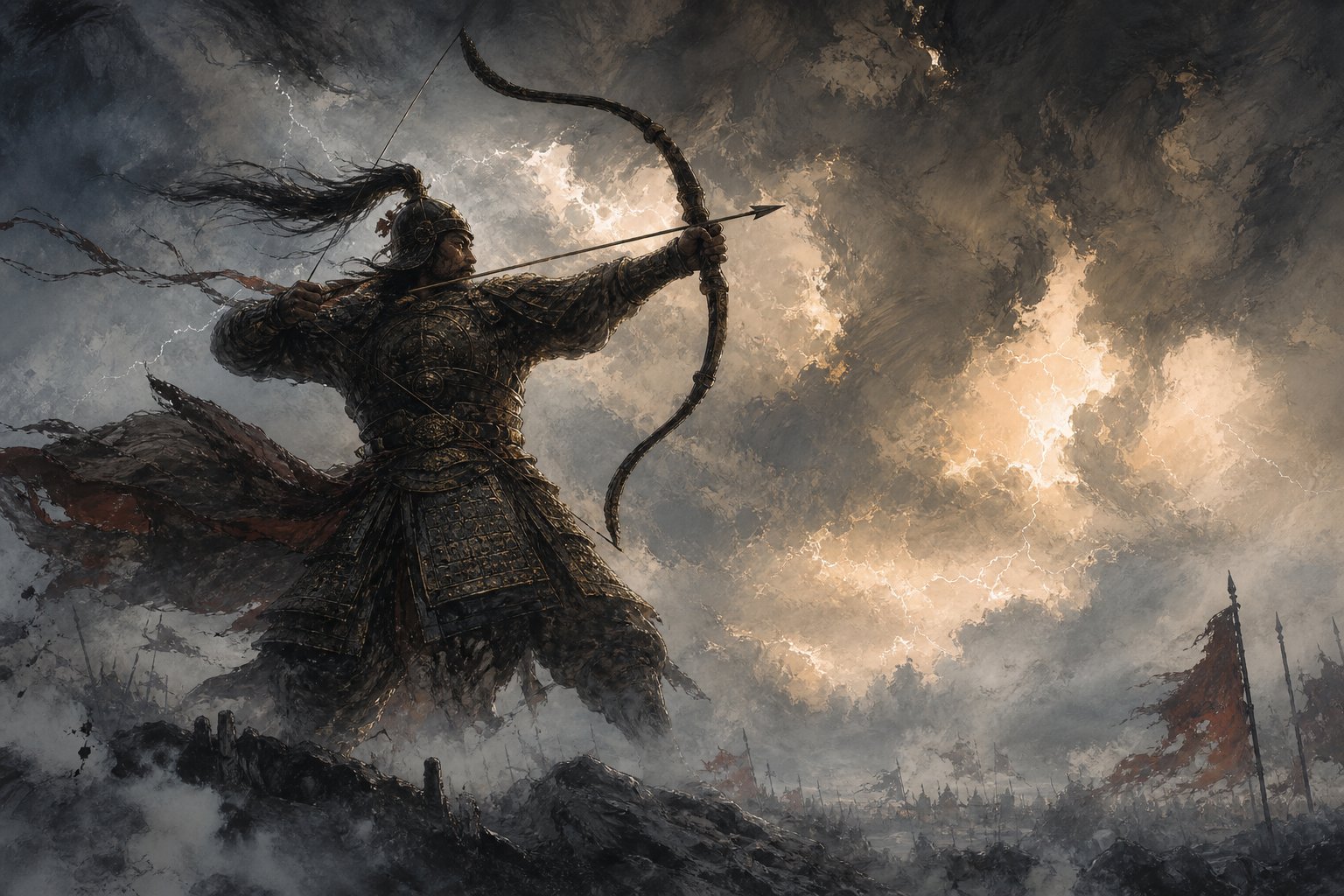
The story centers on a figure named Hui (挥), also known as Zhang Hui, who was the grandson of the Yellow Emperor (Huangdi) and the fifth son of Shao Hao. According to classical genealogical records, Hui observed the Arc Star constellation during the Battle of Zhuolu — a legendary conflict between the Yellow Emperor's forces and the rebel warlord Chi You. Inspired by the star's shape, Hui invented the bow and arrow and armed the Yellow Emperor's troops with this new weapon.
The result was decisive. Chi You's forces, previously unbeatable, crumbled against volleys of arrows. For this achievement, the Yellow Emperor bestowed upon Hui the surname Zhang — literally meaning "to draw a bow" — and appointed him as the Official in Charge of Bows and Arrows (弓正). He was also enfeoffed as the Marquis of Qingyang and given the territory of Qinghe (present-day Qinghe County, Hebei) as his ancestral homeland.
The zhang family name, then, did not emerge from a place or a tribal affiliation. It was granted as recognition of a specific technological breakthrough. The character itself — bow plus stretch — encoded the invention that earned it.
Two classical texts serve as the primary sources documenting this last name zhang origin. The Yuanhe Xing Zuan (元和姓纂), a Tang Dynasty genealogical compendium, states: "The Yellow Emperor's son Qingyang begat Hui, who served as the Director of Bows, observed the Arc Star, first created bows and arrows, presided over sacrifices to the Arc Star, and was granted the surname Zhang." The Tongzhi Shi Zu Lue (通志·氏族略), a Song Dynasty work on clan origins, corroborates this account while noting the connection to the state of Jin in later periods.
From Legend to Lineage
How much of this story is historical fact? The honest answer: it is debated. The Yellow Emperor era belongs to China's legendary period, predating written records by centuries. No archaeological evidence confirms a single inventor of the bow and arrow, and the technology likely developed gradually across many cultures.
Yet dismissing the story as "just a myth" misses the point entirely. In the study of ancient chinese names, founding ancestor narratives function as cultural charters. They define who a clan is, what values it holds, and where it belongs in the social order. For the over 95 million people who carry the zhang name meaning today, Hui represents innovation, service to the collective, and the creative application of observation to solve real problems.
In the Chinese surname tradition, a founding ancestor is not merely a genealogical starting point but a moral and cultural compass. The story of how the name was earned defines what the name means for every generation that carries it forward.
This pattern — rulers granting surnames based on achievements — was one of the primary mechanisms for surname creation during China's legendary and early historical periods. The Yellow Emperor alone is credited with generating dozens of surnames through such grants. Some were totemic, linking a clan to an animal or natural symbol. Others, like Zhang, were achievement-based, permanently connecting a family line to a specific contribution.
Hui's story also reveals something practical about how ancient chinese names encoded social roles. His title, Gong Zheng (弓正), meant he oversaw all bow and arrow production for the ruling authority. The surname did not just honor a one-time invention — it marked a hereditary responsibility. His descendants were the keepers of archery technology, and their name announced that role to the world.
That connection between occupation and identity would prove to be one of the most powerful forces in Chinese surname formation. While Hui received his name from a ruler's decree, other bow-related surnames emerged through a different, more gradual pathway — one rooted in the workshops and armories of the Zhou Dynasty.
Gong the Rare Surname That Literally Means Bow
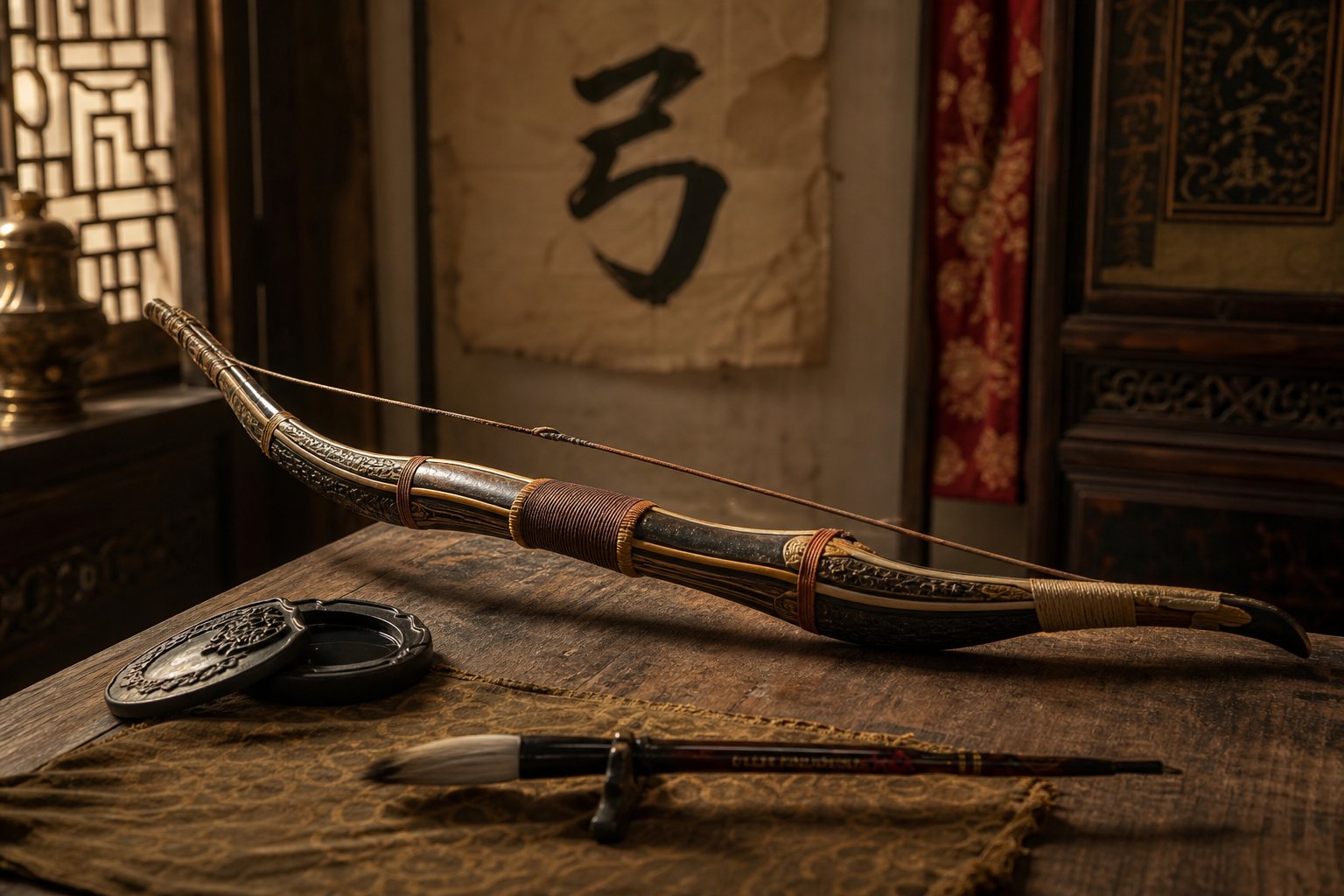
Zhang encodes the action of drawing a bow. But there is another surname in this family that skips the metaphor entirely. The character 弓 (Gong) does not reference bow-making or bow-stretching — it IS the Chinese word for bow, used directly as a hereditary family name. Among rare chinese surnames, Gong stands out precisely because of this literal transparency. You see the character, and you see the weapon.
Gong the Surname That Is the Bow Character Itself
Where Zhang ranks third in the nation with nearly 90 million bearers, Gong sits far down the list. It is one of the rarest chinese surnames still in active use, carried by a comparatively tiny population concentrated in specific pockets of China. The character 弓 is instantly recognizable — a simple pictograph depicting the curved shape of a bow, one of the oldest and most visually intuitive characters in the Chinese writing system.
As a surname, its meaning is straightforward: a bow (weapon), to bend, to arch. There is no secondary radical modifying the sense. No hidden layers of composition. The chinese surname meanings here are as direct as they come — your family name announces that your ancestors made, carried, or were otherwise defined by the bow.
Geographically, the Gong surname appears primarily in parts of northern China, particularly in Shanxi, Shaanxi, and Henan provinces. Among overseas communities, most Gong families who left China in the past several centuries traced their roots to Guangdong and Fujian provinces. Depending on dialect and destination, the name appears romanized as Kung (Cantonese and Taiwanese), Kong (Macau), Keng (Malaysia and Singapore), or Cung (Vietnam) — a reminder that even rare chinese last names carry complex spelling variations across the diaspora.
Occupational Origins of the Gong Surname
The origin story of Gong differs fundamentally from Zhang. There was no single legendary inventor, no imperial decree granting the name for a battlefield innovation. Instead, the Gong surname grew organically from the workshops of the Zhou Dynasty (roughly 1046-256 BCE), where specialized craftsmen known as 弓人 (gongren) — literally "bow people" — manufactured composite bows for the state military.
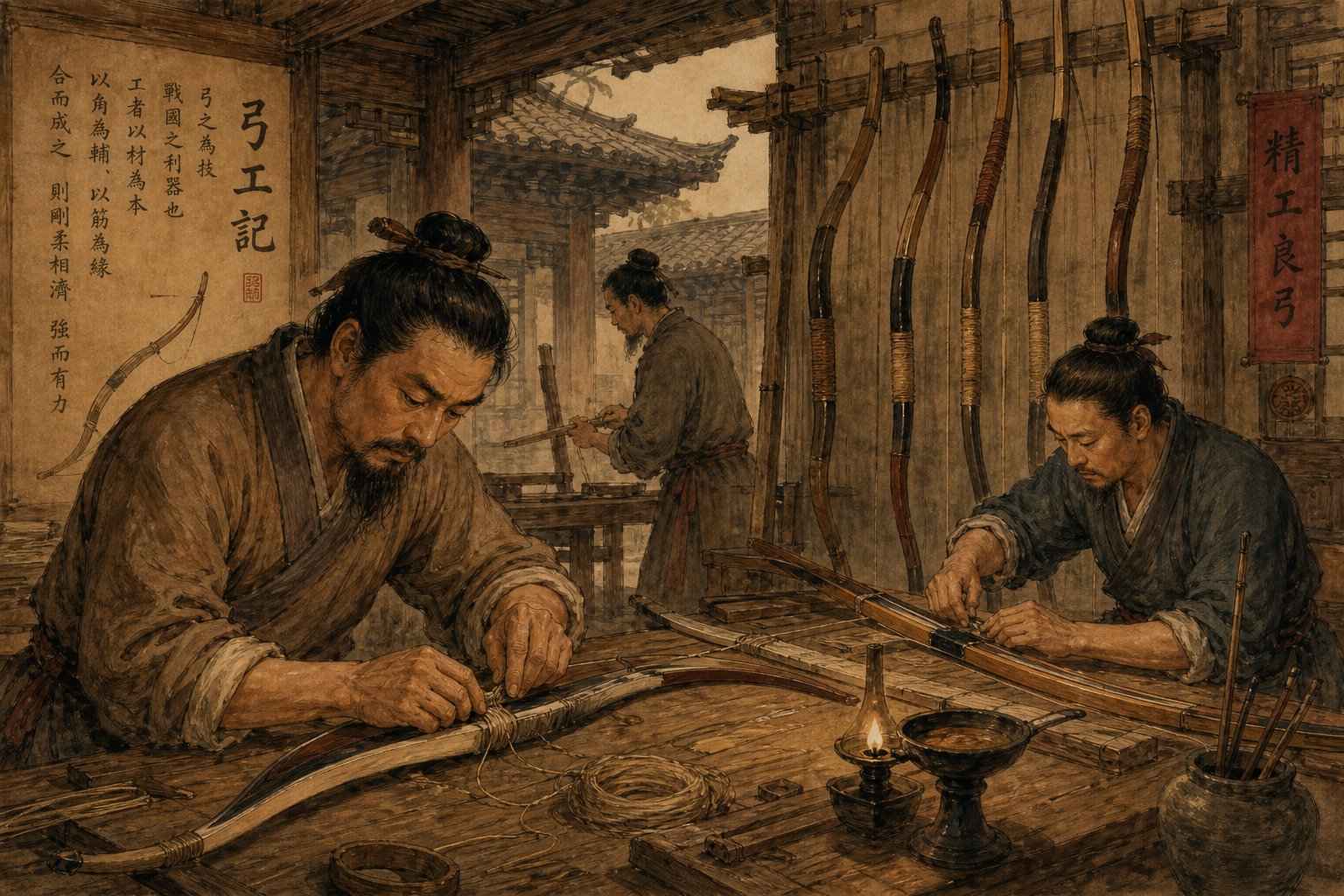
These were not casual laborers. The Rites of Zhou (周礼) describes bow-makers as holding specific hereditary positions within the state's craft administration. They selected and seasoned the wood, horn, sinew, silk, lacquer, and glue required for composite bow construction. Their knowledge was technical, closely guarded, and passed from father to son across generations.
Over time, this occupational identity hardened into something permanent. When the Zhou system of hereditary craft roles began generating fixed family names, the bow-makers did what potters (陶 Tao), butchers (屠 Tu), and other specialists did — they adopted their trade as their surname. The tool they built became the name they carried.
This is a fundamentally different pathway from Zhang's origin. Hui received his surname from a ruler as a reward. The Gong families earned theirs through generations of anonymous, skilled labor. One name came from above. The other grew from below.
Understanding these two pathways clarifies the broader landscape of chinese surname meanings connected to archery. Here is how the two bow-related surnames compare across key dimensions:
- Literal meaning: 弓 (Gong) means "bow" as a noun — the physical object. 张 (Zhang) means "to draw a bow" — the action of stretching the string.
- Character structure: 弓 is a standalone pictograph with no additional radical. 张/張 combines the bow radical (弓) with the element for "long/stretch" (长/長).
- Population size: Zhang ranks among the top 3 surnames in China with approximately 87-95 million bearers. Gong is extremely rare, ranking well outside the top 300.
- Geographic concentration: Zhang is distributed evenly across all Chinese provinces. Gong clusters in specific northern regions and select overseas communities.
- Origin pathway: Zhang was granted by the Yellow Emperor to his grandson for inventing the bow. Gong arose from hereditary bow-making craftsmen in the Zhou Dynasty who adopted their occupation as their family name.
Both surnames preserve the memory of archery's central role in ancient Chinese civilization, but they preserve different aspects of it. Zhang remembers the moment of invention. Gong remembers the generations of skilled hands that kept the technology alive, army after army, dynasty after dynasty.
That distinction — between a name granted for innovation and a name grown from daily labor — reflects something deeper about how occupations shaped identity in ancient China. Bow-making was not the only craft that generated surnames, and archery was far from the only military skill that left its mark on the naming system.
How Ancient Archery Created Chinese Family Names
In most cultures, occupational surnames carry a whiff of the working class. Think Smith, Cooper, or Tanner in English — names rooted in manual trades. Chinese family names tied to bow-making and archery followed a different trajectory entirely. The people who built bows and shot arrows in Zhou Dynasty China were not low-status laborers. They were specialists embedded in a military-ritual complex that sat near the top of the social hierarchy.
That elevated position explains why bow-related surnames carried prestige rather than stigma — and why they persisted as proud identity markers across thousands of years.
Military Roles That Became Family Names
The Zhou Dynasty (1046-256 BCE) operated a highly structured military system where specific roles were assigned to hereditary specialists. When it came to archery and bow production, three distinct positions generated family identities that eventually crystallized into surnames.
The first and most direct were the bow-makers (弓人, gongren). According to the Rites of Zhou (周礼), these craftsmen held defined positions within the state's weapons administration. They were responsible for selecting materials — wood, horn, sinew, silk, lacquer, and glue — and assembling composite bows that met strict military specifications. Their knowledge was technical and closely guarded, passed from father to son. The Zhou military system required that weapons be produced in state-controlled workshops, with officials inspecting quality and marking finished products with identifying characters.
The second group were archers and crossbowmen (射人, sheren, and 弩人, nuren). These soldiers specialized in ranged combat — the left-side rider on every war chariot fought with bow and arrow, while infantry archers formed dedicated units. By the Warring States period, some states maintained tens of thousands of specialized bowmen. The state of Zhao, for example, selected 100,000 archers for campaigns against the Xiongnu nomads.
The third category included officials overseeing weapons production — administrators like the Gong Zheng (弓正, Director of Bows) who managed the entire supply chain from raw materials to finished armaments. These were not craftsmen themselves but bureaucrats responsible for equipping armies. The title Hui received from the Yellow Emperor belonged to this category.
What connected all three roles was their hereditary nature. In Zhou society, your father's occupation was your occupation. Your grandfather's workshop was your workshop. Over generations, this occupational identity became inseparable from personal identity — and when the practice of fixed surnames spread through Chinese society, these roles provided ready-made labels.
This pattern was not unique to archery. Chinese name meaning often traces back to occupational roots. The surname 陶 (Tao) came from potters. 屠 (Tu) came from butchers. 司徒 (Situ) derived from the title "Minister of Education." What made bow-related surnames distinctive was not the mechanism of their creation but the social status attached to the occupation itself.
Archery as a Noble Art in Ancient China
Here is where the meaning of chinese last names connected to bows diverges sharply from their European counterparts. In medieval England, a bowyer or fletcher occupied a respectable but decidedly common trade. In Zhou Dynasty China, archery belonged to the aristocracy.
Archery was one of the Six Arts (六艺, liuyi) — the core curriculum required of every educated gentleman in the Confucian tradition. The full list included ritual propriety (礼), music (乐), archery (射), charioteering (御), calligraphy (书), and mathematics (数). Mastering the bow was not optional for the ruling class. It was a prerequisite for being considered civilized.
The ritual Classics describe elaborate archery ceremonies — village contests documented in the Yili (仪礼) and Liji (礼记) — where shooting skill demonstrated moral character as much as physical ability. Hitting the target was secondary to maintaining proper form, composure, and ritual decorum. The army command itself was symbolized by the act of handing over bow and arrow (弓矢, gong shi) to a general, as recorded in the Liji chapter Wangzhi. The bow was not just a weapon. It was an emblem of legitimate authority.
This cultural prestige elevated everyone in the archery ecosystem. The craftsman who built bows for the king's army was not a mere tradesman — he was a participant in the ritual-military order that held civilization together. The archer who served on a war chariot was not a common soldier — he was a trained specialist whose skill placed him among the armored elite (甲士, jiashi). When these roles generated chinese names and meanings, those names carried the honor of the roles themselves.
The pathway from occupation to surname followed a clear sequence:
- Occupational role assigned — A family receives responsibility for bow-making, archery instruction, or weapons oversight within the Zhou state apparatus.
- Role becomes hereditary — The position passes from father to son across multiple generations, with specialized knowledge transmitted within the family.
- Occupation becomes identity marker — Community members begin referring to the family by their trade: "the bow people," "the bow-stretchers," "the arrow-makers."
- Identity marker becomes surname — As fixed hereditary surnames spread through Chinese society, the occupational label formalizes into a permanent family name carried by all descendants regardless of their actual profession.
This process unfolded over centuries, not overnight. And it produced not just the major surnames like Zhang and Gong, but likely influenced dozens of less common names in chinese and meanings that reference archery equipment, military roles, or weapons production.
Understanding this framework transforms how you approach chinese name interpretation. A bow-related surname is not simply a label — it is a compressed history of social position, technical expertise, and cultural values frozen into a single character. The name tells you not just what an ancestor did, but how their society valued what they did.
That social value, combined with the hereditary nature of Zhou-era roles, explains why bow-related surnames survived the collapse of the system that created them. The Zhou Dynasty ended in 256 BCE, but the names it generated are still carried by hundreds of millions of people. The occupations vanished. The identity remained.
Of course, identity expressed through a Chinese character looks very different when that character crosses an ocean. The same surname that reads clearly in hanzi becomes a puzzle the moment it enters a romanization system — and for bow-related surnames, the romanization puzzle is especially confusing.
The Romanization Puzzle From Zhang to Bow to Cheung
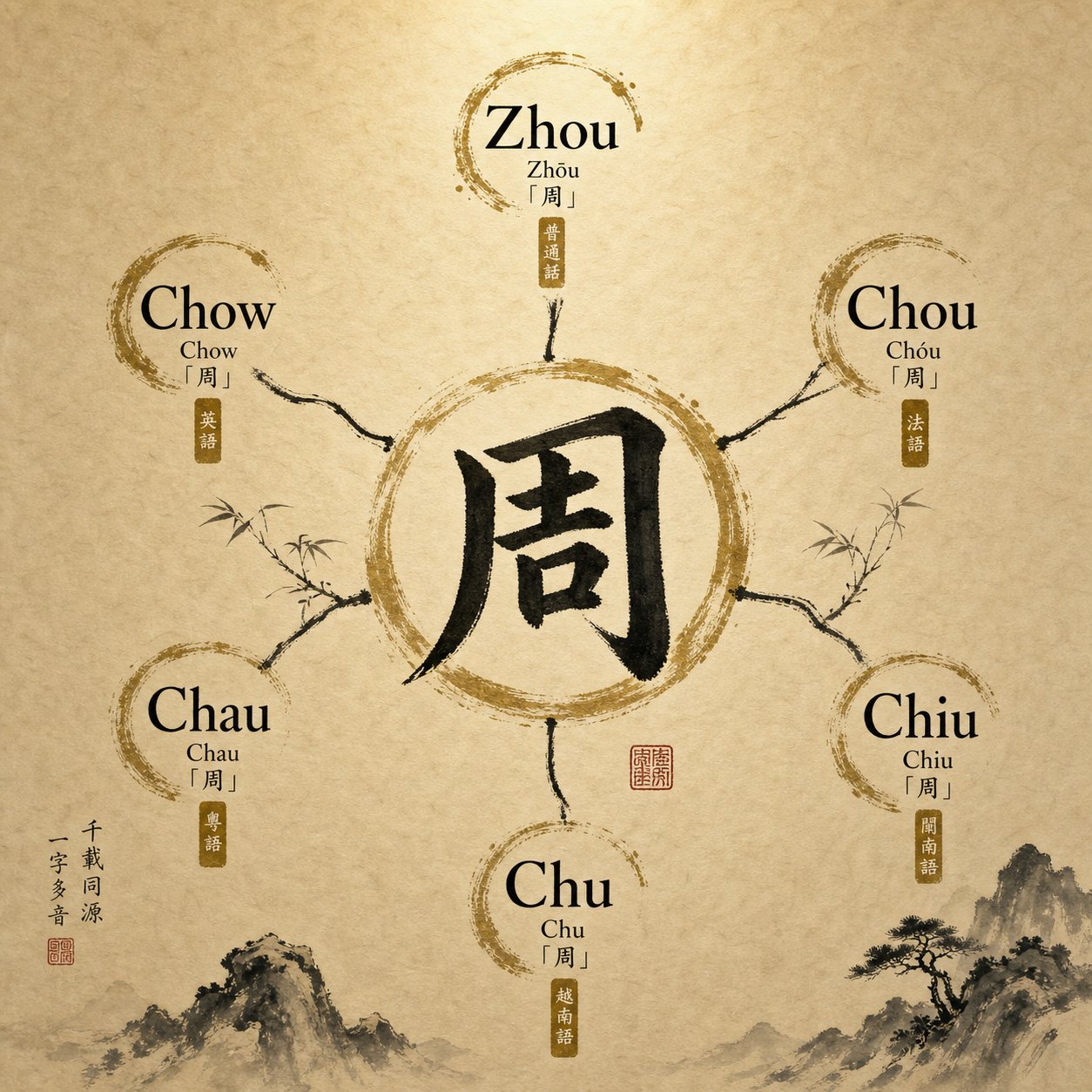
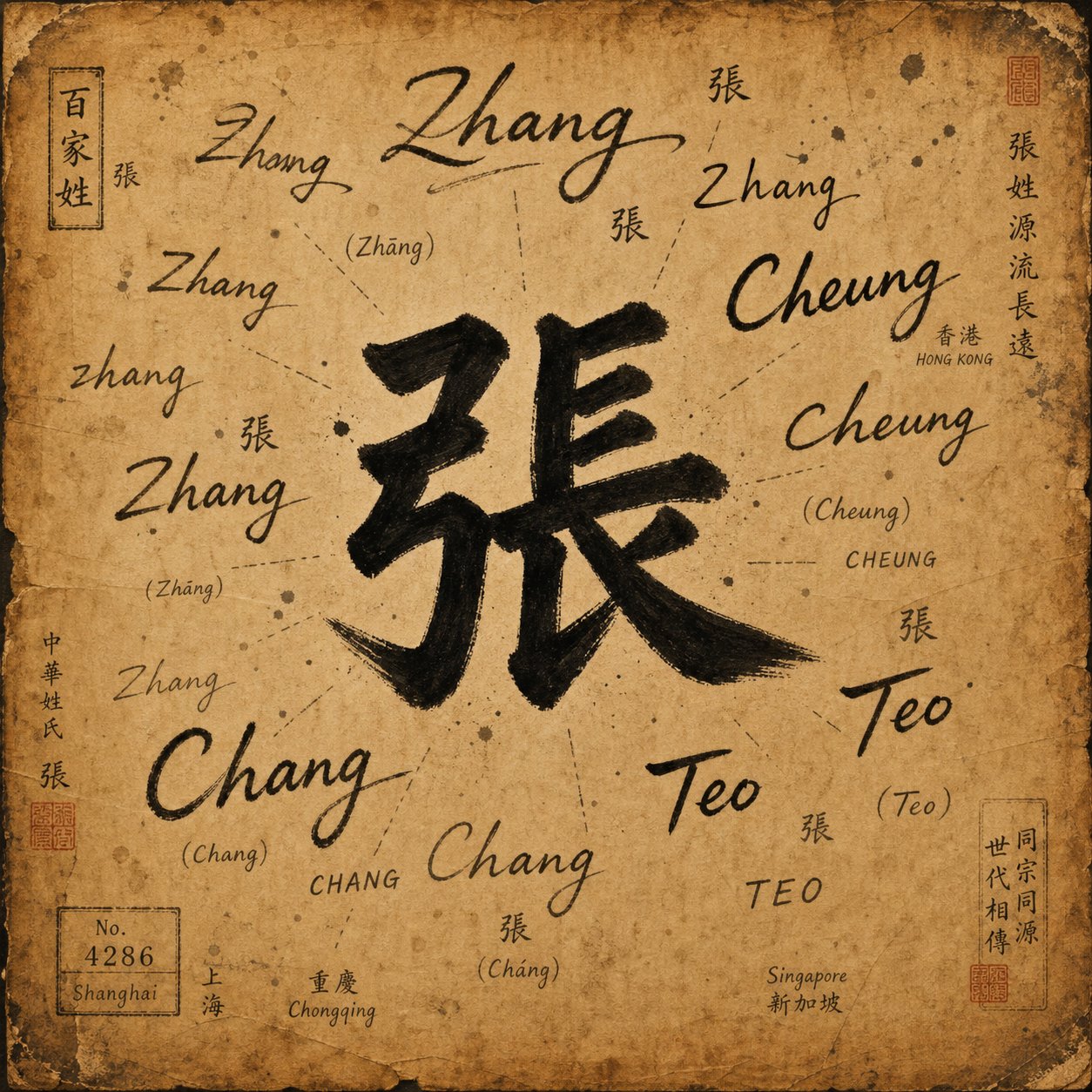
Imagine you are searching through old immigration records and find an ancestor listed with the surname "Bow." Or maybe your family spells it "Cheung," "Chang," "Teo," or "Tiong." You would never guess these are all the same Chinese character. Yet every one of them traces back to 张/張 — the bow-drawing surname — filtered through different Chinese dialects and romanization systems that were never designed to be consistent with each other.
This is the single biggest source of confusion for genealogy researchers working with bow-related surnames. The character never changed. The pronunciation did — dramatically — depending on which region of China your ancestors left from and which colonial clerk wrote down what they heard.
Why Zhang Becomes Bow Cheung Chang and Teo
Chinese is not one spoken language. It is a family of related but mutually unintelligible dialects that share a writing system. A person from Beijing, a person from Hong Kong, and a person from Fujian Province all write the same character 張 for this surname. But they pronounce it in completely different ways. When those pronunciations hit English-language record-keeping systems — ship manifests, census forms, naturalization papers — each dialect produced a different spelling.
Here is how the same character became a dozen different English surnames:
- Zhang — Standard Mandarin pinyin, the official romanization system of mainland China adopted in 1958. This is what you will find on modern Chinese passports issued from the PRC.
- Chang — The Wade-Giles romanization of the same Mandarin pronunciation, widely used in Taiwan and in older English-language scholarship. The chang surname spelling remains common among Taiwanese Americans and earlier generations of Chinese immigrants. The chang last name origin is identical to Zhang — only the transcription system differs.
- Cheung — The standard Cantonese romanization used in Hong Kong. The cheung surname reflects how Cantonese speakers pronounce 張 as something close to "jeurng" (Jyutping: zoeng1). The cheung last name origin is the same bow-drawing character, just spoken in a different dialect. The cheung last name became one of the most recognizable cantonese surnames in the English-speaking world through Hong Kong emigration.
- Cheong — A variant Cantonese romanization common in Macau and among Hakka speakers in Malaysia.
- Teo or Teoh — The Hokkien (Southern Min) pronunciation used in Singapore, Malaysia, and parts of the Philippines. Hokkien speakers say something like "Tiunn" or "Tio," which English clerks rendered as Teo or Teoh.
- Chong — A Hakka dialect romanization found among Chinese communities in Southeast Asia.
- Truong — The Vietnamese reading of the same character, carried by ethnic Chinese families in Vietnam and the Vietnamese diaspora.
- Bow — A less common romanization that appears in certain Cantonese immigration records. This spelling likely reflects an English-speaking clerk's attempt to translate or transliterate the meaning rather than the sound, or a non-standard phonetic rendering from a sub-dialect.
Every single one of these cantonese last names, Hokkien spellings, and Mandarin romanizations points back to the same character: 張. The same bow radical. The same legendary archer ancestor. The same meaning.
Pronunciation Across Chinese Dialects
The zhang pronunciation varies so dramatically across dialects that without the written character as an anchor, you would never connect these sounds to the same word. Here is what the surname actually sounds like in the major dialect groups:
| Dialect | Romanization | IPA Approximation | Common Spelling in English |
|---|---|---|---|
| Mandarin (Standard) | Zhāng (Pinyin) | /ʈ͡ʂɑŋ⁵⁵/ | Zhang, Chang |
| Cantonese (Guangzhou/HK) | Zoeng1 (Jyutping) | /t͡sœːŋ⁵⁵/ | Cheung, Cheong |
| Hokkien (Xiamen/Taiwan) | Tiuⁿ (Pe̍h-oe-ji) | /tiũ⁴⁴/ | Teo, Teoh, Tiu |
| Teochew (Shantou) | Dion1 (Peng'im) | /tĩõ³³/ | Teo, Tio |
| Hakka (Meixian) | Zong1 | /t͡sɔŋ⁴⁴/ | Chong, Cheong |
| Wu (Shanghai) | Tsan (Wugniu) | /t͡sã⁵³/ | Tsan, Tsang |
| Eastern Min (Fuzhou) | Diŏng (BUC) | /tuoŋ⁵⁵/ | Diong, Tiong |
Notice how the initial consonant shifts from "zh" in Mandarin to "ts" in Cantonese to "t" in Hokkien. The vowel changes completely. The final consonant stays relatively stable as "-ng" in most dialects but disappears in some sub-varieties. These are not minor accent differences — they are fundamentally different sound systems applied to the same written character.
For genealogy researchers, this table is a practical decoder ring. If your family surname is spelled "Cheung" or "Cheong," your ancestors almost certainly emigrated from a Cantonese-speaking region — Guangdong Province, Hong Kong, or Macau. If the spelling is "Teo" or "Teoh," the origin points to Hokkien-speaking areas of Fujian Province or their diaspora communities in Southeast Asia. A "Chang" spelling suggests either Taiwanese origin or an earlier generation that used Wade-Giles romanization.
The surname "Bow" presents a special case. When it appears in immigration records from the 19th or early 20th century, it most likely represents one of two scenarios. First, a Cantonese-speaking immigrant whose surname was translated by meaning rather than transliterated by sound — an English-speaking official heard the explanation "it means bow" and wrote that down as the surname. Second, it could represent the rarer surname 弓 (Gong) rendered phonetically through a regional sub-dialect where the pronunciation shifted closer to something an English speaker heard as "Bow."
Either way, encountering "Bow" as a Chinese surname in historical records is a strong signal that you are looking at a bow-related character — most likely 張 or possibly 弓 — and that the ancestor in question came from a Cantonese-speaking community where non-standard romanization was common before systematic spelling conventions were established.
This romanization fragmentation means that the true population of bow-related surname bearers is far larger than any single spelling suggests. Zhang, Chang, Cheung, Teo, Chong, Truong, and Bow are not different surnames — they are different windows into the same ancient name, scattered across the globe by centuries of migration and the accidents of which clerk happened to be holding the pen.
Population and Global Spread of Bow-Related Surnames
All those scattered spellings — Zhang, Chang, Cheung, Teo, Chong, Truong — add up to something staggering when you count the people behind them. Bow-related surnames are not a niche curiosity. They represent one of the largest meaning-based surname categories on the planet.
How Common Are Bow-Related Surnames Today
Zhang consistently ranks as the third most common chinese surname in mainland China. Data from the Sixth National Population Census places Zhang at approximately 85.5 million bearers within China alone, accounting for roughly 6.42% of the total population. Only Wang and Li surpass it. To put that in perspective, the entire population of Germany fits inside the Zhang surname with room to spare.
A 2006 survey led by researcher Yuan Yida found that the three major surnames — Li, Wang, and Zhang — each approached 100 million people, with each exceeding 7% of China's total population. The same study confirmed that the top 100 most common chinese surnames cover approximately 87% of the national population. Zhang's share of that total makes it one of the most popular chinese last names by any measure.
Contrast that with 弓 (Gong), the surname that literally means "bow." Gong does not appear in any top-400 surname ranking. Its bearers number in the tens of thousands rather than tens of millions — a fraction of a percent of the population. Among common chinese last names, Gong simply does not register. It survives as a living surname but remains one of the rarest in active use.
Global Distribution of Zhang and Related Surnames
The diaspora dimension multiplies these numbers further. Centuries of emigration from Guangdong, Fujian, and other coastal provinces scattered Zhang bearers across Southeast Asia, North America, Europe, and Oceania. In Malaysia, Teo and Cheong rank among the most common chinese surnames within the ethnic Chinese community. In the United States, Chang and Cheung appear frequently in census data from California, New York, and Hawaii. Vietnamese communities worldwide include millions who carry the Truong spelling.
When you combine every dialect romanization and every diaspora community, the total population of bow-related surname bearers likely exceeds 100 million people globally. That makes this single semantic category — surnames meaning "bow" or "to draw a bow" — larger than most countries.
| Surname Character | Approximate Rank in China | Estimated Bearers | Primary Regions |
|---|---|---|---|
| 张/張 (Zhang) | #3 | 85-95 million (China); 100+ million globally | All Chinese provinces, Southeast Asia, North America, Europe, Oceania |
| 弓 (Gong) | Outside top 400 | Tens of thousands | Shanxi, Shaanxi, Henan (concentrated pockets) |
The gap between these two surnames is enormous, yet both preserve the same cultural memory. Zhang dominates because it traces to a legendary imperial grant — the Yellow Emperor's grandson and the founding myth of an entire clan. Gong remains rare because it grew from a specific occupational group whose numbers were always limited by the practical demand for bow-makers in any given region.
Together, they illustrate something important about how the most common chinese last names achieved their scale. A surname backed by a powerful origin narrative and a prestigious ancestor attracted adoptees, absorbed smaller clans, and expanded through political favor across dynasties. A surname rooted in a single craft stayed small, tied to the geographic and economic constraints of that craft. Both are legitimate bow-related surnames. Only one became a demographic giant.
That demographic weight also means bow-related surnames occupy a specific position within the broader architecture of Chinese naming — a system with its own classical texts, taxonomies, and cultural authority stretching back over a thousand years.
Where Bow Surnames Fit in the Chinese Naming System
Chinese surnames do not exist in isolation. They belong to a structured system catalogued, debated, and preserved across more than a thousand years of scholarship. If you have ever searched for a chinese surname list or looked up "surname 中文" trying to understand how family names work in Chinese culture, you have already brushed against this system — even if you did not realize its depth.
The architecture that organizes every surname in chinese into categories and lineages has a single foundational text at its center. And bow-related surnames hold a specific, revealing position within it.
Bow Surnames in the Hundred Family Surnames Text
The Hundred Family Surnames (百家姓, Bai Jia Xing) is a Song Dynasty text compiled around 960 CE that arranged Chinese surnames into a rhyming verse for memorization. Despite its name, the text actually catalogues over 400 surnames. For centuries, Chinese children memorized it alongside the Three Character Classic and the Thousand Character Classic as part of basic literacy education.
The text's ordering was political, not alphabetical. Zhao (赵) appears first because it was the imperial surname of the Song Dynasty. Qian (钱) comes second because it was the surname of the last king of Wuyue, who peacefully surrendered to the Song. Every position carried meaning.
Zhang (张) appears in the 24th position within the verse — the line 何呂施張 (He Lu Shi Zhang). This placement among the first few dozen surnames reflects its already massive population during the Song period. The character 弓 (Gong), being far rarer, appears much later in the extended chinese surnames list. Its inclusion at all confirms that even uncommon bow-related names held enough cultural recognition to earn a place in the canon.
The Hundred Family Surnames remains culturally authoritative today. When people compile a chinese name list of mandarin surnames or research their heritage, this text is often the starting point. It functions as both a historical document and a living reference — the closest thing Chinese culture has to a definitive registry of legitimate family names.
Understanding Chinese Surname Categories
Beyond simple listing, Chinese onomastics organizes surnames into categories based on how they originated. This taxonomy gives you a framework for understanding any surname you encounter — not just bow-related ones. The major categories include:
- Totemic surnames — derived from animals, plants, or natural objects that served as clan symbols. Examples: 龙 (Long, dragon), 熊 (Xiong, bear), 马 (Ma, horse).
- Occupational surnames — derived from hereditary trades or craft roles. Examples: 陶 (Tao, potter), 屠 (Tu, butcher), 弓 (Gong, bow-maker).
- Geographic surnames — derived from ancestral territories, states, or landmarks. Examples: 赵 (Zhao, from the State of Zhao), 陈 (Chen, from the State of Chen).
- Granted surnames — bestowed by rulers in recognition of achievement, loyalty, or political alliance. Examples: 张 (Zhang, granted for inventing the bow), 刘 (Liu, granted by Han Dynasty emperors to allies).
What makes bow-related surnames especially interesting is that they span multiple categories within this system. They are not confined to a single origin type. Here is how each bow surname maps to the taxonomy:
- 张/張 (Zhang) — Granted surname. Bestowed by the Yellow Emperor upon his grandson Hui for the invention of the bow and arrow. The name commemorates an achievement, not a trade.
- 弓 (Gong) — Occupational surname. Adopted by hereditary bow-makers (弓人) in the Zhou Dynasty who took their craft as their family identity. The name marks a trade, not a single event.
This dual classification reveals something important. The same object — the bow — generated surnames through completely different social mechanisms. One came from above, through imperial recognition. The other grew from below, through generations of skilled labor. The chinese surnames list contains thousands of names, but few semantic categories demonstrate both pathways as clearly as bow-related surnames do.
Understanding these categories also helps when you encounter unfamiliar entries on any list of chinese surnames. If a surname is a common noun (an animal, a color, a tool), it likely started as totemic or occupational. If it matches an ancient state name, it is probably geographic. If classical texts describe a specific granting event, it belongs to the granted category. The system is consistent enough that you can often deduce a surname's origin type from the character alone — especially when you recognize components like the bow radical 弓 signaling a connection to archery.
This framework transforms surname research from memorizing isolated facts into reading a coherent system. Each name on the chinese surname list is not just a label but a compressed origin story, and the category it belongs to tells you what kind of story to expect. For bow-related surnames, the stories point toward workshops and battlefields, legendary inventors and anonymous craftsmen — all preserved in characters that billions of people still write today.
Knowing where these surnames sit within the system is one thing. Tracing your own connection to them — especially when immigration records, dialect shifts, and romanization inconsistencies have scrambled the trail — requires a more practical set of tools.
Researching Your Bow Surname Heritage
You have found "Bow," "Chang," "Cheung," or "Zhang" in a family document — maybe an old immigration form, a ship manifest, or a faded certificate tucked inside a relative's drawer. You suspect it connects to the bow-drawing surname, but the spelling does not match anything you have seen in modern references. Where do you go from here?
The gap between a romanized spelling on paper and the Chinese character it represents is the central challenge of tracing any chinese last name through historical records. For bow-related surnames, the challenge multiplies because the same character 张/張 appears under so many different spellings depending on dialect, era, and the individual clerk who wrote it down.
Tracing Your Bow Surname Ancestry
The first task is deceptively simple: figure out which Chinese character your romanized surname actually maps to. This matters because the character unlocks everything else — clan genealogies, origin stories, ancestral homelands. Without it, you are searching blind.
Dialect of origin is the key that cracks the code. If your family came from Hong Kong or Guangdong Province, "Cheung" almost certainly represents 張. If the spelling is "Chang" and your family has Taiwanese roots, it is the same character rendered in Wade-Giles romanization. "Teo" or "Teoh" points to Hokkien-speaking ancestors from Fujian or Southeast Asia. And if the record simply says "Bow," you are likely looking at either a meaning-based translation of 張 or a phonetic rendering of 弓 (Gong) from a Cantonese sub-dialect.
How do you determine which dialect your ancestors spoke? Legacy Tree Genealogists recommends looking at the destination country and the specific community your ancestor joined. Since most Chinese immigrants traveled with people from the same region, entire overseas communities often spoke the same dialect. Most Californian Chinese came from the Siyi (Four Counties) region of Guangdong and spoke Taishanese or Standard Cantonese. Most Filipino Chinese came from Quanzhou and Xiamen in Fujian and spoke Hokkien. Most Jamaican Chinese came from Huizhou and Bao'an near Shenzhen and spoke Hakka.
One important complication: the Chinese practice of placing the last name before the first name confused many immigration officials. In the structure of first name last name chinese naming conventions, the surname comes first — so "Zhang Wei" means the family name is Zhang and the given name is Wei. Foreign clerks sometimes reversed this order, recording the given name as the surname. If your ancestor's recorded last name is two syllables long (like "Kaiwei" or "Wing Ho"), it may actually be a given name that was mistakenly treated as a surname. The real chinese last name — likely a single character like Zhang — might be hiding in the "first name" field instead.
Resources for Chinese Surname Research
Once you have identified the likely character behind your romanized spelling, a structured research pathway can take you much deeper. Here is a step-by-step approach for tracing bow-related last names chinese families carried across oceans:
- Identify your ancestral dialect group. Use your family's destination country, community ties, and any surviving documents to determine whether your ancestors spoke Cantonese, Hokkien, Hakka, Teochew, or Mandarin. This narrows the romanization possibilities dramatically.
- Confirm the Chinese character. Cross-reference your romanized surname against dialect-specific pronunciation tables. Wikipedia's List of Common Chinese Surnames provides multi-dialect romanizations for major surnames. For the last name Chang, for example, this step confirms whether you are looking at 张 (Zhang/bow-drawing), 常 (Chang/constant), or 昌 (Chang/prosperous).
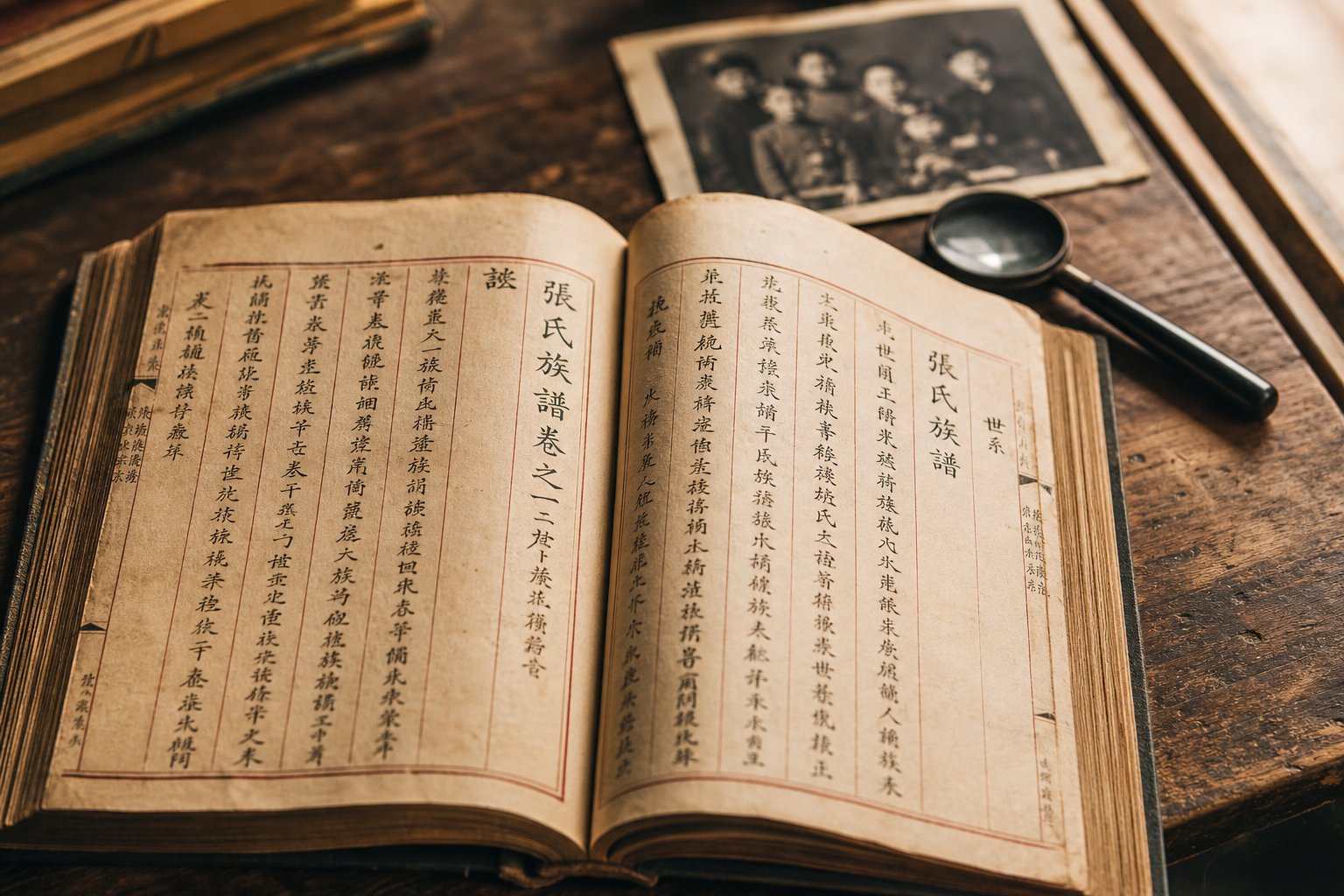
- Search for clan genealogies (族谱, zupu). Chinese families have maintained lineage records for centuries. FamilySearch holds a major collection of digitized Chinese genealogies spanning from 1239 to 2014. These jiapu documents record male descendants in linked patrilineal sequence, including names, birth and death dates, burial locations, official titles, and wives' surnames. For Zhang families, many genealogies trace the lineage back to the legendary ancestor Hui.
- Check immigration-era records. The U.S. National Archives holds Chinese Exclusion Act case files that often contain Chinese-language documents alongside English translations. These can reveal an ancestor's original Chinese name even when other records only show a romanized version.
- Contact Chinese clan associations. Many overseas Chinese communities maintain clan associations (宗亲会) organized by surname. Zhang clan associations exist in most major cities with significant Chinese populations. These organizations sometimes keep archived member lists in Chinese characters and can help connect you to broader lineage networks.
- Consult ancestral homeland records. If you can identify the specific county or village your ancestor left, local gazetteers (地方志) and temple records in China may contain additional genealogical information. For Zhang families, the traditional ancestral homeland is Qinghe County in Hebei Province — the territory granted to Hui by the Yellow Emperor.
A few practical notes for chinese american surnames specifically: many families who arrived during the Exclusion Era (1882-1943) traveled under forged papers as "paper sons," claiming familial ties to existing residents. If your ancestor was among them, the surname on official documents may not be the real family name at all. Cross-referencing community records, tombstone inscriptions, and clan association archives becomes especially important in these cases.
For those researching chinese american last names from later immigration waves — post-1965 or post-1980s — the trail is usually cleaner. Modern passports use standardized pinyin, so a "Zhang" on a recent document reliably maps to 张. The complexity concentrates in earlier generations where no standard system existed and every port clerk invented their own spelling.
Whether your search leads to a Zhang genealogy stretching back to the Yellow Emperor's grandson, or a Gong family record rooted in Zhou Dynasty bow-making workshops, the destination is the same: a connection to one of the oldest and most culturally significant surname categories in Chinese civilization. These names preserve a time when the bow was not just a weapon but a symbol of innovation, authority, and the arts that defined a gentleman. They carry the memory of a legendary archer whose invention changed warfare, and the generations of craftsmen whose skilled hands kept that technology alive across dynasties.
Chinese surnames meaning bow represent a rich intersection of language, military history, and cultural identity spanning thousands of years. Every Zhang, Chang, Cheung, Teo, and Bow walking the earth today carries that intersection in their name — whether they know it or not.
Frequently Asked Questions About Chinese Surnames Meaning Bow
1. What Chinese surname literally means bow?
The surname 弓 (Gong) is the Chinese character for bow used directly as a family name. It originated from hereditary bow-makers called gongren (弓人) during the Zhou Dynasty who manufactured composite bows for the state military. Unlike Zhang, which means 'to draw a bow,' Gong IS the word for the physical weapon itself. It remains extremely rare today, with bearers concentrated primarily in Shanxi, Shaanxi, and Henan provinces of northern China.
2. Why does the Zhang surname mean bow?
The character 张/張 combines two components: the bow radical (弓) on the left and the element for long or stretch (长/長) on the right. Together they depict the action of stretching a bowstring to full draw. According to classical genealogical texts, the Yellow Emperor granted this surname to his grandson Hui after Hui invented the bow and arrow during the legendary Battle of Zhuolu. The character permanently encodes that founding achievement in its visual structure.
3. Are Cheung, Chang, and Zhang the same surname?
Yes, Cheung, Chang, Zhang, Teo, Chong, and Truong all represent the same Chinese character 张/張. The different spellings result from dialect pronunciation differences and varying romanization systems. Zhang is Mandarin pinyin, Chang is Wade-Giles romanization used in Taiwan, Cheung is Cantonese from Hong Kong, and Teo or Teoh reflects Hokkien pronunciation from Fujian Province and Southeast Asia. The character, meaning, and ancestral origin are identical across all spellings.
4. How common are Chinese surnames related to bow?
Zhang ranks as the third most common surname in China with approximately 85 to 95 million bearers domestically and over 100 million globally when all dialect romanizations are combined. In contrast, Gong (弓) is extremely rare, ranking outside the top 400 surnames with only tens of thousands of bearers. Together, bow-related surnames represent one of the largest meaning-based surname categories in Chinese onomastics, exceeding the population of most countries.
5. How do I trace my bow-related Chinese surname ancestry?
Start by identifying your ancestral dialect group based on your family's emigration region and community ties. Then cross-reference your romanized spelling against dialect pronunciation tables to confirm the Chinese character. From there, search digitized clan genealogies on platforms like FamilySearch, check immigration-era records at national archives, and contact surname-based clan associations in your area. For Zhang families, many genealogies trace lineage back to the ancestral homeland of Qinghe County in Hebei Province.