Understanding Chinese Wedding Name Traditions and Their Cultural Significance
Imagine being told you cannot marry someone simply because you share the same last name. No other incompatibility, no family feud — just a surname. In Chinese wedding culture, this was law for centuries. Names in a Chinese wedding carry far more weight than a line on an invitation. They encode ancestry, signal social standing, and have historically determined who could marry whom in the first place.
Why Names Hold Deep Meaning in Chinese Wedding Culture
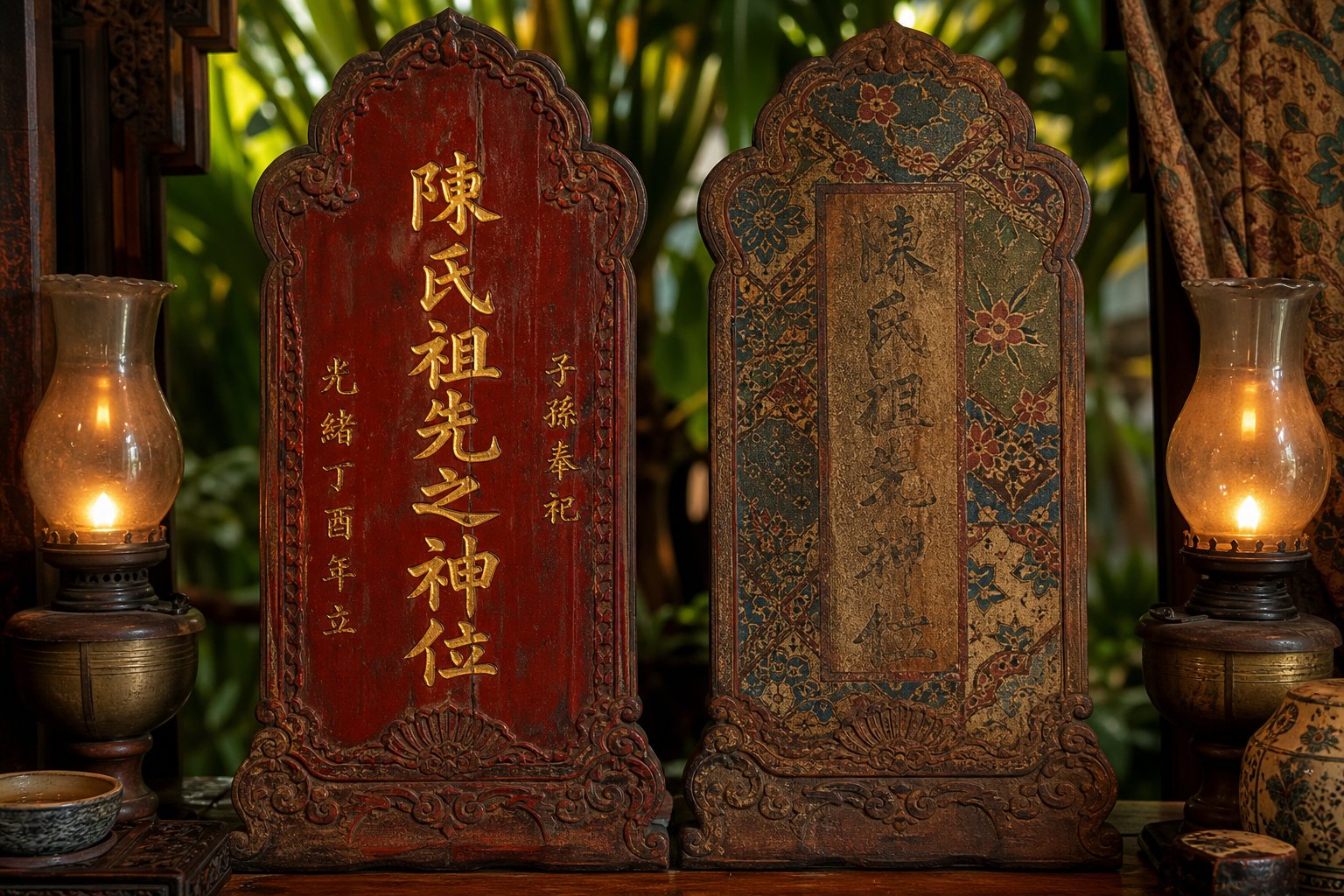
Chinese wedding traditions treat names as living records of lineage. The roots of this run deep. Confucian philosophy, which has shaped china wedding rituals since the Spring and Autumn period (770-476 BC), positions marriage as a ceremony meant to "ensure the provision of services in the ancestral temple" and "secure the continuance of the family line," as stated in the Liji (Book of Rites). A name is not personal property — it belongs to a family line stretching back generations and forward into the future.
This is why wedding customs chinese families observe place such emphasis on proper naming at every stage of the marriage process. The concept of li (礼) — ritual propriety — governs how names are spoken, written, and exchanged throughout a wedding. Getting a name wrong is not a clerical error. It is a breach of social order.
In Western traditions, a bride typically adopts her husband's surname. In Chinese culture, women have historically retained their birth surnames entirely — because erasing a family name means erasing an ancestral line.
What Chinese Wedding Name Traditions Include
So what exactly falls under this umbrella? Chinese wedding name traditions span several distinct practices that touch every phase of marriage:
- Surname compatibility checks before a match is even considered
- Formal naming protocols on wedding invitations, including generational titles and family hierarchy
- The exchange of new kinship titles during the tea ceremony
- Birth chart (八字) matching using the couple's full names and birth details
- Post-marriage surname decisions — whether a bride prefixes her husband's name or retains her own completely
As Cultural Atlas notes, women in Chinese culture do not change their legal names at marriage, though some may place their husband's family name before their full name socially. This stands in sharp contrast to chinese wedding customary expectations many Westerners assume.
Each of these practices connects back to a single principle: in Chinese weddings, a name is not just who you are. It is who your family has been — and who your descendants will become. That principle shaped one of the most powerful naming taboos in marriage history.
Historical Evolution of Names in Chinese Marriage
That principle — names as ancestral property — did not emerge overnight. It was forged across thousands of years of dynastic rule, philosophical debate, and legal reform. Understanding how china marriage traditions around naming shifted over time reveals why certain customs persist today, even in modern secular weddings.
Imperial Era Naming Customs and Patrilineal Lineage
In ancient chinese wedding traditions, a woman's personal name often disappeared from public record entirely after marriage. During the Zhou Dynasty (1046-256 BC), women of noble families were identified by their natal surname combined with a rank or birth-order marker. A married woman might be recorded simply as "Lady Zhang" or "the wife surnamed Li" — her given name reserved for private family use only.
This was not accidental. The patrilineal clan system (宗族制度) demanded that surnames trace an unbroken male line. A woman's natal surname was preserved precisely because it proved she came from a different clan — satisfying the same-surname marriage taboo. Her identity within her husband's household, however, was defined relationally: she was someone's wife, someone's mother, someone's daughter-in-law.
By the Qing Dynasty (1644-1912), the practice of 冠夫姓 — prefixing the husband's surname before the wife's natal surname — became widespread in legal and property documents. A woman named Chen Meiling who married into the Wang family would appear as "Wang Chen shi" (王陈氏) in official records. Research on nineteenth-century Taiwanese naming customs shows this prefix practice likely developed from legal and property documentation needs rather than from any single imperial decree. Importantly, widows could rely on this prefixed name to assert their rights within the family and broader society.
Republican Era Reforms and the Shift in Surname Practices
The fall of the Qing Dynasty in 1912 triggered sweeping changes to traditional chinese wedding customs around naming. Republican-era reformers, influenced by Western legal frameworks and May Fourth Movement ideals, began questioning whether women should be identified solely through their husbands' families.
The 1930 Civil Code of the Republic of China formally addressed married women's surnames for the first time in statute, establishing that a wife would take her husband's surname — but also allowing exceptions by mutual agreement. This was a dramatic departure from ancient chinese wedding customs, where naming was governed by ritual convention rather than codified law.
The most transformative shift came after 1949. Here is a timeline of the key turning points in chinese traditional marriage rituals around naming:
- Zhou Dynasty (1046-256 BC) — Clan surname system established; women identified by natal surname plus relational title within husband's family.
- Tang Dynasty (618-907 AD) — Formal genealogical registers (族谱) codified surname-based marriage restrictions across hundreds of clans.
- Qing Dynasty (1644-1912) — 冠夫姓 (husband's surname prefix) became standard in legal documents; women's given names rarely appeared in public records.
- 1930 ROC Civil Code — First statutory rule requiring wives to adopt husband's surname, with opt-out provisions.
- 1950 PRC Marriage Law — Abolished the old marriage system entirely; established free-choice marriage and gender equality as legal principles.
- 1980 PRC Marriage Law (amended 2001) — Article 14 explicitly states: "Both husband and wife shall have the right to use his or her own surname and given name." Article 22 confirms children may adopt either parent's surname.
How Confucian Philosophy Shaped Wedding Name Conventions
Why did Chinese tradition in marriage preserve a woman's natal surname rather than replace it? The answer lies in Confucian kinship logic. A surname (姓) literally contains the character for "woman" (女) and "birth" (生) — it marks biological origin. Erasing it would sever a traceable link to ancestors who require ongoing ritual veneration.
Filial piety (孝) demanded that both families maintain their ancestral lines. A traditional chinese wedding was not a merger of two individuals but a contractual alliance between two surname groups. The bride's family needed her surname preserved to maintain their honor; the groom's family needed it visible to prove the marriage was exogamous — between different clans.
This Confucian framework explains a paradox that confuses many Western observers: in a deeply patriarchal system, women kept their birth surnames. The reason was never about women's autonomy. It was about the integrity of the patrilineal system itself. Two distinct surname lines had to remain legible for the marriage to fulfill its ritual purpose.
These philosophical roots still echo in how naming functions at a traditional chinese wedding today — particularly in the formal protocols governing invitations, where generational hierarchy and surname placement follow rules that would be recognizable to a Qing-era scholar.
The Same-Surname Marriage Taboo and Its Role in Matchmaking
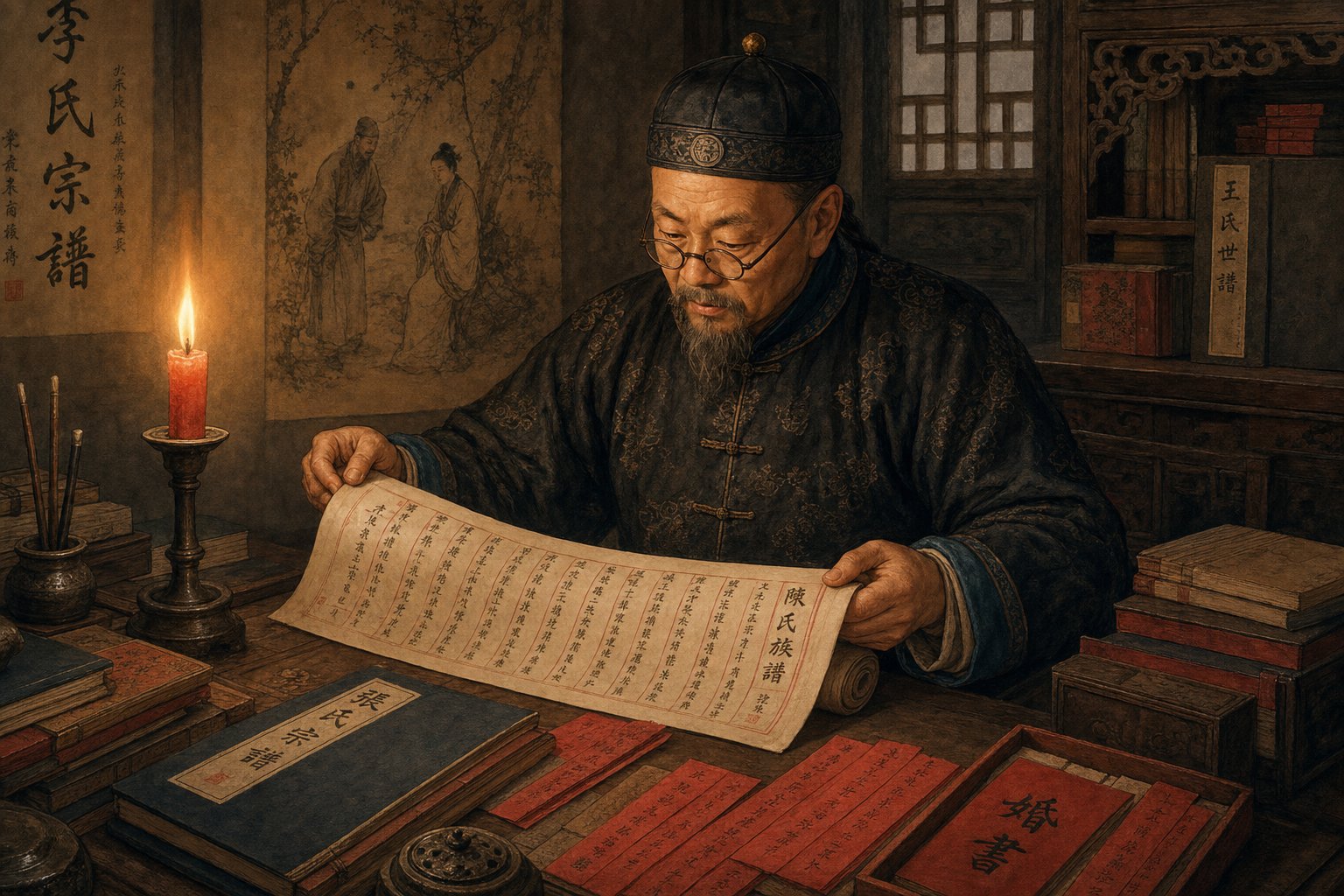
Of all the ways a chinese last name could shape your life, this one was the most absolute: if you shared a surname with someone, you could not marry them. Period. No exceptions, no appeals. The rule known as 同姓不婚 (tongxing bu hun) — the prohibition of same-surname marriage — functioned as a hard boundary in chinese culture about marriage for over two thousand years. It meant that your family name was not just an identity marker. It was a gatekeeper deciding who could enter your life as a spouse.
Origins of the Same-Surname Marriage Taboo
This taboo traces back to the Western Zhou Dynasty (1046-771 BC), when the clan system organized society into patrilineal surname groups. The logic was straightforward: people sharing the same surname descended from the same ancestor. Marrying within that group was considered equivalent to marrying a sibling.
"If a man and a woman share the same surname, their offspring will not thrive." — Zuo Zhuan, 23rd Year of Duke Xi
That classical warning captures the dual reasoning behind the rule. On one hand, it served as a genetic safeguard. The Discourses of the States (Guoyu) states explicitly: "The prohibition of same-surname marriage aims to prevent infertility." Ancient Chinese thinkers recognized — remarkably early — that inbreeding produced weaker offspring. On the other hand, the taboo reinforced social structure. Prohibiting marriage within the same surname group forced clans to build alliances with outside families, expanding political and military networks. It was both biology and statecraft encoded into a single naming rule.
The consequences for violating it were real. The Tang Code prescribed two years of penal servitude for same-surname marriages. The Ming and Qing Codes mandated sixty strokes of the heavy bamboo and compulsory divorce. These were not symbolic penalties — they reflected how seriously marriage customs china enforced through its legal systems treated surname boundaries.
How Surname Matching Shaped Traditional Matchmaking
Imagine you are a matchmaker in imperial China. Before you consider temperament, wealth, horoscopes, or family reputation, you check one thing first: surnames. If both families share the same chinese last name, the conversation ends immediately. No further evaluation is needed.
This is why matchmakers (媒人) functioned partly as genealogical investigators. In a society where hundreds of millions of people shared a relatively small pool of surnames — the "Hundred Family Surnames" (百家姓) lists only a few hundred — the same-surname rule eliminated a significant portion of potential matches outright. A family surnamed Wang could not marry into another Wang family, regardless of whether the two families had any traceable blood connection.
The matchmaker's verification process typically involved:
- Confirming both families' surnames through formal introduction documents
- Checking genealogical records (族谱) to rule out shared clan lineage
- Presenting the "eight characters" (八字) of the prospective couple only after surname compatibility was established
This meant that chinese custom marriage practices placed naming verification before every other compatibility measure. Love, personality, even astrological harmony — none of it mattered if the surnames matched. The rule shaped chinese marriages at the most fundamental level, filtering the entire pool of eligible partners through a single data point: your family name.
Interestingly, as the Library of Congress notes, marriages between patrilateral parallel cousins (children of two brothers, who shared the same surname) were strictly forbidden, while marriages between cross-cousins (children of a brother and sister, who bore different surnames) were generally accepted and even encouraged. The classic novel Dream of the Red Chamber features exactly this pattern — the protagonist marries his maternal aunt's daughter, a union considered perfectly appropriate because the surnames differed.
Modern Relevance of the Same-Surname Rule
Does this taboo still carry weight? Legally, no. Modern marriage law in mainland China does not prohibit same-surname unions. The 1980 PRC Marriage Law shifted the restriction to a science-based ban on marriages between close blood relatives (within three generations), regardless of surname. The old rule conflated surname with kinship — a conflation that stopped making sense once population growth meant millions of unrelated strangers shared names like Li, Wang, and Zhang.
Culturally, though, the story is more nuanced. In rural communities and among older generations, the taboo persists as an unwritten expectation. Some families still feel uncomfortable when a son or daughter announces a partner with the same surname. The discomfort is not rational — they know the couple is not related — but customs in china culture often outlive the logic that created them. Marriage in chinese culture has always been as much about what feels proper as what the law permits.
For couples navigating this today, the same-surname taboo is a vivid reminder that chinese wedding name traditions were never just ceremonial. They were structural — determining who could marry, who could not, and how families positioned themselves within society. That structural power extended beyond the matchmaking stage into every formal document a wedding produced, starting with the invitation itself.
How Names Appear on Chinese Wedding Invitations
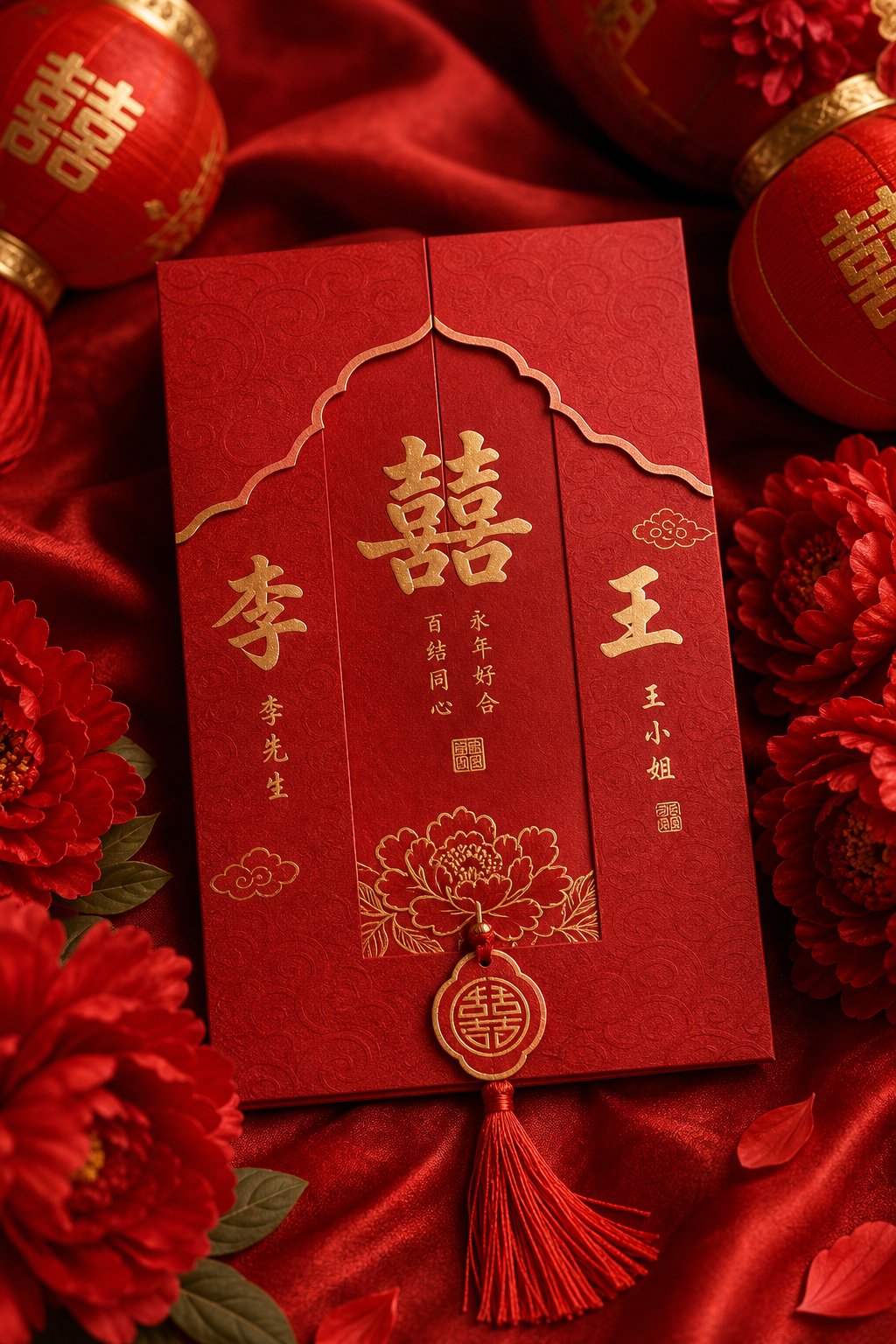
A traditional Chinese wedding invitation — the red-and-gold 喜帖 (xitie) or 红帖 (hongtie) — is not a casual "save the date." It is a formal document where every name placement signals hierarchy, respect, and family standing. Get the ordering wrong, and you have not just made a typo. You have insulted someone's generational position. In chinese wedding culture, the invitation is where naming protocols become visible to the entire social network.
Proper Name Hierarchy on Traditional Red Invitations
On a traditional invitation, the couple's names are not the focal point. The parents are. As wedding planner Sarah Wang explains, "Chinese wedding invitations are deeply rooted in cultural symbolism" and "are often issued formally in the names of the parents, especially in more traditional families." This reflects the Confucian principle that marriage is an alliance between families, not just individuals.
Here is how names are typically structured on a traditional red invitation, with the groom's family on one side and the bride's family on the other:
| Element | Groom's Side | Bride's Side |
|---|---|---|
| Hosting parents' names | Father's full name + Mother's full name (maiden surname retained) | Father's full name + Mother's full name (maiden surname retained) |
| Generational title | 长男 (eldest son) or 次男 (second son) | 长女 (eldest daughter) or 次女 (second daughter) |
| Couple's name | Groom's full name (surname first) | Bride's full name (surname first) |
| Polite closing | 敬邀 (respectfully invite) — issued jointly or by each family separately | |
| Date format | Both Gregorian and lunar calendar dates included | |
Notice the generational markers. Identifying the groom as "eldest son" or the bride as "second daughter" is not optional decoration — it tells recipients exactly where each person sits within the family birth order. In a typical chinese wedding, grandparents' names may also appear at the top of the invitation when they are the most senior living generation, pushing the hierarchy up another level.
Generation Names and Their Connection to Family Identity
Beyond birth order, many Chinese families use generation names (字辈 or 輩分) — a shared character assigned to all members of the same generation within a clan. If you see three cousins named 建国 (Jianguo), 建明 (Jianming), and 建华 (Jianhua), the shared character 建 marks them as belonging to the same generational cohort.
On wedding invitations, these generation names serve a quiet but powerful function. They signal to recipients which branch and generation of a family is involved. For families with extensive genealogical records, a generation name on an invitation is essentially a coordinate — pinpointing exactly where this marriage fits within the broader clan structure. This is one of the chinese wedding practices that remains meaningful even when couples otherwise opt for modern ceremony styles.
Formatting Names for Bilingual Wedding Invitations
When couples need invitations that work for both Chinese-speaking elders and English-speaking friends, the naming challenge doubles. Wang advises that "Chinese text can be placed on the right, English on the left (in keeping with traditional Chinese book flow) or separated top/bottom." She also emphasizes that "name order always places the family name first" on the Chinese side — a detail that trips up many designers unfamiliar with chinese wedding planning conventions.
The trickiest part? Transliterating names consistently. A bride whose Chinese name is 王美玲 might appear as "Mei-Ling Wang" on the English side but "王美玲" on the Chinese side — surname first in Chinese, surname last in English. Formal honorifics equivalent to Mr. or Ms. need careful checking in Chinese, where the wrong title can imply the wrong generational relationship.
For couples planning a chinese traditional wedding ceremony with guests from multiple language backgrounds, bilingual invitations are what Wang calls "ideal for inclusivity" — using "Chinese for parents and elders, English for friends and colleagues." The invitation becomes a bridge between two naming systems, each with its own rules about hierarchy, order, and respect.
These written protocols establish the formal relationship between families. But the real transformation of naming happens in person — during the tea ceremony, when titles are spoken aloud for the first time and a bride's relationship to an entirely new family is sealed through the words she uses to address them.
Tea Ceremony Naming Protocols and New Family Titles
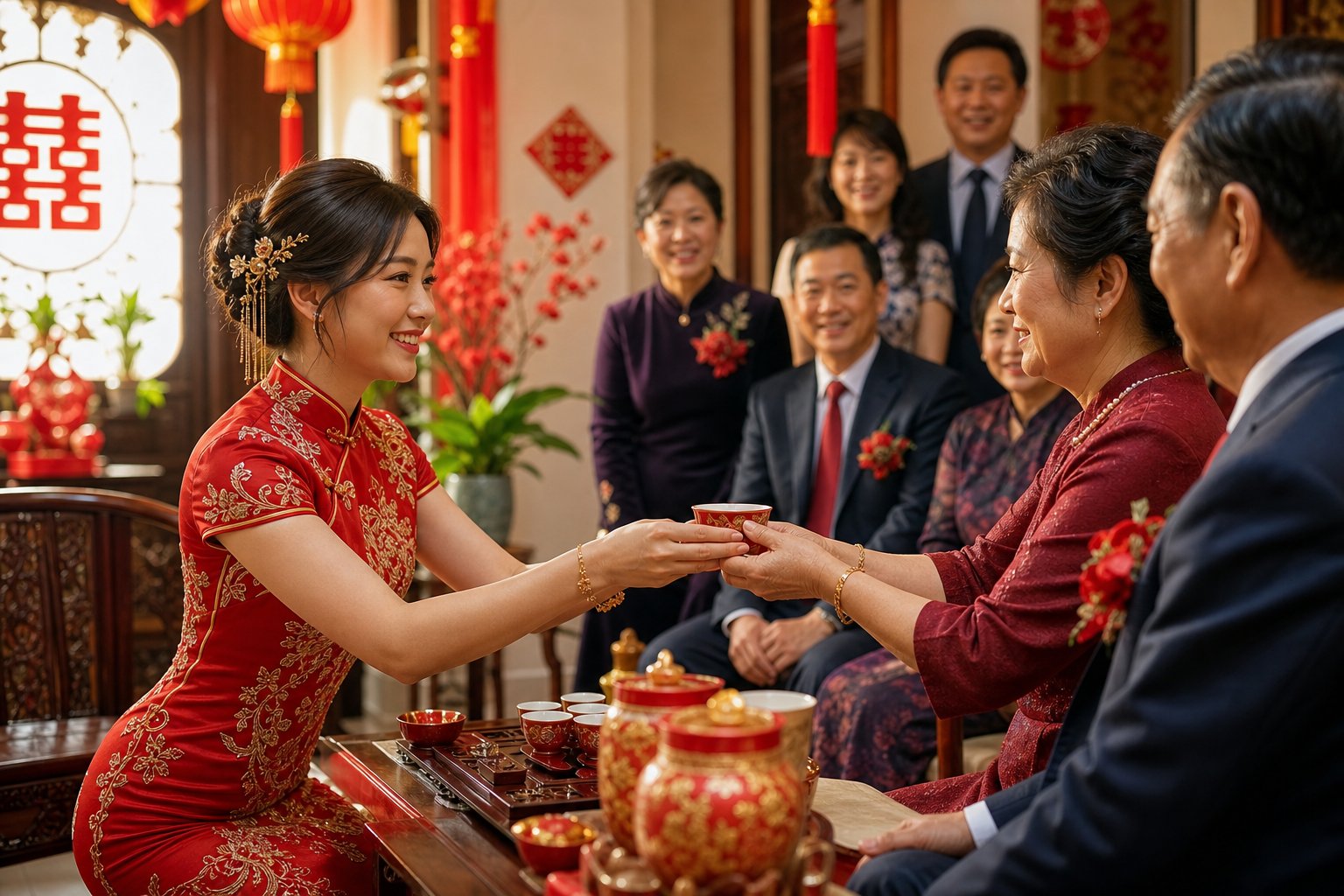
Written invitations declare the union on paper. The chinese wedding tea ceremony makes it real through spoken words. During the 敬茶 (jincha) — the ritual of respectfully offering tea — the bride and groom address each other's family members by kinship titles for the very first time. This is not a casual introduction. It is the precise moment when two strangers become family, and the vehicle for that transformation is language itself.
The Tea Ceremony as a Naming Transformation Ritual
Think of it this way: before the tea ceremony, the bride has no formal relationship with her husband's parents. She might have called them "Uncle" and "Auntie" during courtship — polite but distant terms. The tea ceremony chinese tradition demands something different. As she kneels, offers tea with both hands, and speaks the words "爸爸, 请喝茶" (Dad, please drink tea) or "妈妈, 请喝茶" (Mom, please drink tea), she is linguistically claiming a new identity. She is no longer an outsider. She is a daughter.
The formula is deceptively simple: "[Kinship title], please have some tea." But as The Woks of Life notes from firsthand experience, "A funny question that came up often in preparing for the tea ceremony was what the appropriate Chinese honorifics for various family members were." Getting these titles right matters enough that families rehearse them the day before the wedding. A wrong title — calling a paternal uncle by the maternal uncle's term, for instance — signals ignorance of the family structure you are joining.
The ritual follows strict hierarchical order. Grandparents receive tea first, then parents, then uncles and aunts in descending seniority. Each person served is addressed by their correct kinship title, and each responds with blessings and gifts — typically red envelopes or gold jewelry. The exchange is reciprocal: the bride gives a title, and the elder gives acceptance. In this wedding ceremony chinese families have practiced for centuries, naming is the mechanism of belonging.
New Familial Titles the Bride Receives and Gives
The kinship terminology system in Chinese is far more specific than English. Where English uses "uncle" for multiple relationships, Chinese assigns a distinct term depending on whether the person is older or younger than your parent, on the paternal or maternal side, and related by blood or marriage. During a tea ceremony chinese wedding families conduct, the bride must navigate this entire system in real time.
Here are the key familial titles exchanged during the tea ceremony:
- 公公 (gonggong) — Father-in-law (husband's father). Some families prefer the bride to simply say 爸 (dad).
- 婆婆 (popo) — Mother-in-law (husband's mother). Alternatively, 妈 (mom) in families that prefer warmth over formality.
- 爷爷 (yeye) — Paternal grandfather of the groom.
- 奶奶 (nainai) — Paternal grandmother of the groom.
- 伯父 (bofu) / 伯母 (bomu) — Husband's father's elder brother and his wife.
- 叔叔 (shushu) / 婶婶 (shenshen) — Husband's father's younger brother and his wife.
- 姑姑 (gugu) / 姑丈 (guzhang) — Husband's paternal aunt and her husband.
- 舅舅 (jiujiu) / 舅妈 (jiuma) — Husband's maternal uncle and his wife.
- 姨妈 (yima) / 姨丈 (yizhang) — Husband's maternal aunt and her husband.
Each title the bride speaks aloud is an act of incorporation. She is mapping herself onto a family tree that existed long before she arrived. The tea serving sequence reinforces this: paternal grandparents before maternal grandparents, elder uncles before younger uncles, blood relatives before their spouses. The order is not arbitrary — it mirrors the genealogical hierarchy that chinese wedding name traditions have always prioritized.
How the Groom's Naming Relationships Change
The bride is not the only one whose language shifts. When the couple moves to the bride's family side of the tea ceremony wedding chinese families hold, the groom undergoes his own naming transformation. He addresses his wife's parents as 岳父 (yuefu, father-in-law) and 岳母 (yuemu, mother-in-law) — or, in many modern families, simply 爸 and 妈. He calls her elder brother 大舅子 (dajiuzi) and her younger sister 小姨子 (xiaoyizi).
The groom's transition tends to receive less cultural emphasis, reflecting the traditional assumption that the bride joins the groom's family rather than the reverse. But in practice, especially in an asian tea ceremony wedding where both families participate equally, the groom's adoption of new titles carries real emotional weight. He is acknowledging a second set of parents, a second family network with its own expectations and bonds.
Regional variations add another layer of complexity. Cantonese-speaking families often use different terms than Mandarin speakers — a Cantonese bride might say 老爷 (lo ye) for father-in-law and 奶奶 (naai naai) for mother-in-law, while a Hokkien bride uses 大官 (tua-kuann) and 大家 (ta-ke). Malaysian Chinese families, as documented in local wedding guides, often blend dialect-specific titles with Mandarin terms depending on which generation is being addressed. A bride might use Hokkien for grandparents who speak no Mandarin, then switch to Mandarin for younger aunts and uncles.
These linguistic details might seem minor from the outside. But for the families involved, hearing the correct title — spoken confidently, in the right dialect, to the right person — confirms that the new family member understands where they fit. The tea ceremony does not just celebrate a marriage. It rewrites the naming map of two entire families, one cup of tea at a time.
This spoken transformation of identity has a visual counterpart, too. The symbols and rituals surrounding a Chinese wedding — from the Double Happiness character adorning every surface to the birth chart consultations that happen months before the ceremony — all reinforce the idea that names carry power far beyond their sound.
Symbolic Names and Pre-Wedding Naming Rituals
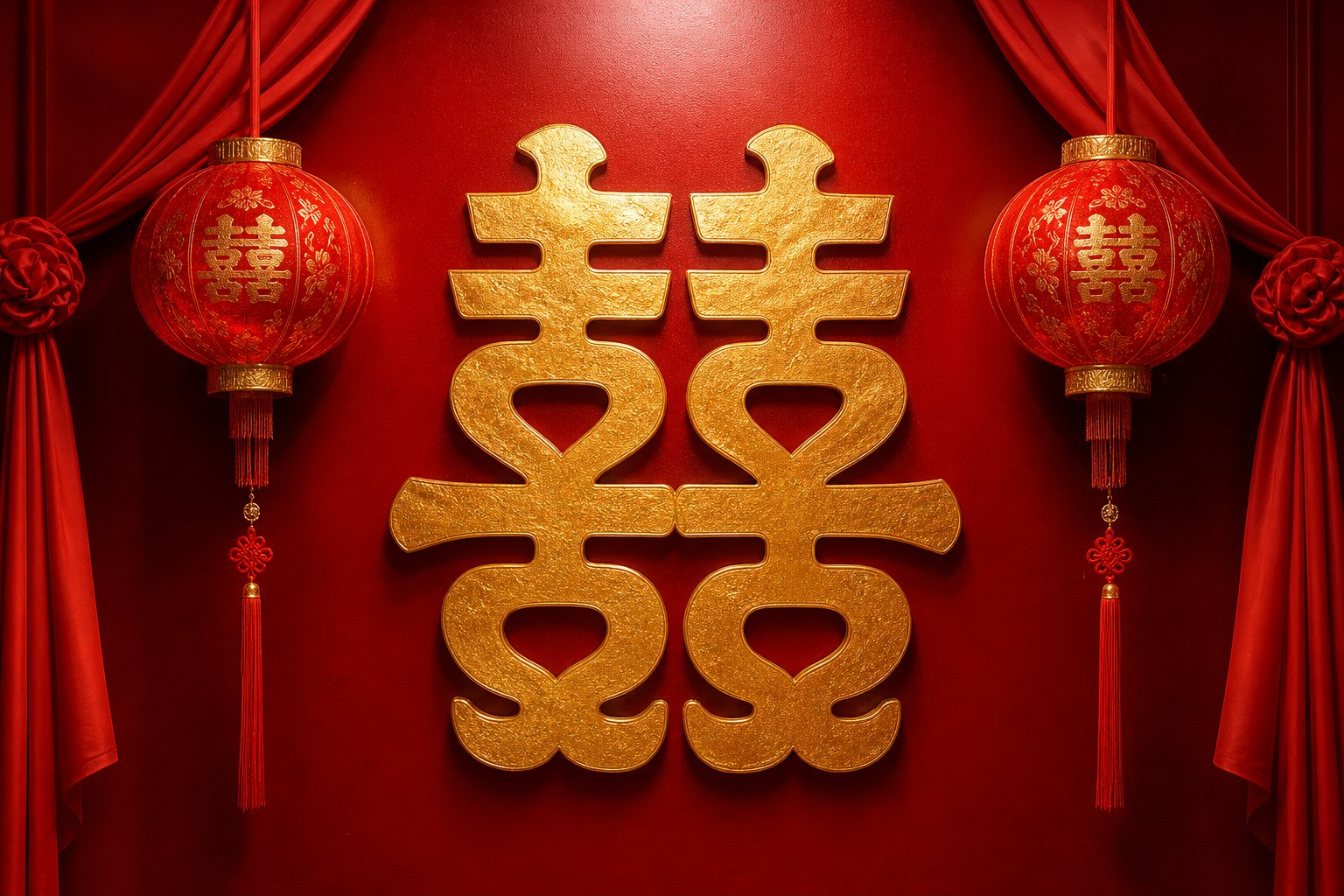
Walk into any Chinese wedding banquet and you will see it everywhere — on lanterns, tablecloths, wall hangings, and candy boxes. The chinese wedding character 囍 (shuangxi, Double Happiness) is the single most recognizable symbol in chinese wedding decorations. But look closer at its structure. It is not one character. It is two identical characters — 喜 (happiness) — pressed side by side into a single unit. That visual construction is not accidental. It is a statement about what marriage means.
Double Happiness and the Union of Two Family Names
The character 囍 literally fuses two 喜 into one form — mirroring how a traditional chinese wedding ceremony joins two separate family names into a single household unit without erasing either one.
This is the philosophy encoded in every piece of chinese wedding decorations bearing the symbol. Neither 喜 character dominates or absorbs the other. They stand equal, side by side, structurally interdependent. Remove one and the character collapses. It is a visual metaphor for how chinese bride and groom families relate after marriage — two surname lines maintaining their distinct identities while forming something new together.
The Double Happiness character appears at virtually every stage of chinese wedding rituals: stamped on red envelopes, embroidered on bedding during the 铺床 (bed-setting ceremony), carved into wedding cake molds, and printed on the invitations themselves. Its omnipresence reinforces a core message — this union is symmetrical. Two families, two names, two lines of happiness joined.
Birth Chart Compatibility and the Power of Names
Months before any of those decorations go up, another naming ritual has already taken place behind the scenes. The practice of 八字合婚 (bazi hehun) — matching the Eight Characters of a prospective couple — uses the full birth details of both individuals to assess whether their union will be harmonious.
What exactly are these "eight characters"? As ALUXE's guide to Bazi matching explains, the system analyzes four pairs of characters representing the year, month, day, and hour of a person's birth. Each pair consists of a Heavenly Stem and an Earthly Branch, grounded in the principles of Yin and Yang and the Five Elements (Wood, Fire, Earth, Metal, and Water). The practice traces back over a thousand years to the Tang Dynasty and was refined during the Song Dynasty.
Here is what makes this relevant to naming traditions specifically: the Eight Characters are derived from a person's birth name and birth time. Your name — the characters chosen by your parents, the tonal balance, the elemental associations of each stroke — feeds into the calculation. A Bazi practitioner assesses whether the elements in both charts complement or clash, whether Yin and Yang energies balance, and whether specific character interactions predict harmony or conflict.
Traditionally, this analysis happened before a formal engagement could proceed. The matchmaker would deliver the bride's eight characters to the groom's family on a red slip of paper. If the reading was unfavorable, the match was off — regardless of how well the couple got along personally. The key reasons families insisted on this step included ensuring elemental harmony between partners, promoting prosperity and longevity in the union, and identifying potential sources of discord before they materialized.
Does this still happen? More often than you might expect. Even couples planning otherwise modern celebrations may quietly consult a fortune-teller about name and birth chart compatibility. In some families, a taoist wedding officiant or Buddhist monk performs the compatibility reading as part of selecting an auspicious wedding date. The practice has adapted — moving from a hard veto power to a softer advisory role — but it has not disappeared. Bazi's influence now extends to modern apps and digital platforms offering compatibility checks, blending ancient metaphysics with contemporary convenience.
Courtesy Names and Formal Wedding Address
Beyond birth charts, historical chinese wedding ceremony traditions involved another layer of naming entirely: the courtesy name (字, zi). In ancient China, a person's given name (名, ming) was considered intimate — used only by oneself or by elders. Upon reaching adulthood (age 20 for men, 15 for women), a person received a courtesy name from respected elders. This was the name others used to show respect, as research from the German Archaeological Institute documents in detail.
In wedding contexts, courtesy names carried specific weight. During formal betrothal negotiations, families exchanged documents using courtesy names rather than given names — addressing someone by their ming would have been presumptuous. The groom's courtesy name appeared on engagement gifts and betrothal letters. The bride's courtesy name, if she had one, appeared on her family's formal acceptance.
This system created a layered naming landscape around chinese wedding rituals. A single person might be known by their surname, their given name (private), their courtesy name (public and respectful), and potentially a pseudonym (号, hao) chosen for artistic or personal expression. Marriage ceremonies navigated all these layers — using the right name in the right context signaled education, breeding, and proper ritual understanding.
The courtesy name tradition faded after the Republican era, but its legacy persists in how formal address still matters at Chinese weddings. The insistence on correct titles during the tea ceremony, the precise name formatting on invitations, the careful attention to how elders are addressed — all echo a culture where using the wrong form of someone's name was a serious social misstep.
These symbolic and divinatory dimensions of naming operate within cultural tradition. But what happens when tradition meets modern law? Across different Chinese-speaking jurisdictions, the legal frameworks governing married names vary dramatically — creating a patchwork of rules that couples must navigate depending on where they live.
Modern Legal Frameworks for Married Names Across Chinese Jurisdictions
That patchwork is more varied than most people realize. A couple getting chinese married in Shanghai faces entirely different surname rules than a couple in Taipei, Hong Kong, or Singapore — even though all four jurisdictions share deep roots in the same Confucian naming philosophy. The legal frameworks governing chinese marriage and surname practices have diverged sharply over the past century, shaped by colonial histories, political ideologies, and competing visions of gender equality.
What does this mean in practice? Depending on where you live, you might keep your birth name automatically, need to file paperwork to retain it, or find your married name treated as an alias rather than a legal identity. For couples navigating china marriage culture across borders, understanding these differences is essential.
Surname Laws in Mainland China After Marriage
Mainland China's approach is the most straightforward — and the most egalitarian on paper. Article 1012 of the Civil Code (which replaced the earlier Marriage Law provisions) states clearly: "Husband and wife shall have the right to use his or her own surname and given name." Neither spouse is expected, required, or pressured by law to change their surname at marriage.
This was not always the case. As covered in the historical evolution of these traditions, the 1950 Marriage Law represented a radical break from centuries of patrilineal naming customs. The current legal position means that in mainland China, marriage in chinese law has zero effect on either spouse's legal name. No paperwork, no applications, no decisions required. You walk out of the marriage registration office with the same name you walked in with.
For children, Article 1015 of the Civil Code allows the child to take either the father's or the mother's surname. In practice, the vast majority of children still receive the father's surname — cultural inertia outlasts legal reform. But the option exists, and a growing minority of families are choosing the mother's surname or even combining both parents' surnames into a compound surname for their children.
Name Practices in Taiwan, Hong Kong, and Singapore
Taiwan's system reflects its distinct legal evolution. Under the current Civil Code (amended multiple times since its ROC-era origins), Article 1000 states that both spouses retain their original surnames after marriage. Before 1998, the default was that a wife would prefix her husband's surname — the old 冠夫姓 practice codified into law. That default was reversed, and today surname prefixing requires a written agreement between spouses. The shift mirrors broader changes in how chinese culture in marriage adapts to modern gender norms while maintaining continuity with tradition.
Hong Kong operates under a common-law framework inherited from British colonial rule. There is no statutory requirement to change names at marriage, but the system makes it easy to do so. A married woman can adopt her husband's surname simply by usage — no deed poll or court order needed. She can also revert to her maiden name after divorce through the same informal process. Many Hong Kong women use their husband's surname socially and professionally while retaining their birth name on identity documents, creating a dual-name practice that blends Western convention with Chinese tradition.
Singapore presents a particularly interesting case. The Immigration and Checkpoints Authority (ICA) allows citizens to include their married name in their passport, but with a specific constraint: the principal (maiden) name remains printed as the primary identity, with the married name appearing in parentheses below as an alias. It cannot replace the principal name unless the citizen executes a formal Change of Name Deed Poll. For Singaporeans whose principal name is recorded in full Hanyu Pinyin, they must choose between their Pinyin name or their married name as the alias — the passport cannot display both.
This policy reveals something important about how Singapore navigates chinese for marriage naming conventions within a multiethnic legal system. The maiden name is treated as the "real" legal identity. The married name is optional, secondary, and explicitly labeled as an alias. It is a modern legal framework that quietly preserves the traditional Chinese principle of surname retention while accommodating those who prefer Western-style name changes.
Malaysia's approach varies by ethnic community. For Malaysian Chinese, there is no automatic name change at marriage. Women who wish to adopt their husband's surname must apply through the National Registration Department. Many Malaysian Chinese women retain their birth names entirely — a practice consistent with traditional chinese naming customs but also reinforced by the administrative burden of changing names across multiple government systems.
Choosing Children's Surnames in Modern Chinese Families
The question of which surname children receive is where tradition and law collide most visibly. Here is how the options compare across jurisdictions:
| Region | Wife's Surname Options | Husband's Surname Options | Children's Surname Rules |
|---|---|---|---|
| Mainland China | Retains birth surname (automatic, no action needed) | Retains birth surname (automatic) | Either parent's surname; compound surnames permitted |
| Taiwan | Retains birth surname (default); may prefix husband's surname by agreement | Retains birth surname (default); may prefix wife's surname by agreement | Agreed upon by parents at birth registration; father's surname if no agreement |
| Hong Kong | May adopt husband's surname by usage; no legal requirement | Retains birth surname (convention) | Typically father's surname; no statutory restriction |
| Singapore | Retains maiden name as principal; married name is optional alias | Retains birth surname | Typically father's surname; no statutory mandate |
| Malaysia | Retains birth surname unless formal application made | Retains birth surname | Typically father's surname by convention |
You will notice a pattern: every jurisdiction allows women to keep their birth surnames, and most make retention the default. The old 冠夫姓 practice survives only as an opt-in choice in Taiwan and an informal social convention in Hong Kong. Legally, the principle that a woman's surname belongs to her natal family — the same principle that drove the same-surname marriage taboo — has been preserved even as its philosophical justification has shifted from patrilineal duty to individual rights.
Children's surnames remain the more contested territory. While laws across these regions technically permit either parent's surname, social pressure still overwhelmingly favors the father's. Mainland China's allowance of compound surnames (combining both parents' single-character surnames into a two-character surname) represents the most creative legal solution — letting families honor both lines without choosing between them.
One important distinction often gets lost in these discussions: the difference between ceremonial name usage and legal name usage. During a chinese traditional marriage ceremony, a bride may be introduced using her husband's family name in formal announcements. Elders may refer to her as "the Wang family's new daughter-in-law." These ceremonial naming practices carry deep cultural meaning — but they exist in a separate sphere from what appears on government documents. A woman can be ceremonially welcomed into the Zhang family while her ID card, passport, and bank accounts all retain her birth name of Li Xiaoming. The two systems coexist without contradiction, each serving its own purpose within chinese culture in marriage.
This legal landscape governs couples who live within Chinese-speaking jurisdictions. But what about the millions of Chinese families scattered across the globe — navigating these naming traditions while simultaneously operating within Western legal systems that assume an entirely different set of defaults?
Chinese Wedding Name Traditions in the Diaspora
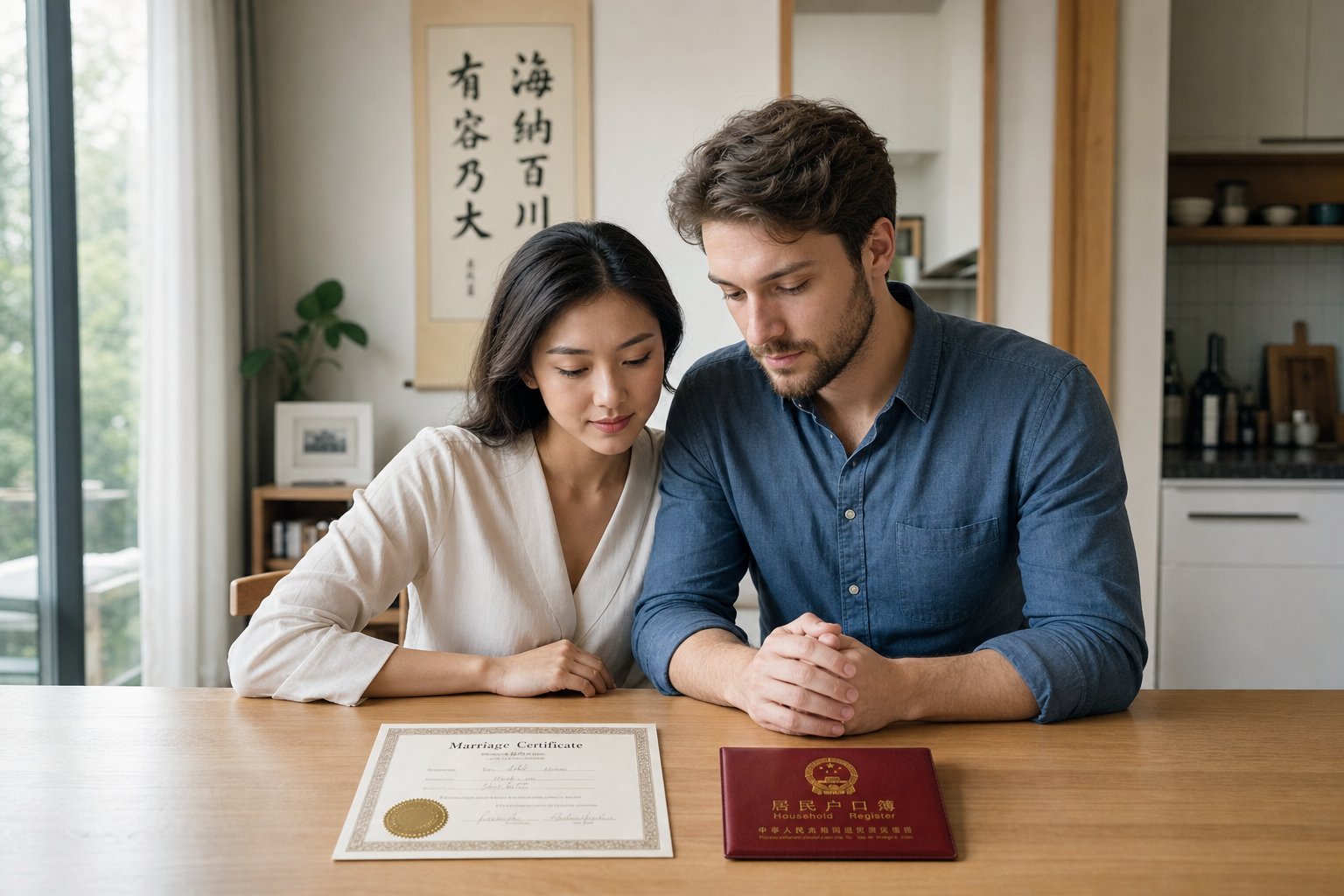
For Chinese families living in the United States, Canada, Australia, or the United Kingdom, the naming question at marriage is not just cultural — it is logistical. Western legal systems assume a name change is the norm. Government forms ask for your "married name." Banks, employers, and schools default to the assumption that a wife takes her husband's surname. Chinese naming traditions assume the opposite. When these two systems collide at a chinese american wedding, couples face decisions their parents and grandparents never had to make.
Navigating Name Traditions as a Diaspora Couple
Picture this: you are a second-generation Chinese American woman getting married. Your parents kept their birth surnames — your mother is still legally surnamed Chen, your father surnamed Liu. That felt normal growing up. But your American friends' mothers all share their fathers' last names. Your workplace assumes you will change yours. Your in-laws expect it. Your own parents quietly hope you will not.
This tension sits at the heart of modern chinese wedding traditions for diaspora families. The decision is not simply personal preference — it touches on cultural loyalty, generational expectations, and practical identity. Chinese american wedding traditions often involve navigating both sets of assumptions simultaneously, with no single "correct" answer.
Here are the most common approaches diaspora couples take when deciding how to handle surnames:
- Full retention of Chinese surname — Both spouses keep their birth names legally, following the traditional Chinese model. Social introductions may use either name depending on context.
- Hyphenation — Combining both surnames (e.g., Chen-Williams or Liu-Park) to honor both family lines. This works well on paper but can create complications with government systems that limit character counts.
- Legal Western name with Chinese family name used socially — A woman might legally become Sarah Williams for professional convenience while remaining 陈美华 (Chen Meihua) within family contexts, at Lunar New Year gatherings, and on any documents sent to relatives in China or Taiwan.
- Creating new combined traditions — Some couples give children one parent's surname as a legal last name and the other parent's surname as a middle name, preserving both lines without hyphenation.
- Selective context switching — Using the married name in English-language settings and the birth name in Chinese-language settings, maintaining parallel identities across linguistic contexts.
Chinese Canadian families face similar calculations, often with the added complexity of French-language documentation in Quebec, where naming laws differ from other provinces. The core tension remains the same: how do you honor chinese wedding traditions and customs when the surrounding legal and social infrastructure was built for a different naming logic?
When Non-Chinese Partners Marry Into Chinese Families
The naming conversation becomes even more layered when one partner is not Chinese. In a chinese modern wedding where a non-Chinese spouse joins a Chinese family, questions multiply. Should the non-Chinese partner receive a Chinese name? Who chooses it? Does the Chinese partner take the non-Chinese surname, breaking with tradition entirely?
Allison Shiozawa Miles, a multiracial Japanese American woman, wrote for HuffPost about taking her white husband's surname at 21 and the identity loss that followed: "When I changed my last name, it felt as if a tangible part of that identity vanished." Her Asian-ness was "no longer plainly visible on a name badge, on a school roster, on a professional license, or even on a credit card." She went from being automatically associated with her heritage to needing to prove it.
This experience resonates deeply with Chinese women who marry non-Chinese partners. A surname like Zhang or Wong carries immediate cultural recognition. Replacing it with Johnson or Smith does not just change a label — it removes a visible marker of heritage that shaped how the world perceived you. For families where asian wedding traditions still hold weight, watching a daughter's Chinese surname disappear from legal documents can feel like a severing of the ancestral line those traditions were designed to protect.
The reverse scenario — a non-Chinese partner adopting a Chinese surname — is rare but not unheard of. More commonly, non-Chinese partners receive a Chinese given name from their spouse's family, used during tea ceremonies and family gatherings. This name often reflects the family's hopes for the marriage and gives the new family member a way to be addressed within Chinese kinship language. During the tea ceremony, the non-Chinese partner still uses the same kinship titles — 爸爸, 妈妈, 爷爷, 奶奶 — regardless of their own ethnic background. The naming system incorporates them through titles rather than surname change.
Interestingly, parallels exist across other Asian diaspora communities. At a chinese and indian wedding, for example, both families may bring strong surname traditions — Chinese patrilineal retention on one side, Indian gotra (clan) considerations on the other. These cross-cultural unions often require creative solutions that honor both naming systems without privileging either one.
Blending Naming Customs Across Cultures
So how do modern couples actually make this work? The answer varies enormously by family, region, and generation — but several patterns have emerged among Chinese diaspora communities navigating a modern chinese wedding within Western contexts.
Children's surnames tend to be the highest-stakes decision. Many Chinese American couples report that while their own surname choices felt personal, deciding what to name their children triggered intense family involvement. Grandparents who said nothing about the couple's own names suddenly have strong opinions about whether grandchildren will carry the Chinese surname forward.
Common solutions for children include:
- Giving the child the father's surname legally (following both Chinese and Western convention) while using the mother's Chinese surname as a middle name
- Alternating surnames between children — first child takes one parent's surname, second child takes the other
- Using a compound surname that combines both (e.g., Chen-Park or Liu-Anderson)
- Registering the child with a Western legal name while maintaining a separate Chinese name (with Chinese surname) for family use, school enrollment in Chinese-language programs, and future travel documents for visiting China
The emotional weight of these decisions should not be underestimated. As Miles reflected in her essay, even years later she recognizes that what "I once saw as just my husband's name has become our family's" — shared with children who "each have a Japanese name along with our English family name." The compromise is imperfect but functional: a dual-naming system that preserves heritage through given names even when the surname follows Western convention.
For couples planning a chinese american wedding where both cultural systems will be visible — bilingual invitations, a tea ceremony alongside Western vows, guests from vastly different naming traditions — the key is intentionality. There is no single right answer. But understanding what chinese wedding name traditions were designed to protect (ancestral continuity, family identity, the legibility of lineage) helps couples make choices that honor those values even when the specific customs cannot be followed to the letter.
What matters most is not whether you hyphenate, retain, or change — but whether the choice is made with full awareness of what names carry in Chinese culture. A surname is not just administrative data. It is a thread connecting you to ancestors you have never met and descendants who do not yet exist. However you handle it, that thread deserves to be held with care.
Frequently Asked Questions About Chinese Wedding Name Traditions
1. Do Chinese women change their last name when they get married?
In most Chinese-speaking jurisdictions, women retain their birth surnames after marriage. Mainland China's Civil Code explicitly grants both spouses the right to keep their own names. Taiwan defaults to surname retention since 1998, and Hong Kong allows optional adoption of a husband's surname by usage without legal requirement. The traditional Chinese principle preserves a woman's natal surname to maintain her ancestral line, which differs fundamentally from Western name-change customs. Some women in Hong Kong and Taiwan may prefix their husband's surname socially while keeping their birth name on official documents.
2. What is the same-surname marriage taboo in Chinese culture?
The same-surname marriage taboo (tongxing bu hun) prohibited people sharing a surname from marrying, based on the belief that shared surnames indicated shared ancestors. Originating in the Zhou Dynasty, this rule functioned as both a genetic safeguard and a tool for building inter-clan alliances. Violations carried real legal penalties in imperial China, including penal servitude and compulsory divorce. While modern Chinese law no longer enforces this rule, replacing it with a science-based ban on marriages between close blood relatives, the taboo still carries cultural weight in some rural communities and among older generations.
3. How are names arranged on traditional Chinese wedding invitations?
Traditional Chinese wedding invitations prioritize family hierarchy over the couple themselves. Parents' names appear prominently as the hosts, often listed before the bride and groom. Each person's generational position is marked with terms like 'eldest son' or 'second daughter.' Grandparents' names may appear at the top when they are the most senior living generation. The groom's family typically occupies one side and the bride's family the other, with surnames always placed first in the Chinese text. Bilingual invitations reverse the name order on the English side while maintaining Chinese conventions on the Chinese side.
4. What naming rituals happen during the Chinese wedding tea ceremony?
The tea ceremony is the moment when naming relationships formally transform. The bride addresses her in-laws by familial kinship titles for the first time, such as calling her father-in-law 'gonggong' or simply 'ba' (dad) and her mother-in-law 'popo' or 'ma' (mom). Tea is served in strict hierarchical order from grandparents down to younger relatives, with each person addressed by their precise kinship term. The groom undergoes a parallel transformation when serving tea to the bride's family. Regional dialect differences between Cantonese, Hokkien, and Mandarin families add complexity to which specific terms are used.
5. How do Chinese American couples handle surname decisions at marriage?
Chinese American couples typically navigate between two competing systems: Western expectations of a shared married name and Chinese tradition of surname retention. Common approaches include both spouses keeping birth names legally, hyphenating surnames, using a Western married name professionally while maintaining the Chinese surname in family contexts, or context-switching between naming systems depending on the language setting. Children's surnames often become the highest-stakes decision, with solutions ranging from using one parent's surname as a middle name to alternating surnames between siblings or creating compound surnames that honor both family lines.